Ministry of Public Health Service of Ukraine
Ivano-Frankivsk National Medical University
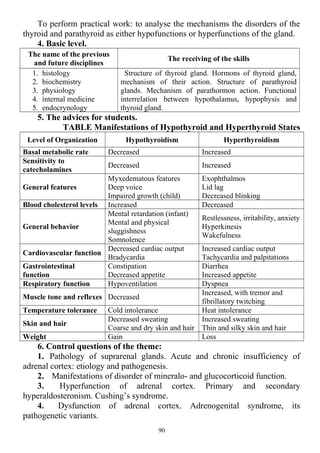
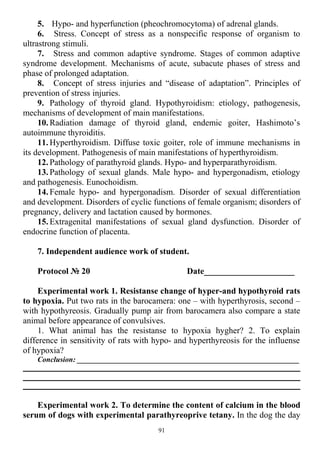
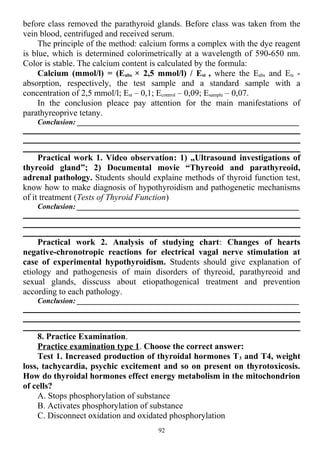
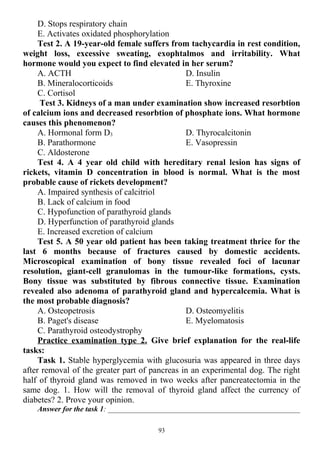
MODULE 2
PATHOPHYSIOLOGY OF ORGANS AND
SYSTEMS
Training-methodical manual
for class and out-of-class work for students of stomatological faculty
Prepared by:
Gerasymchuk M. R.
Cherkasova V. V.
Zaiats L. M.
Ivano-Frankivsk, 2017
2
Ministry of Public Health Service of Ukraine
Ivano-Frankivsk National Medical University
Pathophysiology
MODULE 2
PATHOPHYSIOLOGY OF ORGANS AND
SYSTEMS
Training-methodical manual
for class and out-of-class work for students of stomatological faculty
Student ________________group of stomatological faculty
(name and surname)
Prepared by:
Gerasymchuk M. R.
Cherkasova V. V.
Zaiyats L. M.
3
Ivano-Frankivsk, 2017
«PATHOPHYSIOLOGY OF ORGANS AND SYSTEMS»
Training-methodical manual for class and out-of-class work for
students of stomatological faculty / M.R. Gerasymchuk, V.V. Cherkasova,
L.M. Zaiats // IFNMU. Department of pathological physiology. – 2017. –
110 p. Discussed and approved on profile commission of
medical&biological disciplines meeting of Ivano-Frankivsk National
Medical University.
Protocol № ____ from «___» ________ 2017 year
4
Calendar plan of practical classes
of pathological physiology for the students of the III course in the V semester
THEME OF PRACTICAL STUDIES DATES Hours
1. Violation of blood system. Erythrocytosis. Anemias. Posthemorrhagic anemia. 06.09.2017 2
2. Hemolytic anemias and anemias with disorders of erythropoiesis. 13.09.2017 2
3. Leukocytosis and leukopenias. 16.09.2017 2
4. Diseases of the hemopoietic system. Leukemias. 20.09.2017 2
5. Violation of hemostasis. 27.09.2017 2
6. Practical skills for chapter “Pathophysiology of blood” 30.09.2017 2
7. Cardiac arrhythmias. 04.10.2017 2
8. Insufficiency of circulation of blood. Heart failure. 11.10.2017 2
9. Insufficiency of coronary blood circulation. Ischemic heart disease. 14.10.2017 2
10. Disorders of vascular tone. 18.10.2017 2
11. Pathophysiology of the external respiration. Respiratory failure. 25.10.2017 2
12.
Practical skills for chapter “Pathophysiology circulatory system and
respiration”.
28.10.2017 2
13.
Violation of digestion in an oral cavity. Disorders of salivation. Caries.
Periodontitis.
01.11.2017 2
14. Violation of digestion in a stomach. Etiology. Pathogenesis of ulcer disease. 08.11.2017 2
15.
Violation of digestion in an intestine. Acute pancreatitis. Intestinal
obstruction.
11.11.2017 2
16. Pathophysiology of the liver. Liver insufficiency. 15.11.2017 2
17. Pathophysiology of kidneys. Renal failure. 18.11.2017 2
18. Practical skills for chapter “Pathology of digestion, liver, and kidneys” 22.11.2017 2
19. Pathophysiology of the hypothalamic-pituitary system and adrenal glands. 25.11.2017 2
20. Pathophysiology of thyroid and parathyroid glands. 29.11.2017 2
21.
Violation of sensory, sensory, motor and trophic function of the nervous
system.
02.12.2017 2
22. Pathophysiology of integrative nervous activity. Experimental neuroses. 06.12.2017 2
23. Pathophysiology of extremal conditions. 09.12.2017 2
24. Module 2. Practical part 13.12.2017 2
25. Module 2. Theoretical part 16.12.2017 2
Total hours 50
Calendar plan of lectures
THEME OF LECTURE DATES Hours
1.
Leukocytosis and leukopenias. Diseases of the hemopoietic system.
Leukemia’s.
09.09.17 2
2.
Pathophysiology of blood circulation. Heart failure. Insufficiency of coronary
blood circulation. Ischaemic heart disease. Disorders of vascular tone.
23.09.17 2
3. Pathophysiology of digestion and liver. 07.10.17 2
4. Pathophysiology of kidneys. Renal failure. 21.10.17 2
5. Pathophysiology of the regulatory systems. 04.11.17 2
Total hours 10
5
The ESTIMATION FOR THE MODULE is defined as a sum of marks
of current educational activity (in points), which is proposed during the
evaluation of theoretical knowledges and practical skills. Maximal amount of
points, which a student can collect - 200 points during of every module study,
including for current educational activity – 120 points (together the practical
skills are 115 points, individual work is 5 points), on results final module
control are 80 points.
Control of theoretical and
practical preparation
0 – 2 points – completely prepared homework;
0 – 2 points – oral answer;
0 – 1 points – test control during class.
Minimum – 0 points; positive – 3; maximum – 5
points
Practical lessons are structured and provide a comprehensive assessment scores
in all learning activities (learning tasks) that students perform during practical
classes:
"0" points – student just present in the class, but not fulfilled the task for self-
knowledge control, refuses to answer in the polling (quiz), does not participate
in the discussion of practical work and demonstration material, did not
answerfor the question of the final test control.
"2" point – the student completed the task for self-knowledge, but can not
explain the solution of control tasks, do not know main part of the program
material, does not participate in the discussion of practical tasks, not solved the
50% of the final test control tasks.
"3" points – student completed the task for self-knowledge control, but in the
explanation assumes inaccuracies; in the polling – knows the main program
material, but not remember its details; uses incorrect definitions or terminology,
but make a sequences in the learned material; has difficulties in solving
practical problems and making conclusions, solved 51-70% of the final test
control tasks.
"4" points – student is prepared for class, knows the program material,
intelligently and logical explains it, is able to explain the practical tasks,
correctly analyzes of displayed material, competently and logical makes
conclusions, solved 71-90% of the final test control tasks.
"5" points – student deeply learned program material, thoroughly,
consistently, competently and logical teaching, closely linking theory with
practice, has no difficulties in the response to changed tasks, easily cope with
the reasons of practical work, demonstration material, able to analyze and make
the appropriate conclusions, solved 91 - 100% final test control tasks.
6
Topic 1: Violation of blood system. Erythrocytosis. Anemias.
Posthemorrhagic anemia.
1. Actuality of the theme. The system of blood is the internal environment
of organism. The normal state of blood, its cellular composition, is in close
interrelation with activity of different organs and systems (by the nervous
system, marrow, liver, kidneys, spleen, and endocrine glands). That is why
violations from the side of blood can arise up in connection with changes in
these organs or as a result of direct influence on blood of different pathological
factors.
2. Length of the employment – 1h 30 min.
3. Aim: Form for students the picture of reasons, mechanisms and
consequences of violations of general volume of blood at different pathological
processes. Able to estimate the quantitative changes of RBC, haemoglobin and
color index, indexes of physiology regeneration of marrow, degenerative
changes of RBC at posthemorrhagic anaemia.
To khow:
- determination of concept is “anaemia” and principles of classification;
- etiology and pathogenesis of acute and chronic posthemorrhagic anaemia;
- etiology, pathogenesis and displays of violation of general volume of
blood;
- method of determination of haemoglobin, color index, amount of RBC in
peripheral bloo.
To be able:
- to describe the picture of blood at acute and chronic posthemorrhagic
anaemia in its different stages;
- to estimate, using got in an experiment given, quantitative changes of
RBC, haemoglobin and color index, indexes of physiology regeneration of
marrow, degenerative changes of RBC at posthemorrhagic anaemia.
Task for independent extracurricular work.
1. Able to analyse the value of volume, will make and basic functions of
blood for support of normal vital functions.
2. Methods of determining the amount of haemoglobin, RBC in blood, color
index.
3. Erytropoiesis in a norm, nomenclature and morphology of red blood.
4. Normal indexes of line of RBC: table of contents of RBC, haemoglobin,
color index, amount of reticulocyte.
To perform practical work: to analyse of the normal content of blood
average:
4. Basic level.
7
The name of the previous and
future disciplines
The receiving of the skills
1. Histology
2. Biochemistry
3. Pphysiology
4. Internal medicine
5. Haemathology
6. Surgical stomatology
Scheme of erythropoiesis.
Quantitative parameters of red blood.
Technique of erythrocytes account.
Technique of determination of the hemoglobin
content.
Technique of determination of a colour index.
5. The advices for student
Normal content of erythrocytes (red blood cells - RBC) and hemoglobin in blood:
Erythrocytes: M — 4.0-5.0·1012
/l; F — 3.9-4.7·1012
/l; Newborn: 5-6·1012
/l
Hemoglobin (Hb): M - 135-160 g/l; F - 120-140 g/l;
Mean corpuscular hemoglobin (MCH) = [Hb] / RBC count: 0.85-1.15
Reticulocytes: 2-10 % (of total erythrocyte number)
Erythrocytes sedimentation rate (ESR): M - 2-10 mm/h; F - 2-15mm/h
Hematocrit: Adults: M - 40-48%; F - 36-42%; Newborn: 45-54%
Size of erythrocyte- 7-8 µm
Life span of erythrocyte - 120 days
Maturation of erythrocyte - 3 days
Total amount of erythrocytes in blood of adults - 25·1012
/l
Destroyed and formed daily up to 1% of total amount of erythrocytes (210 billion).
Iron in blood 8.53-28.06 µmol/l
Ferritin, serum in men 96±7.63 µg/l, in women 45.5±4.58 µg/l.
5.2. Practical part: Manual Cell
Counting (by microscope)
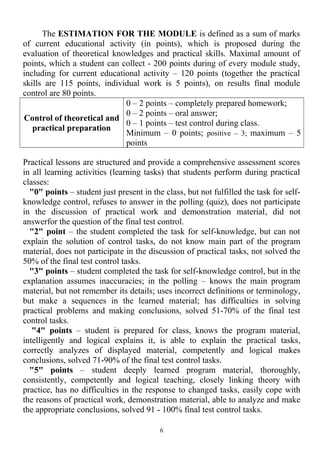
Neubauer counting chamber from above with
cover slip. Notice the two counting grids which are
recognized as crosses.
Schematic representation of the Neubauer counting
chamber's counting grid: blue = area of the leukocyte count
red = areas of the erythrocyte and platelet counts
Since blood cells are counted per unit volume (per
liter), it is vital that the volume of blood, in which the
cells are counted, corresponds to a known quantity. This
makes the Neubauer
counting chamber a
useful method. A
special objective slide
on which two 3 x 3
mm long counting
grids were engraved
comprises the Neubauer counting chamber.
8
The counting grid is composed of 9 big squares, measuring 1 x 1 mm . From these
squares, the central square contains 25 medium sized squares each measuring 0.2 x 0.2
mm. These are further divided into 16 small squares each measuring 0.05 x 0.05 mm. The
large central square is also called the erythrocyte grid. The squares highlighted in red
correspond to 80 small squares, that are used to establish the erythrocyte and platelet
counts. The large squares marked in blue are used to establish the leukocyte count.
During the chamber count, all cells that lie on the left and the lower border or that just
touch it are counted. None of the cells on the upper and the right border or those that just
touch it will be counted. This procedure is also known as the L-form rule
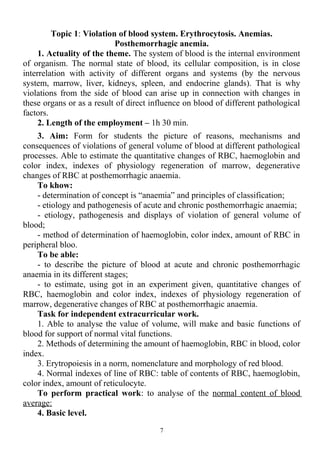
Filled circles = count; Empty circles = do not count
Schematic representation of a medium-sized square (0.2 x 0.2 mm) of the Neubauer
counting chamber's erythrocyte grid.
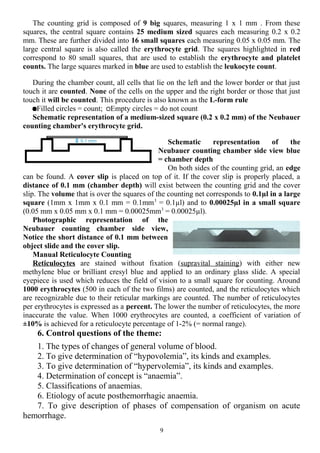
Schematic representation of the
Neubauer counting chamber side view blue
= chamber depth
On both sides of the counting grid, an edge
can be found. A cover slip is placed on top of it. If the cover slip is properly placed, a
distance of 0.1 mm (chamber depth) will exist between the counting grid and the cover
slip. The volume that is over the squares of the counting net corresponds to 0.1µl in a large
square (1mm x 1mm x 0.1 mm = 0.1mm3
= 0.1µl) and to 0.00025µl in a small square
(0.05 mm x 0.05 mm x 0.1 mm = 0.00025mm3
= 0.00025µl).
Photographic representation of the
Neubauer counting chamber side view,
Notice the short distance of 0.1 mm between
object slide and the cover slip.
Manual Reticulocyte Counting
Reticulocytes are stained without fixation (supravital staining) with either new
methylene blue or brilliant cresyl blue and applied to an ordinary glass slide. A special
eyepiece is used which reduces the field of vision to a small square for counting. Around
1000 erythrocytes (500 in each of the two films) are counted, and the reticulocytes which
are recognizable due to their reticular markings are counted. The number of reticulocytes
per erythrocytes is expressed as a percent. The lower the number of reticulocytes, the more
inaccurate the value. When 1000 erythrocytes are counted, a coefficient of variation of
±10% is achieved for a reticulocyte percentage of 1-2% (= normal range).
6. Control questions of the theme:
1. The types of changes of general volume of blood.
2. To give determination of “hypovolemia”, its kinds and examples.
3. To give determination of “hypervolemia”, its kinds and examples.
4. Determination of concept is “anaemia”.
5. Classifications of anaemias.
6. Etiology of acute posthemorrhagic anaemia.
7. To give description of phases of compensation of organism on acute
hemorrhage.
9
8. A picture of peripheral blood is in the bone-cerebral phase of
compensation after hemorrhage.
9. Etiology and pathogenesis of chronic posthemorrhagic anaemia.
7. Students’ practical activities
Protocol № 1 Date_____________________
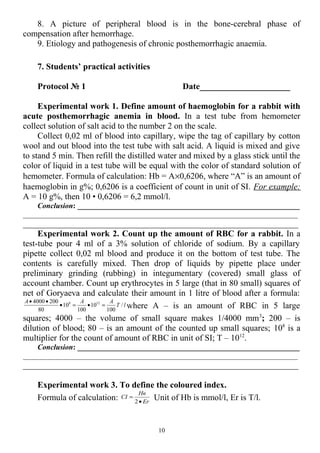
Experimental work 1. Define amount of haemoglobin for a rabbit with
acute posthemorrhagic anemia in blood. In a test tube from hemometer
collect solution of salt acid to the number 2 on the scale.
Collect 0,02 ml of blood into capillary, wipe the tag of capillary by cotton
wool and out blood into the test tube with salt acid. A liquid is mixed and give
to stand 5 min. Then refill the distilled water and mixed by a glass stick until the
color of liquid in a test tube will be equal with the color of standard solution of
hemometer. Formula of calculation: Hb = A×0,6206, where “A” is an amount of
haemoglobin in g%; 0,6206 is a coefficient of count in unit of SI. For example:
A = 10 g%, then 10 • 0,6206 = 6,2 mmol/l.
Conclusion: ___________________________________________________________
_________________________________________________________________________
________________________________________________________________
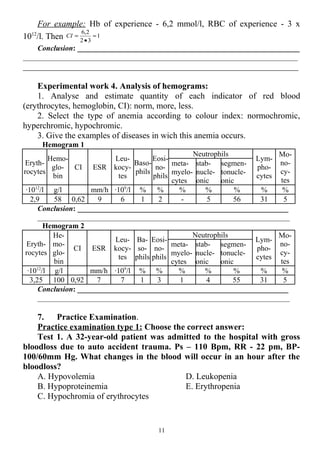
Experimental work 2. Count up the amount of RBC for a rabbit. In a
test-tube pour 4 ml of a 3% solution of chloride of sodium. By a capillary
pipette collect 0,02 ml blood and produce it on the bottom of test tube. The
contents is carefully mixed. Then drop of liquids by pipette place under
preliminary grinding (rubbing) in integumentary (covered) small glass of
account chamber. Count up erythrocytes in 5 large (that in 80 small) squares of
net of Goryaeva and calculate their amount in 1 litre of blood after a formula:
lТ
ААА
/
100
10
100
10
80
2004000 128
=•=•
••
where A – is an amount of RBC in 5 large
squares; 4000 – the volume of small square makes 1/4000 mm3
; 200 – is
dilution of blood; 80 – is an amount of the counted up small squares; 108
is a
multiplier for the count of amount of RBC in unit of SI; T – 1012
.
Conclusion: ___________________________________________________________
_________________________________________________________________________
________________________________________________________________
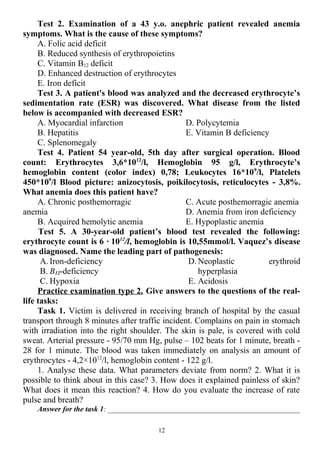
Experimental work 3. To define the coloured index.
Formula of calculation: Er
Нв
CI
•
=
2
Unit of Hb is mmol/l, Er is T/l.
10
For example: Hb of experience - 6,2 mmol/l, RBC of experience - 3 x
1012
/l. Then 1
32
2,6
≈
•
=CI
Conclusion: ___________________________________________________________
_________________________________________________________________________
________________________________________________________________
Experimental work 4. Analysis of hemograms:
1. Analyse and estimate quantity of each indicator of red blood
(erythrocytes, hemoglobin, CI): norm, more, less.
2. Select the type of anemia according to colour index: normochromic,
hyperchromic, hypochromic.
3. Give the examples of diseases in wich this anemia occurs.
Hemogram 1
Eryth-
rocytes
Hemo-
glo-
bin
CI ESR
Leu-
kocy-
tes
Baso-
phils
Eosi-
no-
phils
Neutrophils
Lym-
pho-
cytes
Mo-
no-
cy-
tes
meta-
myelо-
cytes
stab-
nucle-
onic
segmen-
tonucle-
onic
·1012
/l g/l mm/h ·109
/l % % % % % % %
2,9 58 0,62 9 6 1 2 - 5 56 31 5
Conclusion: ________________________________________________________
___________________________________________________________________
Hemogram 2
Eryth-
rocytes
He-
mo-
glo-
bin
CI ESR
Leu-
kocy-
tes
Ba-
so-
phils
Eosi-
no-
phils
Neutrophils
Lym-
pho-
cytes
Mo-
no-
cy-
tes
meta-
myelо-
cytes
stab-
nucle-
onic
segmen-
tonucle-
onic
·1012
/l g/l mm/h ·109
/l % % % % % % %
3,25 100 0,92 7 7 1 3 1 4 55 31 5
Conclusion: ________________________________________________________
___________________________________________________________________
7. Practice Examination.
Practice examination type 1: Choose the correct answer:
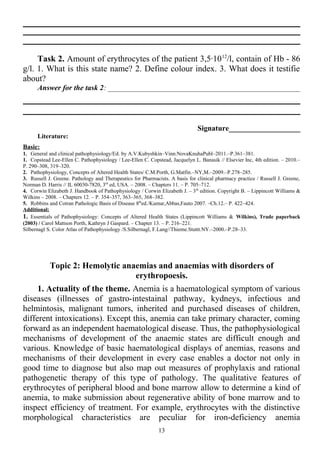
Test 1. A 32-year-old patient was admitted to the hospital with gross
bloodloss due to auto accident trauma. Ps – 110 Bpm, RR - 22 pm, BP-
100/60mm Hg. What changes in the blood will occur in an hour after the
bloodloss?
A. Hypovolemia
B. Hypoproteinemia
C. Hypochromia of erythrocytes
D. Leukopenia
E. Erythropenia
11
Test 2. Examination of a 43 y.o. anephric patient revealed anemia
symptoms. What is the cause of these symptoms?
A. Folic acid deficit
B. Reduced synthesis of erythropoietins
C. Vitamin B12 deficit
D. Enhanced destruction of erythrocytes
E. Iron deficit
Test 3. A patient's blood was analyzed and the decreased erythrocyte’s
sedimentation rate (ESR) was discovered. What disease from the listed
below is accompanied with decreased ESR?
A. Myocardial infarction
B. Hepatitis
C. Splenomegaly
D. Polycytemia
E. Vitamin B deficiency
Test 4. Patient 54 year-old, 5th day after surgical operation. Blood
count: Erythrocytes 3,6*1012
/l, Hemoglobin 95 g/l, Erythrocyte’s
hemoglobin content (color index) 0,78; Leukocytes 16*109
/l, Platelets
450*109
/l Blood picture: anizocytosis, poikilocytosis, reticulocytes - 3,8%.
What anemia does this patient have?
A. Chronic posthemorragic
anemia
B. Acquired hemolytic anemia
C. Acute posthemorragic anemia
D. Anemia from iron deficiency
E. Hypoplastic anemia
Test 5. A 30-year-old patient’s blood test revealed the following:
erythrocyte count is 6 · 1012
/l, hemoglobin is 10,55mmol/l. Vaquez’s disease
was diagnosed. Name the leading part of pathogenesis:
A. Iron-deficiency
B. B12-deficiency
C. Hypoxia
D. Neoplastic erythroid
hyperplasia
E. Acidosis
Practice examination type 2. Give answers to the questions of the real-
life tasks:
Task 1. Victim is delivered in receiving branch of hospital by the casual
transport through 8 minutes after traffic incident. Complains on pain in stomach
with irradiation into the right shoulder. The skin is pale, is covered with cold
sweat. Arterial pressure - 95/70 mm Hg, pulse – 102 beats for 1 minute, breath -
28 for 1 minute. The blood was taken immediately on analysis an amount of
erythrocytes - 4,2×10¹²
/l, hemoglobin content - 122 g/l.
1. Analyse these data. What parameters deviate from norm? 2. What it is
possible to think about in this case? 3. How does it explained painless of skin?
What does it mean this reaction? 4. How do you evaluate the increase of rate
pulse and breath?
Answer for the task 1: ___________________________________________________
12
Task 2. Amount of erythrocytes of the patient 3,5·1012
/l, contain of Hb - 86
g/l. 1. What is this state name? 2. Define colour index. 3. What does it testifie
about?
Answer for the task 2: ___________________________________________________
Signature___________________
Literature:
Basic:
1. General and clinical pathophysiology/Ed. by A.V.Kubyshkin–Vinn:NovaKnuhaPubl–2011.–P.361–381.
1. Copstead Lee-Ellen C. Pathophysiology / Lee-Ellen C. Copstead, Jacquelyn L. Banasik // Elsevier Inc, 4th edition. – 2010.–
P. 290–308, 319–320.
2. Pathophysiology, Concepts of Altered Health States/ C.M.Porth, G.Matfin.–NY,M.–2009.–P.278–285.
3. Russell J. Greene. Pathology and Therapeutics for Pharmacists. A basis for clinical pharmacy practice / Russell J. Greene,
Norman D. Harris // IL 60030-7820, 3rd
ed, USA. – 2008. – Chapters 11. – P. 705–712.
4. Corwin Elizabeth J. Handbook of Pathophysiology / Corwin Elizabeth J. – 3th
edition. Copyright В. – Lippincott Williams &
Wilkins – 2008. – Chapters 12. – P. 354–357, 363–365, 368–382.
5. Robbins and Cotran Pathologic Basis of Disease 8th
ed./Kumar,Abbas,Fauto 2007. –Ch.12.– P. 422–424.
Additional:
1. Essentials of Pathophysiology: Concepts of Altered Health States (Lippincott Williams & Wilkins), Trade paperback
(2003) / Carol Mattson Porth, Kathryn J Gaspard. – Chapter 13. – P. 216–221.
Silbernagl S. Color Atlas of Pathophysiology /S.Silbernagl, F.Lang//Thieme.Stuttt.NY.–2000.–P.28–33.
Topic 2: Hemolytic anaemias and anaemias with disorders of
erythropoesis.
1. Actuality of the theme. Anemia is a haematological symptom of various
diseases (illnesses of gastro-intestainal pathway, kydneys, infectious and
helmintosis, malignant tumors, inherited and purchased diseases of children,
different intoxications). Except this, anemia can take primary character, coming
forward as an independent haematological disease. Thus, the pathophysiological
mechanisms of development of the anaemic states are difficult enough and
various. Knowledge of basic haematological displays of anemias, reasons and
mechanisms of their development in every case enables a doctor not only in
good time to diagnose but also map out measures of prophylaxis and rational
pathogenetic therapy of this type of pathology. The qualitative features of
erythrocytes of peripheral blood and bone marrow allow to determine a kind of
anemia, to make submission about regenerative ability of bone marrow and to
inspect efficiency of treatment. For example, erythrocytes with the distinctive
morphological characteristics are peculiar for iron-deficiency anemia
13
(hypochromic erythrocytes), B12 (folic)-deficiency anemia (megaloblastes and
megalocytes), sickle-cell anemia (sickle-shape erythrocytes), thalassemia (target
like erythrocytes), Minkovskyi-Shoffar’s anemia (microspherocytes). The
increase of amount reticulocytes in peripheral blood testifies for good
compensator possibility of bone marrow.
2. Length of the employment – 1h 30 min.
3. Aim: To form for the students of concept about etiology and
pathogenesis of hemolytic and megaloblastic anemias, ability to characterize
their basic haematological displays, estimate the high-quality changes of RBC
and haemoglobin as index of tension of compensate mechanisms or pathological
changes.
To khow:
- principal reasons of origin and pathogenesis of hemolytic anemias and
anemias are as a result of violation of erythropoiesis;
- a role of industrial and domestic factors is in the origin of anemias;
- basic clinical and haematological syndromes are at B12- and folic acid
deficit anemia;
- a mechanism of origin of icterus is at hemolytic anemias.
To be able:
- to describe basic haematological indexes at hemolytic and megaloblastic
anemias;
- to explain principles of experimental design of hemolytic and
megaloblastic anemias;
- on the basis of information of experiment able to estimate the quantitative
and high-quality changes of RBC and haemoglobin as index of tension of
compensate mechanisms or pathological changes at hemolytic or megaloblastic
anemias.
A task is to independent extracurricular work:
1. To know erythropoiesis in a norm, morphology of cells of red blood.
2. Functions of RBC, structure and functions of haemoglobin.
3. Able to explain a biosynthesis gem; value of iron for a synthesis gem.
4. To know the exchange of iron, vitamin of B12 and folic acid in organism.
5. To know the normal indexes of number of RBC, amount of haemoglobin,
color index, amount of reticulocytes for the grown man.
6. Able to prepare and paint the samples of blood.
7. To define the number of RBC, concentration of haemoglobin, color index
and amount of reticulocytes in blood.
To perform practical work: to analyse of the pathogenesis of the
hemolytic anemias
4. Basic level.
14
The name of the previous and
future disciplines
The receiving of the skills
1. histology
2. biochemistry
3. physiology
4. haemathology
5. stomatology
Scheme of erythropoiesis
Regulation of erythropoiesis
Form and size of erythrocytes
Structure of haemoglobin
5. The advices for student
In hereditary hemolytic anemia, hemolysis is caused by reduction of
osmotic and mechanical resistance of erythrocytes.
In hereditary membranopathy (microspherocytic hemolytic anemia or
disease of Minkovsky-Shoffar) genetic deficiency in the membrane of
erythrocytes of Ca2+
-dependent ATP-phase and phospholipids results in
increased permeability of the membrane.
In hereditary fermentopathy, for example, glucose-6-
phosphatedehydrogenasodeficient (G-6-PhDG) anemia, acute intravascular
hemolysis of erythrocytes is caused by damage of the cellular membranes by
peroxide as the erythrocytes with deficiency G-6-PGDG have reduced contents
of the restored glutation (oxidant).
Intracellular hemolysis of erythrocytes in hereditary hemoglobinopathy is
connected with synthesis of abnormal or not peculiar to the given age
hemoglobin.
In the norm the fetal erythrocytes contain mainly fetal hemoglobin HbF
and their synthesis begins after the 8th
week of the embrional life; newborn’s
erythrocytes have 70-90% of HbF and 10-30% of HbA1; by the end of the first
year of life and in adult, erythrocytes contain 96-98% HbA1, 3%HbA2and 1-2%
of HbF.
In sickle cell anemia HbS is formed (in β-chain of globin glutamic acid is
substituted for valin) which in its restored condition falls out in crystals and
causes erythrocyte deformity (sickle cells); hypoxia contributes to
intensification of hemolysis of such erythrocytes.
The red cell membrane cytoskeleton and the effect of alterations in the
cytoskeleton proteins on red cell shape. With mutations that affect the integrity
of the membrane cytoskeleton, the normal biconcave erythrocyte loses
membrane fragments. To accommodate the loss of surface area, the cell adopts
a spherical shape. Such spherocytic cells are less deformable than normal and
are therefore trapped in the splenic cords, where they are phagocytosed by
macrophages.
6. Control questions of the theme:
1. Etiology of the purchased hemolitic anemias, their kinds.
15
2. To explain the mechanism of hemolysis at the purchased hemolytic
anemias.
3. To give description of picture of peripheral blood at the purchased
hemolytic anemia.
4. To name the types of the inherited hemolytic anemias.
5. To explain pathogenesis hereditary spherocytosis (Minkowsky-Shauffard
disease), picture of blood at this pathology.
6. To explain pathogenesis of glucose 6-phosphate dehydrogenase deficit
anemia.
7. To name kinds, explain pathogenesis, picture of peripheral blood at
inherited hemoglobinopathy.
8. To explain pathogenesis of sickle cell anemia, picture of peripheral
blood.
9. To name kinds, make examples of anemias as a result of violation of
erythropoiesis.
10. Etiology, pathogenesis, picture of blood of asiderotic (iron-deficiency)
anemia.
11. Kinds and etiology of B12-folic acid deficit anemias.
12. Etiology, pathogenesis of pernicious (Addison-Birmer’s) anemia.
13. To give description of picture of peripheral blood at pernicious anemia.
7. Students’ practical activities
Protocol № 2 Date_____________________
Experimental work 1. To learn the picture of blood for a rabbit with
experimental hemolytic anemia. Within a week three times (with a two-day
interval) a 3% solution of phenylhydrazine is entered hypodermic a rabbit (dose
of 0,6 ml per 1 kg of mass).
Cut off wool on ear of rabbit, a skin is wiped an alcohol, dry out ether and
prick a regional vein. The drop of blood inflict on the edge of subject glass,
stretch on all it surface by the polished subject glass, leaned to the drop under
the corner of 45°.
On the stroke dried up on air inflict the counted up amount of drops of paint
of May-gryunval'da and paint during 3 min. (fixing). Then inflict the same
amount of drops of the distilled water, mix up a waggle (colouring). A paint is
united and, not washing water, a stroke is inundated the divorced paint of
Romanovsky (1 drop on 1 ml distill water) on 6 min. Wash off a paint by water,
dry out a stroke and study under a immersion increase.
Conclusion: ________________________________________________________
___________________________________________________________________
16
Experimental work 2. To learn the picture of peripheral blood for an
animal with megaloblastic anemia. Daily, during 5 days, intraperitoneum is
entered an animal water solution of saponin, from the calculation of 5 mg per 1
kg of mass.
On lesson the skin of ear of animal is wiped an alcohol and do an incision.
Prepare the thin stroke of blood, and after drying out dye after Pappengeym. A
stroke is ready to consider under a immersion increase.
To sketch the picture of blood at hemolytic and megaloblastic anemias.
Conclusion: ________________________________________________________
___________________________________________________________________
Experimental work 3. Analysis of hemograms.
1. Analyse and estimate quantity of each indicator of red blood
(erythrocytes, hemoglobin, CI): norm, more, less.
2. Select the type of anemia according to colour index: normochromic,
hyperchromic, hypochromic.
3. Give the examples of diseases in wich this anemia occurs.
Conclusion: ________________________________________________________
___________________________________________________________________
Hemogram 1
Eryth-
rocytes
He-
mo-
glo-
bin
CI ESR
Leu-
kocy-
tes
Ba-
so-
phils
Eosi-
no-
phils
Neutrophils
Lym-
pho-
cytes
Mo-
no-
cy-
tes
meta-
myelо-
cytes
stab-
nucle-
onic
segmen-
tonucle-
onic
·1012
/l g/l mm/h ·109
/l % % % % % % %
2,79 110 0,63 8 5 1 4 - 2 59 28 6
Conclusion: ________________________________________________________
___________________________________________________________________
Hemogram 2
Eryth-
rocytes
He-
mo-
glo-
bin
CI ESR
Leu-
kocy-
tes
Ba-
so-
phils
Eosi-
no-
phils
Neutrophils
Lym-
pho-
cytes
Mo-
no-
cy-
tes
meta-
myelо-
cytes
stab-
nucle-
onic
segmen-
tonucle-
onic
·1012
/l g/l mm/h ·109
/l % % % % % % %
3,27 142 1,42 5 7 1 5 1 6 53 30 4
Conclusion: ________________________________________________________
___________________________________________________________________
___________________________________________________________
8. Practice Examination.
Practice examination type 1: Choose the correct answer:
Test 1. Along with normal hemoglobin types there can be pathological
ones in the organism of an adult. Name one of them:
A. HbF B. HbA1 C. HbA2
17
D. HbS E. HbO2
Test 2. A 25 year old Palestinian woman complains of weakness,
dizziness, dyspnea. In anamnesis: periodically exacerbating anemia. In
blood: Hb - 60g/l, erythrocytes - 2,5*1012
/l, reticulocytes - 35‰, anisocytosis
and poikilocytosis of erythrocytes, a lot of target cells and
polychromatophils. What type of anemia is it?
A. Sickle-cell anemia
B. Addison-Biermer disease
C. Glucose 6-phosphate dehydrogenase-deficient anemia
D. Minkowsky-Shauffard disease
E. Thalassemia
Test 3. A 34 year old woman was diagnosed with hereditary
microspherocytic hemolytic anemia (Minkowsky-Shauffard disease). What
mechanism caused haemolysis of erythrocytes?
A. Autoimmune disorder
B. Bone marrow hypoploasia
C. Enzymopathy
D. Membranopathy
E. Hemoglobinopathy
Test 4. A 56 year old patient came to a hospital with complaints about
general weakness, tongue pain and burning, sensation of limb numbness. In
the past he underwent resection of forestomach. In blood: Hb-80 g/l;
erythrocytes - 2,0*1012
/l; colour index - 1,2, leukocytes - 3,5*109
/l. What
anemia type is it?
A. B12-folate deficient
B. Hemolytic
C. Aplastic
D. Iron-deficient
E. Posthemorrhagic
Test 5. 2 years ago a patient underwent resection of pyloric part of
stomach. He complains of weakness, periodical dark shadows beneath his
eyes, dyspnea. In blood: Hb - 70g/l, erythrocytes - 3,0*1012
/l, colour index -
0,7. What changes of erythrocytes in blood smears are the most typical for
this condition?
A. Megalocytes
B. Ovalocytes
C. Schizocytes
D. Macrocytes
E. Microcytes
Test 6. A 20 year old patient complains of general weakness, dizziness,
quick fatigability. Blood analysis results: Hb - 80g/l. Microscopical
examination results: erythrocytes are of modified form. This condition
might be caused by:
A. Obturative jaundice
B. Sickle-cell anemia
C. Hepatocellular jaundice
D. Acute intermittent porphyria
E. Addison's disease
Practice examination type 2. Give answers to the questions of the real-
life tasks:
18
Task 1. In a patient with anemia there is following picture of blood: an
amount of erythrocytes - 1,4·1012
/l, haemoglobin content - 62g/l; aniso- and
poikilocytes megaloblastes, megalocytes in smear. 1. What type of anemia such
changes are characterized for? 2. Why does it develop? 3. Why in this case is
sharply expressed erythropenia? 4. Give the morphological characteristic to
megaloblastes and megalocytes. 5. Calculate colour index.
Answer for the task 1: ___________________________________________________
Task 2. The blood of patient with anemia is characterized by parameters:
amount of erythrocytes – 3,5·1012
/l, haemoglobin content - 50g/l; in blood smear
– annulocytes, poikilocytes, microcytes. 1. For what kind of anemia these
parameters are characterized? 2. Calculate colour indexand determine, to what
group (according to colour index) this anemia concern. 3. Why erythrocytes are
acquired of rings form.
Answer for the task 2: __________________________________________________
Signature___________________
Literature:
Basic:
1. General and clinical pathophysiology/Ed.by A.V.Kubyshkin–Vinn:NovaKnuhaPubl–2011.–P.381– 409.
2. Copstead L-E.C.Pathophysiology/L-E.C.Copstead, J.L.Banasik // ElsevierInc 4th
ed.–2010.– P. 310–329.
3. Pathophysiology, Concepts of Altered Health States/ C.M.Porth, G.Matfin.–NY,M.–2009.–P.278–285.
4. Corwin Elizabeth J. Handbook of Pathophysiology / Corwin Elizabeth J. – 3th
edition. Copyright В. – Lippincott Williams &
Wilkins – 2008. – Chapters 12. – P. 363–365, 368–382.
5. Russell J. Greene. Pathology and Therapeutics for Pharmacists. A basis for clinical pharmacy practice / Russell J. Greene,
Norman D. Harris // IL 60030-7820, 3rd
edition, USA. – 2008. – Ch. 11. – P. 712–724.
6. Robbins and Cotran Pathologic Basis of Disease 8th
ed/ Kumar, Abbas, Fauto 2007.–Ch.12.–P. 422–441.
Additional:
7. Essentials of Pathophysiology: Concepts of Altered Health States (Lippincott Williams & Wilkins), Trade paperback
(2003) / Carol Mattson Porth, Kathryn J Gaspard. – Chapter 13. – P. 221–230.
8. SilbernaglS. Color Atlas of Pathophysiology/S.Silbernagl,F.Lang//Thieme.Stuttg. NY.– 2000.–P.34–41.
Topic 3. Leukocytosis and leukopenias.
1. Actuality of the theme. Leucocytosis are considered as a reaction
hematopoietic system due to action of physiological and pathological irritations.
Leucocytosis is a pathological symptom of many diseases. In a basis of
leucocytosis lay pathophysiological mechanisms connected with proliferation,
maturation going out of leucocytes and their flow into vessels and
redestribution.
19
Leucopenia may depend upon oppressive influence of some toxines on the
maturation and outflow of leucocytes from the bone-marrow. Often these
phenomenas are observed during the infectious diseases. They have significanse
for the differential diagnostic. If for the disease is characterised leucocytosis, the
availability of leucopenia testifies on depression of hemopoietic system.
2. Length of the employment – 1h 30 min.
3. Aim:
To know: types of the left nuclear deviation.
To be able: to analyse of the quantitative and qualitative changes of
leucocytes in blood.
To perform practical work: to analyse of the pathogenesis of the
quantitative and qualitative changes of leucocytes in blood. The increase of
leucocyte quantity is called leucocytosis, and the decrease-leucopenia. The
norm is 4-9G/l or 4-9*109
/l. The quantitative changes are increased quantity of
immature forms in blood and degeneration of leucocytes.
Task for independent extracurricular work.
1. To know leucopoesis in a norm, morphology of white blood cells.
2. Methods of determining the amount of white blood cells in the blood.
3. Anatomy and functions of primary and secondary hematopoietic organs.
4. Basic level.
The name of the previous
and future disciplines
The receiving of the skills
1. histology
2. biochemistry
3. physiology
4. stomatology
Scheme of leucopoesis.
Leucocytes formula of blood.
Function of leucocytes.
Methods of counting of leucocytes maintenance in blood.
5. The advices for students.
Leucocytosis. Leucocytosis –is the increase of total leucocyte quantity in
blood – over 9G/l (9/109
/l).
Leucopenia. Leucopenia –is the decrease of total leucocyte number in
blood –below 4G/l (4*109
).
Manual leukocyte differential
To manually classify leukocytes, a blood film is stained with May-Gruenwald-
Giemsa. The different types of leukocytes from the film are counted under a
microscope. Since the leukocytes are not evenly distributed in the film and the
same cell may not be counted more than once, the preparation should be
systematically screened.
20
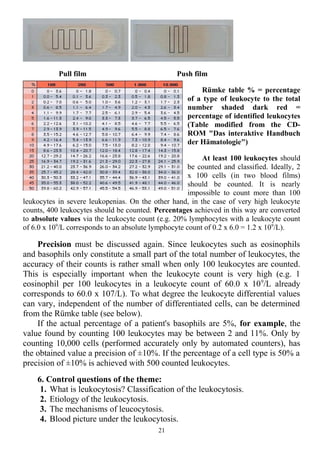
Pull film Push film
Rümke table % = percentage
of a type of leukocyte to the total
number shaded dark red =
percentage of identified leukocytes
(Table modified from the CD-
ROM "Das interaktive Handbuch
der Hämatologie")
At least 100 leukocytes should
be counted and classified. Ideally, 2
x 100 cells (in two blood films)
should be counted. It is nearly
impossible to count more than 100
leukocytes in severe leukopenias. On the other hand, in the case of very high leukocyte
counts, 400 leukocytes should be counted. Percentages achieved in this way are converted
to absolute values via the leukocyte count (e.g. 20% lymphocytes with a leukocyte count
of 6.0 x 10⁹
/L corresponds to an absolute lymphocyte count of 0.2 x 6.0 = 1.2 x 10⁹
/L).
Precision must be discussed again. Since leukocytes such as eosinophils
and basophils only constitute a small part of the total number of leukocytes, the
accuracy of their counts is rather small when only 100 leukocytes are counted.
This is especially important when the leukocyte count is very high (e.g. 1
eosinophil per 100 leukocytes in a leukocyte count of 60.0 x 10⁹
/L already
corresponds to 60.0 x 10⁷/L). To what degree the leukocyte differential values
can vary, independent of the number of differentiated cells, can be determined
from the Rümke table (see below).
If the actual percentage of a patient's basophils are 5%, for example, the
value found by counting 100 leukocytes may be between 2 and 11%. Only by
counting 10,000 cells (performed accurately only by automated counters), has
the obtained value a precision of ±10%. If the percentage of a cell type is 50% a
precision of ±10% is achieved with 500 counted leukocytes.
6. Control questions of the theme:
1. What is leukocytosis? Classification of the leukocytosis.
2. Etiology of the leukocytosis.
3. The mechanisms of leucocytosis.
4. Blood picture under the leukocytosis.
21
5. What is leukopenia? Classification of the leukopenia.
6. Etiology of the leukopenia.
7. The mechanisms of leucopenia.
8. What is aleukia, agranulocytosis?
9. Blood picture under the leukopenia.
10. Leucocyte degeneration in blood.
11. Hereditary WBC abnormalities.
7. Students’ practical activities
Protocol № 3 Date_____________________
Experimental work 1. Count up a leucocytic formula (leucogram) at an
abscess. To prepare the stroke of blood, taken from the vein of ear of rabbit and
to paint it after Pappengeym. See the stroke under a immersion increase. The
stroke of blood is mentally divided into four fields, conducting the lines which
are perpendicular one to one through the center of stroke. Count up in every
field 25 leucocytes, moving a stroke on the broken line. Count up separate types
of leucocytes using a meter.
Formula: LG
А
L
АА
/
20
/10
20
10
11600
204000 96
=•=•
•
••
,
А – amount of leucocytes in 100 big squares; 1600 – amount of small squares; 4000
1
-
a volume of small square is in microliter; 20 - is a degree of breeding of blood; 106
- is a
multiplier for the count of amount of leucocytes in CI units; G - giga = 109
Conclusion:__________________________________________________________
Experimental work 2. Define the index of nuclear change.
The index of nuclear change of neutrophiles is determined after a formula:
S
BYМ
%
%%% ++
where
M – mielocytes B – band [stab] neutrophiles
Y – young neutrophiles S – segmented [polynuclear] neutrophiles.
Index of nuclear exchange in norm 0,6-0,8
Conclusion:__________________________________________________________
____________________________________________________________________
8. Practice Examination.
22
Practice examination type 1: Choose the correct answer:
Test 1. A 16-year-old boy was performed an appendectomy. He has
been hospitalized for right lower quadrant abdominal pain within 18
hours. The surgical specimen is edematous and erythematous. Infiltration
by what of the following cells is the most typical for the process occuring
here?
A. Basophils
B. Eosinophils
C. Monocytes
D. Neutrophils
E. Limphocytes
Test 2. A patient operated on complicated appendicitis has the
following changes of blood count: erythrocytes - 4,0.1012
/l, Нb - 120 g/l,
color index - 0,9, leukocytes – 18,109
/l, basophils - 0, eosinophils - 0,
myelocytes - 0, juvenile - 0, stab neutrophils - 20, segmentonuclear
neutrophils - 53, lymphocytes - 21, monocytes - 5. How is such nuclear shift
of leukocytic formula called?
A. Hyperregenerative
B. Regeneratively-degenerative
C. Regenerative left shift
D. Degenerative left shift
E. Right shift
Test 3. A 3-year-old child has eaten some strawberries. Soon he developed
a rash and itching. What was found in the child’s leukogram?
A. Monocytosis
B. Lymphocytosis
C. Eosinophilia
D. Hypolymphemia
E. Neutrophilic
leukocytosis
Test 4. Lazy leucocyte syndrome is because of:
A. Disorder of phagocytosis
B. Cellular immunodeficiency
C. Combined immunodeficiency
D. Disorder of complement
Test 5. A 5 year old child is ill with measles. Blood analysis revealed
increase of total number of leukocytes up to 13*109
/l. Leukogram:
basophils - 0, eosinophils - 1, myelocytes - 0, juvenile neutrophils - 0, band
neutrophils - 2, segmented neutrophils - 41, lymphocytes - 26, monocytes -
30. Name this phenomenon:
A. Lymphocytosis
B. Agranulocytosis
C. Eosinopenia
D. Monocytosis
E. Neutropenia
Test 6. A 26 year old man is in the torpid shock phase as a result of a
car accident. In blood: 3,2*109
/l. What is the leading mechanism of
leukopenia development?
A. Redistribution of leukocytes in bloodstream
B. Leikopoiesis inhibition
C. Lysis of leukocytes in the blood-forming organs
D. Intensified elimination of leukocytes from the organism
E. Disturbed going out of mature leukocytes from the marrow into the
blood
23
Practice examination type 2 Give answer to the questions of the real-
life tasks:
Amount of
leucocytes
Baso
-
phile
s
Eosino
-philes
Neutrophiles
Lym-
phocyte
s
Mono
-cytesMyelo-
cytes
Meta-
myelo-
cytes
Stab-
nucleo
-nic
Segmen
-tonuc-
leonic
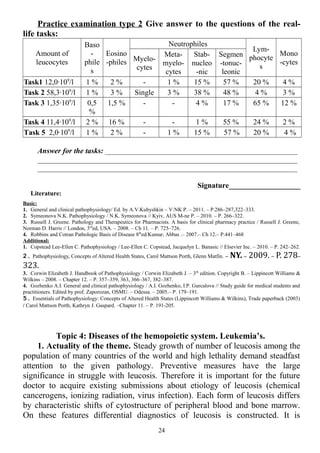
Task1 12,0·109
/l 1 % 2 % - 1 % 15 % 57 % 20 % 4 %
Task 2 58,3·109
/l 1 % 3 % Single 3 % 38 % 48 % 4 % 3 %
Task 3 1,35·109
/l 0,5
%
1,5 % - - 4 % 17 % 65 % 12 %
Task 4 11,4·109
/l 2 % 16 % - - 1 % 55 % 24 % 2 %
Task 5 2,0·109
/l 1 % 2 % - 1 % 15 % 57 % 20 % 4 %
Answer for the tasks: ___________________________________________________
_____________________________________________________________________
_____________________________________________________________________
Signature___________________
Literature:
Basic:
1. General and clinical pathophysiology/ Ed. by A.V.Kubyshkin – V:NK P. – 2011. – P.286–287,322–333.
2. Symeonova N.K. Pathophysiology / N.K. Symeonova // Kyiv, AUS M-ne P. – 2010. – P. 266–322.
3. Russell J. Greene. Pathology and Therapeutics for Pharmacists. A basis for clinical pharmacy practice / Russell J. Greene,
Norman D. Harris // London, 3rd
ed, USA. – 2008. – Ch 11. – P. 725–726.
4. Robbins and Cotran Pathologic Basis of Disease 8th
ed/Kumar, Abbas .– 2007.– Ch 12.– P.441–468
Additional:
1. Copstead Lee-Ellen C. Pathophysiology / Lee-Ellen C. Copstead, Jacquelyn L. Banasic // Elsevier Inc. – 2010. – P. 242–262.
2. Pathophysiology, Concepts of Altered Health States, Carol Mattson Porth, Glenn Matfin. – NY. – 2009. – P. 278–
323.
3. Corwin Elizabeth J. Handbook of Pathophysiology / Corwin Elizabeth J. – 3th
edition. Copyright В. – Lippincott Williams &
Wilkins – 2008. – Chapter 12. – P. 357–359, 363, 366–367, 382–387.
4. Gozhenko A.I. General and clinical pathophysiology / A.I. Gozhenko, I.P. Gurcalova // Study guide for medical students and
practitioners. Edited by prof. Zaporozan, OSMU. – Odessa. – 2005.– P. 179–191.
5. Essentials of Pathophysiology: Concepts of Altered Health States (Lippincott Williams & Wilkins), Trade paperback (2003)
/ Carol Mattson Porth, Kathryn J. Gaspard. –Chapter 11. – P. 191-205.
Topic 4: Diseases of the hemopoietic system. Leukemia’s.
1. Actuality of the theme. Steady growth of number of leucosis among the
population of many countries of the world and high lethality demand steadfast
attention to the given pathology. Preventive measures have the large
significance in struggle with leucosis. Therefore it is important for the future
doctor to acquire existing submissions about etiology of leucosis (chemical
cancerogens, ionizing radiation, virus infection). Each form of leucosis differs
by characteristic shifts of cytostructure of peripheral blood and bone marrow.
On these features differential diagnostics of leucosis is constructed. It is
24
necessary to mark that the therapy of leucosis mainly pathogenetic. The
deepening of our submissions about separate chains of pathogenesis will
promote perfecting of purposeful treatment.
2. Length of the employment – 1h 30 min.
3. Aim:
To know: leukemia –is a disease of tumor nature, originating from blood
cells with initial affection of the bone marrow.
To be able: to analyse of the pathogenesis and blood data under acute and
chronic leukemia.
To perform practical work: to analyse of the pathogenesis of the
leukemia. Oncogenic viruses, ionizing radiation and chemical substances cause
mutation of genes or epigenomic disturbance of regulation of multiplication and
maturation of hematopoietic cells of the II-nd and III-rd levels. Leukemia
viruses can cause such chromosomal translocation that result in transmission of
the oncogenes, localized in chromosomes, to the part of genome where they can
be activated
4. Basic level.
The name of the previous
and future disciplines
The receiving of the skills
1. histology
2. biochemistry
3. physiology
4. oncology
5. surgical
stomatology
Scheme of hematopoisis.
Morphological features of leucocytes.
Leucocytic formula of blood.
Function of leucocytes.
5. Control questions of the theme:
1. Determination and general definition of leucosis. Classification of
leucosis is after motion and morphological signs.
2. Modern theories of origin of leucosis: role of viruses, ionizing radiation,
chemical matters, inherited anomalies. Tumor nature of leucosis. Basic displays
of tumor progression.
3. Features of hemopoiesis, picture of peripheral blood, leucogram at an
acute myeloleucosis [myeloleukemia].
4. Features of hemopoiesis, picture of blood at chronic myeloleucosis.
5. Picture of blood, leukogram at an acute lympholeucosis [lymphatic
leukemia].
6. Picture of blood, leukogram at a chronic lympholeucosis.
7. A mechanism of development of anemia at acute and chronic leucosis.
8. Violation of reactivity of organism is at leucosis.
9. A role of the inherited anomalies is in development of leucosis.
6. Independent audience work of student
25
Protocol № 4 Date_____________________
Experimental work 1. Learn the picture of peripheral blood and
marrow at the different types of leucosis. Use the strokes of blood of patients
with acute and chronic myeloleukemia, acute and chronic lymphatic leukemia.
Study strokes under a immersion increase and draw the picture of blood. Count
up a leukogram, index of nuclear change at every type of leucosis, using the
method of before unit
Conclusion:___________________________________________________________
Experimental work 2. Counting of leucocytic formula in smear of blood
sick on leucosis.
a) Acute lymphoblastic leucosis
b) Acute myeloblastic leucosis
c) Chronic myelocytic leucosis
d) Chronic lymphocytic leucosis
Study smear in immersial microscope objective. For determination of
leucocytic formula is necessary to calculate 100 leucocytes. Counting should be
done in four various parts of smear, moving subject glass so that the fields of
sight were on sufficient distance from either and other. For it also necessary pay
attention to the form, sizes of cells, colour, granularity in protoplazma, form and
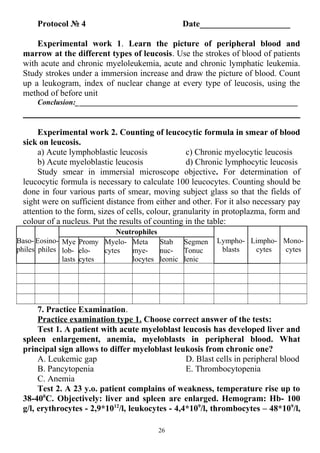
colour of a nucleus. Put the results of counting in the table:
Baso-
philes
Eosino-
philes
Neutrophiles
Lympho-
blasts
Limpho-
cytes
Mono-
cytes
Mye
lob-
lasts
Promy
elo-
cytes
Myelo-
cytes
Meta
mye-
locytes
Stab
nuc-
leonic
Segmen
Tonuc
lenic
7. Practice Examination.
Practice examination type 1. Choose correct answer of the tests:
Test 1. A patient with acute myeloblast leucosis has developed liver and
spleen enlargement, anemia, myeloblasts in peripheral blood. What
principal sign allows to differ myeloblast leukosis from chronic one?
A. Leukemic gap
B. Pancytopenia
C. Anemia
D. Blast cells in peripheral blood
E. Thrombocytopenia
Test 2. A 23 y.o. patient complains of weakness, temperature rise up to
38-400
C. Objectively: liver and spleen are enlarged. Hemogram: Hb- 100
g/l, erythrocytes - 2,9*1012
/l, leukocytes - 4,4*109
/l, thrombocytes – 48*109
/l,
26
segmentonuclear neutrophils - 17%, lymphocytes - 15%, blast cells - 68%.
All cytochemical reactions are negative. Make a hematological conclusion:
A. Acute erythromyelosis
B. Acute myeloblastic leukosis
C. Chronic myeloleukosis
D. Undifferentiated leukosis
E. Acute lymphoblastic leukosis
Test 3. Increase in Alkaline phosphatase is seen in :
A. Chronic mieloleucosis (CML)
B. Leukemoid reaction
С. Eosinophilia
D. Malaria
Test 4. Mongolism is characteristically associated with:
A. Acute lymphoblastic
leukaemia
B. Chronic lymphatic leukaemia
C. Chronic myeloid leukaemia
D. Acute myeloid leukaemia
E. Erythroleukaemia
Test 5. Philadelphia chromosome (Phi) is commonly associated with :
A. Chronic lymphatic leukemia
B. Leukemoid reaction
C. Acute monocytic leukemia
D. None of the above
Practice examination type 2. Give answer for the questions of the real-
life tasks:
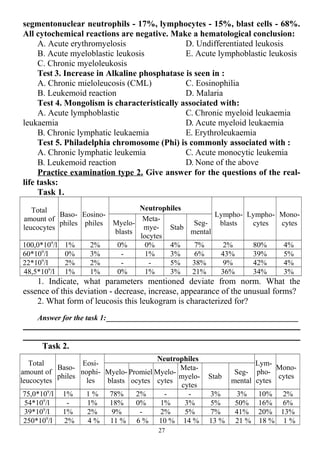
Task 1.
Total
amount of
leucocytes
Baso-
philes
Eosino-
philes
Neutrophiles
Lympho-
blasts
Lympho-
cytes
Mono-
cytesMyelo-
blasts
Meta-
mye-
locytes
Stab
Seg-
mental
100,0*109
/l 1% 2% 0% 0% 4% 7% 2% 80% 4%
60*109
/l 0% 3% - 1% 3% 6% 43% 39% 5%
22*109
/l 2% 2% - - 5% 38% 9% 42% 4%
48,5*109
/l 1% 1% 0% 1% 3% 21% 36% 34% 3%
1. Indicate, what parameters mentioned deviate from norm. What the
essence of this deviation - decrease, increase, appearance of the unusual forms?
2. What form of leucosis this leukogram is characterized for?
Answer for the task 1:___________________________________________________
Task 2.
Total
amount of
leucocytes
Baso-
philes
Eosi-
nophi-
les
Neutrophiles
Lym-
pho-
cytes
Mono-
cytes
Myelo-
blasts
Promiel
ocytes
Myelo-
cytes
Meta-
myelo-
cytes
Stab
Seg-
mental
75,0*109
/l 1% 1 % 78% 2% - - 3% 3% 10% 2%
54*109
/l - 1% 18% 0% 1% 3% 5% 50% 16% 6%
39*109
/l 1% 2% 9% - 2% 5% 7% 41% 20% 13%
250*109
/l 2% 4 % 11 % 6 % 10 % 14 % 13 % 21 % 18 % 1 %
27
1. Indicate, what from above mentioned parameters deviate from norm. In what
the essence of this deviation – decrease, increase, appearance of the unusual
forms consists? 2. What form of leucosis this leukogram is characterized for?
Answer for the task 2:___________________________________________________
Signature___________________
Literature:
Basic:
1. General and clinical pathophysiology/ Ed. by A.V.Kubyshkin – V: NK Publ. – 2011. – P. 286–287,
322–333.
2. Symeonova N.K. Pathophysiology / N.K. Symeonova // K, M-ne Publ. – 2010. – P. 266–322.
3. Copstead Lee-Ellen C. Pathophysiology / Lee-Ellen C. Copstead, Jacquelyn L. Banasic // Elsevier Inc. –
2010. – P. 242–262.
4. Russell J. Greene. Pathology and Therapeutics for Pharmacists. A basis for clinical pharmacy practice /
Russell J. Greene, Norman D. Harris // London, 3rd
ed, USA. – 2008. – Ch 11. – P. 725–726.
Additional:
1. Pathophysiology, Concepts of Altered Health States/C.Porth, G.Matfin. – NY– 2009.–
P.278–323.
2. Corwin Elizabeth J. Handbook of Pathophysiology / Corwin Elizabeth J. – 3th
edition. Copyright В. –
Lippincott Williams & Wilkins – 2008. – Chapter 12. – P. 357–359, 363, 366–367, 382–387.
3. Robbins & Cotran Pathologic Basis of Disease 8th
ed./ Kumar, Abbas, Fauto.–2007.–Ch.12.–
P.441–468.
4. Gozhenko A.I. General and clinical pathophysiology / A.I. Gozhenko, I.P. Gurcalova // Study guide for
medical students and practitioners. Ed. by prof. Zaporozan, OSMU. – O. – 2005.– P. 179–191.
5. Essentials of Pathophysiology: Concepts of Altered Health States (Lippincott Williams & Wilkins),
Trade paperback (2003) / Carol Mattson Porth, Kathryn J. Gaspard. –Chapter 11. – P. 191-205.
Topic 5. Violation of hemostasis.
1. Actuality of the theme. One of major functions of blood there is support
of its liquid state into vessels and coagulates of blood at violation of integrity of
vascular wall. The liquid state of blood is saved due to balance between
coagulative and anticoagulative, fibrinolytic and kallikrein-kinin systems.
Violation in the system of hemostasis can take place in three directions: 1)
decline of coagulative ability of blood and origin of hemorragic diathesis; 2)
increase of coagulative ability of blood and origin of thromboses; 3) origin of
thrombohemorragic syndrome, which shows up increase of thrombosis and
hemorrhagic diathesis both.
2. Length of the employment – 1 h 30 min.
28
3. Aim: To form for students the modern knowledge of reasons and
mechanisms of violation thrombocyte-vascular and coagulative hemostasis, to
design these processes in an experiment on animals with the purpose of
cognition of reasons and terms of their origin, mechanisms of development,
consequences and value of these processes in pathology of man.
To khow:
- etiologic factors which predetermine violation of producing blood clots;
- basic phases of process of producing blood clots;
- reasons and mechanisms of origin of hemorrhagic diathesis;
- reasons and mechanisms of violation thrombocyte-vascular hemostasis;
- etiology and pathogenesis of disseminated intravascular clotting [DIC];
- inherited violations of blood clotting.
To be able:
- to explain the mechanisms of interrelation of basic factors of coagulative
and anticoagulative systems in the process of clotting;
- to reproduce violation of blood clotting in an experiment;
- to calculate prothrombin time [PT] and prothrombin index;
- to count up the amount of platelets in peripheral blood.
A task is to independent extracurricular work:
Modern presentations about coagulative and anticoagulative system of blood.
Mechanisms of the physiology blood clotting. Thrombosis as local violation of
circulation of blood.Stages of blood clotting.
To perform practical work: to analyse of the pathogenesis of the platelet
adhesion and aggregation.
4. Basic level.
The name of the previous and future
disciplines
The receiving of the skills
1. histology
2. biochemistry
3. physiology
4. internal medicine
5. haematology
Vesseles-thrombocytous and plasmatic factors,
which participate in coagulation of blood.
Stage of blood coagulation.
Significance ancoagulative and fibrinolytic
systems of blood.
5. Control questions of the theme:
1. What is hemostasis pathology. Classification of hemostasis pathology.
2. Normal hemostasis.
3. The classical coagulation cascade.
4. Virchow's triad in thrombosis.
5. Decreasing of blood coagulation ability.
6. Thrombocytopenia and thrombocytopathy.
7. Increasing of blood coagulation ability.
29
8. Generalized disseminated intravascular blood coagulation (DIC-
syndrome).
9. Hereditary disorders of coagulation.
6. Independent audience work of student
Protocol № 5 Date_____________________
Experimental work 1. Define prothrombin time [PT] for a dog with the
cirrhosis of liver. In advance oily solution of carbon tetrachloride is entered a
dog from the calculation of 4 ml per 1 kg of mass. Before lesson for a dog take
4,5 ml of blood, add 0,5 ml of a 0,1% solution of oxalic sodium and spin, take
the plasma. In test tube pour 0,2 ml of plasma, warm up on an water bath at
38°N, add 0,2 ml warmed to a 38°N mixture from equal parts of thromboplastin
and 0,5% solution of calcium chloride. Carefully mix up a glass stick,
continuing to hold in a water bath. Calculate time from adding mixture to the
first signs of coagulation of plasma (in seconds).
Calculate the prothrombin indexes after formula: B
А
Х
•
=
100
, where A – time
of coagulation of control plasma (seconds); B – time of coagulation of
experimental plasma (seconds). A normal index of is equal 70-100%.
Conclusion
Experimental work 2. Count up the amount of thrombocytes for a
rabbit with radiation illness. Three days prior to lesson an animal is exposed
to the X-rays.
On the area of regional vein ears inflict a few drops of a 14% solution of
magnesium sulphate, prick a vein; carefully mix up blood a glass stick with
magnesia in correlation 2:10.
From the got mixture prepare a stroke, dye it after Pappengeym (to repaint
for the best visibility of trombocytes). A count is conducted under a immersion
increase in the narrowed eyeshot. Count up the amount of trombocytes on 1000
RBC.
Formula of calculation: 1000
АН
Х
•
= , where H – is an amount of platelets on
1000 RBC; A – is an amount of RBC;.Method of count of amount of RBC see
in previouse lesson.
Conclusion
30
8. Practice Examination.
Practice examination type 1. Choose the correct answer:
Test 1. Hemorrhage punctate was found out in the patient after
application of a tourniquet. With disfunction of what blood cells is it
connected?
A. Monocytes
B. Eosinophiles
C. Neutrophiles
D. Lymphocytes
E. Platelets
Test 2. A 43-year-old patient has thrombocytopenia, reduction of
fibrinogen, products of degradation of fibrin presented in the blood,
petechial hemorrhage along with septic shock. What is the most likely
cause of the changes?
A. Autoimmune thrombocytopenia
B. DIC-syndrom
C. Exogenous intoxication
D. Disorder of thrombocytes production
E. Hemorrhagic diathesis
Test 3. There is an inhibited coagulation in the patients with bile ducts
obstruction, bleeding due to the low level of absorbtion of a vitamin. What
vitamin is in deficiency?
A. К
B. Е
C. D
D. А
E. Carotene
Test 4. A 6-months-old baby has got frequent and extensive subdermal
hemorrhages. The administration of the synthetic analogue of vitamin K
(vicasol) was effective. γ-carboxylation of glutamic acid of what protein of
blood coagulation system does this vitamin take part in?
A. Antihemophilic globulin A
B. Fibrinogen
C. Prothrombin
D. Hageman's factor
E. Rosental's factor
Test 5. A patient with tissue trauma was taken a blood sample for the
determination of blood clotting parameters. Specify the right sequence of
extrinsic pathway activation.
A. III – VIII: TF – Xa
B. III – VIIa – Xa
C. III – IV – Xa
D. IV – VIII: TF – Xa
E. IV – VIIa – Xa
Practice examination type 2. Give answer to the questions of the real-
life task:
Task. The patient was in surgical clinic because of thrombophlebitis of the
right leg. After careless sudden movement an acute dyspnoe to bother him, pain
in the chest and cyanosis appeared. Did these disorders associate with
thrombophlebitis of the leg? In what cases such consequences of
thrombophlebitis are possible? Are such complications occasional in the
31
patient? Is thrombophlebitis complication possible in the other organs - brain,
kidneys, spleen?
Answers for the task: ___________________________________________________
Signature___________________
Literature:
Basic:
1. General and clinical pathophysiology/Ed.byA.V.Kubyshkin–Vinn NovaKnuha Publ.–2011.–P.444–460.
2. Symeonova N.K. Pathophysiology / N.K. Symeonova // Kyiv, AUS M-ne Publ. – 2010. – P. 322–338.
3. Copstead Lee-Ellen C. Pathophysiology /L.-E.C.Copstead,J.L.Banasic//Elsevier Inc.–2010.–P.330–346.
4. Pathophysiology, Concepts of Altered Health States/ C.M.Porth, G.Matfin.–NY,M.–2009.–P.262–278.Corwin Elizabeth J.
Handbook of Pathophysiology / Corwin Elizabeth J. – 3th
edition. Copyright В. – Lippincott Williams & Wilkins – 2008. –
Chapter 12. – P. 359–364, 387–390.
5. Russell J. Greene. Pathology and Therapeutics for Pharmacists. A basis for clinical pharmacy practice / Russell J. Greene,
Norman D. Harris // IL 60030-7820, 3rd
edition, USA. – 2008. – Ch. 11. – P. 726–741.
6. Robbins and Cotran Pathologic Basis of Disease 8th
ed./Kumar,Abbas,Fauto.– 2007.–Ch12. –P.468–475.
Additional:
1. Essentials of Pathophysiology: Concepts of Altered Health States (Lippincott Williams & Wilkins), Trade paperback (2003)
/ Carol Mattson Porth, Kathryn J. Gaspard. Chapter 12. – P. 205-215.
2. Silbernagl S. Color Atlas of Pathophysiology /S.Silbernagl,F.Lang//Thieme.Stuttg.NY.–2000.–P.60–65.
Topic 6. Practical skills for chapter “Pathophysiology of blood”.
1. Common changes of blood volume: hypo- and hypervolemia. Types, causes and
mechanisms of development, significance for organism.
2. Blood loss. Protective and adaptive responses of organism to bleeding: immediate
hemodynamic responses, restoration of blood volume, quantity of protein and blood cells.
3. Disorder of physiological functions caused by bleeding.
4. Hemorrhagic shock. Pathogenesis, consequences, principles of therapy.
5. Posthemotransfusion reactions and complications, mechanisms of their
development and preventive measures. Principles of therapy of bleeding: transfusion of
blood and blood substitutes, mechanisms of transfusion action.
6. Changes of physicochemical properties of blood: osmotic and oncotic pressure,
viscosity, erythrocyte sedimentation rate (ESR).
7. Principles of classification of hemolytic anemias. Etiology and pathogenesis of
acquired hemolytic anemias.
8. Hereditary hemolytic anemias: membrano-, enzymo- and hemoglobinopathies.
9. Mechanisms of intravascular and intracellular hemolysis of erythrocytes. Role of
immune processes in development of anemia.
10. Pathogenesis of main clinical manifestations of hemolytic anemia.
11. Anemias connected with disorder of erythropoiesis. Myelotoxic anemias. Etiology,
pathogenesis, blood picture.
12. Acquired and hereditary kinds of hypoplastic anemia, pathogenesis of clinical
manifestations.
13. Megaloblastic anemias. Causes of vitamin B12 and folic acid deficiency. Addison-
Biermer malignant anemia. B12-refractory megaloblastic anemias. Pathogenesis, blood
32
picture, mechanisms of development of main clinical manifestations of megaloblastic
anemias.
14. Iron-deficient anemia. Etiology, pathogenesis, blood picture, mechanisms of
development of main clinical manifestations. The main principles of pathogenetic therapy
of anemias.
15. Iron-resistant anemias. Anemias due to regulatory dysfunction. The main
principles of pathogenetic therapy of anemias.
16. Leukocytosis, principles of its classification.
17. Reasons and mechanisms of development of reactive and redistributional
leukocytosis. Disorders of structure and function of leukocytes.
18. Neutrophilic, eosinophilic, basophilic, lymphocytic and monocytic leukocytosis.
Concept of nuclear shift of neutrophilic granulocytes, its varieties.
19. Leukopenia, principles of its classification. Reasons and mechanisms of
leukopenia development. Pathogenesis of the main clinical manifestations of leukopenia.
20. Agranulocytosis, alimentary-toxic and hemorrhagic aleukia. Pathogenesis.
21. Definition of the concepts “hemoblastosis”, “leukemia”. Morphological
characteristics of myelopoiesis, lympho- and monopoiesis.
22. Etiology and pathogenesis of leukemia (role of viruses, physical and chemical
mutagens in origin of leukemia). Hereditary factors in leukemia origin. Principles of
leukemia classification.
23. Acute and chronic leukemia. Myeloproliferative diseases. Blood picture in acute
leukemia. Reasons of organism dysfunctions in leukemia.
24. A state of erythropoiesis and thrombocytopoiesis in leukemia. The reason for
weakening of protective properties of organism in leukemia. Blood picture in chronic
myeloleukemia. Blood picture in chronic lymphatic leukemia.
25. System of hemostasis. Vascular, thrombocyto-leucocytic and coagulative links of
hemostasis.
26. Antihemostatic system. Thromboresistance of a vascular wall, antithrombotic
factors of thrombocytes and leucocytes, system of plasma factors of fibrinolysis.
27. Pathogenesis of thrombosis. Causes and conditions of thrombus occurrence. Role
of thrombocytes and endotheliocytes in pathogenesis of thrombus formation.
28. Mechanisms of formation of white (agglutinative) and mixed (agglutinative-
coagulative) thrombi.
29. Hypercoagulation. Prethrombotic conditions. Local and common consequences of
thrombosis. Thrombosis of vitally important vascular regions of organism: brain vessels,
coronary vessels, portal vein.
30. Reasons and mechanisms of hemorrhage at the disorder in the vascular-
thrombocytic link of blood coagulation (thrombocytopenias and thrombocytopathies).
31. Coagulative hemostasis and antihemostasis, their disorders. Reasons of decrease of
blood coagulation system activity and increase of activity of coagulative and fibrinolytic
systems.
32. The main manifestations of disorders of some phases of blood coagulation, their
etiology and pathogenesis. Principles of correction of blood coagulation disorders.
33. Definition of the concepts “bleeding”, “hemorrhage”, “hematoma”, “suffusion”,
“petechiae”, “ecchymoses’, “purpura”. Mechanisms of bleedings. Consequences of
bleedings.
33
34. Vasopathies. Reasons, mechanisms of development, pathogenesis of main clinical
manifestations.
35. Thrombohemorrhagic syndrome. Syndrome of disseminated intravascular
coagulation (DIC-syndrome), its reasons, mechanisms and consequences.
Topic 7: Cardiac arrhythmias.
1. Actuality of the theme. The disorders of cardiac rhythm concern to
complex manifestations of pathology of heart. Its can arise in rather small
damage of the conducting system, and in some cases in structural changes.
More often arrythmia arise with infectious illnesses and intoxications as
consequence of miocarditis or dystrophy processes in cardiac muscle, and also
in heart ishemic disease, cardiosclerosis. The disorders of cardiac rhythm arise
also owing to reflex influences from various interreceptors areas (disease of
liver, intestinal tract, uterus), and also in hemodynamic disorders (arterial
hypertension). Not infrequently аrrythmia is a result of disturbance of functions
central and vegetative parts of nervous system. For example, the increase of
activity parasymphatic nervous system lead to delay of conductivity. Similar is
observed also by overdose of some medicin drugs (digitalis, quinidine,
morphine). If bradycardia is accompanied complete atrioventricular blockade,
can occur ischemia of brain with loss consciousness and occuring spasmes.
Arrythmia can be result in development of cardiac insufficiency.
2. Length of the employment – 1 h 30 min.
3. Aim: To reproduce the models of basic forms of disorders of cardiac
activity of caused violation of excitability, to explain reasons and mechanisms
of origin in order to make ability to apply etiologic and pathogenetic treatment
of arrhythmias on the departments of clinical type.
To know: that ability to automatic formation of impulses depends on the
cells located in the conductive system of the heart (p-cells). A spontaneous
slow depolarization of the cellular membrane occurs in them during diastole.
- classification of arrhythmias and most widespread in clinical practice of
their form;
- mechanisms of violations of automatism, excitability and conductivity of
heart;
- signs of electrocardiographies of separate types of arrhythmias.
To be able:
- to reproduce in an experiment on animals separate types of violations of
cardiac rhythm;
34
- to explain changes on ECG at arrhythmias;
- to conduct electrocardiography research on animals (rabbit, frogs).
A task is to independent extracurricular work:
Conducting system of heart, its anatomy, histology and functional value.
Concept of “pace-maker”, mechanisms of origin of bioelectric potentials in
a cardiac muscle.
Basic electro-physiology properties of cardiac muscle.
Principle of electrocardiography. Basic taking which are used in medical
practice. Description of indexis of ECG.
To perform practical work: to analyse the mechanisms of the arrhythmias.
4. Basic level.
The name of the previous
disciplines
The receiving of the skills
1. Histology
2. Biochemistry
3. Physiology
4. Internal medicine
5. Stomatology
6. Intensive care
Structure of the conducting system of heart.
Histochemical structure of the myocardium. Main
properties of heart - automatism, irritability,
conductivity, contractivity, refractory. Specialities
of blood supply of heart. Principal components of
an electrocardiogram
5. Control questions of the theme:
1. Etiology of cardio-vascular diseases.
2. Arrhythmias of heart: definition, classification.
3. Etiology and pathogenesis of nomotopic and heterotopic violations of
automatism: sinus tachy-, brady- and arrhythmia.
4. Reasons and mechanisms of extrasystoles and paroxysmal tachycardia.
Basic signs of different types of extrasystoles on ECG .
5. Blocks of heart: kinds, reasons, mechanism of origin. Atrio-ventricular
block.
6. Blinking arrhythmia: principal reasons, description, mechanisms.
7. Flutter and fibrillation of atrium or ventricules; a mechanism of origin,
sign is on ECG.
8. Methods of experimental recreation of arrhythmias.
6. Independent audience work of student.
Protocol № 7 Date_____________________
Experimental work 1. Reproduce extrasystoles in a rabbit. A rabbit is
fixed in position on the back. Connect electrodes from electocardioscope on
front and back extremities. Take initial ECG. In a regional vein the ears of
35
rabbit enter 1 ml of a 10% solution of chlorous barium. Through 20-30 sec mark
appearance of single extrasystoles.
Study reflexion bradycardia in a rabbit. After normalization of
electrocardiogram to the nose of rabbit bring cotton wool, moistened the
concentrated solution of ammonia. Look after development bradycardia and
appearance different type of extrasystoles.
Conclusion:___________________________________________________________
Practical work 2. Changes of heart rhythm. Watching of movie by the
results of experiment: sinus tachycardia, reflectory sinus bradycardia,
extrasystole, atrium-ventricular block.
According to the documental movie students should graphicaly paint types
of arrithmias, make conclusions.
Conclusion:___________________________________________________________
Practical work 3. ECG analysis of the patients with arrhythmias
(registered in 12 Leeds).
Аnalyzing of the studding charts. It is necessary to do protocol by the
results of ECG analysis, answer on control questions.
Conclusion:___________________________________________________________
7. Practice Examination.
Practice examination type 1. Choose the correct answer:
Test 1. Test 1. The arrow indicates
A. R wave
B. S wave
C. QS wave
D. Q wave
E. T wave
Test 2. The calcium canals of cardiomyocytes have been blocked on an
isolated rabbit's heart. What changes in the heart's activity can happen as
a result?
A. Decreased force of the contraction
B. Decreased heart beat rate
C. Decreased rate and force of heart beat
D. Heart stops in diastole E. Heart stops in systole
Test 3. In a 45-year-old patient on ECG it was revealed: sinus rhythm,
the number of auricular complexesexceeds number of ventricular
complexes; progressing extension of the P-Q interval from complex to
36
complex; fallout of some ventricular complexes; Р waves and QRST
complexes are without changes. Name the type of heart rhythm disfunction.
A. Complete atrioventricular block
B. Synoauricular block
C. Intraatrial block
D. Atrioventricular blockade of the I degree
E. Atrioventricular block of the II degree
Test 4. Person has stable HR (heart rate), not more than 40 bpm. What
is the pacemaker of the heart rhythm in this person?
A. His' bundle
B. Branches of His' bundle
C. Purkinye' fibers
D. Atrioventricular node
E. Sinoatrial node
Heart rate of a 30-year-old man under emotional stress reached 112
bpm. The reason for the heart rate increase is the altered condition of the
following conducting system of heart:
A. Purkinje's fibers
B. Sinoatrial node
C. His' bundle branches
D. Atrioventricular node
E. His' bundle
Test 5. A 45 year old patient was admitted to the cardiological
department. ECG data: negative P wave overlaps QRS complex, diastolic
interval is prolonged after extrasystole. What type of extrasystole is it?
A. Ventricular
B. Atrial
C. Atrioventricular
D. Sinus
E. Bundle-branch
Practice examination type 2. Give brief explanation for the real-life
tasks:
Task 1. In a football fan during match the heart rate has increased from 76
up to 96/min. 1. What is the name this change? 2. What is its mechanism? 3.
How does change the duration of slow diastolic depolarization of sinus node
pacemaker cells?
Answer for the task 1:___________________________________________________
Task 2. The heart rate patient, which suffers from neurocirculatory
dystonia, increased up to 130/min in the. There are not symptoms of organic
damage of the heart. At doing of diagnostic vagus test (pressing on carotids
sinus), the frequency of heart beats decreased short time, and then has become
higher again.
1. What is the name of described cardiac rhythm disorder?
2. What is the mechanism of this arrythmia development?
37
3. Why carotid sinus irritation did normalize cardiac rhythm?
Answer for the task 2:__________________________________________________
Signature___________________
Literature:
Basic:
1. Robbins basic pathology / ed.by Vinay Kumar, Abul K. Abbas, Jon C. Aster.– 9th ed.Ch.10. – 2013. – P. 385 – 386.
2. General and clinical pathophysiology /Ed.byA.V.Kubyshkin–Vinn:Nova KnuhaPubl–2011.–P.460–780.
3. Pathophysiology / Ed. by N.K. Symeonova // Kyiv, AUS medicine Publishing. – 2010. – P. 348–351.
4. Copstead L-El.C.Pathophysiology / L-E.C.Copstead, J.L. Banasic // Elsevier Inc. – 2010. – P. 396–427.
5. Pathophysiology,Concepts of Altered Health States/C.M.Porth,G.Matfin–NY,Milw.–2009.–P.584–606.
6. Corwin Elizabeth J. Handbook of Pathophysiology / Corwin Elizabeth J. – 3th
edition. Copyright В. – Lippincott Williams &
Wilkins – 2008. – Chapter 13. – P. 392–402, 414–426.
Additional:
7. Gozhenko A.I. General and clinical pathophysiology / A.I. Gozhenko, I.P. Gurcalova // Study guide for medical students and
practitioners. Edited by prof.Zaporozan, OSMU. – Odessa. – 2005.– P. 217–221.
8. SilbernaglS.Color Atlas of Pathophysiology/S.Silbernagl,F.Lang//Thieme.Stuttg.NY.–2000.–P.176–294.
Topic 8: Insufficiency of circulation of blood. Heart failure.
1. Actuality of the theme. Adequate perfusion of body tissues depends on
the pumping ability of the heart, a vascular system that transports blood to the
cells and back to the heart, sufficient blood to fill the circulatory system, and
tissues that are able to extract and use the oxygen and nutrients from the blood.
Heart failure and circulatory shock are separate conditions that reflect failure of
the circulatory system. Both conditions exhibit common compensatory
mechanisms even though they differ in terms of pathogenesis and causes.
Strife with a heart insufficiency - major problem of national public health
services. Its national significance is determined by a high morbidity and death
rate, large labor losses, considerable traumatism. The heart insufficiency often
arises on ground of necrotic damages of cardiac muscle. Quantity both
coronarygenic and epinephrine and norepinephrine genesis damages of the
myocardium recently increases, which one result from a stress, mental
overstress, excessive phisical loads. The warning of necrotic, inflammatory,
metabolic, neuroendocrine and other damages of the myocardium is the
constituent of preventive maintenance of heart insufficiency. The new scientific
direction - preventive cardiology was now formed, problems by which one
include warning and early detection of cardiovascular system function
disorders.
2. Length of the employment – 1 h 30 min.
3. Aim: Learn reasons, forms and mechanisms of development of cardiac
insufficiency. Acquaint students with the features of metabolism and
38
hemodynamics at condition insufficiency of blood circulation. Study concepts
and essence of hypertrophy of myocardium, features of its metabolism,
mechanisms of compensation and decompensation.
To know:
- types of insufficiency of heart and principal reasons of their
development;
- heterometric and homeometric mechanisms of compensation of
insufficiency of heart;
- hypertrophy of myocardium, its stage, feature of the hypertrophied heart;
To be able:
- to explain changes in an organism at the condition insufficiency of blood
circulation;
- to determine character of compensate reactions of myocardium on
experimental model of acute insufficiency of heart (depending on the type of
loading on a heart), discover and explain changes which pass here.
A task is to independent extracurricular work:
1. Structure of heart, its valves, circles of blood circulation [systemic and
pulmonary].
2. Features of innervation, metabolism and bloodstream of heart.
3. Phases of cardiac cycle, their description.
4. Physiology law of the heart [Frank-Starling's law]
5. Systolic [stroke volume] and minute volume [cardiac output] of heart,
methods of their determination.
6. Processes of energy supply of cardiac muscle.
To perform practical work: To analyse the compensatory mechanisms
cardio-vascular diseases.
4. Basic level.
The name of the previous and
future disciplines
The receiving of the skills
1. histology
2. biochemistry
3. physiology
4. internal medicine
5. cardiology
6. intensive care
Histochemical structure of the myocardium. Specialities
of blood supply of heart. The main physiological features
of heart function. Principle of operation of the
electrocardiograph. Technique of record of an
electrocardiogram in three standard leads. Principal
components of an electrocardiogram.
5. Control questions of the theme:
1. Insufficiency of blood circulation: determination, classification.
2. The most widespread innate defects of heart. Mechanisms of
compensation.
3. Reasons and displays of acute cardiac insufficiency.
4. Pathogenesis of cardiac insufficiency at the overload of heart by the
39
volume of blood: reasons, essence of heterometric mechanism of compensation.
5. Pathogenesis of cardiac insufficiency at the overload of heart by
resistance of outflow of blood: reasons, essence of homeometric mechanism of
compensation.
6. Reasons and displays of chronic cardiac insufficiency.
7. Myocardial form of cardiac insufficiency. Molecular mechanisms of
violations of retractive function of myocardium.
8. Compensate hypertrophy of myocardium: determination, kinds and
stages.
9. Features of the hypertrophied heart, mechanisms of development of
cardiosclerosis.
10. Violation of hemo- and cardiodynamics at insufficiency of blood
circulation.
11. Vascular insufficiency. Unconsciousness, collapse: determinations,
reasons of origin.
6. Independent audience work of student.
Protocol № 8 Date_____________________
Experimental work 1. Modeling acute insufficiency of right ventricle in
a rat. Motion of work: Under easy ether anesthesia for a rat the section of skin
on the middle line of neck and separate external jugular vein. To front and back
extremities connect the electrodes of electrocardiographs. Tromboplastine inject
into a jugular vein for the recreation of acute right-ventricule insufficiency. Fix
a stop-watch time of offensive of shortness of breath, stop of breathing, cramps.
At the same time register changes on ECG: deep waves of QS and ST, getting
up of segment of RS-T into III leads, aVF, V1, V2 and decline of segment of
RS-T into I, aVL, V5, V6, appearance of negative waves of Q into III, aVF, V1
and V2 leads.
Conclusion:___________________________________________________________
Practical work 2. Secrets
of our heart. Watching of
movie and discuss the
pathology of the heart: sudden
40
heart death, acute and chronic heart failure. Method of treatment and
prophylaxys: cardioreanimation.
According to the documental movie students should graphicaly paint ECG
for Chagas’ heart disease according to movie explanation, make conclusions.
Conclusion:________________________________________________________
7. Practice Examination.
Practice examination type 1. Choose the correct answer:
Test 1. The patient with acute miocardial infarction was given intravenously
different solutions during 8 hours with medical dropper 1500ml and oxygen
intranasally. He died because of pulmonary edema. What caused the pulmonary
edema?
A. Inhalation of the oxygen
B. Allergic reaction
C. Neurogenic reaction
D. Decreased oncotic pressure due to hemodilution
E. Volume overload of the left ventricular
Test 2. Dystrophic changes of the heart muscle are accompanied with cardiac
cavity enlargement, decrease of the strength of heart contraction, increased amount of
blood, which remains in the heart during systolic phase, overfilled veins. For what
state of heart is it characteristic?
A. Tonogenic dilatation
B. Tamponage of the heart
C. Myogenic dilatation
D. Cardiosclerosis
E. Emergency stage of hyperfunction and hypertrophy
Test 3. A patient ill with essential arterial hypertension had a hypertensic crisis
that resulted in an attack of cardiac asthm A. What is the leading mechanism of
cardiac insufficiency in this case?
A. Blood supply disturbance
B. Heart overload caused by high pressure
C. Heart overload caused by increased blood volume
D. Myocardium damage
E. Absolute coronary insufficiency
Test 4. A 63 year old male patient who had been suffering from chronic diffuse
obstructive disease, pulmonary emphysema, for 15 years died from cardiac
insufficiency. Autopsy revealed nutmeg liver cirrhosis, cyanotic induration of kidneys
and spleen, ascites, edemata of lower limbs. These changes of internal organs are
typical for the following disease:
A. General cardiac insufficiency
B. Acute left-ventricular insufficiency
C. Acute right-ventricular insufficiency
D. Chronic right-ventricular insufficiency
E. Chronic left-ventricular insufficiency
Test 5. A 35-year-old man developed acute heart failure while running for a long
time. What changes in ionic composition can be observed in the cardiac muscle?
41
A. Accumulation of Na+
and Ca2+
ions in the myocardium cells
B. Reduction of Na+
and Ca2+
ions in the myocardium cells
C. Reduction of K+
and Mg2+
ions in the extracellular space
D. Accumulation of K+
and Mg2+
ions in the myocardium cells
E. Reduction of Na+
and Ca2+
ions in the extracellular space
Practice examination type 2 Give answers to the questions of the real-
life task:
Task. After transferred 3 months back anginas patient begin to be disturb
by dyspnea, gravity in the right hypochondrium, attacks of difficult breathing.
The edemas of the lower extremitus have appeared. At objective examination:
dermal covers with icteric colour, labiums cyanotic leg swollen. The cervical
veins is pulsing. The borders of heart are enlarged for expense of both
ventricles, however it is more left. Arterial pressure – 90/60 mm Hg. A
respiration rate - 26/min. The myocarditis, cardiovascular insufficiency in stage
of compensation is detected. 1. What cause the damage of the myocardium in
this patient? 2. What disorder testify about heart insufficiency? 3. Explain their
pathogenesis? 4. What changes have compensatory – adaption significance? 5.
What is their mechanism?
Answer for the task:____________________________________________________
Signature___________________
Literature:
Basic:
1. General and clinical pathophysiology/Ed.by A.V.Kubyshkin–Vinn:NovaKnuha Publ–2011.–P.460–478.
2. Pathophysiology / Ed.by N.K. Symeonova // Kyiv, AUS medicine Publishing. – 2010. – P. 348–351.
3. CopsteadL-E.C.Pathophysiology/L-E.C.Copstead,J.L.Banasic//ElsevierInc.–2010.–P.396–427,461–509.
4. Pathophysiology, Concepts of Altered Health States/ C.M.Porth, G.Matfin.–NY,M.–2009.–P.584–633.
5. Corwin Elizabeth J. Handbook of Pathophysiology / Corwin Elizabeth J. – 3th
edition. Copyright В. – Lippincott Williams &
Wilkins – 2008. – Chapter 13. – P. 392–298, 414–429, 447–460.
6. Russell J. Greene. Pathology and Therapeutics for Pharmacists. A basis for clinical pharmacy practice / Russell J. Greene,
Norman D. Harris // IL 60030-7820, 3rd
edition, USA. – 2008. – Ch. 4. – P. 166–207.
7. Robbins and Cotran Pathologic Basis of Disease 8th
edition./ Kumar, Abbas, Fauto. – 2007. – Ch. 11. – P. 379–388, 400–
420.
Additional:
1. Essentials of Pathophysiology: Concepts of Altered Health States (Lippincott Williams & Wilkins), Trade paperback (2003)
/ C. Mattson Porth, Kathryn J. Gaspard. – Ch.14, 17, 18. – P. 231–303, 308–338.
Silbernagl S. Color Atlas of Pathophysiology / S. Silbernagl, F. Lang // Thieme. Stuttgart.NY. – 2000. – P. 194–205,
224–233.
Topic 9: Insufficiency of coronary blood circulation.
Ischaemic heart disease.
42
1. Actuality of the theme. Among cardio-vascular diseases coronary heart
disease is the most frequent reason of loss of health, capacity and death rate.
From data of WHO, morbidity on CHD in the economic developed countries of
the world continues to be increased, striking all more persons of young age. In
this connection, obviously, there is a necessity of study of etiology,
pathogenesis, forms and complications of CHD, ability to reproduce on
experimental models, students, so both success of fight against ischemic illness
of heart in a considerable measure depends on correct diagnostics, medical and
prophylactic work as doctors of wide type and specialists of cardiologists.
2. Length of the employment – 1 h 30 min.
3. Aim: To expose the mechanisms of different forms of coronal
insufficiency. To master the basic displays of CHD; to learn to analyze the
changes of ECG.
To know:
- reasons and mechanisms of development of violations of coronal
circulation of blood;
- functional, morphological, biochemical and electrocardiography changes
are at the heart attack of myocardium;
To be able:
- to reproduce in an experiment on animals coronal insufficiency;
- to analyse the changes of electrocardiography;
- to explain the mechanism of pain at angina pectoris and heart attack of
myocardium.
A task is to independent extracurricular work:
1. Anatomy of coronal circulation of blood.
2. Normal coronal blood circulation, its features.
3. Features of metabolism of cardiac muscle.
4. A concept is a heart “attack”, its reasons, kinds and consequences.
5. Approaches are to the experimental design of coronal insufficiency.
To perform practical work: To analyse the compensatory mechanisms
cardio-vascular diseases.
4. Basic level.
The name of the previous and future
disciplines
The receiving of the skills
1. histology
2. biochemistry
3. physiology
4. internal medicine
5. intensive care
Histochemical structure of the
myocardium.
Specialities of blood supply of heart.
The main physiological features of
heart function.
Principle of operation of the
electrocardiograph.
Technique of record of an
43
electrocardiogram in three standard
leads.
Principal components of an
electrocardiogram.
5. The advices for students.
Classification of coronary heart disease.
There are 4 main types clinical manifestations of coronary heart disease.
1. Stenocardia (angina pectoris)
a) Stenocardia of the stress;
b) Stenocardia of the rest
2. Myocardial infarction
3. Intermediate variants
a) Acute focal myocardial dystrophy;
b) Small focal myocardial infarction
4. Indolence CHD
a) Silent (asymptomatic) CHD;
b) Atherosclerotical cardiosclerosis
6. Control questions of the theme:
1. Features of coronal circulation of blood and metabolism of cardiac
muscle.
2. Classification of coronary heart disease. CHD: determination, reasons
and terms of origin, form.
3. Ischemic heart disease. Definition of the notion, risk factors, mechanisms
of development
4. Sudden coronary death: reasons, mechanisms of origin.
5. Angina pectoris: classification, pathogenesis of displays.
6. Heart attack of myocardium: kinds, description of functional and
biochemical violations in a cardiac muscle, mechanisms of pain syndrome.
7. Mechanisms of origin of spasms of coronary vessels.
8. Complication of heart attack of myocardium. Pathogenesis of cardiogenic
shock.
9. Experimental models of heart attack of myocardium.
10. Dressler’s syndrome, hibernal myocardium, methods of diagnosis, main
manifestations (blood tests, coagulogramm, ECG, SCG.
11. Noncoronary damages of myocardium: reasons, mechanisms of
development.
12. Damage of pericardium. Cardiac [pericardial] tamponade: reasons,
displays, mechanisms of indemnification.
7. Independent audience work of student.
44
Protocol № 9 Date_____________________
Experimental work 1. Recreate acute coronary insufficiency in a
rabbit. For a rabbit, fixed to the machine-tool, look after and analyze an
electrocardiogram. Then in a vein enter pituitrin (from a calculation 1 unit per
kg of mass). Immediately after introduction and during 3-5 min look after and
analyze an electrocardiogram. Mark bradycardia, displacement of segment of
ST in relation to a isoline, appearance of “coronal” T-wave, lengthening the PQ-
interval. Draw conclusions in relation to the mechanisms of development of
spasms of coronary vessels and changes which was observed on an
electrocardiogram.
Conclusion: ___________________________________________________________
Practical work 2.
Watching of movie
according to the
experimental work 1.
According to the
documental movie
students should
graphicaly paint ECG
with miocardial
infarction.
Conclusion:
_____________________
45
8. Practice Examination.
Practice examination type 1. Choose the correct answer:
Test 1. Transmural myocardial infarction in the patient was
complicated with progressive acute left ventricle insufficiency. What is the
most typical for this state?
A. Edema of the extremities
B. Cyanosis
C. Edema of the lungs
D. Arterial hypertension
E. Ascites
Test 2. A 48-year-old patient after severe psychoemotional exertion
suddenly began feeling sharp pain in the heart region, irradiating into left
arm. Nitroglycerin releaved pain 10 minutes later. What pathogenetic
mechanism is responsible for the development of pain in this case?
A. Compression of coronary vessels
B. Spasm of coronary vessels
C. Dilation of peripheral vessels
D. Occlusion of coronary vessels
E. Increase of myocardial needs in oxygen
Test 3. A patient in three weeks after acute myocardial infarction has
pain in the heart and joints and pneumonia. What is the main mechanism
of development of post-infarction Dressler’s syndrome?
A. Ischemia of myocardium
B. Vessels' thrombosis
C. Secondary infection
D. Autoimmune inflammation
E. Resorption of enzymes from necrotized area of myocardium
Test 4. A patient presents high activity of LDH1,2, aspartate
aminotransferase, creatine phosphokinase. In what organ (organs) is the
development of a pathological process the most probable?
A. In the heart muscle (initial stage of myocardium infarction)
B. In skeletal muscles (dystrophy, atrophy)
C. In kidneys and adrenals
D. In liver and kidneys E. In connective tissue
Test 5. A patient suffering from stenocardia was taking nitroglycerine
which caused restoration of blood supply of myocardium and relieved pain
in the cardiac area. What intracellular mechanism provides restoration of
energy supply of insulted cells?
A. Intensification of RNA generation
B. Intensification of ATP resynthesis
C. Intensification of oxygen transporting into the cell
D. Increased permeability of membranes
E. Reduction of ATP resynthesis
Practice examination type 2 Give answers to the questions of the real-
life task: After transferred 3 months back anginas patient begin to be disturb by
46
dyspnea, gravity in the right hypochondrium, attacks of difficult breathing. The
edemas of the lower extremitus have appeared. At objective examination:
dermal covers with icteric colour, labiums cyanotic leg swollen. The cervical
veins are pulsing. The borders of heart are enlarged for expense of both
ventricles, however it is more left. Arterial pressure – 90/60 mm Hg. A
respiration rate - 26/min. The myocarditis, cardiovascular insufficiency in stage
of compensation is detected.
1. What cause the damage of the myocardium in this patient? 2. What
disorder testifies about heart insufficiency? 3. Explain their pathogenesis? 4.
What changes have compensatory – adaption significance? 5. What is their
mechanism?
Answer for the task:____________________________________________________
Signature___________________
Literature:
Basic:
1. General and clinical pathophysiology /Ed.by A.V.Kubyshkin–Vinn:NovaKnuha Publ–2011.–P.472-476.
2. Pathophysiology / Ed.by N.K. Symeonova // Kyiv, AUS medicine Publishing. – 2010. – P. 344–348.
3. Copstead L-E.C. Pathophysiology / L-E.C. Copstead, J.L. Banasic // Elsevier Inc. – 2010. – P. 448–460.
4. Pathophysiology, Concepts of Altered Health States/ C.M.Porth, G.Matfin.–NY,M.–2009.–P.536–553.
5. Corwin Elizabeth J. Handbook of Pathophysiology / Corwin Elizabeth J. – 3th
edition. Copyright В. – Lippincott Williams &
Wilkins – 2008. – Chapter 13. – P. 345–347, 460–462.
6. Russell J. Greene. Pathology and Therapeutics for Pharmacists. A basis for clinical pharmacy practice / Russell J. Greene,
Norman D. Harris // IL 60030-7820, 3rd
edition, USA. – 2008. – Ch. 4. – P. 235–269.
7. Robbins and Cotran Pathologic Basis of Disease 8th
ed./Kumar,Abbas,Fauto.–2007.–Ch.11.–P. 388–398.
Additional:
1. Faller A., Schunke M., Schunke G. The Human body: An Introduction to Structure and Function.-–Stuttgard, New York:
Thieme.–2004.– P. 536–553.
2. Essentials of Pathophysiology: Concepts of Altered Health States (Lippincott Williams & Wilkins), Trade paperback (2003)
/ Carol Mattson Porth, Kathryn J. Gaspard. –Chapter 17. – P. 294 – 302.
3. SilbernaglS. Color Atlas of Pathophysiology/S.Silbernagl, F.Lang//Thieme.Stut.NY.–2000.–P.216–224.
Topic 10: Disorders of vascular tone.
1. Actuality of the theme. Blood pressure is probably one of the most
variable but best regulated functions of the body. The purpose of the control of
blood pressure is to keep blood flow constant to vital organs such as the heart,
brain, and kidneys. Without constant flow to these organs, death ensues within
seconds, minutes, or days. Although a decrease in flow produces an immediate
47
threat to life, the continuous elevation of blood pressure that occurs with
hypertension is a contributor to premature death and disability due to its effect
on the heart, blood vessels, and kidneys.
2.Length of the employment – 1 h 30 min.
3.Aim: To pay attention of students to prevalence of defeat of vessels of
resistive and capacitive types. To expose the mechanisms of different types of
hypertension with the purpose of understanding of their pathogenesis in a clinic.
To familiarize with the basic experimental models of hypertension.
To know:
- basic types of symptomatic hypertension, their reasons, mechanisms of
development;
- etiology, pathogenesis, complication of hypertensive illness;
- basic experimental models of hypertension.
To be able:
- to explain the mechanisms of increase of arterial pressure at different
hypertension;
- to differentiate symptomatic hypertension and hypertensive illness.
A task for independent extracurricular work:
To think over the followings theoretical questions:
1. Mechanisms of regulation of vascular tone.
2. Functions of kidneys in regulation of blood pressure.
3. Methods of measuring of arterial pressure.
To perform practical work: to analyse the pathogenesis of the
hypertension and hypotension.
4. Basic level.
The name of the previous
and future disciplines
The receiving of the skills
1. histology
2. biochemistry
3. physiology
4. internal medicine
5. intencive care
Histological structure of vessels wall.
Vascular tone.
Arterial pressure: the factors, defining it level.
Regulation of vascular tone and blood pressure.
Concept about the functional system of blood circulation.
5. The advices for students.
Determinants of Blood Pressure
The systolic and diastolic components of blood pressure are determined by
the cardiac output and the peripheral vascular resistance and can be expressed as
a product of the two (blood pressure = cardiac output x peripheral vascular
resistance). The cardiac output is the product of the stroke volume (amount of
blood ejected from the heart with each beat) and the heart rate. The peripheral
vascular resistance reflects changes in the radius of the arterioles as well as the
viscosity or thickness of the blood. The arterioles often are referred to as the
48
resistance vessels because they can selectively constrict or relax to control the
resistance to outflow of blood into the capillaries. The body maintains its blood
pressure by adjusting the cardiac output to compensate for changes in peripheral
vascular resistance, and it changes the peripheral vascular resistance to
compensate for changes in cardiac output.
6. Control questions of the theme:
1. Factors which predetermine the level of blood pressure for a man, basal
tone of vessels.
2. Pressor and depressor systems of organism, their description.
3. Arterial hypertensions: kinds, classification. Degrees of high arterial
pressure.
4. Nephrogenic hypertensions: reasons, kinds, pathogenesis.
5. Etiology and pathogenesis of endocrinal hypertension.
6. A role of the sympathetic nervous system in pathogenesis of neurogenic
hypertension.
7. Salt hypertension: etiology, mechanisms of development.
8. Etiology and pathogenesis of essential hypertension. Complication of
essential hypertension.
9. Reasons and mechanisms of arterial hypotension.
7. Independent audience work of student.
Protocol № 10 Date_____________________
Practical work 1. Study a role of the sympathetic and parasympathetic
nervous system in regulation of vascular tone (determination of Kerdyu
index). Measure arterial pressure on a hand, count up the number of cardiac
reductions. The index of Kerdyu (ІК) is calculated after a formula:
dyastolicBP
rateheart
IK
⋅
−=1 ; Norm of ІК = 0
The index of Kerdyu with the sign of “+” testifies to advantage of
sympathetic influences on a heart, and with the sign of “-“ – about
predominance of the parasympathetic influencing. The index of Kerdyu must be
calculated in the state of rest and after the physical loading.
To conduct such research for all students of group.
Conclusion: ___________________________________________________________
Practical work 2. Arterial hypertension. Watching documental movie
about risk factors and pathogenesis of blood pressure elevation.
49
Students should discuss the main ways of peer-educational explanation of
arterial hypertension prevention and monitoring blood pressure among patients.
Conclusion: __________________________________________________
8. Practice Examination.
Practice examination type 1. Choose the correct answer:
Test 1. Arterial hypertention is caused by the stenosis of the renal
arteries in the patient. Activation of what system is the main link in the
pathogenesys of this form of hypertension?
A. Parasympathetic
B. Kallikrein-kinin
C. Renin-angiotensin
D. Sympathoadrenal
E. Hypothalamic-pituitary
Test 2. In response to a change in body position from horizontal to
vertical blood circulation system develops reflectory pressor reaction.
Which of the following is its compulsory component?
A. Weakening of the pumping ability of heart
B. Decrease in the circulating blood volume
C. Increase in the heart rate
D. Systemic dilatation of the arterial resistive vessels
E. Systemic constriction of the venous vessels
Test 3. A 43-year-old-patient has arterial hypertension caused by increase in
cardiac output and general peripheral resistance. Specify the variant of
hemodynamic development of arterial hypertension in the given case:
A. Hyperkinetic
B. Eukinetic
C. Hypokinetic
D. Combined
Test 4. An aged man had raise of arterial pressure under a stress. It
was caused by activation of:
A. Sympathoadrenal system
B. Functions of thyroid gland
C. Hypophysis function
D. Functions of adrenal cortex
E. Parasympathetic nucleus of vagus
Test 5. An adult man presents with systemic arterial pressure drop
from 120/70 to 90/50 mm Hg. This resulted in reflex vasoconstriction.
Vasoconstriction will be minimal in the following organ:
A. Bowels
B. Liver
C. Heart
D. Skeletal muscles
E. Skin
Practice examination type 2. Give answers to the questions of the real-
life tasks:
Task 1. The 24 years patient has addressed to clinic with the complaints to
headache, back pain, face edema, weakness. All previous years patient felt
healthy but month before hospitalization he has transferred tonsillitis. Data of
inspection for hospitalization: amount of erythrocytes – 3,1∙1012
/l, amount of
50
leucocytes – 12,6∙109
/l, erythrocytes sedimentation rate – 28 mm/hours, heart
rate – 115/min, arterial pressure – 160/125 mm hg. In urine expressed
proteiuria, microhematuria, leukocyteuria. 1. What type of hypertension does
patient suffer from? 2. Explain the reason and mechanism of hypertension
development in this case.
Answer for the task:____________________________________________________
_____________________________________________________________________
Task 2. The patient has arrived on an inspection. There is durable and
stable increase of arterial pressure in anamnesis. They revealed in the patient
lowering concentration of renin in blood, increase of extracellular liquid
volume, increase of Na ions concentration and decrease of K one in saliva. The
treatment by saluretics has given positive result.
1. Analyse clinical biochemical parameters.
2. What mechanism of hypertension does testify it about (activation of
angiotensin synthesis or increase secretion of mineralocorticoids?
Answer for the task:_____________________________________________________
Signature___________________
Literature:
Basic:
1. General and clinical pathophysiology/Ed.by A.V.Kubyshkin–Vinn:NovaKnuha Publ–2011.–P.478–489.
2. Symeonova N.K. Pathophysiology / N.K. Symeonova // Kyiv, AUS M-ne Publ. – 2010. – P. 372–387.
3. CopsteadL-E.C. Pathophysiology / L-E.C.Copstead, J.L.Banasic // ElsevierInc.–2010.–P. 374–395.
4. Pathophysiology, Concepts of Altered Health States/ C.M.Porth, G.Matfin.–NY,M.–2009.–P.50–532.
5. Russell J. Greene. Pathology and Therapeutics for Pharmacists. A basis for clinical pharmacy practice / Russell J. Greene,
Norman D. Harris // IL 60030-7820, 3rd
edition, USA. – 2008. – Ch.4. – P. 208–234.
6. Corwin Elizabeth J. Handbook of Pathophysiology / Corwin Elizabeth J. – 3th
edition. Copyright В. – Lippincott Williams &
Wilkins – 2008. – Chapter 13. – P. 399–412, 426–427, 431–435.
7. Robbins and Cotran Pathologic Basis of Disease 8th
ed./Kumar,Abbas,Fauto.–2007.–Ch.11.–P.398–400.
Additional:
1. Gozhenko A.I. General and clinical pathophysiology / A.I. Gozhenko, I.P. Gurcalova // Study guide for medical students and
practitioners. Edited by prof. Zaporozan, OSMU. – Odessa. – 2005. – P. 222–229.
1. Essentials of Pathophysiology: Concepts of Altered Health States (Lippincott Williams & Wilkins), Trade paperback (2003)
/ Carol Mattson Porth, Kathryn J. Gaspard. –Chapter 16 – P. 274–290.
2. Silbernagl S.Color Atlas of Pathophysiology/S.Silbernagl,F.Lang//Thieme.Stutt.NY.–2000.–P.206–215.
Topic 11. Pathophysiology of the external respiration.
Respiratory failure.
1. Actuality of the theme. The major function of the lungs is to oxygenate
and remove carbon dioxide from the blood as a means of supporting the
metabolic functions of body cells. The gas exchange function of the lungs
51
depends on a system of open airways, expansion of the lungs, an adequate area
for gas diffusion, and blood flow that carries the gases to the rest of the body.
This chapter focuses on diseases that disrupt ventilation and gas exchange and
on respiratory failure and hyperventilation.
Respiration insufficiency is a pathologic process developing due to the
disturbance of the external respiration. In respiration in sufficiency the
maintenance of gas contents adequate to organism requirements isn't ensured.
Even at rest respiration insufficiency may lead to hypoxia and gaseous acidosis
or limit the organism abilities as fulfill physical work. The main mechanisms of
respiration insufficiency development consist in disturbances of ventilation,
perfusion, diffusion as well as their quantitative ratio.
2. Length of the employment – 1 h 30 min.
3. Aim: To form understanding of mechanisms of violation of adjusting of
the external breathing for students, essence of pathological and protective-
adaptive changes in an organism, which arise up subject to the condition
respiratory insufficiency.
To know: Characterize the periodical breath. Strenuous exercise or metabolic
acidosis induces Kussmaul respiration or hyperpnea. Kussmaul respiration is
characterized by a slightly increased ventilatory rate, very large tidal volumes, and
no expiratory pause. Cheyne – Stokes respirations are characterized by alternating
periods of deep and shallow breathing. Apnea, cessation of breathing lasting from
15 to 60 seconds, is followed by increased ventilation after which ventilation
decreases again to apnea. Cheyne – Stokes respirations occur in any condition due
to the slowing down of the blood flow to the brain stem or slowing down the
impulses causing death of the respiratory centers of the brain stem.
- reasons and types of respiratory insufficiency;
- pathophysiological variants of shortness of breath, mechanisms of their
development;
- types of the periodic and terminal breathing.
To be able: to analyse the mechanisms of the obstructive pulmonary
diseases.
1. Basic processes which provide efficiency of the external breathing.
2. To explain the role of reflex of Gering-Breyer in adjusting of the external
breathing.
3. To interpret the adjusting of the external breathing.
4. To explain influence of change of frequency and depth of the external
breathing on its efficiency.
To perform practical work: to analyse the mechanisms of the pulmonary
defenses.
4. Basic level.
52
The name of the previous
and future disciplines
The receiving of the skills
1. histology
2. biochemistry
3. physiology
4. internal medicine
5. stomatological
science
Lung defense mechanisms.
The non-respiratory function of the lungs.
The structure of a normal bronchiole.
The normal structures of the acinus.
Microscopic structure of the alveolar wall.
5. The advices for students.
TABLE. Lung Volumes and Capacities
Volume Symbol Measurement
Tidal volume (about 500
mL at rest)
TV Amount of air that moves into and out of the lungs
with each breath
Inspiratory reserve
volume (about 3000 mL)
IRV Maximum amount of air that can be inhaled from
the point of maximal expiration
Expiratory reserve
volume (about 1100 mL)
ERV Maximum volume of air that can be exhaled from
the resting endexpiratory level
Residual volume (about
1200 mL)
RV Volume of air remaining in the lungs after maximal
expiration. This volume cannot be measured with
the spirometer; it is measured indirectly using
methods such as the helium dilution method, the
nitrogen washout technique, or body
plethysmography.
Functional residual
capacity (about 2300 mL)
FRC Volume of air remaining in the lungs at end-
expiration (sum of RV and ERV)
Inspiratory capacity
(about 3500 mL)
IC Sum of IRV and TV
Vital capacity (about
4600 mL)
VC Maximal amount of air that can be exhaled from the
point of maximal inspiration
Total lung capacity (about
5800 mL)
TLC Total amount of air that the lungs can hold; it is the
sum of all the volume components after maximal
inspiration. This value is about 20% to 25% less in
females than in males.
6. Control questions of the theme:
1. Respiratory insufficiency: determinations, basic kinds.
2. Obstructive and restrictive forms of respiratory insufficiency.
3. A role of violations of alveolar-capillary diffusion is in pathogenesis of
respiratory insufficiency.
4. A role of violation of perfusion of lungs and ventilating relations is in the
origin of the mixed type of breathing insufficiency.
5. Shortness of breath: determinations, kinds.
6. Bradipnoe, hyperpnoa, tachypnoa: reasonsand pathogenesis.
7. Mechanisms of shortness of breath are at the damage of parenchyma of
lungs (inflammation, was swollen).
53
8. Apnoe: definition, mechanisms of origin.
9. Inciter and expiration shortnesses of breath.
10. Periodic and terminal breathing: kinds, pathogenesis.
7. Independent audience work of student.
Protocol № 11 Date_____________________
Experimental work 1. Reflex apnoe at annoying the receptors of mucus
shell of overhead respiratory tracts. A rabbit is fixed to the preparing dinner-
wagon. Respiratory motions register by a kymograph. At the same time by
electrocardiograph write down cardiac activity.
In a role of irritant of receptors of mucus shell of overhead respiratory tracts
use an ammonia. After normalization of breathing in nasal motions bury for 3-4
drops of a 0,5% solution of tetracaine (one drop through 1 min). Repeat
experience with an ammonia. Pneumogram sketch in protocol of experience.
Conclusion:___________________________________________________________
Experimental work 2. A change of breathing rhythm is at the edema of
lungs. It is carried out test on two mice, it is desirable one weight. For them
count up the amount of breathings, and then a 0,1% solution of adrenalin is
entered hypodermic one mouse from the calculation of 0,2-0,3 ml per 100 g of
mass. Look after the common state of animal and through each 5 min. Count up
the amount of breathings. Through 40-50 min. both mice to decapitate, unseal a
thorax, pick out lights, weigh them on weight and determine a pulmonary
coefficient - relation of mass of lungs in mg to mass of body in grammas.
Conclusion:___________________________________________________________
Practical work 3. Watching movie about experimental respiratory
pathology in rats with discussing types of periodical and terminal
respiration. According to the documental movie students should graphicaly
paint types of periodical and terminal respiration (like in page 20-21 of this
methodical instruction), make conclusions.
Conclusion:___________________________________________________________
8. Practice Examination.
54
Practice examination type 1. Choose the correct answer:
Test 1. Lung of premature infant is presented on electronic
photomicrography of biopsy material. Collapse of the alveolar wall caused
by the deficiency of surfactant was revealed. Disfunction of what cells of the
alveolar wall caused it?
A. Fibroblasts
B. Alveolar macrophages
C. Secretory cells
D. Alveocytes type II
E. Alveocytes type I
Test 2. A 62-year-old patient was admitted to the neurological
department due to cerebral hemorrhage. Condition is grave. There is
observed progression of deepness and frequency of breath that turns into
reduction to apnea, and the cycle repeats. What respiration type has
developed in the patient?
A. Kussmaul respiration
B. Biot's respiration
C. Gasping respiration
D. Apneistic respiration
E. Cheyne-Stockes respiration
Test 3. While having the dinner the child choked and aspirated the food.
Heavy cough has started, skin and mucous are cyanotic, pulse is rapid,
respiration is infrequent, expiration is prolonged. What disorder of the
external respiration has the child?
A. Biot's respiration B. Stenotic respiration
C. Alternating respiration
D. Stage of expiratory dyspnea on asphyxia
E. Stage of inspiratory dyspnea on asphyxia
Test 4. A 12 y.o. boy who suffers from bronchial asthma has an acute
attack of asthma: evident expiratory dyspnea, skin pallor. What type of
alveolar ventilation disturbance is it?
A.
Throracodiaphragmatic
B. Central
C. Obstructive
D. Restrictive
E. Neuromuscular
Test 5. All of the following clinical/pathological feature are
characteristically seen in the adult respiratory distress syndrome (ARDS)
except:
A. Heavy "meaty" lungs B. Hyaline membrane formation
C. Hypoxaemia which does not respond to oxygen therapy
D. Proliferation of type-1 pneumocytes
E. Sequestration of leucocytes in lungs
Practice examination type 2. Give answers to the questions of the real-
life tasks:
Task 1. At a patient with the nonclosure of the Botal channel the such
respiratory indexes of arterial blood are certain: oxygen capacity - 20 by volume
%, maintenance of oxygen - 15,6 by volume %, saturation of haemoglobin by
55
oxygen - 82%, pressure of oxygen in an arterial blood - 76 mm Hg. 1. How do
you estimate material well-being of organism of patient with oxygen? 2. If is
she insufficient, as is this being named? 3. What mechanism of his
development? 4. What did you recommend for correction of oxygen balance in
this case?
Answer for the task 1:__________________________________________________
Task 2. In the patient, which was on surgical table under narcosis, the sharp
oppression of breath has occured. The pulse has become rare and weak. Has
appeared cyanosis. The emergency measures accepted by the anaesthesiologist,
liquidated these disorders. 1. What can be connected the oppression of breath
with? 2. How, on yours opinion, the contents of oxygen and carbonic acid in
arterial of blood was changed in the patient? 3. Explain appearance of the
cyanosis. 4. How are you evaluate changes of the pulse in this case?
Answer for the task 2:__________________________________________________
Signature___________________
Literature:
Basic:
1. General and clinical pathophysiology/Ed.byA.V.Kubyshkin–Vinn:Nova Knuha Publ–2011.–P.500–519.
2. Symeonova N.K. Pathophysiology / N.K. Symeonova // Kyiv, AUS M-ne Publ.–2010.– P.391–411.
3. Copstead L-E.C. Pathophysiology / L-E.C.Copstead, J.L.Banasic // ElsevierInc. – 2010. – P. 510–591.
4. Pathophysiology, Concepts of Altered Health States/ C.M.Porth, G.Matfin.–NY,M.–2009.–P.639–739.
5. Russell J. Greene. Pathology and Therapeutics for Pharmacists. A basis for clinical pharmacy practice / Russell J. Greene,
Norman D. Harris // IL 60030-7820, 3rd
edition, USA. – 2008. – Ch. 4. – P. 271–364.
6. Corwin Elizabeth J. Handbook of Pathophysiology / Corwin Elizabeth J. – 3th
edition. Copyright В. – Lippincott Williams &
Wilkins – 2008. – Chapter 14. – P. 464–514.
7. Robbins & Cotran Pathologic Basis of Disease8th
ed./Kumar, Abbas, Fauto.–2007.–Ch13. – P. 479–540.
Additional:
1. Gozhenko A.I. General and clinical pathophysiology / A.I. Gozhenko, I.P. Gurcalova // Study guide for medical students and
practitioners. Edited by prof.Zaporozan, OSMU. – Odessa. – 2005.– P. 198–206.
2. Essentials of Pathophysiology: Concepts of Altered Health States (Lippincott Williams & Wilkins), Trade paperback (2003)
/ Carol Mattson Porth, Kathryn J. Gaspard. – Chapter 19, 20. – P. 339–376.
Silbernagl S. Color Atlas of Pathophysiology/S.Silbernagl,F.Lang//Thieme.Stuttg.NY.–2000.–P. 66–92.
Topic 12. Practical skills for chapter:
“Pathophysiology circulatory system and respiration”
1. Cardiovascular failure and reasons of its origin. Pathogenesis of circulatory failure.
56
2. Concept of pathological and physiological hypertrophy of the heart, its qualitative
distinctions. Conditions and mechanism of hypertrophy development. Foght experiences.
3. Changes of ionic balance, produce of ATP and damage of cardiomyocyte membrane
in mechanism of development of cardiovascular failure.
4. Mechanisms of disorders in mitral stenosis.
5. Reasons and mechanisms of development of the left and right heart failure.
6. Hypertension of a pulmonary circulation, its reasons and consequences. Pulmonary
heart.
7. Systemic hypertension, its reasons and consequences. The role of nervous factors,
impairment of endocrine system and kidneys in its development.
8. Myocardial ischemia, its etiology and pathogenesis. Myocardial infarction.
Mechanism of development of cardiac shock.
9. Pericarditis and its consequences. Disorders of hemodynamics in pericarditis. Foght
experiences.
10. Edema in cardiac failure, pathogenesis.
11. Atherosclerosis. Etiology, experimental models. The role of general disorders of lipid
metabolism.
12. Dysrhythmias of heart. Reasons and mechanisms. Classification.
13. Etiology and pathogenesis of nomotopic and heterotopic violations of automatism:
sinus tachy-, brady- and arrhythmia.
14. Reasons and mechanisms of extrasystoles and paroxysmal tachycardia. Basic signs of
different types of extrasystoles on ECG .
15. Blocks of heart: kinds, reasons, mechanism of origin. Atrio-ventricular block.
16. Blinking arrhythmia: principal reasons, description, displays, pathogenesis.
17. Flutter and fibrillation of atrium or ventricules; a mechanism of origin, sign is on
ECG.
18. Respiratory failure. Types and pathogenesis of basic clinical disorders.
19. Respiratory function and pathogenesis of respiratory failure at decrease of diffusion.
20. Respiratory function and pathogenesis of respiratory failure at disturbance of
pulmonary circulation.
21. Tachypnea, kinds of disturbances of rate, depth and rhythm of respiration.
22. Disorders of respiratory function and pathogenesis of respiratory failure in
ventilation disorders. Hypo- and hyperventilation. Ventilation-perfusion relationship.
23. Ventilation and perfusion in decrease of lung elasticity (emphysema) and
development of obstructive pulmonary disease (asthma, bronchitis). Pathogenesis of
respiratory failure.
24. Ventilation and perfusion in pulmonary fibrosis and inflammation. Pathogenesis of
respiratory failure.
25. Acute obstruction of upper airways, stage of its development. Pathogenesis of
respiratory failure.
26. Pathogenesis and consequences of pulmonary disorders according to obstructive and
restrictive types; their qualitative features.
27. Nonrespiratory function of lungs, their role in exchange of substances, coagulation,
regulation of blood pressure. Hypoxia, its kinds. Etiology and pathogenesis of separate
kinds of hypoxia. The role of etiological factors in the development of hypoxia.
28. Functional and biochemical adaptation at hypoxia.
29. Pathophysiology of cell damage at hypoxia and the way of their protection.
57
30. Compensation and pathological changes in organs and systems at hypoxia.
Topic 13. Violation of digestion in a oral cavity. Disorders of salivation.
Caries. Paradontitis.
1. Actuality of the theme. The diseases of digestive organs take
considerable place in general morbiditi of the population. Chronic gastritis and
peptic ulcer meet in all agegroups and don’t the tendencies to decrease. The
most of them course chronically and is characterized by bend to relapses and
acute. It lead to loss of working ability and disability. It should account, that not
only organic, but also the functional disorders of alimentary system seriosly
influence on state of the whole organism, on it metabolism. The leading
etiological factors of disturbance of digestion are the errors in digestion,
infectious agents, toxic substances and medicines drugs abusing by alcohol and
nicotine, psychic, traumas, negative emotions. Pathogenetical the grounded
methods of prevention and treatments of illnesses of gastrointestinal tract is
based on knowledge of the nature of these pathogenic factors and mechanisms
of those disorders, which arise under their action.
2. Length of the employment – 1 h 30 min.
3. Aim: Explain reasons and pathogenetic mechanisms of violation of
digestion in a mouth cavity.
To khow:
• Characterize the common signs and symptoms of dysfunctions in
oral cavity.
• Etiological factors and to be able explain mechanisms of disturbance
of digestion with the purpose ofdiseases discern of oral cavity.
• The causes of digestion disorder in the oral cavity.
• Displays and mechanisms of disorder salivation, caries and
paradontitis, their causes and mechanisms
To be able:
• To analyse the mechanisms of the caries and paradontitis.
• To give an account etiology and pathogenesis of caries
• To give an account etiology and pathogeny of paradontitis.
• To evaluate role of the hereditary, local and endocrine factors in the
etiology of oral cavity disorders.
A task to independent extracurricular work:
1. Describe component of saliva.
2. Explain the process of digestion in the mouth of cavity.
To perform practical work: to analyse the mechanisms of the caries and
paradontitis.
58
4. Basic level.
The name of the previous
and future disciplines
The receiving of the skills
1. histology
2. biochemistry
3. physiology
4. stomatological
science
Structure of oral cavity.
Digestion in oral cavity.
Salivation.
Principles of stomatological pathology
5. Control questions of the theme:
1. Functions of the oral cavity, causes and consequences of their disorders.
2. Influence of pathological changes in the oral cavity (caries, stomatites,
hyper- and hyposalivation, disorders of chewing) on digestive function.
3. Etiology and pathogenesis of disorders of mechanical processing of food.
4. Etiology and pathogenesis of disorders of the oral cavity protective
function.
5. Etiology and pathogenesis of the resorptive (suction) function.
6. Reasons and mechanisms of changes of excretory and incretory functions
of the oral cavity. Significance of these changes for the whole organism and for
the oral cavity function.
7. Pathophysiology of salivary glands. Hypo- and hypersalivation, causes
and consequences.
8. Causes and pathogenesis of disorder of a swallowing function.
9. Etiology and pathogenesis of tooth caries. Endo- and exogenous factors of
caries. Consequences.
10.Etiology and pathogenesis of stomatitis and gingivitis.
11.Etiology and pathogenesis of parodontosis.
12.The basic principles of pathogenetic therapy of the oral cavity pathology.
6. Independent audience work of student.
Protocol № 13 Date_____________________
Practical work 1. Caries. Watching documental movie about etiology
and pathogenesis of caries.
Practical work 2. Paradontitis. Watching documental movie about
etiology and pathogenesis of oral cavity pathology. Students should disscuss
the main ways of peer-educational explanation of caries and paradontitis
59
prevention, make conclusions about nowerdays prophylactic actions among
pathients.
7. Practice Examination.
Practice examination type 1. Choose the correct answer:
Tets 1. A baby with high temperature over a long period of time refuses
sucking the breast. Symptoms of stomatitis and gingivitis are revealed on
inspection of his oral cavity. What is the connection between fever and
development of inflammation in his oral cavity?
A. Increase of tone of sympatic nervous system
B. Hyposalivation
C. Absence of parotine in saliva
D. High content of Ca2+
in saliva
E. Absence of amylase in saliva
Test 2. Nonspecific protective factors of the oral cavity against invasion
of pathogenic microorganism are of great importance in general system of
physiological resistance of organism. Which of the following components is
the most important factor of nonspecific protection?
A. B-lysines
B. Properdin
C. Phagocytosis
D. Complement
E. Lysozyme
Test 3. Why the disorder of gastric digestion can be observed in a
patient during hypersalivation?
A. Chewing act becomes more difficult
B. Increase of amylase concentration
C. Kallikrein deficiency
D. Excess of nucleases E. A large amount of saliva
Test 4. What is the role of hyposalivation in development of caries?
A. Decrease of cleansing, buffer, antibacterial, remineralizative influence
B. Chewing and swallowing acts become more difficult
C. Excessive kallikrein production occurs
D. Nuclease excess occurs
E. Concentration of Na+
-ions and chlorides increases
Test 5. Numerous caries was revealed on prophylactic examination of
children living in the mountains. What element deficiency causes the
development of caries?
A. Fluorine
B. Iodine
C. Molybdenum
D. Iron
E. Cobalt
Practice examination type 2 (Choose the correct answer, give brief
explanation):
1. The digestive function performed by the saliva and salivary amylase
60
respectively are:
A.
Moistening and protein
digestion
C.
Peristalsis and polysaccharide
digestion
B.
Deglutition and fat digestion
D.
Lubrication and carbohydrate
digestion
2.
The nervous pathway involved in salivary secretion requires
stimulation of:
A.
Receptors in the taste buds,
impulsed to the motor cortex,
and somatic motor impulses
to salivary glands
C.
Taste receptors, sensory
impulses to centers in the
brain stem, and somatic motor
impulses to salivary glands
B.
Receptors in the mouth,
sensory impulses to a center
in the brain stem, and
parasympathetic impulses to
salivary glands
D.
Pressoreceptors in blood
vessels, motor impulses, and
autonomic impulses to
salivary glands
3
Specify the factors of nonspecific resistance, which are contained in
saliva
A Lysozyme D Mucin G prostaglandins
B Secretory IgA1 E Secretory IgA2 H cyclic nucleotides
C B-lysine F
Lactoferrin
I
neutrophilic
leukocytes
4
Progression of the caries process depends on:
A Hyposalivation E Decrease in saliva lactic acid
B
Reduced activity of lysozyme
saliva
F
Reduced activity of alkaline
phosphatase saliva
C
Increased activity of
lysozyme saliva
G
Reduced activity of acid
phosphatase saliva
D
Decrease in saliva secretory
IgA
H
Reduced activity in the saliva
B-lysine
5
Notice the basic principles of dental caries prevention
A
Following a balanced diet that
restricts carbohydrate intake
E Stimulation hyposalivation
B
Eating mainly carbohydrate
food
F
Induction of anticariogenic
immunity
C Hygienic oral care G
Induction of immunological
tolerance
D
Fluoridation of water,
toothpastes, gels, elixirs
H
Conducting specific
hyposensitization
Practice examination type 3
61
STEP 1. Choose correct answer
№ Task Answers
1
A mother consulted a doctor
about her one year old child,
who has got six teeth come
out. How many teeth should
the child of such age have?
A 10 D 7
B 6
E 12
C 8
2
A 10 year old child lives in
the region where fluorine
content in water is above the
mark. A dentist examined
the child and found teeth
damage in form of chalky
and also pigmentary stains
and stripes. What is the
most probable diagnosis?
A Wedge defects D Tooth erosion
B Fluorosis
E
Acidic necrosis
of hard tooth
tissuesC Median caries
3
While the examination of
patient's oral cavity the
dentist found xerostomia,
numerous erosions. What
vitamin deficit caused this
effect?
A Vitamin А D Vitamin Н
B Vitamin Р
E Vitamin РР
C Vitamin К
4
During morphologic
analysis of pulp floor three
zones can be distinctly
differentiated: the one of
softened dentin, transparent
dentin and replacing dentin.
What stage of caries are
these changes typical for?
A
Chronic caries
D
Superficial
caries
B Deep caries
E Median caries
C Stain stage
5
A 40 year old man who took
part in disaster-management
at a nuclear power plant fell
sick with paradontitis. What
etiological agent is the most
important for the
development of this
pathology?
A Emotional stress D Iron deficit
B Streptococcus E
Increased load
of dentoalveolar
apparatusC Malnutrition
62
6
What substance makes
saliva viscous and mucous,
has protective function,
protects mucous membrane
of oral cavity from
mechanical damage?
A Glucose D Lysozyme
B Amylase
E Mucin
C Kallikrein
7
A one year old child has
enlarged head and belly,
retarded cutting of teeth,
destruction of enamel
structur. What
hypovitaminosis causes
these changes?
A
Hypovitaminosis
С
D
Hypovitaminosis
В1
B
Hypovitaminosis
В2
E
Hypovitaminosis
D
C
Hypovitaminosis
А
8
The activity of parotides
reduces with age. Activity
of what enzyme in saliva
will be reducing?
A Hexokinase D Phosphatase
B Maltase
E Lysozime
C Amylase
9
A patient with inflammation
of trigeminal nerve has been
having progressive
paradontitis for some years.
What factor is the most
important for parodontitis
development?
A
Neurodistrophic
disorders
D
Low activity of
kallikrein-kinin
systemB
Poor formation
of
immunoglobulins
C
Low activity of
leukocytic
elastase
E
Increased tone
of vagus nerve
10
Up to 50% of world
population aged above thirty
is affected by paradontosis.
The leading part in
pathogenesis of this disease
is played by:
A
Parodontium
damaged by
active cells
D
Parodontium
tissues damaged
by kallikrein
B
Immune damage
of tissues
E
Neurodystrophic
factor
C
Dental calculus
caused by
microflora
11 Parodontitis is accompanied
by proteolysis activation in
the parodontium tissues.
Proteolysis activation is
A Biogenic amines D Glucose
B Cholesterol E Amino acids
C Organic acids
63
signalized by increase of the
following component of
mouth liquid:
12
Examination of a 60 y.o.
man's oral cavity revealed
the following changes: the
26th and 27th tooth are
covered with metallic
crowns that plunge deep
into the gums. There is a
parodontal pouch 0,7 cm
deep between them
containing some pus.
Gingival papillae of these
teeth are hyperemic,
edematic, cyanotic, bleed as
a reaction to touching by a
dental explorer. X-ray
picture shows resorption of
interdental septa of 1/2 of
tooth root. What is the most
probable diagnosis?
A
Hypertrophic
gingivitis
D
Generalized
parodontitis
B
Local
parodontitis
E
Chronic
catarrhal
gingivitisC -
Signature _____________________
Literature:
1. Symeonova N.K. Pathophysiology / N.K. Symeonova // Kyiv, AUS M. Publ. – 2010. – P.
411-413.
2. Copstead Lee-Ellen C. Pathophysiology / Lee-Ellen C. Copstead, Jacquelyn L. Banasik //
Elsevier Inc, 4th edition. – 2010.– P. 804–836.
3. Pathophysiology, Concepts of Altered Health States, Carol Mattson Porth, Glenn Matfin. –
New York, Milwaukee. – 2009. – P. 894-921.
4. Robbins and Cotran Pathologic Basis of Disease 8th
edition./ Kumar, Abbas, Fauto. – 2007.
– Chapter 15. – P. 579–585
5. Gozhenko A.I. General and clinical pathophysiology / A.I. Gozhenko, I.P. Gurcalova //
Study guide for medical students and practitioners. Edited by prof.Zaporozan, OSMU. – Odessa. – 2005.–
P. 230–233.
6. Essentials of Pathophysiology: Concepts of Altered Health States (Lippincott Williams &
Wilkins), Trade paperback (2003) / Carol Mattson Porth, Kathryn J. Gaspard. – Chapter 26. – P. 459–476.
Topic 14: Violation of digestion in a stomach. Etiology.
Pathogenesis of ulcer disease.
1. Actuality of the theme. Number of patients, which suffer the different
diseases of stomach of, which are accompanied disorders of digestion, grows
64
constantly, resulting in the decline of capacity, invalidity of people. These
diseases often cases death. One of important and most early violations of
functions of stomach there is violation of gastric secretion, which can develop
as a result of violation of the neuroendocrine regulation, and also at pathological
processes in a stomach.
2. Length of the employment – 1h 30 min.
3. Aim: Explain reasons and pathogenetic mechanisms of violation of
digestion in a mouth cavity, stomach and intestine. Estimate character of
violations of secretory and motility function of GIT.
To know:
- structure and function of the digestive system;
- mechanisms of action of digestive enzymes;
- basic mechanisms of the neuro-humoral regulation of function of the
digestive system;
- normal types of gastric secretion;
To be able:
- to analyse the mechanism of development of hypo- and hypersecretion,
hypoacidity and hyperacidity states;
- to apply the got knowledge about the mechanisms of disorders of
digestion in a stomach for the correct understanding of their role in pathogenesis
of diseases of gastro-intestinal pathway.
A task to independent extracurricular work:
1. Describe component of saliva.
2. Explain the process of digestion in the mouth of cavities.
3. Describe components of gastric juice.
4. To interpret and explain the mechanisms of regulators of gastric
secretion.
To perform practical work: to analyse the mechanisms of the acute and
chronic gastritis, stomach ulcer.
4. Basic level.
The name of the previous
and future disciplines
The receiving of the skills
1. histology
2. biochemistry
3. physiology
4. internal medicine
5. stomatological science
Structure of gastrointestinal сhannel.
Digestion in stomach.
Gastric enzimes action
Stomach functions
5. Control questions of the theme:
1. List sequentially the parts of the alimentary canal from mouth to anus.
2. Describe the structure and function of the esophagus, stomach, small
and large intestine.
65
3. Characterize the common signs and symptoms of gastrointestinal
dysfunction.
4. Compare the various disorders of digestive motility.
5. Hormonal and secretory function of GIT, digestion and absorbtion.
6. Types of violations of secretory function of stomach. Etiology and
pathogenesis of chronic gastritis’s (type A, B, C). Reasons and displays of
violations of motive and suction function of stomach.
7. Etiology of ulcerous illness of stomach. A role of aggressive and
protective factors in ulcer creating.
8. A role of emotion and stresses in pathogenesis of ulcerous illness. A
value of local factors in pathogenesis of ulcerous illness (violation of diet and
inherited inclinations).
9. Theories of pathogenesis of ulcerous illness. Experimental design of
ulcerous illness.
10. Reasons of violation of digestion in an intestine, role of insufficiency of
digestion in a stomach.
6. Independent audience work of student.
Protocol № 14 Date_____________________
Experimental work 1. Recreate in the rat of stress damage of stomach.
To the rat which starved 24 hours, enter mixture of alcohol and hydrochloric
acid in correlation 1:1 by probe. Then the rat immobilize during 2 hours. Then
the rat narcotizes, unseal abdomen, select a stomach, wash it running water and
explore mucus under a microscope.
Conclusion: ___________________________________________________
______________________________________________________________
______________________________________________________________
Practical work 1. Ulcer disease. Watching documental movie about
etiology and pathogenesis of stomach ulcer.
______________________________________________________________
______________________________________________________________
Practical work 2. Watching cartoon about etiology and pathogenesis
ulcer.
Discuss with students risk factors GIT pathology development. Explain main
strategies of prophylactic dietary feeding and pathogenetical treatment.
______________________________________________________________
______________________________________________________________
7. Practice Examination.
66
Practice examination type 1. Choose the correct answer:
Test 1. A 57-year-old patient was admitted to the gastroenterological
department with suspicion on Zollinger-Ellison syndrom because of rapid
increase of gastrin level in the blood serum. What disorder of the secretory
function of the stomach is the most likely?
A. Hypoacid hyposecretion
B. Hypoacid hypersecretion
C. Hyperacid hypersecretion
D. Hyperacid hyposecretion
E. Achylia
Test 2. A patient died from acute cardiac insufficiency, among clinical
presentations there was gastrointestinal haemorrhage. Examination of
mucous membrane of sromach revealed some defects reaching myenteron;
their edges and bottom were mostly even and loose, some of them contained
dark-red blood. What pathological process was revealed?
A. Thrombosis
B. Inflammation
C. Erosions
D. Chronic ulcers
E. Acute ulcers
Test 3. A male patient has been diagnosed with gastric ulcer.
Bacteriological examination of biopsy material from the affected part of
stomach revealed small colonies of gram-negative, oxide reductase-positive
flexibacteria that grew on the chocolate agar on the fifth day. Which of the
following microorganisms is the most likely causative agent?
A. Helicobacter pylori
B. Chlamydia trachomatis
C. Campilobacter jejuni
D. Mycoplasma hominis
E. Campilobacter fetus
Test 4. Examination of a 43 y.o. patient revealed that his stomach has
difficulties with digestion of protein food. Gastric juice analysis revealed
low acidity. Function of which gastric cells is disturbed in this case?
A. Endocrinous cells
B. Parietal exocrinocytes
C. Mucous cells (mucocytes)
D. Main exocrinocytes
E. Cervical mucocytes
Test 5. A 42 y.o. patient complains of pain in the epigastral area,
vomiting; vomit masses have the colour of "coffee-grounds", the patient
has also melena. Anamnesis records gastric ulcer. Blood formula:
erythrocytes - 2,8*1012
/l, leukocytes – 8*109
/l, Hb- 90 g/l. What complication
is it?
A. Pyloric stenosis
B. Penetration
C. Haemorrhage
D. Canceration
E. Perforation
Practice examination type 2. Give brief explanations to each question:
Task 1. Experimental animal was fixed on the fixing tool and left without
nutrition for day. After dissecting in stomach the ulcers are found.
1. How the experimental ulcers obtained by such way are called?
67
2. What hormone promotes their formation? Where does it derivate?
3. What mechanisms of it ulcerogenic acting – a,b,c?
Answers for task 1 ______________________________________________
______________________________________________________________
______________________________________________________________
______________________________________________________________
Task 2. In the man 22-nd years old on the background irregular nutrition,
smoking, long nervous overstrain appeared the pains in epigastric area. They
arise fasting and strengthen through 2-3 hours after eat period and night. At the
altitude be of pain occurs heartburn and vomiting acidic contents. X-ray it is
exposured the plenty of liquid in stomach fasting, accelerated of evacuating of
stomach, spastic reductions of the head duodenum is marked. The inspection it
is difficult because of the expressed edema mucous.
1. What parts of gastrointestinal сhannel take place of disorder functions in
the patient?
2. What role of irregular nutrition smoking and nervous overstrain in the
development of disease?
3. Why acute attack of pain for 2-3 hours after eat period and night?
Answers for task 2 ______________________________________________
______________________________________________________________
______________________________________________________________
______________________________________________________________
______________________________________________________________
Signature________________
Literature
Basic:
1. General and clinical pathophysiology/Ed.byA.V.Kubyshkin–Vinn:Nova Knuha Publ–2011.–P.520–546.
2. Symeonova N.K. Pathophysiology / N.K. Symeonova // Kyiv, AUS M-ne Publ.–2010.– P. 411–434
3. Copstead Lee-Ellen C. Pathophysiology / Lee-Ellen C. Copstead, Jacquelyn L. Banasic // Elsevier Inc. – 2010. – P. 804–853.
4. Pathophysiology, Concepts of Altered Health States, Carol Mattson Porth, Glenn Matfin. – New York, Milwaukee. – 2009. –
P. 894–957, 977–982.
5. Russell J. Greene. Pathology and Therapeutics for Pharmacists. A basis for clinical pharmacy practice / Russell J. Greene,
Norman D. Harris // IL 60030-7820, 3rd
edition, USA. – 2008. – Ch. 2-3. – P. 67–137.
Additional:
1. Corwin Elizabeth J. Handbook of Pathophysiology / Corwin Elizabeth J. – 3th
edition. Copyright В. – Lippincott Williams &
Wilkins – 2008. – Chapter 15. – P. 519–545.
2. Robbins and Cotran Pathologic Basis of Disease 8th
edition./ Kumar, Abbas, Fauto. – 2007. – Chapter 15. – P. 579–630.
3. Gozhenko A.I. General and clinical pathophysiology / A.I. Gozhenko, I.P. Gurcalova // Study guide for medical students and
practitioners. Edited by prof. Zaporozan, OSMU. – Odessa. – 2005.– P. 230–247.
4. Essentials of Pathophysiology: Concepts of Altered Health States (Lippincott Williams & Wilkins), Trade paperback (2003)
/ Carol Mattson Porth, Kathryn J. Gaspard. – Chap.26, 27. – P. 459–493.
5. Silbernagl S. Color Atlas of Pathophysiology/S.Silbernagl,F.Lang//Thieme.Stuttg.NY.–2000.–P. 134–157.
Topic 15: Violation of digestion in an intestine.
Acute pancreatitis. Intestinal obstruction.
68
1. Actuality of the theme. In basis of functional insufficiency of intestine
which arises up at many pathological processes, disorders of maldigestion and
malabsorbtion. At most pathological processes which develop in a thin intestine,
violation of intestinal digestion shows up violation of motive and suction
function of bowels. In a thick intestine often there are inflammatory, and also
functionally dystrophic processes which are accompanied by ulcer. Intestinal
digestion is closely associated with functioning of other departments of GIT and
conclusion of its insufficiency there are a metabolic disturbance in organism,
autointoxication, decline of reactivity, common exhaustion
2. Length of the employment – 1h 30 min.
3. Aim: Explain reasons and pathogenetic mechanisms of violation of
digestion in a mouth cavity, stomach and intestine. Estimate character of
violations of secretory and motility function of GIT.
To know:
- structure and function of the digestive system;
- mechanisms of action of digestive enzymes;
- basic mechanisms of the neuro-humoral regulation of function of the
digestive system;
- normal types of gastric secretion;
- reasons and mechanisms of violations of digestion in an intestine;
- modern theories of pathogenesis of pancreatitis and pancreatic shock;
- changes are in an organism at high and low bowel obstruction.
To be able:
- to analyse the mechanism of development of hypo- and hypersecretion,
hypoacidity and hyperacidity states;
- to apply the got knowledges about the mechanisms of disorders of
digestion in a stomach for the correct understanding of their role in pathogenesis
of diseases of gastro-intestinal pathway.
- to explain the mechanisms of development of basic clinical displays of
violation of function of intestine;
- to determine hematocrit [packed cell volume, PCV) and deficit of
extracellular liquid;
- to use diagnostic methods with the purpose of exposure of violations of
function of organs of gastro-intestinal pathway.
A task to independent extracurricular work:
1. Describe component of saliva.
2. Explain the process of digestion in the mouth of cavities.
3. Describe components of gastric juice.
4. To interpret and explain the mechanisms of regulators of gastric
secretion.
69
5. Physiology of digestion is in a duodenum and intestine.
6. External secretion of pancreas.
7. Composition of bile and its role is in the processes of digestion.
8. A concept is about parietal digestion and cavity digestion in an intestine.
9. Mechanisms of suction of matters are in the different departments of
digestive pathway.
To perform practical work: to analyse the mechanisms of the acute and
chronic pancreatitis.
4. Basic level.
The name of the previous
and future disciplines
The receiving of the skills
1. histology
2. biochemistry
3. physiology
4. stomatological
disciplines
Structure of gastrointestinal сhannel.
Digestion in an intestine.
Concept of motility
5. Control questions of the theme:
1. List sequentially the parts of the alimentary canal from mouth to anus.
2. Describe the structure and function of the small and large intestine.
3. Characterize the common signs and symptoms of gastrointestinal
dysfunction.
4. Compare the various disorders of digestive motility. Hormonal and
secretory function of GIT, digestion and absorbtion.
5. Etiology of ulcerous illness of duodenum. A role of aggressive and
protective factors in ulcer creating.
6. A role of emotion and stresses in pathogenesis of ulcerous illness. A
value of local factors in pathogenesis of ulcerous illness (violation of diet and
inherited inclinations).
7. Reasons of violation of digestion in an intestine, role of insufficiency of
digestion in a stomach.
8. Violation of selection juice of pancreas: reasons, displays.
9. A value of hypo- and acholia in violation of digestion in a duodenum.
Insufficiency of secretion of juice of duodenum.
10. Violation of digestion in a thin bowel: reasons, mechanisms, displays.
Violation of suction in an intestine (malabsorbtion).
11. Pancreatitis: definition, kinds, etiology. Pathogenesis of acute
pancreatitis and pancreatic shock.
12. Intestinal impassability: definition, classification, etiology.
Pathogenesis of high and low bowel obstruction.
6. Independent audience work of student.
70
Protocol № 15 Date_____________________
Experimental work. Determine hematocrit level and deficit of
extracellular liquid in a rat with bowel obstruction.
Motion of work. A glass capillary is filled by blood (approximately 7/8 its
length). The end of capillary quickly close a pressurizing matter. Place a
capillary in the ditch of rotor of centrifuge, close a lid and centrifuge 5 minutes.
Hematocrit is determined by a scale. Then determine the degree of solidification
of blood and deficit of extracellular liquid at bowel obstruction.
For example: mass of rat – 300 g; hematocrit (PCV) - 50 % (norm - 45%).
Determination of degree of solidification of blood: 50-45 = 5; 45 – 100%, 5
– X%, %11
45
1005
≈
•
=Х ; Determining the amount of extracellular liquid in a norm:
0,3 kg – 100%, X – 20%
06,0
100
203,0
=
•
=Х kg (0,06 l)
The amount of extracellular liquid in a norm equal 20%.
Determine the amount of extracellular liquid after a disease: 100-11 = 89%;
0,06 – 100%; X – 89%
053,0
100
06,089
=
•
=Х l.
Determination of deficit of liquid: 0,060-0,053 = 0,007 (7 ml).
Conclusion: __________________________________________________
_____________________________________________________________
_____________________________________________________________
Practical work 1. Ulcer disease. Watching documental movie about
etiology and pathogenesis of duodenum ulcer and pancreatitis.
Discuss with students risk factors GIT pathology development. Explain
main strategies of prophylactic dietary feeding and pathogenetical treatment.
_____________________________________________________________
_____________________________________________________________
7. Practice Examination.
Practice examination type 1. Choose the correct answer:
Test 1. A patient complains of frequent diarrheas, especially after
consumption of fattening food, and of body weight loss. Laboratory
examination revealed steatorrhea; hypocholic feces. What can be the cause
of this condition?
A. Mucous membrane inflammation of small intestine
B. Obturation of biliary tracts
C. Lack of pancreatic phospholipase
D. Lack of pancreatic lipase
71
E. Unbalanced diet
Test 2. Secretion of which gastrointestinal hormones is primerily
decreased in patient with removed duodenum?
A. Gastrin
B. Histamine
C. Neurotensin
D. Gastrin and histamine
E. Cholecystokinin and secretin
Test 3. A patient had been taking antibiotics of a wide spectrum of
action for a long period of time that caused decrease of appetite, nausea,
and diarrhea with saprogenic smell. What is the side effect of treatment?
A. Dysbacteriosis
B. Allergic reaction
C. Hepatotoxic action
D. Nephrotoxic action
E. Direct irritative action
Test 4. A patient with signs of encephalopathy was hospitalised in
neurological in- patients department and co relation between increase of
encephalopathy and substances passing from intestine into systemic blood
circulation was determined. What compounds formed in the intestine may
cause endotoxemia?
A. Acetoacetate
B. Biotin
C. Indole
D. Ornitin
E. Buthirate
Test 5. Frequent liquid stool, signs of intoxication, and dehydration
developed in a newborn at 5-6 day. After this newborn was fed by acid-
milk mixtures indicated symptoms disappeared. The conclusion of innate
lactose deficiency was made. What process was broken in this newborn?
A. Membrane digestion
B. Cavital digestion
C. Excretory function of
intestine
D. Secretory function of
pancreas
E. Secretion of gastric juice
Practice examination type 2. Choose correct answer and give brief
explanations to each answer:
Task 1. Which clinical or laboratory finding is most consistently seen in
malabsorption syndromes?
A. Hypercalcemia
B. Iron overload
C. Elevated zinc levels in serum
D. Normal small bowel biopsy
E. Steatorrhea
Task 2 In which disorder is malabsorption due to diminished or absent
digestive enzymes?
A. Chronic pancreatitis
B. Crohn’s disease
C. Gastric surgery
D. Small bowel ischemia
E. Sigmoid resection
Task 3. A 35-year-old woman has had episodes of abdominal pain and
bloody diarrhea for 4 to 5 years. Recently, the episodes became increasingly
72
common, and she noted a weight loss of about 10 pounds. She tells you that two
of her uncles have had similar symptoms “for years” and recently one of them
had colon cancer. On examination, there are no abdominal masses and no
fistulas. The most likely findings on colonoscopy with biopsy are:
A. Normal mucosa B. Granulomas and fibrosis
C. Patchy inflammatory lesions that extend throughout the bowel wall
D. Continuous inflammatory changes mostly confined to the mucosa
E. Patchy inflammation of the mucosa with inflamed mesenteric fat and
fibrosis
Signature _________________
Literature
Basic:
1. General and clinical pathophysiology/Ed.byA.V.Kubyshkin–Vinn:Nova Knuha Publ–2011.–P.520–546.
2. Symeonova N.K. Pathophysiology / N.K.Symeonova // Kyiv, AUS M-ne Publ. – 2010. – P.411–434.
3. Copstead Lee-Ellen C. Pathophysiology / Lee-Ellen C. Copstead, Jacquelyn L. Banasic // Elsevier Inc. – 2010. – P. 804–853.
4. Pathophysiology, Concepts of Altered Health States, Carol Mattson Porth, Glenn Matfin. – NY, Milwaukee. – 2009. – P. 894–957, 977–982.
5. Russell J. Greene. Pathology and Therapeutics for Pharmacists. A basis for clinical pharmacy practice / Russell J. Greene, Norman D. Harris
// London, 3rd
edition, USA. – 2008. – Chapters 2-3. – P. 67–137.
Additional:
6. Corwin Elizabeth J. Handbook of Pathophysiology / Corwin Elizabeth J. – 3th
edition. Copyright В. – Lippincott Williams & Wilkins –
2008. – Chapter 15. – P. 519 – 545.
7. Robbins and Cotran Pathologic Basis of Disease 8th
ed/ Kumar, Abbas, Fauto.–2007–Ch15.– P.579–630.
8. Gozhenko A.I. General and clinical pathophysiology / A.I. Gozhenko, I.P. Gurcalova // Study guide for medical students and practitioners.
Edited by prof. Zaporozan, OSMU. – Odessa. – 2005.– P. 230–247.
9. Essentials of Pathophysiology: Concepts of Altered Health States (Lippincott Williams & Wilkins), Trade paperback (2003) / Carol Mattson
Porth, Kathryn J. Gaspard. – Chapter 26, 27. – P. 459–493.
10. Silbernagl S. Color Atlas of Pathophysiology / S.Silbernagl,F.Lang //Thieme.NY. – 2000–P.134–157.
Topic 16. Pathophysiology of liver. Liver insufficiency.
1. Actuality of the theme. The diseases of liver and bile excretory system
take considerable specific weight in a general morbidity of the population, and
last decade the further growth of them was increased. Technological revolution
and associated with it the negative ecological shifts have resulted in useful
increase of frequency and spread spectrum of diseases of liver and cholic tracts.
In connection with urbanisation of life, hypokinesia, and also such negative
phenomenon as alcoholism, morbidity the hepatitis and cirrhosis of liver,
cholelithiasis and cholecystitis considerably has increased. The chemicalization
of effecting, agriculture, mode of life activities and medicine promoted growth of
frequency of toxic and drugs damages of liver.
2. Length of the employment – 1 h 30 min.
3. Aim: To form for students a concept about principal reasons and
mechanisms of violations of production and selection a bile, origin of basic
syndromes of insufficiency of liver.
To know:
- etiology and pathogenesis of basic pathophysiological syndromes which
arise up at pathology of liver;
73
- to know reasons and mechanisms of origin of separate types of jaundices;
- to know the methods of experimental design of insufficiency of liver.
To be able:
- to explain influence of bile on an organism;
- to explain pathogenesis and basic displays of hepatic comma;
- to explain the mechanism of hemolysis of erythrocytes at the high
concentrations of bilious acids in blood;
- to estimate appearance of pathological components (bilious pigments) in
urine at the different types of jaundices.
A task to independent extracurricular work:
To think over the followings theoretical questions:
1. Structure, blood supply and functions of liver.
2. Participating of liver in metabolism.
3. Physiology production and selection of bilious pigments.
4. To know composition of bile and its role in an organism.
To perform practical work: to analyse the mechanisms of the liver fibrosis.
4. Basic level.
The name of the previous and
future disciplines
The receiving of the skills
1. histology
2. biochemistry
3. physiology
4. internal medicine
5. stomatological science
6. intensive care
Structure of liver and bile excretory. Features of
blood supply of liver. Functions of liver. Participation
of liver in metabolism of carbohydrates, fat and
proteins. Bilirubin metabolism and elimination.
Mechanism of detoxical function of liver. Metabolism
of cholic pigments.
5. Control questions of the theme:
1. Microscopic architecture of the liver parenchyma.
2. The liver is a big chemical laboratory. Carbohydrate, Protein, and Lipid
Metabolism.
3. The cases of liver pathology.
4. Carbohydrate metabolism disorder in liver.
5. Fat metabolism disorder. Liver fatty infiltration.
6. Protein metabolism infringement.
7. Microelements metabolism disorder in liver.
8. Methods of experimental design of violations of function of liver.
9. Functional insufficiency of liver, its etiology, pathogenesis, basic displays.
10.A metabolic disturbance is at the diseases of liver. Antitoxic liver function
disorder.
11.An exchange of bilirubin in an organism in a norm.
12.Jaundices: classification, etiology, pathogenesis, basic clinical displays of
separate kinds.
74
13.Enzymopathic jaundices (Gilbert's syndrome, Crigler - Nagar syndrome,
Dubin-Johnson syndrome).
14.Differential diagnostics of separate types of jaundices is on the basis of
information of laboratory researches of physiology liquids of organism.
15.Hepatocerebral coma: pathogenesis of basic displays, medical measures
16.Cirrhosis of the liver.
17.Disorders of the gallbladder and extrahepatic bile ducts.
6. Independent audience work of student.
Protocol № 16 Date_____________________
Experimental work 1. Explore bilious pigments in urine at different
jaundices.
1. Determine of presence of urobilin in urine. To 1,0 ml of urines add 6-8
drops 10% solution of copper sulfate and 1-2 ml of chloroform. At presence of
urobilin in urine a chloroform after mixing is painted in a rose color.
Conclusion: ___________________________________________________________
2. Quantitative determination of bilirubin. To 5 ml of urines add drops 0,2%
water solution of methylene-blue. Urine which does not contain bilirubine, after
addition of 1-2 drops solution acquires the dark blue coloring. If urine contains
bilirubin is painted in a green color. For 1 mg of bilirubin 20 drops (1 ml) are
needed 0,2% water solution of methylene-blue.
Conclusion: ___________________________________________________________
Practical work 1. Pathophysiology of liver. Watching documental movie
about etiology and pathogenesis of liver pathology: hepatatis, cirrosis,
jaundies and hepatic coma.
Students should give explanation of etiology and pathogenesis of main liver
disorders, disscuss about etiopathogenical treatment and prevention.
Conclusion: ___________________________________________________________
7. Practice Examination.
Practice examination type 1. Choose the correct answer:
Tets 1. A patient has yellow skin color, dark urine, dark-yellow feces.
What substance will have strengthened concentration in the blood serum?
75
A. Biliverdin
B. Unconjugated bilirubin
C. Verdoglobin
D. Mesobilirubin
E. Conjugated bilirubin
Test 2. Blood analysis of a patient with jaundice reveals conjugated
bilirubinemia, increased concentration of bile acids. There is no
stercobilinogen in urine. What type of jaundice is it?
A. Obstructive jaundice
B. Parenchymatous jaundice
C. Cythemolytic jaundice
D. Hemolytic jaundice
E. Hepatocellular jaundice
Test 3. The patient, long time suffering from cholecystitis, has come in
polyclinic with complains to sharpening of illness. The headache, disorders
of sleep, irritability, dermal itch, icteric tint of skin have appeared. The feces
is decolorized. A pulse rate - 64 for 1 minutes, arterial pressure – 105/75 mm
Hg. These information testify about delay of outflow of bile and
development of cholemic syndrome. Its pathogeny is conditioned with
accumulation in blood:
A. Aethers of cholesterol
B. Unconjugated bilirubin
C. Conjugated bilirubin
D. Cholic acids
E. Fatty acids
Test 4. In the patient with cholecystitis, which complicated with
mechanical icterus, the hemorrhagic syndrome was advanced. It is
connected with:
A. Accumulation of cholic acids in
the blood
B. Increase of bilirubin in blood
C. Delayed absorption of fatty acids
D. Lack absorption of vitamin K
E. Lack absorption of calcium
Test 5. In the patient which carried hepatitis and still use alcohol, the signs
of cirrhosis of liver with an ascites and edemas on the lower extremities have
appeared. What change of blood structure has become determining in
development of edemas?
A. Hypoalbuminemia
B. Hypoglobulinemia
C. Hypocholesterolemia
D. Hypopotassiemia
E. Hypoglycemia
Practice examination type 2 Give brief explanation for the real-life
tasks:
Task 1. In the patient appeared on dermal itch, irritableness, disorders of
sleep, fast weakening after fatty food intake. The skin and mucous acquired
icteric color. The pulse rate decreased to 60/min, arterial pressure - 105/65 mm
Hg. The feces got acholic. The urine – dark colour.
76
1. What type of icterus? 2. Likely cause of icterus? 3. Why in the patient
appeared the irritability of skin itch? 4. Explain mechanism of reduction pulse
and low arterial pressure? 5. Why color of feces and urine changed?
Answer for the task 1: __________________________________________________
Task 2. The patient complain on dermal itch, irritebleness, disorders of
sleep, fast weakening. The skin and mucous icteric colour. The pulse rate -
56/mines, arterial pressure - 100/75 mm Hg. The feces is acholic. The urine is
dark colour. 1. What type of an icterus? 2. What did it can be caus by? 3. Why
patient has the irritability of skin? 4. What stained skin and mucous by? 5. What
components of bile cause reduction pulse and low arterial pressure? 6. What the
decolorization of feces is connected with?
7. Why the urine has dark color?
Answer for the task 2: __________________________________________________
Signature___________________
Literature:
Basic:
1. General and clinical pathophysiology/Ed.byA.V.Kubyshkin–Vinn:Nova Knuha Publ–2011.–P.546–566.
2. Pathophysiology / Ed.by N.K. Symeonova // Kyiv, AUS medicine Publishing. – 2010. – P. 434–459.
3. CopsteadL-E.C. Pathophysiology /L-E.C.Copstead,J.L.Banasic//ElsevierInc.,4th ed.–2010.–P. 854–903.
4. Pathophysiology, Concepts of Altered Health States/ C.M.Porth, G.Matfin.–NY,M.–2009.–P.949–974.
5. Corwin Elizabeth J. Handbook of Pathophysiology / Corwin Elizabeth J. – 3th
edition. Copyright В. – Lippincott Williams &
Wilkins – 2008. – Chapter 17. – P. 574 – 602.
6. Russell J. Greene. Pathology and Therapeutics for Pharmacists. A basis for clinical pharmacy practice / Russell J. Greene,
Norman D. Harris // IL 60030-7820, USA - 2008. – Chapter 2. – P. 138–165.
7. Robbins and Cotran Pathologic Basis of Disease8th
ed./Kumar,Abbas,Fauto.–2007.– Ch.15.–P. 600–630.
Additional:
1. Gozhenko A.I. General and clinical pathophysiology / A.I. Gozhenko, I.P. Gurcalova // Study guide for medical students and
practitioners. Edited by prof. Zaporozan, OSMU. – Odessa. – 2005. – P. 248–259.
2. Essentials of Pathophysiology: Concepts of Altered Health States (Lippincott Williams & Wilkins), Trade paperback
(2003) / Carol Mattson Porth, Kathryn J. Gaspard – Сhapter 28. – P. 494–516.
3. SilbernaglS. Color Atlas of Pathophysiology/S.Silbernagl,F.Lang//Thieme.Stutt.NY.–2000.–P.162–175.
Topic 17: Pathophysiology of kidneys. Renal failure.
1. Actuality of the theme. Kidneys play important role in regulation of
constancy of internal environment. Most functions of kidneys related to the
processes of uropoiesis and urination. Due to these processes kidneys take part
in support of water-electrolyte and acid-base balances. The excretion function of
77
kidneys provides the release of organism from the finished goods of metabolic
and different toxic substances. Violation of uropoiesis and urination is
accompanied by violation of vital functions of organism.
2. Length of the employment – 1 h 30 min.
3. Aim: Study principal reasons and mechanisms of violations of functions
of kidneys which conduce to the quantitative and high-quality changes of
composition urines and able to use them for diagnostics of diseases on clinical
departments.
To know:
- reasons and mechanisms of violations of processes of filtration,
reabsorbtion and secretion;
- quantitative and high-quality changes of urine;
- mechanisms of the acute pyelonephrities and nephrolytiasis.
To be able:
- to determine in urine glucose, squirrel, acetone;
- to explain the quantitative and high-quality changes of composition of
urine with the purpose of ground of essence of pathological processes in
kidneys and violations of homeostasis conditioned by them;
- to analyse of the development of the renal syndromes: urinary, nephrotic,
hypertension.
A task for independent extracurricular work:
1. Structure and bloodstream of basic structural unit of kidney - nephron.
2. From which factors does effective filtrational pressure depend?
3. Process of production and components of primary and second urine.
4. Neuro-humoral regulation of filtration, reabsorbtion and secretion.
5. Role of kidneys in support of homeostasis of organism. Extrarenal
function of kidneys.
To perform practical work: to analyse the mechanisms of the Acute Renal
Failure. Analyse the mechanisms the development of the glomerulonephrities.
4. Basic level.
The name of the previous
and future disciplines
The receiving of the skills
1. histology
2. biochemistry
3. physiology
4. internal medicine
5. nephrology
6. urology
7. stomatological
disciplines
Microscopical structure of kidney. Role of kidney in
maintenance of constance of an internal environment.
Nervous and endocrine regulation of kidneys functions. The
main processes, which one implement in kidneys –
filtration, reabsorption, secretion. The main parameters of
kidney function – clearance, efficiency of renal blood
circulation, tests on concentration and delution, residual
nitrogen of blood, data of research of urine. Schematic
diagram of a lobe of a normal glomerulus. Determination of
clearance index. Renin-angiotesin system, prostaglandins.
78
Homeostasis (isovolemia, isotonia, isoionia, isohydria).
5. The advices for students.
The main function of the kidney is:
a) to filter the plasma
b) selectively reabsorb solutes sodium and water
c) excrete metablolic waste products and toxins
d) secrete as endocrine organ such hormones as renin, erythropoietin,
prostoglandins.
6. Control questions of the theme:
1. Disorders of secretory and incretory functions of kidneys.
2. Insufficiency of kidneys: definition, classification, reasons.
3. Violation of glomerulus filtration: reasons and mechanisms. Changes of
obligate diuresis: kinds, reasons and consequences of oliguria and anuria.
Polyuria: kinds, reasons, consequences. Nycturia: kinds, mechanisms of
development.
4. Violation of processes of reabsorbtion in tubulus. Violation of tubular
secretion.
5. Pathological components of urine. Functional tests of kidneys, their using
in a clinic.
6. Acute and chronic glomerulonephritis. Etiology, pathogenesis, clinical
symptoms and mechanism of development of them. Experimental models.
7. Acute and chronic pyelonephritis. Etiology, pathogenesis, clinical
symptoms.
8. Urolithiasis. Theories of stone formation. Clinical picture.
7. Independent audience work of student.
Protocol № 17 Date_____________________
Experimental work 1. Determine the amount of glucose in urine.
Different test-kits are used for semi quantitative determination of glucose in
urine. Thus test-strip of filtration paper, saturated with an indicator, put into the
explored urine and colouring of indicator compare to the scale.
Conclusion: ___________________________________________________________
79
Experimental work 2. Define the amount of albumen and acetone in
urine.
1. Quantitative determination of albumen. 1 ml of a 20% solution
sulfosalicylatic acids make in layers on urine. If a white ring appears after 3
minutes – concentration of proteins equal 0,033‰, if before concentration is
more. For determine urine must be dilute by distilled water. Then 0,033‰
multiply by time of dilute.
2. Determination of acetone in urine by test-kit of express analysis. On the
strip of filtration paper place a pill or powder and inflict by pipette 2 drops of
the explored urine. In 2 minutes, colourings of pill compare to the coloured
scale. In default of acetone the color of pill does not change. The presence of
acetone brings pills over to the violet colouring.
3. Quantitative determination of acetone in urine. To 1 ml urines add 1-2
drops a 10% solution of sulfur-acid ammonium and 2-3 drops of a 10% solution
of nitroprussid sodium. The contents of test tube is carefully mixed and
carefully make in layers 1 ml of the concentrated liquid ammonia. At presence
of acetone in an amount 0,85 mg% on verge of liquids a violet ring appears in 3-
5 minutes. If it appears before, urine must be diluted, and then 0,85mg% to
increase on time of dilute.
Conclusion: ___________________________________________________________
Experimental work 3. Changes of a diuresis under influencing of a
urea. To take two mice. To one of them to enter in the abdominal cavity 3-5 ml
2 % of solution of the urea. Both mice to place in funnels to knot from above by
gauze and to impose funnels in tube. In 1 hour to compare quantity of the urine,
discharged both mice.
1. Compare quantity of the urine, discharged both mice.
2. Explain the cause of the found differences.
3. For what pathology of the person the similar changes of the diuresis
can take place?
Conclusion: ___________________________________________________________
Practical work 1. Pathophysiology of kidneys. Watching documental
movie about etiology and pathogenesis of kidney pathology:
glomerulonephritis, pielonephritis, acute and chronic renal failure,
80
nephrotic and nephrytic syndroms. Students should give explanation of
etiology and pathogenesis of main disorders of urination, disscuss about
etiopathogenical treatment and prevention kidney pathology.
Conclusion: ___________________________________________________________
7. Practice Examination.
Practice examination type 1. Choose the correct answer:
Test 1. Glomerular filtration rate (GFR) increased by 20% due to
prolonged starvation of the person. The most evident cause of filtration
changes under this conditions is:
A. Increase of filtration coefficient
B. Increase of penetration of the renal filter
C. Decrease of oncotic pressure of blood plasma
D. Increase of systemic blood pressure
E. Increase of renal plasma stream
Test 2. Violation of safety rules resulted in calomel intoxication. Two
days later the daily diuresis was 620 ml. A patient experienced headache,
vomiting, convulsions, dyspnea, moist rales in lungs. What pathology is it?
A. Chronic renal insufficiency
B. Acute renal insufficiency
C. Glomerulonephritis
D. Uraemic coma
E. Pyelonephritis
Test 3. Chronic glomerulonephritis was diagnosed in a 34-year-old
patient 3 years ago. Edema has developed within the last 6 monthes. What
caused the edema?
A. Proteinuria
B. Hyperaldosteronism
C. Hyperproduction of vasopressin
D. Liver disfunction of protein formation
E. Hyperosmolarity of plasma
Test 4. On the 6th day of treatment a patient with acute renal
insufficiency developed polyuria. Diuresis intensification at the beginning
of poliuria stage of acute renal insufficiency is caused by:
A. Growth of natriuretic factor
B. Volume expansion of circulating blood
C. Reduction of vasopressin content in plasma
D. Renewal of filtration in nephrons
E. Reduction of aldosteron content in plasma
Test 5. A concentrated solution of sodium chloride was intravenously
injected to an animal. This caused decreased reabsorption of sodium ions in
81
the renal tubules. It is the result of the following changes of hormonal
secretion:
A. Reduction of atrial natriuretic
factor
B. Vasopressin reduction
C. Vasopressin increase
D. Aldosterone increase
E. Aldosterone reduction
Practice examination type 2 Give brief explanation for the real-life
task:
Task 1. In the patient with chronic glomerulonephritis the pains in muscles
and joints, itch of skin, ammoniacal odor from a mouth have appeared. The
filtrate nitrogen of a blood was increased with 82 up to 216 mmol/l. The relative
density of the urine within a week was retained at a level 1,005-1,007.
1. Estimate dynamics of disease. 2. At the expense of what materials
the filtrate nitrogen of a blood was increased? 3. About testify the values of
relative density of a urine testify? 4. Estimate appearance of pain in joints and
muscles. 5. What arose an itch of a skin for ill? 6.What conditions an
ammoniacal odor from a mouth?
Answers for the task 1: __________________________________________________
Task 2. The patient has entered clinic in a comatose condition. Breathing
infrequent, deep, face acyanotic – yellow-pail of colour, pupils narrow, skin dry.
On a body hemorrhagic emptyings of different kind and remoteness scratch.
Temperature of a body 38,8. Sharp odor of urine from the mouth. AP is 145/105
mm Hg. A filtrate nitrogen of the blood of 234 mmol/l. The contents of the urea
and creatinine is increased. Quantity of erythrocytes in the blood - 2,01012
/l,
haemoglobin content - 50 g/l, quantity of thrombocytes - 70109
/l.
1. For what the condition are peculiar these changes?
2. On the basis of what reference tags it is possible it to approve?
Answers for the task 2: __________________________________________________
Signature___________________
Literature:
Basic:
1. General and clinical pathophysiology/Ed.byA.V.Kubyshkin–Vinn:Nova Knuha Publ–2011.–P.566–588.
2. Pathophysiology / Ed.by N.K. Symeonova // Kyiv, AUS medicine Publishing. – 2010. – P. 459–480.
82
3. Copstead Lee-Ellen C. Pathophysiology / Lee-Ellen C. Copstead, Jacquelyn L. Banasik // Elsevier Inc,
4th edition. – 2010. – P. 630–719.
4. Pathophysiology, Concepts of Altered Health States, Carol Mattson Porth, Glenn Matfin. – New York,
Milwaukee. – 2009. – P. 826–893, 949–974.
5. Corwin Elizabeth J. Handbook of Pathophysiology / Corwin Elizabeth J. – 3th
edition. Copyright В. –
Lippincott Williams & Wilkins – 2008. – Chapter 18. – P. 604 – 633.
6. Russell J. Greene. Pathology and Therapeutics for Pharmacists. A basis for clinical pharmacy practice /
Russell J. Greene, Norman D. Harris // IL 60030-7820, 3rd
edition, USA. – 2008. – Ch. 14. – P. 869–941.
7. Robbins and Cotran Pathologic Basis of Disease8th
ed./Kumar,Abbas,Fauto.–2007.– Ch.14.–P. 541–579.
Additional:
1. Essentials of Pathophysiology: Concepts of Altered Health States (Lippincott Williams & Wilkins),
Trade paperback (2003) / Carol Mattson Porth, Kathryn J. Gaspard. – Сhapters 22-25. – P. 401–457.
1. Silbernagl S. Color Atlas of Pathophysiology / S.Silbernagl,F.Lang//Thieme.Stutt.NY–2000.–P.92–134.
Topic 18. Practical skills for chapter
«Pathology of digestion, liver and kidneys».
1. Alteration of the oral cavity functions and their consequences. Alteration of digestion
in the mouth cavity. Disturbance of salivation. Etiology and pathogenesis of caries.
2. Alteration of the oral cavity functions and their consequences. Alteration of digestion
in the mouth cavity. Disturbance of salivation. Etiology and pathogenesis of paradontitis.
3. Alteration of regulation of gastrointestinal tract activity. Intestinal hormones.
Significance of Pavlov`s works for understanding the digestive disorders. Stomach
neurosis.
4. Changes of digestion in alteration of gastric secretion and motility. Types of
secretion disorders, their etiology and mechanisms of development.
5. Mechanisms of alteration of digestion in small intestine; role of pancreas and liver.
6. Alteration of digestion in small intestine; role of enzyme deficiency. Reasons and
mechanisms of malabsorption and maldigestion.
7. Etiology and pathogenesis of alteration of large intestine function. Constipation,
diarrhea.
8. Liver failure. Principles of classification. Experimental modeling of liver pathology.
9. Acute liver failure, reasons and mechanism of development. Disorders of liver
functions. Hepatic coma.
10. Reasons and mechanisms of alteration of liver metabolic function. Role of alcoholic
hepatitis in formation of cirrhosis and liver failure.
11. Jaundice, its types and characteristics.
12. Etiology and pathogenesis of cholelithiasis. Development of gallstones.
13. Etiology and mechanisms of alteration of glomerular filtration, tubular reabsorption
and secretion. Use of functional tests for finding alteration of kidney functions.
14. Mechanisms of development of general disorders in organism at alteration of kidney
function: edema, arterial hypertension, anemia, derangement of acid-base balance,
osteoporosis.
15. Disorders in reabsorption of water and Na by kidneys. Mechanisms and
consequences. The role of renin-angiotensin system.
16. Disorders in reabsorption of K, Ca, phosphates and hydrogen ions. Pathogenesis and
consequences. The role of disturbance of hormonal regulation.
83
17. Etiology and pathogenesis of glomerulonephritis, alteration of kidney functions,
systemic circulation and water-salt balance. Experimental models.
18. Pathogenesis of nephrotic syndrome: alteration of kidney functions, protein
exchange, water-salt balance.
19. Acute renal failure. Reasons and pathogenesis, stages of development.
20. Chronic renal failure. Reasons and pathogenesis. Stages of development.
Pathogenesis of uremia.
Topic 19: Pathophysiology of the hypothalamo-pituitary system
and adrenal glands.
1. Actuality of the theme. The endocrine system is involved in all of the
integrative aspects of life, including growth, sex differentiation, metabolism,
and adaptation to an ever-changing environment. This chapter focuses on
general aspects of endocrine function, organization of the endocrine system,
hormone receptors and hormone actions, and regulation of hormone levels.
The endocrine system uses chemical substances called hormones as a means
of regulating and integrating body functions. The endocrine system participates
in the regulation of digestion, use, and storage of nutrients; growth and
development; electrolyte and water metabolism; and reproductive functions.
Although the endocrine system once was thought to consist solely of discrete
endocrine glands, it is now known that a number of other tissues release
chemical messengers that modulate body processes. The functions of the
endocrine system are closely linked with those of the nervous system and the
immune system.
2. Length of the employment – 1 h 30 min.
3. Aim:
To know: mechanisms of the negative-feedback system of hormone
secretion.
To be able: to analyse the hormone receptors as recognizing and signaling
mechanisms for hormonal action.
To perform practical work: to analyse the mechanisms the disorders of the
anterior pituitary as either hypofunctions or hyperfunctions of the gland.
Schematic representation of the various forms of Cushing syndrome, illustrating
the three endogenous forms, as well as the more common exogenous
(iatrogenic) form. ACTH, adrenocorticotropic hormone.
4. Basic level.
The name of the previous
and future disciplines
The receiving of the skills
1. histology
2. biochemistry
3. physiology
4. endocrinology
5. stomatological science
Structure of thyroid gland. Hormons of thyroid gland,
mechanism of their action. Structure of parathyroid
glands. Mechanism of parathormon action. Functional
interrelation between hypothalamus, hypophysis and
thyroid gland.
84
5. The advices for students.
Adenohypophysiotropic substances of hypothalamus
•Corticoliberin, corticotropin-releasing factor (CRF)
•Thyroliberin, thyrotropin-releasing factor (TRF)
•Folliberin, follicle-stimulating hormone-releasing factor (FSH-RF)
•Luliberin, luteinizing hormone-releasing factor (LRF)
•Prolactoliberin (PRF)
•Somatoliberin, growth hormone-releasing factor (SRF)
•Melanoliberin (MRF-M)
•Prolactinostatin, prolactin-inhibiting factor (PIF-R)
•Somatostatin, somatotropin-inhibiting factor (SIF)
•Melanotropin release inhibiting factor (MIF- M)
Hormones of hypophisis (pituitary gland)
Anterior lobe (adenohypophysis):
•Somatotropin, somatotropic hormone, growth hormone, STH.
•Corticotropin, adrenocorticotropic hormone, ACTH.
•Thyrotropin, thyrotropic hormone, thyroid-stimulating hormone TSH.
•Gonadotropins:
•Follitropin, follicle-stimulating hormone, FSH.
•Lutropin, luteinizing hormone, LH, hormone stimulating interstitial cells,
HSLC.
•Lactotropin, prolactin, luteotropic hormone, LTH.
•Lipotropin, LT.
Intermediate part:
•Melanotropin, melanocyte stimulating hormone, intermedin, MH.
•Posterior lobe (neurohypophysis):
•Vasopressin, antidiuretic hormone, ADH.
•Oxytocin.
Hormones of adrenal glands
Adrenal cortex:
•Glomerular zone - mineralocorticoids, aldosterone
•Fascicular zone - glucocorticoids: corticosterone, cortisol
(hydrocortisone), cortisone.
•Reticular zone - androgens: androstenedione, adrenosterone, estrogens.
Adrenal medulla:
•Catecholamines: adrenalin (epinephrine), noradrenaline (norepinephrine).
Hormones of thyroid gland
•Thyroxin, or tetraidothyronine. Triiodothyronine.
•Thyrocalcitonin, calcitonin, hypocalcemic factor.
Hormones of parathyroid glands
•Parathyrin, parathyroid hormone, parathyrocrin.
Hormones of sexual glands
•Male sexual hormones - androgens: testosterone.
•Female sexual hormones — estrogens (estradiol, estrone), progesterone.
Hormone content in blood serum and urine
•Cortisone (serum) - 230-750 nmol/l
•Parathyroid hormone (serum) - 42.6+-9.31 pmol/l
85
•Growth hormone - 0-118 pmol/l
•Thyroid-stimulating hormone (serum and plasma) - 128+-28 pmol/l
•Thyroxin (T4) (serum) - 65-155 nmol/l
•Thriiodthyronin (T3) (serum) - 1.77-2.23 nmol/l
•17-ketosteroids (urine): in men 27.7-97.7 µmol/day
o in women 17.4-55.4 µmol/day
•17-oxyketosteroids (urine) - 0.11-0.77 µmol/day
6. Control questions of the theme:
1.Common laws of disorders of endocrine control of visceral functions and
metabolism. Endocrine and paracrine control. Role of tissue hormones in
development of pathological processes.
2.The main types of endocrine dysfunctions: hyper-, hypo- and dysfunction.
Endocrine regulatory dysfunction. Disorders of the nervous (impulse-
mediatory), neuroendocrine (hypothalamic), endocrine, and metabolic
regulation of endocrine gland functioning. Disorders of direct and feedback
relations.
3.Gland disorders of endocrine function. Causes and mechanisms of disorders
of biosynthesis, accumulation and secretion of hormones.
4.Peripheral disorders of endocrine function. Disorders of transport and
metabolic inactivation of hormones. Pathology of hormone reception.
5.Disorders of postreceptor realization of hormonal signal in target cells.
Pathology of intracellular system of hormone action intermediaries: adenylate
and guanylate cyclase systems, calcium-calmoduline mechanisms,
phospholipase messengers.
6.Pathology of hypothalamo-pituitary system. Causes and mechanisms of
disorders of neuroendocrine function of hypothalamus. Psychogenic
endocrinopathies.
7.Panhypopituitarism: causes, mechanisms of development, main
manifestations.
8.Partial hypofunction of adenohypophysis.
9.Hyperfunction of adenohypophysis: eosinophilic and basophilic adenoma.
Cushing’s disease.
10. Disorders of hypothalamo-neurohypophyseal system. Disorders of
secretion of antidiuretic hormone. Diabetes insipidus.
11. Describe the etiology, pathogenesis, and manifestations of hyperfunction
and hypofunction of the adrenal cortex.
12. Characterize adrenal medulla hyperfunction.
13. Describe Selye′s historic general adaptation syndrome; cite its stages.
How does stress reactions develop?
14.Summarize the major interactions of the nervous, endocrine, and immune
systems in the stress response. Stress-related Diseases.
86
7. Independent audience work of student.
Protocol № 19 Date_____________________
Experimental work 1. Examine the sensitivity of adrenalectomized rats
to physical exercise. Experiment were performed on two white rats. One of
them, two days before class removed the adrenal glands.
In lesson study the behavior and mobility (activity) of the animals,
measuring body temperature, respiratory rate counted. Then the two rats
simultaneously placed in a container with water (temperature 35 - 360
C). Learn
the duration of the swimming of rats and their mobility. Note the difference in
animal behavior and changes in respiratory rate.
What are the mechanisms of resistance changes operated rats to exercise?
How can is possible to increase the stability of the operated animals to
exercise?
Conclusion: ___________________________________________________________
Practical work 1. Analysis of studying chart: Changes of
electrocardiograms and electroencephalograms in time of acute hypoxia in
control rats and after adrenalectomia. Students should give explanation of
etiology and pathogenesis of main disorders of hypothalamo-neurohypophyseal
system and adrenal glands, disscuss about etiopathogenical treatment and
prevention according to each pathology.
Conclusion: ___________________________________________________________
8. Practice Examination.
Practice examination type 1. Choose the correct answer:
Test 1. Arterial hypertension, hyperglycemia, glucosuria were observed
clinically for a long time in the patient with upper type of obesity. Death
was due to the cerebral haemorrhage. Basophilic hypophysis adenoma,
hyperplasia of adrenal gland cortex were revealed on pathomorphological
examination. What is the likely diagnosis?
A. Cushing disease
B. Diabetes mellitus
C. Acromegaly
D. Hypophysis nanism
E. Adiposogenitalis dystrophy
87
Test 2. Some diseases reveal symptoms of aldosteronism with
hypertension and edema due to sodium retention in the organism. What
organ of the internal secretion is affected on aldosteronism?
A. Hypophysis
B. Testicle
C. Ovaries
D. Pancreas
E. Adrenal glands
Test 3. Rats being under stress have muscular hypertonia and high
arterial pressure, high glucose concentration in blood and intensified
secretion of corticotropin and corticosteroids. In what stress phase are
these animals?
A. Terminal
B. Erectile
C. Exhaustion
D. Antishock phase
E. Shock phase
Test 4. Person felt thirsty after staying in heat for a long time. Signals
of what receptors caused it first of all?
A. Osmoreceptors of the liver
B. Glucoreceptors of hypothalamus
C. Osmoreceptors of hypothalamus
D. Baroreceptors of aortic arch
E. Sodium receptors of hypothalamus
Test 5. A patient with infectious mononucleosis had been taking
glucocorticoids for two weeks. He was brought into remission, but he fell ill
with acute attack of chronic tonsillitis. What action of glucocorticoids
caused this complication?
A. Immunosuppressive
B. Antiinflammatory
C. Antishock
D. Antiallergic
E. Antitoxic
Practice examination type 2. Give answer for the next questions:
1. What nessesary to know and check to put correct diagnosis of
Cushing’s syndrom?
Answer ______________________________________________________
2. Which pathogenic treatment you can advice for pathiens with
acromegaly?
Answer ______________________________________________________
88
Signature ______________________
Literature:
Basic:
1. General and clinical pathophysiology/Ed.byA.V.Kubyshkin–Vinn:Nova Knuha Publ–2011.–P.588–612.
2. Pathophysiology / N.K. Symeonova // Kyiv, AUS medicine Publishing. – 2010. – P. 484–493, 506–512
3. Copstead Lee-Ellen C. Pathophysiology / Lee-Ellen C. Copstead, Jacquelyn L. Banasik // Elsevier Inc, 4th edition. – 2010. –
P. 904–914, 920–926, 931–936.
4. Pathophysiology, Concepts of Altered Health States/ C.M.Porth,G.Matfin.–NY,M.–2009–P.1008–1030.
Additional:
1. Corwin Elizabeth J. Handbook of Pathophysiology / Corwin Elizabeth J. – 3th
edition. Copyright В. – Lippincott Williams &
Wilkins – 2008. – Ch. 9. – P. 245– 249, 251–255, 260–264, 267–274, 277–279.
2. Robbins and Cotran Pathologic Basis of Disease 8th
ed./ Kumar, Abbas, Fauto. – 2007. – Chr 20. – P. 751–757, 789–801.
3. Gozhenko A.I. General and clinical pathophysiology / A.I. Gozhenko, I.P. Gurcalova // Study guide for medical students and
practitioners. Edited by prof.Zaporozan, OSMU. – Odessa. – 2005.– P. 271–282.
4. Essentials of Pathophysiology: Concepts of Altered Health States (Lippincott Williams & Wilkins), Trade paperback. – 2003
/ Carol Mattson Porth, Kathryn J. Gaspard. – Chapter 30, 31. – P. 529–545.
5. Silbernagl S. Color Atlas of Pathophysiology/S.Silbernagl,F.Lang//Thieme.Stutt.NY–2000.–P.256–271.
Topic 20: Pathophysiology of thyroid and parathyroid glands.
1. Actuality of the theme. The diseases in the basis of which is the
disturbance of the endocrine glands functions are widely spread in all the world.
On data the WHO, on a planet is not less then 200 millions people suffer by
diffuse toxic goiter. Except sporadic cases of thyreotoxicosis and myxedema,
which meet everywhere, on territory of a number of the states there are regions,
where the people are sick of endemic goiter, frequently with manifestations
hypo- and hyperfunction of thyroid gland. In our district such region is the
Carpathians.
The diseases of parathyreoid glands meet not so often. Because of large
number and deleted accommodation of the glands of disease and the casual
damages seldom lead them to destruction of such amount of parathyreoid tissues
to cause it insufficiency. More often hypofunction of this organ meets in the
patients, which the taken place as a result of operating interference on the
thyroid gland the destruction of glands. The second form of parathyreoid
insufficiency is ideopatic. This state, it is a result of autoimune response, which
are arisen on base of an inflammation, infection, destructive processes in gland.
Hyperfunction of parathyroid glands is observed in many states, which are
accompanied by calcium loss (osteomalation, rachitic, renal insufficiency,
multiple myeloma, osteoporosis), and also as primary disease due to the
adenoma of one or several endocrine bodies.
2. Length of the employment – 1 h 30 min.
3. Aim:
To know: mechanisms of the negative-feedback system of hormone
secretion.
To be able: to analyse the hormone receptors as recognizing and signaling
mechanisms for hormonal action.
89
To perform practical work: to analyse the mechanisms the disorders of the
thyroid and parathyroid as either hypofunctions or hyperfunctions of the gland.
4. Basic level.
The name of the previous
and future disciplines
The receiving of the skills
1. histology
2. biochemistry
3. physiology
4. internal medicine
5. endocrynology
Structure of thyroid gland. Hormons of thyroid gland,
mechanism of their action. Structure of parathyroid
glands. Mechanism of parathormon action. Functional
interrelation between hypothalamus, hypophysis and
thyroid gland.
5. The advices for students.
TABLE Manifestations of Hypothyroid and Hyperthyroid States
Level of Organization Hypothyroidism Hyperthyroidism
Basal metabolic rate Decreased Increased
Sensitivity to
catecholamines
Decreased Increased
General features
Myxedematous features
Deep voice
Impaired growth (child)
Exophthalmos
Lid lag
Decreased blinking
Blood cholesterol levels Increased Decreased
General behavior
Mental retardation (infant)
Mental and physical
sluggishness
Somnolence
Restlessness, irritability, anxiety
Hyperkinesis
Wakefulness
Cardiovascular function
Decreased cardiac output
Bradycardia
Increased cardiac output
Tachycardia and palpitations
Gastrointestinal
function
Constipation
Decreased appetite
Diarrhea
Increased appetite
Respiratory function Hypoventilation Dyspnea
Muscle tone and reflexes Decreased
Increased, with tremor and
fibrillatory twitching
Temperature tolerance Cold intolerance Heat intolerance
Skin and hair
Decreased sweating
Coarse and dry skin and hair
Increased sweating
Thin and silky skin and hair
Weight Gain Loss
6. Control questions of the theme:
1. Pathology of suprarenal glands. Acute and chronic insufficiency of
adrenal cortex: etiology and pathogenesis.
2. Manifestations of disorder of mineralo- and glucocorticoid function.
3. Hyperfunction of adrenal cortex. Primary and secondary
hyperaldosteronism. Cushing’s syndrome.
4. Dysfunction of adrenal cortex. Adrenogenital syndrome, its
pathogenetic variants.
90
5. Hypo- and hyperfunction (pheochromocytoma) of adrenal glands.
6. Stress. Concept of stress as a nonspecific response of organism to
ultrastrong stimuli.
7. Stress and common adaptive syndrome. Stages of common adaptive
syndrome development. Mechanisms of acute, subacute phases of stress and
phase of prolonged adaptation.
8. Concept of stress injuries and “disease of adaptation”. Principles of
prevention of stress injuries.
9. Pathology of thyroid gland. Hypothyroidism: etiology, pathogenesis,
mechanisms of development of main manifestations.
10. Radiation damage of thyroid gland, endemic goiter, Hashimoto’s
autoimmune thyroiditis.
11. Hyperthyroidism. Diffuse toxic goiter, role of immune mechanisms in
its development. Pathogenesis of main manifestations of hyperthyroidism.
12. Pathology of parathyroid glands. Hypo- and hyperparathyroidism.
13. Pathology of sexual glands. Male hypo- and hypergonadism, etiology
and pathogenesis. Eunochoidism.
14. Female hypo- and hypergonadism. Disorder of sexual differentiation
and development. Disorders of cyclic functions of female organism; disorders of
pregnancy, delivery and lactation caused by hormones.
15. Extragenital manifestations of sexual gland dysfunction. Disorder of
endocrine function of placenta.
7. Independent audience work of student.
Protocol № 20 Date_____________________
Experimental work 1. Resistanse change of hyper-and hypothyroid rats
to hypoxia. Put two rats in the barocamera: one – with hyperthyrosis, second –
with hypothyreosis. Gradually pump air from barocamera also compare a state
animal before appearance of convulsives.
1. What animal has the resistanse to hypoxia hygher? 2. To explain
difference in sensitivity of rats with hypo- and hyperthyreosis for the influense
of hypoxia?
Conclusion: ___________________________________________________________
Experimental work 2. To determine the content of calcium in the blood
serum of dogs with experimental parathyreoprive tetany. In the dog the day
91
before class removed the parathyroid glands. Before class was taken from the
vein blood, centrifuged and received serum.
The principle of the method: calcium forms a complex with the dye reagent
is blue, which is determined colorimetrically at a wavelength of 590-650 nm.
Color is stable. The calcium content is calculated by the formula:
Calcium (mmol/l) = (Eabs × 2,5 mmol/l) / Est , where the Eabs and Ets -
absorption, respectively, the test sample and a standard sample with a
concentration of 2,5 mmol/l; Est – 0,1; Econtrol – 0,09; Esample – 0,07.
In the conclusion pleace pay attention for the main manifestations of
parathyreoprive tetany.
Conclusion: ___________________________________________________________
Practical work 1. Video observation: 1) „Ultrasound investigations of
thyreoid gland”; 2) Documental movie “Thyreoid and parathyreoid,
adrenal pathology. Students should explaine methods of thyroid function test,
know how to make diagnosis of hypothyroidism and pathogenetic mechanisms
of it treatment (Tests of Thyroid Function)
Conclusion: ___________________________________________________________
Practical work 2. Analysis of studying chart: Changes of hearts
negative-chronotropic reactions for electrical vagal nerve stimulation at
case of experimental hypothyroidism. Students should give explanation of
etiology and pathogenesis of main disorders of thyreoid, parathyreoid and
sexual glands, disscuss about etiopathogenical treatment and prevention
according to each pathology.
Conclusion: ___________________________________________________________
8. Practice Examination.
Practice examination type 1. Choose the correct answer:
Test 1. Increased production of thyroidal hormones T3 and T4, weight
loss, tachycardia, psychic excitement and so on present on thyrotoxicosis.
How do thyroidal hormones effect energy metabolism in the mitochondrion
of cells?
A. Stops phosphorylation of substance
B. Activates phosphorylation of substance
C. Disconnect oxidation and oxidated phosphorylation
92
D. Stops respiratory chain
E. Activates oxidated phosphorylation
Test 2. A 19-year-old female suffers from tachycardia in rest condition,
weight loss, excessive sweating, exophtalmos and irritability. What
hormone would you expect to find elevated in her serum?
A. ACTH
B. Mineralocorticoids
C. Cortisol
D. Insulin
E. Thyroxine
Test 3. Kidneys of a man under examination show increased resorbtion
of calcium ions and decreased resorbtion of phosphate ions. What hormone
causes this phenomenon?
A. Hormonal form D3
B. Parathormone
C. Aldosterone
D. Thyrocalcitonin
E. Vasopressin
Test 4. A 4 year old child with hereditary renal lesion has signs of
rickets, vitamin D concentration in blood is normal. What is the most
probable cause of rickets development?
A. Impaired synthesis of calcitriol
B. Lack of calcium in food
C. Hypofunction of parathyroid glands
D. Hyperfunction of parathyroid glands
E. Increased excretion of calcium
Test 5. A 50 year old patient has been taking treatment thrice for the
last 6 months because of fractures caused by domestic accidents.
Microscopical examination of bony tissue revealed foci of lacunar
resolution, giant-cell granulomas in the tumour-like formations, cysts.
Bony tissue was substituted by fibrous connective tissue. Examination
revealed also adenoma of parathyroid gland and hypercalcemia. What is
the most probable diagnosis?
A. Osteopetrosis
B. Paget's disease
C. Parathyroid osteodystrophy
D. Osteomyelitis
E. Myelomatosis
Practice examination type 2. Give brief explanation for the real-life
tasks:
Task 1. Stable hyperglycemia with glucosuria was appeared in three days
after removal of the greater part of pancreas in an experimental dog. The right
half of thyroid gland was removed in two weeks after pancreatectomia in the
same dog. 1. How will the removal of thyroid gland affect the currency of
diabetes? 2. Prove your opinion.
Answer for the task 1: ___________________________________________________
93
Task 2. Bodies temperature of the patient with thyreotoxicosis is 37,9 °C.
1. Is it typical for the patients with thyreotoxicosis?2. Explain the
mechanism of temperatures increase in the patient. 3.Is this hypertermia the
fever?
Answer for the task 2 : __________________________________________________
Task 3. Parathyreoid gland are removed during the operation on thyroid
gland. 1. What pathological state will be the consequence of this operation? 2.
How will the level of calcium in blood be change in this case? 3. How will the
muscle tone be change ? Why?
Answer for the task 3: ___________________________________________________
Signature___________________
Literature:
Basic:
1. General and clinical pathophysiology/Ed.byA.V.Kubyshkin–Vinn:Nova Knuha Publ–2011.–P.588–612.
2. Pathophysiology/Ed.byN.K.Symeonova//Kyiv,AUS M-ne Publishing. – 2010. – P. 484–493, 506–512.
3. Copstead Lee-Ellen C. Pathophysiology / Lee-Ellen C. Copstead, Jacquelyn L. Banasik // Elsevier Inc, 4th edition. – 2010. –
P. 904–914, 920–926, 931–936.
4. Pathophysiology, Concepts of Altered Health States/ C.M.Porth,G.Matfin.–NY,M.–2009.–P.1008–1030
5. Robbins and Cotran Pathologic Basis of Disease 8th
edition./ Kumar, Abbas, Fauto. – 2007. – Ch. 20. – P. 751–757, 789–
801.
Additional:
1. Corwin Elizabeth J. Handbook of Pathophysiology / Corwin Elizabeth J. – 3th
edition. Copyright В. – Lippincott Williams &
Wilkins – 2008. – Ch. 9. – P. 245– 249, 251–255, 260–264, 267–274, 277–279.
2. Gozhenko A.I. General and clinical pathophysiology / A.I. Gozhenko, I.P. Gurcalova // Study guide for medical students and
practitioners. Edited by prof.Zaporozan, OSMU. – Odessa. – 2005.– P. 271–282.
3. Essentials of Pathophysiology: Concepts of Altered Health States (Lippincott Williams & Wilkins), Trade paperback. – 2003
/ Carol Mattson Porth, Kathryn J. Gaspard. – Chapter 30, 31. – P. 529–545.
4. Silbernagl S. Color Atlas of Pathophysiology/S.Silbernagl,F.Lang//Thieme.Stutt.NY–2000.–P.256–271.
Topic 21: Violation of sensory, sensory, motor and trophic function of the
nervous system.
1. Actuality of the theme. The nervous system as a main regulatory system
of an organism in this or that measure participates in pathogenesis of each
diseases. The earliest and obligatory form of participation of the nervous system
94
in pathology is defensive and adaptive the response. The protective reflexes
(cough, vomiting), protective inhibition, response hypotalamo-hypophysial-
adrenal system belong to such responses. At the same time during development
of diseases the nervous system becomes the object of a defeat itself. It is
defensive and adaptive the response of the damaged nervous system are
reduced, and it becomes a source of pathological, harmful to an organism
reflexes. Itself graving and character of violations of nervous activity depend on
localization of pathological process and appear as a complex of diverse
symptoms. Frequently there is a pain, which on the essence is typical
pathological process, but at the same time has signal and adaptive significance.
The disturbance of nervous activity is always reflected in the function of
internal organs. The fundamental knowledges of the reasons and mechanisms of
disorders motor, sensitive and trophic functions of the nervous system are
necessary for understanding of pathogenesis nervous diseases, and also many
symptoms of a damage of internal organs.
2. Length of the employment – 1 h 30 min
3. Aim:
To khow pathogenesis of neurogenic dystrophy, pathogenesis of the
neurosis.
To be able:
To analyse the causes and universal mechanisms of disturbances in all the
nervous system functions.
To establish the causes and mechanisms of development of motor, sensitive
and trophic disorders of nervous system.
To perform practical work:
•To describe a central paralysis
•To enumerate features of peripheral paralysis
•To describe consequences of cerebellum remove
•To explain, what is hyperesthesia, hypersthesia, anesthesia, paresthesia
•To explain the mechanism of appearence and biological significance of
pain
•To enumerate painfull syndromes
•To explain pathogenesis of neurogenic dystrophy
4. Basic level.
The name of the previous and
future disciplines
The receiving of the skills
95
1. histology
2. biochemistry
3. physiology
4. Physic.
5. Pharmacology.
6. Surgery.
7. Stomatological
practice.
Anatomic structure of the nervous system.
Functions of the nervous system.
Scheme of pyramidal and extrapiramidal pathes.
Passage of sensitive fibres in spinal cord and brain.
Mechanism of transfer of excitation in nervous synapses.
Structure and function of the vegetative nervous system.
Methods of anaesthetization.
5. The advices for students.
TABLE. Characteristics of Acute and Chronic Pain
Characteristic Acute Pain Chronic Pain
Onset
Recent Continuous or
intermittent
Duration Short duration (<6 months) 6 months or more
Autonomic responses
Consistent with sympathetic
fight-orflight response*
Increased heart rate
Increased stroke volume
Increased blood pressure
Increased pupillary dilation
Increased muscle tension
Decreased gut motility
Decreased salivary flow (dry
mouth)
Absence of autonomic
responses
Psychological component
Associated anxiety Increased irritability
Associated depression
Somatic preoccupation
Withdrawal from outside
interests
Decreased strength of
relationships
Other types of response
Decreased sleep
Decreased libido
Appetite changes
*Responses are approximately proportional to intensity of the stimulus.
6. Control questions of the theme:
1. Common laws of occurrence and development of pathological processes
in the nervous system. Classification principles of disturbances of the nervous
system activity.
2. Disorders of sensory functions of the nervous system. Disorders of
mechano-, thermo-, proprio-, and nociception. Disorders of conduction of
sensory information. Brown-Sequard’s syndrome. Manifestations of injury of
the thalamic centers and sensory structures of brain cortex.
96
3. Pain: features of pain as a kind of sensitivity. Etiology of pain: role of
mechanic, thermal and chemical pain impulses. Mechanisms of pain: theory of
impulse distribution. Theory of specificity.
4. Principles of pain classification.
5. Somatic superficial pain: early and late, somatic deep and visceral pain.
6. Types of pathological pain: causalgia, phantom, thalamic. Peripheral,
peripheral-central and central mechanisms of development of pathological pain.
7. General reactions of organism to pain: emotional, vegetative, motor,
emotional-painful stress, and pain shock.
8. Natural antinociceptive mechanisms. Principles and methods of
analgetic therapy.
9. Disorders of motor function of the nervous system. Experimental
modeling of motor disorders. Disorders of nervous-muscle conduction.
Myasthenia. Peripheral and central paralyses and pareses: causes, mechanisms
of development, main manifestations. Spinal shock. Motor disorders of a
subcortical origin. Disorders resulting from cerebellum affection. Convulsions,
their types.
10. Disorders of trophic function of the nervous system. A neurodystrophic
process. Role of disorder of axoplasmic transference in pathogenesis of
neurodystrophic process.
7. Independent audience work of student.
Protocol № 21 Date_____________________
Experimental work 1. Experimental trophic ulcer. 2-3 weeks before
experience ischiadic nerve in several rats will intersected on a level of an
average third of thigh. A state of appropriate extremity and check response on
algesic irritation is observed during practical training.
1. How changed the situation of extremity with the damaged nerve? 2.
Explain the mechanism of changes of arbitrary and reflectory movements of
extremity. 3. Explain unidentical response of an animal on painfull irritation of
skin on healthy and injured extremity. 4. Explain the mechanism of trophic
changes of skin and muscles on damaged extremity.
Conclusion: __________________________________________________________
Practical work 1. Documental movie “Experimental pathology of
nervus system. Students should explaine methods of experimental paresis and
97
paralysis, know how to make diagnosis of them and pathogenetic mechanisms
of their development.
Conclusion: __________________________________________________________
8. Practice Examination.
Practice examination type 1. Choose the correct answer:
Test 1. A patient after hypertension stroke does not have voluntary
movements in his right arm and leg with the increased muscle tone in these
extremites. What type of disfunction of nervous system is it?
A. Reflex paresis
B. Peripheral paresis
C. Central paresis
D. Peripheral paralysis
E. Central paralysis
Test 2. A patient has a haemorrhage into the posterior central gyrus.
What type of sensitivity on the opposite side will be disturbed?
A. Auditory
B. Skin and proprioceptive
C. Visual
D. Olfactory
E. Auditory and visual
Test 3. The ventral roots of 5 frontal segment of spinal cord were cut
during experiment in the animal. What changes will take place in the
innervation region?
A. Loss of temperature sensitivity
B. Loss of proprioceptive sensitivity
C. Loss of movements
D. Loss of touch sensitivity
E. Hypersensitivity
Test 4. A 68-year-old woman can't move by the upper and lower right
extremities due to insult. Muscle tone of these extremities and reflexes are
increased. There are pathological reflexes. What form of the paralysis is it?
A. Hemiplegia
B. Tetraplegia
C. Monoplegia
D. Dissociation
E. Paraplegia
Test 5. Four months ago a 43 year old patient had a traumatic
amputation of his lower extrimity. Now he complains of sensing the
amputated extremity and having constantly grave, sometimes unbearable
pain in it. What type of pain does he have?
A. Neuralgia
B. Reflex
C. Thalamic
D. Phantom
E. Causalgia
98
Practice examination type 2 Give answer and brief explanation for the
questions of the real-life tasks:
Task 1. Last year, five years old boy had polyomyelitis. Now he is not able
to work. The movements by his right leg are completely absent. Right crus and
right thigh are atrophic. Muscles tone of the right leg is reduced. Tendinous-
periosteal reflexes are absent.
1. What form of disturbance of motor activity is observed in the child?
2. What neurons of aback brain are injured by polyomyemilis virus?
3. Why algesic and reflestory movements are absent in the patient?
4. Explain the reason of appearance of muscles atrophic of the right leg.
5. Explain the reason of disappearance of reflexes.
Answer for the task 1: __________________________________________________
Task 2. In the patient, who was delivered to clinic with heavy trauma of
backbone paraplegia of lower extremities is observed. Muscle tone is increased.
Tendinous reflexes are strengthened.
1. What type of paralysis is present in patient? 2. Why does muscle tone is
saved? 3. Explain mechanisms of strengthening of tondinous reflexes.
Answer for the task 2: __________________________________________________
Signature___________________
Literature:
Basic:
1. General and clinical pathophysiology / Edited by Anatoliy V. Kubyshkin – Vinnytsia: NK Publishers – 2011. – P.627–638.
2. Symeonova N.K. Pathophysiology / N.K. Symeonova // Kyiv, AUS M-ne Publ. – 2010. – P.512–531.
3. Copstead Lee-Ellen C. Pathophysiology / Lee-Ellen C. Copstead, Jacquelyn L. Banasik // Elsevier Inc, 4th edition. – 2010. –
P. 998–1034, 1086–1123.
4. Pathophysiology, Concepts of Altered Health States, Carol Mattson Porth, Glenn Matfin. – New York, Milwaukee. – 2009.
– P. 1181–1299.
5. Corwin Elizabeth J. Handbook of Pathophysiology / Corwin Elizabeth J. – 3th
edition. Copyright В. – Lippincott Williams &
Wilkins – 2008. – Chapter 8. – P. 185–202, 208–209, 220–224.
6. Russell J. Greene. Pathology and Therapeutics for Pharmacists. A basis for clinical pharmacy practice / Russell J. Greene,
Norman D. Harris // Published by the Pharmaceutical Press An imprint of RPS Publishing 1 Lambeth High Street, London SE1
7JN, UK 100 South Atkinson Road, Suite 200, Greyslake, IL 60030-7820, 3rd
edition, USA. – 2008. – Chapter 7. – P. 455–512.
7. Robbins and Cotran Pathologic Basis of Disease 8th
edition./ Kumar, Abbas, Fauto. – 2007. – Chapter 23. – P. 881–902.
Additional:
1. Gozhenko A.I. General and clinical pathophysiology / A.I. Gozhenko, I.P. Gurcalova // Study guide for medical students and
practitioners. Edited by prof. Zaporozan, OSMU. – Odessa. – 2005. – P. 292–307.
2. Essentials of Pathophysiology: Concepts of Altered Health States (Lippincott Williams & Wilkins), Trade paperback (2003)
/ Carol Mattson Porth, Kathryn J. Gaspard. –Chapters 36, 38-40. – P. 637–363, 456–777.
3. Silbernagl S. Color Atlas of Pathophysiology / S. Silbernagl, F. Lang // Thieme. Stuttgart. New York. – 2000. – P. 298–331.
99
Topic 22: Pathophysiology of integrative nervous activity.
Experimental neuroses.
1. Actuality of the theme. The nervous system as a main regulatory system
of an organism in this or that measure participates in pathogenesis of each
diseases. The disturbance of nervous activity is always reflected in the function
of internal organs. The fundamental knowledges of the reasons and mechanisms
of disorders motor, sensitive and trophic functions of the nervous system are
necessary for understanding of pathogenesis nervous diseases, and also many
symptoms of a damage of internal organs.
Extreme states are the conditions of organism described by an excessive
straining or an exhaustion of adaptive mechanisms. Extreme conditions may
develop primarily by action on an organism of various extreme irritators (for
example, traumas, endogenic intoxications, severe fluctuations of air
temperature and concentration of oxygen) or to become a result of adverse
course of disease (for example, insufficiency of blood circulation, respiratory,
renal or hepatic insufficiency, anemia etc.).
2. Length of the employment – 1 h 30 min
3. Aim:
To know pathogenesis of neurogenic dystrophy, pathogenesis of the
neurosis.
To be able:
To analyse the causes and universal mechanisms of disturbances in all the
nervous system functions.
To estimate the causes, mechanisms of shock, collapse, coma development,
their consequences
To perform practical work:
•To analyse the mechanisms of the neurosis.
•To interprete the indexes of instrumental tests at nervous system diseases.
•To explain pathogenesis of shock, collapse, coma
4. Basic level.
The name of the previous
and future disciplines
The receiving of the skills
1. histology
2. biochemistry
3. physiology
4. neurology
5. internal medicine
6. Stomatological practice
Anatomic structure of the nervous system.
Functions of the nervous system.
Scheme of pyramidal and extrapiramidal pathes.
Passage of sensitive fibres in spinal cord and brain.
Mechanism of transfer of excitation in nervous synapses.
Structure and function of the vegetative nervous system.
5. The advices for students.
MBV – minute blood volume – 5L/min.
VR – venous return – 5L/min.
100
AP – arterial pressure – 120/80 mm Hg.
CVP – central venous pressure – 65-120 mm of water (5-9 mm Hg)
Pulse rate – 60-80 beat/min.
Amount of blood in a zone of high pressure – 15-20 %
Amount of blood in a zone of low pressure – 80-85 %
Hematocrit – male - 40-48 %, female – 36-42 %
Regional blood flow in % to cardiac output:
Cerebral – 14 %
Coronary – 5 %
Through skeletal muscles – 15-20 %
Through skin – 3-6 %
Through gastrointestinal tract (GIT) and liver – 20-25 %
Through kidneys – 20 %
Body temperature – 36-37ο
C
ABB (acid-base balance) pH of blood: arterial blood – 7.4, venous blood – 7.35
Respiratory rate – 12-16 per minute
Tidal volume – 500 ml
Total ventilation (minute volume) – 6000 ml
Urination – 1500 ml
TABLE. Characteristics of the Sympathetic and Parasympathetic Nervous Systems
Characteristic Sympathetic Outflow Parasympathetic Outflow
Location of
preganglionic cell bodies
T1–T12, L1 and L2 Cranial nerves: III, VII
(intermedius), IX, X; sacral
segments 2, 3, and 4
Relative length of
preganglionic fibers
Short—to paravertebral
chain of ganglia or to aortic
prevertebral of ganglia
Long—to ganglion cells near
or in the innervated organ
General function Catabolic—mobilizes
resources in anticipation of
challenge for survival
(preparation for “fight-or-
flight” response)
Anabolic—concerned with
conservation, renewal, and
storage of resources
Nature of peripheral
response
Generalized Localized
Transmitter between
preganglionic terminals
and postganglionic
neurons
ACh ACh
Transmitter of
postganglionic neuro
ACh (sweat glands and
skeletal muscle vasodilator
fibers); norepinephrine (most
synapses); norepinephrine
and epinephrine (secreted by
adrenal gland)
ACh
ACh, acetylcholine.
6. Control questions of the theme:
101
1. Disorders of integrative function of CNS. Causes and mechanisms of
disorders of electrophysiological processes. Changes of extracellular
concentration of K, Na, Ca ions. Disorders of conductions of ionic channels.
Disorders of work of ionic pumps and their energy supply.
2. Changes of conduction of membranes transferring impulses. Causes and
mechanisms of disorders of neurochemical processes. Disorder of metabolism
of neurotransmitters, neuromodulators and neurohormones. Mechanisms of
pathological stimulation and pathological inhibition of the nervous center.
3. Damage of neurons as a cause of disorder of CNS integrative function.
4. Disorders of vegetative functions of the nervous system, methods of
experimental modeling. Syndrome of vegetovascular dystony, its pathogenetic
variants.
5. Acute and chronic disturbances of brain circulation. Cerebral infarction
and cerebral hemorrhage.
6. Edema of the brain, causes and mechanisms of development. Intracranial
hypertension.
7. Role of neuroglia damage in the development of pathological processes
in CNS.
8. Damage of hematoencephalic barrier and autoimmune damage of the
brain.
7. Independent audience work of student.
Protocol № 22 Date_____________________
Experimental work 1. Camphor epilepsy in the rat. Inject 0.5 20 %
solution of camphor into abdominal cavity of the rat. After several convulsive
attacks inject 0.8 ml. 10% solution of urethane per 100 g. of body weight and
continue observation.
1. How did the behaviour of an animal changed under the influence of
camphor?
2. Explain mechanisms of development of these changes.
3. How and why does the state of rat change after introduction of narcotic
substance?
Conclusion: __________________________________________________
102
Experimental work 2. Recreation of audiogenic epilepsy in rats. In
experience use 6 white rats of identical sex and age, they are put in the cell with
rings. Shut on rings on 3-5 min Investigate the individual features of reaction of
rats on voice influence. Pay attention to primary reaction of animals on a strong
sound, presence of motive excitation, his form and expressed, phases of
reactions for different animals. Watch animals during a few minutes after
stopping of voice influence, the general features of behavior, motive activity,
displays of executioner of catalepsia, vegetative violations.
Conclusion: __________________________________________________
Practical work 1. Documental movie “Experimental pathology of
nervus system. Students should explaine methods of experimental disorders of
integrative nervus system, know how to make diagnosis of them and
pathogenetic mechanisms of their development.
Conclusion: _________________________________________________________
8. Practice Examination.
Practice examination type 1. Choose the correct answer:
Test 1. A 60-year-old man after cerebral hemorrhage felt asleep for a
long time. Damage of what structure caused this state?
A. Hippocampus
B. Nuclears of the cerebral nerves
C. Reticular formation
D. Cortex of the large hemispheres
E. Black substances
Test 2. A 60-year-old patient was diagnosed with hypothalamic lateral
nuclei stroke. What changes in patient’s behavior may be expected?
A. Thirst
B. Aggressive behaviour
C. Unsatisfied hunger
D. The rejection of food
E. Depression
Test 3. Autopsy of a woman with cerebral atherosclerosis revealed in
the left cerebral hemisphere a certain focus that is presented by flabby,
anhistic, greyish and yellowish tissue with indistinct edges. What
pathological process is the case?
A. Ischemic stroke
B. Focal encephalitis
103
C. Multiple foci of fresh and old cerebral hemorrhage
D. Senile encephalopathy
E. Multifocal tumor growth with cystic degeneration
Test 4. A patient has lost ability to recognize the objects by the typical
for them sounds (clock, bell, music). What part of brain is most likely
damaged?
A. Lobus temporalis
B. Lobus frontalis
C. Lobus occipitalis
D. Insula
E. Lobus parietalis
Test 5. As a result of punctate retinal hemorrhage a patient lost ability
to see objects in the centre of visual field. In what part of retina did the
hemorrhage take place?
A. Vascular membrane
B. Yellow spot
C. Iris
D. Ciliary part of retina
E. Blind spot
Practice examination type 2 Give answers for the questions of the real-
life task:
Task. The patient was brought to the clinic in coma. Breathing is noisy,
deep. In exhaled air the smell of acetone. The content of glucose in blood is 16,1
mmol/l. There is sugar in urine. Urine reaction on acetone is sharply positive. 1.
What tipes of coma is present in this case? 2. What disease are such disorders
characterized? 3. Evaluate the level of glucose in blood. 4. What are the causes of
breathing disorders?
Answer for the task: __________________________________________________
Signature___________________
Literature:
Basic:
1. General and clinical pathophysiology / Edited by Anatoliy V. Kubyshkin – V: Nova Knuha Publishers – 2011. – P. 638–651.
2. Symeonova N.K. Pathophysiology / N.K. Symeonova // Kyiv, AUS M-ne Publ. – 2010. – P. 531–536.
3. Copstead Lee-Ellen C. Pathophysiology / Lee-Ellen C. Copstead, Jacquelyn L. Banasik // Elsevier Inc, 4th edition. – 2010. –
P. 1035–1085, 1124–1159.
4. Pathophysiology, Concepts of Altered Health States, C. Mattson Porth, G. Matfin. – NY, Milwaukee. – 2009. – P. 1299–1453.
5. Corwin Elizabeth J. Handbook of Pathophysiology / Corwin Elizabeth J. – 3th
edition. Copyright В. – Lippincott Williams &
Wilkins – 2008. – Chapter 8. – P. 202–241.
6. Russell J. Greene. Pathology and Therapeutics for Pharmacists. A basis for clinical pharmacy practice / Russell J. Greene,
Norman D. Harris // Published by the Pharmaceutical Press An imprint of RPS Publishing 1 Lambeth High Street, London SE1
7JN, UK 100 South Atkinson Road, Suite 200, Greyslake, IL 60030-7820, 3rd
edition, USA. – 2008. – Chapter 6. – P. 365–454.
7. Robbins and Cotran Pathologic Basis of Disease 8th
ed/ Kumar, Abbas, Fauto.–2007 –Ch 23 –P.860–881.
104
Additional:
1. Gozhenko A.I. General and clinical pathophysiology / A.I. Gozhenko, I.P. Gurcalova // Study guide for medical students and
practitioners. Edited by prof. Zaporozan, OSMU. – Odessa. – 2005. – P. 307–320.
2. Essentials of Pathophysiology: Concepts of Altered Health States (Lippincott Williams & Wilkins), Trade paperback (2003) /
Carol Mattson Porth, Kathryn J. Gaspard. –Chapter 37. – P. 667–695.
3. Silbernagl S. Color Atlas of Pathophysiology / S. Silbernagl, F. Lang // Thieme. Stuttgart. New York. – 2000. – P. 332–361.
Topic 23: Pathophysiology of terminal states.
1. Actuality of the theme. The nervous system as a main regulatory system of an
organism in this or that measure participates in pathogenesis of each diseases. The
disturbance of nervous activity is always reflected in the function of internal organs. The
fundamental knowledges of the reasons and mechanisms of disorders motor, sensitive and
trophic functions of the nervous system are necessary for understanding of pathogenesis
nervous diseases, and also many symptoms of a damage of internal organs.
2. Length of the employment – 1 h 30 min
3. Aim: to know pathogenesis of neurogenic dystrophy, pathogenesis of the neurosis.
To be able: to analyse the causes and universal mechanisms of disturbances in all the
nervous system functions.
To estimate the causes, mechanisms of shock, collapse, coma development, their
consequences
To perform practical work: to analyse the mechanisms of the neurosis; to interprete the
indexes of instrumental tests at nervous system diseases; to explain pathogenesis of shock,
collapse, coma.
4. Basic level.
The name of the previous
and future disciplines
The receiving of the skills
1. histology
2. biochemistry
3. physiology
4. neurology
5. internal medicine
6. anaestesiology
Anatomic structure of the nervous system. Functions of
the nervous system. Scheme of pyramidal and
extrapiramidal pathes. Passage of sensitive fibres in spinal
cord and brain. Mechanism of transfer of excitation in
nervous synapses. Structure and function of the vegetative
nervous system.
5. The advices for students.
MBV – minute blood volume – 5L/min.
VR – venous return – 5L/min.
AP – arterial pressure – 120/80 mm Hg.
CVP – central venous pressure – 65-120 mm of water (5-9 mm Hg)
Pulse rate – 60-80 beat/min.
Amount of blood in a zone of high pressure – 15-20 %
Amount of blood in a zone of low pressure – 80-85 %
Hematocrit – male - 40-48 %, female – 36-42 %
Regional blood flow in % to cardiac output:
Cerebral – 14 % Coronary – 5 %
Through skeletal muscles – 15-20 % Through skin – 3-6 %
Through gastrointestinal tract (GIT) and liver – 20-25 %
Through kidneys – 20 %
105
Body temperature – 36-37ο
C
ABB (acid-base balance) pH of blood: arterial blood – 7.4, venous blood – 7.35
Respiratory rate – 12-16 per minute
Tidal volume – 500 ml
Total ventilation (minute volume) – 6000 ml
Urination – 1500 ml
6. Control questions of the theme:
1. Disorders of integrative function of CNS. Causes and mechanisms of
disorders of electrophysiological processes. Changes of extracellular
concentration of K, Na, Ca ions. Disorders of conductions of ionic channels.
Disorders of work of ionic pumps and their energy supply.
2. Changes of conduction of membranes transferring impulses. Causes and
mechanisms of disorders of neurochemical processes. Disorder of metabolism of
neurotransmitters, neuromodulators and neurohormones. Mechanisms of
pathological stimulation and pathological inhibition of the nervous center.
3. Damage of neurons as a cause of disorder of CNS integrative function.
4. Disorders of vegetative functions of the nervous system, methods of
experimental modeling. Syndrome of vegetovascular dystony, its pathogenetic
variants.
5. Acute and chronic disturbances of brain circulation. Cerebral infarction and
cerebral hemorrhage.
6. Edema of the brain, causes and mechanisms of development. Intracranial
hypertension.
7. Role of neuroglia damage in the development of pathological processes in
CNS.
8. Damage of hematoencephalic barrier and autoimmune damage of the brain.
7. Independent audience work of student.
Protocol № 23 Date_____________________
Experimental work 1. Camphor epilepsy in the rat. Inject 0.5 20 % solution of
camphor into abdominal cavity of the rat. After several convulsive attacks inject 0.8 ml. 10%
solution of urethane per 100 g. of body weight and continue observation. 1. How did the
behaviour of an animal changed under the influence of camphor? 2. Explain mechanisms of
development of these changes.3. How and why does the state of rat change after introduction
of narcotic substance?
Conclusion: ________________________________________________________________________
106
Experimental work 2. Recreation of audiogenic epilepsy in rats. In experience use 6
white rats of identical sex and age, they are put in the cell with rings. Shut on rings on 3-5
min Investigate the individual features of reaction of rats on voice influence. Pay attention to
primary reaction of animals on a strong sound, presence of motive excitation, his form and
expressed, phases of reactions for different animals. Watch animals during a few minutes
after stopping of voice influence, the general features of behavior, motive activity, displays
of executioner of catalepsia, vegetative violations.
Conclusion: ________________________________________________________________________
Practical work. Documental movie “Experimental pathology of nervus system.
Students should explaine methods of experimental disorders of integrative nervus system,
know how to make diagnosis of them and pathogenetic mechanisms of their development.
Conclusion: ________________________________________________________________________
Practical work 3. Watching movie “Crush Syndrome - Everything You Need To
Know - Dr. Nabil Ebraheim”. Notice in protocol main etiological factors of crush
syndrom, explain pathogenesis of general symptoms and comlications.
Conclusion: ________________________________________________________________________
8. Practice Examination.
Practice examination type 1. Choose the correct answer:
Test 1. Rats being under stress have muscular hypertonia and high
arterial pressure, high glucose concentration in blood and intensified
secretion of corticotropin and corticosteroids. In what stress phase are these
animals?
A. Terminal
B. Erectile
C. Exhaustion
D. Antishock phase
E. Shock phase
Test 2. In course of an experiment thalamocortical tracts of an
experimental animal were cut through. The animal didn't lose the following
sensations:
A. Olfactory
B. Auditory
C. Visual
D. Exteroceptive
E. Nociceptive
Test 3. As a result of punctate retinal hemorrhage a patient lost ability to
see objects in the centre of visual field. In what part of retina did the
hemorrhage take place?
A. Vascular membrane
B. Yellow spot
C. Iris
D. Ciliary part of retina
E. Blind spot
107
Test 4. A patient has lost ability to recognize the objects by the typical for
them sounds (clock, bell, music). What part of brain is most likely
damaged?
A. Lobus temporalis
B. Lobus frontalis
C. Lobus occipitalis
D. Insula
E. Lobus parietalis
Test 5. Autopsy of a woman with cerebral atherosclerosis revealed in the
left cerebral hemisphere a certain focus that is presented by flabby,
anhistic, greyish and yellowish tissue with indistinct edges. What
pathological process is the case?
A. Multifocal tumor growth with cystic degeneration
B. Focal encephalitis
C. Multiple foci of fresh and old cerebral hemorrhage
D. Senile encephalopathy
E. Ischemic stroke
Practice examination type 2 Give answers for the questions of the real-
life task: The patient was brought to the clinic in coma. Breathing is noisy,
deep. In exhaled air the smell of acetone. The content of glucose in blood is
16,1 mmol/l. There is sugar in urine. Urine reaction on acetone is sharply
positive.
1. What tipes of coma is present in this case? 2. What disease are such
disorders characterized? 3. Evaluate the level of glucose in blood. 4. What are
the causes of breathing disorders?
Answer for the task: _______________________________________________________________
Signature___________________
Literature:
Basic:
1. General and clinical pathophysiology/Ed.byA.V.Kubyshkin–Vinn:NovaKnuhaPubl–2011.–P.638–651.
2. Symeonova N.K. Pathophysiology / N.K. Symeonova // Kyiv, AUS M-ne Publ. – 2010. – P. 531–536.
3. Copstead Lee-Ellen C. Pathophysiology / Lee-Ellen C. Copstead, Jacquelyn L. Banasik // Elsevier Inc, 4th edition. – 2010. –
P. 1035–1085, 1124–1159.
4. Pathophysiology, Concepts of Altered Health States/ C.M.Porth, G.Matfin.–NY.–2009.–P.1299–1453.
5. Russell J. Greene. Pathology and Therapeutics for Pharmacists. A basis for clinical pharmacy practice / Russell J. Greene,
Norman D. Harris // IL 60030-7820, 3rd
edition, USA. – 2008. – Ch. 6. – P. 365–454.
Additional:
1. Corwin Elizabeth J. Handbook of Pathophysiology / Corwin Elizabeth J. – 3th
edition. Copyright В. – Lippincott Williams &
Wilkins – 2008. – Chapter 8. – P. 202–241.
2. Robbins and Cotran Pathologic Basis of Disease8th
ed./Kumar,Abbas,Fauto.–2007.–Ch.23.–P.860–881.
3. Essentials of Pathophysiology: Concepts of Altered Health States (Lippincott Williams & Wilkins), Trade paperback
(2003) / Carol Mattson Porth, Kathryn J. Gaspard. –Chapter 37. – P. 667–695.
4. SilbernaglS.Color Atlas of Pathophysiology/S.Silbernagl,F.Lang//Thieme.Stutt.NY–2000.–P.332–361.
108
Practical skills for chapter
“Pathophysiology of endocrine and nervous system”.
1. Etiology and basic mechanisms of origin of endocrine diseases. Violations of direct
and feedback links in pathogenesis of dysregulative endocrine pathology.
2. Glandular and peripheral violations of endocrine function. Reasons and mechanism
of violations of biosynthesis, depositing and excretion of hormones. Violations of transport,
inactivation and reception of hormones.
3. Violation of function of hypothalamus and adenohypophysis. Etiology and
pathogenesis of basic displays.
4. Violation of function of hypothalamus and neurohypophysis. Etiology and
pathogenesis of basic displays. Hypopituitarism: it kinds, etiology and pathogenesis,
clinical displays.
5. Hypo(adreno)corticism, its forms. Etiology and pathogenesis of basic displays.
There are displays, which connect with disorders of secretion mineralo- and glucocorticoids
by adrenal glands.
6. Hyperfunction of adrenal glands. Primary and secondary hyperaldosteronism, its
kinds, mechanisms of displays. Adrenogenital syndrome syndrome: reasons and
mechanisms of development.
7. Pituitary [Cushing's] basophilism (disease) and Cushing's syndrome: etiology and
mechanisms of clinical displays.
8. Hyperthyroidism, its etiology and pathogenesis.
9. Hypothyroidism: forms, basic displays, etiology and pathogenesis.
10. Goiter, their kinds, etiology and pathogenesis, clinical displays.
11. A role of stress in pathology. Stages of stress, their pathogenesis. “Diseases of
adaptation”.
12. Insufficiency of function of parathyroid glands. Basic displays, etiology and
pathogenesis.
13. Hyperparathyroidism: etiology, pathogenesis of basic displays.
14. Hypergonadism and hypogonadism. Etiology and pathogenesis, basic displays in a
men and women.
15. Disorders of sensor function of nervous system. Violations of touch, term and
proprioception and nociception. Violations of conducting sensor information.
16. The pain, its kinds, reasons, mechanism of development. Analgetic [antinoceptive]
systems of organism.
17. Disorders of sensor function of cortex (sensitiveness). Neuroses: etiology,
pathogenesis, forms.
18. Disorders of motor function of nervous system. Paralysis, it kinds. Spinal shock.
19. Disorders of trophic function of nervous system. Neuro-dystrophic process.
Structural, functional and biochemical changes in denervated organs and tissues.
20. Etiology and pathogenesis of damages of CNS. Disorders of brain blood
circulations. Strokes and edema of brain.
21. The role of glia and blood-brain [hematoencephalic] barrier in development of
pathological processes in CNS. Intracranial hypertension.
109
22. Concept about shocks. Types of shock. Mechanism of development of disorders
hemocirculation at condition shocks and collapses. Different between shock and collapse.
23. Concept about comas. Endogenous and exogenous comas. Mechanisms of
development of the comatose states.
Notes
110
111
112

Metod.stomat.f-ty 1st semester book Module 2

  • 1.
    Ministry of PublicHealth Service of Ukraine Ivano-Frankivsk National Medical University MODULE 2 PATHOPHYSIOLOGY OF ORGANS AND SYSTEMS Training-methodical manual for class and out-of-class work for students of stomatological faculty Prepared by: Gerasymchuk M. R. Cherkasova V. V. Zaiats L. M.
  • 2.
  • 3.
    Ministry of PublicHealth Service of Ukraine Ivano-Frankivsk National Medical University Pathophysiology MODULE 2 PATHOPHYSIOLOGY OF ORGANS AND SYSTEMS Training-methodical manual for class and out-of-class work for students of stomatological faculty Student ________________group of stomatological faculty (name and surname) Prepared by: Gerasymchuk M. R. Cherkasova V. V. Zaiyats L. M. 3
  • 4.
    Ivano-Frankivsk, 2017 «PATHOPHYSIOLOGY OFORGANS AND SYSTEMS» Training-methodical manual for class and out-of-class work for students of stomatological faculty / M.R. Gerasymchuk, V.V. Cherkasova, L.M. Zaiats // IFNMU. Department of pathological physiology. – 2017. – 110 p. Discussed and approved on profile commission of medical&biological disciplines meeting of Ivano-Frankivsk National Medical University. Protocol № ____ from «___» ________ 2017 year 4
  • 5.
    Calendar plan ofpractical classes of pathological physiology for the students of the III course in the V semester THEME OF PRACTICAL STUDIES DATES Hours 1. Violation of blood system. Erythrocytosis. Anemias. Posthemorrhagic anemia. 06.09.2017 2 2. Hemolytic anemias and anemias with disorders of erythropoiesis. 13.09.2017 2 3. Leukocytosis and leukopenias. 16.09.2017 2 4. Diseases of the hemopoietic system. Leukemias. 20.09.2017 2 5. Violation of hemostasis. 27.09.2017 2 6. Practical skills for chapter “Pathophysiology of blood” 30.09.2017 2 7. Cardiac arrhythmias. 04.10.2017 2 8. Insufficiency of circulation of blood. Heart failure. 11.10.2017 2 9. Insufficiency of coronary blood circulation. Ischemic heart disease. 14.10.2017 2 10. Disorders of vascular tone. 18.10.2017 2 11. Pathophysiology of the external respiration. Respiratory failure. 25.10.2017 2 12. Practical skills for chapter “Pathophysiology circulatory system and respiration”. 28.10.2017 2 13. Violation of digestion in an oral cavity. Disorders of salivation. Caries. Periodontitis. 01.11.2017 2 14. Violation of digestion in a stomach. Etiology. Pathogenesis of ulcer disease. 08.11.2017 2 15. Violation of digestion in an intestine. Acute pancreatitis. Intestinal obstruction. 11.11.2017 2 16. Pathophysiology of the liver. Liver insufficiency. 15.11.2017 2 17. Pathophysiology of kidneys. Renal failure. 18.11.2017 2 18. Practical skills for chapter “Pathology of digestion, liver, and kidneys” 22.11.2017 2 19. Pathophysiology of the hypothalamic-pituitary system and adrenal glands. 25.11.2017 2 20. Pathophysiology of thyroid and parathyroid glands. 29.11.2017 2 21. Violation of sensory, sensory, motor and trophic function of the nervous system. 02.12.2017 2 22. Pathophysiology of integrative nervous activity. Experimental neuroses. 06.12.2017 2 23. Pathophysiology of extremal conditions. 09.12.2017 2 24. Module 2. Practical part 13.12.2017 2 25. Module 2. Theoretical part 16.12.2017 2 Total hours 50 Calendar plan of lectures THEME OF LECTURE DATES Hours 1. Leukocytosis and leukopenias. Diseases of the hemopoietic system. Leukemia’s. 09.09.17 2 2. Pathophysiology of blood circulation. Heart failure. Insufficiency of coronary blood circulation. Ischaemic heart disease. Disorders of vascular tone. 23.09.17 2 3. Pathophysiology of digestion and liver. 07.10.17 2 4. Pathophysiology of kidneys. Renal failure. 21.10.17 2 5. Pathophysiology of the regulatory systems. 04.11.17 2 Total hours 10 5
  • 6.
    The ESTIMATION FORTHE MODULE is defined as a sum of marks of current educational activity (in points), which is proposed during the evaluation of theoretical knowledges and practical skills. Maximal amount of points, which a student can collect - 200 points during of every module study, including for current educational activity – 120 points (together the practical skills are 115 points, individual work is 5 points), on results final module control are 80 points. Control of theoretical and practical preparation 0 – 2 points – completely prepared homework; 0 – 2 points – oral answer; 0 – 1 points – test control during class. Minimum – 0 points; positive – 3; maximum – 5 points Practical lessons are structured and provide a comprehensive assessment scores in all learning activities (learning tasks) that students perform during practical classes: "0" points – student just present in the class, but not fulfilled the task for self- knowledge control, refuses to answer in the polling (quiz), does not participate in the discussion of practical work and demonstration material, did not answerfor the question of the final test control. "2" point – the student completed the task for self-knowledge, but can not explain the solution of control tasks, do not know main part of the program material, does not participate in the discussion of practical tasks, not solved the 50% of the final test control tasks. "3" points – student completed the task for self-knowledge control, but in the explanation assumes inaccuracies; in the polling – knows the main program material, but not remember its details; uses incorrect definitions or terminology, but make a sequences in the learned material; has difficulties in solving practical problems and making conclusions, solved 51-70% of the final test control tasks. "4" points – student is prepared for class, knows the program material, intelligently and logical explains it, is able to explain the practical tasks, correctly analyzes of displayed material, competently and logical makes conclusions, solved 71-90% of the final test control tasks. "5" points – student deeply learned program material, thoroughly, consistently, competently and logical teaching, closely linking theory with practice, has no difficulties in the response to changed tasks, easily cope with the reasons of practical work, demonstration material, able to analyze and make the appropriate conclusions, solved 91 - 100% final test control tasks. 6
  • 7.
    Topic 1: Violationof blood system. Erythrocytosis. Anemias. Posthemorrhagic anemia. 1. Actuality of the theme. The system of blood is the internal environment of organism. The normal state of blood, its cellular composition, is in close interrelation with activity of different organs and systems (by the nervous system, marrow, liver, kidneys, spleen, and endocrine glands). That is why violations from the side of blood can arise up in connection with changes in these organs or as a result of direct influence on blood of different pathological factors. 2. Length of the employment – 1h 30 min. 3. Aim: Form for students the picture of reasons, mechanisms and consequences of violations of general volume of blood at different pathological processes. Able to estimate the quantitative changes of RBC, haemoglobin and color index, indexes of physiology regeneration of marrow, degenerative changes of RBC at posthemorrhagic anaemia. To khow: - determination of concept is “anaemia” and principles of classification; - etiology and pathogenesis of acute and chronic posthemorrhagic anaemia; - etiology, pathogenesis and displays of violation of general volume of blood; - method of determination of haemoglobin, color index, amount of RBC in peripheral bloo. To be able: - to describe the picture of blood at acute and chronic posthemorrhagic anaemia in its different stages; - to estimate, using got in an experiment given, quantitative changes of RBC, haemoglobin and color index, indexes of physiology regeneration of marrow, degenerative changes of RBC at posthemorrhagic anaemia. Task for independent extracurricular work. 1. Able to analyse the value of volume, will make and basic functions of blood for support of normal vital functions. 2. Methods of determining the amount of haemoglobin, RBC in blood, color index. 3. Erytropoiesis in a norm, nomenclature and morphology of red blood. 4. Normal indexes of line of RBC: table of contents of RBC, haemoglobin, color index, amount of reticulocyte. To perform practical work: to analyse of the normal content of blood average: 4. Basic level. 7
  • 8.
    The name ofthe previous and future disciplines The receiving of the skills 1. Histology 2. Biochemistry 3. Pphysiology 4. Internal medicine 5. Haemathology 6. Surgical stomatology Scheme of erythropoiesis. Quantitative parameters of red blood. Technique of erythrocytes account. Technique of determination of the hemoglobin content. Technique of determination of a colour index. 5. The advices for student Normal content of erythrocytes (red blood cells - RBC) and hemoglobin in blood: Erythrocytes: M — 4.0-5.0·1012 /l; F — 3.9-4.7·1012 /l; Newborn: 5-6·1012 /l Hemoglobin (Hb): M - 135-160 g/l; F - 120-140 g/l; Mean corpuscular hemoglobin (MCH) = [Hb] / RBC count: 0.85-1.15 Reticulocytes: 2-10 % (of total erythrocyte number) Erythrocytes sedimentation rate (ESR): M - 2-10 mm/h; F - 2-15mm/h Hematocrit: Adults: M - 40-48%; F - 36-42%; Newborn: 45-54% Size of erythrocyte- 7-8 µm Life span of erythrocyte - 120 days Maturation of erythrocyte - 3 days Total amount of erythrocytes in blood of adults - 25·1012 /l Destroyed and formed daily up to 1% of total amount of erythrocytes (210 billion). Iron in blood 8.53-28.06 µmol/l Ferritin, serum in men 96±7.63 µg/l, in women 45.5±4.58 µg/l. 5.2. Practical part: Manual Cell Counting (by microscope) Neubauer counting chamber from above with cover slip. Notice the two counting grids which are recognized as crosses. Schematic representation of the Neubauer counting chamber's counting grid: blue = area of the leukocyte count red = areas of the erythrocyte and platelet counts Since blood cells are counted per unit volume (per liter), it is vital that the volume of blood, in which the cells are counted, corresponds to a known quantity. This makes the Neubauer counting chamber a useful method. A special objective slide on which two 3 x 3 mm long counting grids were engraved comprises the Neubauer counting chamber. 8
  • 9.
    The counting gridis composed of 9 big squares, measuring 1 x 1 mm . From these squares, the central square contains 25 medium sized squares each measuring 0.2 x 0.2 mm. These are further divided into 16 small squares each measuring 0.05 x 0.05 mm. The large central square is also called the erythrocyte grid. The squares highlighted in red correspond to 80 small squares, that are used to establish the erythrocyte and platelet counts. The large squares marked in blue are used to establish the leukocyte count. During the chamber count, all cells that lie on the left and the lower border or that just touch it are counted. None of the cells on the upper and the right border or those that just touch it will be counted. This procedure is also known as the L-form rule Filled circles = count; Empty circles = do not count Schematic representation of a medium-sized square (0.2 x 0.2 mm) of the Neubauer counting chamber's erythrocyte grid. Schematic representation of the Neubauer counting chamber side view blue = chamber depth On both sides of the counting grid, an edge can be found. A cover slip is placed on top of it. If the cover slip is properly placed, a distance of 0.1 mm (chamber depth) will exist between the counting grid and the cover slip. The volume that is over the squares of the counting net corresponds to 0.1µl in a large square (1mm x 1mm x 0.1 mm = 0.1mm3 = 0.1µl) and to 0.00025µl in a small square (0.05 mm x 0.05 mm x 0.1 mm = 0.00025mm3 = 0.00025µl). Photographic representation of the Neubauer counting chamber side view, Notice the short distance of 0.1 mm between object slide and the cover slip. Manual Reticulocyte Counting Reticulocytes are stained without fixation (supravital staining) with either new methylene blue or brilliant cresyl blue and applied to an ordinary glass slide. A special eyepiece is used which reduces the field of vision to a small square for counting. Around 1000 erythrocytes (500 in each of the two films) are counted, and the reticulocytes which are recognizable due to their reticular markings are counted. The number of reticulocytes per erythrocytes is expressed as a percent. The lower the number of reticulocytes, the more inaccurate the value. When 1000 erythrocytes are counted, a coefficient of variation of ±10% is achieved for a reticulocyte percentage of 1-2% (= normal range). 6. Control questions of the theme: 1. The types of changes of general volume of blood. 2. To give determination of “hypovolemia”, its kinds and examples. 3. To give determination of “hypervolemia”, its kinds and examples. 4. Determination of concept is “anaemia”. 5. Classifications of anaemias. 6. Etiology of acute posthemorrhagic anaemia. 7. To give description of phases of compensation of organism on acute hemorrhage. 9
  • 10.
    8. A pictureof peripheral blood is in the bone-cerebral phase of compensation after hemorrhage. 9. Etiology and pathogenesis of chronic posthemorrhagic anaemia. 7. Students’ practical activities Protocol № 1 Date_____________________ Experimental work 1. Define amount of haemoglobin for a rabbit with acute posthemorrhagic anemia in blood. In a test tube from hemometer collect solution of salt acid to the number 2 on the scale. Collect 0,02 ml of blood into capillary, wipe the tag of capillary by cotton wool and out blood into the test tube with salt acid. A liquid is mixed and give to stand 5 min. Then refill the distilled water and mixed by a glass stick until the color of liquid in a test tube will be equal with the color of standard solution of hemometer. Formula of calculation: Hb = A×0,6206, where “A” is an amount of haemoglobin in g%; 0,6206 is a coefficient of count in unit of SI. For example: A = 10 g%, then 10 • 0,6206 = 6,2 mmol/l. Conclusion: ___________________________________________________________ _________________________________________________________________________ ________________________________________________________________ Experimental work 2. Count up the amount of RBC for a rabbit. In a test-tube pour 4 ml of a 3% solution of chloride of sodium. By a capillary pipette collect 0,02 ml blood and produce it on the bottom of test tube. The contents is carefully mixed. Then drop of liquids by pipette place under preliminary grinding (rubbing) in integumentary (covered) small glass of account chamber. Count up erythrocytes in 5 large (that in 80 small) squares of net of Goryaeva and calculate their amount in 1 litre of blood after a formula: lТ ААА / 100 10 100 10 80 2004000 128 =•=• •• where A – is an amount of RBC in 5 large squares; 4000 – the volume of small square makes 1/4000 mm3 ; 200 – is dilution of blood; 80 – is an amount of the counted up small squares; 108 is a multiplier for the count of amount of RBC in unit of SI; T – 1012 . Conclusion: ___________________________________________________________ _________________________________________________________________________ ________________________________________________________________ Experimental work 3. To define the coloured index. Formula of calculation: Er Нв CI • = 2 Unit of Hb is mmol/l, Er is T/l. 10
  • 11.
    For example: Hbof experience - 6,2 mmol/l, RBC of experience - 3 x 10¹² /l. Then 1 32 2,6 ≈ • =CI Conclusion: ___________________________________________________________ _________________________________________________________________________ ________________________________________________________________ Experimental work 4. Analysis of hemograms: 1. Analyse and estimate quantity of each indicator of red blood (erythrocytes, hemoglobin, CI): norm, more, less. 2. Select the type of anemia according to colour index: normochromic, hyperchromic, hypochromic. 3. Give the examples of diseases in wich this anemia occurs. Hemogram 1 Eryth- rocytes Hemo- glo- bin CI ESR Leu- kocy- tes Baso- phils Eosi- no- phils Neutrophils Lym- pho- cytes Mo- no- cy- tes meta- myelо- cytes stab- nucle- onic segmen- tonucle- onic ·1012 /l g/l mm/h ·109 /l % % % % % % % 2,9 58 0,62 9 6 1 2 - 5 56 31 5 Conclusion: ________________________________________________________ ___________________________________________________________________ Hemogram 2 Eryth- rocytes He- mo- glo- bin CI ESR Leu- kocy- tes Ba- so- phils Eosi- no- phils Neutrophils Lym- pho- cytes Mo- no- cy- tes meta- myelо- cytes stab- nucle- onic segmen- tonucle- onic ·1012 /l g/l mm/h ·109 /l % % % % % % % 3,25 100 0,92 7 7 1 3 1 4 55 31 5 Conclusion: ________________________________________________________ ___________________________________________________________________ 7. Practice Examination. Practice examination type 1: Choose the correct answer: Test 1. A 32-year-old patient was admitted to the hospital with gross bloodloss due to auto accident trauma. Ps – 110 Bpm, RR - 22 pm, BP- 100/60mm Hg. What changes in the blood will occur in an hour after the bloodloss? A. Hypovolemia B. Hypoproteinemia C. Hypochromia of erythrocytes D. Leukopenia E. Erythropenia 11
  • 12.
    Test 2. Examinationof a 43 y.o. anephric patient revealed anemia symptoms. What is the cause of these symptoms? A. Folic acid deficit B. Reduced synthesis of erythropoietins C. Vitamin B12 deficit D. Enhanced destruction of erythrocytes E. Iron deficit Test 3. A patient's blood was analyzed and the decreased erythrocyte’s sedimentation rate (ESR) was discovered. What disease from the listed below is accompanied with decreased ESR? A. Myocardial infarction B. Hepatitis C. Splenomegaly D. Polycytemia E. Vitamin B deficiency Test 4. Patient 54 year-old, 5th day after surgical operation. Blood count: Erythrocytes 3,6*1012 /l, Hemoglobin 95 g/l, Erythrocyte’s hemoglobin content (color index) 0,78; Leukocytes 16*109 /l, Platelets 450*109 /l Blood picture: anizocytosis, poikilocytosis, reticulocytes - 3,8%. What anemia does this patient have? A. Chronic posthemorragic anemia B. Acquired hemolytic anemia C. Acute posthemorragic anemia D. Anemia from iron deficiency E. Hypoplastic anemia Test 5. A 30-year-old patient’s blood test revealed the following: erythrocyte count is 6 · 1012 /l, hemoglobin is 10,55mmol/l. Vaquez’s disease was diagnosed. Name the leading part of pathogenesis: A. Iron-deficiency B. B12-deficiency C. Hypoxia D. Neoplastic erythroid hyperplasia E. Acidosis Practice examination type 2. Give answers to the questions of the real- life tasks: Task 1. Victim is delivered in receiving branch of hospital by the casual transport through 8 minutes after traffic incident. Complains on pain in stomach with irradiation into the right shoulder. The skin is pale, is covered with cold sweat. Arterial pressure - 95/70 mm Hg, pulse – 102 beats for 1 minute, breath - 28 for 1 minute. The blood was taken immediately on analysis an amount of erythrocytes - 4,2×10¹² /l, hemoglobin content - 122 g/l. 1. Analyse these data. What parameters deviate from norm? 2. What it is possible to think about in this case? 3. How does it explained painless of skin? What does it mean this reaction? 4. How do you evaluate the increase of rate pulse and breath? Answer for the task 1: ___________________________________________________ 12
  • 13.
    Task 2. Amountof erythrocytes of the patient 3,5·1012 /l, contain of Hb - 86 g/l. 1. What is this state name? 2. Define colour index. 3. What does it testifie about? Answer for the task 2: ___________________________________________________ Signature___________________ Literature: Basic: 1. General and clinical pathophysiology/Ed. by A.V.Kubyshkin–Vinn:NovaKnuhaPubl–2011.–P.361–381. 1. Copstead Lee-Ellen C. Pathophysiology / Lee-Ellen C. Copstead, Jacquelyn L. Banasik // Elsevier Inc, 4th edition. – 2010.– P. 290–308, 319–320. 2. Pathophysiology, Concepts of Altered Health States/ C.M.Porth, G.Matfin.–NY,M.–2009.–P.278–285. 3. Russell J. Greene. Pathology and Therapeutics for Pharmacists. A basis for clinical pharmacy practice / Russell J. Greene, Norman D. Harris // IL 60030-7820, 3rd ed, USA. – 2008. – Chapters 11. – P. 705–712. 4. Corwin Elizabeth J. Handbook of Pathophysiology / Corwin Elizabeth J. – 3th edition. Copyright В. – Lippincott Williams & Wilkins – 2008. – Chapters 12. – P. 354–357, 363–365, 368–382. 5. Robbins and Cotran Pathologic Basis of Disease 8th ed./Kumar,Abbas,Fauto 2007. –Ch.12.– P. 422–424. Additional: 1. Essentials of Pathophysiology: Concepts of Altered Health States (Lippincott Williams & Wilkins), Trade paperback (2003) / Carol Mattson Porth, Kathryn J Gaspard. – Chapter 13. – P. 216–221. Silbernagl S. Color Atlas of Pathophysiology /S.Silbernagl, F.Lang//Thieme.Stuttt.NY.–2000.–P.28–33. Topic 2: Hemolytic anaemias and anaemias with disorders of erythropoesis. 1. Actuality of the theme. Anemia is a haematological symptom of various diseases (illnesses of gastro-intestainal pathway, kydneys, infectious and helmintosis, malignant tumors, inherited and purchased diseases of children, different intoxications). Except this, anemia can take primary character, coming forward as an independent haematological disease. Thus, the pathophysiological mechanisms of development of the anaemic states are difficult enough and various. Knowledge of basic haematological displays of anemias, reasons and mechanisms of their development in every case enables a doctor not only in good time to diagnose but also map out measures of prophylaxis and rational pathogenetic therapy of this type of pathology. The qualitative features of erythrocytes of peripheral blood and bone marrow allow to determine a kind of anemia, to make submission about regenerative ability of bone marrow and to inspect efficiency of treatment. For example, erythrocytes with the distinctive morphological characteristics are peculiar for iron-deficiency anemia 13
  • 14.
    (hypochromic erythrocytes), B12(folic)-deficiency anemia (megaloblastes and megalocytes), sickle-cell anemia (sickle-shape erythrocytes), thalassemia (target like erythrocytes), Minkovskyi-Shoffar’s anemia (microspherocytes). The increase of amount reticulocytes in peripheral blood testifies for good compensator possibility of bone marrow. 2. Length of the employment – 1h 30 min. 3. Aim: To form for the students of concept about etiology and pathogenesis of hemolytic and megaloblastic anemias, ability to characterize their basic haematological displays, estimate the high-quality changes of RBC and haemoglobin as index of tension of compensate mechanisms or pathological changes. To khow: - principal reasons of origin and pathogenesis of hemolytic anemias and anemias are as a result of violation of erythropoiesis; - a role of industrial and domestic factors is in the origin of anemias; - basic clinical and haematological syndromes are at B12- and folic acid deficit anemia; - a mechanism of origin of icterus is at hemolytic anemias. To be able: - to describe basic haematological indexes at hemolytic and megaloblastic anemias; - to explain principles of experimental design of hemolytic and megaloblastic anemias; - on the basis of information of experiment able to estimate the quantitative and high-quality changes of RBC and haemoglobin as index of tension of compensate mechanisms or pathological changes at hemolytic or megaloblastic anemias. A task is to independent extracurricular work: 1. To know erythropoiesis in a norm, morphology of cells of red blood. 2. Functions of RBC, structure and functions of haemoglobin. 3. Able to explain a biosynthesis gem; value of iron for a synthesis gem. 4. To know the exchange of iron, vitamin of B12 and folic acid in organism. 5. To know the normal indexes of number of RBC, amount of haemoglobin, color index, amount of reticulocytes for the grown man. 6. Able to prepare and paint the samples of blood. 7. To define the number of RBC, concentration of haemoglobin, color index and amount of reticulocytes in blood. To perform practical work: to analyse of the pathogenesis of the hemolytic anemias 4. Basic level. 14
  • 15.
    The name ofthe previous and future disciplines The receiving of the skills 1. histology 2. biochemistry 3. physiology 4. haemathology 5. stomatology Scheme of erythropoiesis Regulation of erythropoiesis Form and size of erythrocytes Structure of haemoglobin 5. The advices for student In hereditary hemolytic anemia, hemolysis is caused by reduction of osmotic and mechanical resistance of erythrocytes. In hereditary membranopathy (microspherocytic hemolytic anemia or disease of Minkovsky-Shoffar) genetic deficiency in the membrane of erythrocytes of Ca2+ -dependent ATP-phase and phospholipids results in increased permeability of the membrane. In hereditary fermentopathy, for example, glucose-6- phosphatedehydrogenasodeficient (G-6-PhDG) anemia, acute intravascular hemolysis of erythrocytes is caused by damage of the cellular membranes by peroxide as the erythrocytes with deficiency G-6-PGDG have reduced contents of the restored glutation (oxidant). Intracellular hemolysis of erythrocytes in hereditary hemoglobinopathy is connected with synthesis of abnormal or not peculiar to the given age hemoglobin. In the norm the fetal erythrocytes contain mainly fetal hemoglobin HbF and their synthesis begins after the 8th week of the embrional life; newborn’s erythrocytes have 70-90% of HbF and 10-30% of HbA1; by the end of the first year of life and in adult, erythrocytes contain 96-98% HbA1, 3%HbA2and 1-2% of HbF. In sickle cell anemia HbS is formed (in β-chain of globin glutamic acid is substituted for valin) which in its restored condition falls out in crystals and causes erythrocyte deformity (sickle cells); hypoxia contributes to intensification of hemolysis of such erythrocytes. The red cell membrane cytoskeleton and the effect of alterations in the cytoskeleton proteins on red cell shape. With mutations that affect the integrity of the membrane cytoskeleton, the normal biconcave erythrocyte loses membrane fragments. To accommodate the loss of surface area, the cell adopts a spherical shape. Such spherocytic cells are less deformable than normal and are therefore trapped in the splenic cords, where they are phagocytosed by macrophages. 6. Control questions of the theme: 1. Etiology of the purchased hemolitic anemias, their kinds. 15
  • 16.
    2. To explainthe mechanism of hemolysis at the purchased hemolytic anemias. 3. To give description of picture of peripheral blood at the purchased hemolytic anemia. 4. To name the types of the inherited hemolytic anemias. 5. To explain pathogenesis hereditary spherocytosis (Minkowsky-Shauffard disease), picture of blood at this pathology. 6. To explain pathogenesis of glucose 6-phosphate dehydrogenase deficit anemia. 7. To name kinds, explain pathogenesis, picture of peripheral blood at inherited hemoglobinopathy. 8. To explain pathogenesis of sickle cell anemia, picture of peripheral blood. 9. To name kinds, make examples of anemias as a result of violation of erythropoiesis. 10. Etiology, pathogenesis, picture of blood of asiderotic (iron-deficiency) anemia. 11. Kinds and etiology of B12-folic acid deficit anemias. 12. Etiology, pathogenesis of pernicious (Addison-Birmer’s) anemia. 13. To give description of picture of peripheral blood at pernicious anemia. 7. Students’ practical activities Protocol № 2 Date_____________________ Experimental work 1. To learn the picture of blood for a rabbit with experimental hemolytic anemia. Within a week three times (with a two-day interval) a 3% solution of phenylhydrazine is entered hypodermic a rabbit (dose of 0,6 ml per 1 kg of mass). Cut off wool on ear of rabbit, a skin is wiped an alcohol, dry out ether and prick a regional vein. The drop of blood inflict on the edge of subject glass, stretch on all it surface by the polished subject glass, leaned to the drop under the corner of 45°. On the stroke dried up on air inflict the counted up amount of drops of paint of May-gryunval'da and paint during 3 min. (fixing). Then inflict the same amount of drops of the distilled water, mix up a waggle (colouring). A paint is united and, not washing water, a stroke is inundated the divorced paint of Romanovsky (1 drop on 1 ml distill water) on 6 min. Wash off a paint by water, dry out a stroke and study under a immersion increase. Conclusion: ________________________________________________________ ___________________________________________________________________ 16
  • 17.
    Experimental work 2.To learn the picture of peripheral blood for an animal with megaloblastic anemia. Daily, during 5 days, intraperitoneum is entered an animal water solution of saponin, from the calculation of 5 mg per 1 kg of mass. On lesson the skin of ear of animal is wiped an alcohol and do an incision. Prepare the thin stroke of blood, and after drying out dye after Pappengeym. A stroke is ready to consider under a immersion increase. To sketch the picture of blood at hemolytic and megaloblastic anemias. Conclusion: ________________________________________________________ ___________________________________________________________________ Experimental work 3. Analysis of hemograms. 1. Analyse and estimate quantity of each indicator of red blood (erythrocytes, hemoglobin, CI): norm, more, less. 2. Select the type of anemia according to colour index: normochromic, hyperchromic, hypochromic. 3. Give the examples of diseases in wich this anemia occurs. Conclusion: ________________________________________________________ ___________________________________________________________________ Hemogram 1 Eryth- rocytes He- mo- glo- bin CI ESR Leu- kocy- tes Ba- so- phils Eosi- no- phils Neutrophils Lym- pho- cytes Mo- no- cy- tes meta- myelо- cytes stab- nucle- onic segmen- tonucle- onic ·1012 /l g/l mm/h ·109 /l % % % % % % % 2,79 110 0,63 8 5 1 4 - 2 59 28 6 Conclusion: ________________________________________________________ ___________________________________________________________________ Hemogram 2 Eryth- rocytes He- mo- glo- bin CI ESR Leu- kocy- tes Ba- so- phils Eosi- no- phils Neutrophils Lym- pho- cytes Mo- no- cy- tes meta- myelо- cytes stab- nucle- onic segmen- tonucle- onic ·1012 /l g/l mm/h ·109 /l % % % % % % % 3,27 142 1,42 5 7 1 5 1 6 53 30 4 Conclusion: ________________________________________________________ ___________________________________________________________________ ___________________________________________________________ 8. Practice Examination. Practice examination type 1: Choose the correct answer: Test 1. Along with normal hemoglobin types there can be pathological ones in the organism of an adult. Name one of them: A. HbF B. HbA1 C. HbA2 17
  • 18.
    D. HbS E.HbO2 Test 2. A 25 year old Palestinian woman complains of weakness, dizziness, dyspnea. In anamnesis: periodically exacerbating anemia. In blood: Hb - 60g/l, erythrocytes - 2,5*1012 /l, reticulocytes - 35‰, anisocytosis and poikilocytosis of erythrocytes, a lot of target cells and polychromatophils. What type of anemia is it? A. Sickle-cell anemia B. Addison-Biermer disease C. Glucose 6-phosphate dehydrogenase-deficient anemia D. Minkowsky-Shauffard disease E. Thalassemia Test 3. A 34 year old woman was diagnosed with hereditary microspherocytic hemolytic anemia (Minkowsky-Shauffard disease). What mechanism caused haemolysis of erythrocytes? A. Autoimmune disorder B. Bone marrow hypoploasia C. Enzymopathy D. Membranopathy E. Hemoglobinopathy Test 4. A 56 year old patient came to a hospital with complaints about general weakness, tongue pain and burning, sensation of limb numbness. In the past he underwent resection of forestomach. In blood: Hb-80 g/l; erythrocytes - 2,0*1012 /l; colour index - 1,2, leukocytes - 3,5*109 /l. What anemia type is it? A. B12-folate deficient B. Hemolytic C. Aplastic D. Iron-deficient E. Posthemorrhagic Test 5. 2 years ago a patient underwent resection of pyloric part of stomach. He complains of weakness, periodical dark shadows beneath his eyes, dyspnea. In blood: Hb - 70g/l, erythrocytes - 3,0*1012 /l, colour index - 0,7. What changes of erythrocytes in blood smears are the most typical for this condition? A. Megalocytes B. Ovalocytes C. Schizocytes D. Macrocytes E. Microcytes Test 6. A 20 year old patient complains of general weakness, dizziness, quick fatigability. Blood analysis results: Hb - 80g/l. Microscopical examination results: erythrocytes are of modified form. This condition might be caused by: A. Obturative jaundice B. Sickle-cell anemia C. Hepatocellular jaundice D. Acute intermittent porphyria E. Addison's disease Practice examination type 2. Give answers to the questions of the real- life tasks: 18
  • 19.
    Task 1. Ina patient with anemia there is following picture of blood: an amount of erythrocytes - 1,4·1012 /l, haemoglobin content - 62g/l; aniso- and poikilocytes megaloblastes, megalocytes in smear. 1. What type of anemia such changes are characterized for? 2. Why does it develop? 3. Why in this case is sharply expressed erythropenia? 4. Give the morphological characteristic to megaloblastes and megalocytes. 5. Calculate colour index. Answer for the task 1: ___________________________________________________ Task 2. The blood of patient with anemia is characterized by parameters: amount of erythrocytes – 3,5·1012 /l, haemoglobin content - 50g/l; in blood smear – annulocytes, poikilocytes, microcytes. 1. For what kind of anemia these parameters are characterized? 2. Calculate colour indexand determine, to what group (according to colour index) this anemia concern. 3. Why erythrocytes are acquired of rings form. Answer for the task 2: __________________________________________________ Signature___________________ Literature: Basic: 1. General and clinical pathophysiology/Ed.by A.V.Kubyshkin–Vinn:NovaKnuhaPubl–2011.–P.381– 409. 2. Copstead L-E.C.Pathophysiology/L-E.C.Copstead, J.L.Banasik // ElsevierInc 4th ed.–2010.– P. 310–329. 3. Pathophysiology, Concepts of Altered Health States/ C.M.Porth, G.Matfin.–NY,M.–2009.–P.278–285. 4. Corwin Elizabeth J. Handbook of Pathophysiology / Corwin Elizabeth J. – 3th edition. Copyright В. – Lippincott Williams & Wilkins – 2008. – Chapters 12. – P. 363–365, 368–382. 5. Russell J. Greene. Pathology and Therapeutics for Pharmacists. A basis for clinical pharmacy practice / Russell J. Greene, Norman D. Harris // IL 60030-7820, 3rd edition, USA. – 2008. – Ch. 11. – P. 712–724. 6. Robbins and Cotran Pathologic Basis of Disease 8th ed/ Kumar, Abbas, Fauto 2007.–Ch.12.–P. 422–441. Additional: 7. Essentials of Pathophysiology: Concepts of Altered Health States (Lippincott Williams & Wilkins), Trade paperback (2003) / Carol Mattson Porth, Kathryn J Gaspard. – Chapter 13. – P. 221–230. 8. SilbernaglS. Color Atlas of Pathophysiology/S.Silbernagl,F.Lang//Thieme.Stuttg. NY.– 2000.–P.34–41. Topic 3. Leukocytosis and leukopenias. 1. Actuality of the theme. Leucocytosis are considered as a reaction hematopoietic system due to action of physiological and pathological irritations. Leucocytosis is a pathological symptom of many diseases. In a basis of leucocytosis lay pathophysiological mechanisms connected with proliferation, maturation going out of leucocytes and their flow into vessels and redestribution. 19
  • 20.
    Leucopenia may dependupon oppressive influence of some toxines on the maturation and outflow of leucocytes from the bone-marrow. Often these phenomenas are observed during the infectious diseases. They have significanse for the differential diagnostic. If for the disease is characterised leucocytosis, the availability of leucopenia testifies on depression of hemopoietic system. 2. Length of the employment – 1h 30 min. 3. Aim: To know: types of the left nuclear deviation. To be able: to analyse of the quantitative and qualitative changes of leucocytes in blood. To perform practical work: to analyse of the pathogenesis of the quantitative and qualitative changes of leucocytes in blood. The increase of leucocyte quantity is called leucocytosis, and the decrease-leucopenia. The norm is 4-9G/l or 4-9*109 /l. The quantitative changes are increased quantity of immature forms in blood and degeneration of leucocytes. Task for independent extracurricular work. 1. To know leucopoesis in a norm, morphology of white blood cells. 2. Methods of determining the amount of white blood cells in the blood. 3. Anatomy and functions of primary and secondary hematopoietic organs. 4. Basic level. The name of the previous and future disciplines The receiving of the skills 1. histology 2. biochemistry 3. physiology 4. stomatology Scheme of leucopoesis. Leucocytes formula of blood. Function of leucocytes. Methods of counting of leucocytes maintenance in blood. 5. The advices for students. Leucocytosis. Leucocytosis –is the increase of total leucocyte quantity in blood – over 9G/l (9/109 /l). Leucopenia. Leucopenia –is the decrease of total leucocyte number in blood –below 4G/l (4*109 ). Manual leukocyte differential To manually classify leukocytes, a blood film is stained with May-Gruenwald- Giemsa. The different types of leukocytes from the film are counted under a microscope. Since the leukocytes are not evenly distributed in the film and the same cell may not be counted more than once, the preparation should be systematically screened. 20
  • 21.
    Pull film Pushfilm Rümke table % = percentage of a type of leukocyte to the total number shaded dark red = percentage of identified leukocytes (Table modified from the CD- ROM "Das interaktive Handbuch der Hämatologie") At least 100 leukocytes should be counted and classified. Ideally, 2 x 100 cells (in two blood films) should be counted. It is nearly impossible to count more than 100 leukocytes in severe leukopenias. On the other hand, in the case of very high leukocyte counts, 400 leukocytes should be counted. Percentages achieved in this way are converted to absolute values via the leukocyte count (e.g. 20% lymphocytes with a leukocyte count of 6.0 x 10⁹ /L corresponds to an absolute lymphocyte count of 0.2 x 6.0 = 1.2 x 10⁹ /L). Precision must be discussed again. Since leukocytes such as eosinophils and basophils only constitute a small part of the total number of leukocytes, the accuracy of their counts is rather small when only 100 leukocytes are counted. This is especially important when the leukocyte count is very high (e.g. 1 eosinophil per 100 leukocytes in a leukocyte count of 60.0 x 10⁹ /L already corresponds to 60.0 x 10⁷/L). To what degree the leukocyte differential values can vary, independent of the number of differentiated cells, can be determined from the Rümke table (see below). If the actual percentage of a patient's basophils are 5%, for example, the value found by counting 100 leukocytes may be between 2 and 11%. Only by counting 10,000 cells (performed accurately only by automated counters), has the obtained value a precision of ±10%. If the percentage of a cell type is 50% a precision of ±10% is achieved with 500 counted leukocytes. 6. Control questions of the theme: 1. What is leukocytosis? Classification of the leukocytosis. 2. Etiology of the leukocytosis. 3. The mechanisms of leucocytosis. 4. Blood picture under the leukocytosis. 21
  • 22.
    5. What isleukopenia? Classification of the leukopenia. 6. Etiology of the leukopenia. 7. The mechanisms of leucopenia. 8. What is aleukia, agranulocytosis? 9. Blood picture under the leukopenia. 10. Leucocyte degeneration in blood. 11. Hereditary WBC abnormalities. 7. Students’ practical activities Protocol № 3 Date_____________________ Experimental work 1. Count up a leucocytic formula (leucogram) at an abscess. To prepare the stroke of blood, taken from the vein of ear of rabbit and to paint it after Pappengeym. See the stroke under a immersion increase. The stroke of blood is mentally divided into four fields, conducting the lines which are perpendicular one to one through the center of stroke. Count up in every field 25 leucocytes, moving a stroke on the broken line. Count up separate types of leucocytes using a meter. Formula: LG А L АА / 20 /10 20 10 11600 204000 96 =•=• • •• , А – amount of leucocytes in 100 big squares; 1600 – amount of small squares; 4000 1 - a volume of small square is in microliter; 20 - is a degree of breeding of blood; 106 - is a multiplier for the count of amount of leucocytes in CI units; G - giga = 109 Conclusion:__________________________________________________________ Experimental work 2. Define the index of nuclear change. The index of nuclear change of neutrophiles is determined after a formula: S BYМ % %%% ++ where M – mielocytes B – band [stab] neutrophiles Y – young neutrophiles S – segmented [polynuclear] neutrophiles. Index of nuclear exchange in norm 0,6-0,8 Conclusion:__________________________________________________________ ____________________________________________________________________ 8. Practice Examination. 22
  • 23.
    Practice examination type1: Choose the correct answer: Test 1. A 16-year-old boy was performed an appendectomy. He has been hospitalized for right lower quadrant abdominal pain within 18 hours. The surgical specimen is edematous and erythematous. Infiltration by what of the following cells is the most typical for the process occuring here? A. Basophils B. Eosinophils C. Monocytes D. Neutrophils E. Limphocytes Test 2. A patient operated on complicated appendicitis has the following changes of blood count: erythrocytes - 4,0.1012 /l, Нb - 120 g/l, color index - 0,9, leukocytes – 18,109 /l, basophils - 0, eosinophils - 0, myelocytes - 0, juvenile - 0, stab neutrophils - 20, segmentonuclear neutrophils - 53, lymphocytes - 21, monocytes - 5. How is such nuclear shift of leukocytic formula called? A. Hyperregenerative B. Regeneratively-degenerative C. Regenerative left shift D. Degenerative left shift E. Right shift Test 3. A 3-year-old child has eaten some strawberries. Soon he developed a rash and itching. What was found in the child’s leukogram? A. Monocytosis B. Lymphocytosis C. Eosinophilia D. Hypolymphemia E. Neutrophilic leukocytosis Test 4. Lazy leucocyte syndrome is because of: A. Disorder of phagocytosis B. Cellular immunodeficiency C. Combined immunodeficiency D. Disorder of complement Test 5. A 5 year old child is ill with measles. Blood analysis revealed increase of total number of leukocytes up to 13*109 /l. Leukogram: basophils - 0, eosinophils - 1, myelocytes - 0, juvenile neutrophils - 0, band neutrophils - 2, segmented neutrophils - 41, lymphocytes - 26, monocytes - 30. Name this phenomenon: A. Lymphocytosis B. Agranulocytosis C. Eosinopenia D. Monocytosis E. Neutropenia Test 6. A 26 year old man is in the torpid shock phase as a result of a car accident. In blood: 3,2*109 /l. What is the leading mechanism of leukopenia development? A. Redistribution of leukocytes in bloodstream B. Leikopoiesis inhibition C. Lysis of leukocytes in the blood-forming organs D. Intensified elimination of leukocytes from the organism E. Disturbed going out of mature leukocytes from the marrow into the blood 23
  • 24.
    Practice examination type2 Give answer to the questions of the real- life tasks: Amount of leucocytes Baso - phile s Eosino -philes Neutrophiles Lym- phocyte s Mono -cytesMyelo- cytes Meta- myelo- cytes Stab- nucleo -nic Segmen -tonuc- leonic Task1 12,0·109 /l 1 % 2 % - 1 % 15 % 57 % 20 % 4 % Task 2 58,3·109 /l 1 % 3 % Single 3 % 38 % 48 % 4 % 3 % Task 3 1,35·109 /l 0,5 % 1,5 % - - 4 % 17 % 65 % 12 % Task 4 11,4·109 /l 2 % 16 % - - 1 % 55 % 24 % 2 % Task 5 2,0·109 /l 1 % 2 % - 1 % 15 % 57 % 20 % 4 % Answer for the tasks: ___________________________________________________ _____________________________________________________________________ _____________________________________________________________________ Signature___________________ Literature: Basic: 1. General and clinical pathophysiology/ Ed. by A.V.Kubyshkin – V:NK P. – 2011. – P.286–287,322–333. 2. Symeonova N.K. Pathophysiology / N.K. Symeonova // Kyiv, AUS M-ne P. – 2010. – P. 266–322. 3. Russell J. Greene. Pathology and Therapeutics for Pharmacists. A basis for clinical pharmacy practice / Russell J. Greene, Norman D. Harris // London, 3rd ed, USA. – 2008. – Ch 11. – P. 725–726. 4. Robbins and Cotran Pathologic Basis of Disease 8th ed/Kumar, Abbas .– 2007.– Ch 12.– P.441–468 Additional: 1. Copstead Lee-Ellen C. Pathophysiology / Lee-Ellen C. Copstead, Jacquelyn L. Banasic // Elsevier Inc. – 2010. – P. 242–262. 2. Pathophysiology, Concepts of Altered Health States, Carol Mattson Porth, Glenn Matfin. – NY. – 2009. – P. 278– 323. 3. Corwin Elizabeth J. Handbook of Pathophysiology / Corwin Elizabeth J. – 3th edition. Copyright В. – Lippincott Williams & Wilkins – 2008. – Chapter 12. – P. 357–359, 363, 366–367, 382–387. 4. Gozhenko A.I. General and clinical pathophysiology / A.I. Gozhenko, I.P. Gurcalova // Study guide for medical students and practitioners. Edited by prof. Zaporozan, OSMU. – Odessa. – 2005.– P. 179–191. 5. Essentials of Pathophysiology: Concepts of Altered Health States (Lippincott Williams & Wilkins), Trade paperback (2003) / Carol Mattson Porth, Kathryn J. Gaspard. –Chapter 11. – P. 191-205. Topic 4: Diseases of the hemopoietic system. Leukemia’s. 1. Actuality of the theme. Steady growth of number of leucosis among the population of many countries of the world and high lethality demand steadfast attention to the given pathology. Preventive measures have the large significance in struggle with leucosis. Therefore it is important for the future doctor to acquire existing submissions about etiology of leucosis (chemical cancerogens, ionizing radiation, virus infection). Each form of leucosis differs by characteristic shifts of cytostructure of peripheral blood and bone marrow. On these features differential diagnostics of leucosis is constructed. It is 24
  • 25.
    necessary to markthat the therapy of leucosis mainly pathogenetic. The deepening of our submissions about separate chains of pathogenesis will promote perfecting of purposeful treatment. 2. Length of the employment – 1h 30 min. 3. Aim: To know: leukemia –is a disease of tumor nature, originating from blood cells with initial affection of the bone marrow. To be able: to analyse of the pathogenesis and blood data under acute and chronic leukemia. To perform practical work: to analyse of the pathogenesis of the leukemia. Oncogenic viruses, ionizing radiation and chemical substances cause mutation of genes or epigenomic disturbance of regulation of multiplication and maturation of hematopoietic cells of the II-nd and III-rd levels. Leukemia viruses can cause such chromosomal translocation that result in transmission of the oncogenes, localized in chromosomes, to the part of genome where they can be activated 4. Basic level. The name of the previous and future disciplines The receiving of the skills 1. histology 2. biochemistry 3. physiology 4. oncology 5. surgical stomatology Scheme of hematopoisis. Morphological features of leucocytes. Leucocytic formula of blood. Function of leucocytes. 5. Control questions of the theme: 1. Determination and general definition of leucosis. Classification of leucosis is after motion and morphological signs. 2. Modern theories of origin of leucosis: role of viruses, ionizing radiation, chemical matters, inherited anomalies. Tumor nature of leucosis. Basic displays of tumor progression. 3. Features of hemopoiesis, picture of peripheral blood, leucogram at an acute myeloleucosis [myeloleukemia]. 4. Features of hemopoiesis, picture of blood at chronic myeloleucosis. 5. Picture of blood, leukogram at an acute lympholeucosis [lymphatic leukemia]. 6. Picture of blood, leukogram at a chronic lympholeucosis. 7. A mechanism of development of anemia at acute and chronic leucosis. 8. Violation of reactivity of organism is at leucosis. 9. A role of the inherited anomalies is in development of leucosis. 6. Independent audience work of student 25
  • 26.
    Protocol № 4Date_____________________ Experimental work 1. Learn the picture of peripheral blood and marrow at the different types of leucosis. Use the strokes of blood of patients with acute and chronic myeloleukemia, acute and chronic lymphatic leukemia. Study strokes under a immersion increase and draw the picture of blood. Count up a leukogram, index of nuclear change at every type of leucosis, using the method of before unit Conclusion:___________________________________________________________ Experimental work 2. Counting of leucocytic formula in smear of blood sick on leucosis. a) Acute lymphoblastic leucosis b) Acute myeloblastic leucosis c) Chronic myelocytic leucosis d) Chronic lymphocytic leucosis Study smear in immersial microscope objective. For determination of leucocytic formula is necessary to calculate 100 leucocytes. Counting should be done in four various parts of smear, moving subject glass so that the fields of sight were on sufficient distance from either and other. For it also necessary pay attention to the form, sizes of cells, colour, granularity in protoplazma, form and colour of a nucleus. Put the results of counting in the table: Baso- philes Eosino- philes Neutrophiles Lympho- blasts Limpho- cytes Mono- cytes Mye lob- lasts Promy elo- cytes Myelo- cytes Meta mye- locytes Stab nuc- leonic Segmen Tonuc lenic 7. Practice Examination. Practice examination type 1. Choose correct answer of the tests: Test 1. A patient with acute myeloblast leucosis has developed liver and spleen enlargement, anemia, myeloblasts in peripheral blood. What principal sign allows to differ myeloblast leukosis from chronic one? A. Leukemic gap B. Pancytopenia C. Anemia D. Blast cells in peripheral blood E. Thrombocytopenia Test 2. A 23 y.o. patient complains of weakness, temperature rise up to 38-400 C. Objectively: liver and spleen are enlarged. Hemogram: Hb- 100 g/l, erythrocytes - 2,9*1012 /l, leukocytes - 4,4*109 /l, thrombocytes – 48*109 /l, 26
  • 27.
    segmentonuclear neutrophils -17%, lymphocytes - 15%, blast cells - 68%. All cytochemical reactions are negative. Make a hematological conclusion: A. Acute erythromyelosis B. Acute myeloblastic leukosis C. Chronic myeloleukosis D. Undifferentiated leukosis E. Acute lymphoblastic leukosis Test 3. Increase in Alkaline phosphatase is seen in : A. Chronic mieloleucosis (CML) B. Leukemoid reaction С. Eosinophilia D. Malaria Test 4. Mongolism is characteristically associated with: A. Acute lymphoblastic leukaemia B. Chronic lymphatic leukaemia C. Chronic myeloid leukaemia D. Acute myeloid leukaemia E. Erythroleukaemia Test 5. Philadelphia chromosome (Phi) is commonly associated with : A. Chronic lymphatic leukemia B. Leukemoid reaction C. Acute monocytic leukemia D. None of the above Practice examination type 2. Give answer for the questions of the real- life tasks: Task 1. Total amount of leucocytes Baso- philes Eosino- philes Neutrophiles Lympho- blasts Lympho- cytes Mono- cytesMyelo- blasts Meta- mye- locytes Stab Seg- mental 100,0*109 /l 1% 2% 0% 0% 4% 7% 2% 80% 4% 60*109 /l 0% 3% - 1% 3% 6% 43% 39% 5% 22*109 /l 2% 2% - - 5% 38% 9% 42% 4% 48,5*109 /l 1% 1% 0% 1% 3% 21% 36% 34% 3% 1. Indicate, what parameters mentioned deviate from norm. What the essence of this deviation - decrease, increase, appearance of the unusual forms? 2. What form of leucosis this leukogram is characterized for? Answer for the task 1:___________________________________________________ Task 2. Total amount of leucocytes Baso- philes Eosi- nophi- les Neutrophiles Lym- pho- cytes Mono- cytes Myelo- blasts Promiel ocytes Myelo- cytes Meta- myelo- cytes Stab Seg- mental 75,0*109 /l 1% 1 % 78% 2% - - 3% 3% 10% 2% 54*109 /l - 1% 18% 0% 1% 3% 5% 50% 16% 6% 39*109 /l 1% 2% 9% - 2% 5% 7% 41% 20% 13% 250*109 /l 2% 4 % 11 % 6 % 10 % 14 % 13 % 21 % 18 % 1 % 27
  • 28.
    1. Indicate, whatfrom above mentioned parameters deviate from norm. In what the essence of this deviation – decrease, increase, appearance of the unusual forms consists? 2. What form of leucosis this leukogram is characterized for? Answer for the task 2:___________________________________________________ Signature___________________ Literature: Basic: 1. General and clinical pathophysiology/ Ed. by A.V.Kubyshkin – V: NK Publ. – 2011. – P. 286–287, 322–333. 2. Symeonova N.K. Pathophysiology / N.K. Symeonova // K, M-ne Publ. – 2010. – P. 266–322. 3. Copstead Lee-Ellen C. Pathophysiology / Lee-Ellen C. Copstead, Jacquelyn L. Banasic // Elsevier Inc. – 2010. – P. 242–262. 4. Russell J. Greene. Pathology and Therapeutics for Pharmacists. A basis for clinical pharmacy practice / Russell J. Greene, Norman D. Harris // London, 3rd ed, USA. – 2008. – Ch 11. – P. 725–726. Additional: 1. Pathophysiology, Concepts of Altered Health States/C.Porth, G.Matfin. – NY– 2009.– P.278–323. 2. Corwin Elizabeth J. Handbook of Pathophysiology / Corwin Elizabeth J. – 3th edition. Copyright В. – Lippincott Williams & Wilkins – 2008. – Chapter 12. – P. 357–359, 363, 366–367, 382–387. 3. Robbins & Cotran Pathologic Basis of Disease 8th ed./ Kumar, Abbas, Fauto.–2007.–Ch.12.– P.441–468. 4. Gozhenko A.I. General and clinical pathophysiology / A.I. Gozhenko, I.P. Gurcalova // Study guide for medical students and practitioners. Ed. by prof. Zaporozan, OSMU. – O. – 2005.– P. 179–191. 5. Essentials of Pathophysiology: Concepts of Altered Health States (Lippincott Williams & Wilkins), Trade paperback (2003) / Carol Mattson Porth, Kathryn J. Gaspard. –Chapter 11. – P. 191-205. Topic 5. Violation of hemostasis. 1. Actuality of the theme. One of major functions of blood there is support of its liquid state into vessels and coagulates of blood at violation of integrity of vascular wall. The liquid state of blood is saved due to balance between coagulative and anticoagulative, fibrinolytic and kallikrein-kinin systems. Violation in the system of hemostasis can take place in three directions: 1) decline of coagulative ability of blood and origin of hemorragic diathesis; 2) increase of coagulative ability of blood and origin of thromboses; 3) origin of thrombohemorragic syndrome, which shows up increase of thrombosis and hemorrhagic diathesis both. 2. Length of the employment – 1 h 30 min. 28
  • 29.
    3. Aim: Toform for students the modern knowledge of reasons and mechanisms of violation thrombocyte-vascular and coagulative hemostasis, to design these processes in an experiment on animals with the purpose of cognition of reasons and terms of their origin, mechanisms of development, consequences and value of these processes in pathology of man. To khow: - etiologic factors which predetermine violation of producing blood clots; - basic phases of process of producing blood clots; - reasons and mechanisms of origin of hemorrhagic diathesis; - reasons and mechanisms of violation thrombocyte-vascular hemostasis; - etiology and pathogenesis of disseminated intravascular clotting [DIC]; - inherited violations of blood clotting. To be able: - to explain the mechanisms of interrelation of basic factors of coagulative and anticoagulative systems in the process of clotting; - to reproduce violation of blood clotting in an experiment; - to calculate prothrombin time [PT] and prothrombin index; - to count up the amount of platelets in peripheral blood. A task is to independent extracurricular work: Modern presentations about coagulative and anticoagulative system of blood. Mechanisms of the physiology blood clotting. Thrombosis as local violation of circulation of blood.Stages of blood clotting. To perform practical work: to analyse of the pathogenesis of the platelet adhesion and aggregation. 4. Basic level. The name of the previous and future disciplines The receiving of the skills 1. histology 2. biochemistry 3. physiology 4. internal medicine 5. haematology Vesseles-thrombocytous and plasmatic factors, which participate in coagulation of blood. Stage of blood coagulation. Significance ancoagulative and fibrinolytic systems of blood. 5. Control questions of the theme: 1. What is hemostasis pathology. Classification of hemostasis pathology. 2. Normal hemostasis. 3. The classical coagulation cascade. 4. Virchow's triad in thrombosis. 5. Decreasing of blood coagulation ability. 6. Thrombocytopenia and thrombocytopathy. 7. Increasing of blood coagulation ability. 29
  • 30.
    8. Generalized disseminatedintravascular blood coagulation (DIC- syndrome). 9. Hereditary disorders of coagulation. 6. Independent audience work of student Protocol № 5 Date_____________________ Experimental work 1. Define prothrombin time [PT] for a dog with the cirrhosis of liver. In advance oily solution of carbon tetrachloride is entered a dog from the calculation of 4 ml per 1 kg of mass. Before lesson for a dog take 4,5 ml of blood, add 0,5 ml of a 0,1% solution of oxalic sodium and spin, take the plasma. In test tube pour 0,2 ml of plasma, warm up on an water bath at 38°N, add 0,2 ml warmed to a 38°N mixture from equal parts of thromboplastin and 0,5% solution of calcium chloride. Carefully mix up a glass stick, continuing to hold in a water bath. Calculate time from adding mixture to the first signs of coagulation of plasma (in seconds). Calculate the prothrombin indexes after formula: B А Х • = 100 , where A – time of coagulation of control plasma (seconds); B – time of coagulation of experimental plasma (seconds). A normal index of is equal 70-100%. Conclusion Experimental work 2. Count up the amount of thrombocytes for a rabbit with radiation illness. Three days prior to lesson an animal is exposed to the X-rays. On the area of regional vein ears inflict a few drops of a 14% solution of magnesium sulphate, prick a vein; carefully mix up blood a glass stick with magnesia in correlation 2:10. From the got mixture prepare a stroke, dye it after Pappengeym (to repaint for the best visibility of trombocytes). A count is conducted under a immersion increase in the narrowed eyeshot. Count up the amount of trombocytes on 1000 RBC. Formula of calculation: 1000 АН Х • = , where H – is an amount of platelets on 1000 RBC; A – is an amount of RBC;.Method of count of amount of RBC see in previouse lesson. Conclusion 30
  • 31.
    8. Practice Examination. Practiceexamination type 1. Choose the correct answer: Test 1. Hemorrhage punctate was found out in the patient after application of a tourniquet. With disfunction of what blood cells is it connected? A. Monocytes B. Eosinophiles C. Neutrophiles D. Lymphocytes E. Platelets Test 2. A 43-year-old patient has thrombocytopenia, reduction of fibrinogen, products of degradation of fibrin presented in the blood, petechial hemorrhage along with septic shock. What is the most likely cause of the changes? A. Autoimmune thrombocytopenia B. DIC-syndrom C. Exogenous intoxication D. Disorder of thrombocytes production E. Hemorrhagic diathesis Test 3. There is an inhibited coagulation in the patients with bile ducts obstruction, bleeding due to the low level of absorbtion of a vitamin. What vitamin is in deficiency? A. К B. Е C. D D. А E. Carotene Test 4. A 6-months-old baby has got frequent and extensive subdermal hemorrhages. The administration of the synthetic analogue of vitamin K (vicasol) was effective. γ-carboxylation of glutamic acid of what protein of blood coagulation system does this vitamin take part in? A. Antihemophilic globulin A B. Fibrinogen C. Prothrombin D. Hageman's factor E. Rosental's factor Test 5. A patient with tissue trauma was taken a blood sample for the determination of blood clotting parameters. Specify the right sequence of extrinsic pathway activation. A. III – VIII: TF – Xa B. III – VIIa – Xa C. III – IV – Xa D. IV – VIII: TF – Xa E. IV – VIIa – Xa Practice examination type 2. Give answer to the questions of the real- life task: Task. The patient was in surgical clinic because of thrombophlebitis of the right leg. After careless sudden movement an acute dyspnoe to bother him, pain in the chest and cyanosis appeared. Did these disorders associate with thrombophlebitis of the leg? In what cases such consequences of thrombophlebitis are possible? Are such complications occasional in the 31
  • 32.
    patient? Is thrombophlebitiscomplication possible in the other organs - brain, kidneys, spleen? Answers for the task: ___________________________________________________ Signature___________________ Literature: Basic: 1. General and clinical pathophysiology/Ed.byA.V.Kubyshkin–Vinn NovaKnuha Publ.–2011.–P.444–460. 2. Symeonova N.K. Pathophysiology / N.K. Symeonova // Kyiv, AUS M-ne Publ. – 2010. – P. 322–338. 3. Copstead Lee-Ellen C. Pathophysiology /L.-E.C.Copstead,J.L.Banasic//Elsevier Inc.–2010.–P.330–346. 4. Pathophysiology, Concepts of Altered Health States/ C.M.Porth, G.Matfin.–NY,M.–2009.–P.262–278.Corwin Elizabeth J. Handbook of Pathophysiology / Corwin Elizabeth J. – 3th edition. Copyright В. – Lippincott Williams & Wilkins – 2008. – Chapter 12. – P. 359–364, 387–390. 5. Russell J. Greene. Pathology and Therapeutics for Pharmacists. A basis for clinical pharmacy practice / Russell J. Greene, Norman D. Harris // IL 60030-7820, 3rd edition, USA. – 2008. – Ch. 11. – P. 726–741. 6. Robbins and Cotran Pathologic Basis of Disease 8th ed./Kumar,Abbas,Fauto.– 2007.–Ch12. –P.468–475. Additional: 1. Essentials of Pathophysiology: Concepts of Altered Health States (Lippincott Williams & Wilkins), Trade paperback (2003) / Carol Mattson Porth, Kathryn J. Gaspard. Chapter 12. – P. 205-215. 2. Silbernagl S. Color Atlas of Pathophysiology /S.Silbernagl,F.Lang//Thieme.Stuttg.NY.–2000.–P.60–65. Topic 6. Practical skills for chapter “Pathophysiology of blood”. 1. Common changes of blood volume: hypo- and hypervolemia. Types, causes and mechanisms of development, significance for organism. 2. Blood loss. Protective and adaptive responses of organism to bleeding: immediate hemodynamic responses, restoration of blood volume, quantity of protein and blood cells. 3. Disorder of physiological functions caused by bleeding. 4. Hemorrhagic shock. Pathogenesis, consequences, principles of therapy. 5. Posthemotransfusion reactions and complications, mechanisms of their development and preventive measures. Principles of therapy of bleeding: transfusion of blood and blood substitutes, mechanisms of transfusion action. 6. Changes of physicochemical properties of blood: osmotic and oncotic pressure, viscosity, erythrocyte sedimentation rate (ESR). 7. Principles of classification of hemolytic anemias. Etiology and pathogenesis of acquired hemolytic anemias. 8. Hereditary hemolytic anemias: membrano-, enzymo- and hemoglobinopathies. 9. Mechanisms of intravascular and intracellular hemolysis of erythrocytes. Role of immune processes in development of anemia. 10. Pathogenesis of main clinical manifestations of hemolytic anemia. 11. Anemias connected with disorder of erythropoiesis. Myelotoxic anemias. Etiology, pathogenesis, blood picture. 12. Acquired and hereditary kinds of hypoplastic anemia, pathogenesis of clinical manifestations. 13. Megaloblastic anemias. Causes of vitamin B12 and folic acid deficiency. Addison- Biermer malignant anemia. B12-refractory megaloblastic anemias. Pathogenesis, blood 32
  • 33.
    picture, mechanisms ofdevelopment of main clinical manifestations of megaloblastic anemias. 14. Iron-deficient anemia. Etiology, pathogenesis, blood picture, mechanisms of development of main clinical manifestations. The main principles of pathogenetic therapy of anemias. 15. Iron-resistant anemias. Anemias due to regulatory dysfunction. The main principles of pathogenetic therapy of anemias. 16. Leukocytosis, principles of its classification. 17. Reasons and mechanisms of development of reactive and redistributional leukocytosis. Disorders of structure and function of leukocytes. 18. Neutrophilic, eosinophilic, basophilic, lymphocytic and monocytic leukocytosis. Concept of nuclear shift of neutrophilic granulocytes, its varieties. 19. Leukopenia, principles of its classification. Reasons and mechanisms of leukopenia development. Pathogenesis of the main clinical manifestations of leukopenia. 20. Agranulocytosis, alimentary-toxic and hemorrhagic aleukia. Pathogenesis. 21. Definition of the concepts “hemoblastosis”, “leukemia”. Morphological characteristics of myelopoiesis, lympho- and monopoiesis. 22. Etiology and pathogenesis of leukemia (role of viruses, physical and chemical mutagens in origin of leukemia). Hereditary factors in leukemia origin. Principles of leukemia classification. 23. Acute and chronic leukemia. Myeloproliferative diseases. Blood picture in acute leukemia. Reasons of organism dysfunctions in leukemia. 24. A state of erythropoiesis and thrombocytopoiesis in leukemia. The reason for weakening of protective properties of organism in leukemia. Blood picture in chronic myeloleukemia. Blood picture in chronic lymphatic leukemia. 25. System of hemostasis. Vascular, thrombocyto-leucocytic and coagulative links of hemostasis. 26. Antihemostatic system. Thromboresistance of a vascular wall, antithrombotic factors of thrombocytes and leucocytes, system of plasma factors of fibrinolysis. 27. Pathogenesis of thrombosis. Causes and conditions of thrombus occurrence. Role of thrombocytes and endotheliocytes in pathogenesis of thrombus formation. 28. Mechanisms of formation of white (agglutinative) and mixed (agglutinative- coagulative) thrombi. 29. Hypercoagulation. Prethrombotic conditions. Local and common consequences of thrombosis. Thrombosis of vitally important vascular regions of organism: brain vessels, coronary vessels, portal vein. 30. Reasons and mechanisms of hemorrhage at the disorder in the vascular- thrombocytic link of blood coagulation (thrombocytopenias and thrombocytopathies). 31. Coagulative hemostasis and antihemostasis, their disorders. Reasons of decrease of blood coagulation system activity and increase of activity of coagulative and fibrinolytic systems. 32. The main manifestations of disorders of some phases of blood coagulation, their etiology and pathogenesis. Principles of correction of blood coagulation disorders. 33. Definition of the concepts “bleeding”, “hemorrhage”, “hematoma”, “suffusion”, “petechiae”, “ecchymoses’, “purpura”. Mechanisms of bleedings. Consequences of bleedings. 33
  • 34.
    34. Vasopathies. Reasons,mechanisms of development, pathogenesis of main clinical manifestations. 35. Thrombohemorrhagic syndrome. Syndrome of disseminated intravascular coagulation (DIC-syndrome), its reasons, mechanisms and consequences. Topic 7: Cardiac arrhythmias. 1. Actuality of the theme. The disorders of cardiac rhythm concern to complex manifestations of pathology of heart. Its can arise in rather small damage of the conducting system, and in some cases in structural changes. More often arrythmia arise with infectious illnesses and intoxications as consequence of miocarditis or dystrophy processes in cardiac muscle, and also in heart ishemic disease, cardiosclerosis. The disorders of cardiac rhythm arise also owing to reflex influences from various interreceptors areas (disease of liver, intestinal tract, uterus), and also in hemodynamic disorders (arterial hypertension). Not infrequently аrrythmia is a result of disturbance of functions central and vegetative parts of nervous system. For example, the increase of activity parasymphatic nervous system lead to delay of conductivity. Similar is observed also by overdose of some medicin drugs (digitalis, quinidine, morphine). If bradycardia is accompanied complete atrioventricular blockade, can occur ischemia of brain with loss consciousness and occuring spasmes. Arrythmia can be result in development of cardiac insufficiency. 2. Length of the employment – 1 h 30 min. 3. Aim: To reproduce the models of basic forms of disorders of cardiac activity of caused violation of excitability, to explain reasons and mechanisms of origin in order to make ability to apply etiologic and pathogenetic treatment of arrhythmias on the departments of clinical type. To know: that ability to automatic formation of impulses depends on the cells located in the conductive system of the heart (p-cells). A spontaneous slow depolarization of the cellular membrane occurs in them during diastole. - classification of arrhythmias and most widespread in clinical practice of their form; - mechanisms of violations of automatism, excitability and conductivity of heart; - signs of electrocardiographies of separate types of arrhythmias. To be able: - to reproduce in an experiment on animals separate types of violations of cardiac rhythm; 34
  • 35.
    - to explainchanges on ECG at arrhythmias; - to conduct electrocardiography research on animals (rabbit, frogs). A task is to independent extracurricular work: Conducting system of heart, its anatomy, histology and functional value. Concept of “pace-maker”, mechanisms of origin of bioelectric potentials in a cardiac muscle. Basic electro-physiology properties of cardiac muscle. Principle of electrocardiography. Basic taking which are used in medical practice. Description of indexis of ECG. To perform practical work: to analyse the mechanisms of the arrhythmias. 4. Basic level. The name of the previous disciplines The receiving of the skills 1. Histology 2. Biochemistry 3. Physiology 4. Internal medicine 5. Stomatology 6. Intensive care Structure of the conducting system of heart. Histochemical structure of the myocardium. Main properties of heart - automatism, irritability, conductivity, contractivity, refractory. Specialities of blood supply of heart. Principal components of an electrocardiogram 5. Control questions of the theme: 1. Etiology of cardio-vascular diseases. 2. Arrhythmias of heart: definition, classification. 3. Etiology and pathogenesis of nomotopic and heterotopic violations of automatism: sinus tachy-, brady- and arrhythmia. 4. Reasons and mechanisms of extrasystoles and paroxysmal tachycardia. Basic signs of different types of extrasystoles on ECG . 5. Blocks of heart: kinds, reasons, mechanism of origin. Atrio-ventricular block. 6. Blinking arrhythmia: principal reasons, description, mechanisms. 7. Flutter and fibrillation of atrium or ventricules; a mechanism of origin, sign is on ECG. 8. Methods of experimental recreation of arrhythmias. 6. Independent audience work of student. Protocol № 7 Date_____________________ Experimental work 1. Reproduce extrasystoles in a rabbit. A rabbit is fixed in position on the back. Connect electrodes from electocardioscope on front and back extremities. Take initial ECG. In a regional vein the ears of 35
  • 36.
    rabbit enter 1ml of a 10% solution of chlorous barium. Through 20-30 sec mark appearance of single extrasystoles. Study reflexion bradycardia in a rabbit. After normalization of electrocardiogram to the nose of rabbit bring cotton wool, moistened the concentrated solution of ammonia. Look after development bradycardia and appearance different type of extrasystoles. Conclusion:___________________________________________________________ Practical work 2. Changes of heart rhythm. Watching of movie by the results of experiment: sinus tachycardia, reflectory sinus bradycardia, extrasystole, atrium-ventricular block. According to the documental movie students should graphicaly paint types of arrithmias, make conclusions. Conclusion:___________________________________________________________ Practical work 3. ECG analysis of the patients with arrhythmias (registered in 12 Leeds). Аnalyzing of the studding charts. It is necessary to do protocol by the results of ECG analysis, answer on control questions. Conclusion:___________________________________________________________ 7. Practice Examination. Practice examination type 1. Choose the correct answer: Test 1. Test 1. The arrow indicates A. R wave B. S wave C. QS wave D. Q wave E. T wave Test 2. The calcium canals of cardiomyocytes have been blocked on an isolated rabbit's heart. What changes in the heart's activity can happen as a result? A. Decreased force of the contraction B. Decreased heart beat rate C. Decreased rate and force of heart beat D. Heart stops in diastole E. Heart stops in systole Test 3. In a 45-year-old patient on ECG it was revealed: sinus rhythm, the number of auricular complexesexceeds number of ventricular complexes; progressing extension of the P-Q interval from complex to 36
  • 37.
    complex; fallout ofsome ventricular complexes; Р waves and QRST complexes are without changes. Name the type of heart rhythm disfunction. A. Complete atrioventricular block B. Synoauricular block C. Intraatrial block D. Atrioventricular blockade of the I degree E. Atrioventricular block of the II degree Test 4. Person has stable HR (heart rate), not more than 40 bpm. What is the pacemaker of the heart rhythm in this person? A. His' bundle B. Branches of His' bundle C. Purkinye' fibers D. Atrioventricular node E. Sinoatrial node Heart rate of a 30-year-old man under emotional stress reached 112 bpm. The reason for the heart rate increase is the altered condition of the following conducting system of heart: A. Purkinje's fibers B. Sinoatrial node C. His' bundle branches D. Atrioventricular node E. His' bundle Test 5. A 45 year old patient was admitted to the cardiological department. ECG data: negative P wave overlaps QRS complex, diastolic interval is prolonged after extrasystole. What type of extrasystole is it? A. Ventricular B. Atrial C. Atrioventricular D. Sinus E. Bundle-branch Practice examination type 2. Give brief explanation for the real-life tasks: Task 1. In a football fan during match the heart rate has increased from 76 up to 96/min. 1. What is the name this change? 2. What is its mechanism? 3. How does change the duration of slow diastolic depolarization of sinus node pacemaker cells? Answer for the task 1:___________________________________________________ Task 2. The heart rate patient, which suffers from neurocirculatory dystonia, increased up to 130/min in the. There are not symptoms of organic damage of the heart. At doing of diagnostic vagus test (pressing on carotids sinus), the frequency of heart beats decreased short time, and then has become higher again. 1. What is the name of described cardiac rhythm disorder? 2. What is the mechanism of this arrythmia development? 37
  • 38.
    3. Why carotidsinus irritation did normalize cardiac rhythm? Answer for the task 2:__________________________________________________ Signature___________________ Literature: Basic: 1. Robbins basic pathology / ed.by Vinay Kumar, Abul K. Abbas, Jon C. Aster.– 9th ed.Ch.10. – 2013. – P. 385 – 386. 2. General and clinical pathophysiology /Ed.byA.V.Kubyshkin–Vinn:Nova KnuhaPubl–2011.–P.460–780. 3. Pathophysiology / Ed. by N.K. Symeonova // Kyiv, AUS medicine Publishing. – 2010. – P. 348–351. 4. Copstead L-El.C.Pathophysiology / L-E.C.Copstead, J.L. Banasic // Elsevier Inc. – 2010. – P. 396–427. 5. Pathophysiology,Concepts of Altered Health States/C.M.Porth,G.Matfin–NY,Milw.–2009.–P.584–606. 6. Corwin Elizabeth J. Handbook of Pathophysiology / Corwin Elizabeth J. – 3th edition. Copyright В. – Lippincott Williams & Wilkins – 2008. – Chapter 13. – P. 392–402, 414–426. Additional: 7. Gozhenko A.I. General and clinical pathophysiology / A.I. Gozhenko, I.P. Gurcalova // Study guide for medical students and practitioners. Edited by prof.Zaporozan, OSMU. – Odessa. – 2005.– P. 217–221. 8. SilbernaglS.Color Atlas of Pathophysiology/S.Silbernagl,F.Lang//Thieme.Stuttg.NY.–2000.–P.176–294. Topic 8: Insufficiency of circulation of blood. Heart failure. 1. Actuality of the theme. Adequate perfusion of body tissues depends on the pumping ability of the heart, a vascular system that transports blood to the cells and back to the heart, sufficient blood to fill the circulatory system, and tissues that are able to extract and use the oxygen and nutrients from the blood. Heart failure and circulatory shock are separate conditions that reflect failure of the circulatory system. Both conditions exhibit common compensatory mechanisms even though they differ in terms of pathogenesis and causes. Strife with a heart insufficiency - major problem of national public health services. Its national significance is determined by a high morbidity and death rate, large labor losses, considerable traumatism. The heart insufficiency often arises on ground of necrotic damages of cardiac muscle. Quantity both coronarygenic and epinephrine and norepinephrine genesis damages of the myocardium recently increases, which one result from a stress, mental overstress, excessive phisical loads. The warning of necrotic, inflammatory, metabolic, neuroendocrine and other damages of the myocardium is the constituent of preventive maintenance of heart insufficiency. The new scientific direction - preventive cardiology was now formed, problems by which one include warning and early detection of cardiovascular system function disorders. 2. Length of the employment – 1 h 30 min. 3. Aim: Learn reasons, forms and mechanisms of development of cardiac insufficiency. Acquaint students with the features of metabolism and 38
  • 39.
    hemodynamics at conditioninsufficiency of blood circulation. Study concepts and essence of hypertrophy of myocardium, features of its metabolism, mechanisms of compensation and decompensation. To know: - types of insufficiency of heart and principal reasons of their development; - heterometric and homeometric mechanisms of compensation of insufficiency of heart; - hypertrophy of myocardium, its stage, feature of the hypertrophied heart; To be able: - to explain changes in an organism at the condition insufficiency of blood circulation; - to determine character of compensate reactions of myocardium on experimental model of acute insufficiency of heart (depending on the type of loading on a heart), discover and explain changes which pass here. A task is to independent extracurricular work: 1. Structure of heart, its valves, circles of blood circulation [systemic and pulmonary]. 2. Features of innervation, metabolism and bloodstream of heart. 3. Phases of cardiac cycle, their description. 4. Physiology law of the heart [Frank-Starling's law] 5. Systolic [stroke volume] and minute volume [cardiac output] of heart, methods of their determination. 6. Processes of energy supply of cardiac muscle. To perform practical work: To analyse the compensatory mechanisms cardio-vascular diseases. 4. Basic level. The name of the previous and future disciplines The receiving of the skills 1. histology 2. biochemistry 3. physiology 4. internal medicine 5. cardiology 6. intensive care Histochemical structure of the myocardium. Specialities of blood supply of heart. The main physiological features of heart function. Principle of operation of the electrocardiograph. Technique of record of an electrocardiogram in three standard leads. Principal components of an electrocardiogram. 5. Control questions of the theme: 1. Insufficiency of blood circulation: determination, classification. 2. The most widespread innate defects of heart. Mechanisms of compensation. 3. Reasons and displays of acute cardiac insufficiency. 4. Pathogenesis of cardiac insufficiency at the overload of heart by the 39
  • 40.
    volume of blood:reasons, essence of heterometric mechanism of compensation. 5. Pathogenesis of cardiac insufficiency at the overload of heart by resistance of outflow of blood: reasons, essence of homeometric mechanism of compensation. 6. Reasons and displays of chronic cardiac insufficiency. 7. Myocardial form of cardiac insufficiency. Molecular mechanisms of violations of retractive function of myocardium. 8. Compensate hypertrophy of myocardium: determination, kinds and stages. 9. Features of the hypertrophied heart, mechanisms of development of cardiosclerosis. 10. Violation of hemo- and cardiodynamics at insufficiency of blood circulation. 11. Vascular insufficiency. Unconsciousness, collapse: determinations, reasons of origin. 6. Independent audience work of student. Protocol № 8 Date_____________________ Experimental work 1. Modeling acute insufficiency of right ventricle in a rat. Motion of work: Under easy ether anesthesia for a rat the section of skin on the middle line of neck and separate external jugular vein. To front and back extremities connect the electrodes of electrocardiographs. Tromboplastine inject into a jugular vein for the recreation of acute right-ventricule insufficiency. Fix a stop-watch time of offensive of shortness of breath, stop of breathing, cramps. At the same time register changes on ECG: deep waves of QS and ST, getting up of segment of RS-T into III leads, aVF, V1, V2 and decline of segment of RS-T into I, aVL, V5, V6, appearance of negative waves of Q into III, aVF, V1 and V2 leads. Conclusion:___________________________________________________________ Practical work 2. Secrets of our heart. Watching of movie and discuss the pathology of the heart: sudden 40
  • 41.
    heart death, acuteand chronic heart failure. Method of treatment and prophylaxys: cardioreanimation. According to the documental movie students should graphicaly paint ECG for Chagas’ heart disease according to movie explanation, make conclusions. Conclusion:________________________________________________________ 7. Practice Examination. Practice examination type 1. Choose the correct answer: Test 1. The patient with acute miocardial infarction was given intravenously different solutions during 8 hours with medical dropper 1500ml and oxygen intranasally. He died because of pulmonary edema. What caused the pulmonary edema? A. Inhalation of the oxygen B. Allergic reaction C. Neurogenic reaction D. Decreased oncotic pressure due to hemodilution E. Volume overload of the left ventricular Test 2. Dystrophic changes of the heart muscle are accompanied with cardiac cavity enlargement, decrease of the strength of heart contraction, increased amount of blood, which remains in the heart during systolic phase, overfilled veins. For what state of heart is it characteristic? A. Tonogenic dilatation B. Tamponage of the heart C. Myogenic dilatation D. Cardiosclerosis E. Emergency stage of hyperfunction and hypertrophy Test 3. A patient ill with essential arterial hypertension had a hypertensic crisis that resulted in an attack of cardiac asthm A. What is the leading mechanism of cardiac insufficiency in this case? A. Blood supply disturbance B. Heart overload caused by high pressure C. Heart overload caused by increased blood volume D. Myocardium damage E. Absolute coronary insufficiency Test 4. A 63 year old male patient who had been suffering from chronic diffuse obstructive disease, pulmonary emphysema, for 15 years died from cardiac insufficiency. Autopsy revealed nutmeg liver cirrhosis, cyanotic induration of kidneys and spleen, ascites, edemata of lower limbs. These changes of internal organs are typical for the following disease: A. General cardiac insufficiency B. Acute left-ventricular insufficiency C. Acute right-ventricular insufficiency D. Chronic right-ventricular insufficiency E. Chronic left-ventricular insufficiency Test 5. A 35-year-old man developed acute heart failure while running for a long time. What changes in ionic composition can be observed in the cardiac muscle? 41
  • 42.
    A. Accumulation ofNa+ and Ca2+ ions in the myocardium cells B. Reduction of Na+ and Ca2+ ions in the myocardium cells C. Reduction of K+ and Mg2+ ions in the extracellular space D. Accumulation of K+ and Mg2+ ions in the myocardium cells E. Reduction of Na+ and Ca2+ ions in the extracellular space Practice examination type 2 Give answers to the questions of the real- life task: Task. After transferred 3 months back anginas patient begin to be disturb by dyspnea, gravity in the right hypochondrium, attacks of difficult breathing. The edemas of the lower extremitus have appeared. At objective examination: dermal covers with icteric colour, labiums cyanotic leg swollen. The cervical veins is pulsing. The borders of heart are enlarged for expense of both ventricles, however it is more left. Arterial pressure – 90/60 mm Hg. A respiration rate - 26/min. The myocarditis, cardiovascular insufficiency in stage of compensation is detected. 1. What cause the damage of the myocardium in this patient? 2. What disorder testify about heart insufficiency? 3. Explain their pathogenesis? 4. What changes have compensatory – adaption significance? 5. What is their mechanism? Answer for the task:____________________________________________________ Signature___________________ Literature: Basic: 1. General and clinical pathophysiology/Ed.by A.V.Kubyshkin–Vinn:NovaKnuha Publ–2011.–P.460–478. 2. Pathophysiology / Ed.by N.K. Symeonova // Kyiv, AUS medicine Publishing. – 2010. – P. 348–351. 3. CopsteadL-E.C.Pathophysiology/L-E.C.Copstead,J.L.Banasic//ElsevierInc.–2010.–P.396–427,461–509. 4. Pathophysiology, Concepts of Altered Health States/ C.M.Porth, G.Matfin.–NY,M.–2009.–P.584–633. 5. Corwin Elizabeth J. Handbook of Pathophysiology / Corwin Elizabeth J. – 3th edition. Copyright В. – Lippincott Williams & Wilkins – 2008. – Chapter 13. – P. 392–298, 414–429, 447–460. 6. Russell J. Greene. Pathology and Therapeutics for Pharmacists. A basis for clinical pharmacy practice / Russell J. Greene, Norman D. Harris // IL 60030-7820, 3rd edition, USA. – 2008. – Ch. 4. – P. 166–207. 7. Robbins and Cotran Pathologic Basis of Disease 8th edition./ Kumar, Abbas, Fauto. – 2007. – Ch. 11. – P. 379–388, 400– 420. Additional: 1. Essentials of Pathophysiology: Concepts of Altered Health States (Lippincott Williams & Wilkins), Trade paperback (2003) / C. Mattson Porth, Kathryn J. Gaspard. – Ch.14, 17, 18. – P. 231–303, 308–338. Silbernagl S. Color Atlas of Pathophysiology / S. Silbernagl, F. Lang // Thieme. Stuttgart.NY. – 2000. – P. 194–205, 224–233. Topic 9: Insufficiency of coronary blood circulation. Ischaemic heart disease. 42
  • 43.
    1. Actuality ofthe theme. Among cardio-vascular diseases coronary heart disease is the most frequent reason of loss of health, capacity and death rate. From data of WHO, morbidity on CHD in the economic developed countries of the world continues to be increased, striking all more persons of young age. In this connection, obviously, there is a necessity of study of etiology, pathogenesis, forms and complications of CHD, ability to reproduce on experimental models, students, so both success of fight against ischemic illness of heart in a considerable measure depends on correct diagnostics, medical and prophylactic work as doctors of wide type and specialists of cardiologists. 2. Length of the employment – 1 h 30 min. 3. Aim: To expose the mechanisms of different forms of coronal insufficiency. To master the basic displays of CHD; to learn to analyze the changes of ECG. To know: - reasons and mechanisms of development of violations of coronal circulation of blood; - functional, morphological, biochemical and electrocardiography changes are at the heart attack of myocardium; To be able: - to reproduce in an experiment on animals coronal insufficiency; - to analyse the changes of electrocardiography; - to explain the mechanism of pain at angina pectoris and heart attack of myocardium. A task is to independent extracurricular work: 1. Anatomy of coronal circulation of blood. 2. Normal coronal blood circulation, its features. 3. Features of metabolism of cardiac muscle. 4. A concept is a heart “attack”, its reasons, kinds and consequences. 5. Approaches are to the experimental design of coronal insufficiency. To perform practical work: To analyse the compensatory mechanisms cardio-vascular diseases. 4. Basic level. The name of the previous and future disciplines The receiving of the skills 1. histology 2. biochemistry 3. physiology 4. internal medicine 5. intensive care Histochemical structure of the myocardium. Specialities of blood supply of heart. The main physiological features of heart function. Principle of operation of the electrocardiograph. Technique of record of an 43
  • 44.
    electrocardiogram in threestandard leads. Principal components of an electrocardiogram. 5. The advices for students. Classification of coronary heart disease. There are 4 main types clinical manifestations of coronary heart disease. 1. Stenocardia (angina pectoris) a) Stenocardia of the stress; b) Stenocardia of the rest 2. Myocardial infarction 3. Intermediate variants a) Acute focal myocardial dystrophy; b) Small focal myocardial infarction 4. Indolence CHD a) Silent (asymptomatic) CHD; b) Atherosclerotical cardiosclerosis 6. Control questions of the theme: 1. Features of coronal circulation of blood and metabolism of cardiac muscle. 2. Classification of coronary heart disease. CHD: determination, reasons and terms of origin, form. 3. Ischemic heart disease. Definition of the notion, risk factors, mechanisms of development 4. Sudden coronary death: reasons, mechanisms of origin. 5. Angina pectoris: classification, pathogenesis of displays. 6. Heart attack of myocardium: kinds, description of functional and biochemical violations in a cardiac muscle, mechanisms of pain syndrome. 7. Mechanisms of origin of spasms of coronary vessels. 8. Complication of heart attack of myocardium. Pathogenesis of cardiogenic shock. 9. Experimental models of heart attack of myocardium. 10. Dressler’s syndrome, hibernal myocardium, methods of diagnosis, main manifestations (blood tests, coagulogramm, ECG, SCG. 11. Noncoronary damages of myocardium: reasons, mechanisms of development. 12. Damage of pericardium. Cardiac [pericardial] tamponade: reasons, displays, mechanisms of indemnification. 7. Independent audience work of student. 44
  • 45.
    Protocol № 9Date_____________________ Experimental work 1. Recreate acute coronary insufficiency in a rabbit. For a rabbit, fixed to the machine-tool, look after and analyze an electrocardiogram. Then in a vein enter pituitrin (from a calculation 1 unit per kg of mass). Immediately after introduction and during 3-5 min look after and analyze an electrocardiogram. Mark bradycardia, displacement of segment of ST in relation to a isoline, appearance of “coronal” T-wave, lengthening the PQ- interval. Draw conclusions in relation to the mechanisms of development of spasms of coronary vessels and changes which was observed on an electrocardiogram. Conclusion: ___________________________________________________________ Practical work 2. Watching of movie according to the experimental work 1. According to the documental movie students should graphicaly paint ECG with miocardial infarction. Conclusion: _____________________ 45
  • 46.
    8. Practice Examination. Practiceexamination type 1. Choose the correct answer: Test 1. Transmural myocardial infarction in the patient was complicated with progressive acute left ventricle insufficiency. What is the most typical for this state? A. Edema of the extremities B. Cyanosis C. Edema of the lungs D. Arterial hypertension E. Ascites Test 2. A 48-year-old patient after severe psychoemotional exertion suddenly began feeling sharp pain in the heart region, irradiating into left arm. Nitroglycerin releaved pain 10 minutes later. What pathogenetic mechanism is responsible for the development of pain in this case? A. Compression of coronary vessels B. Spasm of coronary vessels C. Dilation of peripheral vessels D. Occlusion of coronary vessels E. Increase of myocardial needs in oxygen Test 3. A patient in three weeks after acute myocardial infarction has pain in the heart and joints and pneumonia. What is the main mechanism of development of post-infarction Dressler’s syndrome? A. Ischemia of myocardium B. Vessels' thrombosis C. Secondary infection D. Autoimmune inflammation E. Resorption of enzymes from necrotized area of myocardium Test 4. A patient presents high activity of LDH1,2, aspartate aminotransferase, creatine phosphokinase. In what organ (organs) is the development of a pathological process the most probable? A. In the heart muscle (initial stage of myocardium infarction) B. In skeletal muscles (dystrophy, atrophy) C. In kidneys and adrenals D. In liver and kidneys E. In connective tissue Test 5. A patient suffering from stenocardia was taking nitroglycerine which caused restoration of blood supply of myocardium and relieved pain in the cardiac area. What intracellular mechanism provides restoration of energy supply of insulted cells? A. Intensification of RNA generation B. Intensification of ATP resynthesis C. Intensification of oxygen transporting into the cell D. Increased permeability of membranes E. Reduction of ATP resynthesis Practice examination type 2 Give answers to the questions of the real- life task: After transferred 3 months back anginas patient begin to be disturb by 46
  • 47.
    dyspnea, gravity inthe right hypochondrium, attacks of difficult breathing. The edemas of the lower extremitus have appeared. At objective examination: dermal covers with icteric colour, labiums cyanotic leg swollen. The cervical veins are pulsing. The borders of heart are enlarged for expense of both ventricles, however it is more left. Arterial pressure – 90/60 mm Hg. A respiration rate - 26/min. The myocarditis, cardiovascular insufficiency in stage of compensation is detected. 1. What cause the damage of the myocardium in this patient? 2. What disorder testifies about heart insufficiency? 3. Explain their pathogenesis? 4. What changes have compensatory – adaption significance? 5. What is their mechanism? Answer for the task:____________________________________________________ Signature___________________ Literature: Basic: 1. General and clinical pathophysiology /Ed.by A.V.Kubyshkin–Vinn:NovaKnuha Publ–2011.–P.472-476. 2. Pathophysiology / Ed.by N.K. Symeonova // Kyiv, AUS medicine Publishing. – 2010. – P. 344–348. 3. Copstead L-E.C. Pathophysiology / L-E.C. Copstead, J.L. Banasic // Elsevier Inc. – 2010. – P. 448–460. 4. Pathophysiology, Concepts of Altered Health States/ C.M.Porth, G.Matfin.–NY,M.–2009.–P.536–553. 5. Corwin Elizabeth J. Handbook of Pathophysiology / Corwin Elizabeth J. – 3th edition. Copyright В. – Lippincott Williams & Wilkins – 2008. – Chapter 13. – P. 345–347, 460–462. 6. Russell J. Greene. Pathology and Therapeutics for Pharmacists. A basis for clinical pharmacy practice / Russell J. Greene, Norman D. Harris // IL 60030-7820, 3rd edition, USA. – 2008. – Ch. 4. – P. 235–269. 7. Robbins and Cotran Pathologic Basis of Disease 8th ed./Kumar,Abbas,Fauto.–2007.–Ch.11.–P. 388–398. Additional: 1. Faller A., Schunke M., Schunke G. The Human body: An Introduction to Structure and Function.-–Stuttgard, New York: Thieme.–2004.– P. 536–553. 2. Essentials of Pathophysiology: Concepts of Altered Health States (Lippincott Williams & Wilkins), Trade paperback (2003) / Carol Mattson Porth, Kathryn J. Gaspard. –Chapter 17. – P. 294 – 302. 3. SilbernaglS. Color Atlas of Pathophysiology/S.Silbernagl, F.Lang//Thieme.Stut.NY.–2000.–P.216–224. Topic 10: Disorders of vascular tone. 1. Actuality of the theme. Blood pressure is probably one of the most variable but best regulated functions of the body. The purpose of the control of blood pressure is to keep blood flow constant to vital organs such as the heart, brain, and kidneys. Without constant flow to these organs, death ensues within seconds, minutes, or days. Although a decrease in flow produces an immediate 47
  • 48.
    threat to life,the continuous elevation of blood pressure that occurs with hypertension is a contributor to premature death and disability due to its effect on the heart, blood vessels, and kidneys. 2.Length of the employment – 1 h 30 min. 3.Aim: To pay attention of students to prevalence of defeat of vessels of resistive and capacitive types. To expose the mechanisms of different types of hypertension with the purpose of understanding of their pathogenesis in a clinic. To familiarize with the basic experimental models of hypertension. To know: - basic types of symptomatic hypertension, their reasons, mechanisms of development; - etiology, pathogenesis, complication of hypertensive illness; - basic experimental models of hypertension. To be able: - to explain the mechanisms of increase of arterial pressure at different hypertension; - to differentiate symptomatic hypertension and hypertensive illness. A task for independent extracurricular work: To think over the followings theoretical questions: 1. Mechanisms of regulation of vascular tone. 2. Functions of kidneys in regulation of blood pressure. 3. Methods of measuring of arterial pressure. To perform practical work: to analyse the pathogenesis of the hypertension and hypotension. 4. Basic level. The name of the previous and future disciplines The receiving of the skills 1. histology 2. biochemistry 3. physiology 4. internal medicine 5. intencive care Histological structure of vessels wall. Vascular tone. Arterial pressure: the factors, defining it level. Regulation of vascular tone and blood pressure. Concept about the functional system of blood circulation. 5. The advices for students. Determinants of Blood Pressure The systolic and diastolic components of blood pressure are determined by the cardiac output and the peripheral vascular resistance and can be expressed as a product of the two (blood pressure = cardiac output x peripheral vascular resistance). The cardiac output is the product of the stroke volume (amount of blood ejected from the heart with each beat) and the heart rate. The peripheral vascular resistance reflects changes in the radius of the arterioles as well as the viscosity or thickness of the blood. The arterioles often are referred to as the 48
  • 49.
    resistance vessels becausethey can selectively constrict or relax to control the resistance to outflow of blood into the capillaries. The body maintains its blood pressure by adjusting the cardiac output to compensate for changes in peripheral vascular resistance, and it changes the peripheral vascular resistance to compensate for changes in cardiac output. 6. Control questions of the theme: 1. Factors which predetermine the level of blood pressure for a man, basal tone of vessels. 2. Pressor and depressor systems of organism, their description. 3. Arterial hypertensions: kinds, classification. Degrees of high arterial pressure. 4. Nephrogenic hypertensions: reasons, kinds, pathogenesis. 5. Etiology and pathogenesis of endocrinal hypertension. 6. A role of the sympathetic nervous system in pathogenesis of neurogenic hypertension. 7. Salt hypertension: etiology, mechanisms of development. 8. Etiology and pathogenesis of essential hypertension. Complication of essential hypertension. 9. Reasons and mechanisms of arterial hypotension. 7. Independent audience work of student. Protocol № 10 Date_____________________ Practical work 1. Study a role of the sympathetic and parasympathetic nervous system in regulation of vascular tone (determination of Kerdyu index). Measure arterial pressure on a hand, count up the number of cardiac reductions. The index of Kerdyu (ІК) is calculated after a formula: dyastolicBP rateheart IK ⋅ −=1 ; Norm of ІК = 0 The index of Kerdyu with the sign of “+” testifies to advantage of sympathetic influences on a heart, and with the sign of “-“ – about predominance of the parasympathetic influencing. The index of Kerdyu must be calculated in the state of rest and after the physical loading. To conduct such research for all students of group. Conclusion: ___________________________________________________________ Practical work 2. Arterial hypertension. Watching documental movie about risk factors and pathogenesis of blood pressure elevation. 49
  • 50.
    Students should discussthe main ways of peer-educational explanation of arterial hypertension prevention and monitoring blood pressure among patients. Conclusion: __________________________________________________ 8. Practice Examination. Practice examination type 1. Choose the correct answer: Test 1. Arterial hypertention is caused by the stenosis of the renal arteries in the patient. Activation of what system is the main link in the pathogenesys of this form of hypertension? A. Parasympathetic B. Kallikrein-kinin C. Renin-angiotensin D. Sympathoadrenal E. Hypothalamic-pituitary Test 2. In response to a change in body position from horizontal to vertical blood circulation system develops reflectory pressor reaction. Which of the following is its compulsory component? A. Weakening of the pumping ability of heart B. Decrease in the circulating blood volume C. Increase in the heart rate D. Systemic dilatation of the arterial resistive vessels E. Systemic constriction of the venous vessels Test 3. A 43-year-old-patient has arterial hypertension caused by increase in cardiac output and general peripheral resistance. Specify the variant of hemodynamic development of arterial hypertension in the given case: A. Hyperkinetic B. Eukinetic C. Hypokinetic D. Combined Test 4. An aged man had raise of arterial pressure under a stress. It was caused by activation of: A. Sympathoadrenal system B. Functions of thyroid gland C. Hypophysis function D. Functions of adrenal cortex E. Parasympathetic nucleus of vagus Test 5. An adult man presents with systemic arterial pressure drop from 120/70 to 90/50 mm Hg. This resulted in reflex vasoconstriction. Vasoconstriction will be minimal in the following organ: A. Bowels B. Liver C. Heart D. Skeletal muscles E. Skin Practice examination type 2. Give answers to the questions of the real- life tasks: Task 1. The 24 years patient has addressed to clinic with the complaints to headache, back pain, face edema, weakness. All previous years patient felt healthy but month before hospitalization he has transferred tonsillitis. Data of inspection for hospitalization: amount of erythrocytes – 3,1∙1012 /l, amount of 50
  • 51.
    leucocytes – 12,6∙109 /l,erythrocytes sedimentation rate – 28 mm/hours, heart rate – 115/min, arterial pressure – 160/125 mm hg. In urine expressed proteiuria, microhematuria, leukocyteuria. 1. What type of hypertension does patient suffer from? 2. Explain the reason and mechanism of hypertension development in this case. Answer for the task:____________________________________________________ _____________________________________________________________________ Task 2. The patient has arrived on an inspection. There is durable and stable increase of arterial pressure in anamnesis. They revealed in the patient lowering concentration of renin in blood, increase of extracellular liquid volume, increase of Na ions concentration and decrease of K one in saliva. The treatment by saluretics has given positive result. 1. Analyse clinical biochemical parameters. 2. What mechanism of hypertension does testify it about (activation of angiotensin synthesis or increase secretion of mineralocorticoids? Answer for the task:_____________________________________________________ Signature___________________ Literature: Basic: 1. General and clinical pathophysiology/Ed.by A.V.Kubyshkin–Vinn:NovaKnuha Publ–2011.–P.478–489. 2. Symeonova N.K. Pathophysiology / N.K. Symeonova // Kyiv, AUS M-ne Publ. – 2010. – P. 372–387. 3. CopsteadL-E.C. Pathophysiology / L-E.C.Copstead, J.L.Banasic // ElsevierInc.–2010.–P. 374–395. 4. Pathophysiology, Concepts of Altered Health States/ C.M.Porth, G.Matfin.–NY,M.–2009.–P.50–532. 5. Russell J. Greene. Pathology and Therapeutics for Pharmacists. A basis for clinical pharmacy practice / Russell J. Greene, Norman D. Harris // IL 60030-7820, 3rd edition, USA. – 2008. – Ch.4. – P. 208–234. 6. Corwin Elizabeth J. Handbook of Pathophysiology / Corwin Elizabeth J. – 3th edition. Copyright В. – Lippincott Williams & Wilkins – 2008. – Chapter 13. – P. 399–412, 426–427, 431–435. 7. Robbins and Cotran Pathologic Basis of Disease 8th ed./Kumar,Abbas,Fauto.–2007.–Ch.11.–P.398–400. Additional: 1. Gozhenko A.I. General and clinical pathophysiology / A.I. Gozhenko, I.P. Gurcalova // Study guide for medical students and practitioners. Edited by prof. Zaporozan, OSMU. – Odessa. – 2005. – P. 222–229. 1. Essentials of Pathophysiology: Concepts of Altered Health States (Lippincott Williams & Wilkins), Trade paperback (2003) / Carol Mattson Porth, Kathryn J. Gaspard. –Chapter 16 – P. 274–290. 2. Silbernagl S.Color Atlas of Pathophysiology/S.Silbernagl,F.Lang//Thieme.Stutt.NY.–2000.–P.206–215. Topic 11. Pathophysiology of the external respiration. Respiratory failure. 1. Actuality of the theme. The major function of the lungs is to oxygenate and remove carbon dioxide from the blood as a means of supporting the metabolic functions of body cells. The gas exchange function of the lungs 51
  • 52.
    depends on asystem of open airways, expansion of the lungs, an adequate area for gas diffusion, and blood flow that carries the gases to the rest of the body. This chapter focuses on diseases that disrupt ventilation and gas exchange and on respiratory failure and hyperventilation. Respiration insufficiency is a pathologic process developing due to the disturbance of the external respiration. In respiration in sufficiency the maintenance of gas contents adequate to organism requirements isn't ensured. Even at rest respiration insufficiency may lead to hypoxia and gaseous acidosis or limit the organism abilities as fulfill physical work. The main mechanisms of respiration insufficiency development consist in disturbances of ventilation, perfusion, diffusion as well as their quantitative ratio. 2. Length of the employment – 1 h 30 min. 3. Aim: To form understanding of mechanisms of violation of adjusting of the external breathing for students, essence of pathological and protective- adaptive changes in an organism, which arise up subject to the condition respiratory insufficiency. To know: Characterize the periodical breath. Strenuous exercise or metabolic acidosis induces Kussmaul respiration or hyperpnea. Kussmaul respiration is characterized by a slightly increased ventilatory rate, very large tidal volumes, and no expiratory pause. Cheyne – Stokes respirations are characterized by alternating periods of deep and shallow breathing. Apnea, cessation of breathing lasting from 15 to 60 seconds, is followed by increased ventilation after which ventilation decreases again to apnea. Cheyne – Stokes respirations occur in any condition due to the slowing down of the blood flow to the brain stem or slowing down the impulses causing death of the respiratory centers of the brain stem. - reasons and types of respiratory insufficiency; - pathophysiological variants of shortness of breath, mechanisms of their development; - types of the periodic and terminal breathing. To be able: to analyse the mechanisms of the obstructive pulmonary diseases. 1. Basic processes which provide efficiency of the external breathing. 2. To explain the role of reflex of Gering-Breyer in adjusting of the external breathing. 3. To interpret the adjusting of the external breathing. 4. To explain influence of change of frequency and depth of the external breathing on its efficiency. To perform practical work: to analyse the mechanisms of the pulmonary defenses. 4. Basic level. 52
  • 53.
    The name ofthe previous and future disciplines The receiving of the skills 1. histology 2. biochemistry 3. physiology 4. internal medicine 5. stomatological science Lung defense mechanisms. The non-respiratory function of the lungs. The structure of a normal bronchiole. The normal structures of the acinus. Microscopic structure of the alveolar wall. 5. The advices for students. TABLE. Lung Volumes and Capacities Volume Symbol Measurement Tidal volume (about 500 mL at rest) TV Amount of air that moves into and out of the lungs with each breath Inspiratory reserve volume (about 3000 mL) IRV Maximum amount of air that can be inhaled from the point of maximal expiration Expiratory reserve volume (about 1100 mL) ERV Maximum volume of air that can be exhaled from the resting endexpiratory level Residual volume (about 1200 mL) RV Volume of air remaining in the lungs after maximal expiration. This volume cannot be measured with the spirometer; it is measured indirectly using methods such as the helium dilution method, the nitrogen washout technique, or body plethysmography. Functional residual capacity (about 2300 mL) FRC Volume of air remaining in the lungs at end- expiration (sum of RV and ERV) Inspiratory capacity (about 3500 mL) IC Sum of IRV and TV Vital capacity (about 4600 mL) VC Maximal amount of air that can be exhaled from the point of maximal inspiration Total lung capacity (about 5800 mL) TLC Total amount of air that the lungs can hold; it is the sum of all the volume components after maximal inspiration. This value is about 20% to 25% less in females than in males. 6. Control questions of the theme: 1. Respiratory insufficiency: determinations, basic kinds. 2. Obstructive and restrictive forms of respiratory insufficiency. 3. A role of violations of alveolar-capillary diffusion is in pathogenesis of respiratory insufficiency. 4. A role of violation of perfusion of lungs and ventilating relations is in the origin of the mixed type of breathing insufficiency. 5. Shortness of breath: determinations, kinds. 6. Bradipnoe, hyperpnoa, tachypnoa: reasonsand pathogenesis. 7. Mechanisms of shortness of breath are at the damage of parenchyma of lungs (inflammation, was swollen). 53
  • 54.
    8. Apnoe: definition,mechanisms of origin. 9. Inciter and expiration shortnesses of breath. 10. Periodic and terminal breathing: kinds, pathogenesis. 7. Independent audience work of student. Protocol № 11 Date_____________________ Experimental work 1. Reflex apnoe at annoying the receptors of mucus shell of overhead respiratory tracts. A rabbit is fixed to the preparing dinner- wagon. Respiratory motions register by a kymograph. At the same time by electrocardiograph write down cardiac activity. In a role of irritant of receptors of mucus shell of overhead respiratory tracts use an ammonia. After normalization of breathing in nasal motions bury for 3-4 drops of a 0,5% solution of tetracaine (one drop through 1 min). Repeat experience with an ammonia. Pneumogram sketch in protocol of experience. Conclusion:___________________________________________________________ Experimental work 2. A change of breathing rhythm is at the edema of lungs. It is carried out test on two mice, it is desirable one weight. For them count up the amount of breathings, and then a 0,1% solution of adrenalin is entered hypodermic one mouse from the calculation of 0,2-0,3 ml per 100 g of mass. Look after the common state of animal and through each 5 min. Count up the amount of breathings. Through 40-50 min. both mice to decapitate, unseal a thorax, pick out lights, weigh them on weight and determine a pulmonary coefficient - relation of mass of lungs in mg to mass of body in grammas. Conclusion:___________________________________________________________ Practical work 3. Watching movie about experimental respiratory pathology in rats with discussing types of periodical and terminal respiration. According to the documental movie students should graphicaly paint types of periodical and terminal respiration (like in page 20-21 of this methodical instruction), make conclusions. Conclusion:___________________________________________________________ 8. Practice Examination. 54
  • 55.
    Practice examination type1. Choose the correct answer: Test 1. Lung of premature infant is presented on electronic photomicrography of biopsy material. Collapse of the alveolar wall caused by the deficiency of surfactant was revealed. Disfunction of what cells of the alveolar wall caused it? A. Fibroblasts B. Alveolar macrophages C. Secretory cells D. Alveocytes type II E. Alveocytes type I Test 2. A 62-year-old patient was admitted to the neurological department due to cerebral hemorrhage. Condition is grave. There is observed progression of deepness and frequency of breath that turns into reduction to apnea, and the cycle repeats. What respiration type has developed in the patient? A. Kussmaul respiration B. Biot's respiration C. Gasping respiration D. Apneistic respiration E. Cheyne-Stockes respiration Test 3. While having the dinner the child choked and aspirated the food. Heavy cough has started, skin and mucous are cyanotic, pulse is rapid, respiration is infrequent, expiration is prolonged. What disorder of the external respiration has the child? A. Biot's respiration B. Stenotic respiration C. Alternating respiration D. Stage of expiratory dyspnea on asphyxia E. Stage of inspiratory dyspnea on asphyxia Test 4. A 12 y.o. boy who suffers from bronchial asthma has an acute attack of asthma: evident expiratory dyspnea, skin pallor. What type of alveolar ventilation disturbance is it? A. Throracodiaphragmatic B. Central C. Obstructive D. Restrictive E. Neuromuscular Test 5. All of the following clinical/pathological feature are characteristically seen in the adult respiratory distress syndrome (ARDS) except: A. Heavy "meaty" lungs B. Hyaline membrane formation C. Hypoxaemia which does not respond to oxygen therapy D. Proliferation of type-1 pneumocytes E. Sequestration of leucocytes in lungs Practice examination type 2. Give answers to the questions of the real- life tasks: Task 1. At a patient with the nonclosure of the Botal channel the such respiratory indexes of arterial blood are certain: oxygen capacity - 20 by volume %, maintenance of oxygen - 15,6 by volume %, saturation of haemoglobin by 55
  • 56.
    oxygen - 82%,pressure of oxygen in an arterial blood - 76 mm Hg. 1. How do you estimate material well-being of organism of patient with oxygen? 2. If is she insufficient, as is this being named? 3. What mechanism of his development? 4. What did you recommend for correction of oxygen balance in this case? Answer for the task 1:__________________________________________________ Task 2. In the patient, which was on surgical table under narcosis, the sharp oppression of breath has occured. The pulse has become rare and weak. Has appeared cyanosis. The emergency measures accepted by the anaesthesiologist, liquidated these disorders. 1. What can be connected the oppression of breath with? 2. How, on yours opinion, the contents of oxygen and carbonic acid in arterial of blood was changed in the patient? 3. Explain appearance of the cyanosis. 4. How are you evaluate changes of the pulse in this case? Answer for the task 2:__________________________________________________ Signature___________________ Literature: Basic: 1. General and clinical pathophysiology/Ed.byA.V.Kubyshkin–Vinn:Nova Knuha Publ–2011.–P.500–519. 2. Symeonova N.K. Pathophysiology / N.K. Symeonova // Kyiv, AUS M-ne Publ.–2010.– P.391–411. 3. Copstead L-E.C. Pathophysiology / L-E.C.Copstead, J.L.Banasic // ElsevierInc. – 2010. – P. 510–591. 4. Pathophysiology, Concepts of Altered Health States/ C.M.Porth, G.Matfin.–NY,M.–2009.–P.639–739. 5. Russell J. Greene. Pathology and Therapeutics for Pharmacists. A basis for clinical pharmacy practice / Russell J. Greene, Norman D. Harris // IL 60030-7820, 3rd edition, USA. – 2008. – Ch. 4. – P. 271–364. 6. Corwin Elizabeth J. Handbook of Pathophysiology / Corwin Elizabeth J. – 3th edition. Copyright В. – Lippincott Williams & Wilkins – 2008. – Chapter 14. – P. 464–514. 7. Robbins & Cotran Pathologic Basis of Disease8th ed./Kumar, Abbas, Fauto.–2007.–Ch13. – P. 479–540. Additional: 1. Gozhenko A.I. General and clinical pathophysiology / A.I. Gozhenko, I.P. Gurcalova // Study guide for medical students and practitioners. Edited by prof.Zaporozan, OSMU. – Odessa. – 2005.– P. 198–206. 2. Essentials of Pathophysiology: Concepts of Altered Health States (Lippincott Williams & Wilkins), Trade paperback (2003) / Carol Mattson Porth, Kathryn J. Gaspard. – Chapter 19, 20. – P. 339–376. Silbernagl S. Color Atlas of Pathophysiology/S.Silbernagl,F.Lang//Thieme.Stuttg.NY.–2000.–P. 66–92. Topic 12. Practical skills for chapter: “Pathophysiology circulatory system and respiration” 1. Cardiovascular failure and reasons of its origin. Pathogenesis of circulatory failure. 56
  • 57.
    2. Concept ofpathological and physiological hypertrophy of the heart, its qualitative distinctions. Conditions and mechanism of hypertrophy development. Foght experiences. 3. Changes of ionic balance, produce of ATP and damage of cardiomyocyte membrane in mechanism of development of cardiovascular failure. 4. Mechanisms of disorders in mitral stenosis. 5. Reasons and mechanisms of development of the left and right heart failure. 6. Hypertension of a pulmonary circulation, its reasons and consequences. Pulmonary heart. 7. Systemic hypertension, its reasons and consequences. The role of nervous factors, impairment of endocrine system and kidneys in its development. 8. Myocardial ischemia, its etiology and pathogenesis. Myocardial infarction. Mechanism of development of cardiac shock. 9. Pericarditis and its consequences. Disorders of hemodynamics in pericarditis. Foght experiences. 10. Edema in cardiac failure, pathogenesis. 11. Atherosclerosis. Etiology, experimental models. The role of general disorders of lipid metabolism. 12. Dysrhythmias of heart. Reasons and mechanisms. Classification. 13. Etiology and pathogenesis of nomotopic and heterotopic violations of automatism: sinus tachy-, brady- and arrhythmia. 14. Reasons and mechanisms of extrasystoles and paroxysmal tachycardia. Basic signs of different types of extrasystoles on ECG . 15. Blocks of heart: kinds, reasons, mechanism of origin. Atrio-ventricular block. 16. Blinking arrhythmia: principal reasons, description, displays, pathogenesis. 17. Flutter and fibrillation of atrium or ventricules; a mechanism of origin, sign is on ECG. 18. Respiratory failure. Types and pathogenesis of basic clinical disorders. 19. Respiratory function and pathogenesis of respiratory failure at decrease of diffusion. 20. Respiratory function and pathogenesis of respiratory failure at disturbance of pulmonary circulation. 21. Tachypnea, kinds of disturbances of rate, depth and rhythm of respiration. 22. Disorders of respiratory function and pathogenesis of respiratory failure in ventilation disorders. Hypo- and hyperventilation. Ventilation-perfusion relationship. 23. Ventilation and perfusion in decrease of lung elasticity (emphysema) and development of obstructive pulmonary disease (asthma, bronchitis). Pathogenesis of respiratory failure. 24. Ventilation and perfusion in pulmonary fibrosis and inflammation. Pathogenesis of respiratory failure. 25. Acute obstruction of upper airways, stage of its development. Pathogenesis of respiratory failure. 26. Pathogenesis and consequences of pulmonary disorders according to obstructive and restrictive types; their qualitative features. 27. Nonrespiratory function of lungs, their role in exchange of substances, coagulation, regulation of blood pressure. Hypoxia, its kinds. Etiology and pathogenesis of separate kinds of hypoxia. The role of etiological factors in the development of hypoxia. 28. Functional and biochemical adaptation at hypoxia. 29. Pathophysiology of cell damage at hypoxia and the way of their protection. 57
  • 58.
    30. Compensation andpathological changes in organs and systems at hypoxia. Topic 13. Violation of digestion in a oral cavity. Disorders of salivation. Caries. Paradontitis. 1. Actuality of the theme. The diseases of digestive organs take considerable place in general morbiditi of the population. Chronic gastritis and peptic ulcer meet in all agegroups and don’t the tendencies to decrease. The most of them course chronically and is characterized by bend to relapses and acute. It lead to loss of working ability and disability. It should account, that not only organic, but also the functional disorders of alimentary system seriosly influence on state of the whole organism, on it metabolism. The leading etiological factors of disturbance of digestion are the errors in digestion, infectious agents, toxic substances and medicines drugs abusing by alcohol and nicotine, psychic, traumas, negative emotions. Pathogenetical the grounded methods of prevention and treatments of illnesses of gastrointestinal tract is based on knowledge of the nature of these pathogenic factors and mechanisms of those disorders, which arise under their action. 2. Length of the employment – 1 h 30 min. 3. Aim: Explain reasons and pathogenetic mechanisms of violation of digestion in a mouth cavity. To khow: • Characterize the common signs and symptoms of dysfunctions in oral cavity. • Etiological factors and to be able explain mechanisms of disturbance of digestion with the purpose ofdiseases discern of oral cavity. • The causes of digestion disorder in the oral cavity. • Displays and mechanisms of disorder salivation, caries and paradontitis, their causes and mechanisms To be able: • To analyse the mechanisms of the caries and paradontitis. • To give an account etiology and pathogenesis of caries • To give an account etiology and pathogeny of paradontitis. • To evaluate role of the hereditary, local and endocrine factors in the etiology of oral cavity disorders. A task to independent extracurricular work: 1. Describe component of saliva. 2. Explain the process of digestion in the mouth of cavity. To perform practical work: to analyse the mechanisms of the caries and paradontitis. 58
  • 59.
    4. Basic level. Thename of the previous and future disciplines The receiving of the skills 1. histology 2. biochemistry 3. physiology 4. stomatological science Structure of oral cavity. Digestion in oral cavity. Salivation. Principles of stomatological pathology 5. Control questions of the theme: 1. Functions of the oral cavity, causes and consequences of their disorders. 2. Influence of pathological changes in the oral cavity (caries, stomatites, hyper- and hyposalivation, disorders of chewing) on digestive function. 3. Etiology and pathogenesis of disorders of mechanical processing of food. 4. Etiology and pathogenesis of disorders of the oral cavity protective function. 5. Etiology and pathogenesis of the resorptive (suction) function. 6. Reasons and mechanisms of changes of excretory and incretory functions of the oral cavity. Significance of these changes for the whole organism and for the oral cavity function. 7. Pathophysiology of salivary glands. Hypo- and hypersalivation, causes and consequences. 8. Causes and pathogenesis of disorder of a swallowing function. 9. Etiology and pathogenesis of tooth caries. Endo- and exogenous factors of caries. Consequences. 10.Etiology and pathogenesis of stomatitis and gingivitis. 11.Etiology and pathogenesis of parodontosis. 12.The basic principles of pathogenetic therapy of the oral cavity pathology. 6. Independent audience work of student. Protocol № 13 Date_____________________ Practical work 1. Caries. Watching documental movie about etiology and pathogenesis of caries. Practical work 2. Paradontitis. Watching documental movie about etiology and pathogenesis of oral cavity pathology. Students should disscuss the main ways of peer-educational explanation of caries and paradontitis 59
  • 60.
    prevention, make conclusionsabout nowerdays prophylactic actions among pathients. 7. Practice Examination. Practice examination type 1. Choose the correct answer: Tets 1. A baby with high temperature over a long period of time refuses sucking the breast. Symptoms of stomatitis and gingivitis are revealed on inspection of his oral cavity. What is the connection between fever and development of inflammation in his oral cavity? A. Increase of tone of sympatic nervous system B. Hyposalivation C. Absence of parotine in saliva D. High content of Ca2+ in saliva E. Absence of amylase in saliva Test 2. Nonspecific protective factors of the oral cavity against invasion of pathogenic microorganism are of great importance in general system of physiological resistance of organism. Which of the following components is the most important factor of nonspecific protection? A. B-lysines B. Properdin C. Phagocytosis D. Complement E. Lysozyme Test 3. Why the disorder of gastric digestion can be observed in a patient during hypersalivation? A. Chewing act becomes more difficult B. Increase of amylase concentration C. Kallikrein deficiency D. Excess of nucleases E. A large amount of saliva Test 4. What is the role of hyposalivation in development of caries? A. Decrease of cleansing, buffer, antibacterial, remineralizative influence B. Chewing and swallowing acts become more difficult C. Excessive kallikrein production occurs D. Nuclease excess occurs E. Concentration of Na+ -ions and chlorides increases Test 5. Numerous caries was revealed on prophylactic examination of children living in the mountains. What element deficiency causes the development of caries? A. Fluorine B. Iodine C. Molybdenum D. Iron E. Cobalt Practice examination type 2 (Choose the correct answer, give brief explanation): 1. The digestive function performed by the saliva and salivary amylase 60
  • 61.
    respectively are: A. Moistening andprotein digestion C. Peristalsis and polysaccharide digestion B. Deglutition and fat digestion D. Lubrication and carbohydrate digestion 2. The nervous pathway involved in salivary secretion requires stimulation of: A. Receptors in the taste buds, impulsed to the motor cortex, and somatic motor impulses to salivary glands C. Taste receptors, sensory impulses to centers in the brain stem, and somatic motor impulses to salivary glands B. Receptors in the mouth, sensory impulses to a center in the brain stem, and parasympathetic impulses to salivary glands D. Pressoreceptors in blood vessels, motor impulses, and autonomic impulses to salivary glands 3 Specify the factors of nonspecific resistance, which are contained in saliva A Lysozyme D Mucin G prostaglandins B Secretory IgA1 E Secretory IgA2 H cyclic nucleotides C B-lysine F Lactoferrin I neutrophilic leukocytes 4 Progression of the caries process depends on: A Hyposalivation E Decrease in saliva lactic acid B Reduced activity of lysozyme saliva F Reduced activity of alkaline phosphatase saliva C Increased activity of lysozyme saliva G Reduced activity of acid phosphatase saliva D Decrease in saliva secretory IgA H Reduced activity in the saliva B-lysine 5 Notice the basic principles of dental caries prevention A Following a balanced diet that restricts carbohydrate intake E Stimulation hyposalivation B Eating mainly carbohydrate food F Induction of anticariogenic immunity C Hygienic oral care G Induction of immunological tolerance D Fluoridation of water, toothpastes, gels, elixirs H Conducting specific hyposensitization Practice examination type 3 61
  • 62.
    STEP 1. Choosecorrect answer № Task Answers 1 A mother consulted a doctor about her one year old child, who has got six teeth come out. How many teeth should the child of such age have? A 10 D 7 B 6 E 12 C 8 2 A 10 year old child lives in the region where fluorine content in water is above the mark. A dentist examined the child and found teeth damage in form of chalky and also pigmentary stains and stripes. What is the most probable diagnosis? A Wedge defects D Tooth erosion B Fluorosis E Acidic necrosis of hard tooth tissuesC Median caries 3 While the examination of patient's oral cavity the dentist found xerostomia, numerous erosions. What vitamin deficit caused this effect? A Vitamin А D Vitamin Н B Vitamin Р E Vitamin РР C Vitamin К 4 During morphologic analysis of pulp floor three zones can be distinctly differentiated: the one of softened dentin, transparent dentin and replacing dentin. What stage of caries are these changes typical for? A Chronic caries D Superficial caries B Deep caries E Median caries C Stain stage 5 A 40 year old man who took part in disaster-management at a nuclear power plant fell sick with paradontitis. What etiological agent is the most important for the development of this pathology? A Emotional stress D Iron deficit B Streptococcus E Increased load of dentoalveolar apparatusC Malnutrition 62
  • 63.
    6 What substance makes salivaviscous and mucous, has protective function, protects mucous membrane of oral cavity from mechanical damage? A Glucose D Lysozyme B Amylase E Mucin C Kallikrein 7 A one year old child has enlarged head and belly, retarded cutting of teeth, destruction of enamel structur. What hypovitaminosis causes these changes? A Hypovitaminosis С D Hypovitaminosis В1 B Hypovitaminosis В2 E Hypovitaminosis D C Hypovitaminosis А 8 The activity of parotides reduces with age. Activity of what enzyme in saliva will be reducing? A Hexokinase D Phosphatase B Maltase E Lysozime C Amylase 9 A patient with inflammation of trigeminal nerve has been having progressive paradontitis for some years. What factor is the most important for parodontitis development? A Neurodistrophic disorders D Low activity of kallikrein-kinin systemB Poor formation of immunoglobulins C Low activity of leukocytic elastase E Increased tone of vagus nerve 10 Up to 50% of world population aged above thirty is affected by paradontosis. The leading part in pathogenesis of this disease is played by: A Parodontium damaged by active cells D Parodontium tissues damaged by kallikrein B Immune damage of tissues E Neurodystrophic factor C Dental calculus caused by microflora 11 Parodontitis is accompanied by proteolysis activation in the parodontium tissues. Proteolysis activation is A Biogenic amines D Glucose B Cholesterol E Amino acids C Organic acids 63
  • 64.
    signalized by increaseof the following component of mouth liquid: 12 Examination of a 60 y.o. man's oral cavity revealed the following changes: the 26th and 27th tooth are covered with metallic crowns that plunge deep into the gums. There is a parodontal pouch 0,7 cm deep between them containing some pus. Gingival papillae of these teeth are hyperemic, edematic, cyanotic, bleed as a reaction to touching by a dental explorer. X-ray picture shows resorption of interdental septa of 1/2 of tooth root. What is the most probable diagnosis? A Hypertrophic gingivitis D Generalized parodontitis B Local parodontitis E Chronic catarrhal gingivitisC - Signature _____________________ Literature: 1. Symeonova N.K. Pathophysiology / N.K. Symeonova // Kyiv, AUS M. Publ. – 2010. – P. 411-413. 2. Copstead Lee-Ellen C. Pathophysiology / Lee-Ellen C. Copstead, Jacquelyn L. Banasik // Elsevier Inc, 4th edition. – 2010.– P. 804–836. 3. Pathophysiology, Concepts of Altered Health States, Carol Mattson Porth, Glenn Matfin. – New York, Milwaukee. – 2009. – P. 894-921. 4. Robbins and Cotran Pathologic Basis of Disease 8th edition./ Kumar, Abbas, Fauto. – 2007. – Chapter 15. – P. 579–585 5. Gozhenko A.I. General and clinical pathophysiology / A.I. Gozhenko, I.P. Gurcalova // Study guide for medical students and practitioners. Edited by prof.Zaporozan, OSMU. – Odessa. – 2005.– P. 230–233. 6. Essentials of Pathophysiology: Concepts of Altered Health States (Lippincott Williams & Wilkins), Trade paperback (2003) / Carol Mattson Porth, Kathryn J. Gaspard. – Chapter 26. – P. 459–476. Topic 14: Violation of digestion in a stomach. Etiology. Pathogenesis of ulcer disease. 1. Actuality of the theme. Number of patients, which suffer the different diseases of stomach of, which are accompanied disorders of digestion, grows 64
  • 65.
    constantly, resulting inthe decline of capacity, invalidity of people. These diseases often cases death. One of important and most early violations of functions of stomach there is violation of gastric secretion, which can develop as a result of violation of the neuroendocrine regulation, and also at pathological processes in a stomach. 2. Length of the employment – 1h 30 min. 3. Aim: Explain reasons and pathogenetic mechanisms of violation of digestion in a mouth cavity, stomach and intestine. Estimate character of violations of secretory and motility function of GIT. To know: - structure and function of the digestive system; - mechanisms of action of digestive enzymes; - basic mechanisms of the neuro-humoral regulation of function of the digestive system; - normal types of gastric secretion; To be able: - to analyse the mechanism of development of hypo- and hypersecretion, hypoacidity and hyperacidity states; - to apply the got knowledge about the mechanisms of disorders of digestion in a stomach for the correct understanding of their role in pathogenesis of diseases of gastro-intestinal pathway. A task to independent extracurricular work: 1. Describe component of saliva. 2. Explain the process of digestion in the mouth of cavities. 3. Describe components of gastric juice. 4. To interpret and explain the mechanisms of regulators of gastric secretion. To perform practical work: to analyse the mechanisms of the acute and chronic gastritis, stomach ulcer. 4. Basic level. The name of the previous and future disciplines The receiving of the skills 1. histology 2. biochemistry 3. physiology 4. internal medicine 5. stomatological science Structure of gastrointestinal сhannel. Digestion in stomach. Gastric enzimes action Stomach functions 5. Control questions of the theme: 1. List sequentially the parts of the alimentary canal from mouth to anus. 2. Describe the structure and function of the esophagus, stomach, small and large intestine. 65
  • 66.
    3. Characterize thecommon signs and symptoms of gastrointestinal dysfunction. 4. Compare the various disorders of digestive motility. 5. Hormonal and secretory function of GIT, digestion and absorbtion. 6. Types of violations of secretory function of stomach. Etiology and pathogenesis of chronic gastritis’s (type A, B, C). Reasons and displays of violations of motive and suction function of stomach. 7. Etiology of ulcerous illness of stomach. A role of aggressive and protective factors in ulcer creating. 8. A role of emotion and stresses in pathogenesis of ulcerous illness. A value of local factors in pathogenesis of ulcerous illness (violation of diet and inherited inclinations). 9. Theories of pathogenesis of ulcerous illness. Experimental design of ulcerous illness. 10. Reasons of violation of digestion in an intestine, role of insufficiency of digestion in a stomach. 6. Independent audience work of student. Protocol № 14 Date_____________________ Experimental work 1. Recreate in the rat of stress damage of stomach. To the rat which starved 24 hours, enter mixture of alcohol and hydrochloric acid in correlation 1:1 by probe. Then the rat immobilize during 2 hours. Then the rat narcotizes, unseal abdomen, select a stomach, wash it running water and explore mucus under a microscope. Conclusion: ___________________________________________________ ______________________________________________________________ ______________________________________________________________ Practical work 1. Ulcer disease. Watching documental movie about etiology and pathogenesis of stomach ulcer. ______________________________________________________________ ______________________________________________________________ Practical work 2. Watching cartoon about etiology and pathogenesis ulcer. Discuss with students risk factors GIT pathology development. Explain main strategies of prophylactic dietary feeding and pathogenetical treatment. ______________________________________________________________ ______________________________________________________________ 7. Practice Examination. 66
  • 67.
    Practice examination type1. Choose the correct answer: Test 1. A 57-year-old patient was admitted to the gastroenterological department with suspicion on Zollinger-Ellison syndrom because of rapid increase of gastrin level in the blood serum. What disorder of the secretory function of the stomach is the most likely? A. Hypoacid hyposecretion B. Hypoacid hypersecretion C. Hyperacid hypersecretion D. Hyperacid hyposecretion E. Achylia Test 2. A patient died from acute cardiac insufficiency, among clinical presentations there was gastrointestinal haemorrhage. Examination of mucous membrane of sromach revealed some defects reaching myenteron; their edges and bottom were mostly even and loose, some of them contained dark-red blood. What pathological process was revealed? A. Thrombosis B. Inflammation C. Erosions D. Chronic ulcers E. Acute ulcers Test 3. A male patient has been diagnosed with gastric ulcer. Bacteriological examination of biopsy material from the affected part of stomach revealed small colonies of gram-negative, oxide reductase-positive flexibacteria that grew on the chocolate agar on the fifth day. Which of the following microorganisms is the most likely causative agent? A. Helicobacter pylori B. Chlamydia trachomatis C. Campilobacter jejuni D. Mycoplasma hominis E. Campilobacter fetus Test 4. Examination of a 43 y.o. patient revealed that his stomach has difficulties with digestion of protein food. Gastric juice analysis revealed low acidity. Function of which gastric cells is disturbed in this case? A. Endocrinous cells B. Parietal exocrinocytes C. Mucous cells (mucocytes) D. Main exocrinocytes E. Cervical mucocytes Test 5. A 42 y.o. patient complains of pain in the epigastral area, vomiting; vomit masses have the colour of "coffee-grounds", the patient has also melena. Anamnesis records gastric ulcer. Blood formula: erythrocytes - 2,8*1012 /l, leukocytes – 8*109 /l, Hb- 90 g/l. What complication is it? A. Pyloric stenosis B. Penetration C. Haemorrhage D. Canceration E. Perforation Practice examination type 2. Give brief explanations to each question: Task 1. Experimental animal was fixed on the fixing tool and left without nutrition for day. After dissecting in stomach the ulcers are found. 1. How the experimental ulcers obtained by such way are called? 67
  • 68.
    2. What hormonepromotes their formation? Where does it derivate? 3. What mechanisms of it ulcerogenic acting – a,b,c? Answers for task 1 ______________________________________________ ______________________________________________________________ ______________________________________________________________ ______________________________________________________________ Task 2. In the man 22-nd years old on the background irregular nutrition, smoking, long nervous overstrain appeared the pains in epigastric area. They arise fasting and strengthen through 2-3 hours after eat period and night. At the altitude be of pain occurs heartburn and vomiting acidic contents. X-ray it is exposured the plenty of liquid in stomach fasting, accelerated of evacuating of stomach, spastic reductions of the head duodenum is marked. The inspection it is difficult because of the expressed edema mucous. 1. What parts of gastrointestinal сhannel take place of disorder functions in the patient? 2. What role of irregular nutrition smoking and nervous overstrain in the development of disease? 3. Why acute attack of pain for 2-3 hours after eat period and night? Answers for task 2 ______________________________________________ ______________________________________________________________ ______________________________________________________________ ______________________________________________________________ ______________________________________________________________ Signature________________ Literature Basic: 1. General and clinical pathophysiology/Ed.byA.V.Kubyshkin–Vinn:Nova Knuha Publ–2011.–P.520–546. 2. Symeonova N.K. Pathophysiology / N.K. Symeonova // Kyiv, AUS M-ne Publ.–2010.– P. 411–434 3. Copstead Lee-Ellen C. Pathophysiology / Lee-Ellen C. Copstead, Jacquelyn L. Banasic // Elsevier Inc. – 2010. – P. 804–853. 4. Pathophysiology, Concepts of Altered Health States, Carol Mattson Porth, Glenn Matfin. – New York, Milwaukee. – 2009. – P. 894–957, 977–982. 5. Russell J. Greene. Pathology and Therapeutics for Pharmacists. A basis for clinical pharmacy practice / Russell J. Greene, Norman D. Harris // IL 60030-7820, 3rd edition, USA. – 2008. – Ch. 2-3. – P. 67–137. Additional: 1. Corwin Elizabeth J. Handbook of Pathophysiology / Corwin Elizabeth J. – 3th edition. Copyright В. – Lippincott Williams & Wilkins – 2008. – Chapter 15. – P. 519–545. 2. Robbins and Cotran Pathologic Basis of Disease 8th edition./ Kumar, Abbas, Fauto. – 2007. – Chapter 15. – P. 579–630. 3. Gozhenko A.I. General and clinical pathophysiology / A.I. Gozhenko, I.P. Gurcalova // Study guide for medical students and practitioners. Edited by prof. Zaporozan, OSMU. – Odessa. – 2005.– P. 230–247. 4. Essentials of Pathophysiology: Concepts of Altered Health States (Lippincott Williams & Wilkins), Trade paperback (2003) / Carol Mattson Porth, Kathryn J. Gaspard. – Chap.26, 27. – P. 459–493. 5. Silbernagl S. Color Atlas of Pathophysiology/S.Silbernagl,F.Lang//Thieme.Stuttg.NY.–2000.–P. 134–157. Topic 15: Violation of digestion in an intestine. Acute pancreatitis. Intestinal obstruction. 68
  • 69.
    1. Actuality ofthe theme. In basis of functional insufficiency of intestine which arises up at many pathological processes, disorders of maldigestion and malabsorbtion. At most pathological processes which develop in a thin intestine, violation of intestinal digestion shows up violation of motive and suction function of bowels. In a thick intestine often there are inflammatory, and also functionally dystrophic processes which are accompanied by ulcer. Intestinal digestion is closely associated with functioning of other departments of GIT and conclusion of its insufficiency there are a metabolic disturbance in organism, autointoxication, decline of reactivity, common exhaustion 2. Length of the employment – 1h 30 min. 3. Aim: Explain reasons and pathogenetic mechanisms of violation of digestion in a mouth cavity, stomach and intestine. Estimate character of violations of secretory and motility function of GIT. To know: - structure and function of the digestive system; - mechanisms of action of digestive enzymes; - basic mechanisms of the neuro-humoral regulation of function of the digestive system; - normal types of gastric secretion; - reasons and mechanisms of violations of digestion in an intestine; - modern theories of pathogenesis of pancreatitis and pancreatic shock; - changes are in an organism at high and low bowel obstruction. To be able: - to analyse the mechanism of development of hypo- and hypersecretion, hypoacidity and hyperacidity states; - to apply the got knowledges about the mechanisms of disorders of digestion in a stomach for the correct understanding of their role in pathogenesis of diseases of gastro-intestinal pathway. - to explain the mechanisms of development of basic clinical displays of violation of function of intestine; - to determine hematocrit [packed cell volume, PCV) and deficit of extracellular liquid; - to use diagnostic methods with the purpose of exposure of violations of function of organs of gastro-intestinal pathway. A task to independent extracurricular work: 1. Describe component of saliva. 2. Explain the process of digestion in the mouth of cavities. 3. Describe components of gastric juice. 4. To interpret and explain the mechanisms of regulators of gastric secretion. 69
  • 70.
    5. Physiology ofdigestion is in a duodenum and intestine. 6. External secretion of pancreas. 7. Composition of bile and its role is in the processes of digestion. 8. A concept is about parietal digestion and cavity digestion in an intestine. 9. Mechanisms of suction of matters are in the different departments of digestive pathway. To perform practical work: to analyse the mechanisms of the acute and chronic pancreatitis. 4. Basic level. The name of the previous and future disciplines The receiving of the skills 1. histology 2. biochemistry 3. physiology 4. stomatological disciplines Structure of gastrointestinal сhannel. Digestion in an intestine. Concept of motility 5. Control questions of the theme: 1. List sequentially the parts of the alimentary canal from mouth to anus. 2. Describe the structure and function of the small and large intestine. 3. Characterize the common signs and symptoms of gastrointestinal dysfunction. 4. Compare the various disorders of digestive motility. Hormonal and secretory function of GIT, digestion and absorbtion. 5. Etiology of ulcerous illness of duodenum. A role of aggressive and protective factors in ulcer creating. 6. A role of emotion and stresses in pathogenesis of ulcerous illness. A value of local factors in pathogenesis of ulcerous illness (violation of diet and inherited inclinations). 7. Reasons of violation of digestion in an intestine, role of insufficiency of digestion in a stomach. 8. Violation of selection juice of pancreas: reasons, displays. 9. A value of hypo- and acholia in violation of digestion in a duodenum. Insufficiency of secretion of juice of duodenum. 10. Violation of digestion in a thin bowel: reasons, mechanisms, displays. Violation of suction in an intestine (malabsorbtion). 11. Pancreatitis: definition, kinds, etiology. Pathogenesis of acute pancreatitis and pancreatic shock. 12. Intestinal impassability: definition, classification, etiology. Pathogenesis of high and low bowel obstruction. 6. Independent audience work of student. 70
  • 71.
    Protocol № 15Date_____________________ Experimental work. Determine hematocrit level and deficit of extracellular liquid in a rat with bowel obstruction. Motion of work. A glass capillary is filled by blood (approximately 7/8 its length). The end of capillary quickly close a pressurizing matter. Place a capillary in the ditch of rotor of centrifuge, close a lid and centrifuge 5 minutes. Hematocrit is determined by a scale. Then determine the degree of solidification of blood and deficit of extracellular liquid at bowel obstruction. For example: mass of rat – 300 g; hematocrit (PCV) - 50 % (norm - 45%). Determination of degree of solidification of blood: 50-45 = 5; 45 – 100%, 5 – X%, %11 45 1005 ≈ • =Х ; Determining the amount of extracellular liquid in a norm: 0,3 kg – 100%, X – 20% 06,0 100 203,0 = • =Х kg (0,06 l) The amount of extracellular liquid in a norm equal 20%. Determine the amount of extracellular liquid after a disease: 100-11 = 89%; 0,06 – 100%; X – 89% 053,0 100 06,089 = • =Х l. Determination of deficit of liquid: 0,060-0,053 = 0,007 (7 ml). Conclusion: __________________________________________________ _____________________________________________________________ _____________________________________________________________ Practical work 1. Ulcer disease. Watching documental movie about etiology and pathogenesis of duodenum ulcer and pancreatitis. Discuss with students risk factors GIT pathology development. Explain main strategies of prophylactic dietary feeding and pathogenetical treatment. _____________________________________________________________ _____________________________________________________________ 7. Practice Examination. Practice examination type 1. Choose the correct answer: Test 1. A patient complains of frequent diarrheas, especially after consumption of fattening food, and of body weight loss. Laboratory examination revealed steatorrhea; hypocholic feces. What can be the cause of this condition? A. Mucous membrane inflammation of small intestine B. Obturation of biliary tracts C. Lack of pancreatic phospholipase D. Lack of pancreatic lipase 71
  • 72.
    E. Unbalanced diet Test2. Secretion of which gastrointestinal hormones is primerily decreased in patient with removed duodenum? A. Gastrin B. Histamine C. Neurotensin D. Gastrin and histamine E. Cholecystokinin and secretin Test 3. A patient had been taking antibiotics of a wide spectrum of action for a long period of time that caused decrease of appetite, nausea, and diarrhea with saprogenic smell. What is the side effect of treatment? A. Dysbacteriosis B. Allergic reaction C. Hepatotoxic action D. Nephrotoxic action E. Direct irritative action Test 4. A patient with signs of encephalopathy was hospitalised in neurological in- patients department and co relation between increase of encephalopathy and substances passing from intestine into systemic blood circulation was determined. What compounds formed in the intestine may cause endotoxemia? A. Acetoacetate B. Biotin C. Indole D. Ornitin E. Buthirate Test 5. Frequent liquid stool, signs of intoxication, and dehydration developed in a newborn at 5-6 day. After this newborn was fed by acid- milk mixtures indicated symptoms disappeared. The conclusion of innate lactose deficiency was made. What process was broken in this newborn? A. Membrane digestion B. Cavital digestion C. Excretory function of intestine D. Secretory function of pancreas E. Secretion of gastric juice Practice examination type 2. Choose correct answer and give brief explanations to each answer: Task 1. Which clinical or laboratory finding is most consistently seen in malabsorption syndromes? A. Hypercalcemia B. Iron overload C. Elevated zinc levels in serum D. Normal small bowel biopsy E. Steatorrhea Task 2 In which disorder is malabsorption due to diminished or absent digestive enzymes? A. Chronic pancreatitis B. Crohn’s disease C. Gastric surgery D. Small bowel ischemia E. Sigmoid resection Task 3. A 35-year-old woman has had episodes of abdominal pain and bloody diarrhea for 4 to 5 years. Recently, the episodes became increasingly 72
  • 73.
    common, and shenoted a weight loss of about 10 pounds. She tells you that two of her uncles have had similar symptoms “for years” and recently one of them had colon cancer. On examination, there are no abdominal masses and no fistulas. The most likely findings on colonoscopy with biopsy are: A. Normal mucosa B. Granulomas and fibrosis C. Patchy inflammatory lesions that extend throughout the bowel wall D. Continuous inflammatory changes mostly confined to the mucosa E. Patchy inflammation of the mucosa with inflamed mesenteric fat and fibrosis Signature _________________ Literature Basic: 1. General and clinical pathophysiology/Ed.byA.V.Kubyshkin–Vinn:Nova Knuha Publ–2011.–P.520–546. 2. Symeonova N.K. Pathophysiology / N.K.Symeonova // Kyiv, AUS M-ne Publ. – 2010. – P.411–434. 3. Copstead Lee-Ellen C. Pathophysiology / Lee-Ellen C. Copstead, Jacquelyn L. Banasic // Elsevier Inc. – 2010. – P. 804–853. 4. Pathophysiology, Concepts of Altered Health States, Carol Mattson Porth, Glenn Matfin. – NY, Milwaukee. – 2009. – P. 894–957, 977–982. 5. Russell J. Greene. Pathology and Therapeutics for Pharmacists. A basis for clinical pharmacy practice / Russell J. Greene, Norman D. Harris // London, 3rd edition, USA. – 2008. – Chapters 2-3. – P. 67–137. Additional: 6. Corwin Elizabeth J. Handbook of Pathophysiology / Corwin Elizabeth J. – 3th edition. Copyright В. – Lippincott Williams & Wilkins – 2008. – Chapter 15. – P. 519 – 545. 7. Robbins and Cotran Pathologic Basis of Disease 8th ed/ Kumar, Abbas, Fauto.–2007–Ch15.– P.579–630. 8. Gozhenko A.I. General and clinical pathophysiology / A.I. Gozhenko, I.P. Gurcalova // Study guide for medical students and practitioners. Edited by prof. Zaporozan, OSMU. – Odessa. – 2005.– P. 230–247. 9. Essentials of Pathophysiology: Concepts of Altered Health States (Lippincott Williams & Wilkins), Trade paperback (2003) / Carol Mattson Porth, Kathryn J. Gaspard. – Chapter 26, 27. – P. 459–493. 10. Silbernagl S. Color Atlas of Pathophysiology / S.Silbernagl,F.Lang //Thieme.NY. – 2000–P.134–157. Topic 16. Pathophysiology of liver. Liver insufficiency. 1. Actuality of the theme. The diseases of liver and bile excretory system take considerable specific weight in a general morbidity of the population, and last decade the further growth of them was increased. Technological revolution and associated with it the negative ecological shifts have resulted in useful increase of frequency and spread spectrum of diseases of liver and cholic tracts. In connection with urbanisation of life, hypokinesia, and also such negative phenomenon as alcoholism, morbidity the hepatitis and cirrhosis of liver, cholelithiasis and cholecystitis considerably has increased. The chemicalization of effecting, agriculture, mode of life activities and medicine promoted growth of frequency of toxic and drugs damages of liver. 2. Length of the employment – 1 h 30 min. 3. Aim: To form for students a concept about principal reasons and mechanisms of violations of production and selection a bile, origin of basic syndromes of insufficiency of liver. To know: - etiology and pathogenesis of basic pathophysiological syndromes which arise up at pathology of liver; 73
  • 74.
    - to knowreasons and mechanisms of origin of separate types of jaundices; - to know the methods of experimental design of insufficiency of liver. To be able: - to explain influence of bile on an organism; - to explain pathogenesis and basic displays of hepatic comma; - to explain the mechanism of hemolysis of erythrocytes at the high concentrations of bilious acids in blood; - to estimate appearance of pathological components (bilious pigments) in urine at the different types of jaundices. A task to independent extracurricular work: To think over the followings theoretical questions: 1. Structure, blood supply and functions of liver. 2. Participating of liver in metabolism. 3. Physiology production and selection of bilious pigments. 4. To know composition of bile and its role in an organism. To perform practical work: to analyse the mechanisms of the liver fibrosis. 4. Basic level. The name of the previous and future disciplines The receiving of the skills 1. histology 2. biochemistry 3. physiology 4. internal medicine 5. stomatological science 6. intensive care Structure of liver and bile excretory. Features of blood supply of liver. Functions of liver. Participation of liver in metabolism of carbohydrates, fat and proteins. Bilirubin metabolism and elimination. Mechanism of detoxical function of liver. Metabolism of cholic pigments. 5. Control questions of the theme: 1. Microscopic architecture of the liver parenchyma. 2. The liver is a big chemical laboratory. Carbohydrate, Protein, and Lipid Metabolism. 3. The cases of liver pathology. 4. Carbohydrate metabolism disorder in liver. 5. Fat metabolism disorder. Liver fatty infiltration. 6. Protein metabolism infringement. 7. Microelements metabolism disorder in liver. 8. Methods of experimental design of violations of function of liver. 9. Functional insufficiency of liver, its etiology, pathogenesis, basic displays. 10.A metabolic disturbance is at the diseases of liver. Antitoxic liver function disorder. 11.An exchange of bilirubin in an organism in a norm. 12.Jaundices: classification, etiology, pathogenesis, basic clinical displays of separate kinds. 74
  • 75.
    13.Enzymopathic jaundices (Gilbert'ssyndrome, Crigler - Nagar syndrome, Dubin-Johnson syndrome). 14.Differential diagnostics of separate types of jaundices is on the basis of information of laboratory researches of physiology liquids of organism. 15.Hepatocerebral coma: pathogenesis of basic displays, medical measures 16.Cirrhosis of the liver. 17.Disorders of the gallbladder and extrahepatic bile ducts. 6. Independent audience work of student. Protocol № 16 Date_____________________ Experimental work 1. Explore bilious pigments in urine at different jaundices. 1. Determine of presence of urobilin in urine. To 1,0 ml of urines add 6-8 drops 10% solution of copper sulfate and 1-2 ml of chloroform. At presence of urobilin in urine a chloroform after mixing is painted in a rose color. Conclusion: ___________________________________________________________ 2. Quantitative determination of bilirubin. To 5 ml of urines add drops 0,2% water solution of methylene-blue. Urine which does not contain bilirubine, after addition of 1-2 drops solution acquires the dark blue coloring. If urine contains bilirubin is painted in a green color. For 1 mg of bilirubin 20 drops (1 ml) are needed 0,2% water solution of methylene-blue. Conclusion: ___________________________________________________________ Practical work 1. Pathophysiology of liver. Watching documental movie about etiology and pathogenesis of liver pathology: hepatatis, cirrosis, jaundies and hepatic coma. Students should give explanation of etiology and pathogenesis of main liver disorders, disscuss about etiopathogenical treatment and prevention. Conclusion: ___________________________________________________________ 7. Practice Examination. Practice examination type 1. Choose the correct answer: Tets 1. A patient has yellow skin color, dark urine, dark-yellow feces. What substance will have strengthened concentration in the blood serum? 75
  • 76.
    A. Biliverdin B. Unconjugatedbilirubin C. Verdoglobin D. Mesobilirubin E. Conjugated bilirubin Test 2. Blood analysis of a patient with jaundice reveals conjugated bilirubinemia, increased concentration of bile acids. There is no stercobilinogen in urine. What type of jaundice is it? A. Obstructive jaundice B. Parenchymatous jaundice C. Cythemolytic jaundice D. Hemolytic jaundice E. Hepatocellular jaundice Test 3. The patient, long time suffering from cholecystitis, has come in polyclinic with complains to sharpening of illness. The headache, disorders of sleep, irritability, dermal itch, icteric tint of skin have appeared. The feces is decolorized. A pulse rate - 64 for 1 minutes, arterial pressure – 105/75 mm Hg. These information testify about delay of outflow of bile and development of cholemic syndrome. Its pathogeny is conditioned with accumulation in blood: A. Aethers of cholesterol B. Unconjugated bilirubin C. Conjugated bilirubin D. Cholic acids E. Fatty acids Test 4. In the patient with cholecystitis, which complicated with mechanical icterus, the hemorrhagic syndrome was advanced. It is connected with: A. Accumulation of cholic acids in the blood B. Increase of bilirubin in blood C. Delayed absorption of fatty acids D. Lack absorption of vitamin K E. Lack absorption of calcium Test 5. In the patient which carried hepatitis and still use alcohol, the signs of cirrhosis of liver with an ascites and edemas on the lower extremities have appeared. What change of blood structure has become determining in development of edemas? A. Hypoalbuminemia B. Hypoglobulinemia C. Hypocholesterolemia D. Hypopotassiemia E. Hypoglycemia Practice examination type 2 Give brief explanation for the real-life tasks: Task 1. In the patient appeared on dermal itch, irritableness, disorders of sleep, fast weakening after fatty food intake. The skin and mucous acquired icteric color. The pulse rate decreased to 60/min, arterial pressure - 105/65 mm Hg. The feces got acholic. The urine – dark colour. 76
  • 77.
    1. What typeof icterus? 2. Likely cause of icterus? 3. Why in the patient appeared the irritability of skin itch? 4. Explain mechanism of reduction pulse and low arterial pressure? 5. Why color of feces and urine changed? Answer for the task 1: __________________________________________________ Task 2. The patient complain on dermal itch, irritebleness, disorders of sleep, fast weakening. The skin and mucous icteric colour. The pulse rate - 56/mines, arterial pressure - 100/75 mm Hg. The feces is acholic. The urine is dark colour. 1. What type of an icterus? 2. What did it can be caus by? 3. Why patient has the irritability of skin? 4. What stained skin and mucous by? 5. What components of bile cause reduction pulse and low arterial pressure? 6. What the decolorization of feces is connected with? 7. Why the urine has dark color? Answer for the task 2: __________________________________________________ Signature___________________ Literature: Basic: 1. General and clinical pathophysiology/Ed.byA.V.Kubyshkin–Vinn:Nova Knuha Publ–2011.–P.546–566. 2. Pathophysiology / Ed.by N.K. Symeonova // Kyiv, AUS medicine Publishing. – 2010. – P. 434–459. 3. CopsteadL-E.C. Pathophysiology /L-E.C.Copstead,J.L.Banasic//ElsevierInc.,4th ed.–2010.–P. 854–903. 4. Pathophysiology, Concepts of Altered Health States/ C.M.Porth, G.Matfin.–NY,M.–2009.–P.949–974. 5. Corwin Elizabeth J. Handbook of Pathophysiology / Corwin Elizabeth J. – 3th edition. Copyright В. – Lippincott Williams & Wilkins – 2008. – Chapter 17. – P. 574 – 602. 6. Russell J. Greene. Pathology and Therapeutics for Pharmacists. A basis for clinical pharmacy practice / Russell J. Greene, Norman D. Harris // IL 60030-7820, USA - 2008. – Chapter 2. – P. 138–165. 7. Robbins and Cotran Pathologic Basis of Disease8th ed./Kumar,Abbas,Fauto.–2007.– Ch.15.–P. 600–630. Additional: 1. Gozhenko A.I. General and clinical pathophysiology / A.I. Gozhenko, I.P. Gurcalova // Study guide for medical students and practitioners. Edited by prof. Zaporozan, OSMU. – Odessa. – 2005. – P. 248–259. 2. Essentials of Pathophysiology: Concepts of Altered Health States (Lippincott Williams & Wilkins), Trade paperback (2003) / Carol Mattson Porth, Kathryn J. Gaspard – Сhapter 28. – P. 494–516. 3. SilbernaglS. Color Atlas of Pathophysiology/S.Silbernagl,F.Lang//Thieme.Stutt.NY.–2000.–P.162–175. Topic 17: Pathophysiology of kidneys. Renal failure. 1. Actuality of the theme. Kidneys play important role in regulation of constancy of internal environment. Most functions of kidneys related to the processes of uropoiesis and urination. Due to these processes kidneys take part in support of water-electrolyte and acid-base balances. The excretion function of 77
  • 78.
    kidneys provides therelease of organism from the finished goods of metabolic and different toxic substances. Violation of uropoiesis and urination is accompanied by violation of vital functions of organism. 2. Length of the employment – 1 h 30 min. 3. Aim: Study principal reasons and mechanisms of violations of functions of kidneys which conduce to the quantitative and high-quality changes of composition urines and able to use them for diagnostics of diseases on clinical departments. To know: - reasons and mechanisms of violations of processes of filtration, reabsorbtion and secretion; - quantitative and high-quality changes of urine; - mechanisms of the acute pyelonephrities and nephrolytiasis. To be able: - to determine in urine glucose, squirrel, acetone; - to explain the quantitative and high-quality changes of composition of urine with the purpose of ground of essence of pathological processes in kidneys and violations of homeostasis conditioned by them; - to analyse of the development of the renal syndromes: urinary, nephrotic, hypertension. A task for independent extracurricular work: 1. Structure and bloodstream of basic structural unit of kidney - nephron. 2. From which factors does effective filtrational pressure depend? 3. Process of production and components of primary and second urine. 4. Neuro-humoral regulation of filtration, reabsorbtion and secretion. 5. Role of kidneys in support of homeostasis of organism. Extrarenal function of kidneys. To perform practical work: to analyse the mechanisms of the Acute Renal Failure. Analyse the mechanisms the development of the glomerulonephrities. 4. Basic level. The name of the previous and future disciplines The receiving of the skills 1. histology 2. biochemistry 3. physiology 4. internal medicine 5. nephrology 6. urology 7. stomatological disciplines Microscopical structure of kidney. Role of kidney in maintenance of constance of an internal environment. Nervous and endocrine regulation of kidneys functions. The main processes, which one implement in kidneys – filtration, reabsorption, secretion. The main parameters of kidney function – clearance, efficiency of renal blood circulation, tests on concentration and delution, residual nitrogen of blood, data of research of urine. Schematic diagram of a lobe of a normal glomerulus. Determination of clearance index. Renin-angiotesin system, prostaglandins. 78
  • 79.
    Homeostasis (isovolemia, isotonia,isoionia, isohydria). 5. The advices for students. The main function of the kidney is: a) to filter the plasma b) selectively reabsorb solutes sodium and water c) excrete metablolic waste products and toxins d) secrete as endocrine organ such hormones as renin, erythropoietin, prostoglandins. 6. Control questions of the theme: 1. Disorders of secretory and incretory functions of kidneys. 2. Insufficiency of kidneys: definition, classification, reasons. 3. Violation of glomerulus filtration: reasons and mechanisms. Changes of obligate diuresis: kinds, reasons and consequences of oliguria and anuria. Polyuria: kinds, reasons, consequences. Nycturia: kinds, mechanisms of development. 4. Violation of processes of reabsorbtion in tubulus. Violation of tubular secretion. 5. Pathological components of urine. Functional tests of kidneys, their using in a clinic. 6. Acute and chronic glomerulonephritis. Etiology, pathogenesis, clinical symptoms and mechanism of development of them. Experimental models. 7. Acute and chronic pyelonephritis. Etiology, pathogenesis, clinical symptoms. 8. Urolithiasis. Theories of stone formation. Clinical picture. 7. Independent audience work of student. Protocol № 17 Date_____________________ Experimental work 1. Determine the amount of glucose in urine. Different test-kits are used for semi quantitative determination of glucose in urine. Thus test-strip of filtration paper, saturated with an indicator, put into the explored urine and colouring of indicator compare to the scale. Conclusion: ___________________________________________________________ 79
  • 80.
    Experimental work 2.Define the amount of albumen and acetone in urine. 1. Quantitative determination of albumen. 1 ml of a 20% solution sulfosalicylatic acids make in layers on urine. If a white ring appears after 3 minutes – concentration of proteins equal 0,033‰, if before concentration is more. For determine urine must be dilute by distilled water. Then 0,033‰ multiply by time of dilute. 2. Determination of acetone in urine by test-kit of express analysis. On the strip of filtration paper place a pill or powder and inflict by pipette 2 drops of the explored urine. In 2 minutes, colourings of pill compare to the coloured scale. In default of acetone the color of pill does not change. The presence of acetone brings pills over to the violet colouring. 3. Quantitative determination of acetone in urine. To 1 ml urines add 1-2 drops a 10% solution of sulfur-acid ammonium and 2-3 drops of a 10% solution of nitroprussid sodium. The contents of test tube is carefully mixed and carefully make in layers 1 ml of the concentrated liquid ammonia. At presence of acetone in an amount 0,85 mg% on verge of liquids a violet ring appears in 3- 5 minutes. If it appears before, urine must be diluted, and then 0,85mg% to increase on time of dilute. Conclusion: ___________________________________________________________ Experimental work 3. Changes of a diuresis under influencing of a urea. To take two mice. To one of them to enter in the abdominal cavity 3-5 ml 2 % of solution of the urea. Both mice to place in funnels to knot from above by gauze and to impose funnels in tube. In 1 hour to compare quantity of the urine, discharged both mice. 1. Compare quantity of the urine, discharged both mice. 2. Explain the cause of the found differences. 3. For what pathology of the person the similar changes of the diuresis can take place? Conclusion: ___________________________________________________________ Practical work 1. Pathophysiology of kidneys. Watching documental movie about etiology and pathogenesis of kidney pathology: glomerulonephritis, pielonephritis, acute and chronic renal failure, 80
  • 81.
    nephrotic and nephryticsyndroms. Students should give explanation of etiology and pathogenesis of main disorders of urination, disscuss about etiopathogenical treatment and prevention kidney pathology. Conclusion: ___________________________________________________________ 7. Practice Examination. Practice examination type 1. Choose the correct answer: Test 1. Glomerular filtration rate (GFR) increased by 20% due to prolonged starvation of the person. The most evident cause of filtration changes under this conditions is: A. Increase of filtration coefficient B. Increase of penetration of the renal filter C. Decrease of oncotic pressure of blood plasma D. Increase of systemic blood pressure E. Increase of renal plasma stream Test 2. Violation of safety rules resulted in calomel intoxication. Two days later the daily diuresis was 620 ml. A patient experienced headache, vomiting, convulsions, dyspnea, moist rales in lungs. What pathology is it? A. Chronic renal insufficiency B. Acute renal insufficiency C. Glomerulonephritis D. Uraemic coma E. Pyelonephritis Test 3. Chronic glomerulonephritis was diagnosed in a 34-year-old patient 3 years ago. Edema has developed within the last 6 monthes. What caused the edema? A. Proteinuria B. Hyperaldosteronism C. Hyperproduction of vasopressin D. Liver disfunction of protein formation E. Hyperosmolarity of plasma Test 4. On the 6th day of treatment a patient with acute renal insufficiency developed polyuria. Diuresis intensification at the beginning of poliuria stage of acute renal insufficiency is caused by: A. Growth of natriuretic factor B. Volume expansion of circulating blood C. Reduction of vasopressin content in plasma D. Renewal of filtration in nephrons E. Reduction of aldosteron content in plasma Test 5. A concentrated solution of sodium chloride was intravenously injected to an animal. This caused decreased reabsorption of sodium ions in 81
  • 82.
    the renal tubules.It is the result of the following changes of hormonal secretion: A. Reduction of atrial natriuretic factor B. Vasopressin reduction C. Vasopressin increase D. Aldosterone increase E. Aldosterone reduction Practice examination type 2 Give brief explanation for the real-life task: Task 1. In the patient with chronic glomerulonephritis the pains in muscles and joints, itch of skin, ammoniacal odor from a mouth have appeared. The filtrate nitrogen of a blood was increased with 82 up to 216 mmol/l. The relative density of the urine within a week was retained at a level 1,005-1,007. 1. Estimate dynamics of disease. 2. At the expense of what materials the filtrate nitrogen of a blood was increased? 3. About testify the values of relative density of a urine testify? 4. Estimate appearance of pain in joints and muscles. 5. What arose an itch of a skin for ill? 6.What conditions an ammoniacal odor from a mouth? Answers for the task 1: __________________________________________________ Task 2. The patient has entered clinic in a comatose condition. Breathing infrequent, deep, face acyanotic – yellow-pail of colour, pupils narrow, skin dry. On a body hemorrhagic emptyings of different kind and remoteness scratch. Temperature of a body 38,8. Sharp odor of urine from the mouth. AP is 145/105 mm Hg. A filtrate nitrogen of the blood of 234 mmol/l. The contents of the urea and creatinine is increased. Quantity of erythrocytes in the blood - 2,01012 /l, haemoglobin content - 50 g/l, quantity of thrombocytes - 70109 /l. 1. For what the condition are peculiar these changes? 2. On the basis of what reference tags it is possible it to approve? Answers for the task 2: __________________________________________________ Signature___________________ Literature: Basic: 1. General and clinical pathophysiology/Ed.byA.V.Kubyshkin–Vinn:Nova Knuha Publ–2011.–P.566–588. 2. Pathophysiology / Ed.by N.K. Symeonova // Kyiv, AUS medicine Publishing. – 2010. – P. 459–480. 82
  • 83.
    3. Copstead Lee-EllenC. Pathophysiology / Lee-Ellen C. Copstead, Jacquelyn L. Banasik // Elsevier Inc, 4th edition. – 2010. – P. 630–719. 4. Pathophysiology, Concepts of Altered Health States, Carol Mattson Porth, Glenn Matfin. – New York, Milwaukee. – 2009. – P. 826–893, 949–974. 5. Corwin Elizabeth J. Handbook of Pathophysiology / Corwin Elizabeth J. – 3th edition. Copyright В. – Lippincott Williams & Wilkins – 2008. – Chapter 18. – P. 604 – 633. 6. Russell J. Greene. Pathology and Therapeutics for Pharmacists. A basis for clinical pharmacy practice / Russell J. Greene, Norman D. Harris // IL 60030-7820, 3rd edition, USA. – 2008. – Ch. 14. – P. 869–941. 7. Robbins and Cotran Pathologic Basis of Disease8th ed./Kumar,Abbas,Fauto.–2007.– Ch.14.–P. 541–579. Additional: 1. Essentials of Pathophysiology: Concepts of Altered Health States (Lippincott Williams & Wilkins), Trade paperback (2003) / Carol Mattson Porth, Kathryn J. Gaspard. – Сhapters 22-25. – P. 401–457. 1. Silbernagl S. Color Atlas of Pathophysiology / S.Silbernagl,F.Lang//Thieme.Stutt.NY–2000.–P.92–134. Topic 18. Practical skills for chapter «Pathology of digestion, liver and kidneys». 1. Alteration of the oral cavity functions and their consequences. Alteration of digestion in the mouth cavity. Disturbance of salivation. Etiology and pathogenesis of caries. 2. Alteration of the oral cavity functions and their consequences. Alteration of digestion in the mouth cavity. Disturbance of salivation. Etiology and pathogenesis of paradontitis. 3. Alteration of regulation of gastrointestinal tract activity. Intestinal hormones. Significance of Pavlov`s works for understanding the digestive disorders. Stomach neurosis. 4. Changes of digestion in alteration of gastric secretion and motility. Types of secretion disorders, their etiology and mechanisms of development. 5. Mechanisms of alteration of digestion in small intestine; role of pancreas and liver. 6. Alteration of digestion in small intestine; role of enzyme deficiency. Reasons and mechanisms of malabsorption and maldigestion. 7. Etiology and pathogenesis of alteration of large intestine function. Constipation, diarrhea. 8. Liver failure. Principles of classification. Experimental modeling of liver pathology. 9. Acute liver failure, reasons and mechanism of development. Disorders of liver functions. Hepatic coma. 10. Reasons and mechanisms of alteration of liver metabolic function. Role of alcoholic hepatitis in formation of cirrhosis and liver failure. 11. Jaundice, its types and characteristics. 12. Etiology and pathogenesis of cholelithiasis. Development of gallstones. 13. Etiology and mechanisms of alteration of glomerular filtration, tubular reabsorption and secretion. Use of functional tests for finding alteration of kidney functions. 14. Mechanisms of development of general disorders in organism at alteration of kidney function: edema, arterial hypertension, anemia, derangement of acid-base balance, osteoporosis. 15. Disorders in reabsorption of water and Na by kidneys. Mechanisms and consequences. The role of renin-angiotensin system. 16. Disorders in reabsorption of K, Ca, phosphates and hydrogen ions. Pathogenesis and consequences. The role of disturbance of hormonal regulation. 83
  • 84.
    17. Etiology andpathogenesis of glomerulonephritis, alteration of kidney functions, systemic circulation and water-salt balance. Experimental models. 18. Pathogenesis of nephrotic syndrome: alteration of kidney functions, protein exchange, water-salt balance. 19. Acute renal failure. Reasons and pathogenesis, stages of development. 20. Chronic renal failure. Reasons and pathogenesis. Stages of development. Pathogenesis of uremia. Topic 19: Pathophysiology of the hypothalamo-pituitary system and adrenal glands. 1. Actuality of the theme. The endocrine system is involved in all of the integrative aspects of life, including growth, sex differentiation, metabolism, and adaptation to an ever-changing environment. This chapter focuses on general aspects of endocrine function, organization of the endocrine system, hormone receptors and hormone actions, and regulation of hormone levels. The endocrine system uses chemical substances called hormones as a means of regulating and integrating body functions. The endocrine system participates in the regulation of digestion, use, and storage of nutrients; growth and development; electrolyte and water metabolism; and reproductive functions. Although the endocrine system once was thought to consist solely of discrete endocrine glands, it is now known that a number of other tissues release chemical messengers that modulate body processes. The functions of the endocrine system are closely linked with those of the nervous system and the immune system. 2. Length of the employment – 1 h 30 min. 3. Aim: To know: mechanisms of the negative-feedback system of hormone secretion. To be able: to analyse the hormone receptors as recognizing and signaling mechanisms for hormonal action. To perform practical work: to analyse the mechanisms the disorders of the anterior pituitary as either hypofunctions or hyperfunctions of the gland. Schematic representation of the various forms of Cushing syndrome, illustrating the three endogenous forms, as well as the more common exogenous (iatrogenic) form. ACTH, adrenocorticotropic hormone. 4. Basic level. The name of the previous and future disciplines The receiving of the skills 1. histology 2. biochemistry 3. physiology 4. endocrinology 5. stomatological science Structure of thyroid gland. Hormons of thyroid gland, mechanism of their action. Structure of parathyroid glands. Mechanism of parathormon action. Functional interrelation between hypothalamus, hypophysis and thyroid gland. 84
  • 85.
    5. The advicesfor students. Adenohypophysiotropic substances of hypothalamus •Corticoliberin, corticotropin-releasing factor (CRF) •Thyroliberin, thyrotropin-releasing factor (TRF) •Folliberin, follicle-stimulating hormone-releasing factor (FSH-RF) •Luliberin, luteinizing hormone-releasing factor (LRF) •Prolactoliberin (PRF) •Somatoliberin, growth hormone-releasing factor (SRF) •Melanoliberin (MRF-M) •Prolactinostatin, prolactin-inhibiting factor (PIF-R) •Somatostatin, somatotropin-inhibiting factor (SIF) •Melanotropin release inhibiting factor (MIF- M) Hormones of hypophisis (pituitary gland) Anterior lobe (adenohypophysis): •Somatotropin, somatotropic hormone, growth hormone, STH. •Corticotropin, adrenocorticotropic hormone, ACTH. •Thyrotropin, thyrotropic hormone, thyroid-stimulating hormone TSH. •Gonadotropins: •Follitropin, follicle-stimulating hormone, FSH. •Lutropin, luteinizing hormone, LH, hormone stimulating interstitial cells, HSLC. •Lactotropin, prolactin, luteotropic hormone, LTH. •Lipotropin, LT. Intermediate part: •Melanotropin, melanocyte stimulating hormone, intermedin, MH. •Posterior lobe (neurohypophysis): •Vasopressin, antidiuretic hormone, ADH. •Oxytocin. Hormones of adrenal glands Adrenal cortex: •Glomerular zone - mineralocorticoids, aldosterone •Fascicular zone - glucocorticoids: corticosterone, cortisol (hydrocortisone), cortisone. •Reticular zone - androgens: androstenedione, adrenosterone, estrogens. Adrenal medulla: •Catecholamines: adrenalin (epinephrine), noradrenaline (norepinephrine). Hormones of thyroid gland •Thyroxin, or tetraidothyronine. Triiodothyronine. •Thyrocalcitonin, calcitonin, hypocalcemic factor. Hormones of parathyroid glands •Parathyrin, parathyroid hormone, parathyrocrin. Hormones of sexual glands •Male sexual hormones - androgens: testosterone. •Female sexual hormones — estrogens (estradiol, estrone), progesterone. Hormone content in blood serum and urine •Cortisone (serum) - 230-750 nmol/l •Parathyroid hormone (serum) - 42.6+-9.31 pmol/l 85
  • 86.
    •Growth hormone -0-118 pmol/l •Thyroid-stimulating hormone (serum and plasma) - 128+-28 pmol/l •Thyroxin (T4) (serum) - 65-155 nmol/l •Thriiodthyronin (T3) (serum) - 1.77-2.23 nmol/l •17-ketosteroids (urine): in men 27.7-97.7 µmol/day o in women 17.4-55.4 µmol/day •17-oxyketosteroids (urine) - 0.11-0.77 µmol/day 6. Control questions of the theme: 1.Common laws of disorders of endocrine control of visceral functions and metabolism. Endocrine and paracrine control. Role of tissue hormones in development of pathological processes. 2.The main types of endocrine dysfunctions: hyper-, hypo- and dysfunction. Endocrine regulatory dysfunction. Disorders of the nervous (impulse- mediatory), neuroendocrine (hypothalamic), endocrine, and metabolic regulation of endocrine gland functioning. Disorders of direct and feedback relations. 3.Gland disorders of endocrine function. Causes and mechanisms of disorders of biosynthesis, accumulation and secretion of hormones. 4.Peripheral disorders of endocrine function. Disorders of transport and metabolic inactivation of hormones. Pathology of hormone reception. 5.Disorders of postreceptor realization of hormonal signal in target cells. Pathology of intracellular system of hormone action intermediaries: adenylate and guanylate cyclase systems, calcium-calmoduline mechanisms, phospholipase messengers. 6.Pathology of hypothalamo-pituitary system. Causes and mechanisms of disorders of neuroendocrine function of hypothalamus. Psychogenic endocrinopathies. 7.Panhypopituitarism: causes, mechanisms of development, main manifestations. 8.Partial hypofunction of adenohypophysis. 9.Hyperfunction of adenohypophysis: eosinophilic and basophilic adenoma. Cushing’s disease. 10. Disorders of hypothalamo-neurohypophyseal system. Disorders of secretion of antidiuretic hormone. Diabetes insipidus. 11. Describe the etiology, pathogenesis, and manifestations of hyperfunction and hypofunction of the adrenal cortex. 12. Characterize adrenal medulla hyperfunction. 13. Describe Selye′s historic general adaptation syndrome; cite its stages. How does stress reactions develop? 14.Summarize the major interactions of the nervous, endocrine, and immune systems in the stress response. Stress-related Diseases. 86
  • 87.
    7. Independent audiencework of student. Protocol № 19 Date_____________________ Experimental work 1. Examine the sensitivity of adrenalectomized rats to physical exercise. Experiment were performed on two white rats. One of them, two days before class removed the adrenal glands. In lesson study the behavior and mobility (activity) of the animals, measuring body temperature, respiratory rate counted. Then the two rats simultaneously placed in a container with water (temperature 35 - 360 C). Learn the duration of the swimming of rats and their mobility. Note the difference in animal behavior and changes in respiratory rate. What are the mechanisms of resistance changes operated rats to exercise? How can is possible to increase the stability of the operated animals to exercise? Conclusion: ___________________________________________________________ Practical work 1. Analysis of studying chart: Changes of electrocardiograms and electroencephalograms in time of acute hypoxia in control rats and after adrenalectomia. Students should give explanation of etiology and pathogenesis of main disorders of hypothalamo-neurohypophyseal system and adrenal glands, disscuss about etiopathogenical treatment and prevention according to each pathology. Conclusion: ___________________________________________________________ 8. Practice Examination. Practice examination type 1. Choose the correct answer: Test 1. Arterial hypertension, hyperglycemia, glucosuria were observed clinically for a long time in the patient with upper type of obesity. Death was due to the cerebral haemorrhage. Basophilic hypophysis adenoma, hyperplasia of adrenal gland cortex were revealed on pathomorphological examination. What is the likely diagnosis? A. Cushing disease B. Diabetes mellitus C. Acromegaly D. Hypophysis nanism E. Adiposogenitalis dystrophy 87
  • 88.
    Test 2. Somediseases reveal symptoms of aldosteronism with hypertension and edema due to sodium retention in the organism. What organ of the internal secretion is affected on aldosteronism? A. Hypophysis B. Testicle C. Ovaries D. Pancreas E. Adrenal glands Test 3. Rats being under stress have muscular hypertonia and high arterial pressure, high glucose concentration in blood and intensified secretion of corticotropin and corticosteroids. In what stress phase are these animals? A. Terminal B. Erectile C. Exhaustion D. Antishock phase E. Shock phase Test 4. Person felt thirsty after staying in heat for a long time. Signals of what receptors caused it first of all? A. Osmoreceptors of the liver B. Glucoreceptors of hypothalamus C. Osmoreceptors of hypothalamus D. Baroreceptors of aortic arch E. Sodium receptors of hypothalamus Test 5. A patient with infectious mononucleosis had been taking glucocorticoids for two weeks. He was brought into remission, but he fell ill with acute attack of chronic tonsillitis. What action of glucocorticoids caused this complication? A. Immunosuppressive B. Antiinflammatory C. Antishock D. Antiallergic E. Antitoxic Practice examination type 2. Give answer for the next questions: 1. What nessesary to know and check to put correct diagnosis of Cushing’s syndrom? Answer ______________________________________________________ 2. Which pathogenic treatment you can advice for pathiens with acromegaly? Answer ______________________________________________________ 88
  • 89.
    Signature ______________________ Literature: Basic: 1. Generaland clinical pathophysiology/Ed.byA.V.Kubyshkin–Vinn:Nova Knuha Publ–2011.–P.588–612. 2. Pathophysiology / N.K. Symeonova // Kyiv, AUS medicine Publishing. – 2010. – P. 484–493, 506–512 3. Copstead Lee-Ellen C. Pathophysiology / Lee-Ellen C. Copstead, Jacquelyn L. Banasik // Elsevier Inc, 4th edition. – 2010. – P. 904–914, 920–926, 931–936. 4. Pathophysiology, Concepts of Altered Health States/ C.M.Porth,G.Matfin.–NY,M.–2009–P.1008–1030. Additional: 1. Corwin Elizabeth J. Handbook of Pathophysiology / Corwin Elizabeth J. – 3th edition. Copyright В. – Lippincott Williams & Wilkins – 2008. – Ch. 9. – P. 245– 249, 251–255, 260–264, 267–274, 277–279. 2. Robbins and Cotran Pathologic Basis of Disease 8th ed./ Kumar, Abbas, Fauto. – 2007. – Chr 20. – P. 751–757, 789–801. 3. Gozhenko A.I. General and clinical pathophysiology / A.I. Gozhenko, I.P. Gurcalova // Study guide for medical students and practitioners. Edited by prof.Zaporozan, OSMU. – Odessa. – 2005.– P. 271–282. 4. Essentials of Pathophysiology: Concepts of Altered Health States (Lippincott Williams & Wilkins), Trade paperback. – 2003 / Carol Mattson Porth, Kathryn J. Gaspard. – Chapter 30, 31. – P. 529–545. 5. Silbernagl S. Color Atlas of Pathophysiology/S.Silbernagl,F.Lang//Thieme.Stutt.NY–2000.–P.256–271. Topic 20: Pathophysiology of thyroid and parathyroid glands. 1. Actuality of the theme. The diseases in the basis of which is the disturbance of the endocrine glands functions are widely spread in all the world. On data the WHO, on a planet is not less then 200 millions people suffer by diffuse toxic goiter. Except sporadic cases of thyreotoxicosis and myxedema, which meet everywhere, on territory of a number of the states there are regions, where the people are sick of endemic goiter, frequently with manifestations hypo- and hyperfunction of thyroid gland. In our district such region is the Carpathians. The diseases of parathyreoid glands meet not so often. Because of large number and deleted accommodation of the glands of disease and the casual damages seldom lead them to destruction of such amount of parathyreoid tissues to cause it insufficiency. More often hypofunction of this organ meets in the patients, which the taken place as a result of operating interference on the thyroid gland the destruction of glands. The second form of parathyreoid insufficiency is ideopatic. This state, it is a result of autoimune response, which are arisen on base of an inflammation, infection, destructive processes in gland. Hyperfunction of parathyroid glands is observed in many states, which are accompanied by calcium loss (osteomalation, rachitic, renal insufficiency, multiple myeloma, osteoporosis), and also as primary disease due to the adenoma of one or several endocrine bodies. 2. Length of the employment – 1 h 30 min. 3. Aim: To know: mechanisms of the negative-feedback system of hormone secretion. To be able: to analyse the hormone receptors as recognizing and signaling mechanisms for hormonal action. 89
  • 90.
    To perform practicalwork: to analyse the mechanisms the disorders of the thyroid and parathyroid as either hypofunctions or hyperfunctions of the gland. 4. Basic level. The name of the previous and future disciplines The receiving of the skills 1. histology 2. biochemistry 3. physiology 4. internal medicine 5. endocrynology Structure of thyroid gland. Hormons of thyroid gland, mechanism of their action. Structure of parathyroid glands. Mechanism of parathormon action. Functional interrelation between hypothalamus, hypophysis and thyroid gland. 5. The advices for students. TABLE Manifestations of Hypothyroid and Hyperthyroid States Level of Organization Hypothyroidism Hyperthyroidism Basal metabolic rate Decreased Increased Sensitivity to catecholamines Decreased Increased General features Myxedematous features Deep voice Impaired growth (child) Exophthalmos Lid lag Decreased blinking Blood cholesterol levels Increased Decreased General behavior Mental retardation (infant) Mental and physical sluggishness Somnolence Restlessness, irritability, anxiety Hyperkinesis Wakefulness Cardiovascular function Decreased cardiac output Bradycardia Increased cardiac output Tachycardia and palpitations Gastrointestinal function Constipation Decreased appetite Diarrhea Increased appetite Respiratory function Hypoventilation Dyspnea Muscle tone and reflexes Decreased Increased, with tremor and fibrillatory twitching Temperature tolerance Cold intolerance Heat intolerance Skin and hair Decreased sweating Coarse and dry skin and hair Increased sweating Thin and silky skin and hair Weight Gain Loss 6. Control questions of the theme: 1. Pathology of suprarenal glands. Acute and chronic insufficiency of adrenal cortex: etiology and pathogenesis. 2. Manifestations of disorder of mineralo- and glucocorticoid function. 3. Hyperfunction of adrenal cortex. Primary and secondary hyperaldosteronism. Cushing’s syndrome. 4. Dysfunction of adrenal cortex. Adrenogenital syndrome, its pathogenetic variants. 90
  • 91.
    5. Hypo- andhyperfunction (pheochromocytoma) of adrenal glands. 6. Stress. Concept of stress as a nonspecific response of organism to ultrastrong stimuli. 7. Stress and common adaptive syndrome. Stages of common adaptive syndrome development. Mechanisms of acute, subacute phases of stress and phase of prolonged adaptation. 8. Concept of stress injuries and “disease of adaptation”. Principles of prevention of stress injuries. 9. Pathology of thyroid gland. Hypothyroidism: etiology, pathogenesis, mechanisms of development of main manifestations. 10. Radiation damage of thyroid gland, endemic goiter, Hashimoto’s autoimmune thyroiditis. 11. Hyperthyroidism. Diffuse toxic goiter, role of immune mechanisms in its development. Pathogenesis of main manifestations of hyperthyroidism. 12. Pathology of parathyroid glands. Hypo- and hyperparathyroidism. 13. Pathology of sexual glands. Male hypo- and hypergonadism, etiology and pathogenesis. Eunochoidism. 14. Female hypo- and hypergonadism. Disorder of sexual differentiation and development. Disorders of cyclic functions of female organism; disorders of pregnancy, delivery and lactation caused by hormones. 15. Extragenital manifestations of sexual gland dysfunction. Disorder of endocrine function of placenta. 7. Independent audience work of student. Protocol № 20 Date_____________________ Experimental work 1. Resistanse change of hyper-and hypothyroid rats to hypoxia. Put two rats in the barocamera: one – with hyperthyrosis, second – with hypothyreosis. Gradually pump air from barocamera also compare a state animal before appearance of convulsives. 1. What animal has the resistanse to hypoxia hygher? 2. To explain difference in sensitivity of rats with hypo- and hyperthyreosis for the influense of hypoxia? Conclusion: ___________________________________________________________ Experimental work 2. To determine the content of calcium in the blood serum of dogs with experimental parathyreoprive tetany. In the dog the day 91
  • 92.
    before class removedthe parathyroid glands. Before class was taken from the vein blood, centrifuged and received serum. The principle of the method: calcium forms a complex with the dye reagent is blue, which is determined colorimetrically at a wavelength of 590-650 nm. Color is stable. The calcium content is calculated by the formula: Calcium (mmol/l) = (Eabs × 2,5 mmol/l) / Est , where the Eabs and Ets - absorption, respectively, the test sample and a standard sample with a concentration of 2,5 mmol/l; Est – 0,1; Econtrol – 0,09; Esample – 0,07. In the conclusion pleace pay attention for the main manifestations of parathyreoprive tetany. Conclusion: ___________________________________________________________ Practical work 1. Video observation: 1) „Ultrasound investigations of thyreoid gland”; 2) Documental movie “Thyreoid and parathyreoid, adrenal pathology. Students should explaine methods of thyroid function test, know how to make diagnosis of hypothyroidism and pathogenetic mechanisms of it treatment (Tests of Thyroid Function) Conclusion: ___________________________________________________________ Practical work 2. Analysis of studying chart: Changes of hearts negative-chronotropic reactions for electrical vagal nerve stimulation at case of experimental hypothyroidism. Students should give explanation of etiology and pathogenesis of main disorders of thyreoid, parathyreoid and sexual glands, disscuss about etiopathogenical treatment and prevention according to each pathology. Conclusion: ___________________________________________________________ 8. Practice Examination. Practice examination type 1. Choose the correct answer: Test 1. Increased production of thyroidal hormones T3 and T4, weight loss, tachycardia, psychic excitement and so on present on thyrotoxicosis. How do thyroidal hormones effect energy metabolism in the mitochondrion of cells? A. Stops phosphorylation of substance B. Activates phosphorylation of substance C. Disconnect oxidation and oxidated phosphorylation 92
  • 93.
    D. Stops respiratorychain E. Activates oxidated phosphorylation Test 2. A 19-year-old female suffers from tachycardia in rest condition, weight loss, excessive sweating, exophtalmos and irritability. What hormone would you expect to find elevated in her serum? A. ACTH B. Mineralocorticoids C. Cortisol D. Insulin E. Thyroxine Test 3. Kidneys of a man under examination show increased resorbtion of calcium ions and decreased resorbtion of phosphate ions. What hormone causes this phenomenon? A. Hormonal form D3 B. Parathormone C. Aldosterone D. Thyrocalcitonin E. Vasopressin Test 4. A 4 year old child with hereditary renal lesion has signs of rickets, vitamin D concentration in blood is normal. What is the most probable cause of rickets development? A. Impaired synthesis of calcitriol B. Lack of calcium in food C. Hypofunction of parathyroid glands D. Hyperfunction of parathyroid glands E. Increased excretion of calcium Test 5. A 50 year old patient has been taking treatment thrice for the last 6 months because of fractures caused by domestic accidents. Microscopical examination of bony tissue revealed foci of lacunar resolution, giant-cell granulomas in the tumour-like formations, cysts. Bony tissue was substituted by fibrous connective tissue. Examination revealed also adenoma of parathyroid gland and hypercalcemia. What is the most probable diagnosis? A. Osteopetrosis B. Paget's disease C. Parathyroid osteodystrophy D. Osteomyelitis E. Myelomatosis Practice examination type 2. Give brief explanation for the real-life tasks: Task 1. Stable hyperglycemia with glucosuria was appeared in three days after removal of the greater part of pancreas in an experimental dog. The right half of thyroid gland was removed in two weeks after pancreatectomia in the same dog. 1. How will the removal of thyroid gland affect the currency of diabetes? 2. Prove your opinion. Answer for the task 1: ___________________________________________________ 93
  • 94.
    Task 2. Bodiestemperature of the patient with thyreotoxicosis is 37,9 °C. 1. Is it typical for the patients with thyreotoxicosis?2. Explain the mechanism of temperatures increase in the patient. 3.Is this hypertermia the fever? Answer for the task 2 : __________________________________________________ Task 3. Parathyreoid gland are removed during the operation on thyroid gland. 1. What pathological state will be the consequence of this operation? 2. How will the level of calcium in blood be change in this case? 3. How will the muscle tone be change ? Why? Answer for the task 3: ___________________________________________________ Signature___________________ Literature: Basic: 1. General and clinical pathophysiology/Ed.byA.V.Kubyshkin–Vinn:Nova Knuha Publ–2011.–P.588–612. 2. Pathophysiology/Ed.byN.K.Symeonova//Kyiv,AUS M-ne Publishing. – 2010. – P. 484–493, 506–512. 3. Copstead Lee-Ellen C. Pathophysiology / Lee-Ellen C. Copstead, Jacquelyn L. Banasik // Elsevier Inc, 4th edition. – 2010. – P. 904–914, 920–926, 931–936. 4. Pathophysiology, Concepts of Altered Health States/ C.M.Porth,G.Matfin.–NY,M.–2009.–P.1008–1030 5. Robbins and Cotran Pathologic Basis of Disease 8th edition./ Kumar, Abbas, Fauto. – 2007. – Ch. 20. – P. 751–757, 789– 801. Additional: 1. Corwin Elizabeth J. Handbook of Pathophysiology / Corwin Elizabeth J. – 3th edition. Copyright В. – Lippincott Williams & Wilkins – 2008. – Ch. 9. – P. 245– 249, 251–255, 260–264, 267–274, 277–279. 2. Gozhenko A.I. General and clinical pathophysiology / A.I. Gozhenko, I.P. Gurcalova // Study guide for medical students and practitioners. Edited by prof.Zaporozan, OSMU. – Odessa. – 2005.– P. 271–282. 3. Essentials of Pathophysiology: Concepts of Altered Health States (Lippincott Williams & Wilkins), Trade paperback. – 2003 / Carol Mattson Porth, Kathryn J. Gaspard. – Chapter 30, 31. – P. 529–545. 4. Silbernagl S. Color Atlas of Pathophysiology/S.Silbernagl,F.Lang//Thieme.Stutt.NY–2000.–P.256–271. Topic 21: Violation of sensory, sensory, motor and trophic function of the nervous system. 1. Actuality of the theme. The nervous system as a main regulatory system of an organism in this or that measure participates in pathogenesis of each diseases. The earliest and obligatory form of participation of the nervous system 94
  • 95.
    in pathology isdefensive and adaptive the response. The protective reflexes (cough, vomiting), protective inhibition, response hypotalamo-hypophysial- adrenal system belong to such responses. At the same time during development of diseases the nervous system becomes the object of a defeat itself. It is defensive and adaptive the response of the damaged nervous system are reduced, and it becomes a source of pathological, harmful to an organism reflexes. Itself graving and character of violations of nervous activity depend on localization of pathological process and appear as a complex of diverse symptoms. Frequently there is a pain, which on the essence is typical pathological process, but at the same time has signal and adaptive significance. The disturbance of nervous activity is always reflected in the function of internal organs. The fundamental knowledges of the reasons and mechanisms of disorders motor, sensitive and trophic functions of the nervous system are necessary for understanding of pathogenesis nervous diseases, and also many symptoms of a damage of internal organs. 2. Length of the employment – 1 h 30 min 3. Aim: To khow pathogenesis of neurogenic dystrophy, pathogenesis of the neurosis. To be able: To analyse the causes and universal mechanisms of disturbances in all the nervous system functions. To establish the causes and mechanisms of development of motor, sensitive and trophic disorders of nervous system. To perform practical work: •To describe a central paralysis •To enumerate features of peripheral paralysis •To describe consequences of cerebellum remove •To explain, what is hyperesthesia, hypersthesia, anesthesia, paresthesia •To explain the mechanism of appearence and biological significance of pain •To enumerate painfull syndromes •To explain pathogenesis of neurogenic dystrophy 4. Basic level. The name of the previous and future disciplines The receiving of the skills 95
  • 96.
    1. histology 2. biochemistry 3.physiology 4. Physic. 5. Pharmacology. 6. Surgery. 7. Stomatological practice. Anatomic structure of the nervous system. Functions of the nervous system. Scheme of pyramidal and extrapiramidal pathes. Passage of sensitive fibres in spinal cord and brain. Mechanism of transfer of excitation in nervous synapses. Structure and function of the vegetative nervous system. Methods of anaesthetization. 5. The advices for students. TABLE. Characteristics of Acute and Chronic Pain Characteristic Acute Pain Chronic Pain Onset Recent Continuous or intermittent Duration Short duration (<6 months) 6 months or more Autonomic responses Consistent with sympathetic fight-orflight response* Increased heart rate Increased stroke volume Increased blood pressure Increased pupillary dilation Increased muscle tension Decreased gut motility Decreased salivary flow (dry mouth) Absence of autonomic responses Psychological component Associated anxiety Increased irritability Associated depression Somatic preoccupation Withdrawal from outside interests Decreased strength of relationships Other types of response Decreased sleep Decreased libido Appetite changes *Responses are approximately proportional to intensity of the stimulus. 6. Control questions of the theme: 1. Common laws of occurrence and development of pathological processes in the nervous system. Classification principles of disturbances of the nervous system activity. 2. Disorders of sensory functions of the nervous system. Disorders of mechano-, thermo-, proprio-, and nociception. Disorders of conduction of sensory information. Brown-Sequard’s syndrome. Manifestations of injury of the thalamic centers and sensory structures of brain cortex. 96
  • 97.
    3. Pain: featuresof pain as a kind of sensitivity. Etiology of pain: role of mechanic, thermal and chemical pain impulses. Mechanisms of pain: theory of impulse distribution. Theory of specificity. 4. Principles of pain classification. 5. Somatic superficial pain: early and late, somatic deep and visceral pain. 6. Types of pathological pain: causalgia, phantom, thalamic. Peripheral, peripheral-central and central mechanisms of development of pathological pain. 7. General reactions of organism to pain: emotional, vegetative, motor, emotional-painful stress, and pain shock. 8. Natural antinociceptive mechanisms. Principles and methods of analgetic therapy. 9. Disorders of motor function of the nervous system. Experimental modeling of motor disorders. Disorders of nervous-muscle conduction. Myasthenia. Peripheral and central paralyses and pareses: causes, mechanisms of development, main manifestations. Spinal shock. Motor disorders of a subcortical origin. Disorders resulting from cerebellum affection. Convulsions, their types. 10. Disorders of trophic function of the nervous system. A neurodystrophic process. Role of disorder of axoplasmic transference in pathogenesis of neurodystrophic process. 7. Independent audience work of student. Protocol № 21 Date_____________________ Experimental work 1. Experimental trophic ulcer. 2-3 weeks before experience ischiadic nerve in several rats will intersected on a level of an average third of thigh. A state of appropriate extremity and check response on algesic irritation is observed during practical training. 1. How changed the situation of extremity with the damaged nerve? 2. Explain the mechanism of changes of arbitrary and reflectory movements of extremity. 3. Explain unidentical response of an animal on painfull irritation of skin on healthy and injured extremity. 4. Explain the mechanism of trophic changes of skin and muscles on damaged extremity. Conclusion: __________________________________________________________ Practical work 1. Documental movie “Experimental pathology of nervus system. Students should explaine methods of experimental paresis and 97
  • 98.
    paralysis, know howto make diagnosis of them and pathogenetic mechanisms of their development. Conclusion: __________________________________________________________ 8. Practice Examination. Practice examination type 1. Choose the correct answer: Test 1. A patient after hypertension stroke does not have voluntary movements in his right arm and leg with the increased muscle tone in these extremites. What type of disfunction of nervous system is it? A. Reflex paresis B. Peripheral paresis C. Central paresis D. Peripheral paralysis E. Central paralysis Test 2. A patient has a haemorrhage into the posterior central gyrus. What type of sensitivity on the opposite side will be disturbed? A. Auditory B. Skin and proprioceptive C. Visual D. Olfactory E. Auditory and visual Test 3. The ventral roots of 5 frontal segment of spinal cord were cut during experiment in the animal. What changes will take place in the innervation region? A. Loss of temperature sensitivity B. Loss of proprioceptive sensitivity C. Loss of movements D. Loss of touch sensitivity E. Hypersensitivity Test 4. A 68-year-old woman can't move by the upper and lower right extremities due to insult. Muscle tone of these extremities and reflexes are increased. There are pathological reflexes. What form of the paralysis is it? A. Hemiplegia B. Tetraplegia C. Monoplegia D. Dissociation E. Paraplegia Test 5. Four months ago a 43 year old patient had a traumatic amputation of his lower extrimity. Now he complains of sensing the amputated extremity and having constantly grave, sometimes unbearable pain in it. What type of pain does he have? A. Neuralgia B. Reflex C. Thalamic D. Phantom E. Causalgia 98
  • 99.
    Practice examination type2 Give answer and brief explanation for the questions of the real-life tasks: Task 1. Last year, five years old boy had polyomyelitis. Now he is not able to work. The movements by his right leg are completely absent. Right crus and right thigh are atrophic. Muscles tone of the right leg is reduced. Tendinous- periosteal reflexes are absent. 1. What form of disturbance of motor activity is observed in the child? 2. What neurons of aback brain are injured by polyomyemilis virus? 3. Why algesic and reflestory movements are absent in the patient? 4. Explain the reason of appearance of muscles atrophic of the right leg. 5. Explain the reason of disappearance of reflexes. Answer for the task 1: __________________________________________________ Task 2. In the patient, who was delivered to clinic with heavy trauma of backbone paraplegia of lower extremities is observed. Muscle tone is increased. Tendinous reflexes are strengthened. 1. What type of paralysis is present in patient? 2. Why does muscle tone is saved? 3. Explain mechanisms of strengthening of tondinous reflexes. Answer for the task 2: __________________________________________________ Signature___________________ Literature: Basic: 1. General and clinical pathophysiology / Edited by Anatoliy V. Kubyshkin – Vinnytsia: NK Publishers – 2011. – P.627–638. 2. Symeonova N.K. Pathophysiology / N.K. Symeonova // Kyiv, AUS M-ne Publ. – 2010. – P.512–531. 3. Copstead Lee-Ellen C. Pathophysiology / Lee-Ellen C. Copstead, Jacquelyn L. Banasik // Elsevier Inc, 4th edition. – 2010. – P. 998–1034, 1086–1123. 4. Pathophysiology, Concepts of Altered Health States, Carol Mattson Porth, Glenn Matfin. – New York, Milwaukee. – 2009. – P. 1181–1299. 5. Corwin Elizabeth J. Handbook of Pathophysiology / Corwin Elizabeth J. – 3th edition. Copyright В. – Lippincott Williams & Wilkins – 2008. – Chapter 8. – P. 185–202, 208–209, 220–224. 6. Russell J. Greene. Pathology and Therapeutics for Pharmacists. A basis for clinical pharmacy practice / Russell J. Greene, Norman D. Harris // Published by the Pharmaceutical Press An imprint of RPS Publishing 1 Lambeth High Street, London SE1 7JN, UK 100 South Atkinson Road, Suite 200, Greyslake, IL 60030-7820, 3rd edition, USA. – 2008. – Chapter 7. – P. 455–512. 7. Robbins and Cotran Pathologic Basis of Disease 8th edition./ Kumar, Abbas, Fauto. – 2007. – Chapter 23. – P. 881–902. Additional: 1. Gozhenko A.I. General and clinical pathophysiology / A.I. Gozhenko, I.P. Gurcalova // Study guide for medical students and practitioners. Edited by prof. Zaporozan, OSMU. – Odessa. – 2005. – P. 292–307. 2. Essentials of Pathophysiology: Concepts of Altered Health States (Lippincott Williams & Wilkins), Trade paperback (2003) / Carol Mattson Porth, Kathryn J. Gaspard. –Chapters 36, 38-40. – P. 637–363, 456–777. 3. Silbernagl S. Color Atlas of Pathophysiology / S. Silbernagl, F. Lang // Thieme. Stuttgart. New York. – 2000. – P. 298–331. 99
  • 100.
    Topic 22: Pathophysiologyof integrative nervous activity. Experimental neuroses. 1. Actuality of the theme. The nervous system as a main regulatory system of an organism in this or that measure participates in pathogenesis of each diseases. The disturbance of nervous activity is always reflected in the function of internal organs. The fundamental knowledges of the reasons and mechanisms of disorders motor, sensitive and trophic functions of the nervous system are necessary for understanding of pathogenesis nervous diseases, and also many symptoms of a damage of internal organs. Extreme states are the conditions of organism described by an excessive straining or an exhaustion of adaptive mechanisms. Extreme conditions may develop primarily by action on an organism of various extreme irritators (for example, traumas, endogenic intoxications, severe fluctuations of air temperature and concentration of oxygen) or to become a result of adverse course of disease (for example, insufficiency of blood circulation, respiratory, renal or hepatic insufficiency, anemia etc.). 2. Length of the employment – 1 h 30 min 3. Aim: To know pathogenesis of neurogenic dystrophy, pathogenesis of the neurosis. To be able: To analyse the causes and universal mechanisms of disturbances in all the nervous system functions. To estimate the causes, mechanisms of shock, collapse, coma development, their consequences To perform practical work: •To analyse the mechanisms of the neurosis. •To interprete the indexes of instrumental tests at nervous system diseases. •To explain pathogenesis of shock, collapse, coma 4. Basic level. The name of the previous and future disciplines The receiving of the skills 1. histology 2. biochemistry 3. physiology 4. neurology 5. internal medicine 6. Stomatological practice Anatomic structure of the nervous system. Functions of the nervous system. Scheme of pyramidal and extrapiramidal pathes. Passage of sensitive fibres in spinal cord and brain. Mechanism of transfer of excitation in nervous synapses. Structure and function of the vegetative nervous system. 5. The advices for students. MBV – minute blood volume – 5L/min. VR – venous return – 5L/min. 100
  • 101.
    AP – arterialpressure – 120/80 mm Hg. CVP – central venous pressure – 65-120 mm of water (5-9 mm Hg) Pulse rate – 60-80 beat/min. Amount of blood in a zone of high pressure – 15-20 % Amount of blood in a zone of low pressure – 80-85 % Hematocrit – male - 40-48 %, female – 36-42 % Regional blood flow in % to cardiac output: Cerebral – 14 % Coronary – 5 % Through skeletal muscles – 15-20 % Through skin – 3-6 % Through gastrointestinal tract (GIT) and liver – 20-25 % Through kidneys – 20 % Body temperature – 36-37ο C ABB (acid-base balance) pH of blood: arterial blood – 7.4, venous blood – 7.35 Respiratory rate – 12-16 per minute Tidal volume – 500 ml Total ventilation (minute volume) – 6000 ml Urination – 1500 ml TABLE. Characteristics of the Sympathetic and Parasympathetic Nervous Systems Characteristic Sympathetic Outflow Parasympathetic Outflow Location of preganglionic cell bodies T1–T12, L1 and L2 Cranial nerves: III, VII (intermedius), IX, X; sacral segments 2, 3, and 4 Relative length of preganglionic fibers Short—to paravertebral chain of ganglia or to aortic prevertebral of ganglia Long—to ganglion cells near or in the innervated organ General function Catabolic—mobilizes resources in anticipation of challenge for survival (preparation for “fight-or- flight” response) Anabolic—concerned with conservation, renewal, and storage of resources Nature of peripheral response Generalized Localized Transmitter between preganglionic terminals and postganglionic neurons ACh ACh Transmitter of postganglionic neuro ACh (sweat glands and skeletal muscle vasodilator fibers); norepinephrine (most synapses); norepinephrine and epinephrine (secreted by adrenal gland) ACh ACh, acetylcholine. 6. Control questions of the theme: 101
  • 102.
    1. Disorders ofintegrative function of CNS. Causes and mechanisms of disorders of electrophysiological processes. Changes of extracellular concentration of K, Na, Ca ions. Disorders of conductions of ionic channels. Disorders of work of ionic pumps and their energy supply. 2. Changes of conduction of membranes transferring impulses. Causes and mechanisms of disorders of neurochemical processes. Disorder of metabolism of neurotransmitters, neuromodulators and neurohormones. Mechanisms of pathological stimulation and pathological inhibition of the nervous center. 3. Damage of neurons as a cause of disorder of CNS integrative function. 4. Disorders of vegetative functions of the nervous system, methods of experimental modeling. Syndrome of vegetovascular dystony, its pathogenetic variants. 5. Acute and chronic disturbances of brain circulation. Cerebral infarction and cerebral hemorrhage. 6. Edema of the brain, causes and mechanisms of development. Intracranial hypertension. 7. Role of neuroglia damage in the development of pathological processes in CNS. 8. Damage of hematoencephalic barrier and autoimmune damage of the brain. 7. Independent audience work of student. Protocol № 22 Date_____________________ Experimental work 1. Camphor epilepsy in the rat. Inject 0.5 20 % solution of camphor into abdominal cavity of the rat. After several convulsive attacks inject 0.8 ml. 10% solution of urethane per 100 g. of body weight and continue observation. 1. How did the behaviour of an animal changed under the influence of camphor? 2. Explain mechanisms of development of these changes. 3. How and why does the state of rat change after introduction of narcotic substance? Conclusion: __________________________________________________ 102
  • 103.
    Experimental work 2.Recreation of audiogenic epilepsy in rats. In experience use 6 white rats of identical sex and age, they are put in the cell with rings. Shut on rings on 3-5 min Investigate the individual features of reaction of rats on voice influence. Pay attention to primary reaction of animals on a strong sound, presence of motive excitation, his form and expressed, phases of reactions for different animals. Watch animals during a few minutes after stopping of voice influence, the general features of behavior, motive activity, displays of executioner of catalepsia, vegetative violations. Conclusion: __________________________________________________ Practical work 1. Documental movie “Experimental pathology of nervus system. Students should explaine methods of experimental disorders of integrative nervus system, know how to make diagnosis of them and pathogenetic mechanisms of their development. Conclusion: _________________________________________________________ 8. Practice Examination. Practice examination type 1. Choose the correct answer: Test 1. A 60-year-old man after cerebral hemorrhage felt asleep for a long time. Damage of what structure caused this state? A. Hippocampus B. Nuclears of the cerebral nerves C. Reticular formation D. Cortex of the large hemispheres E. Black substances Test 2. A 60-year-old patient was diagnosed with hypothalamic lateral nuclei stroke. What changes in patient’s behavior may be expected? A. Thirst B. Aggressive behaviour C. Unsatisfied hunger D. The rejection of food E. Depression Test 3. Autopsy of a woman with cerebral atherosclerosis revealed in the left cerebral hemisphere a certain focus that is presented by flabby, anhistic, greyish and yellowish tissue with indistinct edges. What pathological process is the case? A. Ischemic stroke B. Focal encephalitis 103
  • 104.
    C. Multiple fociof fresh and old cerebral hemorrhage D. Senile encephalopathy E. Multifocal tumor growth with cystic degeneration Test 4. A patient has lost ability to recognize the objects by the typical for them sounds (clock, bell, music). What part of brain is most likely damaged? A. Lobus temporalis B. Lobus frontalis C. Lobus occipitalis D. Insula E. Lobus parietalis Test 5. As a result of punctate retinal hemorrhage a patient lost ability to see objects in the centre of visual field. In what part of retina did the hemorrhage take place? A. Vascular membrane B. Yellow spot C. Iris D. Ciliary part of retina E. Blind spot Practice examination type 2 Give answers for the questions of the real- life task: Task. The patient was brought to the clinic in coma. Breathing is noisy, deep. In exhaled air the smell of acetone. The content of glucose in blood is 16,1 mmol/l. There is sugar in urine. Urine reaction on acetone is sharply positive. 1. What tipes of coma is present in this case? 2. What disease are such disorders characterized? 3. Evaluate the level of glucose in blood. 4. What are the causes of breathing disorders? Answer for the task: __________________________________________________ Signature___________________ Literature: Basic: 1. General and clinical pathophysiology / Edited by Anatoliy V. Kubyshkin – V: Nova Knuha Publishers – 2011. – P. 638–651. 2. Symeonova N.K. Pathophysiology / N.K. Symeonova // Kyiv, AUS M-ne Publ. – 2010. – P. 531–536. 3. Copstead Lee-Ellen C. Pathophysiology / Lee-Ellen C. Copstead, Jacquelyn L. Banasik // Elsevier Inc, 4th edition. – 2010. – P. 1035–1085, 1124–1159. 4. Pathophysiology, Concepts of Altered Health States, C. Mattson Porth, G. Matfin. – NY, Milwaukee. – 2009. – P. 1299–1453. 5. Corwin Elizabeth J. Handbook of Pathophysiology / Corwin Elizabeth J. – 3th edition. Copyright В. – Lippincott Williams & Wilkins – 2008. – Chapter 8. – P. 202–241. 6. Russell J. Greene. Pathology and Therapeutics for Pharmacists. A basis for clinical pharmacy practice / Russell J. Greene, Norman D. Harris // Published by the Pharmaceutical Press An imprint of RPS Publishing 1 Lambeth High Street, London SE1 7JN, UK 100 South Atkinson Road, Suite 200, Greyslake, IL 60030-7820, 3rd edition, USA. – 2008. – Chapter 6. – P. 365–454. 7. Robbins and Cotran Pathologic Basis of Disease 8th ed/ Kumar, Abbas, Fauto.–2007 –Ch 23 –P.860–881. 104
  • 105.
    Additional: 1. Gozhenko A.I.General and clinical pathophysiology / A.I. Gozhenko, I.P. Gurcalova // Study guide for medical students and practitioners. Edited by prof. Zaporozan, OSMU. – Odessa. – 2005. – P. 307–320. 2. Essentials of Pathophysiology: Concepts of Altered Health States (Lippincott Williams & Wilkins), Trade paperback (2003) / Carol Mattson Porth, Kathryn J. Gaspard. –Chapter 37. – P. 667–695. 3. Silbernagl S. Color Atlas of Pathophysiology / S. Silbernagl, F. Lang // Thieme. Stuttgart. New York. – 2000. – P. 332–361. Topic 23: Pathophysiology of terminal states. 1. Actuality of the theme. The nervous system as a main regulatory system of an organism in this or that measure participates in pathogenesis of each diseases. The disturbance of nervous activity is always reflected in the function of internal organs. The fundamental knowledges of the reasons and mechanisms of disorders motor, sensitive and trophic functions of the nervous system are necessary for understanding of pathogenesis nervous diseases, and also many symptoms of a damage of internal organs. 2. Length of the employment – 1 h 30 min 3. Aim: to know pathogenesis of neurogenic dystrophy, pathogenesis of the neurosis. To be able: to analyse the causes and universal mechanisms of disturbances in all the nervous system functions. To estimate the causes, mechanisms of shock, collapse, coma development, their consequences To perform practical work: to analyse the mechanisms of the neurosis; to interprete the indexes of instrumental tests at nervous system diseases; to explain pathogenesis of shock, collapse, coma. 4. Basic level. The name of the previous and future disciplines The receiving of the skills 1. histology 2. biochemistry 3. physiology 4. neurology 5. internal medicine 6. anaestesiology Anatomic structure of the nervous system. Functions of the nervous system. Scheme of pyramidal and extrapiramidal pathes. Passage of sensitive fibres in spinal cord and brain. Mechanism of transfer of excitation in nervous synapses. Structure and function of the vegetative nervous system. 5. The advices for students. MBV – minute blood volume – 5L/min. VR – venous return – 5L/min. AP – arterial pressure – 120/80 mm Hg. CVP – central venous pressure – 65-120 mm of water (5-9 mm Hg) Pulse rate – 60-80 beat/min. Amount of blood in a zone of high pressure – 15-20 % Amount of blood in a zone of low pressure – 80-85 % Hematocrit – male - 40-48 %, female – 36-42 % Regional blood flow in % to cardiac output: Cerebral – 14 % Coronary – 5 % Through skeletal muscles – 15-20 % Through skin – 3-6 % Through gastrointestinal tract (GIT) and liver – 20-25 % Through kidneys – 20 % 105
  • 106.
    Body temperature –36-37ο C ABB (acid-base balance) pH of blood: arterial blood – 7.4, venous blood – 7.35 Respiratory rate – 12-16 per minute Tidal volume – 500 ml Total ventilation (minute volume) – 6000 ml Urination – 1500 ml 6. Control questions of the theme: 1. Disorders of integrative function of CNS. Causes and mechanisms of disorders of electrophysiological processes. Changes of extracellular concentration of K, Na, Ca ions. Disorders of conductions of ionic channels. Disorders of work of ionic pumps and their energy supply. 2. Changes of conduction of membranes transferring impulses. Causes and mechanisms of disorders of neurochemical processes. Disorder of metabolism of neurotransmitters, neuromodulators and neurohormones. Mechanisms of pathological stimulation and pathological inhibition of the nervous center. 3. Damage of neurons as a cause of disorder of CNS integrative function. 4. Disorders of vegetative functions of the nervous system, methods of experimental modeling. Syndrome of vegetovascular dystony, its pathogenetic variants. 5. Acute and chronic disturbances of brain circulation. Cerebral infarction and cerebral hemorrhage. 6. Edema of the brain, causes and mechanisms of development. Intracranial hypertension. 7. Role of neuroglia damage in the development of pathological processes in CNS. 8. Damage of hematoencephalic barrier and autoimmune damage of the brain. 7. Independent audience work of student. Protocol № 23 Date_____________________ Experimental work 1. Camphor epilepsy in the rat. Inject 0.5 20 % solution of camphor into abdominal cavity of the rat. After several convulsive attacks inject 0.8 ml. 10% solution of urethane per 100 g. of body weight and continue observation. 1. How did the behaviour of an animal changed under the influence of camphor? 2. Explain mechanisms of development of these changes.3. How and why does the state of rat change after introduction of narcotic substance? Conclusion: ________________________________________________________________________ 106
  • 107.
    Experimental work 2.Recreation of audiogenic epilepsy in rats. In experience use 6 white rats of identical sex and age, they are put in the cell with rings. Shut on rings on 3-5 min Investigate the individual features of reaction of rats on voice influence. Pay attention to primary reaction of animals on a strong sound, presence of motive excitation, his form and expressed, phases of reactions for different animals. Watch animals during a few minutes after stopping of voice influence, the general features of behavior, motive activity, displays of executioner of catalepsia, vegetative violations. Conclusion: ________________________________________________________________________ Practical work. Documental movie “Experimental pathology of nervus system. Students should explaine methods of experimental disorders of integrative nervus system, know how to make diagnosis of them and pathogenetic mechanisms of their development. Conclusion: ________________________________________________________________________ Practical work 3. Watching movie “Crush Syndrome - Everything You Need To Know - Dr. Nabil Ebraheim”. Notice in protocol main etiological factors of crush syndrom, explain pathogenesis of general symptoms and comlications. Conclusion: ________________________________________________________________________ 8. Practice Examination. Practice examination type 1. Choose the correct answer: Test 1. Rats being under stress have muscular hypertonia and high arterial pressure, high glucose concentration in blood and intensified secretion of corticotropin and corticosteroids. In what stress phase are these animals? A. Terminal B. Erectile C. Exhaustion D. Antishock phase E. Shock phase Test 2. In course of an experiment thalamocortical tracts of an experimental animal were cut through. The animal didn't lose the following sensations: A. Olfactory B. Auditory C. Visual D. Exteroceptive E. Nociceptive Test 3. As a result of punctate retinal hemorrhage a patient lost ability to see objects in the centre of visual field. In what part of retina did the hemorrhage take place? A. Vascular membrane B. Yellow spot C. Iris D. Ciliary part of retina E. Blind spot 107
  • 108.
    Test 4. Apatient has lost ability to recognize the objects by the typical for them sounds (clock, bell, music). What part of brain is most likely damaged? A. Lobus temporalis B. Lobus frontalis C. Lobus occipitalis D. Insula E. Lobus parietalis Test 5. Autopsy of a woman with cerebral atherosclerosis revealed in the left cerebral hemisphere a certain focus that is presented by flabby, anhistic, greyish and yellowish tissue with indistinct edges. What pathological process is the case? A. Multifocal tumor growth with cystic degeneration B. Focal encephalitis C. Multiple foci of fresh and old cerebral hemorrhage D. Senile encephalopathy E. Ischemic stroke Practice examination type 2 Give answers for the questions of the real- life task: The patient was brought to the clinic in coma. Breathing is noisy, deep. In exhaled air the smell of acetone. The content of glucose in blood is 16,1 mmol/l. There is sugar in urine. Urine reaction on acetone is sharply positive. 1. What tipes of coma is present in this case? 2. What disease are such disorders characterized? 3. Evaluate the level of glucose in blood. 4. What are the causes of breathing disorders? Answer for the task: _______________________________________________________________ Signature___________________ Literature: Basic: 1. General and clinical pathophysiology/Ed.byA.V.Kubyshkin–Vinn:NovaKnuhaPubl–2011.–P.638–651. 2. Symeonova N.K. Pathophysiology / N.K. Symeonova // Kyiv, AUS M-ne Publ. – 2010. – P. 531–536. 3. Copstead Lee-Ellen C. Pathophysiology / Lee-Ellen C. Copstead, Jacquelyn L. Banasik // Elsevier Inc, 4th edition. – 2010. – P. 1035–1085, 1124–1159. 4. Pathophysiology, Concepts of Altered Health States/ C.M.Porth, G.Matfin.–NY.–2009.–P.1299–1453. 5. Russell J. Greene. Pathology and Therapeutics for Pharmacists. A basis for clinical pharmacy practice / Russell J. Greene, Norman D. Harris // IL 60030-7820, 3rd edition, USA. – 2008. – Ch. 6. – P. 365–454. Additional: 1. Corwin Elizabeth J. Handbook of Pathophysiology / Corwin Elizabeth J. – 3th edition. Copyright В. – Lippincott Williams & Wilkins – 2008. – Chapter 8. – P. 202–241. 2. Robbins and Cotran Pathologic Basis of Disease8th ed./Kumar,Abbas,Fauto.–2007.–Ch.23.–P.860–881. 3. Essentials of Pathophysiology: Concepts of Altered Health States (Lippincott Williams & Wilkins), Trade paperback (2003) / Carol Mattson Porth, Kathryn J. Gaspard. –Chapter 37. – P. 667–695. 4. SilbernaglS.Color Atlas of Pathophysiology/S.Silbernagl,F.Lang//Thieme.Stutt.NY–2000.–P.332–361. 108
  • 109.
    Practical skills forchapter “Pathophysiology of endocrine and nervous system”. 1. Etiology and basic mechanisms of origin of endocrine diseases. Violations of direct and feedback links in pathogenesis of dysregulative endocrine pathology. 2. Glandular and peripheral violations of endocrine function. Reasons and mechanism of violations of biosynthesis, depositing and excretion of hormones. Violations of transport, inactivation and reception of hormones. 3. Violation of function of hypothalamus and adenohypophysis. Etiology and pathogenesis of basic displays. 4. Violation of function of hypothalamus and neurohypophysis. Etiology and pathogenesis of basic displays. Hypopituitarism: it kinds, etiology and pathogenesis, clinical displays. 5. Hypo(adreno)corticism, its forms. Etiology and pathogenesis of basic displays. There are displays, which connect with disorders of secretion mineralo- and glucocorticoids by adrenal glands. 6. Hyperfunction of adrenal glands. Primary and secondary hyperaldosteronism, its kinds, mechanisms of displays. Adrenogenital syndrome syndrome: reasons and mechanisms of development. 7. Pituitary [Cushing's] basophilism (disease) and Cushing's syndrome: etiology and mechanisms of clinical displays. 8. Hyperthyroidism, its etiology and pathogenesis. 9. Hypothyroidism: forms, basic displays, etiology and pathogenesis. 10. Goiter, their kinds, etiology and pathogenesis, clinical displays. 11. A role of stress in pathology. Stages of stress, their pathogenesis. “Diseases of adaptation”. 12. Insufficiency of function of parathyroid glands. Basic displays, etiology and pathogenesis. 13. Hyperparathyroidism: etiology, pathogenesis of basic displays. 14. Hypergonadism and hypogonadism. Etiology and pathogenesis, basic displays in a men and women. 15. Disorders of sensor function of nervous system. Violations of touch, term and proprioception and nociception. Violations of conducting sensor information. 16. The pain, its kinds, reasons, mechanism of development. Analgetic [antinoceptive] systems of organism. 17. Disorders of sensor function of cortex (sensitiveness). Neuroses: etiology, pathogenesis, forms. 18. Disorders of motor function of nervous system. Paralysis, it kinds. Spinal shock. 19. Disorders of trophic function of nervous system. Neuro-dystrophic process. Structural, functional and biochemical changes in denervated organs and tissues. 20. Etiology and pathogenesis of damages of CNS. Disorders of brain blood circulations. Strokes and edema of brain. 21. The role of glia and blood-brain [hematoencephalic] barrier in development of pathological processes in CNS. Intracranial hypertension. 109
  • 110.
    22. Concept aboutshocks. Types of shock. Mechanism of development of disorders hemocirculation at condition shocks and collapses. Different between shock and collapse. 23. Concept about comas. Endogenous and exogenous comas. Mechanisms of development of the comatose states. Notes 110
  • 111.
  • 112.