DevelopinganICT
ProjectforSocial
Change
Quarter 2- Empowering Technologies
ICT Project Creation Process
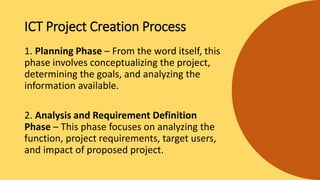
1. Planning Phase – From the word itself, this
phase involves conceptualizing the project,
determining the goals, and analyzing the
information available.
2. Analysis and Requirement Definition
Phase – This phase focuses on analyzing the
function, project requirements, target users,
and impact of proposed project.
ICT Project Creation Process
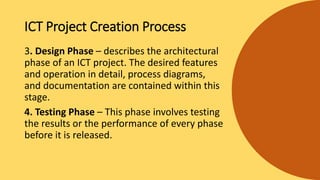
3. Design Phase – describes the architectural
phase of an ICT project. The desired features
and operation in detail, process diagrams,
and documentation are contained within this
stage.
4. Testing Phase – This phase involves testing
the results or the performance of every phase
before it is released.
ICT Project Creation Process
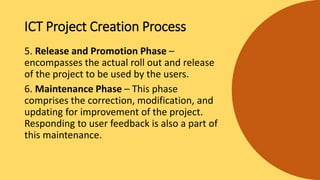
5. Release and Promotion Phase –
encompasses the actual roll out and release
of the project to be used by the users.
6. Maintenance Phase – This phase
comprises the correction, modification, and
updating for improvement of the project.
Responding to user feedback is also a part of
this maintenance.
What Should Be Considered in Planning?
Demographics is described as factual
information that is gathered from users
of the ICT application. The information
can be categorized into different labels
such as age, gender, income, religion,
and profession.
Writing a Project Proposal
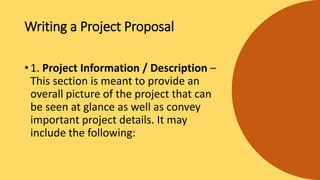
• 1. Project Information / Description –
This section is meant to provide an
overall picture of the project that can
be seen at glance as well as convey
important project details. It may
include the following:
Writing a Project Proposal
a. Project Title: (PROJECT TITLE);
b. Type of Project: (education-training/
health-medical mission/ art exhibit,
etc.);
c. Project Proponent/s: (Name of
organization/ name of the people
involves);
Writing a Project Proposal
d. Project Beneficiaries: (Urban poor,
women, youth, etc.);
e. Date of Implementation/ Duration:
(Start date/ number of implementation
days);
f. Budget Requirement: (overall amount
of budget requirement);
g. Project Contacts: (List of individuals
involved with the project.)
Writing a Project Proposal
• 2. Project Background – explains what
needs/ problems you are trying to
solve, and why these needs/ problems
are worth solving. The project’s brief
history, references, and other
supporting documentation may also be
provided here.
Writing a Project Proposal
3. Project Objectives – The goals of the
project should already be set from the
beginning.
4. Desired Impact and Outcome of the
Project – describes the long-term effect
of the project and specific measures to
sustain it.
Writing a Project Proposal
5. Risk Management Plan – it includes
the risks and factors that may hamper or
hinder the successful implementation of
the project activities and the
achievement of project outputs. This
also includes measures to mitigate the
effects of project risks encountered.
6. Project organization and Staffing –
describes the people involved and their
responsibilities in the project.
. Project organization and Staffing
Writing a Project Proposal
7. Work Plan - a detailed project
schedule. It is a list of tasks that will be
performed for the project. The work
plan is a means to expose the project’s
risks which could be used to make
reasonable estimates of the man hours
required to complete it. A milestone
chart can also be used in this section to
monitor work progress at any given
time.
Writing a Project Proposal
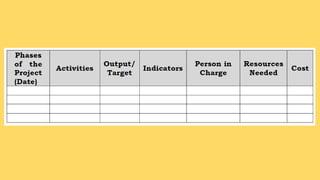
8. Budget Requirement – A detailed, line
item budget that includes the cost
needed for every part of the project. The
following table may be used to repeat
budget requirement.
Writing a Project Proposal
9. Other Relevant Information –
includes any information that will
support a request for funding such as
brief enumeration of stakeholders’
pledge and lined-up projects to
complement the current.
Writing a Project Proposal
10. Conclusion – a short summary that
explains the potential value of the
project.
11. Appendix – refers to additional
charts, graphs, reports, etc. that we a re
cited in the proposal, but were not
appropriate to be placed in the main
body of the document.

Developing an ICT Project for Social Change.pptx

  • 1.
  • 2.
    ICT Project CreationProcess 1. Planning Phase – From the word itself, this phase involves conceptualizing the project, determining the goals, and analyzing the information available. 2. Analysis and Requirement Definition Phase – This phase focuses on analyzing the function, project requirements, target users, and impact of proposed project.
  • 3.
    ICT Project CreationProcess 3. Design Phase – describes the architectural phase of an ICT project. The desired features and operation in detail, process diagrams, and documentation are contained within this stage. 4. Testing Phase – This phase involves testing the results or the performance of every phase before it is released.
  • 4.
    ICT Project CreationProcess 5. Release and Promotion Phase – encompasses the actual roll out and release of the project to be used by the users. 6. Maintenance Phase – This phase comprises the correction, modification, and updating for improvement of the project. Responding to user feedback is also a part of this maintenance.
  • 5.
    What Should BeConsidered in Planning? Demographics is described as factual information that is gathered from users of the ICT application. The information can be categorized into different labels such as age, gender, income, religion, and profession.
  • 6.
    Writing a ProjectProposal • 1. Project Information / Description – This section is meant to provide an overall picture of the project that can be seen at glance as well as convey important project details. It may include the following:
  • 7.
    Writing a ProjectProposal a. Project Title: (PROJECT TITLE); b. Type of Project: (education-training/ health-medical mission/ art exhibit, etc.); c. Project Proponent/s: (Name of organization/ name of the people involves);
  • 8.
    Writing a ProjectProposal d. Project Beneficiaries: (Urban poor, women, youth, etc.); e. Date of Implementation/ Duration: (Start date/ number of implementation days); f. Budget Requirement: (overall amount of budget requirement); g. Project Contacts: (List of individuals involved with the project.)
  • 9.
    Writing a ProjectProposal • 2. Project Background – explains what needs/ problems you are trying to solve, and why these needs/ problems are worth solving. The project’s brief history, references, and other supporting documentation may also be provided here.
  • 10.
    Writing a ProjectProposal 3. Project Objectives – The goals of the project should already be set from the beginning. 4. Desired Impact and Outcome of the Project – describes the long-term effect of the project and specific measures to sustain it.
  • 11.
    Writing a ProjectProposal 5. Risk Management Plan – it includes the risks and factors that may hamper or hinder the successful implementation of the project activities and the achievement of project outputs. This also includes measures to mitigate the effects of project risks encountered. 6. Project organization and Staffing – describes the people involved and their responsibilities in the project.
  • 12.
  • 13.
    Writing a ProjectProposal 7. Work Plan - a detailed project schedule. It is a list of tasks that will be performed for the project. The work plan is a means to expose the project’s risks which could be used to make reasonable estimates of the man hours required to complete it. A milestone chart can also be used in this section to monitor work progress at any given time.
  • 15.
    Writing a ProjectProposal 8. Budget Requirement – A detailed, line item budget that includes the cost needed for every part of the project. The following table may be used to repeat budget requirement.
  • 16.
    Writing a ProjectProposal 9. Other Relevant Information – includes any information that will support a request for funding such as brief enumeration of stakeholders’ pledge and lined-up projects to complement the current.
  • 17.
    Writing a ProjectProposal 10. Conclusion – a short summary that explains the potential value of the project. 11. Appendix – refers to additional charts, graphs, reports, etc. that we a re cited in the proposal, but were not appropriate to be placed in the main body of the document.