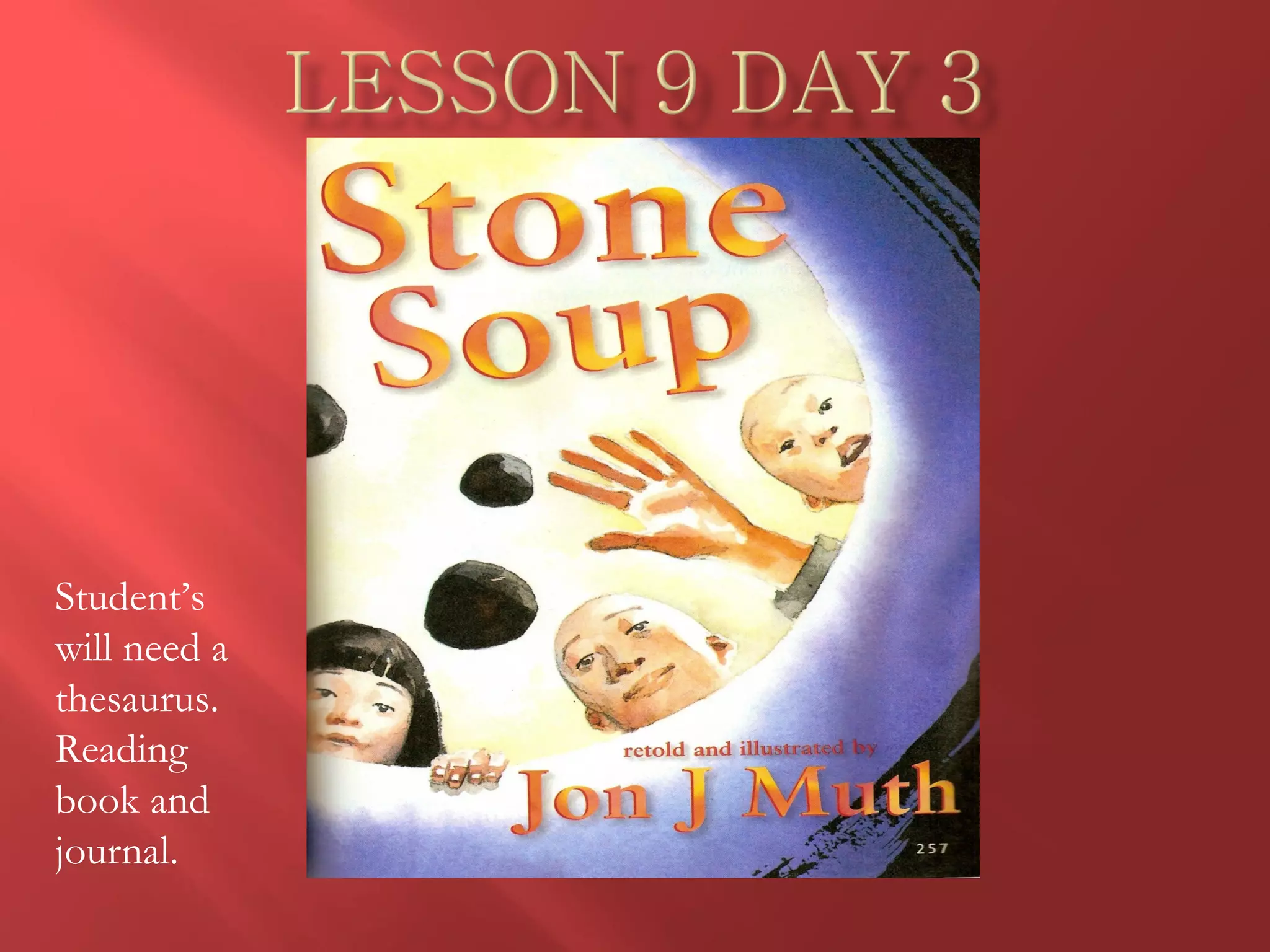
Student’s 
will need a 
thesaurus. 
Reading 
book and 
journal.
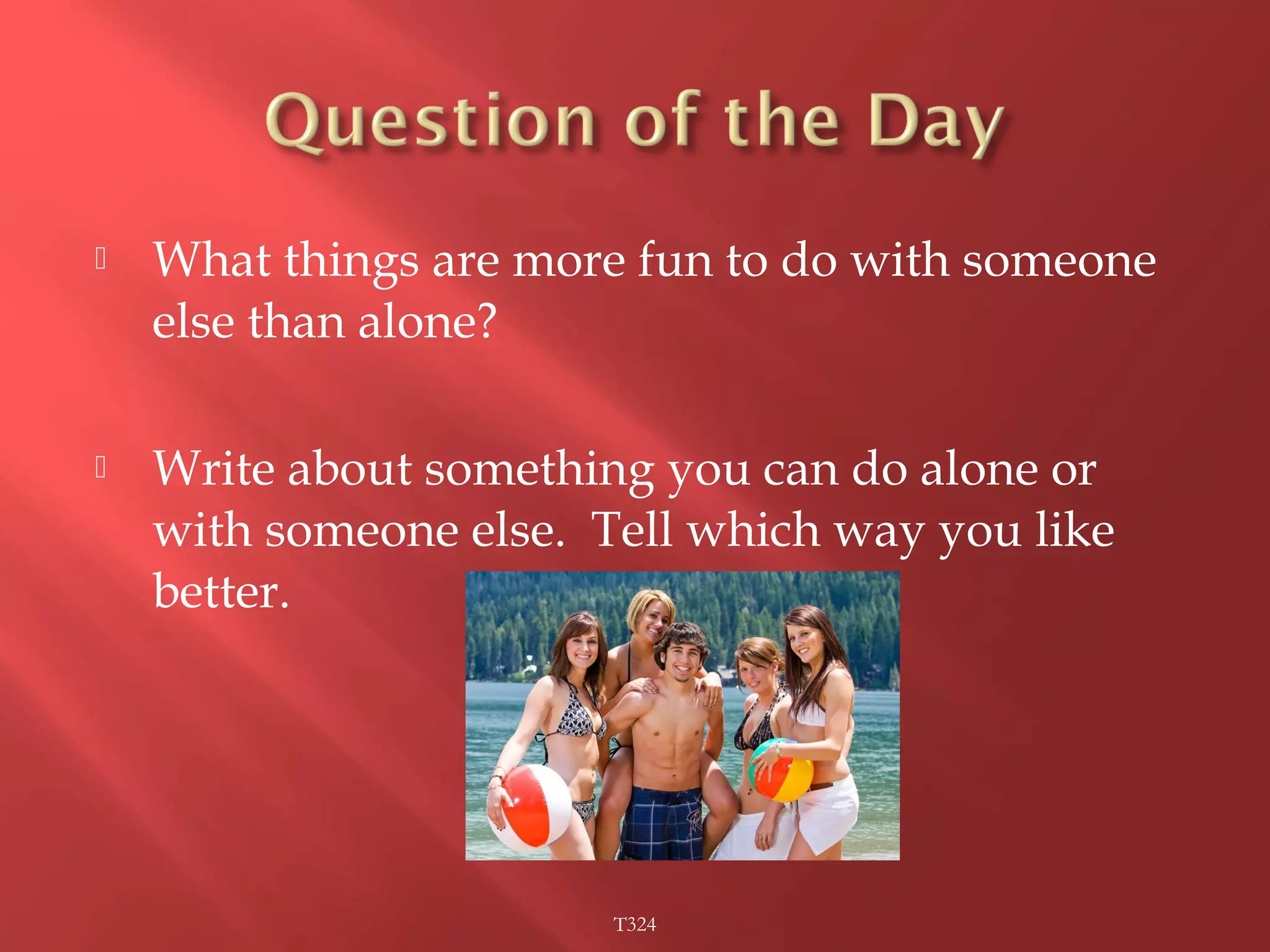
 What things are more fun to do with someone 
else than alone? 
 Write about something you can do alone or 
with someone else. Tell which way you like 
better. 
T324
 Why might you read a poem more than once? 
 to enjoy it again 
 to practice fluency 
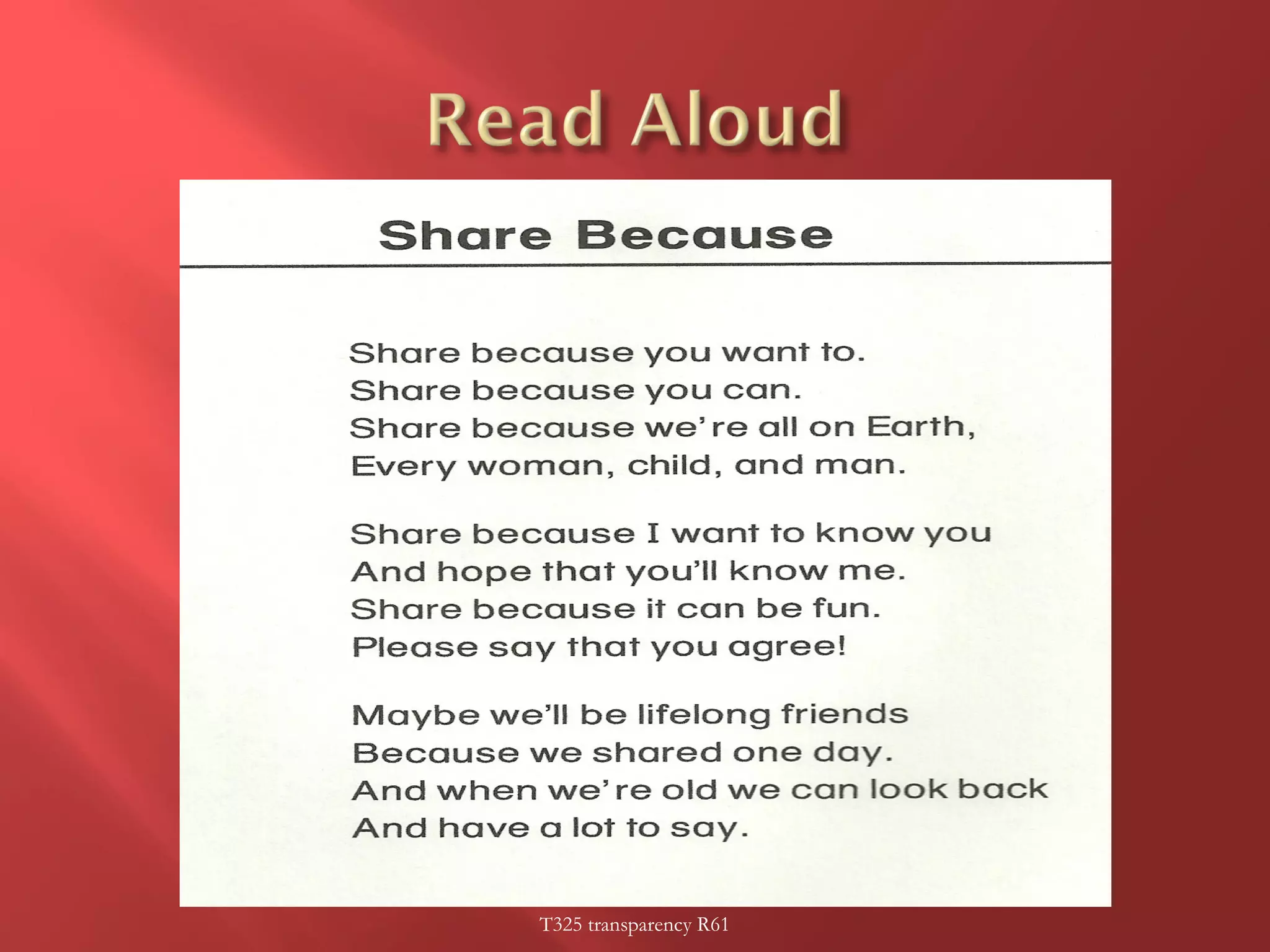
 I am going to reread the poem “Share 
Because”. Follow along as I read. Then you 
will practice reading it fluently and 
expressively with partners. 
T325
T325 transparency R61
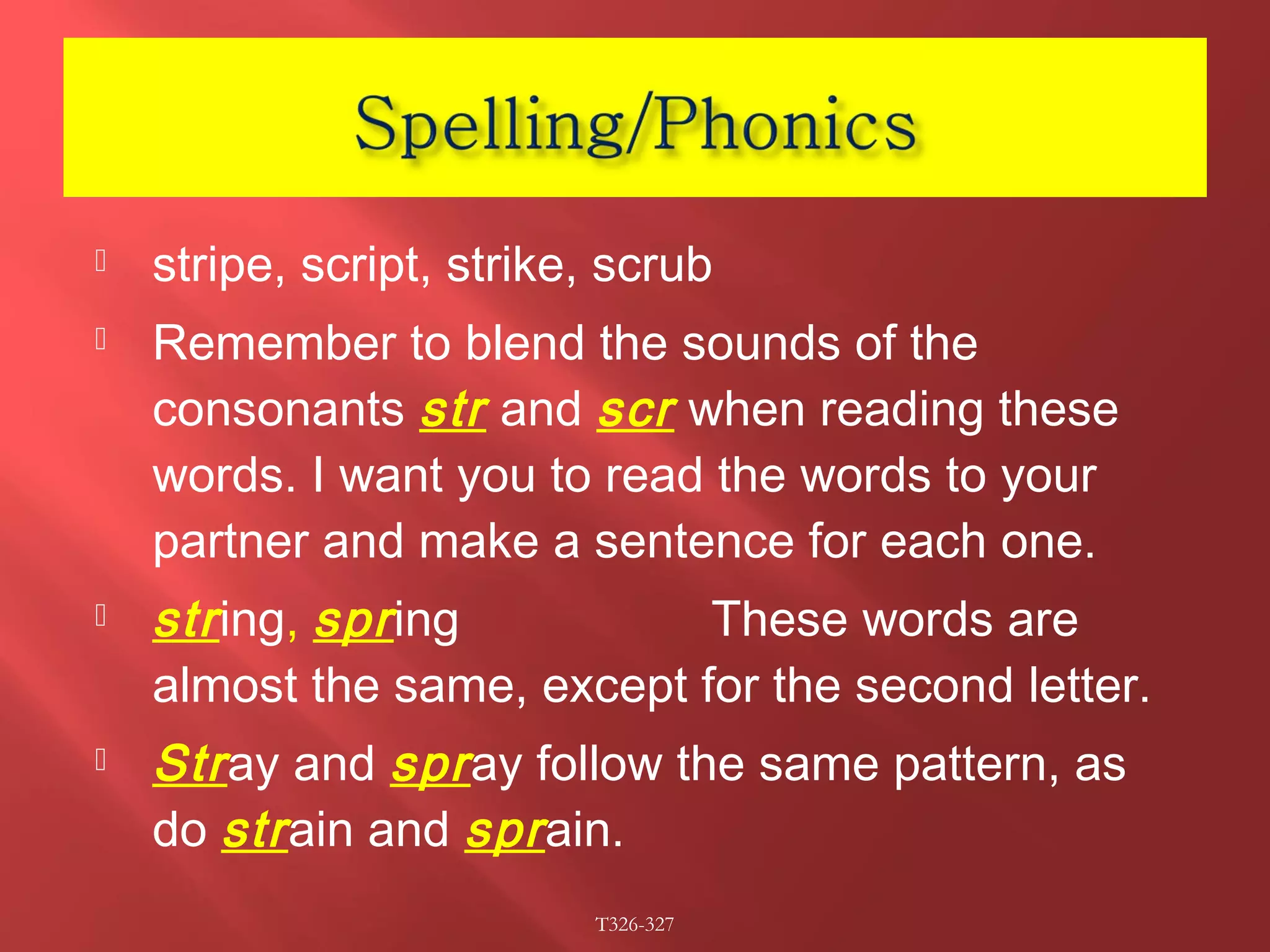
 stripe, script, strike, scrub 
 Remember to blend the sounds of the 
consonants str and scr when reading these 
words. I want you to read the words to your 
partner and make a sentence for each one. 
 str ing, spr ing These words are 
almost the same, except for the second letter. 
 Str ay and spr ay follow the same pattern, as 
do str ain and spr ain. 
T326-327
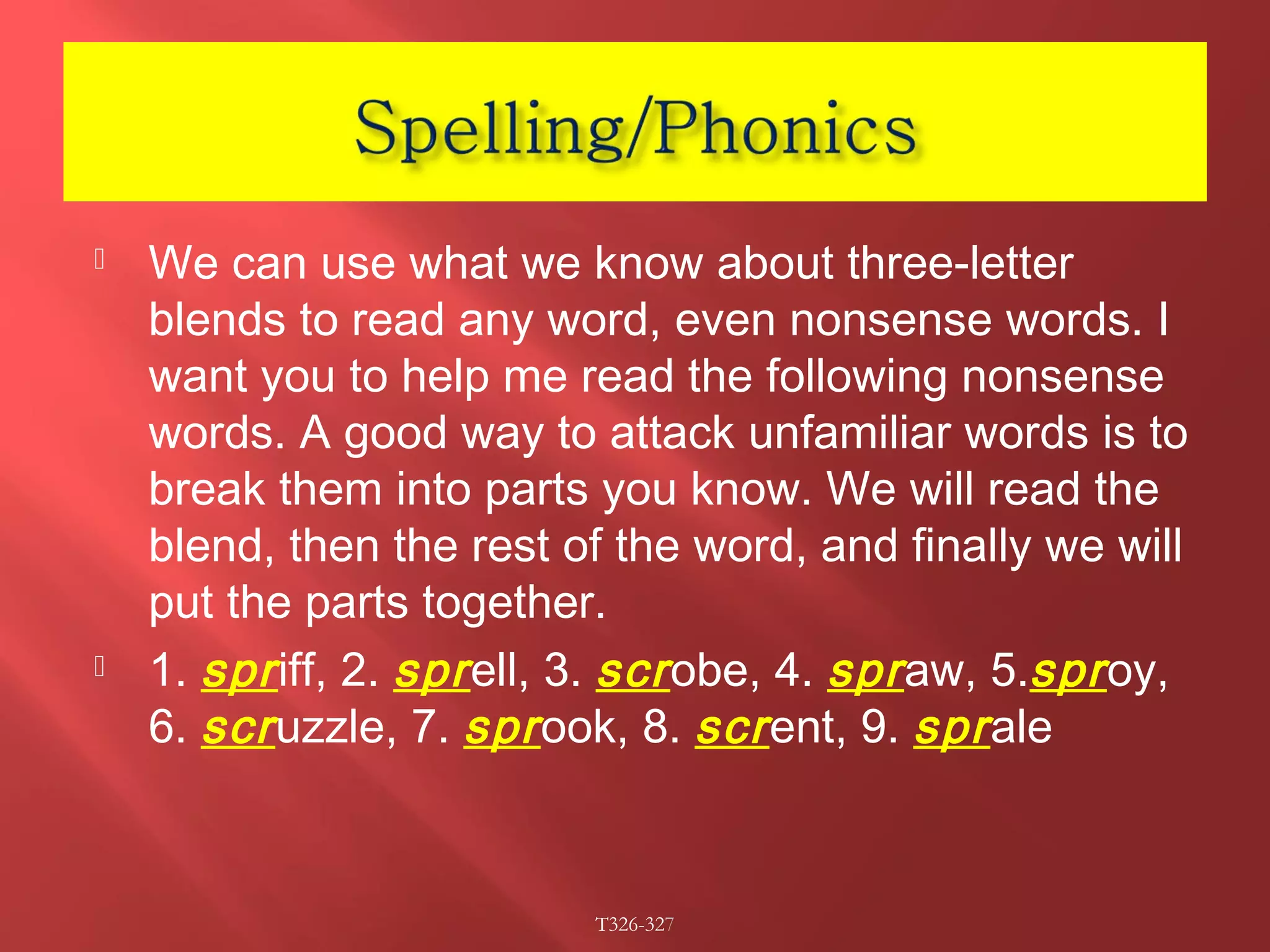
 We can use what we know about three-letter 
blends to read any word, even nonsense words. I 
want you to help me read the following nonsense 
words. A good way to attack unfamiliar words is to 
break them into parts you know. We will read the 
blend, then the rest of the word, and finally we will 
put the parts together. 
 1. spr iff, 2. spr ell, 3. scr obe, 4. spr aw, 5.spr oy, 
6. scr uzzle, 7. spr ook, 8. scr ent, 9. spr ale 
T326-327
• Good readers 
• do not rush when they read aloud 
• pay attention to punctuation 
• pay attention to the meanings of the 
words to help them read 
expressively. 
• pause slightly when they see a 
comma and pause longer when they 
see a period. 
T328
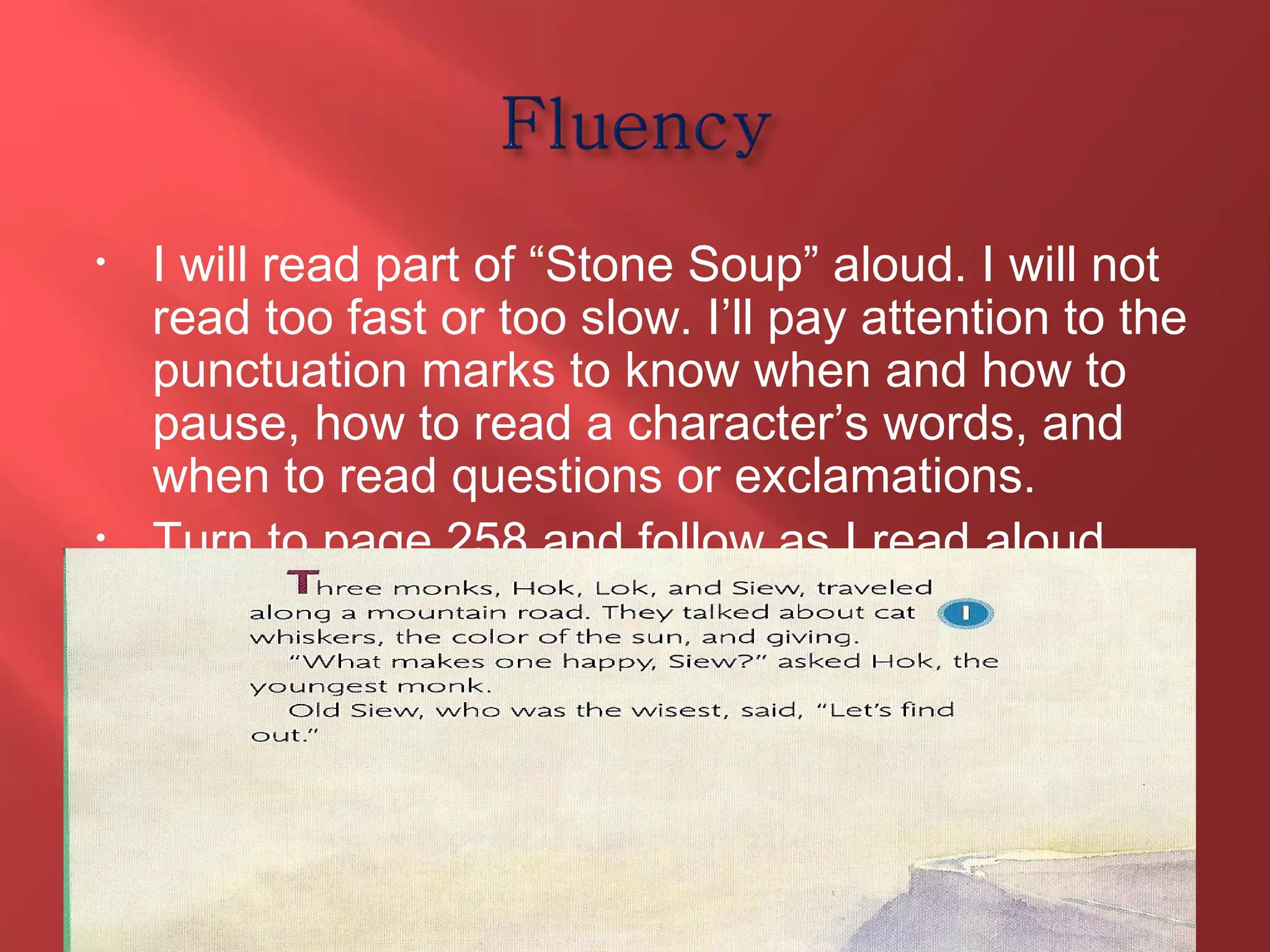
• I will read part of “Stone Soup” aloud. I will not 
read too fast or too slow. I’ll pay attention to the 
punctuation marks to know when and how to 
pause, how to read a character’s words, and 
when to read questions or exclamations. 
• Turn to page 258 and follow as I read aloud. 
T328
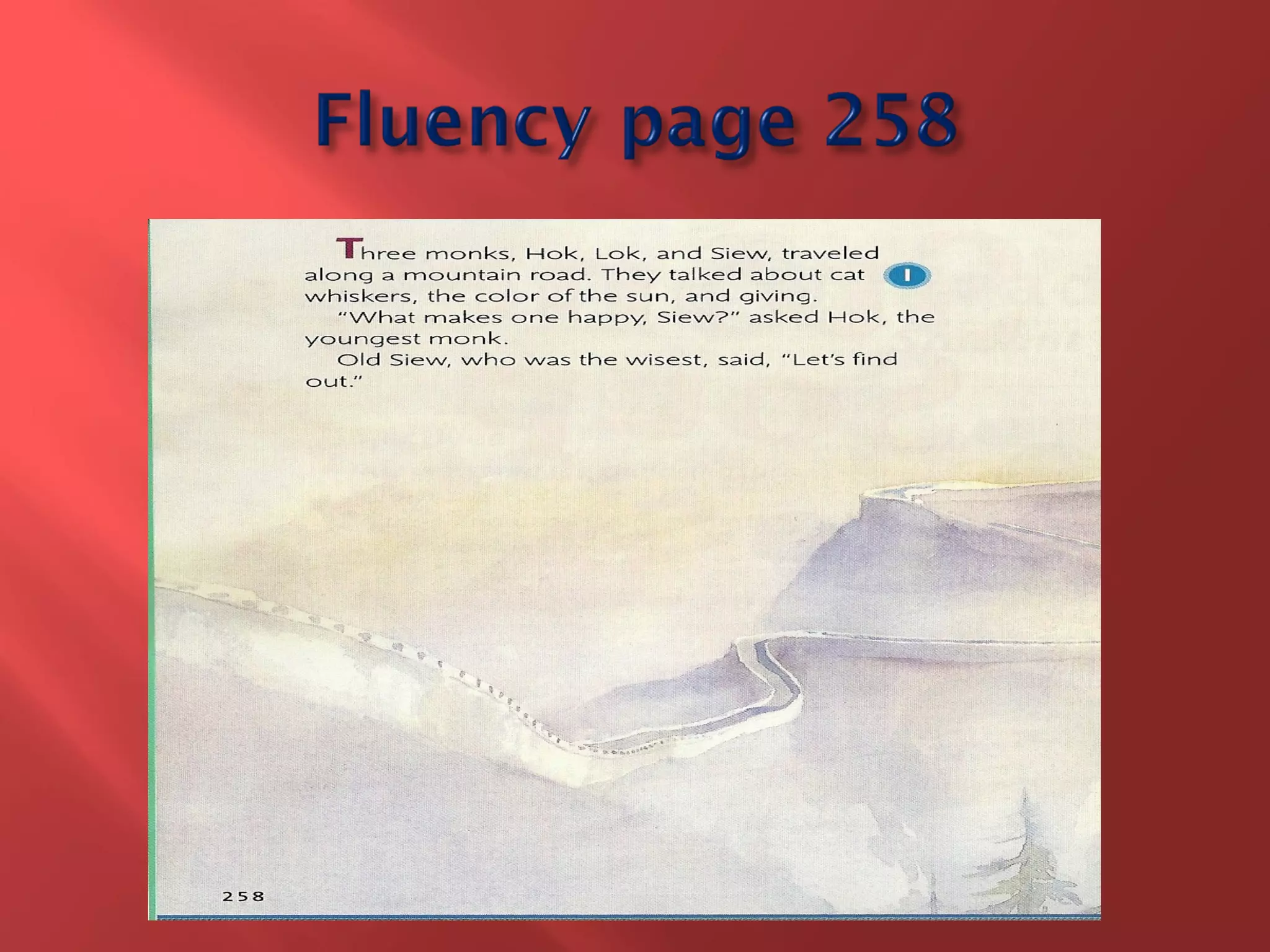
 I want you to read page 258 with your partner. I 
want you to read at a proper pace and pay 
attention to punctuation marks. Let’s find 
places in the story where the characters use 
dialogue, or their own words. When we come 
to dialogue, we should read with stronger 
expression. 
 Read page 258 with your partner. (go to next 
slide.)
 Choose your favorite page from “Stone Soup” 
to read with your partner. You may read only 
the first half of the page if it is long. Remember 
to be a good reader and pay attention to 
punctuation. 
T328
 You can often discover the main idea of a 
selection by thinking about what happens in the 
beginning, in the middle, and at the end. 
 We will revisit “Stone Soup” to discover the 
main idea of the story. 
 We will also fill in a graphic organizer to help us 
with our ideas. 
T329
 On page 258, the monks decide to find out what makes people 
happy. What does this detail tell you about the main idea? 
 The story is probably about how to find happiness. 
 On page 266, each villager is giving what he or she has. The 
next person gives even more. How does this detail add to the 
main idea? 
 Seeing others gain happiness from sharing encourages others. 
 On page 271, the villagers tell the monks, “With the gifts you 
gave given, we will always have plenty. You have shown us that 
sharing makes us all richer.” How does this detail help explain 
the main idea? 
 It shows that the villagers have learned that sharing can bring 
happiness. 
 We will put these ideas into a graphic organizer to help us better 
understand the main idea and three important details. 
T329
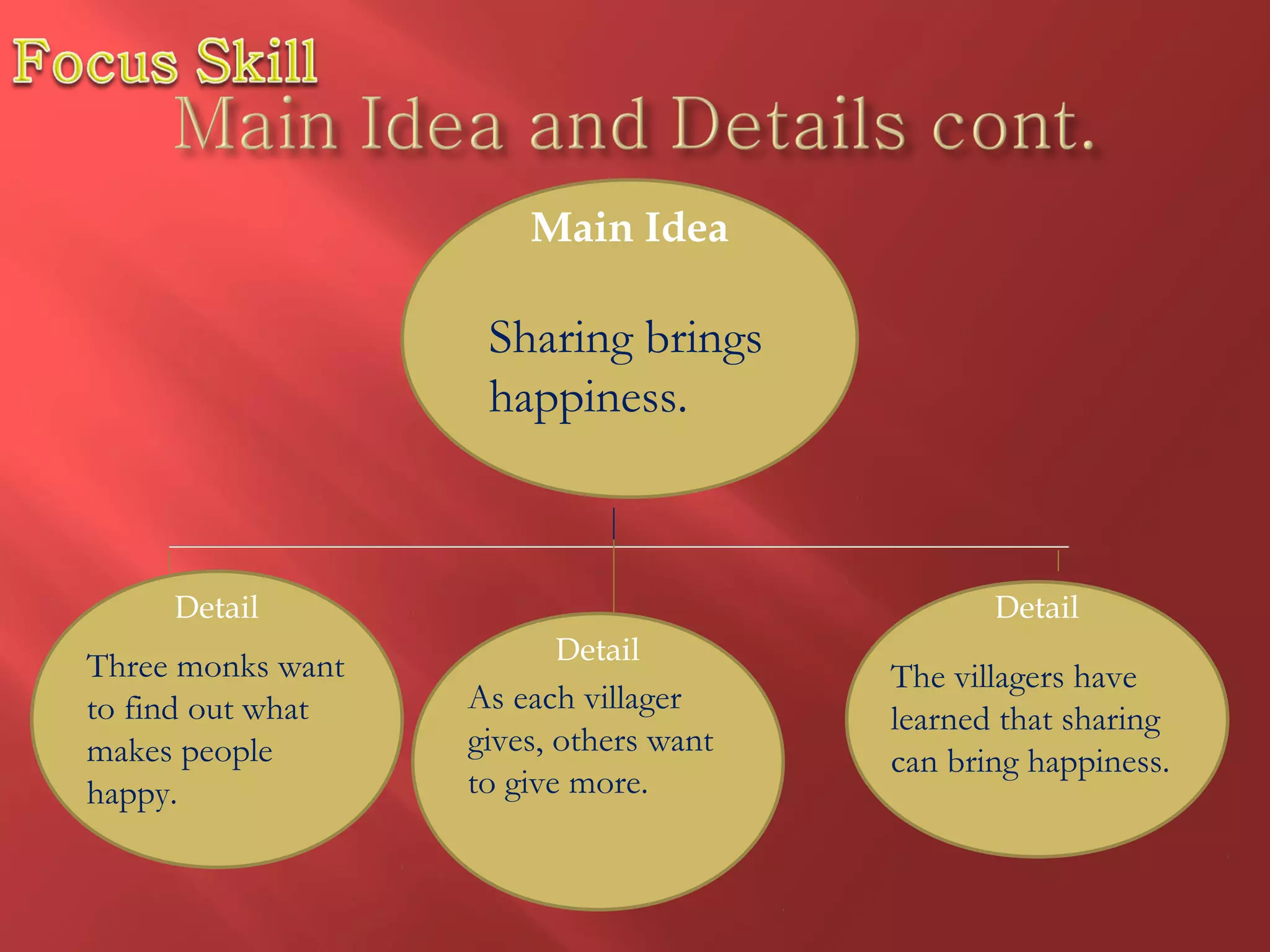
Main Idea 
Sharing brings 
happiness. 
Detail Detail 
Detail 
Three monks want 
to find out what 
makes people 
happy. 
As each villager 
gives, others want 
to give more. 
The villagers have 
learned that sharing 
can bring happiness.
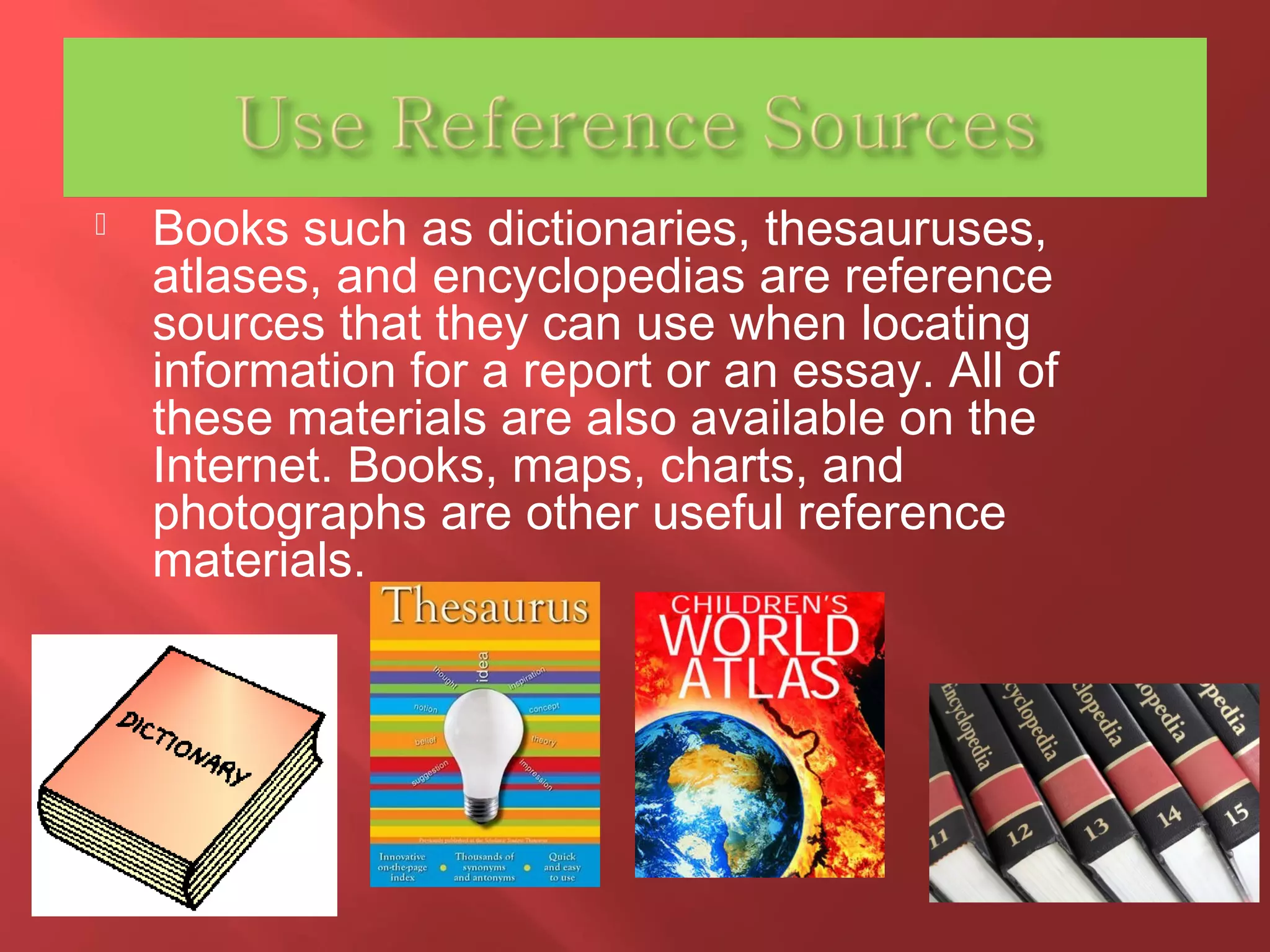
 Books such as dictionaries, thesauruses, 
atlases, and encyclopedias are reference 
sources that they can use when locating 
information for a report or an essay. All of 
these materials are also available on the 
Internet. Books, maps, charts, and 
photographs are other useful reference 
materials.
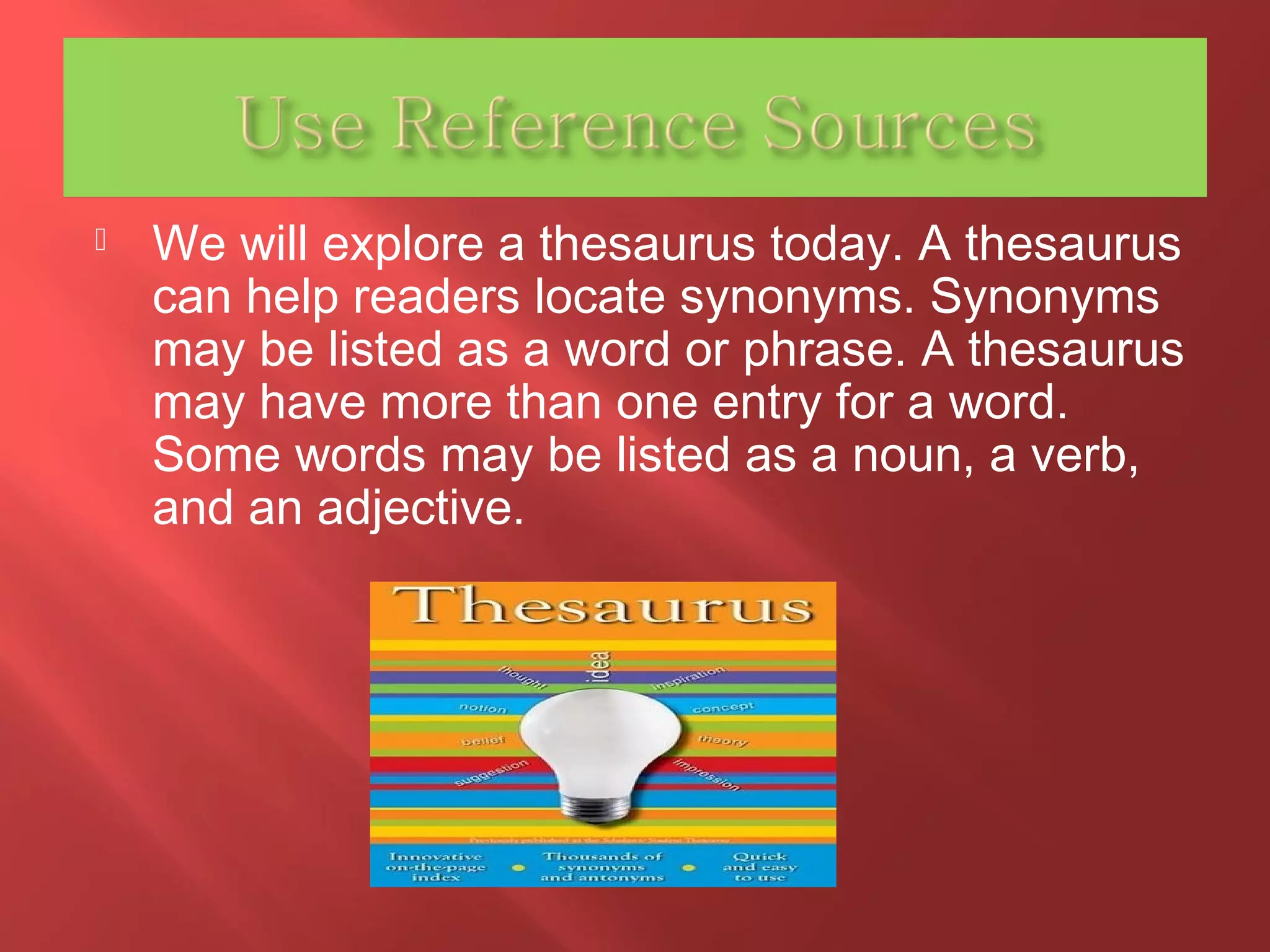
 We will explore a thesaurus today. A thesaurus 
can help readers locate synonyms. Synonyms 
may be listed as a word or phrase. A thesaurus 
may have more than one entry for a word. 
Some words may be listed as a noun, a verb, 
and an adjective.
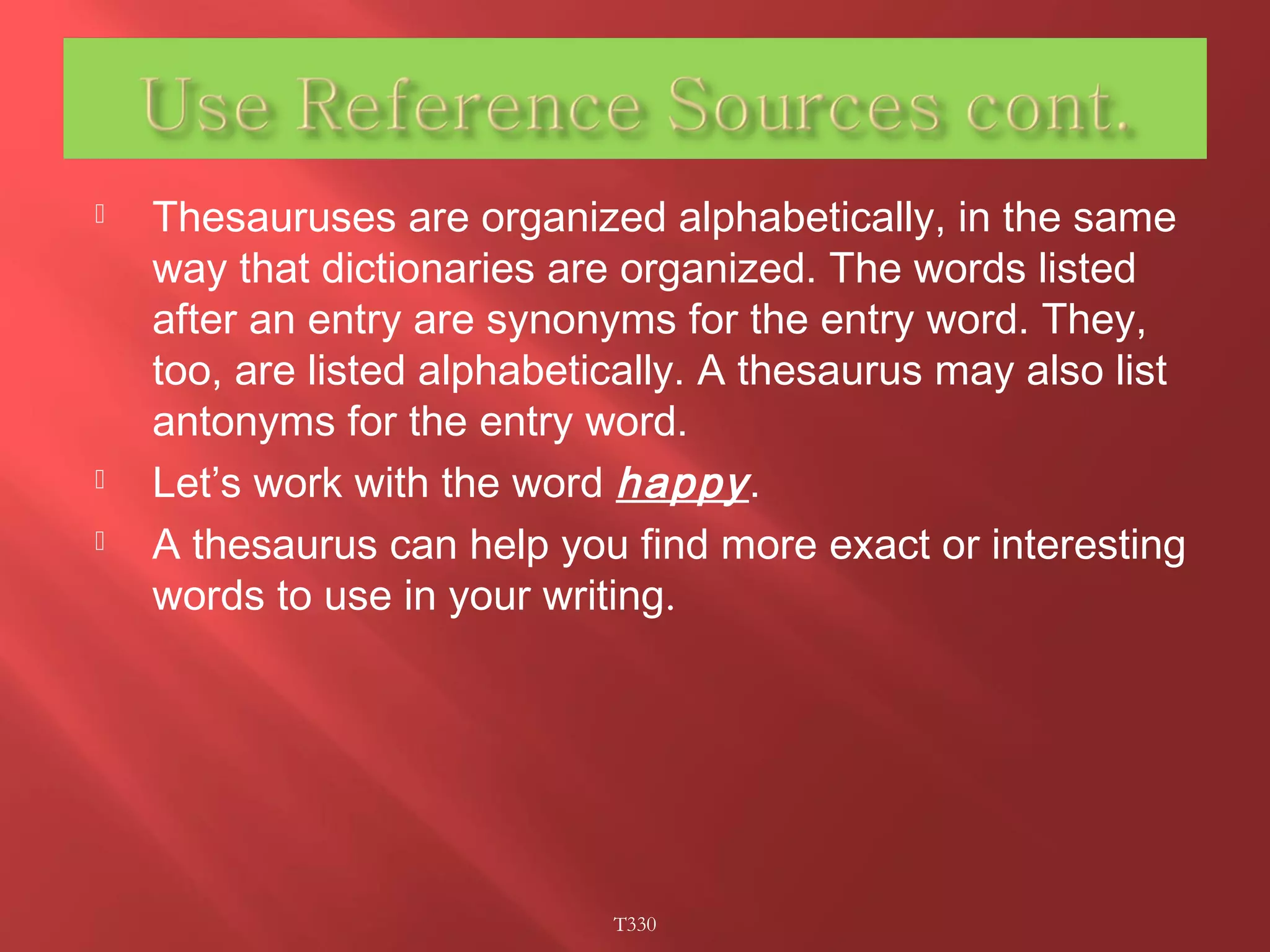
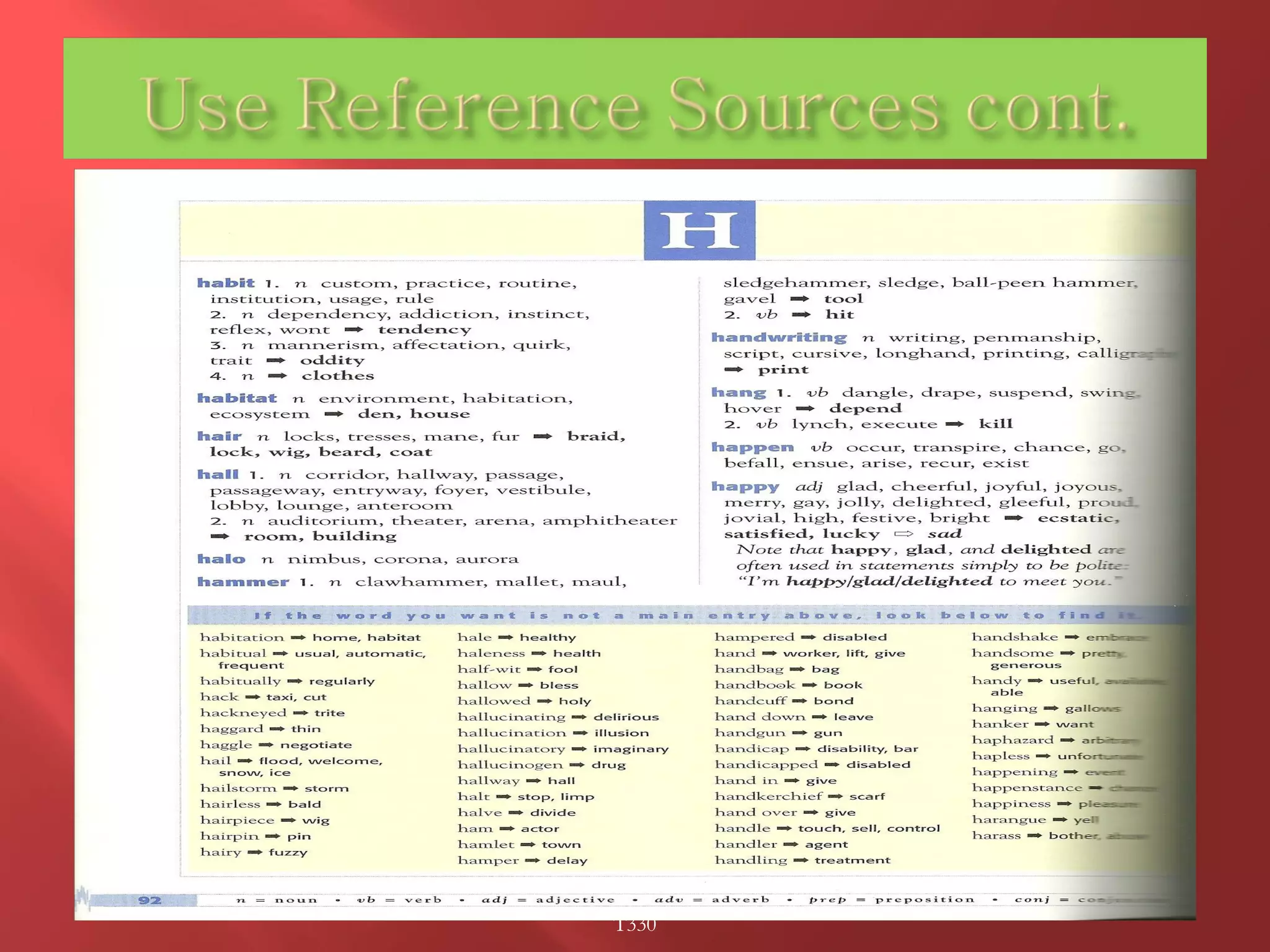
 Thesauruses are organized alphabetically, in the same 
way that dictionaries are organized. The words listed 
after an entry are synonyms for the entry word. They, 
too, are listed alphabetically. A thesaurus may also list 
antonyms for the entry word. 
 Let’s work with the word happy . 
 A thesaurus can help you find more exact or interesting 
words to use in your writing. 
T330
T330
 Look up these words in a thesaurus. Write 
down one synonym for each word. 
 walk 
 sleepy 
 angry 
 leader 
 friend 
Extra support page 74
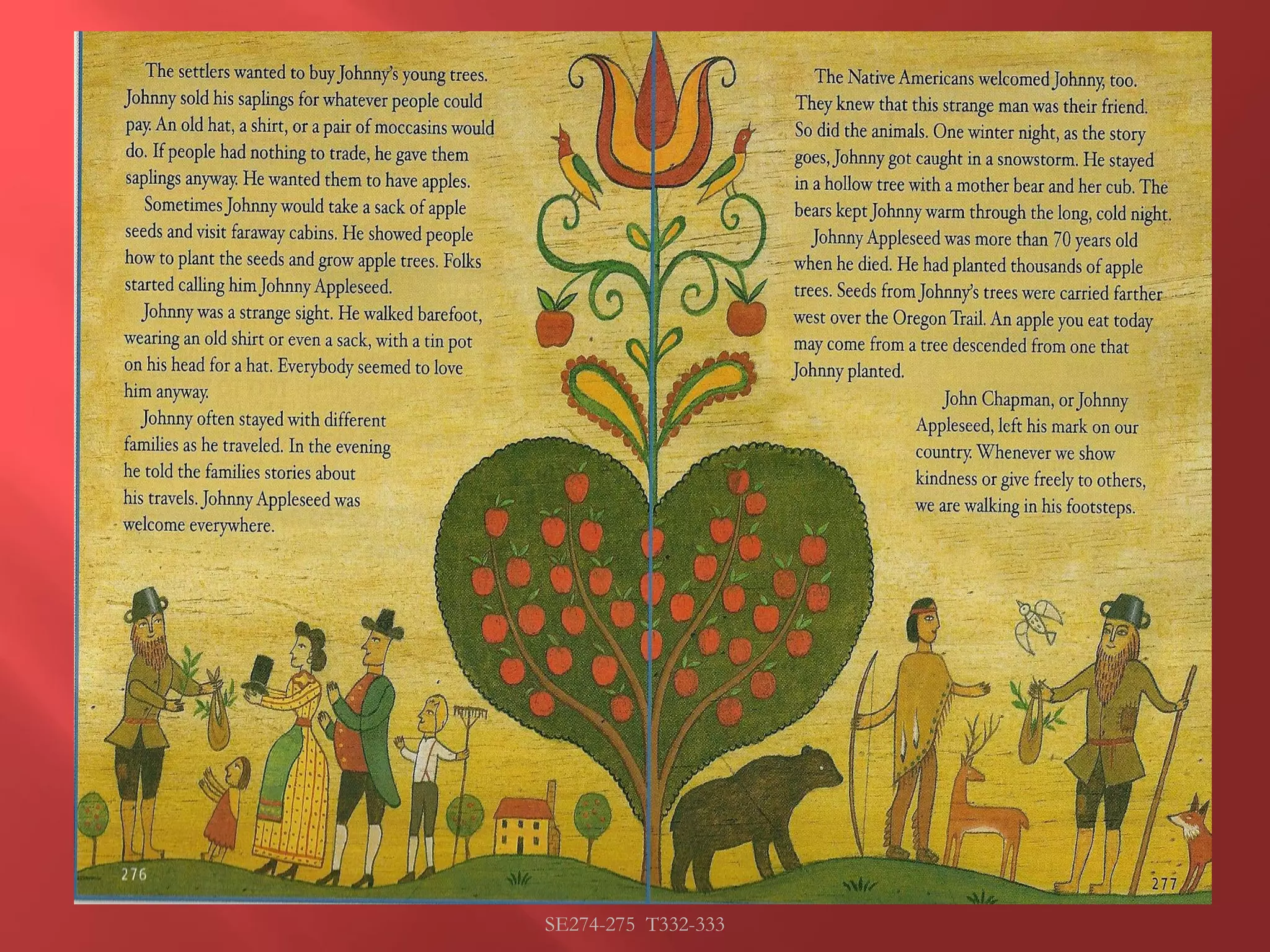
SE274-275 T332-333 
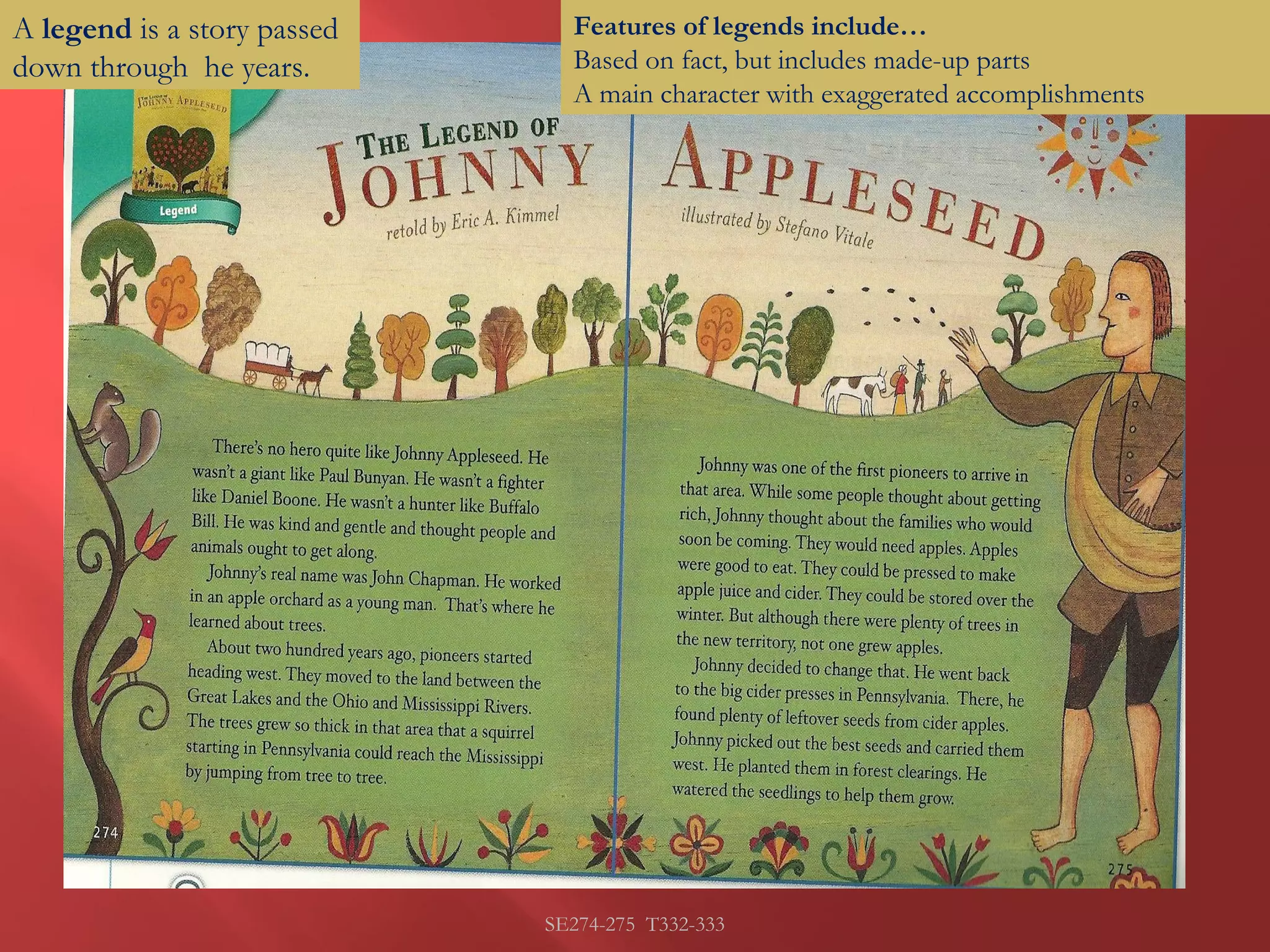
A legend is a story passed 
down through he years. 
Features of legends include… 
Based on fact, but includes made-up parts 
A main character with exaggerated accomplishments
SE274-275 T332-333
 What is the main idea of the legend? 
 Johnny Appleseed left his mark on America by 
carrying apple trees to the western part of the 
country. 
 What would you like to say to Johnny 
Appleseed? 
 How can you tell that this is a legend? 
 Johnny’s real name is given, so the story is 
based on fact. We don’t know how much else 
is true. 
T333
 dense : Does the group of desks in this 
classroom look dense ? 
 If something is very heavy, do you think 
it is dense ? Why or why not? 
 reaction : If someone tickles your foot, 
what is your reaction ? 
 What is the reaction of ice to heat? 
T336-337
 ingredients : What are some of the 
ingredients in pancakes? 
 What ingredients would you use to make 
a sandwich? 
 momentum: If everyone copied your 
yellow shoelaces, would your idea have 
momentum? 
 If your school collected pennies for charity, 
how could the idea gain momentum? 
T336-337
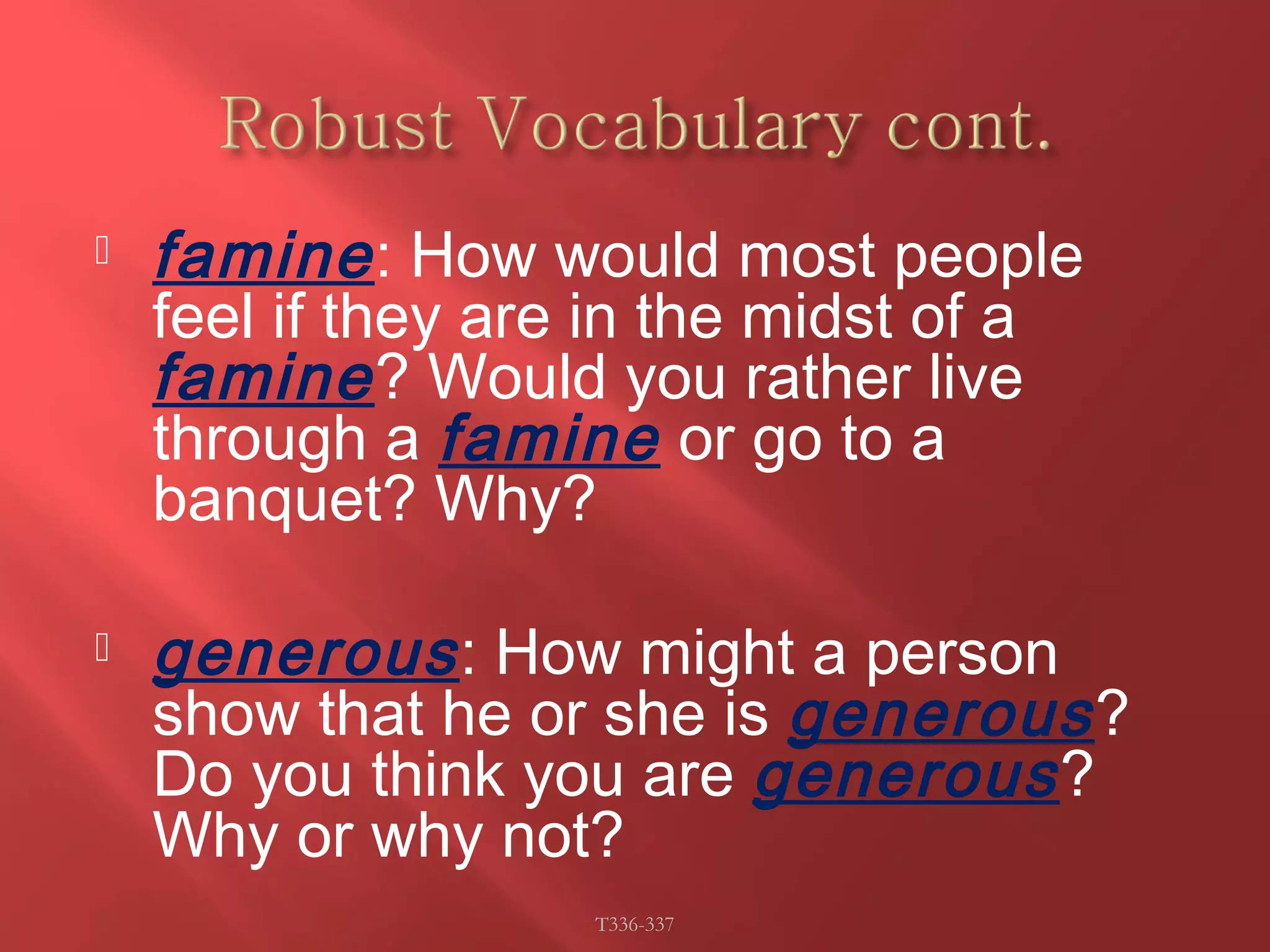
 famine : How would most people 
feel if they are in the midst of a 
famine ? Would you rather live 
through a famine or go to a 
banquet? Why? 
 generous : How might a person 
show that he or she is generous ? 
Do you think you are generous ? 
Why or why not? 
T336-337
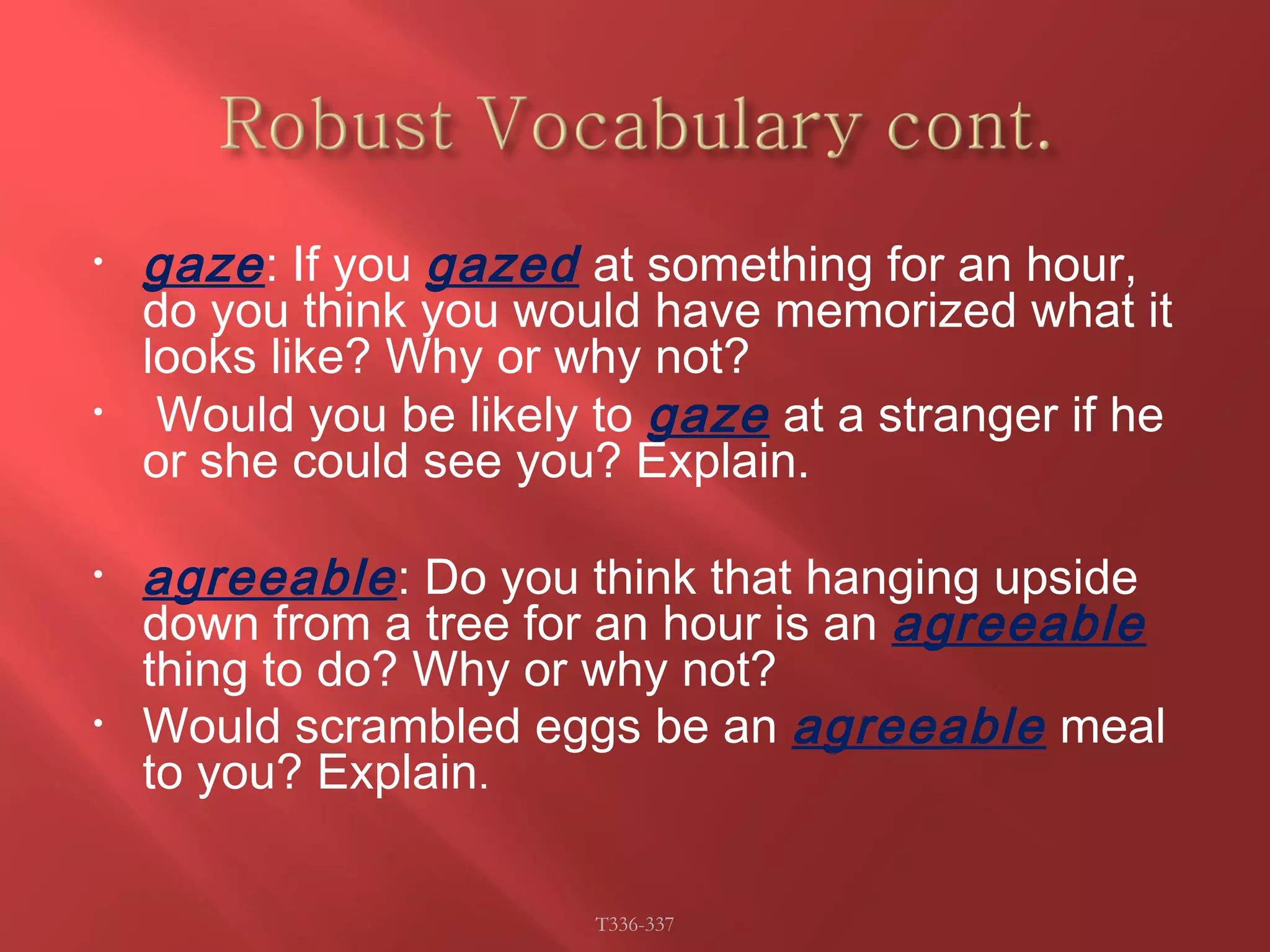
• gaze : If you gazed at something for an hour, 
do you think you would have memorized what it 
looks like? Why or why not? 
• Would you be likely to gaze at a stranger if he 
or she could see you? Explain. 
• agreeable : Do you think that hanging upside 
down from a tree for an hour is an agreeable 
thing to do? Why or why not? 
• Would scrambled eggs be an agreeable meal 
to you? Explain. 
T336-337
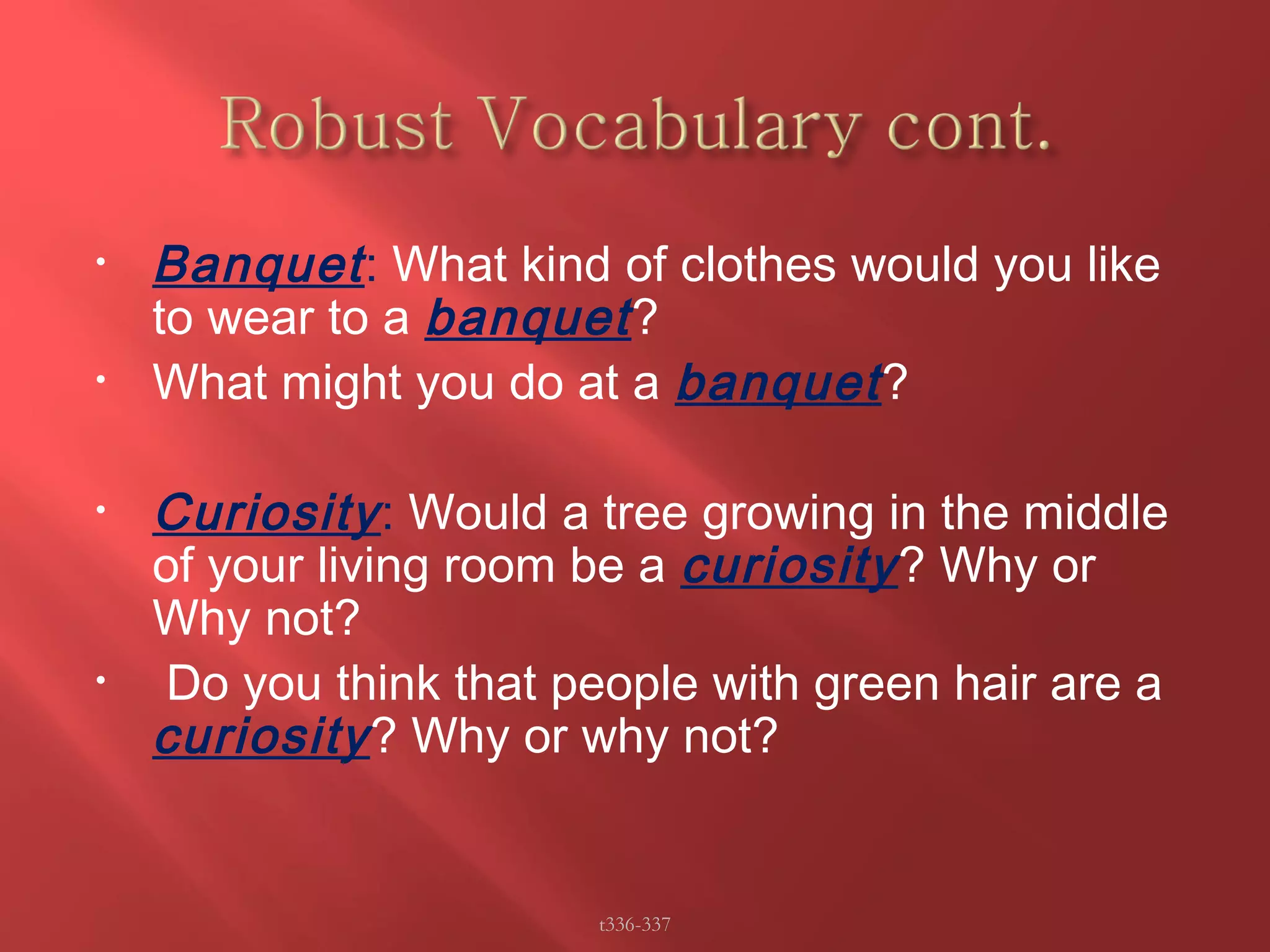
• Banquet : What kind of clothes would you like 
to wear to a banquet ? 
• What might you do at a banquet ? 
• Curiosity : Would a tree growing in the middle 
of your living room be a curiosity ? Why or 
Why not? 
• Do you think that people with green hair are a 
curiosity ? Why or why not? 
t336-337
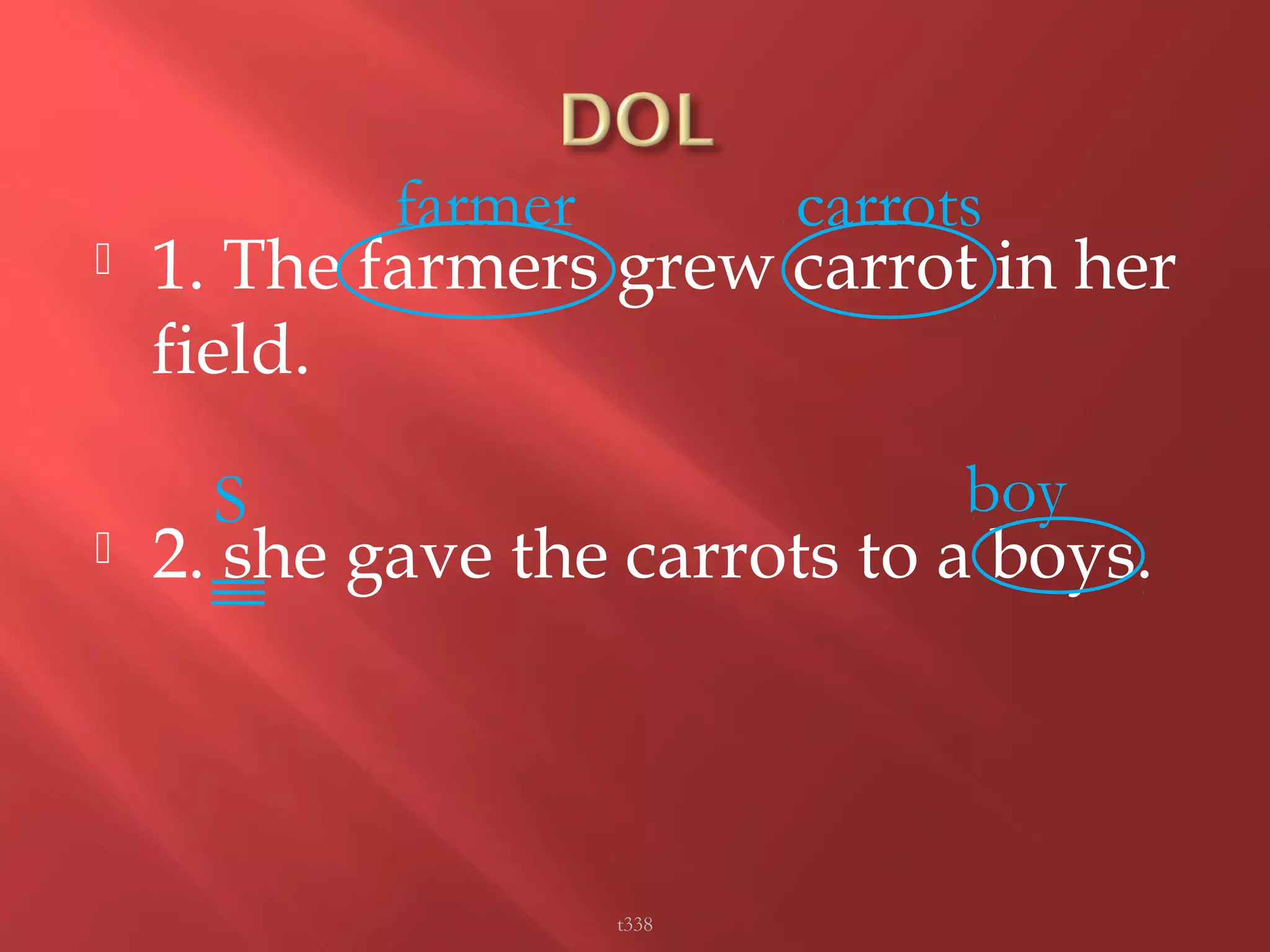
farmer carrots 
 1. The farmers grew carrot in her 
field. 
S boy 
 2. she gave the carrots to a boys. 
t338
 The following words are plural nouns (They name more 
than one.): carrots, homes, boys, cakes, mountains. 
 Each of these plural nouns is formed by adding an –s to 
the singular form. 
 I want you to help me make the following singular nouns 
plural. 1. monk; 2. lunch; 3.fox; 4. lady; 5. wish; 6. 
potato 
 1. monks ; 2. lunches ; 3. foxes ; 4. ladies ; 5.wishes ; 6. 
potatoes 
 Remember the rules for making nouns plural: if the 
word ends in ch, x, sh. or a vowel , you add –es ; if 
the word ends with y, change the y to i and add – 
es. 
T338
 With your partner, create a list of 8 plural 
nouns. Then work together to create sentences 
with at least 4 of your plural nouns. We will 
share in 5 minutes. 
T338
 We are going to use our prewriting information 
from yesterday to write a first draft of a 
summary. 
 Remember that a good summary includes: 
 The main idea and key details of a passage 
 Uses words that will help readers understand the 
exact meaning of a passage 
 Uses strong, exact language. 
T339
 I will read aloud the first and last pages of 
“Stone Soup.” 
 At the beginning of the story, the monks want 
to find out what makes people happy. In the 
end of the story, they learn that sharing brings 
happiness. Should this information be included 
in a summary of “Stone Soup”? 
T339
 I want you to use the list of ideas and facts 
from yesterday to create a summary paragraph 
of the story you chose. Remember to use 
strong, exact words in your summary. 
t339

Lesson 9 day 3

  • 1.
    Student’s will needa thesaurus. Reading book and journal.
  • 2.
     What thingsare more fun to do with someone else than alone?  Write about something you can do alone or with someone else. Tell which way you like better. T324
  • 3.
     Why mightyou read a poem more than once?  to enjoy it again  to practice fluency  I am going to reread the poem “Share Because”. Follow along as I read. Then you will practice reading it fluently and expressively with partners. T325
  • 4.
  • 5.
     stripe, script,strike, scrub  Remember to blend the sounds of the consonants str and scr when reading these words. I want you to read the words to your partner and make a sentence for each one.  str ing, spr ing These words are almost the same, except for the second letter.  Str ay and spr ay follow the same pattern, as do str ain and spr ain. T326-327
  • 6.
     We canuse what we know about three-letter blends to read any word, even nonsense words. I want you to help me read the following nonsense words. A good way to attack unfamiliar words is to break them into parts you know. We will read the blend, then the rest of the word, and finally we will put the parts together.  1. spr iff, 2. spr ell, 3. scr obe, 4. spr aw, 5.spr oy, 6. scr uzzle, 7. spr ook, 8. scr ent, 9. spr ale T326-327
  • 7.
    • Good readers • do not rush when they read aloud • pay attention to punctuation • pay attention to the meanings of the words to help them read expressively. • pause slightly when they see a comma and pause longer when they see a period. T328
  • 8.
    • I willread part of “Stone Soup” aloud. I will not read too fast or too slow. I’ll pay attention to the punctuation marks to know when and how to pause, how to read a character’s words, and when to read questions or exclamations. • Turn to page 258 and follow as I read aloud. T328
  • 9.
     I wantyou to read page 258 with your partner. I want you to read at a proper pace and pay attention to punctuation marks. Let’s find places in the story where the characters use dialogue, or their own words. When we come to dialogue, we should read with stronger expression.  Read page 258 with your partner. (go to next slide.)
  • 11.
     Choose yourfavorite page from “Stone Soup” to read with your partner. You may read only the first half of the page if it is long. Remember to be a good reader and pay attention to punctuation. T328
  • 12.
     You canoften discover the main idea of a selection by thinking about what happens in the beginning, in the middle, and at the end.  We will revisit “Stone Soup” to discover the main idea of the story.  We will also fill in a graphic organizer to help us with our ideas. T329
  • 13.
     On page258, the monks decide to find out what makes people happy. What does this detail tell you about the main idea?  The story is probably about how to find happiness.  On page 266, each villager is giving what he or she has. The next person gives even more. How does this detail add to the main idea?  Seeing others gain happiness from sharing encourages others.  On page 271, the villagers tell the monks, “With the gifts you gave given, we will always have plenty. You have shown us that sharing makes us all richer.” How does this detail help explain the main idea?  It shows that the villagers have learned that sharing can bring happiness.  We will put these ideas into a graphic organizer to help us better understand the main idea and three important details. T329
  • 14.
    Main Idea Sharingbrings happiness. Detail Detail Detail Three monks want to find out what makes people happy. As each villager gives, others want to give more. The villagers have learned that sharing can bring happiness.
  • 15.
     Books suchas dictionaries, thesauruses, atlases, and encyclopedias are reference sources that they can use when locating information for a report or an essay. All of these materials are also available on the Internet. Books, maps, charts, and photographs are other useful reference materials.
  • 16.
     We willexplore a thesaurus today. A thesaurus can help readers locate synonyms. Synonyms may be listed as a word or phrase. A thesaurus may have more than one entry for a word. Some words may be listed as a noun, a verb, and an adjective.
  • 17.
     Thesauruses areorganized alphabetically, in the same way that dictionaries are organized. The words listed after an entry are synonyms for the entry word. They, too, are listed alphabetically. A thesaurus may also list antonyms for the entry word.  Let’s work with the word happy .  A thesaurus can help you find more exact or interesting words to use in your writing. T330
  • 18.
  • 19.
     Look upthese words in a thesaurus. Write down one synonym for each word.  walk  sleepy  angry  leader  friend Extra support page 74
  • 20.
    SE274-275 T332-333 Alegend is a story passed down through he years. Features of legends include… Based on fact, but includes made-up parts A main character with exaggerated accomplishments
  • 21.
  • 22.
     What isthe main idea of the legend?  Johnny Appleseed left his mark on America by carrying apple trees to the western part of the country.  What would you like to say to Johnny Appleseed?  How can you tell that this is a legend?  Johnny’s real name is given, so the story is based on fact. We don’t know how much else is true. T333
  • 23.
     dense :Does the group of desks in this classroom look dense ?  If something is very heavy, do you think it is dense ? Why or why not?  reaction : If someone tickles your foot, what is your reaction ?  What is the reaction of ice to heat? T336-337
  • 24.
     ingredients :What are some of the ingredients in pancakes?  What ingredients would you use to make a sandwich?  momentum: If everyone copied your yellow shoelaces, would your idea have momentum?  If your school collected pennies for charity, how could the idea gain momentum? T336-337
  • 25.
     famine :How would most people feel if they are in the midst of a famine ? Would you rather live through a famine or go to a banquet? Why?  generous : How might a person show that he or she is generous ? Do you think you are generous ? Why or why not? T336-337
  • 26.
    • gaze :If you gazed at something for an hour, do you think you would have memorized what it looks like? Why or why not? • Would you be likely to gaze at a stranger if he or she could see you? Explain. • agreeable : Do you think that hanging upside down from a tree for an hour is an agreeable thing to do? Why or why not? • Would scrambled eggs be an agreeable meal to you? Explain. T336-337
  • 27.
    • Banquet :What kind of clothes would you like to wear to a banquet ? • What might you do at a banquet ? • Curiosity : Would a tree growing in the middle of your living room be a curiosity ? Why or Why not? • Do you think that people with green hair are a curiosity ? Why or why not? t336-337
  • 28.
    farmer carrots 1. The farmers grew carrot in her field. S boy  2. she gave the carrots to a boys. t338
  • 29.
     The followingwords are plural nouns (They name more than one.): carrots, homes, boys, cakes, mountains.  Each of these plural nouns is formed by adding an –s to the singular form.  I want you to help me make the following singular nouns plural. 1. monk; 2. lunch; 3.fox; 4. lady; 5. wish; 6. potato  1. monks ; 2. lunches ; 3. foxes ; 4. ladies ; 5.wishes ; 6. potatoes  Remember the rules for making nouns plural: if the word ends in ch, x, sh. or a vowel , you add –es ; if the word ends with y, change the y to i and add – es. T338
  • 30.
     With yourpartner, create a list of 8 plural nouns. Then work together to create sentences with at least 4 of your plural nouns. We will share in 5 minutes. T338
  • 31.
     We aregoing to use our prewriting information from yesterday to write a first draft of a summary.  Remember that a good summary includes:  The main idea and key details of a passage  Uses words that will help readers understand the exact meaning of a passage  Uses strong, exact language. T339
  • 32.
     I willread aloud the first and last pages of “Stone Soup.”  At the beginning of the story, the monks want to find out what makes people happy. In the end of the story, they learn that sharing brings happiness. Should this information be included in a summary of “Stone Soup”? T339
  • 33.
     I wantyou to use the list of ideas and facts from yesterday to create a summary paragraph of the story you chose. Remember to use strong, exact words in your summary. t339