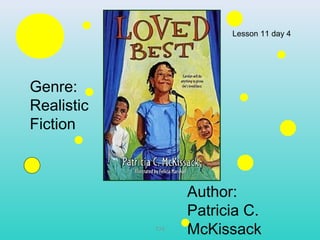

Genre: 
Realistic 
Fiction 
Lesson 11 day 4 
Author: 
Patricia C. 
McKissack 
T74
Question of the Day 
Have you ever helped someone 
feel better? 
I can help by ______ 
T74 T74
Read Aloud 
• What would the purpose be for reading a 
story that is similar to another story you have 
read? 
• to see how different characters deal with 
similar situations 
• for enjoyment 
T75
Read Aloud 
T75 transparency R75
Read Aloud 
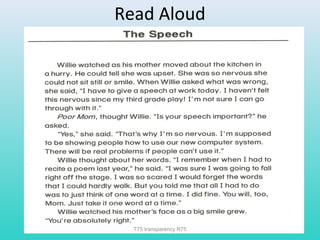
• What is the story’s problem? 
• In the story, how might Willie’s mom have 
said “I’m not sure I can go through with it”? 
• What emotion should you try to show in your 
voice? 
• How does Willie try to help his mother? 
T75
C-le syllable 
• My uncle put the saddle and the bridle in the 
stable. 
• Find the words that end with –le. 
• uncle 
• saddle 
• bridle 
• stable 
T76
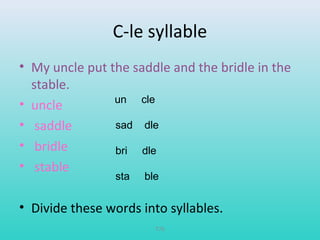
C-le syllable 
• My uncle put the saddle and the bridle in the 
stable. 
• uncle 
• saddle 
• bridle 
• stable 
un cle 
sad dle 
bri dle 
sta ble 
• Divide these words into syllables. 
T76
C-le syllable 
• My uncle put the saddle and the bridle in the 
stable. 
• Which words have long vowel sounds ? 
• bridle, stable 
• Which words have short vowel sounds? 
• uncle, saddle 
T76
C-le syllable 
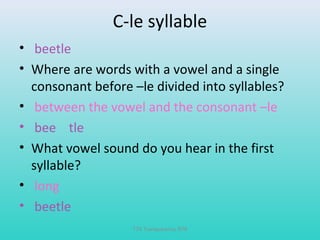
• beetle 
• Where are words with a vowel and a single 
consonant before –le divided into syllables? 
• between the vowel and the consonant –le 
• bee tle 
• What vowel sound do you hear in the first 
syllable? 
• long 
• beetle 
T76 Transparency R76
C-le syllable 
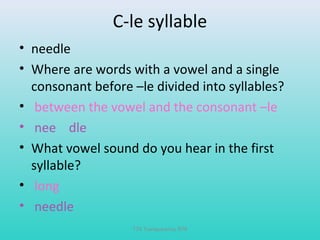
• needle 
• Where are words with a vowel and a single 
consonant before –le divided into syllables? 
• between the vowel and the consonant –le 
• nee dle 
• What vowel sound do you hear in the first 
syllable? 
• long 
• needle 
T76 Transparency R76
C-le syllable 
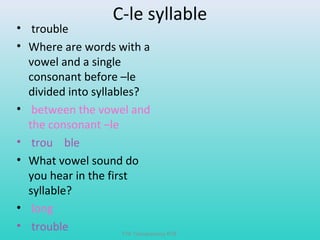
• trouble 
• Where are words with a 
vowel and a single 
consonant before –le 
divided into syllables? 
• between the vowel and 
the consonant –le 
• trou ble 
• What vowel sound do 
you hear in the first 
syllable? 
• long 
• trouble 
T76 Transparency R76
C-le syllable 
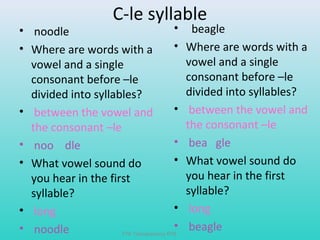
• beagle 
• Where are words with a 
vowel and a single 
consonant before –le 
divided into syllables? 
• between the vowel and 
the consonant –le 
• bea gle 
• What vowel sound do 
you hear in the first 
syllable? 
• long 
• beagle 
• noodle 
• Where are words with a 
vowel and a single 
consonant before –le 
divided into syllables? 
• between the vowel and 
the consonant –le 
• noo dle 
• What vowel sound do 
you hear in the first 
syllable? 
• long 
• noodle T76 Transparency R76
Fluency 
• Remember that good readers vary the sound 
of their voices to show expression. 
• Depending on what is happening in the 
selection, there are several things that readers 
can change in order to show expression. 
• tone of voice (soft, angry, firm, ect.) 
• reading speed ( slow, quick, ect.) 
• volume (soft, loud, etc.) 
• pitch (high voice, medium voice, or low voice) 
T78
Fluency 
• Turn to page 318-319 of “Loved Best”. 
• I am going to read these pages. As I read I am 
going to change my voice so that the sound of 
the reading makes sense with what is going on 
in the story. I am going to read quietly when a 
character is speaking quietly. I will sound 
stern when someone is saying something that 
is serious. I will speed up my voice when 
something exciting is happening, and I will 
slow it down for parts that are quiet and slow. 
• Would anyone like to volunteer to read 2 or 3 sentences? 
T78
Plot 
• The plot is the events that take place, 
including the problem and solution to the 
problem in a story. 
• Good readers pay attention to the problems 
and the events that lead to a solution of those 
problems. 
T79
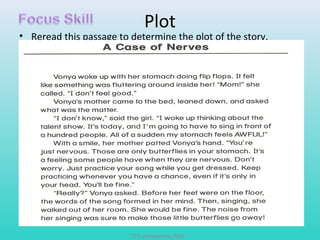
Plot 
• Reread this passage to determine the plot of the story. 
T79 transparency R69
Plot 
• What is the problem in the story? 
• Vonya is nervous about singing in front of an 
audience. 
• What are the important events in the story? 
• Vonya wakes up feeling nervous, she talks 
with her mother about it , and her mother 
gives her some advice. 
• How is the problem solved in the story? 
• Vonya practices, which calms her and makes 
her feel less nervous and more confident. 
T79
Plot 
• Reread the introduction of “Loved Best” on 
page 307. 
• What problem does Carolyn have? 
• She wants her parents to love her best. 
• What does Carolyn think will fix this problem? 
• Her parents will see how wonderful she is in 
the play and will love her best. 
• What is the solution to the problem? 
• Carolyn’s parents love Carolyn, her brother, 
and her sister equally. They cannnot love one 
of them more. T79
Use Alphabetical Order 
Research/Study Skill 
• Information is often arranged in the order of the 
letters of the alphabet, from A to Z. 
• When you look up information in an encyclopedia, 
dictionary or thesaurus the topic will be in ABC 
order. 
• Organizing words in alphabetical order is called 
alphabetizing. 
• When alphabetizing a group of words, you should 
look at the first letter of each word and think about 
the order of the alphabet. If more than one word 
begins with the same letter, you should look at the 
second letter, third letter, or more, all the way 
through the word. T780
Use Alphabetical Order 
Research/Study Skill 
• As I compare two or more words 
that start with the same letter or 
letters, I look for the first letter in 
each word that is different. Then 
I check the alphabet in my head 
and decide which letter comes 
first. 
T780
Let’s Practice! 
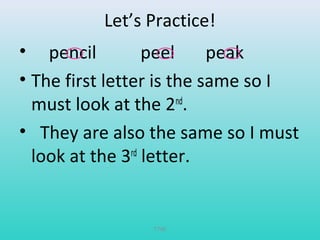
• pencil peel peak 
• The first letter is the same so I 
must look at the 2nd. 
• They are also the same so I must 
look at the 3rd letter. 
T780
Let’s Practice! 
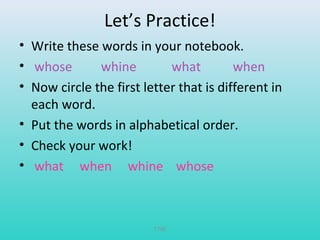
• Write these words in your notebook. 
• whose whine what when 
• Now circle the first letter that is different in 
each word. 
• Put the words in alphabetical order. 
• Check your work! 
• what when whine whose 
T780
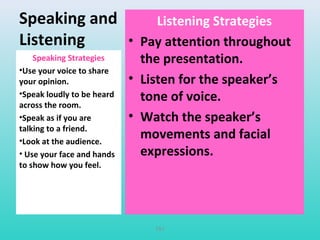
Speaking and 
Listening 
Listening Strategies 
• Pay attention throughout 
the presentation. 
• Listen for the speaker’s 
tone of voice. 
• Watch the speaker’s 
movements and facial 
expressions. 
Speaking Strategies 
•Use your voice to share 
your opinion. 
•Speak loudly to be heard 
across the room. 
•Speak as if you are 
talking to a friend. 
•Look at the audience. 
• Use your face and hands 
to show how you feel. 
T81
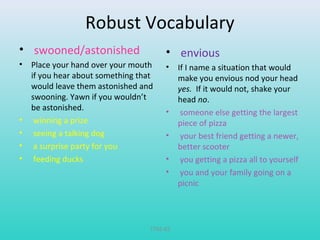
Robust Vocabulary 
• swooned/astonished 
• Place your hand over your mouth 
if you hear about something that 
would leave them astonished and 
swooning. Yawn if you wouldn’t 
be astonished. 
• winning a prize 
• seeing a talking dog 
• a surprise party for you 
• feeding ducks 
• envious 
• If I name a situation that would 
make you envious nod your head 
yes. If it would not, shake your 
head no. 
• someone else getting the largest 
piece of pizza 
• your best friend getting a newer, 
better scooter 
• you getting a pizza all to yourself 
• you and your family going on a 
picnic 
T782-83
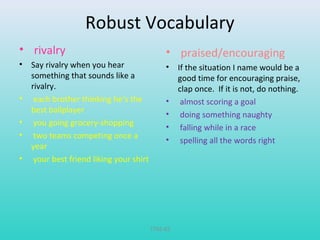
Robust Vocabulary 
• rivalry 
• Say rivalry when you hear 
something that sounds like a 
rivalry. 
• each brother thinking he’s the 
best ballplayer 
• you going grocery-shopping 
• two teams competing once a 
year 
• your best friend liking your shirt 
• praised/encouraging 
• If the situation I name would be a 
good time for encouraging praise, 
clap once. If it is not, do nothing. 
• almost scoring a goal 
• doing something naughty 
• falling while in a race 
• spelling all the words right 
T782-83
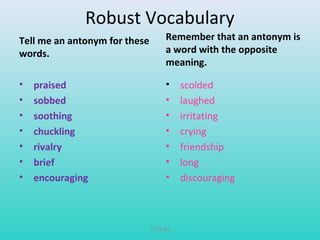
Robust Vocabulary 
Tell me an antonym for these 
words. 
• praised 
• sobbed 
• soothing 
• chuckling 
• rivalry 
• brief 
• encouraging 
Remember that an antonym is 
a word with the opposite 
meaning. 
• scolded 
• laughed 
• irritating 
• crying 
• friendship 
• long 
• discouraging 
T782-83
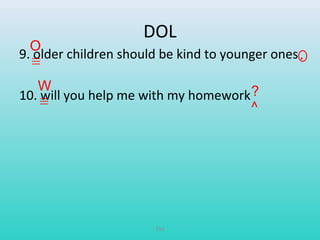
DOL 
O . 
W 
9. older children should be kind to younger ones 
10. will you help me with my homework 
T84 
? 
^
Grammar: Possessive Nouns 
• Rules for singular and plural possessive nouns. 
• To make a singular possessive noun, add an 
apostrophe (‘) and the letter -s (‘s) at the end 
of a singular noun. 
• For plural nouns that end in s, add and 
apostrophe (‘) at the end of the plural noun to 
make a possessive noun. 
T84
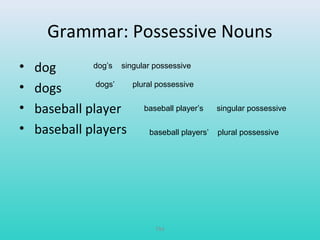
Grammar: Possessive Nouns 
• dog 
• dogs 
• baseball player 
• baseball players 
dog’s singular possessive 
dogs’ plural possessive 
baseball player’s singular possessive 
baseball players’ plural possessive 
T84
Grammar: Possessive Nouns 
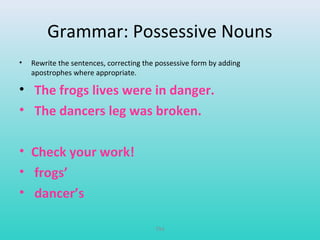
• Rewrite the sentences, correcting the possessive form by adding 
apostrophes where appropriate. 
• The frogs lives were in danger. 
• The dancers leg was broken. 
• Check your work! 
• frogs’ 
• dancer’s 
T94
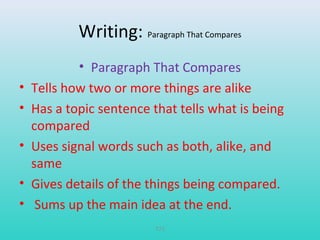
Writing: Paragraph That Compares 
• Paragraph That Compares 
• Tells how two or more things are alike 
• Has a topic sentence that tells what is being 
compared 
• Uses signal words such as both, alike, and 
same 
• Gives details of the things being compared. 
• Sums up the main idea at the end. 
T73

Lesson 11 day 4

  • 1.
    Genre: Realistic Fiction Lesson 11 day 4 Author: Patricia C. McKissack T74
  • 2.
    Question of theDay Have you ever helped someone feel better? I can help by ______ T74 T74
  • 3.
    Read Aloud •What would the purpose be for reading a story that is similar to another story you have read? • to see how different characters deal with similar situations • for enjoyment T75
  • 4.
    Read Aloud T75transparency R75
  • 5.
    Read Aloud •What is the story’s problem? • In the story, how might Willie’s mom have said “I’m not sure I can go through with it”? • What emotion should you try to show in your voice? • How does Willie try to help his mother? T75
  • 6.
    C-le syllable •My uncle put the saddle and the bridle in the stable. • Find the words that end with –le. • uncle • saddle • bridle • stable T76
  • 7.
    C-le syllable •My uncle put the saddle and the bridle in the stable. • uncle • saddle • bridle • stable un cle sad dle bri dle sta ble • Divide these words into syllables. T76
  • 8.
    C-le syllable •My uncle put the saddle and the bridle in the stable. • Which words have long vowel sounds ? • bridle, stable • Which words have short vowel sounds? • uncle, saddle T76
  • 9.
    C-le syllable •beetle • Where are words with a vowel and a single consonant before –le divided into syllables? • between the vowel and the consonant –le • bee tle • What vowel sound do you hear in the first syllable? • long • beetle T76 Transparency R76
  • 10.
    C-le syllable •needle • Where are words with a vowel and a single consonant before –le divided into syllables? • between the vowel and the consonant –le • nee dle • What vowel sound do you hear in the first syllable? • long • needle T76 Transparency R76
  • 11.
    C-le syllable •trouble • Where are words with a vowel and a single consonant before –le divided into syllables? • between the vowel and the consonant –le • trou ble • What vowel sound do you hear in the first syllable? • long • trouble T76 Transparency R76
  • 12.
    C-le syllable •beagle • Where are words with a vowel and a single consonant before –le divided into syllables? • between the vowel and the consonant –le • bea gle • What vowel sound do you hear in the first syllable? • long • beagle • noodle • Where are words with a vowel and a single consonant before –le divided into syllables? • between the vowel and the consonant –le • noo dle • What vowel sound do you hear in the first syllable? • long • noodle T76 Transparency R76
  • 13.
    Fluency • Rememberthat good readers vary the sound of their voices to show expression. • Depending on what is happening in the selection, there are several things that readers can change in order to show expression. • tone of voice (soft, angry, firm, ect.) • reading speed ( slow, quick, ect.) • volume (soft, loud, etc.) • pitch (high voice, medium voice, or low voice) T78
  • 14.
    Fluency • Turnto page 318-319 of “Loved Best”. • I am going to read these pages. As I read I am going to change my voice so that the sound of the reading makes sense with what is going on in the story. I am going to read quietly when a character is speaking quietly. I will sound stern when someone is saying something that is serious. I will speed up my voice when something exciting is happening, and I will slow it down for parts that are quiet and slow. • Would anyone like to volunteer to read 2 or 3 sentences? T78
  • 15.
    Plot • Theplot is the events that take place, including the problem and solution to the problem in a story. • Good readers pay attention to the problems and the events that lead to a solution of those problems. T79
  • 16.
    Plot • Rereadthis passage to determine the plot of the story. T79 transparency R69
  • 17.
    Plot • Whatis the problem in the story? • Vonya is nervous about singing in front of an audience. • What are the important events in the story? • Vonya wakes up feeling nervous, she talks with her mother about it , and her mother gives her some advice. • How is the problem solved in the story? • Vonya practices, which calms her and makes her feel less nervous and more confident. T79
  • 18.
    Plot • Rereadthe introduction of “Loved Best” on page 307. • What problem does Carolyn have? • She wants her parents to love her best. • What does Carolyn think will fix this problem? • Her parents will see how wonderful she is in the play and will love her best. • What is the solution to the problem? • Carolyn’s parents love Carolyn, her brother, and her sister equally. They cannnot love one of them more. T79
  • 19.
    Use Alphabetical Order Research/Study Skill • Information is often arranged in the order of the letters of the alphabet, from A to Z. • When you look up information in an encyclopedia, dictionary or thesaurus the topic will be in ABC order. • Organizing words in alphabetical order is called alphabetizing. • When alphabetizing a group of words, you should look at the first letter of each word and think about the order of the alphabet. If more than one word begins with the same letter, you should look at the second letter, third letter, or more, all the way through the word. T780
  • 20.
    Use Alphabetical Order Research/Study Skill • As I compare two or more words that start with the same letter or letters, I look for the first letter in each word that is different. Then I check the alphabet in my head and decide which letter comes first. T780
  • 21.
    Let’s Practice! •pencil peel peak • The first letter is the same so I must look at the 2nd. • They are also the same so I must look at the 3rd letter. T780
  • 22.
    Let’s Practice! •Write these words in your notebook. • whose whine what when • Now circle the first letter that is different in each word. • Put the words in alphabetical order. • Check your work! • what when whine whose T780
  • 23.
    Speaking and Listening Listening Strategies • Pay attention throughout the presentation. • Listen for the speaker’s tone of voice. • Watch the speaker’s movements and facial expressions. Speaking Strategies •Use your voice to share your opinion. •Speak loudly to be heard across the room. •Speak as if you are talking to a friend. •Look at the audience. • Use your face and hands to show how you feel. T81
  • 24.
    Robust Vocabulary •swooned/astonished • Place your hand over your mouth if you hear about something that would leave them astonished and swooning. Yawn if you wouldn’t be astonished. • winning a prize • seeing a talking dog • a surprise party for you • feeding ducks • envious • If I name a situation that would make you envious nod your head yes. If it would not, shake your head no. • someone else getting the largest piece of pizza • your best friend getting a newer, better scooter • you getting a pizza all to yourself • you and your family going on a picnic T782-83
  • 25.
    Robust Vocabulary •rivalry • Say rivalry when you hear something that sounds like a rivalry. • each brother thinking he’s the best ballplayer • you going grocery-shopping • two teams competing once a year • your best friend liking your shirt • praised/encouraging • If the situation I name would be a good time for encouraging praise, clap once. If it is not, do nothing. • almost scoring a goal • doing something naughty • falling while in a race • spelling all the words right T782-83
  • 26.
    Robust Vocabulary Tellme an antonym for these words. • praised • sobbed • soothing • chuckling • rivalry • brief • encouraging Remember that an antonym is a word with the opposite meaning. • scolded • laughed • irritating • crying • friendship • long • discouraging T782-83
  • 27.
    DOL O . W 9. older children should be kind to younger ones 10. will you help me with my homework T84 ? ^
  • 28.
    Grammar: Possessive Nouns • Rules for singular and plural possessive nouns. • To make a singular possessive noun, add an apostrophe (‘) and the letter -s (‘s) at the end of a singular noun. • For plural nouns that end in s, add and apostrophe (‘) at the end of the plural noun to make a possessive noun. T84
  • 29.
    Grammar: Possessive Nouns • dog • dogs • baseball player • baseball players dog’s singular possessive dogs’ plural possessive baseball player’s singular possessive baseball players’ plural possessive T84
  • 30.
    Grammar: Possessive Nouns • Rewrite the sentences, correcting the possessive form by adding apostrophes where appropriate. • The frogs lives were in danger. • The dancers leg was broken. • Check your work! • frogs’ • dancer’s T94
  • 31.
    Writing: Paragraph ThatCompares • Paragraph That Compares • Tells how two or more things are alike • Has a topic sentence that tells what is being compared • Uses signal words such as both, alike, and same • Gives details of the things being compared. • Sums up the main idea at the end. T73