Lesson 3 Day 3 
“Schools Around the World”
Question of the Day 
What part of being at school is the most 
important to you? (such as learning to read, 
making friends, and joining clubs or teams, 
etc…) 
*Write about something at school that really 
matters to you. Tell me why it matters to you. 
T238
Today’s Read Aloud: First Day 
of School 
Why might someone reread or listen to a 
poem again? 
 To enjoy it, understand it better, or to pay 
more attention to the sounds of words. 
T239
Today’s Read Aloud: First Day of School 
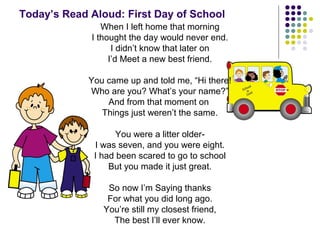
When I left home that morning 
I thought the day would never end. 
I didn’t know that later on 
I’d Meet a new best friend. 
You came up and told me, “Hi there! 
Who are you? What’s your name?” 
And from that moment on 
Things just weren’t the same. 
You were a litter older- 
I was seven, and you were eight. 
I had been scared to go to school 
But you made it just great. 
So now I’m Saying thanks 
For what you did long ago. 
You’re still my closest friend, 
The best I’ll ever know.
Long Vowel Diagraphs 
Words with the CVCe pattern usually have a 
long vowel sound. I want you to read the 
words aloud after me. 
 late 
 rake 
 tame 
 shade
Long Vowel Digraphs 
 There are other spellings that stand for the 
long a sound. 
 For example: 
 pail say against 
 day rain paid 
 may sway wait said 
T240
Words with ai, ay 
 Both ai and ay can stand for the long a sound. 
 pay sway wait train 
The ay usually comes at the end of a word or syllable, 
while ai generally appears in the middle. Tell me 
where you hear the long a sound in these words. 
 gray rain braid bay 
T241
Fluency 
 Remember good readers read aloud at a comfortable pace that 
helps their listeners stay interested. Good readers adjust their 
reading rate depending on their purpose and the writing form. 
 My purpose for reading “Schools Around the World” is to learn 
information about schools. I want to make sure that anyone 
listening to me read can also understand the information, so I’ll 
read the nonfiction selection more slowly than I would if I were 
reading a story for enjoyment. 
 Turn to page 94! I am going to show you how to read nonfiction 
at a slower speed. 
T242
Locate Information: 
Comprehension 
 There are special ways to find information in 
nonfiction writing. Nonfiction books often have 
features such as a table of contents, an index, and 
headings that help readers locate facts, ideas, and 
topics. 
 Captions can be another text feature that can help 
readers get information. Captions are brief 
passages that are found near a photo, illustration, or 
other visual aid. A caption tells what is happening in 
the picture or explains what the graphic aid is about. 
A caption can also give information not included 
elsewhere. 
T243
Locate Information: 
Comprehension 
 Open your books to page 92. 
Which photograph does this caption tell you 
about? What does it tell you about that 
illustration? 
 Page 93. Why do you think the author put this 
information in the caption instead of in the 
text? 
T243
Use a Dictionary 
What do you do when you see or hear a word 
that you do not know? Do you ask someone 
about it? Do you make guesses about its 
meaning? 
 Using a dictionary is the best way to learn 
about a new, difficult, or interesting words. 
T244
Use a Dictionary 
 Each word has an entry that shows how to say the 
word and what the word means. 
 Inside the dictionary all of the words that begin with 
the same letter are grouped together in alphabetical 
order. Some dictionaries have tabs. These tabs 
extend out from the edge of certain pages to help 
people locate the entries that begin with a particular 
letter. 
 Guide Words may be at the top of the page, the 
bottom of the page or both. The guide words are the 
first and last entries listed on that page.
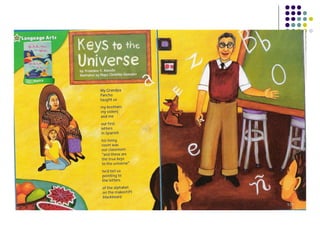
Keys to the Universe 
 Turn to page 106! 
 How is the living room like a classroom? 
Why did grandpa want the poet and the other 
children to learn the alphabet? 
 Do you think the title is a good one? Why or 
why not? 
T246/247
Vocabulary 
 Why would it be better to take a proper sleeping bag on a camping 
trip instead of just an old blanket. 
 Explain why it would not be proper to call a friend at 4:00am? 
 If your family went on a trip, where might your dog be boarding while you 
were away? 
 Why might your aunt send you an e-mail rather than a letter if you were 
boarding at a school in another country? 
 How would reading more books help improve your literacy? 
 What do you think computer literacy is? 
 How is having a diet of diverse foods better than eating the same food all 
the time? 
 How can students with diverse talents help you put on a school talent 
show? T250/251
Vocabulary 
 What resources might help you write a science 
report? 
 What resources does your community have to help 
children have fun in the summer? 
 Why is it a good idea for police officers to wear 
uniforms? 
 Why is it helpful when members of a basketball 
team wear uniforms. 
 What chores do you do now at home or at school? 
 Which home chore would be your favorite? Why? 
 Does a tutor work with a large group or with a small 
group? 
 Why might a person learning a new language have 
a tutor?
Vocabulary 
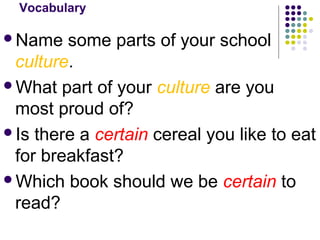
Name some parts of your school 
culture. 
What part of your culture are you 
most proud of? 
Is there a certain cereal you like to eat 
for breakfast? 
Which book should we be certain to 
read?
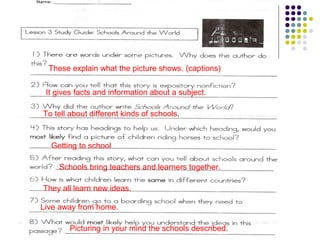
These explain what the picture shows. (captions) 
It gives facts and information about a subject. 
To tell about different kinds of schools. 
Getting to school 
Schools bring teachers and learners together. 
They all learn new ideas. 
Live away from home. 
Picturing in your mind the schools described.
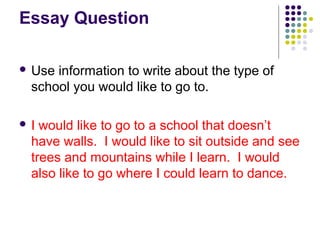
Essay Question 
 Use information to write about the type of 
school you would like to go to. 
 I would like to go to a school that doesn’t 
have walls. I would like to sit outside and see 
trees and mountains while I learn. I would 
also like to go where I could learn to dance.
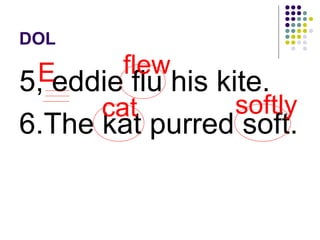
DOL 
5, E eddie flew 
flu his kite. 
6.The cat kat purred softly 
soft.
Complete and Simple Subjects and Predicates 
Remember that the subject of a sentence 
is who or what the sentence is about. The 
simple subject names only the person, place, or 
thing that the sentence is about. 
The shiny keys dropped to the desk. 
The simple subject is keys. The complete 
predicate is all the words that tell about what 
the subject is or does: dropped to the desk. The 
simple predicate names the action: dropped. 
T252
Paragraph of Information 
 Gives facts about real things 
 Has a topic sentence 
 Discusses a topic that can be covered in one 
paragraph 
 Includes details 
Turn to page 98 and read the first paragraph. 
What information do you see that goes with 
the above chart.

Lesson 3 day 3

  • 1.
    Lesson 3 Day3 “Schools Around the World”
  • 2.
    Question of theDay What part of being at school is the most important to you? (such as learning to read, making friends, and joining clubs or teams, etc…) *Write about something at school that really matters to you. Tell me why it matters to you. T238
  • 3.
    Today’s Read Aloud:First Day of School Why might someone reread or listen to a poem again?  To enjoy it, understand it better, or to pay more attention to the sounds of words. T239
  • 4.
    Today’s Read Aloud:First Day of School When I left home that morning I thought the day would never end. I didn’t know that later on I’d Meet a new best friend. You came up and told me, “Hi there! Who are you? What’s your name?” And from that moment on Things just weren’t the same. You were a litter older- I was seven, and you were eight. I had been scared to go to school But you made it just great. So now I’m Saying thanks For what you did long ago. You’re still my closest friend, The best I’ll ever know.
  • 5.
    Long Vowel Diagraphs Words with the CVCe pattern usually have a long vowel sound. I want you to read the words aloud after me.  late  rake  tame  shade
  • 6.
    Long Vowel Digraphs  There are other spellings that stand for the long a sound.  For example:  pail say against  day rain paid  may sway wait said T240
  • 7.
    Words with ai,ay  Both ai and ay can stand for the long a sound.  pay sway wait train The ay usually comes at the end of a word or syllable, while ai generally appears in the middle. Tell me where you hear the long a sound in these words.  gray rain braid bay T241
  • 8.
    Fluency  Remembergood readers read aloud at a comfortable pace that helps their listeners stay interested. Good readers adjust their reading rate depending on their purpose and the writing form.  My purpose for reading “Schools Around the World” is to learn information about schools. I want to make sure that anyone listening to me read can also understand the information, so I’ll read the nonfiction selection more slowly than I would if I were reading a story for enjoyment.  Turn to page 94! I am going to show you how to read nonfiction at a slower speed. T242
  • 9.
    Locate Information: Comprehension  There are special ways to find information in nonfiction writing. Nonfiction books often have features such as a table of contents, an index, and headings that help readers locate facts, ideas, and topics.  Captions can be another text feature that can help readers get information. Captions are brief passages that are found near a photo, illustration, or other visual aid. A caption tells what is happening in the picture or explains what the graphic aid is about. A caption can also give information not included elsewhere. T243
  • 10.
    Locate Information: Comprehension  Open your books to page 92. Which photograph does this caption tell you about? What does it tell you about that illustration?  Page 93. Why do you think the author put this information in the caption instead of in the text? T243
  • 11.
    Use a Dictionary What do you do when you see or hear a word that you do not know? Do you ask someone about it? Do you make guesses about its meaning?  Using a dictionary is the best way to learn about a new, difficult, or interesting words. T244
  • 12.
    Use a Dictionary  Each word has an entry that shows how to say the word and what the word means.  Inside the dictionary all of the words that begin with the same letter are grouped together in alphabetical order. Some dictionaries have tabs. These tabs extend out from the edge of certain pages to help people locate the entries that begin with a particular letter.  Guide Words may be at the top of the page, the bottom of the page or both. The guide words are the first and last entries listed on that page.
  • 14.
    Keys to theUniverse  Turn to page 106!  How is the living room like a classroom? Why did grandpa want the poet and the other children to learn the alphabet?  Do you think the title is a good one? Why or why not? T246/247
  • 15.
    Vocabulary  Whywould it be better to take a proper sleeping bag on a camping trip instead of just an old blanket.  Explain why it would not be proper to call a friend at 4:00am?  If your family went on a trip, where might your dog be boarding while you were away?  Why might your aunt send you an e-mail rather than a letter if you were boarding at a school in another country?  How would reading more books help improve your literacy?  What do you think computer literacy is?  How is having a diet of diverse foods better than eating the same food all the time?  How can students with diverse talents help you put on a school talent show? T250/251
  • 16.
    Vocabulary  Whatresources might help you write a science report?  What resources does your community have to help children have fun in the summer?  Why is it a good idea for police officers to wear uniforms?  Why is it helpful when members of a basketball team wear uniforms.  What chores do you do now at home or at school?  Which home chore would be your favorite? Why?  Does a tutor work with a large group or with a small group?  Why might a person learning a new language have a tutor?
  • 17.
    Vocabulary Name someparts of your school culture. What part of your culture are you most proud of? Is there a certain cereal you like to eat for breakfast? Which book should we be certain to read?
  • 18.
    These explain whatthe picture shows. (captions) It gives facts and information about a subject. To tell about different kinds of schools. Getting to school Schools bring teachers and learners together. They all learn new ideas. Live away from home. Picturing in your mind the schools described.
  • 19.
    Essay Question Use information to write about the type of school you would like to go to.  I would like to go to a school that doesn’t have walls. I would like to sit outside and see trees and mountains while I learn. I would also like to go where I could learn to dance.
  • 20.
    DOL 5, Eeddie flew flu his kite. 6.The cat kat purred softly soft.
  • 21.
    Complete and SimpleSubjects and Predicates Remember that the subject of a sentence is who or what the sentence is about. The simple subject names only the person, place, or thing that the sentence is about. The shiny keys dropped to the desk. The simple subject is keys. The complete predicate is all the words that tell about what the subject is or does: dropped to the desk. The simple predicate names the action: dropped. T252
  • 22.
    Paragraph of Information  Gives facts about real things  Has a topic sentence  Discusses a topic that can be covered in one paragraph  Includes details Turn to page 98 and read the first paragraph. What information do you see that goes with the above chart.