Human Computer
Interaction 2
Instructor:
Ellen Grace Porras
User Interaction Design
Interaction design is about creating interventions in often
complex situations using technology of many kinds including
PC software, the web and physical devices
3
• Design involves:
o Achieving goals within constraints and trade-off between these
o Understanding the raw materials: computer and human
o Accepting limitations of humans and of design
• The design process has several stages and is iterative and never complete.
• Interaction starts with getting to know the users and their context:
o Finding out who they are and what they are like ...
o Talking to them, watching them
4
• Scenarios are rich design stories, which can be used and reused
throughout design:
o They help us see what users will want to do
o They give a step-by-step walkthrough of users' interactions: including
what they see, do and are thinking
5
• Users need to find their way around a system; this involves:
o Helping users know where they are, where they have been and what
they can do next
o Creating overall structures that are easy to understand and fit the users'
needs
o Designing comprehensible screens and control panels
6
• Complexity of design means we don't get it right first time:
o So, we need iteration and prototypes to try out and evaluate
o But iteration can get trapped in local maxima, designs that have no
simple improvements, but are not good
o Theory and models can help give good start points
7
Usability
“It is a measure of the effectiveness, efficiency and satisfaction with which
specified user can achieve specified goals in a particular environment”.
It asks following:
• Is effective to use
• Is efficient to use
• Is safe to use
• Has good utility
• Is easy to learn
• Is easy to remember how to use
8
Issues in Design
• Who are the users?
• What do we mean by needs?
• How do generate alternative design?
• How do we choose between designs?
9
User Centered Development
• Data Collection
• Data Analysis
• User Modeling
• Design
• Prototyping
• Evaluation
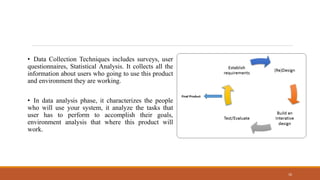
• Data Collection Techniques includes surveys, user
questionnaires, Statistical Analysis. It collects all the
information about users who going to use this product
and environment they are working.
• In data analysis phase, it characterizes the people
who will use your system, it analyze the tasks that
user has to perform to accomplish their goals,
environment analysis that where this product will
work.
10
11
• In User Modeling, a computational model for how people perform tasks and
solve problems based on psychological principles.
• In design phase, all the analysis are used to design a system in interface design,
it shows how this product present itself. And in interaction design, it tells how
this product should work.
• Rapids prototypes are early and inexpensive ways to identify usability
problems before committing lots of resources. In interaction design main
concern here is with usability. So using prototypes we can better understand
the needs of user.
12
• In usability testing and evaluation phase, users perform a variety of tasks with
a prototype (or other system) while observers record notes on what each user
does and speaks.
• Typical tests are conducted with one user at a time or two users working
together. Testing may include collecting data on the paths users take to do
tasks, the errors they make, when and where they are confused or frustrated,
how fast they do a task, whether they succeed in doing the task, and how
satisfied they are with the experience.
• The goal of most usability testing is to uncover any problems that users may
encounter so those problems can be fixed.
13
Interaction Styles
Interaction can be seen as a dialogue between the computer and the user. Some applications have
very distinct styles of interaction.
We can identify some common styles
• Command line interface
• Menus
• question/answer and query dialogue
• Form-fills and spreadsheets
• WIMP
14
Command Line Interface
Way of expressing instructions to the computer directly. Can be function keys,
Single characters, short abbreviations, whole words, or a combination
• Suitable for repetitive tasks
• Better for expert users than novices
• Offer direct access to system functionality
• Command names/abbreviations should be meaningful
15
Human Computer Interaction 2
Menus
Set of options displayed on the screen. Options visible so demand less recall - rely
on recognition so names should be meaningful. Selected by using mouse, numeric
or alphabetic keys. Often options hierarchically grouped: sensible grouping is
needed.
Menu systems can be:
• Purely text based, with options presented as numbered choices, or
• can have graphical component, with menu appearing in box and choices
made either by typing initial letter, or moving around with arrow keys
16
Form-Filling Interfaces
• Primarily for data entry or data retrieval.
• Screen like paper form.
• Data put in relevant place.
• Requires good design and obvious correction facilities.
WIMP Interface
• Windows
• Icon
• Menus
• Pointers
17
Human Computer Interaction 2
Windows
Areas of the screen that behave as if they were independent terminals
• can contain text or graphics
• can be moved or resized
• can overlap and obscure each other, or can be laid out next to one another
• Scrollbars allow the user to move the contents of the window up and down or
from side to side
• Title bars describe the name of the window
18
Icons
Small picture or image, used to represent some object in the interface, often a window. Windows can
be closed to this small representation (iconized) allowing many windows to be accessible. Icons can
be many and various - highly stylized or realistic representations.
Pointers
Important component, since WIMP style relies on pointing and selecting things such as icons and
menu items.
• Usually achieved with mouse
• Joystick, trackball, cursor keys or keyboard shortcuts are also used
• Wide variety
Thank you
Presenter name: Ellen Grace D. Porras
Email address: egporras@psu.palawan.edu.ph

Lesson 2 HCI 2.pdf

  • 1.
  • 2.
    User Interaction Design Interactiondesign is about creating interventions in often complex situations using technology of many kinds including PC software, the web and physical devices
  • 3.
    3 • Design involves: oAchieving goals within constraints and trade-off between these o Understanding the raw materials: computer and human o Accepting limitations of humans and of design • The design process has several stages and is iterative and never complete. • Interaction starts with getting to know the users and their context: o Finding out who they are and what they are like ... o Talking to them, watching them
  • 4.
    4 • Scenarios arerich design stories, which can be used and reused throughout design: o They help us see what users will want to do o They give a step-by-step walkthrough of users' interactions: including what they see, do and are thinking
  • 5.
    5 • Users needto find their way around a system; this involves: o Helping users know where they are, where they have been and what they can do next o Creating overall structures that are easy to understand and fit the users' needs o Designing comprehensible screens and control panels
  • 6.
    6 • Complexity ofdesign means we don't get it right first time: o So, we need iteration and prototypes to try out and evaluate o But iteration can get trapped in local maxima, designs that have no simple improvements, but are not good o Theory and models can help give good start points
  • 7.
    7 Usability “It is ameasure of the effectiveness, efficiency and satisfaction with which specified user can achieve specified goals in a particular environment”. It asks following: • Is effective to use • Is efficient to use • Is safe to use • Has good utility • Is easy to learn • Is easy to remember how to use
  • 8.
    8 Issues in Design •Who are the users? • What do we mean by needs? • How do generate alternative design? • How do we choose between designs?
  • 9.
    9 User Centered Development •Data Collection • Data Analysis • User Modeling • Design • Prototyping • Evaluation
  • 10.
    • Data CollectionTechniques includes surveys, user questionnaires, Statistical Analysis. It collects all the information about users who going to use this product and environment they are working. • In data analysis phase, it characterizes the people who will use your system, it analyze the tasks that user has to perform to accomplish their goals, environment analysis that where this product will work. 10
  • 11.
    11 • In UserModeling, a computational model for how people perform tasks and solve problems based on psychological principles. • In design phase, all the analysis are used to design a system in interface design, it shows how this product present itself. And in interaction design, it tells how this product should work. • Rapids prototypes are early and inexpensive ways to identify usability problems before committing lots of resources. In interaction design main concern here is with usability. So using prototypes we can better understand the needs of user.
  • 12.
    12 • In usabilitytesting and evaluation phase, users perform a variety of tasks with a prototype (or other system) while observers record notes on what each user does and speaks. • Typical tests are conducted with one user at a time or two users working together. Testing may include collecting data on the paths users take to do tasks, the errors they make, when and where they are confused or frustrated, how fast they do a task, whether they succeed in doing the task, and how satisfied they are with the experience. • The goal of most usability testing is to uncover any problems that users may encounter so those problems can be fixed.
  • 13.
    13 Interaction Styles Interaction canbe seen as a dialogue between the computer and the user. Some applications have very distinct styles of interaction. We can identify some common styles • Command line interface • Menus • question/answer and query dialogue • Form-fills and spreadsheets • WIMP
  • 14.
    14 Command Line Interface Wayof expressing instructions to the computer directly. Can be function keys, Single characters, short abbreviations, whole words, or a combination • Suitable for repetitive tasks • Better for expert users than novices • Offer direct access to system functionality • Command names/abbreviations should be meaningful
  • 15.
    15 Human Computer Interaction2 Menus Set of options displayed on the screen. Options visible so demand less recall - rely on recognition so names should be meaningful. Selected by using mouse, numeric or alphabetic keys. Often options hierarchically grouped: sensible grouping is needed. Menu systems can be: • Purely text based, with options presented as numbered choices, or • can have graphical component, with menu appearing in box and choices made either by typing initial letter, or moving around with arrow keys
  • 16.
    16 Form-Filling Interfaces • Primarilyfor data entry or data retrieval. • Screen like paper form. • Data put in relevant place. • Requires good design and obvious correction facilities. WIMP Interface • Windows • Icon • Menus • Pointers
  • 17.
    17 Human Computer Interaction2 Windows Areas of the screen that behave as if they were independent terminals • can contain text or graphics • can be moved or resized • can overlap and obscure each other, or can be laid out next to one another • Scrollbars allow the user to move the contents of the window up and down or from side to side • Title bars describe the name of the window
  • 18.
    18 Icons Small picture orimage, used to represent some object in the interface, often a window. Windows can be closed to this small representation (iconized) allowing many windows to be accessible. Icons can be many and various - highly stylized or realistic representations. Pointers Important component, since WIMP style relies on pointing and selecting things such as icons and menu items. • Usually achieved with mouse • Joystick, trackball, cursor keys or keyboard shortcuts are also used • Wide variety
  • 19.
    Thank you Presenter name:Ellen Grace D. Porras Email address: egporras@psu.palawan.edu.ph