s
Objectives: At the end of the
lesson, the learner should be
able to;
 Recognize the importance of providing
correct information in a data collection
activity;
 Understand the issue of confidentiality of
information in a data collection activity;
Participate in a data collection activity; and
 Contextualize data.
A. Preliminaries in a Data Collection
Activity
Getting “Class Student Number” by using
random number.
B. Performing a Data Collection
Activity
The following are the content of SIS:
1.CLASS STUDENT NUMBER
2. SEX
3. NUMBER OF SIBLINGS
4.WEIGHT
5.HEIGHT
6.AGE OF MOTHER
7.USUAL DAILY ALLOWANCE IN SCHOOL
8. USUAL DAILY FOOD EXPENDITURE IN
SCHOOL
9.USUAL NUMBER OF TEXT MESSAGES
SENT IN A DAY
10. MOST PREFERRED COLOR
11. USUAL SLEEPING TIME
12. HAPPINESS INDEX FOR THE DAY
Philippine Statistics Authority (PSA)
• Is the government agency mandated to
conduct censuses and surveys to obtain
information about socio-demographic
characteristics of the resident of the
country.
• Census data are used by the government
to make plans. Censuses of population
and housing are conducted every 10
years on years ending in zero(e.g., 1990,
2000, 2010) to obtain population counts,
and demographic information about all
Filipinos.
• Through Republic Act 10625(also referred to
as The Philippine Statistical Act of 2013), PSA
was created from four former government
statistical agencies, namely: National
Statistics Office(NSO), National Statistical
Coordination Board(NSCB), Bureau of Labor
and Employment of Statistics(BLES) and
Bureau of Agricultural Statistics(BAS).
• The other agency created through RA 10625
is the Philippine Statistical Research and
Training Institute(PSRTI) which is mandated
as the research and training arm of the
Philippine Statistical System. PSRTI was
created from its forerunner the former
Statistical Research and Training
Center(SRTC).
C. Contextualization of Data
Questions:
1.What come into your mind when you
hear the term “Data”?
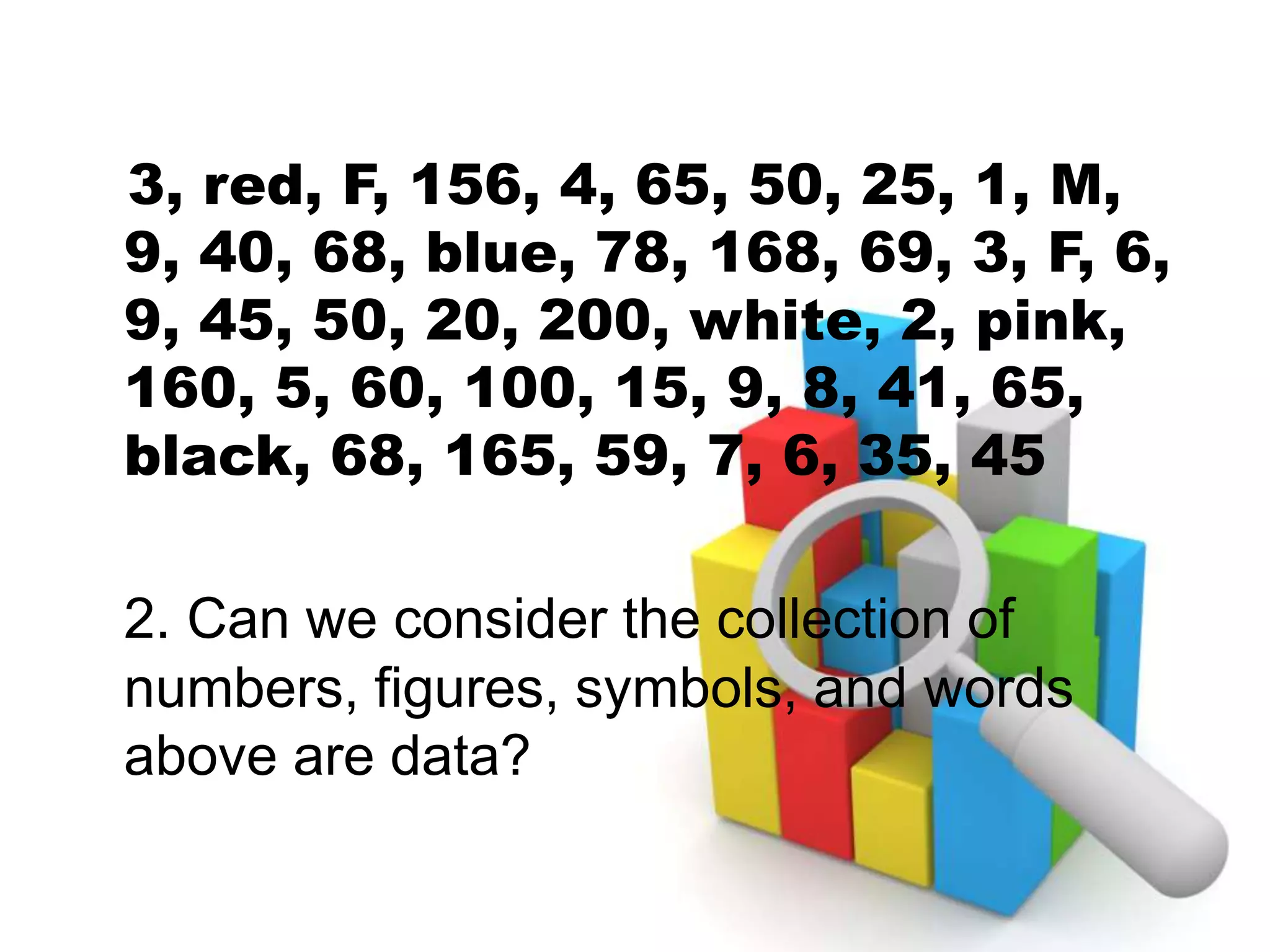
3, red, F, 156, 4, 65, 50, 25, 1, M,
9, 40, 68, blue, 78, 168, 69, 3, F, 6,
9, 45, 50, 20, 200, white, 2, pink,
160, 5, 60, 100, 15, 9, 8, 41, 65,
black, 68, 165, 59, 7, 6, 35, 45
2. Can we consider the collection of
numbers, figures, symbols, and words
above are data?
DATA
Are facts and figures that are presented,
collected and analyzed.
Data are either numeric or non-numeric and
must be contextualized.
To contextualize data, we must identify its six
W’s or to put meaning on the data.
Six W’s of the Data
1) Who?
 Who provided the data?
2) What?
 What are the information from the
respondents
 What is the unit of measurement used for
each of the information(if there are any)?
3) When?
 When was the data collected?
4) Where?
 Where was the data collected?
5) Why?
 Why was the data collected?
6). HoW?
 HoW was the data Collected?
1. Who provided the data?
The students in this class provided the
data.
2. What are the information from
the respondents and What is the unit
of measurement used for each of the
information(If there are any)?
 The information gathered include Class
Student number, Sex, Number of
siblings, Weight, Height, Age of
Mother, Usual Daily Allowance in School,
Usual Daily Food Expenditure in School,
Usual Number of Text Messages Sent in
a Day, Most Preferred Color, Usual
Sleeping Time and Happiness Index for
the Day.
The units of measurement are person,
kilogram, centimeter, year, pesos, pesos
and message.
3. When was the data collected?
The data was collected on the first few
days of classes for Statistics and
Probability.
4. Where was the data collected?
The data was collected inside the
classroom.
5. Why was the data collected?
As explained earlier, the data will be used
in our future lessons in statistics and
probability.
6. HoW was the data collected?
The students provided the data by
responding to the Student Information
Sheet prepared and distributed by the
teacher for data collection activity.
Lesson 2 data collection activity

Lesson 2 data collection activity

  • 1.
  • 2.
    Objectives: At theend of the lesson, the learner should be able to;  Recognize the importance of providing correct information in a data collection activity;  Understand the issue of confidentiality of information in a data collection activity; Participate in a data collection activity; and  Contextualize data.
  • 3.
    A. Preliminaries ina Data Collection Activity Getting “Class Student Number” by using random number.
  • 4.
    B. Performing aData Collection Activity The following are the content of SIS: 1.CLASS STUDENT NUMBER 2. SEX 3. NUMBER OF SIBLINGS 4.WEIGHT 5.HEIGHT 6.AGE OF MOTHER
  • 5.
    7.USUAL DAILY ALLOWANCEIN SCHOOL 8. USUAL DAILY FOOD EXPENDITURE IN SCHOOL 9.USUAL NUMBER OF TEXT MESSAGES SENT IN A DAY 10. MOST PREFERRED COLOR 11. USUAL SLEEPING TIME 12. HAPPINESS INDEX FOR THE DAY
  • 6.
    Philippine Statistics Authority(PSA) • Is the government agency mandated to conduct censuses and surveys to obtain information about socio-demographic characteristics of the resident of the country. • Census data are used by the government to make plans. Censuses of population and housing are conducted every 10 years on years ending in zero(e.g., 1990, 2000, 2010) to obtain population counts, and demographic information about all Filipinos.
  • 7.
    • Through RepublicAct 10625(also referred to as The Philippine Statistical Act of 2013), PSA was created from four former government statistical agencies, namely: National Statistics Office(NSO), National Statistical Coordination Board(NSCB), Bureau of Labor and Employment of Statistics(BLES) and Bureau of Agricultural Statistics(BAS). • The other agency created through RA 10625 is the Philippine Statistical Research and Training Institute(PSRTI) which is mandated as the research and training arm of the Philippine Statistical System. PSRTI was created from its forerunner the former Statistical Research and Training Center(SRTC).
  • 8.
    C. Contextualization ofData Questions: 1.What come into your mind when you hear the term “Data”?
  • 9.
    3, red, F,156, 4, 65, 50, 25, 1, M, 9, 40, 68, blue, 78, 168, 69, 3, F, 6, 9, 45, 50, 20, 200, white, 2, pink, 160, 5, 60, 100, 15, 9, 8, 41, 65, black, 68, 165, 59, 7, 6, 35, 45 2. Can we consider the collection of numbers, figures, symbols, and words above are data?
  • 10.
    DATA Are facts andfigures that are presented, collected and analyzed. Data are either numeric or non-numeric and must be contextualized. To contextualize data, we must identify its six W’s or to put meaning on the data.
  • 11.
    Six W’s ofthe Data 1) Who?  Who provided the data? 2) What?  What are the information from the respondents  What is the unit of measurement used for each of the information(if there are any)?
  • 12.
    3) When?  Whenwas the data collected? 4) Where?  Where was the data collected? 5) Why?  Why was the data collected? 6). HoW?  HoW was the data Collected?
  • 13.
    1. Who providedthe data? The students in this class provided the data.
  • 14.
    2. What arethe information from the respondents and What is the unit of measurement used for each of the information(If there are any)?
  • 15.
     The informationgathered include Class Student number, Sex, Number of siblings, Weight, Height, Age of Mother, Usual Daily Allowance in School, Usual Daily Food Expenditure in School, Usual Number of Text Messages Sent in a Day, Most Preferred Color, Usual Sleeping Time and Happiness Index for the Day. The units of measurement are person, kilogram, centimeter, year, pesos, pesos and message.
  • 16.
    3. When wasthe data collected? The data was collected on the first few days of classes for Statistics and Probability.
  • 17.
    4. Where wasthe data collected? The data was collected inside the classroom.
  • 18.
    5. Why wasthe data collected? As explained earlier, the data will be used in our future lessons in statistics and probability.
  • 19.
    6. HoW wasthe data collected? The students provided the data by responding to the Student Information Sheet prepared and distributed by the teacher for data collection activity.