Basic Biostat 15: Multiple Linear Regression 1
Chapter 15:
Multiple Linear Regression
Basic Biostat 15: Multiple Linear Regression 2
In Chapter 15:
15.1 The General Idea
15.2 The Multiple Regression Model
15.3 Categorical Explanatory Variables
15.4 Regression Coefficients
[15.5 ANOVA for Multiple Linear Regression]
[15.6 Examining Conditions]
[Not covered in recorded presentation]
Basic Biostat 15: Multiple Linear Regression 3
15.1 The General Idea
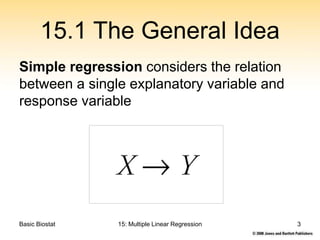
Simple regression considers the relation
between a single explanatory variable and
response variable
Basic Biostat 15: Multiple Linear Regression 4
The General Idea
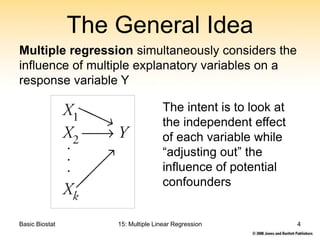
Multiple regression simultaneously considers the
influence of multiple explanatory variables on a
response variable Y
The intent is to look at
the independent effect
of each variable while
“adjusting out” the
influence of potential
confounders
Basic Biostat 15: Multiple Linear Regression 5
Regression Modeling
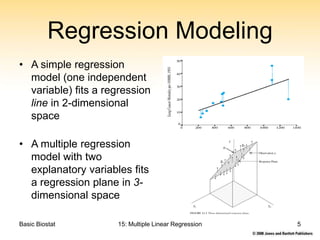
• A simple regression
model (one independent
variable) fits a regression
line in 2-dimensional
space
• A multiple regression
model with two
explanatory variables fits
a regression plane in 3-
dimensional space
Basic Biostat 15: Multiple Linear Regression 6
Simple Regression Model
Regression coefficients are estimated by
minimizing ∑residuals2 (i.e., sum of the squared
residuals) to derive this model:
The standard error of the regression (sY|x) is
based on the squared residuals:
Basic Biostat 15: Multiple Linear Regression 7
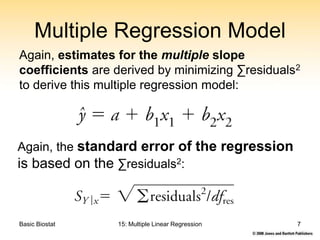
Multiple Regression Model
Again, estimates for the multiple slope
coefficients are derived by minimizing ∑residuals2
to derive this multiple regression model:
Again, the standard error of the regression
is based on the ∑residuals2:
Basic Biostat 15: Multiple Linear Regression 8
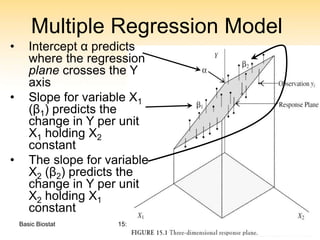
Multiple Regression Model
• Intercept α predicts
where the regression
plane crosses the Y
axis
• Slope for variable X1
(β1) predicts the
change in Y per unit
X1 holding X2
constant
• The slope for variable
X2 (β2) predicts the
change in Y per unit
X2 holding X1
constant
Basic Biostat 15: Multiple Linear Regression 9
Multiple Regression Model
A multiple regression
model with k independent
variables fits a regression
“surface” in k + 1
dimensional space (cannot
be visualized)
Basic Biostat 15: Multiple Linear Regression 10
15.3 Categorical Explanatory
Variables in Regression Models
• Categorical independent
variables can be
incorporated into a
regression model by
converting them into 0/1
(“dummy”) variables
• For binary variables, code
dummies “0” for “no” and 1
for “yes”
Basic Biostat 15: Multiple Linear Regression 11
Dummy Variables, More than two
levels
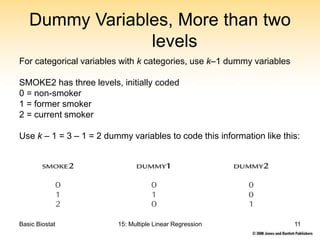
For categorical variables with k categories, use k–1 dummy variables
SMOKE2 has three levels, initially coded
0 = non-smoker
1 = former smoker
2 = current smoker
Use k – 1 = 3 – 1 = 2 dummy variables to code this information like this:
Basic Biostat 15: Multiple Linear Regression 12
Illustrative Example
Childhood respiratory health survey.
• Binary explanatory variable (SMOKE) is
coded 0 for non-smoker and 1 for smoker
• Response variable Forced Expiratory
Volume (FEV) is measured in liters/second
• The mean FEV in nonsmokers is 2.566
• The mean FEV in smokers is 3.277
Basic Biostat 15: Multiple Linear Regression 13
Example, cont.
• Regress FEV on SMOKE least squares
regression line:
ŷ = 2.566 + 0.711X
• Intercept (2.566) = the mean FEV of group 0
• Slope = the mean difference in FEV
= 3.277 − 2.566 = 0.711
• tstat = 6.464 with 652 df, P ≈ 0.000 (same as
equal variance t test)
• The 95% CI for slope β is 0.495 to 0.927 (same
as the 95% CI for μ1 − μ0)
Basic Biostat 15: Multiple Linear Regression 14
Dummy Variable SMOKE
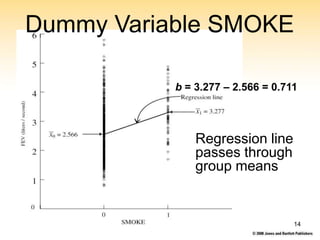
Regression line
passes through
group means
b = 3.277 – 2.566 = 0.711
Basic Biostat 15: Multiple Linear Regression 15
Smoking increases FEV?
• Children who smoked had higher mean FEV
• How can this be true given what we know
about the deleterious respiratory effects of
smoking?
• ANS: Smokers were older than the
nonsmokers
• AGE confounded the relationship between
SMOKE and FEV
• A multiple regression model can be used to
adjust for AGE in this situation
Basic Biostat 15: Multiple Linear Regression 16
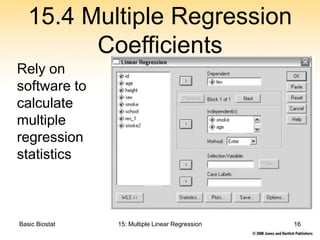
15.4 Multiple Regression
Coefficients
Rely on
software to
calculate
multiple
regression
statistics
Basic Biostat 15: Multiple Linear Regression 17
Example
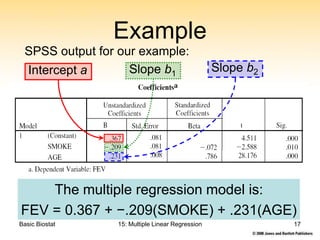
The multiple regression model is:
FEV = 0.367 + −.209(SMOKE) + .231(AGE)
SPSS output for our example:
Intercept a Slope b2
Slope b1
Basic Biostat 15: Multiple Linear Regression 18
Multiple Regression Coefficients, cont.
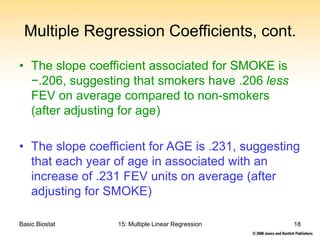
• The slope coefficient associated for SMOKE is
−.206, suggesting that smokers have .206 less
FEV on average compared to non-smokers
(after adjusting for age)
• The slope coefficient for AGE is .231, suggesting
that each year of age in associated with an
increase of .231 FEV units on average (after
adjusting for SMOKE)
Basic Biostat 15: Multiple Linear Regression 19
Coefficients
a
.367 .081 4.511 .000
-.209 .081 -.072 -2.588 .010
.231 .008 .786 28.176 .000
(Constant)
smoke
age
Model
1
B Std. Error
Unstandardized
Coefficients
Beta
Standardized
Coefficients
t Sig.
Dependent Variable: fev
a.
Inference About the Coefficients
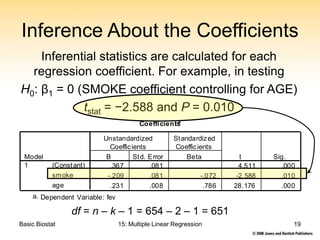
Inferential statistics are calculated for each
regression coefficient. For example, in testing
H0: β1 = 0 (SMOKE coefficient controlling for AGE)
tstat = −2.588 and P = 0.010
df = n – k – 1 = 654 – 2 – 1 = 651
Basic Biostat 15: Multiple Linear Regression 20
Inference About the Coefficients
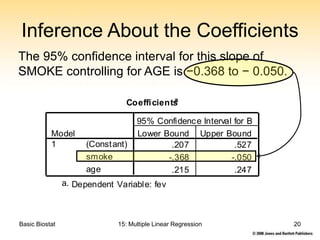
The 95% confidence interval for this slope of
SMOKE controlling for AGE is −0.368 to − 0.050.
Coefficients
a
.207 .527
-.368 -.050
.215 .247
(Constant)
smoke
age
Model
1
Lower Bound Upper Bound
95% Confidence Interval for B
Dependent Variable: fev
a.

Multiple_Linear_Regression Presentation.

  • 1.
    Basic Biostat 15:Multiple Linear Regression 1 Chapter 15: Multiple Linear Regression
  • 2.
    Basic Biostat 15:Multiple Linear Regression 2 In Chapter 15: 15.1 The General Idea 15.2 The Multiple Regression Model 15.3 Categorical Explanatory Variables 15.4 Regression Coefficients [15.5 ANOVA for Multiple Linear Regression] [15.6 Examining Conditions] [Not covered in recorded presentation]
  • 3.
    Basic Biostat 15:Multiple Linear Regression 3 15.1 The General Idea Simple regression considers the relation between a single explanatory variable and response variable
  • 4.
    Basic Biostat 15:Multiple Linear Regression 4 The General Idea Multiple regression simultaneously considers the influence of multiple explanatory variables on a response variable Y The intent is to look at the independent effect of each variable while “adjusting out” the influence of potential confounders
  • 5.
    Basic Biostat 15:Multiple Linear Regression 5 Regression Modeling • A simple regression model (one independent variable) fits a regression line in 2-dimensional space • A multiple regression model with two explanatory variables fits a regression plane in 3- dimensional space
  • 6.
    Basic Biostat 15:Multiple Linear Regression 6 Simple Regression Model Regression coefficients are estimated by minimizing ∑residuals2 (i.e., sum of the squared residuals) to derive this model: The standard error of the regression (sY|x) is based on the squared residuals:
  • 7.
    Basic Biostat 15:Multiple Linear Regression 7 Multiple Regression Model Again, estimates for the multiple slope coefficients are derived by minimizing ∑residuals2 to derive this multiple regression model: Again, the standard error of the regression is based on the ∑residuals2:
  • 8.
    Basic Biostat 15:Multiple Linear Regression 8 Multiple Regression Model • Intercept α predicts where the regression plane crosses the Y axis • Slope for variable X1 (β1) predicts the change in Y per unit X1 holding X2 constant • The slope for variable X2 (β2) predicts the change in Y per unit X2 holding X1 constant
  • 9.
    Basic Biostat 15:Multiple Linear Regression 9 Multiple Regression Model A multiple regression model with k independent variables fits a regression “surface” in k + 1 dimensional space (cannot be visualized)
  • 10.
    Basic Biostat 15:Multiple Linear Regression 10 15.3 Categorical Explanatory Variables in Regression Models • Categorical independent variables can be incorporated into a regression model by converting them into 0/1 (“dummy”) variables • For binary variables, code dummies “0” for “no” and 1 for “yes”
  • 11.
    Basic Biostat 15:Multiple Linear Regression 11 Dummy Variables, More than two levels For categorical variables with k categories, use k–1 dummy variables SMOKE2 has three levels, initially coded 0 = non-smoker 1 = former smoker 2 = current smoker Use k – 1 = 3 – 1 = 2 dummy variables to code this information like this:
  • 12.
    Basic Biostat 15:Multiple Linear Regression 12 Illustrative Example Childhood respiratory health survey. • Binary explanatory variable (SMOKE) is coded 0 for non-smoker and 1 for smoker • Response variable Forced Expiratory Volume (FEV) is measured in liters/second • The mean FEV in nonsmokers is 2.566 • The mean FEV in smokers is 3.277
  • 13.
    Basic Biostat 15:Multiple Linear Regression 13 Example, cont. • Regress FEV on SMOKE least squares regression line: ŷ = 2.566 + 0.711X • Intercept (2.566) = the mean FEV of group 0 • Slope = the mean difference in FEV = 3.277 − 2.566 = 0.711 • tstat = 6.464 with 652 df, P ≈ 0.000 (same as equal variance t test) • The 95% CI for slope β is 0.495 to 0.927 (same as the 95% CI for μ1 − μ0)
  • 14.
    Basic Biostat 15:Multiple Linear Regression 14 Dummy Variable SMOKE Regression line passes through group means b = 3.277 – 2.566 = 0.711
  • 15.
    Basic Biostat 15:Multiple Linear Regression 15 Smoking increases FEV? • Children who smoked had higher mean FEV • How can this be true given what we know about the deleterious respiratory effects of smoking? • ANS: Smokers were older than the nonsmokers • AGE confounded the relationship between SMOKE and FEV • A multiple regression model can be used to adjust for AGE in this situation
  • 16.
    Basic Biostat 15:Multiple Linear Regression 16 15.4 Multiple Regression Coefficients Rely on software to calculate multiple regression statistics
  • 17.
    Basic Biostat 15:Multiple Linear Regression 17 Example The multiple regression model is: FEV = 0.367 + −.209(SMOKE) + .231(AGE) SPSS output for our example: Intercept a Slope b2 Slope b1
  • 18.
    Basic Biostat 15:Multiple Linear Regression 18 Multiple Regression Coefficients, cont. • The slope coefficient associated for SMOKE is −.206, suggesting that smokers have .206 less FEV on average compared to non-smokers (after adjusting for age) • The slope coefficient for AGE is .231, suggesting that each year of age in associated with an increase of .231 FEV units on average (after adjusting for SMOKE)
  • 19.
    Basic Biostat 15:Multiple Linear Regression 19 Coefficients a .367 .081 4.511 .000 -.209 .081 -.072 -2.588 .010 .231 .008 .786 28.176 .000 (Constant) smoke age Model 1 B Std. Error Unstandardized Coefficients Beta Standardized Coefficients t Sig. Dependent Variable: fev a. Inference About the Coefficients Inferential statistics are calculated for each regression coefficient. For example, in testing H0: β1 = 0 (SMOKE coefficient controlling for AGE) tstat = −2.588 and P = 0.010 df = n – k – 1 = 654 – 2 – 1 = 651
  • 20.
    Basic Biostat 15:Multiple Linear Regression 20 Inference About the Coefficients The 95% confidence interval for this slope of SMOKE controlling for AGE is −0.368 to − 0.050. Coefficients a .207 .527 -.368 -.050 .215 .247 (Constant) smoke age Model 1 Lower Bound Upper Bound 95% Confidence Interval for B Dependent Variable: fev a.

Editor's Notes