Welcome to CollaborativeICT Development
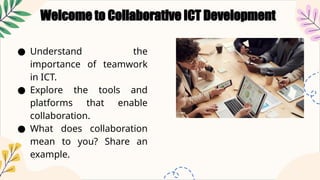
● Understand the
importance of teamwork
in ICT.
● Explore the tools and
platforms that enable
collaboration.
● What does collaboration
mean to you? Share an
example.
3.
The Essence ofCollaboration in ICT
● Collaboration combines different skills and perspectives.
● It leads to innovative solutions and shared knowledge.
● Can you think of a situation where collaboration improved a
project?
4.
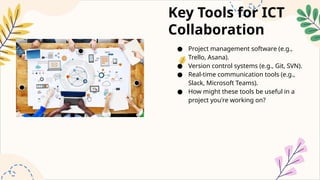
Key Tools forICT
Collaboration
● Project management software (e.g.,
Trello, Asana).
● Version control systems (e.g., Git, SVN).
● Real-time communication tools (e.g.,
Slack, Microsoft Teams).
● How might these tools be useful in a
project you're working on?
5.
Understanding Version Control
●Version control allows multiple people to work on the same
project.
● It helps track changes and manage different versions of
content.
● Discuss how version control might prevent conflicts in a team
project.
6.
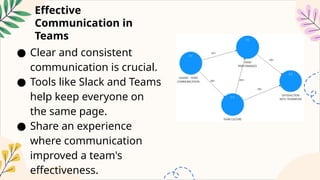
Effective
Communication in
Teams
● Clearand consistent
communication is crucial.
● Tools like Slack and Teams
help keep everyone on
the same page.
● Share an experience
where communication
improved a team's
effectiveness.
7.
Project Management Platforms
Theseplatforms help organize
tasks, deadlines, and
responsibilities.
They provide a visual overview of
the project's progress.
How could a project
management tool help with your
group assignments?
8.
Collaborative Writing andDocumentation
● Tools like Google Docs and Confluence allow simultaneous
editing.
● Documentation is key for knowledge transfer and project
continuity.
● What are the benefits of collaborative writing for learning?
9.
Designing Together:
UI/UX Collaboration
●Design tools like Figma and Sketch
support real-time collaboration.
● They allow for quick feedback and
iteration on design projects.
● How does collaborative design enhance
the user experience?
10.
Peer Review and
CodeSharing
● Code sharing platforms like GitHub and
GitLab facilitate peer review.
● Peer review ensures code quality and
encourages learning from others.
● Why is peer review important in
developing reliable ICT content?
11.
Collaborative Problem Solving
●Teams can brainstorm and tackle complex problems
together.
● Diverse perspectives lead to more comprehensive solutions.
● Think of a problem that could be solved more effectively with
a team.
12.
Agile Methodology inTeamwork
● Agile promotes adaptive planning, evolutionary
development, and flexibility.
● Scrum is a popular agile framework for managing complex
projects.
● How might agile methods improve the way your team works?
13.
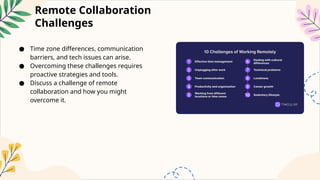
Remote Collaboration
Challenges
● Timezone differences, communication
barriers, and tech issues can arise.
● Overcoming these challenges requires
proactive strategies and tools.
● Discuss a challenge of remote
collaboration and how you might
overcome it.
14.
Security Considerations
in Collaboration
●Sharing information online comes with
security risks.
● Use of encryption, secure networks, and
access controls is essential.
● How can teams ensure the security of
their collaborative ICT content?
15.
Open Source Collaboration
●Open source projects are developed publicly and
collaboratively.
● They encourage community contributions and collective
problem-solving.
● What are the advantages of contributing to open source
projects?
16.
Feedback Loops
in Collaboration
●Regular feedback helps refine ideas and
improve project outcomes.
● Constructive criticism should be
welcomed and acted upon.
● How do feedback loops contribute to
the success of a project?
17.
Collaborative
Learning and
Growth
● Workingwith others offers
opportunities to learn new skills.
● It fosters personal growth and a deeper
understanding of the subject matter.
● Share how you have grown from a
collaborative learning experience.
18.
Integrating Diverse Technologies
●Collaboration often involves integrating various technologies
and platforms.
● This integration can streamline processes and enhance
productivity.
● Can you think of technologies that, when combined, could
improve a project?
19.
Best Practices for
Collaborative
Development
●Establish clear roles and
responsibilities.
● Maintain open lines of communication.
● Embrace flexibility and adaptability.
● What best practices would you add to
this list?
20.
Measuring the Success
ofCollaboration
● Success can be measured by project
outcomes, team satisfaction, and
individual growth.
● Regularly evaluate and adjust
collaboration strategies for continuous
improvement.
● How would you measure the success of
a collaborative effort in your team?
21.
Future Trends inCollaborative ICT Development
● Look out for advancements in AI, machine learning, and
virtual reality.
● These technologies will shape the future of how we
collaborate.
● What future trends do you think will impact collaborative ICT
development?
22.
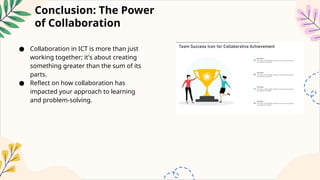
Conclusion: The Power
ofCollaboration
● Collaboration in ICT is more than just
working together; it's about creating
something greater than the sum of its
parts.
● Reflect on how collaboration has
impacted your approach to learning
and problem-solving.
Editor's Notes
#1 Created from: https://docs.google.com/presentation/d/1RXBR3OYBKl2-RHdLpa0EX-2X9EQqx84W-sHi1Nnqo2Q/edit#slide=id.p