LeSS Like Adoption @ SAP
Robert Briese, Agile Coach
Briese SSC UG
Robert Briese – Briese SSC
 Certified Scrum Master (2011)
 Certified Product Owner (2012)
 Certified Scrum Professional (2015)
 Certfied LeSS Practitioner (2015)
 Working as IT Consultant since 2002
 Helping companies like SAP,
Vailant, adidas improve agile
understanding and mindset
Agenda
 Present initial situation (10 mins)
 Exercise (20 mins)
 Transition approach (20 mins)
 Exercise (20 mins)
 Ways of Working (10 mins)
 Exercise (15 mins)
SAP Store on Hybris
SAPPHIRE Development Team
Maintenance Development Team
Overview Governance – Technical Workstream
Project Management
Maintenance: N.N, Software: N.N, Education: N.N,
Infrastructure: N.N
Enterprise Architecture
SAP: N.N
Software: N.N, Education: N.N
Overall: N.N
Software
(hybris)
N.N, N.N
DEV Team 2
Change
Management &
Infrastructure
N.N, N.N, N.N
DEV Team 3
HEC TLCs: N.N, N.N
hMS: N.N, N.N
DEV Team 4
QA
SAP: N.N
Education
(hybris)
N.N, N.N, N.N
Maintenance (cont.
improve.) (hybris)
N.N, N.N
Interface & backend
(including BYD Store)
N.N, N.N, N.N
Product Owner: N.N.
DEV Team 1
Product Owner: N.NProduct Owner: N.N
Overview Governance – Including Business
Business
N.N, N.N &
& N.N
Program Management
SAP Digital: N.N IT: N.N, N.N Education: N.N
Linked Projects
Payment Hub
Learning in the Cloud
Transformation Program
s-Fin
1DX
Business User Acceptance
Requirements Prioritization
Portfolio prioritization
Technical
N.N
Software
Dev
Team
(C4C)
(InApp)
(SF P&R)
Educati
on Dev
Team
(Learnin
g Hub)
Change Management &
Infrastructure
QA & Project Office
Continu
ous
Improv
ement
(Mainte
nance)
Weekly stakeholder status
report
Programme updates via LTM
Workstream meeting
structure
SM, Blue Printing & Onboarding
N.N
Learni
ng
Hub
N.N
In-App
Lumira
N.N.
C4S
N.N
SF
P&R
N.N
User Experience & Design
N.N, N.N
Operations & content
N.N
High Level Program Schedule
Jan Feb Mar Apr May Jun Jul Aug Sep Oct Nov Dec
Q1 / 2015 Q2 / 2015 Q3 / 2015 Q4 / 2015
Jan Feb Mar
Q1 / 2016
Major releases
Minor releases
Cont. improvement
Dev
May 2nd
Bluep. Dev Test
Oct 15th
Bluep. Dev Test
Feb 20th (tbc)
“SAPPHIRE”
“D-Code”
“ByD Sunset”
Test
Custom ready (1.30)
Dev
May 2nd
Bluep. Dev
“SAPPHIRE”
“Payment Hub”
Test
Dev
May 2th
“SAPPHIRE” Test
Software
Education
May 30th
Program Development & Test Schedule
Feb March April May
CW09 CW10 CW11 CW12 CW13 CW14 CW15 CW16 CW17 CW18
2
3
2
4
2
5
2
6
2
7
0
2
0
3
0
4
0
5
0
6
0
9
1
0
1
0
1
2
1
3
1
6
1
7
1
8
1
9
2
0
2
3
2
4
2
5
2
6
2
7
3
0
3
1
0
1
0
2
0
3
0
6
0
7
0
8
0
9
1
0
1
3
14 1
5
1
6
1
7
2
0
2
1
2
2
2
3
2
4
2
7
2
8
2
9
3
0
0
1
0
4
Go-live 1.30
“customer ready”
27.02.
Test
Deploy.
(ICV)
Prod
Deploy.
Dev/Main
Deploy.
IT Spot
check
UAT
Learning Hub
- Sprint 1
test
Go-live
Version x.y
today
Version 1.31
development/
configuration
testing
PCB
C4S - Sprint 1
Lumira - Sprint 1
IT Test
test Maint. Dev. 1.31
UAT Regression
Test
Deploy.
(ICT)
IT Test
UAT
IT Test
UAT
C4S - Sprint 2
Lumira - Sprint
2
Go-live
Learning Hub - Sprint 2
Version x.y
Version x.y
Test
V-Landscape
Regression Test
T-Landscape
Regression Test
T-Landscape / Staging
Development Test
X-Landscape
Regression Timeline and
go-live in review
Bug Fix
D-Landscape
ISX Upg./Mig
ISV Upg./Mig
east
ern
IT Test
Challenge Summary
 Business Challenges (some examples)
 Unclear priority of single features and product capabilities
 Resolved tickets/implemented features show bugs later in the process
 Technical Challenges (some examples)
 Availability and infrastructure faults (performance, closed ports, etc.) are blocking daily
work
 Entire Deployment process takes too long. Often some parts (templates, post-processes
etc.) are missing
 Team members (architects) are busy with manual tasks around build process, code merge
and infrastructure setup/configuration
 High effort of code line merging, resulting in low code quality and many defects
 Setup of test data is a high time consuming process and highly influence from
knowledge-gaps
Exercise: How do you start the change?
 Discuss in groups at each table:
 How do you switch to an agile framework?
 What do you focus on?
 What do you do first?
 What pre-requisites do you need?
Starting a LeSS Adoption – Larman
Approach
 Perform an informed consent workshop for 3 days, with focus on:
 Educate everyone
 Define “Product”
 Define “Done”
 Have appropriately structured teams
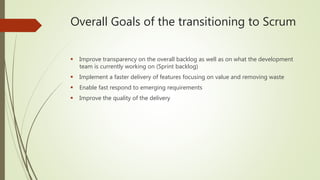
Overall Goals of the transitioning to Scrum
 Improve transparency on the overall backlog as well as on what the development
team is currently working on (Sprint backlog)
 Implement a faster delivery of features focusing on value and removing waste
 Enable fast respond to emerging requirements
 Improve the quality of the delivery
Prerequisites before starting
 Business and IT needs to agree on a process framework how to work together.
 Stable, dedicated, ideally co-located, cross-functional team(s)
 The team needs to be educated in Scrum and set up a working agreement
definition
 An overall backlog needs to be setup including the technical topics above as well
as business topics (i.e. Success Factors P&R, Payment Hub, etc.)
Transition – Proposed Timeline
C4C
1st May 1st June 31st Dec 2015
Scrum
Timeline 2015
FKom & SAPPHIRE Post SAPPHIRE May Post SAPPHIRE H2
Scrum Setup
1st April
Maintenance / SAPHIRE /Payment Hub
In-App Lumira
LH onboarding
2 Days Business Workshop
 First day presentation of requirements
 Second day team creates a User Story Map and defines epics & user stories
 Afterwards team provide high-level estimates
 With the estimates a high-level release roadmap is created
 Once a month a stakeholder alignment will be performed using “Business Value
Game” to prioritize user stories
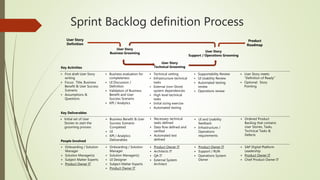
Product Backlog definition Process
 Will be done after
initial training of all
Solution Managers
 Uses the Solution
Blueprint documents
Key Deliverables
People Involved
Feature
Ideation
Grooming /
Epics Breakdown
Theme
Definition
Epics Ordering
Product
Roadmap
 Interim process to
“translate”
requirements from
various documents to
Epics and User Stories
 Grooming of Epics that
are defined in the
Ideation process
 Initial grooming
process to ensure that
the Epics are sized
properly so that they
can be planned in a
product roadmap and
high level costing
 Create an ordered list
of Epics for the next
half of year
 Performed at the end
of each Sprint
 Review and if necessary
adjustment of
Roadmap
 Initial list of Epics and
User Stories
 Creation of additional
Epics and User Stories
 Proper sized Epics and
User Stories that fit in a
product roadmap
 Ordered list of Epics for
the next 3 – 6 months
 Epics placed into
Roadmap broken down
by month
 Onboarding / Solution
Manager
 Solution Manager(s)
 Subject Matter Experts
 Product Owner IT
 Onboarding / solution
Manager
 Solution Manager(s)
 Subject Matter Experts
 Product Owner IT
 SAP Digital Platform
Solution Owner
 Onboarding Manager
 Solution Manager(s)
 Subject Matter Experts
 Product Owner IT
 SAP Digital Platform
Solution Owner
 Product Owner IT
 Architects IT
Key Activities
Sprint Backlog definition Process
 First draft User Story
writing
 Focus: Title, Business
Benefit & User Success
Scenario
 Assumptions &
Questions
Key Deliverables
User Story
Business Grooming
User Story
Definition
User Story
Technical Grooming
Product
Roadmap
 Business evaluation for
completeness
 UI Discussion /
Definition
 Validation of Business
Benefit and User
Success Scenario
 KPI / Analytics
 Technical vetting
 Infrastructure technical
tasks
 External (non-Store)
system dependencies
 High level technical
tasks
 Initial sizing exercise
 Automated testing
 Supportability Review
 UI Usability Review
 Automated testing
review
 Operations review
 User Story meets
“Definition of Ready”
 Optional: Story
Pointing
 Business Benefit & User
Success Scenario
Completed
 UI
 KPI / Analytics
Deliverables
 Necessary technical
tasks defined
 Data flow defined and
verified
 Automated test
defined
 UI and Usability
feedback
 Infrastructure /
Operations
requirements
 Ordered Product
Backlog that contains
User Stories, Tasks,
Technical Tasks &
Defects
Key Activities
User Story
Support / Operations Grooming
People Involved
 Onboarding / Solution
Manager
 Solution Manager(s)
 Subject Matter Experts
 Product Owner IT
 Onboarding / Solution
Manager
 Solution Manager(s)
 UI Designer
 Subject Matter Experts
 Product Owner IT
 Product Owner IT
 Architects IT
 QA IT
 External System
Architect
 Product Owner IT
 Support / RUN
 Operations System
Owner
 SAP Digital Platform
Leadership
 Product Owner IT
 Chief Product Owner IT
 Initial set of User
Stories to start the
grooming process
Artifacts
Timeline for Initial Roadmap Definition and
Ongoing Updates
Jun 8th Jun 22nd Jul 6th Jul 20th Aug 3rd
Initial roadmap Roadmap updates Roadmap updates Roadmap updates Roadmap updates
Jun 17th Jul 1st Jul15th Jul 29th Aug 12th
Team Participants Date /
Duration
Moderator Input Output
Portfolio BO1
BO2
CW 25 / 2h Robert  Portfolio prioritization
 XLS from planning offsite
 Sequenced requirements list
GTM BO3 CW 25 / 2h Robert  GTM blueprints (promotions, …)
 XLS from planning offsite
 Sequenced requirements list
Content Bo4 CW 25 / 1h Robert  Content review results
 XLS from planning offsite
 Sequenced requirements list
Operations BO5 CW 26 / 1h Robert  XLS from planning offsite  Sequenced requirements list
Platform BO6 CW 26 / 2h Robert  List of blueprint left overs
 XLS from planning offsite
 Sequenced requirements list
SAP IT BO7
BO8
CW 26 / 2h Robert  SAP IT issue list
 XLS from planning offsite
 Sequenced requirements list
Initial roadmap alignment meetings
Biweekly roadmap
alignment & update
Exercise: What could have been the
challenges of the propose approach?
 Discuss in groups at each table:
 What are the advantages of the approach?
 What are the disadvantages?
 Come up with a list of max. 5 items for each
 What do you think overweighed?
Challenges
 Team members didn’t get involved in refinement of the PBIs
 The “needs” where cascaded down from business owners via user stories as a new
form of “requirement documents”
 Business felt uncomfortable with estimates and speed of delivery
 Primary measure of success was speed of delivery and quality
Ways of Working
Key Success Factors
 One Product Backlog for all teams
 High performing and good aligned feature teams
 A potential shippable product increment every sprint
 High quality through continuous integration and test automation
Exercise: Why only one Product Backlog?
 Discuss in groups at each table:
 What is the impact of using one Product Backlog for multiple teams?
 Consider:
 Local Optimization vs. System Optimization
 Generating Highest Business Value as soon as possible
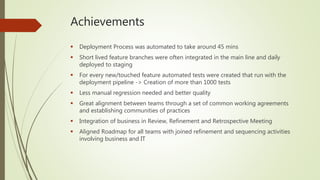
Achievements
 Deployment Process was automated to take around 45 mins
 Short lived feature branches were often integrated in the main line and daily
deployed to staging
 For every new/touched feature automated tests were created that run with the
deployment pipeline -> Creation of more than 1000 tests
 Less manual regression needed and better quality
 Great alignment between teams through a set of common working agreements
and establishing communities of practices
 Integration of business in Review, Refinement and Retrospective Meeting
 Aligned Roadmap for all teams with joined refinement and sequencing activities
involving business and IT

LeSS Like Adoption @ SAP

  • 1.
    LeSS Like Adoption@ SAP Robert Briese, Agile Coach Briese SSC UG
  • 2.
    Robert Briese –Briese SSC  Certified Scrum Master (2011)  Certified Product Owner (2012)  Certified Scrum Professional (2015)  Certfied LeSS Practitioner (2015)  Working as IT Consultant since 2002  Helping companies like SAP, Vailant, adidas improve agile understanding and mindset
  • 3.
    Agenda  Present initialsituation (10 mins)  Exercise (20 mins)  Transition approach (20 mins)  Exercise (20 mins)  Ways of Working (10 mins)  Exercise (15 mins)
  • 4.
  • 5.
    SAPPHIRE Development Team MaintenanceDevelopment Team Overview Governance – Technical Workstream Project Management Maintenance: N.N, Software: N.N, Education: N.N, Infrastructure: N.N Enterprise Architecture SAP: N.N Software: N.N, Education: N.N Overall: N.N Software (hybris) N.N, N.N DEV Team 2 Change Management & Infrastructure N.N, N.N, N.N DEV Team 3 HEC TLCs: N.N, N.N hMS: N.N, N.N DEV Team 4 QA SAP: N.N Education (hybris) N.N, N.N, N.N Maintenance (cont. improve.) (hybris) N.N, N.N Interface & backend (including BYD Store) N.N, N.N, N.N Product Owner: N.N. DEV Team 1 Product Owner: N.NProduct Owner: N.N
  • 6.
    Overview Governance –Including Business Business N.N, N.N & & N.N Program Management SAP Digital: N.N IT: N.N, N.N Education: N.N Linked Projects Payment Hub Learning in the Cloud Transformation Program s-Fin 1DX Business User Acceptance Requirements Prioritization Portfolio prioritization Technical N.N Software Dev Team (C4C) (InApp) (SF P&R) Educati on Dev Team (Learnin g Hub) Change Management & Infrastructure QA & Project Office Continu ous Improv ement (Mainte nance) Weekly stakeholder status report Programme updates via LTM Workstream meeting structure SM, Blue Printing & Onboarding N.N Learni ng Hub N.N In-App Lumira N.N. C4S N.N SF P&R N.N User Experience & Design N.N, N.N Operations & content N.N
  • 7.
    High Level ProgramSchedule Jan Feb Mar Apr May Jun Jul Aug Sep Oct Nov Dec Q1 / 2015 Q2 / 2015 Q3 / 2015 Q4 / 2015 Jan Feb Mar Q1 / 2016 Major releases Minor releases Cont. improvement Dev May 2nd Bluep. Dev Test Oct 15th Bluep. Dev Test Feb 20th (tbc) “SAPPHIRE” “D-Code” “ByD Sunset” Test Custom ready (1.30) Dev May 2nd Bluep. Dev “SAPPHIRE” “Payment Hub” Test Dev May 2th “SAPPHIRE” Test Software Education May 30th
  • 8.
    Program Development &Test Schedule Feb March April May CW09 CW10 CW11 CW12 CW13 CW14 CW15 CW16 CW17 CW18 2 3 2 4 2 5 2 6 2 7 0 2 0 3 0 4 0 5 0 6 0 9 1 0 1 0 1 2 1 3 1 6 1 7 1 8 1 9 2 0 2 3 2 4 2 5 2 6 2 7 3 0 3 1 0 1 0 2 0 3 0 6 0 7 0 8 0 9 1 0 1 3 14 1 5 1 6 1 7 2 0 2 1 2 2 2 3 2 4 2 7 2 8 2 9 3 0 0 1 0 4 Go-live 1.30 “customer ready” 27.02. Test Deploy. (ICV) Prod Deploy. Dev/Main Deploy. IT Spot check UAT Learning Hub - Sprint 1 test Go-live Version x.y today Version 1.31 development/ configuration testing PCB C4S - Sprint 1 Lumira - Sprint 1 IT Test test Maint. Dev. 1.31 UAT Regression Test Deploy. (ICT) IT Test UAT IT Test UAT C4S - Sprint 2 Lumira - Sprint 2 Go-live Learning Hub - Sprint 2 Version x.y Version x.y Test V-Landscape Regression Test T-Landscape Regression Test T-Landscape / Staging Development Test X-Landscape Regression Timeline and go-live in review Bug Fix D-Landscape ISX Upg./Mig ISV Upg./Mig east ern IT Test
  • 9.
    Challenge Summary  BusinessChallenges (some examples)  Unclear priority of single features and product capabilities  Resolved tickets/implemented features show bugs later in the process  Technical Challenges (some examples)  Availability and infrastructure faults (performance, closed ports, etc.) are blocking daily work  Entire Deployment process takes too long. Often some parts (templates, post-processes etc.) are missing  Team members (architects) are busy with manual tasks around build process, code merge and infrastructure setup/configuration  High effort of code line merging, resulting in low code quality and many defects  Setup of test data is a high time consuming process and highly influence from knowledge-gaps
  • 10.
    Exercise: How doyou start the change?  Discuss in groups at each table:  How do you switch to an agile framework?  What do you focus on?  What do you do first?  What pre-requisites do you need?
  • 11.
    Starting a LeSSAdoption – Larman Approach  Perform an informed consent workshop for 3 days, with focus on:  Educate everyone  Define “Product”  Define “Done”  Have appropriately structured teams
  • 12.
    Overall Goals ofthe transitioning to Scrum  Improve transparency on the overall backlog as well as on what the development team is currently working on (Sprint backlog)  Implement a faster delivery of features focusing on value and removing waste  Enable fast respond to emerging requirements  Improve the quality of the delivery
  • 13.
    Prerequisites before starting Business and IT needs to agree on a process framework how to work together.  Stable, dedicated, ideally co-located, cross-functional team(s)  The team needs to be educated in Scrum and set up a working agreement definition  An overall backlog needs to be setup including the technical topics above as well as business topics (i.e. Success Factors P&R, Payment Hub, etc.)
  • 14.
    Transition – ProposedTimeline C4C 1st May 1st June 31st Dec 2015 Scrum Timeline 2015 FKom & SAPPHIRE Post SAPPHIRE May Post SAPPHIRE H2 Scrum Setup 1st April Maintenance / SAPHIRE /Payment Hub In-App Lumira LH onboarding
  • 15.
    2 Days BusinessWorkshop  First day presentation of requirements  Second day team creates a User Story Map and defines epics & user stories  Afterwards team provide high-level estimates  With the estimates a high-level release roadmap is created  Once a month a stakeholder alignment will be performed using “Business Value Game” to prioritize user stories
  • 16.
    Product Backlog definitionProcess  Will be done after initial training of all Solution Managers  Uses the Solution Blueprint documents Key Deliverables People Involved Feature Ideation Grooming / Epics Breakdown Theme Definition Epics Ordering Product Roadmap  Interim process to “translate” requirements from various documents to Epics and User Stories  Grooming of Epics that are defined in the Ideation process  Initial grooming process to ensure that the Epics are sized properly so that they can be planned in a product roadmap and high level costing  Create an ordered list of Epics for the next half of year  Performed at the end of each Sprint  Review and if necessary adjustment of Roadmap  Initial list of Epics and User Stories  Creation of additional Epics and User Stories  Proper sized Epics and User Stories that fit in a product roadmap  Ordered list of Epics for the next 3 – 6 months  Epics placed into Roadmap broken down by month  Onboarding / Solution Manager  Solution Manager(s)  Subject Matter Experts  Product Owner IT  Onboarding / solution Manager  Solution Manager(s)  Subject Matter Experts  Product Owner IT  SAP Digital Platform Solution Owner  Onboarding Manager  Solution Manager(s)  Subject Matter Experts  Product Owner IT  SAP Digital Platform Solution Owner  Product Owner IT  Architects IT Key Activities
  • 17.
    Sprint Backlog definitionProcess  First draft User Story writing  Focus: Title, Business Benefit & User Success Scenario  Assumptions & Questions Key Deliverables User Story Business Grooming User Story Definition User Story Technical Grooming Product Roadmap  Business evaluation for completeness  UI Discussion / Definition  Validation of Business Benefit and User Success Scenario  KPI / Analytics  Technical vetting  Infrastructure technical tasks  External (non-Store) system dependencies  High level technical tasks  Initial sizing exercise  Automated testing  Supportability Review  UI Usability Review  Automated testing review  Operations review  User Story meets “Definition of Ready”  Optional: Story Pointing  Business Benefit & User Success Scenario Completed  UI  KPI / Analytics Deliverables  Necessary technical tasks defined  Data flow defined and verified  Automated test defined  UI and Usability feedback  Infrastructure / Operations requirements  Ordered Product Backlog that contains User Stories, Tasks, Technical Tasks & Defects Key Activities User Story Support / Operations Grooming People Involved  Onboarding / Solution Manager  Solution Manager(s)  Subject Matter Experts  Product Owner IT  Onboarding / Solution Manager  Solution Manager(s)  UI Designer  Subject Matter Experts  Product Owner IT  Product Owner IT  Architects IT  QA IT  External System Architect  Product Owner IT  Support / RUN  Operations System Owner  SAP Digital Platform Leadership  Product Owner IT  Chief Product Owner IT  Initial set of User Stories to start the grooming process
  • 18.
  • 19.
    Timeline for InitialRoadmap Definition and Ongoing Updates Jun 8th Jun 22nd Jul 6th Jul 20th Aug 3rd Initial roadmap Roadmap updates Roadmap updates Roadmap updates Roadmap updates Jun 17th Jul 1st Jul15th Jul 29th Aug 12th Team Participants Date / Duration Moderator Input Output Portfolio BO1 BO2 CW 25 / 2h Robert  Portfolio prioritization  XLS from planning offsite  Sequenced requirements list GTM BO3 CW 25 / 2h Robert  GTM blueprints (promotions, …)  XLS from planning offsite  Sequenced requirements list Content Bo4 CW 25 / 1h Robert  Content review results  XLS from planning offsite  Sequenced requirements list Operations BO5 CW 26 / 1h Robert  XLS from planning offsite  Sequenced requirements list Platform BO6 CW 26 / 2h Robert  List of blueprint left overs  XLS from planning offsite  Sequenced requirements list SAP IT BO7 BO8 CW 26 / 2h Robert  SAP IT issue list  XLS from planning offsite  Sequenced requirements list Initial roadmap alignment meetings Biweekly roadmap alignment & update
  • 20.
    Exercise: What couldhave been the challenges of the propose approach?  Discuss in groups at each table:  What are the advantages of the approach?  What are the disadvantages?  Come up with a list of max. 5 items for each  What do you think overweighed?
  • 21.
    Challenges  Team membersdidn’t get involved in refinement of the PBIs  The “needs” where cascaded down from business owners via user stories as a new form of “requirement documents”  Business felt uncomfortable with estimates and speed of delivery  Primary measure of success was speed of delivery and quality
  • 22.
  • 23.
    Key Success Factors One Product Backlog for all teams  High performing and good aligned feature teams  A potential shippable product increment every sprint  High quality through continuous integration and test automation
  • 24.
    Exercise: Why onlyone Product Backlog?  Discuss in groups at each table:  What is the impact of using one Product Backlog for multiple teams?  Consider:  Local Optimization vs. System Optimization  Generating Highest Business Value as soon as possible
  • 25.
    Achievements  Deployment Processwas automated to take around 45 mins  Short lived feature branches were often integrated in the main line and daily deployed to staging  For every new/touched feature automated tests were created that run with the deployment pipeline -> Creation of more than 1000 tests  Less manual regression needed and better quality  Great alignment between teams through a set of common working agreements and establishing communities of practices  Integration of business in Review, Refinement and Retrospective Meeting  Aligned Roadmap for all teams with joined refinement and sequencing activities involving business and IT

Editor's Notes

  • #5 What is the SAP Store.
  • #6 4 Development teams: One for education offerings, one for software offerings, one for interface and backend and one for maintenance. In addition there was an infrastructure team, an enterprise architecture team and a QA team. Each team had of course a project manager (and a Product Owner). For some teams this was the same person
  • #7  The governance model included different streams with different responsible managers (ie. Business - responsible for portfolio prioritisation, business user acceptance, etc, Blue Printing and Onboarding - responsible for different feature releases (each with a PM), User Experience & Design, Operations & Content (with a PM)
  • #8 For a big release like SAPPHIRE the development teams worked in parallel on the different requirements/features for 3 months. There was a “dev close” 5,5 weeks before the release. There was a plan to perform 2 weeks of IT testing and another 2 weeks of UAT, leaving one more week for regression tests, and a couple of buffer days
  • #12 Usually Craig likes to work at Gemba the first day, first half with the development team working trough legacy code and teaching TDD, while spending the afternoon with the product management group doing (high-level) impact mapping. The next 2 days are a workshop with the whole team. The second day Craig focuses on Thinking Tools behind LeSS (Occupational Psychology, waste, queuing theory) and creating causal loop diagrams. The third day has a focus on the LeSS framework and some adoption notes.
  • #13 This is the actual slide that I showed to the CDO of SAP (Jonathan Becher) in a workshop March 2015.
  • #14 First item includes: how requirements are provided, the visualization of requirements (i.e. User Story Maps), the alignment of requirements from different stakeholders, the involvement of business during the Sprint, etc. All relevant enterprise and product architects should document what are the dependencies to other teams and how to solve them. They should come up with an initial backlog for technical tasks regarding continuous integration and delivery, test automation, platform stabilization, code refactoring, consolidation into a single code line, etc. The team should come up with an initial backlog for technical tasks regarding continuous integration and delivery, test automation, platform stabilization, code refactoring, consolidation into a single code line, etc.
  • #15 During the Scrum Setup phase a 2 day Business Workshop was planned as well as 2 weeks for teams to meet in one location and go through training and creation of the technical backlog
  • #16 That was the original plan Problem: Business wanted a clear definition of the process, artifacts and roles & responsibilities
  • #17 We had a 2 days workshop with business. But after some deeper retrospective it went into a deeper discussion on detailed processes, artifacts and roles and responsibilities of everyone involved.
  • #26 Open Questions: What LeSS like? Is it really LeSS? One Chief Product Owner but unfortunately he was not supported from the organization to be the one and only decision maker No significant organizational changes to support a different way of working