Prepared by Muhammad Ishaq
Lecturer at Cusit
Topic Lesion characteristics
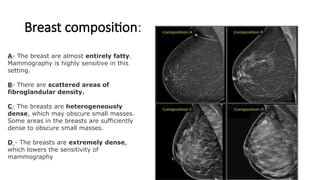
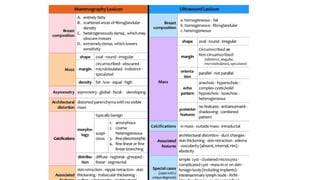
Breast composition:
A- The breast are almost entirely fatty.
Mammography is highly sensitive in this
setting.
B- There are scattered areas of
fibroglandular density.
C- The breasts are heterogeneously
dense, which may obscure small masses.
Some areas in the breasts are sufficiently
dense to obscure small masses.
D - The breasts are extremely dense,
which lowers the sensitivity of
mammography
• Four main lesions are visible mammographically:
1. Masses
2. Calcifications
3. Architectural distortion
4. Focal density
Mass: Any space occupying lesion is called mass.
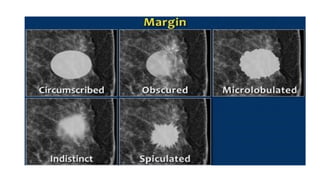
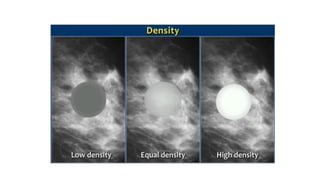
• Masses are assessd by shape, margin and density.
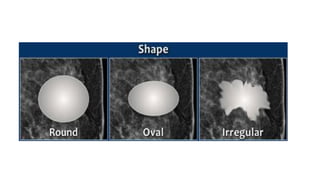
a. SHAPE: The shape may be round, oval, irregular or lobulated
b. Margins: Margins (or surface) may be smooth, obscured(partially
hidden by adjacent tissue), indistinct (ill-defined), or spiculated
(characterized by lines radiating from the mass).
c. Density: lesions may be hyperdense, isodense or hypodense.
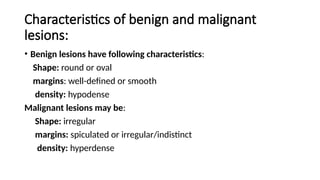
Characteristics of benign and malignant
lesions:
• Benign lesions have following characteristics:
Shape: round or oval
margins: well-defined or smooth
density: hypodense
Malignant lesions may be:
Shape: irregular
margins: spiculated or irregular/indistinct
density: hyperdense
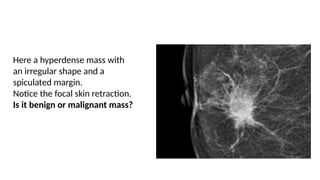
Here a hyperdense mass with
an irregular shape and a
spiculated margin.
Notice the focal skin retraction.
Is it benign or malignant mass?
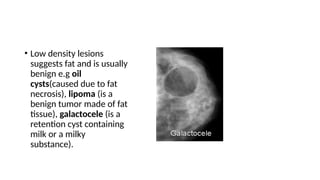
• Low density lesions
suggests fat and is usually
benign e.g oil
cysts(caused due to fat
necrosis), lipoma (is a
benign tumor made of fat
tissue), galactocele (is a
retention cyst containing
milk or a milky
substance).
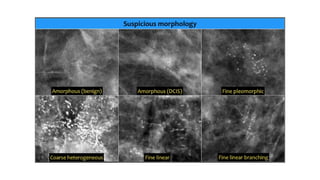
Calcifications:
• Calcifications vary in size, shape, number, grouping and orientation.
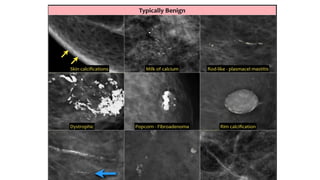
• Benign calcifications are:
dermal, vascular, popcorn, rod and ringlike calcifications
• Malignant calcification: grouped , liner or branching and irregular in
size, shape and separation.
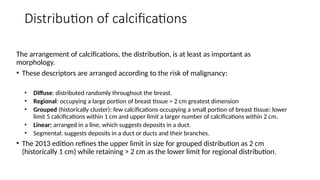
Distribution of calcifications
The arrangement of calcifications, the distribution, is at least as important as
morphology.
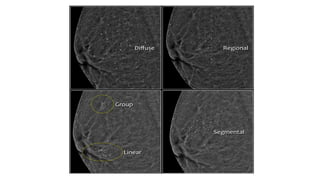
• These descriptors are arranged according to the risk of malignancy:
• Diffuse: distributed randomly throughout the breast.
• Regional: occupying a large portion of breast tissue > 2 cm greatest dimension
• Grouped (historically cluster): few calcifications occupying a small portion of breast tissue: lower
limit 5 calcifications within 1 cm and upper limit a larger number of calcifications within 2 cm.
• Linear: arranged in a line, which suggests deposits in a duct.
• Segmental: suggests deposits in a duct or ducts and their branches.
• The 2013 edition refines the upper limit in size for grouped distribution as 2 cm
(historically 1 cm) while retaining > 2 cm as the lower limit for regional distribution.
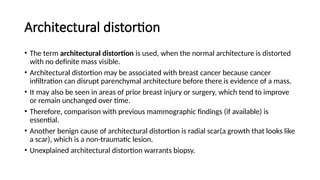
Architectural distortion
• The term architectural distortion is used, when the normal architecture is distorted
with no definite mass visible.
• Architectural distortion may be associated with breast cancer because cancer
infiltration can disrupt parenchymal architecture before there is evidence of a mass.
• It may also be seen in areas of prior breast injury or surgery, which tend to improve
or remain unchanged over time.
• Therefore, comparison with previous mammographic findings (if available) is
essential.
• Another benign cause of architectural distortion is radial scar(a growth that looks like
a scar), which is a non-traumatic lesion.
• Unexplained architectural distortion warrants biopsy.
Notice the distortion of the normal
breast architecture on oblique view
(yellow circle) and magnification
view.
A resection was performed and only
scar tissue was found in the
specimen.
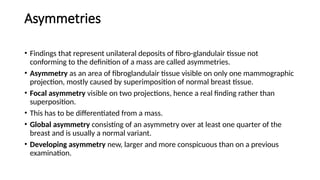
Asymmetries
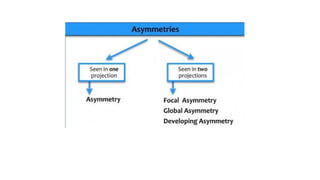
• Findings that represent unilateral deposits of fibro-glandulair tissue not
conforming to the definition of a mass are called asymmetries.
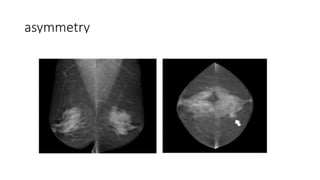
• Asymmetry as an area of fibroglandulair tissue visible on only one mammographic
projection, mostly caused by superimposition of normal breast tissue.
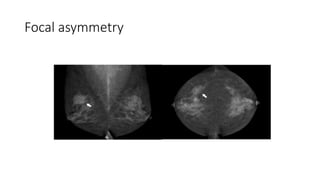
• Focal asymmetry visible on two projections, hence a real finding rather than
superposition.
• This has to be differentiated from a mass.
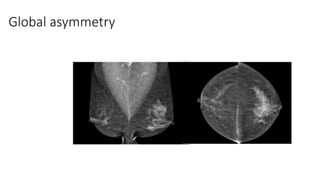
• Global asymmetry consisting of an asymmetry over at least one quarter of the
breast and is usually a normal variant.
• Developing asymmetry new, larger and more conspicuous than on a previous
examination.
asymmetry
Global asymmetry
Focal asymmetry
Asymmetry versus Mass
• All types of asymmetry have different border contours than true
masses and also lack the conspicuity of masses.
• Asymmetries appear similar to other discrete areas of fibroglandulair
tissue except that they are unitaleral, with no mirror-image correlate in
the opposite breast.
• An asymmetry demonstrates concave outward borders and usually is
interspersed with fat, whereas a mass demonstrates convex outward
borders and appears denser in the center than at the periphery.
Other feautres:
• Associated features are things that are seen in association with
suspicious findings like masses, asymmetries and calcifications.
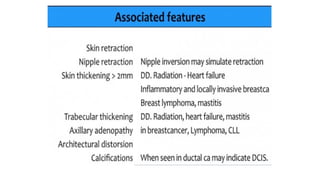
• Associated features such as skin thickening, skin retraction, nipple
retraction and trabecular thickening.
• These are assessed with the main features outlined above and in light
of clinical picture.
• Associated features play a role in the final assessment.
Lesion characteristics memography 3.pptx

Lesion characteristics memography 3.pptx

  • 1.
    Prepared by MuhammadIshaq Lecturer at Cusit Topic Lesion characteristics
  • 2.
    Breast composition: A- Thebreast are almost entirely fatty. Mammography is highly sensitive in this setting. B- There are scattered areas of fibroglandular density. C- The breasts are heterogeneously dense, which may obscure small masses. Some areas in the breasts are sufficiently dense to obscure small masses. D - The breasts are extremely dense, which lowers the sensitivity of mammography
  • 3.
    • Four mainlesions are visible mammographically: 1. Masses 2. Calcifications 3. Architectural distortion 4. Focal density
  • 4.
    Mass: Any spaceoccupying lesion is called mass. • Masses are assessd by shape, margin and density. a. SHAPE: The shape may be round, oval, irregular or lobulated b. Margins: Margins (or surface) may be smooth, obscured(partially hidden by adjacent tissue), indistinct (ill-defined), or spiculated (characterized by lines radiating from the mass). c. Density: lesions may be hyperdense, isodense or hypodense.
  • 9.
    Characteristics of benignand malignant lesions: • Benign lesions have following characteristics: Shape: round or oval margins: well-defined or smooth density: hypodense Malignant lesions may be: Shape: irregular margins: spiculated or irregular/indistinct density: hyperdense
  • 10.
    Here a hyperdensemass with an irregular shape and a spiculated margin. Notice the focal skin retraction. Is it benign or malignant mass?
  • 11.
    • Low densitylesions suggests fat and is usually benign e.g oil cysts(caused due to fat necrosis), lipoma (is a benign tumor made of fat tissue), galactocele (is a retention cyst containing milk or a milky substance).
  • 12.
    Calcifications: • Calcifications varyin size, shape, number, grouping and orientation. • Benign calcifications are: dermal, vascular, popcorn, rod and ringlike calcifications • Malignant calcification: grouped , liner or branching and irregular in size, shape and separation.
  • 15.
    Distribution of calcifications Thearrangement of calcifications, the distribution, is at least as important as morphology. • These descriptors are arranged according to the risk of malignancy: • Diffuse: distributed randomly throughout the breast. • Regional: occupying a large portion of breast tissue > 2 cm greatest dimension • Grouped (historically cluster): few calcifications occupying a small portion of breast tissue: lower limit 5 calcifications within 1 cm and upper limit a larger number of calcifications within 2 cm. • Linear: arranged in a line, which suggests deposits in a duct. • Segmental: suggests deposits in a duct or ducts and their branches. • The 2013 edition refines the upper limit in size for grouped distribution as 2 cm (historically 1 cm) while retaining > 2 cm as the lower limit for regional distribution.
  • 17.
    Architectural distortion • Theterm architectural distortion is used, when the normal architecture is distorted with no definite mass visible. • Architectural distortion may be associated with breast cancer because cancer infiltration can disrupt parenchymal architecture before there is evidence of a mass. • It may also be seen in areas of prior breast injury or surgery, which tend to improve or remain unchanged over time. • Therefore, comparison with previous mammographic findings (if available) is essential. • Another benign cause of architectural distortion is radial scar(a growth that looks like a scar), which is a non-traumatic lesion. • Unexplained architectural distortion warrants biopsy.
  • 18.
    Notice the distortionof the normal breast architecture on oblique view (yellow circle) and magnification view. A resection was performed and only scar tissue was found in the specimen.
  • 19.
    Asymmetries • Findings thatrepresent unilateral deposits of fibro-glandulair tissue not conforming to the definition of a mass are called asymmetries. • Asymmetry as an area of fibroglandulair tissue visible on only one mammographic projection, mostly caused by superimposition of normal breast tissue. • Focal asymmetry visible on two projections, hence a real finding rather than superposition. • This has to be differentiated from a mass. • Global asymmetry consisting of an asymmetry over at least one quarter of the breast and is usually a normal variant. • Developing asymmetry new, larger and more conspicuous than on a previous examination.
  • 21.
  • 22.
  • 23.
  • 24.
    Asymmetry versus Mass •All types of asymmetry have different border contours than true masses and also lack the conspicuity of masses. • Asymmetries appear similar to other discrete areas of fibroglandulair tissue except that they are unitaleral, with no mirror-image correlate in the opposite breast. • An asymmetry demonstrates concave outward borders and usually is interspersed with fat, whereas a mass demonstrates convex outward borders and appears denser in the center than at the periphery.
  • 25.
    Other feautres: • Associatedfeatures are things that are seen in association with suspicious findings like masses, asymmetries and calcifications. • Associated features such as skin thickening, skin retraction, nipple retraction and trabecular thickening. • These are assessed with the main features outlined above and in light of clinical picture. • Associated features play a role in the final assessment.