Aberystwyth University 6 th  December 2010 Les Watson [email_address] www.leswatson.net Designing Spaces Creating Places
21st century There is, as yet, no paradigm for  the 21st Century University
A New Paradigm Obsession with GDP as a measure of how good people feel is losing its grip against concerns for welfare and sustainability Observer 10/01/10 Economists start to consider that money can't buy happiness
A New Paradigm The UK  government  is poised to start  measuring  people's psychological and environmental wellbeing, bidding to be among the first countries to officially monitor  happiness . Guardian14/11/10
Who will weather the financial storm?  Guardian Education 19th February 2008 “ The  national student survey  - which asks students to rate their university and then publishes the results - has created a certain  pressure . This is now a  very competitive environment ”
21st century  Student library visits fall 20 per cent in a decade THES 12th October 2007
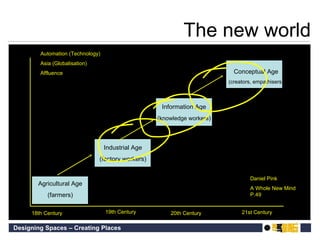
The new world Automation (Technology)  Asia (Globalisation) Affluence 18th Century 19th Century 20th Century 21st Century Agricultural Age (farmers) Information Age ( knowledge workers ) Industrial Age (factory workers) Conceptual Age (creators, empathisers) Daniel Pink  A Whole New Mind P.49
Unexpected events The Black Swan   Nicholas Nassim Taleb
Strategic stance The Creative World View ..the reference point is the future, not the past. We don’t need to fall back on the past for our decisions. Choices are based on alignment with our purpose and our vision for a different world.   George Land & Beth Jarman Breakpoint and Beyond p.166
Be intuitive Albert Einstein quoted in My Organisation is a Jungle Jef Staes The  intuitive mind  is a  sacred gift  and the  rational mind  is a  faithful servant . We have created a  society  that  honours   the servant and has forgotten the gift.
Be unhappy The truly  successful businessman is essentially a dissenter J.Paul Getty
Be creative At the  moment  any of us  set out  to  create  something new, we  cannot know  if what we are about to do  will work or not. Ellen Langer On Becoming an Artis t2005
Take risks A  de-risked project  is going to be a  boring project , a project that will deliver at best  mediocre results Alastair Dryburgh Chief Contrarian in Management Today Dec. 2010
Be Playful It’s never occurred to me that I can’t  be playful ….. Twyla Tharp The creative habit
All buildings are predictions. Stewart Brand How Buildings Learn What happens to then after they’re built All predictions are wrong ….. But we can design buildings so that it doesn’t matter if they are wrong. Uncertainty
Welcome inexperience Inexperience  provides us with a childlike  fearlessness  that is the polar  opposite  of the alleged  wisdom  that age confers on us.  Inexperience erases fear …… Twyla Tharp The creative habit
Welcome inexperience All our decisions are made in ignorance . If we knew what to do, we would just do it. That is, we would not be faced with a decision in the first place. The problem is not not knowing; rather,  the problem is thinking we should know. Ellen Langer On Becoming an Artist 2002
Acocrdnig to rseerach at Cmabirdge Uinvrestiy it dsoen’t mtater waht oredr the letetrs are in a wrod. Olny the fisrt and the lsat mtater the rset can be a toatl mses. Tihs is bceasue the huamn mnid deos not raed evrey letetr - olny the frist and the lsat. Amzaing relaly. Be open to new ideas
Can we  make  a  better education system? Ask BIG questions
When my daughter was about seven years old, she asked me one day what I did at work. I told her I worked at the college – that my job was to teach people how to draw. She stared back at me incredulous, and said, You mean they forget? Howard Ikemoto Ask BIG questions
“ Most people’s  expectation  of the  future  is that the current pace will continue, despite the fact that the  power  of  technology  is  doubling   every year ” Ray Kurzweil   Imagining change
2020   Imagining change
2030   Imagining change
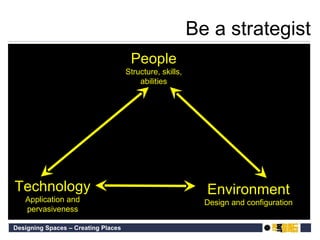
Be a strategist People Structure,  skills , abilities Technology Application and pervasiveness Environment Design and configuration
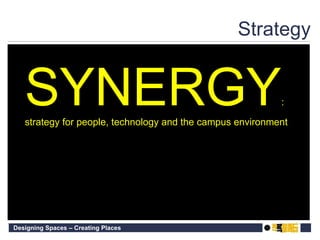
Strategy SYNERGY :  strategy for people, technology and the campus environment
Be Imaginative Imagine…
Be Imaginative Imagine…   a world in which  everyone achieves their full educational potential , where  academic and vocational achievement has equal value , and where experiential learning enables  everyone  to continually  develop  their knowledge and skills  throughout their life .
Technology Technology is only technology  for people who were born before it was invented Alan Kay   (in Don Tapscott – Grown up Digital)
Net Generation  That’s why  we   don’t argue about whether the piano is corrupting music with technology Seymour Papert
21st century challenge The  next stage of technological investment  must be  more strategic . The sector currently  lacks a coherent narrative  of how  institutions will look in the future  and  the role of technology  in the  transition to a wider learning and research culture.  The Edgeless University - Demos/Jisc June 2009
 
The myths The  internet  is too  dangerous  for  children Junk culture  is  poisoning  young  people  and taking over their  lives No learning  happens and  digital technologies  are a  waste of time There is an  epidemic  of  internet plagiarism  in schools Their Space Education for a digital generation DEMOS Moral Panic
The myths All  gaming  is  good All  children  are  cyberkids Their Space Education for a digital generation DEMOS Digital faith
See the Don Tapscott video at  http://www.youtube.com/watch?v=4MDPDf34vaI
Net Generation  They’re natural collaborators, who enjoy a conversation not a lecture Don Tapscott Grown Up Digital 2009
Net Generation  The  NetGen  want  entertainment  and  play  in their  work education  and  social life Don Tapscott – Grown Up Digital
What’s changing? “ Play  will be to the  21st century  what work was to the last 300 years of industrial society - our dominant way of  knowing ,  doing  and  creating  value” Pat Kane - The Play Ethic
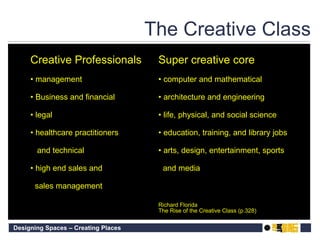
The Creative Class Creative Professionals Super creative core •  management • computer and mathematical •  Business and financial • architecture and engineering •  legal • life, physical, and social science •  healthcare practitioners  • education, training, and library jobs and technical • arts, design, entertainment, sports •  high end sales and    and media sales management Richard Florida The Rise of the Creative Class (p.328)
The Creative Class “ Experiences are replacing goods and services because they stimulate our creative faculties and enhance our creative capacities. This active, experiential lifestyle is spreading and becoming more prevalent in society…” Richard Florida The Rise of the Creative Class (p.168)
The Creative Class “ The death-of-place prognostications simply do not square with the countless people I have interviewed, the focus groups I’ve observed, and the statistical research I’ve done. Place and community are more critical factors than ever before… the economy itself increasingly takes form around real concentrations of people in real places” Richard Florida The Rise of the Creative Class (p.187)
The Creative Class “ The best things in life are not things” Pine and Gilmore The Experience Economy p.20
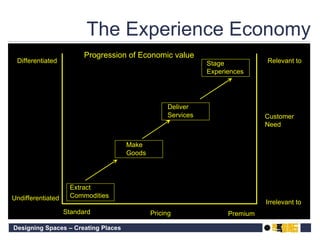
The Experience Economy Progression of Economic value Differentiated Undifferentiated Pricing Standard Premium Relevant to Irrelevant to Customer Need Extract Commodities Make Goods Deliver  Services Stage Experiences
The Value of Good Building Design in Higher Education CABE March 2005 “ the way  people feel  and  behave  while studying or working   within buildings  is linked to their  overall satisfaction  rates and level of  happiness ” Spaces can make us happier..
By speaking to us... “ .. John Ruskin proposed that we seek two things of our buildings. We want them to  shelter us . And we want them - to  speak to us  of whatever we find important and need to be reminded of.”   Alain De Botton The Architecture of Happiness p.62
Environmental impact... “ Belief in the significance of architecture is premised on the notion that  we are , for better or worse,  different people in different places  - and on the conviction that it is  architecture’s task  to render vivid to us  who we might really be.” Alain De Botton The Architecture of Happiness p.13
“… seemingly trivial things in our environment may be influencing our behaviour, dormant goals are triggered without our even realising it.”  Fine  –  A mind of its own,  How your brain distorts and deceives 2007 With subtlety....
“ ...not only are  emotions  important as drivers and barriers to learning but that they  are present all the time, connected to our behaviours and transient  - continuously dynamically changing  Jensen  –  Brain based teaching 2005 And emotion
The  environment  can make you  younger and with remarkable effects....
Whatever environment we create.... it has emotional effects It’s not optional....
Buildings and spaces speak to us “ The notion of buildings that speak helps us to place at the very centre of our architectural conundrums the question of the  values we want to live by  - rather than merely of how we want things to look.” The Architecture of Happiness p.73 Alain De Botton
21st Century Learning Space In short the design of our learning spaces should become a physical representation of the institution ’ s vision and strategy for learning -  responsive, inclusive, and supportive of attainment by all   JISC - Designing Spaces for Effective Learning
Conversational learning? “ All learning starts with conversation” John Seely Brown
Conversation=thinking When I was a kid growing up in Far Rockaway, I had a friend named Bernie Walker. We both had “labs” at home, and we would do various “experiments”. One time, we were discussing something - we must have been 11 or 12 at the time - and I said, “But thinking is nothing but talking to yourself inside. Richard P. Feynman The Pleasure of Finding Things Out p.217
“ To scholars, both of the arts and sciences,   coffee-houses   became one of the most significant   locations for debate   and the   exchange of ideas ,  evolving into an important research tool, somewhere between  a peer review system, an encyclopedia, a research centre and a symposium.” Ellis M, The Coffee House,  A Cultural History, Orion Books (2004) Informal settings are powerful....
The  Medici Effect  is the  ‘breakthrough insights  [that occur] at the  intersection of ideas, concepts and cultures’ .  Frans Johanssen  The Medici Effect Informal settings are powerful....
...you should  choose  to have more  diversity  in the  people  and  world views  you  interact with Steve Johnson Where Good Ideas Come From Informal settings are powerful....
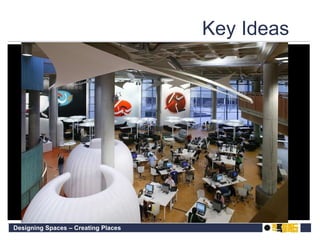
Key Ideas  Open Flexible (Agile) Space
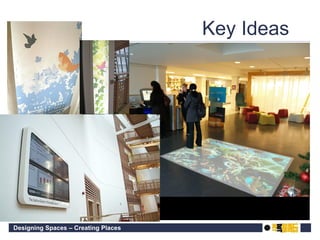
Key Ideas
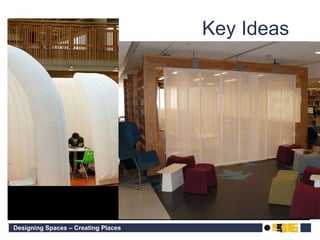
Key Ideas  Open Flexible (Agile) Space Semi private space
Key Ideas
Key Ideas  Open Flexible (Agile) Space Interior Design – not architecture Semi private space
Key Ideas
Key Ideas  Open Flexible (Agile) Space Interior Design – not architecture Semi private space Pace layering
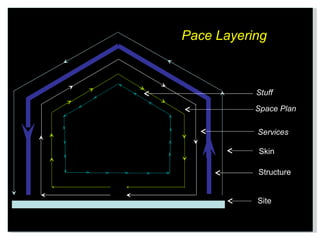
P a ce Layering Stuff Space Plan Services Structure Skin Site
New Paradigm  •  A New Library
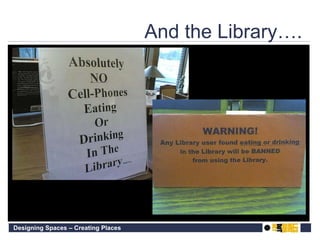
And the Library….
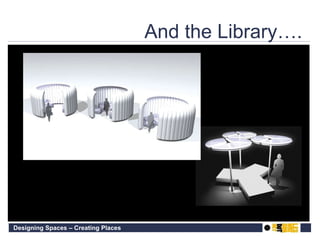
And the Library….
Scott Bennett Righting the Balance  In Library as Place:  Rethinking Roles, Rethinking Space, CLIR The knowledge base that  guides library space  planning   is   poorly balanced ,  tilted heavily   toward  library operations   and   away from systematic knowledge of  how students learn. And the Library….
Geoffrey T. Freeman Changes in Learning Patterns, Technology and Use  In Library as Place:  Rethinking Roles, Rethinking Space, CLIR As an extension of the classroom,  library space needs to embody new pedagogies , including  collaborative  and  interactive  modalities. Significantly, the library must serve as the  principal   building  on campus where one can  truly   experience and benefit from the centrality of an institution’s intellectual community . And the Library….
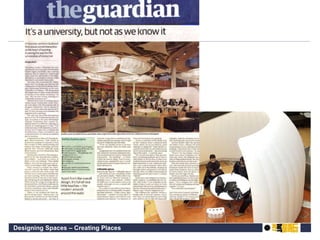
It’s a  fantastic  highly  designed   21st century  building …… and  it feels like home
It’s great …………  is it the Students’ Union?
It’s one of the  best-loved  and  most used landmark buildings on any UK campus …the £23 million Saltire Centre  rewrote the design book for academic libraries Guardian 22/04/08
 
What makes a  good building  is not just the  architecture …. It’s the  ideas  in the building
Creating Places From  space  to  Place
It is a “Third Place” for our users “ Third places are neither home nor work - the ‘first two’ places - but venues like coffee shops, bookstores and cafes in which we find less formal acquaintances. These comprise  ‘the heart of a community’s social vitality’  where people go for good company and lively conversation” Richard Florida -  The Rise of the Creative Class Ray Oldenberg - A Great Good Place Christian Mikunda - Brand Lands, Hot Spots and Cools Spaces - Welcome to the 3rd Place Pat Kane - The Play Ethic Robert Putnam - Better Together - Restoring the American Community
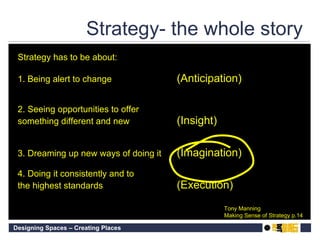
Strategy- the whole story Strategy has to be about: 1. Being alert to change  (Anticipation) 2. Seeing opportunities to offer  something different and new  (Insight) 3. Dreaming up new ways of doing it  (Imagination) 4. Doing it consistently and to  the highest standards  (Execution) Tony Manning Making Sense of Strategy p.14
We create the future Imagination is more important than knowledge Albert Einstein  (1879 - 1955) Everything you can imagine is real Pablo Picasso (1881 - 1973) There is only one admirable form of the imagination: the imagination that is so Intense that it creates a new reality, that it makes things happen. Sean O’Faolain (1900 - 1991)
On Campus space If you can  design  the  physical   space , the  social   space  and the  information   space  together to enhance  collaborative   learning , then that whole milieu  turns into a learning technology . People just  love   working   there  and they start  learning with and from each other . John Seely Brown former chief scientist, Xerox Corporation
www.leswatson.net

Les watson

  • 1.
    Aberystwyth University 6th December 2010 Les Watson [email_address] www.leswatson.net Designing Spaces Creating Places
  • 2.
    21st century Thereis, as yet, no paradigm for the 21st Century University
  • 3.
    A New ParadigmObsession with GDP as a measure of how good people feel is losing its grip against concerns for welfare and sustainability Observer 10/01/10 Economists start to consider that money can't buy happiness
  • 4.
    A New ParadigmThe UK government is poised to start measuring people's psychological and environmental wellbeing, bidding to be among the first countries to officially monitor happiness . Guardian14/11/10
  • 5.
    Who will weatherthe financial storm? Guardian Education 19th February 2008 “ The national student survey - which asks students to rate their university and then publishes the results - has created a certain pressure . This is now a very competitive environment ”
  • 6.
    21st century Student library visits fall 20 per cent in a decade THES 12th October 2007
  • 7.
    The new worldAutomation (Technology) Asia (Globalisation) Affluence 18th Century 19th Century 20th Century 21st Century Agricultural Age (farmers) Information Age ( knowledge workers ) Industrial Age (factory workers) Conceptual Age (creators, empathisers) Daniel Pink A Whole New Mind P.49
  • 8.
    Unexpected events TheBlack Swan Nicholas Nassim Taleb
  • 9.
    Strategic stance TheCreative World View ..the reference point is the future, not the past. We don’t need to fall back on the past for our decisions. Choices are based on alignment with our purpose and our vision for a different world. George Land & Beth Jarman Breakpoint and Beyond p.166
  • 10.
    Be intuitive AlbertEinstein quoted in My Organisation is a Jungle Jef Staes The intuitive mind is a sacred gift and the rational mind is a faithful servant . We have created a society that honours the servant and has forgotten the gift.
  • 11.
    Be unhappy Thetruly successful businessman is essentially a dissenter J.Paul Getty
  • 12.
    Be creative Atthe moment any of us set out to create something new, we cannot know if what we are about to do will work or not. Ellen Langer On Becoming an Artis t2005
  • 13.
    Take risks A de-risked project is going to be a boring project , a project that will deliver at best mediocre results Alastair Dryburgh Chief Contrarian in Management Today Dec. 2010
  • 14.
    Be Playful It’snever occurred to me that I can’t be playful ….. Twyla Tharp The creative habit
  • 15.
    All buildings arepredictions. Stewart Brand How Buildings Learn What happens to then after they’re built All predictions are wrong ….. But we can design buildings so that it doesn’t matter if they are wrong. Uncertainty
  • 16.
    Welcome inexperience Inexperience provides us with a childlike fearlessness that is the polar opposite of the alleged wisdom that age confers on us. Inexperience erases fear …… Twyla Tharp The creative habit
  • 17.
    Welcome inexperience Allour decisions are made in ignorance . If we knew what to do, we would just do it. That is, we would not be faced with a decision in the first place. The problem is not not knowing; rather, the problem is thinking we should know. Ellen Langer On Becoming an Artist 2002
  • 18.
    Acocrdnig to rseerachat Cmabirdge Uinvrestiy it dsoen’t mtater waht oredr the letetrs are in a wrod. Olny the fisrt and the lsat mtater the rset can be a toatl mses. Tihs is bceasue the huamn mnid deos not raed evrey letetr - olny the frist and the lsat. Amzaing relaly. Be open to new ideas
  • 19.
    Can we make a better education system? Ask BIG questions
  • 20.
    When my daughterwas about seven years old, she asked me one day what I did at work. I told her I worked at the college – that my job was to teach people how to draw. She stared back at me incredulous, and said, You mean they forget? Howard Ikemoto Ask BIG questions
  • 21.
    “ Most people’s expectation of the future is that the current pace will continue, despite the fact that the power of technology is doubling every year ” Ray Kurzweil Imagining change
  • 22.
    2020 Imagining change
  • 23.
    2030 Imagining change
  • 24.
    Be a strategistPeople Structure, skills , abilities Technology Application and pervasiveness Environment Design and configuration
  • 25.
    Strategy SYNERGY : strategy for people, technology and the campus environment
  • 26.
  • 27.
    Be Imaginative Imagine… a world in which everyone achieves their full educational potential , where academic and vocational achievement has equal value , and where experiential learning enables everyone to continually develop their knowledge and skills throughout their life .
  • 28.
    Technology Technology isonly technology for people who were born before it was invented Alan Kay (in Don Tapscott – Grown up Digital)
  • 29.
    Net Generation That’s why we don’t argue about whether the piano is corrupting music with technology Seymour Papert
  • 30.
    21st century challengeThe next stage of technological investment must be more strategic . The sector currently lacks a coherent narrative of how institutions will look in the future and the role of technology in the transition to a wider learning and research culture. The Edgeless University - Demos/Jisc June 2009
  • 31.
  • 32.
    The myths The internet is too dangerous for children Junk culture is poisoning young people and taking over their lives No learning happens and digital technologies are a waste of time There is an epidemic of internet plagiarism in schools Their Space Education for a digital generation DEMOS Moral Panic
  • 33.
    The myths All gaming is good All children are cyberkids Their Space Education for a digital generation DEMOS Digital faith
  • 34.
    See the DonTapscott video at http://www.youtube.com/watch?v=4MDPDf34vaI
  • 35.
    Net Generation They’re natural collaborators, who enjoy a conversation not a lecture Don Tapscott Grown Up Digital 2009
  • 36.
    Net Generation The NetGen want entertainment and play in their work education and social life Don Tapscott – Grown Up Digital
  • 37.
    What’s changing? “Play will be to the 21st century what work was to the last 300 years of industrial society - our dominant way of knowing , doing and creating value” Pat Kane - The Play Ethic
  • 38.
    The Creative ClassCreative Professionals Super creative core • management • computer and mathematical • Business and financial • architecture and engineering • legal • life, physical, and social science • healthcare practitioners • education, training, and library jobs and technical • arts, design, entertainment, sports • high end sales and and media sales management Richard Florida The Rise of the Creative Class (p.328)
  • 39.
    The Creative Class“ Experiences are replacing goods and services because they stimulate our creative faculties and enhance our creative capacities. This active, experiential lifestyle is spreading and becoming more prevalent in society…” Richard Florida The Rise of the Creative Class (p.168)
  • 40.
    The Creative Class“ The death-of-place prognostications simply do not square with the countless people I have interviewed, the focus groups I’ve observed, and the statistical research I’ve done. Place and community are more critical factors than ever before… the economy itself increasingly takes form around real concentrations of people in real places” Richard Florida The Rise of the Creative Class (p.187)
  • 41.
    The Creative Class“ The best things in life are not things” Pine and Gilmore The Experience Economy p.20
  • 42.
    The Experience EconomyProgression of Economic value Differentiated Undifferentiated Pricing Standard Premium Relevant to Irrelevant to Customer Need Extract Commodities Make Goods Deliver Services Stage Experiences
  • 43.
    The Value ofGood Building Design in Higher Education CABE March 2005 “ the way people feel and behave while studying or working within buildings is linked to their overall satisfaction rates and level of happiness ” Spaces can make us happier..
  • 44.
    By speaking tous... “ .. John Ruskin proposed that we seek two things of our buildings. We want them to shelter us . And we want them - to speak to us of whatever we find important and need to be reminded of.” Alain De Botton The Architecture of Happiness p.62
  • 45.
    Environmental impact... “Belief in the significance of architecture is premised on the notion that we are , for better or worse, different people in different places - and on the conviction that it is architecture’s task to render vivid to us who we might really be.” Alain De Botton The Architecture of Happiness p.13
  • 46.
    “… seemingly trivialthings in our environment may be influencing our behaviour, dormant goals are triggered without our even realising it.” Fine – A mind of its own, How your brain distorts and deceives 2007 With subtlety....
  • 47.
    “ ...not onlyare emotions important as drivers and barriers to learning but that they are present all the time, connected to our behaviours and transient - continuously dynamically changing Jensen – Brain based teaching 2005 And emotion
  • 48.
    The environment can make you younger and with remarkable effects....
  • 49.
    Whatever environment wecreate.... it has emotional effects It’s not optional....
  • 50.
    Buildings and spacesspeak to us “ The notion of buildings that speak helps us to place at the very centre of our architectural conundrums the question of the values we want to live by - rather than merely of how we want things to look.” The Architecture of Happiness p.73 Alain De Botton
  • 51.
    21st Century LearningSpace In short the design of our learning spaces should become a physical representation of the institution ’ s vision and strategy for learning - responsive, inclusive, and supportive of attainment by all JISC - Designing Spaces for Effective Learning
  • 52.
    Conversational learning? “All learning starts with conversation” John Seely Brown
  • 53.
    Conversation=thinking When Iwas a kid growing up in Far Rockaway, I had a friend named Bernie Walker. We both had “labs” at home, and we would do various “experiments”. One time, we were discussing something - we must have been 11 or 12 at the time - and I said, “But thinking is nothing but talking to yourself inside. Richard P. Feynman The Pleasure of Finding Things Out p.217
  • 54.
    “ To scholars,both of the arts and sciences, coffee-houses became one of the most significant locations for debate and the exchange of ideas , evolving into an important research tool, somewhere between a peer review system, an encyclopedia, a research centre and a symposium.” Ellis M, The Coffee House, A Cultural History, Orion Books (2004) Informal settings are powerful....
  • 55.
    The MediciEffect is the ‘breakthrough insights [that occur] at the intersection of ideas, concepts and cultures’ . Frans Johanssen The Medici Effect Informal settings are powerful....
  • 56.
    ...you should choose to have more diversity in the people and world views you interact with Steve Johnson Where Good Ideas Come From Informal settings are powerful....
  • 57.
    Key Ideas Open Flexible (Agile) Space
  • 58.
  • 59.
    Key Ideas Open Flexible (Agile) Space Semi private space
  • 60.
  • 61.
    Key Ideas Open Flexible (Agile) Space Interior Design – not architecture Semi private space
  • 62.
  • 63.
    Key Ideas Open Flexible (Agile) Space Interior Design – not architecture Semi private space Pace layering
  • 64.
    P a ceLayering Stuff Space Plan Services Structure Skin Site
  • 65.
    New Paradigm • A New Library
  • 66.
  • 67.
  • 68.
    Scott Bennett Rightingthe Balance In Library as Place: Rethinking Roles, Rethinking Space, CLIR The knowledge base that guides library space planning is poorly balanced , tilted heavily toward library operations and away from systematic knowledge of how students learn. And the Library….
  • 69.
    Geoffrey T. FreemanChanges in Learning Patterns, Technology and Use In Library as Place: Rethinking Roles, Rethinking Space, CLIR As an extension of the classroom, library space needs to embody new pedagogies , including collaborative and interactive modalities. Significantly, the library must serve as the principal building on campus where one can truly experience and benefit from the centrality of an institution’s intellectual community . And the Library….
  • 70.
    It’s a fantastic highly designed 21st century building …… and it feels like home
  • 71.
    It’s great ………… is it the Students’ Union?
  • 72.
    It’s one ofthe best-loved and most used landmark buildings on any UK campus …the £23 million Saltire Centre rewrote the design book for academic libraries Guardian 22/04/08
  • 73.
  • 74.
    What makes a good building is not just the architecture …. It’s the ideas in the building
  • 75.
    Creating Places From space to Place
  • 76.
    It is a“Third Place” for our users “ Third places are neither home nor work - the ‘first two’ places - but venues like coffee shops, bookstores and cafes in which we find less formal acquaintances. These comprise ‘the heart of a community’s social vitality’ where people go for good company and lively conversation” Richard Florida - The Rise of the Creative Class Ray Oldenberg - A Great Good Place Christian Mikunda - Brand Lands, Hot Spots and Cools Spaces - Welcome to the 3rd Place Pat Kane - The Play Ethic Robert Putnam - Better Together - Restoring the American Community
  • 77.
    Strategy- the wholestory Strategy has to be about: 1. Being alert to change (Anticipation) 2. Seeing opportunities to offer something different and new (Insight) 3. Dreaming up new ways of doing it (Imagination) 4. Doing it consistently and to the highest standards (Execution) Tony Manning Making Sense of Strategy p.14
  • 78.
    We create thefuture Imagination is more important than knowledge Albert Einstein (1879 - 1955) Everything you can imagine is real Pablo Picasso (1881 - 1973) There is only one admirable form of the imagination: the imagination that is so Intense that it creates a new reality, that it makes things happen. Sean O’Faolain (1900 - 1991)
  • 79.
    On Campus spaceIf you can design the physical space , the social space and the information space together to enhance collaborative learning , then that whole milieu turns into a learning technology . People just love working there and they start learning with and from each other . John Seely Brown former chief scientist, Xerox Corporation
  • 80.