
LANGUAGE TESTING ESCUELA : NOMBRES: Inglés Mgs. Vanessa Toro G. BIMESTRE: Primer Octubre 2011-Febrero 2012
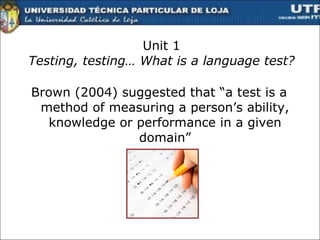
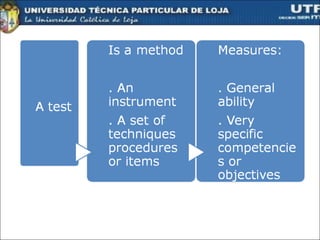
Unit 1 Testing, testing… What is a language test? Brown (2004) suggested that “a test is a method of measuring a person’s ability, knowledge or performance in a given domain”
 
Tests according to the method Multiple-choice questions with  prescribed correct answers.  A writing prompt with a scoring rubric An oral interview: question script, expected responses.  The method must be  explicit  and  structured.
Types of test according to the method Paper-and-language tests. Assess separate components  of language knowledge (grammar, vocabulary) or of receptive understanding (listening and reading comprehension) Format of paper-and-language tests. Multiple-choice task  Cloze tess  Blank filling test Dichotomous items
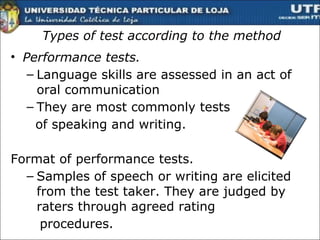
Types of test according to the method Performance tests. Language skills are assessed in an act of oral communication They are most commonly tests of speaking and writing.  Format of performance tests. Samples of speech or writing are elicited from the test taker. They are judged by raters through agreed rating procedures.
Types of test according to their purpose Achievement tests: Are related to classroom lessons, units, or even a total curriculum Determine whether course objectives have been met. Determine whether appropriate knowledge and skills have been acquired. Can be summative (final exams in a course) and formative (give comments and suggestions, call attention to an error, performance tasks, practice).
Types of test according to their purpose Proficiency tests: Test global competence in a language. Test overall ability. Consist of standardized multiple-choice items on grammar, vocabulary, reading and aural comprehension. (Include oral production performance).
Validity The test measures what we intend to measure.  For example: A valid test of reading ability measures reading ability nor previous knowledge in a subject.
Unit 2 Communication and the design  of language tests Tests  are  designed according to the view they take . Discrete point tests Integrative and pragmatic tests Communicative language tests
Discrete-Point Tests Test aspects of knowledge in isolation  ( skills   of listening, speaking, reading, and writing, grammatical points, vocabulary, and aspects of pronunciation).  Atomize and descontextualize the knowledge  to be tested (isolated sentences) Early theories of test performance, influenced by structuralist linguistics, saw knowledge of language as consisting of mastery of the features of the language as a system.
Integrative tests The   necessity of assessing practical language skills and the need of measuring productive capacities for language, led to a demand for language tests which involved an integrated  performance on the part of the language user .  The new orientation resulted in the development of tests which integrated knowledge of relevant systematic features of language (pronunciation, grammar, vocabulary) with an understanding of context.
Integrative tests Cloze tests :  Every sixth or seventh word in a reading passage  (150 to 300 words) is deleted. Words that fit into those blanks are supplied by the test-taker. Cloze test results are good measures of overall proficiency. Successful completion of cloze items taps into knowledge of vocabulary, grammatical structure, discourse structure, and reading skills and strategies.
Communicative Language Tests Hymes’s theory of communicative competence greatly expanded the scope of what was covered by an understanding of language and the ability to use language in context, particularly in terms of the social demands of performance. Hymes saw that knowing a language was more than knowing its rules of grammar.
Communicative language tests came to have two features :  They were performance tests, requiring assessment to be carried out when the learner was engaged in an extended act of communication (receptive or productive). They paid attention to the social roles candidates were likely to assume in real world setting, and offered a means of specifying the demands of such roles in detail.
Models of communicative ability Grammatical competence, knowledge of systematic features of grammar, lexis, and phonology. Sociolinguistic competence, knowledge of rules of language use in terms of what is appropriate to different kinds of interlocutors, in different settings, and on different topics.  Strategic competence, the ability to compensate in performance for incomplete or imperfect linguistic resources in a second language. Discourse competence, the ability to deal with extended use of language in context.
  Unit 3
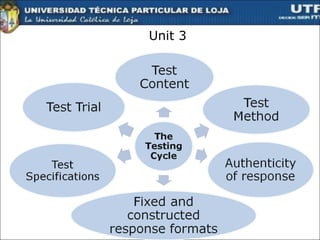
The Testing Cycle Before designing a test, consider what physical and financial resources are available for test development and test operation. For example: tests delivered via computer are not practical options where the technology is not available.
Test content Establishing test content involves careful sampling from the domain of the test, that is, the set of tasks or the kinds of behaviours in the criterion setting.  For example, a test of the communicative abilities of health professionals in work settings will be based on representations of such workplace tasks as communicating with patients or other health professionals.
Test method Consider the way in which candidates will be required to interact with the test materials, particularly the response format, that is, the way in which the candidate will be required to respond to the material. Fixed response formats MCQ format: (vocabulary and grammar) True-false format: (reading and listening x comprehension)
Fixed response formats In this type of format, the candidates’ possible responses have been anticipated and the candidates’ task is to choose the appropriate response from those offered.  Examples: - Multiple choice question format - True or false format
Constructed response formats This type of formats do not constrain the candidate to the same degree, and reduce the effects of guessing.  Disadvantage Cloze tests: another word may be acceptable.  Short answer questions: cannot be marked automatically.
The testing of productive skills In the testing of productive skills, a further range of  test method  decisions need to be made, about the content and format of the stimulus to writing or speaking, the length and format of the responses, and about the scoring. (lectures, reading passages, etc.) For example, speaking skills can be assessed through interviews, role plays, group discussions, etc.
Test Specifications These are a set of instructions for creating the test, written as if they are to be followed by someone other than the test developer.  They will include information on such matters as the length and structure of each part of the test, the type of materials with which candidates will have to engage, the source, the extend to which authentic materials will be altered, the response format, and the test rubric.
Test  trials This stage involves trying out the test materials and procedures prior to their use under operational conditions.  - Find a trial population. - Use discrete point test items. - Carry out a careful statistical analysis to  investigate the items quality.  - For subjective judgments, there is a need  for training raters..
Unit 4 The rating process Ratings are necessarily subjective; however, they can be made objective  if the rating category labels are clear and explicit, and the rater is trained carefully to interpret them in accordance with the intention of the test designers. Rating scales are very necessary during the rating process.
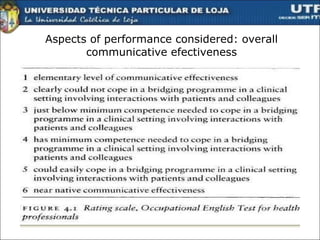
Rating Scales A rating scale is an ordered set of descriptions of typical performances in terms of their quality, it is used by raters in rating procedures. The preparation of such a scale involves developing  level descriptors,  that is describing in words performances that illustrate each level of competence defined on the scale.
Aspects of performance considered: overall communicative efectiveness
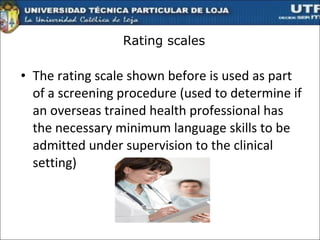
Rating scales The rating scale shown before is used as part of a screening procedure (used to determine if an overseas trained health professional has the necessary minimum language skills to be admitted under supervision to the clinical setting)
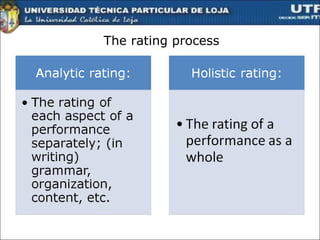
The rating process
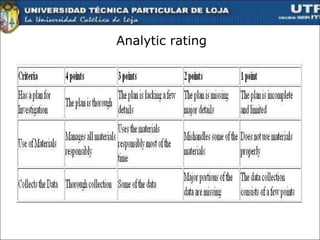
Analytic  rating
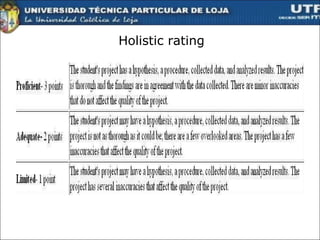
Holistic rating
References Georgia State University. (n.d.).  Rubrics.  Retrieved from http://www2.gsu.edu/ ~mstnrhx/457/rubric.htm McNamara, T. (2008).  Language Testing. , Oxford, NY: Oxford University Press. Brown, D. (2004).  Language Assessment: Principles and Classroom Practices.  White Plains, NY: Pearson Education, Inc.
 
PROGRAMA:  Language Testing  Carrera:  Inglés  Fecha:  16 de noviembre de 2011 Docente:  Mgs. Vanessa Toro.  Hora Inicio:  19h15  Hora Final:  20h15 GUIÓN DE PRESENTACIÓN  Puntos de la Presentación Intervienen Duración Aprox. en minutos Material de Apoyo - Presentación - Objetivos  Mgs. Vanessa Toro 2 minutos 3 minutos Sin material. Sin material. Desarrollo del contenido: Capítulo I Capítulo II …………… . Mgs. Vanessa Toro Estudiantes Language testing 35 minutos Diapositivas (cambios cada 5 seg.), videos, otro o ningún material. - Preguntas - Despedida (Contactos, Sugerencias) Desarrollo del contenido: Capítulo I Capítulo II …………… . Mgs. Vanessa Toro Estudiantes Language testing [email_address] 07 2 570 275  ext. 2934 Miércoles: 15h30-17h30 Jueves: 08h30 – 10h30

UTPL-LENGUAGE TESTING-I-BIMESTRE-(OCTUBRE 2011-FEBRERO 2012)

  • 1.
    LANGUAGE TESTING ESCUELA: NOMBRES: Inglés Mgs. Vanessa Toro G. BIMESTRE: Primer Octubre 2011-Febrero 2012
  • 2.
    Unit 1 Testing,testing… What is a language test? Brown (2004) suggested that “a test is a method of measuring a person’s ability, knowledge or performance in a given domain”
  • 3.
  • 4.
    Tests according tothe method Multiple-choice questions with prescribed correct answers. A writing prompt with a scoring rubric An oral interview: question script, expected responses. The method must be explicit and structured.
  • 5.
    Types of testaccording to the method Paper-and-language tests. Assess separate components of language knowledge (grammar, vocabulary) or of receptive understanding (listening and reading comprehension) Format of paper-and-language tests. Multiple-choice task Cloze tess Blank filling test Dichotomous items
  • 6.
    Types of testaccording to the method Performance tests. Language skills are assessed in an act of oral communication They are most commonly tests of speaking and writing. Format of performance tests. Samples of speech or writing are elicited from the test taker. They are judged by raters through agreed rating procedures.
  • 7.
    Types of testaccording to their purpose Achievement tests: Are related to classroom lessons, units, or even a total curriculum Determine whether course objectives have been met. Determine whether appropriate knowledge and skills have been acquired. Can be summative (final exams in a course) and formative (give comments and suggestions, call attention to an error, performance tasks, practice).
  • 8.
    Types of testaccording to their purpose Proficiency tests: Test global competence in a language. Test overall ability. Consist of standardized multiple-choice items on grammar, vocabulary, reading and aural comprehension. (Include oral production performance).
  • 9.
    Validity The testmeasures what we intend to measure. For example: A valid test of reading ability measures reading ability nor previous knowledge in a subject.
  • 10.
    Unit 2 Communicationand the design of language tests Tests are designed according to the view they take . Discrete point tests Integrative and pragmatic tests Communicative language tests
  • 11.
    Discrete-Point Tests Testaspects of knowledge in isolation ( skills of listening, speaking, reading, and writing, grammatical points, vocabulary, and aspects of pronunciation). Atomize and descontextualize the knowledge to be tested (isolated sentences) Early theories of test performance, influenced by structuralist linguistics, saw knowledge of language as consisting of mastery of the features of the language as a system.
  • 12.
    Integrative tests The necessity of assessing practical language skills and the need of measuring productive capacities for language, led to a demand for language tests which involved an integrated performance on the part of the language user . The new orientation resulted in the development of tests which integrated knowledge of relevant systematic features of language (pronunciation, grammar, vocabulary) with an understanding of context.
  • 13.
    Integrative tests Clozetests : Every sixth or seventh word in a reading passage (150 to 300 words) is deleted. Words that fit into those blanks are supplied by the test-taker. Cloze test results are good measures of overall proficiency. Successful completion of cloze items taps into knowledge of vocabulary, grammatical structure, discourse structure, and reading skills and strategies.
  • 14.
    Communicative Language TestsHymes’s theory of communicative competence greatly expanded the scope of what was covered by an understanding of language and the ability to use language in context, particularly in terms of the social demands of performance. Hymes saw that knowing a language was more than knowing its rules of grammar.
  • 15.
    Communicative language testscame to have two features : They were performance tests, requiring assessment to be carried out when the learner was engaged in an extended act of communication (receptive or productive). They paid attention to the social roles candidates were likely to assume in real world setting, and offered a means of specifying the demands of such roles in detail.
  • 16.
    Models of communicativeability Grammatical competence, knowledge of systematic features of grammar, lexis, and phonology. Sociolinguistic competence, knowledge of rules of language use in terms of what is appropriate to different kinds of interlocutors, in different settings, and on different topics. Strategic competence, the ability to compensate in performance for incomplete or imperfect linguistic resources in a second language. Discourse competence, the ability to deal with extended use of language in context.
  • 17.
  • 18.
    The Testing CycleBefore designing a test, consider what physical and financial resources are available for test development and test operation. For example: tests delivered via computer are not practical options where the technology is not available.
  • 19.
    Test content Establishingtest content involves careful sampling from the domain of the test, that is, the set of tasks or the kinds of behaviours in the criterion setting. For example, a test of the communicative abilities of health professionals in work settings will be based on representations of such workplace tasks as communicating with patients or other health professionals.
  • 20.
    Test method Considerthe way in which candidates will be required to interact with the test materials, particularly the response format, that is, the way in which the candidate will be required to respond to the material. Fixed response formats MCQ format: (vocabulary and grammar) True-false format: (reading and listening x comprehension)
  • 21.
    Fixed response formatsIn this type of format, the candidates’ possible responses have been anticipated and the candidates’ task is to choose the appropriate response from those offered. Examples: - Multiple choice question format - True or false format
  • 22.
    Constructed response formatsThis type of formats do not constrain the candidate to the same degree, and reduce the effects of guessing. Disadvantage Cloze tests: another word may be acceptable. Short answer questions: cannot be marked automatically.
  • 23.
    The testing ofproductive skills In the testing of productive skills, a further range of test method decisions need to be made, about the content and format of the stimulus to writing or speaking, the length and format of the responses, and about the scoring. (lectures, reading passages, etc.) For example, speaking skills can be assessed through interviews, role plays, group discussions, etc.
  • 24.
    Test Specifications Theseare a set of instructions for creating the test, written as if they are to be followed by someone other than the test developer. They will include information on such matters as the length and structure of each part of the test, the type of materials with which candidates will have to engage, the source, the extend to which authentic materials will be altered, the response format, and the test rubric.
  • 25.
    Test trialsThis stage involves trying out the test materials and procedures prior to their use under operational conditions. - Find a trial population. - Use discrete point test items. - Carry out a careful statistical analysis to investigate the items quality. - For subjective judgments, there is a need for training raters..
  • 26.
    Unit 4 Therating process Ratings are necessarily subjective; however, they can be made objective if the rating category labels are clear and explicit, and the rater is trained carefully to interpret them in accordance with the intention of the test designers. Rating scales are very necessary during the rating process.
  • 27.
    Rating Scales Arating scale is an ordered set of descriptions of typical performances in terms of their quality, it is used by raters in rating procedures. The preparation of such a scale involves developing level descriptors, that is describing in words performances that illustrate each level of competence defined on the scale.
  • 28.
    Aspects of performanceconsidered: overall communicative efectiveness
  • 29.
    Rating scales Therating scale shown before is used as part of a screening procedure (used to determine if an overseas trained health professional has the necessary minimum language skills to be admitted under supervision to the clinical setting)
  • 30.
  • 31.
  • 32.
  • 33.
    References Georgia StateUniversity. (n.d.). Rubrics. Retrieved from http://www2.gsu.edu/ ~mstnrhx/457/rubric.htm McNamara, T. (2008). Language Testing. , Oxford, NY: Oxford University Press. Brown, D. (2004). Language Assessment: Principles and Classroom Practices. White Plains, NY: Pearson Education, Inc.
  • 34.
  • 35.
    PROGRAMA: LanguageTesting Carrera: Inglés Fecha: 16 de noviembre de 2011 Docente: Mgs. Vanessa Toro. Hora Inicio: 19h15 Hora Final: 20h15 GUIÓN DE PRESENTACIÓN Puntos de la Presentación Intervienen Duración Aprox. en minutos Material de Apoyo - Presentación - Objetivos Mgs. Vanessa Toro 2 minutos 3 minutos Sin material. Sin material. Desarrollo del contenido: Capítulo I Capítulo II …………… . Mgs. Vanessa Toro Estudiantes Language testing 35 minutos Diapositivas (cambios cada 5 seg.), videos, otro o ningún material. - Preguntas - Despedida (Contactos, Sugerencias) Desarrollo del contenido: Capítulo I Capítulo II …………… . Mgs. Vanessa Toro Estudiantes Language testing [email_address] 07 2 570 275 ext. 2934 Miércoles: 15h30-17h30 Jueves: 08h30 – 10h30