Language Assessment
A test and its criteria
Kinds of test
Elements to measure in language skills
Large-scale proficiency testing
Oral proficiency testing
Critical language testing: ethical issue
A test and its criteria
 A set of technique, procedure and item to measure someone’s ability or
knowledge in a given domain
 Criteria
Practicality: financial limitations, time constraints,
case of administration, scoring and interpretation
Reliability: whenever and to whoever the test is
administered, the result will remain the same
Validity: measuring what is really intended to
measure
Validity
 Content/logical validity: an estimate of how much a test represents every
single element of a construct
 Face validity: an estimate of whether a test appears to measure a certain
criterion
 Construct validity: an estimate to see whether a test measure the construct
adequately based on the theory
Kinds of test
1. Proficiency tests; e.g: TOEFL, IELTS
2. Diagnostic tests; e.g: entry or exit level
3. Placement tests; e.g: language course test
4. Achievement tests; e.g: midterm or final term tests
5. Aptitude tests; e.g: test for seeking a job
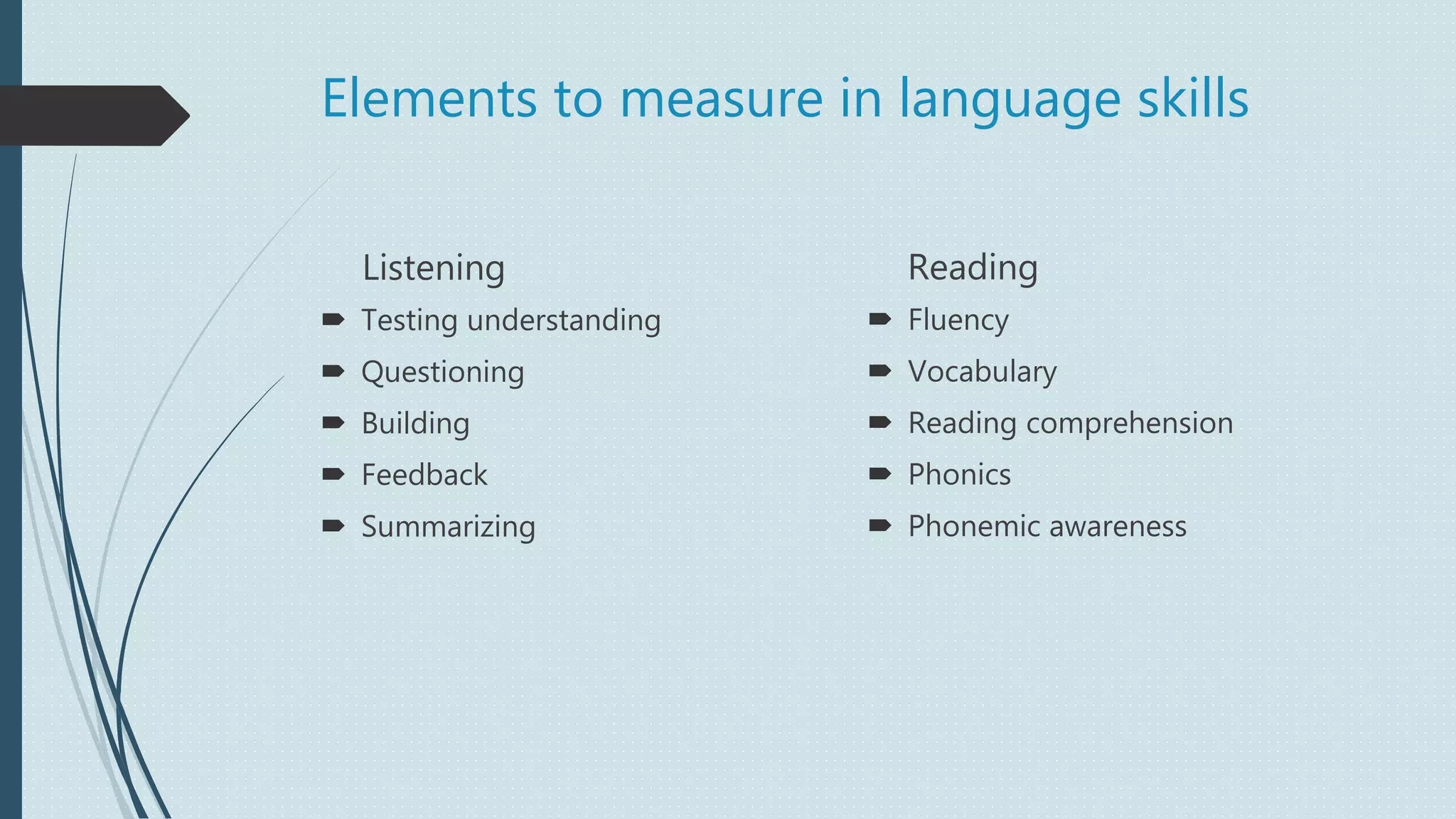
Elements to measure in language skills
Listening
 Testing understanding
 Questioning
 Building
 Feedback
 Summarizing
Reading
 Fluency
 Vocabulary
 Reading comprehension
 Phonics
 Phonemic awareness
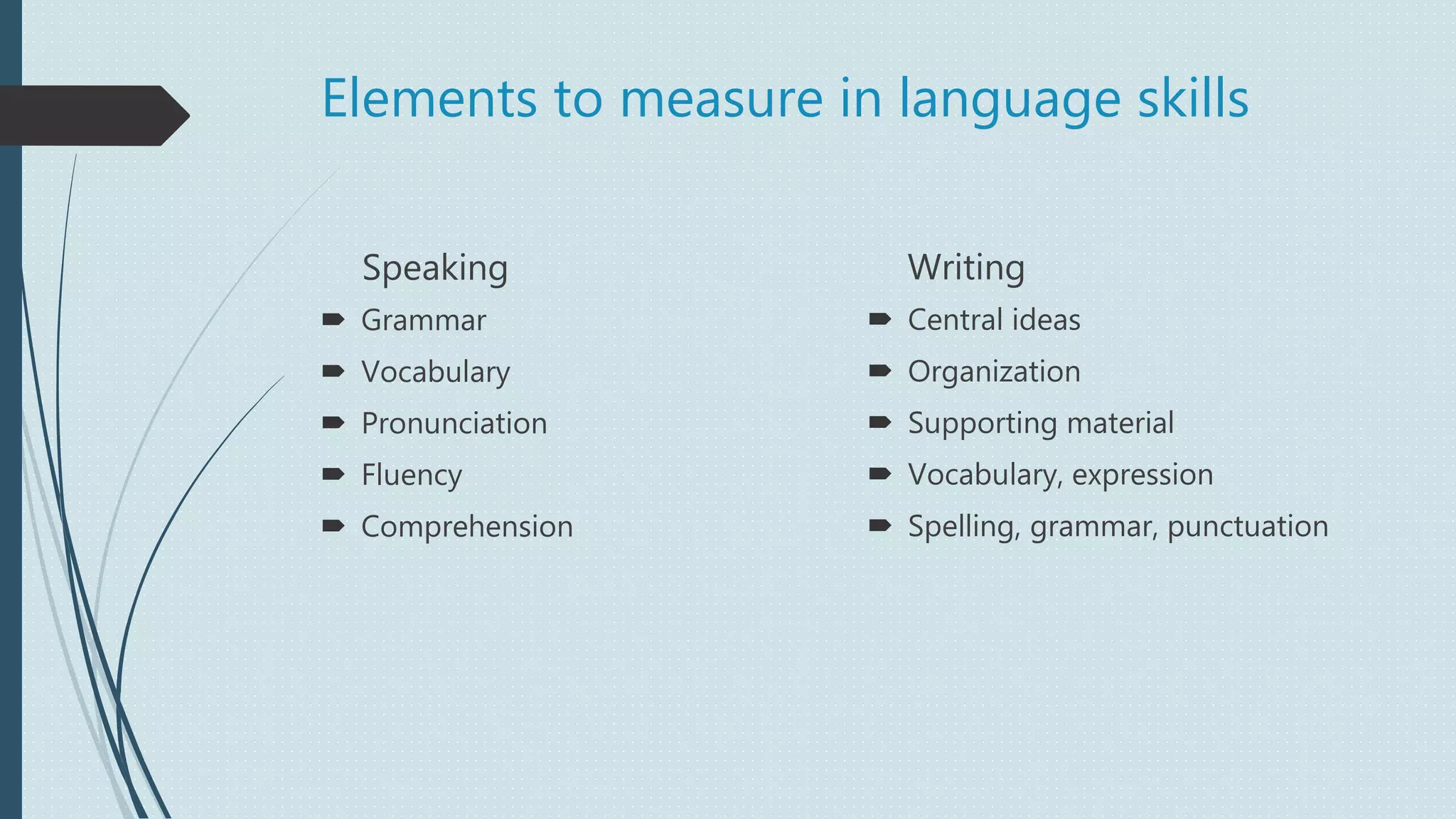
Elements to measure in language skills
Speaking
 Grammar
 Vocabulary
 Pronunciation
 Fluency
 Comprehension
Writing
 Central ideas
 Organization
 Supporting material
 Vocabulary, expression
 Spelling, grammar, punctuation
Historical development in language testing
 Following the changing winds and shifting sands of methodology
 In 1950s, in the era of behaviorism and constructivism, language testing
focused on phonological, grammatical and lexical contrast
 The change leads to two language testing approaches: discrete point and
integrative testing
 Discrete point: students are only tested one thing at one time.
 Integrative testing: students are asked to use a variety of language and
skills to complete a task.
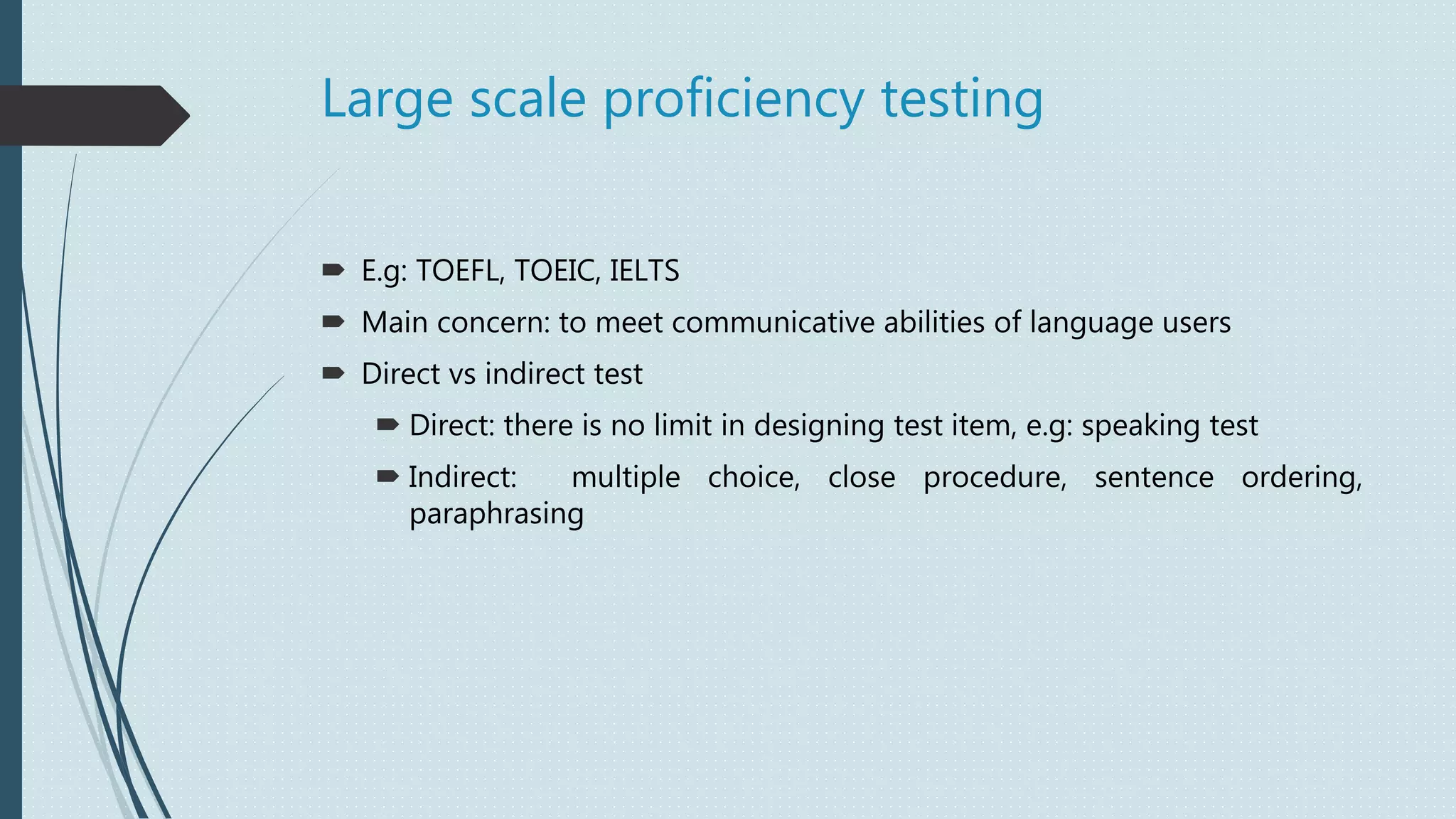
Large scale proficiency testing
 E.g: TOEFL, TOEIC, IELTS
 Main concern: to meet communicative abilities of language users
 Direct vs indirect test
 Direct: there is no limit in designing test item, e.g: speaking test
 Indirect: multiple choice, close procedure, sentence ordering,
paraphrasing
Oral proficiency testing
 The most challenging part in language testing
 Requiring much more time, money and ingenuity
 Recent oral proficiency test:
 IBT TOEFL
 IELTS
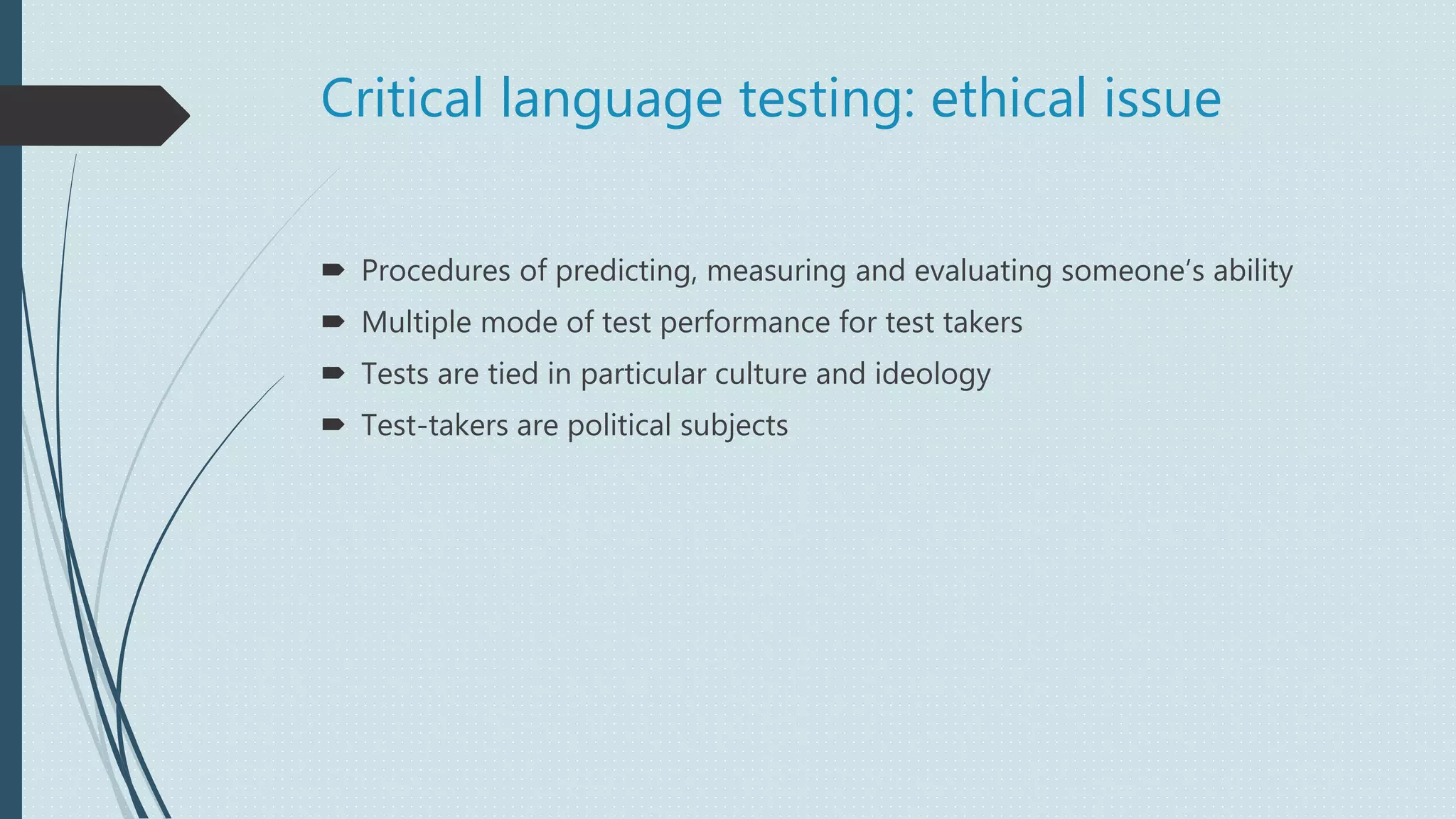
Critical language testing: ethical issue
 Procedures of predicting, measuring and evaluating someone’s ability
 Multiple mode of test performance for test takers
 Tests are tied in particular culture and ideology
 Test-takers are political subjects

Language assessment

  • 1.
    Language Assessment A testand its criteria Kinds of test Elements to measure in language skills Large-scale proficiency testing Oral proficiency testing Critical language testing: ethical issue
  • 2.
    A test andits criteria  A set of technique, procedure and item to measure someone’s ability or knowledge in a given domain  Criteria Practicality: financial limitations, time constraints, case of administration, scoring and interpretation Reliability: whenever and to whoever the test is administered, the result will remain the same Validity: measuring what is really intended to measure
  • 3.
    Validity  Content/logical validity:an estimate of how much a test represents every single element of a construct  Face validity: an estimate of whether a test appears to measure a certain criterion  Construct validity: an estimate to see whether a test measure the construct adequately based on the theory
  • 4.
    Kinds of test 1.Proficiency tests; e.g: TOEFL, IELTS 2. Diagnostic tests; e.g: entry or exit level 3. Placement tests; e.g: language course test 4. Achievement tests; e.g: midterm or final term tests 5. Aptitude tests; e.g: test for seeking a job
  • 5.
    Elements to measurein language skills Listening  Testing understanding  Questioning  Building  Feedback  Summarizing Reading  Fluency  Vocabulary  Reading comprehension  Phonics  Phonemic awareness
  • 6.
    Elements to measurein language skills Speaking  Grammar  Vocabulary  Pronunciation  Fluency  Comprehension Writing  Central ideas  Organization  Supporting material  Vocabulary, expression  Spelling, grammar, punctuation
  • 7.
    Historical development inlanguage testing  Following the changing winds and shifting sands of methodology  In 1950s, in the era of behaviorism and constructivism, language testing focused on phonological, grammatical and lexical contrast  The change leads to two language testing approaches: discrete point and integrative testing  Discrete point: students are only tested one thing at one time.  Integrative testing: students are asked to use a variety of language and skills to complete a task.
  • 8.
    Large scale proficiencytesting  E.g: TOEFL, TOEIC, IELTS  Main concern: to meet communicative abilities of language users  Direct vs indirect test  Direct: there is no limit in designing test item, e.g: speaking test  Indirect: multiple choice, close procedure, sentence ordering, paraphrasing
  • 9.
    Oral proficiency testing The most challenging part in language testing  Requiring much more time, money and ingenuity  Recent oral proficiency test:  IBT TOEFL  IELTS
  • 10.
    Critical language testing:ethical issue  Procedures of predicting, measuring and evaluating someone’s ability  Multiple mode of test performance for test takers  Tests are tied in particular culture and ideology  Test-takers are political subjects