Lemon battery
Lemon battery
Driving Question
What generates electricity in a battery?
Lemon battery
Procedure: Connecting
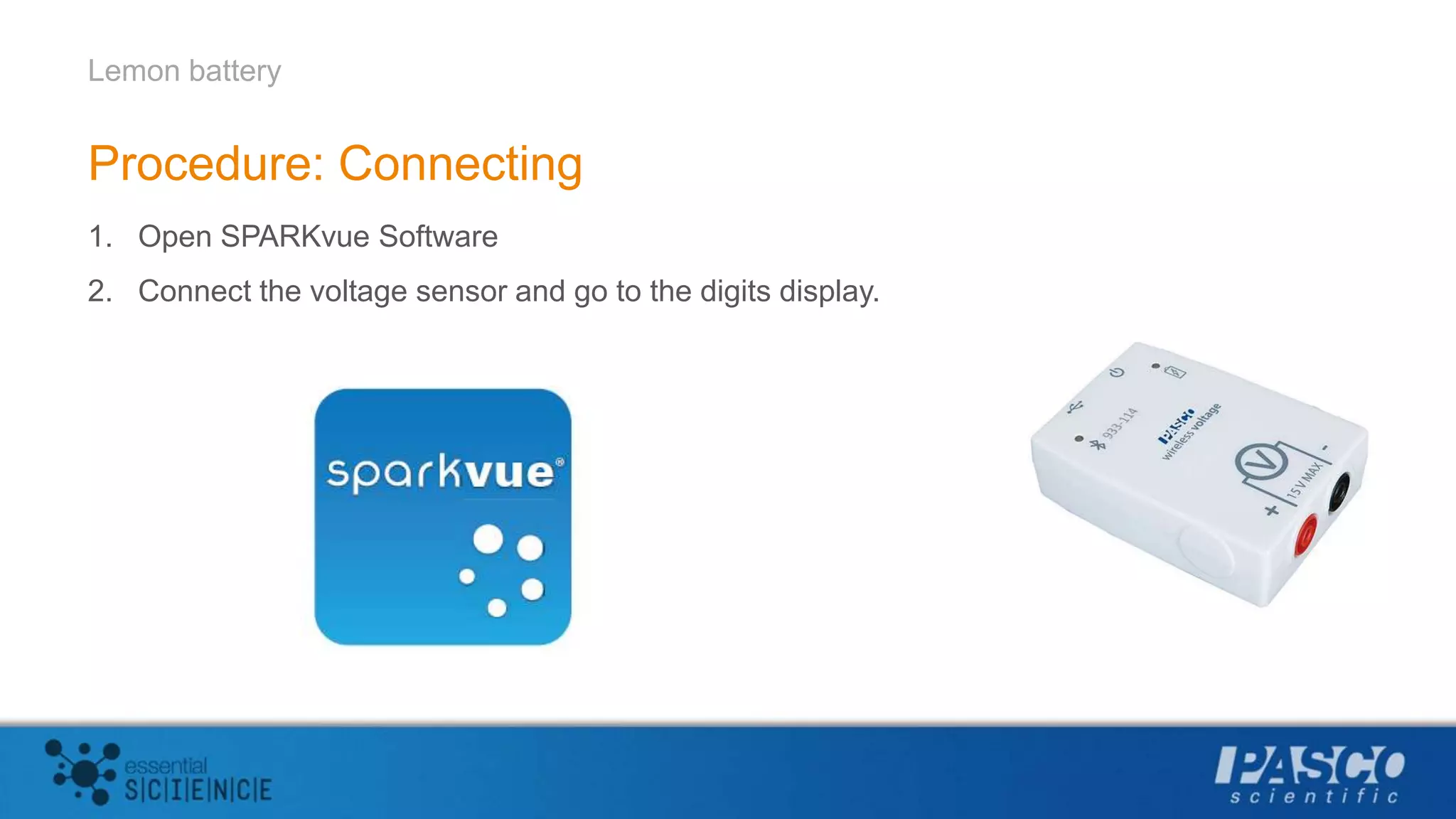
1. Open SPARKvue Software
2. Connect the voltage sensor and go to the digits display.
Lemon battery
Procedure
3. Roll the lemon on a table so that the juice can flow
easily.
4. Make two small incisions on the lemon about 3 cm
apart.
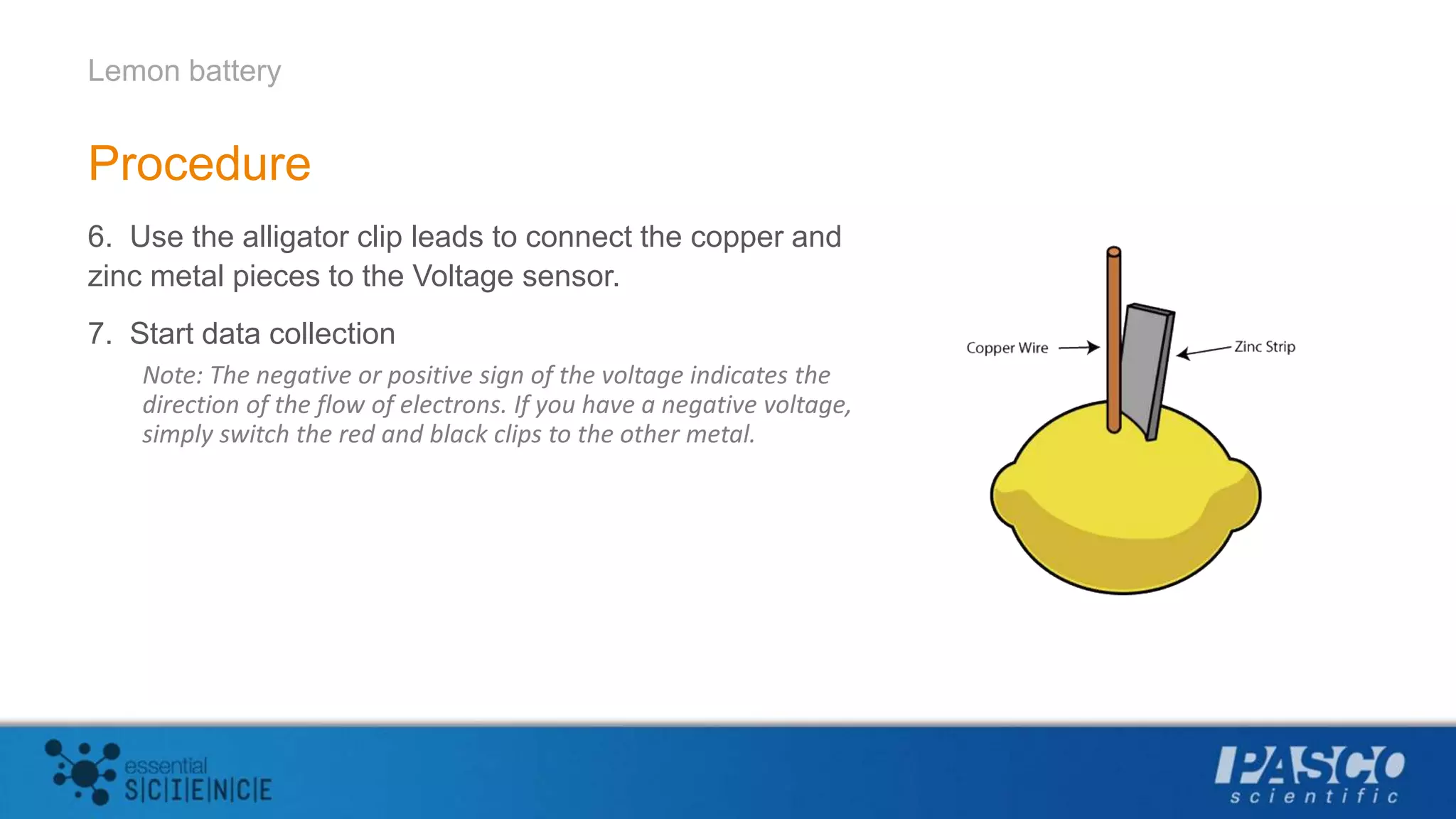
5. Insert a piece of copper and a piece of zinc into the
slits on the lemon.
Note: If the metals are not clean, polish them with a piece of
sandpaper or steel wool.
Lemon battery
Procedure
6. Use the alligator clip leads to connect the copper and
zinc metal pieces to the Voltage sensor.
7. Start data collection
Note: The negative or positive sign of the voltage indicates the
direction of the flow of electrons. If you have a negative voltage,
simply switch the red and black clips to the other metal.
Lemon battery
Procedure
8. If you have a positive voltage then you have made a battery! Record the voltage in Table 1.
Metal Combination Negative electrode
(metal at the black clip)
Positive electrode
(metal at the red clip)
Voltage (V)
Cu with Zn
Cu with Sn
Sn with Zn
Cu with Cu
Zn with Zn
Sn with Sn
Lemon battery
Procedure
9. In any battery, there is a positive (+) and negative (-) electrode. Electrons flow from the negative
electrode (black) to the positive electrode (red). Record the positive electrode and negative
electrode of your lemon battery in Table 1.
Metal Combination Negative electrode
(metal at the black clip)
Positive electrode
(metal at the red clip)
Voltage (V)
Cu with Zn
Cu with Sn
Sn with Zn
Cu with Cu
Zn with Zn
Sn with Sn
Lemon battery
Procedure
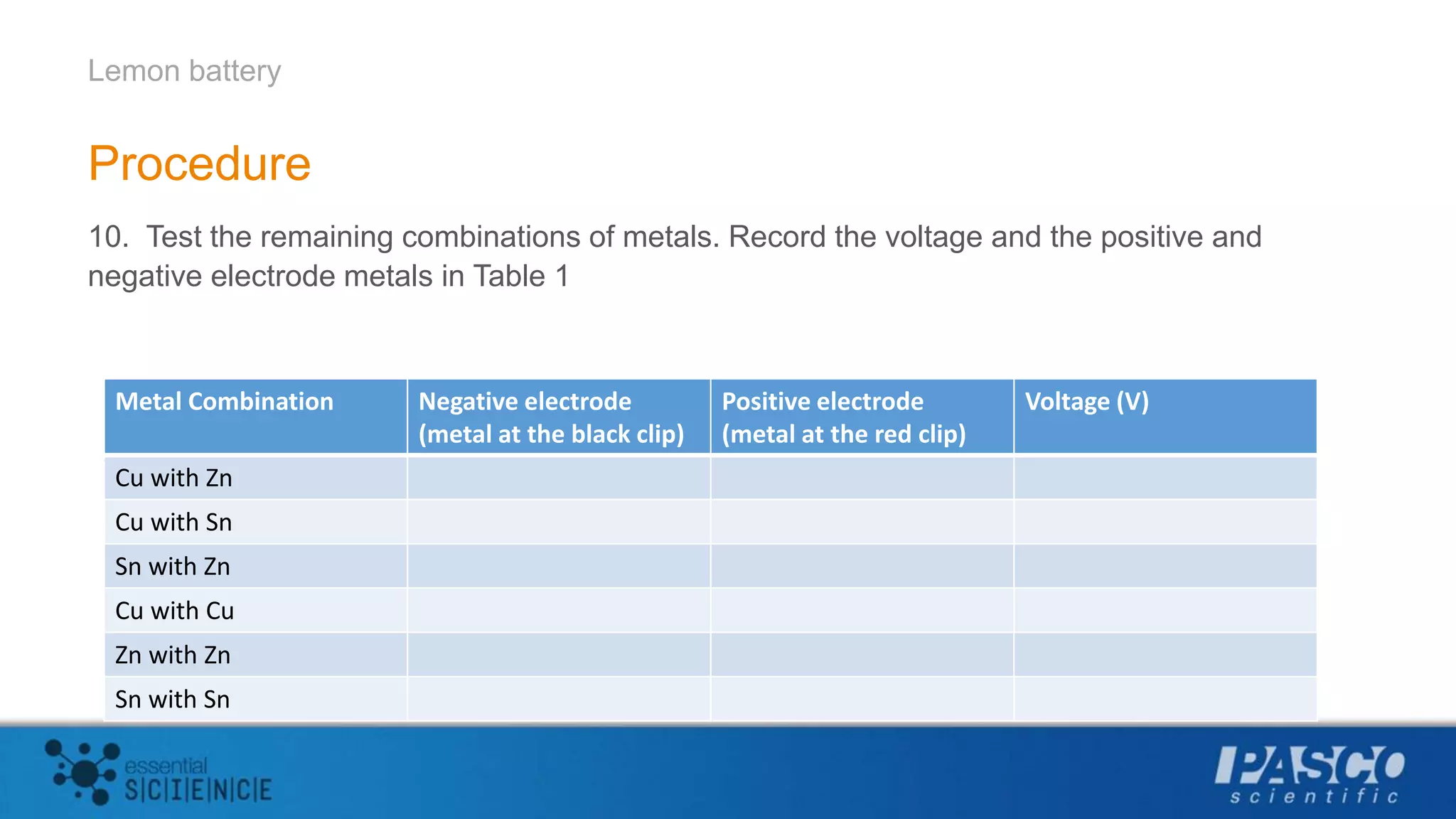
10. Test the remaining combinations of metals. Record the voltage and the positive and
negative electrode metals in Table 1
Metal Combination Negative electrode
(metal at the black clip)
Positive electrode
(metal at the red clip)
Voltage (V)
Cu with Zn
Cu with Sn
Sn with Zn
Cu with Cu
Zn with Zn
Sn with Sn
Lemon battery
Analysis
Metal Combination Negative electrode
(metal at the black clip)
Positive electrode
(metal at the red clip)
Voltage (V)
Cu with Zn
Cu with Sn
Sn with Zn
Cu with Cu
Zn with Zn
Sn with Sn
Lemon Battery
Questions
1. Which metal combination generated the largest voltage?
2. Which metal combination(s) generated the smallest voltage?
3. Based on your data, do you think that the type of metal has something to do with the voltage that
is generated?
Lemon Battery
Questions
4. The metal that is at the negative electrode is the metal that loses electrons. Of this set of metals
(Cu, Sn, Zn), which one is most likely to lose electrons?
5. The metal that is at the positive electrode is the metal that gains electrons. Of this set of metals
(Cu, Sn, Zn), which one is most likely to gain electrons?
Lemon Battery
Engineering challenge
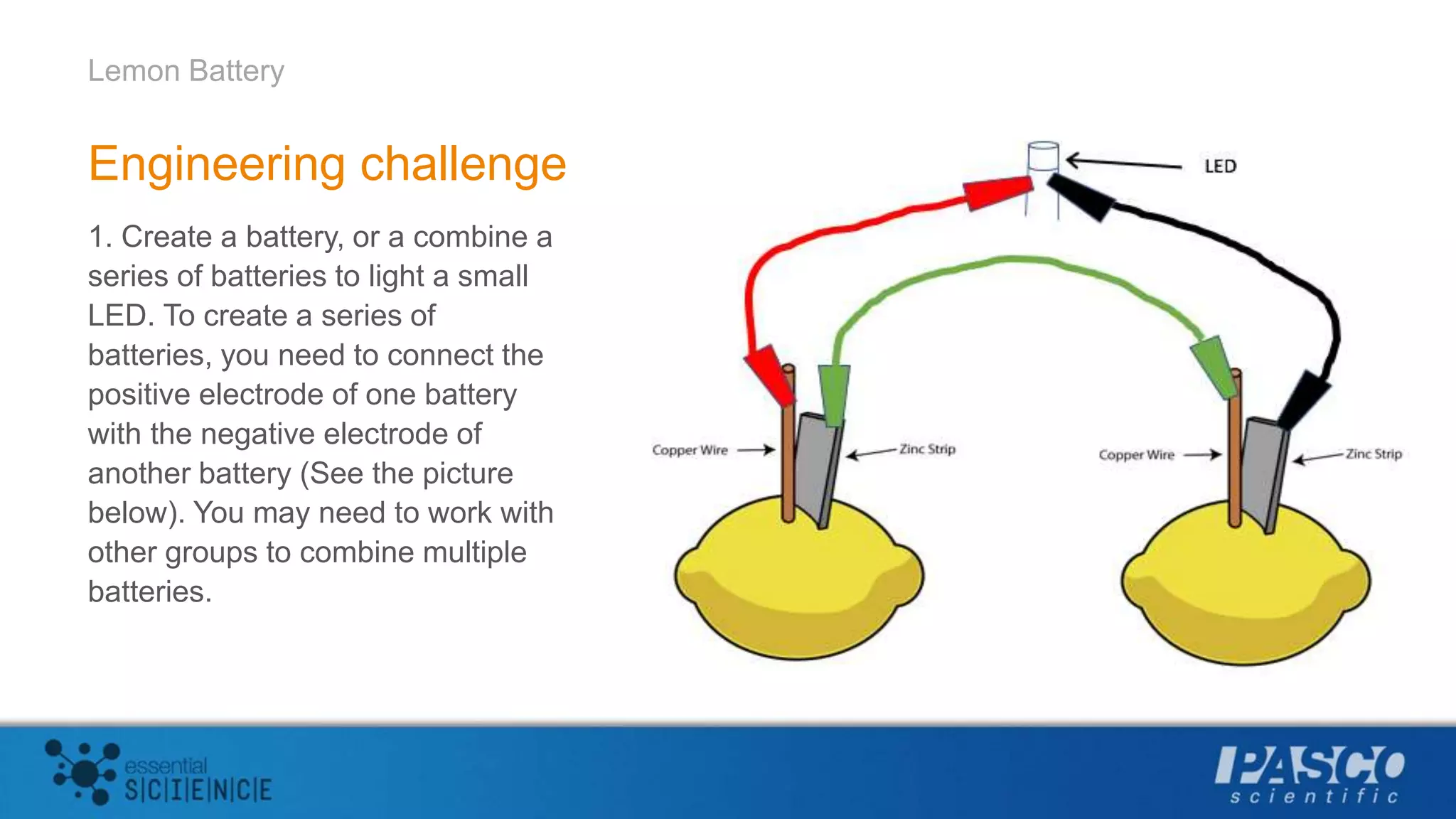
1. Create a battery, or a combine a
series of batteries to light a small
LED. To create a series of
batteries, you need to connect the
positive electrode of one battery
with the negative electrode of
another battery (See the picture
below). You may need to work with
other groups to combine multiple
batteries.
Lemon battery
Engineering challenge
2. Which metal combination did you use?
3. How many lemon batteries did you use to generate enough electricity to light the LED.
4. Based on the number of lemon batteries, and the metal combination, what voltage do you
expect to be generated by the series of lemon batteries?
5. Use the Voltage sensor to measure the voltage of the series of lemon batteries.
6. How does the measured voltage compare to the expected voltage?
lemon-battery.pptx

lemon-battery.pptx

  • 1.
  • 2.
    Lemon battery Driving Question Whatgenerates electricity in a battery?
  • 3.
    Lemon battery Procedure: Connecting 1.Open SPARKvue Software 2. Connect the voltage sensor and go to the digits display.
  • 4.
    Lemon battery Procedure 3. Rollthe lemon on a table so that the juice can flow easily. 4. Make two small incisions on the lemon about 3 cm apart. 5. Insert a piece of copper and a piece of zinc into the slits on the lemon. Note: If the metals are not clean, polish them with a piece of sandpaper or steel wool.
  • 5.
    Lemon battery Procedure 6. Usethe alligator clip leads to connect the copper and zinc metal pieces to the Voltage sensor. 7. Start data collection Note: The negative or positive sign of the voltage indicates the direction of the flow of electrons. If you have a negative voltage, simply switch the red and black clips to the other metal.
  • 6.
    Lemon battery Procedure 8. Ifyou have a positive voltage then you have made a battery! Record the voltage in Table 1. Metal Combination Negative electrode (metal at the black clip) Positive electrode (metal at the red clip) Voltage (V) Cu with Zn Cu with Sn Sn with Zn Cu with Cu Zn with Zn Sn with Sn
  • 7.
    Lemon battery Procedure 9. Inany battery, there is a positive (+) and negative (-) electrode. Electrons flow from the negative electrode (black) to the positive electrode (red). Record the positive electrode and negative electrode of your lemon battery in Table 1. Metal Combination Negative electrode (metal at the black clip) Positive electrode (metal at the red clip) Voltage (V) Cu with Zn Cu with Sn Sn with Zn Cu with Cu Zn with Zn Sn with Sn
  • 8.
    Lemon battery Procedure 10. Testthe remaining combinations of metals. Record the voltage and the positive and negative electrode metals in Table 1 Metal Combination Negative electrode (metal at the black clip) Positive electrode (metal at the red clip) Voltage (V) Cu with Zn Cu with Sn Sn with Zn Cu with Cu Zn with Zn Sn with Sn
  • 9.
    Lemon battery Analysis Metal CombinationNegative electrode (metal at the black clip) Positive electrode (metal at the red clip) Voltage (V) Cu with Zn Cu with Sn Sn with Zn Cu with Cu Zn with Zn Sn with Sn
  • 10.
    Lemon Battery Questions 1. Whichmetal combination generated the largest voltage? 2. Which metal combination(s) generated the smallest voltage? 3. Based on your data, do you think that the type of metal has something to do with the voltage that is generated?
  • 11.
    Lemon Battery Questions 4. Themetal that is at the negative electrode is the metal that loses electrons. Of this set of metals (Cu, Sn, Zn), which one is most likely to lose electrons? 5. The metal that is at the positive electrode is the metal that gains electrons. Of this set of metals (Cu, Sn, Zn), which one is most likely to gain electrons?
  • 12.
    Lemon Battery Engineering challenge 1.Create a battery, or a combine a series of batteries to light a small LED. To create a series of batteries, you need to connect the positive electrode of one battery with the negative electrode of another battery (See the picture below). You may need to work with other groups to combine multiple batteries.
  • 13.
    Lemon battery Engineering challenge 2.Which metal combination did you use? 3. How many lemon batteries did you use to generate enough electricity to light the LED. 4. Based on the number of lemon batteries, and the metal combination, what voltage do you expect to be generated by the series of lemon batteries? 5. Use the Voltage sensor to measure the voltage of the series of lemon batteries. 6. How does the measured voltage compare to the expected voltage?

Editor's Notes

  • #6 The red lead should be on the copper for a positive voltage
  • #7 Voltage should be ~ 1.0 V
  • #8 The red lead should be on the copper for a positive voltage
  • #9 The metal combinations with the same metal should have zero voltage (or close to zero)
  • #10 The metal combinations with the same metal should have zero voltage (or close to zero)
  • #11 Cu with Zn is the largest When you have the same metals, the voltage is zero. Yes – the metals must be different
  • #12 Zn is the most likely to lose electrons Cu is the most likely to gain electrons
  • #13 Connect the copper to the positive terminal of the LED. This is usually the longer terminal on the LED. Connect the zinc to the negative terminal of the LED. This is usually the shorter end.
  • #14 Copper and zinc 3-4 3-4 x whatever Cu with Zn was ~4 V