HUMAN RESOURCE MANAGEMENT
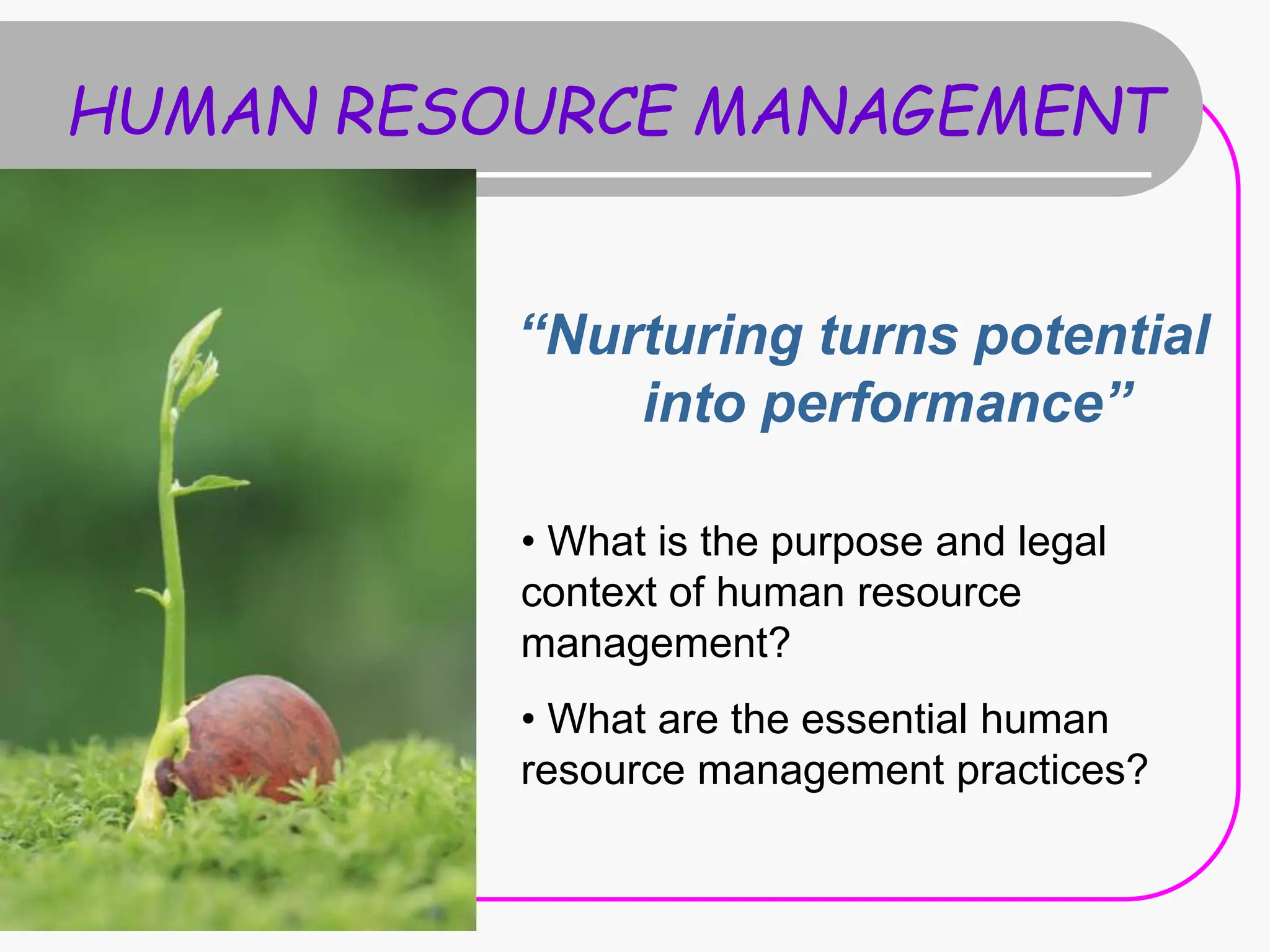
“Nurturing turns potential
into performance”
• What is the purpose and legal
context of human resource
management?
• What are the essential human
resource management practices?
HUMAN RESOURCE MANAGEMENT
Purpose of Human Resource
Management
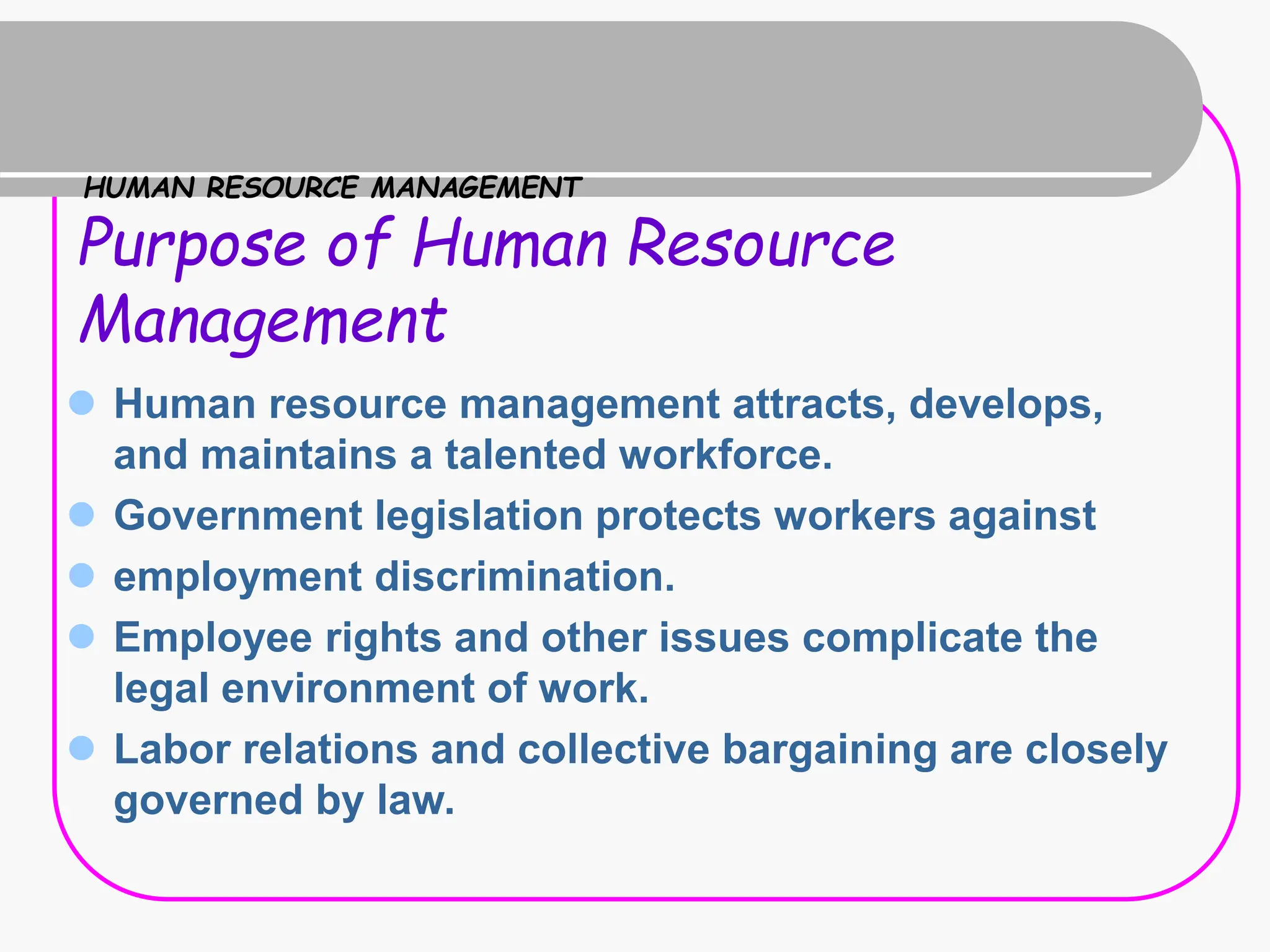
 Human resource management attracts, develops,
and maintains a talented workforce.
 Government legislation protects workers against
 employment discrimination.
 Employee rights and other issues complicate the
legal environment of work.
 Labor relations and collective bargaining are closely
governed by law.
HUMAN RESOURCE MANAGEMENT
Purpose of Human Resource
Management
Human Resource Management
involves attracting, developing, and
maintaining a quality workforce.
Basic Responsibilities of Human Resource Management
1. Attract a quality workforce—human resource planning,
recruitment, and selection.
2. Develop a quality workforce—employee orientation,
training, performance appraisal.
3. Maintain a quality workforce—retention and career
development.
PURPOSE OF HUMAN RESOURCE MANAGEMENT
Legal Aspects Of HRM
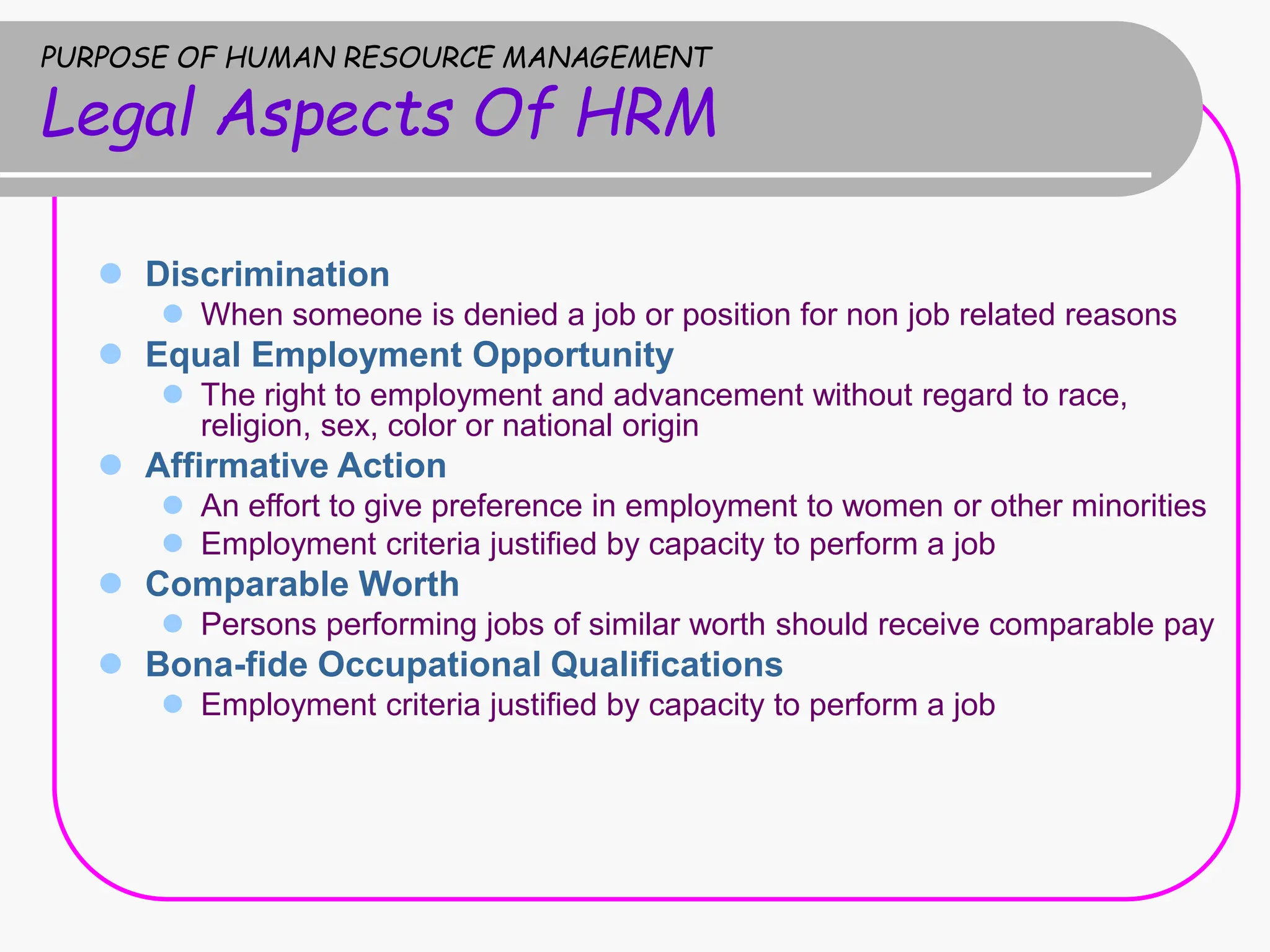
 Discrimination
 When someone is denied a job or position for non job related reasons
 Equal Employment Opportunity
 The right to employment and advancement without regard to race,
religion, sex, color or national origin
 Affirmative Action
 An effort to give preference in employment to women or other minorities
 Employment criteria justified by capacity to perform a job
 Comparable Worth
 Persons performing jobs of similar worth should receive comparable pay
 Bona-fide Occupational Qualifications
 Employment criteria justified by capacity to perform a job
PURPOSE OF HUMAN RESOURCE MANAGEMENT
Legal Aspects Of HRM
PURPOSE OF HUMAN RESOURCE MANAGEMENT
Labor Relations & Collective Bargaining
 Workplace Privacy
 The right to privacy while at work
 Independent Contractors
 Hired on temporary contracts and are not part of the organization’s permanent
work force
 Labor Union
 An organization that deals with employers on the workers collective behalf
 Labor Contract
 A formal agreement between a union and employer about the terms of work for
union members
U.S. labor union facts:
• U.S. union membership was 12.5% in 2004, down from 20.1% in 1983.
• 8% of private sector workers belong to unions, and 36% of government
workers.
• Many of the fastest growing unions represent white-collar workers.
• 75% of U.S. adults believe unions improve wages and working conditions;
• 67% believe unions are too involved in politics.
PURPOSE OF HUMAN RESOURCE MANAGEMENT
Legal Aspects Of HRM
HUMAN RESOURCE MANAGEMENT
Human Resource Practices
MODULE GUIDE 15.2
 Human resource planning matches staffing with
organizational needs.
 Recruitment and selection attract and hire qualified job
applicants.
 Socialization and orientation integrate new employees into
the organization.
 Training continually improves employee skills and
capabilities.
 Performance management techniques appraise individual
accomplishments.
 Retention and career development provide career paths and
options.
HUMAN RESOURCE MANAGEMENT
Human Resource Practices
 Human resource planning is the process of analyzing staffing
needs and identifying actions that should be taken to satisfy
them over time.
HUMAN RESOURCE PRACTICES
Recruitment And Training
 Recruitment
 the process of attracting qualified job candidates to fill vacant
positions; realistic job previews try to provide candidates with
accurate information on the job and organization.
 Selection
 Choosing whom to hire from a field of qualified applicants
 Realistic Job Previews
 Provide job candidates with pertinent information regarding a job and
organization
 Reliability
 means a selection device gives consistent results over repeated measures
 Validity
 Means scores on a selection device have links to future performance
 Assessment Centers
 Examine how job candidates handle simulated job situations
HUMAN RESOURCE PRACTICES
Orientation And Training
 Orientation
 the process of formally introducing new employees to their
jobs and socializing them with performance expectations.
 Training
 keeping workers’ skills up to date and job relevant; important
training approaches include coaching and mentoring.
 Coaching
 An experienced person offers performance advice to a less
experienced person
 Mentoring
 Assigns early career employees as protégés to more senior ones
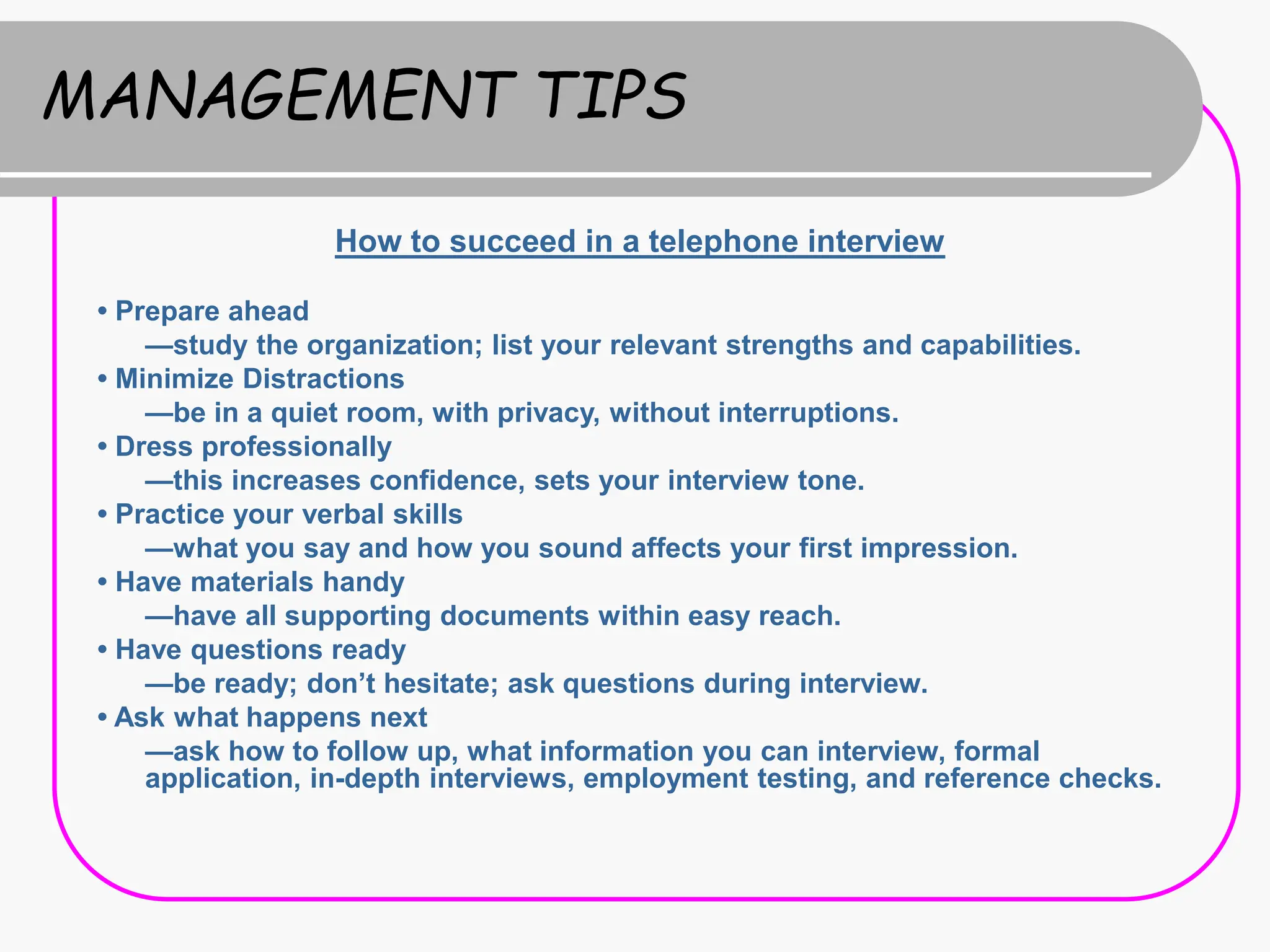
MANAGEMENT TIPS
How to succeed in a telephone interview
• Prepare ahead
—study the organization; list your relevant strengths and capabilities.
• Minimize Distractions
—be in a quiet room, with privacy, without interruptions.
• Dress professionally
—this increases confidence, sets your interview tone.
• Practice your verbal skills
—what you say and how you sound affects your first impression.
• Have materials handy
—have all supporting documents within easy reach.
• Have questions ready
—be ready; don’t hesitate; ask questions during interview.
• Ask what happens next
—ask how to follow up, what information you can interview, formal
application, in-depth interviews, employment testing, and reference checks.
HUMAN RESOURCE PRACTICES
Performance Appraisals
Performance Appraisal
The process of formally evaluating
performance and feedback to an employee
Two Purposes of Performance Appraisal
1. Evaluation—document and let people know how well they are
doing; judgmental role.
2. Development—identify how training and support can improve
performance; counseling role.
HUMAN RESOURCE PRACTICES
Performance Appraisals
 Critical Incident Technique
 Keeps a log of a person’s effective and ineffective
job behavior
 360 Degree feedback
 Includes superiors, subordinates, peers and even
customers in the appraisal process
 Multi-person Comparison
 Rates employees against each other
 Graphic Rating Scale
 Uses a checklist of characteristics or traits to
evaluate performance
HUMAN RESOURCE PRACTICES
Performance Appraisals
 Behaviorally Anchored Rating Scale
Uses specific descriptions of actual behaviors to rate various levels of actual
performance
HUMAN RESOURCE PRACTICES
Retention And Career Development
Career Development
Manages how a person grows and
progresses in their career
Career Planning
The process of managing career goals and
individual capabilities with opportunities for
their fulfillment

Legal HR.ppt legal hrm ppt ppt on human resource management legal environment

  • 1.
    HUMAN RESOURCE MANAGEMENT “Nurturingturns potential into performance” • What is the purpose and legal context of human resource management? • What are the essential human resource management practices?
  • 2.
    HUMAN RESOURCE MANAGEMENT Purposeof Human Resource Management  Human resource management attracts, develops, and maintains a talented workforce.  Government legislation protects workers against  employment discrimination.  Employee rights and other issues complicate the legal environment of work.  Labor relations and collective bargaining are closely governed by law.
  • 3.
    HUMAN RESOURCE MANAGEMENT Purposeof Human Resource Management Human Resource Management involves attracting, developing, and maintaining a quality workforce. Basic Responsibilities of Human Resource Management 1. Attract a quality workforce—human resource planning, recruitment, and selection. 2. Develop a quality workforce—employee orientation, training, performance appraisal. 3. Maintain a quality workforce—retention and career development.
  • 4.
    PURPOSE OF HUMANRESOURCE MANAGEMENT Legal Aspects Of HRM  Discrimination  When someone is denied a job or position for non job related reasons  Equal Employment Opportunity  The right to employment and advancement without regard to race, religion, sex, color or national origin  Affirmative Action  An effort to give preference in employment to women or other minorities  Employment criteria justified by capacity to perform a job  Comparable Worth  Persons performing jobs of similar worth should receive comparable pay  Bona-fide Occupational Qualifications  Employment criteria justified by capacity to perform a job
  • 5.
    PURPOSE OF HUMANRESOURCE MANAGEMENT Legal Aspects Of HRM
  • 6.
    PURPOSE OF HUMANRESOURCE MANAGEMENT Labor Relations & Collective Bargaining  Workplace Privacy  The right to privacy while at work  Independent Contractors  Hired on temporary contracts and are not part of the organization’s permanent work force  Labor Union  An organization that deals with employers on the workers collective behalf  Labor Contract  A formal agreement between a union and employer about the terms of work for union members U.S. labor union facts: • U.S. union membership was 12.5% in 2004, down from 20.1% in 1983. • 8% of private sector workers belong to unions, and 36% of government workers. • Many of the fastest growing unions represent white-collar workers. • 75% of U.S. adults believe unions improve wages and working conditions; • 67% believe unions are too involved in politics.
  • 7.
    PURPOSE OF HUMANRESOURCE MANAGEMENT Legal Aspects Of HRM
  • 8.
    HUMAN RESOURCE MANAGEMENT HumanResource Practices MODULE GUIDE 15.2  Human resource planning matches staffing with organizational needs.  Recruitment and selection attract and hire qualified job applicants.  Socialization and orientation integrate new employees into the organization.  Training continually improves employee skills and capabilities.  Performance management techniques appraise individual accomplishments.  Retention and career development provide career paths and options.
  • 9.
    HUMAN RESOURCE MANAGEMENT HumanResource Practices  Human resource planning is the process of analyzing staffing needs and identifying actions that should be taken to satisfy them over time.
  • 10.
    HUMAN RESOURCE PRACTICES RecruitmentAnd Training  Recruitment  the process of attracting qualified job candidates to fill vacant positions; realistic job previews try to provide candidates with accurate information on the job and organization.  Selection  Choosing whom to hire from a field of qualified applicants  Realistic Job Previews  Provide job candidates with pertinent information regarding a job and organization  Reliability  means a selection device gives consistent results over repeated measures  Validity  Means scores on a selection device have links to future performance  Assessment Centers  Examine how job candidates handle simulated job situations
  • 11.
    HUMAN RESOURCE PRACTICES OrientationAnd Training  Orientation  the process of formally introducing new employees to their jobs and socializing them with performance expectations.  Training  keeping workers’ skills up to date and job relevant; important training approaches include coaching and mentoring.  Coaching  An experienced person offers performance advice to a less experienced person  Mentoring  Assigns early career employees as protégés to more senior ones
  • 12.
    MANAGEMENT TIPS How tosucceed in a telephone interview • Prepare ahead —study the organization; list your relevant strengths and capabilities. • Minimize Distractions —be in a quiet room, with privacy, without interruptions. • Dress professionally —this increases confidence, sets your interview tone. • Practice your verbal skills —what you say and how you sound affects your first impression. • Have materials handy —have all supporting documents within easy reach. • Have questions ready —be ready; don’t hesitate; ask questions during interview. • Ask what happens next —ask how to follow up, what information you can interview, formal application, in-depth interviews, employment testing, and reference checks.
  • 13.
    HUMAN RESOURCE PRACTICES PerformanceAppraisals Performance Appraisal The process of formally evaluating performance and feedback to an employee Two Purposes of Performance Appraisal 1. Evaluation—document and let people know how well they are doing; judgmental role. 2. Development—identify how training and support can improve performance; counseling role.
  • 14.
    HUMAN RESOURCE PRACTICES PerformanceAppraisals  Critical Incident Technique  Keeps a log of a person’s effective and ineffective job behavior  360 Degree feedback  Includes superiors, subordinates, peers and even customers in the appraisal process  Multi-person Comparison  Rates employees against each other  Graphic Rating Scale  Uses a checklist of characteristics or traits to evaluate performance
  • 15.
    HUMAN RESOURCE PRACTICES PerformanceAppraisals  Behaviorally Anchored Rating Scale Uses specific descriptions of actual behaviors to rate various levels of actual performance
  • 16.
    HUMAN RESOURCE PRACTICES RetentionAnd Career Development Career Development Manages how a person grows and progresses in their career Career Planning The process of managing career goals and individual capabilities with opportunities for their fulfillment