Legacy Migration
WORPCLOUD LTD
Research reveals that application modernisation and migration budgets are currently very strong, covering between 25% to 71% of
most companies IT budgets in 2013/2014. This clearly indicates that application modernisation is one of the most significant issues
affecting companies – due to high software maintenance costs, low business flexibility and crippled integration and
interoperability. Software modernisation is the sole remedy for these problems.
Automated software modernisation is the best solution that is fast, low cost, preserves legacy value and is less risky by comparison
to the traditional methodology of a re-write or replacement by packaged ERP. Object Management Groups (OMGs) Model Driven
Architecture (MDA) methodology provides an automated model-driven reverse engineering and forward engineering process called
Architecture Driven Modernisation (ADM) which has already been successfully adopted by a variety of high profile organisations
such as Boeing, U.S. Air Force, Raytheon, EDS, Thales (European Aerospace) and numerous governments worldwide.
WORPCLOUD LTD is focused on being an Automated Software Modernisation Expert. We use OMG compliant tools and parsing
techniques to extract all system information, business semantics and software artifacts into an XML repository called the Abstract
Syntax Tree Metamodel. Next we use MDAs automated transformation procedures to generate new source code of your choice.
Manual architecting of the target system are also performed before the transformation thus ensuring; speed, low cost and
accuracy of the automated process combined with the flexibility & insight of human analysis.
www.worpcloud.com
Overview
Model Driven Architecture (MDA) is a new way of developing applications and writing
specifications, based on a Platform Independent Model (PIM) of the application or specifications
business functionality and behaviour.
A complete MDA specification consists of a definitive platform independent base model, plus
one or more platform specific models (PSM) and sets of
interface definitions, each describing how the base model is implemented on a different
middleware platform. Refer: http://www.omg.org/mda
Adhering to MDA processes, we focus on the behaviour of software systems, unbothered by the
intricacies of the technology platform(s) in which they are implemented, thus avoiding
redundant functionality/behaviour definitions, each time a new technology comes along.
www.worpcloud.com
Model Driven Architecture
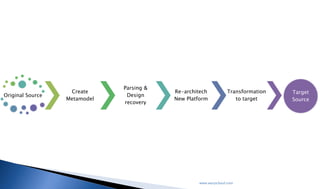
Original Source
Create
Metamodel
Parsing &
Design
recovery
Re-architect
New Platform
Transformation
to target
Target
Source
www.worpcloud.com
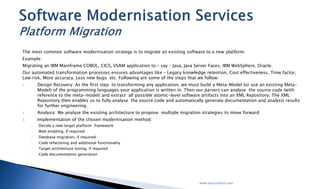
The most common software modernisation strategy is to migrate an existing software to a new platform.
Example:
Migrating an IBM Mainframe COBOL, CICS, VSAM application to – say – Java, Java Server Faces, IBM WebSphere, Oracle.
Our automated transformation processes ensures advantages like – Legacy knowledge retention, Cost effectiveness, Time factor, Low risk,
More accuracy, Less new bugs etc. Following are some of the steps that we follow:
1. Design Recovery: As the first step to transforming any application, we must build a Meta-Model (or use an existing Meta-Model) of
the programming languages your application is written in. Then our parsers can analyse the source code (with reference to the meta-
model) and extract all possible atomic-level software artifacts into an XML Repository. The XML Repository then enables us to fully
analyse the source code and automatically generate documentation and analysis results for further engineering.
2. Analysis: We analyse the existing architecture to propose multiple migration strategies to move forward
3. Implementation of the chosen modernisation method:
 Decide a new target platform framework
 Web enabling, if required
 Database migration, if required
 Code refactoring and additional functionality
 Target architecture tuning, if required
 Code documentation generation
Software Modernisation Services
Platform Migration
www.worpcloud.com
Software Modernisation Services
Platform Migration
Original
Parcers
Language
Metamodels
AST
XML Repository
Software Artifacts
Documentation
Analyst Work Bench
Diagrams
Charts
Graphs
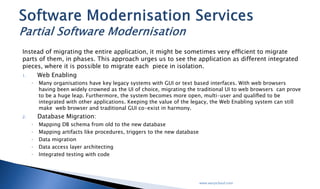
Instead of migrating the entire application, it might be sometimes very efficient to migrate parts of them, in
phases. This approach urges us to see the application as different integrated pieces, where it is possible to
migrate each piece in isolation.
1. Web Enabling
Many organisations have key legacy systems with GUI or text based interfaces. With web browsers having been
widely crowned as the UI of choice, migrating the traditional UI to web browsers can prove to be a huge leap.
Furthermore, the system becomes more open, multi-user and qualified to be integrated with other applications.
Keeping the value of the legacy, the Web Enabling system can still make web browser and traditional GUI co-
exist in harmony.
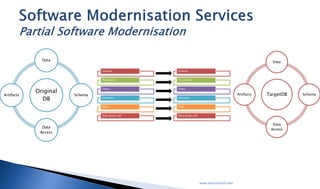
2. Database Migration:
 Mapping DB schema from old to the new database
 Mapping artifacts like procedures, triggers to the new database
 Data migration
 Data access layer architecting
 Integrated testing with code
www.worpcloud.com
Software Modernisation Services
Partial Software Modernisation
www.worpcloud.com
Software Modernisation Services
Partial Software Modernisation
Original
DB
Data
Schema
Data
Access
Artifacts
Schema
Procedures
Views
Functions
Data
Data Access API
Schema
Procedures
Views
Functions
Data
Data Access API
TargetDB
Data
Schema
Data
Access
Artifacts
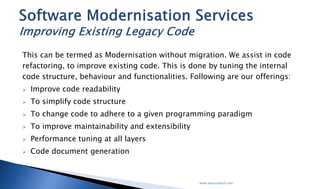
This can be termed as Modernisation without migration. We assist in code
refactoring, to improve existing code. This is done by tuning the internal code
structure, behaviour and functionalities. Following are our offerings:
 Improve code readability
 To simplify code structure
 To change code to adhere to a given programming paradigm
 To improve maintainability and extensibility
 Performance tuning at all layers
 Code document generation
www.worpcloud.com
Software Modernisation Services
Improving Existing Legacy Code
It is obvious that legacy systems undergo constant change, according to the volatile business environments.
Since legacy systems are poorly documented, we develop system documentation and reporting tools that
enable team to track the impacting areas of change requests and also maintain updated system
documentation. This cost effective and time efficient procedure is usually the first priority of most customers,
even if the real agenda is a complete platform migration. The typical reporting outputs are as follows:
 Application inventory – line count, fields, methods & file sizes.
 Method call and called by tree.
 Data access point highlighting
 Dead code analysis
 Unreferenced code analysis
 Unreferenced variable analysis
 Complexity analysis
 Sequence diagram
 Source file dependency analysis
 Business process modelling
www.worpcloud.com
Software Modernisation Services
Legacy System Analysts Workbenches
Original
Parcers
Language
Metamodels
AST
XML
Repository
Software Artifacts
Analyst Work
Bench
• Application Inventory Report
• Method call and called by tree
• Unreferenced variable analysis
• Unreferenced code report
• Dead code report
• Complexity analysis
• Sequence diagram
• Source file dependency analysis
• Business process modelling
• Data access report
About US
WORPCLOUD LTD is a Liverpool based company specialising in software and database solutions, with a
particular focus on cloud and mobility solutions. From customised application and database
development; to migration of existing legacy systems to modern cloud & mobile platforms. Our founding
technical team consists of highly experienced and skilled software engineers some of whom are former
employees of fortune 500 companies such as IBM and Oracle.
We are experts on all modern standard technologies including Java, JSP, Servlets, EJB, JSF, Seam, Struts,
Spring, Hibernate,PHP,C#,.Net, MySQL, Oracle, SQL-server etc. Our skilful and experienced team of
software developers are 100% committed to help you modernise your organisation with the latest cutting
edge cloud technologies. From day one you will be assigned a project manager with technical and
industry knowledge. This dedicated project manager will be available 5 days a week to assist you with
any queries; he/she will keep you updated every step of the way during the projects implementation‫‏‬‫‏‬.
Your project manager will also be backed up by our 24/7 technical support team.
Contact Us
WORPCLOUD LTD HQ
1 Old Hall Street
L3 9HG
Liverpool, UK
Tel : +44 151 528 2670
Mob : +44 744 791 6207
Skype: Worpcloud ( WORPCLOUD LTD)
Email : support@worpcloud.com
Website : worpcloud.com

Legacy Migration

  • 1.
  • 2.
    Research reveals thatapplication modernisation and migration budgets are currently very strong, covering between 25% to 71% of most companies IT budgets in 2013/2014. This clearly indicates that application modernisation is one of the most significant issues affecting companies – due to high software maintenance costs, low business flexibility and crippled integration and interoperability. Software modernisation is the sole remedy for these problems. Automated software modernisation is the best solution that is fast, low cost, preserves legacy value and is less risky by comparison to the traditional methodology of a re-write or replacement by packaged ERP. Object Management Groups (OMGs) Model Driven Architecture (MDA) methodology provides an automated model-driven reverse engineering and forward engineering process called Architecture Driven Modernisation (ADM) which has already been successfully adopted by a variety of high profile organisations such as Boeing, U.S. Air Force, Raytheon, EDS, Thales (European Aerospace) and numerous governments worldwide. WORPCLOUD LTD is focused on being an Automated Software Modernisation Expert. We use OMG compliant tools and parsing techniques to extract all system information, business semantics and software artifacts into an XML repository called the Abstract Syntax Tree Metamodel. Next we use MDAs automated transformation procedures to generate new source code of your choice. Manual architecting of the target system are also performed before the transformation thus ensuring; speed, low cost and accuracy of the automated process combined with the flexibility & insight of human analysis. www.worpcloud.com Overview
  • 3.
    Model Driven Architecture(MDA) is a new way of developing applications and writing specifications, based on a Platform Independent Model (PIM) of the application or specifications business functionality and behaviour. A complete MDA specification consists of a definitive platform independent base model, plus one or more platform specific models (PSM) and sets of interface definitions, each describing how the base model is implemented on a different middleware platform. Refer: http://www.omg.org/mda Adhering to MDA processes, we focus on the behaviour of software systems, unbothered by the intricacies of the technology platform(s) in which they are implemented, thus avoiding redundant functionality/behaviour definitions, each time a new technology comes along. www.worpcloud.com Model Driven Architecture
  • 4.
    Original Source Create Metamodel Parsing & Design recovery Re-architect NewPlatform Transformation to target Target Source www.worpcloud.com
  • 5.
    The most commonsoftware modernisation strategy is to migrate an existing software to a new platform. Example: Migrating an IBM Mainframe COBOL, CICS, VSAM application to – say – Java, Java Server Faces, IBM WebSphere, Oracle. Our automated transformation processes ensures advantages like – Legacy knowledge retention, Cost effectiveness, Time factor, Low risk, More accuracy, Less new bugs etc. Following are some of the steps that we follow: 1. Design Recovery: As the first step to transforming any application, we must build a Meta-Model (or use an existing Meta-Model) of the programming languages your application is written in. Then our parsers can analyse the source code (with reference to the meta- model) and extract all possible atomic-level software artifacts into an XML Repository. The XML Repository then enables us to fully analyse the source code and automatically generate documentation and analysis results for further engineering. 2. Analysis: We analyse the existing architecture to propose multiple migration strategies to move forward 3. Implementation of the chosen modernisation method:  Decide a new target platform framework  Web enabling, if required  Database migration, if required  Code refactoring and additional functionality  Target architecture tuning, if required  Code documentation generation Software Modernisation Services Platform Migration
  • 6.
    www.worpcloud.com Software Modernisation Services PlatformMigration Original Parcers Language Metamodels AST XML Repository Software Artifacts Documentation Analyst Work Bench Diagrams Charts Graphs
  • 7.
    Instead of migratingthe entire application, it might be sometimes very efficient to migrate parts of them, in phases. This approach urges us to see the application as different integrated pieces, where it is possible to migrate each piece in isolation. 1. Web Enabling Many organisations have key legacy systems with GUI or text based interfaces. With web browsers having been widely crowned as the UI of choice, migrating the traditional UI to web browsers can prove to be a huge leap. Furthermore, the system becomes more open, multi-user and qualified to be integrated with other applications. Keeping the value of the legacy, the Web Enabling system can still make web browser and traditional GUI co- exist in harmony. 2. Database Migration:  Mapping DB schema from old to the new database  Mapping artifacts like procedures, triggers to the new database  Data migration  Data access layer architecting  Integrated testing with code www.worpcloud.com Software Modernisation Services Partial Software Modernisation
  • 8.
    www.worpcloud.com Software Modernisation Services PartialSoftware Modernisation Original DB Data Schema Data Access Artifacts Schema Procedures Views Functions Data Data Access API Schema Procedures Views Functions Data Data Access API TargetDB Data Schema Data Access Artifacts
  • 9.
    This can betermed as Modernisation without migration. We assist in code refactoring, to improve existing code. This is done by tuning the internal code structure, behaviour and functionalities. Following are our offerings:  Improve code readability  To simplify code structure  To change code to adhere to a given programming paradigm  To improve maintainability and extensibility  Performance tuning at all layers  Code document generation www.worpcloud.com Software Modernisation Services Improving Existing Legacy Code
  • 10.
    It is obviousthat legacy systems undergo constant change, according to the volatile business environments. Since legacy systems are poorly documented, we develop system documentation and reporting tools that enable team to track the impacting areas of change requests and also maintain updated system documentation. This cost effective and time efficient procedure is usually the first priority of most customers, even if the real agenda is a complete platform migration. The typical reporting outputs are as follows:  Application inventory – line count, fields, methods & file sizes.  Method call and called by tree.  Data access point highlighting  Dead code analysis  Unreferenced code analysis  Unreferenced variable analysis  Complexity analysis  Sequence diagram  Source file dependency analysis  Business process modelling www.worpcloud.com Software Modernisation Services Legacy System Analysts Workbenches Original Parcers Language Metamodels AST XML Repository Software Artifacts Analyst Work Bench • Application Inventory Report • Method call and called by tree • Unreferenced variable analysis • Unreferenced code report • Dead code report • Complexity analysis • Sequence diagram • Source file dependency analysis • Business process modelling • Data access report
  • 11.
    About US WORPCLOUD LTDis a Liverpool based company specialising in software and database solutions, with a particular focus on cloud and mobility solutions. From customised application and database development; to migration of existing legacy systems to modern cloud & mobile platforms. Our founding technical team consists of highly experienced and skilled software engineers some of whom are former employees of fortune 500 companies such as IBM and Oracle. We are experts on all modern standard technologies including Java, JSP, Servlets, EJB, JSF, Seam, Struts, Spring, Hibernate,PHP,C#,.Net, MySQL, Oracle, SQL-server etc. Our skilful and experienced team of software developers are 100% committed to help you modernise your organisation with the latest cutting edge cloud technologies. From day one you will be assigned a project manager with technical and industry knowledge. This dedicated project manager will be available 5 days a week to assist you with any queries; he/she will keep you updated every step of the way during the projects implementation‫‏‬‫‏‬. Your project manager will also be backed up by our 24/7 technical support team.
  • 12.
    Contact Us WORPCLOUD LTDHQ 1 Old Hall Street L3 9HG Liverpool, UK Tel : +44 151 528 2670 Mob : +44 744 791 6207 Skype: Worpcloud ( WORPCLOUD LTD) Email : support@worpcloud.com Website : worpcloud.com