IBM Software Group | Rational software

IBM SE Symposium

Roma – 29 Nov 2012

Model-Driven Development for Safety Critical
Software
Giulio Santoli (giulio_santoli@it.ibm.com)
Client Technical Professional, IBM Rational

© 2008 IBM Corporation
© 2012 IBM Corporation
Software and Systems Engineering | Rational

Agenda

1 Safety Critical Application Standards
Integrated Software Development Process

2
3
4
5
6

Model-Driven Development for Safety Critical
Rational Rhapsody Enhancements for Safety Critical

Rhapsody TestConductor AddOd Qualification Kit

Summary

© 2012 IBM Corporation
Software and Systems Engineering | Rational

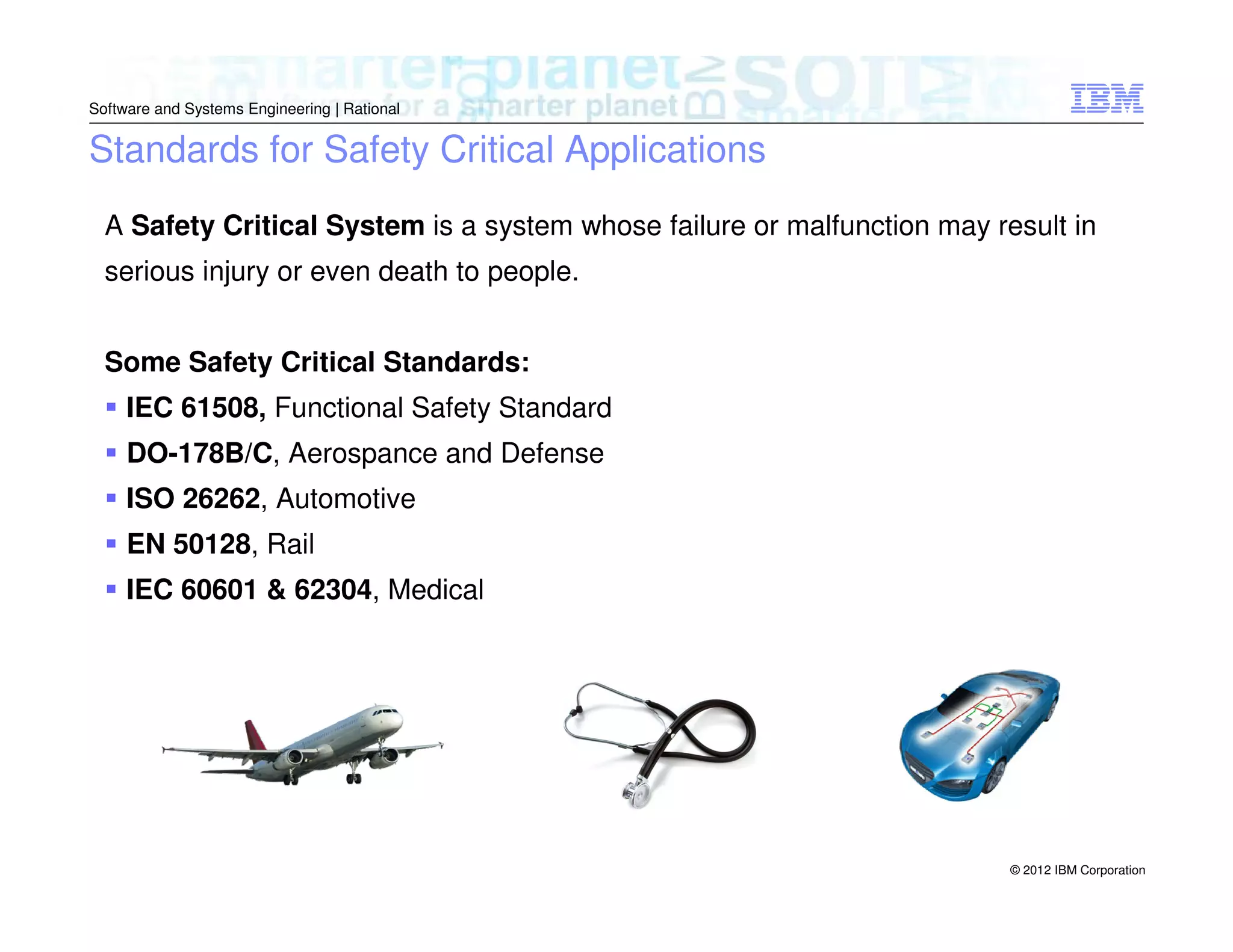
Standards for Safety Critical Applications
A Safety Critical System is a system whose failure or malfunction may result in
serious injury or even death to people.
Some Safety Critical Standards:
IEC 61508, Functional Safety Standard
DO-178B/C, Aerospance and Defense
ISO 26262, Automotive
EN 50128, Rail
IEC 60601 & 62304, Medical

© 2012 IBM Corporation
Software and Systems Engineering | Rational

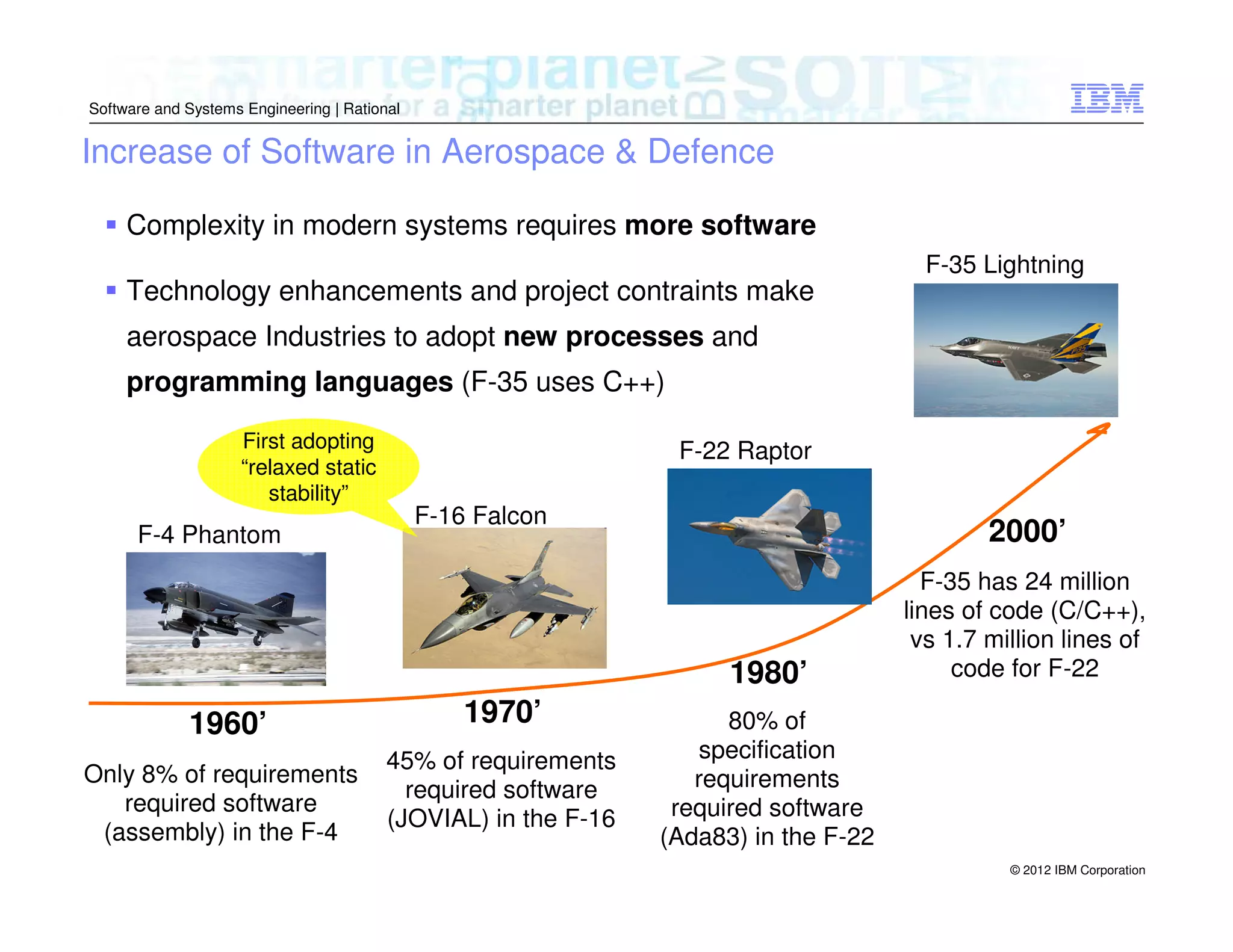
Increase of Software in Aerospace & Defence
Complexity in modern systems requires more software
Technology enhancements and project contraints make

F-35 Lightning

aerospace Industries to adopt new processes and
programming languages (F-35 uses C++)
First adopting
“relaxed static
stability”

F-4 Phantom

F-22 Raptor
F-16 Falcon

2000’

1980’
1960’
Only 8% of requirements
required software
(assembly) in the F-4

1970’
45% of requirements
required software
(JOVIAL) in the F-16

F-35 has 24 million
lines of code (C/C++),
vs 1.7 million lines of
code for F-22

80% of
specification
requirements
required software
(Ada83) in the F-22
© 2012 IBM Corporation
Software and Systems Engineering | Rational

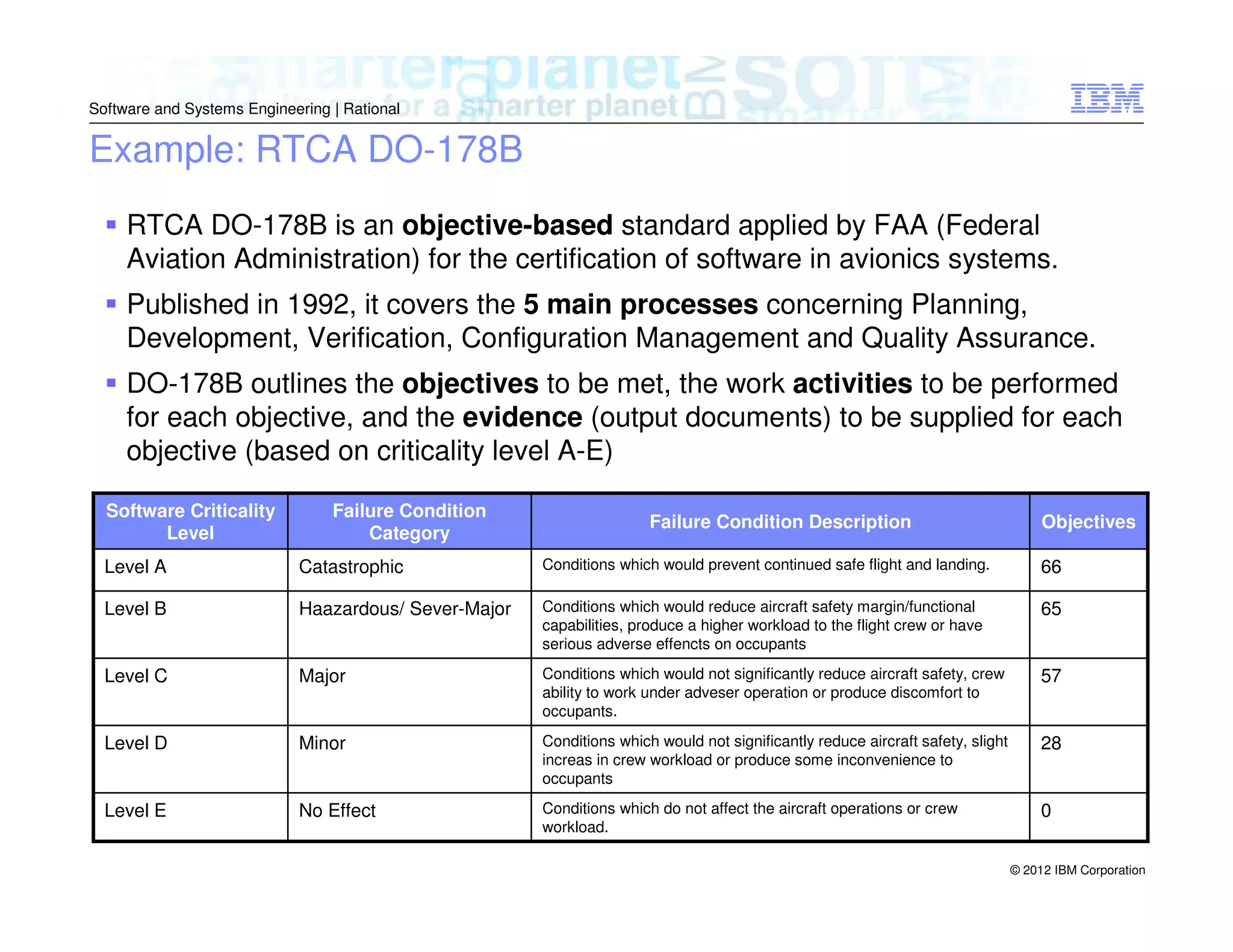
Example: RTCA DO-178B
RTCA DO-178B is an objective-based standard applied by FAA (Federal
Aviation Administration) for the certification of software in avionics systems.
Published in 1992, it covers the 5 main processes concerning Planning,
Development, Verification, Configuration Management and Quality Assurance.
DO-178B outlines the objectives to be met, the work activities to be performed
for each objective, and the evidence (output documents) to be supplied for each
objective (based on criticality level A-E)
Software Criticality
Level

Failure Condition
Category

Failure Condition Description

Objectives

Level A

Catastrophic

Conditions which would prevent continued safe flight and landing.

66

Level B

Haazardous/ Sever-Major

Conditions which would reduce aircraft safety margin/functional
capabilities, produce a higher workload to the flight crew or have
serious adverse effencts on occupants

65

Level C

Major

Conditions which would not significantly reduce aircraft safety, crew
ability to work under adveser operation or produce discomfort to
occupants.

57

Level D

Minor

Conditions which would not significantly reduce aircraft safety, slight
increas in crew workload or produce some inconvenience to
occupants

28

Level E

No Effect

Conditions which do not affect the aircraft operations or crew
workload.

0
© 2012 IBM Corporation
Software and Systems Engineering | Rational

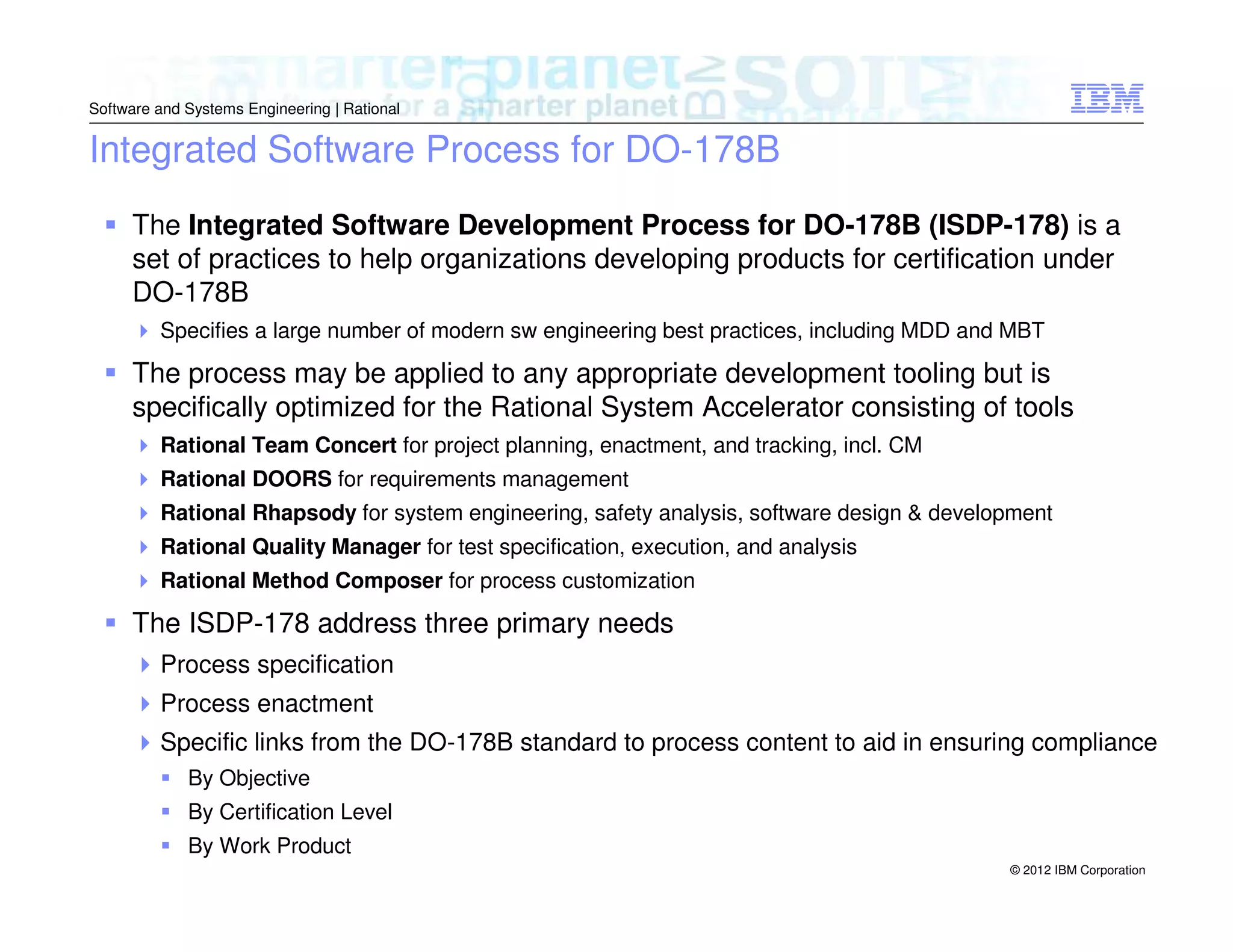
Integrated Software Process for DO-178B
The Integrated Software Development Process for DO-178B (ISDP-178) is a
set of practices to help organizations developing products for certification under
DO-178B
Specifies a large number of modern sw engineering best practices, including MDD and MBT

The process may be applied to any appropriate development tooling but is
specifically optimized for the Rational System Accelerator consisting of tools
Rational Team Concert for project planning, enactment, and tracking, incl. CM
Rational DOORS for requirements management
Rational Rhapsody for system engineering, safety analysis, software design & development
Rational Quality Manager for test specification, execution, and analysis
Rational Method Composer for process customization

The ISDP-178 address three primary needs
Process specification
Process enactment
Specific links from the DO-178B standard to process content to aid in ensuring compliance
By Objective
By Certification Level
By Work Product
© 2012 IBM Corporation
Software and Systems Engineering | Rational

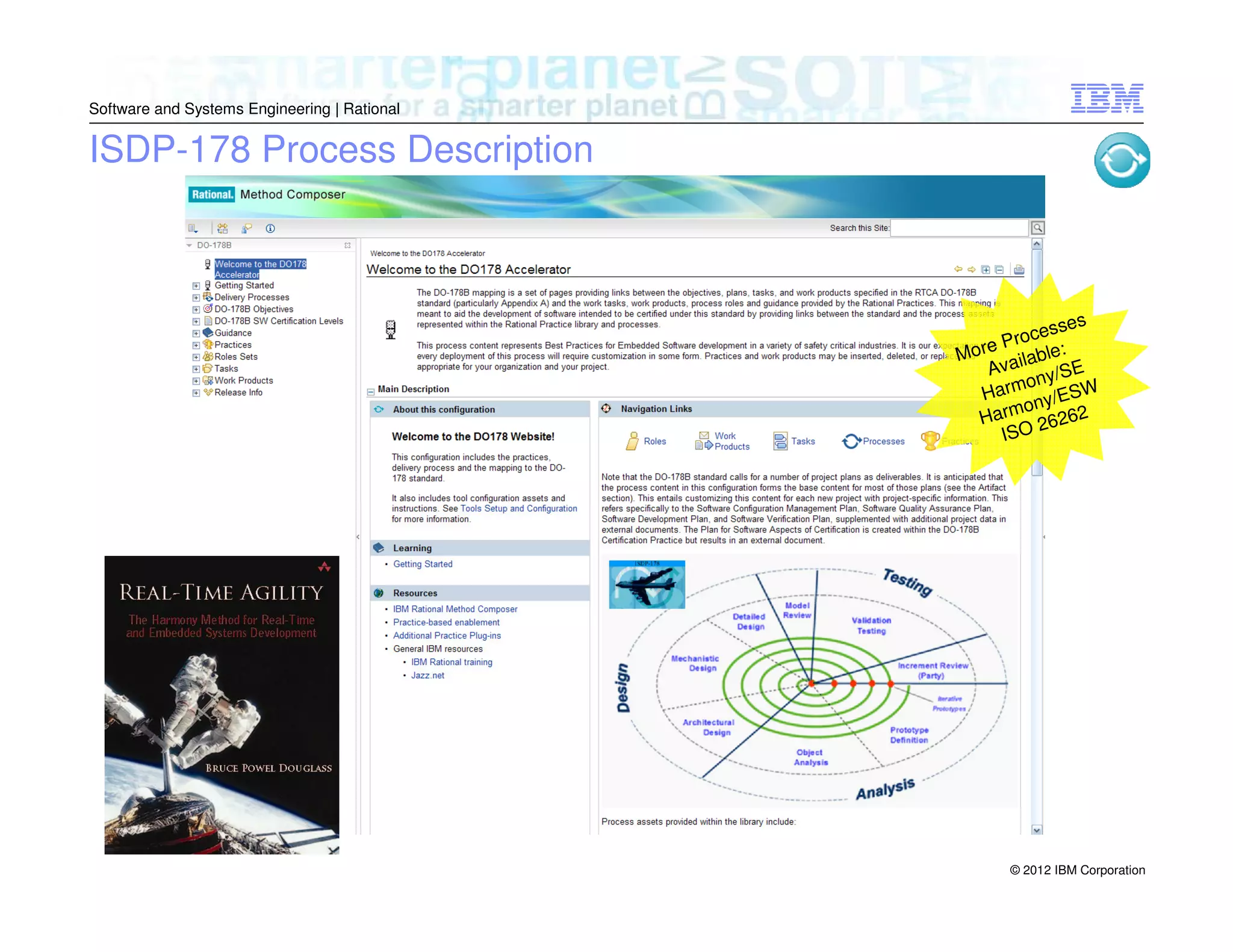
ISDP-178 Process Description

s
esse
Proc :
More ailable
E
Av
ny/S
armo /ESW
H
ony
Harm 26262
ISO

© 2012 IBM Corporation
Software and Systems Engineering | Rational

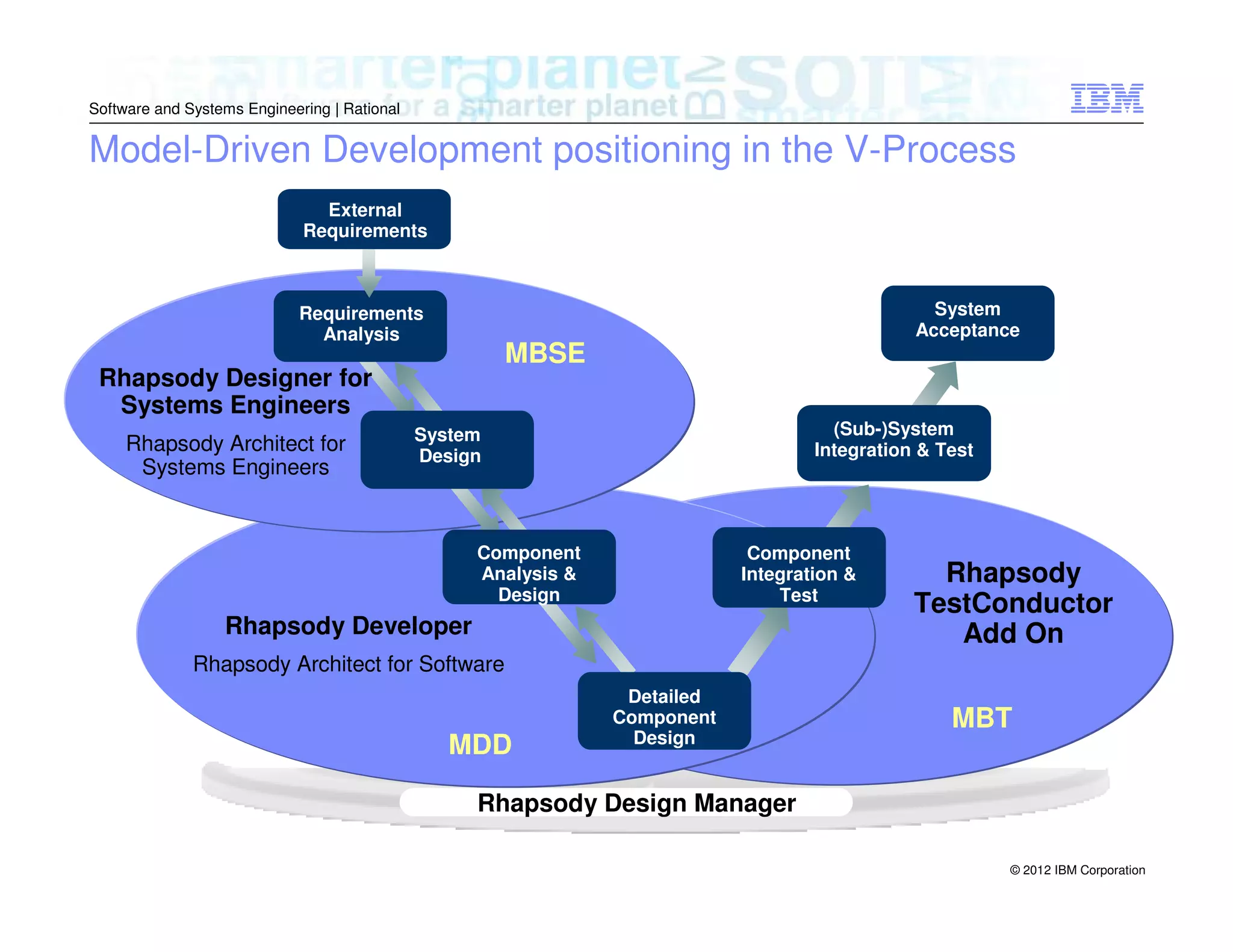
Model-Driven Development positioning in the V-Process
External
Requirements

Requirements
Analysis

MBSE

Rhapsody Designer for
Systems Engineers
Rhapsody Architect for
Systems Engineers

System
Acceptance

(Sub-)System
Integration & Test

System
Design

Component
Analysis &
Design

Component
Integration &
Test

Rhapsody Developer

Rhapsody
TestConductor
Add On

Rhapsody Architect for Software

MDD

Detailed
Component
Design

MBT

Rhapsody Design Manager
© 2012 IBM Corporation
Software and Systems Engineering | Rational

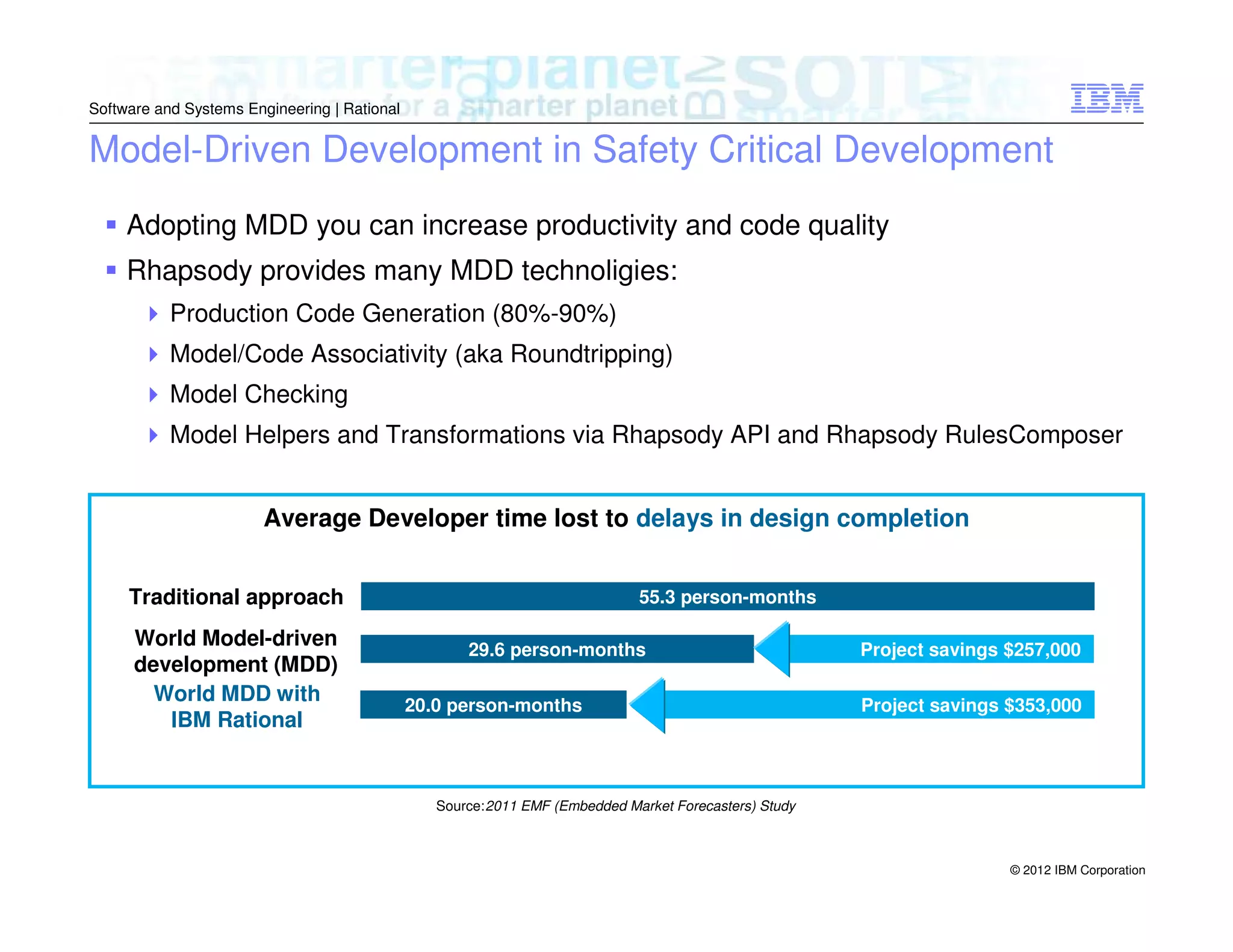
Model-Driven Development in Safety Critical Development
Adopting MDD you can increase productivity and code quality
Rhapsody provides many MDD technoligies:
Production Code Generation (80%-90%)
Model/Code Associativity (aka Roundtripping)
Model Checking
Model Helpers and Transformations via Rhapsody API and Rhapsody RulesComposer
IBM Collaborative
Design Management
Average Developer time lost to delays in design completion
Traditional approach
World Model-driven
development (MDD)
World MDD with
IBM Rational

55.3 person-months
29.6 person-months
20.0 person-months

Project savings $257,000
Project savings $353,000

Source:2011 EMF (Embedded Market Forecasters) Study

© 2012 IBM Corporation
Software and Systems Engineering | Rational

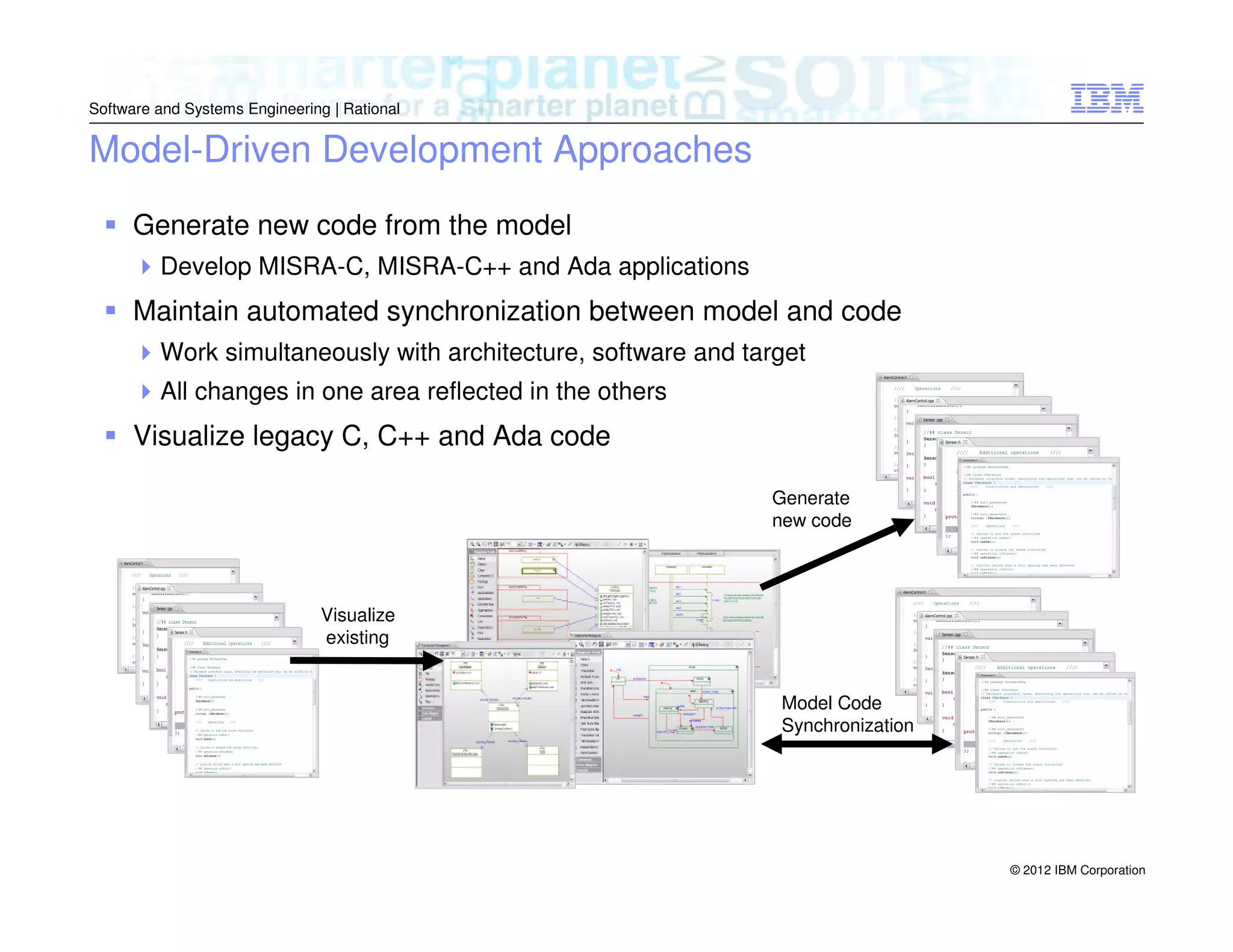
Model-Driven Development Approaches
Generate new code from the model
Develop MISRA-C, MISRA-C++ and Ada applications

Maintain automated synchronization between model and code
Work simultaneously with architecture, software and target
All changes in one area reflected in the others

Visualize legacy C, C++ and Ada code
Generate
new code

Visualize
existing
Model Code
Synchronization

© 2012 IBM Corporation
Software and Systems Engineering | Rational

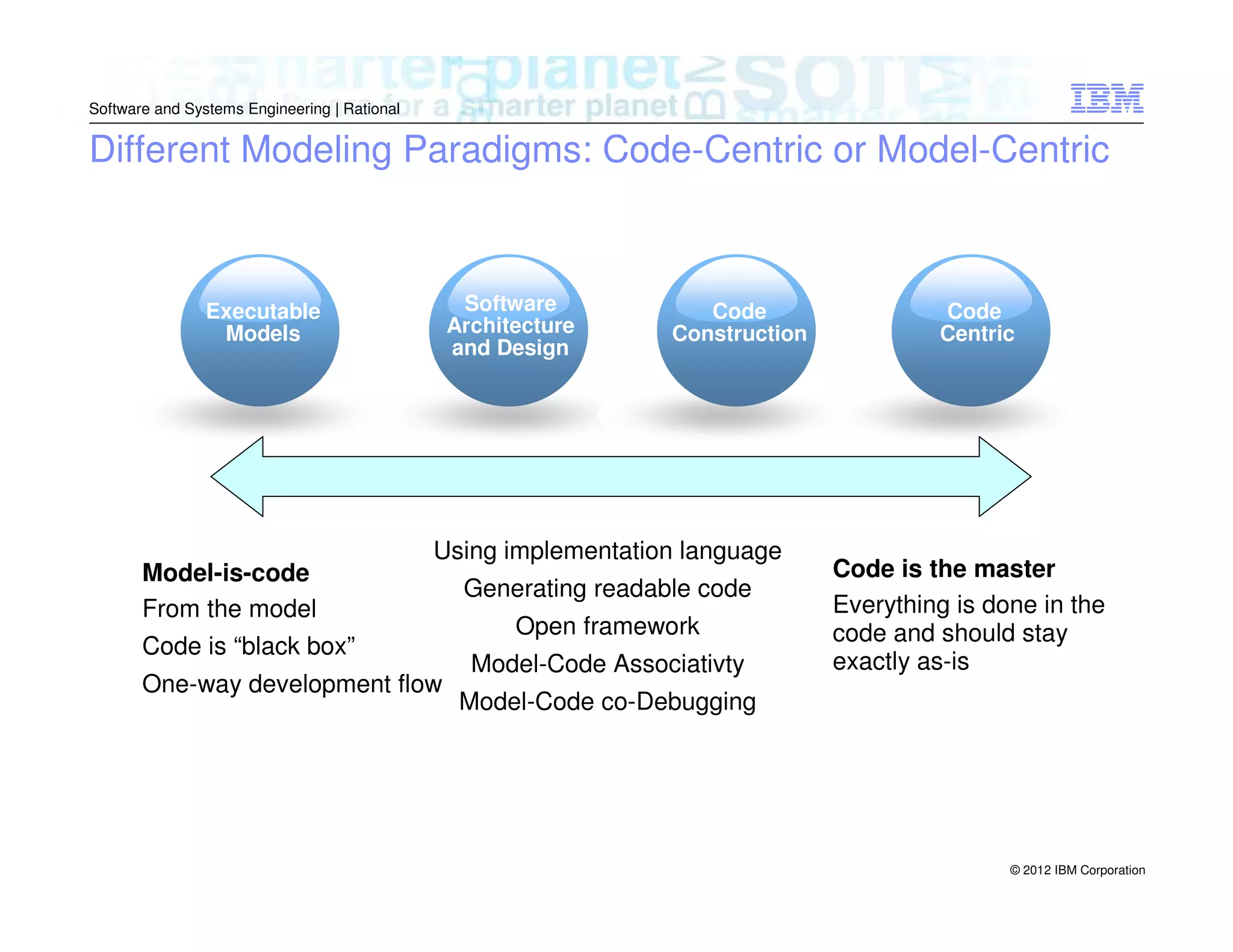
Different Modeling Paradigms: Code-Centric or Model-Centric

Software
Architecture
and Design

Executable
Models

Model-is-code
From the model

Code
Construction

Using implementation language

Code is “black box”
One-way development flow

Generating readable code
Open framework
Model-Code Associativty

Code

Code
Centric
Centric

Code is the master
Everything is done in the
code and should stay
exactly as-is

Model-Code co-Debugging

© 2012 IBM Corporation
Software and Systems Engineering | Rational

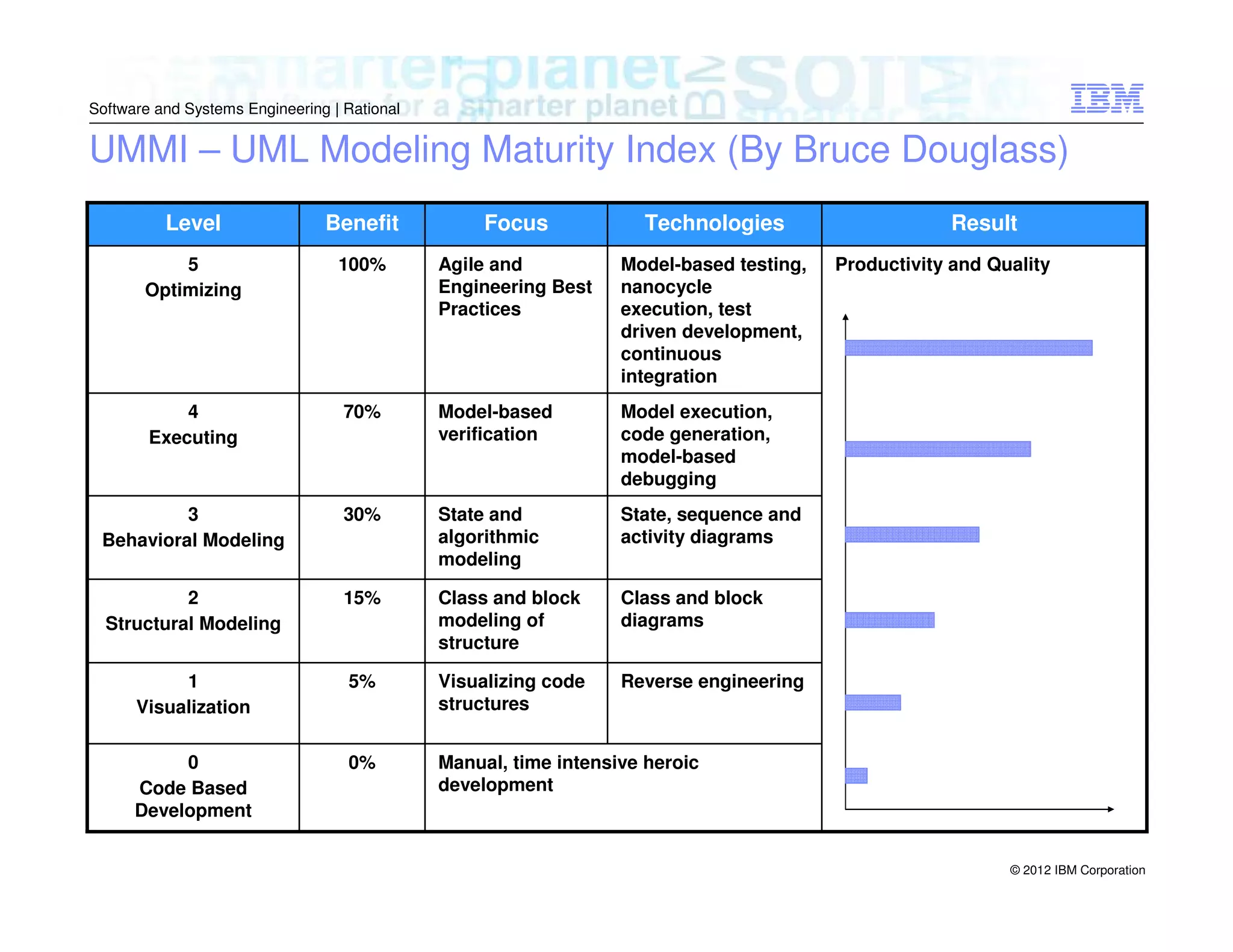
UMMI – UML Modeling Maturity Index (By Bruce Douglass)
Level

Benefit

Focus

Technologies

5
Optimizing

100%

Agile and
Engineering Best
Practices

Model-based testing,
nanocycle
execution, test
driven development,
continuous
integration

4
Executing

70%

Model-based
verification

Model execution,
code generation,
model-based
debugging

3
Behavioral Modeling

30%

State and
algorithmic
modeling

State, sequence and
activity diagrams

2
Structural Modeling

15%

Class and block
modeling of
structure

Class and block
diagrams

1
Visualization

5%

Visualizing code
structures

Reverse engineering

0
Code Based
Development

0%

Result

Manual, time intensive heroic
development

Productivity and Quality

© 2012 IBM Corporation
Software and Systems Engineering | Rational

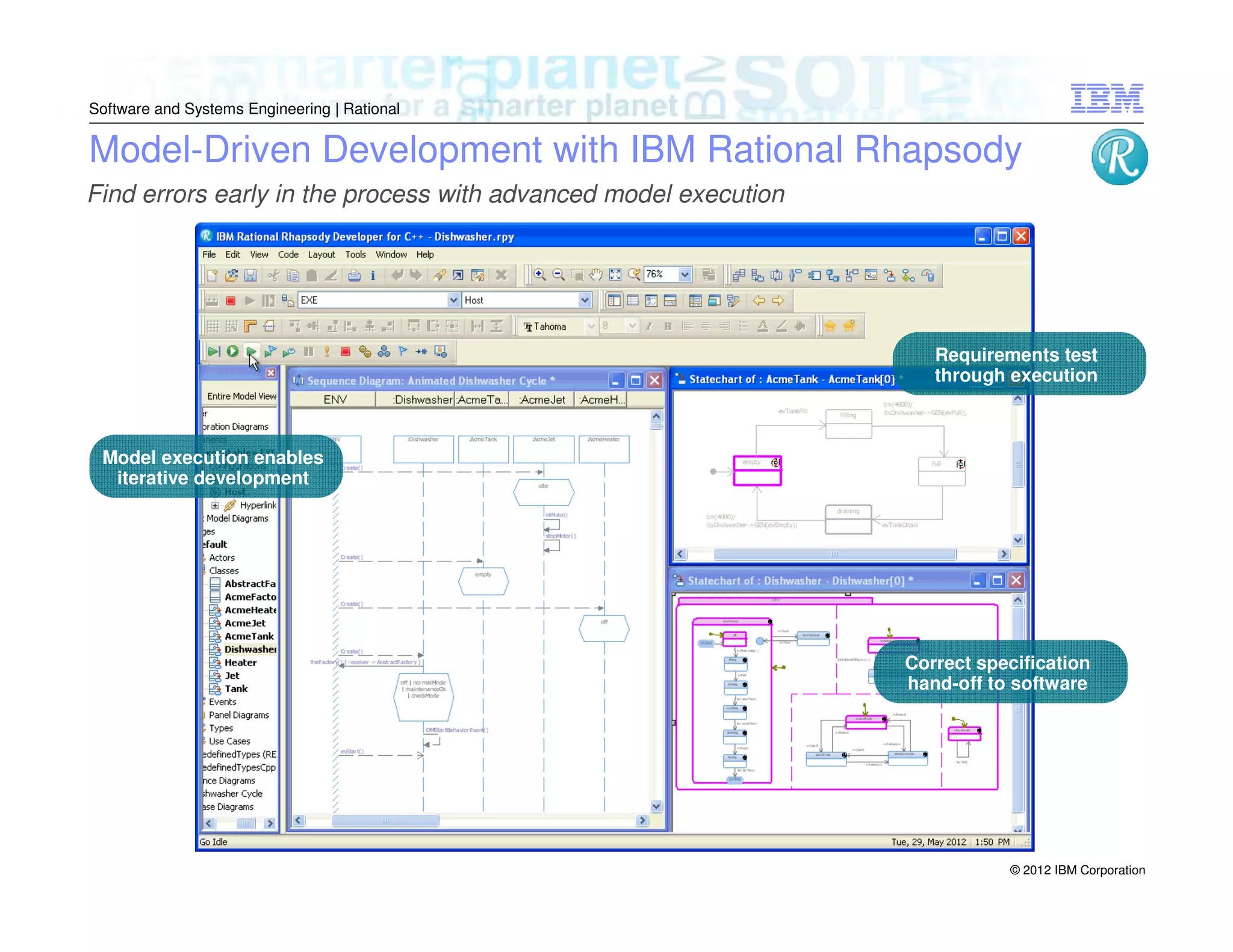
Model-Driven Development with IBM Rational Rhapsody
Find errors early in the process with advanced model execution

Requirements test
through execution

Model execution enables
iterative development

Correct specification
hand-off to software

© 2012 IBM Corporation
Software and Systems Engineering | Rational

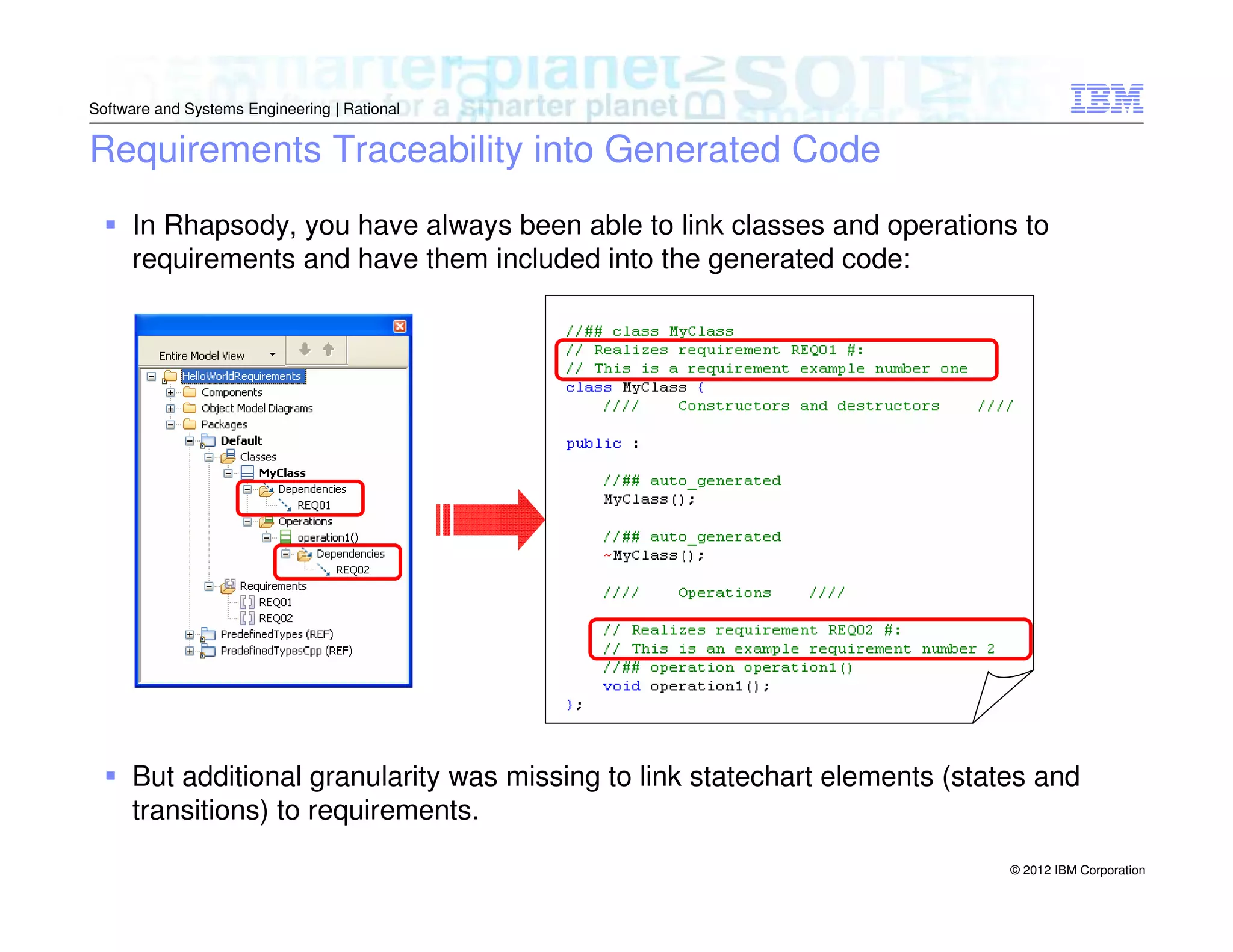
Requirements Traceability into Generated Code
In Rhapsody, you have always been able to link classes and operations to
requirements and have them included into the generated code:

But additional granularity was missing to link statechart elements (states and
transitions) to requirements.
© 2012 IBM Corporation
Software and Systems Engineering | Rational

Main Enhancemnts for MDD in Rhapsody 8.0
“High-Level” and “Low-Level” Requirements stereotypes
Better Treacability from Statechart to Code
Distinguish between HLR and LLR with new stereotypes

od y
ha ps
R
8.0.1 ed
leas
st re er ‘12)
ju
emb
(Nov

Improved location in code for Transitions and States’ Requirements
Improved mapping-back of Statechart code to the specific model element
Generate Requirements associated with Entry/Exit Action and Internal Transition
Associate Statechart’s auto-generated code with its justification
Ability to generate Requirement on Operation to implementation file as well

Safety-Critical Frameworks for Rational Rhapsody
C: SMXF (Simplified MicroC eXecution Framework)
C++: SXF (Simplified C++ eXecution Framework)

Rhapsody TestConductor Qualification Kit for ISO 26262 and IEC 61508

© 2012 IBM Corporation
Software and Systems Engineering | Rational

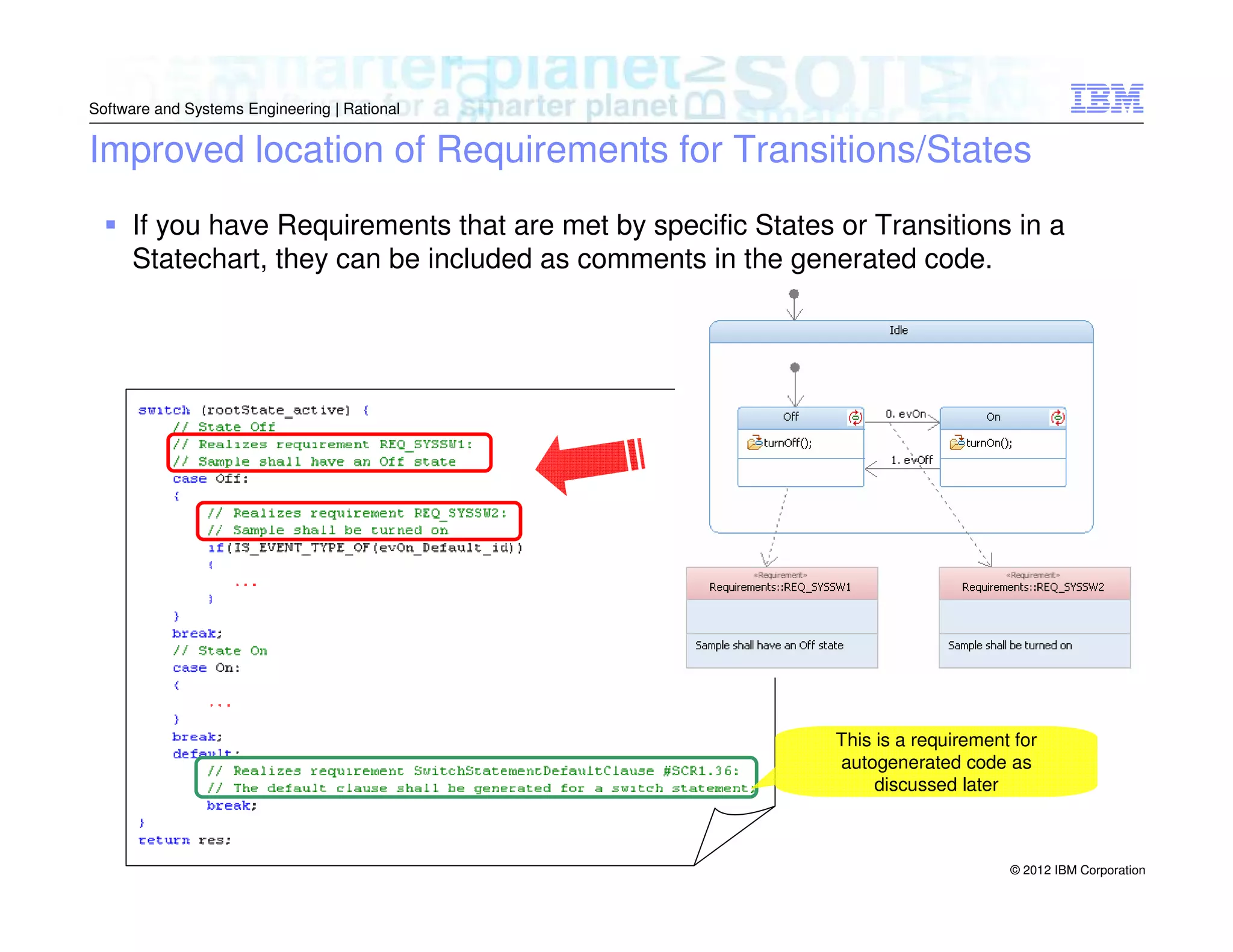
Improved location of Requirements for Transitions/States
If you have Requirements that are met by specific States or Transitions in a
Statechart, they can be included as comments in the generated code.

This is a requirement for
autogenerated code as
discussed later

© 2012 IBM Corporation
Software and Systems Engineering | Rational

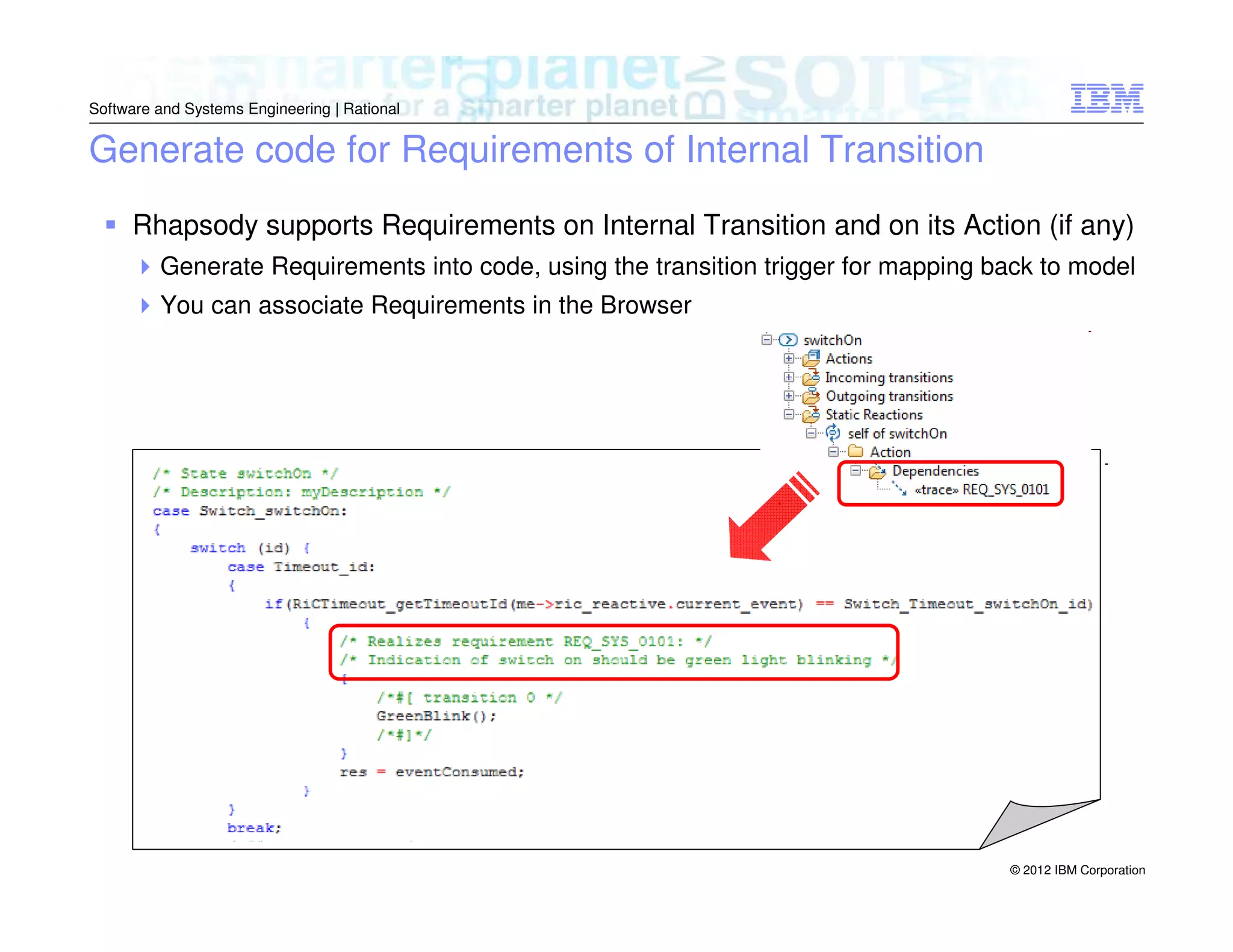
Generate code for Requirements of Internal Transition
Rhapsody supports Requirements on Internal Transition and on its Action (if any)
Generate Requirements into code, using the transition trigger for mapping back to model
You can associate Requirements in the Browser

© 2012 IBM Corporation
Software and Systems Engineering | Rational

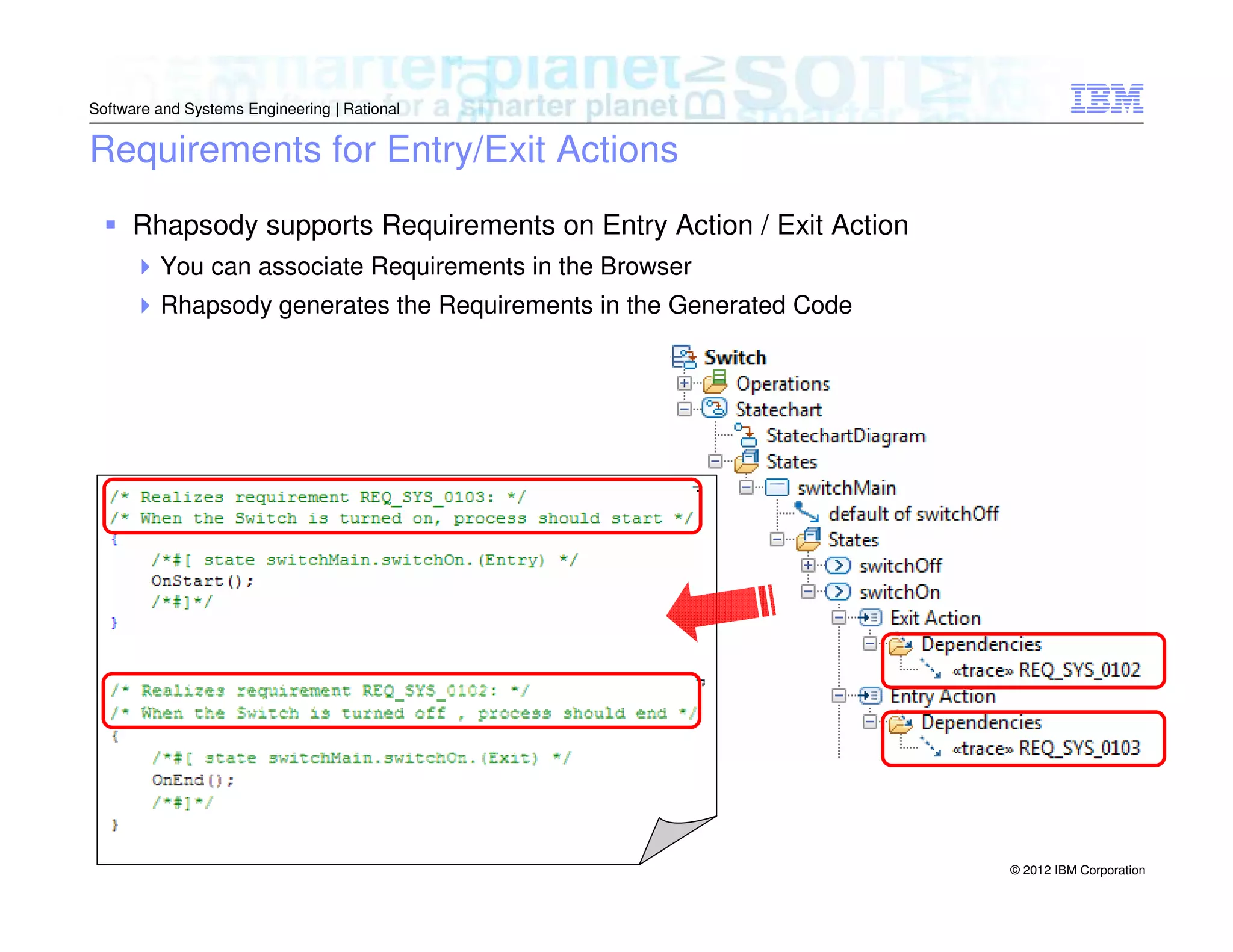
Requirements for Entry/Exit Actions
Rhapsody supports Requirements on Entry Action / Exit Action
You can associate Requirements in the Browser
Rhapsody generates the Requirements in the Generated Code

© 2012 IBM Corporation
Software and Systems Engineering | Rational

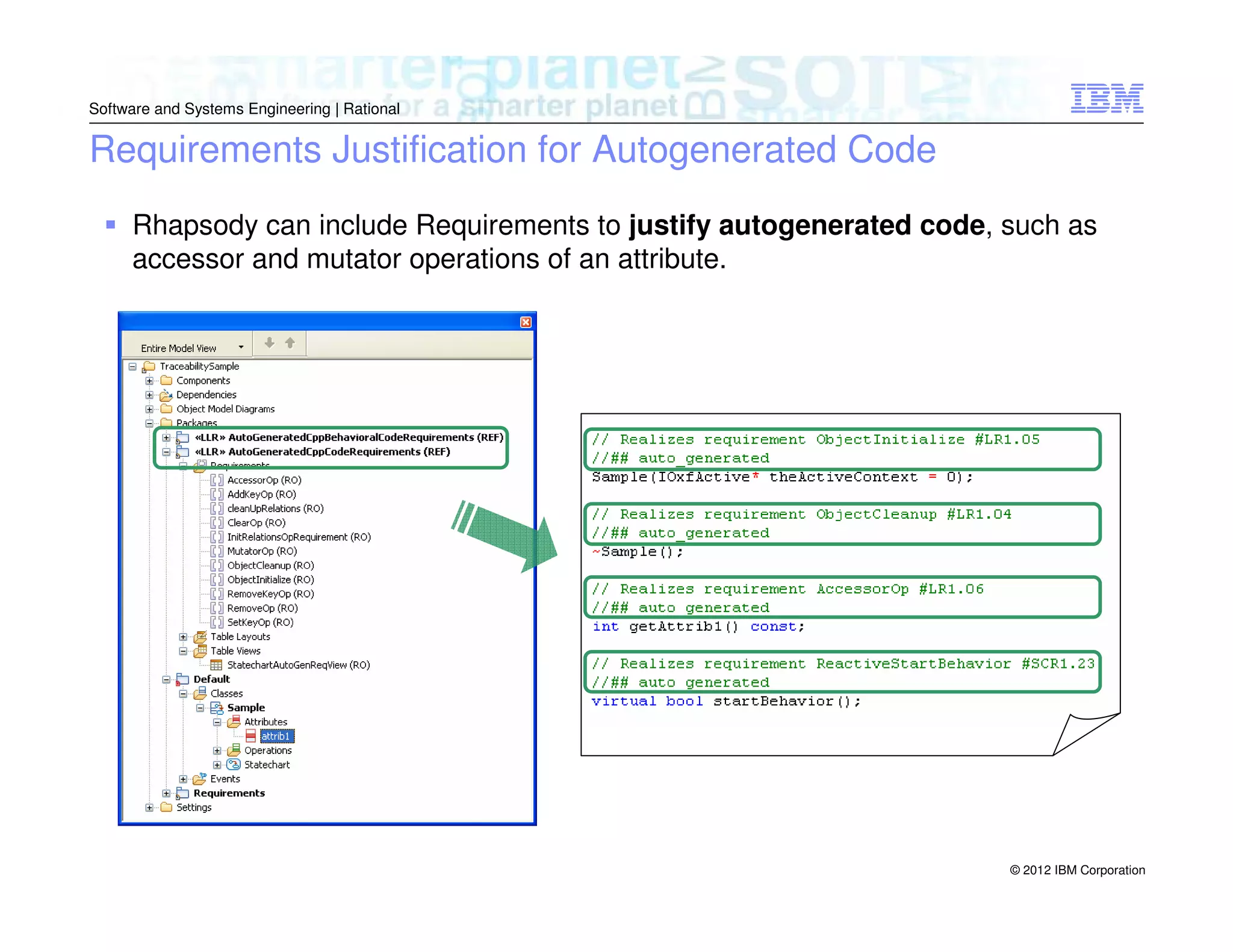
Requirements Justification for Autogenerated Code
Rhapsody can include Requirements to justify autogenerated code, such as
accessor and mutator operations of an attribute.

© 2012 IBM Corporation
Software and Systems Engineering | Rational

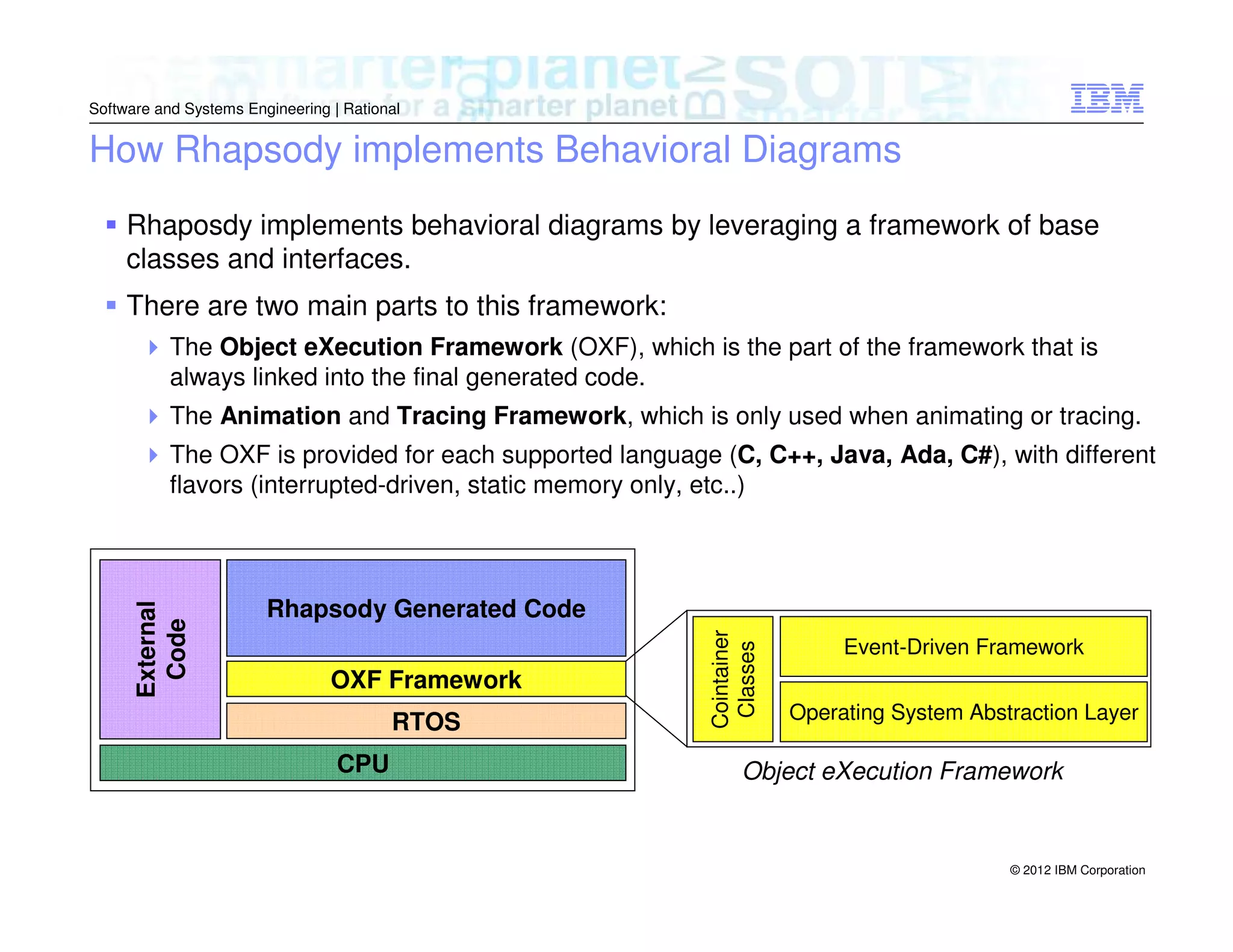
How Rhapsody implements Behavioral Diagrams
Rhaposdy implements behavioral diagrams by leveraging a framework of base
classes and interfaces.
There are two main parts to this framework:
The Object eXecution Framework (OXF), which is the part of the framework that is
always linked into the final generated code.
The Animation and Tracing Framework, which is only used when animating or tracing.

Rhapsody Generated Code
OXF Framework
RTOS
CPU

Cointainer
Classes

External
Code

The OXF is provided for each supported language (C, C++, Java, Ada, C#), with different
flavors (interrupted-driven, static memory only, etc..)

Event-Driven Framework
Operating System Abstraction Layer

Object eXecution Framework

© 2012 IBM Corporation
Software and Systems Engineering | Rational

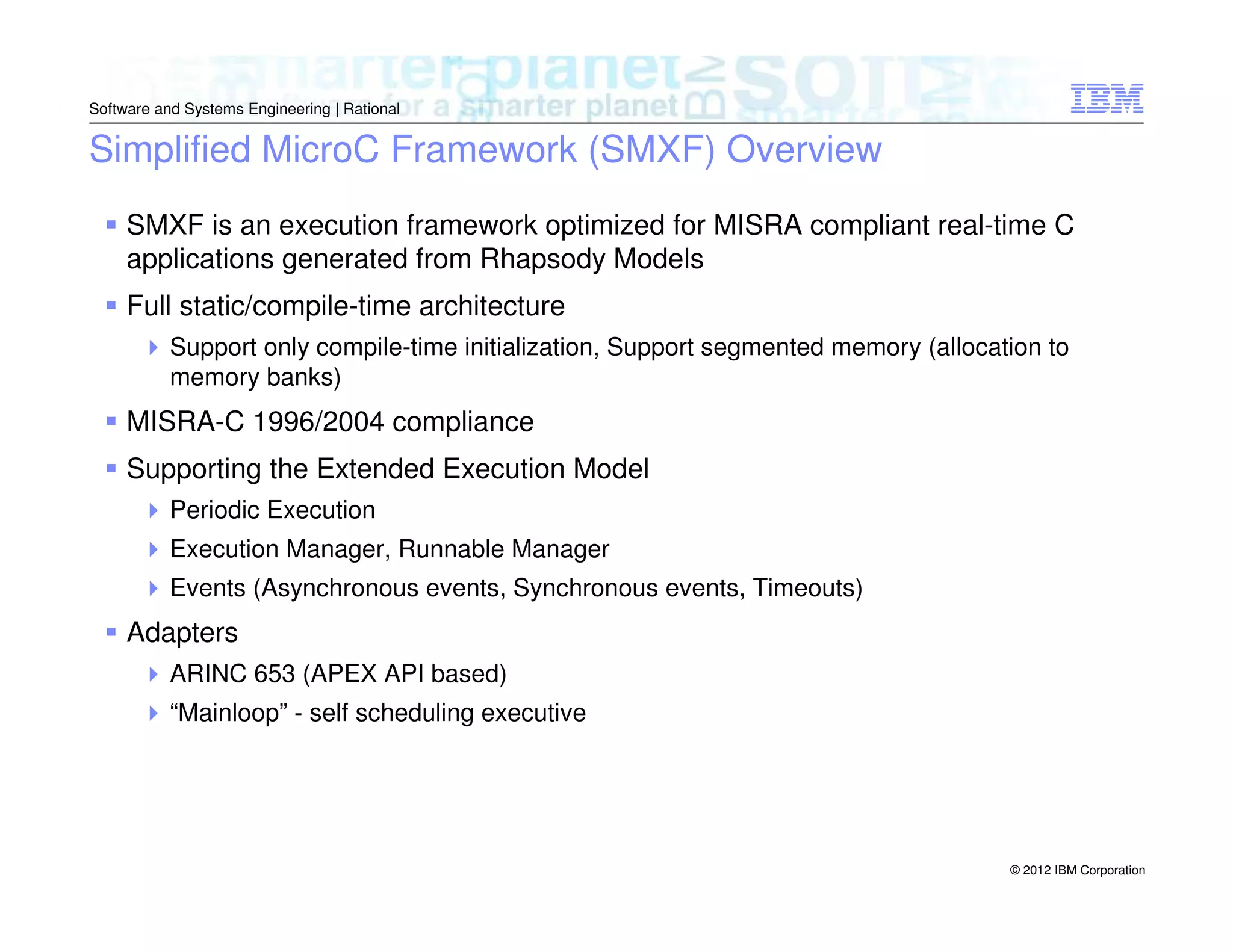
Simplified MicroC Framework (SMXF) Overview
SMXF is an execution framework optimized for MISRA compliant real-time C
applications generated from Rhapsody Models
Full static/compile-time architecture
Support only compile-time initialization, Support segmented memory (allocation to
memory banks)

MISRA-C 1996/2004 compliance
Supporting the Extended Execution Model
Periodic Execution
Execution Manager, Runnable Manager
Events (Asynchronous events, Synchronous events, Timeouts)

Adapters
ARINC 653 (APEX API based)
“Mainloop” - self scheduling executive

© 2012 IBM Corporation
Software and Systems Engineering | Rational

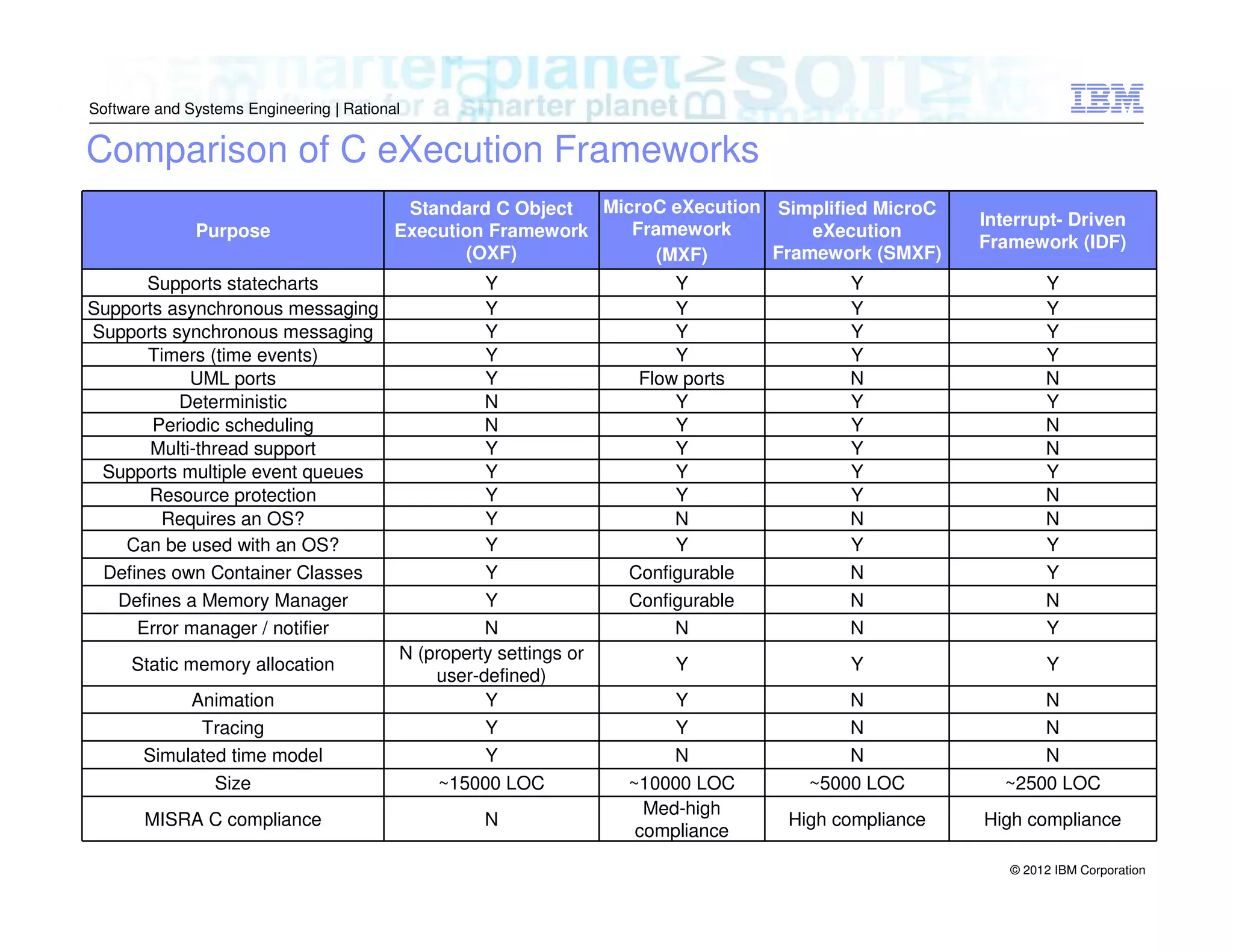
Comparison of C eXecution Frameworks
Purpose
Supports statecharts
Supports asynchronous messaging
Supports synchronous messaging
Timers (time events)
UML ports
Deterministic
Periodic scheduling
Multi-thread support
Supports multiple event queues
Resource protection
Requires an OS?
Can be used with an OS?
Defines own Container Classes
Defines a Memory Manager
Error manager / notifier

MicroC eXecution Simplified MicroC
Standard C Object
Framework
Execution Framework
eXecution
(OXF)
Framework (SMXF)
(MXF)

Animation
Tracing
Simulated time model
Size

Y
Y
Y
Y
Y
N
N
Y
Y
Y
Y
Y
Y
Y
N
N (property settings or
user-defined)
Y
Y
Y
~15000 LOC

MISRA C compliance

N

Static memory allocation

Interrupt- Driven
Framework (IDF)

Y
Y
Y
Y
Flow ports
Y
Y
Y
Y
Y
N
Y
Configurable
Configurable
N

Y
Y
Y
Y
N
Y
Y
Y
Y
Y
N
Y
N
N
N

Y
Y
Y
Y
N
Y
N
N
Y
N
N
Y
Y
N
Y

Y

Y

Y

Y
Y
N
~10000 LOC
Med-high
compliance

N
N
N
~5000 LOC

N
N
N
~2500 LOC

High compliance

High compliance
© 2012 IBM Corporation
Software and Systems Engineering | Rational

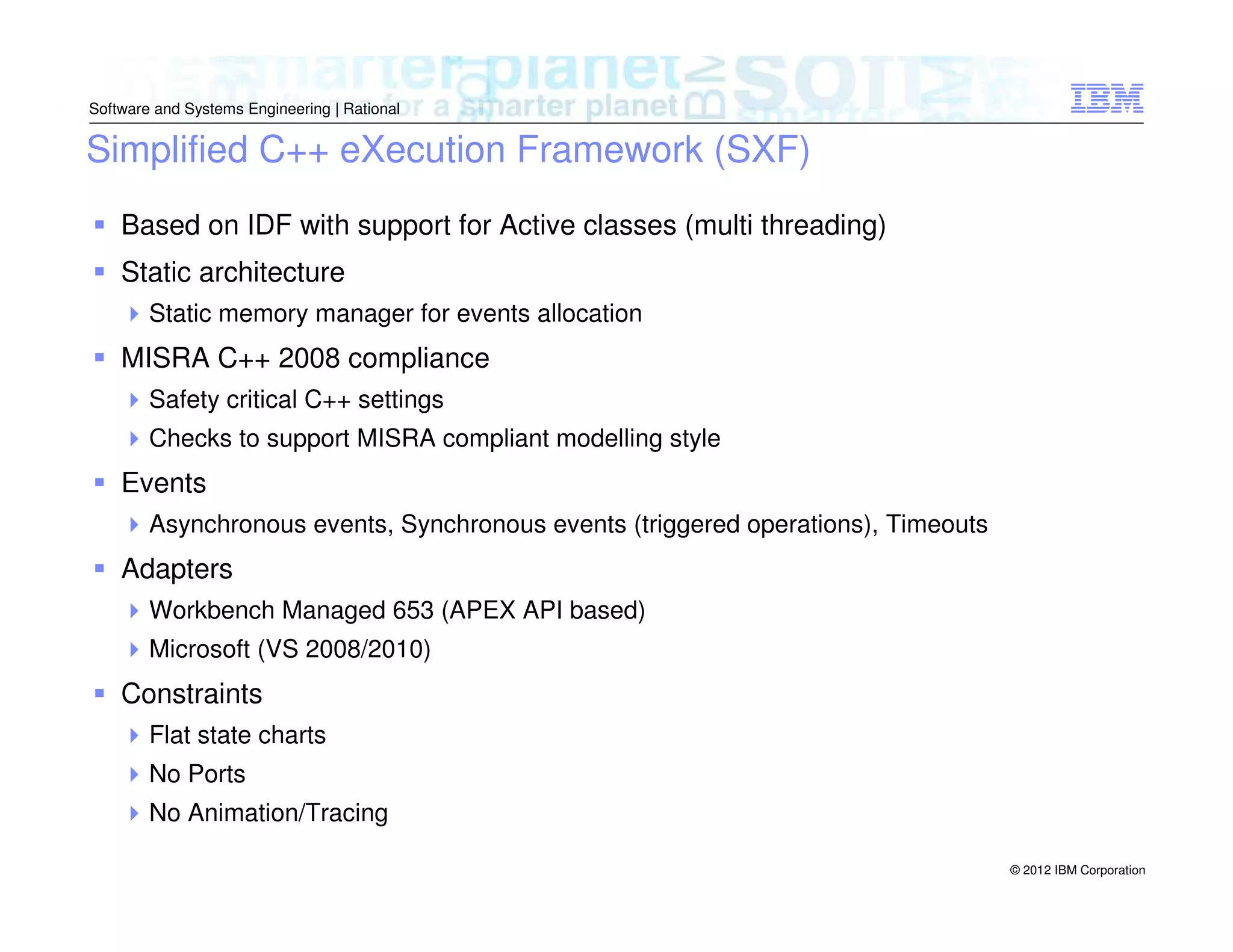
Simplified C++ eXecution Framework (SXF)
Based on IDF with support for Active classes (multi threading)
Static architecture
Static memory manager for events allocation

MISRA C++ 2008 compliance
Safety critical C++ settings
Checks to support MISRA compliant modelling style

Events
Asynchronous events, Synchronous events (triggered operations), Timeouts

Adapters
Workbench Managed 653 (APEX API based)
Microsoft (VS 2008/2010)

Constraints
Flat state charts
No Ports
No Animation/Tracing
© 2012 IBM Corporation
Software and Systems Engineering | Rational

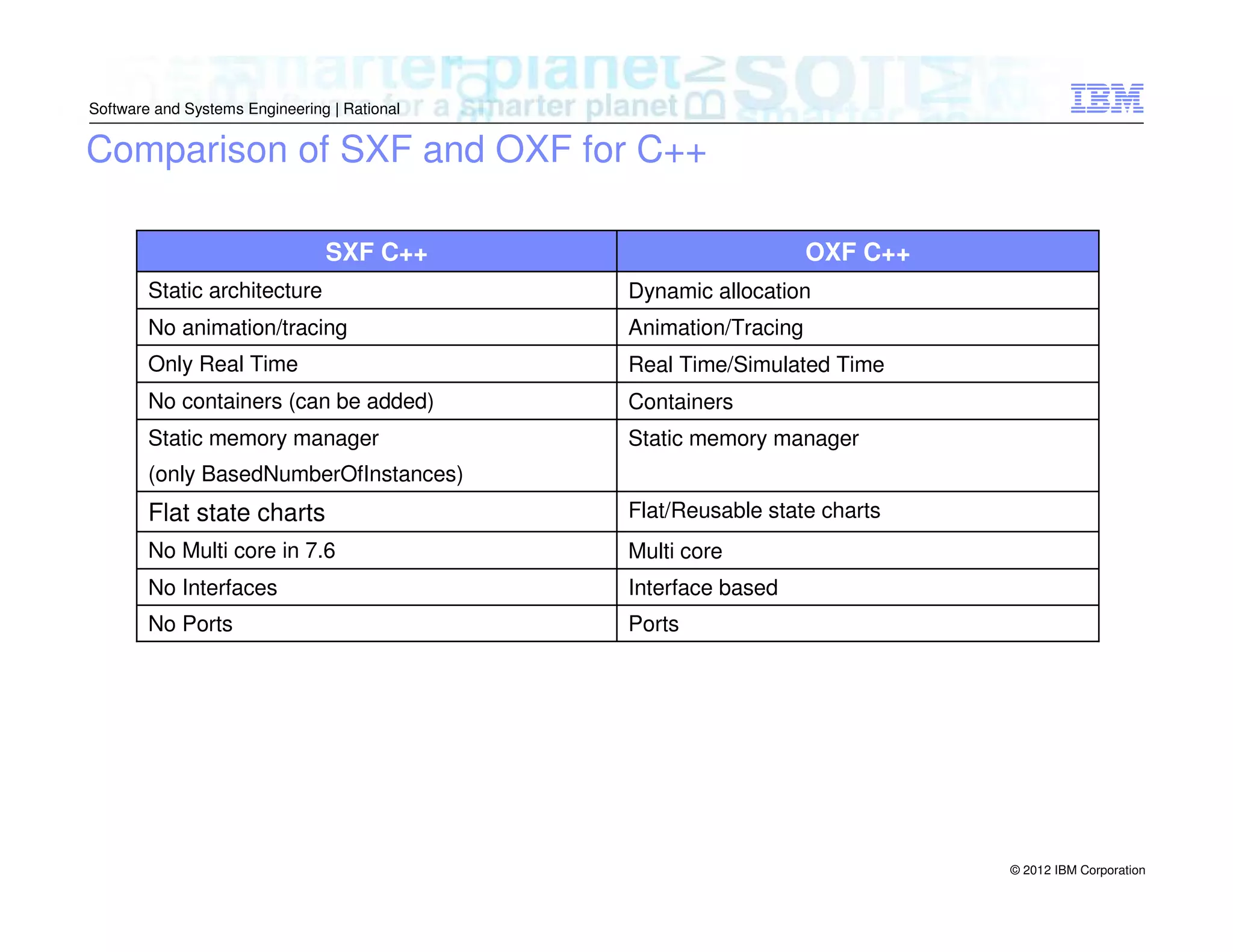
Comparison of SXF and OXF for C++
SXF C++

OXF C++

Static architecture

Dynamic allocation

No animation/tracing

Animation/Tracing

Only Real Time

Real Time/Simulated Time

No containers (can be added)

Containers

Static memory manager

Static memory manager

(only BasedNumberOfInstances)

Flat state charts

Flat/Reusable state charts

No Multi core in 7.6

Multi core

No Interfaces

Interface based

No Ports

Ports

© 2012 IBM Corporation
Software and Systems Engineering | Rational

Certification Supporting Materials for SMXF and SXF
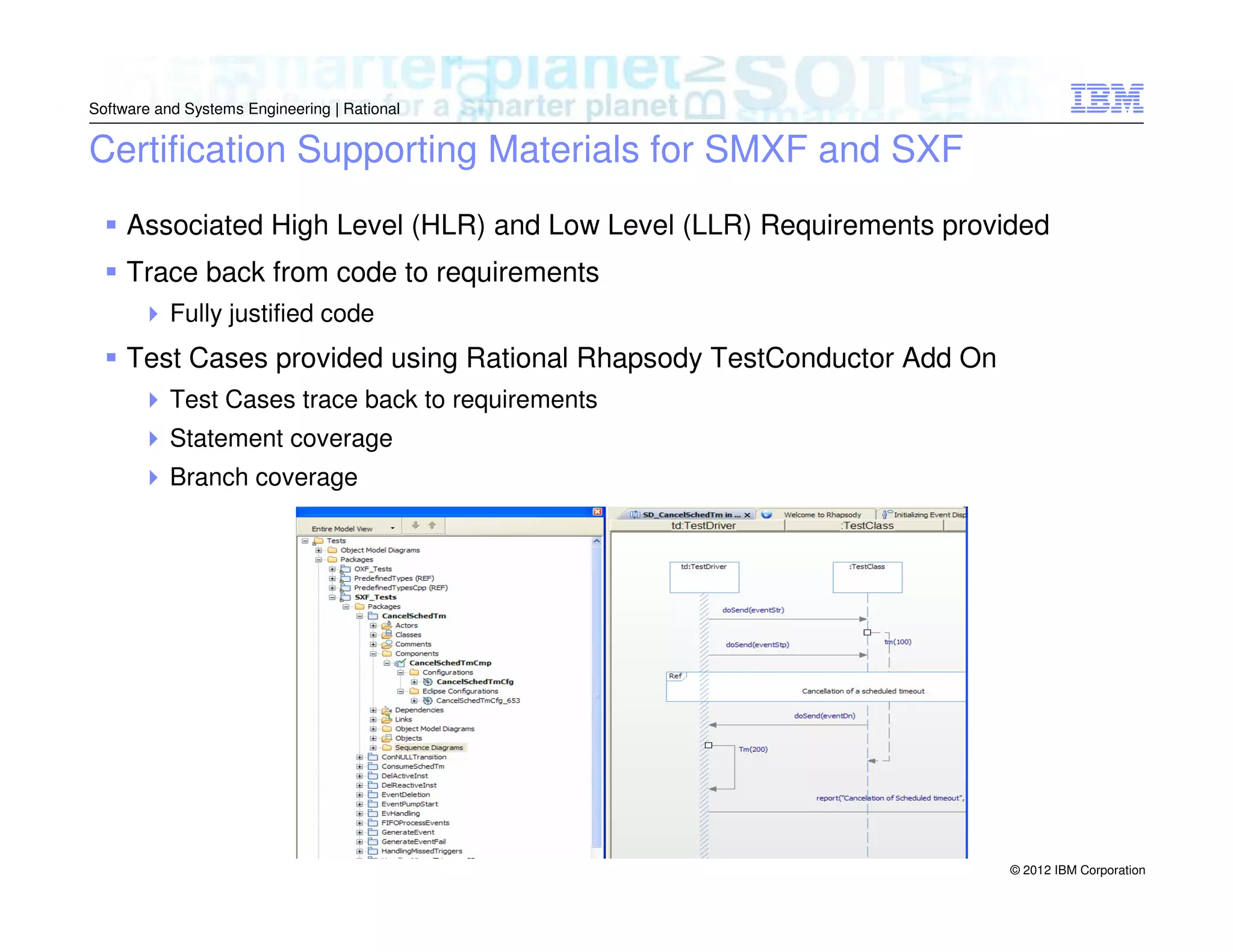
Associated High Level (HLR) and Low Level (LLR) Requirements provided
Trace back from code to requirements
Fully justified code

Test Cases provided using Rational Rhapsody TestConductor Add On
Test Cases trace back to requirements
Statement coverage
Branch coverage

© 2012 IBM Corporation
Software and Systems Engineering | Rational

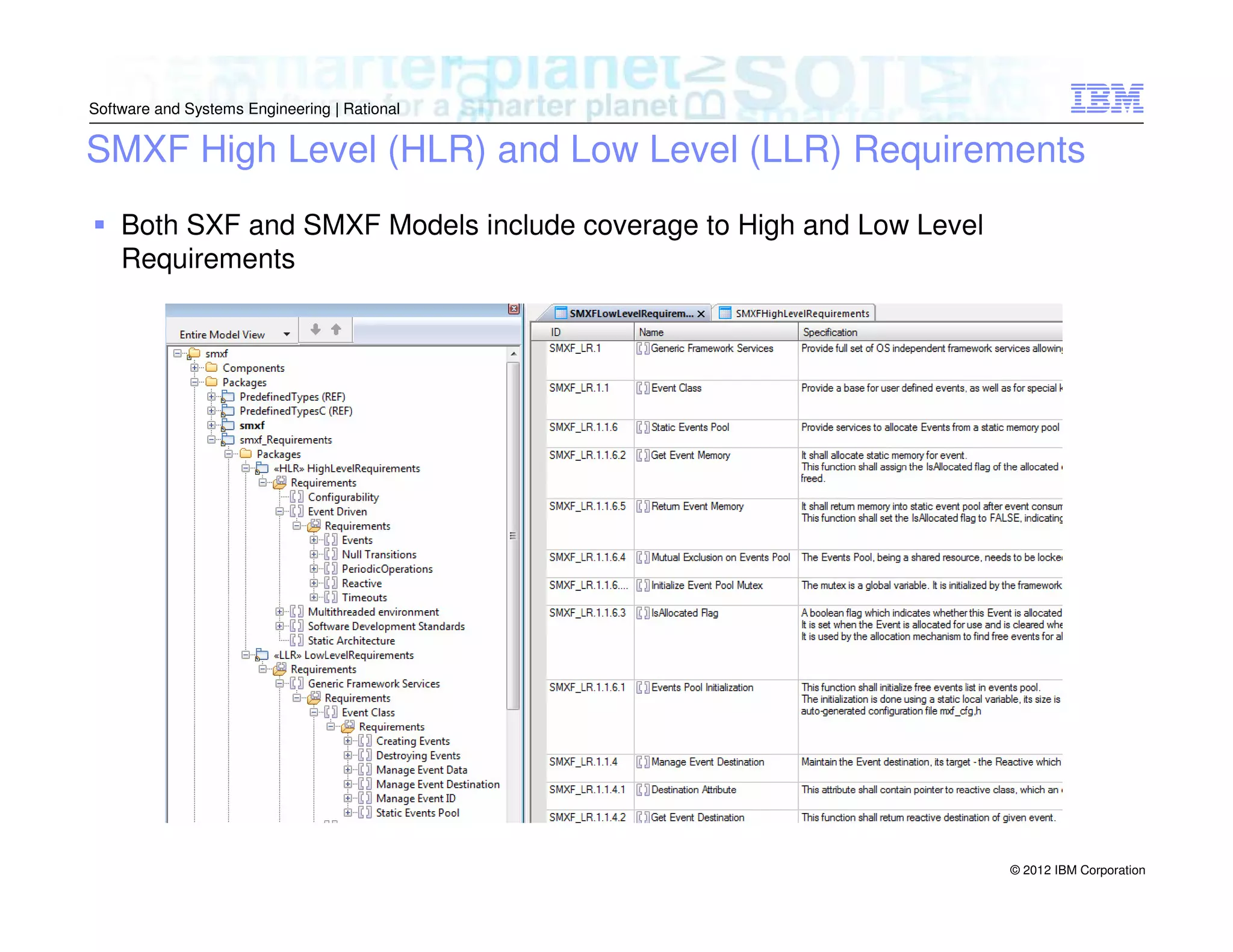
SMXF High Level (HLR) and Low Level (LLR) Requirements
Both SXF and SMXF Models include coverage to High and Low Level
Requirements

© 2012 IBM Corporation
Software and Systems Engineering | Rational

SMXF and SXF Test Reports
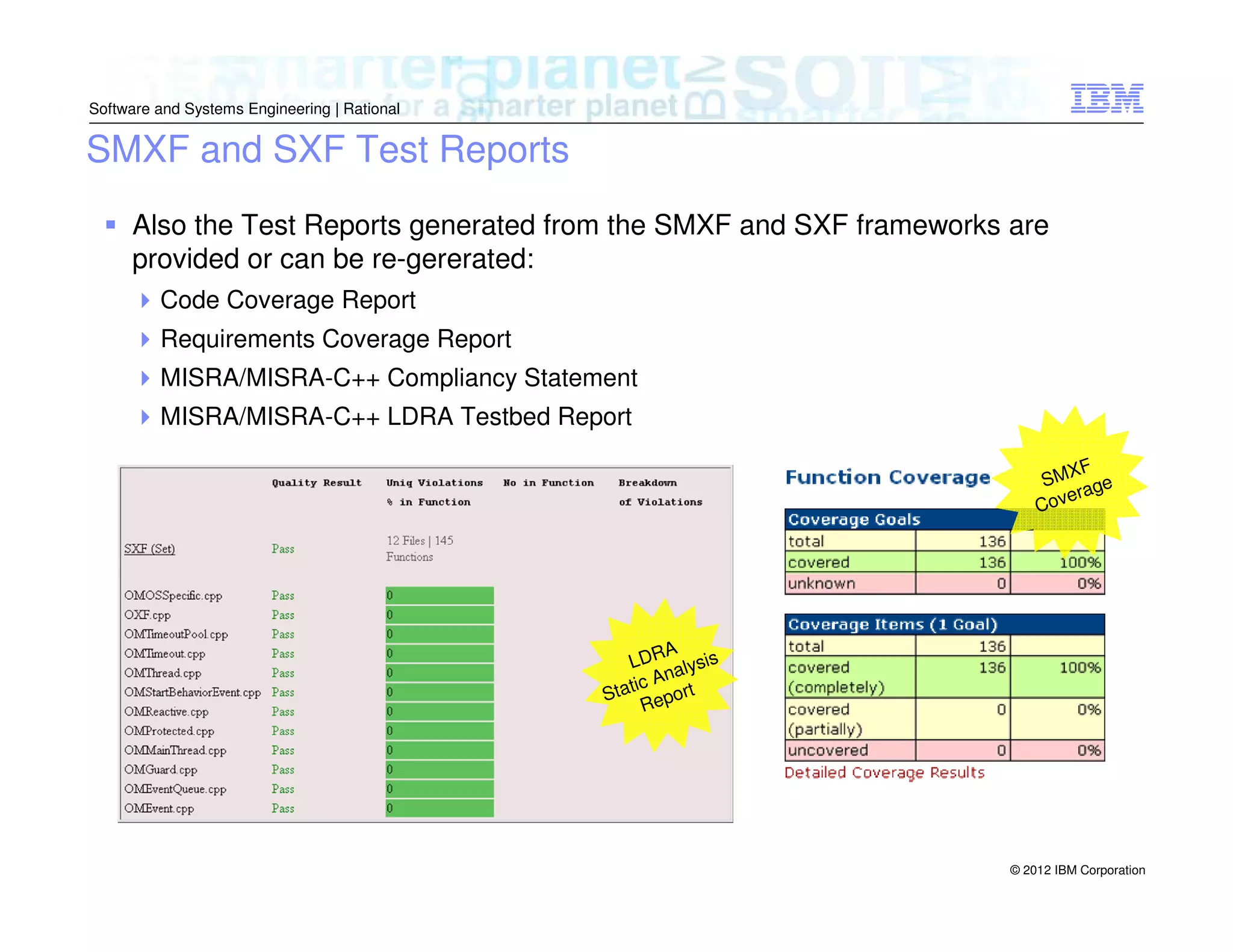
Also the Test Reports generated from the SMXF and SXF frameworks are
provided or can be re-gererated:
Code Coverage Report
Requirements Coverage Report
MISRA/MISRA-C++ Compliancy Statement
MISRA/MISRA-C++ LDRA Testbed Report
F
SMX ge
era
Cov

A
LDR alysis
n
ic A
Stat eport
R

© 2012 IBM Corporation
Software and Systems Engineering | Rational

Rhapsody TestConductor Add-on for Model-Based Testing
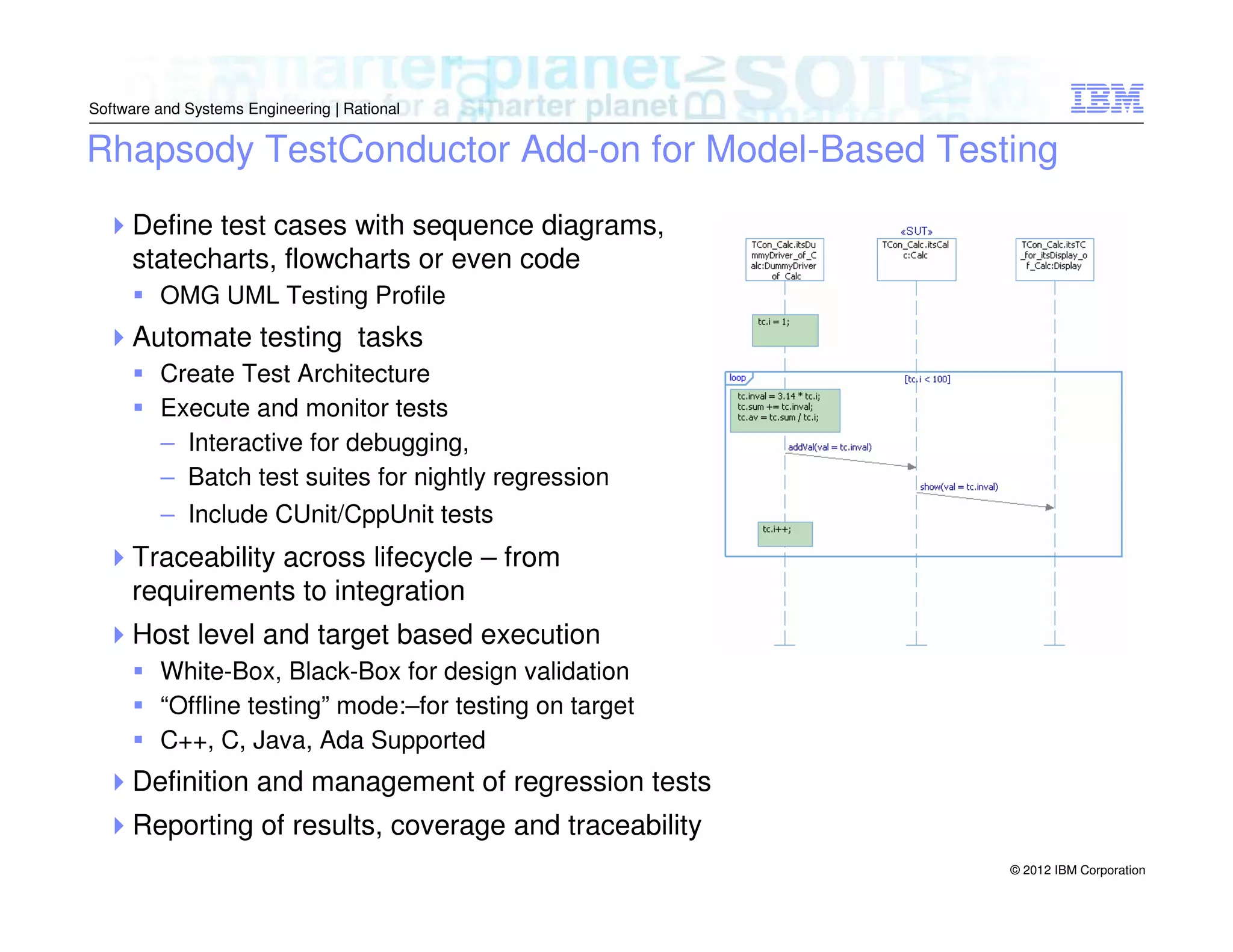
Define test cases with sequence diagrams,
statecharts, flowcharts or even code
OMG UML Testing Profile

Automate testing tasks
Create Test Architecture
Execute and monitor tests
– Interactive for debugging,
– Batch test suites for nightly regression
– Include CUnit/CppUnit tests

Traceability across lifecycle – from
requirements to integration
Host level and target based execution
White-Box, Black-Box for design validation
“Offline testing” mode:–for testing on target
C++, C, Java, Ada Supported

Definition and management of regression tests
Reporting of results, coverage and traceability
© 2012 IBM Corporation
Software and Systems Engineering | Rational

Rhapsody Kit for ISO 26262 and IEC 61508
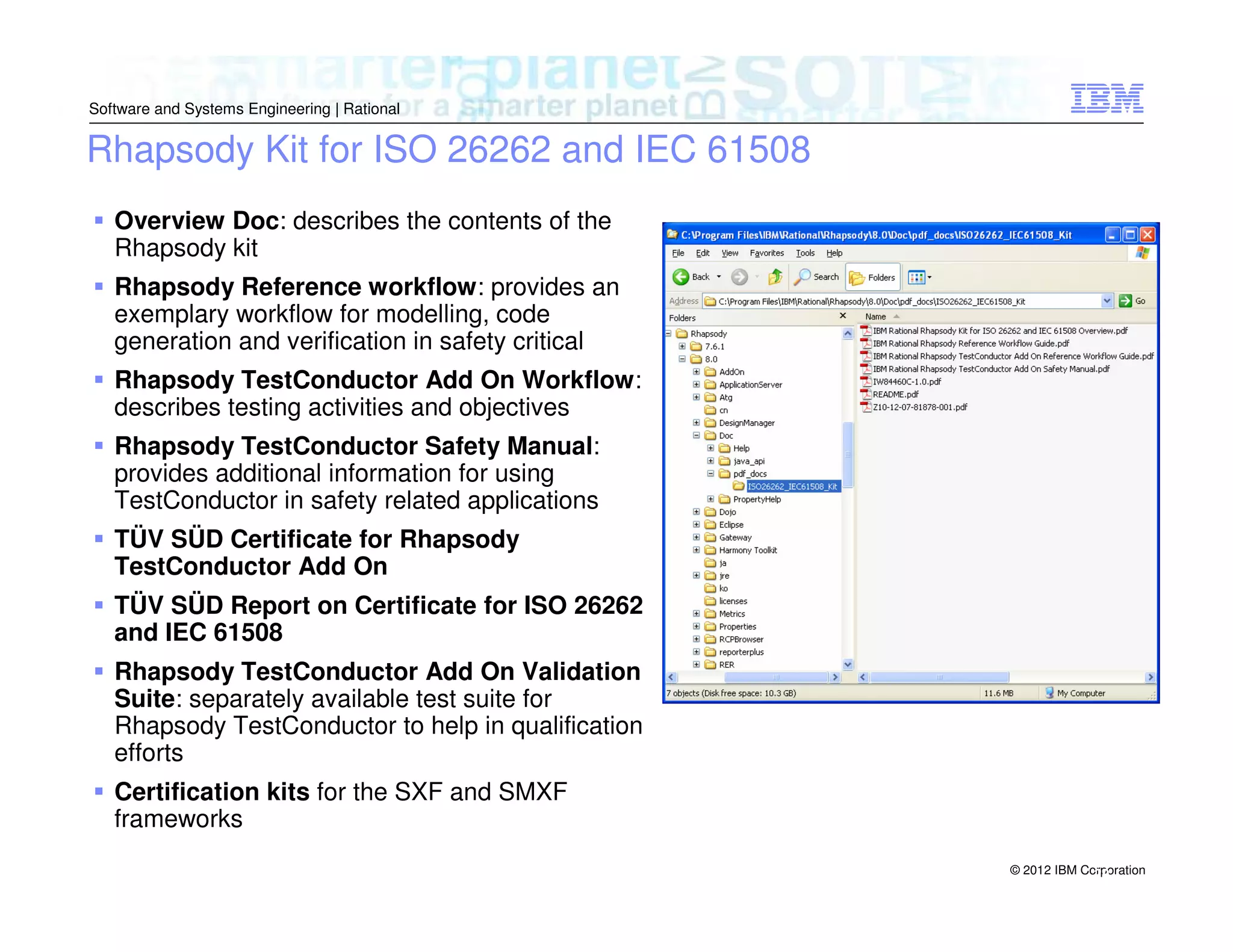
Overview Doc: describes the contents of the
Rhapsody kit
Rhapsody Reference workflow: provides an
exemplary workflow for modelling, code
generation and verification in safety critical
Rhapsody TestConductor Add On Workflow:
describes testing activities and objectives
Rhapsody TestConductor Safety Manual:
provides additional information for using
TestConductor in safety related applications
TÜV SÜD Certificate for Rhapsody
TestConductor Add On
TÜV SÜD Report on Certificate for ISO 26262
and IEC 61508
Rhapsody TestConductor Add On Validation
Suite: separately available test suite for
Rhapsody TestConductor to help in qualification
efforts
Certification kits for the SXF and SMXF
frameworks
© 2012 IBM Corporation
29
Software and Systems Engineering | Rational

IBM Rational Rhapsody TestConductor Add-On Certification
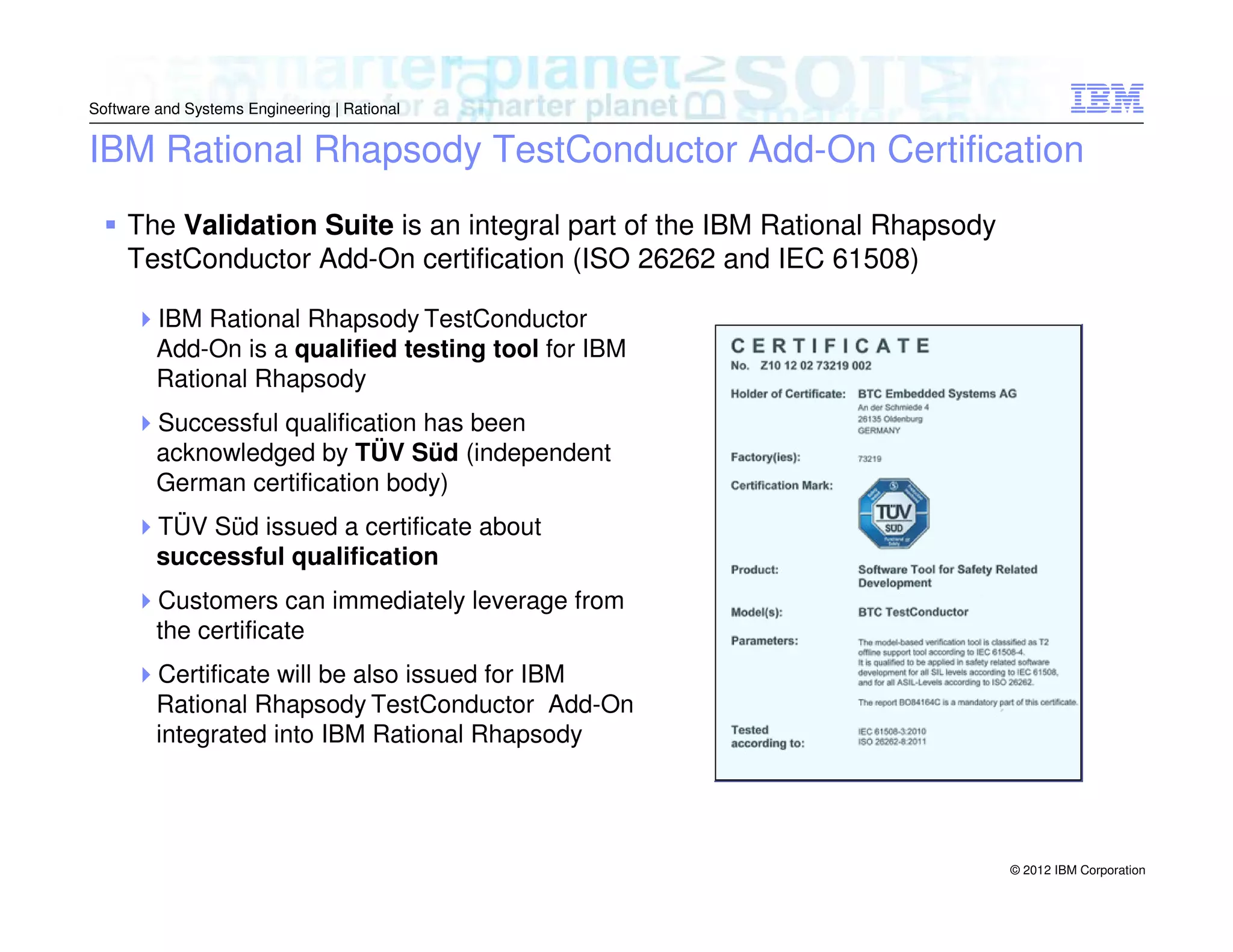
The Validation Suite is an integral part of the IBM Rational Rhapsody
TestConductor Add-On certification (ISO 26262 and IEC 61508)
IBM Rational Rhapsody TestConductor
Add-On is a qualified testing tool for IBM
Rational Rhapsody
Successful qualification has been
acknowledged by TÜV Süd (independent
German certification body)
TÜV Süd issued a certificate about
successful qualification
Customers can immediately leverage from
the certificate
Certificate will be also issued for IBM
Rational Rhapsody TestConductor Add-On
integrated into IBM Rational Rhapsody

© 2012 IBM Corporation
Software and Systems Engineering | Rational

IBM Rational Rhapsody Reference Workflow
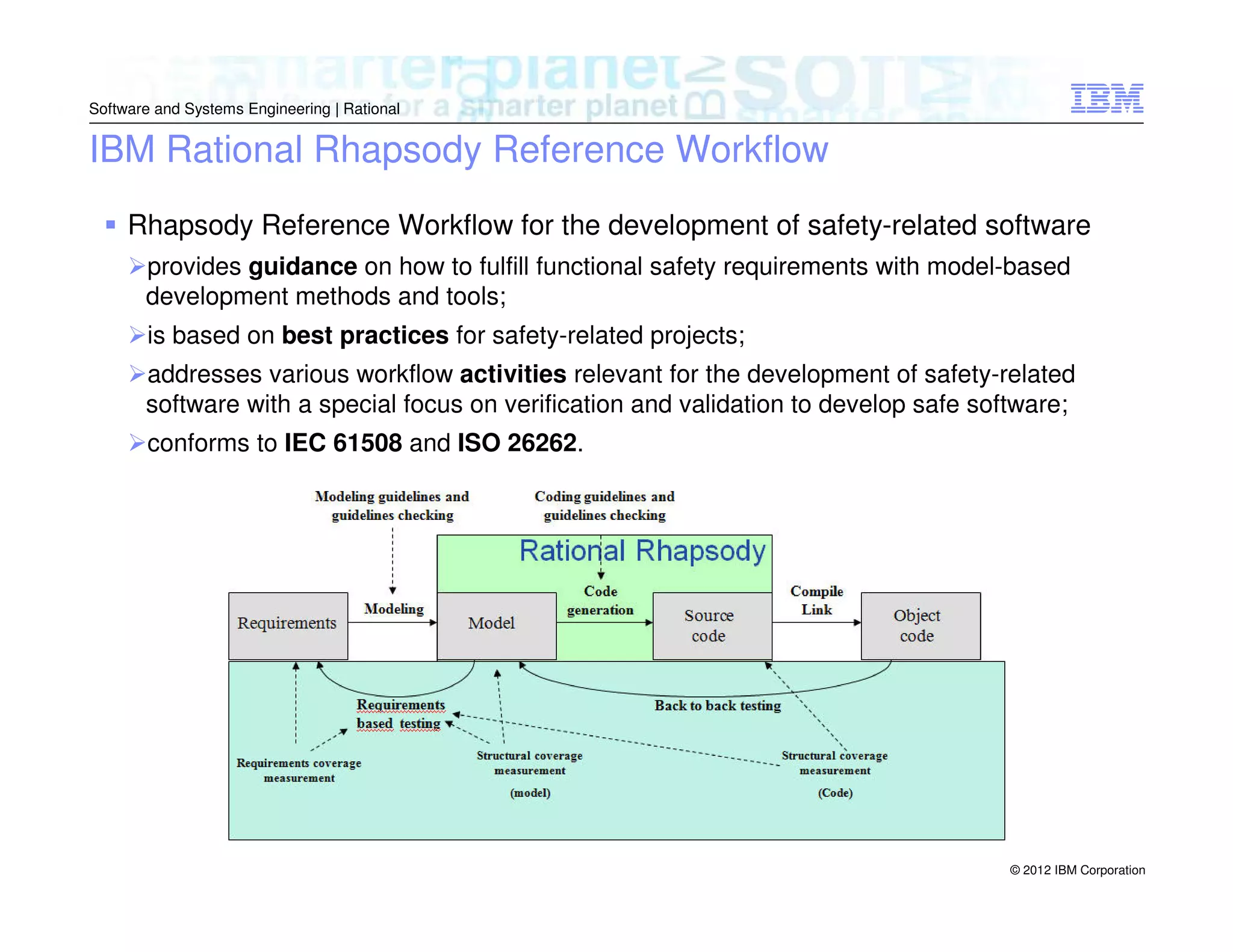
Rhapsody Reference Workflow for the development of safety-related software
provides guidance on how to fulfill functional safety requirements with model-based
development methods and tools;
is based on best practices for safety-related projects;
addresses various workflow activities relevant for the development of safety-related
software with a special focus on verification and validation to develop safe software;
conforms to IEC 61508 and ISO 26262.

© 2012 IBM Corporation
Software and Systems Engineering | Rational

IBM Rational Test RealTime
Rational Test RealTime is a cross-platform solution for component testing and
runtime analysis of embedded software for C,C++, Ada and Java.
Software Unit & Integration Testing
Electronic Control Unit (ECU) / Hardware in the Loop (HIL) Validation
Modified Condition/Decision Coverage (MC/DC)
Memory Profiling
Performance Profiling
Runtime Tracing
Static Code Analysis (MISRA-C)
Integrated with Rhapsody TestConductor

Rational Test RealTime DO-178B Qualification Kit

© 2012 IBM Corporation
Software and Systems Engineering | Rational

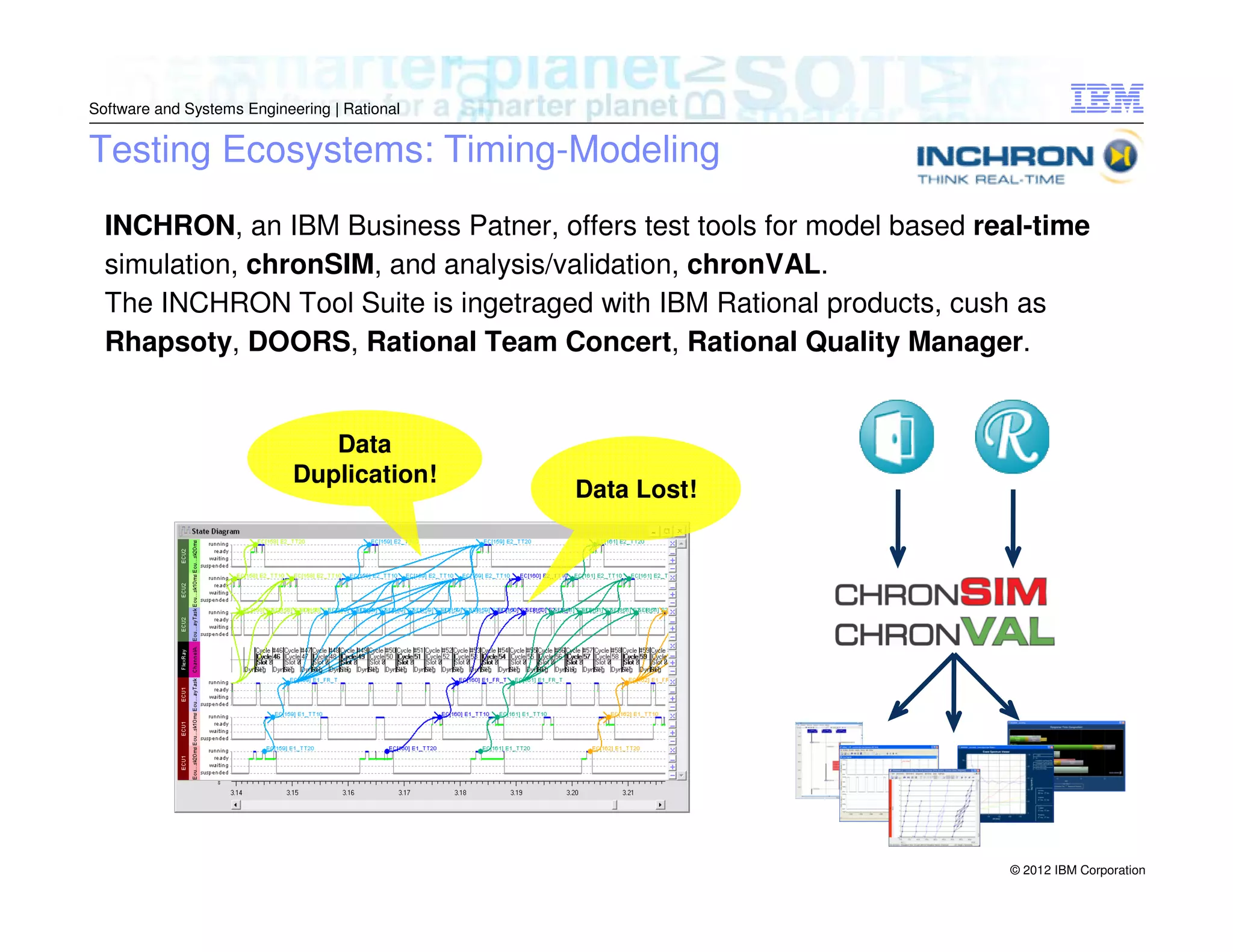
Testing Ecosystems: Timing-Modeling
INCHRON, an IBM Business Patner, offers test tools for model based real-time
simulation, chronSIM, and analysis/validation, chronVAL.
The INCHRON Tool Suite is ingetraged with IBM Rational products, cush as
Rhapsoty, DOORS, Rational Team Concert, Rational Quality Manager.

Data
Duplication!

Data Lost!

© 2012 IBM Corporation
Software and Systems Engineering | Rational

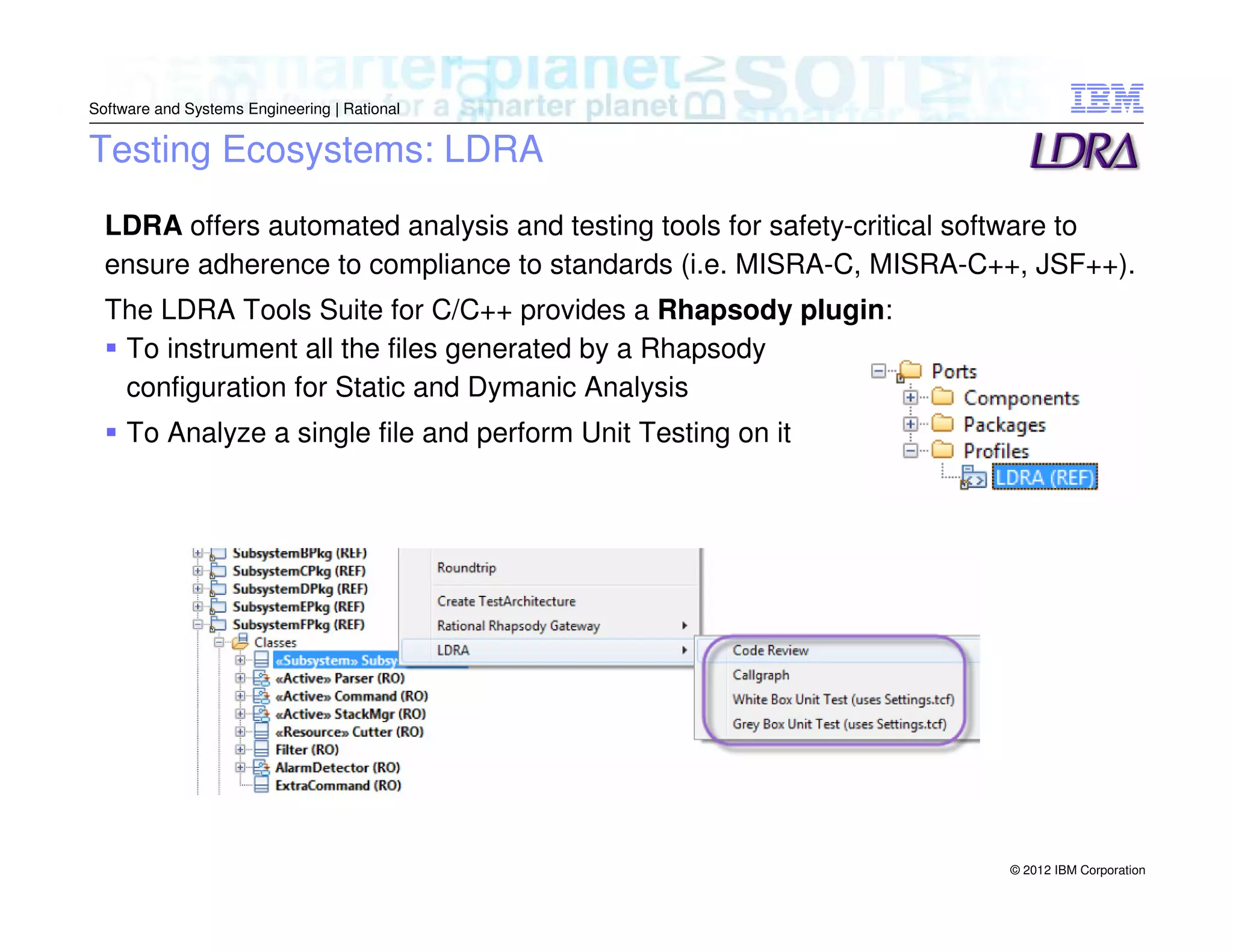
Testing Ecosystems: LDRA
LDRA offers automated analysis and testing tools for safety-critical software to
ensure adherence to compliance to standards (i.e. MISRA-C, MISRA-C++, JSF++).
The LDRA Tools Suite for C/C++ provides a Rhapsody plugin:
To instrument all the files generated by a Rhapsody
configuration for Static and Dymanic Analysis
To Analyze a single file and perform Unit Testing on it

© 2012 IBM Corporation
Software and Systems Engineering | Rational

An Example: Invensys Rail Dimetronic
Speeds innovation with a unified platform for multi-stage development processes
The need:
Modernize development processes
Ensure systems integration with other railways
while meeting railway standards

The solution:
Incorporated system intelligence into its development process
Deployed an application development platform to:
– Model system reliability

“Innovation and process flexibility are
important in allowing us to differentiate
our offerings. We’re now able
to ensure that our design can be rapidly
adapted, not only to customer needs,
but to changing ERTMS requirements,
at a reasonable cost.”
Francisco Lozano
ERTMS Program Manager

– Highlight areas requiring improvement

The benefits:
Reduced time-to-market for signaling systems products by 40%
Facilitated 100% compliance rate with ERTMS standards
for code traceability and safety
Reduced cost and risks of development and documentation

Solution components:
IBM® Rational® Rhapsody
IBM Rational DOORS
IBM Rational Synergy
IBM Rational Change
IBM Rational Publishing Engine
IBM Software Services

© 2012 IBM Corporation
Software and Systems Engineering | Rational

An Example: Tata Consultancy Services Limited
Improving time-to-market with IBM Rational Rhapsody
The need:
Achieve high-quality design/code
Speed-up development and variants

The solution:
Improved software development process by incorporating both
MBDA (SysML) and MDD (UML) for embedded real-time:
– Systems Engineering
– Software Development
– Software Testing

“We used IBM Rational Rhapsody to
aid and succeed in the model-driven
development (MDD) methodology for
the key product development of our
customers. Behavioral modeling in
Rhapsody is very powerful and we
used it extensively to test our design
and generate high-quality code.”
Rampura Venkatachar Raman
Head – EIS Semiconductor & Consumer
Electronics Vertical, Tata Consultancy
Services

The benefits:
Extracted 60% of a new design from reverse engineering of
existing software
Reduced 50% learning curve for new staff members
Eliminated 90% of design errors with model simulation

Solution components:
IBM® Rational® Rhapsody

© 2012 IBM Corporation
Software and Systems Engineering | Rational

Summary
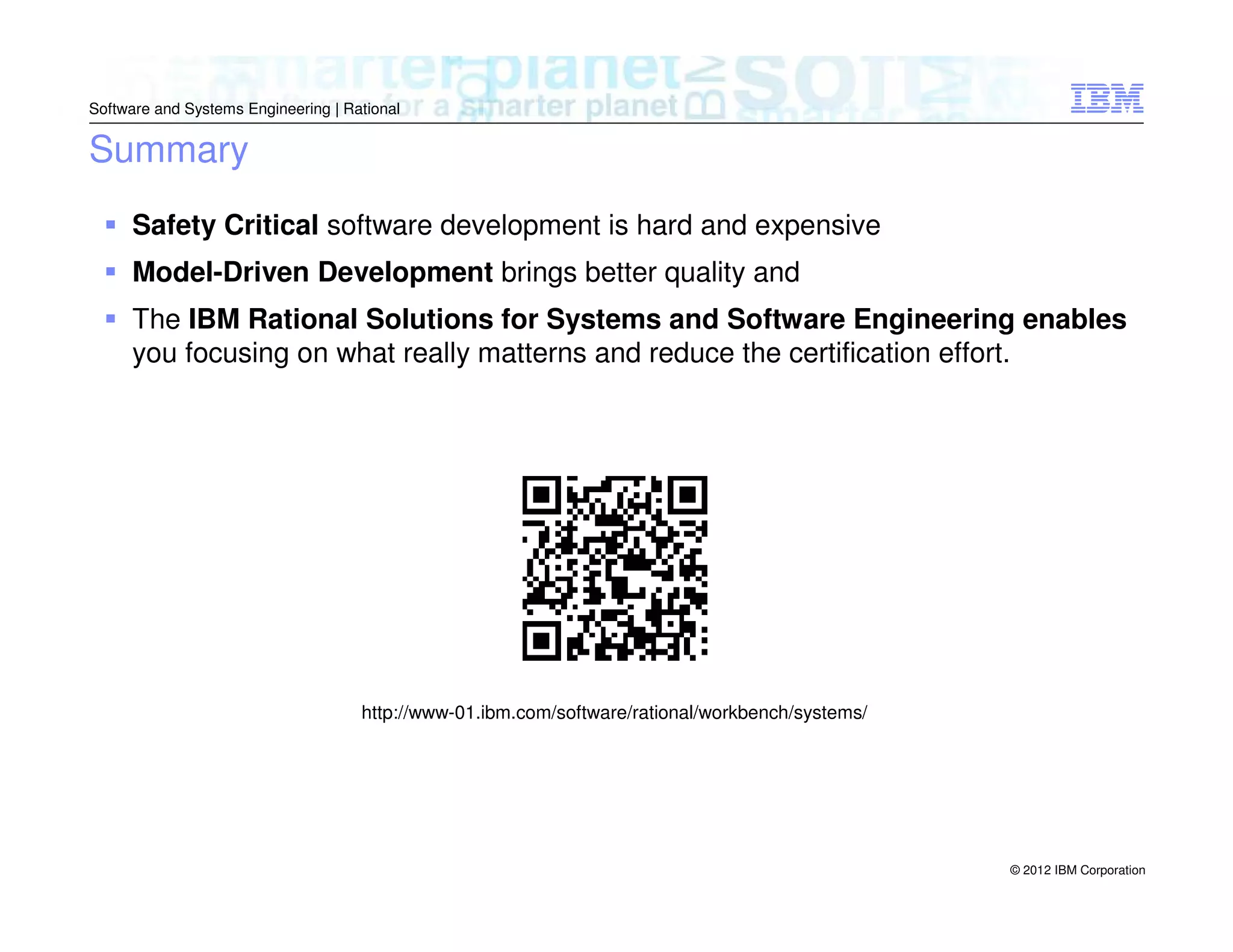
Safety Critical software development is hard and expensive
Model-Driven Development brings better quality and
The IBM Rational Solutions for Systems and Software Engineering enables
you focusing on what really matterns and reduce the certification effort.

http://www-01.ibm.com/software/rational/workbench/systems/

© 2012 IBM Corporation
Software and Systems Engineering | Rational

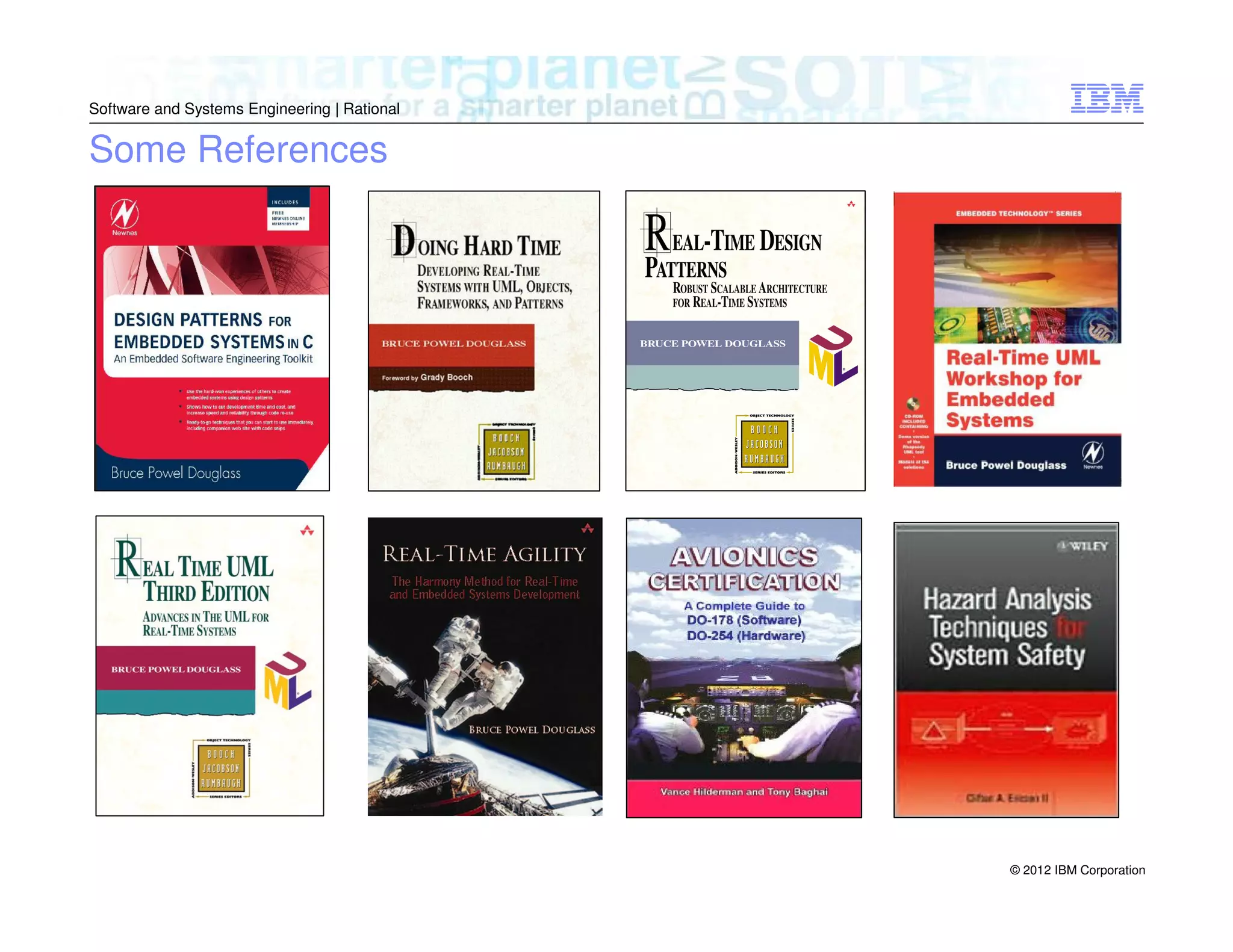
Some References

© 2012 IBM Corporation
Software and Systems Engineering | Rational

www.ibm.com/software/rational
© Copyright IBM Corporation 2012. All rights reserved. The information contained in these materials is provided for informational purposes only, and is provided AS IS without warranty of any kind,
express or implied. IBM shall not be responsible for any damages arising out of the use of, or otherwise related to, these materials. Nothing contained in these materials is intended to, nor shall have
the effect of, creating any warranties or representations from IBM or its suppliers or licensors, or altering the terms and conditions of the applicable license agreement governing the use of IBM
software. References in these materials to IBM products, programs, or services do not imply that they will be available in all countries in which IBM operates. Product release dates and/or capabilities
referenced in these materials may change at any time at IBM’s sole discretion based on market opportunities or other factors, and are not intended to be a commitment to future product or feature
availability in any way. IBM, the IBM logo, Rational, the Rational logo, Telelogic, the Telelogic logo, and other IBM products and services are trademarks of the International Business Machines
Corporation, in the United States, other countries or both. Other company, product, or service names may be trademarks or service marks of others.
© 2012 IBM Corporation
Software and Systems Engineering | Rational

www.ibm.com/software/rational

© 2012 IBM Corporation
Software and Systems Engineering | Rational

Acknowledgements and disclaimers
Availability: References in this presentation to IBM products, programs, or services do not imply that they will be available in all countries
in which IBM operates.
The workshops, sessions and materials have been prepared by IBM or the session speakers and reflect their own views. They are provided for
informational purposes only, and are neither intended to, nor shall have the effect of being, legal or other guidance or advice to any participant.
While efforts were made to verify the completeness and accuracy of the information contained in this presentation, it is provided AS-IS without
warranty of any kind, express or implied. IBM shall not be responsible for any damages arising out of the use of, or otherwise related to, this
presentation or any other materials. Nothing contained in this presentation is intended to, nor shall have the effect of, creating any warranties or
representations from IBM or its suppliers or licensors, or altering the terms and conditions of the applicable license agreement governing the use of
IBM software.
All customer examples described are presented as illustrations of how those customers have used IBM products and the results they may have
achieved. Actual environmental costs and performance characteristics may vary by customer. Nothing contained in these materials is intended to,
nor shall have the effect of, stating or implying that any activities undertaken by you will result in any specific sales, revenue growth or other results.
© Copyright IBM Corporation 2012. All rights reserved.

– U.S. Government Users Restricted Rights - Use, duplication or disclosure restricted by GSA ADP Schedule Contract with IBM Corp.
IBM, the IBM logo, ibm.com, Rational, the Rational logo, Telelogic, the Telelogic logo, Green Hat, the Green Hat logo, and other IBM products and
services are trademarks or registered trademarks of International Business Machines Corporation in the United States, other countries, or both. If
these and other IBM trademarked terms are marked on their first occurrence in this information with a trademark symbol (® or ™), these symbols
indicate U.S. registered or common law trademarks owned by IBM at the time this information was published. Such trademarks may also be registered
or common law trademarks in other countries. A current list of IBM trademarks is available on the Web at “Copyright and trademark information” at
www.ibm.com/legal/copytrade.shtml
If you have mentioned trademarks that are not from IBM, please update and add the following lines:
[Insert any special third-party trademark names/attributions here]
Other company, product, or service names may be trademarks or service marks of others.

© 2012 IBM Corporation
Software and Systems Engineering | Rational

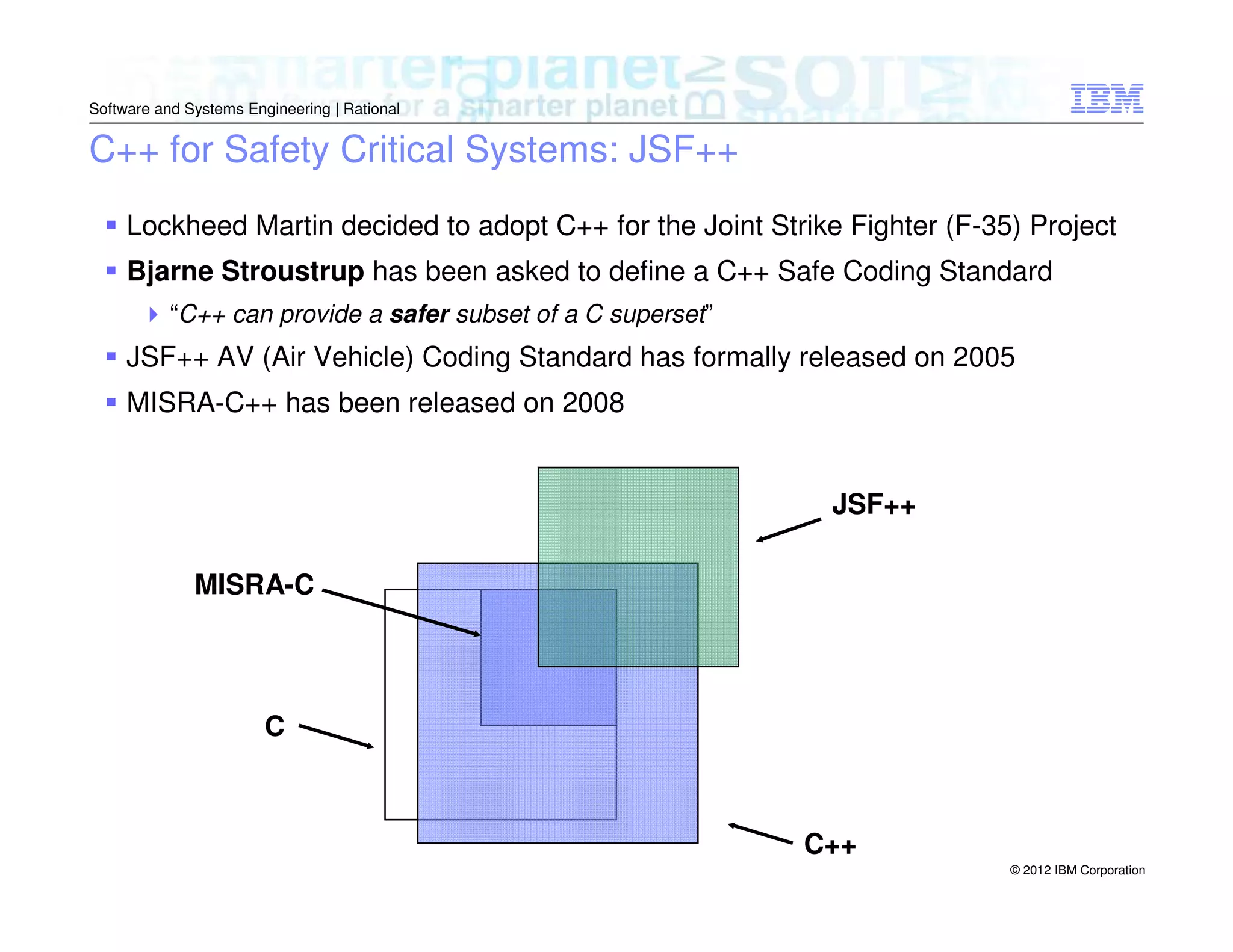
C++ for Safety Critical Systems: JSF++
Lockheed Martin decided to adopt C++ for the Joint Strike Fighter (F-35) Project
Bjarne Stroustrup has been asked to define a C++ Safe Coding Standard
“C++ can provide a safer subset of a C superset”

JSF++ AV (Air Vehicle) Coding Standard has formally released on 2005
MISRA-C++ has been released on 2008
JSF++
MISRA-C

C

C++
© 2012 IBM Corporation

Model-Driven Development for Safety-Critical Software

  • 1.
    IBM Software Group| Rational software IBM SE Symposium Roma – 29 Nov 2012 Model-Driven Development for Safety Critical Software Giulio Santoli (giulio_santoli@it.ibm.com) Client Technical Professional, IBM Rational © 2008 IBM Corporation © 2012 IBM Corporation
  • 2.
    Software and SystemsEngineering | Rational Agenda 1 Safety Critical Application Standards Integrated Software Development Process 2 3 4 5 6 Model-Driven Development for Safety Critical Rational Rhapsody Enhancements for Safety Critical Rhapsody TestConductor AddOd Qualification Kit Summary © 2012 IBM Corporation
  • 3.
    Software and SystemsEngineering | Rational Standards for Safety Critical Applications A Safety Critical System is a system whose failure or malfunction may result in serious injury or even death to people. Some Safety Critical Standards: IEC 61508, Functional Safety Standard DO-178B/C, Aerospance and Defense ISO 26262, Automotive EN 50128, Rail IEC 60601 & 62304, Medical © 2012 IBM Corporation
  • 4.
    Software and SystemsEngineering | Rational Increase of Software in Aerospace & Defence Complexity in modern systems requires more software Technology enhancements and project contraints make F-35 Lightning aerospace Industries to adopt new processes and programming languages (F-35 uses C++) First adopting “relaxed static stability” F-4 Phantom F-22 Raptor F-16 Falcon 2000’ 1980’ 1960’ Only 8% of requirements required software (assembly) in the F-4 1970’ 45% of requirements required software (JOVIAL) in the F-16 F-35 has 24 million lines of code (C/C++), vs 1.7 million lines of code for F-22 80% of specification requirements required software (Ada83) in the F-22 © 2012 IBM Corporation
  • 5.
    Software and SystemsEngineering | Rational Example: RTCA DO-178B RTCA DO-178B is an objective-based standard applied by FAA (Federal Aviation Administration) for the certification of software in avionics systems. Published in 1992, it covers the 5 main processes concerning Planning, Development, Verification, Configuration Management and Quality Assurance. DO-178B outlines the objectives to be met, the work activities to be performed for each objective, and the evidence (output documents) to be supplied for each objective (based on criticality level A-E) Software Criticality Level Failure Condition Category Failure Condition Description Objectives Level A Catastrophic Conditions which would prevent continued safe flight and landing. 66 Level B Haazardous/ Sever-Major Conditions which would reduce aircraft safety margin/functional capabilities, produce a higher workload to the flight crew or have serious adverse effencts on occupants 65 Level C Major Conditions which would not significantly reduce aircraft safety, crew ability to work under adveser operation or produce discomfort to occupants. 57 Level D Minor Conditions which would not significantly reduce aircraft safety, slight increas in crew workload or produce some inconvenience to occupants 28 Level E No Effect Conditions which do not affect the aircraft operations or crew workload. 0 © 2012 IBM Corporation
  • 6.
    Software and SystemsEngineering | Rational Integrated Software Process for DO-178B The Integrated Software Development Process for DO-178B (ISDP-178) is a set of practices to help organizations developing products for certification under DO-178B Specifies a large number of modern sw engineering best practices, including MDD and MBT The process may be applied to any appropriate development tooling but is specifically optimized for the Rational System Accelerator consisting of tools Rational Team Concert for project planning, enactment, and tracking, incl. CM Rational DOORS for requirements management Rational Rhapsody for system engineering, safety analysis, software design & development Rational Quality Manager for test specification, execution, and analysis Rational Method Composer for process customization The ISDP-178 address three primary needs Process specification Process enactment Specific links from the DO-178B standard to process content to aid in ensuring compliance By Objective By Certification Level By Work Product © 2012 IBM Corporation
  • 7.
    Software and SystemsEngineering | Rational ISDP-178 Process Description s esse Proc : More ailable E Av ny/S armo /ESW H ony Harm 26262 ISO © 2012 IBM Corporation
  • 8.
    Software and SystemsEngineering | Rational Model-Driven Development positioning in the V-Process External Requirements Requirements Analysis MBSE Rhapsody Designer for Systems Engineers Rhapsody Architect for Systems Engineers System Acceptance (Sub-)System Integration & Test System Design Component Analysis & Design Component Integration & Test Rhapsody Developer Rhapsody TestConductor Add On Rhapsody Architect for Software MDD Detailed Component Design MBT Rhapsody Design Manager © 2012 IBM Corporation
  • 9.
    Software and SystemsEngineering | Rational Model-Driven Development in Safety Critical Development Adopting MDD you can increase productivity and code quality Rhapsody provides many MDD technoligies: Production Code Generation (80%-90%) Model/Code Associativity (aka Roundtripping) Model Checking Model Helpers and Transformations via Rhapsody API and Rhapsody RulesComposer IBM Collaborative Design Management Average Developer time lost to delays in design completion Traditional approach World Model-driven development (MDD) World MDD with IBM Rational 55.3 person-months 29.6 person-months 20.0 person-months Project savings $257,000 Project savings $353,000 Source:2011 EMF (Embedded Market Forecasters) Study © 2012 IBM Corporation
  • 10.
    Software and SystemsEngineering | Rational Model-Driven Development Approaches Generate new code from the model Develop MISRA-C, MISRA-C++ and Ada applications Maintain automated synchronization between model and code Work simultaneously with architecture, software and target All changes in one area reflected in the others Visualize legacy C, C++ and Ada code Generate new code Visualize existing Model Code Synchronization © 2012 IBM Corporation
  • 11.
    Software and SystemsEngineering | Rational Different Modeling Paradigms: Code-Centric or Model-Centric Software Architecture and Design Executable Models Model-is-code From the model Code Construction Using implementation language Code is “black box” One-way development flow Generating readable code Open framework Model-Code Associativty Code Code Centric Centric Code is the master Everything is done in the code and should stay exactly as-is Model-Code co-Debugging © 2012 IBM Corporation
  • 12.
    Software and SystemsEngineering | Rational UMMI – UML Modeling Maturity Index (By Bruce Douglass) Level Benefit Focus Technologies 5 Optimizing 100% Agile and Engineering Best Practices Model-based testing, nanocycle execution, test driven development, continuous integration 4 Executing 70% Model-based verification Model execution, code generation, model-based debugging 3 Behavioral Modeling 30% State and algorithmic modeling State, sequence and activity diagrams 2 Structural Modeling 15% Class and block modeling of structure Class and block diagrams 1 Visualization 5% Visualizing code structures Reverse engineering 0 Code Based Development 0% Result Manual, time intensive heroic development Productivity and Quality © 2012 IBM Corporation
  • 13.
    Software and SystemsEngineering | Rational Model-Driven Development with IBM Rational Rhapsody Find errors early in the process with advanced model execution Requirements test through execution Model execution enables iterative development Correct specification hand-off to software © 2012 IBM Corporation
  • 14.
    Software and SystemsEngineering | Rational Requirements Traceability into Generated Code In Rhapsody, you have always been able to link classes and operations to requirements and have them included into the generated code: But additional granularity was missing to link statechart elements (states and transitions) to requirements. © 2012 IBM Corporation
  • 15.
    Software and SystemsEngineering | Rational Main Enhancemnts for MDD in Rhapsody 8.0 “High-Level” and “Low-Level” Requirements stereotypes Better Treacability from Statechart to Code Distinguish between HLR and LLR with new stereotypes od y ha ps R 8.0.1 ed leas st re er ‘12) ju emb (Nov Improved location in code for Transitions and States’ Requirements Improved mapping-back of Statechart code to the specific model element Generate Requirements associated with Entry/Exit Action and Internal Transition Associate Statechart’s auto-generated code with its justification Ability to generate Requirement on Operation to implementation file as well Safety-Critical Frameworks for Rational Rhapsody C: SMXF (Simplified MicroC eXecution Framework) C++: SXF (Simplified C++ eXecution Framework) Rhapsody TestConductor Qualification Kit for ISO 26262 and IEC 61508 © 2012 IBM Corporation
  • 16.
    Software and SystemsEngineering | Rational Improved location of Requirements for Transitions/States If you have Requirements that are met by specific States or Transitions in a Statechart, they can be included as comments in the generated code. This is a requirement for autogenerated code as discussed later © 2012 IBM Corporation
  • 17.
    Software and SystemsEngineering | Rational Generate code for Requirements of Internal Transition Rhapsody supports Requirements on Internal Transition and on its Action (if any) Generate Requirements into code, using the transition trigger for mapping back to model You can associate Requirements in the Browser © 2012 IBM Corporation
  • 18.
    Software and SystemsEngineering | Rational Requirements for Entry/Exit Actions Rhapsody supports Requirements on Entry Action / Exit Action You can associate Requirements in the Browser Rhapsody generates the Requirements in the Generated Code © 2012 IBM Corporation
  • 19.
    Software and SystemsEngineering | Rational Requirements Justification for Autogenerated Code Rhapsody can include Requirements to justify autogenerated code, such as accessor and mutator operations of an attribute. © 2012 IBM Corporation
  • 20.
    Software and SystemsEngineering | Rational How Rhapsody implements Behavioral Diagrams Rhaposdy implements behavioral diagrams by leveraging a framework of base classes and interfaces. There are two main parts to this framework: The Object eXecution Framework (OXF), which is the part of the framework that is always linked into the final generated code. The Animation and Tracing Framework, which is only used when animating or tracing. Rhapsody Generated Code OXF Framework RTOS CPU Cointainer Classes External Code The OXF is provided for each supported language (C, C++, Java, Ada, C#), with different flavors (interrupted-driven, static memory only, etc..) Event-Driven Framework Operating System Abstraction Layer Object eXecution Framework © 2012 IBM Corporation
  • 21.
    Software and SystemsEngineering | Rational Simplified MicroC Framework (SMXF) Overview SMXF is an execution framework optimized for MISRA compliant real-time C applications generated from Rhapsody Models Full static/compile-time architecture Support only compile-time initialization, Support segmented memory (allocation to memory banks) MISRA-C 1996/2004 compliance Supporting the Extended Execution Model Periodic Execution Execution Manager, Runnable Manager Events (Asynchronous events, Synchronous events, Timeouts) Adapters ARINC 653 (APEX API based) “Mainloop” - self scheduling executive © 2012 IBM Corporation
  • 22.
    Software and SystemsEngineering | Rational Comparison of C eXecution Frameworks Purpose Supports statecharts Supports asynchronous messaging Supports synchronous messaging Timers (time events) UML ports Deterministic Periodic scheduling Multi-thread support Supports multiple event queues Resource protection Requires an OS? Can be used with an OS? Defines own Container Classes Defines a Memory Manager Error manager / notifier MicroC eXecution Simplified MicroC Standard C Object Framework Execution Framework eXecution (OXF) Framework (SMXF) (MXF) Animation Tracing Simulated time model Size Y Y Y Y Y N N Y Y Y Y Y Y Y N N (property settings or user-defined) Y Y Y ~15000 LOC MISRA C compliance N Static memory allocation Interrupt- Driven Framework (IDF) Y Y Y Y Flow ports Y Y Y Y Y N Y Configurable Configurable N Y Y Y Y N Y Y Y Y Y N Y N N N Y Y Y Y N Y N N Y N N Y Y N Y Y Y Y Y Y N ~10000 LOC Med-high compliance N N N ~5000 LOC N N N ~2500 LOC High compliance High compliance © 2012 IBM Corporation
  • 23.
    Software and SystemsEngineering | Rational Simplified C++ eXecution Framework (SXF) Based on IDF with support for Active classes (multi threading) Static architecture Static memory manager for events allocation MISRA C++ 2008 compliance Safety critical C++ settings Checks to support MISRA compliant modelling style Events Asynchronous events, Synchronous events (triggered operations), Timeouts Adapters Workbench Managed 653 (APEX API based) Microsoft (VS 2008/2010) Constraints Flat state charts No Ports No Animation/Tracing © 2012 IBM Corporation
  • 24.
    Software and SystemsEngineering | Rational Comparison of SXF and OXF for C++ SXF C++ OXF C++ Static architecture Dynamic allocation No animation/tracing Animation/Tracing Only Real Time Real Time/Simulated Time No containers (can be added) Containers Static memory manager Static memory manager (only BasedNumberOfInstances) Flat state charts Flat/Reusable state charts No Multi core in 7.6 Multi core No Interfaces Interface based No Ports Ports © 2012 IBM Corporation
  • 25.
    Software and SystemsEngineering | Rational Certification Supporting Materials for SMXF and SXF Associated High Level (HLR) and Low Level (LLR) Requirements provided Trace back from code to requirements Fully justified code Test Cases provided using Rational Rhapsody TestConductor Add On Test Cases trace back to requirements Statement coverage Branch coverage © 2012 IBM Corporation
  • 26.
    Software and SystemsEngineering | Rational SMXF High Level (HLR) and Low Level (LLR) Requirements Both SXF and SMXF Models include coverage to High and Low Level Requirements © 2012 IBM Corporation
  • 27.
    Software and SystemsEngineering | Rational SMXF and SXF Test Reports Also the Test Reports generated from the SMXF and SXF frameworks are provided or can be re-gererated: Code Coverage Report Requirements Coverage Report MISRA/MISRA-C++ Compliancy Statement MISRA/MISRA-C++ LDRA Testbed Report F SMX ge era Cov A LDR alysis n ic A Stat eport R © 2012 IBM Corporation
  • 28.
    Software and SystemsEngineering | Rational Rhapsody TestConductor Add-on for Model-Based Testing Define test cases with sequence diagrams, statecharts, flowcharts or even code OMG UML Testing Profile Automate testing tasks Create Test Architecture Execute and monitor tests – Interactive for debugging, – Batch test suites for nightly regression – Include CUnit/CppUnit tests Traceability across lifecycle – from requirements to integration Host level and target based execution White-Box, Black-Box for design validation “Offline testing” mode:–for testing on target C++, C, Java, Ada Supported Definition and management of regression tests Reporting of results, coverage and traceability © 2012 IBM Corporation
  • 29.
    Software and SystemsEngineering | Rational Rhapsody Kit for ISO 26262 and IEC 61508 Overview Doc: describes the contents of the Rhapsody kit Rhapsody Reference workflow: provides an exemplary workflow for modelling, code generation and verification in safety critical Rhapsody TestConductor Add On Workflow: describes testing activities and objectives Rhapsody TestConductor Safety Manual: provides additional information for using TestConductor in safety related applications TÜV SÜD Certificate for Rhapsody TestConductor Add On TÜV SÜD Report on Certificate for ISO 26262 and IEC 61508 Rhapsody TestConductor Add On Validation Suite: separately available test suite for Rhapsody TestConductor to help in qualification efforts Certification kits for the SXF and SMXF frameworks © 2012 IBM Corporation 29
  • 30.
    Software and SystemsEngineering | Rational IBM Rational Rhapsody TestConductor Add-On Certification The Validation Suite is an integral part of the IBM Rational Rhapsody TestConductor Add-On certification (ISO 26262 and IEC 61508) IBM Rational Rhapsody TestConductor Add-On is a qualified testing tool for IBM Rational Rhapsody Successful qualification has been acknowledged by TÜV Süd (independent German certification body) TÜV Süd issued a certificate about successful qualification Customers can immediately leverage from the certificate Certificate will be also issued for IBM Rational Rhapsody TestConductor Add-On integrated into IBM Rational Rhapsody © 2012 IBM Corporation
  • 31.
    Software and SystemsEngineering | Rational IBM Rational Rhapsody Reference Workflow Rhapsody Reference Workflow for the development of safety-related software provides guidance on how to fulfill functional safety requirements with model-based development methods and tools; is based on best practices for safety-related projects; addresses various workflow activities relevant for the development of safety-related software with a special focus on verification and validation to develop safe software; conforms to IEC 61508 and ISO 26262. © 2012 IBM Corporation
  • 32.
    Software and SystemsEngineering | Rational IBM Rational Test RealTime Rational Test RealTime is a cross-platform solution for component testing and runtime analysis of embedded software for C,C++, Ada and Java. Software Unit & Integration Testing Electronic Control Unit (ECU) / Hardware in the Loop (HIL) Validation Modified Condition/Decision Coverage (MC/DC) Memory Profiling Performance Profiling Runtime Tracing Static Code Analysis (MISRA-C) Integrated with Rhapsody TestConductor Rational Test RealTime DO-178B Qualification Kit © 2012 IBM Corporation
  • 33.
    Software and SystemsEngineering | Rational Testing Ecosystems: Timing-Modeling INCHRON, an IBM Business Patner, offers test tools for model based real-time simulation, chronSIM, and analysis/validation, chronVAL. The INCHRON Tool Suite is ingetraged with IBM Rational products, cush as Rhapsoty, DOORS, Rational Team Concert, Rational Quality Manager. Data Duplication! Data Lost! © 2012 IBM Corporation
  • 34.
    Software and SystemsEngineering | Rational Testing Ecosystems: LDRA LDRA offers automated analysis and testing tools for safety-critical software to ensure adherence to compliance to standards (i.e. MISRA-C, MISRA-C++, JSF++). The LDRA Tools Suite for C/C++ provides a Rhapsody plugin: To instrument all the files generated by a Rhapsody configuration for Static and Dymanic Analysis To Analyze a single file and perform Unit Testing on it © 2012 IBM Corporation
  • 35.
    Software and SystemsEngineering | Rational An Example: Invensys Rail Dimetronic Speeds innovation with a unified platform for multi-stage development processes The need: Modernize development processes Ensure systems integration with other railways while meeting railway standards The solution: Incorporated system intelligence into its development process Deployed an application development platform to: – Model system reliability “Innovation and process flexibility are important in allowing us to differentiate our offerings. We’re now able to ensure that our design can be rapidly adapted, not only to customer needs, but to changing ERTMS requirements, at a reasonable cost.” Francisco Lozano ERTMS Program Manager – Highlight areas requiring improvement The benefits: Reduced time-to-market for signaling systems products by 40% Facilitated 100% compliance rate with ERTMS standards for code traceability and safety Reduced cost and risks of development and documentation Solution components: IBM® Rational® Rhapsody IBM Rational DOORS IBM Rational Synergy IBM Rational Change IBM Rational Publishing Engine IBM Software Services © 2012 IBM Corporation
  • 36.
    Software and SystemsEngineering | Rational An Example: Tata Consultancy Services Limited Improving time-to-market with IBM Rational Rhapsody The need: Achieve high-quality design/code Speed-up development and variants The solution: Improved software development process by incorporating both MBDA (SysML) and MDD (UML) for embedded real-time: – Systems Engineering – Software Development – Software Testing “We used IBM Rational Rhapsody to aid and succeed in the model-driven development (MDD) methodology for the key product development of our customers. Behavioral modeling in Rhapsody is very powerful and we used it extensively to test our design and generate high-quality code.” Rampura Venkatachar Raman Head – EIS Semiconductor & Consumer Electronics Vertical, Tata Consultancy Services The benefits: Extracted 60% of a new design from reverse engineering of existing software Reduced 50% learning curve for new staff members Eliminated 90% of design errors with model simulation Solution components: IBM® Rational® Rhapsody © 2012 IBM Corporation
  • 37.
    Software and SystemsEngineering | Rational Summary Safety Critical software development is hard and expensive Model-Driven Development brings better quality and The IBM Rational Solutions for Systems and Software Engineering enables you focusing on what really matterns and reduce the certification effort. http://www-01.ibm.com/software/rational/workbench/systems/ © 2012 IBM Corporation
  • 38.
    Software and SystemsEngineering | Rational Some References © 2012 IBM Corporation
  • 39.
    Software and SystemsEngineering | Rational www.ibm.com/software/rational © Copyright IBM Corporation 2012. All rights reserved. The information contained in these materials is provided for informational purposes only, and is provided AS IS without warranty of any kind, express or implied. IBM shall not be responsible for any damages arising out of the use of, or otherwise related to, these materials. Nothing contained in these materials is intended to, nor shall have the effect of, creating any warranties or representations from IBM or its suppliers or licensors, or altering the terms and conditions of the applicable license agreement governing the use of IBM software. References in these materials to IBM products, programs, or services do not imply that they will be available in all countries in which IBM operates. Product release dates and/or capabilities referenced in these materials may change at any time at IBM’s sole discretion based on market opportunities or other factors, and are not intended to be a commitment to future product or feature availability in any way. IBM, the IBM logo, Rational, the Rational logo, Telelogic, the Telelogic logo, and other IBM products and services are trademarks of the International Business Machines Corporation, in the United States, other countries or both. Other company, product, or service names may be trademarks or service marks of others. © 2012 IBM Corporation
  • 40.
    Software and SystemsEngineering | Rational www.ibm.com/software/rational © 2012 IBM Corporation
  • 41.
    Software and SystemsEngineering | Rational Acknowledgements and disclaimers Availability: References in this presentation to IBM products, programs, or services do not imply that they will be available in all countries in which IBM operates. The workshops, sessions and materials have been prepared by IBM or the session speakers and reflect their own views. They are provided for informational purposes only, and are neither intended to, nor shall have the effect of being, legal or other guidance or advice to any participant. While efforts were made to verify the completeness and accuracy of the information contained in this presentation, it is provided AS-IS without warranty of any kind, express or implied. IBM shall not be responsible for any damages arising out of the use of, or otherwise related to, this presentation or any other materials. Nothing contained in this presentation is intended to, nor shall have the effect of, creating any warranties or representations from IBM or its suppliers or licensors, or altering the terms and conditions of the applicable license agreement governing the use of IBM software. All customer examples described are presented as illustrations of how those customers have used IBM products and the results they may have achieved. Actual environmental costs and performance characteristics may vary by customer. Nothing contained in these materials is intended to, nor shall have the effect of, stating or implying that any activities undertaken by you will result in any specific sales, revenue growth or other results. © Copyright IBM Corporation 2012. All rights reserved. – U.S. Government Users Restricted Rights - Use, duplication or disclosure restricted by GSA ADP Schedule Contract with IBM Corp. IBM, the IBM logo, ibm.com, Rational, the Rational logo, Telelogic, the Telelogic logo, Green Hat, the Green Hat logo, and other IBM products and services are trademarks or registered trademarks of International Business Machines Corporation in the United States, other countries, or both. If these and other IBM trademarked terms are marked on their first occurrence in this information with a trademark symbol (® or ™), these symbols indicate U.S. registered or common law trademarks owned by IBM at the time this information was published. Such trademarks may also be registered or common law trademarks in other countries. A current list of IBM trademarks is available on the Web at “Copyright and trademark information” at www.ibm.com/legal/copytrade.shtml If you have mentioned trademarks that are not from IBM, please update and add the following lines: [Insert any special third-party trademark names/attributions here] Other company, product, or service names may be trademarks or service marks of others. © 2012 IBM Corporation
  • 42.
    Software and SystemsEngineering | Rational C++ for Safety Critical Systems: JSF++ Lockheed Martin decided to adopt C++ for the Joint Strike Fighter (F-35) Project Bjarne Stroustrup has been asked to define a C++ Safe Coding Standard “C++ can provide a safer subset of a C superset” JSF++ AV (Air Vehicle) Coding Standard has formally released on 2005 MISRA-C++ has been released on 2008 JSF++ MISRA-C C C++ © 2012 IBM Corporation