1
Note on Vector Calculus
1. Elementary
2. Vector Product
3. Differentiation of Vectors
4. Integration of Vectors
5. Del Operator or Nabla (Symbol )
6. Polar Coordinates
2
7. Line Integral
8. Volume Integral
9. Surface Integral
10. Green’s Theorem
11. Divergence Theorem (Gauss’ Theorem)
12. Stokes’ Theorem
3
Elementary Vector Analysis
Definition (Scalar and vector)
Vector is a directed quantity, one with
both magnitude and direction.
For instance acceleration, velocity, force
Scalar is a quantity that has magnitude
but not direction.
For instance mass, volume, distance
4
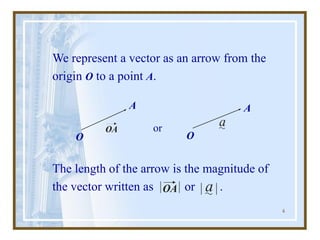
We represent a vector as an arrow from the
origin O to a point A.
The length of the arrow is the magnitude of
the vector written as or .
O
A
or
O
A
OA
a
a
OA
5
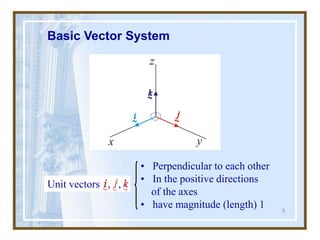
Basic Vector System
Unit vectors , ,
• Perpendicular to each other
• In the positive directions
of the axes
• have magnitude (length) 1
6
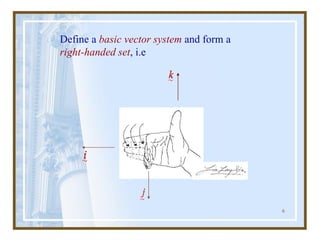
Define a basic vector system and form a
right-handed set, i.e
7
Magnitude of vectors
Let P = (x, y, z). Vector is defined by
with magnitude (length)
OP = = + +
p x i y j z k
= [ ]
x, y, z
OP = p
OP = = + +
p x y z
2 2 2
8
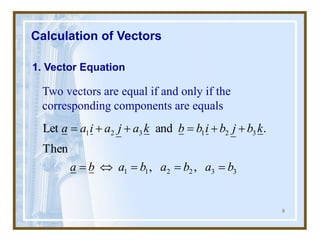
Calculation of Vectors
1. Vector Equation
Two vectors are equal if and only if the
corresponding components are equals
3
3
2
2
1
1
3
2
1
3
2
1
,
,
Then
.
and
Let
b
a
b
a
b
a
b
a
k
b
j
b
i
b
b
k
a
j
a
i
a
a
=
=
=

=
+
+
=
+
+
=
9
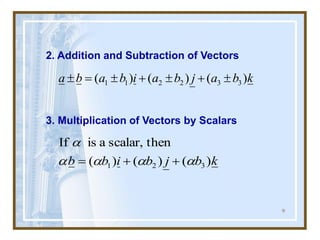
2. Addition and Subtraction of Vectors
3. Multiplication of Vectors by Scalars
k
b
a
j
b
a
i
b
a
b
a )
(
)
(
)
( 3
3
2
2
1
1 
+

+

=

k
b
j
b
i
b
b )
(
)
(
)
(
then
scalar,
a
is
If
3
2
1 




+
+
=
10
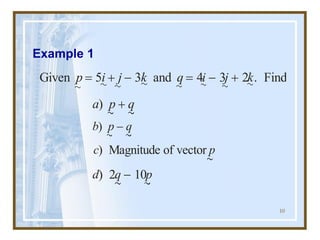
Example 1
Given 5 3 and 4 3 2 . Find
p i j k q i j k
= + - = - +
a p q
) +
)
b p q
-
) 2 10
d q p
-
c p
) Magnitude of vector
11
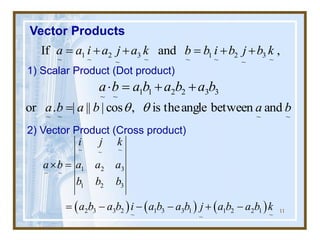
Vector Products
1 2 3 1 2 3
~ ~ ~ ~ ~ ~
~ ~
If and ,
a a i a j a k b b i b j b k
= + + = + +
1 1 2 2 3 3
~ ~
a b a b a b a b
 = + +
1) Scalar Product (Dot product)
2) Vector Product (Cross product)
     
~ ~
~
1 2 3
~ ~
1 2 3
2 3 3 2 1 3 3 1 1 2 2 1
~ ~
~
i j k
a b a a a
b b b
a b a b i a b a b j a b a b k
 =
= - - - + -
~
~
~
~
and
between
angle
the
is
,
cos
|
||
|
.
or b
a
b
a
b
a 

=
12
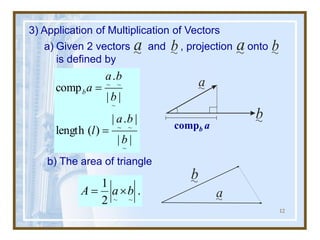
3) Application of Multiplication of Vectors
a) Given 2 vectors and , projection onto
is defined by
b) The area of triangle
~ ~
1
.
2
A a b
= 
a b a b
a
b
b
a
compb a
|
|
|
.
|
)
(
length
|
|
.
comp
~
~
~
~
~
~
b
b
a
l
b
b
a
a
b
=
=
13
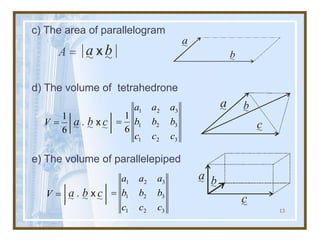
c) The area of parallelogram
d) The volume of tetrahedrone
e) The volume of parallelepiped
a
b
a b
x
A =
a b
c
3
2
1
3
2
1
3
2
1
6
1
c
c
c
b
b
b
a
a
a
=
6
1
=
V a . b c
x
a b
c
3
2
1
3
2
1
3
2
1
c
c
c
b
b
b
a
a
a
=
=
V a . b c
x
14
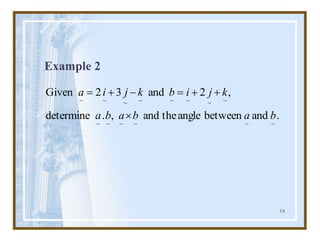
Example 2
.
and
between
angle
the
and
,
.
determine
,
2
and
3
2
Given
~
~
~
~
~
~
~
~
~
~
~
~
~
~
b
a
b
a
b
a
k
j
i
b
k
j
i
a

+
+
=
-
+
=
15
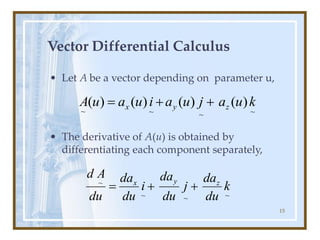
Vector Differential Calculus
• Let A be a vector depending on parameter u,
• The derivative of A(u) is obtained by
differentiating each component separately,
~
~
~
~
k
du
da
j
du
da
i
du
da
du
A
d
z
y
x
+
+
=
~
~
~
~
)
(
)
(
)
(
)
( k
u
a
j
u
a
i
u
a
u
A z
y
x +
+
=
16
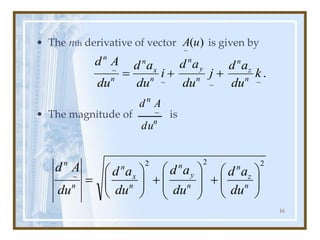
• The nth derivative of vector is given by
• The magnitude of is
)
(
~
u
A
.
~
~
~
~
k
du
a
d
j
du
a
d
i
du
a
d
du
A
d
n
z
n
n
y
n
n
x
n
n
n
+
+
=
2
2
2
~








+








+








= n
z
n
n
y
n
n
x
n
n
n
du
a
d
du
a
d
du
a
d
du
A
d
n
n
du
A
d
~
17
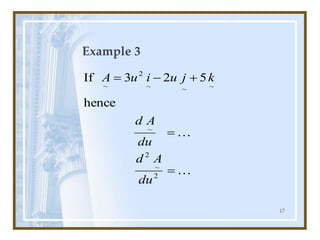
Example 3


=
=
+
-
=
2
~
2
~
~
~
~
2
~
hence
5
2
3
If
du
A
d
du
A
d
k
j
u
i
u
A
18
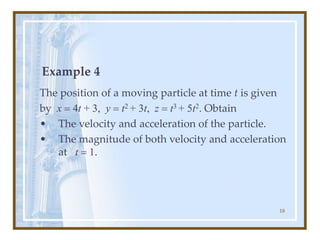
Example 4
The position of a moving particle at time t is given
by x = 4t + 3, y = t2 + 3t, z = t3 + 5t2. Obtain
• The velocity and acceleration of the particle.
• The magnitude of both velocity and acceleration
at t = 1.
19
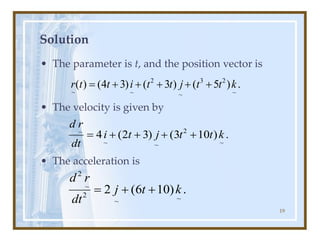
Solution
• The parameter is t, and the position vector is
• The velocity is given by
• The acceleration is
.
)
5
(
)
3
(
)
3
4
(
)
(
~
2
3
~
2
~
~
k
t
t
j
t
t
i
t
t
r +
+
+
+
+
=
.
)
10
3
(
)
3
2
(
4
~
2
~
~
~
k
t
t
j
t
i
dt
r
d
+
+
+
+
=
.
)
10
6
(
2
~
~
2
~
2
k
t
j
dt
r
d
+
+
=
20
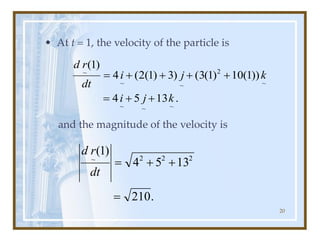
• At t = 1, the velocity of the particle is
and the magnitude of the velocity is
.
13
5
4
))
1
(
10
)
1
(
3
(
)
3
)
1
(
2
(
4
)
1
(
~
~
~
~
2
~
~
~
k
j
i
k
j
i
dt
r
d
+
+
=
+
+
+
+
=
.
210
13
5
4
)
1
( 2
2
2
~
=
+
+
=
dt
r
d
21
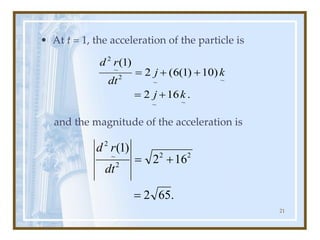
• At t = 1, the acceleration of the particle is
and the magnitude of the acceleration is
.
16
2
)
10
)
1
(
6
(
2
)
1
(
~
~
~
~
2
~
2
k
j
k
j
dt
r
d
+
=
+
+
=
.
65
2
16
2
)
1
( 2
2
2
~
2
=
+
=
dt
r
d
22
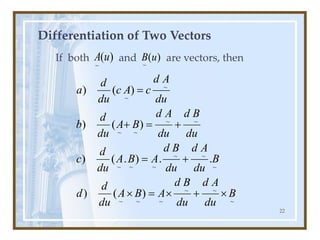
Differentiation of Two Vectors
If both and are vectors, then
)
(
~
u
A )
(
~
u
B
~
~
~
~
~
~
~
~
~
~
~
~
~
~
~
~
~
~
)
(
)
.
.
)
.
(
)
)
(
)
)
(
)
B
du
A
d
du
B
d
A
B
A
du
d
d
B
du
A
d
du
B
d
A
B
A
du
d
c
du
B
d
du
A
d
B
A
du
d
b
du
A
d
c
A
c
du
d
a

+

=

+
=
+
=
+
=
23
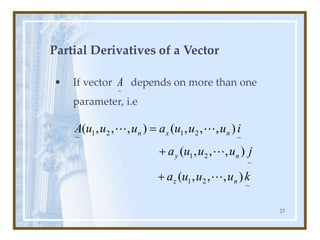
Partial Derivatives of a Vector
• If vector depends on more than one
parameter, i.e
~
A
~
2
1
~
2
1
~
2
1
2
1
~
)
,
,
,
(
)
,
,
,
(
)
,
,
,
(
)
,
,
,
(
k
u
u
u
a
j
u
u
u
a
i
u
u
u
a
u
u
u
A
n
z
n
y
n
x
n




+
+
=
24
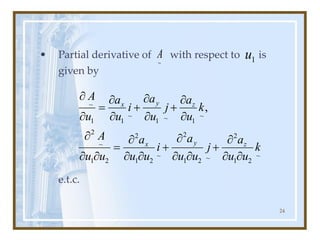
• Partial derivative of with respect to is
given by
e.t.c.
~
A
~
2
1
2
~
2
1
2
~
2
1
2
2
1
~
2
~
1
~
1
~
1
1
~
,
k
u
u
a
j
u
u
a
i
u
u
a
u
u
A
k
u
a
j
u
a
i
u
a
u
A
z
y
x
z
y
x



+



+



=





+


+


=


1
u
25
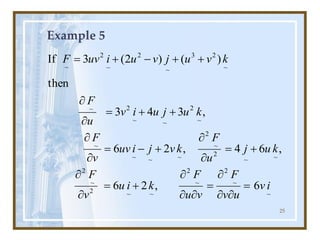
Example 5
~
~
2
~
2
~
~
2
~
2
~
~
2
~
2
~
~
~
~
~
2
~
~
2
~
~
2
3
~
2
~
2
~
6
,
2
6
,
6
4
,
2
6
,
3
4
3
then
)
(
)
2
(
3
If
i
v
u
v
F
v
u
F
k
i
u
v
F
k
u
j
u
F
k
v
j
i
uv
v
F
k
u
j
u
i
v
u
F
k
v
u
j
v
u
i
uv
F
=



=



+
=


+
=


+
-
=


+
+
=


+
+
-
+
=
26
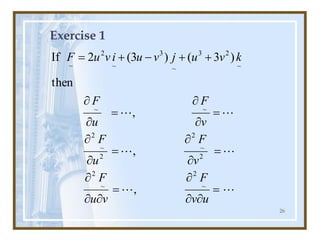
Exercise 1






=



=



=


=


=


=


+
+
-
+
=
u
v
F
v
u
F
v
F
u
F
v
F
u
F
k
v
u
j
v
u
i
v
u
F
~
2
~
2
2
~
2
2
~
2
~
~
~
2
3
~
3
~
2
~
,
,
,
then
)
3
(
)
3
(
2
If
27
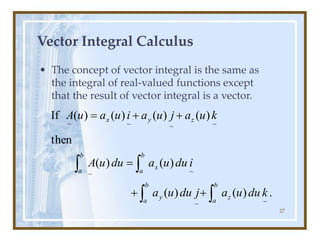
Vector Integral Calculus
• The concept of vector integral is the same as
the integral of real-valued functions except
that the result of vector integral is a vector.
.
)
(
)
(
)
(
)
(
then
)
(
)
(
)
(
)
(
If
~
~
~
~
~
~
~
~
k
du
u
a
j
du
u
a
i
du
u
a
du
u
A
k
u
a
j
u
a
i
u
a
u
A
b
a
z
b
a
y
b
a
x
b
a
z
y
x




+
+
=
+
+
=
28
Example 6
.
80
2
42
]
[
]
5
[
]
2
[
4
)
5
2
(
)
4
3
(
.
calculate
,
4
)
5
2
(
)
4
3
(
If
~
~
~
~
3
1
4
~
3
1
2
~
3
1
2
3
3
1 ~
3
3
1 ~
3
1 ~
2
3
1 ~
3
1 ~
~
3
~
~
2
~
k
j
i
k
t
j
t
t
i
t
t
k
dt
t
j
dt
t
i
dt
t
t
dt
F
dt
F
k
t
j
t
i
t
t
F
+
-
=
+
-
+
+
=
+
-
+
+
=
+
-
+
+
=





Answer
29
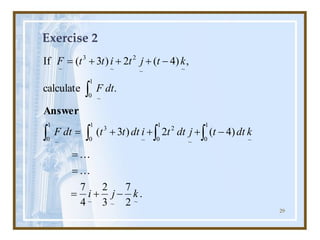
Exercise 2
.
2
7
3
2
4
7
)
4
(
2
)
3
(
.
calculate
,
)
4
(
2
)
3
(
If
~
~
~
1
0 ~
1
0 ~
2
1
0 ~
3
1
0 ~
1
0 ~
~
~
2
~
3
~
k
j
i
k
dt
t
j
dt
t
i
dt
t
t
dt
F
dt
F
k
t
j
t
i
t
t
F
-
+
=
=
=
-
+
+
+
=
-
+
+
+
=







Answer
30
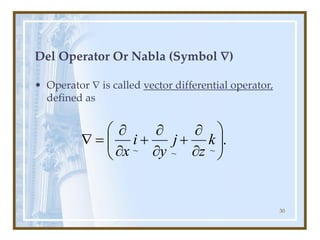
Del Operator Or Nabla (Symbol )
• Operator  is called vector differential operator,
defined as
.
~
~
~ 









+


+


=
 k
z
j
y
i
x
31
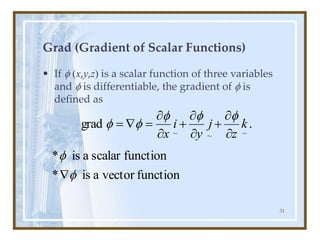
Grad (Gradient of Scalar Functions)
• If  x,y,z is a scalar function of three variables
and  is differentiable, the gradient of  is
defined as
.
grad
~
~
~
k
z
j
y
i
x 

+


+


=

=





function
vector
a
is
*
function
scalar
a
is
*



32
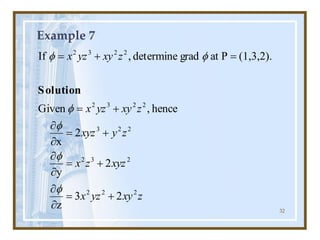
Example 7
z
xy
yz
x
xyz
z
x
z
y
xyz
z
xy
yz
x
z
xy
yz
x
2
2
2
2
3
2
2
2
3
2
2
3
2
2
2
3
2
2
3
z
2
y
2
x
hence
,
Given
(1,3,2).
P
at
grad
determine
,
If
+
=


+
=


+
=


+
=
=
+
=






Solution
33
.
72
32
84
.
))
2
(
)
3
)(
1
(
2
)
2
)(
3
(
)
1
(
3
(
)
)
2
)(
3
)(
1
(
2
)
2
(
)
1
((
)
)
2
(
)
3
(
)
2
)(
3
)(
1
(
2
(
have
we
(1,3,2),
P
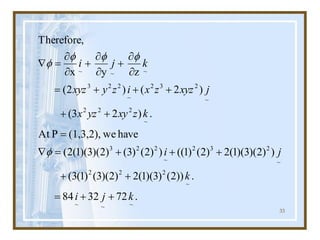
At
.
)
2
3
(
)
2
(
)
2
(
z
y
x
Therefore,
~
~
~
~
2
2
2
~
2
3
2
~
2
2
3
~
2
2
2
~
2
3
2
~
2
2
3
~
~
~
k
j
i
k
j
i
k
z
xy
yz
x
j
xyz
z
x
i
z
y
xyz
k
j
i
+
+
=
+
+
+
+
+
=

=
+
+
+
+
+
=


+


+


=






34
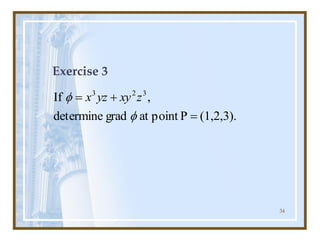
Exercise 3
(1,2,3).
P
point
at
grad
determine
,
If 3
2
3
=
+
=

 z
xy
yz
x
35
Solution
.
110
111
126
(1,2,3),
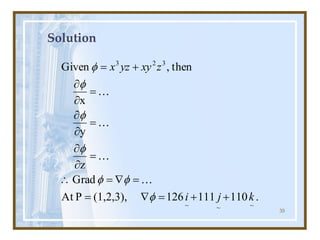
P
At
Grad
z
y
x
then
,
Given
~
~
~
3
2
3
k
j
i
z
xy
yz
x
+
+
=

=
=

=

=


=


=


+
=











36
Grad Properties
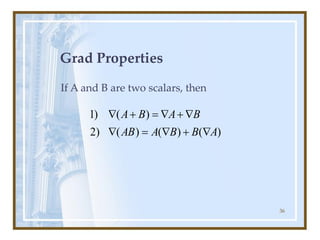
If A and B are two scalars, then
)
(
)
(
)
(
)
2
)
(
)
1
A
B
B
A
AB
B
A
B
A

+

=


+

=
+

37
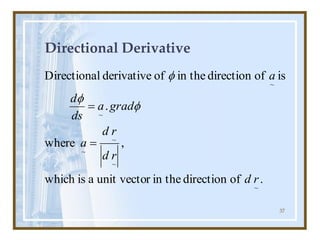
Directional Derivative
.
of
direction
in the
r
unit vecto
a
is
which
,
where
.
is
of
direction
in the
of
derivative
l
Directiona
~
~
~
~
~
~
r
d
r
d
r
d
a
grad
a
ds
d
a
=
= 


38
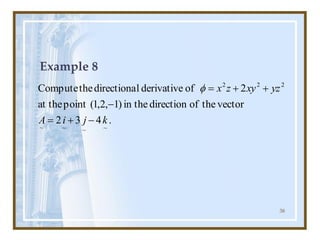
Example 8
.
4
3
2
vector
the
of
direction
in the
)
1
,
2
,
1
(
point
at the
2
of
derivative
l
directiona
the
Compute
~
~
~
~
2
2
2
k
j
i
A
yz
xy
z
x
-
+
=
-
+
+
=

39
Solution
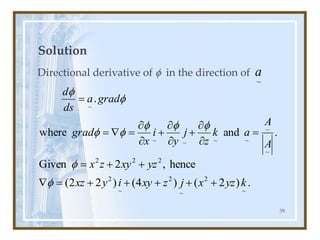
Directional derivative of  in the direction of
.
)
2
(
)
4
(
)
2
2
(
hence
,
2
Given
~
2
~
2
~
2
2
2
2
k
yz
x
j
z
xy
i
y
xz
yz
xy
z
x
+
+
+
+
+
=

+
+
=


.
and
where
.
~
~
~
~
~
~
~
A
A
a
k
z
j
y
i
x
grad
grad
a
ds
d
=


+


+


=

=
=







~
a
40
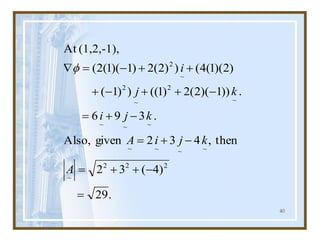
.
29
)
4
(
3
2
then
,
4
3
2
given
Also,
.
3
9
6
.
))
1
)(
2
(
2
)
1
((
)
)
1
(
)
2
)(
1
(
4
(
)
)
2
(
2
)
1
)(
1
(
2
(
(1,2,-1),
At
2
2
2
~
~
~
~
~
~
~
~
~
2
~
2
~
2
=
-
+
+
=
-
+
=
-
+
=
-
+
+
-
+
+
+
-
=

A
k
j
i
A
k
j
i
k
j
i

41
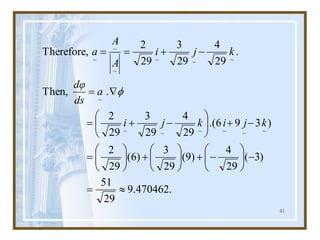
.
470462
.
9
29
51
)
3
(
29
4
)
9
(
29
3
)
6
(
29
2
)
3
9
6
.(
29
4
29
3
29
2
.
Then,
.
29
4
29
3
29
2
Therefore,
~
~
~
~
~
~
~
~
~
~
~
~
~

=
-






-
+






+






=
-
+






-
+
=

=
-
+
=
=
k
j
i
k
j
i
a
ds
dφ
k
j
i
A
A
a

42
Unit Normal Vector
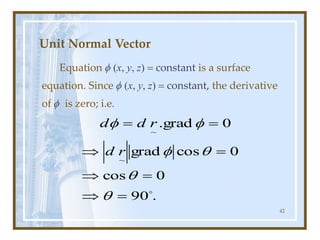
Equation  (x, y, z) = constant is a surface
equation. Since  (x, y, z) = constant, the derivative
of  is zero; i.e.
.
90
0
cos
0
cos
grad
0
grad
.
~
~

=

=

=

=
=






r
d
r
d
d
43
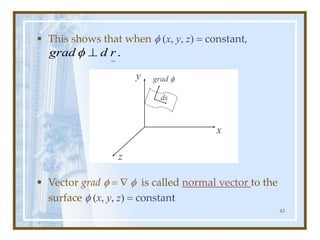
• This shows that when  (x, y, z) = constant,
• Vector grad  =   is called normal vector to the
surface  (x, y, z) = constant
.
~
r
d
grad 

y
ds
grad 
z
x
44
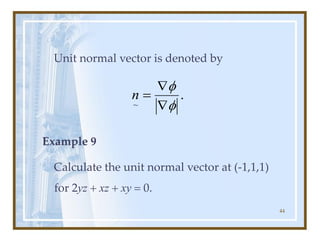
Unit normal vector is denoted by
Example 9
Calculate the unit normal vector at (-1,1,1)
for 2yz + xz + xy = 0.
.
~ 



=
n
45
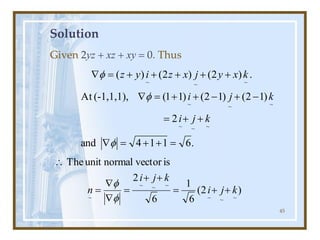
Solution
Given 2yz + xz + xy = 0. Thus
.
6
1
1
4
and
2
)
1
2
(
)
1
2
(
)
1
1
(
(-1,1,1),
At
.
)
2
(
)
2
(
)
(
~
~
~
~
~
~
~
~
~
=
+
+
=

+
+
=
-
+
-
+
+
=

+
+
+
+
+
=




k
j
i
k
j
i
k
x
y
j
x
z
i
y
z
)
2
(
6
1
6
2
is
vector
normal
unit
The
~
~
~
~
~
~
k
j
i
k
j
i
n
~
+
+
=
+
+
=


=



46
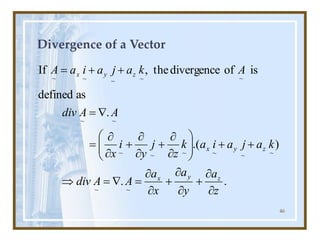
Divergence of a Vector
.
.
)
.(
.
as
defined
is
of
divergence
the
,
If
~
~
~
~
~
~
~
~
~
~
~
~
~
~
~
z
a
y
a
x
a
A
A
div
k
a
j
a
i
a
k
z
j
y
i
x
A
A
div
A
k
a
j
a
i
a
A
z
y
x
z
y
x
z
y
x


+


+


=

=

+
+










+


+


=

=
+
+
=
47
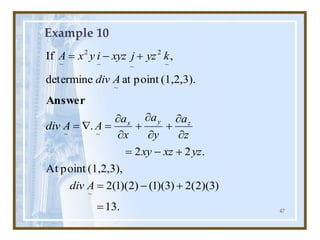
Example 10
.
13
)
3
)(
2
(
2
)
3
)(
1
(
)
2
)(
1
(
2
(1,2,3),
point
At
.
2
2
.
(1,2,3).
point
at
determine
,
If
~
~
~
~
~
2
~
~
2
~
=
+
-
=
+
-
=


+


+


=

=
+
-
=
A
div
yz
xz
xy
z
a
y
a
x
a
A
A
div
A
div
k
yz
j
xyz
i
y
x
A
z
y
x
Answer
48
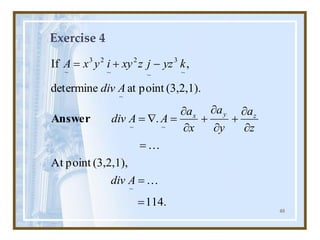
Exercise 4
.
114
(3,2,1),
point
At
.
(3,2,1).
point
at
determine
,
If
~
~
~
~
~
3
~
2
~
2
3
~
=
=
=


+


+


=

=
-
+
=


A
div
z
a
y
a
x
a
A
A
div
A
div
k
yz
j
z
xy
i
y
x
A
z
y
x
Answer
49
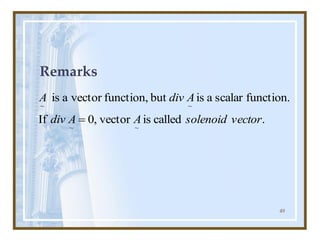
Remarks
.
called
is
vector
,
0
If
function.
scalar
a
is
but
function,
vector
a
is
~
~
~
~
vector
solenoid
A
A
div
A
div
A
=
50
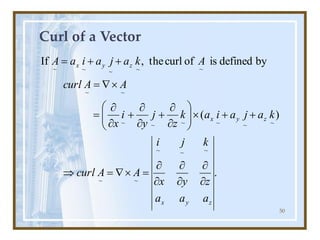
Curl of a Vector
.
)
(
by
defined
is
of
curl
the
,
If
~
~
~
~
~
~
~
~
~
~
~
~
~
~
~
~
~
~
z
y
x
z
y
x
z
y
x
a
a
a
z
y
x
k
j
i
A
A
curl
k
a
j
a
i
a
k
z
j
y
i
x
A
A
curl
A
k
a
j
a
i
a
A






=


=

+
+











+


+


=


=
+
+
=
51
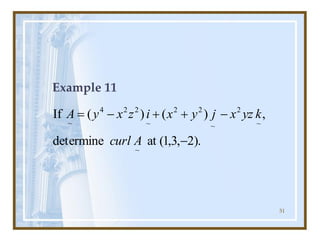
Example 11
.
)
2
,
3
,
1
(
at
determine
,
)
(
)
(
If
~
~
2
~
2
2
~
2
2
4
~
-
-
+
+
-
=
A
curl
k
yz
x
j
y
x
i
z
x
y
A
52
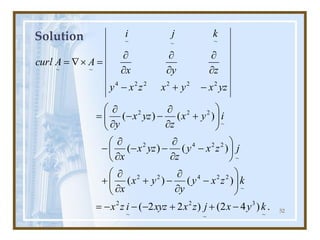
Solution
.
)
4
2
(
)
2
2
(
)
(
)
(
)
(
)
(
)
(
)
(
~
3
~
2
~
2
~
2
2
4
2
2
~
2
2
4
2
~
2
2
2
2
2
2
2
2
4
~
~
~
~
~
k
y
x
j
z
x
xyz
i
z
x
k
z
x
y
y
y
x
x
j
z
x
y
z
yz
x
x
i
y
x
z
yz
x
y
yz
x
y
x
z
x
y
z
y
x
k
j
i
A
A
curl
-
+
+
-
-
-
=








-


-
+


+






-


-
-


-








+


-
-


=
-
+
-






=


=
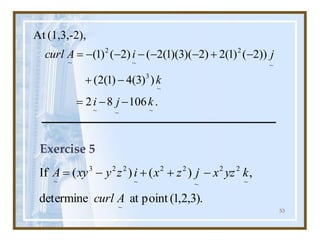
53
.
106
8
2
)
)
3
(
4
)
1
(
2
(
))
2
(
)
1
(
2
)
2
)(
3
)(
1
(
2
(
)
2
(
)
1
(
(1,3,-2),
At
~
~
~
~
3
~
2
~
2
~
k
j
i
k
j
i
A
curl
-
-
=
-
+
-
+
-
-
-
-
-
=
Exercise 5
.
)
3
,
2
,
1
(
point
at
determine
,
)
(
)
(
If
~
~
2
2
~
2
2
~
2
2
3
~
A
curl
k
yz
x
j
z
x
i
z
y
xy
A -
+
+
-
=
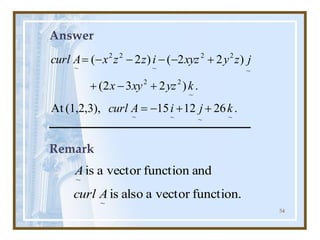
54
Answer
.
26
12
15
(1,2,3),
At
.
)
2
3
2
(
)
2
2
(
)
2
(
~
~
~
~
~
2
2
~
2
2
~
2
2
~
k
j
i
A
curl
k
yz
xy
x
j
z
y
xyz
i
z
z
x
A
curl
+
+
-
=
+
-
+
+
-
-
-
-
=
Remark
function.
vector
a
also
is
and
function
vector
a
is
~
~
A
curl
A
55
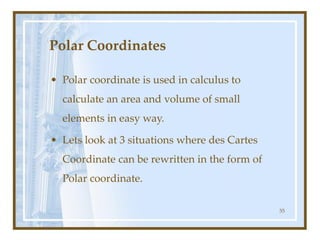
Polar Coordinates
• Polar coordinate is used in calculus to
calculate an area and volume of small
elements in easy way.
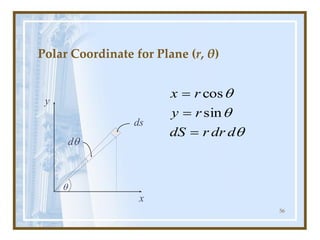
• Lets look at 3 situations where des Cartes
Coordinate can be rewritten in the form of
Polar coordinate.
56
Polar Coordinate for Plane (r, θ)
x
ds
y

d



d
dr
r
dS
r
y
r
x
=
=
=
sin
cos
57
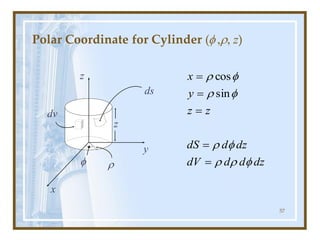
Polar Coordinate for Cylinder ( ,, z)
dz
d
d
dV
dz
d
dS
z
z
y
x









=
=
=
=
=
sin
cos

x
y
z
dv

z
ds
58
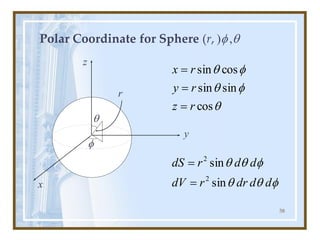
Polar Coordinate for Sphere (r,  ,











d
d
dr
r
dV
d
d
r
dS
r
z
r
y
r
x
sin
sin
cos
sin
sin
cos
sin
2
2
=
=
=
=
=
y
x
r
z


59
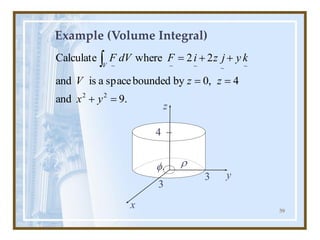
Example (Volume Integral)
.
9
and
4
,
0
by
bounded
space
a
is
and
2
2
where
Calculate
2
2
~
~
~
~
~
=
+
=
=
+
+
=

y
x
z
z
V
k
y
j
z
i
F
dV
F
V
x
z

y

4 -
3
3
60
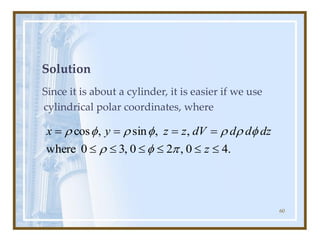
Solution
Since it is about a cylinder, it is easier if we use
cylindrical polar coordinates, where
.
4
0
,
2
0
,
3
0
where
,
,
sin
,
cos






=
=
=
=
z
dz
d
d
dV
z
z
y
x










61
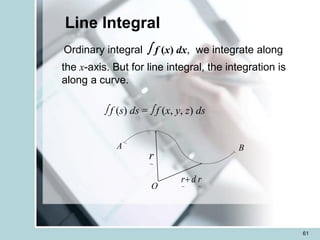
Line Integral
Ordinary integral  f (x) dx, we integrate along
the x-axis. But for line integral, the integration is
along a curve.
 f (s) ds =  f (x, y, z) ds
A
O
B
~
~
r
d
r+
~
r
62
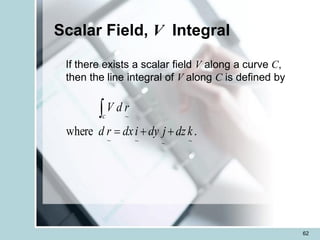
Scalar Field, V Integral
If there exists a scalar field V along a curve C,
then the line integral of V along C is defined by
.
where
~
~
~
~
~
k
dz
j
dy
i
dx
r
d
r
d
V
c
+
+
=

63
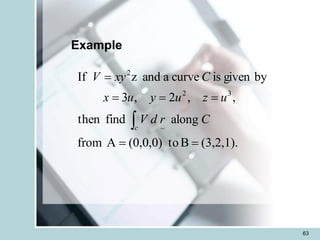
Example
(3,2,1).
B
to
(0,0,0)
A
from
along
find
then
,
,
2
,
3
by
given
is
curve
a
and
z
If
~
3
2
2
=
=
=
=
=
=
 C
r
d
V
u
z
u
y
u
x
C
xy
V
c
64
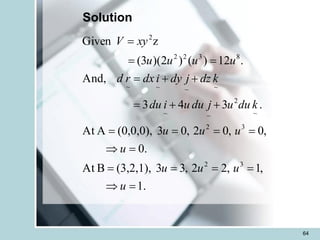
Solution
.
1
,
1
,
2
2
,
3
3
(3,2,1),
B
At
.
0
,
0
,
0
2
,
0
3
(0,0,0),
A
At
.
3
4
3
And,
.
12
)
(
)
2
)(
3
(
z
Given
3
2
3
2
~
2
~
~
~
~
~
~
8
3
2
2
2
=

=
=
=
=
=

=
=
=
=
+
+
=
+
+
=
=
=
=
u
u
u
u
u
u
u
u
k
du
u
j
du
u
i
du
k
dz
j
dy
i
dx
r
d
u
u
u
u
xy
V
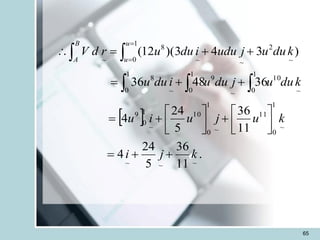
65
 
.
11
36
5
24
4
11
36
5
24
4
36
48
36
)
3
4
3
)(
12
(
~
~
~
~
1
0
11
~
1
0
10
~
1
0
9
1
0 ~
10
1
0
~
9
1
0
~
8
1
0 ~
2
~
~
8
~
k
j
i
k
u
j
u
i
u
k
du
u
j
du
u
i
du
u
k
du
u
j
udu
i
du
u
r
d
V
u
u
B
A
+
+
=






+






+
=
+
+
=
+
+
=

 



=
=
66
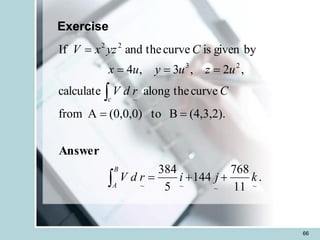
Exercise
.
11
768
144
5
384
(4,3,2).
B
to
(0,0,0)
A
from
curve
the
along
calculate
,
2
,
3
,
4
by
given
is
curve
the
and
If
~
~
~
~
~
2
3
2
2
k
j
i
r
d
V
C
r
d
V
u
z
u
y
u
x
C
yz
x
V
B
A
c
+
+
=
=
=
=
=
=
=


Answer
67
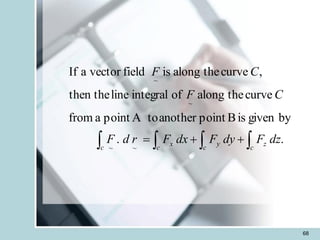
Vector Field, Integral
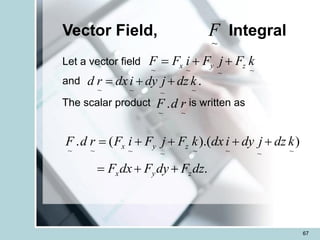
Let a vector field
and
The scalar product is written as
.
)
).(
(
.
~
~
~
~
~
~
~
~
dz
F
dy
F
dx
F
k
dz
j
dy
i
dx
k
F
j
F
i
F
r
d
F
z
y
x
z
y
x
+
+
=
+
+
+
+
=
~
F
~
~
~
~
k
F
j
F
i
F
F z
y
x +
+
=
.
~
~
~
~
k
dz
j
dy
i
dx
r
d +
+
=
~
~
. r
d
F
68
.
.
by
given
is
B
point
another
A to
point
a
from
curve
the
along
of
integral
line
then the
,
curve
the
along
is
field
vector
a
If
~
~
~
~



 +
+
=
c
z
c
y
c
x
c
dz
F
dy
F
dx
F
r
d
F
C
F
C
F
69
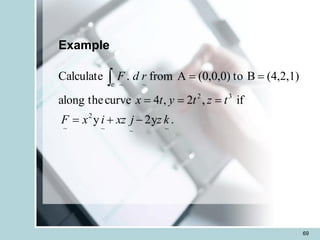
Example
.
y
2
y
if
,
2
,
4
curve
the
along
(4,2,1)
B
to
(0,0,0)
A
from
.
Calculate
~
~
~
2
~
3
2
~
~
k
z
j
xz
i
x
F
t
z
t
y
t
x
r
d
F
c
-
+
=
=
=
=
=
=

70
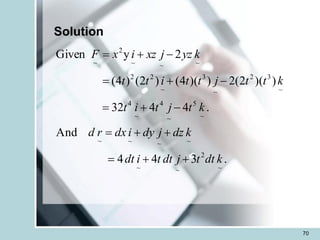
Solution
.
3
4
4
And
.
4
4
32
)
(
)
2
(
2
)
(
)
4
(
)
2
(
)
4
(
2
y
Given
~
2
~
~
~
~
~
~
~
5
~
4
~
4
~
3
2
~
3
~
2
2
~
~
~
2
~
k
dt
t
j
dt
t
i
dt
k
dz
j
dy
i
dx
r
d
k
t
j
t
i
t
k
t
t
j
t
t
i
t
t
k
yz
j
xz
i
x
F
+
+
=
+
+
=
-
+
=
-
+
=
-
+
=
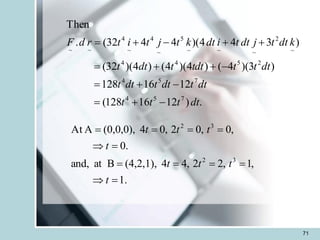
71
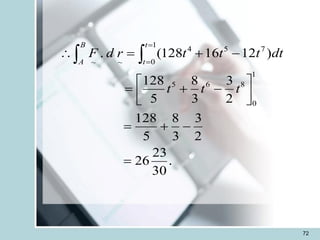
.
)
12
16
128
(
12
16
128
)
3
)(
4
(
)
4
)(
4
(
)
4
)(
32
(
)
3
4
4
)(
4
4
32
(
.
Then
7
5
4
7
5
4
2
5
4
4
~
2
~
~
~
5
~
4
~
4
~
~
dt
t
t
t
dt
t
dt
t
dt
t
dt
t
t
tdt
t
dt
t
k
dt
t
j
dt
t
i
dt
k
t
j
t
i
t
r
d
F
-
+
=
-
+
=
-
+
+
=
+
+
-
+
=
.
1
,
1
,
2
2
,
4
4
(4,2,1),
B
at
and,
.
0
,
0
,
0
2
,
0
4
(0,0,0),
A
At
3
2
3
2
=

=
=
=
=
=

=
=
=
=
t
t
t
t
t
t
t
t
72
.
30
23
26
2
3
3
8
5
128
2
3
3
8
5
128
)
12
16
128
(
.
1
0
8
6
5
1
0
7
5
4
~
~
=
-
+
=






-
+
=
-
+
=
 

=
=
t
t
t
dt
t
t
t
r
d
F
t
t
B
A
73
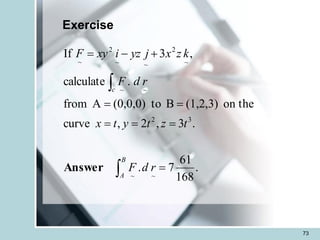
Exercise
.
168
61
7
.
.
3
,
2
,
curve
on the
(1,2,3)
B
to
(0,0,0)
A
from
.
calculate
,
3
If
~
~
3
2
~
~
~
2
~
~
2
~
=
=
=
=
=
=
+
-
=


r
d
F
t
z
t
y
t
x
r
d
F
k
z
x
j
yz
i
xy
F
B
A
c
Answer
78
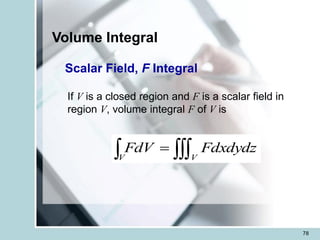
Volume Integral
Scalar Field, F Integral
If V is a closed region and F is a scalar field in
region V, volume integral F of V is

 =
V
V
Fdxdydz
FdV
79
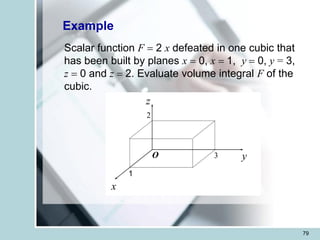
Example
Scalar function F = 2 x defeated in one cubic that
has been built by planes x = 0, x = 1, y = 0, y = 3,
z = 0 and z = 2. Evaluate volume integral F of the
cubic.
z
x
y
3
O
2
1
80
  
 = = =
=
2
0
3
0
1
0
2
z y x
V
xdxdydz
FdV
Solution
6
]
[
3
3
]
[
2
1
.
2
2
1
2
2
2
2
0
2
0
3
0
2
0
2
0
3
0
1
0
2
0
3
0
2
=
=
=
=
=






=


 
 
=
=
= =
= =
z
dz
dz
y
dydz
dydz
x
z
z
z y
z y
81
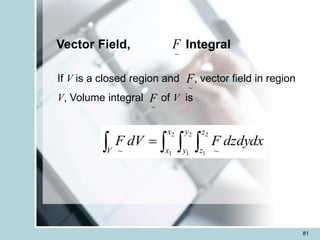
Vector Field, Integral
~
F
If V is a closed region and , vector field in region
V, Volume integral of V is
~
F
~
F
   
=
V
x
x
y
y
z
z
dzdydx
F
dV
F
2
1
2
1
2
1 ~
~
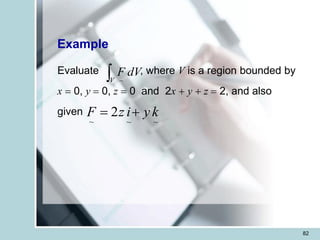
82
, where V is a region bounded by
x = 0, y = 0, z = 0 and 2x + y + z = 2, and also
given
V
dV
F
~
~
~
~
2 k
y
i
z
F +
=
Example
Evaluate
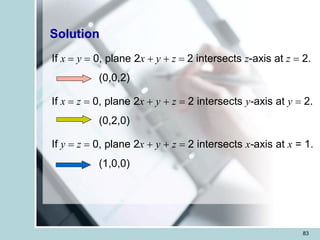
83
If x = y = 0, plane 2x + y + z = 2 intersects z-axis at z = 2.
(0,0,2)
If x = z = 0, plane 2x + y + z = 2 intersects y-axis at y = 2.
(0,2,0)
If y = z = 0, plane 2x + y + z = 2 intersects x-axis at x = 1.
(1,0,0)
Solution
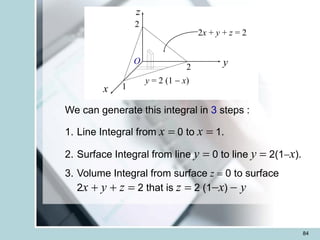
84
We can generate this integral in 3 steps :
1. Line Integral from x = 0 to x = 1.
2. Surface Integral from line y = 0 to line y = 2(1-x).
3. Volume Integral from surface z = 0 to surface
2x + y + z = 2 that is z = 2 (1-x) - y
z
x
y
2
O
2
1
2x + y + z = 2
y = 2 (1 - x)
85
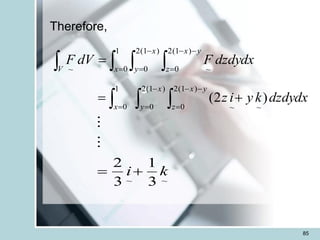
Therefore,
   
=
-
=
-
-
=
=
V x
x
y
y
x
z
dzdydx
F
dV
F
1
0
)
1
(
2
0
)
1
(
2
0 ~
~
 

-
=
-
-
=
=
+
=
)
1
(
2
0
)
1
(
2
0 ~
~
1
0
)
2
(
x
y
y
x
z
x
dzdydx
k
y
i
z
~
~ 3
1
3
2
k
i+
=


86
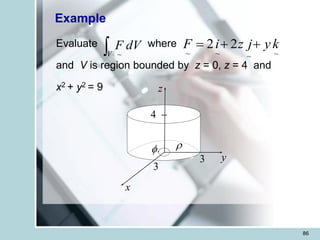
Example
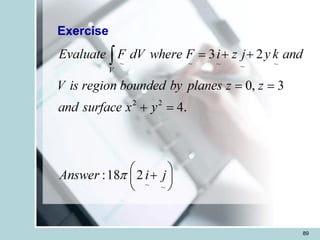
Evaluate where
and V is region bounded by z = 0, z = 4 and
x2 + y2 = 9
V
dV
F
~ ~
~
~
~
2
2 k
y
j
z
i
F +
+
=
x
z

y

4 -
3
3
87
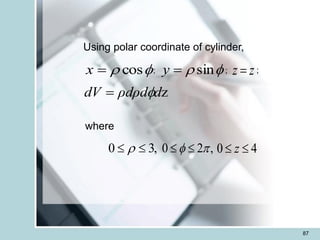

 cos
=
x 
 sin
=
y z
z =
z
d
ρdρd
dV 
=
; ; ;
where
,
3
0 
  ,
2
0 
 
 4
0 
 z
Using polar coordinate of cylinder,
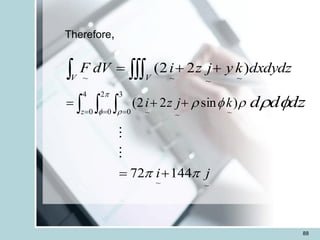
88
  +
+
=
V V
dxdydz
k
y
j
z
i
dV
F )
2
2
(
~
~
~
~
Therefore,
  
= = =
+
+
=
4
0
2
0
3
0 ~
~
~
)
sin
2
2
(
z
k
j
z
i

 


 dz
d
d 

~
~
144
72 j
i 
 +
=


89
Exercise
90
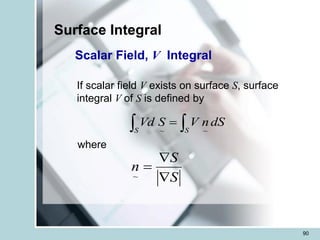
Surface Integral
Scalar Field, V Integral
If scalar field V exists on surface S, surface
integral V of S is defined by
 
=
S S
dS
n
V
S
Vd
~
~
where
S
S
n


=
~
91
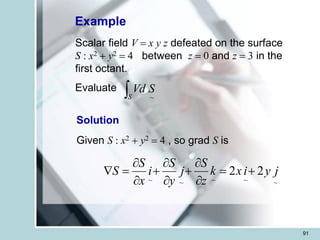
Example
Scalar field V = x y z defeated on the surface
S : x2 + y2 = 4 between z = 0 and z = 3 in the
first octant.
Evaluate
S
S
Vd
~
Solution
Given S : x2 + y2 = 4 , so grad S is
~
~
~
~
~
2
2 j
y
i
x
k
z
S
j
y
S
i
x
S
S +
=


+


+


=

92
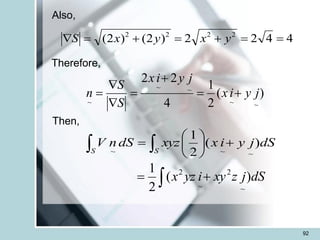
Also,
4
4
2
2
)
2
(
)
2
( 2
2
2
2
=
=
+
=
+
=
 y
x
y
x
S
Therefore,
)
(
2
1
4
2
2
~
~
~
~
~
j
y
i
x
j
y
i
x
S
S
n +
=
+
=


=
Then,
  +






=
S S
dS
j
y
i
x
xyz
dS
n
V )
(
2
1
~
~
~
 +
= dS
j
z
xy
i
yz
x )
(
2
1
~
2
~
2
93
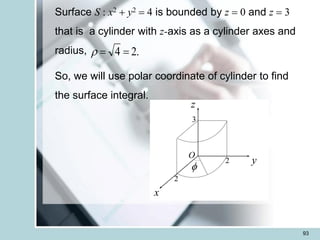
Surface S : x2 + y2 = 4 is bounded by z = 0 and z = 3
that is a cylinder with z-axis as a cylinder axes and
radius,
So, we will use polar coordinate of cylinder to find
the surface integral.
.
2
4 =
=

x
z

y
2
2
3
O
94
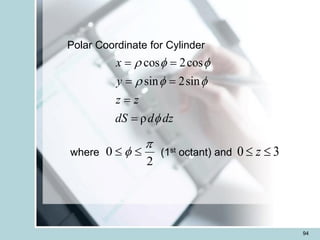
Polar Coordinate for Cylinder
cos 2cos
sin 2sin
ρ
x
y
z z
dS d dz
  
  

= =
= =
=
=
where
2
0

 
 3
0 
 z
(1st octant) and
95
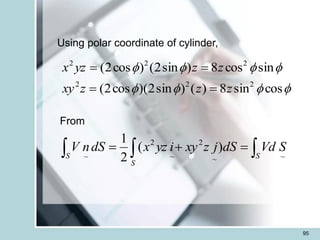
Using polar coordinate of cylinder,








cos
sin
8
)
(
)
sin
2
)(
cos
2
(
sin
cos
8
)
sin
2
(
)
cos
2
(
2
2
2
2
2
2
z
z
z
xy
z
z
yz
x
=
=
=
=
From


 =
+
=
S
S
S
S
Vd
dS
j
z
xy
i
yz
x
dS
n
V
~
~
2
~
2
~
)
(
2
1
96
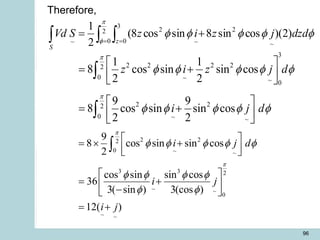
  
= =
+
=
S
z
dzd
j
z
i
z
S
Vd 2
0
3
0 ~
2
~
2
~
)
2
)(
cos
sin
8
sin
cos
8
(
2
1 






3
2 2 2 2
2
0 ~ ~ 0
2 2
2
0 ~ ~
1 1
8 cos sin sin cos
2 2
9 9
8 cos sin sin cos
2 2
z i z j d
i j d


    
    
 
= +
 
 
 
= +
 
 


2 2
2
0 ~ ~
3 3 2
~ ~
0
~ ~
9
8 cos sin sin cos
2
cos sin sin cos
36
3( sin ) 3(cos )
12( )
i j d
i j
i j


    
   
 
 
=  +
 
 
 
= +
 
-
 
= +

Therefore,
97
2
2 2
~
,
9
0 2
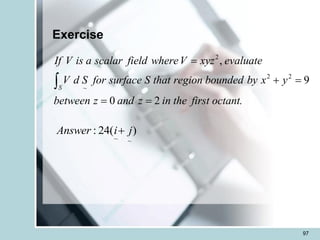
S
If V is a scalar field whereV xyz evaluate
V d S for surface S that region bounded by x y
between z and z in the first octant.
=
+ =
= =

Exercise
~ ~
: 24( )
Answer i j
+
98
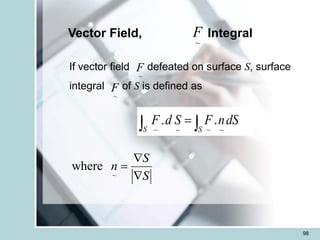
Vector Field, Integral
If vector field defeated on surface S, surface
integral of S is defined as

 =
S
S
dS
n
F
S
d
F .
.
~
~
~
~
~
F
~
F
~
F
~
where
S
n
S

=

99
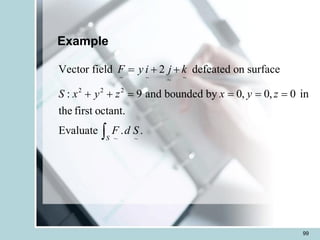
Example
~ ~ ~
~
2 2 2
~ ~
Vector field 2 defeated on surface
: 9 and bounded by 0, 0, 0 in
the first octant.
Evaluate . .
S
F y i j k
S x y z x y z
F d S
= + +
+ + = = = =

100
Solution
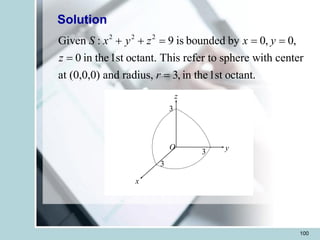
2 2 2
Given : 9 is bounded by 0, 0,
0 in the1st octant. This refer to sphere with center
at (0,0,0) and radius, 3, in the1st octant.
S x y z x y
z
r
+ + = = =
=
=
x
z
y
3
3
3
O
101
~ ~
~
~ ~
~
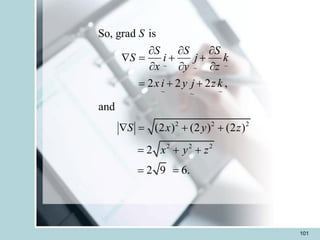
2 2 2
2 2 2
So, grad is
2 2 2 ,
and
(2 ) (2 ) (2 )
2
2 9 6.
S
S S S
S i j k
x y z
x i y j z k
S x y z
x y z
  
 = + +
  
= + +
 = + +
= + +
= =
102
~ ~
~ ~
~ ~ ~ ~
~ ~
Therefore,
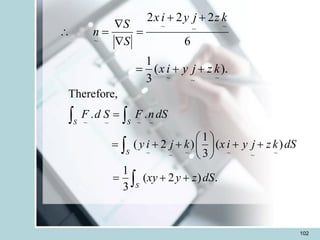
. .
1
( 2 ) ( )
3
1
( 2 ) .
3
S S
S
S
F d S F ndS
y i j k x i y j z k dS
xy y z dS
=
 
= + + + +
 
 
= + +
 


).
(
3
1
6
2
2
2
~
~
~
~
~
~
~
k
z
j
y
i
x
k
z
j
y
i
x
S
S
n
+
+
=
+
+
=


=

103
Using polar coordinate of sphere,
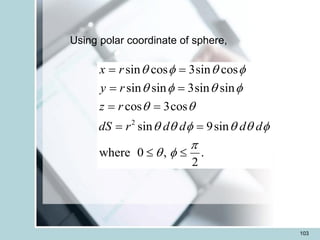
2
sin cos 3sin cos
sin sin 3sin sin
cos 3cos
sin 9sin
where 0 , .
2
x r
y r
z r
dS r d d d d
   
   
 
     

 
= =
= =
= =
= =
 
104



















 
 
 
 
d
d
d
d
S
d
F
S
]
cos
sin
sin
sin
2
cos
sin
sin
3
[
9
]
sin
9
[
]
cos
3
)
sin
sin
3
(
2
)
sin
sin
3
)(
cos
sin
3
[(
3
1
.
2
0 0
3
0 0
~
~
2 2
2 2
+
+
=
+
+
=

 
  
= =
= =






+
=
4
3
1
9



105
Exercise
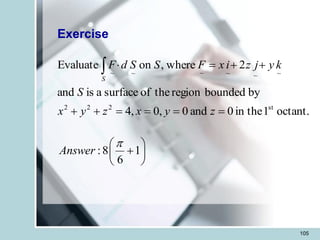
octant.
1
in the
0
and
0
,
0
,
4
by
bounded
region
the
of
surface
a
is
and
2
where
,
on
Evaluate
st
2
2
2
~
~
~
~
~
~
=
=
=
=
+
+
+
+
=


z
y
x
z
y
x
S
k
y
j
z
i
x
F
S
S
d
F
S
:8 1
6
Answer

 
+
 
 
106
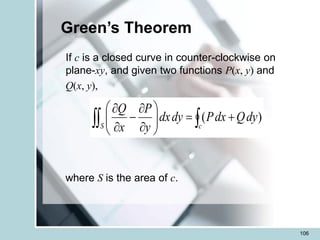
Green’s Theorem
If c is a closed curve in counter-clockwise on
plane-xy, and given two functions P(x, y) and
Q(x, y),
where S is the area of c.

 +
=










-


c
S
dy
Q
dx
P
dy
dx
y
P
x
Q
)
(
107
Example
2 2
2 2
Prove Green's Theorem for
[( ) ( 2 ) ]
which has been evaluated by boundary that defined as
0, 0 4 in the first quarter.
c
x y dx x y dy
x y and x y
+ + +
= = + =

y
2
x
2
C3
C2
C1
O
x2 + y2 = 22
Solution
108
1 1
2 2
2 2
1 2 3
1
2 2
2
2
0
2
3
0
Given [( ) ( 2 ) ] where
and 2 . We defined curve
as , .
i) For : 0, 0 0 2
( ) ( ) ( 2 )
1 8
.
3 3
c
c c
x y dx x y dy
P x y Q x y c
c c and c
c y dy and x
Pdx Qdy x y dx x y dy
x dx
x
+ + +
= + = +
= =  
 
+ = + + +
 
=
 
= =
 
 

 

109
2 2
2
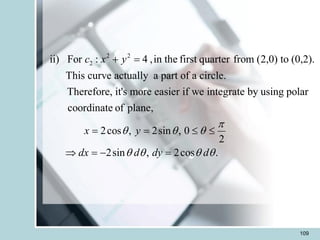
ii) For : 4 ,in the first quarter from (2,0) to (0,2).
This curve actually a part of a circle.
Therefore, it's more easier if we integrate by using polar
coordinate of plane,
2cos , 2sin , 0
c x y
x y
 
+ =
= =
2
2sin , 2cos .
dx d dy d


   
 
 = - =
110
 
 
.
4
4
8
sin
4
2
sin
2
cos
8
)
cos
sin
8
2
cos
2
2
sin
8
(
)
cos
sin
8
cos
4
sin
8
(
)]
cos
2
))(
sin
2
(
2
cos
2
((
)
sin
2
)(
)
sin
2
(
)
cos
2
((
[
)
2
(
)
(
)
(
2
2
2
2
2
2
0
2
0
0
2
2
2
0
2
2
-
=
+
+
-
=
+
+
+
=
+
+
+
-
=
+
+
-
=
+
+
-
+
=
+
+
+
=
+

































d
d
d
d
dy
y
x
dx
y
x
Qdy
Pdx
c
c
111
3 3
3
2 2
0
2
0
2
2
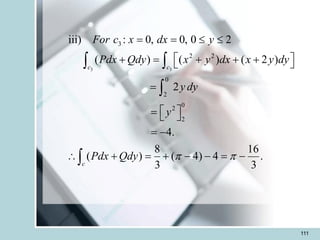
iii) : 0, 0, 0 2
( ) ( ) ( 2 )
2
4.
8 16
( ) ( 4) 4 .
3 3
c c
c
For c x dx y
Pdx Qdy x y dx x y dy
y dy
y
Pdx Qdy  
= =  
 
+ = + + +
 
=
 
=  
= -
 + = + - - = -
 


112
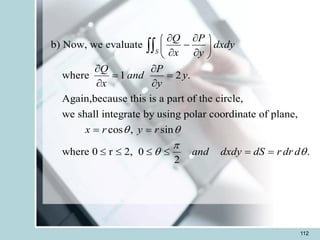
b) Now, we evaluate
where 1 2 .
Again,because this is a part of the circle,
we shall integrate by using polar coordinate of plane,
cos , sin
where
S
Q P
dxdy
x y
Q P
and y
x y
x r y r
 
 
 
-
 
 
 
 
= =
 
= =

0 r 2, 0 .
2
and dxdy dS r dr d

 
    = =
113
.
3
16
cos
3
16
2
sin
3
16
2
sin
3
2
2
1
)
sin
2
1
(
)
2
1
(
2
2
2
2
0
0
2
0
0
3
2
0
2
0
-
=






+
=






-
=






-
=
-
=
-
=










-




 


=
=
= =
















d
d
r
r
d
dr
r
r
dy
dx
y
dy
dx
y
P
x
Q
r
S
S
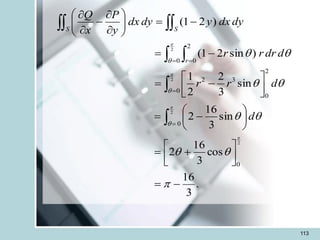
114
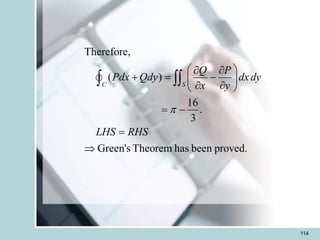
Therefore,
( )
16
.
3
Green's Theorem has been proved.
C S
Q P
Pdx Qdy dxdy
x y
LHS RHS

 
 
+ = -
 
 
 
= -
=

 
115
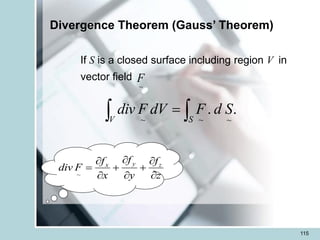
Divergence Theorem (Gauss’ Theorem)
If S is a closed surface including region V in
vector field
.
.
~
~
~ 
 =
S
V
S
d
F
dV
F
div
~
F
~
y
x z
f
f f
div F
x y z

 
= + +
  
116
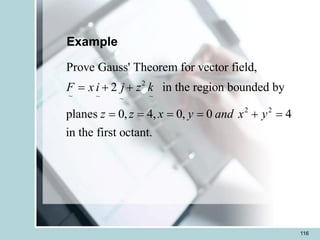
Example
2
~ ~ ~
~
2 2
Prove Gauss' Theorem for vector field,
2 in the region bounded by
planes 0, 4, 0, 0 4
in the first octant.
F x i j z k
z z x y and x y
= + +
= = = = + =
117
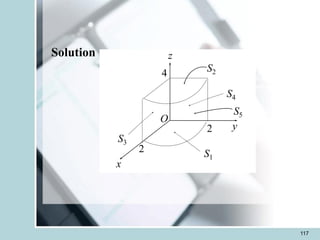
Solution
x
z
y
2
2
4
O
S3
S4
S2
S1
S5
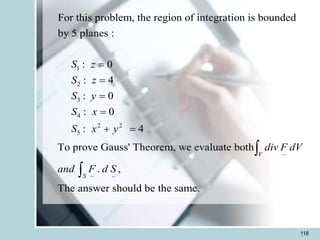
118
1
2
3
4
2 2
5
~
~ ~
For this problem, the region of integration is bounded
by 5 planes :
: 0
: 4
: 0
: 0
: 4
To prove Gauss' Theorem, we evaluate both
. ,
The answer should be the same.
V
S
S z
S z
S y
S x
S x y
div F dV
and F d S
=
=
=
=
+ =


119
2
~ ~ ~ ~
~
2
~
~
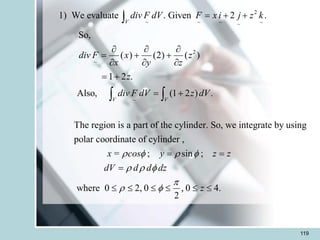
1) We evaluate . Given 2 .
So,
( ) (2) ( )
1 2 .
Also, (1 2 ) .
The region is a part of the cylinder. So, we integrate by using
polar c
V
V V
div F dV F x i j z k
div F x z
x y z
z
div F dV z dV
= + +
  
= + +
  
= +
= +

 
oordinate of cylinder ,
; sin ;
where 0 2, 0 , 0 4.
2
x = cos y z z
dV d d dz
z
   
  

 
= =
=
     
120
 
2
2
2
2
2
2
2 4
0 0 0
2
2 4
0
0 0
2
0 0
2 2
0
0
0
0
~
Therefore,
(1 2 ) (1 2 )
[ ]
(20 )
[10 ]
(40)
40
20 .
20 .
V z
V
z dV z dzd d
z z d d
d d
d
d
div F dV






 
 
 


  
  
  
 




= = =
= =
= =
=
=
+ = +
= +
=
=
=
=
=
 =
   
 
 



121
1
~ ~
~ ~
1
~ ~
~ ~ ~
~
~ ~ ~ ~
~
~ ~
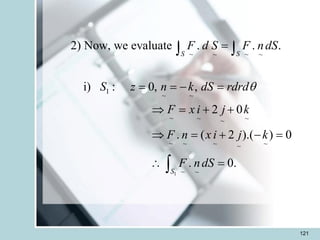
2) Now, we evaluate . . .
i) : 0, ,
2 0
. ( 2 ).( ) 0
. 0.
S S
S
F d S F ndS
S z n k dS rdrd
F x i j k
F n x i j k
F ndS

=
= = - =
 = + +
 = + - =
 =
 

122
2
2
2
~ ~
2
~ ~ ~ ~ ~
~ ~
~ ~ ~ ~ ~
~
2
2
0 0
~ ~
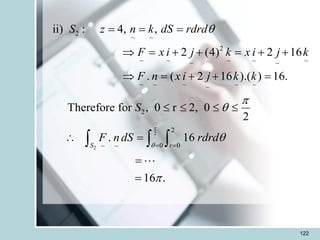
ii) : 4, ,
2 (4) 2 16
. ( 2 16 ).( ) 16.
Therefore for , 0 r 2, 0
2
. 16
16 .
S r
S z n k dS rdrd
F x i j k x i j k
F n x i j k k
S
F ndS rdrd







= =
= = =
 = + + = + +
 = + + =
   
 =
=
=
  
123
3
3
~ ~
2
~ ~ ~
~
2
~ ~ ~ ~
~ ~
3
2 4
0 0
~ ~
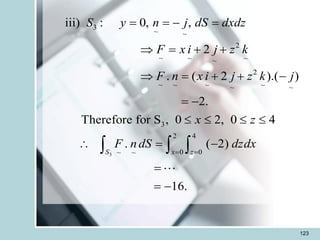
iii) : 0, ,
2
. ( 2 ).( )
2.
Therefore for S , 0 2, 0 4
. ( 2)
16.
S x z
S y n j dS dxdz
F x i j z k
F n x i j z k j
x z
F ndS dzdx
= =
= = - =
 = + +
 = + + -
= -
   
 = -
=
= -
  
124
4
4
~ ~
2 2
~ ~ ~ ~
~ ~
2
~ ~ ~ ~
~
~ ~
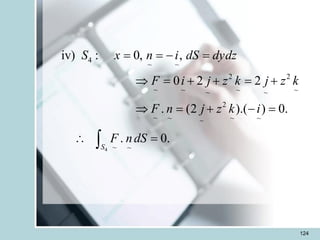
iv) : 0, ,
0 2 2
. (2 ).( ) 0.
. 0.
S
S x n i dS dydz
F i j z k j z k
F n j z k i
F ndS
= = - =
 = + + = +
 = + - =
 =

125
2 2
5
5 5
~ ~
~
5 ~
~
5
~ ~
5
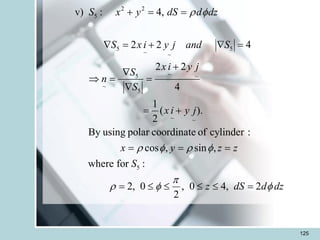
v) : 4,
2 2 4
2 2
4
1
( ).
2
By using polar coordinate of cylinder :
cos , sin ,
where for :
2, 0 , 0 4, 2
2
S x y dS d dz
S x i y j and S
x i y j
S
n
S
x i y j
x y z z
S
z dS d dz
 
   
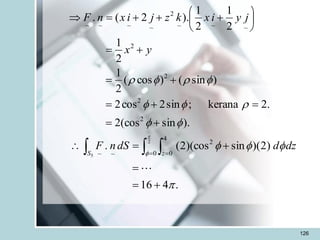

  
+ = =
 = +  =
+

 = =

= +
= = =
=     =
126
.
4
16
)
2
)(
sin
)(cos
2
(
.
).
sin
(cos
2
2.
kerana
;
sin
2
cos
2
)
sin
(
)
cos
(
2
1
2
1
2
1
2
1
).
2
(
.
5
2
0
4
0
2
~
~
2
2
2
2
~
~
~
2
~
~
~
~















+
=
=
+
=

+
=
=
+
=
+
=
+
=






+
+
+
=

  
= =

S z
dz
d
dS
n
F
y
x
j
y
i
x
k
z
j
i
x
n
F
127
1 2 3 4 5
~ ~ ~ ~ ~ ~
~ ~ ~ ~ ~ ~
~ ~
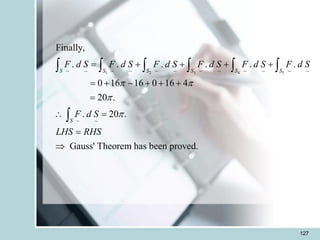
Finally,
. . . . . .
0 16 16 0 16 4
20 .
. 20 .
Gauss' Theorem has been proved.
S S S S S S
S
F d S F d S F d S F d S F d S F d S
F d S
LHS RHS
 


= + + + +
= + - + + +
=
 =
=

     

128
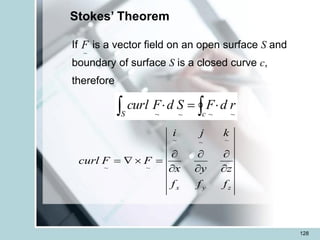
Stokes’ Theorem
If is a vector field on an open surface S and
boundary of surface S is a closed curve c,
therefore
  
=

S c
r
d
F
S
d
F
curl
~
~
~
~
~
F
~ ~
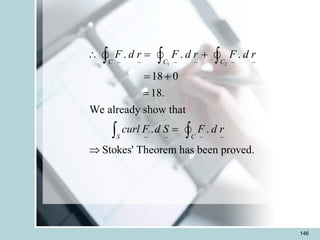
~
~ ~
x y z
i j k
curl F F
x y z
f f f
  
=   =
  
129
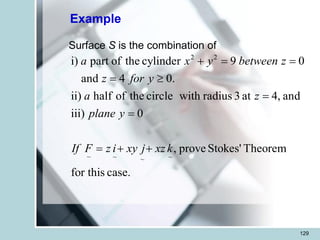
Example
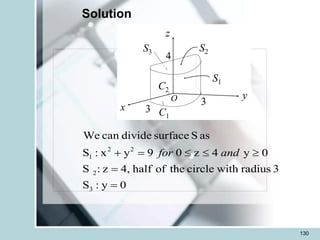
Surface S is the combination of
2 2
~ ~ ~
~
i) part of the cylinder 9 0
and 4 0.
ii) half of the circle with radius 3 at 4, and
iii) 0
, prove Stokes' Theorem
for this case.
a x y between z
z for y
a z
plane y
If F z i xy j xz k
+ = =
= 
=
=
= + +
130
Solution
2 2
1
2
3
We can divide surface S as
S : x y 9 0 z 4 y 0
S : z 4, half of the circle with radius 3
S : y 0
for and
+ =   
=
=
z
y
x
3
4
O
S3
C2
S2
C1
S1
3
131
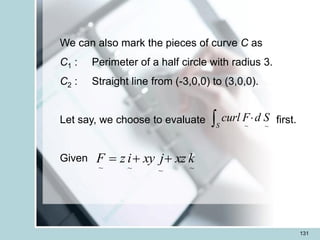
We can also mark the pieces of curve C as
C1 : Perimeter of a half circle with radius 3.
C2 : Straight line from (-3,0,0) to (3,0,0).
Let say, we choose to evaluate first.
Given
~ ~
S
curl F d S


~
~
~
~
k
xz
j
xy
i
z
F +
+
=
132
So,
~
~
~
~
~
~
~
~
~
)
1
(
)
(
)
(
)
(
)
(
)
(
)
(
k
y
j
z
k
z
y
xy
x
j
xz
x
z
z
i
xy
z
xz
y
xz
xy
z
z
y
x
k
j
i
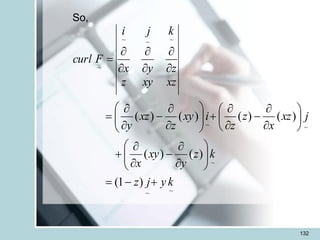
F
curl
+
-
=










-


+








-


+










-


=






=
133
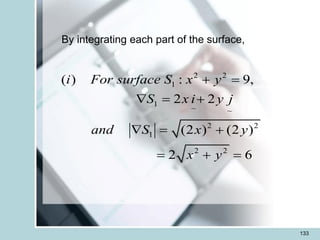
By integrating each part of the surface,
2 2
1
1
~ ~
2 2
1
2 2
( ) : 9,
2 2
(2 ) (2 )
2 6
i For surface S x y
S x i y j
and S x y
x y
+ =
 = +
 = +
= + =
134
)
(
3
1
6
2
2
~
~
~
~
1
1
~
j
y
i
x
j
y
i
x
S
S
n +
=
+
=


=
and
).
1
(
3
1
3
1
3
1
)
1
(
~
~
~
~
~
~
z
y
j
y
i
x
k
y
j
z
n
F
curl
-
=






+






 +
-
=

Then ,
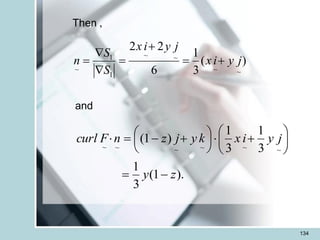
135
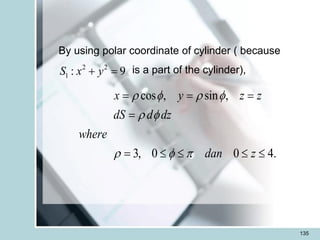
By using polar coordinate of cylinder ( because
is a part of the cylinder),
9
: 2
2
1 =
+ y
x
S
cos , sin ,
3, 0 0 4.
x y z z
dS d dz
where
dan z
   
 
  
= = =
=
=    
136
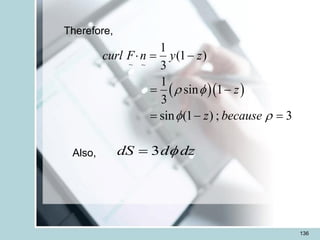
Therefore,
  
~ ~
1
(1 )
3
1
sin 1
3
sin (1 ) ; 3
curl F n y z
z
z because
 
 
 = -
= -
= - =
Also, dz
d
dS 
3
=
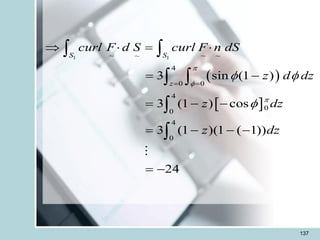
137
 
 
1 1
~ ~
~ ~
4
0 0
4
0
0
4
0
3 sin (1 )
3 (1 ) cos
3 (1 )(1 ( 1))
24
S S
z
curl F d S curl F n dS
z d dz
z dz
z dz



 

= =
  = 
= -
= - -
= - - -
= -
 
 


138
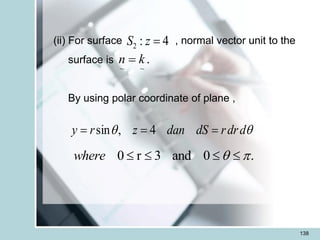
(ii) For surface , normal vector unit to the
surface is
By using polar coordinate of plane ,
4
:
2 =
z
S
.
~
~
k
n =

 d
dr
r
dS
dan
z
r
y =
=
= 4
,
sin
0 r 3 and 0 .
where  
   
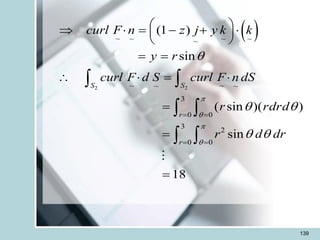
139
 
2 2
~ ~ ~ ~
~
~ ~
~ ~
3
0 0
3
2
0 0
(1 )
sin
( sin )( )
sin
18
S S
r
r
curl F n z j y k k
y r
curl F d S curl F n dS
r rdrd
r d dr





 
 
= =
= =
 
  = - + 
 
 
= =
  = 
=
=
=
 
 
 
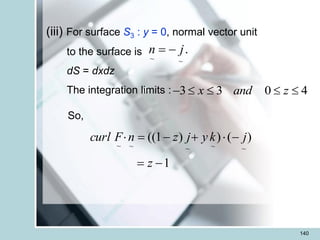
140
(iii) For surface S3 : y = 0, normal vector unit
to the surface is
dS = dxdz
The integration limits :
.
~
~
j
n -
=
3 3 0 4
x and z
-    
So,
1
)
(
)
)
1
((
~
~
~
~
~
-
=
-

+
-
=

z
j
k
y
j
z
n
F
curl
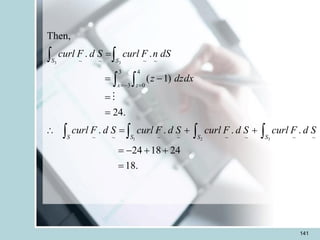
141
3 3
1 2 3
~ ~
~ ~
3 4
3 0
~ ~ ~ ~
~ ~ ~ ~
Then,
. .
( 1)
24.
. . . .
24 18 24
18.
S S
x z
S S S S
curl F d S curl F n dS
z dzdx
curl F d S curl F d S curl F d S curl F d S
=- =
=
= -
=
=
 = + +
= - + +
=
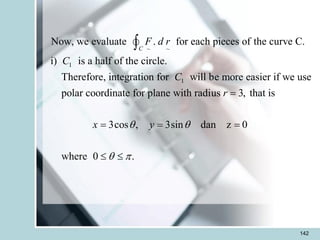
 
 
   
142
~ ~
1
1
Now, we evaluate . for each pieces of the curve C.
i) is a half of the circle.
Therefore, integration for will be more easier if we use
polar coordinate for plane with radius
C
F d r
C
C

3, that is
3cos , 3sin dan z 0
where 0 .
r
x y
 
 
=
= = =
 
143
~ ~ ~
~
~
~
~ ~
~
~ ~
(3cos )(3sin )
9sin cos
and
3sin 3cos .
F z i xy j xzk
j
j
dr dx i dy j dzk
d i d j
 
 
   
 = + +
=
=
= + +
= - +
144
1
2
~ ~
2
0
~ ~
3
0
From here,
. 27sin cos .
. 27sin cos
9cos
18.
C
F d r d
F d r d


  
  

=
 =
 
= -
 
=
 
145
2
2
~ ~ ~
~
~
~ ~
ii) Curve is a straight line defined as
, 0 z 0, where 3 3.
Therefore,
0.
. 0.
C
C
x t y and t
F z i xy j xz k
F d r
= = = -  
= + +
=
 =

146
1 2
~ ~ ~ ~ ~ ~
~ ~ ~
~
. . .
18 0
18.
We already show that
. .
Stokes' Theorem has been proved.
C C C
S C
F d r F d r F d r
curl F d S F d r
 = +
= +
=
=

  
 

Lectures Note on Vector Calculus Materials.pdf