Environmental
Engineering
LECTURE # 5
Previous Lecture was covered from Book
Example 7.1-7.3
Calculation of ThOD, BOD and COD.
Water Pollution in Rivers.
PREVIEW
Ultimate BOD and Factors
affecting BOD
Ultimate BOD (Lo) is defined as the maximum BOD exerted by the waste.
From a practical point of view, we can observe that when the BOD curve is approximately horizontal,
the ultimate BOD has been achieved.
While the ultimate BOD best expresses the concentration of degradable organic matter, it does not, by
itself, indicate how rapidly oxygen will be depleted in a receiving water.
Oxygen depletion is related to both the ultimate BOD and the BOD rate constant (k).
While the ultimate BOD increases in direct proportion to the concentration of degradable organic
matter, the numerical value of the rate constant is dependent on the following
Nature of the Waste
The ability of the organisms in the system to utilize the waste
The temperature
Nature of Waste
There are literally thousands of naturally occurring organic compounds, not all of which can be
degraded with equal ease. Simple sugars and starches are rapidly degraded and will therefore
have a very large BOD rate constant.
Cellulose degrades much more slowly, and hair and fingernails are almost undegradable in the
BOD test or in normal wastewater treatment.
Other compounds are intermediate between these extremes. The BOD rate constant for a
complex waste depends very much on the relative proportions of the various components.
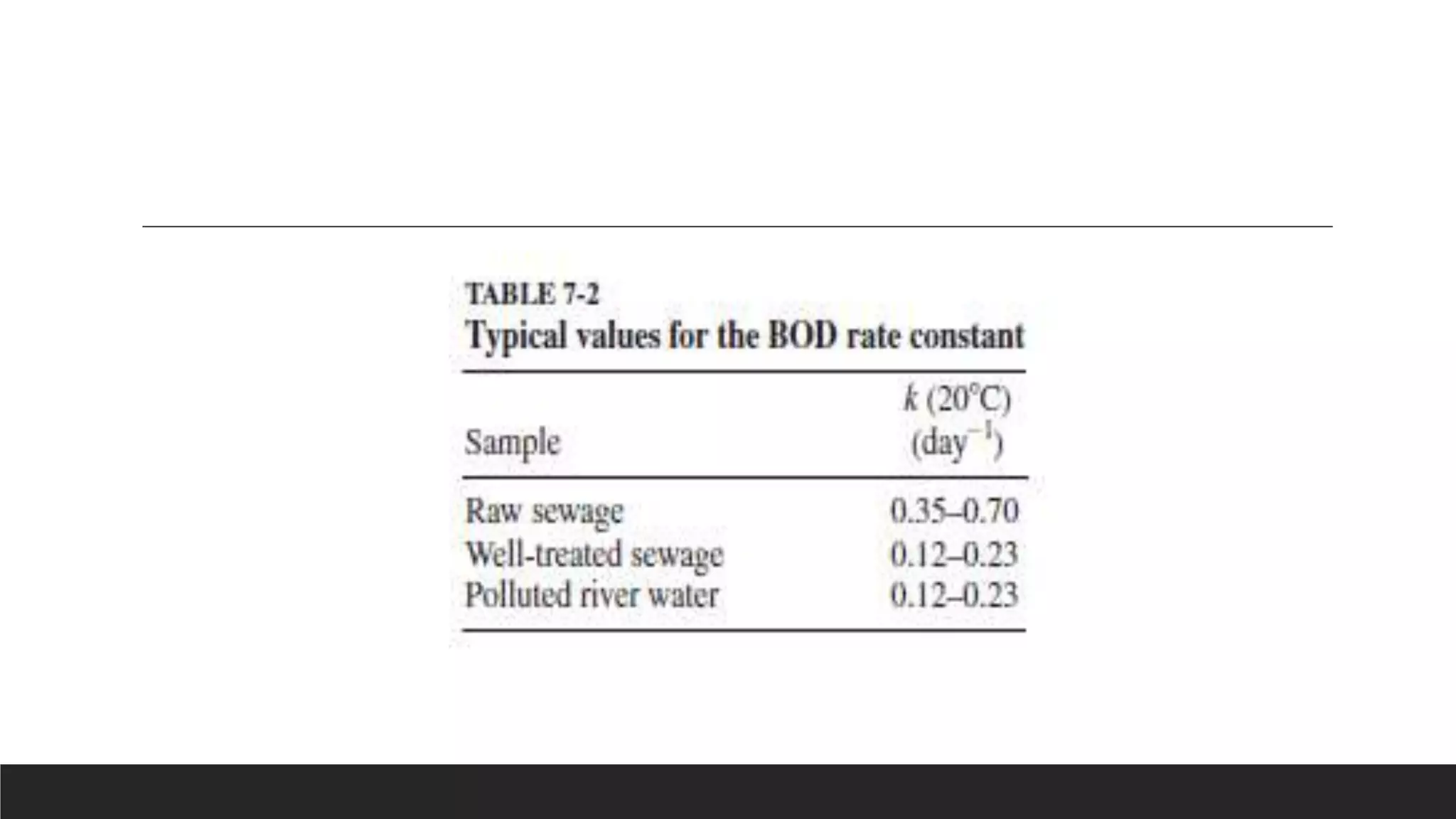
The lower rate constants for treated sewage compared to raw sewage result from the fact that
easily degradable organic compounds are more completely removed than less readily degradable
organic compounds during wastewater treatment.
Ability of Organisms to Utilize Waste
Any given microorganism is limited in its ability to utilize organic compounds. As a consequence,
many organic compounds can be degraded by only a small group of microorganisms.
In a natural environment receiving a continuous discharge of organic waste, that population of
organisms which can most efficiently utilize this waste will predominate.
However, the culture used to inoculate the BOD test may contain only a very small number of
organisms that can degrade the particular organic compounds in the waste. This problem is
especially common when analyzing industrial wastes.
The result is that the BOD rate constant is lower in the laboratory test than in the natural water
This is an undesirable outcome. The BOD test should therefore be conducted with organisms that
have been acclimated
to the waste so that the rate constant determined in the laboratory can be compared to that in the
river
Temperature
Most biological processes speed up as the temperature increases and slow down as the temperature
drops.
oxygen utilization is caused by the metabolism of microorganisms, the rate of utilization is similarly
affected by temperature.
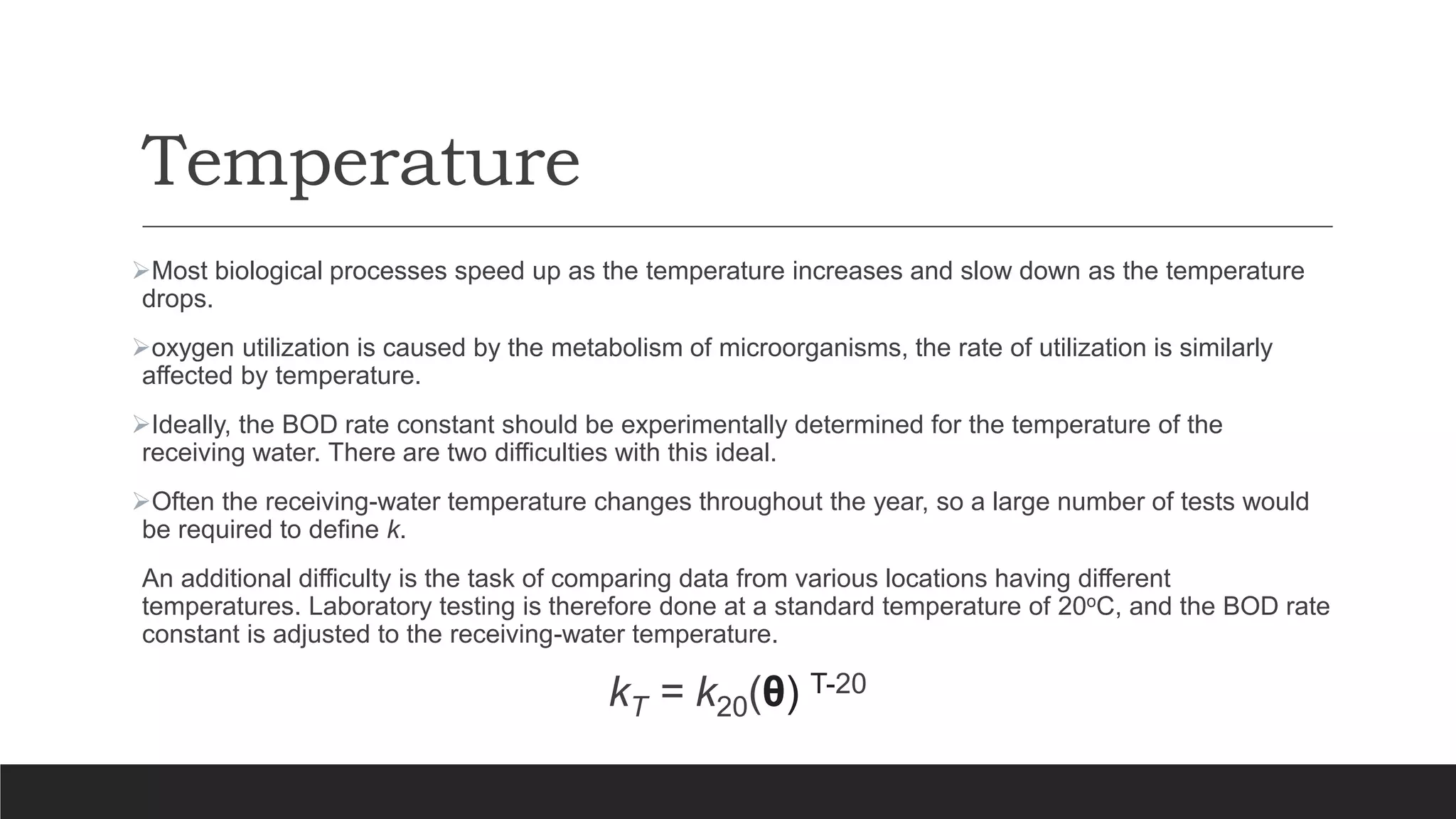
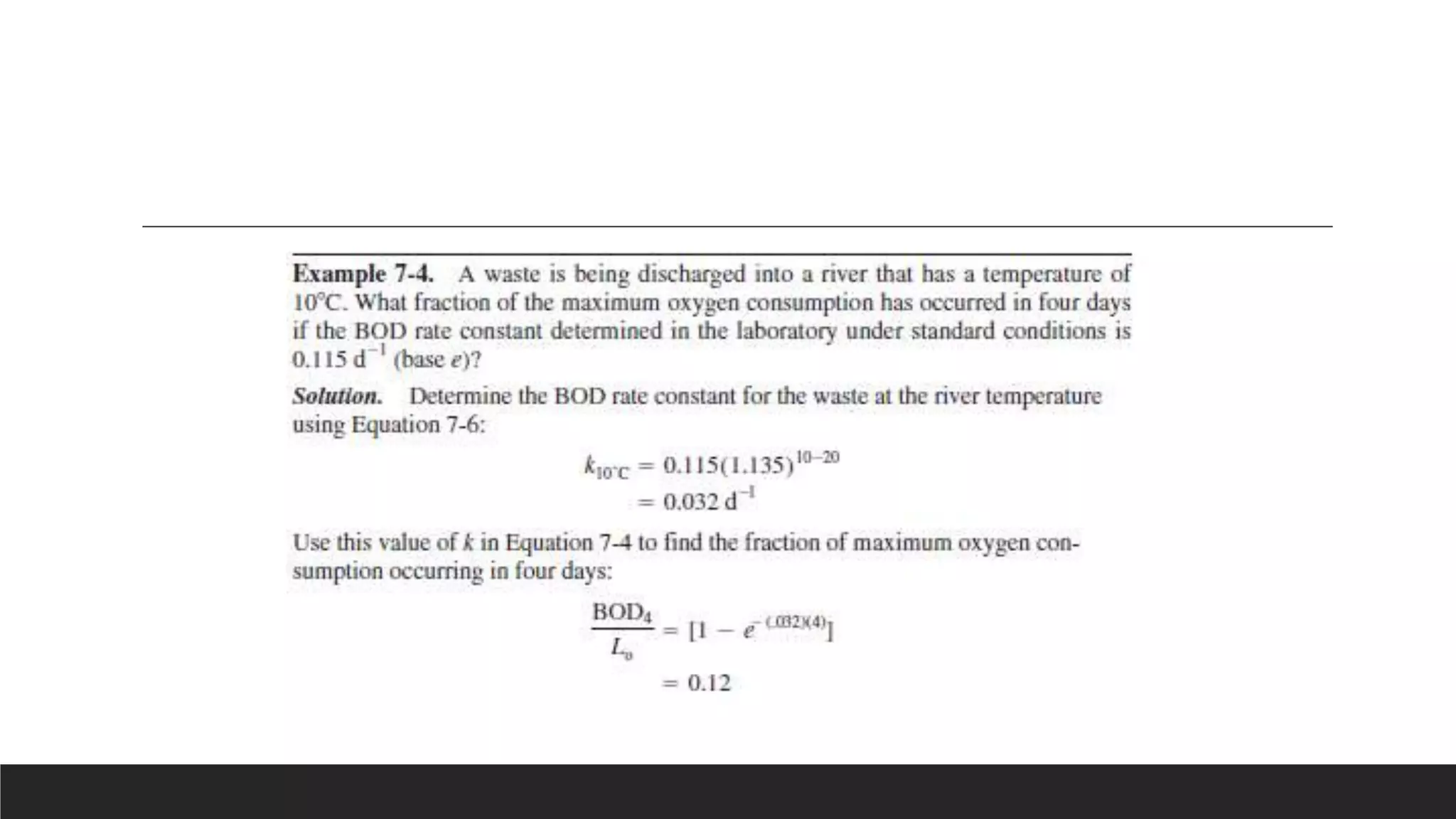
Ideally, the BOD rate constant should be experimentally determined for the temperature of the
receiving water. There are two difficulties with this ideal.
Often the receiving-water temperature changes throughout the year, so a large number of tests would
be required to define k.
An additional difficulty is the task of comparing data from various locations having different
temperatures. Laboratory testing is therefore done at a standard temperature of 20oC, and the BOD rate
constant is adjusted to the receiving-water temperature.
kT = k20(θ) T-20
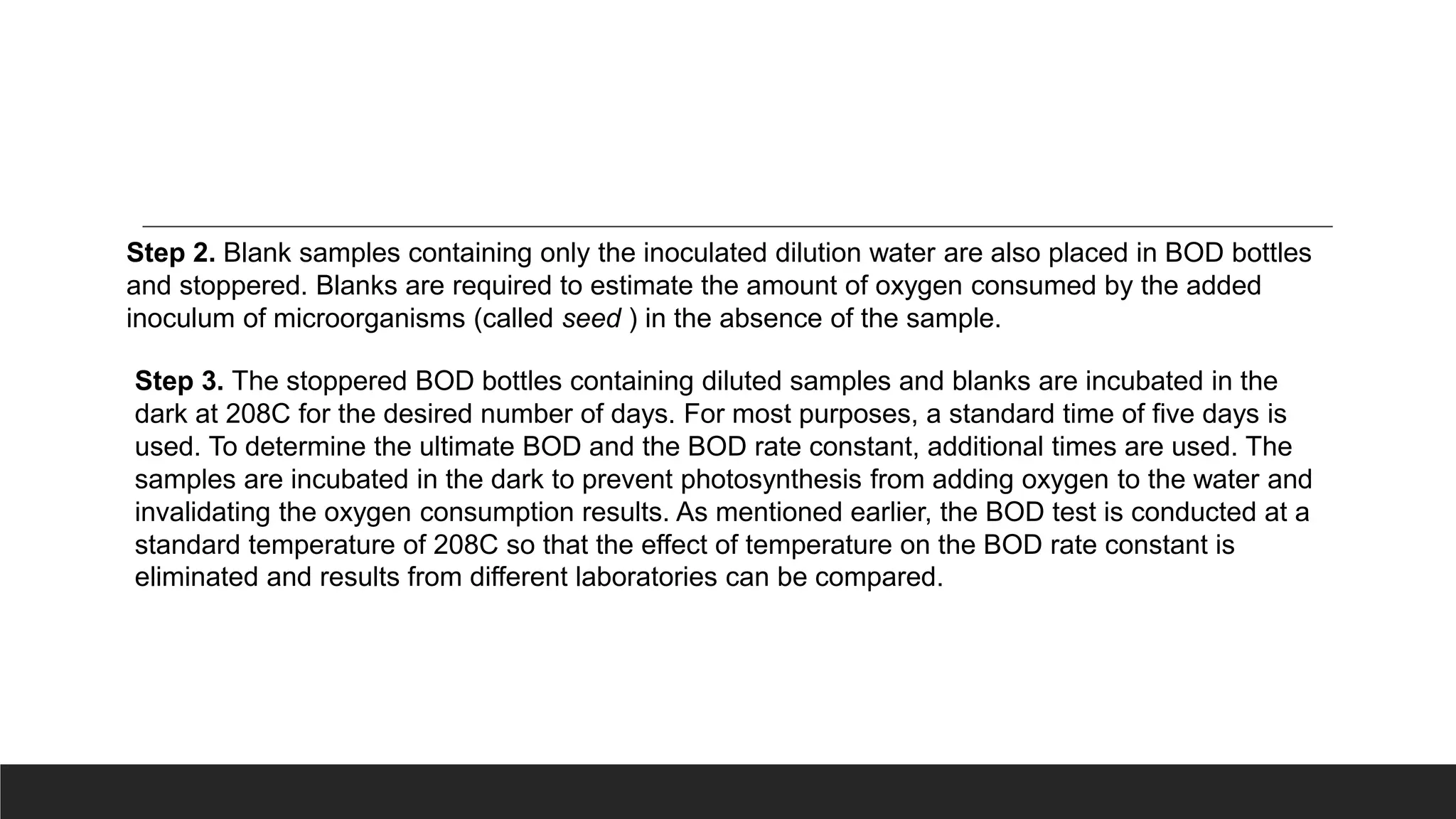
Step 2. Blank samples containing only the inoculated dilution water are also placed in BOD bottles
and stoppered. Blanks are required to estimate the amount of oxygen consumed by the added
inoculum of microorganisms (called seed ) in the absence of the sample.
Step 3. The stoppered BOD bottles containing diluted samples and blanks are incubated in the
dark at 208C for the desired number of days. For most purposes, a standard time of five days is
used. To determine the ultimate BOD and the BOD rate constant, additional times are used. The
samples are incubated in the dark to prevent photosynthesis from adding oxygen to the water and
invalidating the oxygen consumption results. As mentioned earlier, the BOD test is conducted at a
standard temperature of 208C so that the effect of temperature on the BOD rate constant is
eliminated and results from different laboratories can be compared.
Lecture-3.pptx

Lecture-3.pptx

  • 1.
  • 2.
    Previous Lecture wascovered from Book Example 7.1-7.3 Calculation of ThOD, BOD and COD. Water Pollution in Rivers. PREVIEW
  • 3.
    Ultimate BOD andFactors affecting BOD Ultimate BOD (Lo) is defined as the maximum BOD exerted by the waste. From a practical point of view, we can observe that when the BOD curve is approximately horizontal, the ultimate BOD has been achieved. While the ultimate BOD best expresses the concentration of degradable organic matter, it does not, by itself, indicate how rapidly oxygen will be depleted in a receiving water. Oxygen depletion is related to both the ultimate BOD and the BOD rate constant (k). While the ultimate BOD increases in direct proportion to the concentration of degradable organic matter, the numerical value of the rate constant is dependent on the following Nature of the Waste The ability of the organisms in the system to utilize the waste The temperature
  • 4.
    Nature of Waste Thereare literally thousands of naturally occurring organic compounds, not all of which can be degraded with equal ease. Simple sugars and starches are rapidly degraded and will therefore have a very large BOD rate constant. Cellulose degrades much more slowly, and hair and fingernails are almost undegradable in the BOD test or in normal wastewater treatment. Other compounds are intermediate between these extremes. The BOD rate constant for a complex waste depends very much on the relative proportions of the various components. The lower rate constants for treated sewage compared to raw sewage result from the fact that easily degradable organic compounds are more completely removed than less readily degradable organic compounds during wastewater treatment.
  • 6.
    Ability of Organismsto Utilize Waste Any given microorganism is limited in its ability to utilize organic compounds. As a consequence, many organic compounds can be degraded by only a small group of microorganisms. In a natural environment receiving a continuous discharge of organic waste, that population of organisms which can most efficiently utilize this waste will predominate. However, the culture used to inoculate the BOD test may contain only a very small number of organisms that can degrade the particular organic compounds in the waste. This problem is especially common when analyzing industrial wastes. The result is that the BOD rate constant is lower in the laboratory test than in the natural water This is an undesirable outcome. The BOD test should therefore be conducted with organisms that have been acclimated to the waste so that the rate constant determined in the laboratory can be compared to that in the river
  • 7.
    Temperature Most biological processesspeed up as the temperature increases and slow down as the temperature drops. oxygen utilization is caused by the metabolism of microorganisms, the rate of utilization is similarly affected by temperature. Ideally, the BOD rate constant should be experimentally determined for the temperature of the receiving water. There are two difficulties with this ideal. Often the receiving-water temperature changes throughout the year, so a large number of tests would be required to define k. An additional difficulty is the task of comparing data from various locations having different temperatures. Laboratory testing is therefore done at a standard temperature of 20oC, and the BOD rate constant is adjusted to the receiving-water temperature. kT = k20(θ) T-20
  • 11.
    Step 2. Blanksamples containing only the inoculated dilution water are also placed in BOD bottles and stoppered. Blanks are required to estimate the amount of oxygen consumed by the added inoculum of microorganisms (called seed ) in the absence of the sample. Step 3. The stoppered BOD bottles containing diluted samples and blanks are incubated in the dark at 208C for the desired number of days. For most purposes, a standard time of five days is used. To determine the ultimate BOD and the BOD rate constant, additional times are used. The samples are incubated in the dark to prevent photosynthesis from adding oxygen to the water and invalidating the oxygen consumption results. As mentioned earlier, the BOD test is conducted at a standard temperature of 208C so that the effect of temperature on the BOD rate constant is eliminated and results from different laboratories can be compared.