Abdisalam Issa-Salwe, Taibah University


                                                      Lecture 3


                                         Innovation and
                                        Entrepreneurship
                       (Information Systems Innovation and Technologies IS313)


                                              Abdisalam Issa-Salwe

                                       Taibah University
                          College of Computer Science & Engineering
                               Information Systems Department


    David Zilberman, Technology, Innovation, and Entrepreneurship, University of California, Berkeley


Topic list
 Entrepreneurship and marketing
 Innovation process
 Intellectual property rights
 Intellectual property rights and development
 Technology adoption and diffusion
 Marketing and adoption


                                                                                                        2


                                                                                                            1
About Entrepreneurship
 Entrepreneurs make things happen.
 They are individuals who take a concept and convert
 it into a reality.
    A product, policy or institution.
 They become the champions of a new process, and
 they are engines of change.
 Entrepreneurship occurs in all areas of life.
 Entrepreneurs are everywhere.
 Entrepreneurship can be used for good and evil.


                                                          3


About Entrepreneurship (cont…)

Entrepreneurs can be encouraged and promoted
Openness to new ideas, freedom from investigation of
operation, and promotion and pay based on merit
encourage entrepreneurship.
Excessive regulation, rigid hierarchy, lack of freedom,
and excess control discourage entrepreneurship.


                                                          4


                                                              2
Requirements of Entrepreneurs
 Entrepreneurs need a keen eye to understand
 economic, social, and scientific realities and the
 capacity to understand evolutionary processes in
 the future.
 They need to understand how institutions work, and
 individuals react in order to introduce activities and
 products that serve peoples’ need and that are
 sustainable economically and politically.
 Entrepreneurs also need dedication and
 commitments and the capacity to overcome failure.


                                                            5


Technology Adaptation and
Appropriateness
Rarely is the same technological solution optimal everywhere.
The value of an innovation depends on socio-economic, climatic,
and ecological specifics.
Important innovative activities adapt technological solutions to
specific conditions.
   Export of technologies across regions without adaptation may
   lead to negative environmental side effects and waste.
A technology may have several versions to meet needs and
capabilities of various users in a region, e.g., large vs. small
farmers’ versions of a machinery.
The establishment of an innovative capability starts with a
buildup of capacity to support and adopt innovations and new
technologies.


                                                            6


                                                                   3
Successful Entrepreneurship


    The key to success with entrepreneurship
    and innovation is moving from the
    invention of ideas to effective
    commercialization and acceptance in the
    marketplace


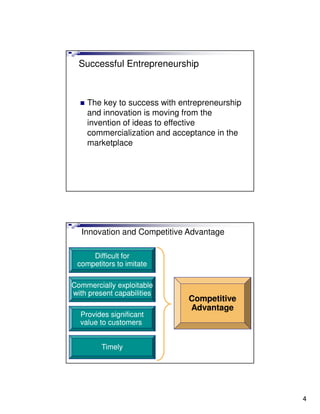
   Innovation and Competitive Advantage

     Difficult for
 competitors to imitate

Commercially exploitable
with present capabilities
                              Competitive
                              Advantage
  Provides significant
  value to customers


         Timely


                                               4
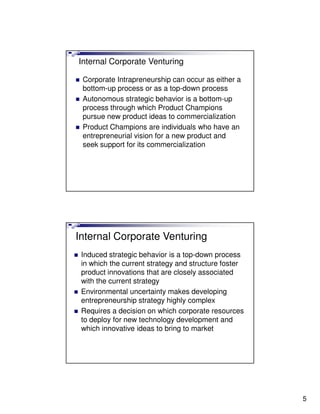
Internal Corporate Venturing

 Corporate Intrapreneurship can occur as either a
 bottom-up process or as a top-down process
 Autonomous strategic behavior is a bottom-up
 process through which Product Champions
 pursue new product ideas to commercialization
 Product Champions are individuals who have an
 entrepreneurial vision for a new product and
 seek support for its commercialization


Internal Corporate Venturing
 Induced strategic behavior is a top-down process
 in which the current strategy and structure foster
 product innovations that are closely associated
 with the current strategy
 Environmental uncertainty makes developing
 entrepreneurship strategy highly complex
 Requires a decision on which corporate resources
 to deploy for new technology development and
 which innovative ideas to bring to market


                                                      5
Cooperating to Produce Innovation

  Strategic alliances can help to foster innovation
  by combining the knowledge and resources of
  two or more partners
  Firms must focus on building knowledge,
  identifying core competencies and developing
  strong human resources to manage these
  projects
  Firms can also give away their core
  competencies by outsourcing to alliance
  partners rather than developing their own
  capabilities over time


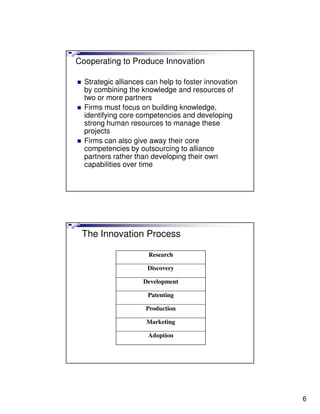
 The Innovation Process

                      Research

                      Discovery

                    Development

                      Patenting

                     Production

                     Marketing

                      Adoption


                                                      6
Induced Innovations
Innovations respond to need and economic
conditions.
Inventors, investors, and researchers put effort into
solving burning problems, and that leads to
innovations.
  Labor shortages led to mechanized equipment.
  Drought conditions led to improved irrigation.
  Energy crises led to higher efficiency cars.
  Farmers’ cooperatives were established during periods of
  excessive low farm prices.
Environmental regulations trigger cleaner
technologies.
  A tax on carbon will lead to improved stoves and power
  plants.                                              13


Various Types of Innovators
In the past most innovations were introduced by
practitioners. Even now practitioners are important
innovators. They identify a way to meet needs.
The scientific discoveries of the late 19th century
gave rise to science-based innovations (Edison, Bell,
Marconi).
Major companies (IBM, Sony, Bell, Kodak, GM) built
their own research labs.
Public sector labs made important agricultural and
environmental discoveries.
Universities and start-up companies are becoming
major sources of new innovations. The ownership of
a technology and leadership in its applications move
between organizations over time.
                                                       14


                                                             7
Incentives for Innovations
Patents: Awards monopoly rights for 17-20 years.
   Patent protection allows publication of research
   findings that leads to innovations.
   Patent rights (for certain applications) can be
   transferred.
   Patents are valid only where they are registered.
Copyright protection: Pertains to books, brand
names, and the media.
Trade secrets: Protects against thefts.
Plant breeders’ right: Allows exclusive sales of
varieties and allows farmers to reuse seeds.
Prizes: Awarded to winners of a contest for finding a
technical solution to a problem.
Indigenous knowledge is poorly protected.
                                                             15


Adoption and Diffusion

  The use of new technologies spreads gradually.
  There is a significant time lag between the time a new
  innovation is introduced and when it becomes widely
  used by producers or consumers.
  Diffusion is the aggregate process of product
  penetration.
     It is measured by the percentage of potential users
     who actually adopt a technology.
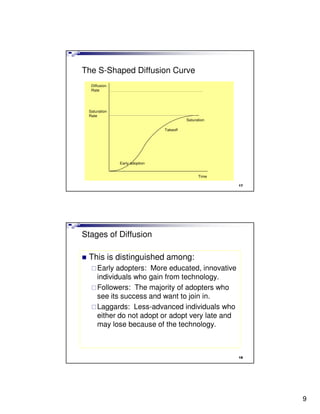
  Diffusion curves measure aggregate adoption as a
  function of time.
     They tend to be S-shaped.
  Adoption is a decision by a specific individual to use a
  technology. Diffusion is aggregate adoption.

                                                             16


                                                                  8
The S-Shaped Diffusion Curve
  Diffusion
  Rate


 Saturation
 Rate
                                         Saturation

                               Takeoff


              Early adoption


                                               Time

                                                      17


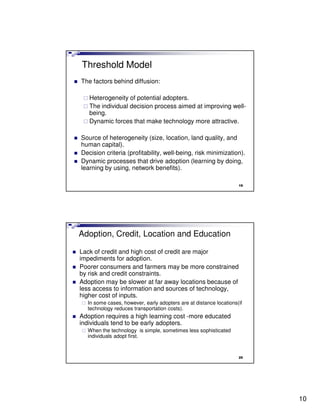
Stages of Diffusion

 This is distinguished among:
     Early adopters: More educated, innovative
     individuals who gain from technology.
     Followers: The majority of adopters who
     see its success and want to join in.
     Laggards: Less-advanced individuals who
     either do not adopt or adopt very late and
     may lose because of the technology.


                                                      18


                                                           9
Threshold Model
The factors behind diffusion:

   Heterogeneity of potential adopters.
   The individual decision process aimed at improving well-
   being.
   Dynamic forces that make technology more attractive.

Source of heterogeneity (size, location, land quality, and
human capital).
Decision criteria (profitability, well-being, risk minimization).
Dynamic processes that drive adoption (learning by doing,
learning by using, network benefits).

                                                                   19


Adoption, Credit, Location and Education

Lack of credit and high cost of credit are major
impediments for adoption.
Poorer consumers and farmers may be more constrained
by risk and credit constraints.
Adoption may be slower at far away locations because of
less access to information and sources of technology,
higher cost of inputs.
  In some cases, however, early adopters are at distance locations(if
  technology reduces transportation costs).
Adoption requires a high learning cost -more educated
individuals tend to be early adopters.
  When the technology is simple, sometimes less sophisticated
  individuals adopt first.


                                                                   20


                                                                        10
Reference

     David Zilberman, Technology, Innovation,
     and Entrepreneurship, University of
     California, Berkeley
     Abdisalam Issa-Salwe, Lecture Notes,
     Taibah University, 2010.


21


                                                11

Lecture3 is313-(innovation&enterpriseship)

  • 1.
    Abdisalam Issa-Salwe, TaibahUniversity Lecture 3 Innovation and Entrepreneurship (Information Systems Innovation and Technologies IS313) Abdisalam Issa-Salwe Taibah University College of Computer Science & Engineering Information Systems Department David Zilberman, Technology, Innovation, and Entrepreneurship, University of California, Berkeley Topic list Entrepreneurship and marketing Innovation process Intellectual property rights Intellectual property rights and development Technology adoption and diffusion Marketing and adoption 2 1
  • 2.
    About Entrepreneurship Entrepreneursmake things happen. They are individuals who take a concept and convert it into a reality. A product, policy or institution. They become the champions of a new process, and they are engines of change. Entrepreneurship occurs in all areas of life. Entrepreneurs are everywhere. Entrepreneurship can be used for good and evil. 3 About Entrepreneurship (cont…) Entrepreneurs can be encouraged and promoted Openness to new ideas, freedom from investigation of operation, and promotion and pay based on merit encourage entrepreneurship. Excessive regulation, rigid hierarchy, lack of freedom, and excess control discourage entrepreneurship. 4 2
  • 3.
    Requirements of Entrepreneurs Entrepreneurs need a keen eye to understand economic, social, and scientific realities and the capacity to understand evolutionary processes in the future. They need to understand how institutions work, and individuals react in order to introduce activities and products that serve peoples’ need and that are sustainable economically and politically. Entrepreneurs also need dedication and commitments and the capacity to overcome failure. 5 Technology Adaptation and Appropriateness Rarely is the same technological solution optimal everywhere. The value of an innovation depends on socio-economic, climatic, and ecological specifics. Important innovative activities adapt technological solutions to specific conditions. Export of technologies across regions without adaptation may lead to negative environmental side effects and waste. A technology may have several versions to meet needs and capabilities of various users in a region, e.g., large vs. small farmers’ versions of a machinery. The establishment of an innovative capability starts with a buildup of capacity to support and adopt innovations and new technologies. 6 3
  • 4.
    Successful Entrepreneurship The key to success with entrepreneurship and innovation is moving from the invention of ideas to effective commercialization and acceptance in the marketplace Innovation and Competitive Advantage Difficult for competitors to imitate Commercially exploitable with present capabilities Competitive Advantage Provides significant value to customers Timely 4
  • 5.
    Internal Corporate Venturing Corporate Intrapreneurship can occur as either a bottom-up process or as a top-down process Autonomous strategic behavior is a bottom-up process through which Product Champions pursue new product ideas to commercialization Product Champions are individuals who have an entrepreneurial vision for a new product and seek support for its commercialization Internal Corporate Venturing Induced strategic behavior is a top-down process in which the current strategy and structure foster product innovations that are closely associated with the current strategy Environmental uncertainty makes developing entrepreneurship strategy highly complex Requires a decision on which corporate resources to deploy for new technology development and which innovative ideas to bring to market 5
  • 6.
    Cooperating to ProduceInnovation Strategic alliances can help to foster innovation by combining the knowledge and resources of two or more partners Firms must focus on building knowledge, identifying core competencies and developing strong human resources to manage these projects Firms can also give away their core competencies by outsourcing to alliance partners rather than developing their own capabilities over time The Innovation Process Research Discovery Development Patenting Production Marketing Adoption 6
  • 7.
    Induced Innovations Innovations respondto need and economic conditions. Inventors, investors, and researchers put effort into solving burning problems, and that leads to innovations. Labor shortages led to mechanized equipment. Drought conditions led to improved irrigation. Energy crises led to higher efficiency cars. Farmers’ cooperatives were established during periods of excessive low farm prices. Environmental regulations trigger cleaner technologies. A tax on carbon will lead to improved stoves and power plants. 13 Various Types of Innovators In the past most innovations were introduced by practitioners. Even now practitioners are important innovators. They identify a way to meet needs. The scientific discoveries of the late 19th century gave rise to science-based innovations (Edison, Bell, Marconi). Major companies (IBM, Sony, Bell, Kodak, GM) built their own research labs. Public sector labs made important agricultural and environmental discoveries. Universities and start-up companies are becoming major sources of new innovations. The ownership of a technology and leadership in its applications move between organizations over time. 14 7
  • 8.
    Incentives for Innovations Patents:Awards monopoly rights for 17-20 years. Patent protection allows publication of research findings that leads to innovations. Patent rights (for certain applications) can be transferred. Patents are valid only where they are registered. Copyright protection: Pertains to books, brand names, and the media. Trade secrets: Protects against thefts. Plant breeders’ right: Allows exclusive sales of varieties and allows farmers to reuse seeds. Prizes: Awarded to winners of a contest for finding a technical solution to a problem. Indigenous knowledge is poorly protected. 15 Adoption and Diffusion The use of new technologies spreads gradually. There is a significant time lag between the time a new innovation is introduced and when it becomes widely used by producers or consumers. Diffusion is the aggregate process of product penetration. It is measured by the percentage of potential users who actually adopt a technology. Diffusion curves measure aggregate adoption as a function of time. They tend to be S-shaped. Adoption is a decision by a specific individual to use a technology. Diffusion is aggregate adoption. 16 8
  • 9.
    The S-Shaped DiffusionCurve Diffusion Rate Saturation Rate Saturation Takeoff Early adoption Time 17 Stages of Diffusion This is distinguished among: Early adopters: More educated, innovative individuals who gain from technology. Followers: The majority of adopters who see its success and want to join in. Laggards: Less-advanced individuals who either do not adopt or adopt very late and may lose because of the technology. 18 9
  • 10.
    Threshold Model The factorsbehind diffusion: Heterogeneity of potential adopters. The individual decision process aimed at improving well- being. Dynamic forces that make technology more attractive. Source of heterogeneity (size, location, land quality, and human capital). Decision criteria (profitability, well-being, risk minimization). Dynamic processes that drive adoption (learning by doing, learning by using, network benefits). 19 Adoption, Credit, Location and Education Lack of credit and high cost of credit are major impediments for adoption. Poorer consumers and farmers may be more constrained by risk and credit constraints. Adoption may be slower at far away locations because of less access to information and sources of technology, higher cost of inputs. In some cases, however, early adopters are at distance locations(if technology reduces transportation costs). Adoption requires a high learning cost -more educated individuals tend to be early adopters. When the technology is simple, sometimes less sophisticated individuals adopt first. 20 10
  • 11.
    Reference David Zilberman, Technology, Innovation, and Entrepreneurship, University of California, Berkeley Abdisalam Issa-Salwe, Lecture Notes, Taibah University, 2010. 21 11