MODEL OF RETAILING
WHEEL OF RETAILING THEORY
• The retail industry has undergone a significant transformation due to
changes in consumer buying behaviours.
• Customers view their purchases from high-end retailers as a reflection
of their personal identity.
• Retailers can be grouped based on factors such as store locations,
operations, products and services, pricing, and marketing strategies.
• A retailer nowadays must aim to be dominating or position uniquely
in some way if they are to succeed.
• Once the business has achieved destination retailer status, customers
may become devoted to it and go out of their way to shop there
because they perceive the business as unique. We often equate
“dominant” with “having a significant geographic footprint.”
• Attract price-conscious customers by being budget-friendly and
emphasizing affordability
• Appeal to status-conscious, full-service customers by offering upscale
products and services
• Target customers who value convenience by offering practical
shopping options, such as local locations or extended hours.
• Attract customers by offering a wide variety of products and an
exceptional shopping experience.
• Address customers’ dissatisfaction with poor retail service by
providing outstanding customer service.
• Stand out from competitors by implementing innovative and unique
business strategies and identifying market opportunities for new
products and services.
WHEEL OF RETAILING THEORY
• A well-known concept for analyzing changes in retail institutions is the
wheel of retailing.
• McNair first proposed this theory in 1931, and Hollander later made
changes to it.McNair focused on how retailing has changed,
explaining that a retail business begins by offering low prices, basic
product characteristics, and minimum services at a small profit
margin.
• Then it gradually develops into a brand that provides a broad choice
of goods, high-priced, superior services, and several other amenities
at a huge profit margin.
• It is predicted on the idea that consumers who are price-sensitive are
not store-loyal, and therefore new shops will be better able to
implement lower operating expenses than existing ones.
• This theory suggests that retail establishments have cycles as they
grow When low-end merchants improve their tactics to boost sales
and profit margins, new types of low-price (discount) retailers begin
to emerge in the market.
• The wheel of retailing theory also states that retail innovators
frequently start out as low-cost operators with minimal profit margin
requirements.
• Prices increase when entrepreneurs add higher-quality items, move
into more expensive locations, offer credit and delivery services, and
make other improvements to their facilities and customer service
over time.
• The retailing wheel is brought on by the fact that as innovators get
older, they are more open to competition from new discounters
offering lower prices. Retail innovators frequently pose as low-cost
vendors.
The wheel is based on the following four
ideas:
(1) Many consumers who are price conscious may sacrifice good
customer service, a large assortment, and convenient locations in
favor of reduced costs.
(2) Customers who are price-sensitive are often disloyal and will try to
switch stores that offer lower prices. Customers who value prestige,
on the other hand, prefer to shop at establishments that employ
upscale practices.
(3) Operating costs for new institutions are often lower than for
established ones.
(4) Retailers often move up the wheel to boost sales, expand their
target market, and enhance their reputation.
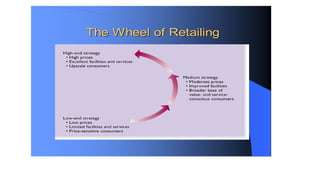
• The wheel of retailing offers three fundamental strategic positions: low
end, medium end, and high end.
• Retailers who adopts a medium strategy may face challenges if they are
not perceived as unique or differentiated from their competitors. This can
be particularly problematic in mature formats such as department stores.
• Competitors at the higher and lower ends can take market share away
from a middle of-the-road retailer.
• It’s merchandising strategy of offering a wide range of mid-priced goods
and services, and failure to adapt to changes in the department store
market is putting its survival as a retailer at risk.
• According to the retailing wheel, established businesses should
proceed with caution when introducing new services or shifting from
a low-end to a high-end approach.
• Price-conscious customers are not often loyal; therefore, they are
more likely to switch to companies with lower prices.
• The competitive advantages that previously drove profitability may
also be eliminated by retailers at that point.
• First Phase: Entry This stage demonstrates how new types of shops
enter the market as operators offering basic commodities in low-
status, low-rent sites with minimal margins.
• Second Phase: Trade-up As shops experience success, they upgrade
their locations, increase their service offerings, and infuse ambiance
into their product lines.
• Third Phase: Vulnerability Low adaptability and a high-cost structure
characterize this phase. The same pattern is followed by new sorts of
low-cost, low-margin retail competitors, making existing businesses
susceptible.
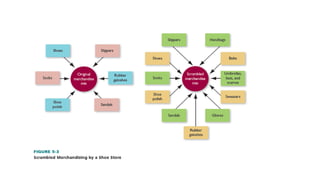
SCRAMBLED MERCHANDISING
• While the wheel of retailing concentrates on product value, ultimate
price, and customer satisfaction, scrambled merchandising entails a
merchant broadening its product and service offerings (the number of
different product lines carried).
• When a merchant adds products and services that are not related to
the company’s core competencies, this is known as scrambled
merchandising.
• Retailers frequently add highly profitable goods and services in an
effort to boost overall sales and make them fast-selling.
• consumers buy more on impulse, prefer one-stop shopping, can reach
numerous target audiences, and are less affected by seasonality and
rivalry.
• In addition, a retailer may find it difficult to maintain and expand its
consumer base as its original product line(s) lose popularity.
• Scrambled merchandising leads to increased competition among
various types of retailers, and as sales are spread out over more
stores, distribution costs are impacted.
• Other drawbacks to scrambled merchandising include the potential
lack of retailer expertise in purchasing, reselling, and providing
services for unrelated items; the costs of a wider selection; and the
potential damage to a retailer’s reputation if scrambled
merchandising is unsuccessful.
STAGES IN RETAIL LIFE CYCLE
• A retail format goes through a series of recognizable stages known as
the retail lifecycle throughout its time.
• According to the retail life cycle theory, retail establishment go
through four distinct stages of development: introduction (early
growth), growth (rapid development), maturity, and decline.
Development stage
• The new format is released to the market while it is still in the
development stage.
• As at least one component of the marketing mix is transformed in the
new format, it differs from the strategies of existing retail institutions.
Introduction Stage
• During the introduction phase, sales and profitability are initially low
but gradually rising.
• As long-term success is not yet secured, costs and risks are high. In
the launch stage of the cycle, there is a marked shift away from the
strategy combinations of established retailers.
• The strategy mix of a company in this stage is significantly different
from that of traditional competitors in at least one aspect.
• For the first companies in new industry, sales and earnings often
experience a significant increase.
• Long-term success is still uncertain at this point. There is a possibility
that new businesses may not be well-received by consumers and
early investments could result in significant financial losses. For
example, a new retail concept, such as Amazon entering a new
market, such as India
Growth Stage
• The rapid growth of sales and revenues is a characteristic of the growth
period.
• Markets for existing businesses are expanded, while new competitors
using the same retail model enter the market.
• By the end of this phase, growth has slowed, and costs have begun to
rise. Both sales and profits expand quickly during the growth stage.
• Existing businesses grow geographically, and new businesses of the same
kind enter the market. Cost pressures (to pay for a larger staff, a more
complicated inventory system, and stringent controls) may start to have
an impact on profits at the conclusion of accelerated development.
Maturity Stage
• The maturity stage of the retail life cycle is characterized by slow sales
growth.
• While overall sales may still increase, they are rising at a significantly
slower rate than in earlier phases.
• To boost purchases, it may be necessary to lower profit margins.
• The maturity stage is often caused by market saturation due to multiple
businesses in an institutional setting, competition from newer
businesses, changing societal priorities, and a lack of management skills
to lead established or larger companies.When maturity is attained, the
objective is to maintain it for as long as possible without declining.
Decline Stage
• In the final stage, there is a decline; characterized by decreasing
prices, profitability, and sales volumes.
• Businesses may try to reposition their retail structure to avoid decline,
but many do so to retain existing customers or attract new ones.
• During this phase, many businesses abandon their format, and create
a new format to attract customers who were previously loyal to that
type of retailer.
• In certain situations; a decline may be difficult or nearly impossible to
turn around. In other cases, it may be prevented or delayed by
repositioning the business.
• The life-cycle concept highlights the need for retailers to adapt as
formats evolve.
• The initial objective should be growth, followed by the building of
management and operational capabilities as the business matures
and finally, flexibility at the end of the cycle.
DIALECTIC PROCESS THEORY
• According to this theory, retail establishments change with time and
take on novel forms.
• This theory is also called the “melting pot” theory.
• It implies that new retail formats develop by incorporating traits of
different types of merchants.
• The introduction of new retail formats maintains consistency with
those already in use. It provides a clear and logical framework for
comprehending the evolution of current retail forms.
• The evolution of the new retail establishment is comparable to that of
synthesis, which results from the fusion of a thesis (a notion or idea)
and an anti-thesis (the opposite concept or idea).
• One such instance is the birth of a new retail format called “electronic
direct marketing” as a result of the convergence of “traditional”
(store-based) and “direct marketing” (home-based)
• The Dialectic Process Theory can also be demonstrated by the
emergence of multichannel retail , which combines physical and
online retail to offer a brickand-click business model. This is a result of
the convergence of physical retail, which has limited reach, and online
retail, which has a wide reach.
THEORY OF NATURAL SELECTION
• The progression of retail businesses from traditional stores to various
types of retail outlets was first examined by Dreesman using the
Darwin Theory of Natural Selection.
• It suggests that natural selection also occurs in the retail industry.
Adapting to changes in the environment is crucial for the survival of
retail formats.
• Specialty retail formats for specific product categories such as baby
clothing and toy stores have decreased as discount stores and
category killers gained more market share
• Traditional food retailers in India are facing competition from fast
food chains as lifestyles change.
• Traditional bookstores are facing competition from online booksellers
such as amazon.com in the USA.
• The retailing industry is always changing as a result of these changes
in demand.
• Future developments will further integrate the retail value chain.
Now, retailers want to be in charge of the supply chain, which is
nothing but backward integration. Retailers of clothing like Pantaloon
and Koutons have established their own production facilities or have
signed exclusive agreements with their suppliers. Manufacturers and
suppliers, on the other hand, desire direct consumer contact in order
to strengthen their brands and boost profitability.
• This is called “forward integration.” Arvind Mills and Mudra Coats, for
instance, have established their own retail chains and brands. In
general, we can state that businesses that provide the most value
have the best prospects of surviving in the retail industry.

lecture2.- retail maangement power point

  • 1.
  • 2.
    WHEEL OF RETAILINGTHEORY • The retail industry has undergone a significant transformation due to changes in consumer buying behaviours. • Customers view their purchases from high-end retailers as a reflection of their personal identity. • Retailers can be grouped based on factors such as store locations, operations, products and services, pricing, and marketing strategies.
  • 3.
    • A retailernowadays must aim to be dominating or position uniquely in some way if they are to succeed. • Once the business has achieved destination retailer status, customers may become devoted to it and go out of their way to shop there because they perceive the business as unique. We often equate “dominant” with “having a significant geographic footprint.”
  • 4.
    • Attract price-consciouscustomers by being budget-friendly and emphasizing affordability • Appeal to status-conscious, full-service customers by offering upscale products and services • Target customers who value convenience by offering practical shopping options, such as local locations or extended hours. • Attract customers by offering a wide variety of products and an exceptional shopping experience.
  • 5.
    • Address customers’dissatisfaction with poor retail service by providing outstanding customer service. • Stand out from competitors by implementing innovative and unique business strategies and identifying market opportunities for new products and services.
  • 6.
    WHEEL OF RETAILINGTHEORY • A well-known concept for analyzing changes in retail institutions is the wheel of retailing. • McNair first proposed this theory in 1931, and Hollander later made changes to it.McNair focused on how retailing has changed, explaining that a retail business begins by offering low prices, basic product characteristics, and minimum services at a small profit margin.
  • 7.
    • Then itgradually develops into a brand that provides a broad choice of goods, high-priced, superior services, and several other amenities at a huge profit margin. • It is predicted on the idea that consumers who are price-sensitive are not store-loyal, and therefore new shops will be better able to implement lower operating expenses than existing ones.
  • 8.
    • This theorysuggests that retail establishments have cycles as they grow When low-end merchants improve their tactics to boost sales and profit margins, new types of low-price (discount) retailers begin to emerge in the market. • The wheel of retailing theory also states that retail innovators frequently start out as low-cost operators with minimal profit margin requirements.
  • 9.
    • Prices increasewhen entrepreneurs add higher-quality items, move into more expensive locations, offer credit and delivery services, and make other improvements to their facilities and customer service over time. • The retailing wheel is brought on by the fact that as innovators get older, they are more open to competition from new discounters offering lower prices. Retail innovators frequently pose as low-cost vendors.
  • 10.
    The wheel isbased on the following four ideas: (1) Many consumers who are price conscious may sacrifice good customer service, a large assortment, and convenient locations in favor of reduced costs. (2) Customers who are price-sensitive are often disloyal and will try to switch stores that offer lower prices. Customers who value prestige, on the other hand, prefer to shop at establishments that employ upscale practices.
  • 11.
    (3) Operating costsfor new institutions are often lower than for established ones. (4) Retailers often move up the wheel to boost sales, expand their target market, and enhance their reputation.
  • 12.
    • The wheelof retailing offers three fundamental strategic positions: low end, medium end, and high end. • Retailers who adopts a medium strategy may face challenges if they are not perceived as unique or differentiated from their competitors. This can be particularly problematic in mature formats such as department stores. • Competitors at the higher and lower ends can take market share away from a middle of-the-road retailer. • It’s merchandising strategy of offering a wide range of mid-priced goods and services, and failure to adapt to changes in the department store market is putting its survival as a retailer at risk.
  • 13.
    • According tothe retailing wheel, established businesses should proceed with caution when introducing new services or shifting from a low-end to a high-end approach. • Price-conscious customers are not often loyal; therefore, they are more likely to switch to companies with lower prices. • The competitive advantages that previously drove profitability may also be eliminated by retailers at that point.
  • 15.
    • First Phase:Entry This stage demonstrates how new types of shops enter the market as operators offering basic commodities in low- status, low-rent sites with minimal margins. • Second Phase: Trade-up As shops experience success, they upgrade their locations, increase their service offerings, and infuse ambiance into their product lines. • Third Phase: Vulnerability Low adaptability and a high-cost structure characterize this phase. The same pattern is followed by new sorts of low-cost, low-margin retail competitors, making existing businesses susceptible.
  • 16.
    SCRAMBLED MERCHANDISING • Whilethe wheel of retailing concentrates on product value, ultimate price, and customer satisfaction, scrambled merchandising entails a merchant broadening its product and service offerings (the number of different product lines carried). • When a merchant adds products and services that are not related to the company’s core competencies, this is known as scrambled merchandising.
  • 17.
    • Retailers frequentlyadd highly profitable goods and services in an effort to boost overall sales and make them fast-selling. • consumers buy more on impulse, prefer one-stop shopping, can reach numerous target audiences, and are less affected by seasonality and rivalry. • In addition, a retailer may find it difficult to maintain and expand its consumer base as its original product line(s) lose popularity.
  • 18.
    • Scrambled merchandisingleads to increased competition among various types of retailers, and as sales are spread out over more stores, distribution costs are impacted. • Other drawbacks to scrambled merchandising include the potential lack of retailer expertise in purchasing, reselling, and providing services for unrelated items; the costs of a wider selection; and the potential damage to a retailer’s reputation if scrambled merchandising is unsuccessful.
  • 20.
    STAGES IN RETAILLIFE CYCLE • A retail format goes through a series of recognizable stages known as the retail lifecycle throughout its time. • According to the retail life cycle theory, retail establishment go through four distinct stages of development: introduction (early growth), growth (rapid development), maturity, and decline.
  • 21.
    Development stage • Thenew format is released to the market while it is still in the development stage. • As at least one component of the marketing mix is transformed in the new format, it differs from the strategies of existing retail institutions.
  • 22.
    Introduction Stage • Duringthe introduction phase, sales and profitability are initially low but gradually rising. • As long-term success is not yet secured, costs and risks are high. In the launch stage of the cycle, there is a marked shift away from the strategy combinations of established retailers. • The strategy mix of a company in this stage is significantly different from that of traditional competitors in at least one aspect.
  • 23.
    • For thefirst companies in new industry, sales and earnings often experience a significant increase. • Long-term success is still uncertain at this point. There is a possibility that new businesses may not be well-received by consumers and early investments could result in significant financial losses. For example, a new retail concept, such as Amazon entering a new market, such as India
  • 24.
    Growth Stage • Therapid growth of sales and revenues is a characteristic of the growth period. • Markets for existing businesses are expanded, while new competitors using the same retail model enter the market. • By the end of this phase, growth has slowed, and costs have begun to rise. Both sales and profits expand quickly during the growth stage. • Existing businesses grow geographically, and new businesses of the same kind enter the market. Cost pressures (to pay for a larger staff, a more complicated inventory system, and stringent controls) may start to have an impact on profits at the conclusion of accelerated development.
  • 25.
    Maturity Stage • Thematurity stage of the retail life cycle is characterized by slow sales growth. • While overall sales may still increase, they are rising at a significantly slower rate than in earlier phases. • To boost purchases, it may be necessary to lower profit margins. • The maturity stage is often caused by market saturation due to multiple businesses in an institutional setting, competition from newer businesses, changing societal priorities, and a lack of management skills to lead established or larger companies.When maturity is attained, the objective is to maintain it for as long as possible without declining.
  • 26.
    Decline Stage • Inthe final stage, there is a decline; characterized by decreasing prices, profitability, and sales volumes. • Businesses may try to reposition their retail structure to avoid decline, but many do so to retain existing customers or attract new ones. • During this phase, many businesses abandon their format, and create a new format to attract customers who were previously loyal to that type of retailer. • In certain situations; a decline may be difficult or nearly impossible to turn around. In other cases, it may be prevented or delayed by repositioning the business.
  • 27.
    • The life-cycleconcept highlights the need for retailers to adapt as formats evolve. • The initial objective should be growth, followed by the building of management and operational capabilities as the business matures and finally, flexibility at the end of the cycle.
  • 28.
    DIALECTIC PROCESS THEORY •According to this theory, retail establishments change with time and take on novel forms. • This theory is also called the “melting pot” theory. • It implies that new retail formats develop by incorporating traits of different types of merchants. • The introduction of new retail formats maintains consistency with those already in use. It provides a clear and logical framework for comprehending the evolution of current retail forms.
  • 29.
    • The evolutionof the new retail establishment is comparable to that of synthesis, which results from the fusion of a thesis (a notion or idea) and an anti-thesis (the opposite concept or idea). • One such instance is the birth of a new retail format called “electronic direct marketing” as a result of the convergence of “traditional” (store-based) and “direct marketing” (home-based)
  • 30.
    • The DialecticProcess Theory can also be demonstrated by the emergence of multichannel retail , which combines physical and online retail to offer a brickand-click business model. This is a result of the convergence of physical retail, which has limited reach, and online retail, which has a wide reach.
  • 31.
    THEORY OF NATURALSELECTION • The progression of retail businesses from traditional stores to various types of retail outlets was first examined by Dreesman using the Darwin Theory of Natural Selection. • It suggests that natural selection also occurs in the retail industry. Adapting to changes in the environment is crucial for the survival of retail formats.
  • 32.
    • Specialty retailformats for specific product categories such as baby clothing and toy stores have decreased as discount stores and category killers gained more market share • Traditional food retailers in India are facing competition from fast food chains as lifestyles change. • Traditional bookstores are facing competition from online booksellers such as amazon.com in the USA.
  • 33.
    • The retailingindustry is always changing as a result of these changes in demand. • Future developments will further integrate the retail value chain. Now, retailers want to be in charge of the supply chain, which is nothing but backward integration. Retailers of clothing like Pantaloon and Koutons have established their own production facilities or have signed exclusive agreements with their suppliers. Manufacturers and suppliers, on the other hand, desire direct consumer contact in order to strengthen their brands and boost profitability.
  • 34.
    • This iscalled “forward integration.” Arvind Mills and Mudra Coats, for instance, have established their own retail chains and brands. In general, we can state that businesses that provide the most value have the best prospects of surviving in the retail industry.