CONSUMER BEHAVIOUR
AND LIFESTYLE MARKETING
• Lifestyle marketing is a process of establishing relationships between
products offered in the market and targeted lifestyle groups.
• It involves segmenting the market on the basis of lifestyle
dimensions, positioning the product in a way that appeals to the
activities, interests and opinions of the targeted market and
undertaking specific promotional campaigns which exploit lifestyle
appeals to enhance the market attractiveness of the offered product
DEMOGRAPHICS, PSYCHOGRAPHICS AND
LIFESTYLE
• Demographic variables help marketers “ locate” their target market and
psychographic variables provide the marketer with more insight about the
segment.
• Psychographics is, in common parlance, lifestyle analysis or AIO research.
In its most widely practiced form, a psychographic study consists of a long
list of statements designed to capture relevant aspects of a consumer, like
personality, hinting motives, interests, attitudes, beliefs and values.
• Lifestyle, analysis leads to more comprehensive and penetrating profiles
of how consumers think and act than may be available from other
approaches.
CHARACTERISTICS OF LIFESTYLE
1. Lifestyle is a group phenomenon A person’s lifestyle bears the
influence of his/her participation in social groups and of his/her
relationships with others.
2. Lifestyle pervades various aspects of life An individual’s lifestyle may
result in certain consistency of behaviour across different aspects of
his life and consumption. Knowinga person’s conduct in one aspect
of life may enable us to predict how he/she may behave in other
areas
3. Lifestyle implies a central life interest For every individual there are
many central life interests like family, work, leisure, sexual exploits,
religion, politics etc. that may shape his interaction with the
environment.
4. Lifestyles vary according to sociologically relevant variables The rate of
social change in a society has a great deal to do with variations in
lifestyles. So do age, sex, religion, ethnicity and social class. The increase
in the number of double income families , nuclear families, rising income
and aspirations, large number of women in the workforce have resulted
in very different lifestyles of Indian families compared to the last decade.
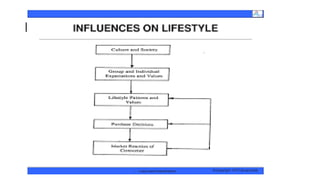
INFLUENCES ON LIFESTYLE
APPROACHES TO STUDY LIFESTYLE
• lifestyle refers to the way in which people live and spend money,
consumers psychographic profiles are derived by measuring different
aspects of consumer behaviour such as
1. Products and services consumed
2. Activities, interests and opinions
3. Value systems
4. Personality traits and self-concept
5. Attitude towards various product classes
• Many approaches are available to the study of psychographic
variables.
• One of the ways is to study the lifestyle variables by an AIO inventory
for use in segmenting, targeting and positioning.
• Another lifestyle approach is by using VALS typology.
• Two more recent approaches are the PRIZM approach and the Roper
Starch global lifestyle studies
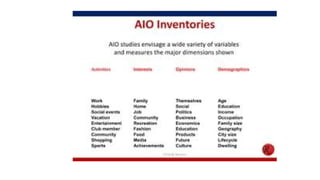
AIO Inventories
• This approach involves developing detailed lifestyle profiles on the
basis of analysis of activities, interests, opinions and demographics of
very large samples of population AIO studies envisage a wide variety
of variables and measures
VALS SYSTEM OF CLASSIFICATION
• Another widely used lifestyle classification system is the Values and
Lifestyle classification developed by Arnold Mitchell.
• The VALS system of classification classifies adults (18 +) in the US into
distinctive lifestyle groups.
• Each group is based on inner psychological needs (values) and
behaviour response patterns (lifestyles) which their values predict
• VALS provides a dynamic framework of values and lifestyles; which
helps to explain why people act as they do as social groups and
asconsumers.
• VALS, unlike some other approaches, weave together: 1.
Demographics, 2. Attitudes, 3. Activities, 4. Consumption patterns, 5.
Brand preferences, 6. Media graphics
• The VALS 1 study led to the identification of four major groups i.e.,
• the need driven (the poor and uneducated),
• the outer directed (the middle- or upper-income class consumer
whose lifestyle is directed by external criteria) and
• the inner directed (people who are motivated more by inner needs
than by the expectations of others).
• The fourth segment, called integrated represents individuals who
have been able to combine the best of both outer directed and inner-
directed values
VALS-2 Classification
• VALS 2 typology classifies the American population into 3-major
consumer groups
• the principle oriented,
• the status oriented, and
• the action oriented.
• These are then further sub-divided in to eight distinctive lifestyle
segments.
• The principles oriented represent consumers whose choices are
governed by their beliefs rather than their need for other peoples’
approval.
• The choices of status-oriented consumers, on the other hand, are
directed by the action, approval and opinion of other people.
• The action-oriented consumers are those who are motivated by a
need for social or physical activity, variety and risk bearing.
• The principle-oriented people have been divided into 2 classes, the
fulfilleds and the believers
• Believers are conservative, conventional people with concrete beliefs
and strong attachments to traditional institutions: family, church,
community, and the nation
• Fulfilleds are mature, satisfied, comfortable, reflective people who
value order, knowledge, and responsibility. Most are well educated,
and in (or recently retired from) professional occupations
• The status-oriented people have been further subdivided into 4
classes, the actualizers, the achievers, the strivers and the strugglers.
• Actualizers are successful, sophisticated, active, “take-charge” people
with high self-esteem and abundant resources
• Achievers are successful career and work-oriented people who like to-
and generally do-noel in control of their lives. They value structure.
predictability, and stability of over risk, intimacy, and self-discovery.
They are deeply committed to their work and their families. Work
provides them with a sense of duty, material rewards, and prestige.
• Strivers seek motivation, self-definition, and approval from the world
around them. They are striving to find a secure place in life. Unsure of
themselves and low on economic, social, and psychological resources.
Strivers are deeply concerned about the opinions and approval of
others
• Strugglers’ lives are constricted. Chronically poor, ill-educated, low-
skilled, without strong social bonds, aging, and concerned about their
health they are often despairing and passive.
• The action-oriented segment comprises of two sub segments of
Experiencers and Makers
• Experiences are young, vital, enthusiastic, impulsive, and rebellious.
They seek variety and excitement, savouring the new, the off beat,
and the risky.
• Makers are practical people who have constructive skills and value
self-sufficiency. They live in a traditional context of family, practical
work, and physical recreation, and have little interest in what lies
outside that context.
APPLICATIONS OF LIFESTYLE MARKETING
• Positioning of New Products -Positioning comprises finding the most
profitable niche for a new product in terms of target market
• Repositioning an Old/Existing- Product Sometimes existing products
may sell well below their forecasted potential or the company may
discover a new, more profitable niche, nearer to the core market
where it may now want to position the product
• Developing New Product Concepts Study of existing market segments
and analysis of their needs have typically been used to conceptualise
on new product opportunities
• Creating Promotional Strategies Lifestyle information is helpful in
developing promotional strategies in a number of ways. It gives the
decision maker a much more complete profile of the type of
consumer who will be at the receiving end of the communication
ORGANISATIONAL BUYING
BEHAVIOUR
• Webster and Wind, who have done some pioneering work in this
area, define organisational buying as a complex process of decision
making and communication, which takes place over time, involving
several organisational members and relationships with other firms
and institutions.
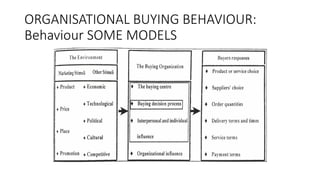
ORGANISATIONAL BUYING BEHAVIOUR:
CHARACTERISTICS
• Organisational buying is a multi-person buying activity
• It is a formal activity which follows the procedures laid down in an
organisation
• Longer time lag between efforts and results
• Rational but also emotional activity
• The uniqueness of organisations
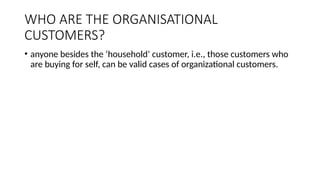
WHO ARE THE ORGANISATIONAL
CUSTOMERS?
• anyone besides the ‘household’ customer, i.e., those customers who
are buying for self, can be valid cases of organizational customers.
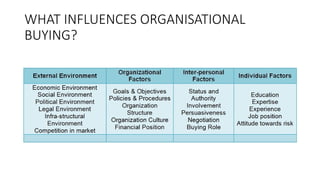
WHAT INFLUENCES ORGANISATIONAL
BUYING?
ORGANISATIONAL BUYING BEHAVIOUR:
Behaviour SOME MODELS
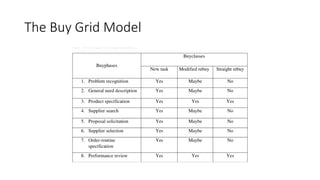
The Buy Grid Model
The Buy Grid Model
• Robinson, Faris and Wind, developed a matrix with rows for various
buying decision steps (called as Buy Phases) and the columns as the
type of the buying situation (called as Buy Classes)
• the buying exercise may be a very complex and time consuming for
the ‘new task’.
• This is because a buyer in this situation will have a large buying
centre, and will require sufficient amount of effort and time for each
phase before moving to the second phase.
• On the other hand, the task would be simple and routinised for
straight re-buy situations. A marketer, depending upon thebuy class
for his product can formulate the marketing strategies
The payoffs of the ‘buy grid’ models are
• Its ability to convey the degree of complexity or simplicity for an
organizational customer for a given product or service.
• Its ability to help the marketers to anticipate the marketing effort
needed for the different buying stages in the decision making.
• A framework to identify the composition of the buying centers and
the dominant influences for each stage.
• In spite of the above payoffs, the buy grid model is completely devoid
of any predictive ability.
• It addresses itself only to the ‘non-human’ factors and thus fails to
bring out the dynamics and the influences of human related or
emotional factors.
• But in spite of the limitations, the Buy Grid Model is a very useful
conceptual framework to comprehend the complexities of
organizational buying behavior.

Individual Influences on Buying Behavior

  • 1.
  • 2.
    • Lifestyle marketingis a process of establishing relationships between products offered in the market and targeted lifestyle groups. • It involves segmenting the market on the basis of lifestyle dimensions, positioning the product in a way that appeals to the activities, interests and opinions of the targeted market and undertaking specific promotional campaigns which exploit lifestyle appeals to enhance the market attractiveness of the offered product
  • 3.
    DEMOGRAPHICS, PSYCHOGRAPHICS AND LIFESTYLE •Demographic variables help marketers “ locate” their target market and psychographic variables provide the marketer with more insight about the segment. • Psychographics is, in common parlance, lifestyle analysis or AIO research. In its most widely practiced form, a psychographic study consists of a long list of statements designed to capture relevant aspects of a consumer, like personality, hinting motives, interests, attitudes, beliefs and values. • Lifestyle, analysis leads to more comprehensive and penetrating profiles of how consumers think and act than may be available from other approaches.
  • 4.
    CHARACTERISTICS OF LIFESTYLE 1.Lifestyle is a group phenomenon A person’s lifestyle bears the influence of his/her participation in social groups and of his/her relationships with others. 2. Lifestyle pervades various aspects of life An individual’s lifestyle may result in certain consistency of behaviour across different aspects of his life and consumption. Knowinga person’s conduct in one aspect of life may enable us to predict how he/she may behave in other areas
  • 5.
    3. Lifestyle impliesa central life interest For every individual there are many central life interests like family, work, leisure, sexual exploits, religion, politics etc. that may shape his interaction with the environment. 4. Lifestyles vary according to sociologically relevant variables The rate of social change in a society has a great deal to do with variations in lifestyles. So do age, sex, religion, ethnicity and social class. The increase in the number of double income families , nuclear families, rising income and aspirations, large number of women in the workforce have resulted in very different lifestyles of Indian families compared to the last decade.
  • 6.
  • 7.
    APPROACHES TO STUDYLIFESTYLE • lifestyle refers to the way in which people live and spend money, consumers psychographic profiles are derived by measuring different aspects of consumer behaviour such as 1. Products and services consumed 2. Activities, interests and opinions 3. Value systems 4. Personality traits and self-concept 5. Attitude towards various product classes
  • 8.
    • Many approachesare available to the study of psychographic variables. • One of the ways is to study the lifestyle variables by an AIO inventory for use in segmenting, targeting and positioning. • Another lifestyle approach is by using VALS typology. • Two more recent approaches are the PRIZM approach and the Roper Starch global lifestyle studies
  • 9.
    AIO Inventories • Thisapproach involves developing detailed lifestyle profiles on the basis of analysis of activities, interests, opinions and demographics of very large samples of population AIO studies envisage a wide variety of variables and measures
  • 11.
    VALS SYSTEM OFCLASSIFICATION • Another widely used lifestyle classification system is the Values and Lifestyle classification developed by Arnold Mitchell. • The VALS system of classification classifies adults (18 +) in the US into distinctive lifestyle groups. • Each group is based on inner psychological needs (values) and behaviour response patterns (lifestyles) which their values predict
  • 12.
    • VALS providesa dynamic framework of values and lifestyles; which helps to explain why people act as they do as social groups and asconsumers. • VALS, unlike some other approaches, weave together: 1. Demographics, 2. Attitudes, 3. Activities, 4. Consumption patterns, 5. Brand preferences, 6. Media graphics
  • 13.
    • The VALS1 study led to the identification of four major groups i.e., • the need driven (the poor and uneducated), • the outer directed (the middle- or upper-income class consumer whose lifestyle is directed by external criteria) and • the inner directed (people who are motivated more by inner needs than by the expectations of others). • The fourth segment, called integrated represents individuals who have been able to combine the best of both outer directed and inner- directed values
  • 14.
    VALS-2 Classification • VALS2 typology classifies the American population into 3-major consumer groups • the principle oriented, • the status oriented, and • the action oriented.
  • 15.
    • These arethen further sub-divided in to eight distinctive lifestyle segments. • The principles oriented represent consumers whose choices are governed by their beliefs rather than their need for other peoples’ approval. • The choices of status-oriented consumers, on the other hand, are directed by the action, approval and opinion of other people.
  • 16.
    • The action-orientedconsumers are those who are motivated by a need for social or physical activity, variety and risk bearing. • The principle-oriented people have been divided into 2 classes, the fulfilleds and the believers • Believers are conservative, conventional people with concrete beliefs and strong attachments to traditional institutions: family, church, community, and the nation • Fulfilleds are mature, satisfied, comfortable, reflective people who value order, knowledge, and responsibility. Most are well educated, and in (or recently retired from) professional occupations
  • 17.
    • The status-orientedpeople have been further subdivided into 4 classes, the actualizers, the achievers, the strivers and the strugglers. • Actualizers are successful, sophisticated, active, “take-charge” people with high self-esteem and abundant resources • Achievers are successful career and work-oriented people who like to- and generally do-noel in control of their lives. They value structure. predictability, and stability of over risk, intimacy, and self-discovery. They are deeply committed to their work and their families. Work provides them with a sense of duty, material rewards, and prestige.
  • 18.
    • Strivers seekmotivation, self-definition, and approval from the world around them. They are striving to find a secure place in life. Unsure of themselves and low on economic, social, and psychological resources. Strivers are deeply concerned about the opinions and approval of others • Strugglers’ lives are constricted. Chronically poor, ill-educated, low- skilled, without strong social bonds, aging, and concerned about their health they are often despairing and passive.
  • 19.
    • The action-orientedsegment comprises of two sub segments of Experiencers and Makers • Experiences are young, vital, enthusiastic, impulsive, and rebellious. They seek variety and excitement, savouring the new, the off beat, and the risky. • Makers are practical people who have constructive skills and value self-sufficiency. They live in a traditional context of family, practical work, and physical recreation, and have little interest in what lies outside that context.
  • 20.
    APPLICATIONS OF LIFESTYLEMARKETING • Positioning of New Products -Positioning comprises finding the most profitable niche for a new product in terms of target market • Repositioning an Old/Existing- Product Sometimes existing products may sell well below their forecasted potential or the company may discover a new, more profitable niche, nearer to the core market where it may now want to position the product • Developing New Product Concepts Study of existing market segments and analysis of their needs have typically been used to conceptualise on new product opportunities
  • 21.
    • Creating PromotionalStrategies Lifestyle information is helpful in developing promotional strategies in a number of ways. It gives the decision maker a much more complete profile of the type of consumer who will be at the receiving end of the communication
  • 22.
  • 23.
    • Webster andWind, who have done some pioneering work in this area, define organisational buying as a complex process of decision making and communication, which takes place over time, involving several organisational members and relationships with other firms and institutions.
  • 24.
    ORGANISATIONAL BUYING BEHAVIOUR: CHARACTERISTICS •Organisational buying is a multi-person buying activity • It is a formal activity which follows the procedures laid down in an organisation • Longer time lag between efforts and results • Rational but also emotional activity • The uniqueness of organisations
  • 25.
    WHO ARE THEORGANISATIONAL CUSTOMERS? • anyone besides the ‘household’ customer, i.e., those customers who are buying for self, can be valid cases of organizational customers.
  • 26.
  • 27.
  • 28.
  • 29.
    The Buy GridModel • Robinson, Faris and Wind, developed a matrix with rows for various buying decision steps (called as Buy Phases) and the columns as the type of the buying situation (called as Buy Classes) • the buying exercise may be a very complex and time consuming for the ‘new task’. • This is because a buyer in this situation will have a large buying centre, and will require sufficient amount of effort and time for each phase before moving to the second phase.
  • 30.
    • On theother hand, the task would be simple and routinised for straight re-buy situations. A marketer, depending upon thebuy class for his product can formulate the marketing strategies
  • 31.
    The payoffs ofthe ‘buy grid’ models are • Its ability to convey the degree of complexity or simplicity for an organizational customer for a given product or service. • Its ability to help the marketers to anticipate the marketing effort needed for the different buying stages in the decision making. • A framework to identify the composition of the buying centers and the dominant influences for each stage.
  • 32.
    • In spiteof the above payoffs, the buy grid model is completely devoid of any predictive ability. • It addresses itself only to the ‘non-human’ factors and thus fails to bring out the dynamics and the influences of human related or emotional factors. • But in spite of the limitations, the Buy Grid Model is a very useful conceptual framework to comprehend the complexities of organizational buying behavior.