MODULE-2
Lasers
Lecture-1
• Introduction
• Laser Characteristics
S
What is Laser?
Light Amplification by Stimulated Emission of
Radiation
• A device produces a coherent beam of optical
radiation by stimulating electronic, ionic, or
molecular transitions to higher energy levels
• When they return to lower energy levels by
stimulated emission, they emit energy.
5
Incandescent vs. Laser Light
1. Many wavelengths
2. Multidirectional
3. Incoherent
1. Monochromatic
2. Directional
3. Coherent
Characteristics of Laser
• Monochromatic
Concentrate in a narrow range of wavelengths (one specific
colour). The light emitted from a laser is monochromatic,
that is, it is of one color/wavelength. In contrast,
ordinary white light is a combination of many colors (or
wavelengths) of light.
• Coherent
All the emitted photons bear a constant phase relationship
with each other in both time and phase.The light from
a laser is said to be coherent, which means that the
wavelengths of the laser light are in phase in space and time.
Ordinary light can be a mixture of many wavelengths.
Characteristics of Laser
• Directional
A very tight beam which is very strong and
concentrated. Lasers emit light that is highly
directional, that is, laser light is emitted as a relatively
narrow beam in a specific direction. Ordinary light,
such as from a light bulb, is emitted in many directions
away from the source.
High Intensity. It has been that a 1-mW He-Ne laser is
hundreds of times “brighter” than the sun. As difficult
as this may be to imagine, calculations for luminance
or visual brightness of a typical laser, compared to the
sun, substantiate these claims.
8
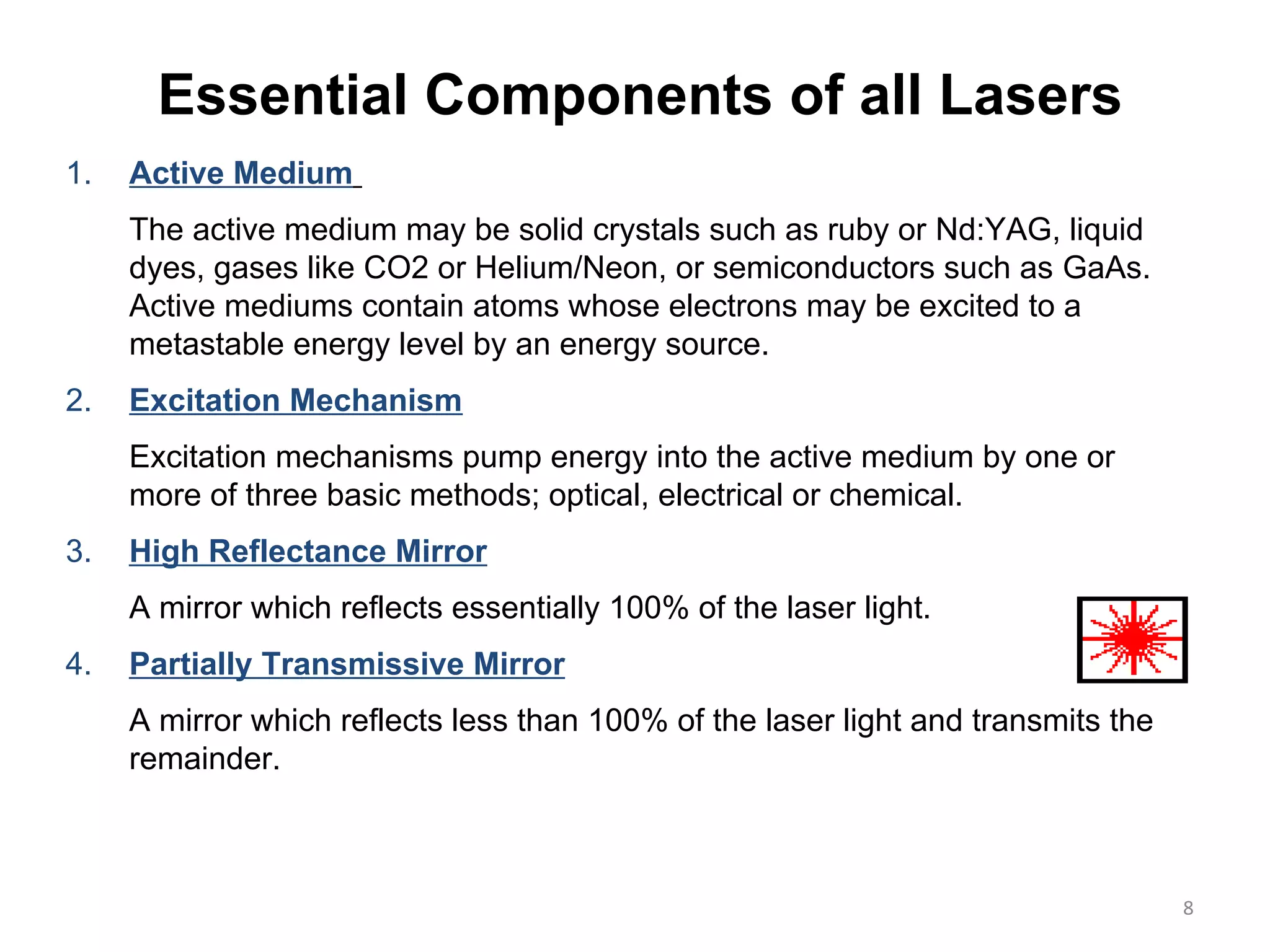
Essential Components of all Lasers
1. Active Medium
The active medium may be solid crystals such as ruby or Nd:YAG, liquid
dyes, gases like CO2 or Helium/Neon, or semiconductors such as GaAs.
Active mediums contain atoms whose electrons may be excited to a
metastable energy level by an energy source.
2. Excitation Mechanism
Excitation mechanisms pump energy into the active medium by one or
more of three basic methods; optical, electrical or chemical.
3. High Reflectance Mirror
A mirror which reflects essentially 100% of the laser light.
4. Partially Transmissive Mirror
A mirror which reflects less than 100% of the laser light and transmits the
remainder.
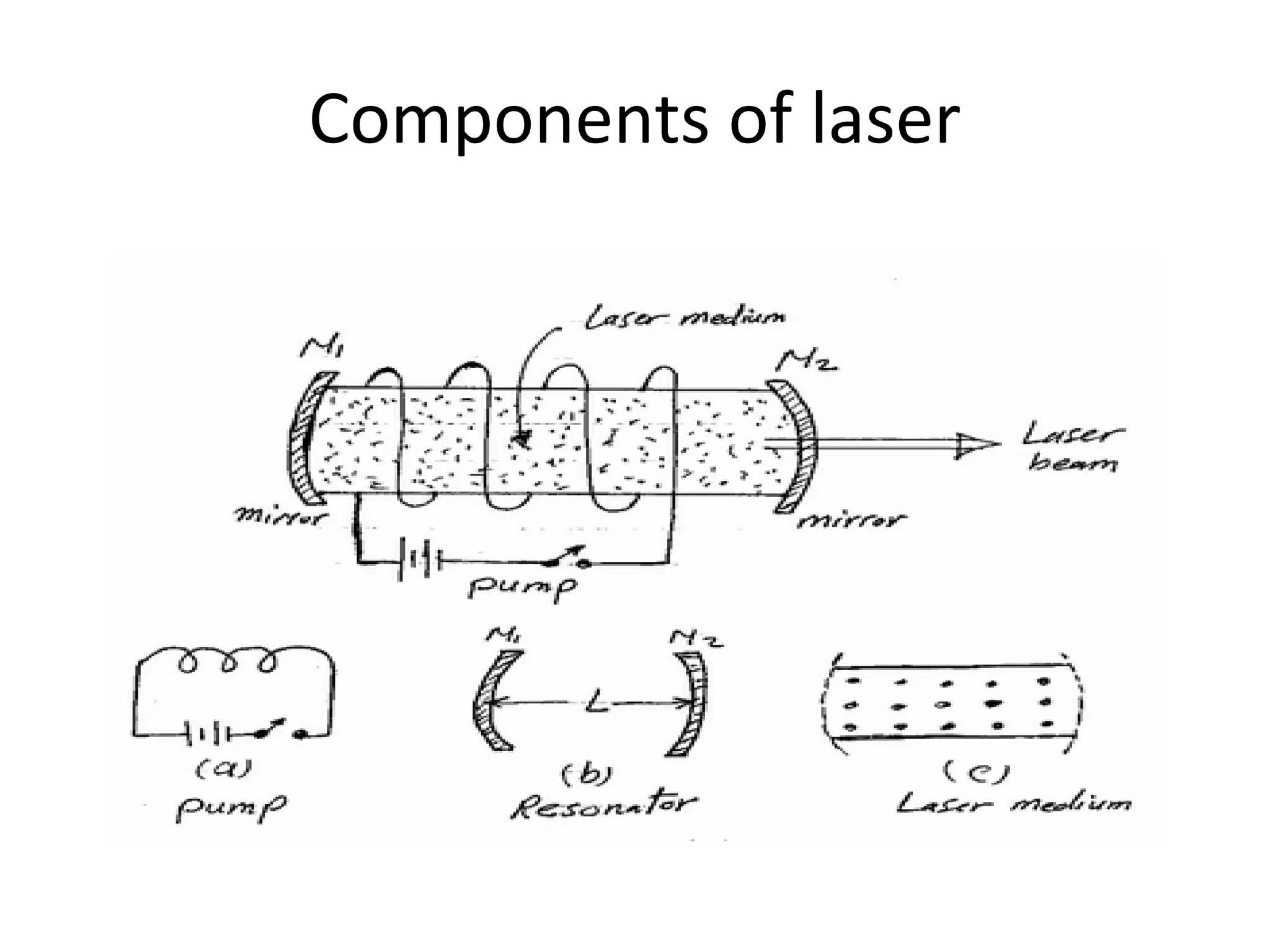
Components of laser
Pump Source
• Provides energy to the laser system
• Pumps can be optical, electrical, chemical or thermal in
nature. Examples: electrical discharges, flashlamps, arc
lamps and chemical reactions.
• The type of pump source used depends on the gain
medium. The important parameters governing this
type of pumping are the electron excitation cross-
sections and the lifetimes of the energy levels.
• →A helium-neon (HeNe) laser uses an electrical
discharge in the helium-neon gas mixture.
→Excimer lasers use a chemical reaction.
Active Medium: The amplifying medium or laser
medium is an important part of the laser device
• Major determining factor of the wavelength of
operation of the laser.
• Excited by the pump source to produce a population
inversion.
• Where spontaneous and stimulated emission of
photons takes place.
The most important requirement of the amplifying medium
is its ability to support a population inversion between
two energy levels of the laser atoms.
• Example:
solid, liquid, gas and semiconductor.
Optical Resonator
• Two parallel mirrors placed around the active
medium.
• Light is reflected by the mirrors back into the
medium and is amplified .
• The design and alignment of the mirrors with
respect to the medium is crucial.
• Spinning mirrors, modulators, filters and
absorbers may be added to produce a variety
of effects on the laser output.

Lecture1(laser).pptx.pdf

  • 1.
  • 2.
  • 3.
  • 4.
    What is Laser? LightAmplification by Stimulated Emission of Radiation • A device produces a coherent beam of optical radiation by stimulating electronic, ionic, or molecular transitions to higher energy levels • When they return to lower energy levels by stimulated emission, they emit energy.
  • 5.
    5 Incandescent vs. LaserLight 1. Many wavelengths 2. Multidirectional 3. Incoherent 1. Monochromatic 2. Directional 3. Coherent
  • 6.
    Characteristics of Laser •Monochromatic Concentrate in a narrow range of wavelengths (one specific colour). The light emitted from a laser is monochromatic, that is, it is of one color/wavelength. In contrast, ordinary white light is a combination of many colors (or wavelengths) of light. • Coherent All the emitted photons bear a constant phase relationship with each other in both time and phase.The light from a laser is said to be coherent, which means that the wavelengths of the laser light are in phase in space and time. Ordinary light can be a mixture of many wavelengths.
  • 7.
    Characteristics of Laser •Directional A very tight beam which is very strong and concentrated. Lasers emit light that is highly directional, that is, laser light is emitted as a relatively narrow beam in a specific direction. Ordinary light, such as from a light bulb, is emitted in many directions away from the source. High Intensity. It has been that a 1-mW He-Ne laser is hundreds of times “brighter” than the sun. As difficult as this may be to imagine, calculations for luminance or visual brightness of a typical laser, compared to the sun, substantiate these claims.
  • 8.
    8 Essential Components ofall Lasers 1. Active Medium The active medium may be solid crystals such as ruby or Nd:YAG, liquid dyes, gases like CO2 or Helium/Neon, or semiconductors such as GaAs. Active mediums contain atoms whose electrons may be excited to a metastable energy level by an energy source. 2. Excitation Mechanism Excitation mechanisms pump energy into the active medium by one or more of three basic methods; optical, electrical or chemical. 3. High Reflectance Mirror A mirror which reflects essentially 100% of the laser light. 4. Partially Transmissive Mirror A mirror which reflects less than 100% of the laser light and transmits the remainder.
  • 9.
  • 10.
    Pump Source • Providesenergy to the laser system • Pumps can be optical, electrical, chemical or thermal in nature. Examples: electrical discharges, flashlamps, arc lamps and chemical reactions. • The type of pump source used depends on the gain medium. The important parameters governing this type of pumping are the electron excitation cross- sections and the lifetimes of the energy levels. • →A helium-neon (HeNe) laser uses an electrical discharge in the helium-neon gas mixture. →Excimer lasers use a chemical reaction.
  • 11.
    Active Medium: Theamplifying medium or laser medium is an important part of the laser device • Major determining factor of the wavelength of operation of the laser. • Excited by the pump source to produce a population inversion. • Where spontaneous and stimulated emission of photons takes place. The most important requirement of the amplifying medium is its ability to support a population inversion between two energy levels of the laser atoms. • Example: solid, liquid, gas and semiconductor.
  • 12.
    Optical Resonator • Twoparallel mirrors placed around the active medium. • Light is reflected by the mirrors back into the medium and is amplified . • The design and alignment of the mirrors with respect to the medium is crucial. • Spinning mirrors, modulators, filters and absorbers may be added to produce a variety of effects on the laser output.