THERMAL
ENGINEERING
VIOLATIONS OF THERMODYNAMICS – PERPETUAL MOTION MACHINES
ENGR. NINO LOUIE R. BOLORON
THERMODYNAMIC LAWS
Define a group of physical quantities, such as temperature,
energy, and entropy, that characterize thermodynamic systems
in thermodynamic equilibrium.
The laws also use various parameters for thermodynamic
processes, such as thermodynamic work and heat, and
establish relationships between them.
They state empirical facts that form a basis of precluding the
possibility of certain phenomena, such as perpetual motion.
THERMODYNAMIC LAWS
The zeroth law of thermodynamics defines thermal
equilibrium and forms a basis for the definition of temperature:
If two systems are each in thermal equilibrium with a third
system, then they are in thermal equilibrium with each other.
The first law of thermodynamics states that, when energy
passes into or out of a system (as work, heat, or matter), the
system's internal energy changes in accord with the law of
conservation of energy.
The second law of thermodynamics states that in a natural
thermodynamic process, the sum of the entropies of the
interacting thermodynamic systems never decreases. Another
form of the statement is that heat does not spontaneously pass
from a colder body to a warmer body.
The third law of thermodynamics states that a system's
entropy approaches a constant value as the temperature
approaches absolute zero.
PERPETUAL MOTION
Is the motion of bodies that continues forever in an
unperturbed system.
A perpetual motion machine is a hypothetical machine that
can do work infinitely without an external energy source. This
kind of machine is impossible, as it would violate either
the first or second law of thermodynamics or both.
CLASSIFICATION
•A perpetual motion machine of the first kind produces work without
the input of energy. It thus violates the first law of thermodynamics:
the law of conservation of energy.
•A perpetual motion machine of the second kind is a machine that
spontaneously converts thermal energy into mechanical work. When the
thermal energy is equivalent to the work done, this does not violate the
law of conservation of energy. However, it does violate the more
subtle second law of thermodynamics (entropy). The signature of a
perpetual motion machine of the second kind is that there is only one
heat reservoir involved, which is being spontaneously cooled without
involving a transfer of heat to a cooler reservoir. This conversion of heat
into useful work, without any side effect, is impossible, according to the
second law of thermodynamics.
CLASSIFICATION
A perpetual motion machine of the third kind is usually (but
not always) defined as one that completely eliminates friction
and other dissipative forces, to maintain motion forever due to
its mass inertia. It is impossible to make such a machine, as
dissipation can never be completely eliminated in a mechanical
system, no matter how close a system gets to this ideal.
BASIC PRINCIPLES
1.In any isolated system, one cannot create new energy (law of
conservation of energy). As a result, the thermal efficiency—the
produced work power divided by the input heating power—cannot
be greater than one.
2.The output work power of heat engines is always smaller than the
input heating power. The rest of the heat energy supplied is wasted
as heat to the ambient surroundings. The thermal efficiency
therefore has a maximum, given by the Carnot efficiency, which is
always less than one.
3.The efficiency of real heat engines is even lower than the Carnot
efficiency due to irreversibility arising from the speed of processes,
including friction.
PROBLEM STATEMENTS
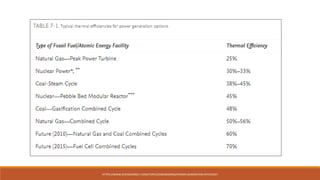
A heat engine produces 5MW of power while absorbing 8MW
of power from a high-temperature source. What is the thermal
efficiency of this heat engine? What is the rate of heat transfer
to the low-temperature tank?
A heat engine absorbs 20MW from a 400 deg C furnace and
rejects 12MW to the atmosphere at 25 deg C. Find the actual
and Carnot thermal efficiencies of this heat engine. How much
power does the heat engine produce?
PROBLEM #1
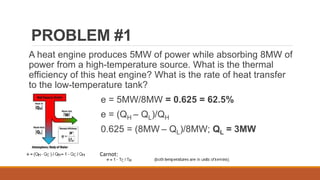
A heat engine produces 5MW of power while absorbing 8MW of
power from a high-temperature source. What is the thermal
efficiency of this heat engine? What is the rate of heat transfer
to the low-temperature tank?
e = 5MW/8MW = 0.625 = 62.5%
e = (QH – QL)/QH
0.625 = (8MW – QL)/8MW; QL = 3MW
Carnot:
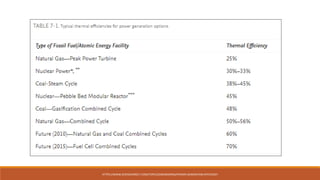
HTTPS://WWW.SCIENCEDIRECT.COM/TOPICS/ENGINEERING/POWER-GENERATION-EFFICIENCY
PROBLEM #2
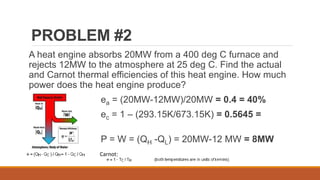
A heat engine absorbs 20MW from a 400 deg C furnace and
rejects 12MW to the atmosphere at 25 deg C. Find the actual
and Carnot thermal efficiencies of this heat engine. How much
power does the heat engine produce?
ea = (20MW-12MW)/20MW = 0.4 = 40%
ec = 1 – (293.15K/673.15K) = 0.5645 =
56.45%
P = W = (QH -QL) = 20MW-12 MW = 8MW
Carnot:
HTTPS://WWW.SCIENCEDIRECT.COM/TOPICS/ENGINEERING/POWER-GENERATION-EFFICIENCY
REFERENCES
Guggenheim, E.A. (1985). Thermodynamics. An Advanced Treatment for Chemists and Physicists,
seventh edition, North Holland, Amsterdam, ISBN 0-444-86951-4.
Kittel, C. Kroemer, H. (1980). Thermal Physics, second edition, W.H. Freeman, San
Francisco, ISBN 0-7167-1088-9.
Adkins, C.J. (1968). Equilibrium Thermodynamics, McGraw-Hill, London, ISBN 0-07-084057-1.
Derry, Gregory N. (2002-03-04). What Science Is and How It Works. Princeton University Press.
p. 167. ISBN 978-1400823116.
Roy, Bimalendu Narayan (2002). Fundamentals of Classical and Statistical Thermodynamics.
John Wiley & Sons. p. 58. Bibcode:2002fcst.book.....N. ISBN 978-0470843130.
"Definition of perpetual motion". Oxforddictionaries.com. 2012-11-22. Retrieved 2012-11-27.
Sébastien Point, Free energy: when the web is freewheeling, Skeptikal Inquirer, January February
2018
Simanek, Donald E. (2012). "Perpetual Futility: A short history of the search for perpetual
motion". The Museum of Unworkable Devices. Donald Simanek's website, Lock Haven University.
Retrieved 3 October 2013.
REFERENCES
Rao, Y. V. C. (2004). An Introduction to Thermodynamics. Hyderabad, India: Universities Press
(India) Private Ltd. ISBN 978-81-7371-461-0. Retrieved 1 August 2010.
Schadewald, Robert J. (2008), Worlds of Their Own - A Brief History of Misguided Ideas:
Creationism, Flat-Earthism, Energy Scams, and the Velikovsky Affair, Xlibris, ISBN 978-1-4363-
0435-1. pp55–56
Wong, Kau-Fui Vincent (2000). Thermodynamics for Engineers. CRC Press. p. 154. ISBN 978-0-
84-930232-9.
Akshoy, Ranjan Paul; Sanchayan, Mukherjee; Pijush, Roy (2005). Mechanical Sciences:
Engineering Thermodynamics and Fluid Mechanics. Prentice-Hall India. p. 51. ISBN 978-8-12-
032727-6.
https://physics.bu.edu/~duffy/py105/Heatengines.html
https://energyeducation.ca/encyclopedia/Thermal_efficiency

Thermal Engineering - Perpetual Machines (2).pptx

  • 1.
    THERMAL ENGINEERING VIOLATIONS OF THERMODYNAMICS– PERPETUAL MOTION MACHINES ENGR. NINO LOUIE R. BOLORON
  • 2.
    THERMODYNAMIC LAWS Define agroup of physical quantities, such as temperature, energy, and entropy, that characterize thermodynamic systems in thermodynamic equilibrium. The laws also use various parameters for thermodynamic processes, such as thermodynamic work and heat, and establish relationships between them. They state empirical facts that form a basis of precluding the possibility of certain phenomena, such as perpetual motion.
  • 3.
    THERMODYNAMIC LAWS The zerothlaw of thermodynamics defines thermal equilibrium and forms a basis for the definition of temperature: If two systems are each in thermal equilibrium with a third system, then they are in thermal equilibrium with each other. The first law of thermodynamics states that, when energy passes into or out of a system (as work, heat, or matter), the system's internal energy changes in accord with the law of conservation of energy.
  • 4.
    The second lawof thermodynamics states that in a natural thermodynamic process, the sum of the entropies of the interacting thermodynamic systems never decreases. Another form of the statement is that heat does not spontaneously pass from a colder body to a warmer body. The third law of thermodynamics states that a system's entropy approaches a constant value as the temperature approaches absolute zero.
  • 5.
    PERPETUAL MOTION Is themotion of bodies that continues forever in an unperturbed system. A perpetual motion machine is a hypothetical machine that can do work infinitely without an external energy source. This kind of machine is impossible, as it would violate either the first or second law of thermodynamics or both.
  • 6.
    CLASSIFICATION •A perpetual motionmachine of the first kind produces work without the input of energy. It thus violates the first law of thermodynamics: the law of conservation of energy. •A perpetual motion machine of the second kind is a machine that spontaneously converts thermal energy into mechanical work. When the thermal energy is equivalent to the work done, this does not violate the law of conservation of energy. However, it does violate the more subtle second law of thermodynamics (entropy). The signature of a perpetual motion machine of the second kind is that there is only one heat reservoir involved, which is being spontaneously cooled without involving a transfer of heat to a cooler reservoir. This conversion of heat into useful work, without any side effect, is impossible, according to the second law of thermodynamics.
  • 7.
    CLASSIFICATION A perpetual motionmachine of the third kind is usually (but not always) defined as one that completely eliminates friction and other dissipative forces, to maintain motion forever due to its mass inertia. It is impossible to make such a machine, as dissipation can never be completely eliminated in a mechanical system, no matter how close a system gets to this ideal.
  • 8.
    BASIC PRINCIPLES 1.In anyisolated system, one cannot create new energy (law of conservation of energy). As a result, the thermal efficiency—the produced work power divided by the input heating power—cannot be greater than one. 2.The output work power of heat engines is always smaller than the input heating power. The rest of the heat energy supplied is wasted as heat to the ambient surroundings. The thermal efficiency therefore has a maximum, given by the Carnot efficiency, which is always less than one. 3.The efficiency of real heat engines is even lower than the Carnot efficiency due to irreversibility arising from the speed of processes, including friction.
  • 9.
    PROBLEM STATEMENTS A heatengine produces 5MW of power while absorbing 8MW of power from a high-temperature source. What is the thermal efficiency of this heat engine? What is the rate of heat transfer to the low-temperature tank? A heat engine absorbs 20MW from a 400 deg C furnace and rejects 12MW to the atmosphere at 25 deg C. Find the actual and Carnot thermal efficiencies of this heat engine. How much power does the heat engine produce?
  • 10.
    PROBLEM #1 A heatengine produces 5MW of power while absorbing 8MW of power from a high-temperature source. What is the thermal efficiency of this heat engine? What is the rate of heat transfer to the low-temperature tank? e = 5MW/8MW = 0.625 = 62.5% e = (QH – QL)/QH 0.625 = (8MW – QL)/8MW; QL = 3MW Carnot:
  • 11.
  • 12.
    PROBLEM #2 A heatengine absorbs 20MW from a 400 deg C furnace and rejects 12MW to the atmosphere at 25 deg C. Find the actual and Carnot thermal efficiencies of this heat engine. How much power does the heat engine produce? ea = (20MW-12MW)/20MW = 0.4 = 40% ec = 1 – (293.15K/673.15K) = 0.5645 = 56.45% P = W = (QH -QL) = 20MW-12 MW = 8MW Carnot:
  • 13.
  • 14.
    REFERENCES Guggenheim, E.A. (1985).Thermodynamics. An Advanced Treatment for Chemists and Physicists, seventh edition, North Holland, Amsterdam, ISBN 0-444-86951-4. Kittel, C. Kroemer, H. (1980). Thermal Physics, second edition, W.H. Freeman, San Francisco, ISBN 0-7167-1088-9. Adkins, C.J. (1968). Equilibrium Thermodynamics, McGraw-Hill, London, ISBN 0-07-084057-1. Derry, Gregory N. (2002-03-04). What Science Is and How It Works. Princeton University Press. p. 167. ISBN 978-1400823116. Roy, Bimalendu Narayan (2002). Fundamentals of Classical and Statistical Thermodynamics. John Wiley & Sons. p. 58. Bibcode:2002fcst.book.....N. ISBN 978-0470843130. "Definition of perpetual motion". Oxforddictionaries.com. 2012-11-22. Retrieved 2012-11-27. Sébastien Point, Free energy: when the web is freewheeling, Skeptikal Inquirer, January February 2018 Simanek, Donald E. (2012). "Perpetual Futility: A short history of the search for perpetual motion". The Museum of Unworkable Devices. Donald Simanek's website, Lock Haven University. Retrieved 3 October 2013.
  • 15.
    REFERENCES Rao, Y. V.C. (2004). An Introduction to Thermodynamics. Hyderabad, India: Universities Press (India) Private Ltd. ISBN 978-81-7371-461-0. Retrieved 1 August 2010. Schadewald, Robert J. (2008), Worlds of Their Own - A Brief History of Misguided Ideas: Creationism, Flat-Earthism, Energy Scams, and the Velikovsky Affair, Xlibris, ISBN 978-1-4363- 0435-1. pp55–56 Wong, Kau-Fui Vincent (2000). Thermodynamics for Engineers. CRC Press. p. 154. ISBN 978-0- 84-930232-9. Akshoy, Ranjan Paul; Sanchayan, Mukherjee; Pijush, Roy (2005). Mechanical Sciences: Engineering Thermodynamics and Fluid Mechanics. Prentice-Hall India. p. 51. ISBN 978-8-12- 032727-6. https://physics.bu.edu/~duffy/py105/Heatengines.html https://energyeducation.ca/encyclopedia/Thermal_efficiency