Fungal Biodiversity
Pl Path 501
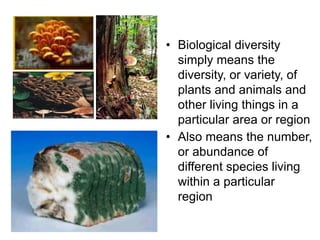
• Biological diversity
simply means the
diversity, or variety, of
plants and animals and
other living things in a
particular area or region
• Also means the number,
or abundance of
different species living
within a particular
region
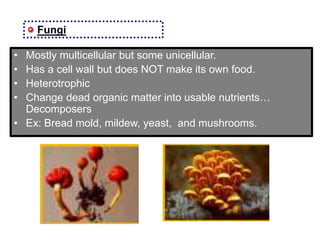
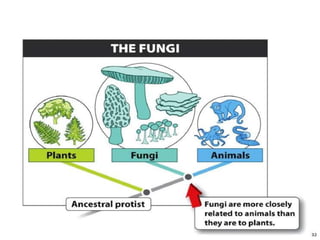
Fungi
• Mostly multicellular but some unicellular.
• Has a cell wall but does NOT make its own food.
• Heterotrophic
• Change dead organic matter into usable nutrients…
Decomposers
• Ex: Bread mold, mildew, yeast, and mushrooms.
• Distinguished from other
kingdoms by:
– Nutrition
– Structural
organisation
– Growth
– Reproduction
FUNGI
• COMMON FUNGI
EXAMPLES:
– Mushrooms, yeasts,
molds, morels, bracket
fungi, puff balls
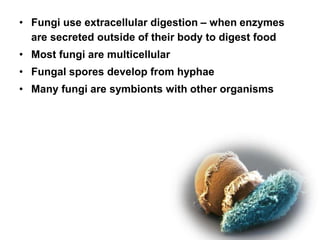
• Fungi use extracellular digestion – when enzymes
are secreted outside of their body to digest food
• Most fungi are multicellular
• Fungal spores develop from hyphae
• Many fungi are symbionts with other organisms
Absorptive nutrition enables fungi to live as decomposers
and symbionts
• Fungi are heterotrophs that acquire nutrients by
absorption
• Secrete hydrolytic enzymes and acids to decompose
complex molecules into simpler ones that can be
absorbed
• Specialised into three main types:
– Saprobes - absorb nutrients from dead organic
material
– Parasitic fungi - absorb nutrients from cells of living
hosts; some are pathogenic
– Mutualistic fungi - absorb nutrients from a host, but
reciprocate to benefit the host
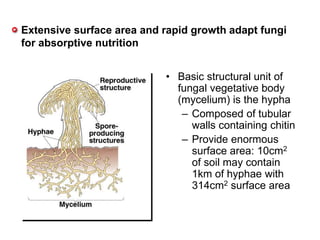
Extensive surface area and rapid growth adapt fungi
for absorptive nutrition
• Basic structural unit of
fungal vegetative body
(mycelium) is the hypha
– Composed of tubular
walls containing chitin
– Provide enormous
surface area: 10cm2
of soil may contain
1km of hyphae with
314cm2 surface area
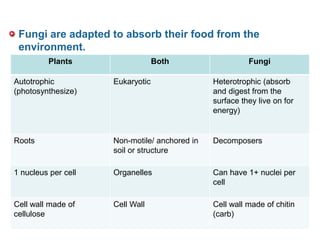
Fungi are adapted to absorb their food from the
environment.
Plants Both Fungi
Autotrophic
(photosynthesize)
Eukaryotic Heterotrophic (absorb
and digest from the
surface they live on for
energy)
Roots Non-motile/ anchored in
soil or structure
Decomposers
1 nucleus per cell Organelles Can have 1+ nuclei per
cell
Cell wall made of
cellulose
Cell Wall Cell wall made of chitin
(carb)
3 Major Features
1.Cell walls
– Made of Chitin
– The same stuff that makes insects’ exoskeleton.
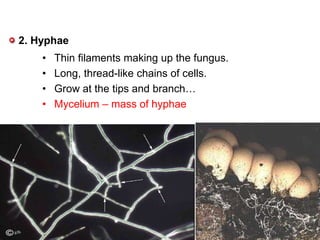
2. Hyphae
• Thin filaments making up the fungus.
• Long, thread-like chains of cells.
• Grow at the tips and branch…
• Mycelium – mass of hyphae
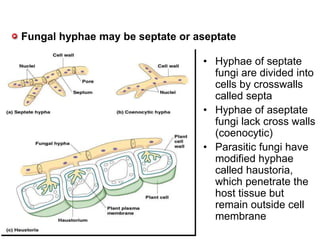
Fungal hyphae may be septate or aseptate
• Hyphae of septate
fungi are divided into
cells by crosswalls
called septa
• Hyphae of aseptate
fungi lack cross walls
(coenocytic)
• Parasitic fungi have
modified hyphae
called haustoria,
which penetrate the
host tissue but
remain outside cell
membrane
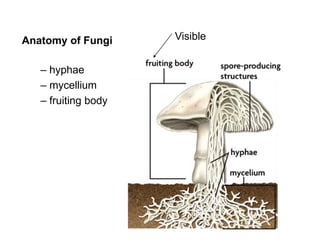
Anatomy of Fungi
– hyphae
– mycellium
– fruiting body
Visible
Fungi come in many shapes and sizes.
• Primitive fungi are aquatic and have flagellated spores.
Fungi reproduce by releasing spores that
are produced either sexually or asexually
• Usually unicellular, haploid and of various shapes and
sizes
• Produced either sexually (by meiosis) or asexually (by
mitosis)
– In favourable conditions, fungi generally clone
themselves by producing enormous numbers of spores
asexually
– For many fungi, sexual reproduction only occurs as a
contingency- results in greater genetic diversity
• Spores are the agent of dispersal responsible for
geographic distribution of fungi:
– Carried by wind or water
– Germinate in moist places with appropriate substrata
Generalised life cycle of fungi
Sexual
Asexual
5 Phyla of Fungi
1. Chytridiomycota - Chytrids
2. Zygomycota – Common Molds
3. Ascomycota – Sac Fungi
4. Basidiomycota – Club Fungi
5. Deuteromycota – Imperfect Fungi
1. Phylum Chytridiomycota
• Mostly marine
• Mostly saprophytes (lives on dead
or decaying organic matter)
• Have flagellated spores
2. Phylum Zygomycota
• Mostly terrestrial.
• Two types of hyphae:
– Stolons – (horizontal) spread across the surface
– Rhizoids – (vertical) digs into the surface
3. Phylum Ascomycota (Sac Fungi)
• Most are multicellular (except for
yeast)
• Most undergo asexual
reproduction
• Largest phylum of Fungi
ascoscarpMorels
• Club fungi have fruiting bodies which are club-shaped.
• Most are edible
• reproductive structures called basidia
• Include mushrooms, puffballs, and shelf fungi
4. Phylum Basidiomycota (Club Fungi)
5. Phylum Deuteromycota
Ringworm
•Asexual Reproduction
•Imperfect Fungi
•Do not fit into the commonly established taxonomic classification
•No sexual structures
•Multicellular tissue is similar to the hyphae of sac fungi and club
fungi
•Erect hyphae with asexual spores similar to sac fungi and club
fungi
– life cycles may include either sexual or asexual
reproduction or both
• Multicellular fungi have complex reproductive cycles.
• All fungi form spores and zygotes.
Fungi may be decomposers, pathogens, or mutualists.
• Fungi and bacteria are the main decomposers in any
ecosystem.
– decompose dead leaves, twigs, logs, and animals
– return nutrients to the soil
– can damage fruit trees and wooden structures
 Fungi can act as pathogens.
• human diseases include ringworm and athlete’s foot
• plant diseases include Dutch elm disease
• Haustoria – hyphae that penetrate the host so that the
parasitic fungus can absorb nutrients
• Fungi can act as mutualists.
– lichens form between fungi and algae
– mycorrhizae form between fungi and plants
Lichens
Bioindicators – help show when environmental
conditions are unsuitable.
foliose
crustose
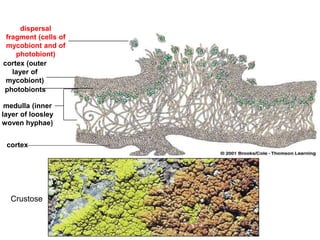
dispersal
fragment (cells of
mycobiont and of
photobiont)
cortex (outer
layer of
mycobiont)
photobionts
medulla (inner
layer of loosley
woven hyphae)
cortex
Crustose
Leaf-like - foliose
Old Man’s
Beard
Usnea –
fructicose
Erect branching
Lichen
Cladonia rangiferina
fructicose
Crustose
foliose
fructicose
– relationships form between fungi and some insects
• Fungi can act as mutualists.
Fungi are studied for many purposes.
• Fungi are useful in several ways.
– as food
– as antibiotics
– as model systems for molecular biology
Fungi and Humans
• Bioremediation – help clean the environment.
Fungi and Humans
• Molds
– Penicillium
- Penicillin
- Camembert and
Roquefort
cheeses
– Aspergillus
- Soy sauce
- Soft drinks - citric
acid
• Yeasts
– Saccharomyces
cerevisiae
- Bread, wine and
beer
– Candida albicans
- Infections
Some Pathogenic and Toxic Fungi
Zygomycetes
Rhizopus - Food spoilage
Ascomycetes
Aspergillus – sinus, ear,
lung infection
Verticillium sp Plant wilt
Monilinia fructicola-
Brown Rot of Peaches

biodiversity_of_fungi.ppt

  • 1.
  • 2.
    • Biological diversity simplymeans the diversity, or variety, of plants and animals and other living things in a particular area or region • Also means the number, or abundance of different species living within a particular region
  • 3.
    Fungi • Mostly multicellularbut some unicellular. • Has a cell wall but does NOT make its own food. • Heterotrophic • Change dead organic matter into usable nutrients… Decomposers • Ex: Bread mold, mildew, yeast, and mushrooms.
  • 4.
    • Distinguished fromother kingdoms by: – Nutrition – Structural organisation – Growth – Reproduction
  • 5.
    FUNGI • COMMON FUNGI EXAMPLES: –Mushrooms, yeasts, molds, morels, bracket fungi, puff balls
  • 6.
    • Fungi useextracellular digestion – when enzymes are secreted outside of their body to digest food • Most fungi are multicellular • Fungal spores develop from hyphae • Many fungi are symbionts with other organisms
  • 7.
    Absorptive nutrition enablesfungi to live as decomposers and symbionts • Fungi are heterotrophs that acquire nutrients by absorption • Secrete hydrolytic enzymes and acids to decompose complex molecules into simpler ones that can be absorbed • Specialised into three main types: – Saprobes - absorb nutrients from dead organic material – Parasitic fungi - absorb nutrients from cells of living hosts; some are pathogenic – Mutualistic fungi - absorb nutrients from a host, but reciprocate to benefit the host
  • 8.
    Extensive surface areaand rapid growth adapt fungi for absorptive nutrition • Basic structural unit of fungal vegetative body (mycelium) is the hypha – Composed of tubular walls containing chitin – Provide enormous surface area: 10cm2 of soil may contain 1km of hyphae with 314cm2 surface area
  • 9.
    Fungi are adaptedto absorb their food from the environment. Plants Both Fungi Autotrophic (photosynthesize) Eukaryotic Heterotrophic (absorb and digest from the surface they live on for energy) Roots Non-motile/ anchored in soil or structure Decomposers 1 nucleus per cell Organelles Can have 1+ nuclei per cell Cell wall made of cellulose Cell Wall Cell wall made of chitin (carb)
  • 11.
    3 Major Features 1.Cellwalls – Made of Chitin – The same stuff that makes insects’ exoskeleton.
  • 12.
    2. Hyphae • Thinfilaments making up the fungus. • Long, thread-like chains of cells. • Grow at the tips and branch… • Mycelium – mass of hyphae
  • 13.
    Fungal hyphae maybe septate or aseptate • Hyphae of septate fungi are divided into cells by crosswalls called septa • Hyphae of aseptate fungi lack cross walls (coenocytic) • Parasitic fungi have modified hyphae called haustoria, which penetrate the host tissue but remain outside cell membrane
  • 14.
    Anatomy of Fungi –hyphae – mycellium – fruiting body Visible
  • 15.
    Fungi come inmany shapes and sizes. • Primitive fungi are aquatic and have flagellated spores.
  • 16.
    Fungi reproduce byreleasing spores that are produced either sexually or asexually • Usually unicellular, haploid and of various shapes and sizes • Produced either sexually (by meiosis) or asexually (by mitosis) – In favourable conditions, fungi generally clone themselves by producing enormous numbers of spores asexually – For many fungi, sexual reproduction only occurs as a contingency- results in greater genetic diversity • Spores are the agent of dispersal responsible for geographic distribution of fungi: – Carried by wind or water – Germinate in moist places with appropriate substrata
  • 17.
    Generalised life cycleof fungi Sexual Asexual
  • 18.
    5 Phyla ofFungi 1. Chytridiomycota - Chytrids 2. Zygomycota – Common Molds 3. Ascomycota – Sac Fungi 4. Basidiomycota – Club Fungi 5. Deuteromycota – Imperfect Fungi
  • 19.
    1. Phylum Chytridiomycota •Mostly marine • Mostly saprophytes (lives on dead or decaying organic matter) • Have flagellated spores
  • 20.
    2. Phylum Zygomycota •Mostly terrestrial. • Two types of hyphae: – Stolons – (horizontal) spread across the surface – Rhizoids – (vertical) digs into the surface
  • 21.
    3. Phylum Ascomycota(Sac Fungi) • Most are multicellular (except for yeast) • Most undergo asexual reproduction • Largest phylum of Fungi ascoscarpMorels
  • 22.
    • Club fungihave fruiting bodies which are club-shaped. • Most are edible • reproductive structures called basidia • Include mushrooms, puffballs, and shelf fungi 4. Phylum Basidiomycota (Club Fungi)
  • 23.
    5. Phylum Deuteromycota Ringworm •AsexualReproduction •Imperfect Fungi •Do not fit into the commonly established taxonomic classification •No sexual structures •Multicellular tissue is similar to the hyphae of sac fungi and club fungi •Erect hyphae with asexual spores similar to sac fungi and club fungi
  • 25.
    – life cyclesmay include either sexual or asexual reproduction or both • Multicellular fungi have complex reproductive cycles.
  • 27.
    • All fungiform spores and zygotes.
  • 28.
    Fungi may bedecomposers, pathogens, or mutualists. • Fungi and bacteria are the main decomposers in any ecosystem. – decompose dead leaves, twigs, logs, and animals – return nutrients to the soil – can damage fruit trees and wooden structures
  • 29.
     Fungi canact as pathogens. • human diseases include ringworm and athlete’s foot • plant diseases include Dutch elm disease • Haustoria – hyphae that penetrate the host so that the parasitic fungus can absorb nutrients
  • 30.
    • Fungi canact as mutualists. – lichens form between fungi and algae – mycorrhizae form between fungi and plants
  • 31.
    Lichens Bioindicators – helpshow when environmental conditions are unsuitable. foliose crustose
  • 32.
    dispersal fragment (cells of mycobiontand of photobiont) cortex (outer layer of mycobiont) photobionts medulla (inner layer of loosley woven hyphae) cortex Crustose
  • 33.
    Leaf-like - foliose OldMan’s Beard Usnea – fructicose Erect branching Lichen Cladonia rangiferina fructicose
  • 34.
  • 35.
    – relationships formbetween fungi and some insects • Fungi can act as mutualists.
  • 36.
    Fungi are studiedfor many purposes. • Fungi are useful in several ways. – as food – as antibiotics – as model systems for molecular biology
  • 37.
    Fungi and Humans •Bioremediation – help clean the environment.
  • 38.
    Fungi and Humans •Molds – Penicillium - Penicillin - Camembert and Roquefort cheeses – Aspergillus - Soy sauce - Soft drinks - citric acid • Yeasts – Saccharomyces cerevisiae - Bread, wine and beer – Candida albicans - Infections
  • 39.
    Some Pathogenic andToxic Fungi Zygomycetes Rhizopus - Food spoilage Ascomycetes Aspergillus – sinus, ear, lung infection Verticillium sp Plant wilt Monilinia fructicola- Brown Rot of Peaches