Sp’ 05 W. Li
Solidification and Heat
Treatment
 Solidification
 Crystal structures
 Structure-property relationships
 Heat treatment
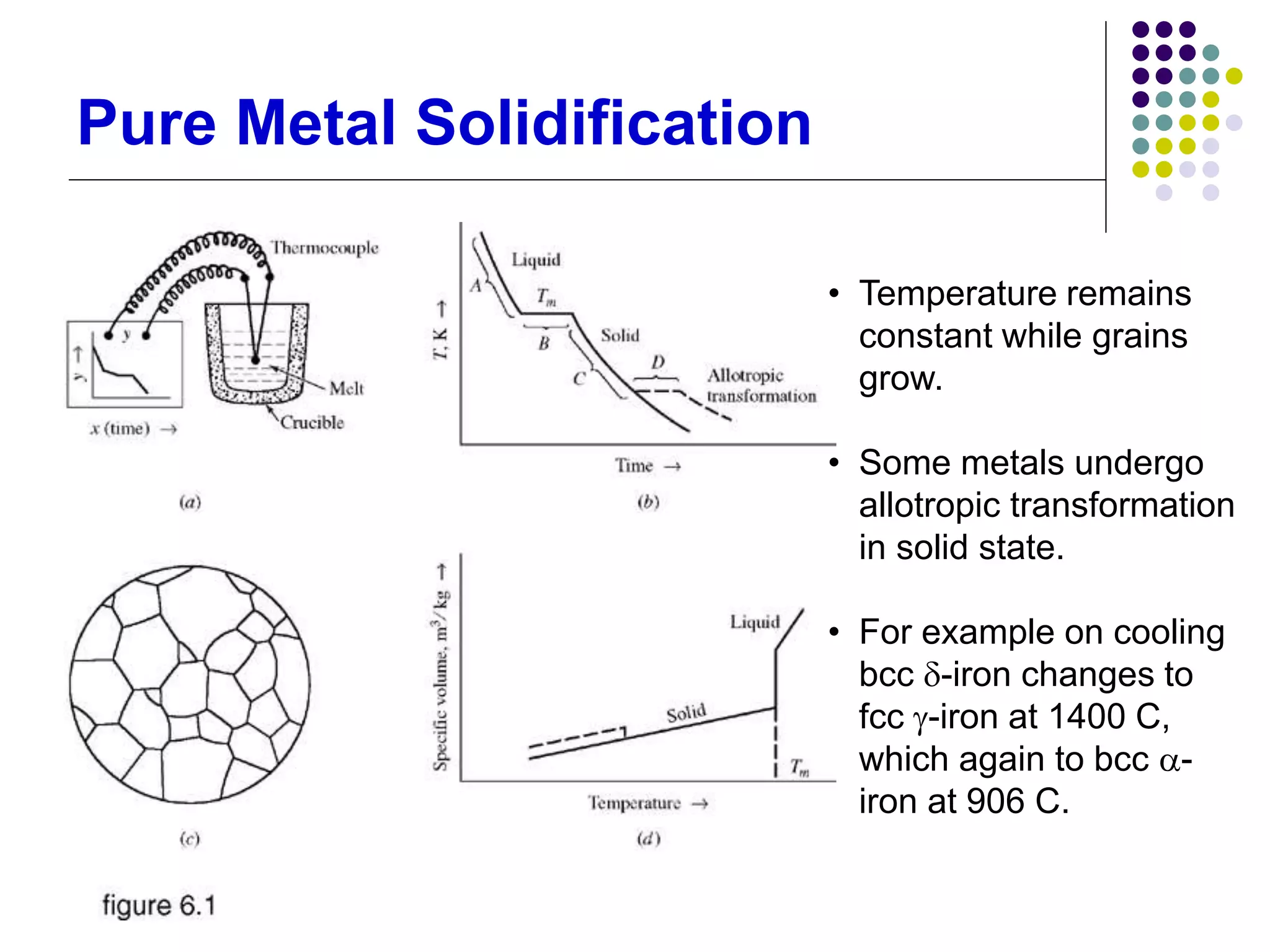
Pure Metal Solidification
• Temperature remains
constant while grains
grow.
• Some metals undergo
allotropic transformation
in solid state.
• For example on cooling
bcc -iron changes to
fcc -iron at 1400 C,
which again to bcc -
iron at 906 C.
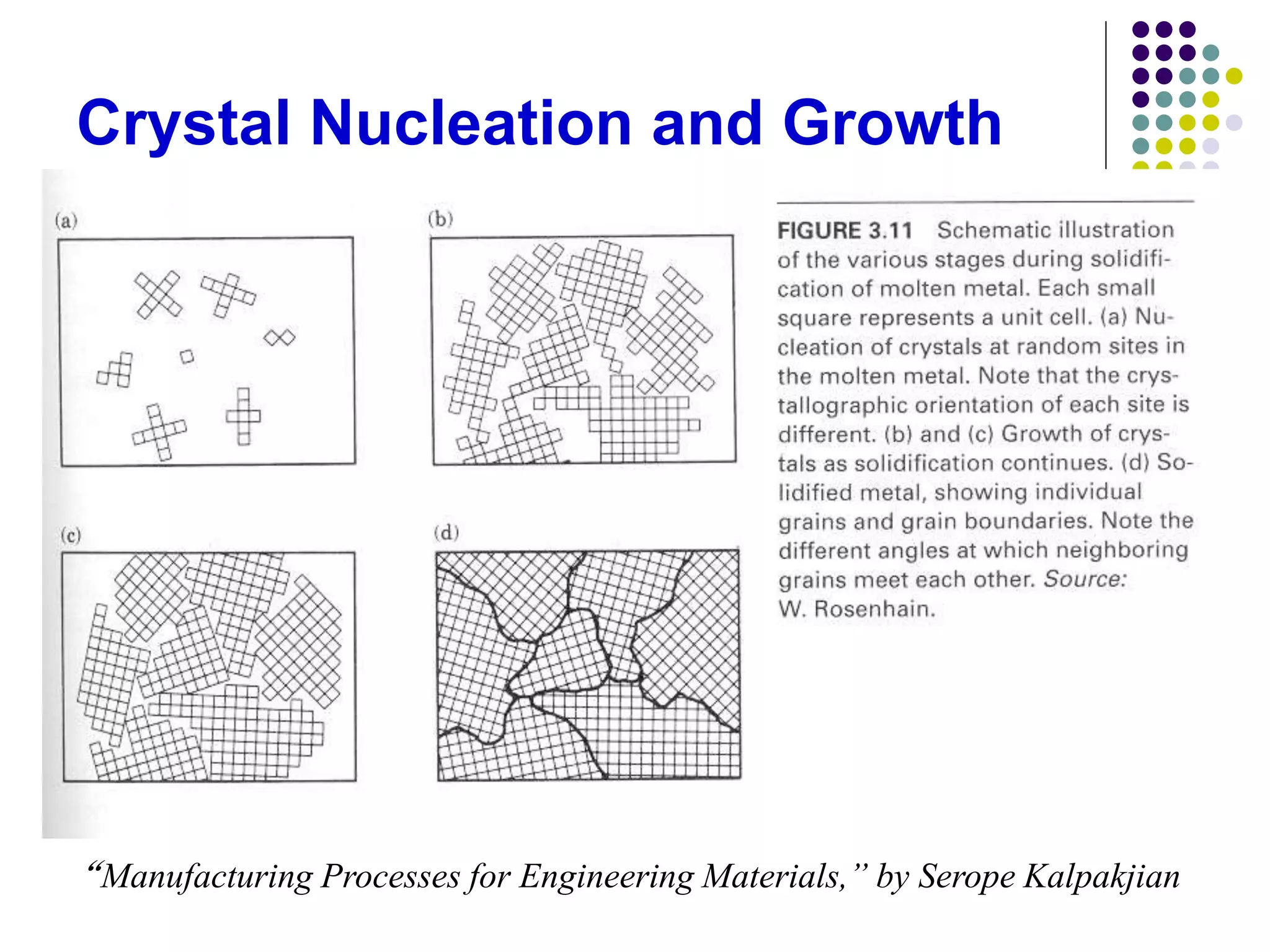
Nucleation and Grain Growth
 Nucleation;
 Homogeneous nucleation: very pure metal, substantial
undercooling (0.2Tm)
 Heterogeneous nucleation: nucleation agents (5ºC
undercooling)
 Grain growth
 Planar: pure metal
 Dendritic: solid solution
 Grain size
 depends on number of nuclei and cooling rate.
Crystal Nucleation and Growth
“Manufacturing Processes for Engineering Materials,” by Serope Kalpakjian
Crystal Structure of Metals
 Atoms arrange themselves into various orderly
configuration, called crystals.
 The arrangement of the atoms in the crystal is
called crystalline structure.
 The smallest group of atoms showing the
characteristic lattice structure of a particular
metal is known as a unit cell.
Crystal Structure of Metals
Slip Systems
 Deformation (dislocation) occurs on preferential
crystallographic planes and directions, called slip
systems.
 The slip plane/direction is the plane/direction with the
most closely packed atoms.
6x2=12 4x3=12 1x3=3
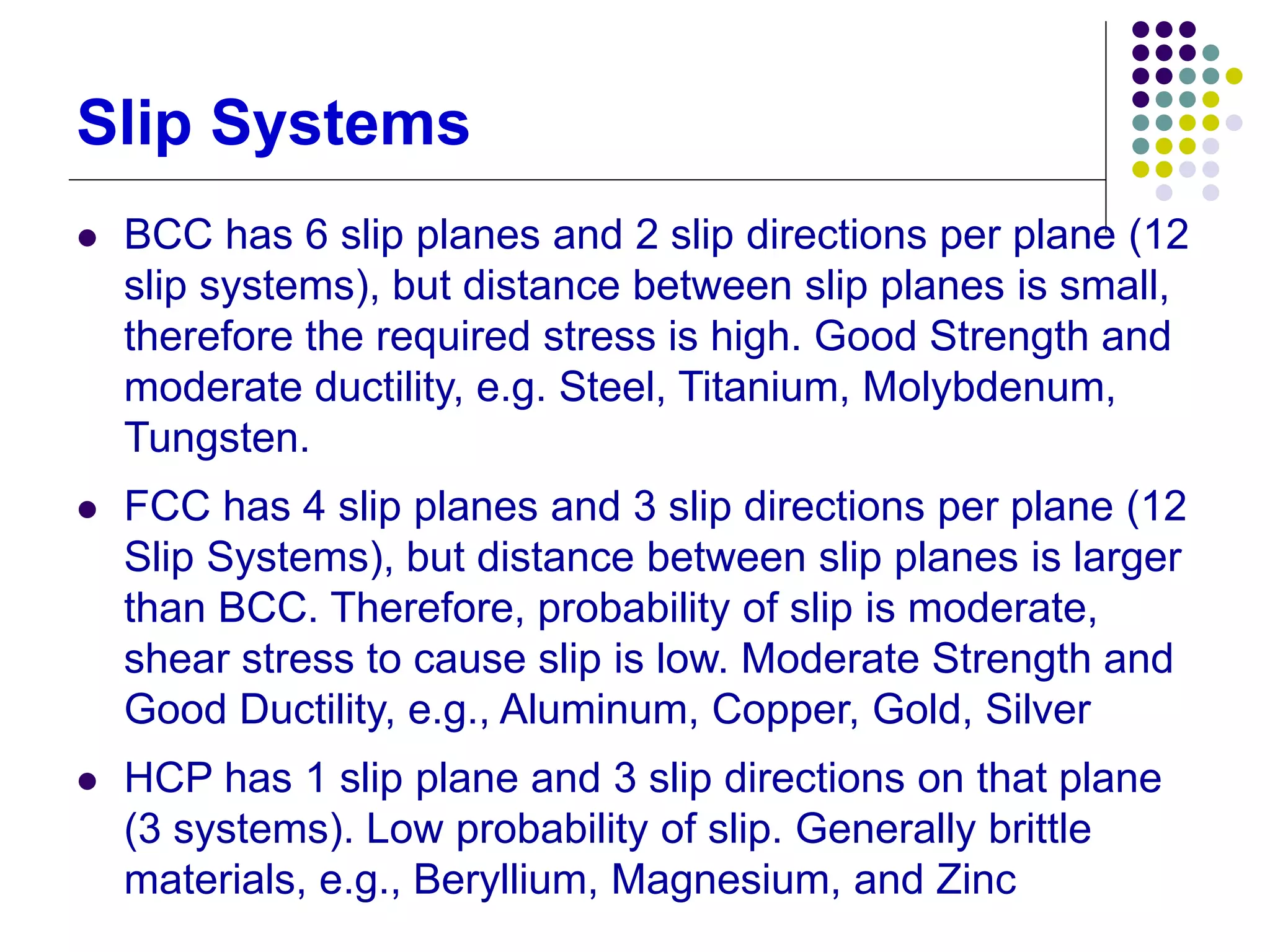
Slip Systems
 BCC has 6 slip planes and 2 slip directions per plane (12
slip systems), but distance between slip planes is small,
therefore the required stress is high. Good Strength and
moderate ductility, e.g. Steel, Titanium, Molybdenum,
Tungsten.
 FCC has 4 slip planes and 3 slip directions per plane (12
Slip Systems), but distance between slip planes is larger
than BCC. Therefore, probability of slip is moderate,
shear stress to cause slip is low. Moderate Strength and
Good Ductility, e.g., Aluminum, Copper, Gold, Silver
 HCP has 1 slip plane and 3 slip directions on that plane
(3 systems). Low probability of slip. Generally brittle
materials, e.g., Beryllium, Magnesium, and Zinc
Plastic Deformation of Single
Crystals
Theoretical Shear Strength and
Tensile Strength
 Theoretical shear stress is the shear stress to
cause permanent deformation in a perfect
crystal.
 Theoretical or ideal tensile strength of material is
the tensile stress required to break the atomic
bonds between two neighboring atomic planes.
30
/
~
10
/
2
max G
G
between
a
b
G




10
/
max E


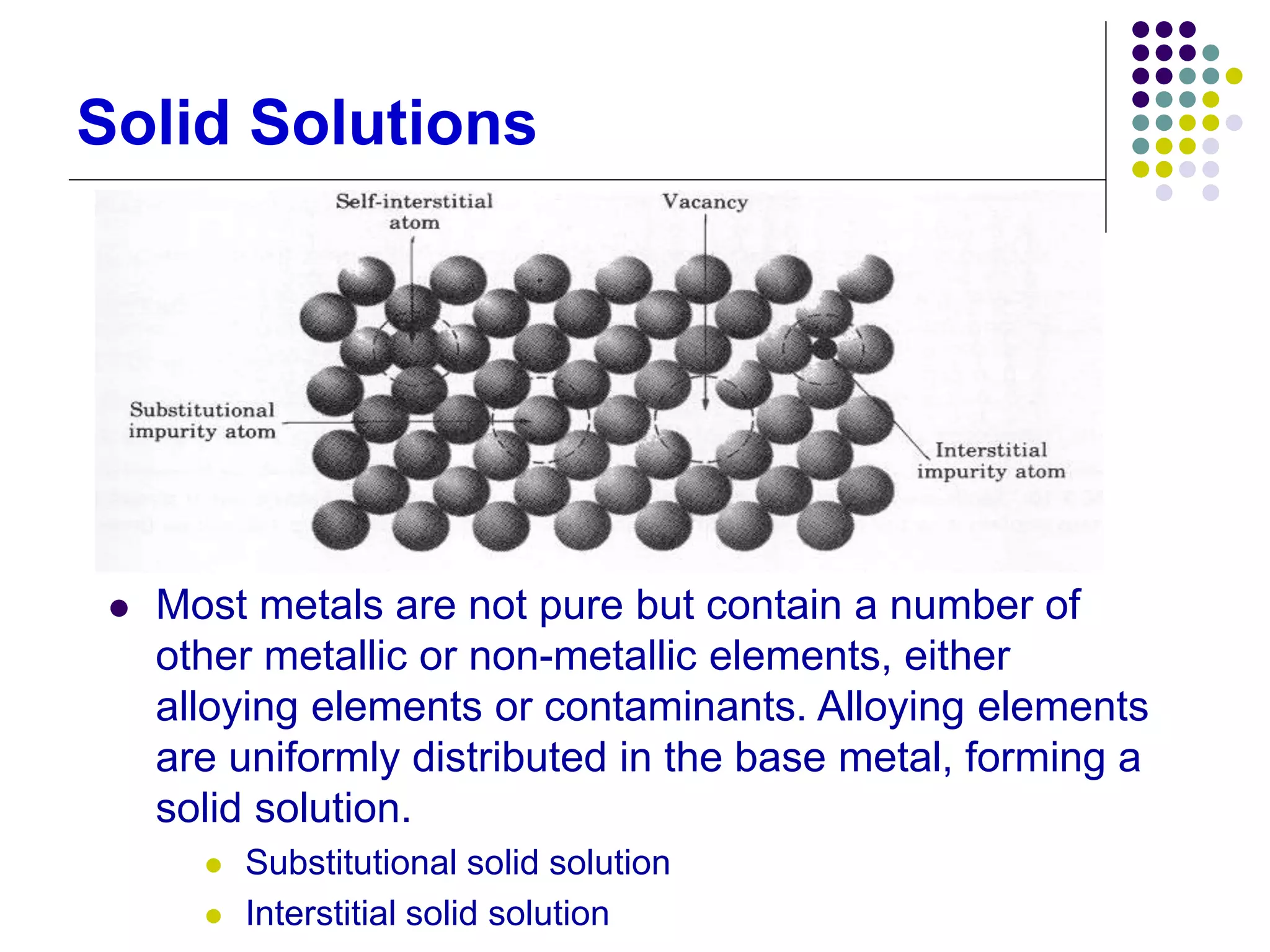
Solid Solutions
 Most metals are not pure but contain a number of
other metallic or non-metallic elements, either
alloying elements or contaminants. Alloying elements
are uniformly distributed in the base metal, forming a
solid solution.
 Substitutional solid solution
 Interstitial solid solution
Effect of Imperfections
 Pure metal: dislocation
 Solid solutions
 Solute atoms of slightly different size distort the lattice and makes
dislocation propagation more difficult, thus strength increases
without necessarily reducing ductility.
 Interstitial elements play a similar role in impeding dislocation
mobility although they can have an embrittling effect.
 Interfaces, inclusions, gases
Grain Size Effect
 Grain boundaries present
obstacles to dislocation
propagation. Therefore, it is
generally found that the yield
strength of a material
increase with decreasing
grain size according to the
Hall-Petch equation.
 However at low strain rate
and close to Tm, dislocation
is resolved by diffusion.
Material deforms by sliding
of grains or reshaping of
grains. Both processes are
easier if grain size is small.
Phase Diagrams
• A phase diagram, also called equilibrium diagram or a constitutional
diagram, graphically illustrates the relationships among temperature,
composition, and the phases present in a particular alloy system.
Lever Rule
 The composition of various phases in a phase
diagram can be determined by a procedure
called the lever rule.
 Example: Calculate the relative proportions of
the phases in a Cu-Ag alloy of eutectic
composition just below the eutectic temperature.
L
s
s
L
s
L
C
C
C
C
L
S
L
or
C
C
C
C
L
S
S








0
0
%
2
.
23
2
.
91
9
.
7
2
.
91
9
.
71







 





C
C
C
CE
The Structure of a Cu-Ag Solid
Solution with 20% Ag
Iron/Iron Carbide Phase Diagram
Nonequilibrium Solidification
Microsegregation or coring
Heat Treatment
 Most parts will require heat treatment either after or
during the processing for proper in-service properties
 Annealing
 Heat to elevated temp, hold, cool
 Softens the material and removes stress
 Precipitation Hardening
 Diffusion of alloys to produce two phase structure that
promote good strength and ductility
 (Aging – Aluminum for example)
 Heat Treatment of Steel
Heat Treatment of Steel (TTT
Diagram)
Summary
 Solidification process affects crystal structures
which in turn affect material properties.
 Single crystal materials behave very differently
than metal alloys.
 The effect of imperfections and grain size in
solid solutions.
 Heat treatment can modify material properties by
changing the crystal structure.
solidification and heat treatment.ppt

  • 1.
    Sp’ 05 W.Li Solidification and Heat Treatment  Solidification  Crystal structures  Structure-property relationships  Heat treatment
  • 2.
    Pure Metal Solidification •Temperature remains constant while grains grow. • Some metals undergo allotropic transformation in solid state. • For example on cooling bcc -iron changes to fcc -iron at 1400 C, which again to bcc - iron at 906 C.
  • 3.
    Nucleation and GrainGrowth  Nucleation;  Homogeneous nucleation: very pure metal, substantial undercooling (0.2Tm)  Heterogeneous nucleation: nucleation agents (5ºC undercooling)  Grain growth  Planar: pure metal  Dendritic: solid solution  Grain size  depends on number of nuclei and cooling rate.
  • 4.
    Crystal Nucleation andGrowth “Manufacturing Processes for Engineering Materials,” by Serope Kalpakjian
  • 5.
    Crystal Structure ofMetals  Atoms arrange themselves into various orderly configuration, called crystals.  The arrangement of the atoms in the crystal is called crystalline structure.  The smallest group of atoms showing the characteristic lattice structure of a particular metal is known as a unit cell.
  • 6.
  • 7.
    Slip Systems  Deformation(dislocation) occurs on preferential crystallographic planes and directions, called slip systems.  The slip plane/direction is the plane/direction with the most closely packed atoms. 6x2=12 4x3=12 1x3=3
  • 8.
    Slip Systems  BCChas 6 slip planes and 2 slip directions per plane (12 slip systems), but distance between slip planes is small, therefore the required stress is high. Good Strength and moderate ductility, e.g. Steel, Titanium, Molybdenum, Tungsten.  FCC has 4 slip planes and 3 slip directions per plane (12 Slip Systems), but distance between slip planes is larger than BCC. Therefore, probability of slip is moderate, shear stress to cause slip is low. Moderate Strength and Good Ductility, e.g., Aluminum, Copper, Gold, Silver  HCP has 1 slip plane and 3 slip directions on that plane (3 systems). Low probability of slip. Generally brittle materials, e.g., Beryllium, Magnesium, and Zinc
  • 9.
    Plastic Deformation ofSingle Crystals
  • 10.
    Theoretical Shear Strengthand Tensile Strength  Theoretical shear stress is the shear stress to cause permanent deformation in a perfect crystal.  Theoretical or ideal tensile strength of material is the tensile stress required to break the atomic bonds between two neighboring atomic planes. 30 / ~ 10 / 2 max G G between a b G     10 / max E  
  • 11.
    Solid Solutions  Mostmetals are not pure but contain a number of other metallic or non-metallic elements, either alloying elements or contaminants. Alloying elements are uniformly distributed in the base metal, forming a solid solution.  Substitutional solid solution  Interstitial solid solution
  • 12.
    Effect of Imperfections Pure metal: dislocation  Solid solutions  Solute atoms of slightly different size distort the lattice and makes dislocation propagation more difficult, thus strength increases without necessarily reducing ductility.  Interstitial elements play a similar role in impeding dislocation mobility although they can have an embrittling effect.  Interfaces, inclusions, gases
  • 13.
    Grain Size Effect Grain boundaries present obstacles to dislocation propagation. Therefore, it is generally found that the yield strength of a material increase with decreasing grain size according to the Hall-Petch equation.  However at low strain rate and close to Tm, dislocation is resolved by diffusion. Material deforms by sliding of grains or reshaping of grains. Both processes are easier if grain size is small.
  • 14.
    Phase Diagrams • Aphase diagram, also called equilibrium diagram or a constitutional diagram, graphically illustrates the relationships among temperature, composition, and the phases present in a particular alloy system.
  • 15.
    Lever Rule  Thecomposition of various phases in a phase diagram can be determined by a procedure called the lever rule.  Example: Calculate the relative proportions of the phases in a Cu-Ag alloy of eutectic composition just below the eutectic temperature. L s s L s L C C C C L S L or C C C C L S S         0 0 % 2 . 23 2 . 91 9 . 7 2 . 91 9 . 71               C C C CE
  • 16.
    The Structure ofa Cu-Ag Solid Solution with 20% Ag
  • 17.
  • 18.
  • 19.
    Heat Treatment  Mostparts will require heat treatment either after or during the processing for proper in-service properties  Annealing  Heat to elevated temp, hold, cool  Softens the material and removes stress  Precipitation Hardening  Diffusion of alloys to produce two phase structure that promote good strength and ductility  (Aging – Aluminum for example)  Heat Treatment of Steel
  • 20.
    Heat Treatment ofSteel (TTT Diagram)
  • 21.
    Summary  Solidification processaffects crystal structures which in turn affect material properties.  Single crystal materials behave very differently than metal alloys.  The effect of imperfections and grain size in solid solutions.  Heat treatment can modify material properties by changing the crystal structure.