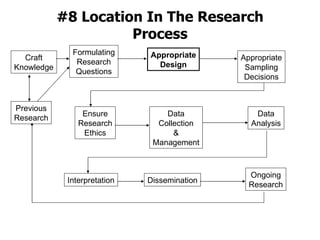
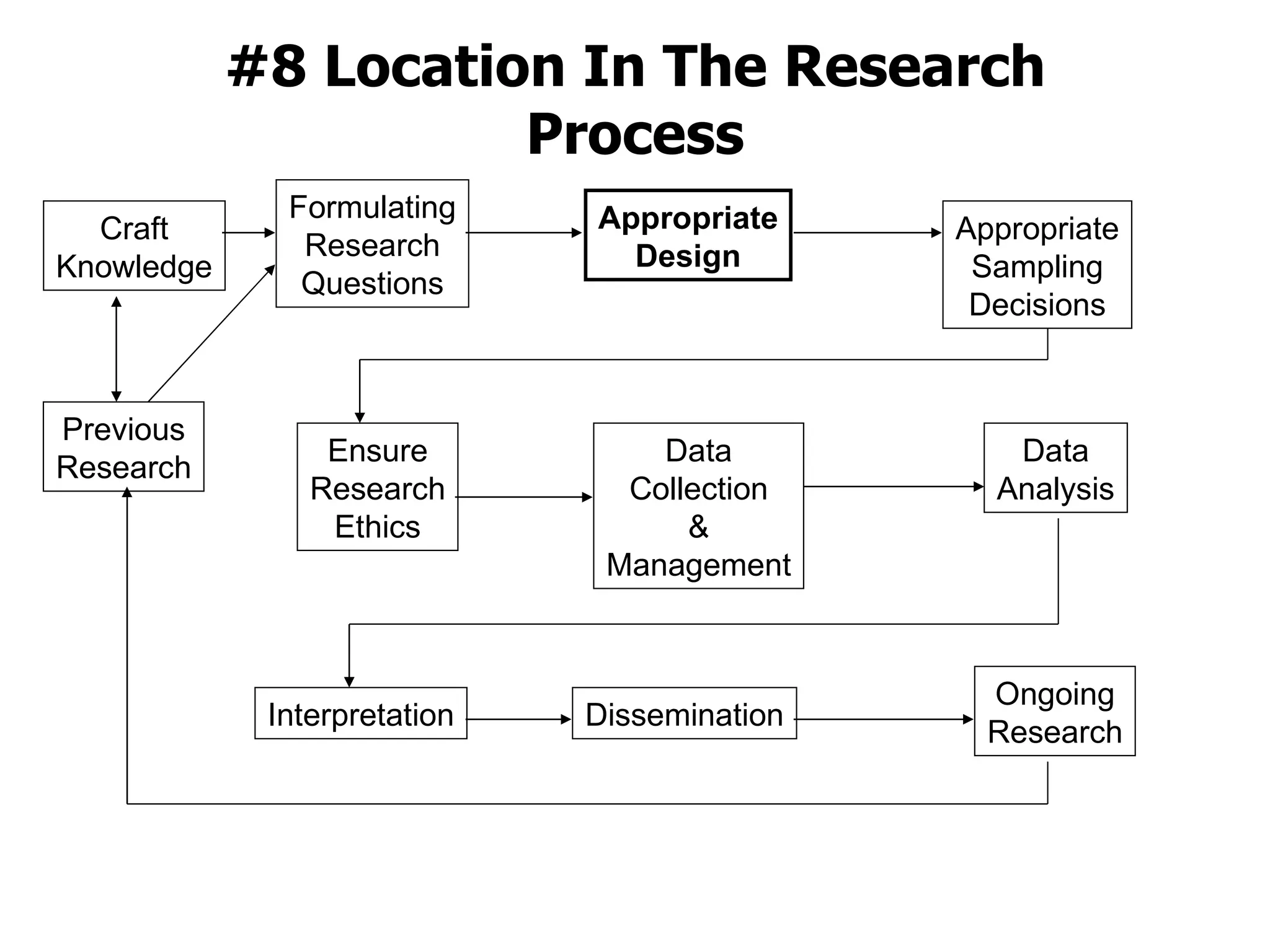
#8 Location In The Research Process Formulating Research Questions Previous Research Craft Knowledge Appropriate Design Appropriate Sampling Decisions Ensure Research Ethics Data Collection & Management Data Analysis Interpretation Dissemination Ongoing Research
Basic Requirements Of All Single Subject Designs Continuous Assessment Several observations of the target behavior Across all phases of the study A minimum of three times during each phase Baseline Assessment Of Functioning Data about what expected performance would be Descriptive function (control phase) Predictive function  Baseline Data Should Be Stable Without trend and have little variability
Internal and External Validity Internal Validity The extent to which alternate explanations, beyond the variable of interest, can be ruled out External Validity The extent to which results of an experiment can be generalized beyond the conditions of an experiment
Internal and External Validity Internal validity addressed through Withdrawal or reversal with repeating phases Comparing across multiple baselines External validity addressed through replication At least four cases per study
Two Types of Experimental Single Subject Designs AB designs are pre-experimental Establishing measurement accuracy Detecting preliminary data trends Cannot infer causality ABAB Designs Are Experimental Withdrawal and Reversal take place Multiple Baseline Designs Are Experimental Target behavior changes when and only when an intervention is applied to that behavior
A first baseline phase describes and predicts the target First intervention phase, when the intervention is applied and the target is measured Next comes a second baseline phase, also known as a  withdrawal  phase, when the intervention is removed and the target is measured Finishes with a second intervention phase, maintained as long as is needed, and then faded out ABAB Design - Implementing
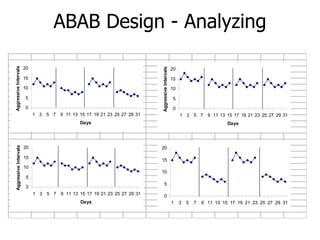
A stable first baseline phase a marked change during the first intervention phase A clear return to first baseline performance levels during the second baseline phase Another marked change in the target during the second intervention phase ABAB Design - Analyzing
ABAB Design - Analyzing
Phases can be ordered differently within ABAB designs As long as there are at least two intervention phases and two baseline phases Intervention and baseline phases are adjacent to each other Treatment comparisons can be made An ABCABC design for example The ordering of treatments should be changed across replications ABAB Design - Considerations
Problems with ABAB designs Absence of reversal The target doesn't return to first baseline levels during the second baseline phase Undesirability of reversing behavior In some instances it is unethical to allow the client to worsen, even for a brief period of time Especially if the behavior has a risk of harming anyone
Multiple Baseline Designs Test causality  Demonstrating that a target behavior changes when and only when an intervention is applied to that behavior Require highly specified targets and interventions
Multiple Baseline Designs Can Be Implemented Across behaviors At least three different target behaviors Across participants With a single intervention being compared across at least three participants who have the same target Across settings with a single intervention being applied to a single participant across at least three different settings Across Change Agents
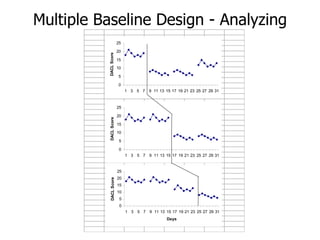
Collect baseline data On at least three targets, participants, or settings/change agents Apply an intervention To only one target, participant or setting After change is demonstrated in the first target, participant or setting Apply an intervention to another single target, participant or setting After change is demonstrated in the second target, participant or setting Apply an intervention to another single target, participant or setting Multiple Baseline - Implementing
Multiple Baseline Design - Analyzing
Problems With Multiple Baseline Designs Interdependent baselines When behaviors change before the intervention is applied to them Inconsistent intervention effects Add ambiguity to conclusions about interventions Prolonged baselines Raise clinical and ethical issues Raise the risk that a behavior may change before an intervention is applied

Lecture 8 single subject designs i

  • 1.
    #8 Location InThe Research Process Formulating Research Questions Previous Research Craft Knowledge Appropriate Design Appropriate Sampling Decisions Ensure Research Ethics Data Collection & Management Data Analysis Interpretation Dissemination Ongoing Research
  • 2.
    Basic Requirements OfAll Single Subject Designs Continuous Assessment Several observations of the target behavior Across all phases of the study A minimum of three times during each phase Baseline Assessment Of Functioning Data about what expected performance would be Descriptive function (control phase) Predictive function Baseline Data Should Be Stable Without trend and have little variability
  • 3.
    Internal and ExternalValidity Internal Validity The extent to which alternate explanations, beyond the variable of interest, can be ruled out External Validity The extent to which results of an experiment can be generalized beyond the conditions of an experiment
  • 4.
    Internal and ExternalValidity Internal validity addressed through Withdrawal or reversal with repeating phases Comparing across multiple baselines External validity addressed through replication At least four cases per study
  • 5.
    Two Types ofExperimental Single Subject Designs AB designs are pre-experimental Establishing measurement accuracy Detecting preliminary data trends Cannot infer causality ABAB Designs Are Experimental Withdrawal and Reversal take place Multiple Baseline Designs Are Experimental Target behavior changes when and only when an intervention is applied to that behavior
  • 6.
    A first baselinephase describes and predicts the target First intervention phase, when the intervention is applied and the target is measured Next comes a second baseline phase, also known as a withdrawal phase, when the intervention is removed and the target is measured Finishes with a second intervention phase, maintained as long as is needed, and then faded out ABAB Design - Implementing
  • 7.
    A stable firstbaseline phase a marked change during the first intervention phase A clear return to first baseline performance levels during the second baseline phase Another marked change in the target during the second intervention phase ABAB Design - Analyzing
  • 8.
    ABAB Design -Analyzing
  • 9.
    Phases can beordered differently within ABAB designs As long as there are at least two intervention phases and two baseline phases Intervention and baseline phases are adjacent to each other Treatment comparisons can be made An ABCABC design for example The ordering of treatments should be changed across replications ABAB Design - Considerations
  • 10.
    Problems with ABABdesigns Absence of reversal The target doesn't return to first baseline levels during the second baseline phase Undesirability of reversing behavior In some instances it is unethical to allow the client to worsen, even for a brief period of time Especially if the behavior has a risk of harming anyone
  • 11.
    Multiple Baseline DesignsTest causality Demonstrating that a target behavior changes when and only when an intervention is applied to that behavior Require highly specified targets and interventions
  • 12.
    Multiple Baseline DesignsCan Be Implemented Across behaviors At least three different target behaviors Across participants With a single intervention being compared across at least three participants who have the same target Across settings with a single intervention being applied to a single participant across at least three different settings Across Change Agents
  • 13.
    Collect baseline dataOn at least three targets, participants, or settings/change agents Apply an intervention To only one target, participant or setting After change is demonstrated in the first target, participant or setting Apply an intervention to another single target, participant or setting After change is demonstrated in the second target, participant or setting Apply an intervention to another single target, participant or setting Multiple Baseline - Implementing
  • 14.
  • 15.
    Problems With MultipleBaseline Designs Interdependent baselines When behaviors change before the intervention is applied to them Inconsistent intervention effects Add ambiguity to conclusions about interventions Prolonged baselines Raise clinical and ethical issues Raise the risk that a behavior may change before an intervention is applied