The Lean LaunchPad

Lecture 6: Revenue Streams

             Steve Blank
             Jon Feiber
             John Burke
            Ann Miura-Ko
             Jerry Engel
            Jim Hornthal
             Oren Jacob
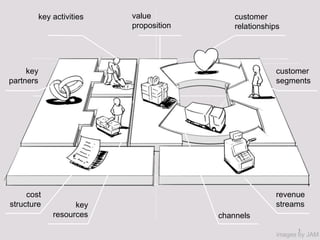
key activities   value             customer
                         proposition       relationships


     key                                               customer
partners                                               segments


     cost                                              revenue
structure         key                                  streams
            resources                  channels
                                                             1
                                                       images by JAM
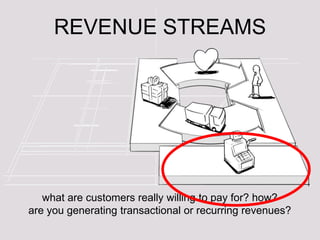
REVENUE STREAMS


   what are customers really willing to pay for? how?
are you generating transactional or recurring revenues?
REVENUE MODEL =

the strategy the company uses to generate
cash from each customer segment
How Many Will You Sell?

• What was the Market size and estimate of market share?,
 – Translate into the anticipated number of customers (as in 10% of a million-
   person market=100,000 customers)
• How many can your channel sell?
• How much will the channel cost?
• How many customer activations?
 – Revenue? Churn/Attrition rate? customers/?
• How much will it cost to acquire a customer?
 – How many units will they buy from each of these efforts?
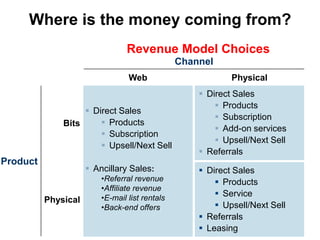
Where is the money coming from?
                                 Revenue Model Choices
                                                Channel
                                 Web                        Physical
                                                     Direct Sales
                                                         Products
                    Direct Sales
                                                         Subscription
              Bits      Products
                                                         Add-on services
                        Subscription
                                                         Upsell/Next Sell
                        Upsell/Next Sell
                                                     Referrals
Product
                      Ancillary Sales:              Direct Sales
                         •Referral revenue               Products
                         •Affiliate revenue
                         •E-mail list rentals
                                                         Service
          Physical
                         •Back-end offers                Upsell/Next Sell
                                                     Referrals
                                                     Leasing
Web/Mobile Revenue Models
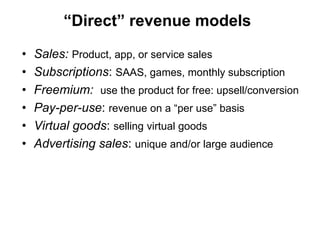
“Direct” revenue models

•   Sales: Product, app, or service sales
•   Subscriptions: SAAS, games, monthly subscription
•   Freemium: use the product for free: upsell/conversion
•   Pay-per-use: revenue on a “per use” basis
•   Virtual goods: selling virtual goods
•   Advertising sales: unique and/or large audience
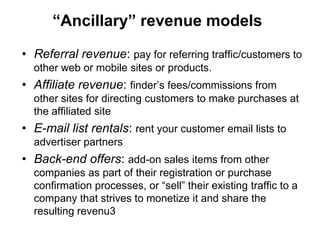
“Ancillary” revenue models

• Referral revenue: pay for referring traffic/customers to
  other web or mobile sites or products.
• Affiliate revenue: finder’s fees/commissions from
  other sites for directing customers to make purchases at
  the affiliated site
• E-mail list rentals: rent your customer email lists to
  advertiser partners
• Back-end offers: add-on sales items from other
  companies as part of their registration or purchase
  confirmation processes, or “sell” their existing traffic to a
  company that strives to monetize it and share the
  resulting revenu3
Physical Revenue Models
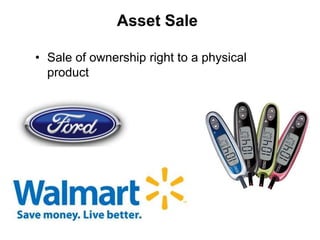
Asset Sale

• Sale of ownership right to a physical
  product
Usage Fee

• Usage of service. Fee is proportional to
  the usage of the service.
Subscription Fee

• Fee for continuous access to a service
Renting

• Fee for temporary access to a good or service
Licensing

• Fee for use of some IP (including software)
Intermediation Fee

• Often found in marketplaces of various types, a
  fee for bringing together two or more parties
  involved in a transaction
Advertising

• Fee paid by brands and companies to get in
  front of potential customers
PRICING MODEL =

the tactics you use to set the price in each
customer segment
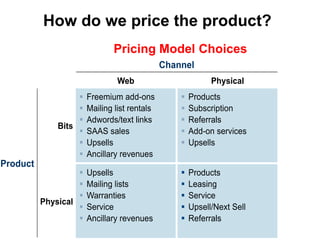
How do we price the product?
        Pricing Model Choices
How do we price the product?
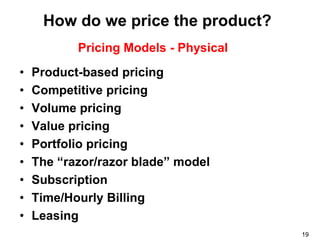
           Pricing Models - Physical
•   Product-based pricing
•   Competitive pricing
•   Volume pricing
•   Value pricing
•   Portfolio pricing
•   The “razor/razor blade” model
•   Subscription
•   Time/Hourly Billing
•   Leasing
                                       19
How do we price the product?
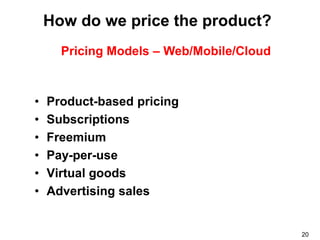
      Pricing Models – Web/Mobile/Cloud


•   Product-based pricing
•   Subscriptions
•   Freemium
•   Pay-per-use
•   Virtual goods
•   Advertising sales


                                          20
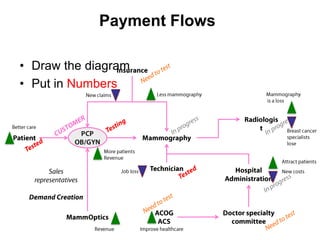
Payment Flows

• Draw the diagram
• Put in Numbers
Pricing
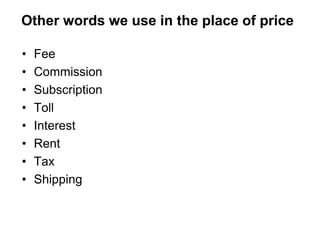
Other words we use in the place of price

•   Fee
•   Commission
•   Subscription
•   Toll
•   Interest
•   Rent
•   Tax
•   Shipping
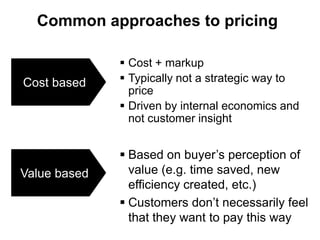
Common approaches to pricing

               Cost + markup
Cost based     Typically not a strategic way to
                price
               Driven by internal economics and
                not customer insight


               Based on buyer’s perception of
Value based     value (e.g. time saved, new
                efficiency created, etc.)
               Customers don’t necessarily feel
                that they want to pay this way
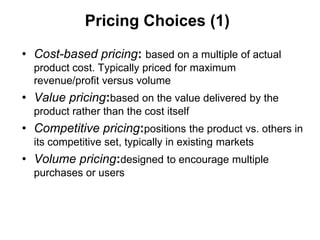
Pricing Choices (1)

• Cost-based pricing: based on a multiple of actual
  product cost. Typically priced for maximum
  revenue/profit versus volume
• Value pricing:based on the value delivered by the
  product rather than the cost itself
• Competitive pricing:positions the product vs. others in
  its competitive set, typically in existing markets
• Volume pricing:designed to encourage multiple
  purchases or users
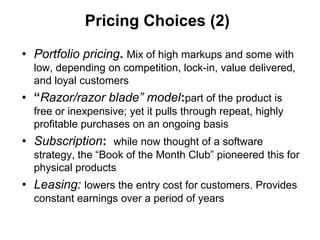
Pricing Choices (2)

• Portfolio pricing. Mix of high markups and some with
  low, depending on competition, lock-in, value delivered,
  and loyal customers
• “Razor/razor blade” model:part of the product is
  free or inexpensive; yet it pulls through repeat, highly
  profitable purchases on an ongoing basis
• Subscription: while now thought of a software
  strategy, the “Book of the Month Club” pioneered this for
  physical products
• Leasing: lowers the entry cost for customers. Provides
  constant earnings over a period of years
Additional components of pricing

• Exclusive vs. non-exclusive
• What do you price? What do you give away for
  free?
• How does cost vary at different production
  levels?
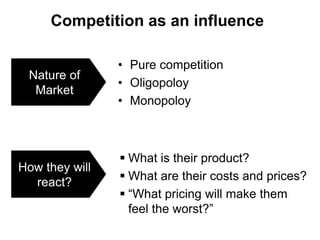
Competition as an influence

                • Pure competition
 Nature of
                • Oligopoloy
  Market
                • Monopoloy


                 What is their product?
How they will
  react?         What are their costs and prices?
                 “What pricing will make them
                  feel the worst?”
Multi-side Markets and Revenue


• Single-sided markets that care about
  revenues

• Web-based Multi-sided markets may care
  about users first, revenues second
“Revenue First” Companies


• Time to doublings for monthly revenues
• Key questions:
     • When will I get to $100k/month in revenues?
     • When will I get to $1M/month in revenues?
     • What assumptions about my business am I making
       when I reach these milestones?
“Users First” Companies

If you say your business is advertising based:

• How do you get to 10M monthly users?
• How do you become one of the top 5 websites
  visited?
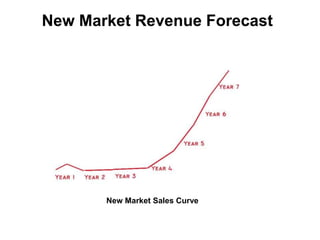
New Market Revenue Forecast


       New Market Sales Curve
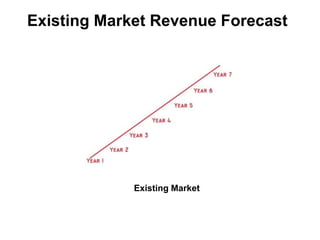
Existing Market Revenue Forecast


             Existing Market
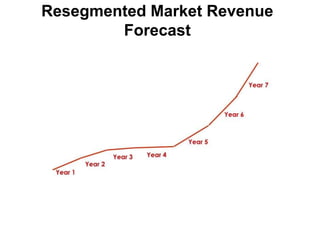
Resegmented Market Revenue
        Forecast
Other Revenue Issues

• Channel issues
  – Return rights?
  – Channel discounts? SPIFs?
• Market Type affects Revenue Streams
• Demand curve affects Revenue
• Consider Lifetime Value
Other Questions

• What are my customers paying for?
• What capacity do my customers have to
  pay?
• How will you package your product ?
• How will you price the offerings?
• What constitutes cost for the company?
• What are the key financials metrics for your
  business model?
• What are the risks involved?
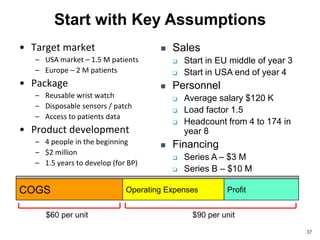
Start with Key Assumptions
• Target market                         Sales
   – USA market – 1.5 M patients            Start in EU middle of year 3
   – Europe – 2 M patients                  Start in USA end of year 4
• Package                               Personnel
   – Reusable wrist watch                   Average salary $120 K
   – Disposable sensors / patch
                                            Load factor 1.5
   – Access to patients data
                                            Headcount from 4 to 174 in
• Product development                        year 8
   – 4 people in the beginning          Financing
   – $2 million
                                            Series A – $3 M
   – 1.5 years to develop (for BP)
                                            Series B – $10 M

Price per package: $150
COGS                 Operating Expenses                 Profit


      $60 per unit                             $90 per unit

                                                                            37
Does it add up?


• Is the revenue adequate to cover costs in the short term;
• Are you confident the revenue will grow materially if not
  dramatically over time; and
• Does the profitability get better as the revenues get
  bigger?


                                                          38
Team Deliverable for Next Week

•   What’s your revenue model?
•   How will you price your products?
•   Draw the diagram of payment flows
•   What are your key financial metrics?
•   Test pricing 100 web customers 10/15 non web?
•   How do competitors price?
•   Assemble a rough income statement

•   Summarized in a 5 Minute PowerPoint Presentation

Lecture 6 revenue model

  • 1.
    The Lean LaunchPad Lecture6: Revenue Streams Steve Blank Jon Feiber John Burke Ann Miura-Ko Jerry Engel Jim Hornthal Oren Jacob
  • 2.
    key activities value customer proposition relationships key customer partners segments cost revenue structure key streams resources channels 1 images by JAM
  • 3.
    REVENUE STREAMS what are customers really willing to pay for? how? are you generating transactional or recurring revenues?
  • 4.
    REVENUE MODEL = thestrategy the company uses to generate cash from each customer segment
  • 5.
    How Many WillYou Sell? • What was the Market size and estimate of market share?, – Translate into the anticipated number of customers (as in 10% of a million- person market=100,000 customers) • How many can your channel sell? • How much will the channel cost? • How many customer activations? – Revenue? Churn/Attrition rate? customers/? • How much will it cost to acquire a customer? – How many units will they buy from each of these efforts?
  • 6.
    Where is themoney coming from? Revenue Model Choices Channel Web Physical  Direct Sales  Products  Direct Sales  Subscription Bits  Products  Add-on services  Subscription  Upsell/Next Sell  Upsell/Next Sell  Referrals Product  Ancillary Sales:  Direct Sales •Referral revenue  Products •Affiliate revenue •E-mail list rentals  Service Physical •Back-end offers  Upsell/Next Sell  Referrals  Leasing
  • 7.
  • 8.
    “Direct” revenue models • Sales: Product, app, or service sales • Subscriptions: SAAS, games, monthly subscription • Freemium: use the product for free: upsell/conversion • Pay-per-use: revenue on a “per use” basis • Virtual goods: selling virtual goods • Advertising sales: unique and/or large audience
  • 9.
    “Ancillary” revenue models •Referral revenue: pay for referring traffic/customers to other web or mobile sites or products. • Affiliate revenue: finder’s fees/commissions from other sites for directing customers to make purchases at the affiliated site • E-mail list rentals: rent your customer email lists to advertiser partners • Back-end offers: add-on sales items from other companies as part of their registration or purchase confirmation processes, or “sell” their existing traffic to a company that strives to monetize it and share the resulting revenu3
  • 10.
  • 11.
    Asset Sale • Saleof ownership right to a physical product
  • 12.
    Usage Fee • Usageof service. Fee is proportional to the usage of the service.
  • 13.
    Subscription Fee • Feefor continuous access to a service
  • 14.
    Renting • Fee fortemporary access to a good or service
  • 15.
    Licensing • Fee foruse of some IP (including software)
  • 16.
    Intermediation Fee • Oftenfound in marketplaces of various types, a fee for bringing together two or more parties involved in a transaction
  • 17.
    Advertising • Fee paidby brands and companies to get in front of potential customers
  • 18.
    PRICING MODEL = thetactics you use to set the price in each customer segment
  • 19.
    How do weprice the product? Pricing Model Choices
  • 20.
    How do weprice the product? Pricing Models - Physical • Product-based pricing • Competitive pricing • Volume pricing • Value pricing • Portfolio pricing • The “razor/razor blade” model • Subscription • Time/Hourly Billing • Leasing 19
  • 21.
    How do weprice the product? Pricing Models – Web/Mobile/Cloud • Product-based pricing • Subscriptions • Freemium • Pay-per-use • Virtual goods • Advertising sales 20
  • 22.
    Payment Flows • Drawthe diagram • Put in Numbers
  • 23.
  • 24.
    Other words weuse in the place of price • Fee • Commission • Subscription • Toll • Interest • Rent • Tax • Shipping
  • 25.
    Common approaches topricing  Cost + markup Cost based  Typically not a strategic way to price  Driven by internal economics and not customer insight  Based on buyer’s perception of Value based value (e.g. time saved, new efficiency created, etc.)  Customers don’t necessarily feel that they want to pay this way
  • 26.
    Pricing Choices (1) •Cost-based pricing: based on a multiple of actual product cost. Typically priced for maximum revenue/profit versus volume • Value pricing:based on the value delivered by the product rather than the cost itself • Competitive pricing:positions the product vs. others in its competitive set, typically in existing markets • Volume pricing:designed to encourage multiple purchases or users
  • 27.
    Pricing Choices (2) •Portfolio pricing. Mix of high markups and some with low, depending on competition, lock-in, value delivered, and loyal customers • “Razor/razor blade” model:part of the product is free or inexpensive; yet it pulls through repeat, highly profitable purchases on an ongoing basis • Subscription: while now thought of a software strategy, the “Book of the Month Club” pioneered this for physical products • Leasing: lowers the entry cost for customers. Provides constant earnings over a period of years
  • 28.
    Additional components ofpricing • Exclusive vs. non-exclusive • What do you price? What do you give away for free? • How does cost vary at different production levels?
  • 29.
    Competition as aninfluence • Pure competition Nature of • Oligopoloy Market • Monopoloy  What is their product? How they will react?  What are their costs and prices?  “What pricing will make them feel the worst?”
  • 30.
    Multi-side Markets andRevenue • Single-sided markets that care about revenues • Web-based Multi-sided markets may care about users first, revenues second
  • 31.
    “Revenue First” Companies •Time to doublings for monthly revenues • Key questions: • When will I get to $100k/month in revenues? • When will I get to $1M/month in revenues? • What assumptions about my business am I making when I reach these milestones?
  • 32.
    “Users First” Companies Ifyou say your business is advertising based: • How do you get to 10M monthly users? • How do you become one of the top 5 websites visited?
  • 33.
    New Market RevenueForecast New Market Sales Curve
  • 34.
    Existing Market RevenueForecast Existing Market
  • 35.
  • 36.
    Other Revenue Issues •Channel issues – Return rights? – Channel discounts? SPIFs? • Market Type affects Revenue Streams • Demand curve affects Revenue • Consider Lifetime Value
  • 37.
    Other Questions • Whatare my customers paying for? • What capacity do my customers have to pay? • How will you package your product ? • How will you price the offerings? • What constitutes cost for the company? • What are the key financials metrics for your business model? • What are the risks involved?
  • 38.
    Start with KeyAssumptions • Target market  Sales – USA market – 1.5 M patients  Start in EU middle of year 3 – Europe – 2 M patients  Start in USA end of year 4 • Package  Personnel – Reusable wrist watch  Average salary $120 K – Disposable sensors / patch  Load factor 1.5 – Access to patients data  Headcount from 4 to 174 in • Product development year 8 – 4 people in the beginning  Financing – $2 million  Series A – $3 M – 1.5 years to develop (for BP)  Series B – $10 M Price per package: $150 COGS Operating Expenses Profit $60 per unit $90 per unit 37
  • 39.
    Does it addup? • Is the revenue adequate to cover costs in the short term; • Are you confident the revenue will grow materially if not dramatically over time; and • Does the profitability get better as the revenues get bigger? 38
  • 40.
    Team Deliverable forNext Week • What’s your revenue model? • How will you price your products? • Draw the diagram of payment flows • What are your key financial metrics? • Test pricing 100 web customers 10/15 non web? • How do competitors price? • Assemble a rough income statement • Summarized in a 5 Minute PowerPoint Presentation