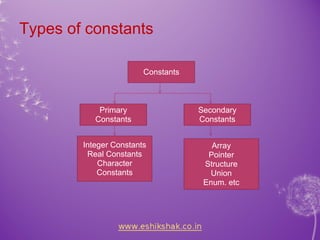
Types of constants

                        Constants


            Primary                 Secondary
           Constants                Constants


        Integer Constants              Array
         Real Constants               Pointer
            Character                Structure
            Constants                  Union
                                     Enum. etc
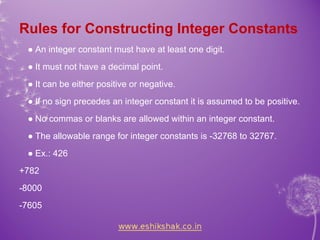
Rules for Constructing Integer Constants
 ● An integer constant must have at least one digit.
 ● It must not have a decimal point.
 ● It can be either positive or negative.
 ● If no sign precedes an integer constant it is assumed to be positive.
 ● No commas or blanks are allowed within an integer constant.
 ● The allowable range for integer constants is -32768 to 32767.
 ● Ex.: 426
+782
-8000
-7605
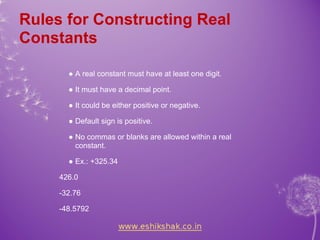
Rules for Constructing Real
Constants

       ● A real constant must have at least one digit.

       ● It must have a decimal point.

       ● It could be either positive or negative.

       ● Default sign is positive.

       ● No commas or blanks are allowed within a real
         constant.

       ● Ex.: +325.34

     426.0

     -32.76

     -48.5792
Rules for Constructing Character
Constants


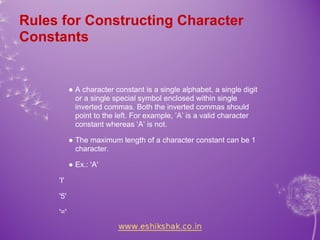
           ● A character constant is a single alphabet, a single digit
             or a single special symbol enclosed within single
             inverted commas. Both the inverted commas should
             point to the left. For example, ’A’ is a valid character
             constant whereas ‘A’ is not.

           ● The maximum length of a character constant can be 1
             character.

           ● Ex.: 'A'

     'I'

     '5'

     '='
Variables in ‘C’

       ● Naming Variables
       ● Declaring Variables
       ● Using Variables
       ● The Assignment Statement
What Are Variables in C?
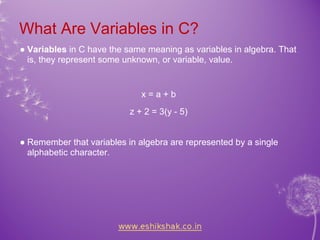
● Variables in C have the same meaning as variables in algebra. That
  is, they represent some unknown, or variable, value.


                              x=a+b
                           z + 2 = 3(y - 5)


● Remember that variables in algebra are represented by a single
  alphabetic character.
Naming Variables
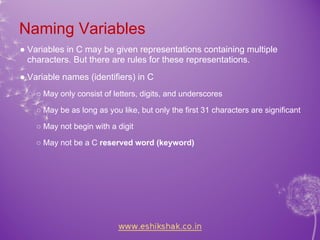
● Variables in C may be given representations containing multiple
  characters. But there are rules for these representations.
● Variable names (identifiers) in C
    ○ May only consist of letters, digits, and underscores

    ○ May be as long as you like, but only the first 31 characters are significant

    ○ May not begin with a digit

    ○ May not be a C reserved word (keyword)
Naming Conventions
● C programmers generally agree on the following conventions for
  naming variables.
   ○ Begin variable names with lowercase letters


   ○ Use   meaningful identifiers
   ○ Separate “words” within identifiers with underscores or mixed upper and
     lower case.

   ○ Examples: surfaceArea surface_Area surface_area

   ○ Be consistent!
Reserved Words (Keywords) in C

 ● auto break       ● int long
 ● case char        ● register return
 ● const continue   ● short signed
                    ● sizeof static
 ● default do
                    ● struct switch
 ● double else      ● typedef union
 ● enum extern      ● unsigned void
 ● float for        ● volatile while
 ● goto if
Naming Conventions (con’t)
● Use all uppercase for symbolic constants (used in #define
  preprocessor directives).
● Note: symbolic constants are not variables, but make the program
  easier to read.
● Examples:


● #define PI 3.14159
● #define AGE 52
Case Sensitivity
● C is case sensitive
    ○ It matters whether an identifier, such as a variable name, is uppercase or
      lowercase.

    ○ Example:

     area

     Area

     AREA

     ArEa

     are all seen as different variables by the compiler.
Which Are Legal Identifiers?

      ● AREA area_under_the_curve
      ● 3D num45
      ● Last-Chance #values
      ● x_yt3 pi
      ● num$ %done
      ● lucky***
Declaring Variables

      ● Before using a variable, you must give the
        compiler some information about the variable;
        i.e., you must declare it.
      ● The declaration statement includes the data
        type of the variable.
      ● Examples of variable declarations:
      ● int meatballs ;
      ● float area ;
Declaring Variables (con’t)
● When we declare a variable
    ○ Space is set aside in memory to hold a value of the specified data
      type
    ○ That space is associated with the variable name
    ○ That space is associated with a unique address
    ○ Unless we specify otherwise, the space has no known value.
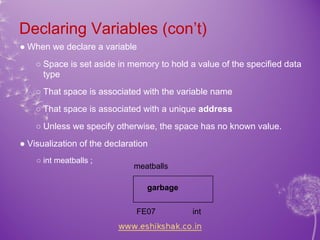
● Visualization of the declaration
    ○ int meatballs ;
                              meatballs

                                 garbage

                               FE07         int

Lecture 4 constants_variables

  • 2.
    Types of constants Constants Primary Secondary Constants Constants Integer Constants Array Real Constants Pointer Character Structure Constants Union Enum. etc
  • 3.
    Rules for ConstructingInteger Constants ● An integer constant must have at least one digit. ● It must not have a decimal point. ● It can be either positive or negative. ● If no sign precedes an integer constant it is assumed to be positive. ● No commas or blanks are allowed within an integer constant. ● The allowable range for integer constants is -32768 to 32767. ● Ex.: 426 +782 -8000 -7605
  • 4.
    Rules for ConstructingReal Constants ● A real constant must have at least one digit. ● It must have a decimal point. ● It could be either positive or negative. ● Default sign is positive. ● No commas or blanks are allowed within a real constant. ● Ex.: +325.34 426.0 -32.76 -48.5792
  • 5.
    Rules for ConstructingCharacter Constants ● A character constant is a single alphabet, a single digit or a single special symbol enclosed within single inverted commas. Both the inverted commas should point to the left. For example, ’A’ is a valid character constant whereas ‘A’ is not. ● The maximum length of a character constant can be 1 character. ● Ex.: 'A' 'I' '5' '='
  • 6.
    Variables in ‘C’ ● Naming Variables ● Declaring Variables ● Using Variables ● The Assignment Statement
  • 7.
    What Are Variablesin C? ● Variables in C have the same meaning as variables in algebra. That is, they represent some unknown, or variable, value. x=a+b z + 2 = 3(y - 5) ● Remember that variables in algebra are represented by a single alphabetic character.
  • 8.
    Naming Variables ● Variablesin C may be given representations containing multiple characters. But there are rules for these representations. ● Variable names (identifiers) in C ○ May only consist of letters, digits, and underscores ○ May be as long as you like, but only the first 31 characters are significant ○ May not begin with a digit ○ May not be a C reserved word (keyword)
  • 9.
    Naming Conventions ● Cprogrammers generally agree on the following conventions for naming variables. ○ Begin variable names with lowercase letters ○ Use meaningful identifiers ○ Separate “words” within identifiers with underscores or mixed upper and lower case. ○ Examples: surfaceArea surface_Area surface_area ○ Be consistent!
  • 10.
    Reserved Words (Keywords)in C ● auto break ● int long ● case char ● register return ● const continue ● short signed ● sizeof static ● default do ● struct switch ● double else ● typedef union ● enum extern ● unsigned void ● float for ● volatile while ● goto if
  • 11.
    Naming Conventions (con’t) ●Use all uppercase for symbolic constants (used in #define preprocessor directives). ● Note: symbolic constants are not variables, but make the program easier to read. ● Examples: ● #define PI 3.14159 ● #define AGE 52
  • 12.
    Case Sensitivity ● Cis case sensitive ○ It matters whether an identifier, such as a variable name, is uppercase or lowercase. ○ Example: area Area AREA ArEa are all seen as different variables by the compiler.
  • 13.
    Which Are LegalIdentifiers? ● AREA area_under_the_curve ● 3D num45 ● Last-Chance #values ● x_yt3 pi ● num$ %done ● lucky***
  • 14.
    Declaring Variables ● Before using a variable, you must give the compiler some information about the variable; i.e., you must declare it. ● The declaration statement includes the data type of the variable. ● Examples of variable declarations: ● int meatballs ; ● float area ;
  • 15.
    Declaring Variables (con’t) ●When we declare a variable ○ Space is set aside in memory to hold a value of the specified data type ○ That space is associated with the variable name ○ That space is associated with a unique address ○ Unless we specify otherwise, the space has no known value. ● Visualization of the declaration ○ int meatballs ; meatballs garbage FE07 int