Randomized Algorithms
CS648

Lecture 2
• Randomized Algorithm for Approximate Median
• Elementary Probability theory
1
Randomized Monte Carlo Algorithm for
approximate median
This lecture was delivered at slow pace and its flavor was that of a
tutorial.
Reason: To show that designing and analyzing a randomized
algorithm demands right insight and just elementary probability.

2
A simple probability exercise
•

There is a coin which gives HEADS with probability ¼ and TAILS with
probability ¾. The coin is tossed times. What is the probability that we get at
least HEADS ?
[Stirling’s approximation for Factorial: ]

3
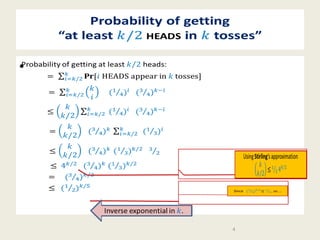
Probability of getting
“at least HEADS in tosses”
Probability of getting at least heads:

•

Using Stirling’s approximation

Since , so …
Inverse exponential in .
4
Approximate median
Definition: Given an array A[] storing n numbers and ϵ > 0, compute an
element whose rank is in the range [(1- ϵ)n/2, (1+ ϵ)n/2].

Best Deterministic Algorithm:
• “Median of Medians” algorithm for finding exact median
• Running time: O(n)
• No faster algorithm possible for approximate median
Can you give a short proof ?

5
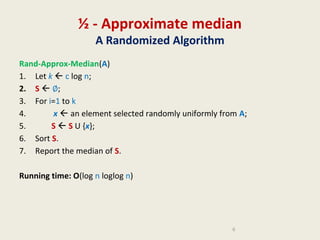
½ - Approximate median
A Randomized Algorithm

Rand-Approx-Median(A)
1. Let k  c log n;
2. S  ∅;
3. For i=1 to k
4.
x  an element selected randomly uniformly from A;
5.
S  S U {x};
6. Sort S.
7. Report the median of S.
Running time: O(log n loglog n)

6
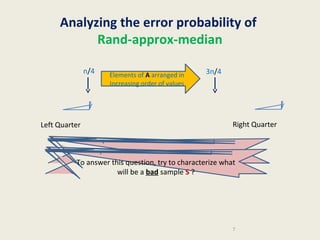
Analyzing the error probability of
Rand-approx-median
n/4

Left Quarter

Elements of A arranged in
Increasing order of values

3n/4

Right Quarter

When does the algorithm err ?
To answer this question, try to characterize what
will be a bad sample S ?

7
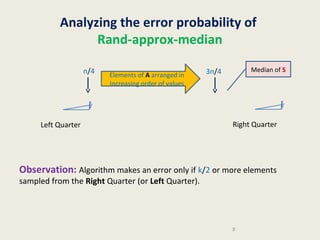
Analyzing the error probability of
Rand-approx-median
n/4

Elements of A arranged in
Increasing order of values

Left Quarter

Median of S

3n/4

Right Quarter

Observation: Algorithm makes an error only if k/2 or more elements
sampled from the Right Quarter (or Left Quarter).

8
Analyzing the error probability of
Rand-approx-median
•

n/4

Elements of A arranged in
Increasing order of values

3n/4

Right Quarter

Left Quarter

Pr[ An element selected randomly from A is from Right quarter] = ¼
??
Pr[ Out of k elements sampled from A, at least k/2 are from Right quarter] = ??
for

Exactly the same as the coin
tossing exercise we did !

9
Main result we discussed

•
Theorem: The Rand-approx-median algorithm fails to report ½
-approximate median from array A[1.. ] with probability at most.
Homework: Design a randomized Monte Carlo algorithm for
computing ϵ-approximate median of array A[1.. ] with running
time O(log n loglog n) and error probability for any given
constants ϵ and .
[Do this homework sincerely without any friend’s help.]

10
Elementary probability theory
(It is so simple that you underestimate its elegance and power)

11
Elementary probability theory
(Relevant for CS648)
•
•

We shall mainly deal with discrete probability theory in this course.
We shall take the set theoretic approach to explain probability theory.

Consider any random experiment :
o Tossing a coin 5 times.
o Throwing a dice 2 times.
o Selecting a number randomly uniformly from [1..n].
How to capture the following facts in the theory of probability ?
1. Outcome will always be from a specified set.
2. Likelihood of each possible outcome is non-negative.
3. We may be interested in a collection of outcomes.
12
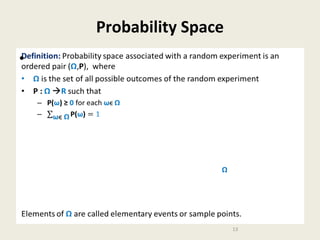
Probability Space
Definition: Probability space associated with a random experiment is an
ordered pair (Ω,P), where
• Ω is the set of all possible outcomes of the random experiment
• P : Ω R such that

•

–

P(ω) ≥ 0 for each ωϵ Ω

Ω

Elements of Ω are called elementary events or sample points.
13
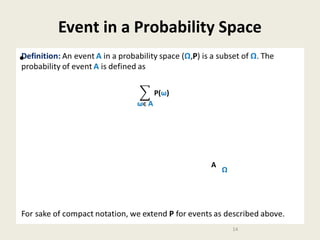
Event in a Probability Space
Definition: An event A in a probability space (Ω,P) is a subset of Ω. The
probability of event A is defined as

•

A

Ω

For sake of compact notation, we extend P for events as described above.
14
Exercises

A randomized algorithm can also be viewed as a random experiment.
1. What is the sample space associated with Randomized Quick sort ?
2. What is the sample space associated with Rand-approx-median
algorithm ?

15
An Important Advice
In the following slides, we shall state well known equations
(highlighted in yellow boxes) from probability theory.
• You should internalize them fully.
• We shall use them crucially in this course.
• Make sincere attempts to solve exercises that follow.

16
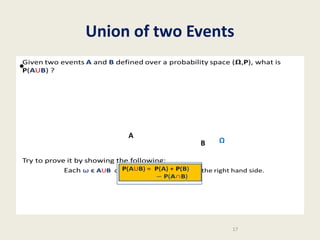
Union of two Events
Given two events A and B defined over a probability space (,P), what is
P(AUB) ?

•

A

B

Ω

P(AUB) = P(A) + P(B)
P(A∩B)

Try to prove it by showing the following:
Each ω ϵ AUB contributes exactly P(ω) in the right hand side.
17
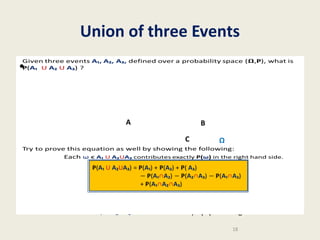
Union of three Events
Given three events A₁, A₂, A₃, defined over a probability space (,P), what is
P(A₁ U A₂ U A₃) ?

•

A

B
C

Ω

P(A₁ U A₂UA₃) = P(A₁) + P(A₂) + P( A₃)
P(A₁∩A₂) P(A₂∩A₃) P(A₁∩A₃)
+ P(A₁∩A₂∩A₃)

Try to prove this equation as well by showing the following:
Each ω ϵ A₁ U A₂UA₃ contributes exactly P(ω) in the right hand side.
18
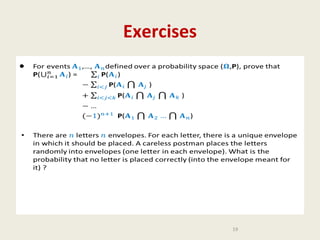
Exercises
•

•

For events ,…, defined over a probability space (,P), prove that P() =

…
)
•

There are letters envelopes. For each letter, there is a unique envelope in
which it should be placed. A careless postman places the letters randomly
into envelopes (one letter in each envelope). What is the probability that
no letter is placed correctly (into the envelope meant for it) ?

19
Conditional Probability
Happening of some event influences the likelihood of happening of other events. This
notion is formally captured by conditional probability as follows.

•

Probability of event A conditioned on event B, compactly represented as P[A|B],
means the following.
Given that event B has happened, what is the probability that event A has also
happened ?
You might have seen and used the following equation for conditional probability.
P[A|B] =
Can you give suitable reason to justify the validity of the above equation ?
In particular, give justification for ] in numerator and ] in denominator in this
equation.
20
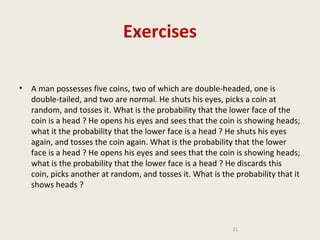
Exercises
•

A man possesses five coins, two of which are double-headed, one is
double-tailed, and two are normal. He shuts his eyes, picks a coin at
random, and tosses it. What is the probability that the lower face of the
coin is a head ? He opens his eyes and sees that the coin is showing heads;
what it the probability that the lower face is a head ? He shuts his eyes
again, and tosses the coin again. What is the probability that the lower
face is a head ? He opens his eyes and sees that the coin is showing heads;
what is the probability that the lower face is a head ? He discards this
coin, picks another at random, and tosses it. What is the probability that it
shows heads ?

21
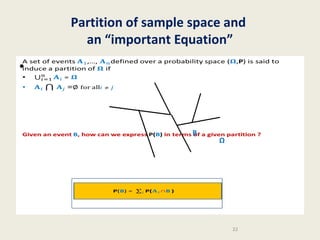
Partition of sample space and
an “important Equation”
A set of events ,…, defined over a probability space (,P) is said to induce a
partition of if
• =

•
•

=∅ for all

B

Ω

Given an event B, how can we express P(B) in terms of a given partition ?
P(B) = )

22
Exercises
•
•

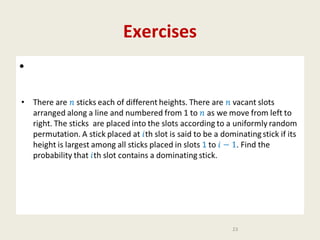
There are sticks each of different heights. There are vacant slots arranged
along a line and numbered from 1 to as we move from left to right. The
sticks are placed into the slots according to a uniformly random
permutation. A stick placed at th slot is said to be a dominating stick if its
height is largest among all sticks placed in slots 1 to . Find the probability
that th slot contains a dominating stick.

23
Independent Events
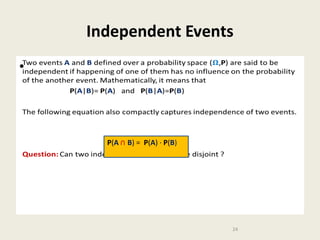
Two events A and B defined over a probability space (,P) are said to be
independent if happening of one of them has no influence on the probability
of the another event. Mathematically, it means that
P(A|B)= P(A) and P(B|A)=P(B)

•

The following equation also compactly captures independence of two events.
P(A ∩ B) = P(A) · P(B)

Question: Can two independent events ever be disjoint ?

24
Exercises
•
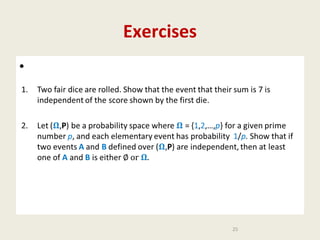
1.

Two fair dice are rolled. Show that the event that their sum is 7 is
independent of the score shown by the first die.

2.

Let (,P) be a probability space where = {1,2,…,p} for a given prime
number p, and each elementary event has probability 1/p. Show that if
two events A and B defined over (,P) are independent, then at least one
of A and B is either ∅ or .

25

Lecture 2-cs648

  • 1.
    Randomized Algorithms CS648 Lecture 2 •Randomized Algorithm for Approximate Median • Elementary Probability theory 1
  • 2.
    Randomized Monte CarloAlgorithm for approximate median This lecture was delivered at slow pace and its flavor was that of a tutorial. Reason: To show that designing and analyzing a randomized algorithm demands right insight and just elementary probability. 2
  • 3.
    A simple probabilityexercise • There is a coin which gives HEADS with probability ¼ and TAILS with probability ¾. The coin is tossed times. What is the probability that we get at least HEADS ? [Stirling’s approximation for Factorial: ] 3
  • 4.
    Probability of getting “atleast HEADS in tosses” Probability of getting at least heads: • Using Stirling’s approximation Since , so … Inverse exponential in . 4
  • 5.
    Approximate median Definition: Givenan array A[] storing n numbers and ϵ > 0, compute an element whose rank is in the range [(1- ϵ)n/2, (1+ ϵ)n/2]. Best Deterministic Algorithm: • “Median of Medians” algorithm for finding exact median • Running time: O(n) • No faster algorithm possible for approximate median Can you give a short proof ? 5
  • 6.
    ½ - Approximatemedian A Randomized Algorithm Rand-Approx-Median(A) 1. Let k  c log n; 2. S  ∅; 3. For i=1 to k 4. x  an element selected randomly uniformly from A; 5. S  S U {x}; 6. Sort S. 7. Report the median of S. Running time: O(log n loglog n) 6
  • 7.
    Analyzing the errorprobability of Rand-approx-median n/4 Left Quarter Elements of A arranged in Increasing order of values 3n/4 Right Quarter When does the algorithm err ? To answer this question, try to characterize what will be a bad sample S ? 7
  • 8.
    Analyzing the errorprobability of Rand-approx-median n/4 Elements of A arranged in Increasing order of values Left Quarter Median of S 3n/4 Right Quarter Observation: Algorithm makes an error only if k/2 or more elements sampled from the Right Quarter (or Left Quarter). 8
  • 9.
    Analyzing the errorprobability of Rand-approx-median • n/4 Elements of A arranged in Increasing order of values 3n/4 Right Quarter Left Quarter Pr[ An element selected randomly from A is from Right quarter] = ¼ ?? Pr[ Out of k elements sampled from A, at least k/2 are from Right quarter] = ?? for Exactly the same as the coin tossing exercise we did ! 9
  • 10.
    Main result wediscussed • Theorem: The Rand-approx-median algorithm fails to report ½ -approximate median from array A[1.. ] with probability at most. Homework: Design a randomized Monte Carlo algorithm for computing ϵ-approximate median of array A[1.. ] with running time O(log n loglog n) and error probability for any given constants ϵ and . [Do this homework sincerely without any friend’s help.] 10
  • 11.
    Elementary probability theory (Itis so simple that you underestimate its elegance and power) 11
  • 12.
    Elementary probability theory (Relevantfor CS648) • • We shall mainly deal with discrete probability theory in this course. We shall take the set theoretic approach to explain probability theory. Consider any random experiment : o Tossing a coin 5 times. o Throwing a dice 2 times. o Selecting a number randomly uniformly from [1..n]. How to capture the following facts in the theory of probability ? 1. Outcome will always be from a specified set. 2. Likelihood of each possible outcome is non-negative. 3. We may be interested in a collection of outcomes. 12
  • 13.
    Probability Space Definition: Probabilityspace associated with a random experiment is an ordered pair (Ω,P), where • Ω is the set of all possible outcomes of the random experiment • P : Ω R such that • – P(ω) ≥ 0 for each ωϵ Ω Ω Elements of Ω are called elementary events or sample points. 13
  • 14.
    Event in aProbability Space Definition: An event A in a probability space (Ω,P) is a subset of Ω. The probability of event A is defined as • A Ω For sake of compact notation, we extend P for events as described above. 14
  • 15.
    Exercises A randomized algorithmcan also be viewed as a random experiment. 1. What is the sample space associated with Randomized Quick sort ? 2. What is the sample space associated with Rand-approx-median algorithm ? 15
  • 16.
    An Important Advice Inthe following slides, we shall state well known equations (highlighted in yellow boxes) from probability theory. • You should internalize them fully. • We shall use them crucially in this course. • Make sincere attempts to solve exercises that follow. 16
  • 17.
    Union of twoEvents Given two events A and B defined over a probability space (,P), what is P(AUB) ? • A B Ω P(AUB) = P(A) + P(B) P(A∩B) Try to prove it by showing the following: Each ω ϵ AUB contributes exactly P(ω) in the right hand side. 17
  • 18.
    Union of threeEvents Given three events A₁, A₂, A₃, defined over a probability space (,P), what is P(A₁ U A₂ U A₃) ? • A B C Ω P(A₁ U A₂UA₃) = P(A₁) + P(A₂) + P( A₃) P(A₁∩A₂) P(A₂∩A₃) P(A₁∩A₃) + P(A₁∩A₂∩A₃) Try to prove this equation as well by showing the following: Each ω ϵ A₁ U A₂UA₃ contributes exactly P(ω) in the right hand side. 18
  • 19.
    Exercises • • For events ,…,defined over a probability space (,P), prove that P() = … ) • There are letters envelopes. For each letter, there is a unique envelope in which it should be placed. A careless postman places the letters randomly into envelopes (one letter in each envelope). What is the probability that no letter is placed correctly (into the envelope meant for it) ? 19
  • 20.
    Conditional Probability Happening ofsome event influences the likelihood of happening of other events. This notion is formally captured by conditional probability as follows. • Probability of event A conditioned on event B, compactly represented as P[A|B], means the following. Given that event B has happened, what is the probability that event A has also happened ? You might have seen and used the following equation for conditional probability. P[A|B] = Can you give suitable reason to justify the validity of the above equation ? In particular, give justification for ] in numerator and ] in denominator in this equation. 20
  • 21.
    Exercises • A man possessesfive coins, two of which are double-headed, one is double-tailed, and two are normal. He shuts his eyes, picks a coin at random, and tosses it. What is the probability that the lower face of the coin is a head ? He opens his eyes and sees that the coin is showing heads; what it the probability that the lower face is a head ? He shuts his eyes again, and tosses the coin again. What is the probability that the lower face is a head ? He opens his eyes and sees that the coin is showing heads; what is the probability that the lower face is a head ? He discards this coin, picks another at random, and tosses it. What is the probability that it shows heads ? 21
  • 22.
    Partition of samplespace and an “important Equation” A set of events ,…, defined over a probability space (,P) is said to induce a partition of if • = • • =∅ for all B Ω Given an event B, how can we express P(B) in terms of a given partition ? P(B) = ) 22
  • 23.
    Exercises • • There are stickseach of different heights. There are vacant slots arranged along a line and numbered from 1 to as we move from left to right. The sticks are placed into the slots according to a uniformly random permutation. A stick placed at th slot is said to be a dominating stick if its height is largest among all sticks placed in slots 1 to . Find the probability that th slot contains a dominating stick. 23
  • 24.
    Independent Events Two eventsA and B defined over a probability space (,P) are said to be independent if happening of one of them has no influence on the probability of the another event. Mathematically, it means that P(A|B)= P(A) and P(B|A)=P(B) • The following equation also compactly captures independence of two events. P(A ∩ B) = P(A) · P(B) Question: Can two independent events ever be disjoint ? 24
  • 25.
    Exercises • 1. Two fair diceare rolled. Show that the event that their sum is 7 is independent of the score shown by the first die. 2. Let (,P) be a probability space where = {1,2,…,p} for a given prime number p, and each elementary event has probability 1/p. Show that if two events A and B defined over (,P) are independent, then at least one of A and B is either ∅ or . 25