Randomized Algorithms
CS648
Lecture 2
• Randomized Algorithm for Approximate Median
• Elementary Probability theory
1
RANDOMIZED MONTE CARLO ALGORITHM
FOR
APPROXIMATE MEDIAN
2
This lecture was delivered at slow pace and its flavor was that of a
tutorial.
Reason: To show that designing and analyzing a randomized
algorithm demands right insight and just elementary probability.
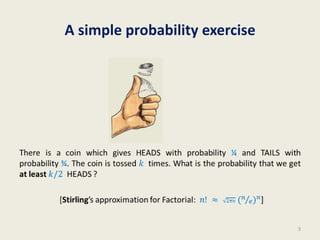
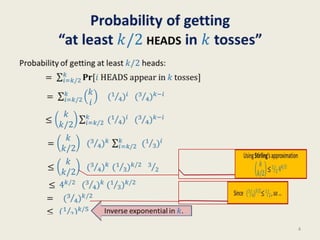
A simple probability exercise
3
4
Approximate median
Definition: Given an array A[] storing n numbers and ϵ > 0, compute an
element whose rank is in the range [(1- ϵ)n/2, (1+ ϵ)n/2].
Best Deterministic Algorithm:
• “Median of Medians” algorithm for finding exact median
• Running time: O(n)
• No faster algorithm possible for approximate median
5
Can you give a short proof ?
½ - Approximate median
A Randomized Algorithm
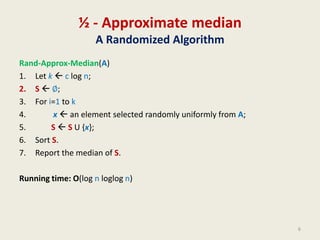
Rand-Approx-Median(A)
1. Let k  c log n;
2. S  ∅;
3. For i=1 to k
4. x  an element selected randomly uniformly from A;
5. S  S U {x};
6. Sort S.
7. Report the median of S.
Running time: O(log n loglog n)
6
Analyzing the error probability of
Rand-approx-median
7
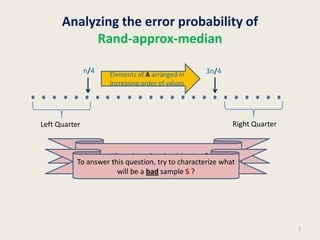
Elements of A arranged in
Increasing order of values
n/4 3n/4
Right QuarterLeft Quarter
When does the algorithm err ?
To answer this question, try to characterize what
will be a bad sample S ?
Analyzing the error probability of
Rand-approx-median
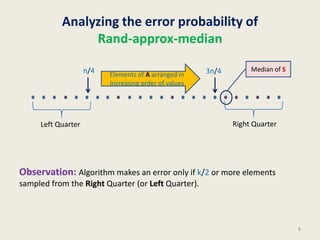
Observation: Algorithm makes an error only if k/2 or more elements
sampled from the Right Quarter (or Left Quarter).
8
n/4
Left Quarter Right Quarter
Elements of A arranged in
Increasing order of values
3n/4 Median of S
Analyzing the error probability of
Rand-approx-median
9
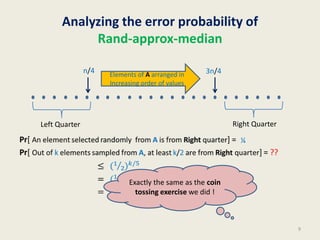
Elements of A arranged in
Increasing order of values
n/4 3n/4
Right QuarterLeft Quarter
Exactly the same as the coin
tossing exercise we did !
¼
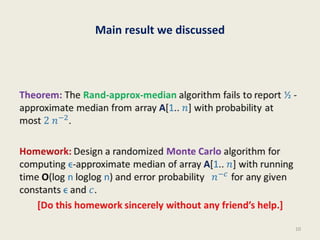
Main result we discussed
10
ELEMENTARY PROBABILITY THEORY
(IT IS SO SIMPLE THAT YOU UNDERESTIMATE ITS ELEGANCE AND POWER)
11
Elementary probability theory
(Relevant for CS648)
• We shall mainly deal with discrete probability theory in this course.
• We shall take the set theoretic approach to explain probability theory.
Consider any random experiment :
o Tossing a coin 5 times.
o Throwing a dice 2 times.
o Selecting a number randomly uniformly from [1..n].
How to capture the following facts in the theory of probability ?
1. Outcome will always be from a specified set.
2. Likelihood of each possible outcome is non-negative.
3. We may be interested in a collection of outcomes.
12
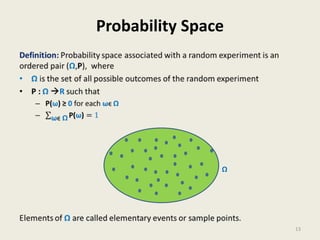
Probability Space
13
Ω
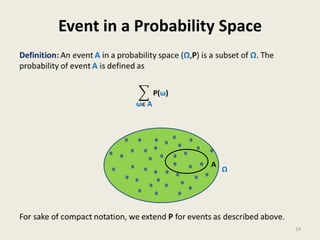
Event in a Probability Space
14
A
Ω
Exercises
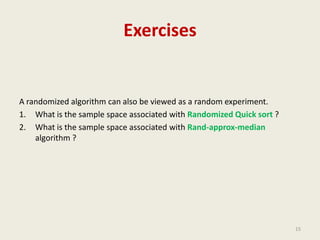
A randomized algorithm can also be viewed as a random experiment.
1. What is the sample space associated with Randomized Quick sort ?
2. What is the sample space associated with Rand-approx-median
algorithm ?
15
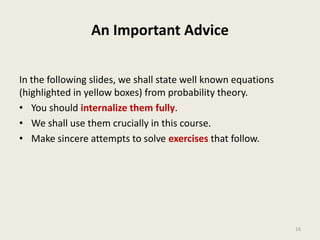
An Important Advice
In the following slides, we shall state well known equations
(highlighted in yellow boxes) from probability theory.
• You should internalize them fully.
• We shall use them crucially in this course.
• Make sincere attempts to solve exercises that follow.
16
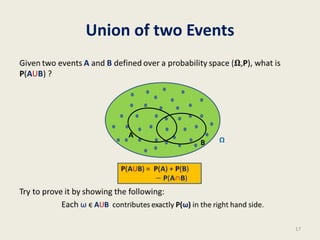
Union of two Events
17
A
B Ω
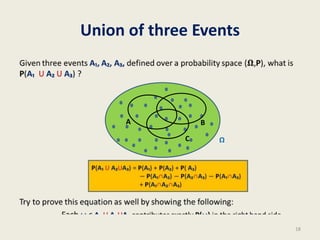
Union of three Events
18
A B
C Ω
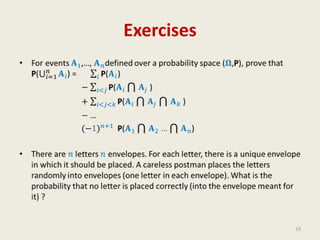
Exercises
19
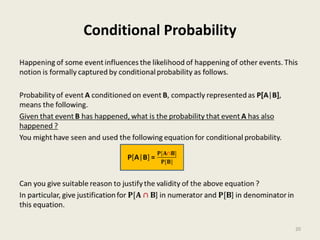
Conditional Probability
20
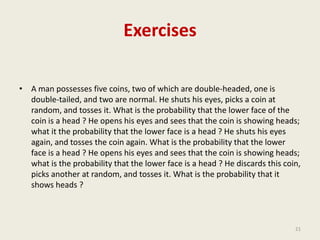
Exercises
• A man possesses five coins, two of which are double-headed, one is
double-tailed, and two are normal. He shuts his eyes, picks a coin at
random, and tosses it. What is the probability that the lower face of the
coin is a head ? He opens his eyes and sees that the coin is showing heads;
what it the probability that the lower face is a head ? He shuts his eyes
again, and tosses the coin again. What is the probability that the lower
face is a head ? He opens his eyes and sees that the coin is showing heads;
what is the probability that the lower face is a head ? He discards this coin,
picks another at random, and tosses it. What is the probability that it
shows heads ?
21
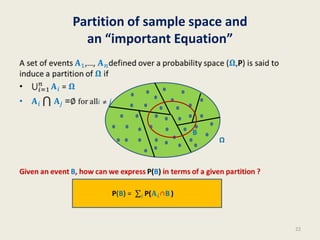
Partition of sample space and
an “important Equation”
22
Ω
B
Exercises
23
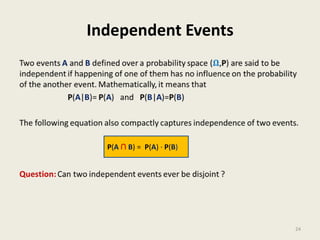
Independent Events
24
P(A ∩ B) = P(A) · P(B)
Exercises
25

Lecture 2-cs648 Randomized Algorithms

  • 1.
    Randomized Algorithms CS648 Lecture 2 •Randomized Algorithm for Approximate Median • Elementary Probability theory 1
  • 2.
    RANDOMIZED MONTE CARLOALGORITHM FOR APPROXIMATE MEDIAN 2 This lecture was delivered at slow pace and its flavor was that of a tutorial. Reason: To show that designing and analyzing a randomized algorithm demands right insight and just elementary probability.
  • 3.
  • 4.
  • 5.
    Approximate median Definition: Givenan array A[] storing n numbers and ϵ > 0, compute an element whose rank is in the range [(1- ϵ)n/2, (1+ ϵ)n/2]. Best Deterministic Algorithm: • “Median of Medians” algorithm for finding exact median • Running time: O(n) • No faster algorithm possible for approximate median 5 Can you give a short proof ?
  • 6.
    ½ - Approximatemedian A Randomized Algorithm Rand-Approx-Median(A) 1. Let k  c log n; 2. S  ∅; 3. For i=1 to k 4. x  an element selected randomly uniformly from A; 5. S  S U {x}; 6. Sort S. 7. Report the median of S. Running time: O(log n loglog n) 6
  • 7.
    Analyzing the errorprobability of Rand-approx-median 7 Elements of A arranged in Increasing order of values n/4 3n/4 Right QuarterLeft Quarter When does the algorithm err ? To answer this question, try to characterize what will be a bad sample S ?
  • 8.
    Analyzing the errorprobability of Rand-approx-median Observation: Algorithm makes an error only if k/2 or more elements sampled from the Right Quarter (or Left Quarter). 8 n/4 Left Quarter Right Quarter Elements of A arranged in Increasing order of values 3n/4 Median of S
  • 9.
    Analyzing the errorprobability of Rand-approx-median 9 Elements of A arranged in Increasing order of values n/4 3n/4 Right QuarterLeft Quarter Exactly the same as the coin tossing exercise we did ! ¼
  • 10.
    Main result wediscussed 10
  • 11.
    ELEMENTARY PROBABILITY THEORY (ITIS SO SIMPLE THAT YOU UNDERESTIMATE ITS ELEGANCE AND POWER) 11
  • 12.
    Elementary probability theory (Relevantfor CS648) • We shall mainly deal with discrete probability theory in this course. • We shall take the set theoretic approach to explain probability theory. Consider any random experiment : o Tossing a coin 5 times. o Throwing a dice 2 times. o Selecting a number randomly uniformly from [1..n]. How to capture the following facts in the theory of probability ? 1. Outcome will always be from a specified set. 2. Likelihood of each possible outcome is non-negative. 3. We may be interested in a collection of outcomes. 12
  • 13.
  • 14.
    Event in aProbability Space 14 A Ω
  • 15.
    Exercises A randomized algorithmcan also be viewed as a random experiment. 1. What is the sample space associated with Randomized Quick sort ? 2. What is the sample space associated with Rand-approx-median algorithm ? 15
  • 16.
    An Important Advice Inthe following slides, we shall state well known equations (highlighted in yellow boxes) from probability theory. • You should internalize them fully. • We shall use them crucially in this course. • Make sincere attempts to solve exercises that follow. 16
  • 17.
    Union of twoEvents 17 A B Ω
  • 18.
    Union of threeEvents 18 A B C Ω
  • 19.
  • 20.
  • 21.
    Exercises • A manpossesses five coins, two of which are double-headed, one is double-tailed, and two are normal. He shuts his eyes, picks a coin at random, and tosses it. What is the probability that the lower face of the coin is a head ? He opens his eyes and sees that the coin is showing heads; what it the probability that the lower face is a head ? He shuts his eyes again, and tosses the coin again. What is the probability that the lower face is a head ? He opens his eyes and sees that the coin is showing heads; what is the probability that the lower face is a head ? He discards this coin, picks another at random, and tosses it. What is the probability that it shows heads ? 21
  • 22.
    Partition of samplespace and an “important Equation” 22 Ω B
  • 23.
  • 24.
  • 25.