Lecture 2.1: Echelon Method
Dr. Taoufik Ben Jabeur
Department of Mathematics, Physics and Statistics
Lecture Notes in Business Math1-Math-119
1
Learning Outcomes
By the end of this section In shaa Allah, you shall:
1. Manipulation between rows
2. Solving system of linear equations using Echelon Method for cases:
a) System 2x2, no solution
b) System 2x2, one solution
c) System 2x2, infinity of solutions
d) System 2x3, No solution
e) System 2x3, infinity of solutions (Line solution)
f) System 2x3, infinity of solutions (Surface solution)
2
Manipulation between rows
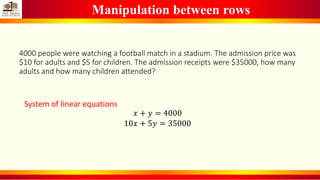
4000 people were watching a football match in a stadium. The admission price was
$10 for adults and $5 for children. The admission receipts were $35000, how many
adults and how many children attended?
System of linear equations
𝑥 + 𝑦 = 4000
10𝑥 + 5𝑦 = 35000
3
Manipulation between rows
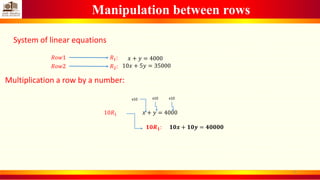
System of linear equations
𝑥 + 𝑦 = 4000
10𝑥 + 5𝑦 = 35000
10𝑅1 𝑥 + 𝑦 = 4000
x10 x10 x10
𝟏𝟎𝑹 𝟏: 𝟏𝟎𝒙 + 𝟏𝟎𝒚 = 𝟒𝟎𝟎𝟎𝟎
𝑅𝑜𝑤1 𝑅1:
𝑅𝑜𝑤2 𝑅2:
Multiplication a row by a number:
4
Manipulation between rows
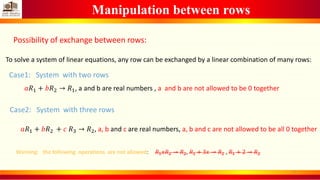
Possibility of exchange between rows:
To solve a system of linear equations, any row can be exchanged by a linear combination of many rows:
𝑎𝑅1 + 𝑏𝑅2 → 𝑅1, a and b are real numbers , a and b are not allowed to be 0 together
Case1: System with two rows
Case2: System with three rows
𝑎𝑅1 + 𝑏𝑅2 + 𝑐 𝑅3 → 𝑅2, a, b and c are real numbers, a, b and c are not allowed to be all 0 together
Warning: the following operations are not allowed: 𝑅1 𝑥𝑅2 → 𝑅2, 𝑅1 + 3𝑥 → 𝑅2 , 𝑅1 + 2 → 𝑅2
5
Manipulation between rows
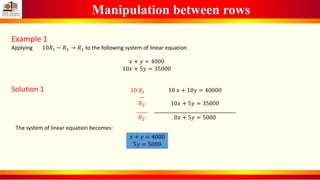
Example 1
Applying 10𝑅1 − 𝑅2 → 𝑅2 to the following system of linear equation
𝑥 + 𝑦 = 4000
10𝑥 + 5𝑦 = 35000
Solution 1 10 𝑅1
−
𝑅2:
_____
𝑅2:
10 𝑥 + 10𝑦 = 40000
10𝑥 + 5𝑦 = 35000
_____________________________________
0𝑥 + 5𝑦 = 5000
The system of linear equation becomes:
𝑥 + 𝑦 = 4000
5𝑦 = 5000
6
Manipulation between rows
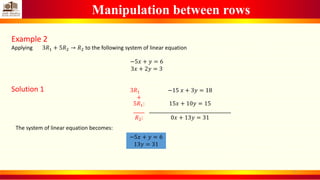
Example 2
Applying 3𝑅1 + 5𝑅2 → 𝑅2 to the following system of linear equation
−5𝑥 + 𝑦 = 6
3𝑥 + 2𝑦 = 3
Solution 1 3𝑅1
+
5𝑅1:
_____
𝑅2:
−15 𝑥 + 3𝑦 = 18
15𝑥 + 10𝑦 = 15
_____________________________________
0𝑥 + 13𝑦 = 31
The system of linear equation becomes:
−5𝑥 + 𝑦 = 6
13𝑦 = 31
7
Echelon Method:
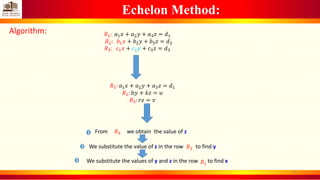
Algorithm: 𝑅1: 𝑎1 𝑥 + 𝑎2 𝑦 + 𝑎3 𝑧 = 𝑑1
𝑅2: 𝑏1 𝑥 + 𝑏2 𝑦 + 𝑏3 𝑧 = 𝑑2
𝑅3: 𝑐1 𝑥 + 𝑐2 𝑦 + 𝑐3 𝑧 = 𝑑3
𝑅1: 𝑎1 𝑥 + 𝑎2 𝑦 + 𝑎3 𝑧 = 𝑑1
𝑅2: h𝑦 + 𝑘𝑧 = 𝑢
𝑅3: 𝑟𝑧 = 𝑣
From we obtain the value of z𝑅3
We substitute the value of z in the row to find y
𝑅1
We substitute the values of y and z in the row to find x
𝑅2
1
2
3
8
Echelon Method: case 2x2 : no solution
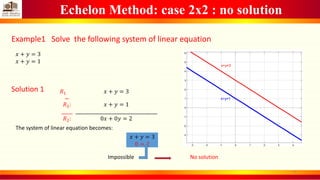
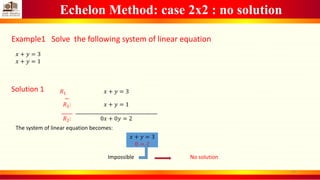
Example1 Solve the following system of linear equation
𝑥 + 𝑦 = 3
𝑥 + 𝑦 = 1
Solution 1 𝑅1
−
𝑅2:
_____
𝑅2:
𝑥 + 𝑦 = 3
𝑥 + 𝑦 = 1
_____________________________________
0𝑥 + 0𝑦 = 2
The system of linear equation becomes:
𝑥 + 𝑦 = 3
0 = 2 -3 -2 -1 0 1 2 3 4
-3
-2
-1
0
1
2
3
4
5
6
x+y=3
x+y=1
Impossible No solution
9
Echelon Method: case 2x2 : no solution
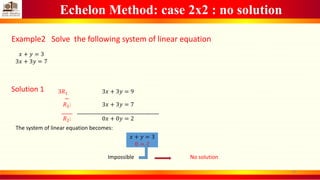
Example2 Solve the following system of linear equation
𝑥 + 𝑦 = 3
3𝑥 + 3𝑦 = 7
Solution 1 3𝑅1
−
𝑅2:
_____
𝑅2:
3𝑥 + 3𝑦 = 9
3𝑥 + 3𝑦 = 7
_____________________________________
0𝑥 + 0𝑦 = 2
The system of linear equation becomes:
𝑥 + 𝑦 = 3
0 = 2
Impossible No solution
10
Echelon Method: case 2x2 : no solution
Example1 Solve the following system of linear equation
𝑥 + 𝑦 = 3
𝑥 + 𝑦 = 1
Solution 1 𝑅1
−
𝑅2:
_____
𝑅2:
𝑥 + 𝑦 = 3
𝑥 + 𝑦 = 1
_____________________________________
0𝑥 + 0𝑦 = 2
The system of linear equation becomes:
𝑥 + 𝑦 = 3
0 = 2
Impossible No solution
11
Echelon Method: case 2x2 : one solution
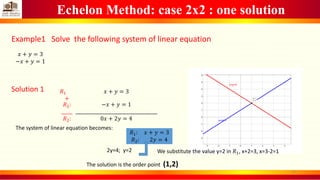
Example1 Solve the following system of linear equation
𝑥 + 𝑦 = 3
−𝑥 + 𝑦 = 1
Solution 1 𝑅1
+
𝑅2:
_____
𝑅2:
𝑥 + 𝑦 = 3
−𝑥 + 𝑦 = 1
_____________________________________
0𝑥 + 2𝑦 = 4
The system of linear equation becomes:
𝑅1: 𝑥 + 𝑦 = 3
𝑅2: 2𝑦 = 4
2y=4; y=2 We substitute the value y=2 in 𝑅1, x+2=3, x=3-2=1
The solution is the order point (1,2)
12
Echelon Method: case 2x2 : one solution
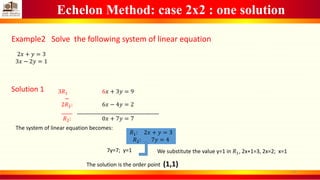
Example2 Solve the following system of linear equation
2𝑥 + 𝑦 = 3
3𝑥 − 2𝑦 = 1
Solution 1 3𝑅1
−
2𝑅2:
_____
𝑅2:
6𝑥 + 3𝑦 = 9
6𝑥 − 4𝑦 = 2
_____________________________________
0𝑥 + 7𝑦 = 7
The system of linear equation becomes:
𝑅1: 2𝑥 + 𝑦 = 3
𝑅2: 7𝑦 = 4
7y=7; y=1 We substitute the value y=1 in 𝑅1, 2x+1=3, 2x=2; x=1
The solution is the order point (1,1)
13
Echelon Method: case 2x2 infinity of solutions
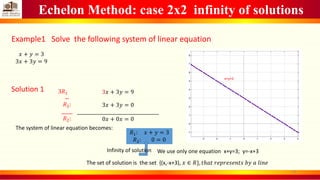
Example1 Solve the following system of linear equation
𝑥 + 𝑦 = 3
3𝑥 + 3𝑦 = 9
Solution 1 3𝑅1
−
𝑅2:
_____
𝑅2:
3𝑥 + 3𝑦 = 9
3𝑥 + 3𝑦 = 0
_____________________________________
0𝑥 + 0𝑥 = 0
The system of linear equation becomes:
𝑅1: 𝑥 + 𝑦 = 3
𝑅2: 0 = 0
Infinity of solution We use only one equation x+y=3; y=-x+3
The set of solution is the set {(x,-x+3), 𝑥 ∈ 𝑅}, 𝑡ℎ𝑎𝑡 𝑟𝑒𝑝𝑟𝑒𝑠𝑒𝑛𝑡𝑠 𝑏𝑦 𝑎 𝑙𝑖𝑛𝑒
-3 -2 -1 0 1 2 3 4
-1
0
1
2
3
4
5
6
7
8
x+y=3
14
Echelon Method: case 2x2 infinity of solutions
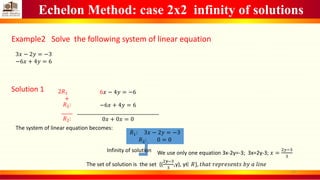
Example2 Solve the following system of linear equation
3𝑥 − 2𝑦 = −3
−6𝑥 + 4𝑦 = 6
Solution 1 2𝑅1
+
𝑅2:
_____
𝑅2:
6𝑥 − 4𝑦 = −6
−6𝑥 + 4𝑦 = 6
_____________________________________
0𝑥 + 0𝑥 = 0
The system of linear equation becomes:
𝑅1: 3𝑥 − 2𝑦 = −3
𝑅2: 0 = 0
Infinity of solution We use only one equation 3x-2y=-3; 3x=2y-3; 𝑥 =
2𝑦−3
3
The set of solution is the set {(
2𝒚−3
3
,y), y∈ 𝑅}, 𝑡ℎ𝑎𝑡 𝑟𝑒𝑝𝑟𝑒𝑠𝑒𝑛𝑡𝑠 𝑏𝑦 𝑎 𝑙𝑖𝑛𝑒
15
Echelon Method: case 2x3: No solution
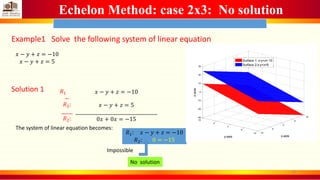
Example1 Solve the following system of linear equation
𝑥 − 𝑦 + 𝑧 = −10
𝑥 − 𝑦 + 𝑧 = 5
Solution 1 𝑅1
−
𝑅2:
_____
𝑅2:
𝑥 − 𝑦 + 𝑧 = −10
𝑥 − 𝑦 + 𝑧 = 5
_____________________________________
0𝑥 + 0𝑥 = −15
The system of linear equation becomes:
𝑅1: 𝑥 − 𝑦 + 𝑧 = −10
𝑅2: 0 = −15
Impossible
No solution
-10
-5
0
5
10
-10
-5
0
5
10
-30
-20
-10
0
10
20
30
x-axisy-axis
z-axis
Surface 1: x-y+z=-10
Surface 2:x-y+z=5
16
Echelon Method: case 2x3: No solution
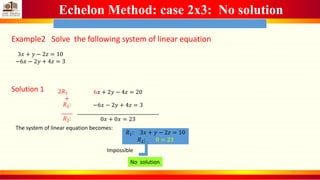
Example2 Solve the following system of linear equation
3𝑥 + 𝑦 − 2𝑧 = 10
−6𝑥 − 2𝑦 + 4𝑧 = 3
Solution 1 2𝑅1
+
𝑅2:
_____
𝑅2:
6𝑥 + 2𝑦 − 4𝑧 = 20
−6𝑥 − 2𝑦 + 4𝑧 = 3
_____________________________________
0𝑥 + 0𝑥 = 23
The system of linear equation becomes:
𝑅1: 3𝑥 + 𝑦 − 2𝑧 = 10
𝑅2: 0 = 23
Impossible
No solution
17
Echelon Method: case 2x3: Infinity of solutions (Line)
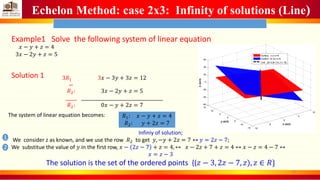
Example1 Solve the following system of linear equation
𝑥 − 𝑦 + 𝑧 = 4
3𝑥 − 2𝑦 + 𝑧 = 5
Solution 1 3𝑅1
−
𝑅2:
_____
𝑅2:
3𝑥 − 3𝑦 + 3𝑧 = 12
3𝑥 − 2𝑦 + 𝑧 = 5
_____________________________________
0𝑥 − 𝑦 + 2𝑧 = 7
The system of linear equation becomes: 𝑅1: 𝑥 − 𝑦 + 𝑧 = 4
𝑅2: 𝑦 + 2𝑧 = 7
Infiniy of solution;
We consider z as known, and we use the row 𝑅2 to get 𝑦, −𝑦 + 2𝑧 = 7 ↔ 𝑦 = 2𝑧 − 7;
We substitue the value of 𝑦 in the first row, 𝑥 − 2𝑧 − 7 + 𝑧 = 4, ↔ 𝑥 − 2𝑧 + 7 + 𝑧 = 4 ↔ 𝑥 − 𝑧 = 4 − 7 ↔
𝑥 = 𝑧 − 3
The solution is the set of the ordered points {(𝑧 − 3, 2𝑧 − 7, 𝑧), 𝑧 ∈ 𝑅}
-10
-5
0
5
10
-15
-10
-5
0
5
10
15
-60
-40
-20
0
20
40
60
x-axis
y-axis
z-axis
Surface : x-y+z=4
Surface: 3x-2y+z=5
Line : {(k-3,2k-7,k), k R}
1
2
18
Echelon Method: case 2x3: Infinity of solutions (Line)
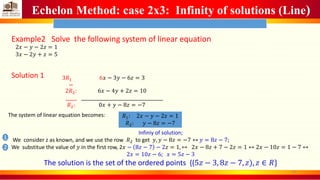
Example2 Solve the following system of linear equation
2𝑥 − 𝑦 − 2𝑧 = 1
3𝑥 − 2𝑦 + 𝑧 = 5
Solution 1 3𝑅1
−
2𝑅2:
_____
𝑅2:
6𝑥 − 3𝑦 − 6𝑧 = 3
6𝑥 − 4𝑦 + 2𝑧 = 10
_____________________________________
0𝑥 + 𝑦 − 8𝑧 = −7
The system of linear equation becomes: 𝑅1: 2𝑥 − 𝑦 − 2𝑧 = 1
𝑅2: 𝑦 − 8𝑧 = −7
Infiniy of solution;
We consider z as known, and we use the row 𝑅2 to get 𝑦, 𝑦 − 8𝑧 = −7 ↔ 𝑦 = 8𝑧 − 7;
We substitue the value of 𝑦 in the first row, 2𝑥 − 8𝑧 − 7 − 2𝑧 = 1, ↔ 2𝑥 − 8𝑧 + 7 − 2𝑧 = 1 ↔ 2𝑥 − 10𝑧 = 1 − 7 ↔
2𝑥 = 10𝑧 − 6; 𝑥 = 5𝑧 − 3
The solution is the set of the ordered points {(5𝑧 − 3, 8𝑧 − 7, 𝑧), 𝑧 ∈ 𝑅}
1
2
19
Echelon Method: case 2x3: Infinity of solutions (Surface)
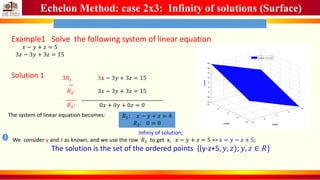
Example1 Solve the following system of linear equation
𝑥 − 𝑦 + 𝑧 = 5
3𝑥 − 3𝑦 + 3𝑧 = 15
Solution 1 3𝑅1
−
𝑅2:
_____
𝑅2:
3𝑥 − 3𝑦 + 3𝑧 = 15
3𝑥 − 3𝑦 + 3𝑧 = 15
_____________________________________
0𝑥 + 0𝑦 + 0𝑧 = 0
The system of linear equation becomes: 𝑅1: 𝑥 − 𝑦 + 𝑧 = 4
𝑅2: 0 = 0
Infiniy of solution;
We consider y and z as known, and we use the row 𝑅1 to get x, 𝑥 − 𝑦 + 𝑧 = 5 ↔ x = 𝑦 − 𝑧 + 5;
The solution is the set of the ordered points {(y-z+5, 𝑦, 𝑧); 𝑦, 𝑧 ∈ 𝑅}
1
-10
-5
0
5
10
-10
-5
0
5
10
-15
-10
-5
0
5
10
15
20
25
x-axisy-axis
z-axis
Surface: x-y+z=5
20
Echelon Method: case 2x3: Infinity of solutions (Surface)
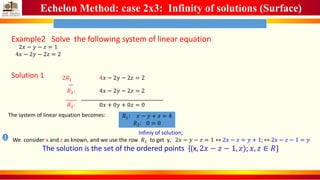
Example2 Solve the following system of linear equation
2𝑥 − 𝑦 − 𝑧 = 1
4𝑥 − 2𝑦 − 2𝑧 = 2
Solution 1 2𝑅1
−
𝑅2:
_____
𝑅2:
4𝑥 − 2𝑦 − 2𝑧 = 2
4𝑥 − 2𝑦 − 2𝑧 = 2
_____________________________________
0𝑥 + 0𝑦 + 0𝑧 = 0
The system of linear equation becomes: 𝑅1: 𝑥 − 𝑦 + 𝑧 = 4
𝑅2: 0 = 0
Infiniy of solution;
We consider x and z as known, and we use the row 𝑅1 to get y, 2𝑥 − 𝑦 − 𝑧 = 1 ↔ 2𝑥 − 𝑧 = 𝑦 + 1; ↔ 2𝑥 − 𝑧 − 1 = 𝑦
The solution is the set of the ordered points {(x, 2𝑥 − 𝑧 − 1, 𝑧); 𝑥, 𝑧 ∈ 𝑅}
1
21

Lecture 2.1 Echelon method

  • 1.
    Lecture 2.1: EchelonMethod Dr. Taoufik Ben Jabeur Department of Mathematics, Physics and Statistics Lecture Notes in Business Math1-Math-119 1
  • 2.
    Learning Outcomes By theend of this section In shaa Allah, you shall: 1. Manipulation between rows 2. Solving system of linear equations using Echelon Method for cases: a) System 2x2, no solution b) System 2x2, one solution c) System 2x2, infinity of solutions d) System 2x3, No solution e) System 2x3, infinity of solutions (Line solution) f) System 2x3, infinity of solutions (Surface solution) 2
  • 3.
    Manipulation between rows 4000people were watching a football match in a stadium. The admission price was $10 for adults and $5 for children. The admission receipts were $35000, how many adults and how many children attended? System of linear equations 𝑥 + 𝑦 = 4000 10𝑥 + 5𝑦 = 35000 3
  • 4.
    Manipulation between rows Systemof linear equations 𝑥 + 𝑦 = 4000 10𝑥 + 5𝑦 = 35000 10𝑅1 𝑥 + 𝑦 = 4000 x10 x10 x10 𝟏𝟎𝑹 𝟏: 𝟏𝟎𝒙 + 𝟏𝟎𝒚 = 𝟒𝟎𝟎𝟎𝟎 𝑅𝑜𝑤1 𝑅1: 𝑅𝑜𝑤2 𝑅2: Multiplication a row by a number: 4
  • 5.
    Manipulation between rows Possibilityof exchange between rows: To solve a system of linear equations, any row can be exchanged by a linear combination of many rows: 𝑎𝑅1 + 𝑏𝑅2 → 𝑅1, a and b are real numbers , a and b are not allowed to be 0 together Case1: System with two rows Case2: System with three rows 𝑎𝑅1 + 𝑏𝑅2 + 𝑐 𝑅3 → 𝑅2, a, b and c are real numbers, a, b and c are not allowed to be all 0 together Warning: the following operations are not allowed: 𝑅1 𝑥𝑅2 → 𝑅2, 𝑅1 + 3𝑥 → 𝑅2 , 𝑅1 + 2 → 𝑅2 5
  • 6.
    Manipulation between rows Example1 Applying 10𝑅1 − 𝑅2 → 𝑅2 to the following system of linear equation 𝑥 + 𝑦 = 4000 10𝑥 + 5𝑦 = 35000 Solution 1 10 𝑅1 − 𝑅2: _____ 𝑅2: 10 𝑥 + 10𝑦 = 40000 10𝑥 + 5𝑦 = 35000 _____________________________________ 0𝑥 + 5𝑦 = 5000 The system of linear equation becomes: 𝑥 + 𝑦 = 4000 5𝑦 = 5000 6
  • 7.
    Manipulation between rows Example2 Applying 3𝑅1 + 5𝑅2 → 𝑅2 to the following system of linear equation −5𝑥 + 𝑦 = 6 3𝑥 + 2𝑦 = 3 Solution 1 3𝑅1 + 5𝑅1: _____ 𝑅2: −15 𝑥 + 3𝑦 = 18 15𝑥 + 10𝑦 = 15 _____________________________________ 0𝑥 + 13𝑦 = 31 The system of linear equation becomes: −5𝑥 + 𝑦 = 6 13𝑦 = 31 7
  • 8.
    Echelon Method: Algorithm: 𝑅1:𝑎1 𝑥 + 𝑎2 𝑦 + 𝑎3 𝑧 = 𝑑1 𝑅2: 𝑏1 𝑥 + 𝑏2 𝑦 + 𝑏3 𝑧 = 𝑑2 𝑅3: 𝑐1 𝑥 + 𝑐2 𝑦 + 𝑐3 𝑧 = 𝑑3 𝑅1: 𝑎1 𝑥 + 𝑎2 𝑦 + 𝑎3 𝑧 = 𝑑1 𝑅2: h𝑦 + 𝑘𝑧 = 𝑢 𝑅3: 𝑟𝑧 = 𝑣 From we obtain the value of z𝑅3 We substitute the value of z in the row to find y 𝑅1 We substitute the values of y and z in the row to find x 𝑅2 1 2 3 8
  • 9.
    Echelon Method: case2x2 : no solution Example1 Solve the following system of linear equation 𝑥 + 𝑦 = 3 𝑥 + 𝑦 = 1 Solution 1 𝑅1 − 𝑅2: _____ 𝑅2: 𝑥 + 𝑦 = 3 𝑥 + 𝑦 = 1 _____________________________________ 0𝑥 + 0𝑦 = 2 The system of linear equation becomes: 𝑥 + 𝑦 = 3 0 = 2 -3 -2 -1 0 1 2 3 4 -3 -2 -1 0 1 2 3 4 5 6 x+y=3 x+y=1 Impossible No solution 9
  • 10.
    Echelon Method: case2x2 : no solution Example2 Solve the following system of linear equation 𝑥 + 𝑦 = 3 3𝑥 + 3𝑦 = 7 Solution 1 3𝑅1 − 𝑅2: _____ 𝑅2: 3𝑥 + 3𝑦 = 9 3𝑥 + 3𝑦 = 7 _____________________________________ 0𝑥 + 0𝑦 = 2 The system of linear equation becomes: 𝑥 + 𝑦 = 3 0 = 2 Impossible No solution 10
  • 11.
    Echelon Method: case2x2 : no solution Example1 Solve the following system of linear equation 𝑥 + 𝑦 = 3 𝑥 + 𝑦 = 1 Solution 1 𝑅1 − 𝑅2: _____ 𝑅2: 𝑥 + 𝑦 = 3 𝑥 + 𝑦 = 1 _____________________________________ 0𝑥 + 0𝑦 = 2 The system of linear equation becomes: 𝑥 + 𝑦 = 3 0 = 2 Impossible No solution 11
  • 12.
    Echelon Method: case2x2 : one solution Example1 Solve the following system of linear equation 𝑥 + 𝑦 = 3 −𝑥 + 𝑦 = 1 Solution 1 𝑅1 + 𝑅2: _____ 𝑅2: 𝑥 + 𝑦 = 3 −𝑥 + 𝑦 = 1 _____________________________________ 0𝑥 + 2𝑦 = 4 The system of linear equation becomes: 𝑅1: 𝑥 + 𝑦 = 3 𝑅2: 2𝑦 = 4 2y=4; y=2 We substitute the value y=2 in 𝑅1, x+2=3, x=3-2=1 The solution is the order point (1,2) 12
  • 13.
    Echelon Method: case2x2 : one solution Example2 Solve the following system of linear equation 2𝑥 + 𝑦 = 3 3𝑥 − 2𝑦 = 1 Solution 1 3𝑅1 − 2𝑅2: _____ 𝑅2: 6𝑥 + 3𝑦 = 9 6𝑥 − 4𝑦 = 2 _____________________________________ 0𝑥 + 7𝑦 = 7 The system of linear equation becomes: 𝑅1: 2𝑥 + 𝑦 = 3 𝑅2: 7𝑦 = 4 7y=7; y=1 We substitute the value y=1 in 𝑅1, 2x+1=3, 2x=2; x=1 The solution is the order point (1,1) 13
  • 14.
    Echelon Method: case2x2 infinity of solutions Example1 Solve the following system of linear equation 𝑥 + 𝑦 = 3 3𝑥 + 3𝑦 = 9 Solution 1 3𝑅1 − 𝑅2: _____ 𝑅2: 3𝑥 + 3𝑦 = 9 3𝑥 + 3𝑦 = 0 _____________________________________ 0𝑥 + 0𝑥 = 0 The system of linear equation becomes: 𝑅1: 𝑥 + 𝑦 = 3 𝑅2: 0 = 0 Infinity of solution We use only one equation x+y=3; y=-x+3 The set of solution is the set {(x,-x+3), 𝑥 ∈ 𝑅}, 𝑡ℎ𝑎𝑡 𝑟𝑒𝑝𝑟𝑒𝑠𝑒𝑛𝑡𝑠 𝑏𝑦 𝑎 𝑙𝑖𝑛𝑒 -3 -2 -1 0 1 2 3 4 -1 0 1 2 3 4 5 6 7 8 x+y=3 14
  • 15.
    Echelon Method: case2x2 infinity of solutions Example2 Solve the following system of linear equation 3𝑥 − 2𝑦 = −3 −6𝑥 + 4𝑦 = 6 Solution 1 2𝑅1 + 𝑅2: _____ 𝑅2: 6𝑥 − 4𝑦 = −6 −6𝑥 + 4𝑦 = 6 _____________________________________ 0𝑥 + 0𝑥 = 0 The system of linear equation becomes: 𝑅1: 3𝑥 − 2𝑦 = −3 𝑅2: 0 = 0 Infinity of solution We use only one equation 3x-2y=-3; 3x=2y-3; 𝑥 = 2𝑦−3 3 The set of solution is the set {( 2𝒚−3 3 ,y), y∈ 𝑅}, 𝑡ℎ𝑎𝑡 𝑟𝑒𝑝𝑟𝑒𝑠𝑒𝑛𝑡𝑠 𝑏𝑦 𝑎 𝑙𝑖𝑛𝑒 15
  • 16.
    Echelon Method: case2x3: No solution Example1 Solve the following system of linear equation 𝑥 − 𝑦 + 𝑧 = −10 𝑥 − 𝑦 + 𝑧 = 5 Solution 1 𝑅1 − 𝑅2: _____ 𝑅2: 𝑥 − 𝑦 + 𝑧 = −10 𝑥 − 𝑦 + 𝑧 = 5 _____________________________________ 0𝑥 + 0𝑥 = −15 The system of linear equation becomes: 𝑅1: 𝑥 − 𝑦 + 𝑧 = −10 𝑅2: 0 = −15 Impossible No solution -10 -5 0 5 10 -10 -5 0 5 10 -30 -20 -10 0 10 20 30 x-axisy-axis z-axis Surface 1: x-y+z=-10 Surface 2:x-y+z=5 16
  • 17.
    Echelon Method: case2x3: No solution Example2 Solve the following system of linear equation 3𝑥 + 𝑦 − 2𝑧 = 10 −6𝑥 − 2𝑦 + 4𝑧 = 3 Solution 1 2𝑅1 + 𝑅2: _____ 𝑅2: 6𝑥 + 2𝑦 − 4𝑧 = 20 −6𝑥 − 2𝑦 + 4𝑧 = 3 _____________________________________ 0𝑥 + 0𝑥 = 23 The system of linear equation becomes: 𝑅1: 3𝑥 + 𝑦 − 2𝑧 = 10 𝑅2: 0 = 23 Impossible No solution 17
  • 18.
    Echelon Method: case2x3: Infinity of solutions (Line) Example1 Solve the following system of linear equation 𝑥 − 𝑦 + 𝑧 = 4 3𝑥 − 2𝑦 + 𝑧 = 5 Solution 1 3𝑅1 − 𝑅2: _____ 𝑅2: 3𝑥 − 3𝑦 + 3𝑧 = 12 3𝑥 − 2𝑦 + 𝑧 = 5 _____________________________________ 0𝑥 − 𝑦 + 2𝑧 = 7 The system of linear equation becomes: 𝑅1: 𝑥 − 𝑦 + 𝑧 = 4 𝑅2: 𝑦 + 2𝑧 = 7 Infiniy of solution; We consider z as known, and we use the row 𝑅2 to get 𝑦, −𝑦 + 2𝑧 = 7 ↔ 𝑦 = 2𝑧 − 7; We substitue the value of 𝑦 in the first row, 𝑥 − 2𝑧 − 7 + 𝑧 = 4, ↔ 𝑥 − 2𝑧 + 7 + 𝑧 = 4 ↔ 𝑥 − 𝑧 = 4 − 7 ↔ 𝑥 = 𝑧 − 3 The solution is the set of the ordered points {(𝑧 − 3, 2𝑧 − 7, 𝑧), 𝑧 ∈ 𝑅} -10 -5 0 5 10 -15 -10 -5 0 5 10 15 -60 -40 -20 0 20 40 60 x-axis y-axis z-axis Surface : x-y+z=4 Surface: 3x-2y+z=5 Line : {(k-3,2k-7,k), k R} 1 2 18
  • 19.
    Echelon Method: case2x3: Infinity of solutions (Line) Example2 Solve the following system of linear equation 2𝑥 − 𝑦 − 2𝑧 = 1 3𝑥 − 2𝑦 + 𝑧 = 5 Solution 1 3𝑅1 − 2𝑅2: _____ 𝑅2: 6𝑥 − 3𝑦 − 6𝑧 = 3 6𝑥 − 4𝑦 + 2𝑧 = 10 _____________________________________ 0𝑥 + 𝑦 − 8𝑧 = −7 The system of linear equation becomes: 𝑅1: 2𝑥 − 𝑦 − 2𝑧 = 1 𝑅2: 𝑦 − 8𝑧 = −7 Infiniy of solution; We consider z as known, and we use the row 𝑅2 to get 𝑦, 𝑦 − 8𝑧 = −7 ↔ 𝑦 = 8𝑧 − 7; We substitue the value of 𝑦 in the first row, 2𝑥 − 8𝑧 − 7 − 2𝑧 = 1, ↔ 2𝑥 − 8𝑧 + 7 − 2𝑧 = 1 ↔ 2𝑥 − 10𝑧 = 1 − 7 ↔ 2𝑥 = 10𝑧 − 6; 𝑥 = 5𝑧 − 3 The solution is the set of the ordered points {(5𝑧 − 3, 8𝑧 − 7, 𝑧), 𝑧 ∈ 𝑅} 1 2 19
  • 20.
    Echelon Method: case2x3: Infinity of solutions (Surface) Example1 Solve the following system of linear equation 𝑥 − 𝑦 + 𝑧 = 5 3𝑥 − 3𝑦 + 3𝑧 = 15 Solution 1 3𝑅1 − 𝑅2: _____ 𝑅2: 3𝑥 − 3𝑦 + 3𝑧 = 15 3𝑥 − 3𝑦 + 3𝑧 = 15 _____________________________________ 0𝑥 + 0𝑦 + 0𝑧 = 0 The system of linear equation becomes: 𝑅1: 𝑥 − 𝑦 + 𝑧 = 4 𝑅2: 0 = 0 Infiniy of solution; We consider y and z as known, and we use the row 𝑅1 to get x, 𝑥 − 𝑦 + 𝑧 = 5 ↔ x = 𝑦 − 𝑧 + 5; The solution is the set of the ordered points {(y-z+5, 𝑦, 𝑧); 𝑦, 𝑧 ∈ 𝑅} 1 -10 -5 0 5 10 -10 -5 0 5 10 -15 -10 -5 0 5 10 15 20 25 x-axisy-axis z-axis Surface: x-y+z=5 20
  • 21.
    Echelon Method: case2x3: Infinity of solutions (Surface) Example2 Solve the following system of linear equation 2𝑥 − 𝑦 − 𝑧 = 1 4𝑥 − 2𝑦 − 2𝑧 = 2 Solution 1 2𝑅1 − 𝑅2: _____ 𝑅2: 4𝑥 − 2𝑦 − 2𝑧 = 2 4𝑥 − 2𝑦 − 2𝑧 = 2 _____________________________________ 0𝑥 + 0𝑦 + 0𝑧 = 0 The system of linear equation becomes: 𝑅1: 𝑥 − 𝑦 + 𝑧 = 4 𝑅2: 0 = 0 Infiniy of solution; We consider x and z as known, and we use the row 𝑅1 to get y, 2𝑥 − 𝑦 − 𝑧 = 1 ↔ 2𝑥 − 𝑧 = 𝑦 + 1; ↔ 2𝑥 − 𝑧 − 1 = 𝑦 The solution is the set of the ordered points {(x, 2𝑥 − 𝑧 − 1, 𝑧); 𝑥, 𝑧 ∈ 𝑅} 1 21