5
5
 Systems of Linear Equations:
Systems of Linear Equations:
✦ An Introduction
An Introduction
✦ Unique Solutions
Unique Solutions
✦ Underdetermined and
Underdetermined and
Overdetermined Systems
 Matrices
Matrices
 Multiplication of Matrices
Multiplication of Matrices
 The Inverse of a Square Matrix
The Inverse of a Square Matrix
Systems of Linear Equations and Matrices
5.1
5.1
Systems of Linear Equations:
An Introduction
An Introduction
1
1 2
2 3
3 4
4 5
5 6
6
6
6
5
5
4
4
3
3
2
2
1
1
–
–1
1
y
y
x
x
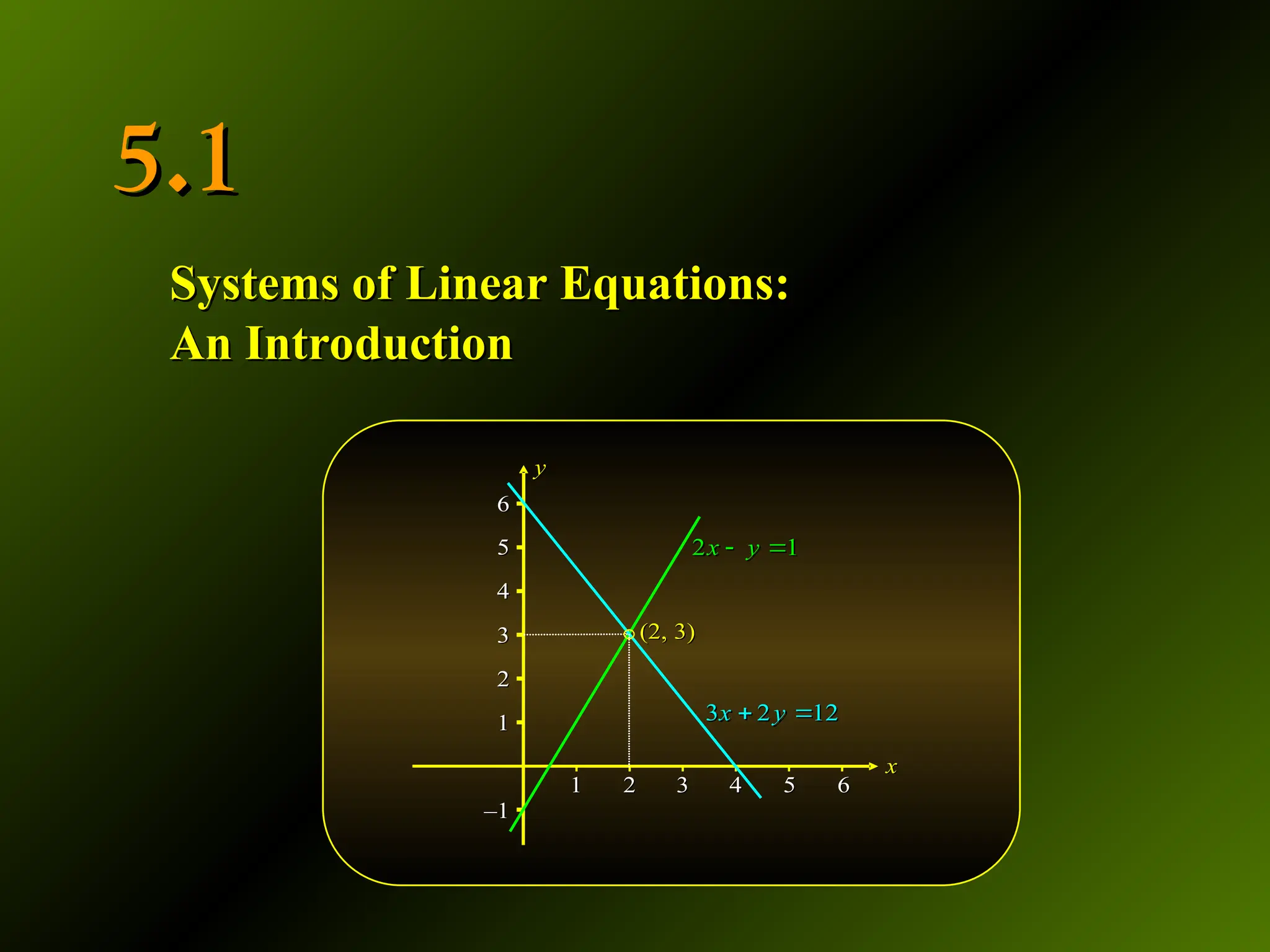
(2, 3)
(2, 3)
2 1
x y
 
2 1
x y
 
3 2 12
x y
 
3 2 12
x y
 
Systems of Equations
 Recall that a
Recall that a system of two linear equations in two
system of two linear equations in two
variables
variables may be written in the general form
may be written in the general form
where
where a
a,
, b
b,
, c
c,
, d
d,
, h
h, and
, and k
k are
are real numbers
real numbers and neither
and neither
a
a and
and b
b nor
nor c
c and
and d
d are both zero.
are both zero.
 Recall that the graph of each equation in the system is a
Recall that the graph of each equation in the system is a
straight line
straight line in the plane, so that geometrically, the
in the plane, so that geometrically, the
solution
solution to the system is the
to the system is the point(s) of intersection
point(s) of intersection of the
of the
two straight lines
two straight lines L
L1
1 and
and L
L2
2, represented by the first and
, represented by the first and
second equations of the system.
ax by h
cx dy k
 
 
Systems of Equations
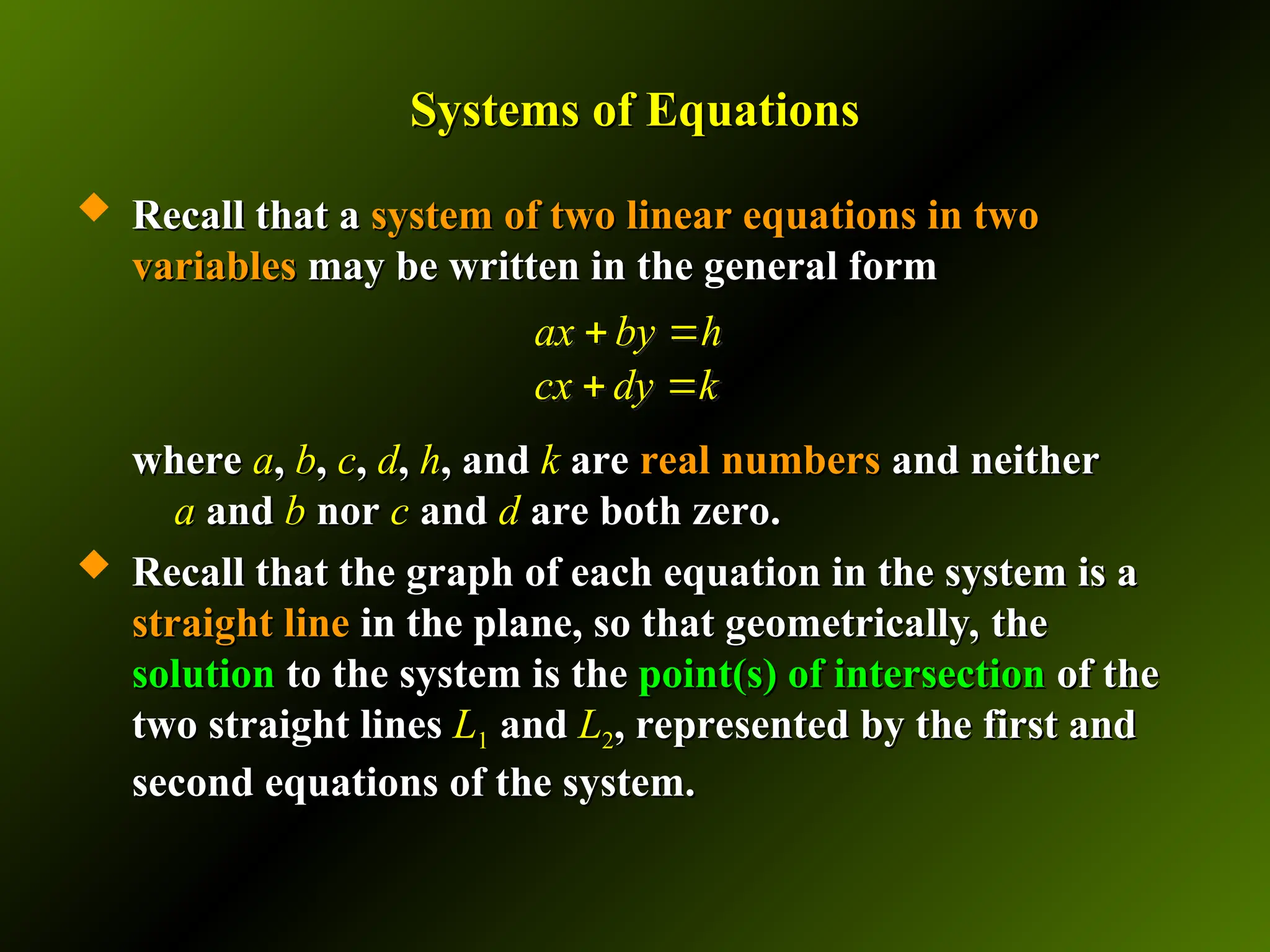
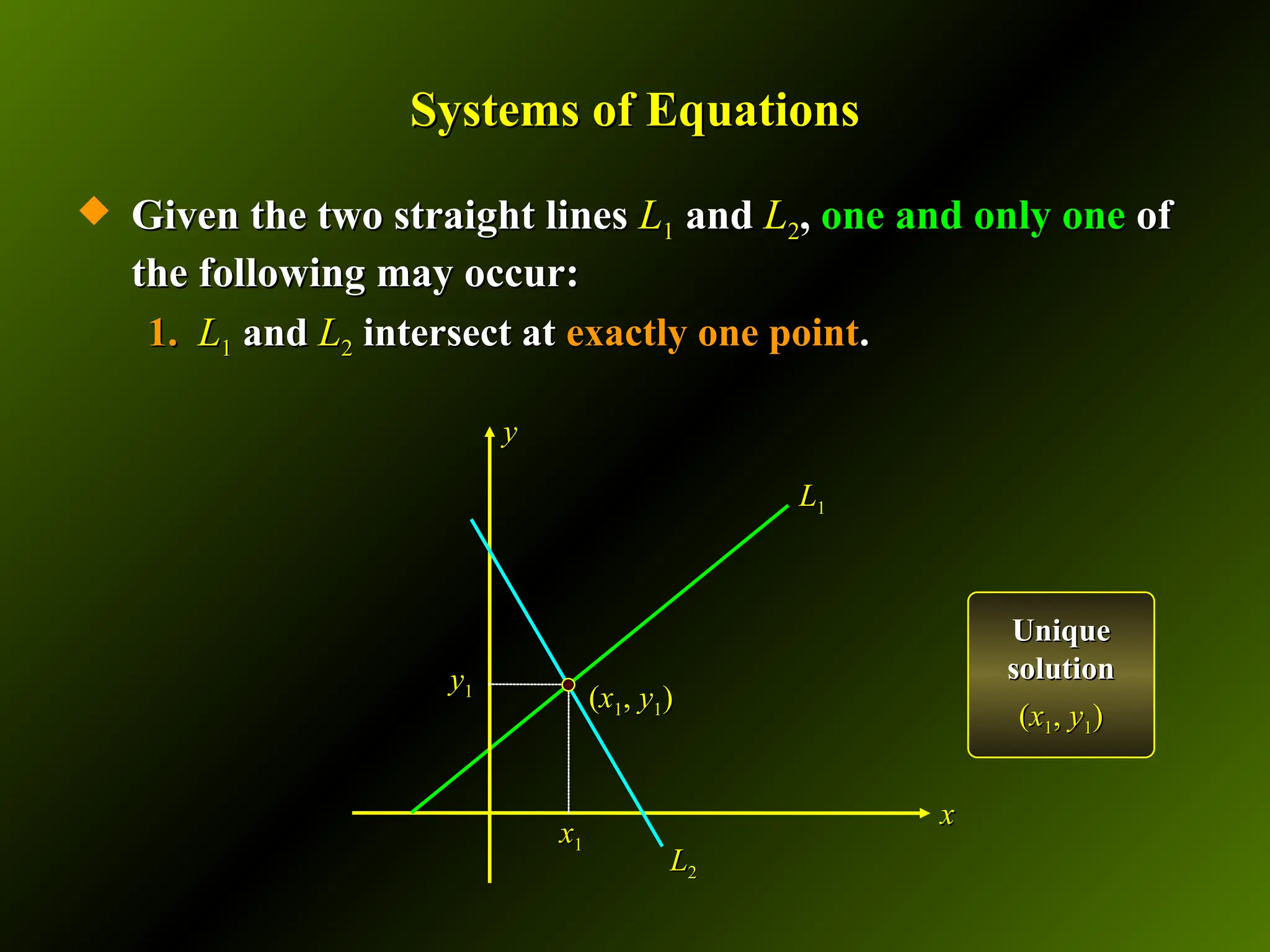
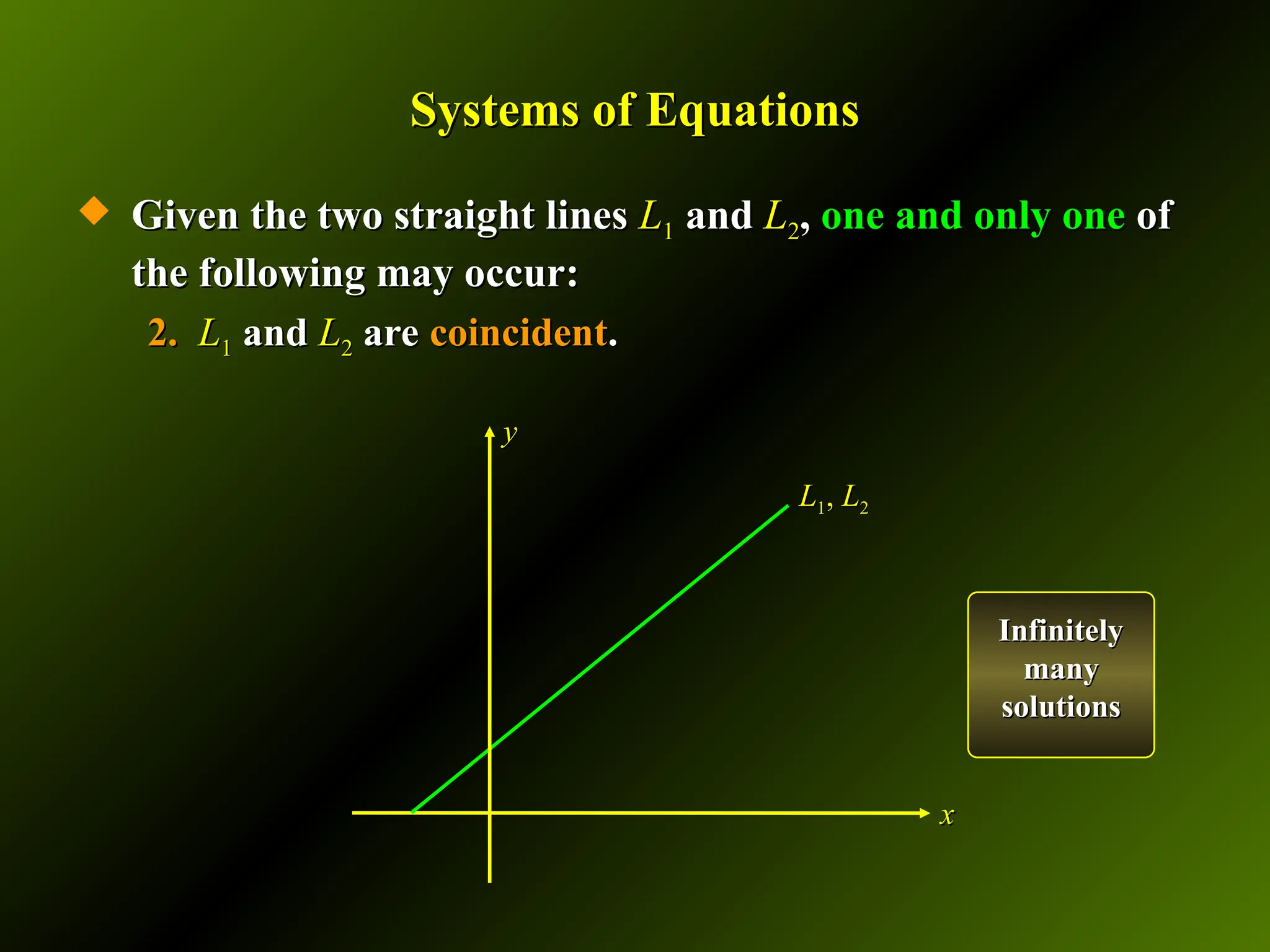
 Given the two straight lines
Given the two straight lines L
L1
1 and
and L
L2
2,
, one and only one
one and only one of
of
the following may occur:
1.
1. L
L1
1 and
and L
L2
2 intersect at
intersect at exactly one point
exactly one point.
.
y
y
x
x
L
L1
1
L
L2
2
Unique
Unique
solution
solution
(
(x
x1
1,
, y
y1
1)
)
(
(x
x1
1,
, y
y1
1)
)
x
x1
1
y
y1
1
Systems of Equations
 Given the two straight lines
Given the two straight lines L
L1
1 and
and L
L2
2,
, one and only one
one and only one of
of
the following may occur:
2.
2. L
L1
1 and
and L
L2
2 are
are coincident
coincident.
.
y
y
x
x
L
L1
1,
, L
L2
2
Infinitely
Infinitely
many
many
solutions
solutions
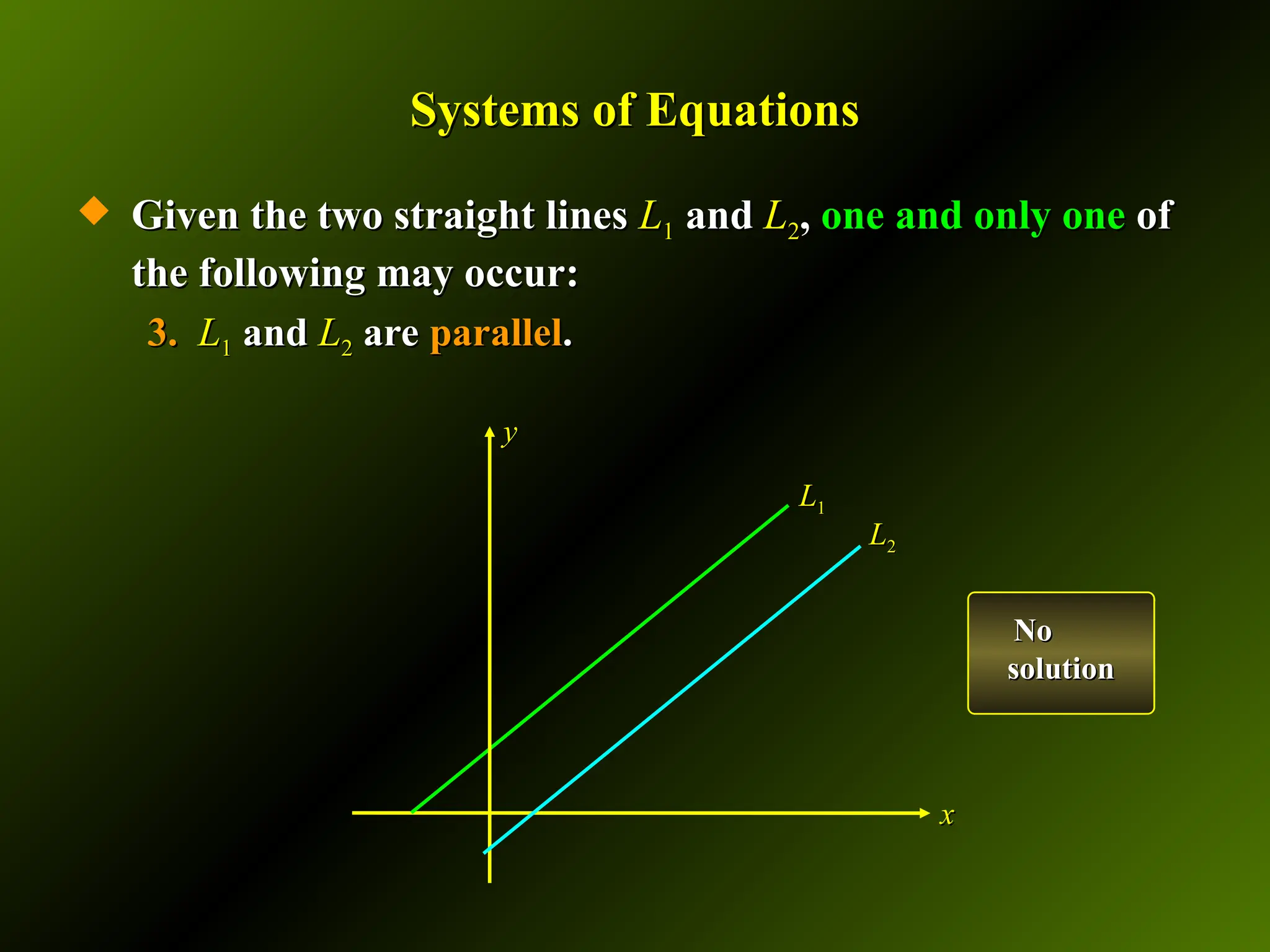
Systems of Equations
 Given the two straight lines
Given the two straight lines L
L1
1 and
and L
L2
2,
, one and only one
one and only one of
of
the following may occur:
3.
3. L
L1
1 and
and L
L2
2 are
are parallel
parallel.
.
y
y
x
x
L
L1
1
L
L2
2
No
No
solution
solution
Example:
Example:
A System of Equations With Exactly One Solution
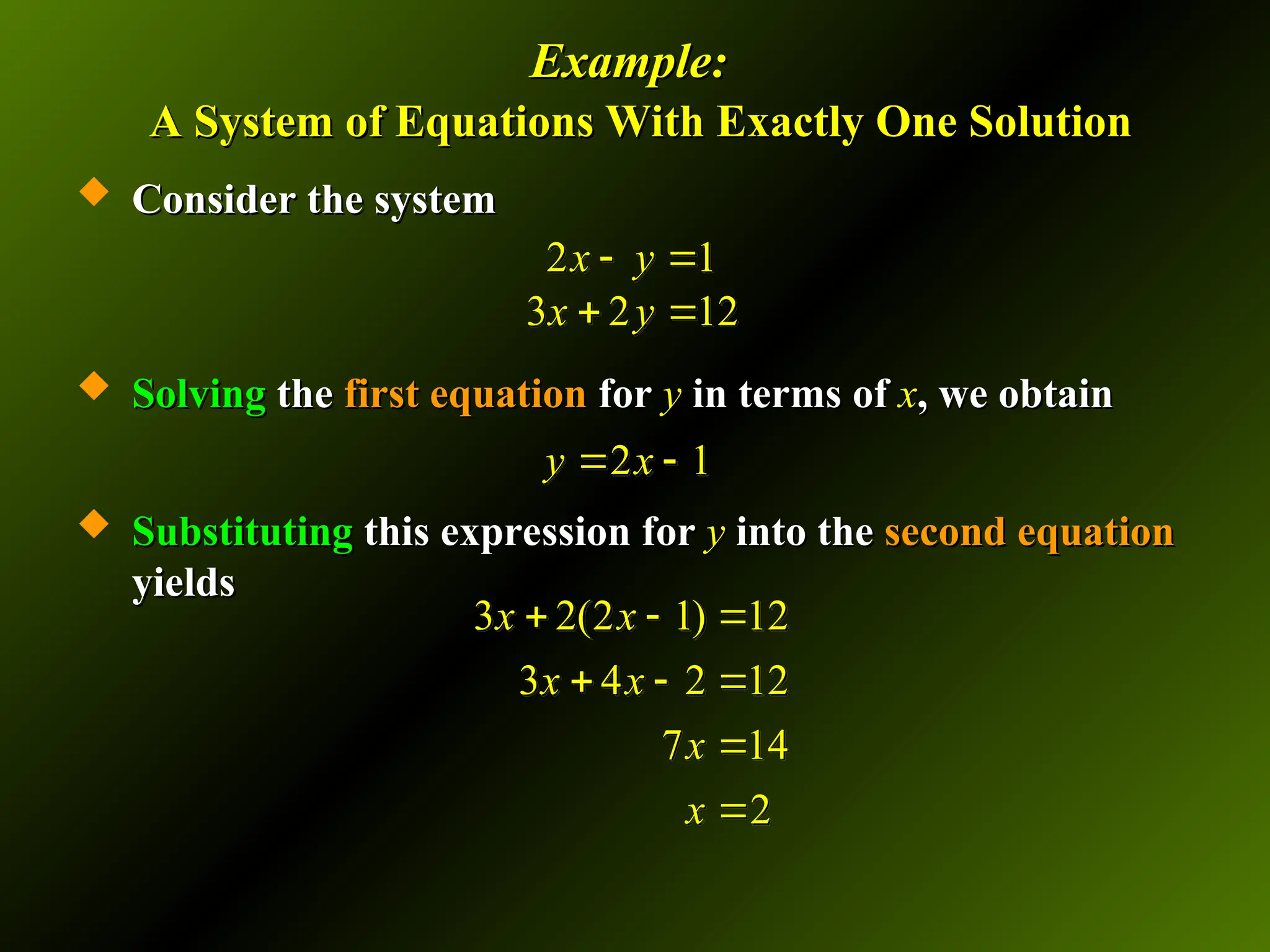
 Consider the system
Consider the system
 Solving
Solving the
the first equation
first equation for
for y
y in terms of
in terms of x
x, we obtain
, we obtain
 Substituting
Substituting this expression for
this expression for y
y into the
into the second equation
second equation
yields
yields
2 1
3 2 12
x y
x y
 
 
2 1
y x
 
3 2(2 1) 12
3 4 2 12
7 14
2
x x
x x
x
x
  
  


Example:
Example:
A System of Equations With Exactly One Solution
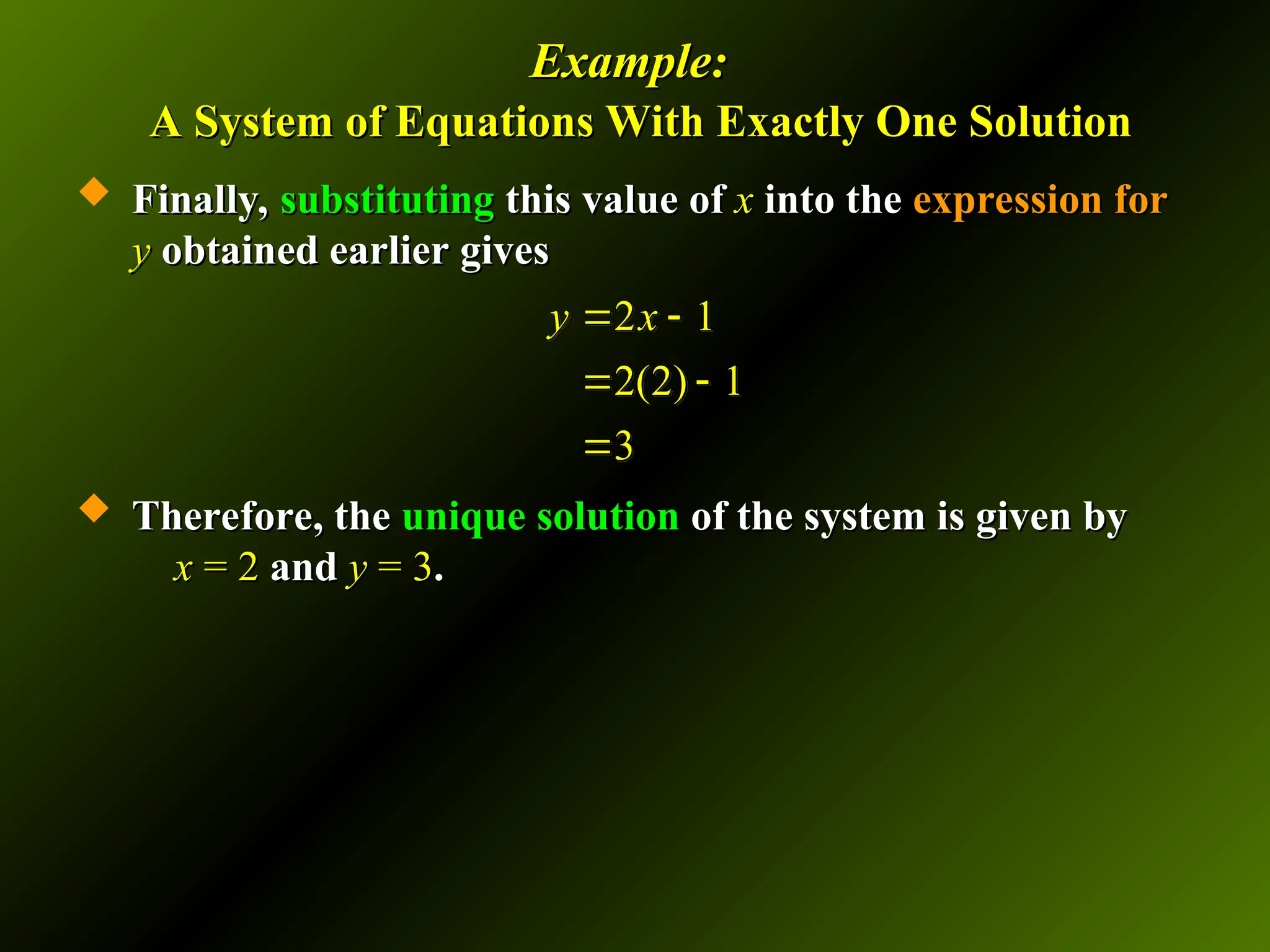
 Finally,
Finally, substituting
substituting this value of
this value of x
x into the
into the expression for
expression for
y
y obtained earlier gives
obtained earlier gives
 Therefore, the
Therefore, the unique solution
unique solution of the system is given by
of the system is given by
x
x = 2
= 2 and
and y
y = 3
= 3.
.
2 1
2(2) 1
3
y x
 
 

1
1 2
2 3
3 4
4 5
5 6
6
6
6
5
5
4
4
3
3
2
2
1
1
–
–1
1
Example:
Example:
A System of Equations With Exactly One Solution
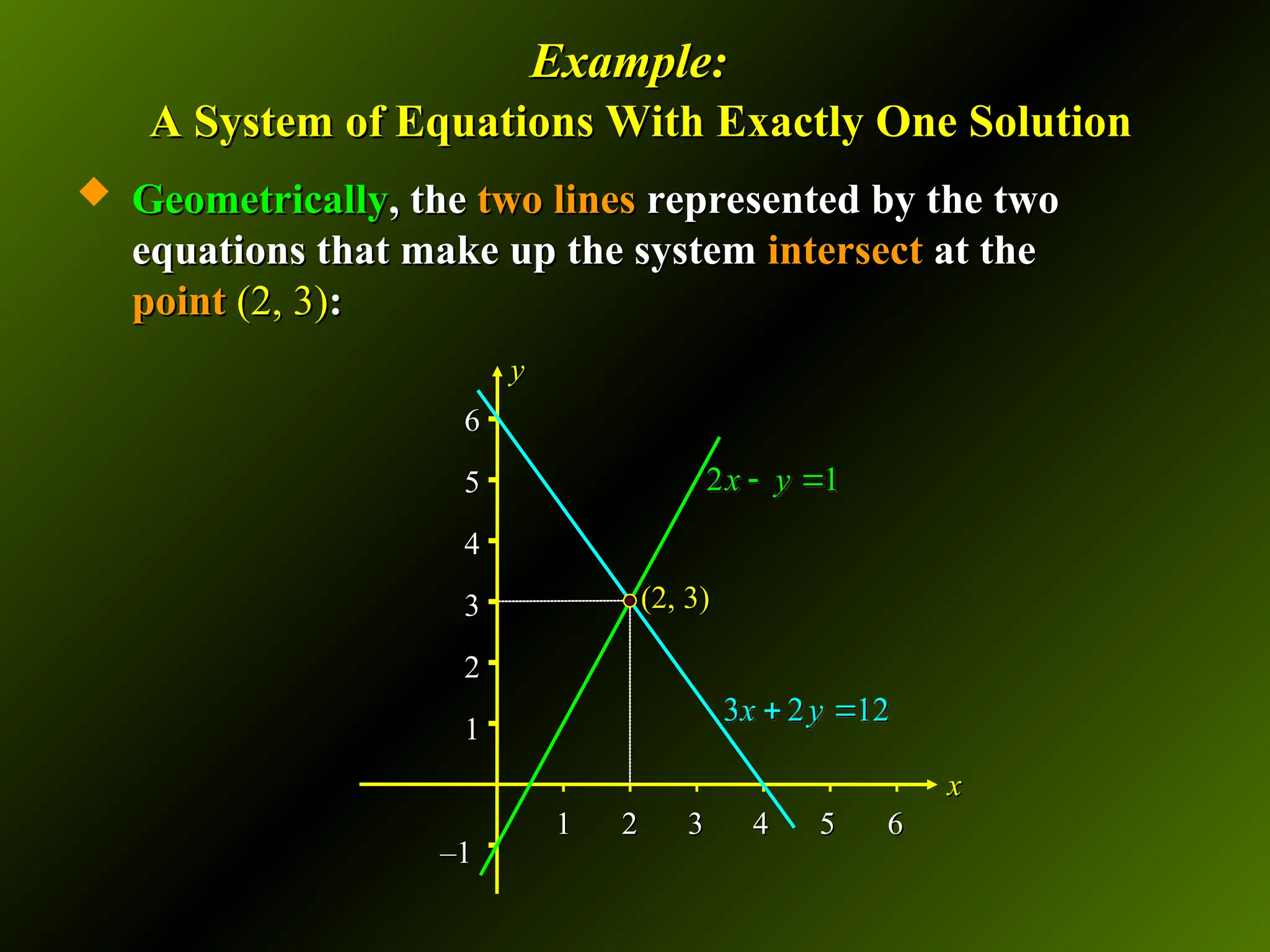
 Geometrically
Geometrically, the
, the two lines
two lines represented by the two
represented by the two
equations that make up the system
equations that make up the system intersect
intersect at the
at the
point
point (2, 3)
(2, 3):
:
y
y
x
x
(2, 3)
(2, 3)
2 1
x y
 
3 2 12
x y
 
Example:
Example:
A System of Equations With Infinitely Many Solutions
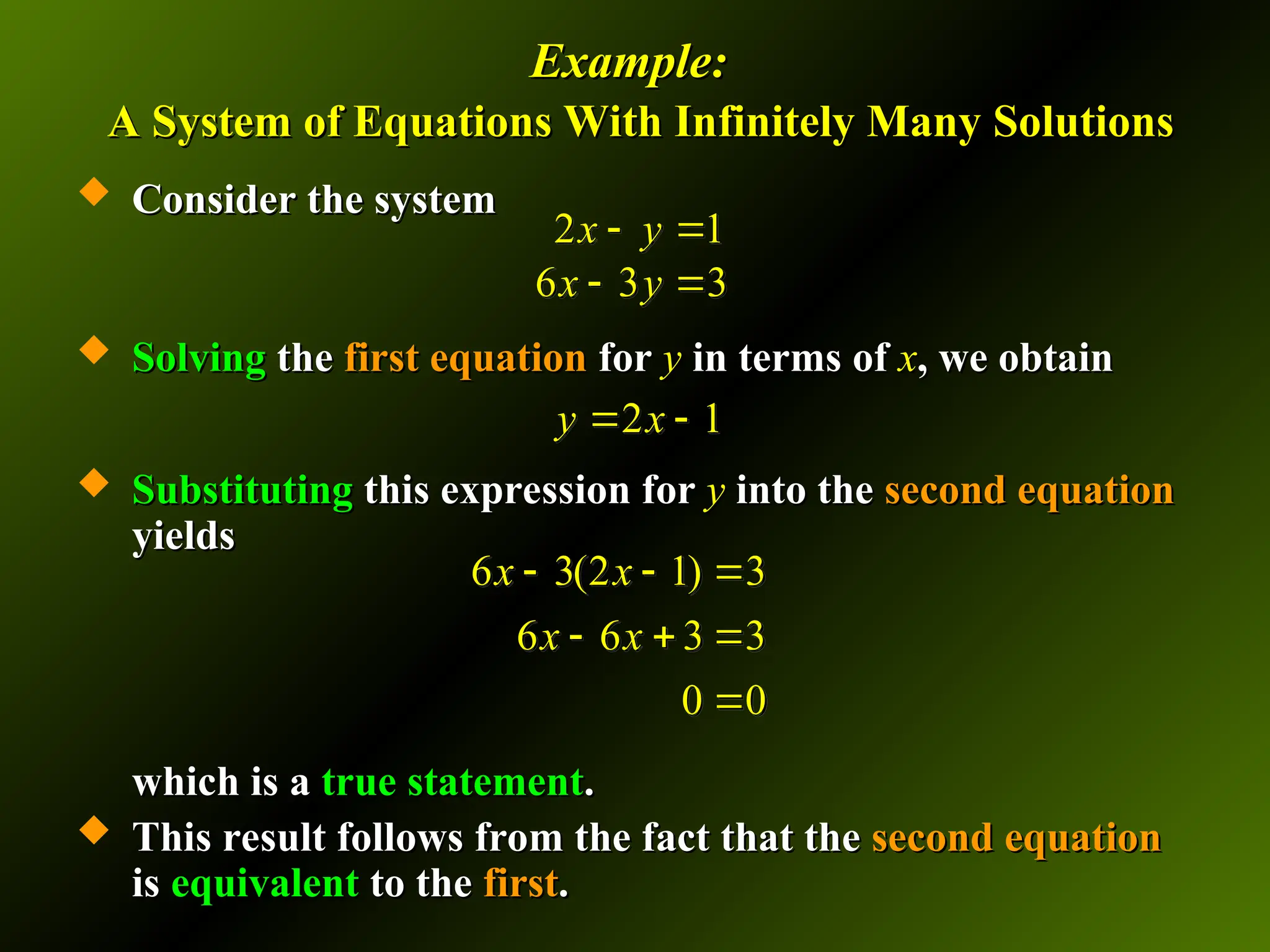
 Consider the system
Consider the system
 Solving
Solving the
the first equation
first equation for
for y
y in terms of
in terms of x
x, we obtain
, we obtain
 Substituting
Substituting this expression for
this expression for y
y into the
into the second equation
second equation
yields
yields
which is a
which is a true statement
true statement.
.
 This result follows from the fact that the
This result follows from the fact that the second equation
second equation
is
is equivalent
equivalent to the
to the first
first.
.
2 1
6 3 3
x y
x y
 
 
2 1
y x
 
6 3(2 1) 3
6 6 3 3
0 0
x x
x x
  
  

Example:
Example:
A System of Equations With Infinitely Many Solutions
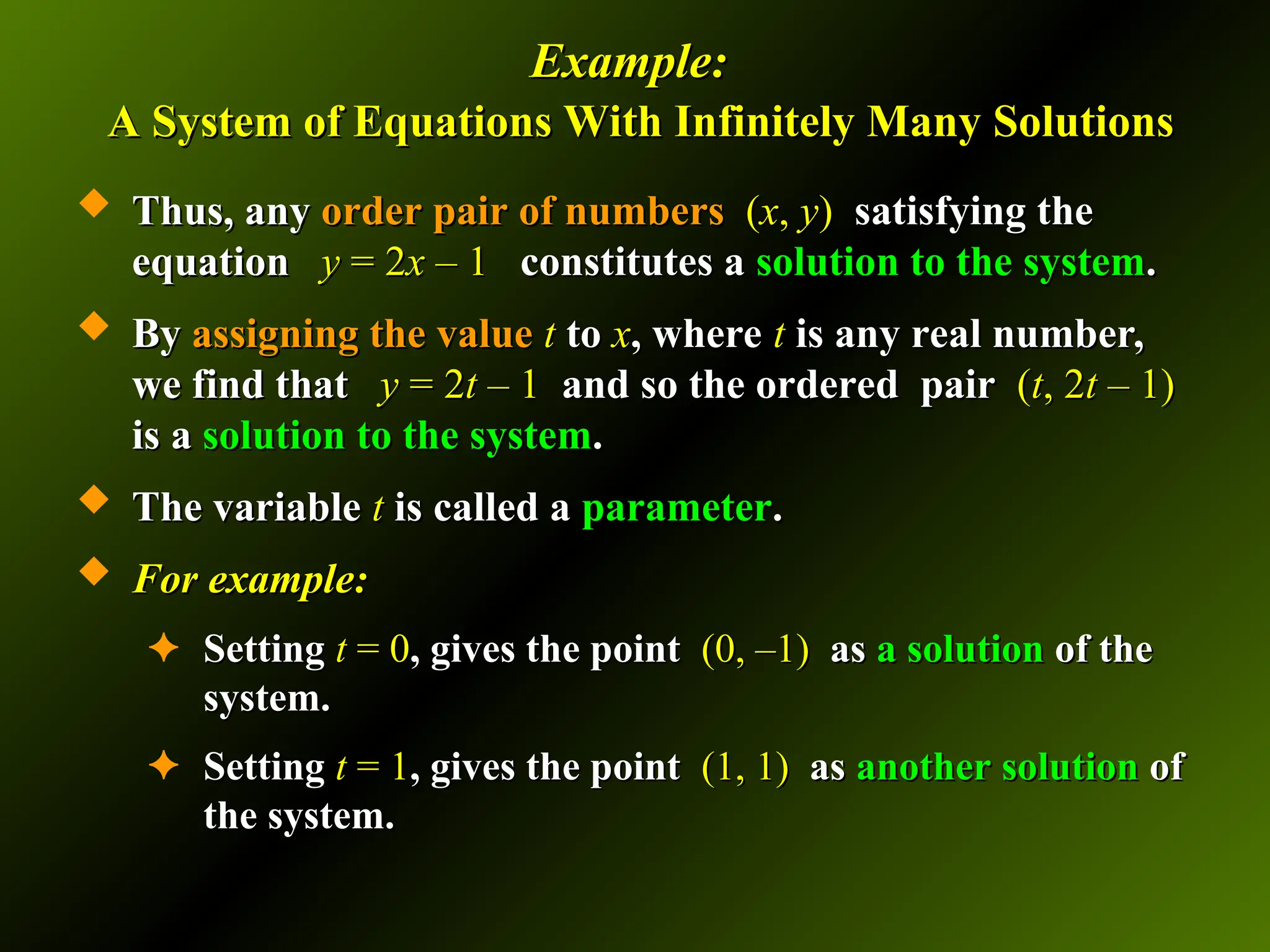
 Thus, any
Thus, any order pair of numbers
order pair of numbers (
(x
x,
, y
y)
) satisfying the
satisfying the
equation
equation y
y =
= 2
2x
x – 1
– 1 constitutes a
constitutes a solution to the system
solution to the system.
.
 By
By assigning the value
assigning the value t
t to
to x
x, where
, where t
t is any real number,
is any real number,
we find that
we find that y
y =
= 2
2t
t – 1
– 1 and so the ordered pair
and so the ordered pair (
(t
t, 2
, 2t
t – 1)
– 1)
is a
is a solution to the system
solution to the system.
.
 The variable
The variable t
t is called a
is called a parameter
parameter.
.
 For example:
For example:
✦ Setting
Setting t
t = 0
= 0, gives the point
, gives the point (0, –1)
(0, –1) as
as a
a solution
solution of the
of the
system.
system.
✦ Setting
Setting t
t = 1
= 1, gives the point
, gives the point (1, 1)
(1, 1) as
as another solution
another solution of
of
the system.
the system.
6
6
5
5
4
4
3
3
2
2
1
1
–
–1
1
1
1 2
2 3
3 4
4 5
5 6
6
Example:
Example:
A System of Equations With Infinitely Many Solutions
 Since
Since t
t represents
represents any real number
any real number, there are
, there are infinitely
infinitely
many solutions
many solutions of the system.
of the system.
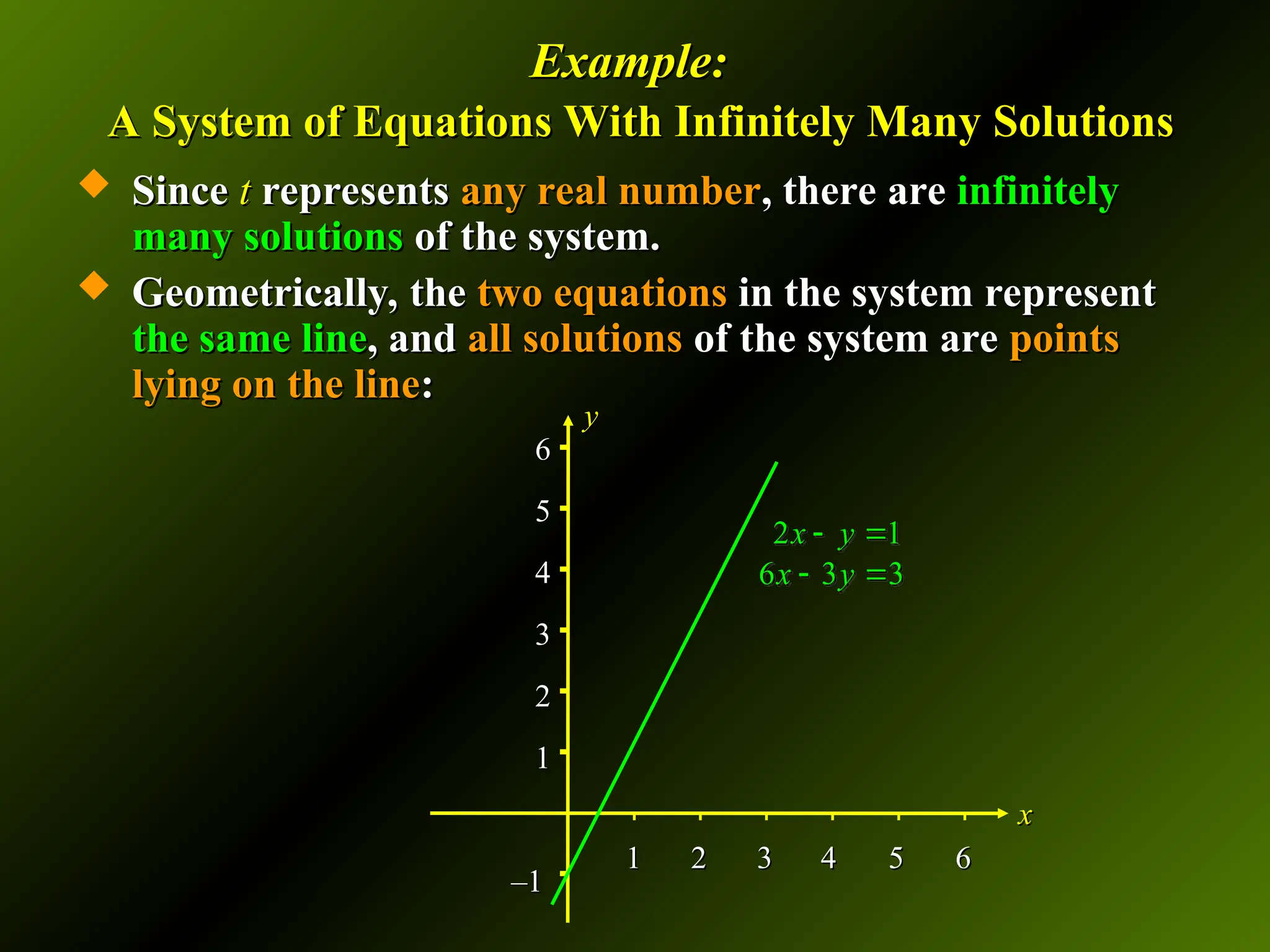
 Geometrically, the
Geometrically, the two equations
two equations in the system represent
in the system represent
the same line
the same line, and
, and all solutions
all solutions of the system are
of the system are points
points
lying on the line
lying on the line:
:
y
y
x
x
2 1
6 3 3
x y
x y
 
 
Example:
Example:
A System of Equations That Has No Solution
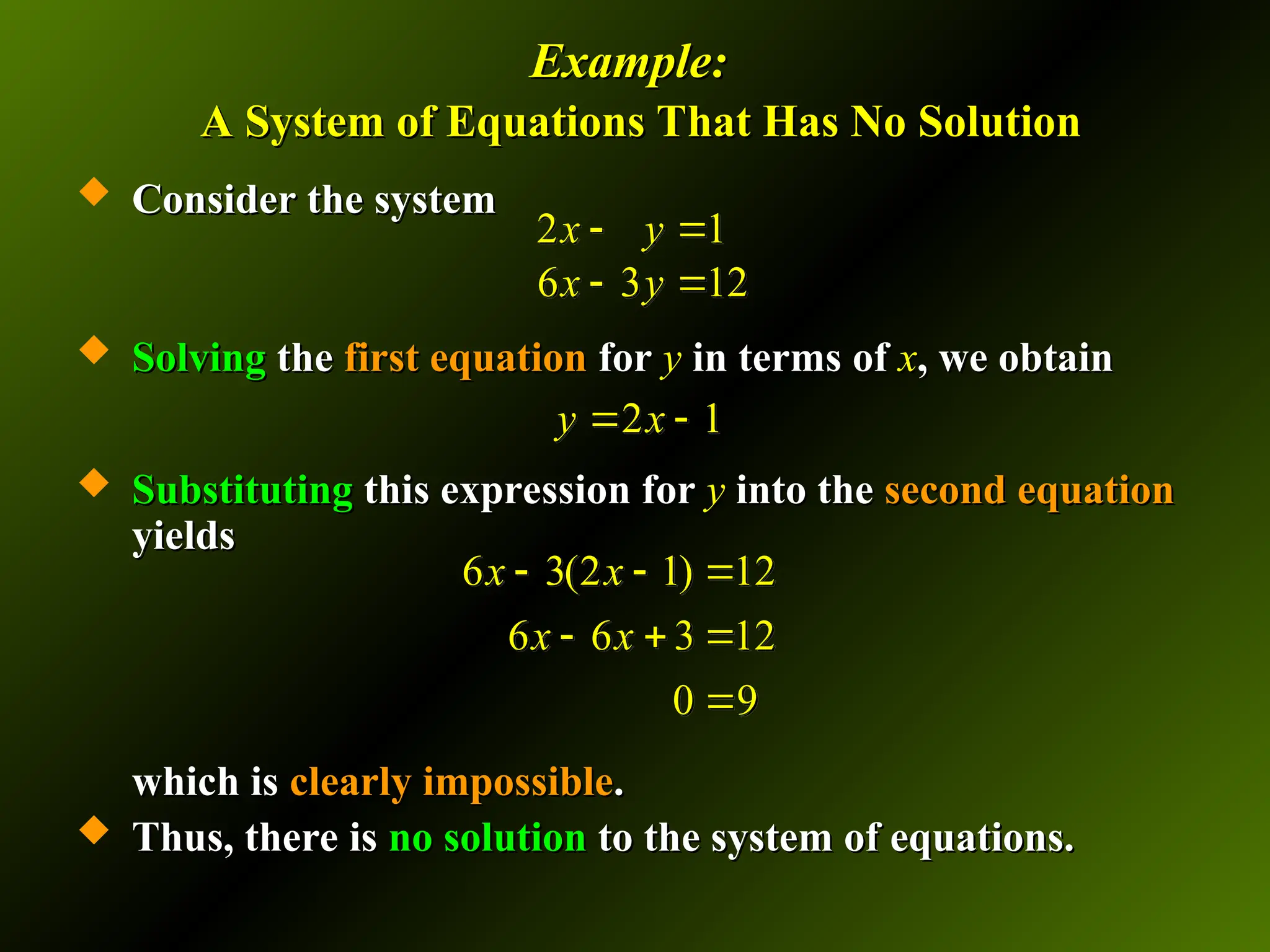
 Consider the system
Consider the system
 Solving
Solving the
the first equation
first equation for
for y
y in terms of
in terms of x
x, we obtain
, we obtain
 Substituting
Substituting this expression for
this expression for y
y into the
into the second equation
second equation
yields
yields
which is
which is clearly
clearly impossible
impossible.
.
 Thus, there is
Thus, there is no solution
no solution to the system of equations.
to the system of equations.
2 1
6 3 12
x y
x y
 
 
2 1
y x
 
6 3(2 1) 12
6 6 3 12
0 9
x x
x x
  
  

1
1 2
2 3
3 4
4 5
5 6
6
Example:
Example:
A System of Equations That Has No Solution
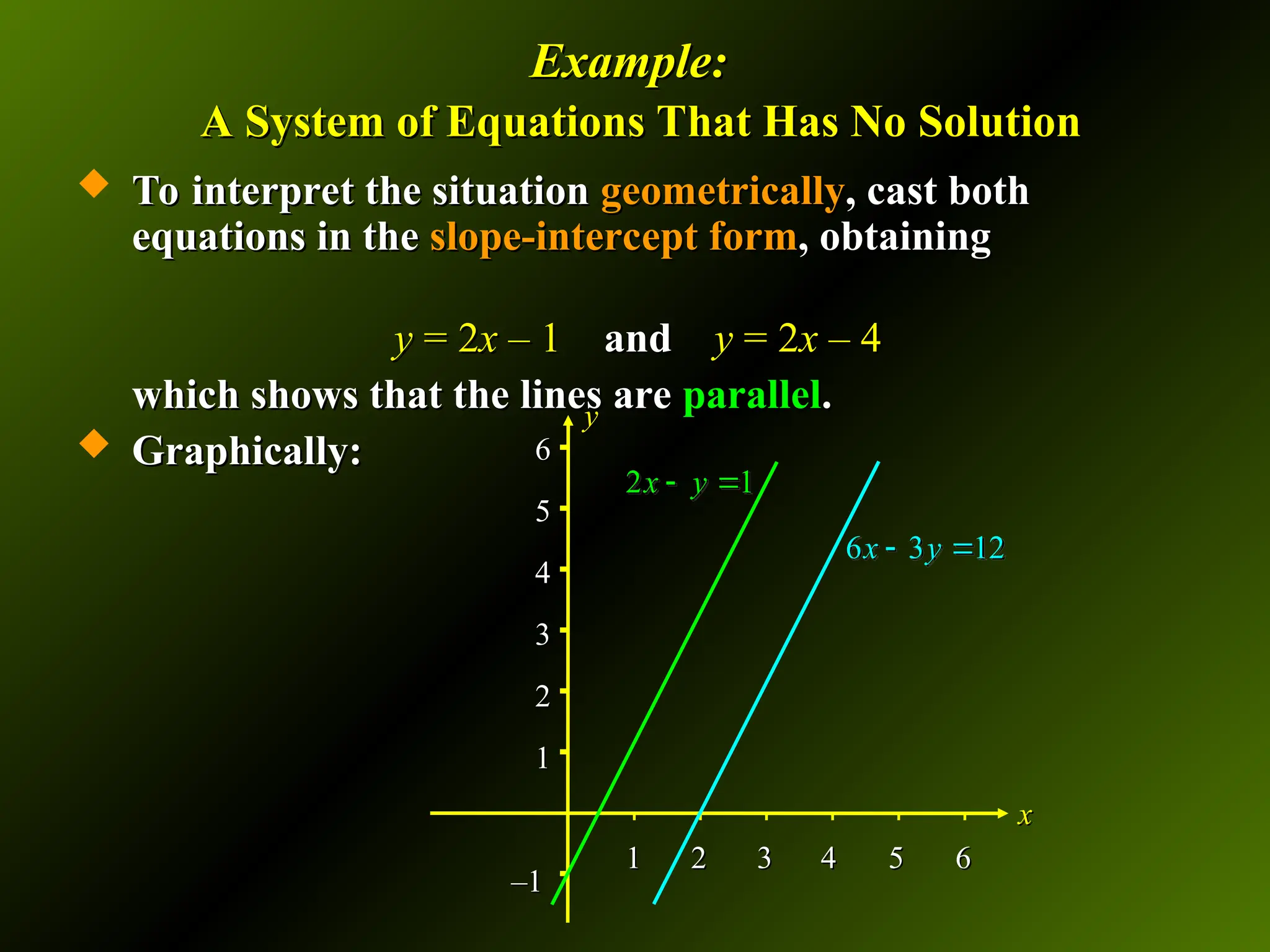
 To interpret the situation
To interpret the situation geometrically
geometrically, cast both
, cast both
equations in the
equations in the slope-intercept form
slope-intercept form, obtaining
, obtaining
y
y = 2
= 2x
x – 1
– 1 and
and y
y = 2
= 2x
x – 4
– 4
which shows that the lines are
which shows that the lines are parallel
parallel.
.
 Graphically:
Graphically: 6
6
5
5
4
4
3
3
2
2
1
1
–
–1
1
y
y
x
x
2 1
x y
 
6 3 12
x y
 
5.2
5.2
Systems of Linear Equations:
Unique Solutions
Unique Solutions
3 2 8 9
2 2 1 3
1 2 3 8

 
 

 
 

 
3 2 8 9
2 2 1 3
1 2 3 8

 
 

 
 

 
3 2 8 9
2 2 3
2 3 8
x y z
x y z
x y z
  
   
  
3 2 8 9
2 2 3
2 3 8
x y z
x y z
x y z
  
   
  
1 0 0 3
0 1 0 4
0 0 1 1
 
 
 
 
 
1 0 0 3
0 1 0 4
0 0 1 1
 
 
 
 
 
The Gauss-Jordan Method
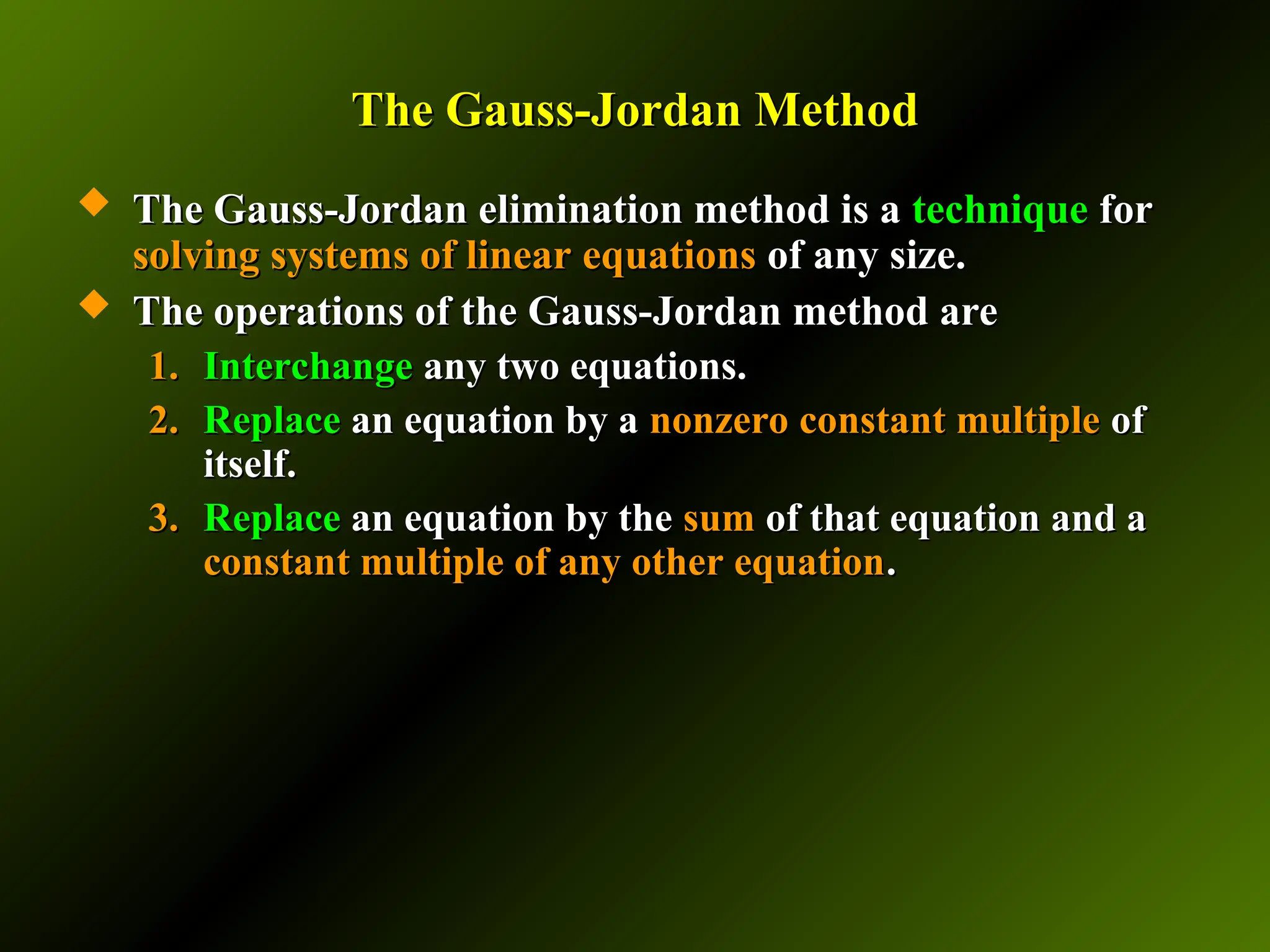
 The Gauss-Jordan elimination method is a
The Gauss-Jordan elimination method is a technique
technique for
for
solving systems of linear equations
solving systems of linear equations of any size.
of any size.
 The operations of the Gauss-Jordan method are
The operations of the Gauss-Jordan method are
1.
1. Interchange
Interchange any two equations.
any two equations.
2.
2. Replace
Replace an equation by a
an equation by a nonzero constant multiple
nonzero constant multiple of
of
itself.
itself.
3.
3. Replace
Replace an equation by the
an equation by the sum
sum of that equation and a
of that equation and a
constant multiple of any other equation
constant multiple of any other equation.
.
Example
Example
 Solve the following system of equations:
Solve the following system of equations:
Solution
Solution
 First, we transform this system into an equivalent system
First, we transform this system into an equivalent system
in which the coefficient of
in which the coefficient of x
x in the
in the first equation
first equation is
is 1
1:
:
2 4 6 22
3 8 5 27
2 2
x y z
x y z
x y z
  
  
   
2 4 6 22
3 8 5 27
2 2
x y z
x y z
x y z
  
  
   
Multiply the
Multiply the
equation by
equation by 1/2
1/2
Toggle slides
Toggle slides
back and forth to
back and forth to
compare before
compare before
and changes
and changes
Example
Example
 Solve the following system of equations:
Solve the following system of equations:
Solution
Solution
 First, we transform this system into an equivalent system
First, we transform this system into an equivalent system
in which the coefficient of
in which the coefficient of x
x in the
in the first equation
first equation is
is 1
1:
:
2 4 6 22
3 8 5 27
2 2
x y z
x y z
x y z
  
  
   
2 3 11
3 8 5 27
2 2
x y z
x y z
x y z
  
  
   
Multiply the first
Multiply the first
equation by
equation by 1/2
1/2
Toggle slides
Toggle slides
back and forth to
back and forth to
compare before
compare before
and changes
and changes
Example
Example
 Solve the following system of equations:
Solve the following system of equations:
Solution
Solution
 Next, we
Next, we eliminate
eliminate the variable
the variable x
x from all equations except
from all equations except
the first:
the first:
2 4 6 22
3 8 5 27
2 2
x y z
x y z
x y z
  
  
   
2 3 11
3 8 5 27
2 2
x y z
x y z
x y z
  
  
   
Replace by the sum of
– 3
– 3 X
X the first equation
the first equation
+
+ the second
the second
equation
equation
Toggle slides
Toggle slides
back and forth to
back and forth to
compare before
compare before
and changes
and changes
Example
Example
 Solve the following system of equations:
Solve the following system of equations:
Solution
Solution
 Next, we
Next, we eliminate
eliminate the variable
the variable x
x from all equations except
from all equations except
the first:
the first:
2 4 6 22
3 8 5 27
2 2
x y z
x y z
x y z
  
  
   
2 3 11
2 4 6
2 2
x y z
y z
x y z
  
 
   
Replace by the sum of
– 3
– 3 ☓
☓ the first
the first
equation
equation +
+ the
the
second equation
second equation
Toggle slides
Toggle slides
back and forth to
back and forth to
compare before
compare before
and changes
and changes
Example
Example
 Solve the following system of equations:
Solve the following system of equations:
Solution
Solution
 Next, we
Next, we eliminate
eliminate the variable
the variable x
x from all equations except
from all equations except
the first:
the first:
2 4 6 22
3 8 5 27
2 2
x y z
x y z
x y z
  
  
   
2 3 11
2 4 6
2 2
x y z
y z
x y z
  
 
    Replace by the sum
Replace by the sum
of the first equation
+
+ the third equation
the third equation
Toggle slides
Toggle slides
back and forth to
back and forth to
compare before
compare before
and changes
and changes
Example
Example
 Solve the following system of equations:
Solve the following system of equations:
Solution
Solution
 Next, we
Next, we eliminate
eliminate the variable
the variable x
x from all equations except
from all equations except
the first:
the first:
2 4 6 22
3 8 5 27
2 2
x y z
x y z
x y z
  
  
   
2 3 11
2 4 6
3 5 13
x y z
y z
y z
  
 
  Replace by the sum
Replace by the sum
of the first equation
+
+ the third equation
the third equation
Toggle slides
Toggle slides
back and forth to
back and forth to
compare before
compare before
and changes
and changes
Example
Example
 Solve the following system of equations:
Solve the following system of equations:
Solution
Solution
 Then we transform so that the coefficient of
Then we transform so that the coefficient of y
y in the
in the
second equation
second equation is
is 1
1:
:
2 4 6 22
3 8 5 27
2 2
x y z
x y z
x y z
  
  
   
2 3 11
2 4 6
3 5 13
x y z
y z
y z
  
 
 
Multiply the second
Multiply the second
equation by
equation by 1/2
1/2
Toggle slides
Toggle slides
back and forth to
back and forth to
compare before
compare before
and changes
and changes
Example
Example
 Solve the following system of equations:
Solve the following system of equations:
Solution
Solution
 Then we transform so that the coefficient of
Then we transform so that the coefficient of y
y in the
in the
second equation
second equation is
is 1
1:
:
2 4 6 22
3 8 5 27
2 2
x y z
x y z
x y z
  
  
   
2 3 11
2 3
3 5 13
x y z
y z
y z
  
 
 
Multiply the second
Multiply the second
equation by
equation by 1/2
1/2
Toggle slides
Toggle slides
back and forth to
back and forth to
compare before
compare before
and changes
and changes
Example
Example
 Solve the following system of equations:
Solve the following system of equations:
Solution
Solution
 We now
We now eliminate
eliminate y
y from all equations except the second:
from all equations except the second:
2 4 6 22
3 8 5 27
2 2
x y z
x y z
x y z
  
  
   
2 3 11
2 3
3 5 13
x y z
y z
y z
  
 
 
Replace by the sum of
the first equation
the first equation +
+
(–2)
(–2) ☓
☓ the second
the second
equation
equation
Toggle slides
Toggle slides
back and forth to
back and forth to
compare before
compare before
and changes
and changes
Example
Example
 Solve the following system of equations:
Solve the following system of equations:
Solution
Solution
 We now
We now eliminate
eliminate y
y from all equations except the second:
from all equations except the second:
2 4 6 22
3 8 5 27
2 2
x y z
x y z
x y z
  
  
   
7 17
2 3
3 5 13
x z
y z
y z
 
 
 
Replace by the sum of
the first equation
the first equation +
+
(–2)
(–2) ☓
☓ the second
the second
equation
equation
Toggle slides
Toggle slides
back and forth to
back and forth to
compare before
compare before
and changes
and changes
Example
Example
 Solve the following system of equations:
Solve the following system of equations:
Solution
Solution
 We now
We now eliminate
eliminate y
y from all equations except the second:
from all equations except the second:
2 4 6 22
3 8 5 27
2 2
x y z
x y z
x y z
  
  
   
7 17
2 3
3 5 13
x z
y z
y z
 
 
  Replace by the sum of
Replace by the sum of
the third equation
the third equation +
+
(–3)
(–3) ☓
☓ the second
the second
equation
equation
Toggle slides
Toggle slides
back and forth to
back and forth to
compare before
compare before
and changes
and changes
Example
Example
 Solve the following system of equations:
Solve the following system of equations:
Solution
Solution
 We now
We now eliminate
eliminate y
y from all equations except the second:
from all equations except the second:
2 4 6 22
3 8 5 27
2 2
x y z
x y z
x y z
  
  
   
7 17
2 3
11 22
x z
y z
z
 
 
 Replace by the sum of
Replace by the sum of
the third equation
the third equation +
+
(–3)
(–3) ☓
☓ the second
the second
equation
equation
Toggle slides
Toggle slides
back and forth to
back and forth to
compare before
compare before
and changes
and changes
Example
Example
 Solve the following system of equations:
Solve the following system of equations:
Solution
Solution
 Now we transform so that the coefficient of
Now we transform so that the coefficient of z
z in the
in the third
third
equation
equation is
is 1
1:
:
2 4 6 22
3 8 5 27
2 2
x y z
x y z
x y z
  
  
   
7 17
2 3
11 22
x z
y z
z
 
 
 Multiply the third
Multiply the third
equation by
equation by 1/11
1/11
Toggle slides
Toggle slides
back and forth to
back and forth to
compare before
compare before
and changes
and changes
Example
Example
 Solve the following system of equations:
Solve the following system of equations:
Solution
Solution
 Now we transform so that the coefficient of
Now we transform so that the coefficient of z
z in the
in the third
third
equation
equation is
is 1
1:
:
2 4 6 22
3 8 5 27
2 2
x y z
x y z
x y z
  
  
   
7 17
2 3
2
x z
y z
z
 
 
 Multiply the third
Multiply the third
equation by
equation by 1/11
1/11
Toggle slides
Toggle slides
back and forth to
back and forth to
compare before
compare before
and changes
and changes
Example
Example
 Solve the following system of equations:
Solve the following system of equations:
Solution
Solution
 We now
We now eliminate
eliminate z
z from all equations except the third:
from all equations except the third:
2 4 6 22
3 8 5 27
2 2
x y z
x y z
x y z
  
  
   
Replace by the sum of
the first equation
the first equation +
+
(–7)
(–7) ☓
☓ the third
the third
equation
equation
7 17
2 3
2
x z
y z
z
 
 

Toggle slides
Toggle slides
back and forth to
back and forth to
compare before
compare before
and changes
and changes
Example
Example
 Solve the following system of equations:
Solve the following system of equations:
Solution
Solution
 We now
We now eliminate
eliminate z
z from all equations except the third:
from all equations except the third:
2 4 6 22
3 8 5 27
2 2
x y z
x y z
x y z
  
  
   
3
2 3
2
x
y z
z

 

Replace by the sum of
the first equation
the first equation +
+
(–7)
(–7) ☓
☓ the third
the third
equation
equation
Toggle slides
Toggle slides
back and forth to
back and forth to
compare before
compare before
and changes
and changes
Example
Example
 Solve the following system of equations:
Solve the following system of equations:
Solution
Solution
 We now
We now eliminate
eliminate z
z from all equations except the third:
from all equations except the third:
2 4 6 22
3 8 5 27
2 2
x y z
x y z
x y z
  
  
   
3
2 3
2
x
y z
z

 

Replace by the sum of
the second equation
the second equation +
+
2
2 ☓
☓ the third
the third
equation
equation
Toggle slides
Toggle slides
back and forth to
back and forth to
compare before
compare before
and changes
and changes
Example
Example
 Solve the following system of equations:
Solve the following system of equations:
Solution
Solution
 We now
We now eliminate
eliminate z
z from all equations except the third:
from all equations except the third:
2 4 6 22
3 8 5 27
2 2
x y z
x y z
x y z
  
  
   
3
1
2
x
y
z



Replace by the sum of
the second equation
the second equation +
+
2
2 ☓
☓ the third
the third
equation
equation
Toggle slides
Toggle slides
back and forth to
back and forth to
compare before
compare before
and changes
and changes
Example
Example
 Solve the following system of equations:
Solve the following system of equations:
Solution
Solution
 Thus, the
Thus, the solution
solution to the system is
to the system is x
x = 3
= 3,
, y
y = 1
= 1, and
, and z
z = 2
= 2.
.
2 4 6 22
3 8 5 27
2 2
x y z
x y z
x y z
  
  
   
3
1
2
x
y
z



Augmented Matrices
Augmented Matrices
 Matrices are
Matrices are rectangular arrays of numbers
rectangular arrays of numbers that can aid
that can aid
us by
us by eliminating the need to write the variables
eliminating the need to write the variables at each
at each
step of the reduction.
 For example, the
For example, the system
system
may be represented by the
may be represented by the augmented
augmented matrix
matrix
Coefficient
Coefficient
Matrix
Matrix
2 4 6 22
3 8 5 27
2 2
x y z
x y z
x y z
  
  
   
2 4 6 22
3 8 5 27
1 1 2 2
 
 
 
 

 
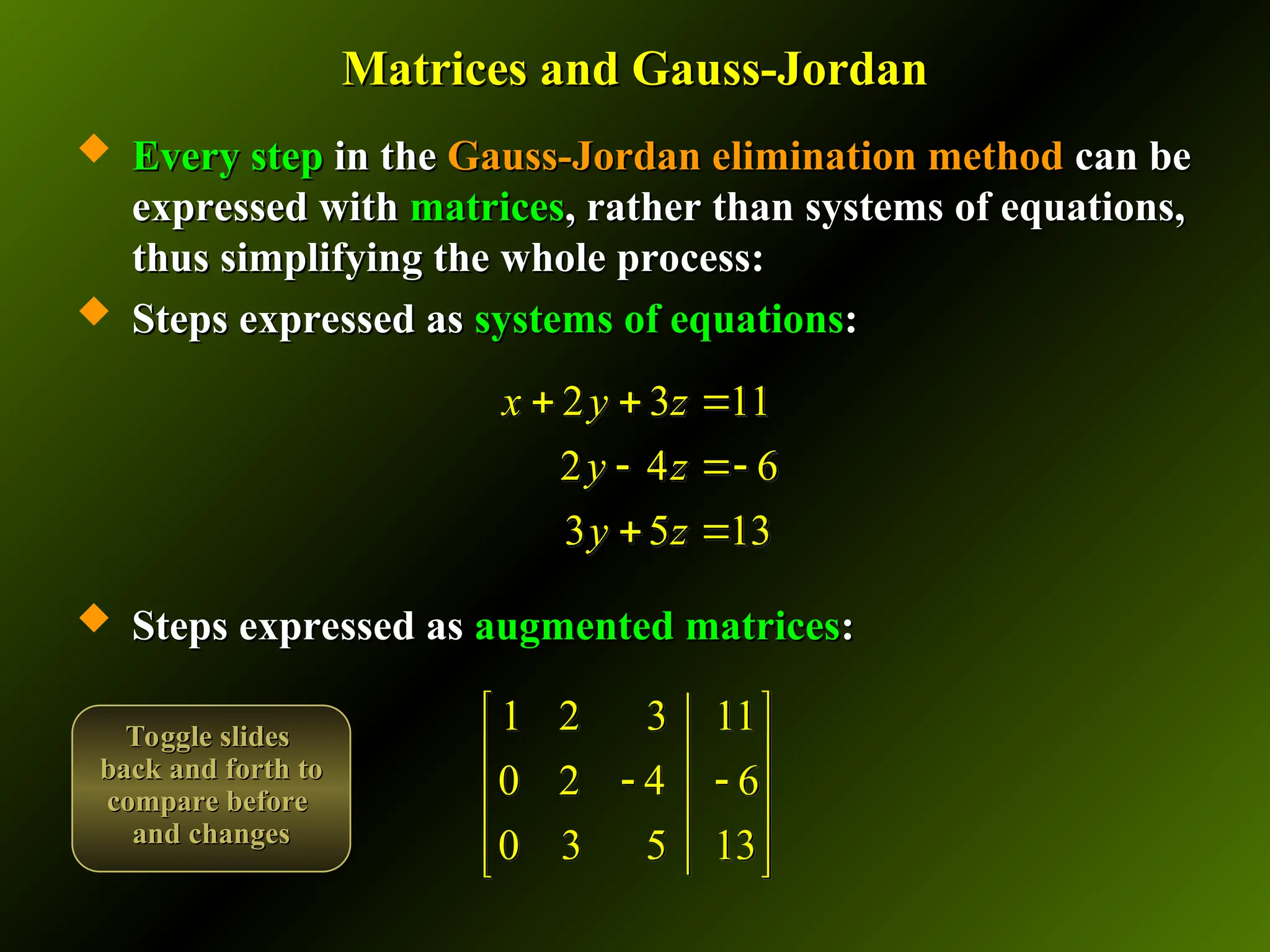
Matrices and Gauss-Jordan
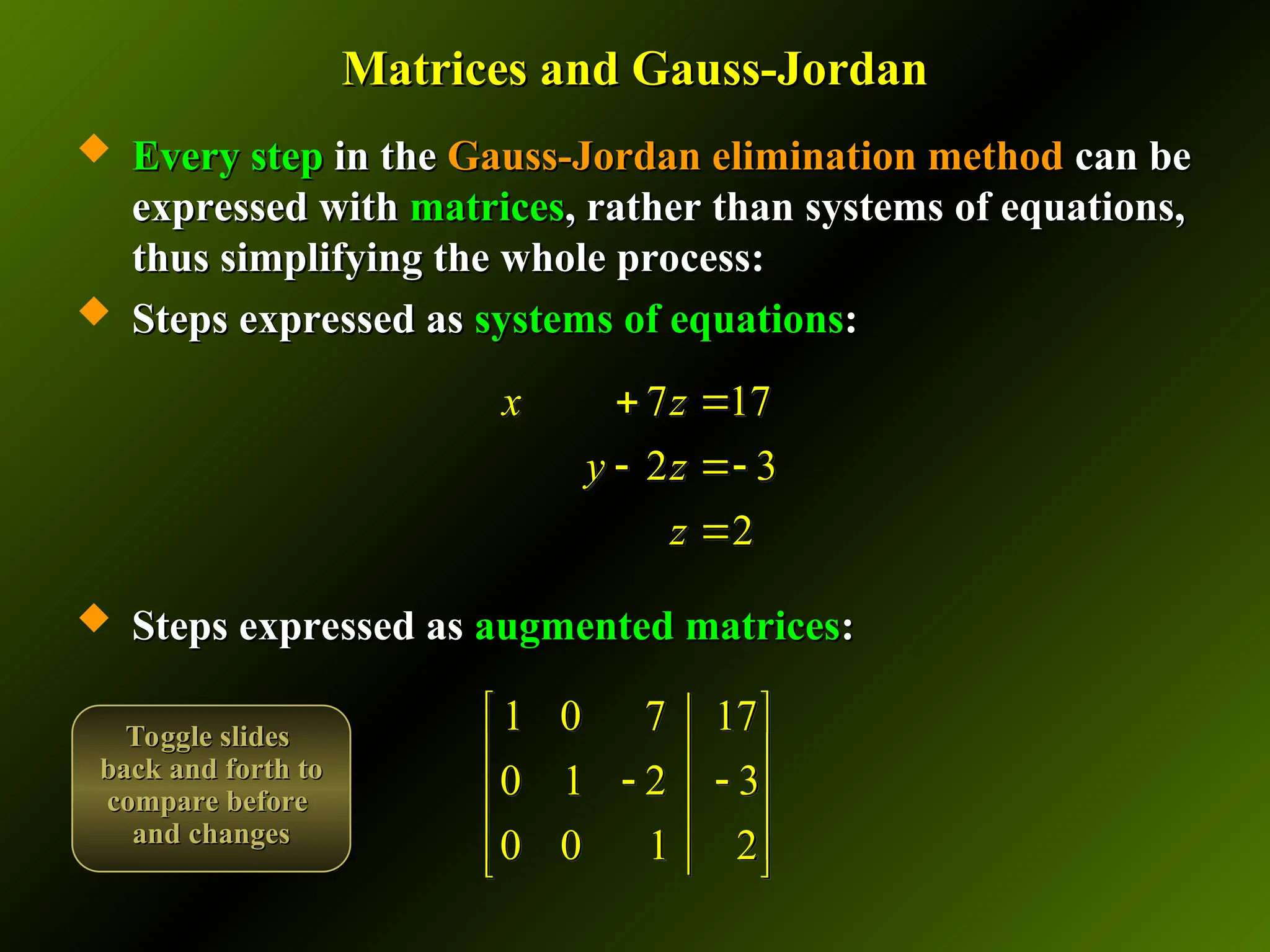
 Every step
Every step in the
in the Gauss-Jordan elimination method
Gauss-Jordan elimination method can be
can be
expressed with
expressed with matrices
matrices, rather than systems of equations,
, rather than systems of equations,
thus simplifying the whole process:
 Steps expressed as
Steps expressed as systems of equations
systems of equations:
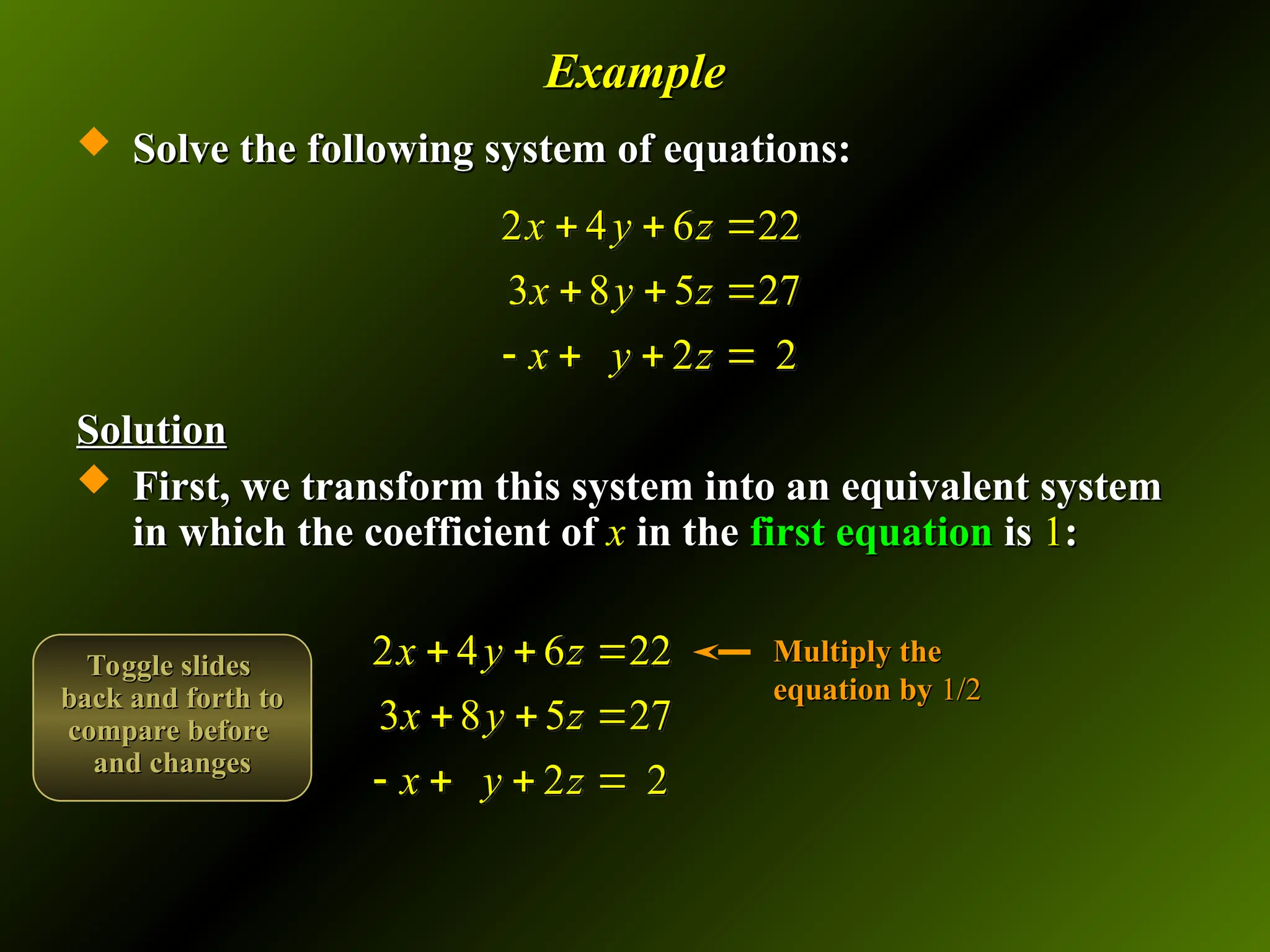
:
 Steps expressed as
Steps expressed as augmented matrices
augmented matrices:
:
2 4 6 22
3 8 5 27
2 2
x y z
x y z
x y z
  
  
   
2 4 6 22
3 8 5 27
1 1 2 2
 
 
 
 

 
Toggle slides
Toggle slides
back and forth to
back and forth to
compare before
compare before
and changes
and changes
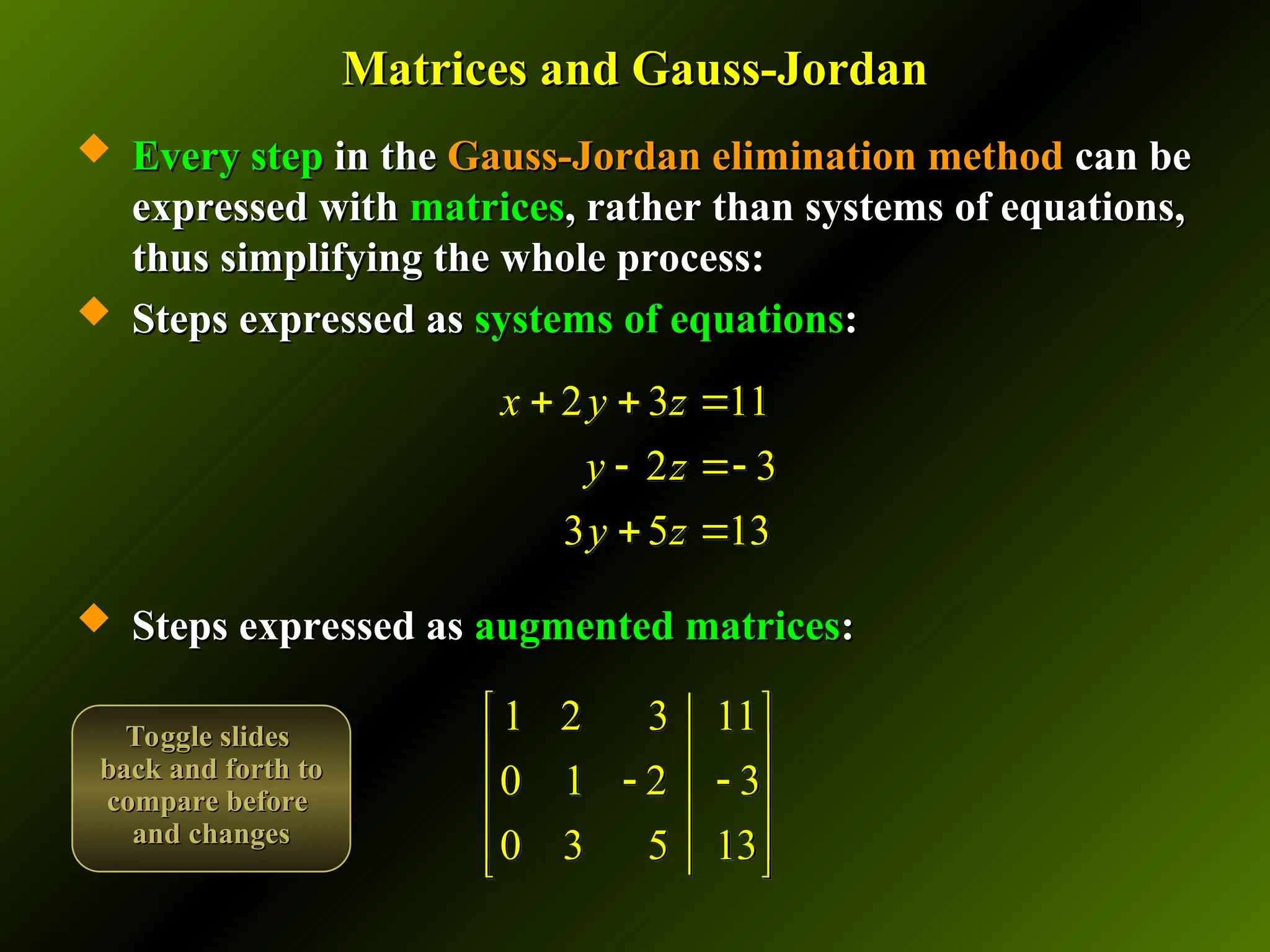
Matrices and Gauss-Jordan
 Every step
Every step in the
in the Gauss-Jordan elimination method
Gauss-Jordan elimination method can be
can be
expressed with
expressed with matrices
matrices, rather than systems of equations,
, rather than systems of equations,
thus simplifying the whole process:
 Steps expressed as
Steps expressed as systems of equations
systems of equations:
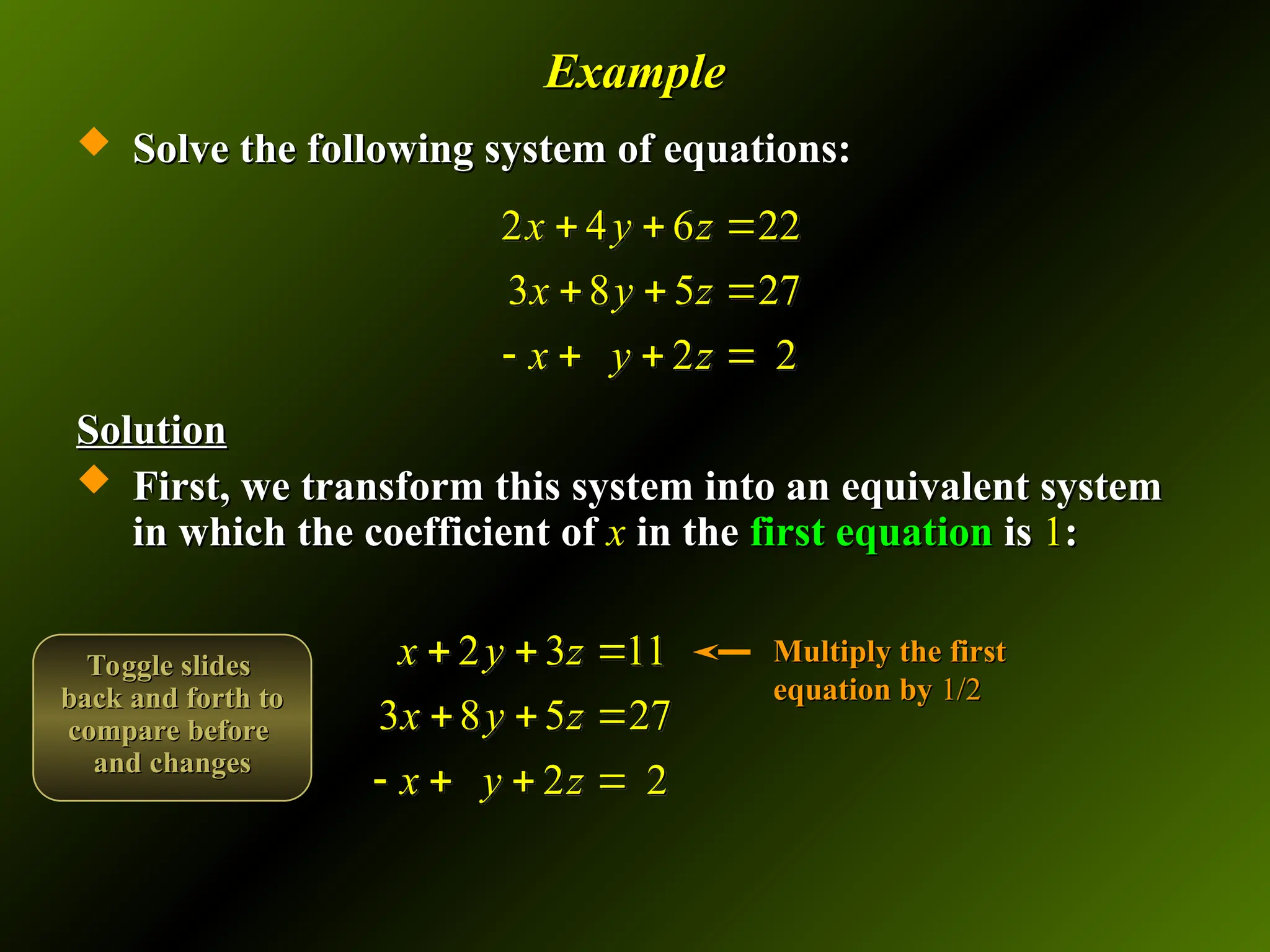
:
 Steps expressed as
Steps expressed as augmented matrices
augmented matrices:
:
1 2 3 11
3 8 5 27
1 1 2 2
 
 
 
 

 
2 3 11
3 8 5 27
2 2
x y z
x y z
x y z
  
  
   
Toggle slides
Toggle slides
back and forth to
back and forth to
compare before
compare before
and changes
and changes
Matrices and Gauss-Jordan
 Every step
Every step in the
in the Gauss-Jordan elimination method
Gauss-Jordan elimination method can be
can be
expressed with
expressed with matrices
matrices, rather than systems of equations,
, rather than systems of equations,
thus simplifying the whole process:
 Steps expressed as
Steps expressed as systems of equations
systems of equations:
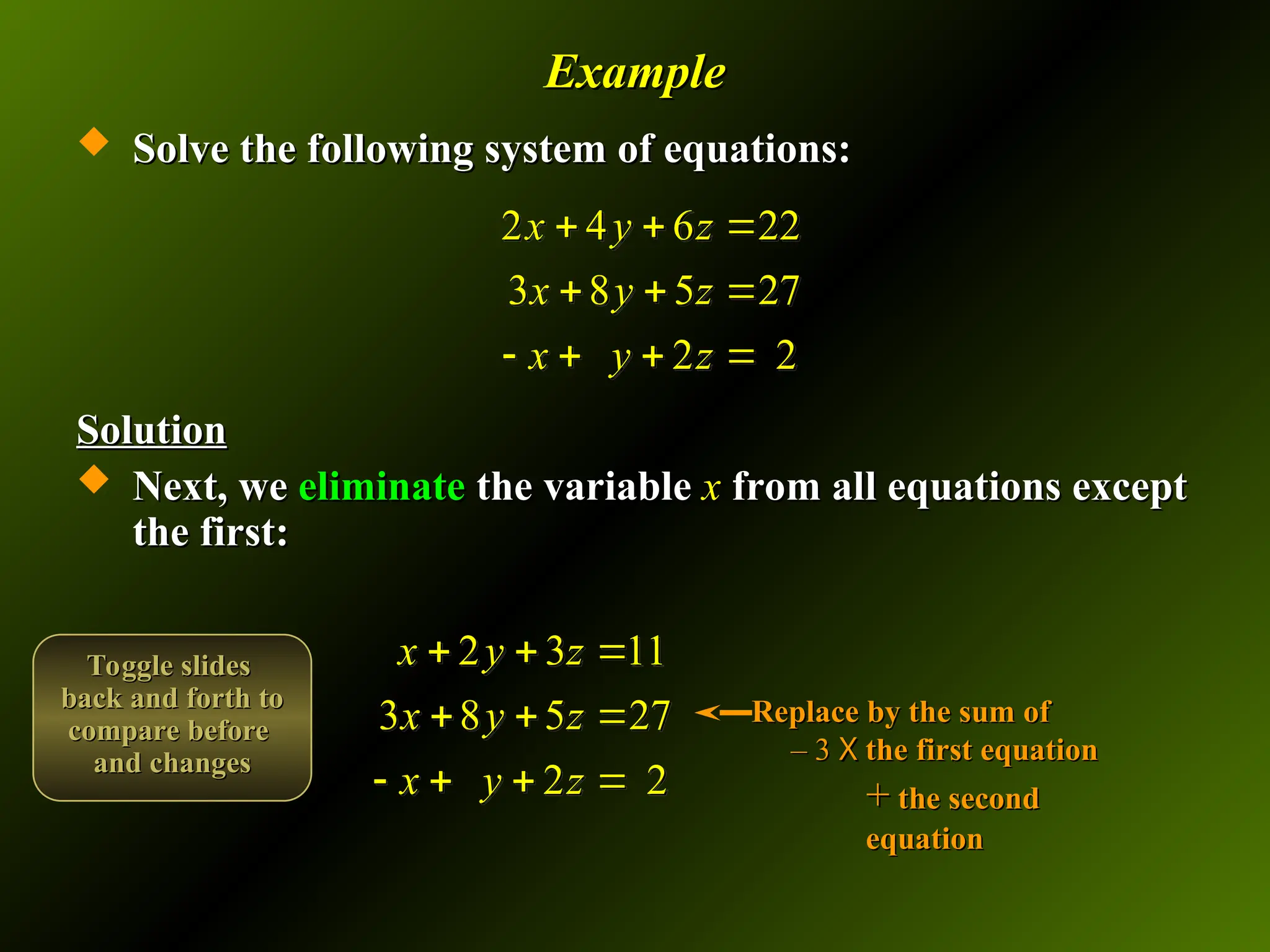
:
 Steps expressed as
Steps expressed as augmented matrices
augmented matrices:
:
1 2 3 11
0 2 4 6
1 1 2 2
 
 
 
 
 

 
2 3 11
2 4 6
2 2
x y z
y z
x y z
  
 
   
Toggle slides
Toggle slides
back and forth to
back and forth to
compare before
compare before
and changes
and changes
Matrices and Gauss-Jordan
 Every step
Every step in the
in the Gauss-Jordan elimination method
Gauss-Jordan elimination method can be
can be
expressed with
expressed with matrices
matrices, rather than systems of equations,
, rather than systems of equations,
thus simplifying the whole process:
 Steps expressed as
Steps expressed as systems of equations
systems of equations:
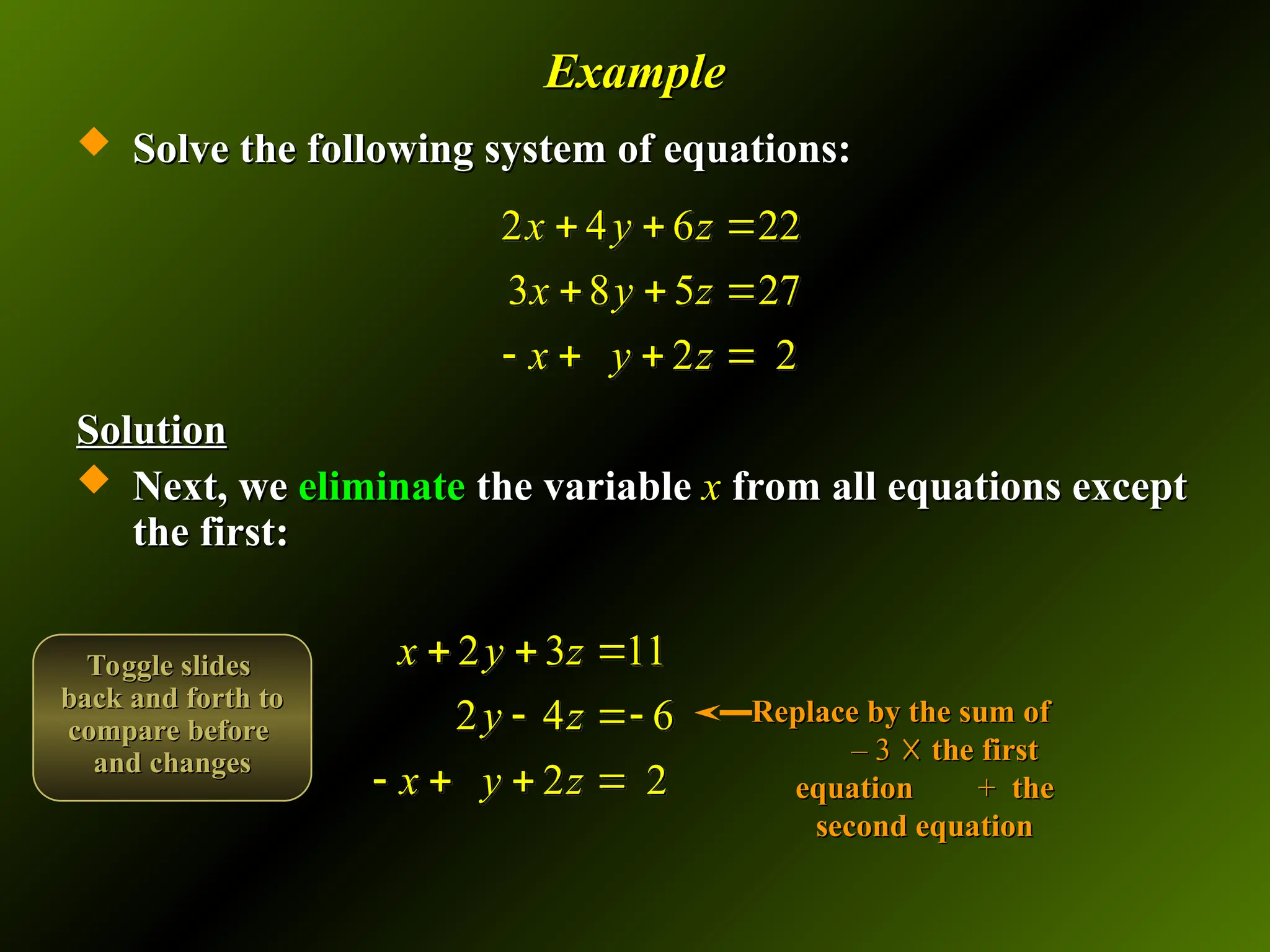
:
 Steps expressed as
Steps expressed as augmented matrices
augmented matrices:
:
1 2 3 11
0 2 4 6
0 3 5 13
 
 
 
 
 
 
2 3 11
2 4 6
3 5 13
x y z
y z
y z
  
 
 
Toggle slides
Toggle slides
back and forth to
back and forth to
compare before
compare before
and changes
and changes
Matrices and Gauss-Jordan
 Every step
Every step in the
in the Gauss-Jordan elimination method
Gauss-Jordan elimination method can be
can be
expressed with
expressed with matrices
matrices, rather than systems of equations,
, rather than systems of equations,
thus simplifying the whole process:
 Steps expressed as
Steps expressed as systems of equations
systems of equations:
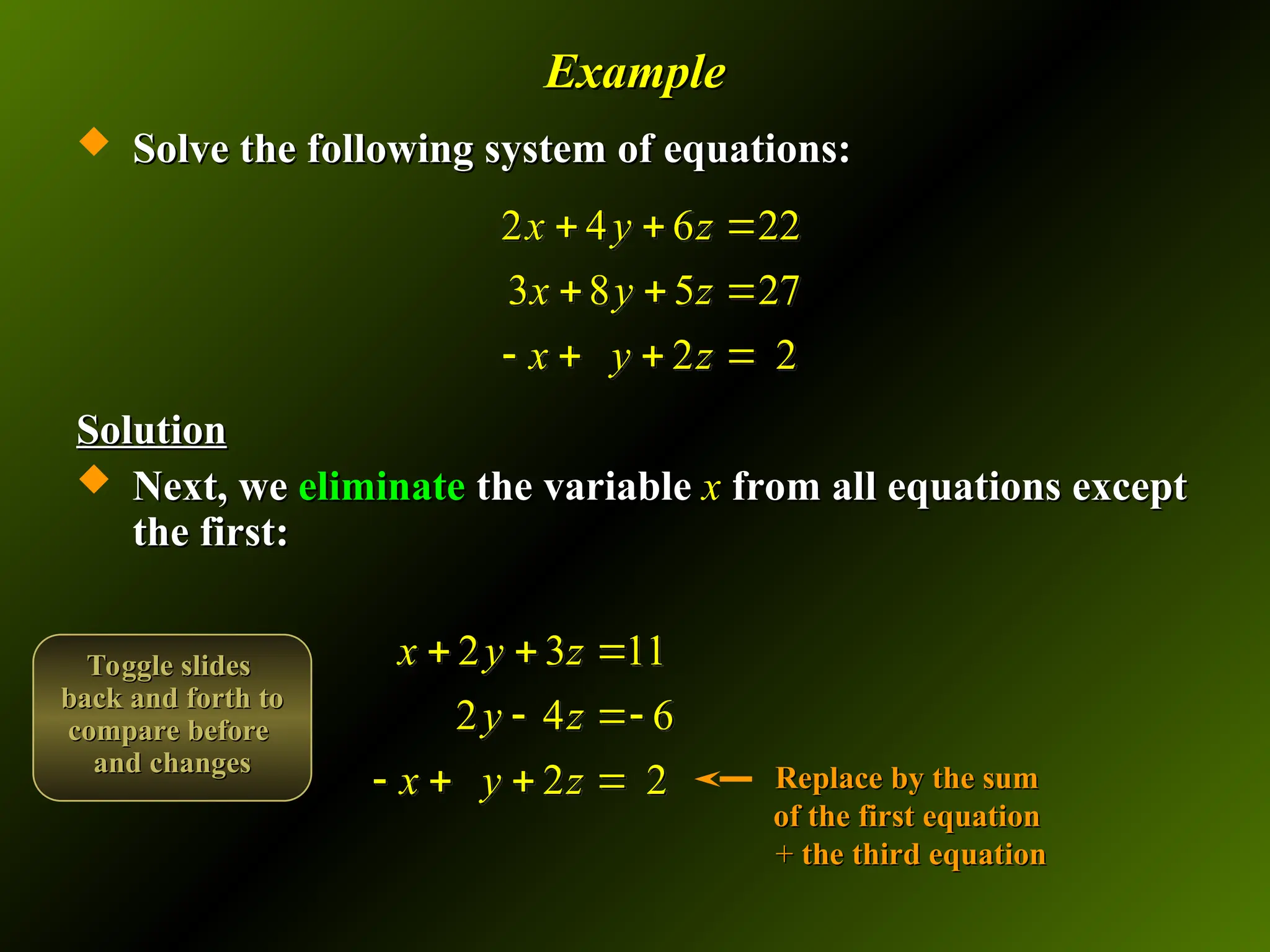
:
 Steps expressed as
Steps expressed as augmented matrices
augmented matrices:
:
1 2 3 11
0 1 2 3
0 3 5 13
 
 
 
 
 
 
2 3 11
2 3
3 5 13
x y z
y z
y z
  
 
 
Toggle slides
Toggle slides
back and forth to
back and forth to
compare before
compare before
and changes
and changes
Matrices and Gauss-Jordan
 Every step
Every step in the
in the Gauss-Jordan elimination method
Gauss-Jordan elimination method can be
can be
expressed with
expressed with matrices
matrices, rather than systems of equations,
, rather than systems of equations,
thus simplifying the whole process:
 Steps expressed as
Steps expressed as systems of equations
systems of equations:
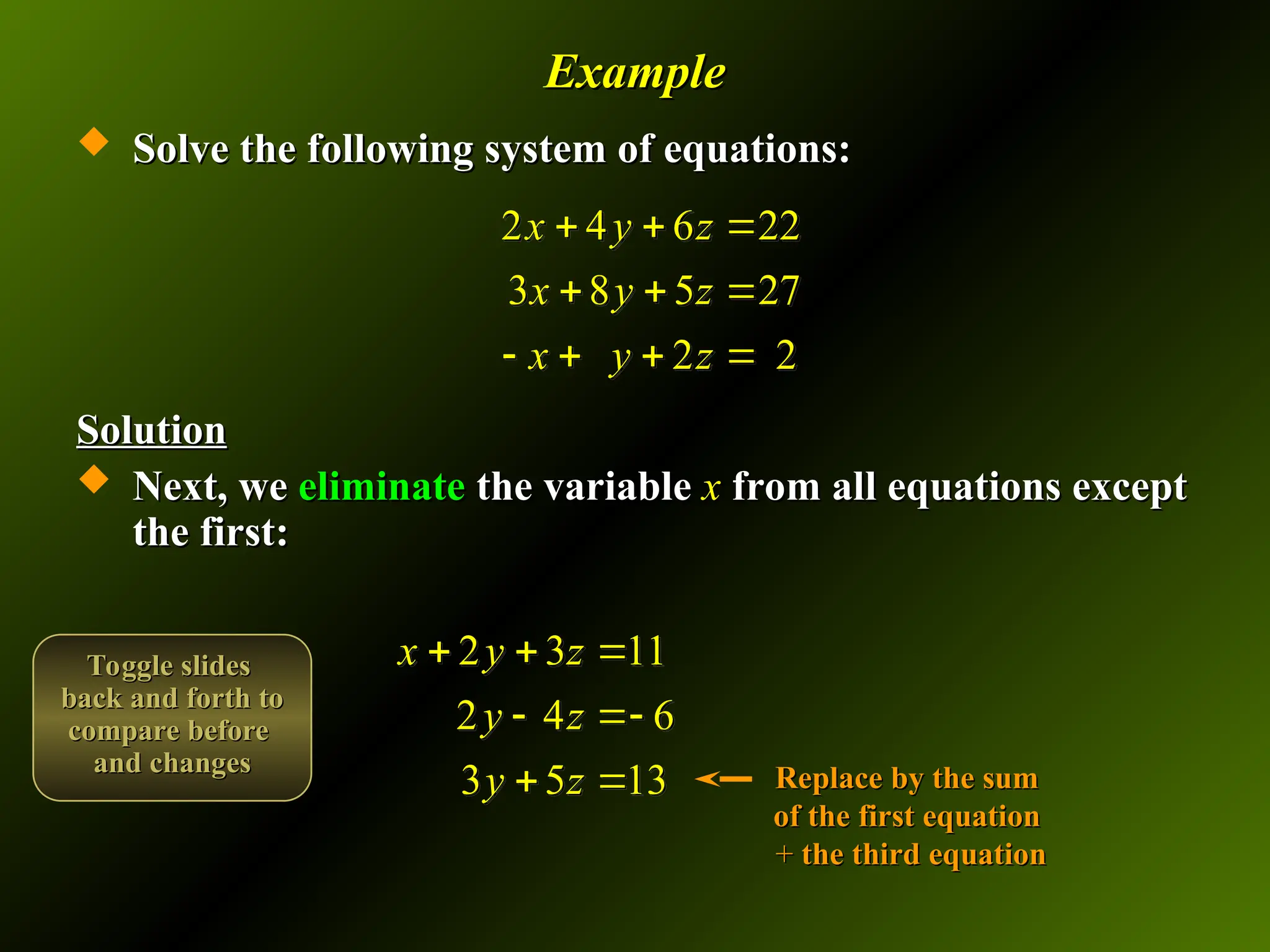
:
 Steps expressed as
Steps expressed as augmented matrices
augmented matrices:
:
1 0 7 17
0 1 2 3
0 3 5 13
 
 
 
 
 
 
7 17
2 3
3 5 13
x z
y z
y z
 
 
 
Toggle slides
Toggle slides
back and forth to
back and forth to
compare before
compare before
and changes
and changes
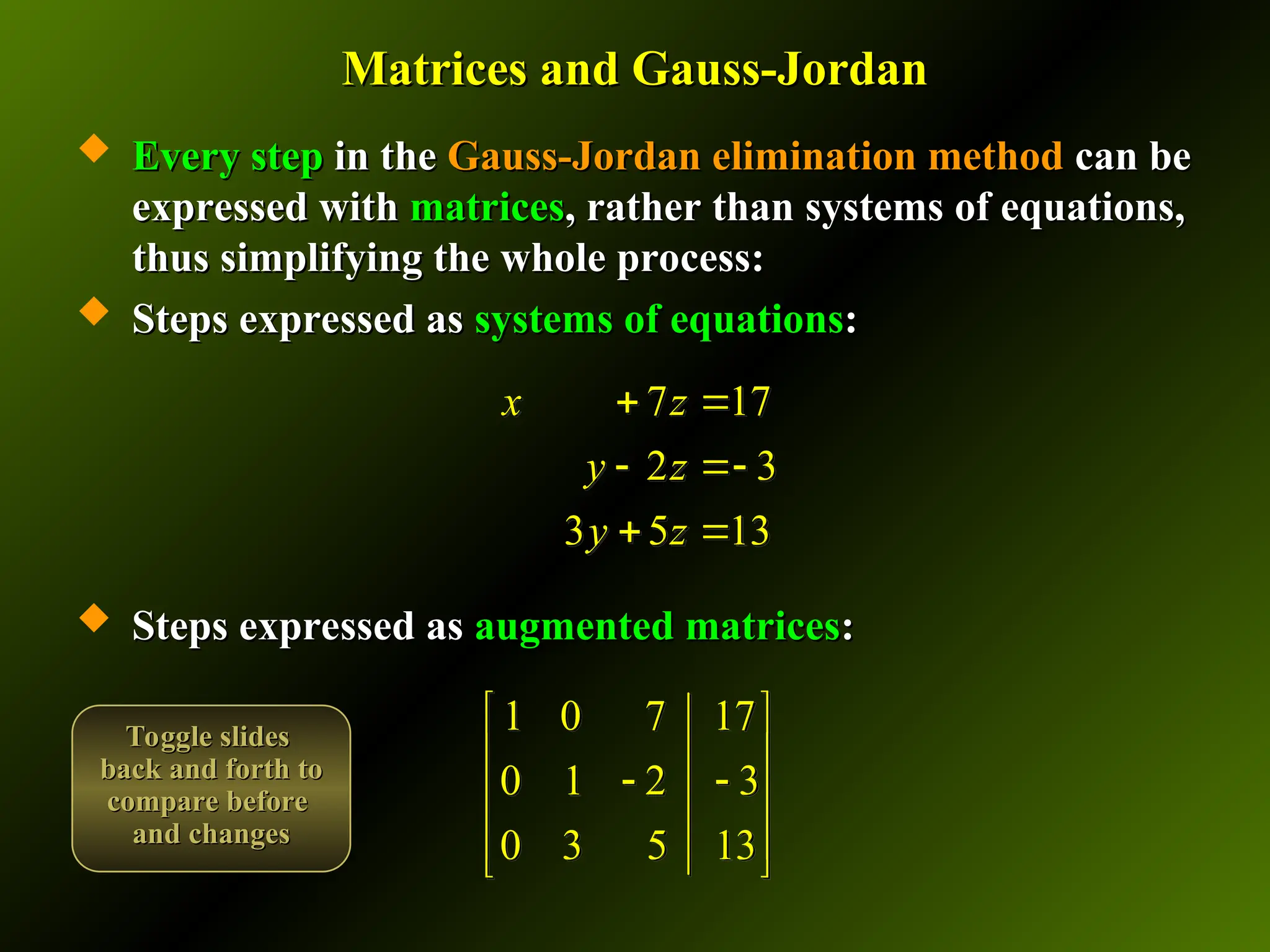
Matrices and Gauss-Jordan
 Every step
Every step in the
in the Gauss-Jordan elimination method
Gauss-Jordan elimination method can be
can be
expressed with
expressed with matrices
matrices, rather than systems of equations,
, rather than systems of equations,
thus simplifying the whole process:
 Steps expressed as
Steps expressed as systems of equations
systems of equations:
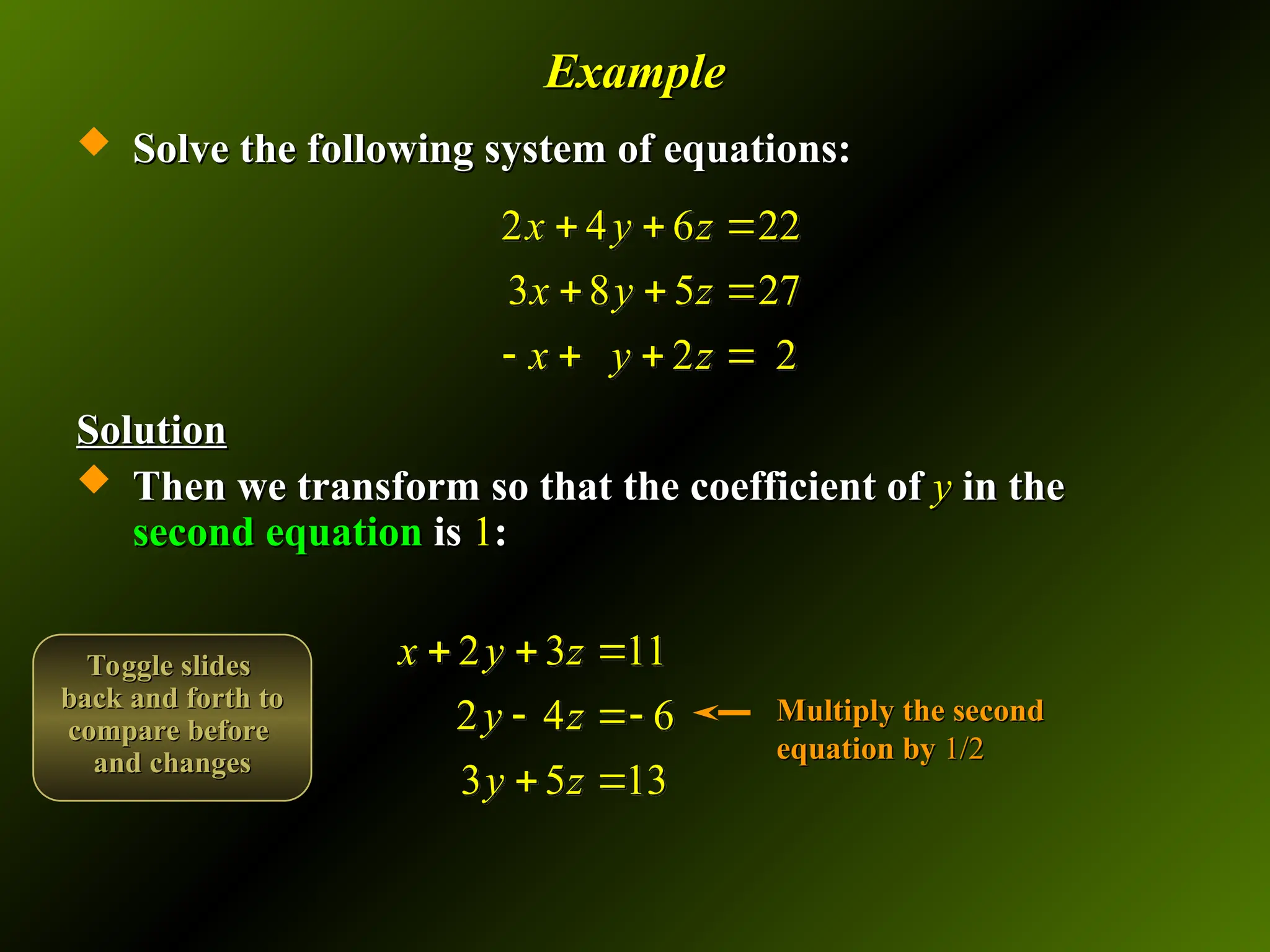
:
 Steps expressed as
Steps expressed as augmented matrices
augmented matrices:
:
1 0 7 17
0 1 2 3
0 0 11 22
 
 
 
 
 
 
7 17
2 3
11 22
x z
y z
z
 
 

Toggle slides
Toggle slides
back and forth to
back and forth to
compare before
compare before
and changes
and changes
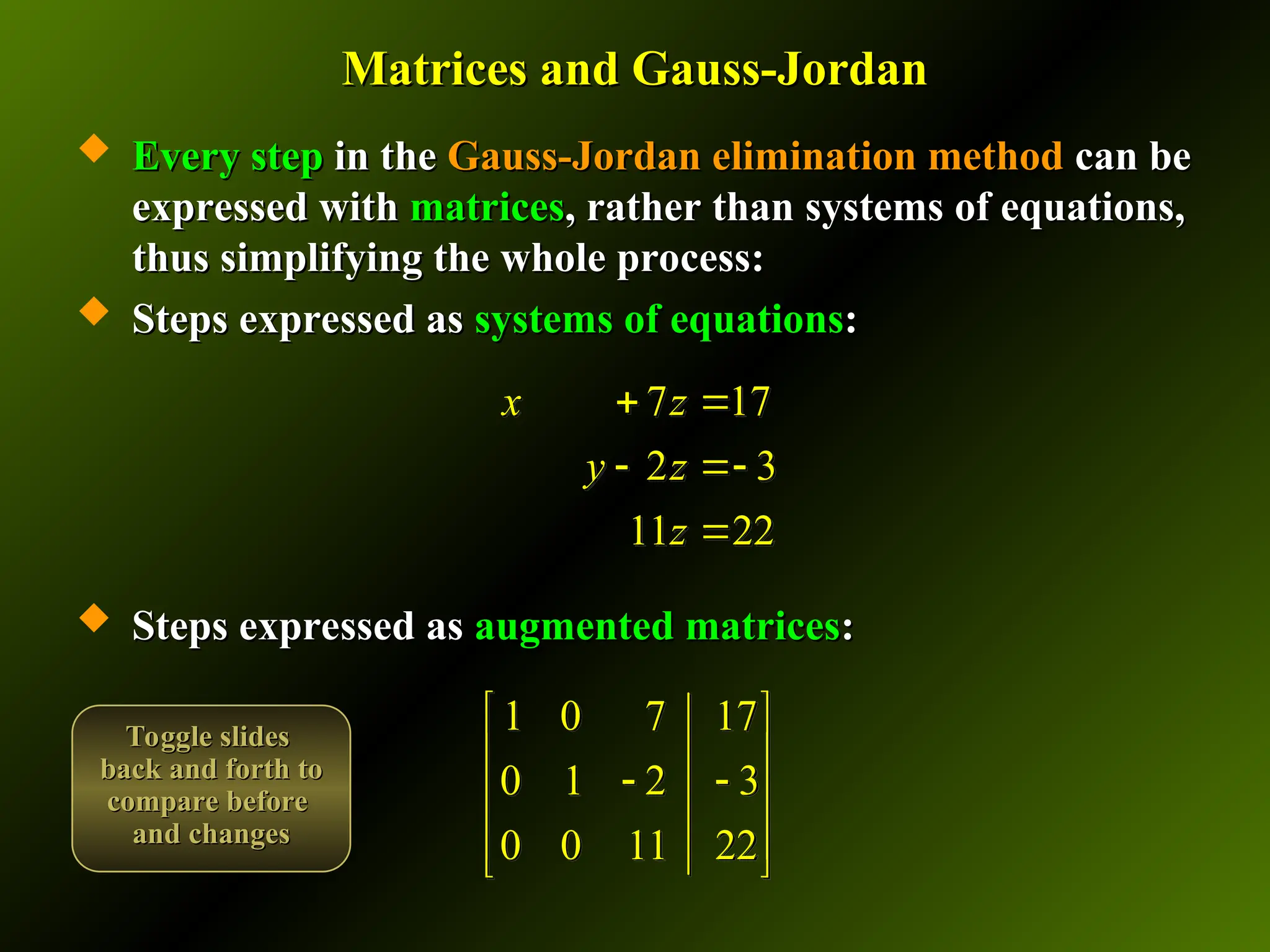
Matrices and Gauss-Jordan
 Every step
Every step in the
in the Gauss-Jordan elimination method
Gauss-Jordan elimination method can be
can be
expressed with
expressed with matrices
matrices, rather than systems of equations,
, rather than systems of equations,
thus simplifying the whole process:
 Steps expressed as
Steps expressed as systems of equations
systems of equations:
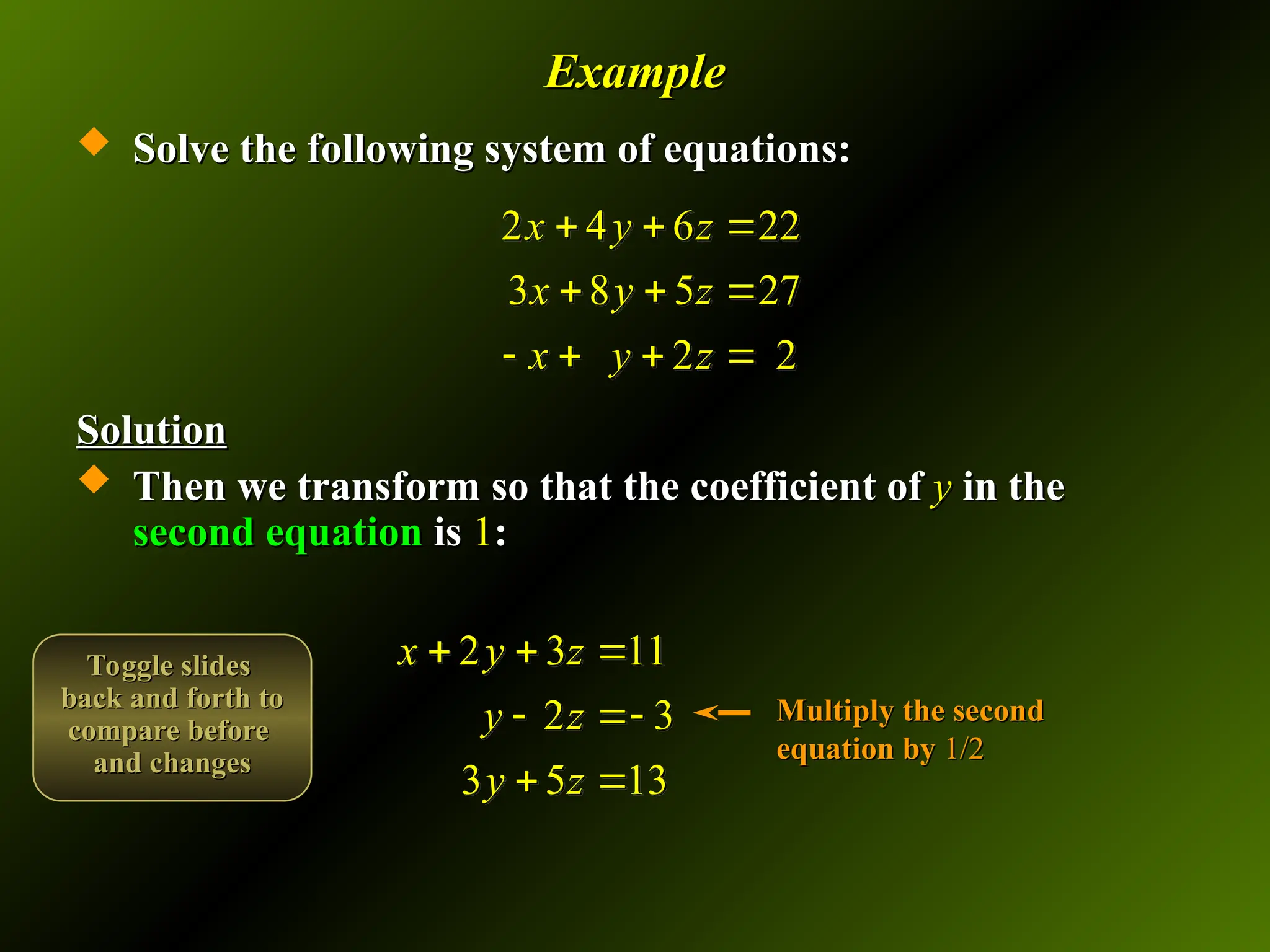
:
 Steps expressed as
Steps expressed as augmented matrices
augmented matrices:
:
1 0 7 17
0 1 2 3
0 0 1 2
 
 
 
 
 
 
7 17
2 3
2
x z
y z
z
 
 

Toggle slides
Toggle slides
back and forth to
back and forth to
compare before
compare before
and changes
and changes
Matrices and Gauss-Jordan
 Every step
Every step in the
in the Gauss-Jordan elimination method
Gauss-Jordan elimination method can be
can be
expressed with
expressed with matrices
matrices, rather than systems of equations,
, rather than systems of equations,
thus simplifying the whole process:
 Steps expressed as
Steps expressed as systems of equations
systems of equations:
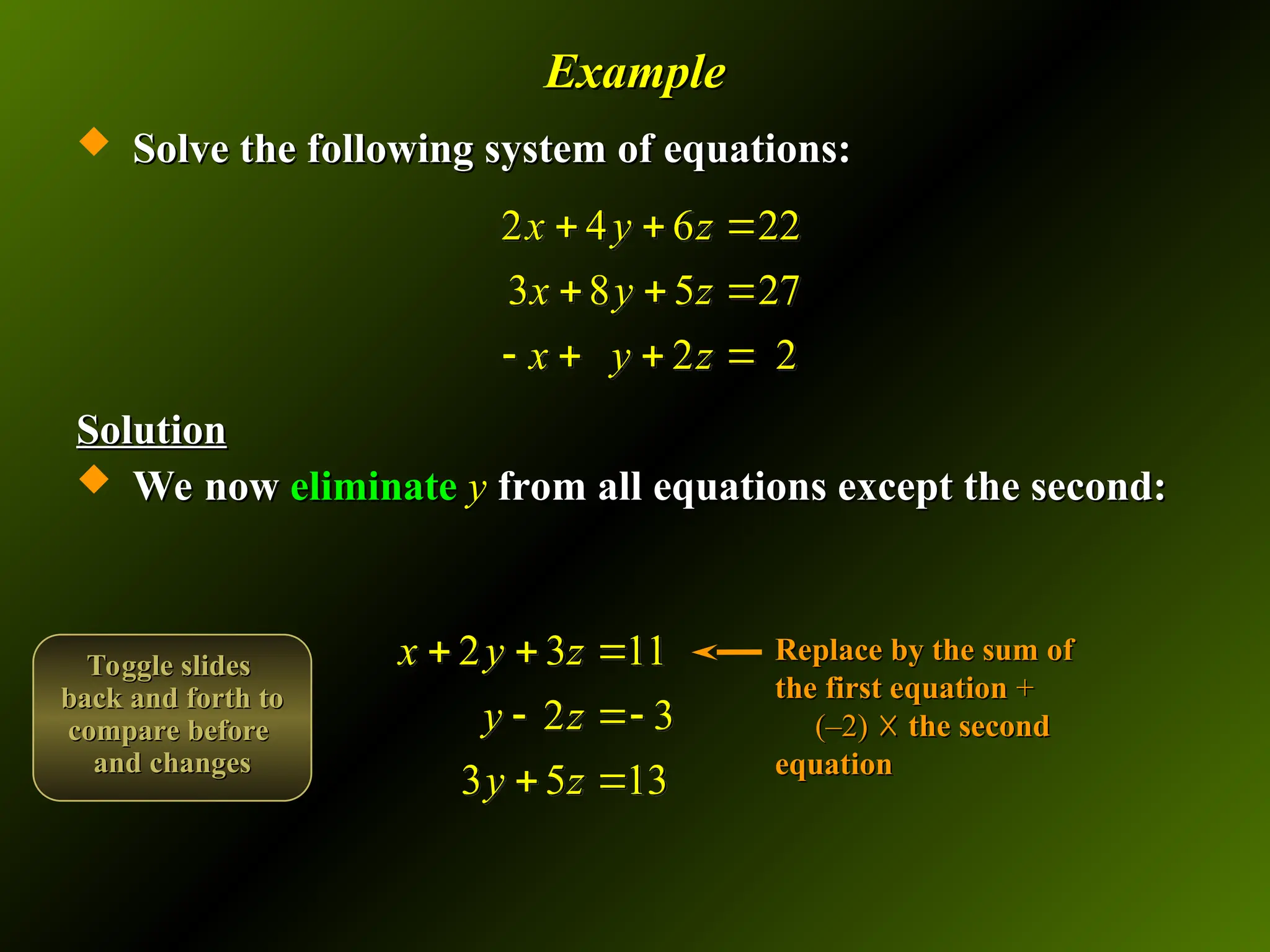
:
 Steps expressed as
Steps expressed as augmented matrices
augmented matrices:
:
1 0 0 3
0 1 2 3
0 0 1 2
 
 
 
 
 
 
3
2 3
2
x
y z
z

 

Toggle slides
Toggle slides
back and forth to
back and forth to
compare before
compare before
and changes
and changes
Matrices and Gauss-Jordan
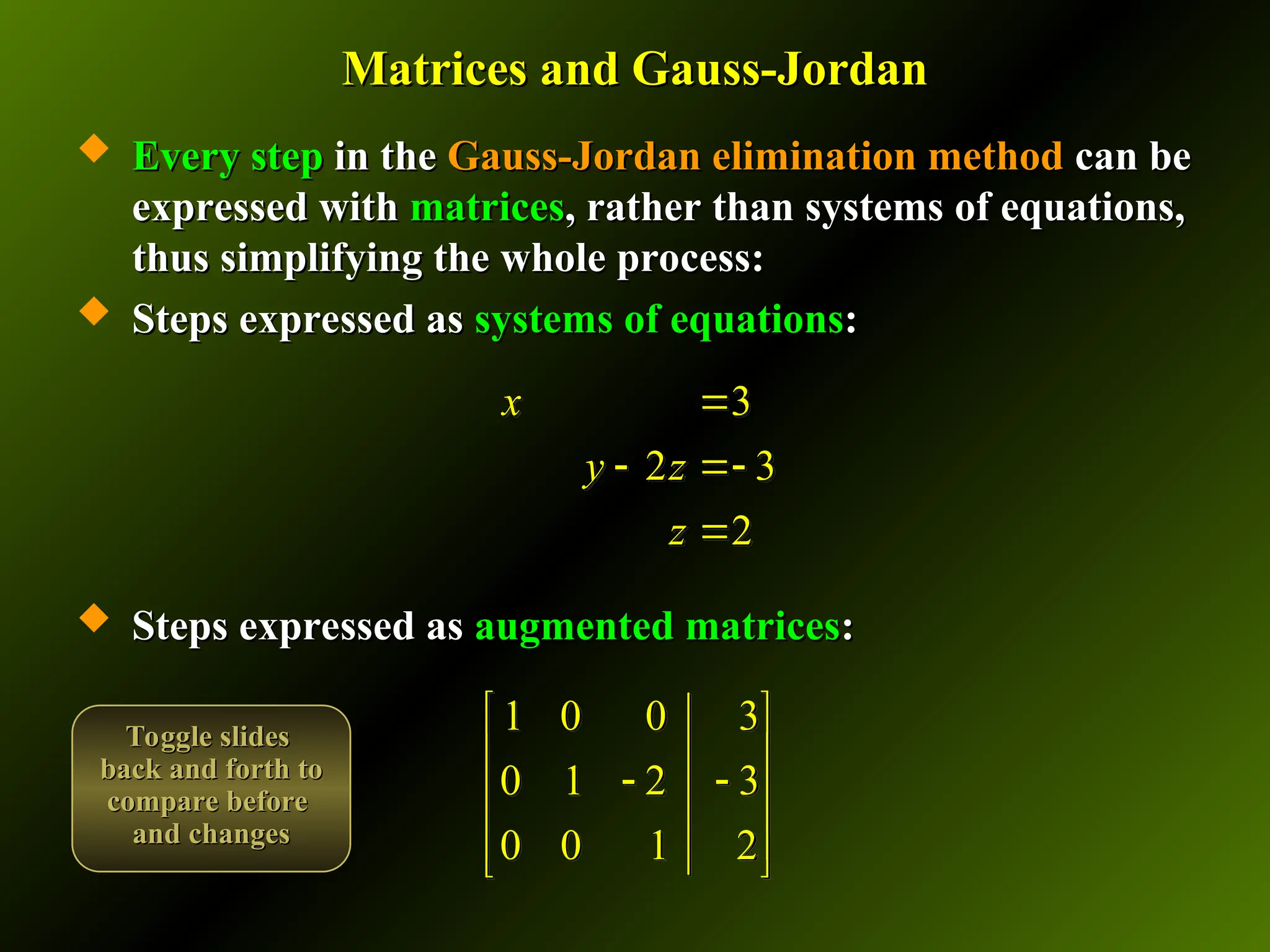
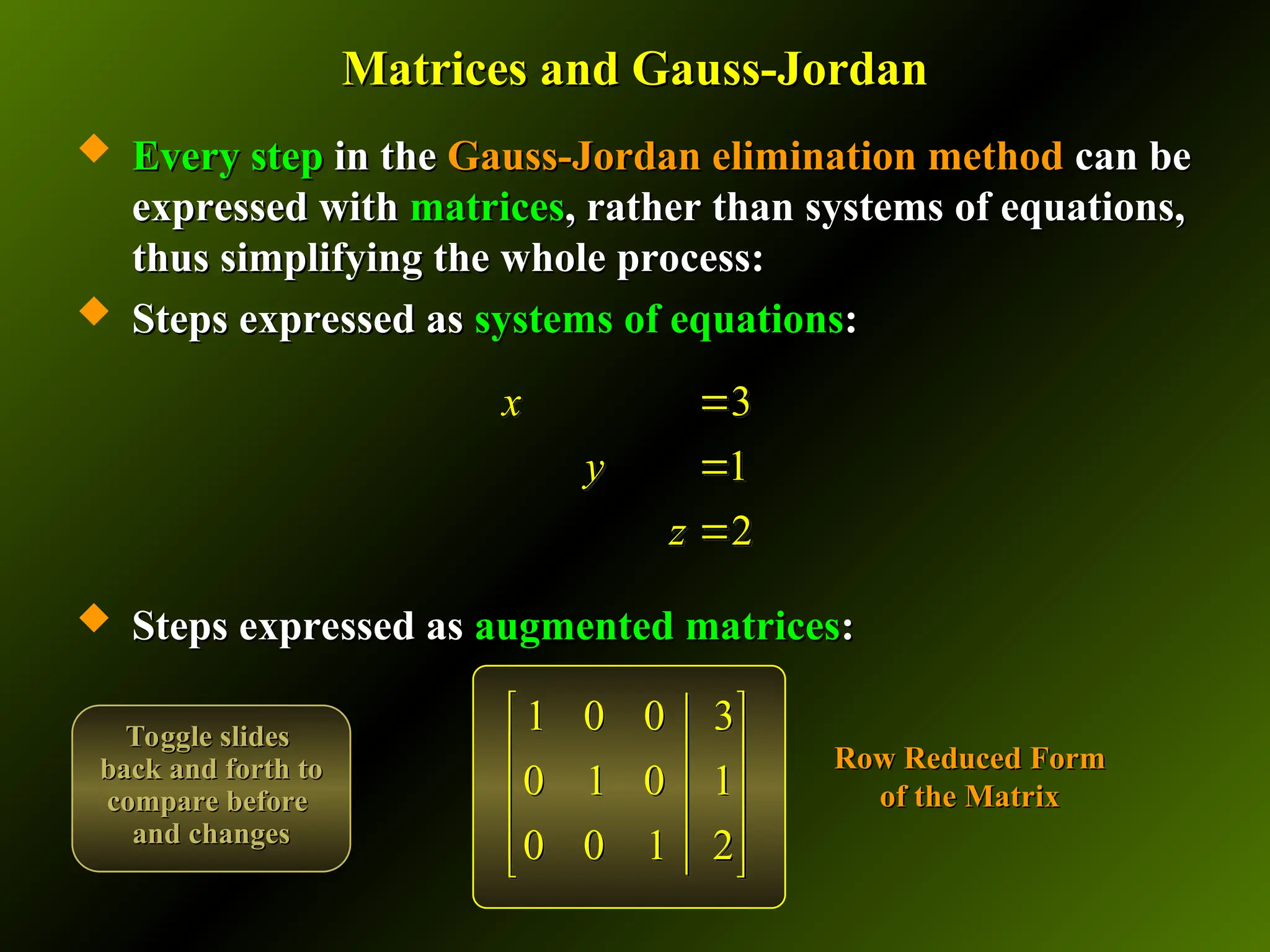
 Every step
Every step in the
in the Gauss-Jordan elimination method
Gauss-Jordan elimination method can be
can be
expressed with
expressed with matrices
matrices, rather than systems of equations,
, rather than systems of equations,
thus simplifying the whole process:
 Steps expressed as
Steps expressed as systems of equations
systems of equations:
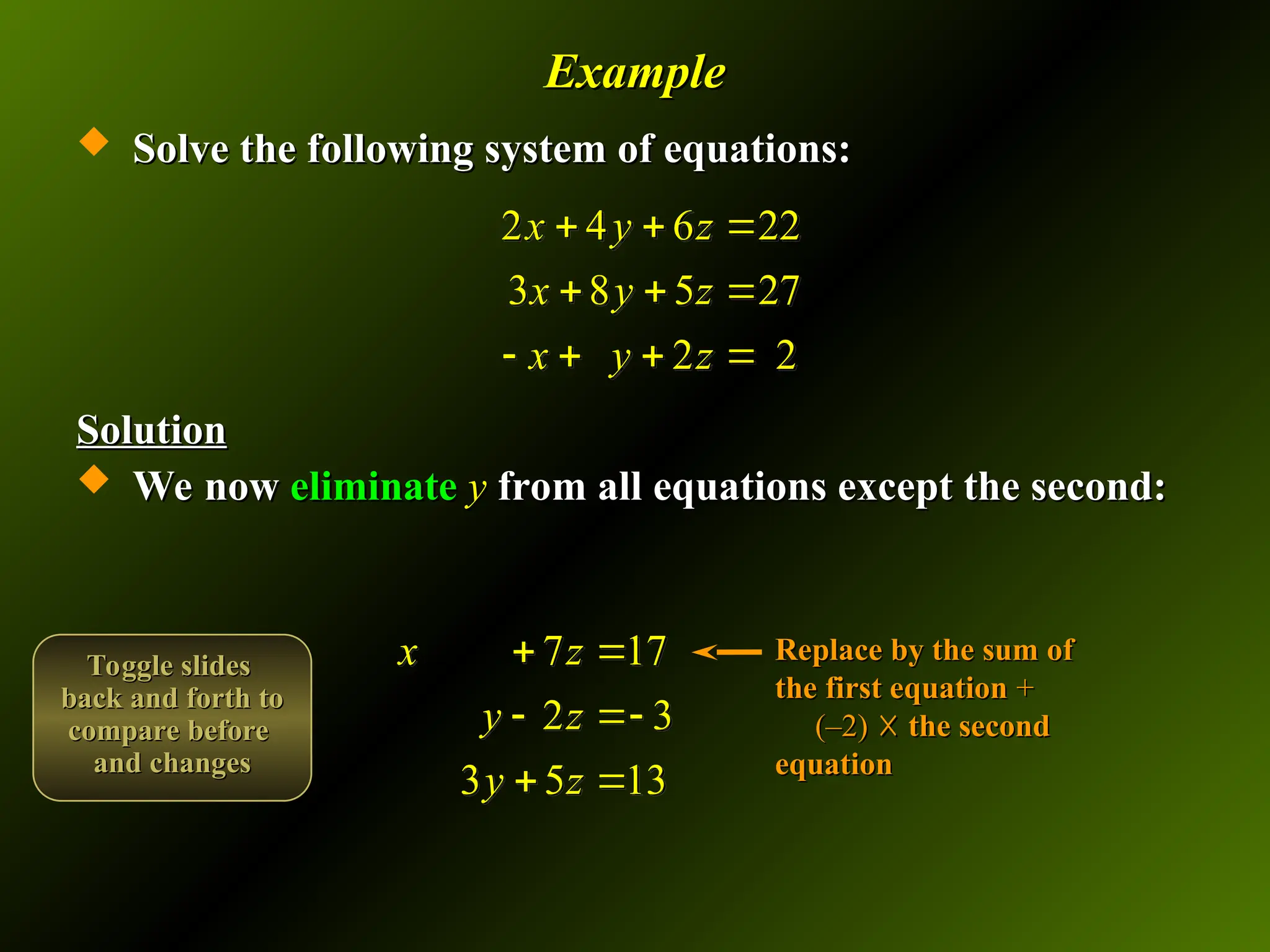
:
 Steps expressed as
Steps expressed as augmented matrices
augmented matrices:
:
1 0 0 3
0 1 0 1
0 0 1 2
 
 
 
 
 
3
1
2
x
y
z



Row Reduced Form
Row Reduced Form
of the Matrix
of the Matrix
Toggle slides
Toggle slides
back and forth to
back and forth to
compare before
compare before
and changes
and changes
Row-Reduced Form of a Matrix
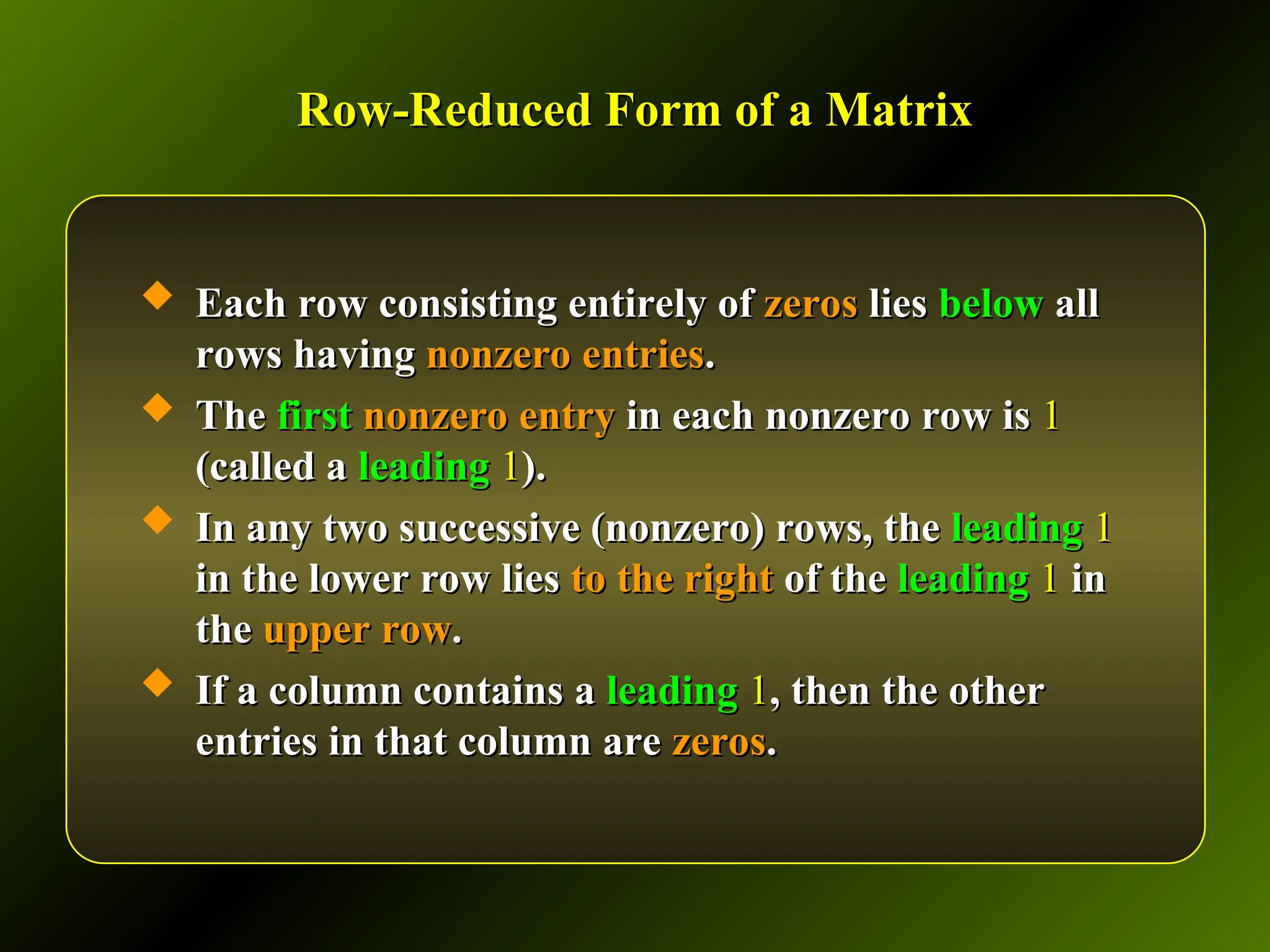
 Each row consisting entirely of
Each row consisting entirely of zeros
zeros lies
lies below
below all
all
rows having
rows having nonzero entries
nonzero entries.
.
 The
The first
first nonzero entry
nonzero entry in each nonzero row is
in each nonzero row is 1
1
(called a
(called a leading
leading 1
1).
).
 In any two successive (nonzero) rows, the
In any two successive (nonzero) rows, the leading
leading 1
1
in the lower row lies
in the lower row lies to the right
to the right of the
of the leading
leading 1
1 in
in
the
the upper row
upper row.
.
 If a column contains a
If a column contains a leading
leading 1
1, then the other
, then the other
entries in that column are
entries in that column are zeros
zeros.
.
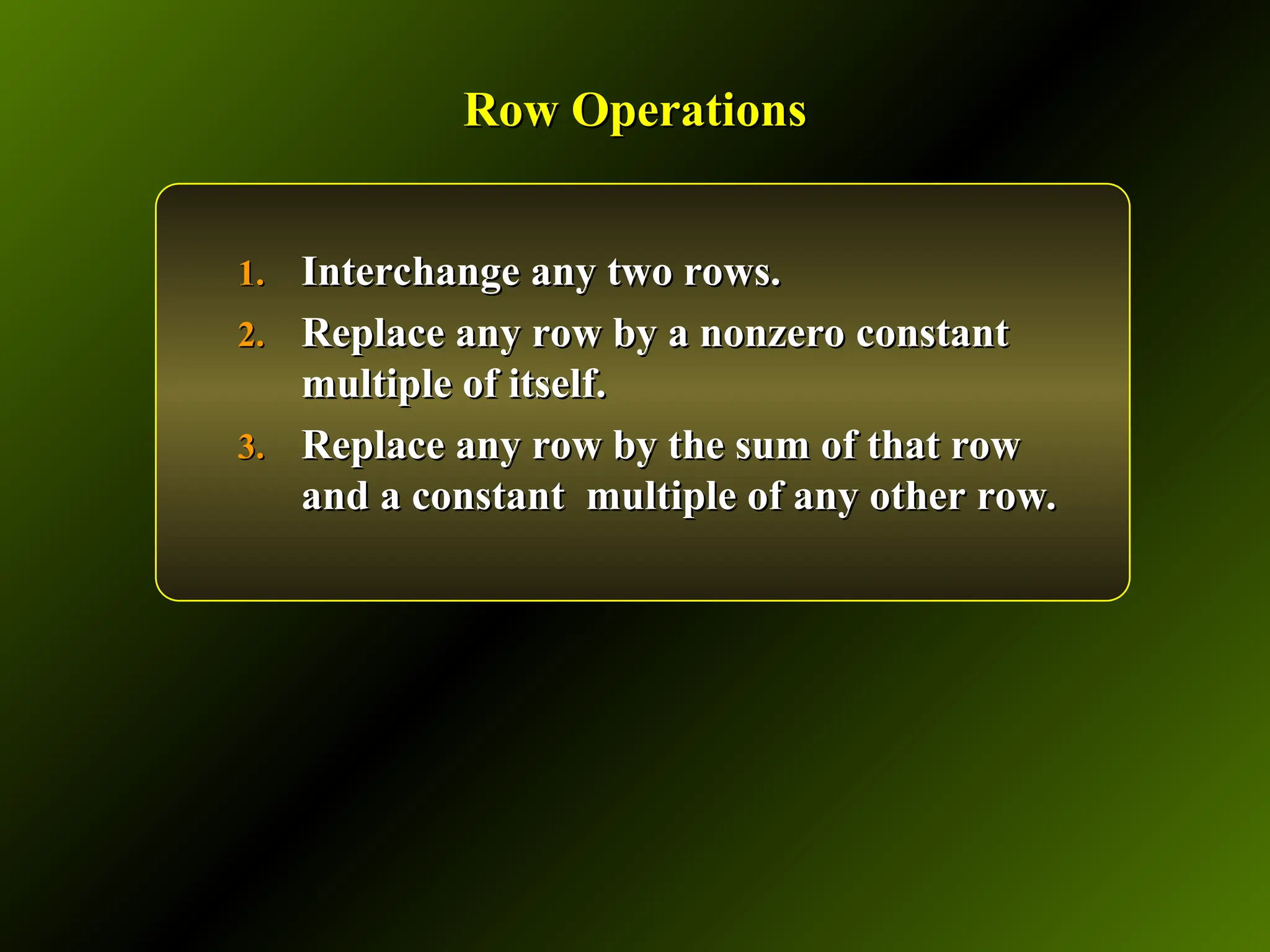
Row Operations
Row Operations
1.
1. Interchange any two rows.
Interchange any two rows.
2.
2. Replace any row by a nonzero constant
Replace any row by a nonzero constant
multiple of itself.
multiple of itself.
3.
3. Replace any row by the sum of that row
Replace any row by the sum of that row
and a constant multiple of any other row.
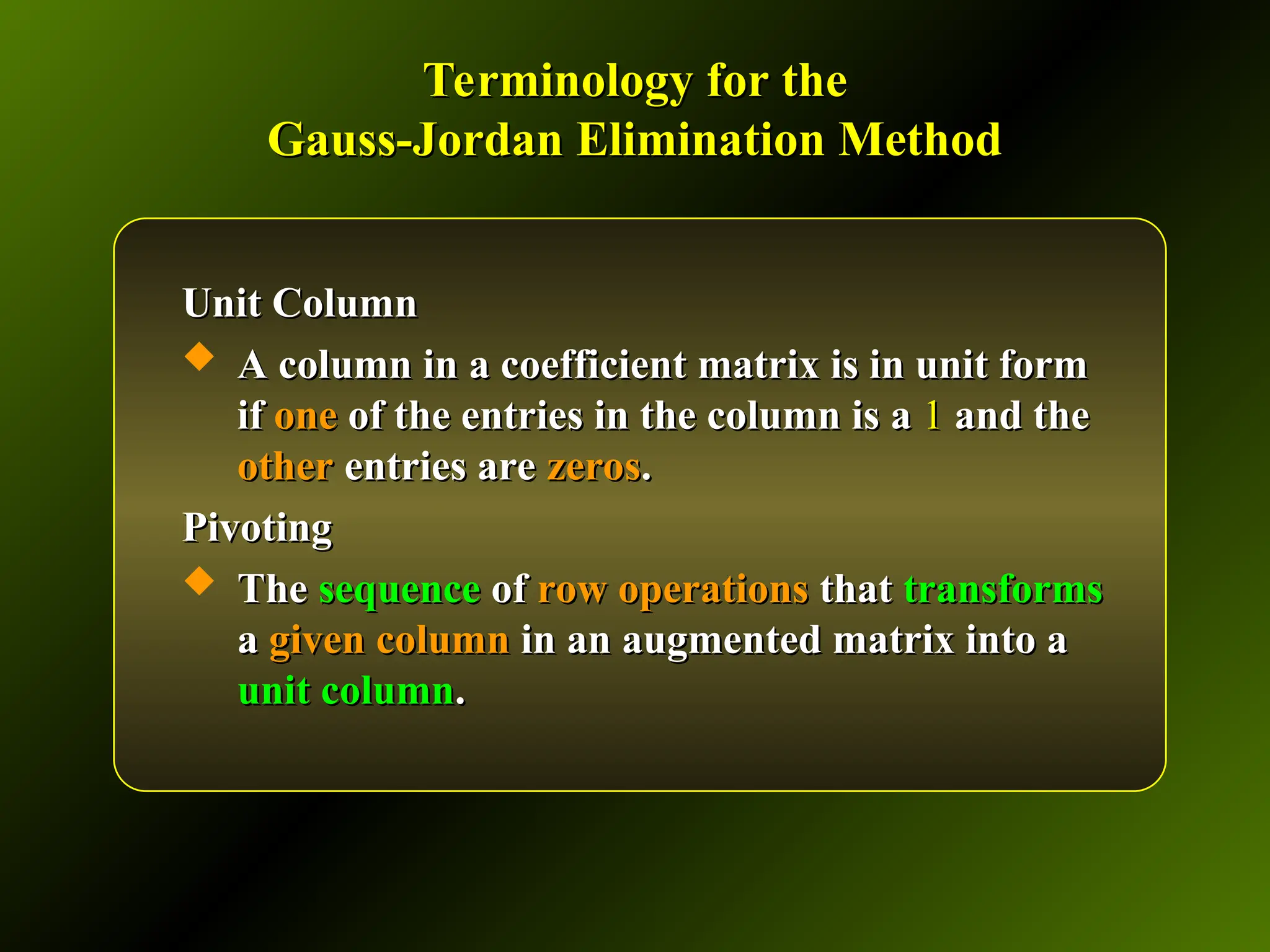
Terminology for the
Terminology for the
Gauss-Jordan Elimination Method
Unit Column
Unit Column
 A column in a coefficient matrix is in unit form
A column in a coefficient matrix is in unit form
if
if one
one of the entries in the column is a
of the entries in the column is a 1
1 and the
and the
other
other entries are
entries are zeros
zeros.
.
Pivoting
Pivoting
 The
The sequence
sequence of
of row operations
row operations that
that transforms
transforms
a
a given column
given column in an augmented matrix into a
in an augmented matrix into a
unit column
unit column.
.
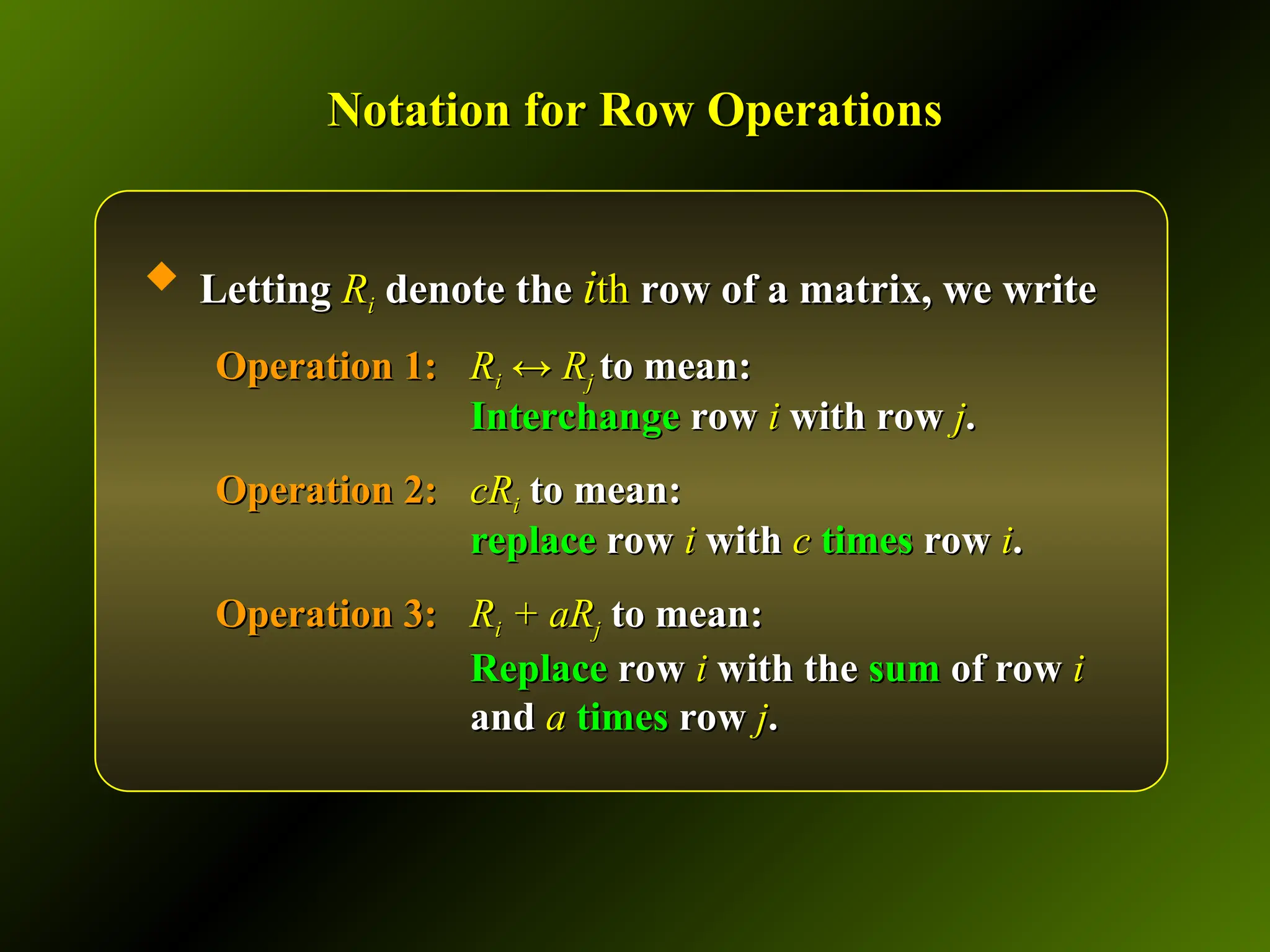
Notation for Row Operations
 Letting
Letting R
Ri
i denote the
denote the i
ith
th row of a matrix, we write
row of a matrix, we write
Operation 1:
Operation 1: R
Ri
i ↔ R
↔ Rj
j to mean:
to mean:
Interchange
Interchange row
row i
i with row
with row j
j.
.
Operation 2:
Operation 2: cR
cRi
i to mean:
to mean:
replace
replace row
row i
i with
with c
c times
times row
row i
i.
.
Operation 3:
Operation 3: R
Ri
i + aR
+ aRj
j to mean:
to mean:
Replace
Replace row
row i
i with the
with the sum
sum of row
of row i
i
and
and a
a times
times row
row j
j.
.
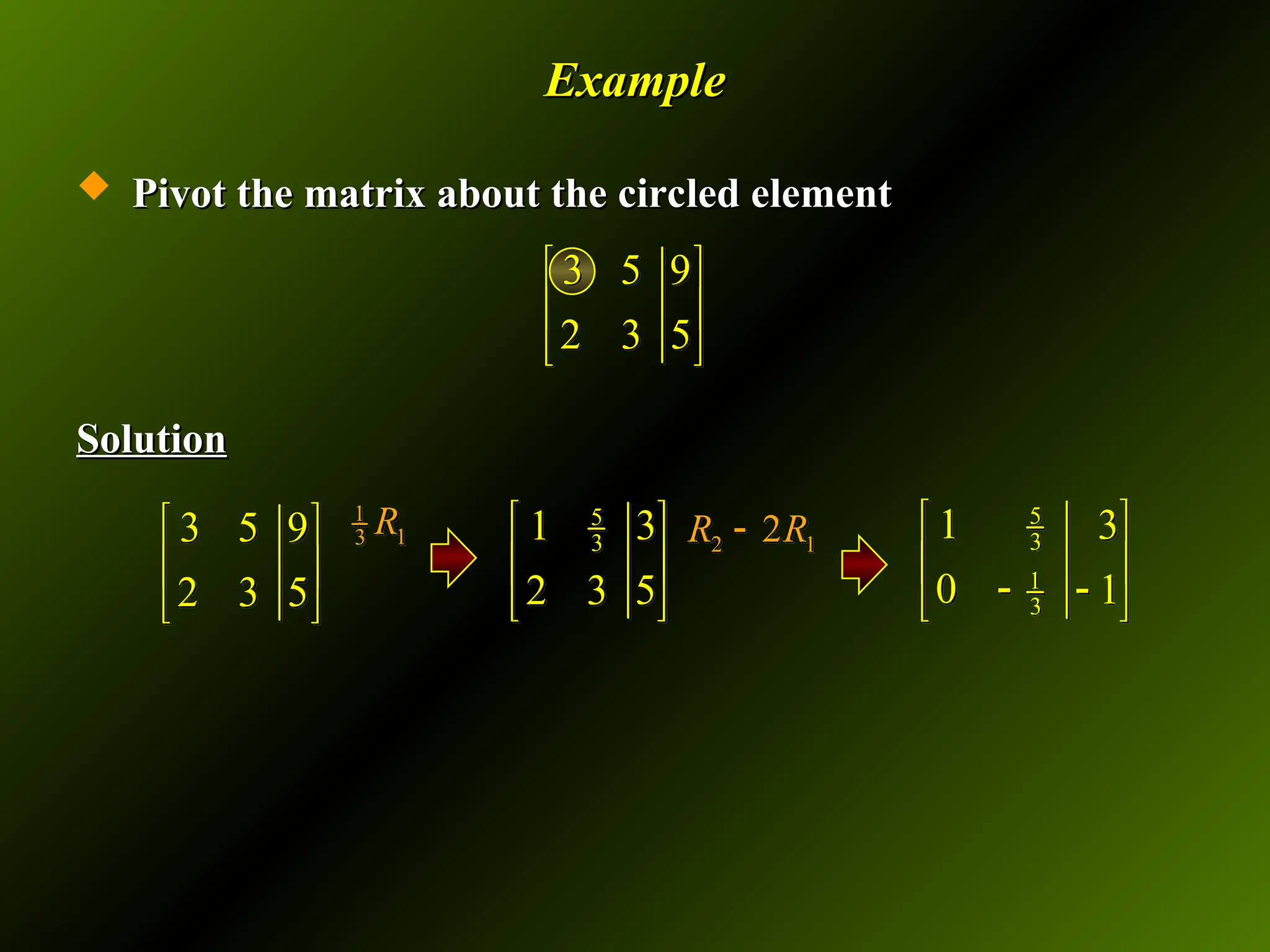
Example
Example
 Pivot the matrix about the circled element
Pivot the matrix about the circled element
Solution
Solution
3 5 9
2 3 5
 
 
 
3 5 9
2 3 5
 
 
 
1
1
3 R 5
3 3
1
5
2 3
 
 
 
2 1
2
R R
 5
3
1
3
1 3
0 1
 
 
 
 
The Gauss-Jordan Elimination Method
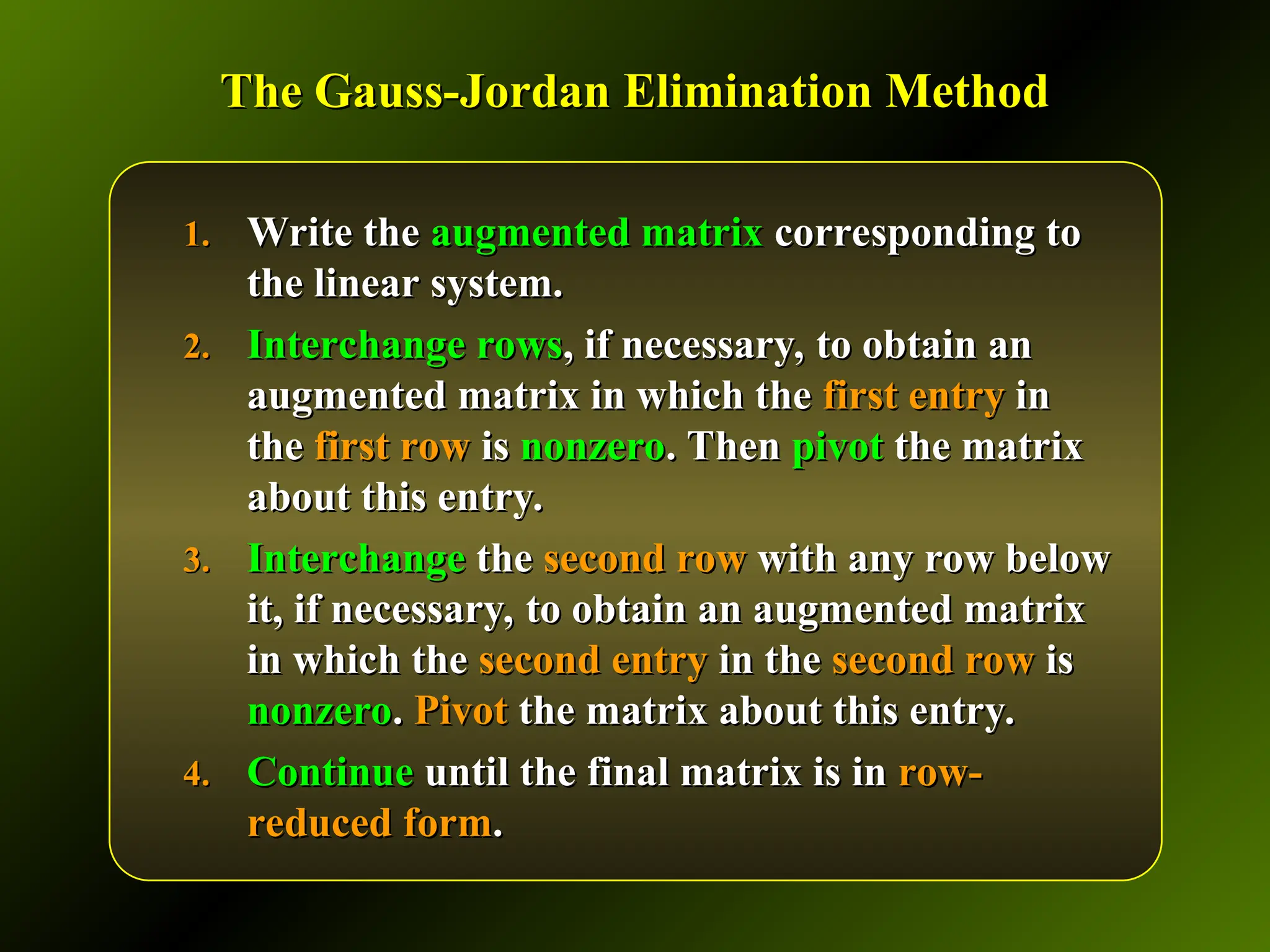
1.
1. Write the
Write the augmented matrix
augmented matrix corresponding to
corresponding to
the linear system.
the linear system.
2.
2. Interchange rows
Interchange rows, if necessary, to obtain an
, if necessary, to obtain an
augmented matrix in which the
augmented matrix in which the first entry
first entry in
in
the
the first row
first row is
is nonzero
nonzero. Then
. Then pivot
pivot the matrix
the matrix
about this entry.
about this entry.
3.
3. Interchange
Interchange the
the second row
second row with any row below
with any row below
it, if necessary, to obtain an augmented matrix
in which the
in which the second entry
second entry in the
in the second row
second row is
is
nonzero
nonzero.
. Pivot
Pivot the matrix about this entry.
the matrix about this entry.
4.
4. Continue
Continue until the final matrix is in
until the final matrix is in row-
row-
reduced form
reduced form.
.
Example
Example
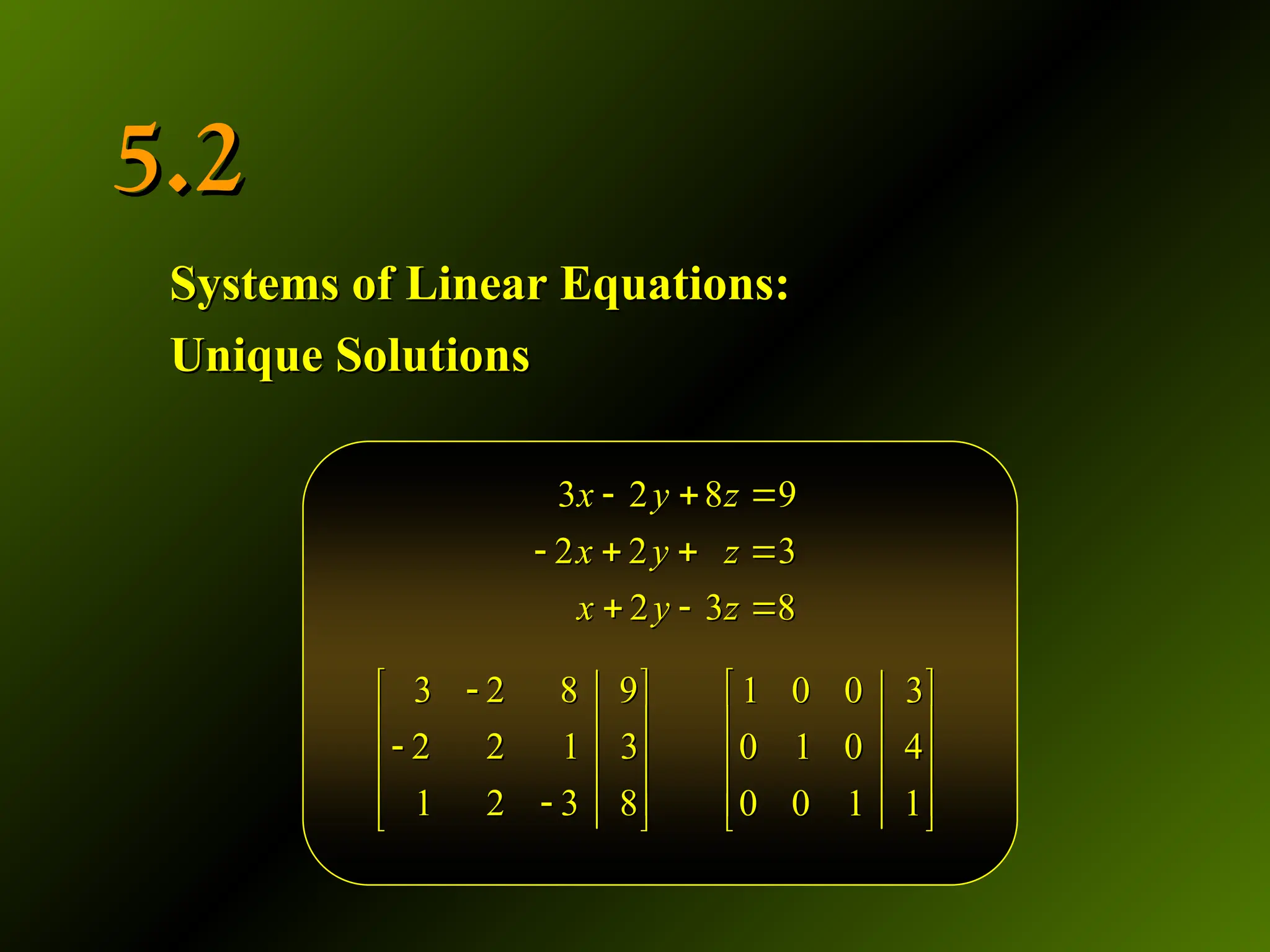
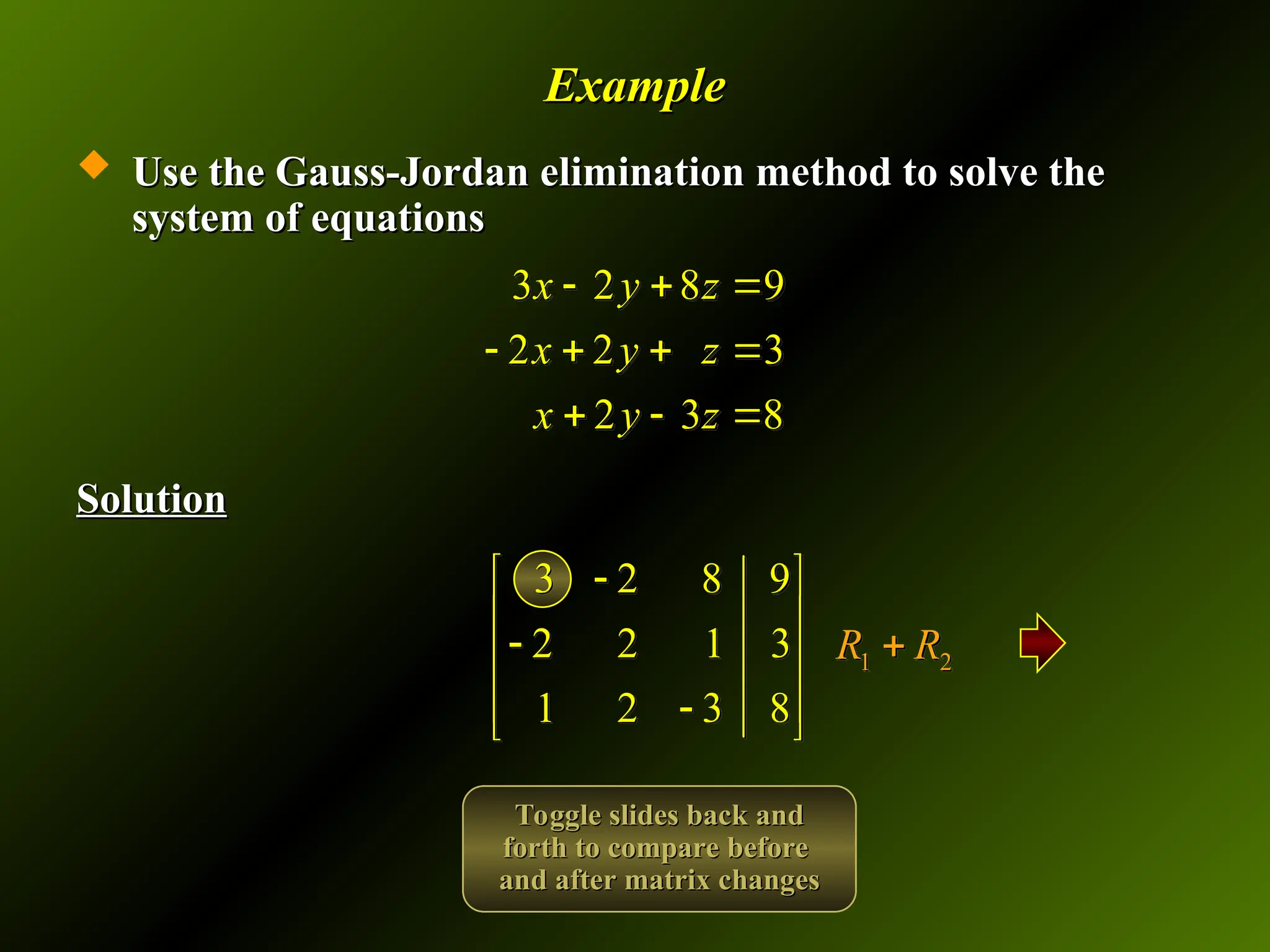
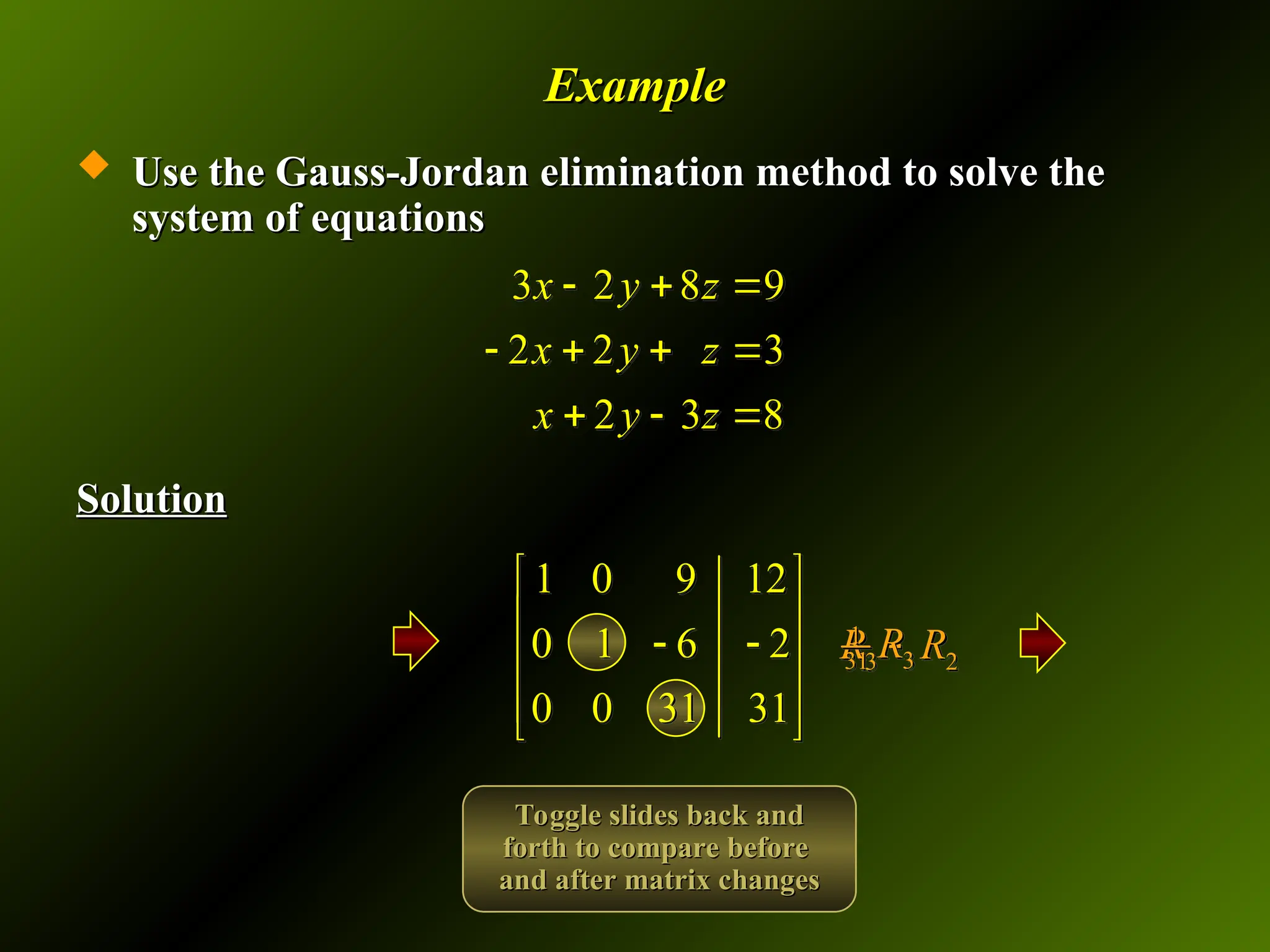
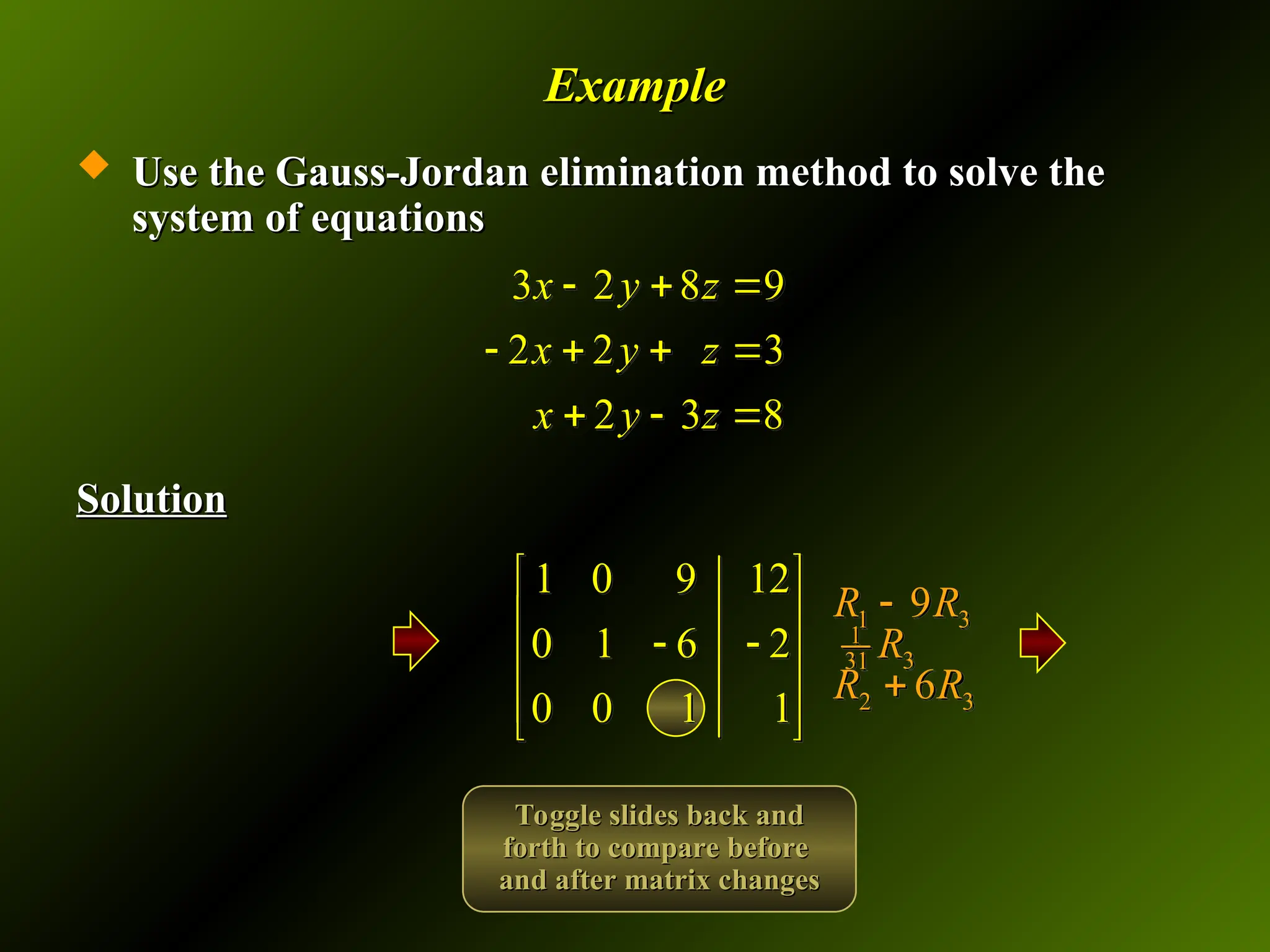
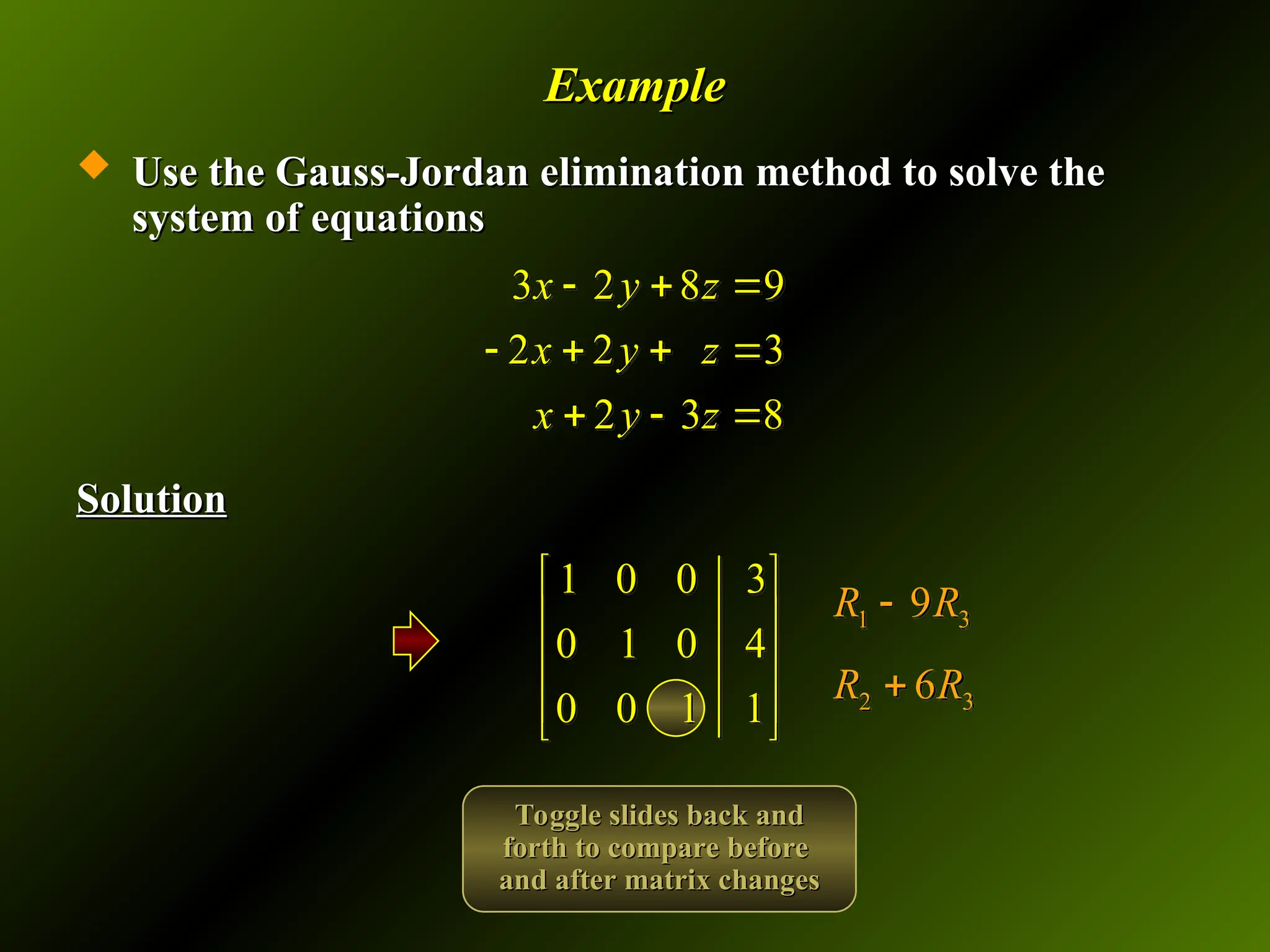
 Use the Gauss-Jordan elimination method to solve the
Use the Gauss-Jordan elimination method to solve the
system of equations
system of equations
Solution
Solution
3 2 8 9
2 2 3
2 3 8
x y z
x y z
x y z
  
   
  
3 2 8 9
2 2 1 3
1 2 3 8

 
 

 
 

 
1 2
R R

Toggle slides back and
forth to compare before
and after matrix changes
Example
Example
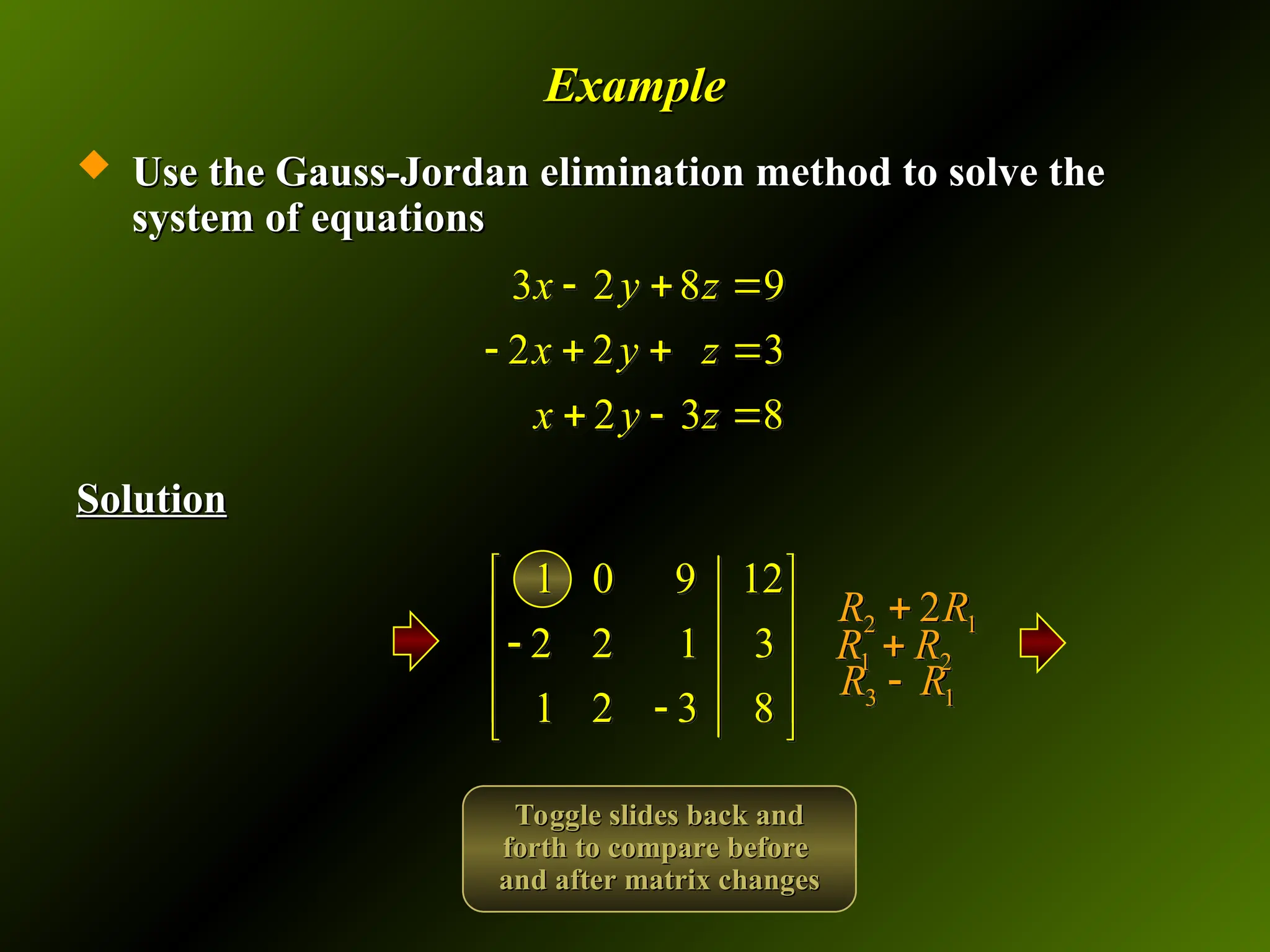
 Use the Gauss-Jordan elimination method to solve the
Use the Gauss-Jordan elimination method to solve the
system of equations
system of equations
Solution
Solution
3 2 8 9
2 2 3
2 3 8
x y z
x y z
x y z
  
   
  
1 0 9 12
2 2 1 3
1 2 3 8
 
 

 
 

 
2 1
2
R R

3 1
R R

1 2
R R

Toggle slides back and
forth to compare before
and after matrix changes
Example
Example
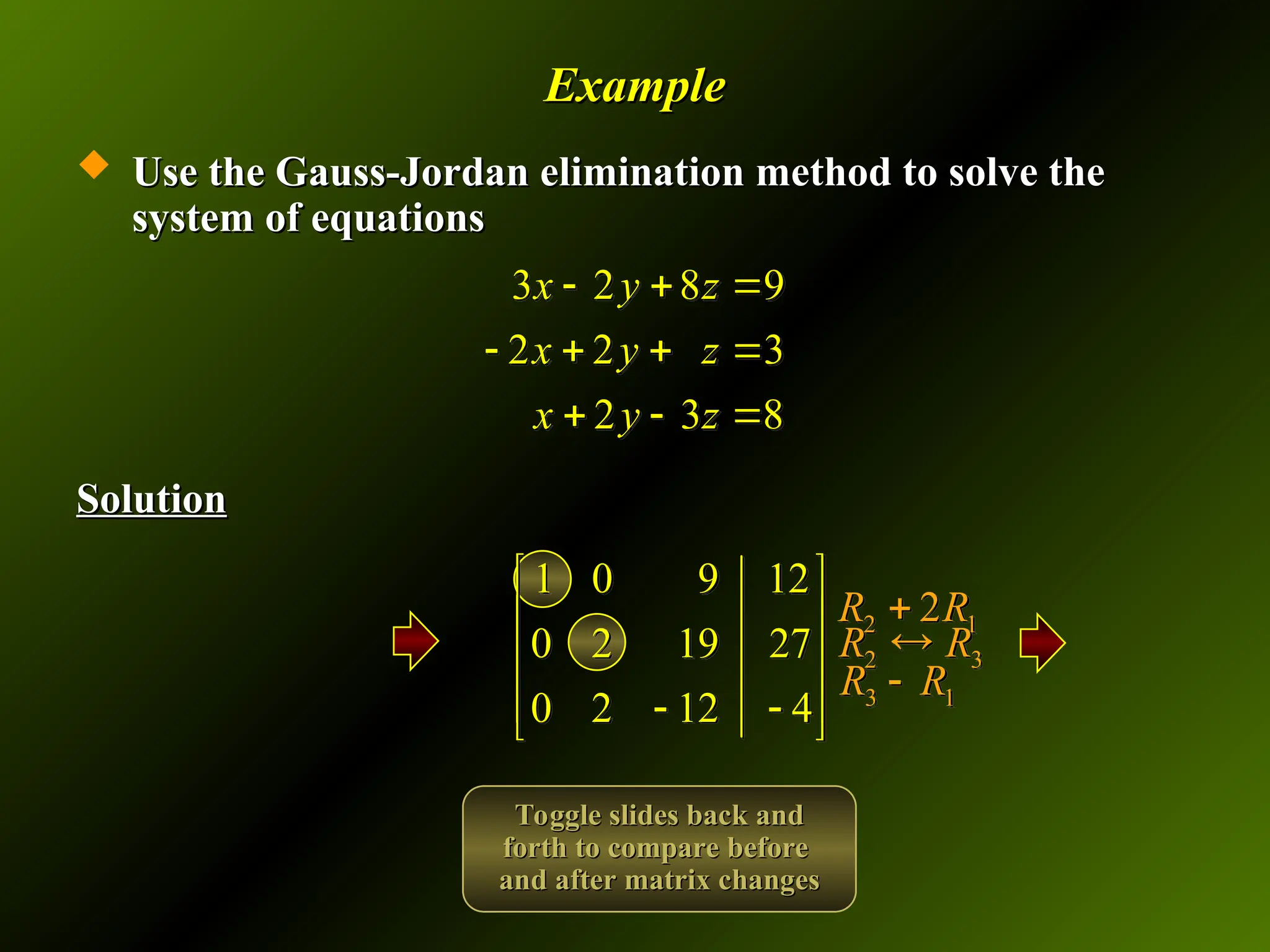
 Use the Gauss-Jordan elimination method to solve the
Use the Gauss-Jordan elimination method to solve the
system of equations
system of equations
Solution
Solution
3 2 8 9
2 2 3
2 3 8
x y z
x y z
x y z
  
   
  
1 0 9 12
0 2 19 27
0 2 12 4
 
 
 
 
 
 
2 1
2
R R

3 1
R R

2 3
R R

Toggle slides back and
forth to compare before
and after matrix changes
Example
Example
 Use the Gauss-Jordan elimination method to solve the
Use the Gauss-Jordan elimination method to solve the
system of equations
system of equations
Solution
Solution
3 2 8 9
2 2 3
2 3 8
x y z
x y z
x y z
  
   
  
2 3
R R

1
2
2 R
1 0 9 12
0 2 12 4
0 2 19 27
 
 
 
 
 
 
Toggle slides back and
forth to compare before
and after matrix changes
Example
Example
 Use the Gauss-Jordan elimination method to solve the
Use the Gauss-Jordan elimination method to solve the
system of equations
system of equations
Solution
Solution
3 2 8 9
2 2 3
2 3 8
x y z
x y z
x y z
  
   
  
1
2
2 R
1 0 9 12
0 1 6 2
0 2 19 27
 
 
 
 
 
 
3 2
R R

Toggle slides back and
forth to compare before
and after matrix changes
Example
Example
 Use the Gauss-Jordan elimination method to solve the
Use the Gauss-Jordan elimination method to solve the
system of equations
system of equations
Solution
Solution
3 2 8 9
2 2 3
2 3 8
x y z
x y z
x y z
  
   
  
1 0 9 12
0 1 6 2
0 0 31 31
 
 
 
 
 
 
3 2
R R

1
3
31 R
Toggle slides back and
forth to compare before
and after matrix changes
Example
Example
 Use the Gauss-Jordan elimination method to solve the
Use the Gauss-Jordan elimination method to solve the
system of equations
system of equations
Solution
Solution
3 2 8 9
2 2 3
2 3 8
x y z
x y z
x y z
  
   
  
1 0 9 12
0 1 6 2
0 0 1 1
 
 
 
 
 
 
1
3
31 R
1 3
9
R R

2 3
6
R R

Toggle slides back and
forth to compare before
and after matrix changes
Example
Example
 Use the Gauss-Jordan elimination method to solve the
Use the Gauss-Jordan elimination method to solve the
system of equations
system of equations
Solution
Solution
3 2 8 9
2 2 3
2 3 8
x y z
x y z
x y z
  
   
  
1 0 0 3
0 1 0 4
0 0 1 1
 
 
 
 
 
2 3
6
R R

1 3
9
R R

Toggle slides back and
forth to compare before
and after matrix changes
Example
Example
 Use the Gauss-Jordan elimination method to solve the
Use the Gauss-Jordan elimination method to solve the
system of equations
system of equations
Solution
Solution
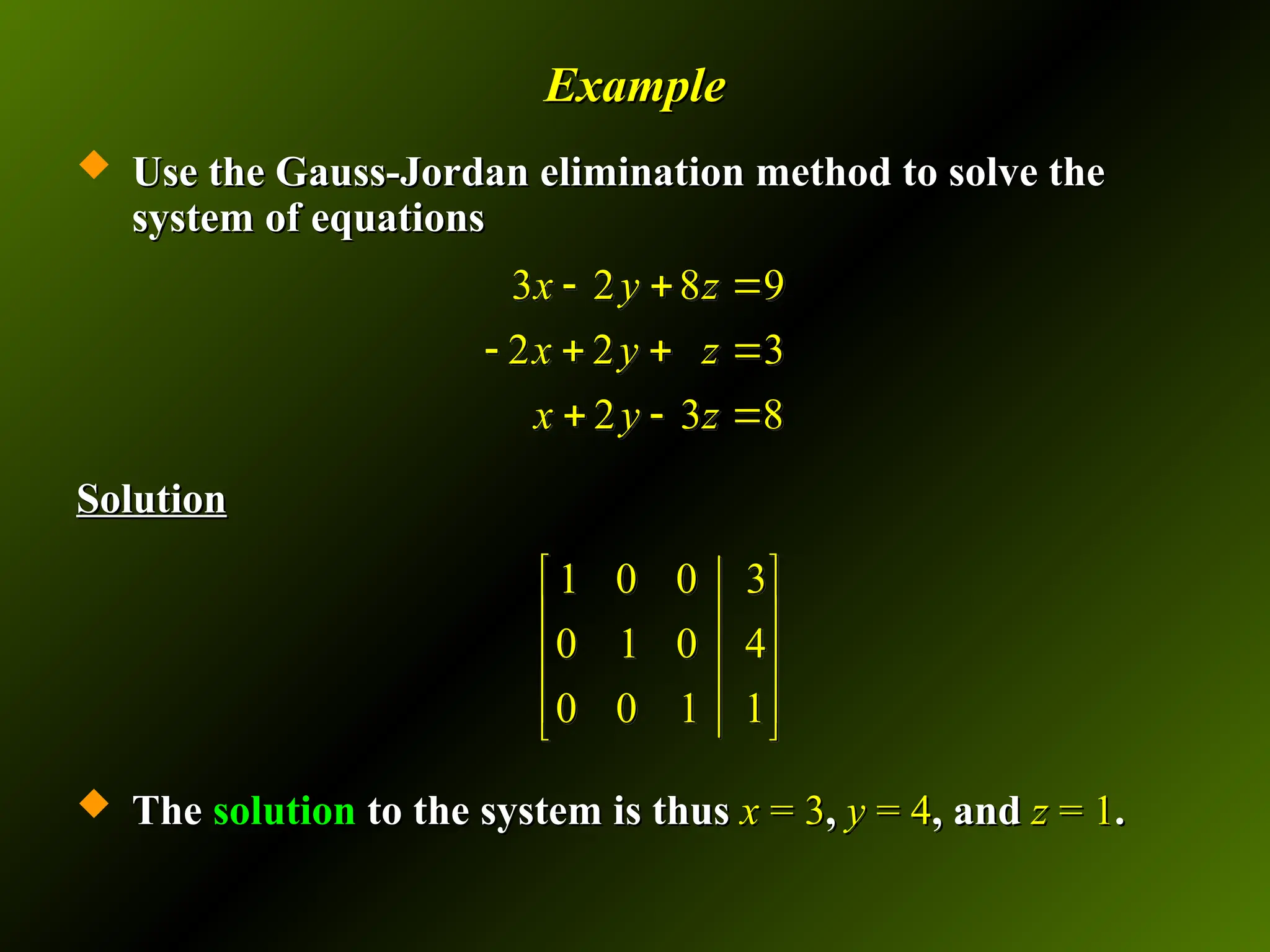
 The
The solution
solution to the system is thus
to the system is thus x
x = 3
= 3,
, y
y = 4
= 4, and
, and z
z = 1
= 1.
.
3 2 8 9
2 2 3
2 3 8
x y z
x y z
x y z
  
   
  
1 0 0 3
0 1 0 4
0 0 1 1
 
 
 
 
 
5.3
5.3
Systems of Linear Equations:
Underdetermined and Overdetermined systems
2 3 2
3 2 1
2 3 5 3
x y z
x y z
x y z
  
  
  
1 2 3 2
3 1 2 1
2 3 5 3
 
 
 
 
 
 
 
 
1
x z
y z

 
0
1
x z
y z
 
 
A System of Equations
with an Infinite Number of Solutions
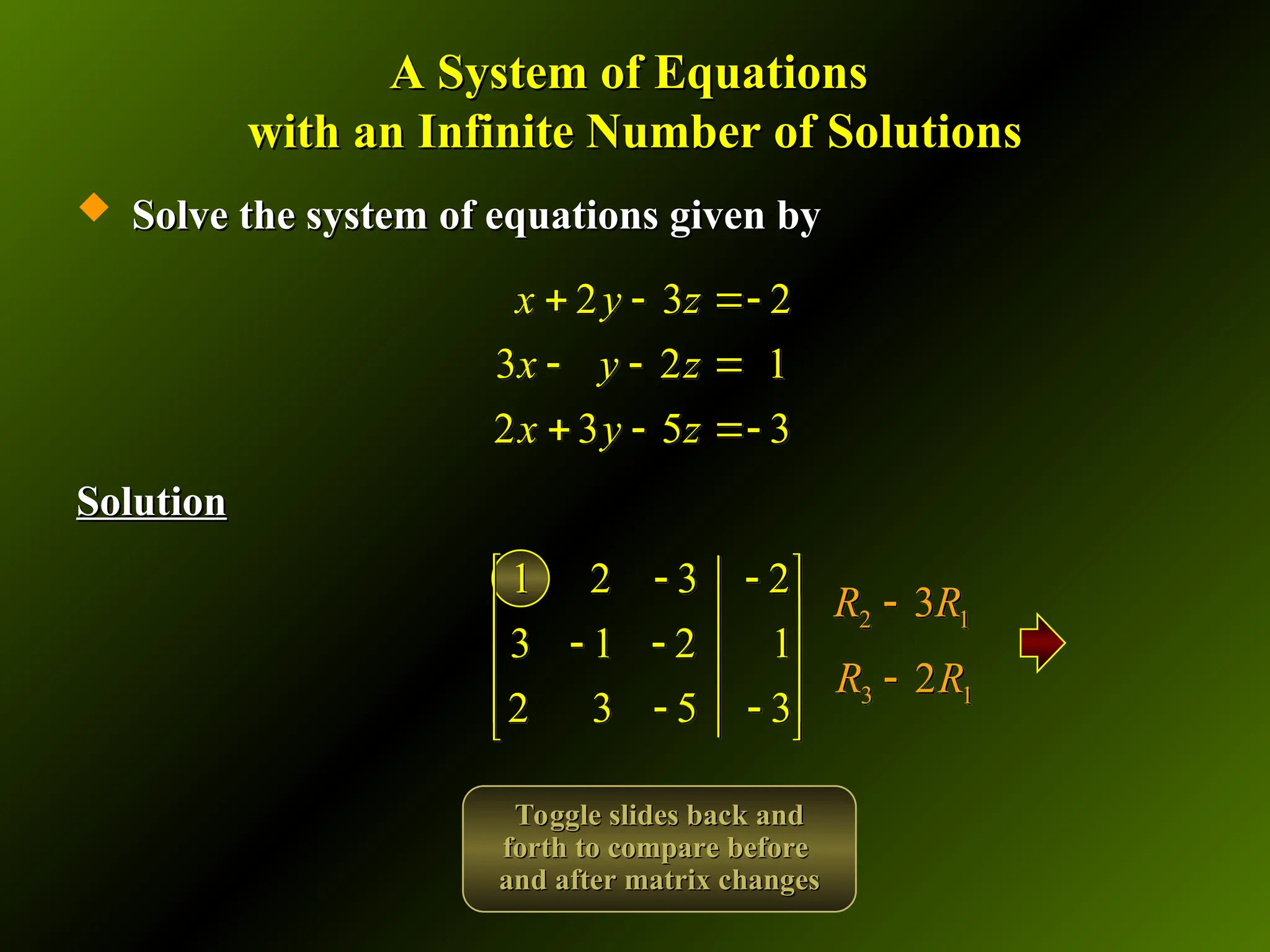
 Solve the system of equations given by
Solve the system of equations given by
Solution
Solution
2 3 2
3 2 1
2 3 5 3
x y z
x y z
x y z
  
  
  
1 2 3 2
3 1 2 1
2 3 5 3
 
 
 
 
 
 
 
 
2 1
3
R R

3 1
2
R R

Toggle slides back and
forth to compare before
and after matrix changes
A System of Equations
with an Infinite Number of Solutions
 Solve the system of equations given by
Solve the system of equations given by
Solution
Solution
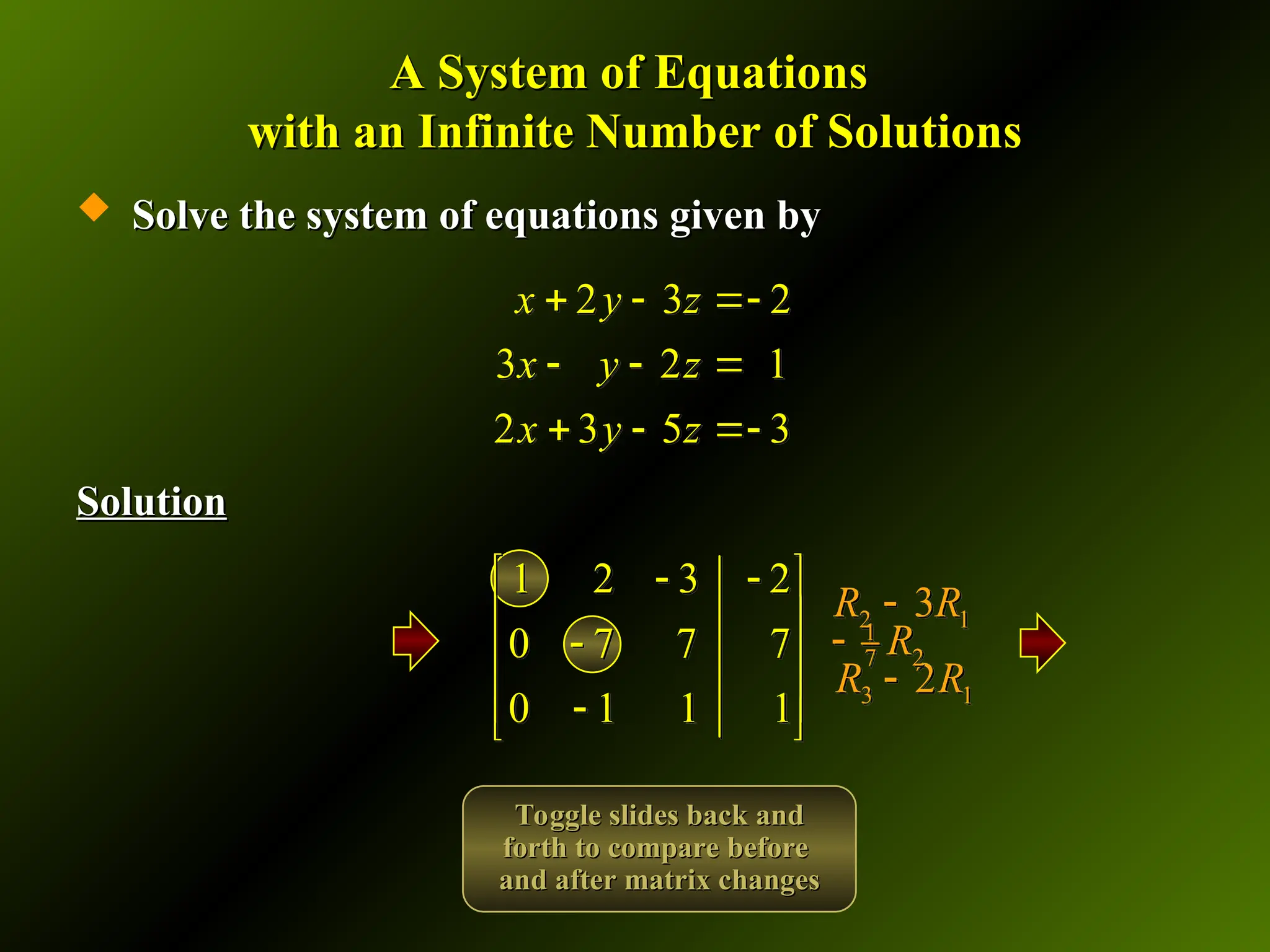
2 3 2
3 2 1
2 3 5 3
x y z
x y z
x y z
  
  
  
1 2 3 2
0 7 7 7
0 1 1 1
 
 
 

 
 

 
2 1
3
R R

3 1
2
R R

1
2
7 R

Toggle slides back and
forth to compare before
and after matrix changes
A System of Equations
with an Infinite Number of Solutions
 Solve the system of equations given by
Solve the system of equations given by
Solution
Solution
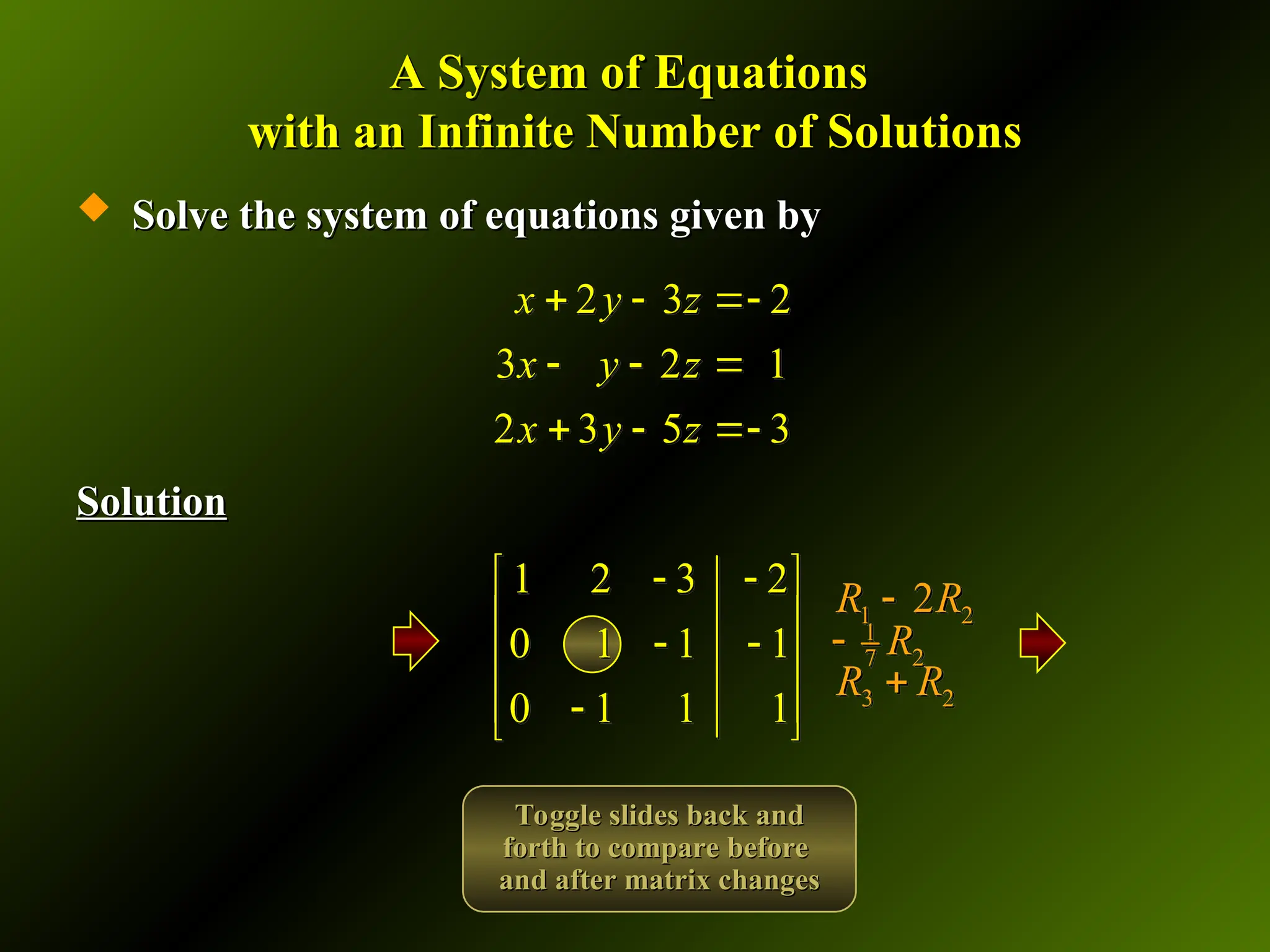
2 3 2
3 2 1
2 3 5 3
x y z
x y z
x y z
  
  
  
1 2 3 2
0 1 1 1
0 1 1 1
 
 
 
 
 
 

 
1
2
7 R

1 2
2
R R

3 2
R R

Toggle slides back and
forth to compare before
and after matrix changes
A System of Equations
with an Infinite Number of Solutions
 Solve the system of equations given by
Solve the system of equations given by
Solution
Solution
2 3 2
3 2 1
2 3 5 3
x y z
x y z
x y z
  
  
  
1 0 1 0
0 1 1 1
0 0 0 0

 
 
 
 
 
 
1 2
2
R R

3 2
R R

Toggle slides back and
forth to compare before
and after matrix changes
A System of Equations
with an Infinite Number of Solutions
 Solve the system of equations given by
Solve the system of equations given by
Solution
Solution
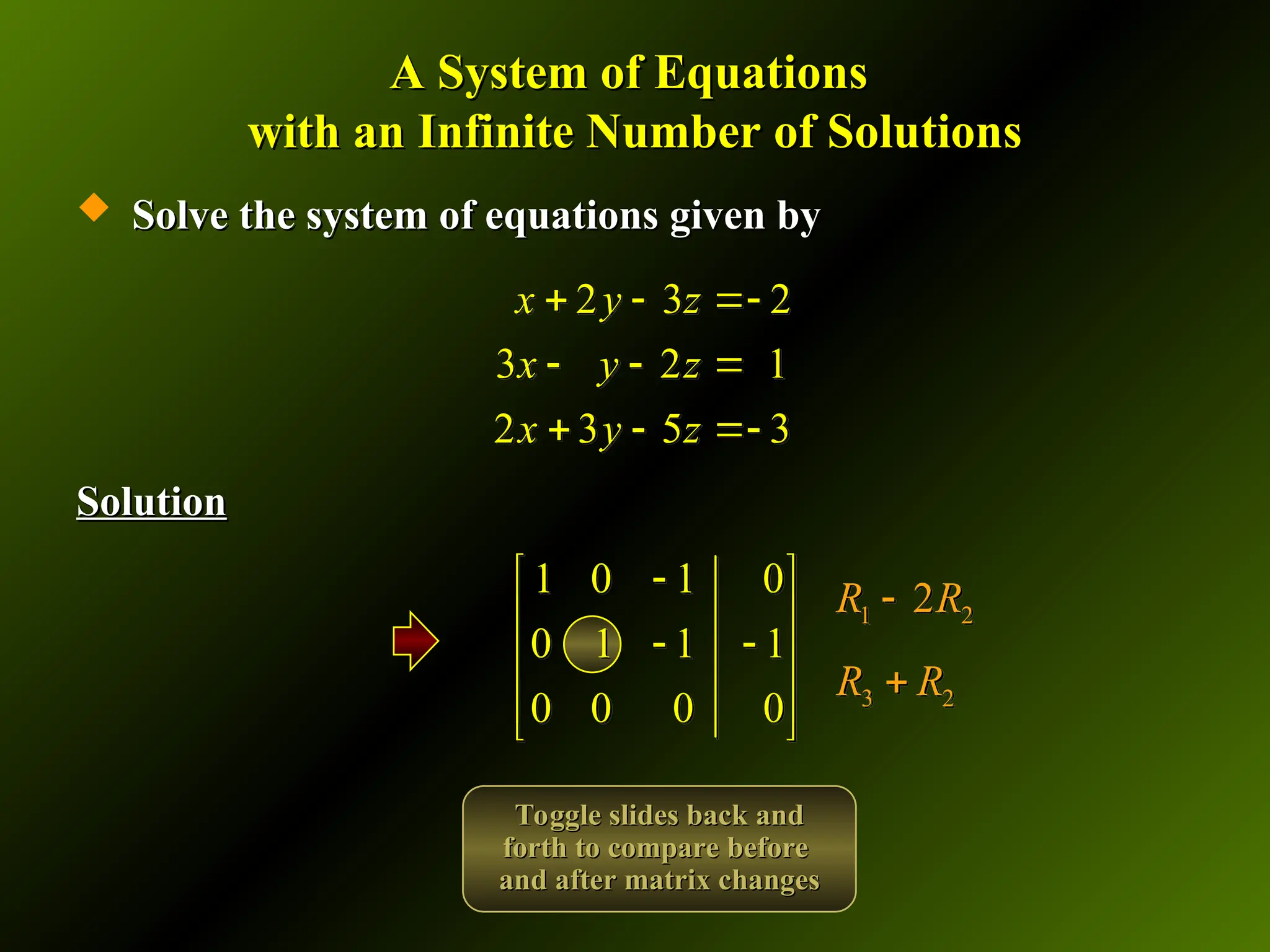
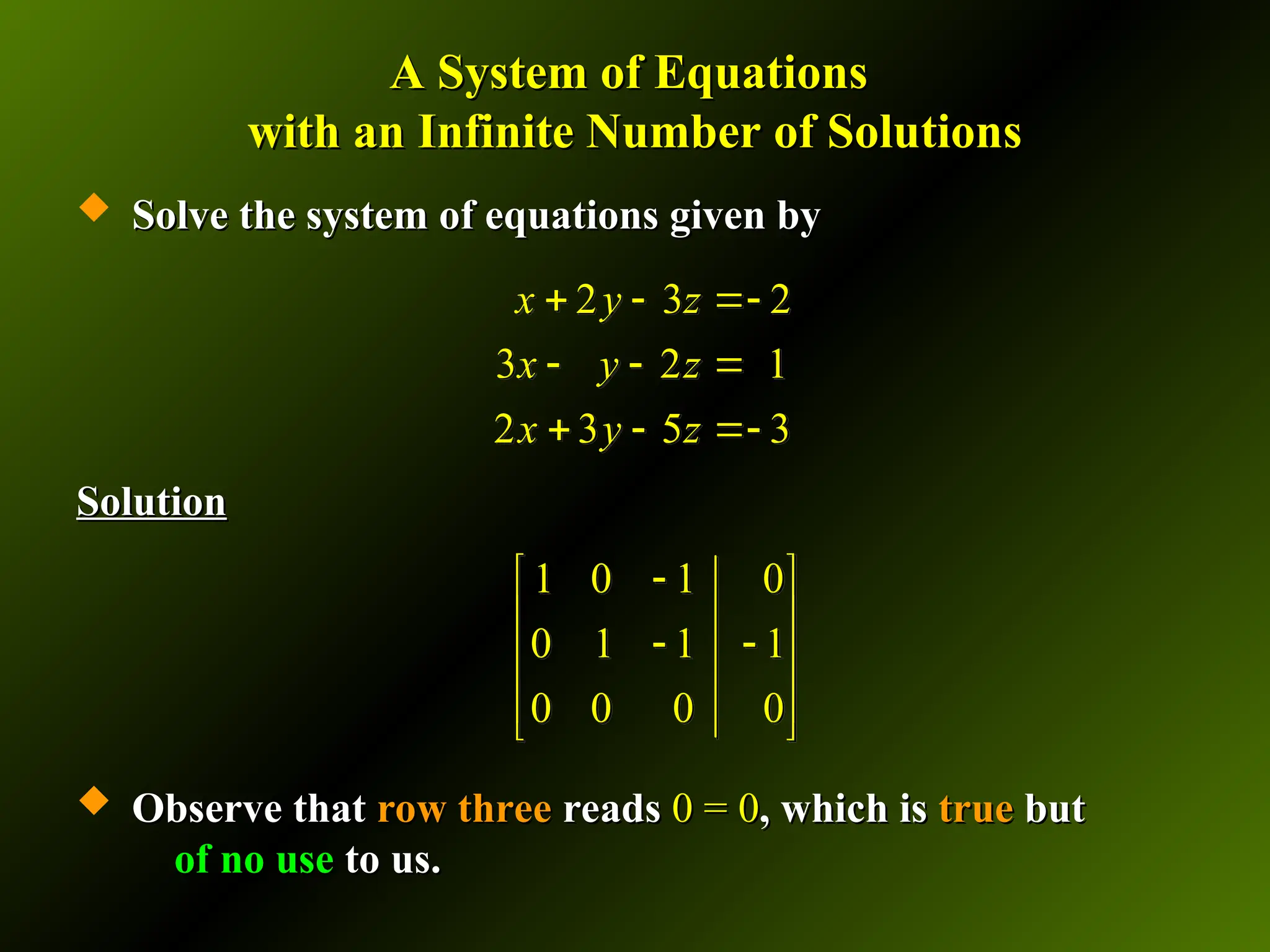
 Observe that
Observe that row three
row three reads
reads 0 = 0
0 = 0, which is
, which is true
true but
but
of no use
of no use to us.
to us.
2 3 2
3 2 1
2 3 5 3
x y z
x y z
x y z
  
  
  
1 0 1 0
0 1 1 1
0 0 0 0

 
 
 
 
 
 
A System of Equations
with an Infinite Number of Solutions
 Solve the system of equations given by
Solve the system of equations given by
Solution
Solution
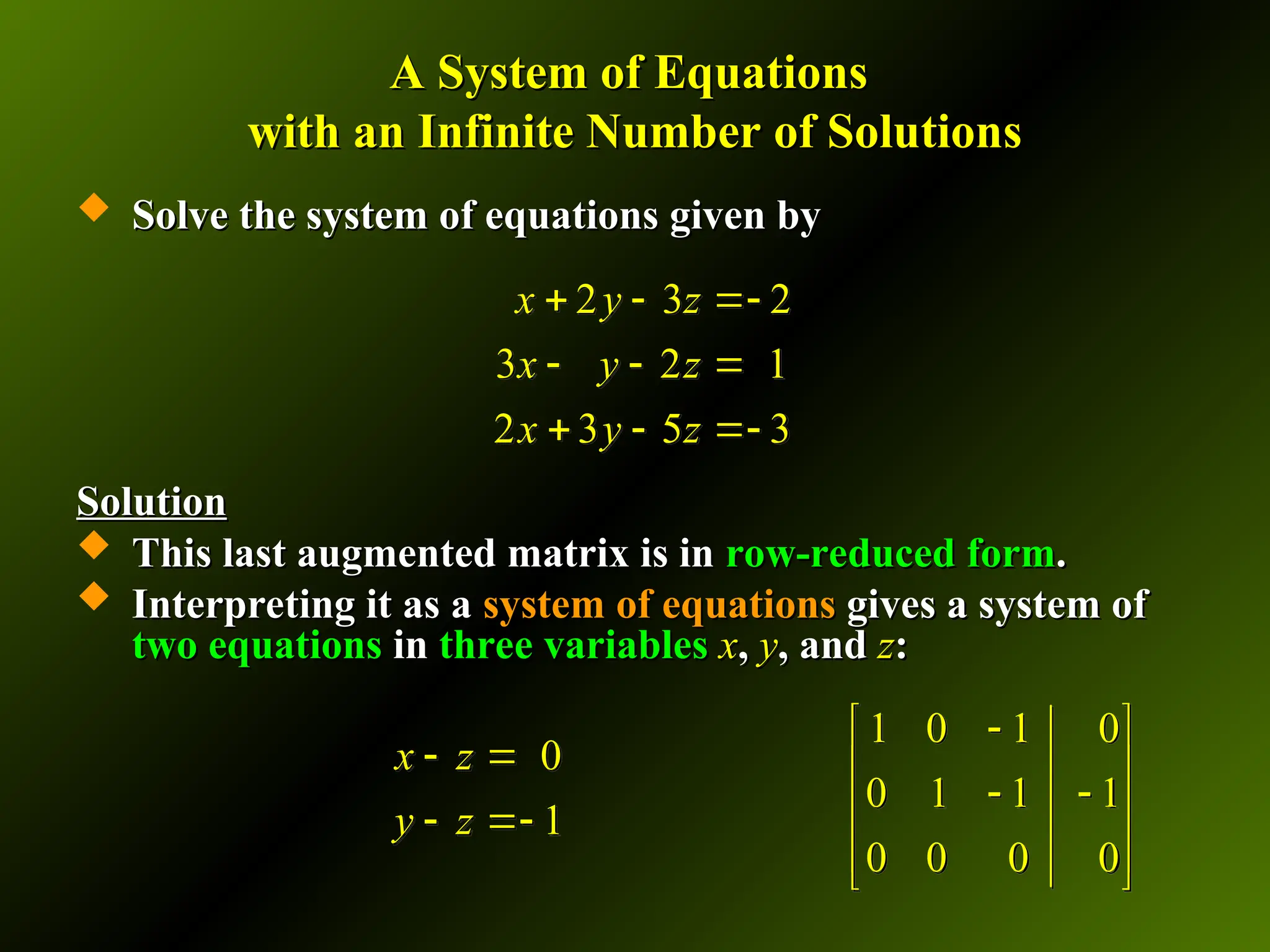
 This last augmented matrix is in
This last augmented matrix is in row-reduced form
row-reduced form.
.
 Interpreting it as a
Interpreting it as a system of equations
system of equations gives a system of
gives a system of
two equations
two equations in
in three variables
three variables x
x,
, y
y, and
, and z
z:
:
2 3 2
3 2 1
2 3 5 3
x y z
x y z
x y z
  
  
  
1 0 1 0
0 1 1 1
0 0 0 0

 
 
 
 
 
 
0
1
x z
y z
 
 
A System of Equations
with an Infinite Number of Solutions
 Solve the system of equations given by
Solve the system of equations given by
Solution
Solution
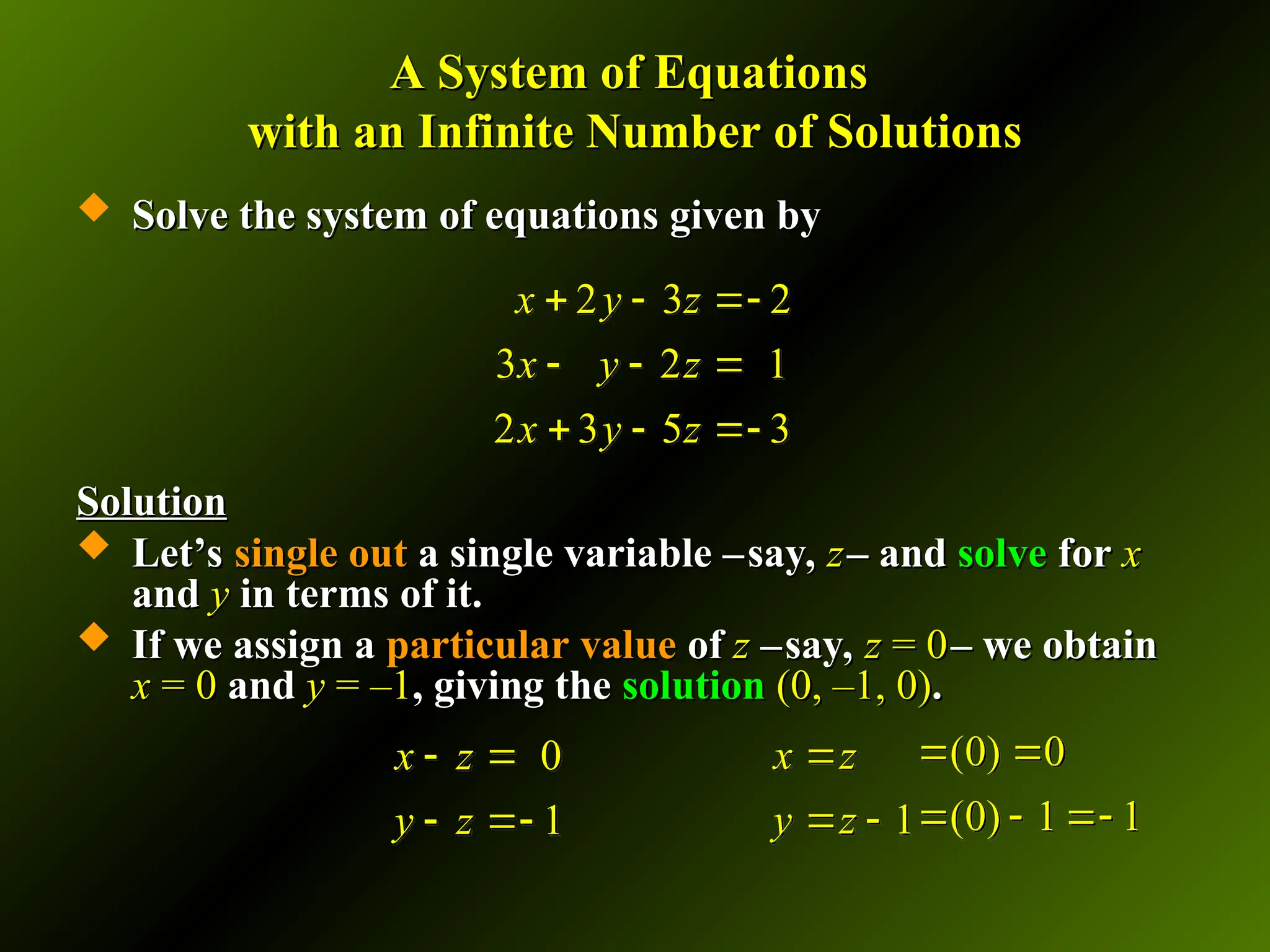
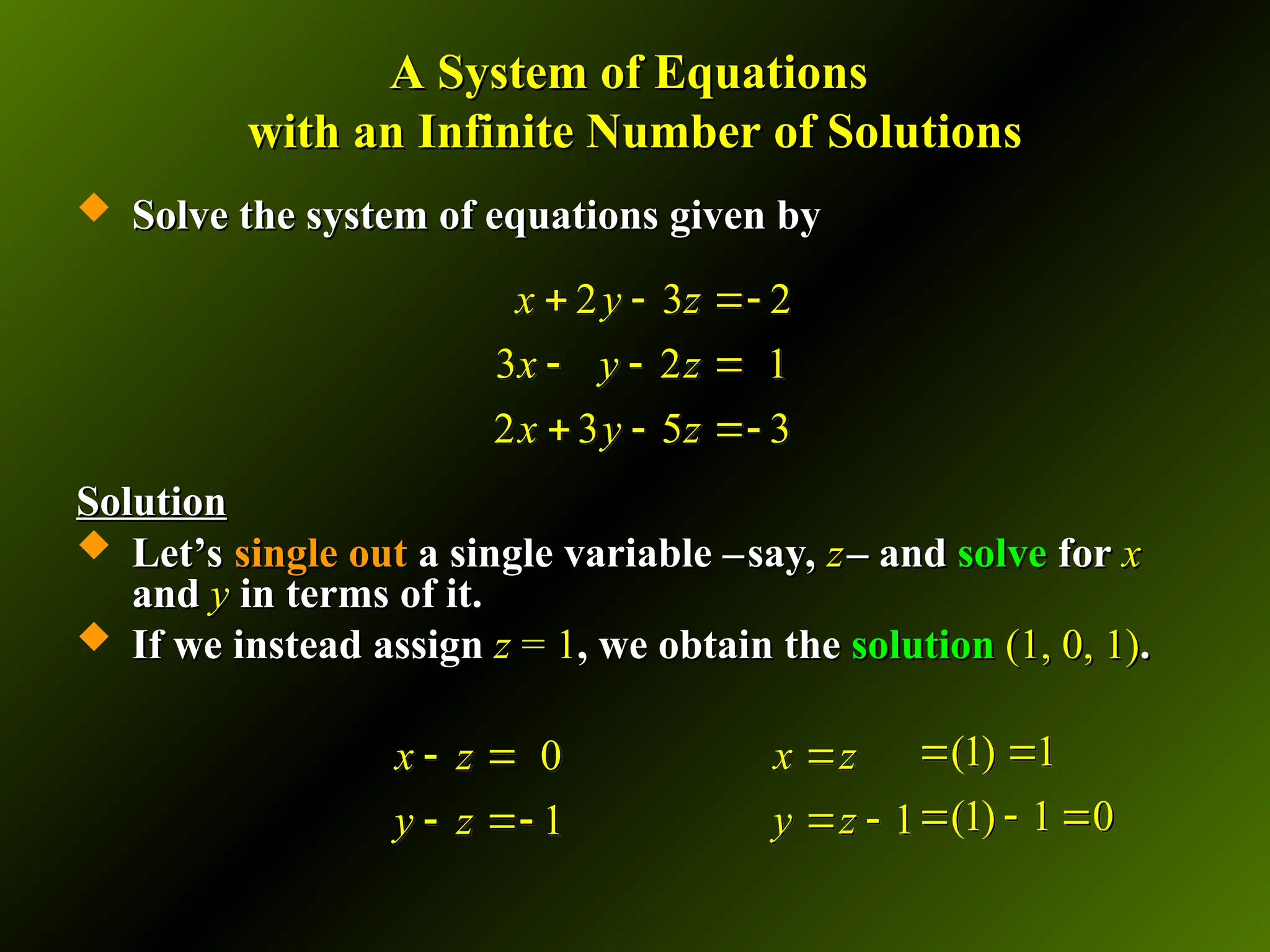
 Let’s
Let’s single out
single out a single variable –
a single variable –say,
say, z
z– and
– and solve
solve for
for x
x
and
and y
y in terms of it.
in terms of it.
 If we assign a
If we assign a particular value
particular value of
of z
z –
–say,
say, z
z = 0
= 0– we obtain
– we obtain
x
x = 0
= 0 and
and y
y = –1
= –1, giving the
, giving the solution
solution (0, –1, 0)
(0, –1, 0).
.
2 3 2
3 2 1
2 3 5 3
x y z
x y z
x y z
  
  
  
1
x z
y z

 
0
1
x z
y z
 
 
(0) 0
(0) 1 1
 
  
A System of Equations
with an Infinite Number of Solutions
 Solve the system of equations given by
Solve the system of equations given by
Solution
Solution
 Let’s
Let’s single out
single out a single variable –
a single variable –say,
say, z
z– and
– and solve
solve for
for x
x
and
and y
y in terms of it.
in terms of it.
 If we instead assign
If we instead assign z
z = 1
= 1, we obtain the
, we obtain the solution
solution (1, 0, 1)
(1, 0, 1).
.
2 3 2
3 2 1
2 3 5 3
x y z
x y z
x y z
  
  
  
1
x z
y z

 
0
1
x z
y z
 
 
(1) 1
(1) 1 0
 
  
A System of Equations
with an Infinite Number of Solutions
 Solve the system of equations given by
Solve the system of equations given by
Solution
Solution
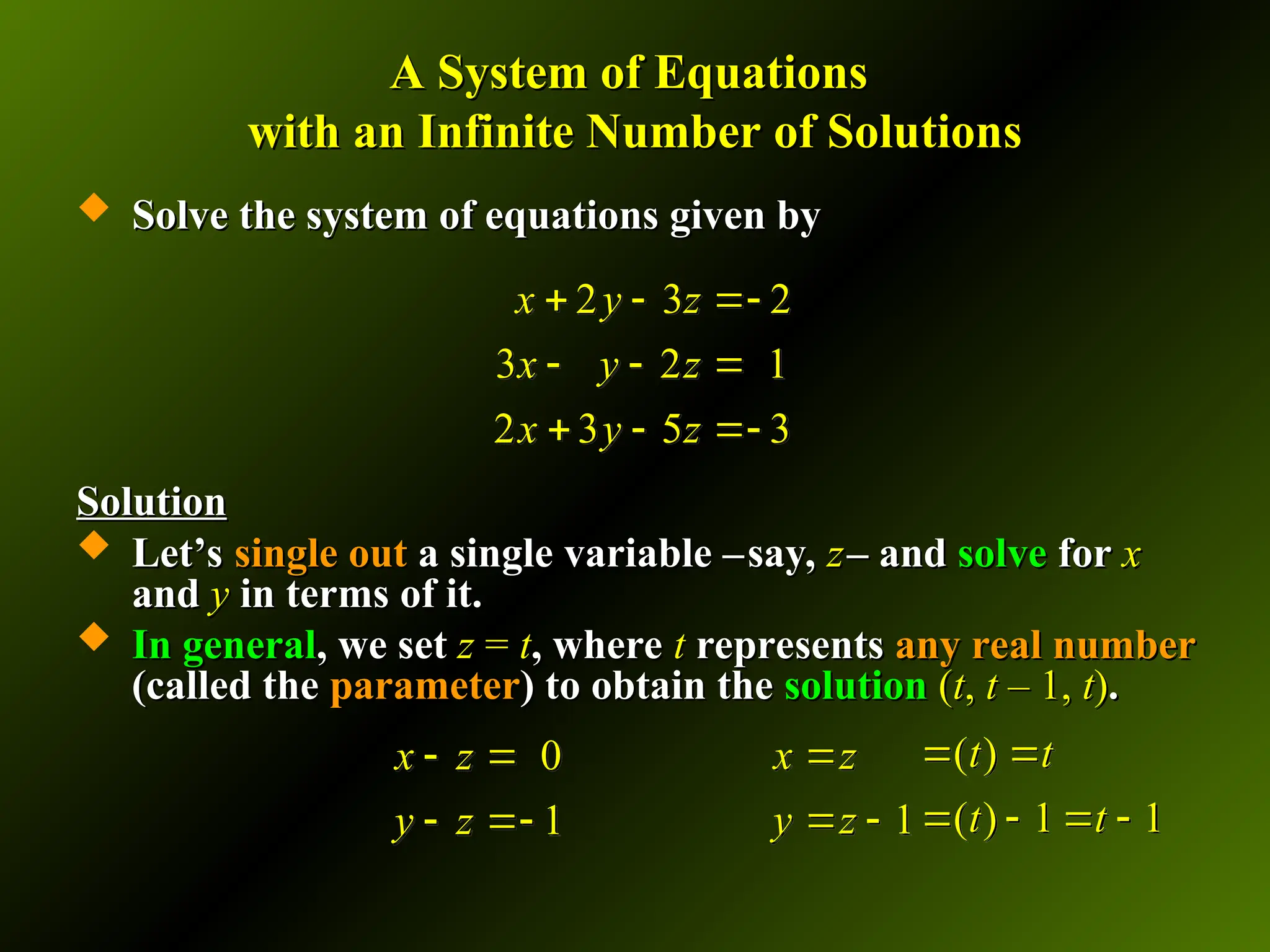
 Let’s
Let’s single out
single out a single variable –
a single variable –say,
say, z
z– and
– and solve
solve for
for x
x
and
and y
y in terms of it.
in terms of it.
 In general
In general, we set
, we set z
z =
= t
t, where
, where t
t represents
represents any real number
any real number
(called the
(called the parameter
parameter) to obtain the
) to obtain the solution
solution (
(t
t,
, t
t – 1,
– 1, t
t)
).
.
2 3 2
3 2 1
2 3 5 3
x y z
x y z
x y z
  
  
  
1
x z
y z

 
0
1
x z
y z
 
 
( )
( ) 1 1
t t
t t
 
   
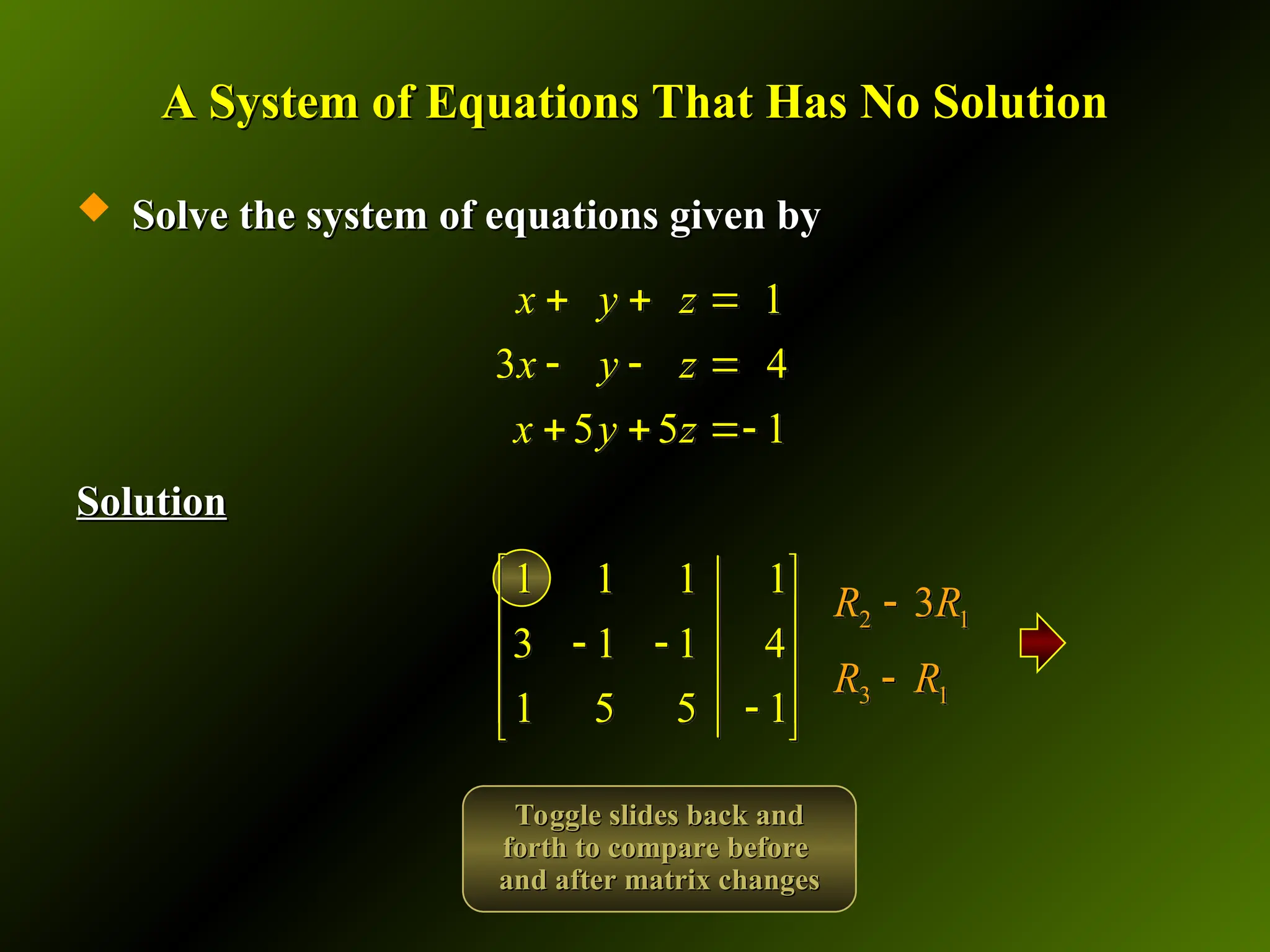
A System of Equations That Has No Solution
 Solve the system of equations given by
Solve the system of equations given by
Solution
Solution
1
3 4
5 5 1
x y z
x y z
x y z
  
  
  
1 1 1 1
3 1 1 4
1 5 5 1
 
 
 
 
 

 
2 1
3
R R

3 1
R R

Toggle slides back and
forth to compare before
and after matrix changes
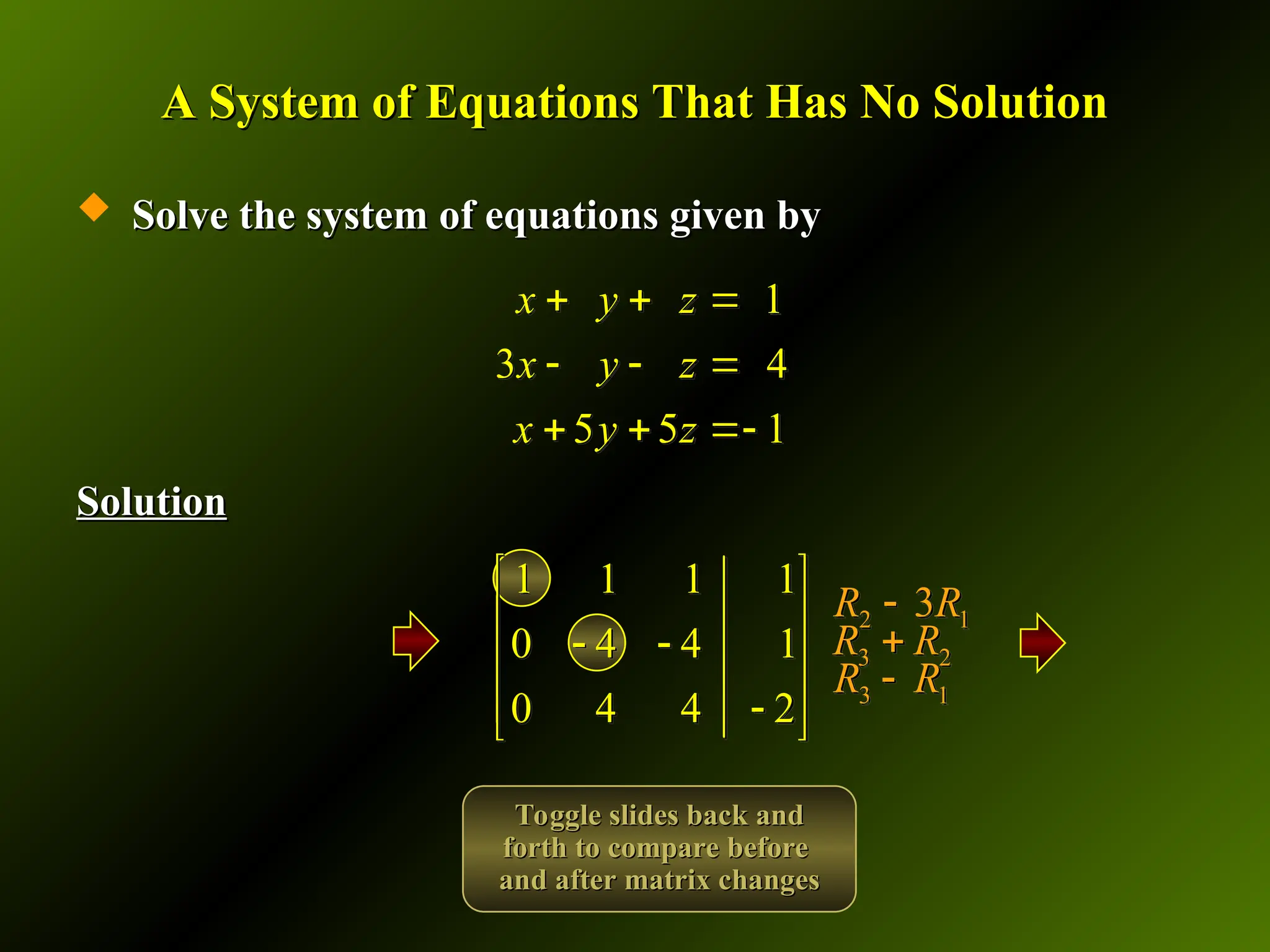
A System of Equations That Has No Solution
 Solve the system of equations given by
Solve the system of equations given by
Solution
Solution
1 1 1 1
0 4 4 1
0 4 4 2
 
 
 
 
 

 
2 1
3
R R

3 1
R R

3 2
R R

1
3 4
5 5 1
x y z
x y z
x y z
  
  
  
Toggle slides back and
forth to compare before
and after matrix changes
A System of Equations That Has No Solution
 Solve the system of equations given by
Solve the system of equations given by
Solution
Solution
1 1 1 1
0 4 4 1
0 0 0 1
 
 
 
 
 

 
3 2
R R

1
3 4
5 5 1
x y z
x y z
x y z
  
  
  
Toggle slides back and
forth to compare before
and after matrix changes
A System of Equations That Has No Solution
 Solve the system of equations given by
Solve the system of equations given by
Solution
Solution
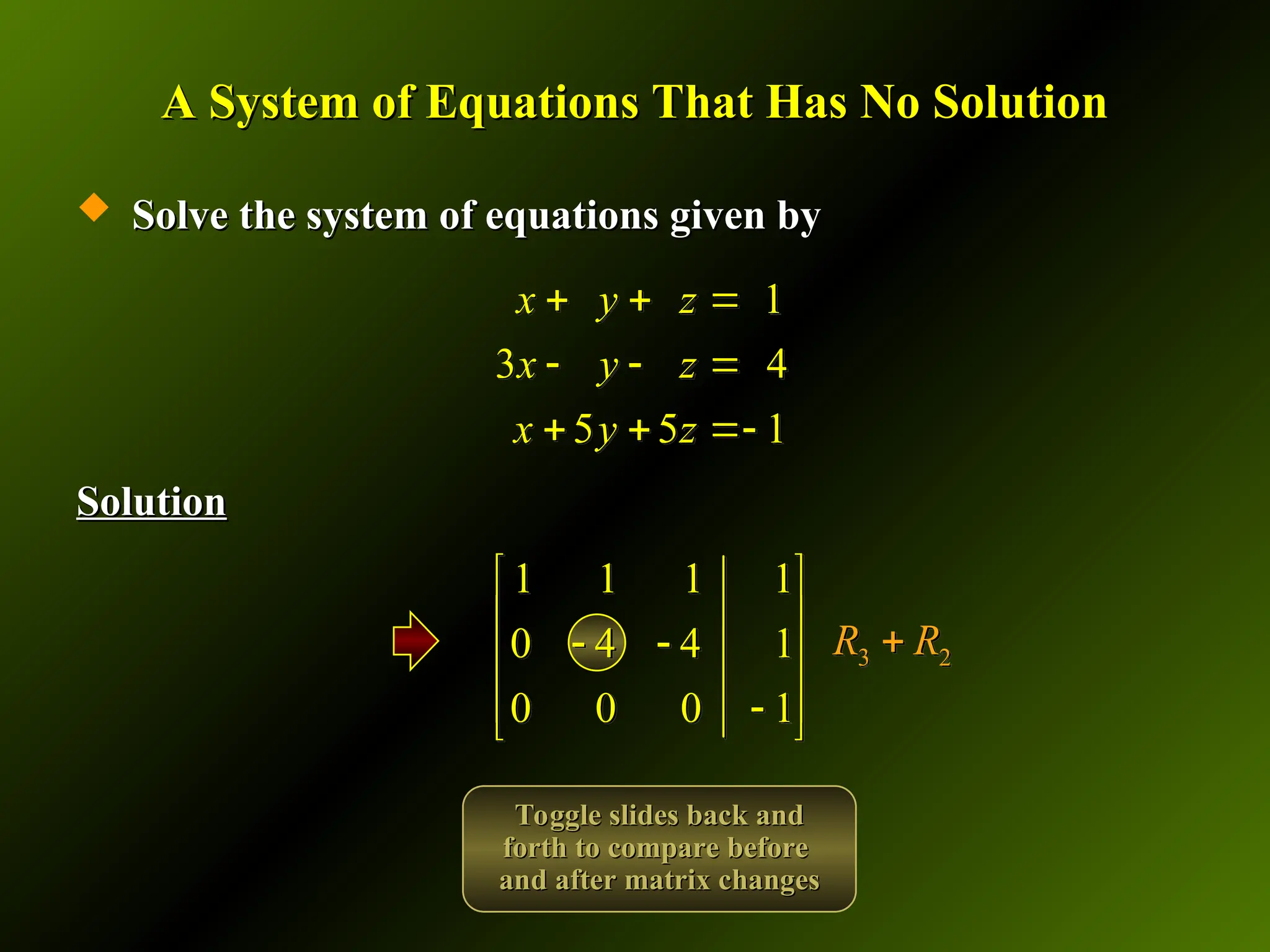
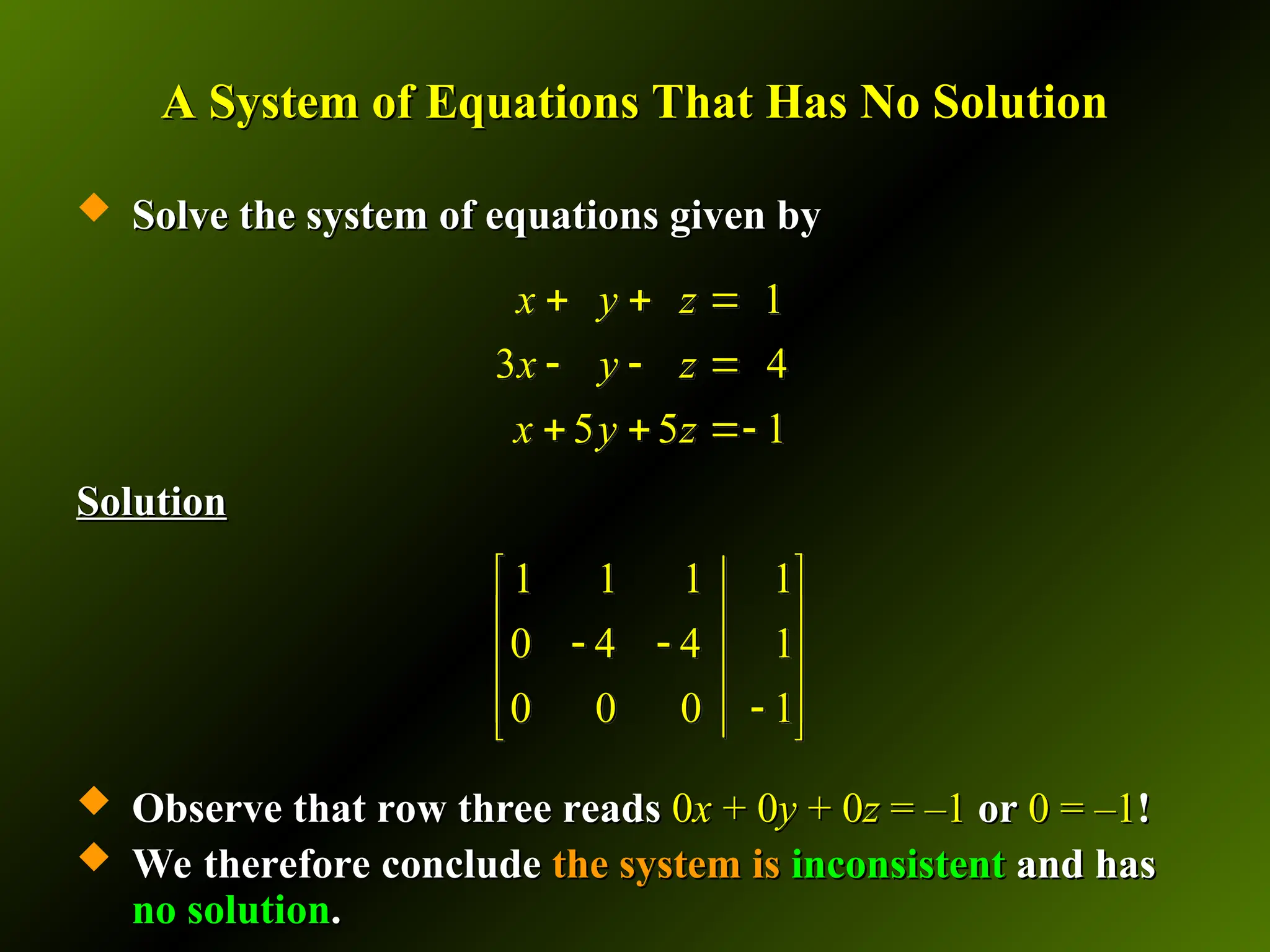
 Observe that row three reads
Observe that row three reads 0
0x
x + 0
+ 0y
y + 0
+ 0z
z = –1
= –1 or
or 0 = –1
0 = –1!
!
 We therefore conclude
We therefore conclude the system is
the system is inconsistent
inconsistent and has
and has
no solution
no solution.
.
1 1 1 1
0 4 4 1
0 0 0 1
 
 
 
 
 

 
1
3 4
5 5 1
x y z
x y z
x y z
  
  
  
Systems with no Solution
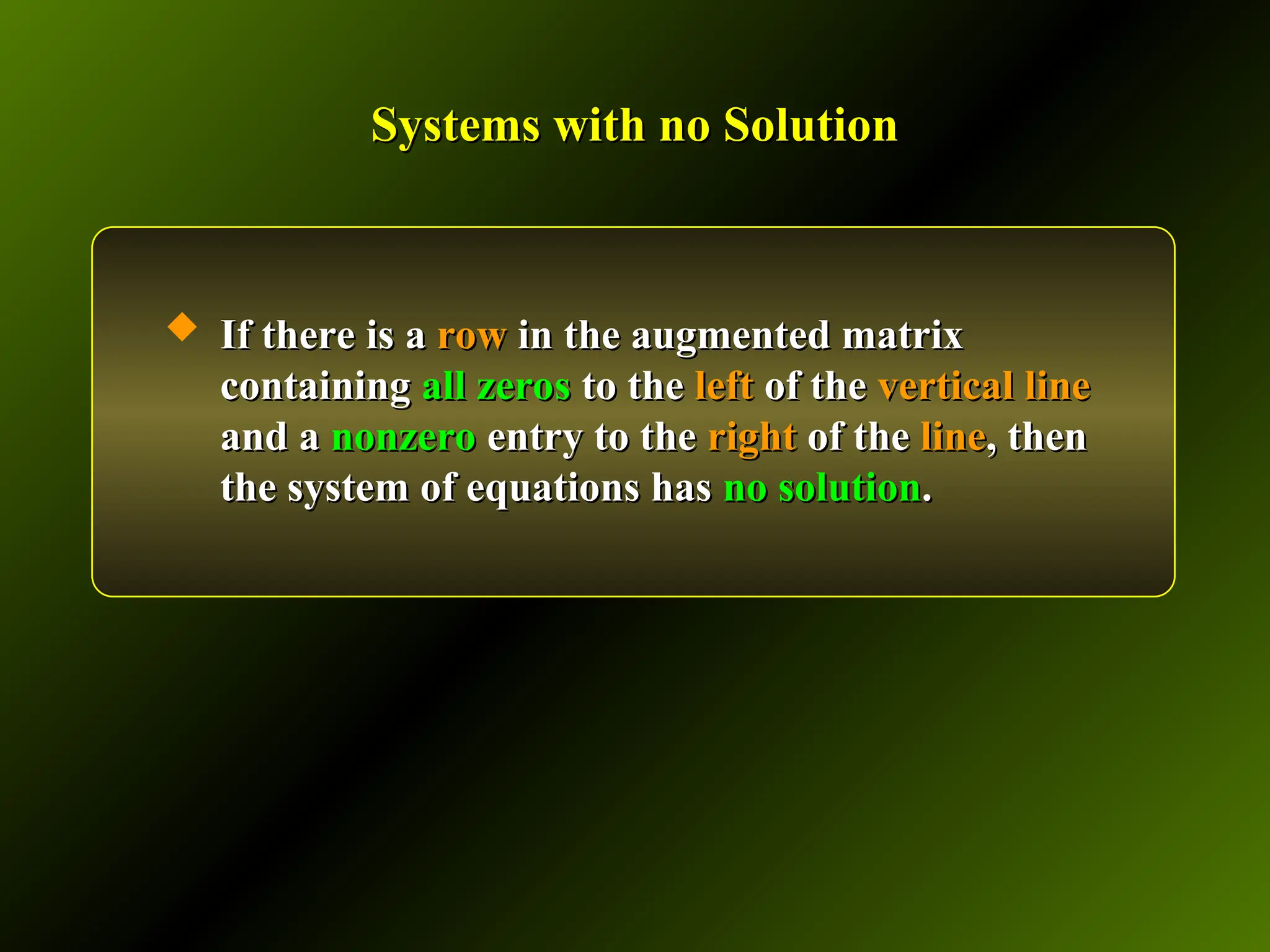
 If there is a
If there is a row
row in the augmented matrix
in the augmented matrix
containing
containing all zeros
all zeros to the
to the left
left of the
of the vertical line
vertical line
and a
and a nonzero
nonzero entry to the
entry to the right
right of the
of the line
line, then
, then
the system of equations has
the system of equations has no solution
no solution.
.
Theorem 1
Theorem 1
a.
a. If the
If the number of equations
number of equations is
is greater
greater than or
than or
equal to the
equal to the number of variables
number of variables in a linear
in a linear
system, then one of the following is true:
i.
i. The system has
The system has no solution
no solution.
.
ii.
ii. The system has
The system has exactly one solution
exactly one solution.
.
iii.
iii. The system has
The system has infinitely many solutions
infinitely many solutions.
.
b.
b. If there are
If there are fewer
fewer equations than variables
equations than variables in
in
a linear system, then the system either has no
solution
solution or it has
or it has infinitely many solutions
infinitely many solutions.
.
5.4
5.4
Matrices
Matrices
2 3
2 3
X B A
X A B
 
 
2 3
2 3
X B A
X A B
 
 
3 4 3 2
3
1 2 1 2
   
 
   
 
   
3 4 3 2
3
1 2 1 2
   
 
   
 
   
9 12 3 2
3 6 1 2
   
 
   
 
   
9 12 3 2
3 6 1 2
   
 
   
 
   
6 10
2 4
 
 

 
6 10
2 4
 
 

 
6 10
1
2 4
2
X
 
  

 
6 10
1
2 4
2
X
 
  

 
3 5
1 2
 
 

 
3 5
1 2
 
 

 
Matrix
Matrix
 A
A matrix
matrix is an
is an ordered rectangular array of numbers
ordered rectangular array of numbers.
.
 A matrix with
A matrix with m
m rows
rows and
and n
n columns
columns has size
has size m
m ☓
☓ n
n.
.
 The
The entry
entry in the
in the i
ith
th row
row and
and j
jth
th column
column is denoted by
is denoted by a
aij
ij.
.
Applied Example:
Applied Example: Organizing Production Data
Organizing Production Data
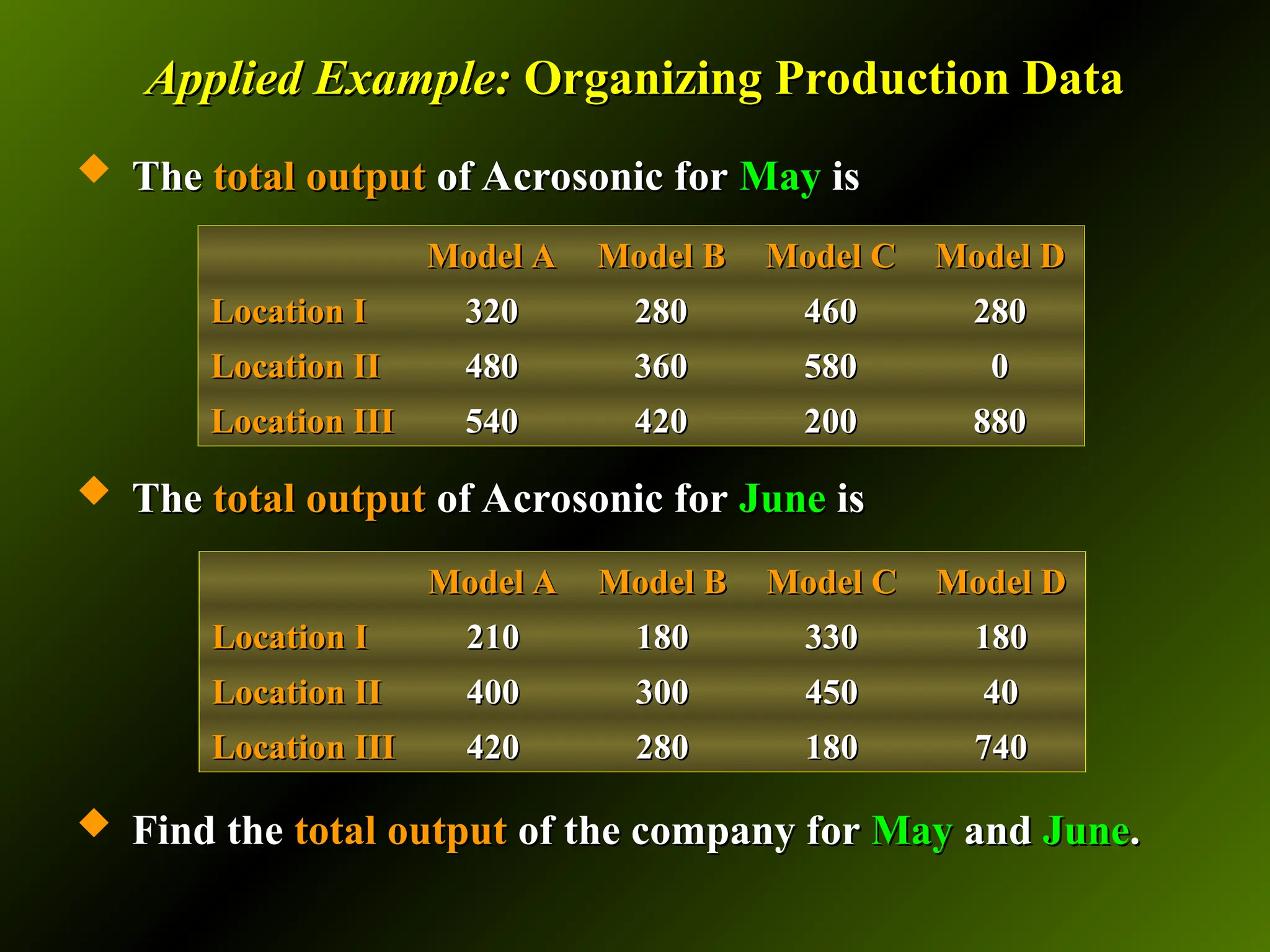
 The Acrosonic Company manufactures
The Acrosonic Company manufactures four different
four different
loudspeaker systems
loudspeaker systems at
at three
three separate
separate locations
locations.
.
 The company’s
The company’s May
May output is as follows:
output is as follows:
 If we agree to preserve the
If we agree to preserve the relative location
relative location of each
of each entry
entry
in the table, we can summarize the set of data as follows:
Model A
Model A Model B
Model B Model C
Model C Model D
Model D
Location I
Location I 320
320 280
280 460
460 280
280
Location II
Location II 480
480 360
360 580
580 0
0
Location III
Location III 540
540 420
420 200
200 880
880
320 280 460 280
480 360 580 0
540 420 200 880
 
 
 
 
 
Applied Example:
Applied Example: Organizing Production Data
Organizing Production Data
 We have Acrosonic’s
We have Acrosonic’s May
May output expressed as a matrix:
output expressed as a matrix:
a.
a. What is the
What is the size
size of the matrix
of the matrix P
P?
?
Solution
Solution
Matrix
Matrix P
P has
has three rows
three rows and
and four columns
four columns and hence
and hence
has
has size
size 3
3 ☓
☓ 4
4.
.
320 280 460 280
480 360 580 0
540 420 200 880
P
 
 
 
 
 
Applied Example:
Applied Example: Organizing Production Data
Organizing Production Data
 We have Acrosonic’s
We have Acrosonic’s May
May output expressed as a matrix:
output expressed as a matrix:
b.
b. Find
Find a
a24
24 (the entry in
(the entry in row 2
row 2 and
and column 4
column 4 of the
of the
matrix
matrix P
P) and give an
) and give an interpretation
interpretation of this number.
of this number.
Solution
Solution
The required entry lies in
The required entry lies in row 2
row 2 and
and column 4
column 4, and is
, and is
the
the number 0
number 0. This means that
. This means that no model D
no model D
loudspeaker system was manufactured at location II
in May.
in May.
320 280 460 280
480 360 580 0
540 420 200 880
P
 
 
 
 
 
Applied Example:
Applied Example: Organizing Production Data
Organizing Production Data
 We have Acrosonic’s
We have Acrosonic’s May
May output expressed as a matrix:
output expressed as a matrix:
c.
c. Find the
Find the sum
sum of the
of the entries
entries that make up
that make up row
row 1
1 of
of P
P
and
and interpret
interpret the result.
the result.
Solution
Solution
The required
The required sum
sum is given by
is given by
320 + 280 + 460 + 280 = 1340
320 + 280 + 460 + 280 = 1340
which gives the
which gives the total number
total number of loudspeaker systems
of loudspeaker systems
manufactured at
manufactured at location I
location I in May as
in May as 1340
1340 units.
units.
320 280 460 280
480 360 580 0
540 420 200 880
P
 
 
 
 
 
Applied Example:
Applied Example: Organizing Production Data
Organizing Production Data
 We have Acrosonic’s
We have Acrosonic’s May
May output expressed as a matrix:
output expressed as a matrix:
d.
d. Find the
Find the sum
sum of the
of the entries
entries that make up
that make up column
column 4
4 of
of
P
P and
and interpret
interpret the result.
the result.
Solution
Solution
The required
The required sum
sum is given by
is given by
280 + 0 + 880 = 1160
280 + 0 + 880 = 1160
giving the
giving the output
output of
of Model D
Model D loudspeaker systems at
loudspeaker systems at
all
all locations
locations in May as
in May as 1160
1160 units.
units.
320 280 460 280
480 360 580 0
540 420 200 880
P
 
 
 
 
 
Equality of Matrices
 Two matrices are equal if they have the same size
Two matrices are equal if they have the same size
and their corresponding entries are equal.
Example
Example
 Solve the following matrix equation for
Solve the following matrix equation for x
x,
, y
y, and
, and z
z:
:
Solution
Solution
 Since the
Since the corresponding elements
corresponding elements of the two matrices
of the two matrices must
must
be equal
be equal, we find that
, we find that x
x = 4
= 4,
, z
z = 3
= 3, and
, and y
y – 1 = 1
– 1 = 1, or
, or y
y = 2
= 2.
.
1 3 1 4
2 1 2 2 1 2
x z
y
   

   

   
Addition and Subtraction of Matrices
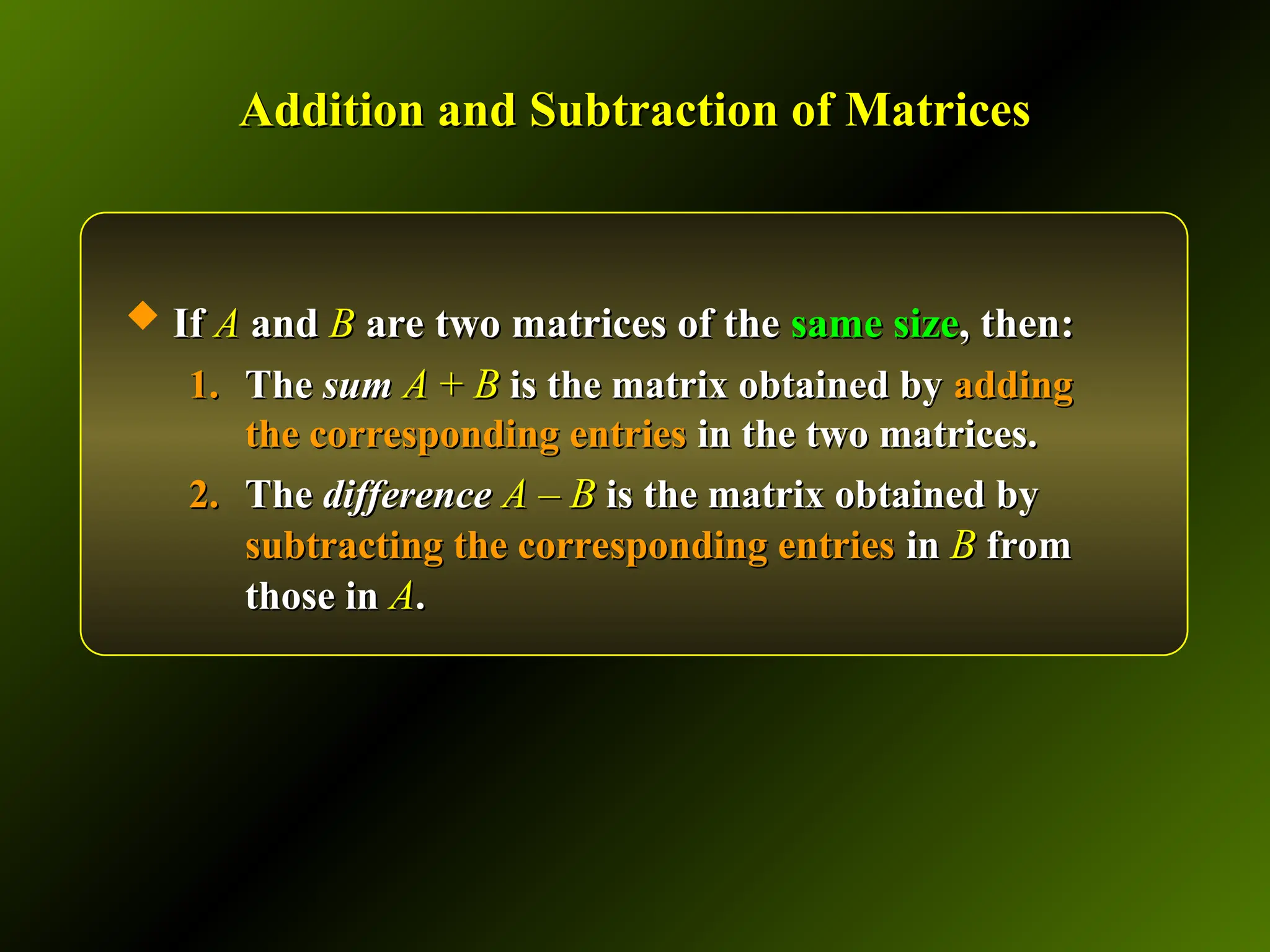
 If
If A
A and
and B
B are two matrices of the
are two matrices of the same size
same size, then:
, then:
1.
1. The
The sum
sum A
A +
+ B
B is the matrix obtained by
is the matrix obtained by adding
adding
the corresponding entries
the corresponding entries in the two matrices.
in the two matrices.
2.
2. The
The difference
difference A
A –
– B
B is the matrix obtained by
is the matrix obtained by
subtracting the corresponding entries
subtracting the corresponding entries in
in B
B from
from
those in
those in A
A.
.
Applied Example:
Applied Example: Organizing Production Data
Organizing Production Data
 The
The total output
total output of Acrosonic for
of Acrosonic for May
May is
is
 The
The total output
total output of Acrosonic for
of Acrosonic for June
June is
is
 Find the
Find the total output
total output of the company for
of the company for May
May and
and June
June.
.
Model A
Model A Model B
Model B Model C
Model C Model D
Model D
Location I
Location I 210
210 180
180 330
330 180
180
Location II
Location II 400
400 300
300 450
450 40
40
Location III
Location III 420
420 280
280 180
180 740
740
Model A
Model A Model B
Model B Model C
Model C Model D
Model D
Location I
Location I 320
320 280
280 460
460 280
280
Location II
Location II 480
480 360
360 580
580 0
0
Location III
Location III 540
540 420
420 200
200 880
880
Applied Example:
Applied Example: Organizing Production Data
Organizing Production Data
Solution
Solution
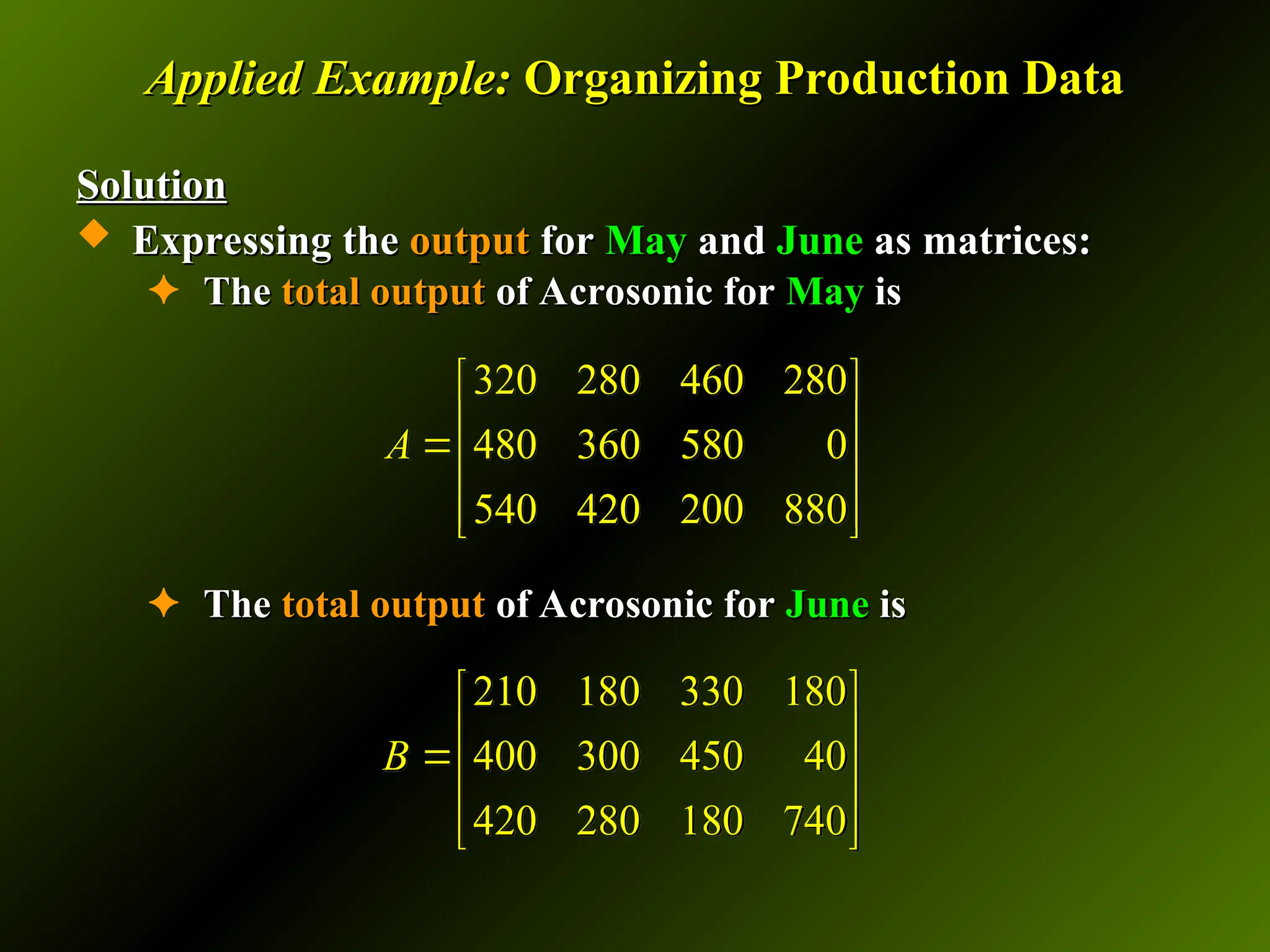
 Expressing the
Expressing the output
output for
for May
May and
and June
June as matrices:
as matrices:
✦ The
The total output
total output of Acrosonic for
of Acrosonic for May
May is
is
✦ The
The total output
total output of Acrosonic for
of Acrosonic for June
June is
is
320 280 460 280
480 360 580 0
540 420 200 880
A
 
 

 
 
 
210 180 330 180
400 300 450 40
420 280 180 740
B
 
 

 
 
 
Applied Example:
Applied Example: Organizing Production Data
Organizing Production Data
Solution
Solution
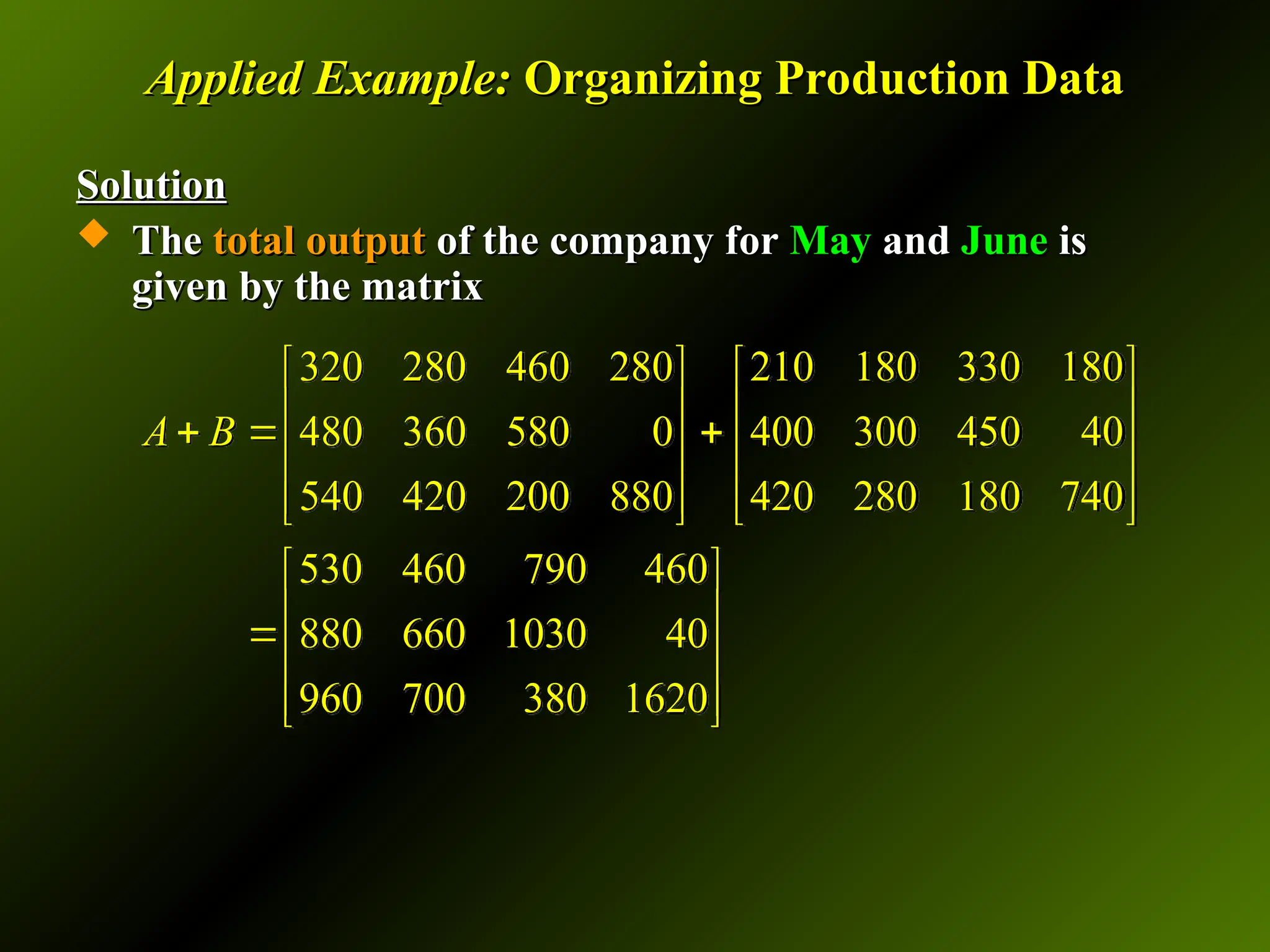
 The
The total output
total output of the company for
of the company for May
May and
and June
June is
is
given by the matrix
given by the matrix
320 280 460 280 210 180 330 180
480 360 580 0 400 300 450 40
540 420 200 880 420 280 180 740
530 460 790 460
880 660 1030 40
960 700 380 1620
A B
   
   
  
   
   
   
 
 

 
 
 
Laws for Matrix Addition
 If
If A
A,
, B
B, and
, and C
C are
are matrices
matrices of the
of the same size
same size, then
, then
1.
1. A
A +
+ B
B =
= B
B +
+ A
A Commutative
Commutative
law
law
2.
2. (
(A
A +
+ B
B) +
) + C
C =
= A
A + (
+ (B
B +
+ C
C)
) Associative law
Associative law
Transpose of a Matrix
 If
If A
A is an
is an m
m ☓
☓ n
n matrix with elements
matrix with elements a
aij
ij,
,
then the
then the transpose
transpose of
of A
A is the
is the n
n ☓
☓ m
m matrix
matrix
A
AT
T
with elements
with elements a
aji
ji.
.
Example
Example
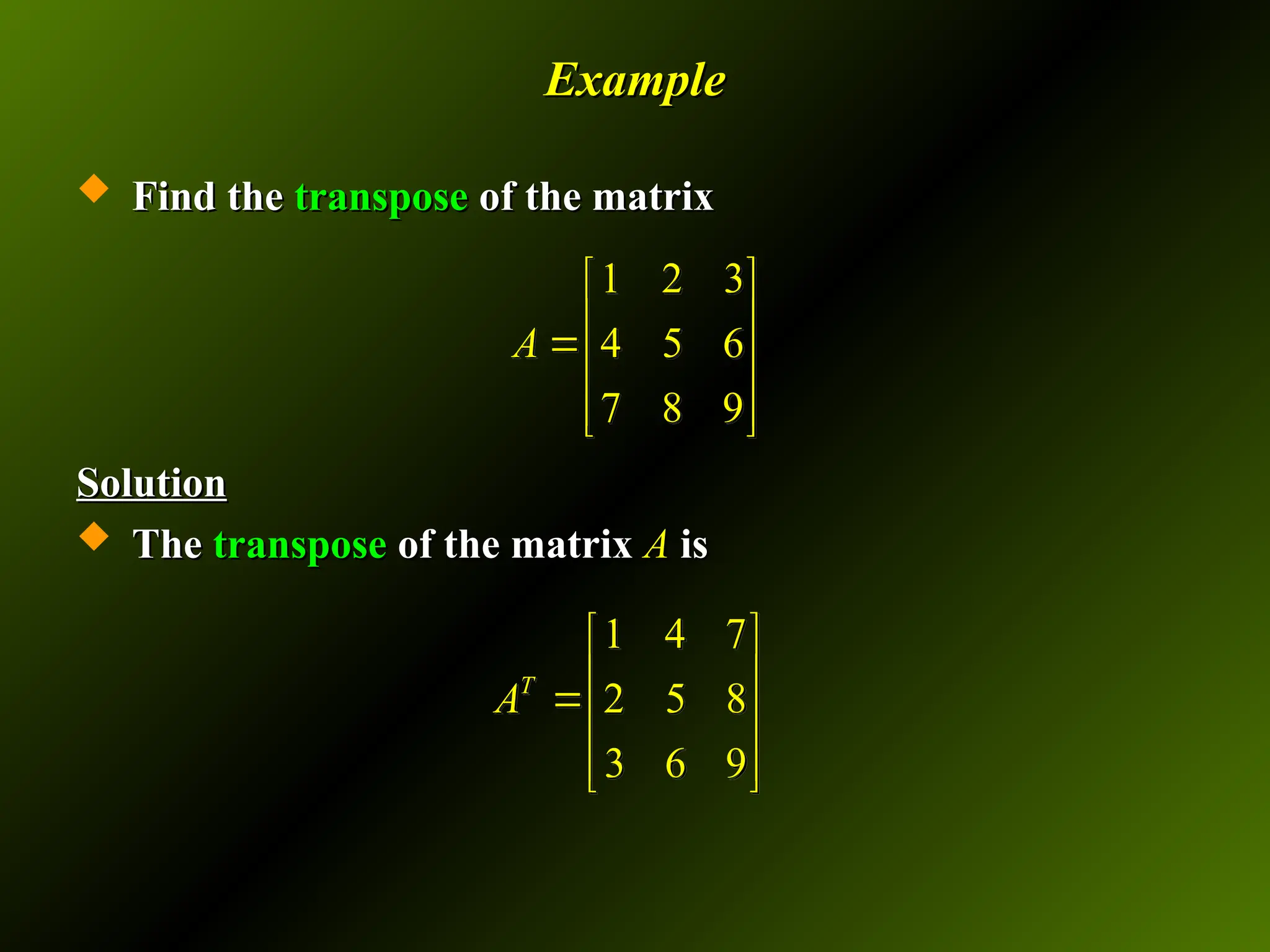
 Find the
Find the transpose
transpose of the matrix
of the matrix
Solution
Solution
 The
The transpose
transpose of the matrix
of the matrix A
A is
is
1 2 3
4 5 6
7 8 9
A
 
 

 
 
 
1 4 7
2 5 8
3 6 9
T
A
 
 

 
 
 
Scalar Product
Scalar Product
 If
If A
A is a matrix and
is a matrix and c
c is a
is a real number
real number, then
, then
the
the scalar product
scalar product cA
cA is the matrix obtained
is the matrix obtained
by
by multiplying
multiplying each entry
each entry of
of A
A by
by c
c.
.
Example
Example
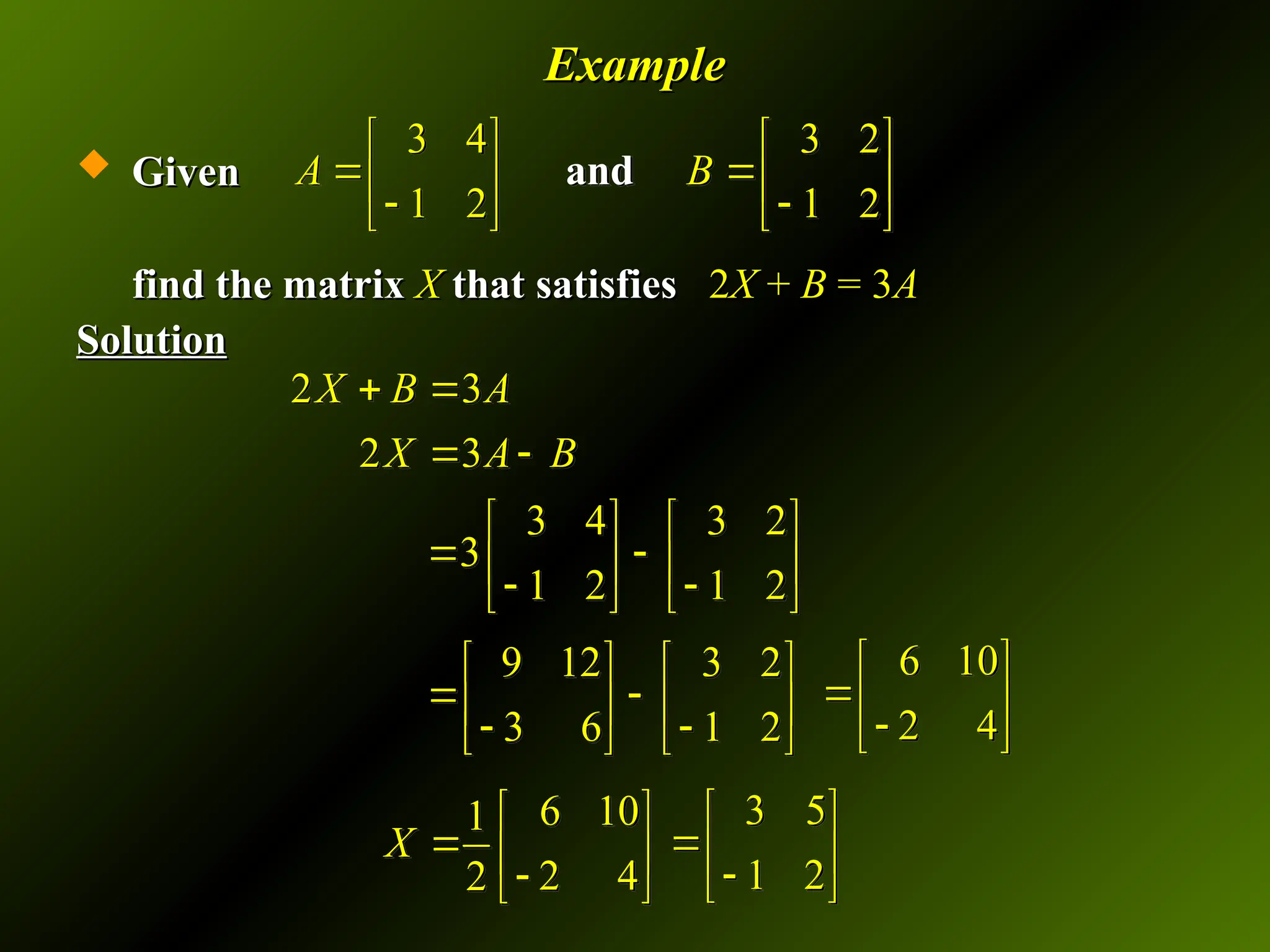
 Given
Given
find the matrix
find the matrix X
X that satisfies
that satisfies 2
2X
X +
+ B
B = 3
= 3A
A
Solution
Solution
2 3
2 3
X B A
X A B
 
 
3 4 3 2
3
1 2 1 2
   
 
   
 
   
9 12 3 2
3 6 1 2
   
 
   
 
   
6 10
2 4
 
 

 
6 10
1
2 4
2
X
 
  

 
3 5
1 2
 
 

 
3 4 3 2
1 2 1 2
A B
   
 
   
 
   
and
Applied Example:
Applied Example: Production Planning
Production Planning
 The management of Acrosonic has decided to increase its
The management of Acrosonic has decided to increase its
July
July production of
production of loudspeaker systems
loudspeaker systems by
by 10%
10%
(over
(over June
June output).
output).
 Find a
Find a matrix
matrix giving the targeted production for
giving the targeted production for July
July.
.
Solution
Solution
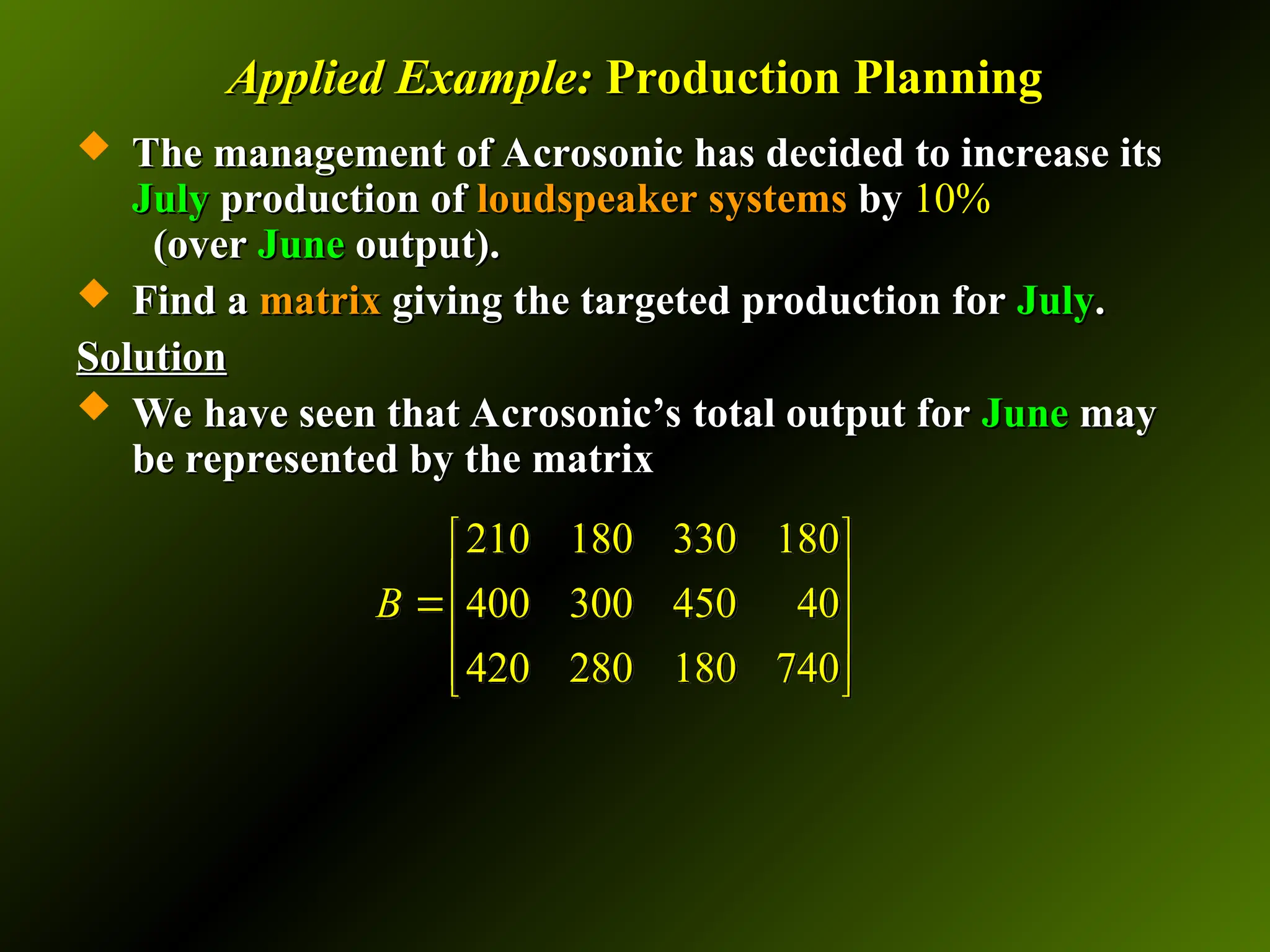
 We have seen that Acrosonic’s total output for
We have seen that Acrosonic’s total output for June
June may
may
be represented by the matrix
210 180 330 180
400 300 450 40
420 280 180 740
B
 
 

 
 
 
Applied Example:
Applied Example: Production Planning
Production Planning
 The management of Acrosonic has decided to increase its
The management of Acrosonic has decided to increase its
July
July production of
production of loudspeaker systems
loudspeaker systems by
by 10%
10%
(over
(over June
June output).
output).
 Find a
Find a matrix
matrix giving the targeted production for
giving the targeted production for July
July.
.
Solution
Solution
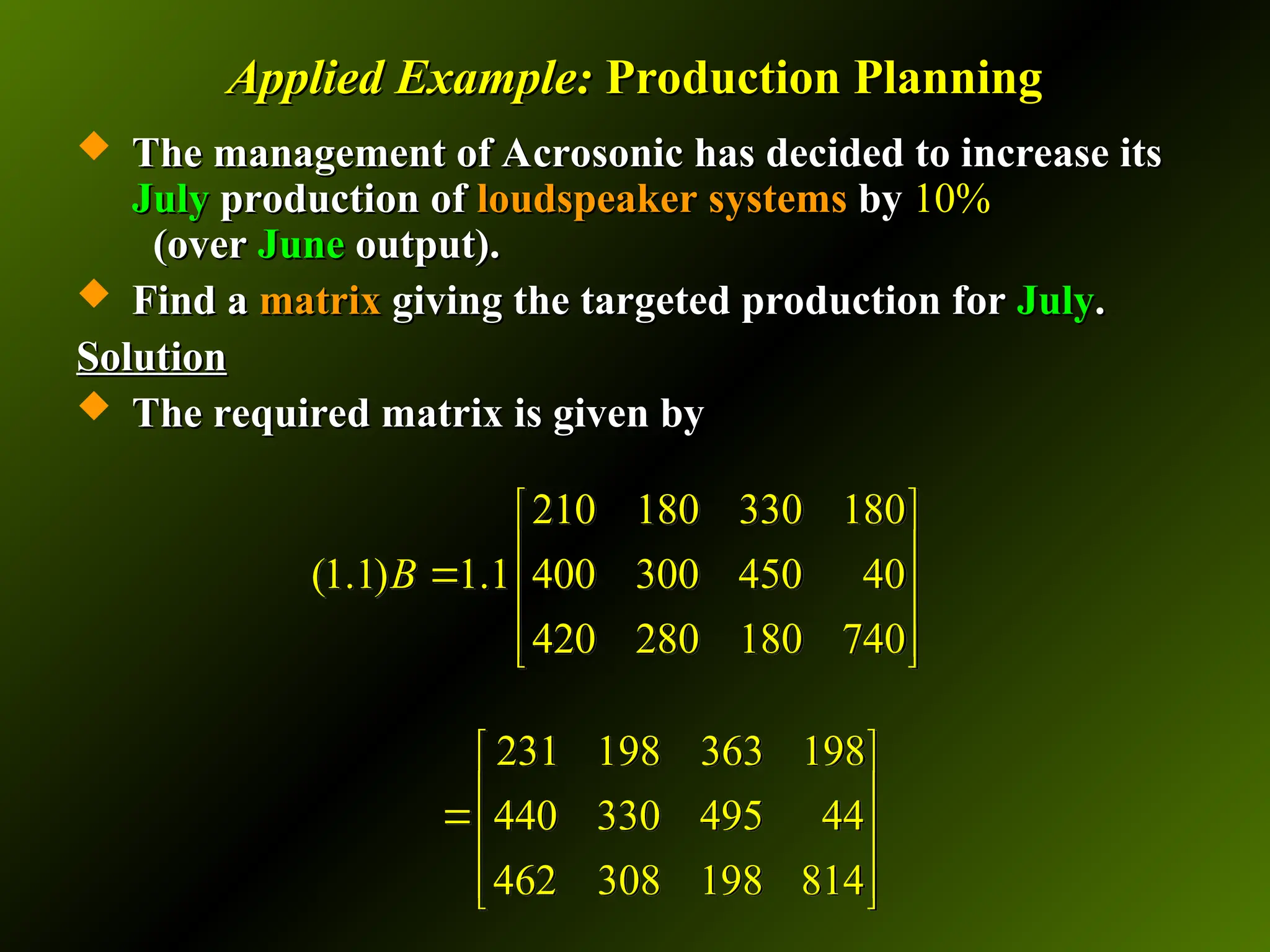
 The required matrix is given by
The required matrix is given by
210 180 330 180
(1.1) 1.1 400 300 450 40
420 280 180 740
B
 
 

 
 
 
231 198 363 198
440 330 495 44
462 308 198 814
 
 

 
 
 
5.5
5.5
Multiplication of Matrices
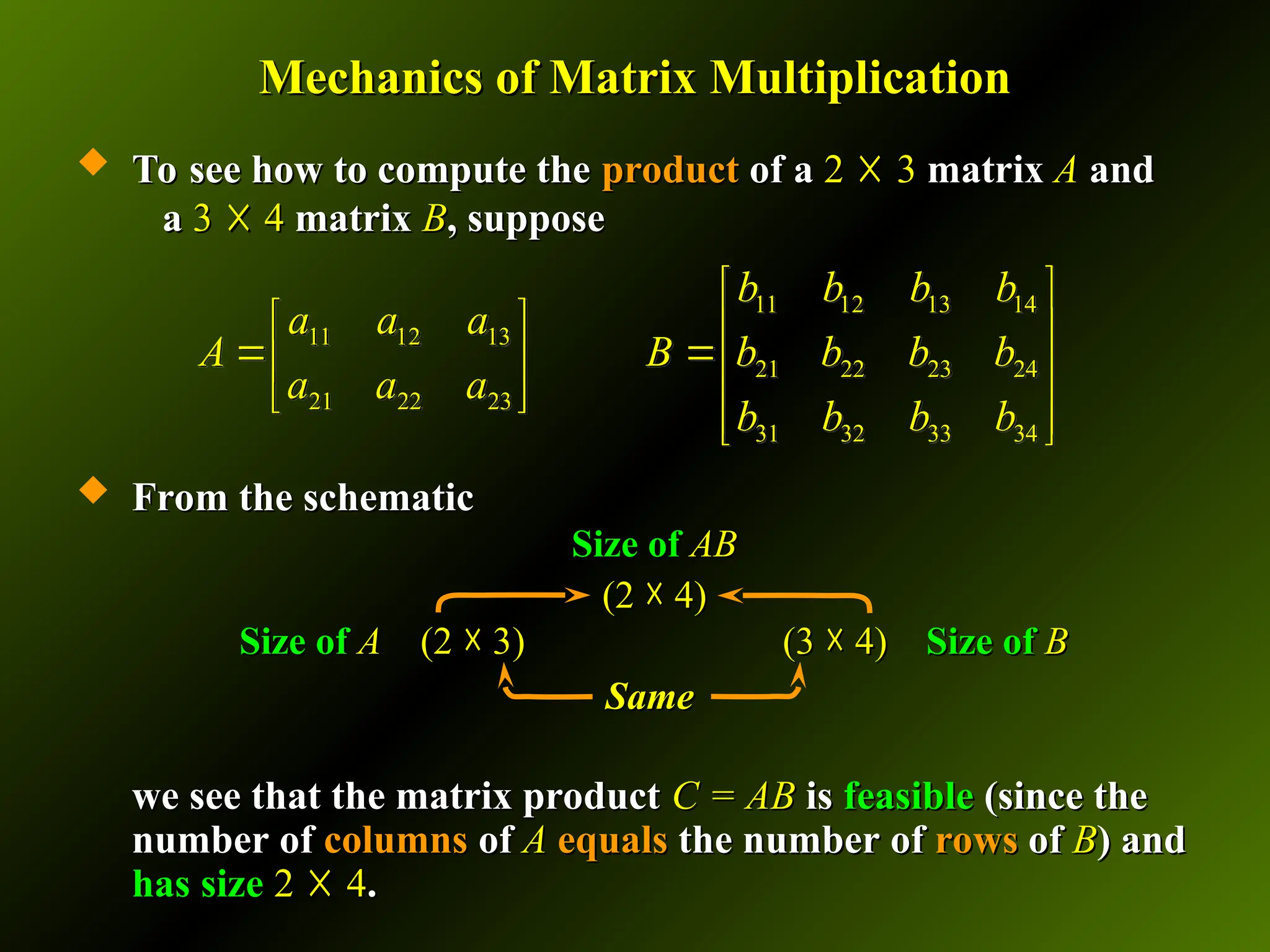
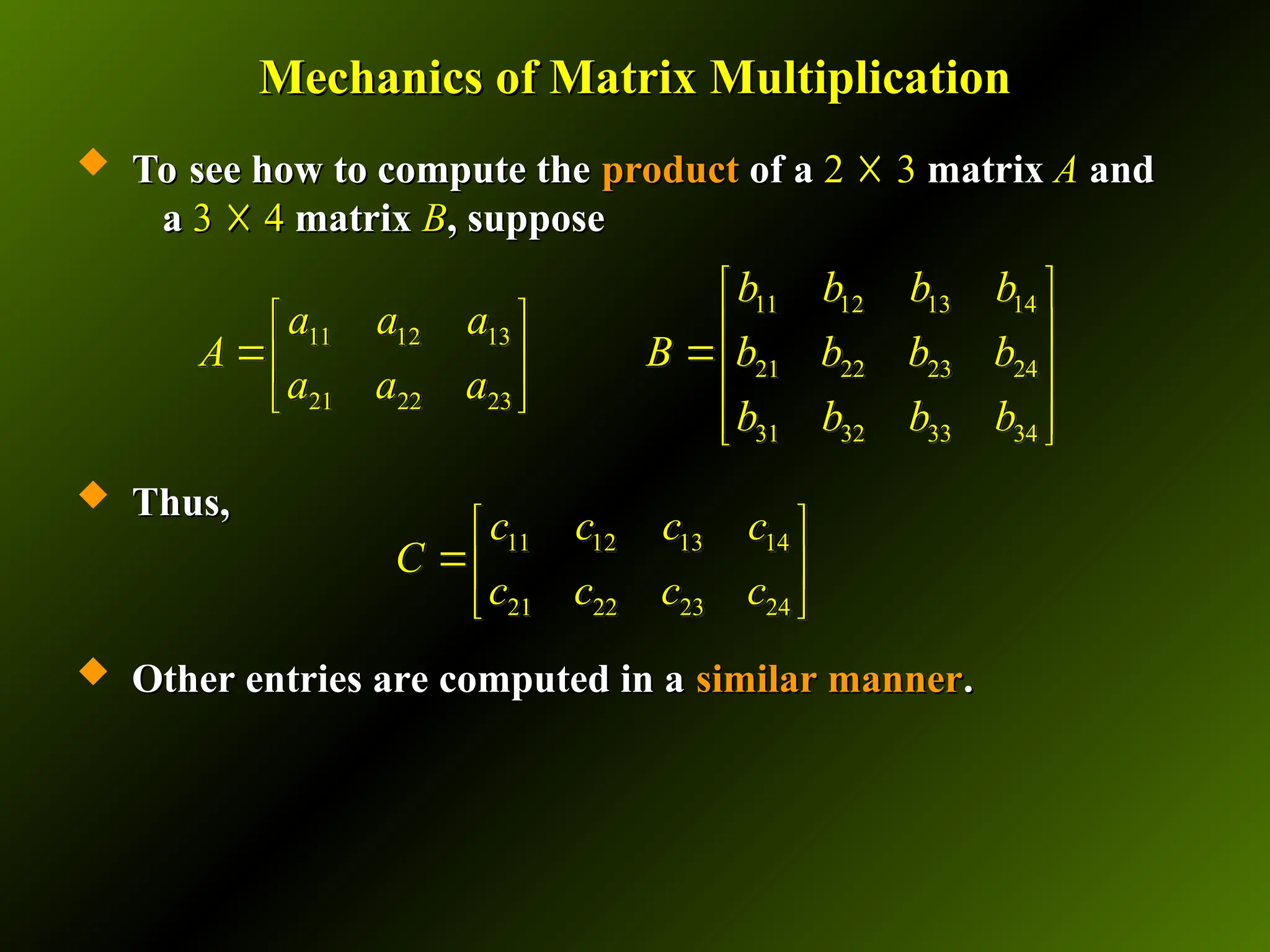
11 12 13 14
11 12 13
21 22 23 24
21 22 23
31 32 33 34
b b b b
a a a
A B b b b b
a a a
b b b b
 
   
 
   
   
 
11 12 13 14
11 12 13
21 22 23 24
21 22 23
31 32 33 34
b b b b
a a a
A B b b b b
a a a
b b b b
 
   
 
   
   
 
Size of A (2 ☓ 3) (3 ☓ 4) Size of B
(2 ☓ 4)
Size of AB
Same
Multiplying a Row Matrix by a Column Matrix
 If we have a
If we have a row matrix
row matrix of size
of size 1
1☓
☓ n
n,
,
 And a
And a column matrix
column matrix of size
of size n
n ☓
☓ 1
1,
,
 Then we may define the
Then we may define the matrix product
matrix product of
of A
A and
and B
B, written
, written
AB
AB, by
, by
1 2 3
[ ]
n
A a a a a
 


1
2
3
n
b
b
B b
b
 
 
 
 

 
 
 
 

1
2
1 2 3 3 1 1 2 2 3 3
[ ]
n n n
n
b
b
AB a a a a b a b a b a b a b
b
 
 
 
 
 

    


 
 
 
 

Example
Example
 Let
Let
 Find the matrix product
Find the matrix product AB
AB.
.
Solution
Solution
2
3
[1 2 3 5]
0
1
a d
n
A B
 
 
 
  
 
 

 
2
3
[1 2 3 5] (1)(2) ( 2)(3) (3)(0) (5)( 1) 9
0
1
AB
 
 
 
        
 
 

 
Dimensions Requirement
for Matrices Being Multiplied
 Note from the last example that for the multiplication to
Note from the last example that for the multiplication to
be
be feasible
feasible, the
, the number of columns
number of columns of the
of the row matrix
row matrix A
A
must be equal
must be equal to the
to the number of rows
number of rows of the
of the column
column
matrix
matrix B
B.
.
Dimensions of the Product Matrix
 From last example, note that the
From last example, note that the product matrix
product matrix AB
AB has
has
size
size 1
1 ☓
☓ 1
1.
.
 This has to do with the fact that we are multiplying a
This has to do with the fact that we are multiplying a row
row
matrix
matrix with a
with a column matrix
column matrix.
.
 We can establish the
We can establish the dimensions
dimensions of a
of a product matrix
product matrix
schematically:
schematically:
Size of
Size of A
A (1
(1 ☓
☓ n
n)
) (
(n
n ☓
☓ 1
1)
) Size of
Size of B
B
Size of
Size of AB
AB
(
(1
1 ☓
☓ 1
1)
)
Same
Same
Dimensions of the Product Matrix
 More generally, if
More generally, if A
A is a matrix of size
is a matrix of size m
m ☓
☓ n
n and
and B
B is a
is a
matrix of size
matrix of size n
n ☓
☓ p
p, then the
, then the matrix product
matrix product of
of A
A and
and B
B,
,
AB
AB, is defined and is a matrix of
, is defined and is a matrix of size m
m ☓
☓ p
p.
.
 Schematically:
Schematically:
 The
The number of columns
number of columns of
of A
A must be the
must be the same
same as the
as the
number of rows
number of rows of
of B
B for the multiplication to be
for the multiplication to be feasible
feasible.
.
Size of
Size of A
A (
(m
m ☓
☓ n
n)
) (
(n
n ☓
☓ p
p)
) Size of
Size of B
B
Size of
Size of AB
AB
(
(m
m ☓
☓ p
p)
)
Same
Same
Mechanics of Matrix Multiplication
 To see how to compute the
To see how to compute the product
product of a
of a 2
2 ☓
☓ 3
3 matrix
matrix A
A and
and
a
a 3
3 ☓
☓ 4
4 matrix
matrix B
B, suppose
, suppose
 From the schematic
From the schematic
we see that the matrix product
we see that the matrix product C = AB
C = AB is
is feasible
feasible (since the
(since the
number of
number of columns
columns of
of A
A equals
equals the number of
the number of rows
rows of
of B
B) and
) and
has size
has size 2
2 ☓
☓ 4
4.
.
11 12 13 14
11 12 13
21 22 23 24
21 22 23
31 32 33 34
b b b b
a a a
A B b b b b
a a a
b b b b
 
   
 
   
   
 
Size of
Size of A
A (2 3
☓
(2 3
☓ )
) (3 4
☓
(3 4
☓ )
) Size of
Size of B
B
Size of
Size of AB
AB
(
(2
2 ☓
☓ 4
4)
)
Same
Same
Mechanics of Matrix Multiplication
 To see how to compute the
To see how to compute the product
product of a
of a 2
2 ☓
☓ 3
3 matrix
matrix A
A and
and
a
a 3
3 ☓
☓ 4
4 matrix
matrix B
B, suppose
, suppose
 Thus,
Thus,
 To see how to
To see how to calculate the entries
calculate the entries of
of C
C consider
consider entry
entry c
c11
11:
:
11 12 13 14
21 22 23 24
c c c c
C
c c c c
 
 
 
11
11 11 12 13 21 11 11 12 21 13 31
31
[ ]
b
c a a a b a b a b a b
b
 
 
   
 
 
 
11 12 13 14
11 12 13
21 22 23 24
21 22 23
31 32 33 34
b b b b
a a a
A B b b b b
a a a
b b b b
 
   
 
   
   
 
Mechanics of Matrix Multiplication
 To see how to compute the
To see how to compute the product
product of a
of a 2
2 ☓
☓ 3
3 matrix
matrix A
A and
and
a
a 3
3 ☓
☓ 4
4 matrix
matrix B
B, suppose
, suppose
 Thus,
Thus,
 Now consider calculating the
Now consider calculating the entry
entry c
c12
12:
:
11 12 13 14
21 22 23 24
c c c c
C
c c c c
 
 
 
12
12 11 12 13 22 11 12 12 22 13 32
32
[ ]
b
c a a a b a b a b a b
b
 
 
   
 
 
 
11 12 13 14
11 12 13
21 22 23 24
21 22 23
31 32 33 34
b b b b
a a a
A B b b b b
a a a
b b b b
 
   
 
   
   
 
Mechanics of Matrix Multiplication
 To see how to compute the
To see how to compute the product
product of a
of a 2
2 ☓
☓ 3
3 matrix
matrix A
A and
and
a
a 3
3 ☓
☓ 4
4 matrix
matrix B
B, suppose
, suppose
 Thus,
Thus,
 Now consider calculating the
Now consider calculating the entry
entry c
c21
21:
:
11 12 13 14
21 22 23 24
c c c c
C
c c c c
 
 
 
11
21 21 22 23 21 21 11 22 21 23 31
31
[ ]
b
c a a a b a b a b a b
b
 
 
   
 
 
 
11 12 13 14
11 12 13
21 22 23 24
21 22 23
31 32 33 34
b b b b
a a a
A B b b b b
a a a
b b b b
 
   
 
   
   
 
Mechanics of Matrix Multiplication
 To see how to compute the
To see how to compute the product
product of a
of a 2
2 ☓
☓ 3
3 matrix
matrix A
A and
and
a
a 3
3 ☓
☓ 4
4 matrix
matrix B
B, suppose
, suppose
 Thus,
Thus,
 Other entries are computed in a
Other entries are computed in a similar manner
similar manner.
.
11 12 13 14
21 22 23 24
c c c c
C
c c c c
 
 
 
11 12 13 14
11 12 13
21 22 23 24
21 22 23
31 32 33 34
b b b b
a a a
A B b b b b
a a a
b b b b
 
   
 
   
   
 
Example
Example
 Let
Let
 Compute
Compute AB
AB.
.
Solution
Solution
 Since the
Since the number of columns
number of columns of
of A
A is
is equal
equal to the
to the number
number
of rows
of rows of
of B
B, the matrix product
, the matrix product C = AB
C = AB is defined
is defined.
.
 The
The size
size of
of C
C is
is 2
2 ☓
☓ 3
3.
.
1 3 3
3 1 4
4 1 2
1 2 3
2 4 1
A B

 
   
  
   

 
 
 
Example
Example
 Let
Let
 Compute
Compute AB
AB.
.
Solution
Solution
 Thus,
Thus,
 Calculate all entries for
Calculate all entries for C
C:
:
1 3 3
3 1 4
4 1 2
1 2 3
2 4 1
A B

 
   
  
   

 
 
 
11 12 13
21 22 23
1 3 3
3 1 4
4 1 2
1 2 3
2 4 1
c c c
C AB
c c c

 
 
   
    
   

   
 
 
11
1
[3 1 4] 4 (3)(1) (1)(4) (4)(2) 15
2
c
 
 
    
 
 
 
Example
Example
 Let
Let
 Compute
Compute AB
AB.
.
Solution
Solution
 Thus,
Thus,
 Calculate all entries for
Calculate all entries for C
C:
:
1 3 3
3 1 4
4 1 2
1 2 3
2 4 1
A B

 
   
  
   

 
 
 
12 13
21 22 23
1 3 3
15
3 1 4
4 1 2
1 2 3
2 4 1
c c
C AB
c c c

 
 
   
    
   

   
 
 
12
3
[3 1 4] 1 (3)(3) (1)( 1) (4)(4) 24
4
c
 
 
      
 
 
 
Example
Example
 Let
Let
 Compute
Compute AB
AB.
.
Solution
Solution
 Thus,
Thus,
 Calculate all entries for
Calculate all entries for C
C:
:
1 3 3
3 1 4
4 1 2
1 2 3
2 4 1
A B

 
   
  
   

 
 
 
13
21 22 23
1 3 3
15 24
3 1 4
4 1 2
1 2 3
2 4 1
c
C AB
c c c

 
 
   
    
   

   
 
 
13
3
[3 1 4] 2 (3)( 3) (1)(2) (4)(1) 3
1
c

 
 
     
 
 
 
Example
Example
 Let
Let
 Compute
Compute AB
AB.
.
Solution
Solution
 Thus,
Thus,
 Calculate all entries for
Calculate all entries for C
C:
:
1 3 3
3 1 4
4 1 2
1 2 3
2 4 1
A B

 
   
  
   

 
 
 
21 22 23
1 3 3
15 24 3
3 1 4
4 1 2
1 2 3
2 4 1
C AB
c c c

 

 
   
    
   

   
 
 
21
1
[ 1 2 3] 4 ( 1)(1) (2)(4) (3)(2) 13
2
c
 
 
      
 
 
 
Example
Example
 Let
Let
 Compute
Compute AB
AB.
.
Solution
Solution
 Thus,
Thus,
 Calculate all entries for
Calculate all entries for C
C:
:
1 3 3
3 1 4
4 1 2
1 2 3
2 4 1
A B

 
   
  
   

 
 
 
22 23
1 3 3
15 24 3
3 1 4
4 1 2
13
1 2 3
2 4 1
C AB
c c

 

 
   
    
   

   
 
 
22
3
[ 1 2 3] 1 ( 1)(3) (2)( 1) (3)(4) 7
4
c
 
 
        
 
 
 
Example
Example
 Let
Let
 Compute
Compute AB
AB.
.
Solution
Solution
 Thus,
Thus,
 Calculate all entries for
Calculate all entries for C
C:
:
1 3 3
3 1 4
4 1 2
1 2 3
2 4 1
A B

 
   
  
   

 
 
 
23
1 3 3
15 24 3
3 1 4
4 1 2
13 7
1 2 3
2 4 1
C AB
c

 

 
   
    
   

   
 
 
23
3
[ 1 2 3] 2 ( 1)( 3) (2)(2) (3)(1) 10
1
c

 
 
       
 
 
 
Example
Example
 Let
Let
 Compute
Compute AB
AB.
.
Solution
Solution
 Thus,
Thus,
1 3 3
3 1 4
4 1 2
1 2 3
2 4 1
A B

 
   
  
   

 
 
 
1 3 3
3 1 4 15 24 3
4 1 2
1 2 3 13 7 10
2 4 1
C AB

 

   
 
   
   
 

   
 
 
Laws for Matrix Multiplication
 If the
If the products
products and
and sums
sums are defined for the
are defined for the
matrices
matrices A
A,
, B
B, and
, and C
C, then
, then
1.
1. (
(AB
AB)
)C
C =
= A
A(
(BC
BC)
) Associative law
Associative law
2.
2. A
A(
(B
B +
+ C
C) =
) = AB
AB +
+ AC
AC Distributive law
Distributive law
Identity Matrix
Identity Matrix
 The
The identity matrix
identity matrix of
of size
size n
n is given by
is given by
n
n rows
rows
n
n columns
columns
1 0 0
0 1 0
0 0 1
n
I



 
 



 

 
 



 
   
Properties of the Identity Matrix
 The
The identity matrix
identity matrix has the
has the properties
properties that
that
✦ I
In
n A
A =
= A
A for any
for any n
n ☓
☓ r
r matrix
matrix A
A.
.
✦ BI
BIn
n =
= B
B for any
for any s
s ☓
☓ n
n matrix
matrix B
B.
.
✦ In particular, if
In particular, if A
A is a
is a square matrix
square matrix of
of
size
size n
n, then
, then
n n
I A AI A
 
Example
Example
 Let
Let
 Then
Then
 So,
So, I
I3
3A
A =
= AI
AI3
3 =
= A
A.
.
1 3 1
4 3 2
1 0 1
A
 
 
 
 
 
 
3
1 0 0 1 3 1 1 3 1
0 1 0 4 3 2 4 3 2
0 0 1 1 0 1 1 0 1
I A A
     
     
    
     
     
     
3
1 3 1 1 0 0 1 3 1
4 3 2 0 1 0 4 3 2
1 0 1 0 0 1 1 0 1
AI A
     
     
    
     
     
     
Matrix Representation
 A system of linear equations
A system of linear equations can be expressed in the form
can be expressed in the form
of
of an equation of matrices
an equation of matrices. Consider the system
. Consider the system
 The
The coefficients
coefficients on the left-hand side of the equation can
on the left-hand side of the equation can
be expressed as
be expressed as matrix
matrix A
A below, the
below, the variables
variables as
as matrix
matrix X
X,
,
and the
and the constants
constants on right-hand side of the equation as
on right-hand side of the equation as
matrix
matrix B
B:
:
2 4 6
3 6 5 1
3 7 0
x y z
x y z
x y z
  
   
  
2 4 1 6
3 6 5 1
1 3 7 0
x
A X y B
z

     
     
     
     

     
     
Matrix Representation
 A system of linear equations
A system of linear equations can be expressed in the form
can be expressed in the form
of
of an equation of matrices
an equation of matrices. Consider the system
. Consider the system
 The
The matrix representation
matrix representation of the system of linear
of the system of linear
equations is given by
equations is given by AX
AX =
= B
B, or
, or
2 4 6
3 6 5 1
3 7 0
x y z
x y z
x y z
  
   
  
2 4 1 6
3 6 5 1
1 3 7 0
x
y
z

     
     
   
     

     
     
Matrix Representation
 A system of linear equations
A system of linear equations can be expressed in the form
can be expressed in the form
of
of an equation of matrices
an equation of matrices. Consider the system
. Consider the system
 To confirm this, we can
To confirm this, we can multiply the two matrices
multiply the two matrices on the
on the
left-hand side
left-hand side of the equation, obtaining
of the equation, obtaining
which, by matrix equality, is easily seen to be
which, by matrix equality, is easily seen to be equivalent
equivalent to
to
the given
the given system of linear equations
system of linear equations.
.
2 4 6
3 6 5 1
3 7 0
x y z
x y z
x y z
  
   
  
2 4 6
3 6 5 1
3 7 0
x y z
x y z
x y z
 
   
   
    
   
 
   
   
5.6
5.6
The Inverse of a Square Matrix
(3)(1) ( 1)(2) ( 1)( 1) 2
( 4)(1) (2)(2) (1)( 1) 1
( 1)(1) (0)(2) (1)( 1) 2
    
   
   
     
   
    
   
   
(3)(1) ( 1)(2) ( 1)( 1) 2
( 4)(1) (2)(2) (1)( 1) 1
( 1)(1) (0)(2) (1)( 1) 2
    
   
   
     
   
    
   
   
x
y
z
 
  
 
 
 
x
y
z
 
  
 
 
 
Inverse of a Matrix
Inverse of a Matrix
 Let
Let A
A be a
be a square matrix
square matrix of size
of size n
n.
.
 A
A square matrix
square matrix A
A–1
–1
of size
of size n
n such that
such that
is called the
is called the inverse of
inverse of A
A.
.
 Not every matrix has an inverse.
Not every matrix has an inverse.
✦ A square matrix that
A square matrix that has
has an inverse is
an inverse is
said to be
said to be nonsingular
nonsingular.
.
✦ A square matrix that
A square matrix that does not have
does not have an
an
inverse is said to be
inverse is said to be singular
singular.
.
1 1
n
A A AA I
 
 
Example:
Example: A Nonsingular Matrix
A Nonsingular Matrix
 The matrix
The matrix has
has a matrix
a matrix
as its
as its inverse
inverse.
.
 This can be demonstrated by
This can be demonstrated by multiplying them
multiplying them:
:
1 2
3 4
A
 
 
 
1
3 1
2 2
2 1
A

 
 

 
1
3 1
2 2
2 1
1 2 1 0
3 4 0 1
AA I


 
   
  
 
   

   
 
1
3 1
2 2
2 1 1 2 1 0
3 4 0 1
A A I


     
  
     
    
 
Example:
Example: A Singular Matrix
A Singular Matrix
 The matrix
The matrix does
does not
not have
have an
an inverse
inverse.
.
 If
If B
B had an inverse given by
had an inverse given by where
where
a
a,
, b
b,
, c
c, and
, and d
d are some appropriate numbers, then
are some appropriate numbers, then by
by
definition
definition of an
of an inverse
inverse we would have
we would have BB
BB–1
–1
=
= I
I.
.
 That is
That is
implying
implying that
that 0 = 1,
0 = 1, which is
which is impossible
impossible!
!
0 1
0 0
B
 
 
 
0 1 1 0
0 0 0 1
1 0
0 0 0 1
a b
c d
c d
     

     
     
   

   
   
1
a b
B
c d
  
 
 
Finding the Inverse of a Square Matrix
 Given the
Given the n
n ☓
☓ n
n matrix
matrix A
A:
:
1.
1. Adjoin the
Adjoin the n
n ☓
☓ n
n identity matrix
identity matrix I
I to obtain
to obtain
the
the augmented matrix
augmented matrix [
[A
A |
| I
I ]
].
.
2.
2. Use a sequence of
Use a sequence of row operations
row operations to
to reduce
reduce
[
[A
A |
| I
I ]
] to the form
to the form [
[I
I |
| B
B]
] if possible.
if possible.
 Then the matrix
Then the matrix B
B is the
is the inverse
inverse of
of A
A.
.
Example
Example
 Find the inverse of the matrix
Find the inverse of the matrix
Solution
Solution
 We form the
We form the augmented matrix
augmented matrix
2 1 1
3 2 1
2 1 2
A
 
 

 
 
 
2 1 1 1 0 0
3 2 1 0 1 0
2 1 2 0 0 1
 
 
 
 
 
Example
Example
 Find the inverse of the matrix
Find the inverse of the matrix
Solution
Solution
 And use the
And use the Gauss-Jordan elimination method
Gauss-Jordan elimination method to
to reduce it
reduce it
to the form
to the form [
[I
I |
| B
B]
]:
:
2 1 1
3 2 1
2 1 2
A
 
 

 
 
 
2 1 1 1 0 0
3 2 1 0 1 0
2 1 2 0 0 1
 
 
 
 
 
1 2
R R

Toggle slides
Toggle slides
back and forth to
back and forth to
compare before
compare before
and changes
and changes
Example
Example
 Find the inverse of the matrix
Find the inverse of the matrix
Solution
Solution
 And use the
And use the Gauss-Jordan elimination method
Gauss-Jordan elimination method to
to reduce it
reduce it
to the form
to the form [
[I
I |
| B
B]
]:
:
2 1 1
3 2 1
2 1 2
A
 
 

 
 
 
1 1 0 1 1 0
3 2 1 0 1 0
2 1 2 0 0 1
  
 
 
 
 
 
1 2
R R

1
2 3
3 1
3
2
R
R R
R R



Toggle slides
Toggle slides
back and forth to
back and forth to
compare before
compare before
and changes
and changes
Example
Example
 Find the inverse of the matrix
Find the inverse of the matrix
Solution
Solution
 And use the
And use the Gauss-Jordan elimination method
Gauss-Jordan elimination method to
to reduce it
reduce it
to the form
to the form [
[I
I |
| B
B]
]:
:
2 1 1
3 2 1
2 1 2
A
 
 

 
 
 
1 1 0 1 1 0
0 1 1 3 2 0
0 1 2 2 2 1

 
 
 
 
 
 
 
1
2 3
3 1
3
2
R
R R
R R



1 2
2
3 2
R R
R
R R



Toggle slides
Toggle slides
back and forth to
back and forth to
compare before
compare before
and changes
and changes
1 2
2
3 2
R R
R
R R



Example
Example
 Find the inverse of the matrix
Find the inverse of the matrix
Solution
Solution
 And use the
And use the Gauss-Jordan elimination method
Gauss-Jordan elimination method to
to reduce it
reduce it
to the form
to the form [
[I
I |
| B
B]
]:
:
2 1 1
3 2 1
2 1 2
A
 
 

 
 
 
1 0 1 2 1 0
0 1 1 3 2 0
0 0 1 1 0 1

 
 
 
 
 

 
1 3
2 3
R R
R R


Toggle slides
Toggle slides
back and forth to
back and forth to
compare before
compare before
and changes
and changes
Example
Example
 Find the inverse of the matrix
Find the inverse of the matrix
Solution
Solution
 And use the
And use the Gauss-Jordan elimination method
Gauss-Jordan elimination method to
to reduce it
reduce it
to the form
to the form [
[I
I |
| B
B]
]:
:
2 1 1
3 2 1
2 1 2
A
 
 

 
 
 
1 0 0 3 1 1
0 1 0 4 2 1
0 0 1 1 0 1
 
 
 

 
 

 
1 3
2 3
R R
R R


I
In
n B
B
Toggle slides
Toggle slides
back and forth to
back and forth to
compare before
compare before
and changes
and changes
Example
Example
 Find the inverse of the matrix
Find the inverse of the matrix
Solution
Solution
 Thus, the
Thus, the inverse
inverse of
of A
A is the matrix
is the matrix
2 1 1
3 2 1
2 1 2
A
 
 

 
 
 
3 1 1
4 2 1
1 0 1
 
 
 

 

 
 
1
A

A Formula for the Inverse of a
A Formula for the Inverse of a 2
2 ☓
☓ 2
2 Matrix
Matrix
 Let
Let
 Suppose
Suppose D
D =
= ad – bc
ad – bc is
is not
not equal to
equal to zero
zero.
.
 Then
Then A
A–1
–1
exists and is given by
a b
A
c d
 
 
 
1 1 d b
A
c a
D


 
  

 
Example
Example
 Find the inverse of
Find the inverse of
Solution
Solution
 We first
We first identify
identify a
a,
, b
b,
, c
c, and
, and d
d as being
as being 1
1,
, 2
2,
, 3
3, and
, and 4
4
respectively.
respectively.
 We then
We then compute
compute
D
D =
= ad – bc
ad – bc = (1)(4) – (2)(3) = 4 – 6 = –
= (1)(4) – (2)(3) = 4 – 6 = – 2
2
1 2
3 4
A
 
 
 
Example
Example
 Find the inverse of
Find the inverse of
Solution
Solution
 Next, we
Next, we substitute
substitute the
the values
values 1
1,
, 2
2,
, 3
3, and
, and 4
4 instead of
instead of
a
a,
, b
b,
, c
c, and
, and d
d, respectively, in the formula
, respectively, in the formula matrix
matrix
to obtain
to obtain the
the matrix
matrix
1 2
3 4
A
 
 
 
4 2
3 1

 
 

 
d b
c a

 
 

 
Example
Example
 Find the inverse of
Find the inverse of
Solution
Solution
 Finally,
Finally, multiplying
multiplying this matrix by
this matrix by 1/
1/D
D, we obtain
, we obtain
1 2
3 4
A
 
 
 
1
3 1
2 2
2 1
4 2
1 1
3 1
2
d b
A
c a
D


   
   
   
    
 

     
Using Inverses to Solve Systems of Equations
 If
If AX
AX =
= B
B is a
is a linear system
linear system of
of n
n equations
equations
in
in n
n unknowns
unknowns and if
and if A
A–1
–1
exists, then
exists, then
X
X =
= A
A–1
–1
B
B
is the
is the unique solution
unique solution of the system.
of the system.
Example
Example
 Solve the system of linear equations
Solve the system of linear equations
Solution
Solution
 Write the system of equations in the form
Write the system of equations in the form AX
AX =
= B
B where
where
2 1
3 2 2
2 2 1
x y z
x y z
x y z
  
  
  
1
2
1
x
X y B
z
   
   
 
   

   
   
2 1 1
3 2 1
2 1 2
A
 
 

 
 
 
Example
Example
 Solve the system of linear equations
Solve the system of linear equations
Solution
Solution
 Find the inverse matrix of
Find the inverse matrix of A
A:
:
2 1
3 2 2
2 2 1
x y z
x y z
x y z
  
  
  
1
2
1
x
X y B
z
   
   
 
   

   
   
2 1 1
3 2 1
2 1 2
A
 
 

 
 
 
1
3 1 1
4 2 1
1 0 1
A
 
 
 
 
 
 

 
Example
Example
 Solve the system of linear equations
Solve the system of linear equations
Solution
Solution
 Finally, we write the matrix equation
Finally, we write the matrix equation X
X =
= A
A–1
–1
B
B and multiply:
and multiply:
2 1
3 2 2
2 2 1
x y z
x y z
x y z
  
  
  
x
y
z
 
  
 
 
 
3 1 1 1
4 2 1 2
1 0 1 1
 
   
   

   
 
   
   
Example
Example
 Solve the system of linear equations
Solve the system of linear equations
Solution
Solution
 Finally, we write the matrix equation
Finally, we write the matrix equation X
X =
= A
A–1
–1
B
B and multiply:
and multiply:
 Thus, the solution is
Thus, the solution is x
x = 2
= 2,
, y
y = –1
= –1, and
, and z
z = –2
= –2.
.
2 1
3 2 2
2 2 1
x y z
x y z
x y z
  
  
  
(3)(1) ( 1)(2) ( 1)( 1) 2
( 4)(1) (2)(2) (1)( 1) 1
( 1)(1) (0)(2) (1)( 1) 2
    
   
   
     
   
    
   
   
x
y
z
 
  
 
 
 
End of
End of
Chapter
Chapter

Systems of Linear Equations and Matrices.ppt

  • 1.
    5 5  Systems ofLinear Equations: Systems of Linear Equations: ✦ An Introduction An Introduction ✦ Unique Solutions Unique Solutions ✦ Underdetermined and Underdetermined and Overdetermined Systems Overdetermined Systems  Matrices Matrices  Multiplication of Matrices Multiplication of Matrices  The Inverse of a Square Matrix The Inverse of a Square Matrix Systems of Linear Equations and Matrices Systems of Linear Equations and Matrices
  • 2.
    5.1 5.1 Systems of LinearEquations: Systems of Linear Equations: An Introduction An Introduction 1 1 2 2 3 3 4 4 5 5 6 6 6 6 5 5 4 4 3 3 2 2 1 1 – –1 1 y y x x (2, 3) (2, 3) 2 1 x y   2 1 x y   3 2 12 x y   3 2 12 x y  
  • 3.
    Systems of Equations Systemsof Equations  Recall that a Recall that a system of two linear equations in two system of two linear equations in two variables variables may be written in the general form may be written in the general form where where a a, , b b, , c c, , d d, , h h, and , and k k are are real numbers real numbers and neither and neither a a and and b b nor nor c c and and d d are both zero. are both zero.  Recall that the graph of each equation in the system is a Recall that the graph of each equation in the system is a straight line straight line in the plane, so that geometrically, the in the plane, so that geometrically, the solution solution to the system is the to the system is the point(s) of intersection point(s) of intersection of the of the two straight lines two straight lines L L1 1 and and L L2 2, represented by the first and , represented by the first and second equations of the system. second equations of the system. ax by h cx dy k    
  • 4.
    Systems of Equations Systemsof Equations  Given the two straight lines Given the two straight lines L L1 1 and and L L2 2, , one and only one one and only one of of the following may occur: the following may occur: 1. 1. L L1 1 and and L L2 2 intersect at intersect at exactly one point exactly one point. . y y x x L L1 1 L L2 2 Unique Unique solution solution ( (x x1 1, , y y1 1) ) ( (x x1 1, , y y1 1) ) x x1 1 y y1 1
  • 5.
    Systems of Equations Systemsof Equations  Given the two straight lines Given the two straight lines L L1 1 and and L L2 2, , one and only one one and only one of of the following may occur: the following may occur: 2. 2. L L1 1 and and L L2 2 are are coincident coincident. . y y x x L L1 1, , L L2 2 Infinitely Infinitely many many solutions solutions
  • 6.
    Systems of Equations Systemsof Equations  Given the two straight lines Given the two straight lines L L1 1 and and L L2 2, , one and only one one and only one of of the following may occur: the following may occur: 3. 3. L L1 1 and and L L2 2 are are parallel parallel. . y y x x L L1 1 L L2 2 No No solution solution
  • 7.
    Example: Example: A System ofEquations With Exactly One Solution A System of Equations With Exactly One Solution  Consider the system Consider the system  Solving Solving the the first equation first equation for for y y in terms of in terms of x x, we obtain , we obtain  Substituting Substituting this expression for this expression for y y into the into the second equation second equation yields yields 2 1 3 2 12 x y x y     2 1 y x   3 2(2 1) 12 3 4 2 12 7 14 2 x x x x x x        
  • 8.
    Example: Example: A System ofEquations With Exactly One Solution A System of Equations With Exactly One Solution  Finally, Finally, substituting substituting this value of this value of x x into the into the expression for expression for y y obtained earlier gives obtained earlier gives  Therefore, the Therefore, the unique solution unique solution of the system is given by of the system is given by x x = 2 = 2 and and y y = 3 = 3. . 2 1 2(2) 1 3 y x     
  • 9.
    1 1 2 2 3 34 4 5 5 6 6 6 6 5 5 4 4 3 3 2 2 1 1 – –1 1 Example: Example: A System of Equations With Exactly One Solution A System of Equations With Exactly One Solution  Geometrically Geometrically, the , the two lines two lines represented by the two represented by the two equations that make up the system equations that make up the system intersect intersect at the at the point point (2, 3) (2, 3): : y y x x (2, 3) (2, 3) 2 1 x y   3 2 12 x y  
  • 10.
    Example: Example: A System ofEquations With Infinitely Many Solutions A System of Equations With Infinitely Many Solutions  Consider the system Consider the system  Solving Solving the the first equation first equation for for y y in terms of in terms of x x, we obtain , we obtain  Substituting Substituting this expression for this expression for y y into the into the second equation second equation yields yields which is a which is a true statement true statement. .  This result follows from the fact that the This result follows from the fact that the second equation second equation is is equivalent equivalent to the to the first first. . 2 1 6 3 3 x y x y     2 1 y x   6 3(2 1) 3 6 6 3 3 0 0 x x x x       
  • 11.
    Example: Example: A System ofEquations With Infinitely Many Solutions A System of Equations With Infinitely Many Solutions  Thus, any Thus, any order pair of numbers order pair of numbers ( (x x, , y y) ) satisfying the satisfying the equation equation y y = = 2 2x x – 1 – 1 constitutes a constitutes a solution to the system solution to the system. .  By By assigning the value assigning the value t t to to x x, where , where t t is any real number, is any real number, we find that we find that y y = = 2 2t t – 1 – 1 and so the ordered pair and so the ordered pair ( (t t, 2 , 2t t – 1) – 1) is a is a solution to the system solution to the system. .  The variable The variable t t is called a is called a parameter parameter. .  For example: For example: ✦ Setting Setting t t = 0 = 0, gives the point , gives the point (0, –1) (0, –1) as as a a solution solution of the of the system. system. ✦ Setting Setting t t = 1 = 1, gives the point , gives the point (1, 1) (1, 1) as as another solution another solution of of the system. the system.
  • 12.
    6 6 5 5 4 4 3 3 2 2 1 1 – –1 1 1 1 2 2 3 34 4 5 5 6 6 Example: Example: A System of Equations With Infinitely Many Solutions A System of Equations With Infinitely Many Solutions  Since Since t t represents represents any real number any real number, there are , there are infinitely infinitely many solutions many solutions of the system. of the system.  Geometrically, the Geometrically, the two equations two equations in the system represent in the system represent the same line the same line, and , and all solutions all solutions of the system are of the system are points points lying on the line lying on the line: : y y x x 2 1 6 3 3 x y x y    
  • 13.
    Example: Example: A System ofEquations That Has No Solution A System of Equations That Has No Solution  Consider the system Consider the system  Solving Solving the the first equation first equation for for y y in terms of in terms of x x, we obtain , we obtain  Substituting Substituting this expression for this expression for y y into the into the second equation second equation yields yields which is which is clearly clearly impossible impossible. .  Thus, there is Thus, there is no solution no solution to the system of equations. to the system of equations. 2 1 6 3 12 x y x y     2 1 y x   6 3(2 1) 12 6 6 3 12 0 9 x x x x       
  • 14.
    1 1 2 2 3 34 4 5 5 6 6 Example: Example: A System of Equations That Has No Solution A System of Equations That Has No Solution  To interpret the situation To interpret the situation geometrically geometrically, cast both , cast both equations in the equations in the slope-intercept form slope-intercept form, obtaining , obtaining y y = 2 = 2x x – 1 – 1 and and y y = 2 = 2x x – 4 – 4 which shows that the lines are which shows that the lines are parallel parallel. .  Graphically: Graphically: 6 6 5 5 4 4 3 3 2 2 1 1 – –1 1 y y x x 2 1 x y   6 3 12 x y  
  • 15.
    5.2 5.2 Systems of LinearEquations: Systems of Linear Equations: Unique Solutions Unique Solutions 3 2 8 9 2 2 1 3 1 2 3 8              3 2 8 9 2 2 1 3 1 2 3 8              3 2 8 9 2 2 3 2 3 8 x y z x y z x y z           3 2 8 9 2 2 3 2 3 8 x y z x y z x y z           1 0 0 3 0 1 0 4 0 0 1 1           1 0 0 3 0 1 0 4 0 0 1 1          
  • 16.
    The Gauss-Jordan Method TheGauss-Jordan Method  The Gauss-Jordan elimination method is a The Gauss-Jordan elimination method is a technique technique for for solving systems of linear equations solving systems of linear equations of any size. of any size.  The operations of the Gauss-Jordan method are The operations of the Gauss-Jordan method are 1. 1. Interchange Interchange any two equations. any two equations. 2. 2. Replace Replace an equation by a an equation by a nonzero constant multiple nonzero constant multiple of of itself. itself. 3. 3. Replace Replace an equation by the an equation by the sum sum of that equation and a of that equation and a constant multiple of any other equation constant multiple of any other equation. .
  • 17.
    Example Example  Solve thefollowing system of equations: Solve the following system of equations: Solution Solution  First, we transform this system into an equivalent system First, we transform this system into an equivalent system in which the coefficient of in which the coefficient of x x in the in the first equation first equation is is 1 1: : 2 4 6 22 3 8 5 27 2 2 x y z x y z x y z           2 4 6 22 3 8 5 27 2 2 x y z x y z x y z           Multiply the Multiply the equation by equation by 1/2 1/2 Toggle slides Toggle slides back and forth to back and forth to compare before compare before and changes and changes
  • 18.
    Example Example  Solve thefollowing system of equations: Solve the following system of equations: Solution Solution  First, we transform this system into an equivalent system First, we transform this system into an equivalent system in which the coefficient of in which the coefficient of x x in the in the first equation first equation is is 1 1: : 2 4 6 22 3 8 5 27 2 2 x y z x y z x y z           2 3 11 3 8 5 27 2 2 x y z x y z x y z           Multiply the first Multiply the first equation by equation by 1/2 1/2 Toggle slides Toggle slides back and forth to back and forth to compare before compare before and changes and changes
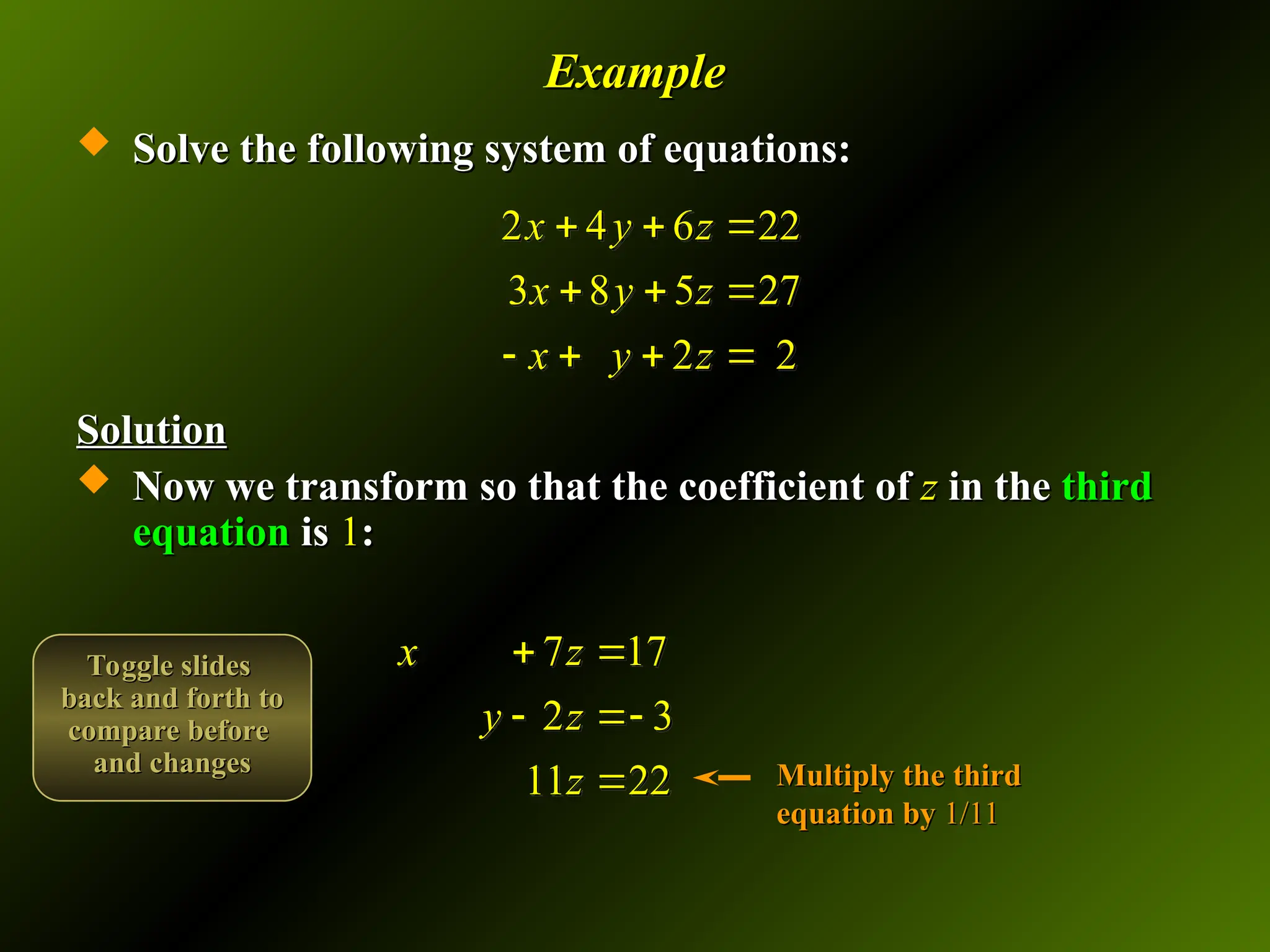
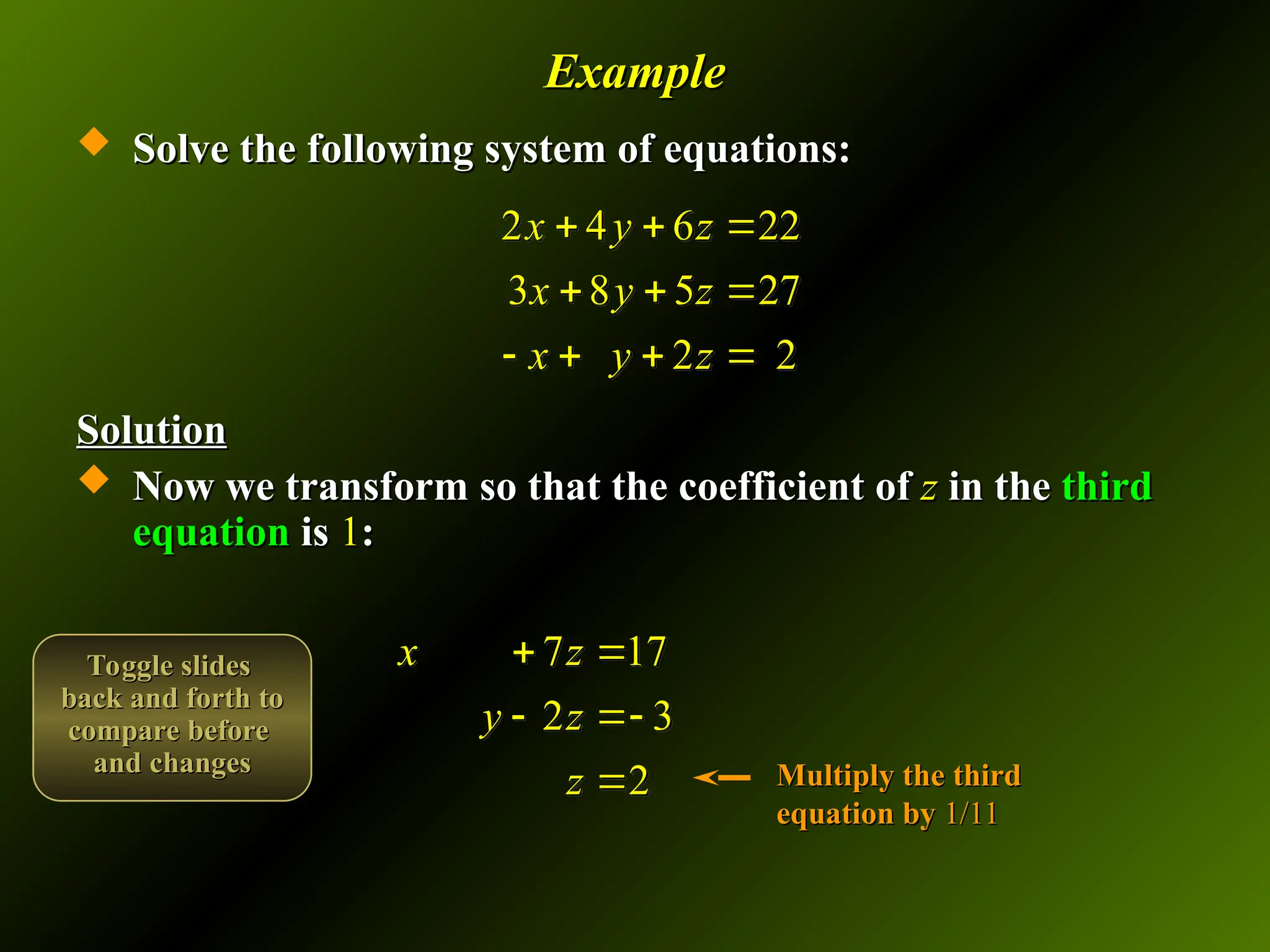
  • 19.
    Example Example  Solve thefollowing system of equations: Solve the following system of equations: Solution Solution  Next, we Next, we eliminate eliminate the variable the variable x x from all equations except from all equations except the first: the first: 2 4 6 22 3 8 5 27 2 2 x y z x y z x y z           2 3 11 3 8 5 27 2 2 x y z x y z x y z           Replace by the sum of Replace by the sum of – 3 – 3 X X the first equation the first equation + + the second the second equation equation Toggle slides Toggle slides back and forth to back and forth to compare before compare before and changes and changes
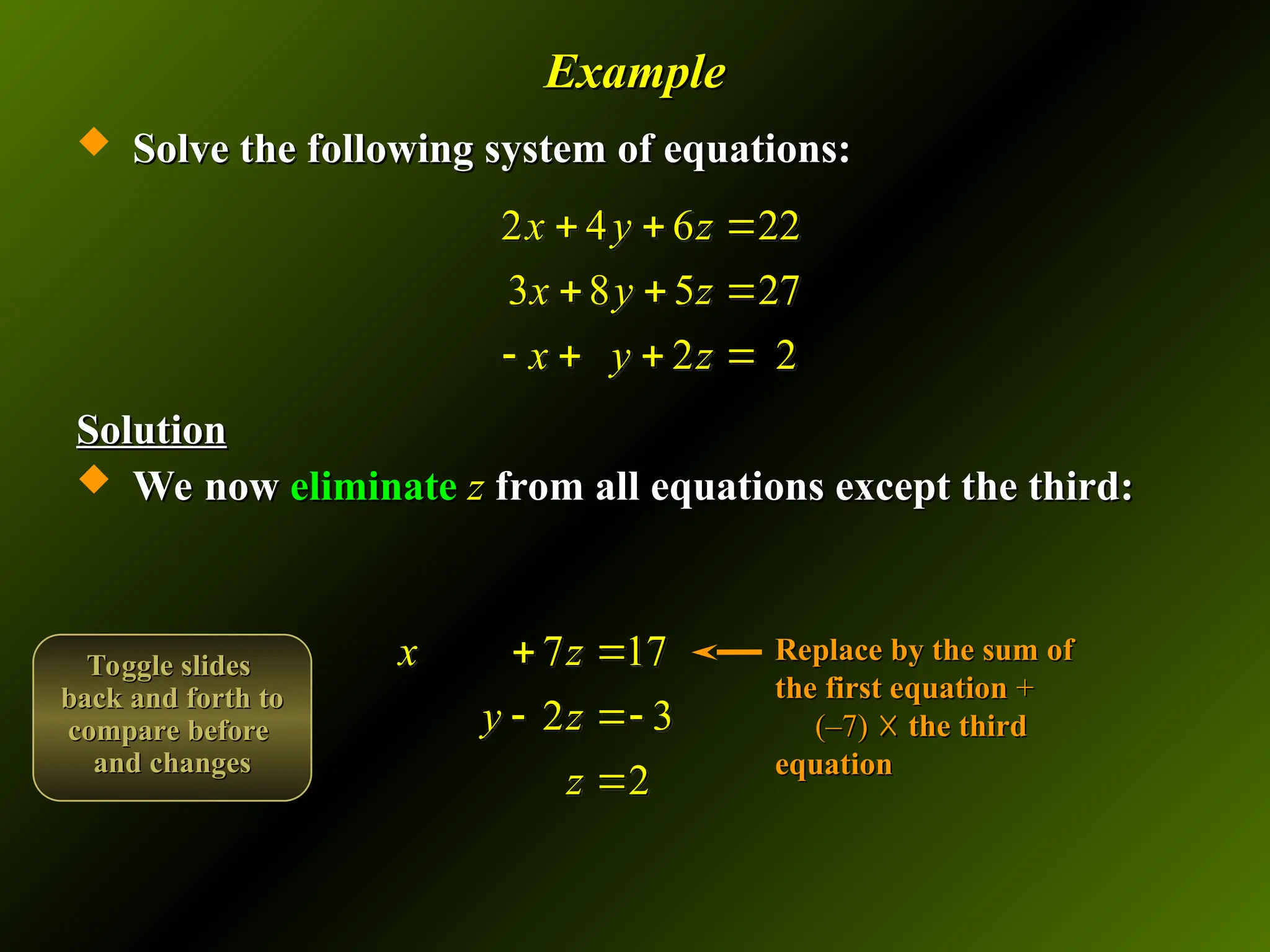
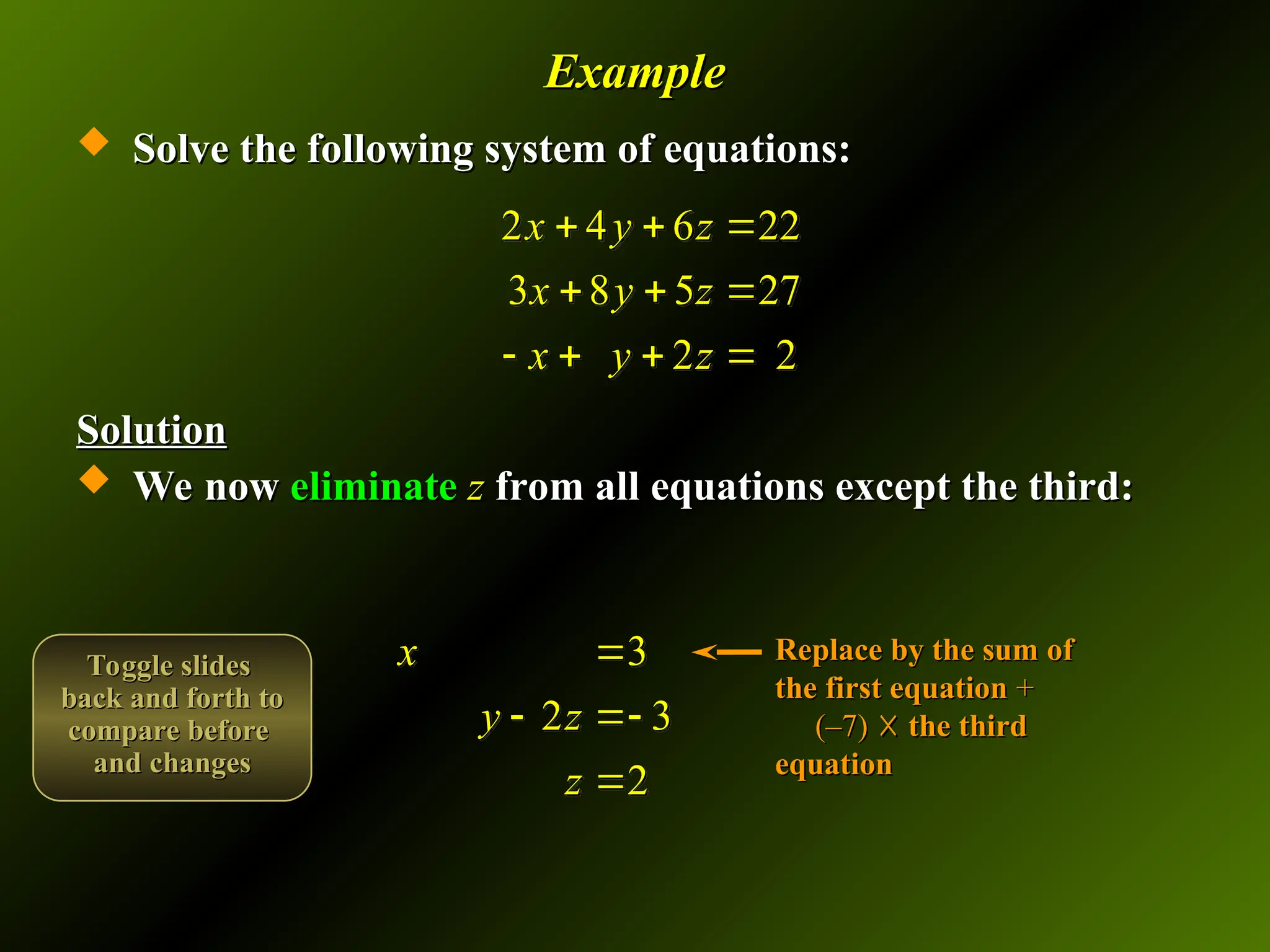
  • 20.
    Example Example  Solve thefollowing system of equations: Solve the following system of equations: Solution Solution  Next, we Next, we eliminate eliminate the variable the variable x x from all equations except from all equations except the first: the first: 2 4 6 22 3 8 5 27 2 2 x y z x y z x y z           2 3 11 2 4 6 2 2 x y z y z x y z          Replace by the sum of Replace by the sum of – 3 – 3 ☓ ☓ the first the first equation equation + + the the second equation second equation Toggle slides Toggle slides back and forth to back and forth to compare before compare before and changes and changes
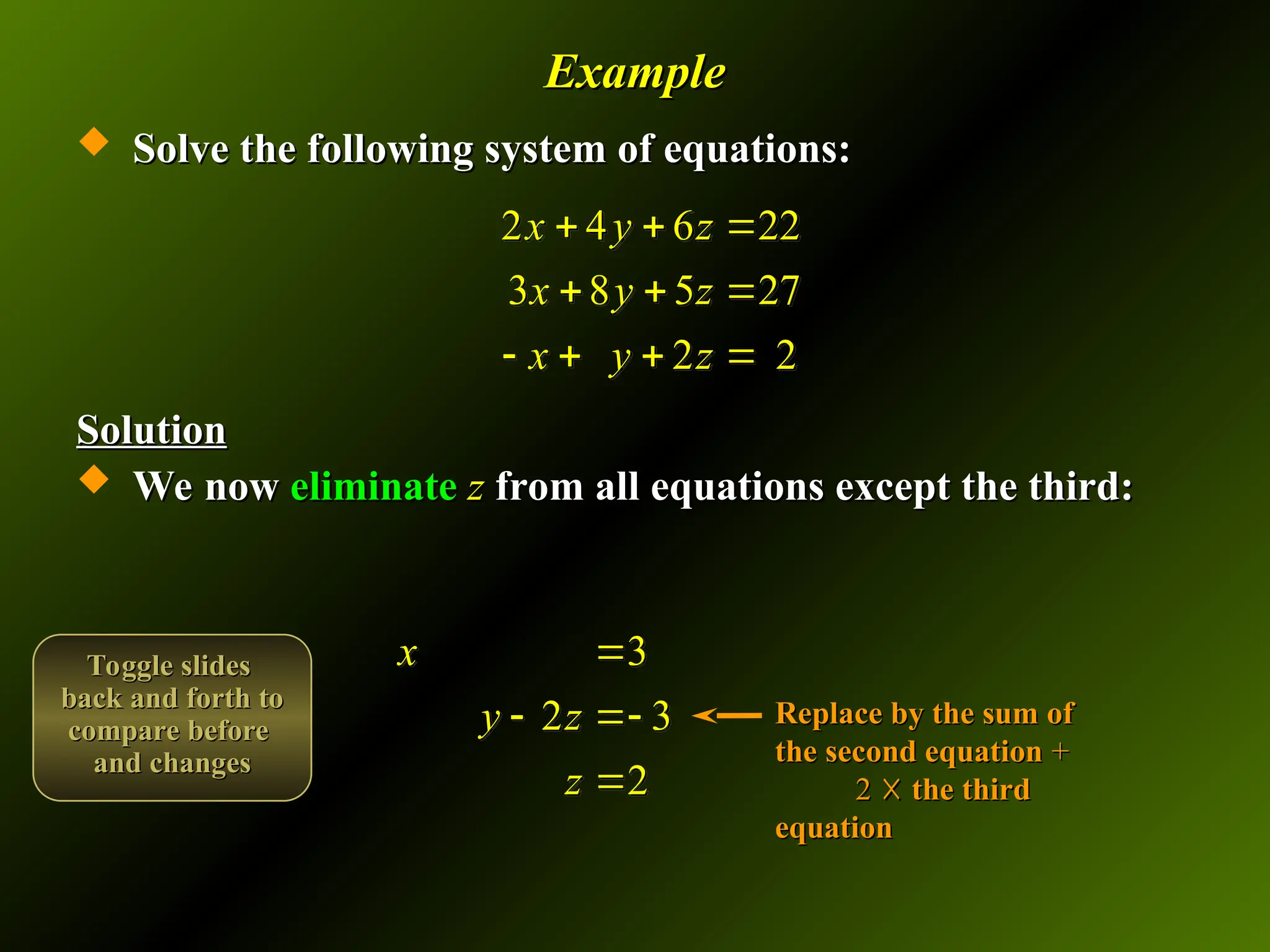
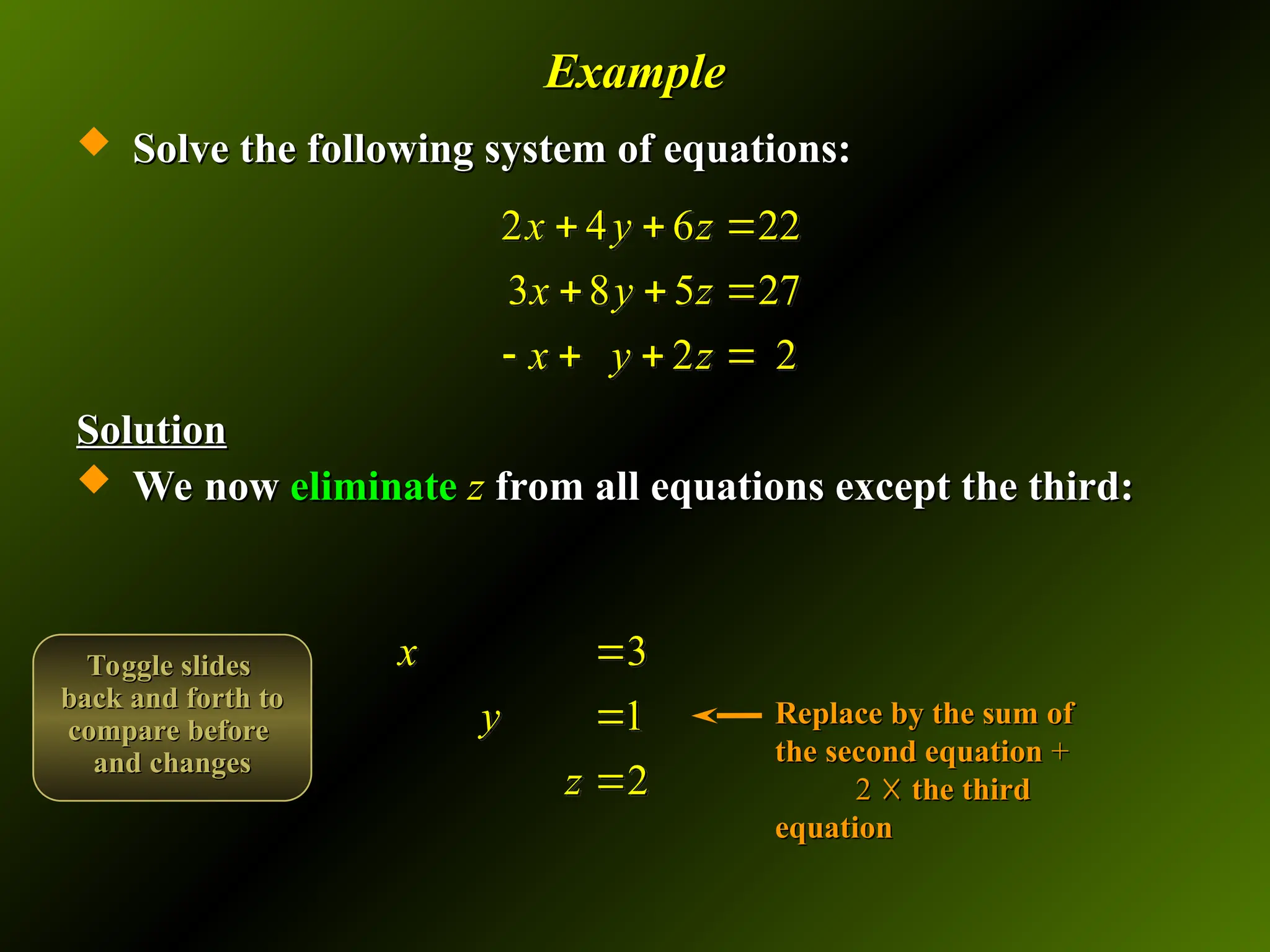
  • 21.
    Example Example  Solve thefollowing system of equations: Solve the following system of equations: Solution Solution  Next, we Next, we eliminate eliminate the variable the variable x x from all equations except from all equations except the first: the first: 2 4 6 22 3 8 5 27 2 2 x y z x y z x y z           2 3 11 2 4 6 2 2 x y z y z x y z          Replace by the sum Replace by the sum of the first equation of the first equation + + the third equation the third equation Toggle slides Toggle slides back and forth to back and forth to compare before compare before and changes and changes
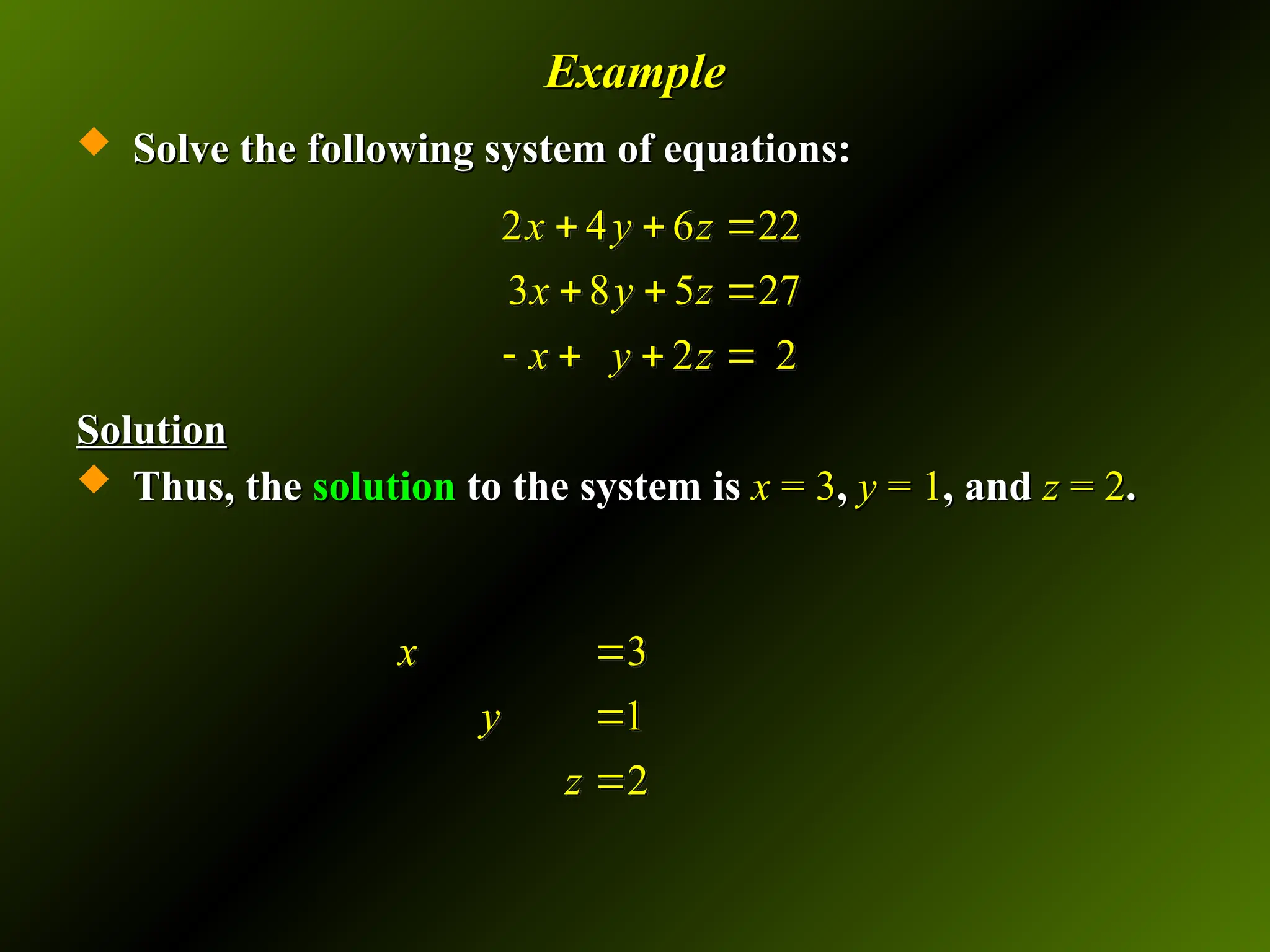
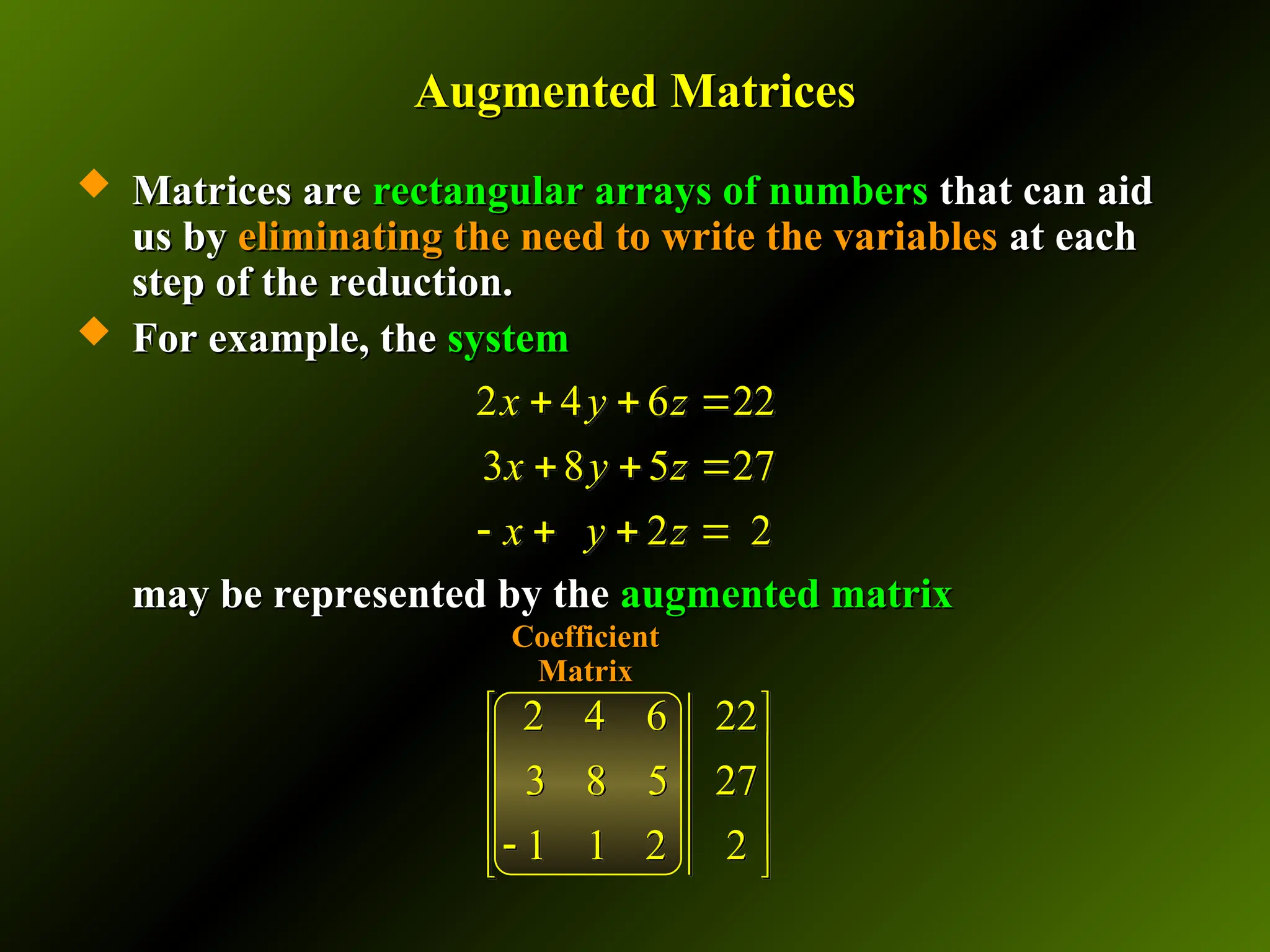
  • 22.
    Example Example  Solve thefollowing system of equations: Solve the following system of equations: Solution Solution  Next, we Next, we eliminate eliminate the variable the variable x x from all equations except from all equations except the first: the first: 2 4 6 22 3 8 5 27 2 2 x y z x y z x y z           2 3 11 2 4 6 3 5 13 x y z y z y z        Replace by the sum Replace by the sum of the first equation of the first equation + + the third equation the third equation Toggle slides Toggle slides back and forth to back and forth to compare before compare before and changes and changes
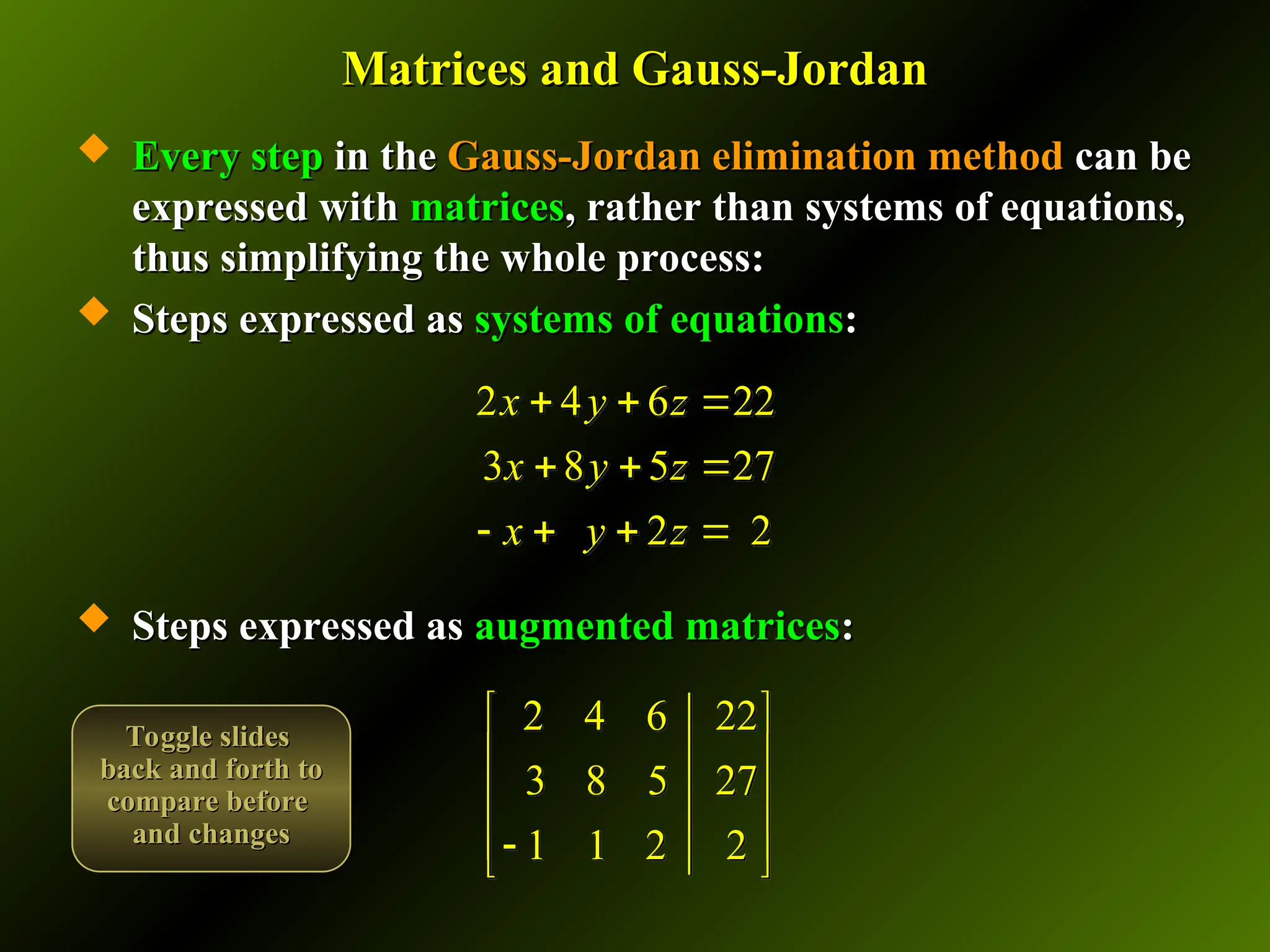
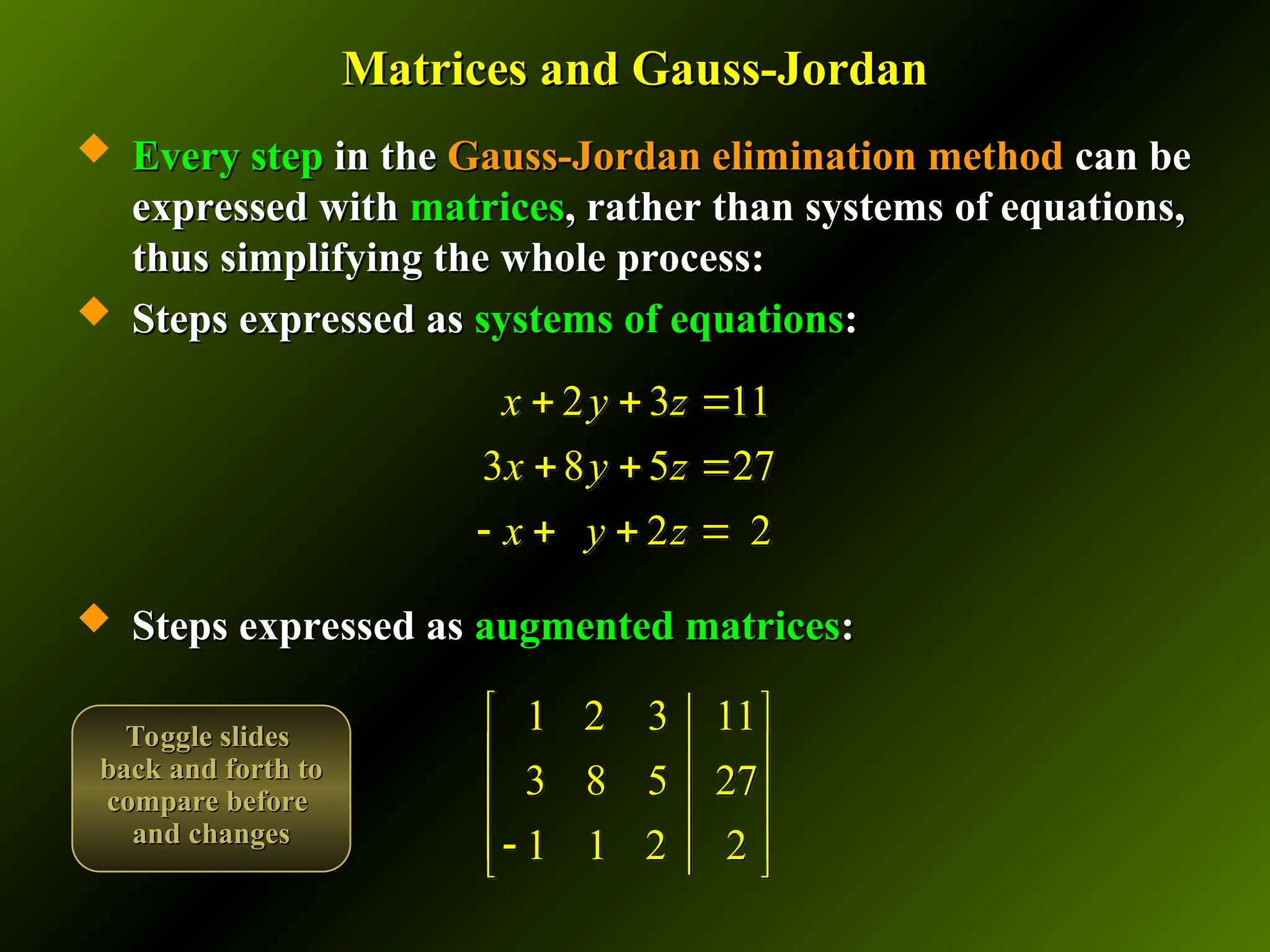
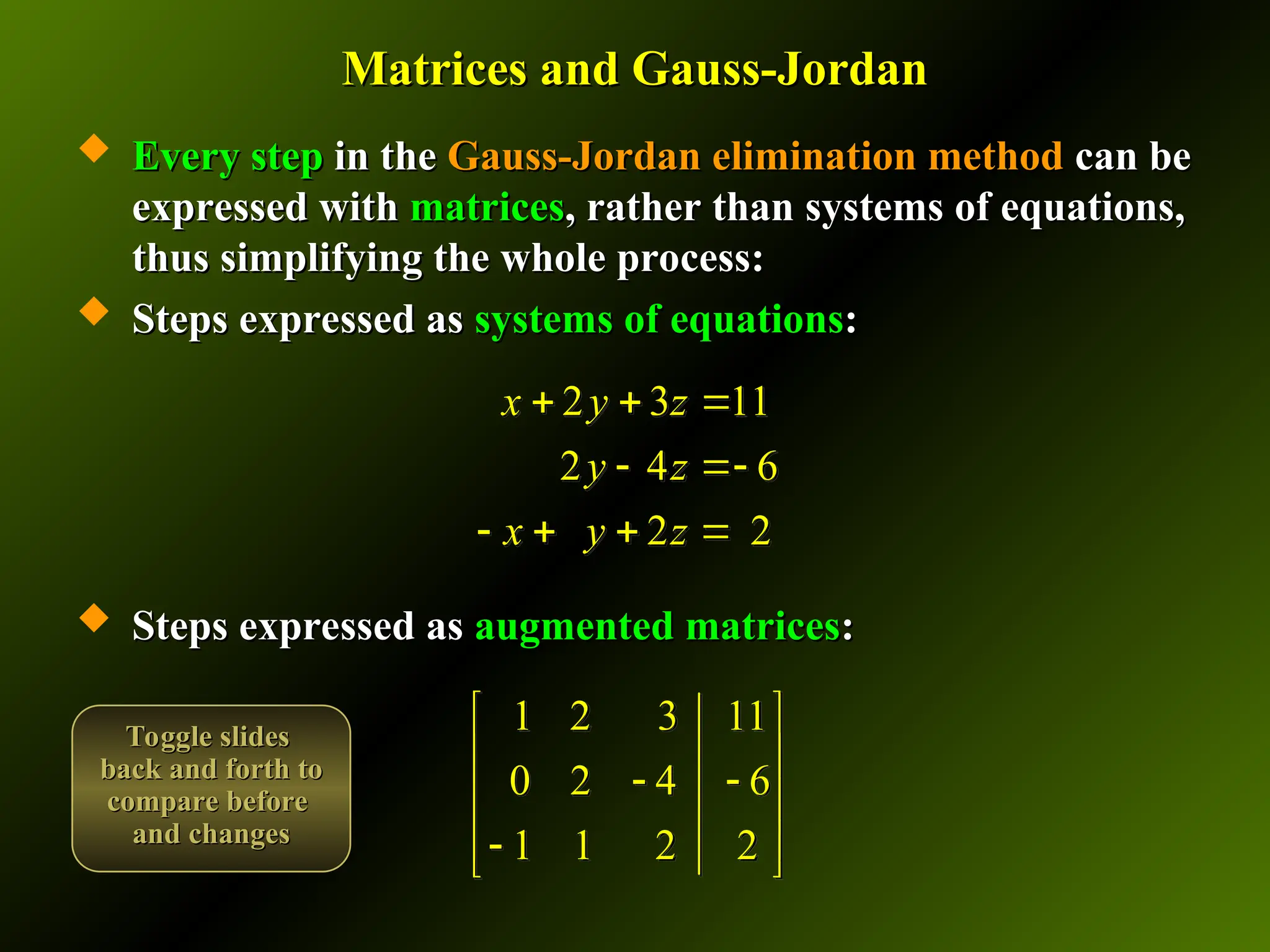
  • 23.
    Example Example  Solve thefollowing system of equations: Solve the following system of equations: Solution Solution  Then we transform so that the coefficient of Then we transform so that the coefficient of y y in the in the second equation second equation is is 1 1: : 2 4 6 22 3 8 5 27 2 2 x y z x y z x y z           2 3 11 2 4 6 3 5 13 x y z y z y z        Multiply the second Multiply the second equation by equation by 1/2 1/2 Toggle slides Toggle slides back and forth to back and forth to compare before compare before and changes and changes
  • 24.
    Example Example  Solve thefollowing system of equations: Solve the following system of equations: Solution Solution  Then we transform so that the coefficient of Then we transform so that the coefficient of y y in the in the second equation second equation is is 1 1: : 2 4 6 22 3 8 5 27 2 2 x y z x y z x y z           2 3 11 2 3 3 5 13 x y z y z y z        Multiply the second Multiply the second equation by equation by 1/2 1/2 Toggle slides Toggle slides back and forth to back and forth to compare before compare before and changes and changes
  • 25.
    Example Example  Solve thefollowing system of equations: Solve the following system of equations: Solution Solution  We now We now eliminate eliminate y y from all equations except the second: from all equations except the second: 2 4 6 22 3 8 5 27 2 2 x y z x y z x y z           2 3 11 2 3 3 5 13 x y z y z y z        Replace by the sum of Replace by the sum of the first equation the first equation + + (–2) (–2) ☓ ☓ the second the second equation equation Toggle slides Toggle slides back and forth to back and forth to compare before compare before and changes and changes
  • 26.
    Example Example  Solve thefollowing system of equations: Solve the following system of equations: Solution Solution  We now We now eliminate eliminate y y from all equations except the second: from all equations except the second: 2 4 6 22 3 8 5 27 2 2 x y z x y z x y z           7 17 2 3 3 5 13 x z y z y z       Replace by the sum of Replace by the sum of the first equation the first equation + + (–2) (–2) ☓ ☓ the second the second equation equation Toggle slides Toggle slides back and forth to back and forth to compare before compare before and changes and changes
  • 27.
    Example Example  Solve thefollowing system of equations: Solve the following system of equations: Solution Solution  We now We now eliminate eliminate y y from all equations except the second: from all equations except the second: 2 4 6 22 3 8 5 27 2 2 x y z x y z x y z           7 17 2 3 3 5 13 x z y z y z       Replace by the sum of Replace by the sum of the third equation the third equation + + (–3) (–3) ☓ ☓ the second the second equation equation Toggle slides Toggle slides back and forth to back and forth to compare before compare before and changes and changes
  • 28.
    Example Example  Solve thefollowing system of equations: Solve the following system of equations: Solution Solution  We now We now eliminate eliminate y y from all equations except the second: from all equations except the second: 2 4 6 22 3 8 5 27 2 2 x y z x y z x y z           7 17 2 3 11 22 x z y z z      Replace by the sum of Replace by the sum of the third equation the third equation + + (–3) (–3) ☓ ☓ the second the second equation equation Toggle slides Toggle slides back and forth to back and forth to compare before compare before and changes and changes
  • 29.
    Example Example  Solve thefollowing system of equations: Solve the following system of equations: Solution Solution  Now we transform so that the coefficient of Now we transform so that the coefficient of z z in the in the third third equation equation is is 1 1: : 2 4 6 22 3 8 5 27 2 2 x y z x y z x y z           7 17 2 3 11 22 x z y z z      Multiply the third Multiply the third equation by equation by 1/11 1/11 Toggle slides Toggle slides back and forth to back and forth to compare before compare before and changes and changes
  • 30.
    Example Example  Solve thefollowing system of equations: Solve the following system of equations: Solution Solution  Now we transform so that the coefficient of Now we transform so that the coefficient of z z in the in the third third equation equation is is 1 1: : 2 4 6 22 3 8 5 27 2 2 x y z x y z x y z           7 17 2 3 2 x z y z z      Multiply the third Multiply the third equation by equation by 1/11 1/11 Toggle slides Toggle slides back and forth to back and forth to compare before compare before and changes and changes
  • 31.
    Example Example  Solve thefollowing system of equations: Solve the following system of equations: Solution Solution  We now We now eliminate eliminate z z from all equations except the third: from all equations except the third: 2 4 6 22 3 8 5 27 2 2 x y z x y z x y z           Replace by the sum of Replace by the sum of the first equation the first equation + + (–7) (–7) ☓ ☓ the third the third equation equation 7 17 2 3 2 x z y z z      Toggle slides Toggle slides back and forth to back and forth to compare before compare before and changes and changes
  • 32.
    Example Example  Solve thefollowing system of equations: Solve the following system of equations: Solution Solution  We now We now eliminate eliminate z z from all equations except the third: from all equations except the third: 2 4 6 22 3 8 5 27 2 2 x y z x y z x y z           3 2 3 2 x y z z     Replace by the sum of Replace by the sum of the first equation the first equation + + (–7) (–7) ☓ ☓ the third the third equation equation Toggle slides Toggle slides back and forth to back and forth to compare before compare before and changes and changes
  • 33.
    Example Example  Solve thefollowing system of equations: Solve the following system of equations: Solution Solution  We now We now eliminate eliminate z z from all equations except the third: from all equations except the third: 2 4 6 22 3 8 5 27 2 2 x y z x y z x y z           3 2 3 2 x y z z     Replace by the sum of Replace by the sum of the second equation the second equation + + 2 2 ☓ ☓ the third the third equation equation Toggle slides Toggle slides back and forth to back and forth to compare before compare before and changes and changes
  • 34.
    Example Example  Solve thefollowing system of equations: Solve the following system of equations: Solution Solution  We now We now eliminate eliminate z z from all equations except the third: from all equations except the third: 2 4 6 22 3 8 5 27 2 2 x y z x y z x y z           3 1 2 x y z    Replace by the sum of Replace by the sum of the second equation the second equation + + 2 2 ☓ ☓ the third the third equation equation Toggle slides Toggle slides back and forth to back and forth to compare before compare before and changes and changes
  • 35.
    Example Example  Solve thefollowing system of equations: Solve the following system of equations: Solution Solution  Thus, the Thus, the solution solution to the system is to the system is x x = 3 = 3, , y y = 1 = 1, and , and z z = 2 = 2. . 2 4 6 22 3 8 5 27 2 2 x y z x y z x y z           3 1 2 x y z   
  • 36.
    Augmented Matrices Augmented Matrices Matrices are Matrices are rectangular arrays of numbers rectangular arrays of numbers that can aid that can aid us by us by eliminating the need to write the variables eliminating the need to write the variables at each at each step of the reduction. step of the reduction.  For example, the For example, the system system may be represented by the may be represented by the augmented augmented matrix matrix Coefficient Coefficient Matrix Matrix 2 4 6 22 3 8 5 27 2 2 x y z x y z x y z           2 4 6 22 3 8 5 27 1 1 2 2           
  • 37.
    Matrices and Gauss-Jordan Matricesand Gauss-Jordan  Every step Every step in the in the Gauss-Jordan elimination method Gauss-Jordan elimination method can be can be expressed with expressed with matrices matrices, rather than systems of equations, , rather than systems of equations, thus simplifying the whole process: thus simplifying the whole process:  Steps expressed as Steps expressed as systems of equations systems of equations: :  Steps expressed as Steps expressed as augmented matrices augmented matrices: : 2 4 6 22 3 8 5 27 2 2 x y z x y z x y z           2 4 6 22 3 8 5 27 1 1 2 2            Toggle slides Toggle slides back and forth to back and forth to compare before compare before and changes and changes
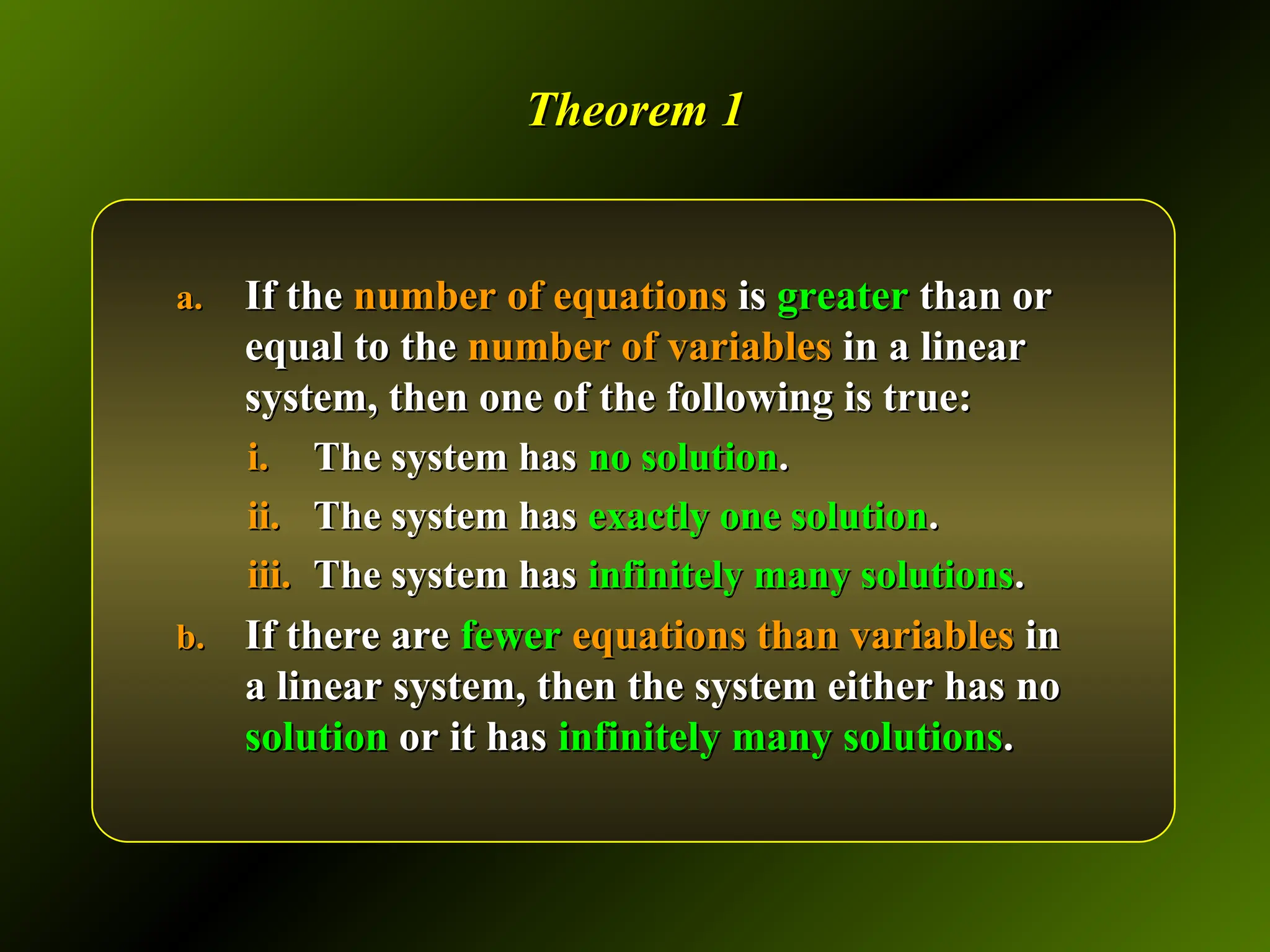
  • 38.
    Matrices and Gauss-Jordan Matricesand Gauss-Jordan  Every step Every step in the in the Gauss-Jordan elimination method Gauss-Jordan elimination method can be can be expressed with expressed with matrices matrices, rather than systems of equations, , rather than systems of equations, thus simplifying the whole process: thus simplifying the whole process:  Steps expressed as Steps expressed as systems of equations systems of equations: :  Steps expressed as Steps expressed as augmented matrices augmented matrices: : 1 2 3 11 3 8 5 27 1 1 2 2            2 3 11 3 8 5 27 2 2 x y z x y z x y z           Toggle slides Toggle slides back and forth to back and forth to compare before compare before and changes and changes
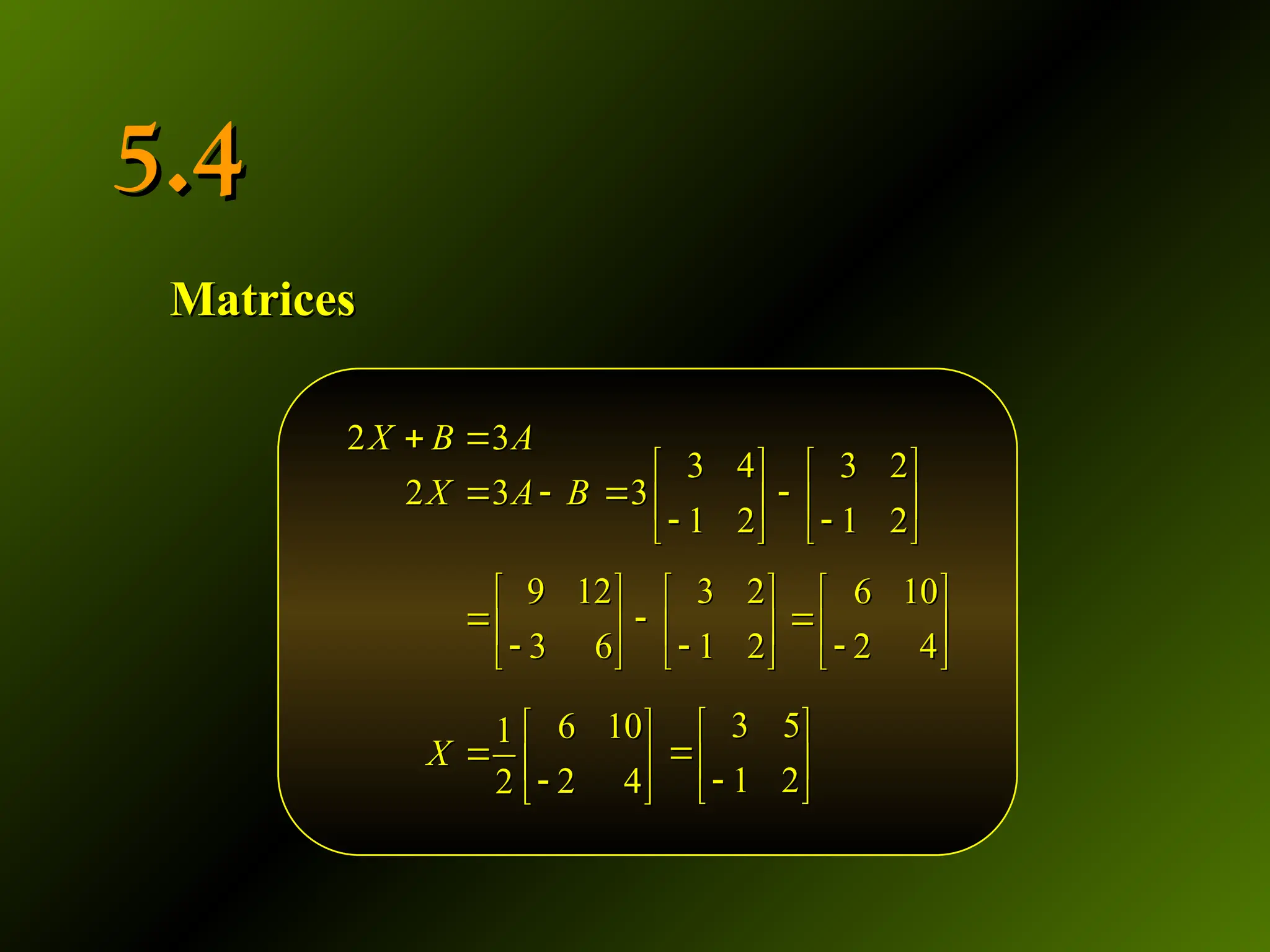
  • 39.
    Matrices and Gauss-Jordan Matricesand Gauss-Jordan  Every step Every step in the in the Gauss-Jordan elimination method Gauss-Jordan elimination method can be can be expressed with expressed with matrices matrices, rather than systems of equations, , rather than systems of equations, thus simplifying the whole process: thus simplifying the whole process:  Steps expressed as Steps expressed as systems of equations systems of equations: :  Steps expressed as Steps expressed as augmented matrices augmented matrices: : 1 2 3 11 0 2 4 6 1 1 2 2              2 3 11 2 4 6 2 2 x y z y z x y z          Toggle slides Toggle slides back and forth to back and forth to compare before compare before and changes and changes
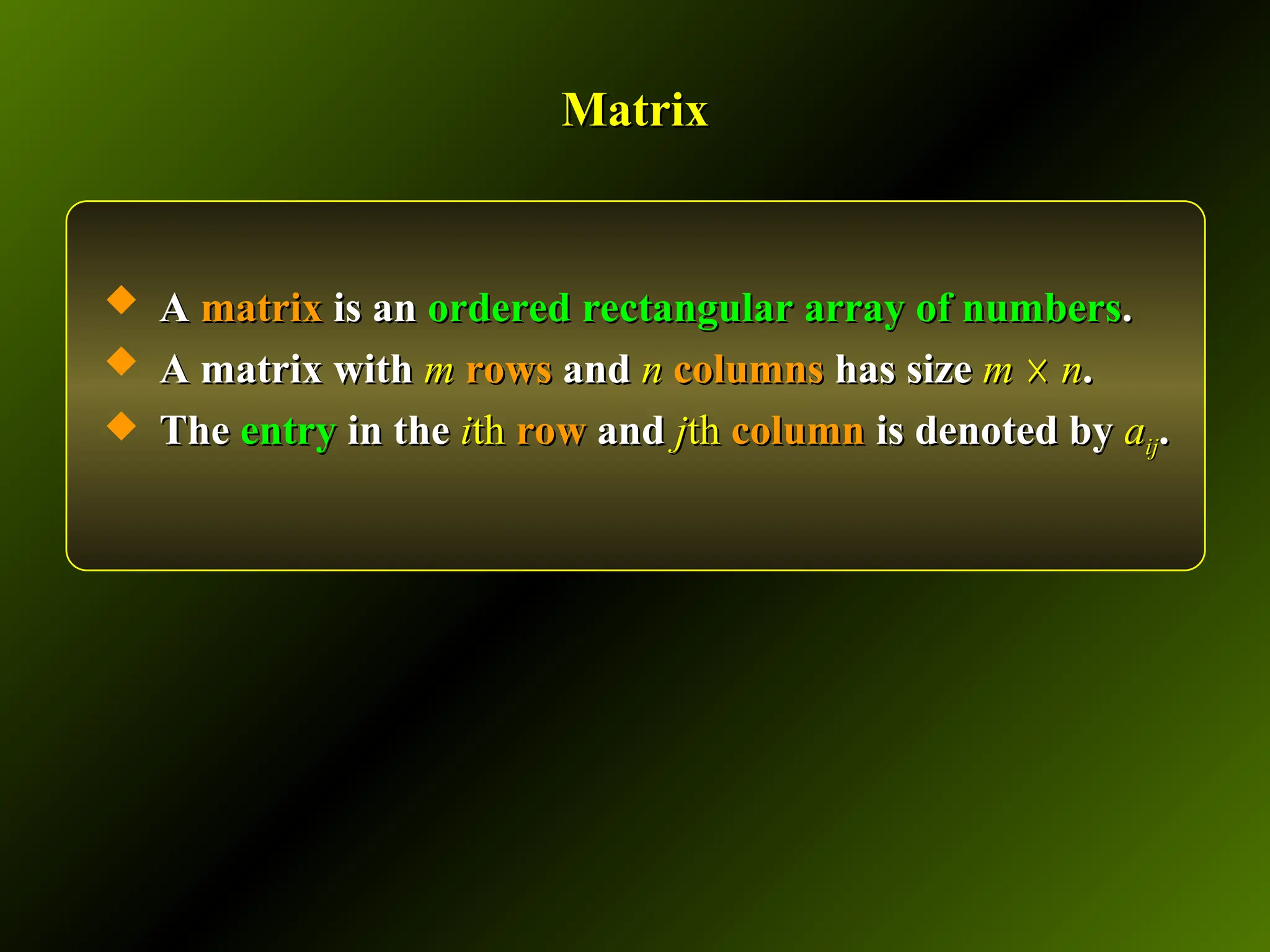
  • 40.
    Matrices and Gauss-Jordan Matricesand Gauss-Jordan  Every step Every step in the in the Gauss-Jordan elimination method Gauss-Jordan elimination method can be can be expressed with expressed with matrices matrices, rather than systems of equations, , rather than systems of equations, thus simplifying the whole process: thus simplifying the whole process:  Steps expressed as Steps expressed as systems of equations systems of equations: :  Steps expressed as Steps expressed as augmented matrices augmented matrices: : 1 2 3 11 0 2 4 6 0 3 5 13             2 3 11 2 4 6 3 5 13 x y z y z y z        Toggle slides Toggle slides back and forth to back and forth to compare before compare before and changes and changes
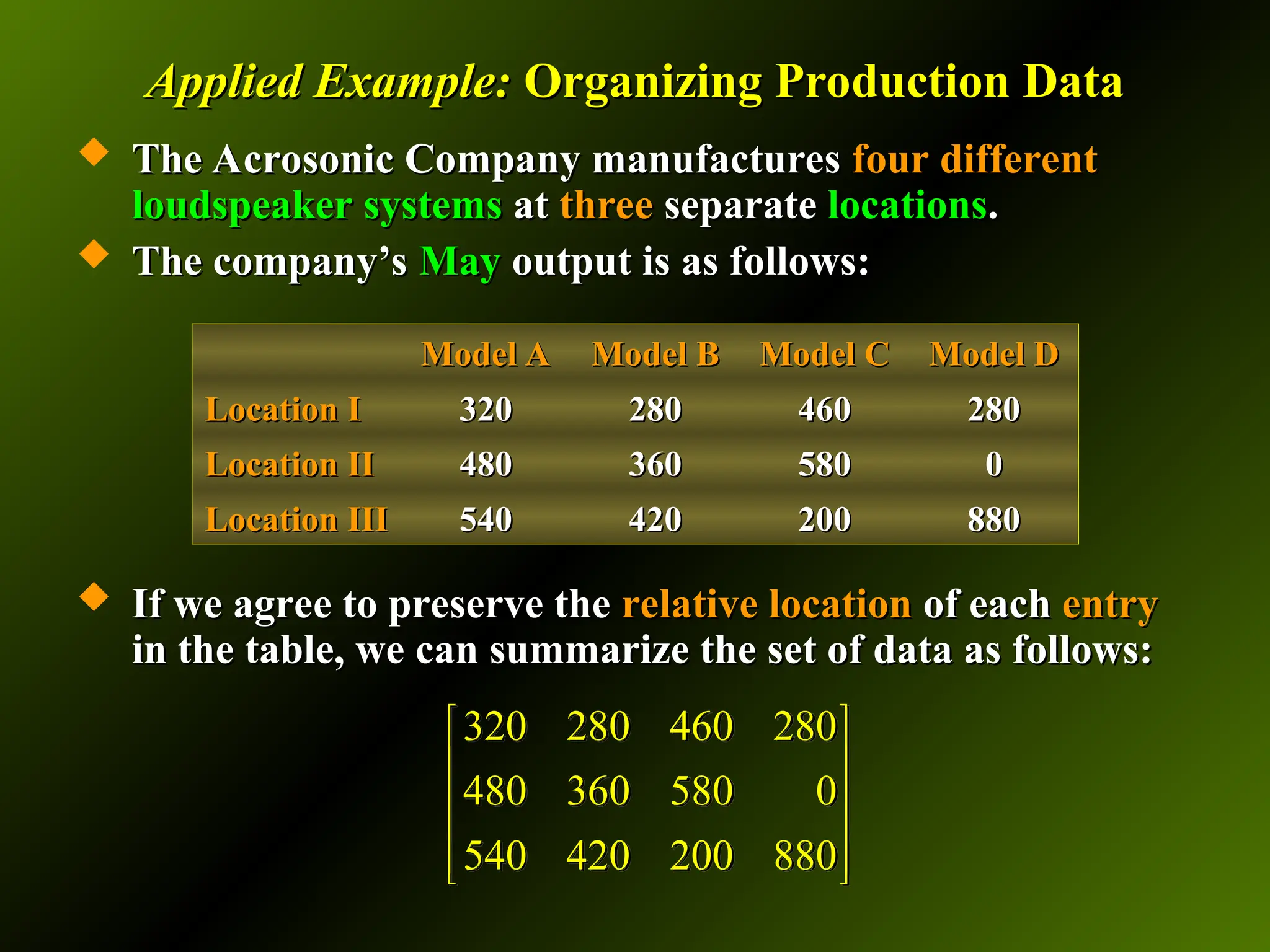
  • 41.
    Matrices and Gauss-Jordan Matricesand Gauss-Jordan  Every step Every step in the in the Gauss-Jordan elimination method Gauss-Jordan elimination method can be can be expressed with expressed with matrices matrices, rather than systems of equations, , rather than systems of equations, thus simplifying the whole process: thus simplifying the whole process:  Steps expressed as Steps expressed as systems of equations systems of equations: :  Steps expressed as Steps expressed as augmented matrices augmented matrices: : 1 2 3 11 0 1 2 3 0 3 5 13             2 3 11 2 3 3 5 13 x y z y z y z        Toggle slides Toggle slides back and forth to back and forth to compare before compare before and changes and changes
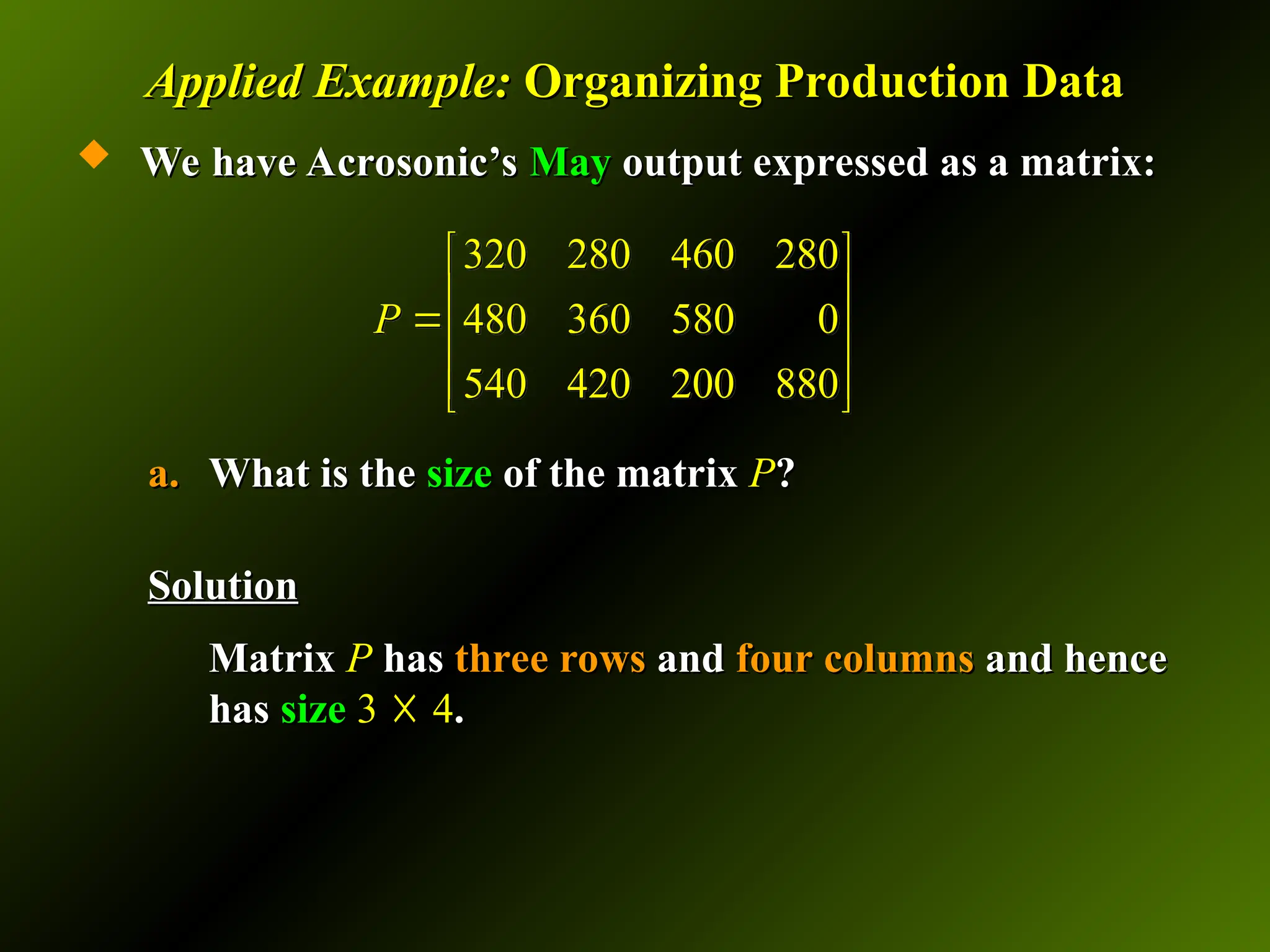
  • 42.
    Matrices and Gauss-Jordan Matricesand Gauss-Jordan  Every step Every step in the in the Gauss-Jordan elimination method Gauss-Jordan elimination method can be can be expressed with expressed with matrices matrices, rather than systems of equations, , rather than systems of equations, thus simplifying the whole process: thus simplifying the whole process:  Steps expressed as Steps expressed as systems of equations systems of equations: :  Steps expressed as Steps expressed as augmented matrices augmented matrices: : 1 0 7 17 0 1 2 3 0 3 5 13             7 17 2 3 3 5 13 x z y z y z       Toggle slides Toggle slides back and forth to back and forth to compare before compare before and changes and changes
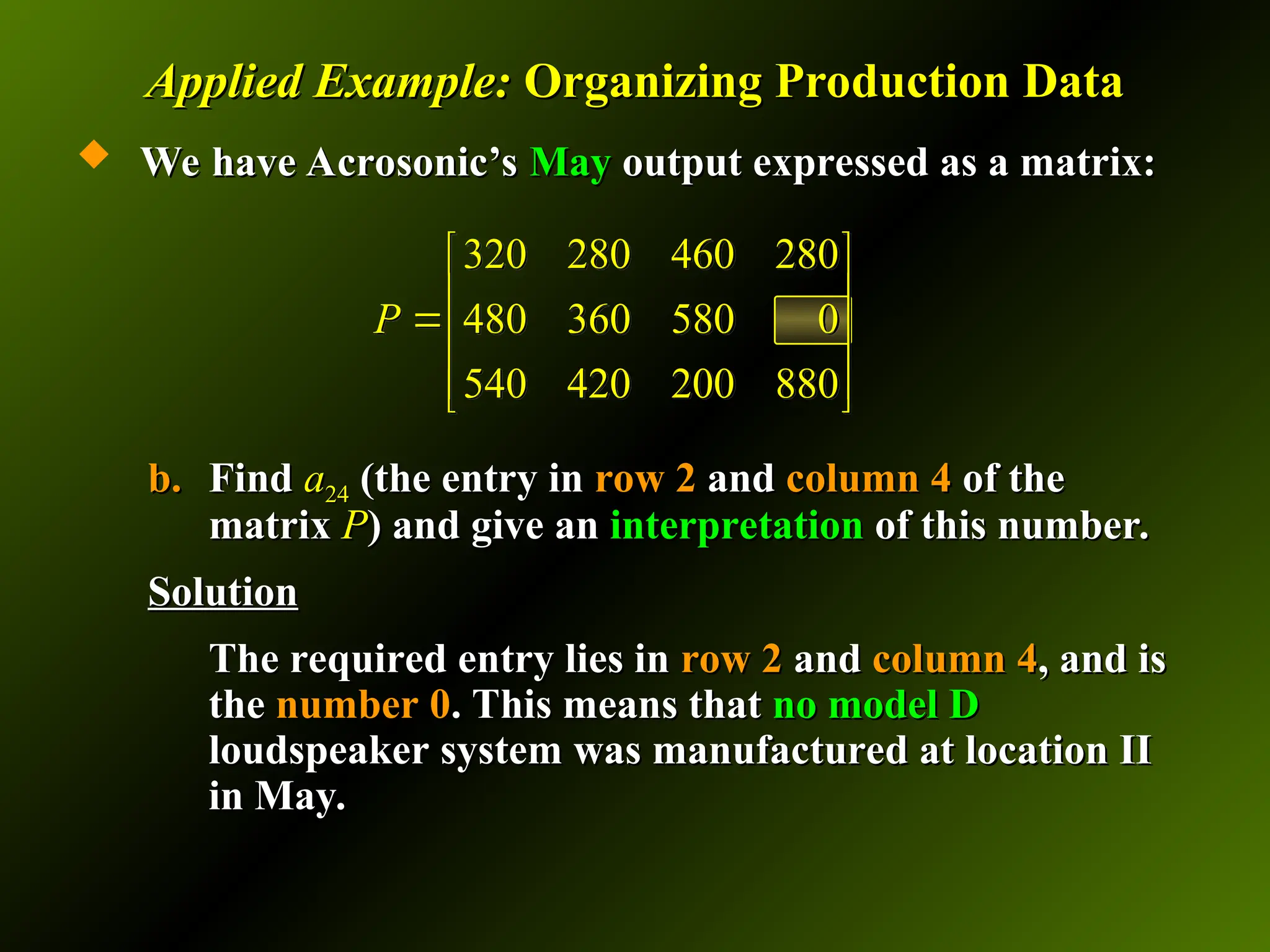
  • 43.
    Matrices and Gauss-Jordan Matricesand Gauss-Jordan  Every step Every step in the in the Gauss-Jordan elimination method Gauss-Jordan elimination method can be can be expressed with expressed with matrices matrices, rather than systems of equations, , rather than systems of equations, thus simplifying the whole process: thus simplifying the whole process:  Steps expressed as Steps expressed as systems of equations systems of equations: :  Steps expressed as Steps expressed as augmented matrices augmented matrices: : 1 0 7 17 0 1 2 3 0 0 11 22             7 17 2 3 11 22 x z y z z      Toggle slides Toggle slides back and forth to back and forth to compare before compare before and changes and changes
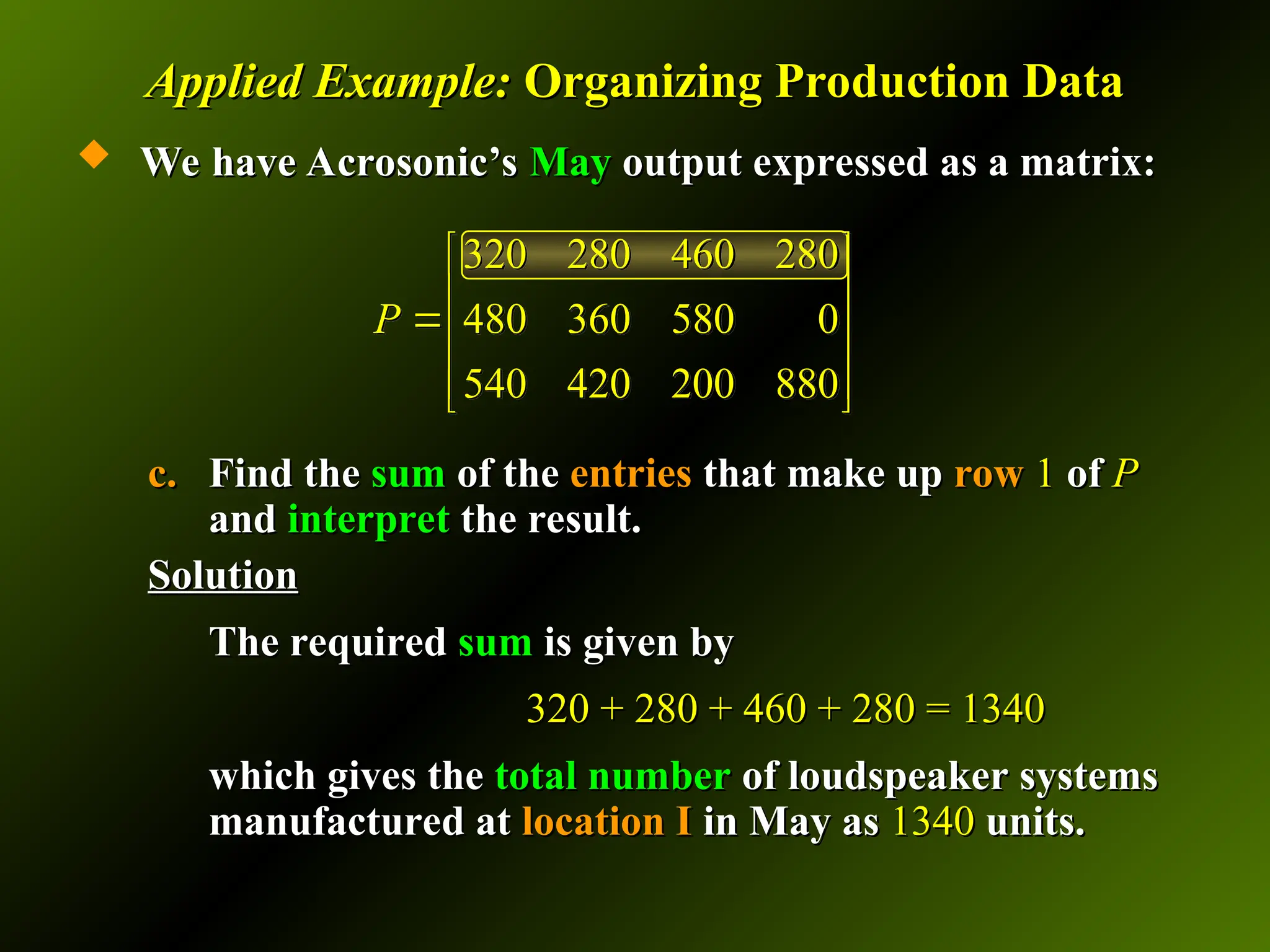
  • 44.
    Matrices and Gauss-Jordan Matricesand Gauss-Jordan  Every step Every step in the in the Gauss-Jordan elimination method Gauss-Jordan elimination method can be can be expressed with expressed with matrices matrices, rather than systems of equations, , rather than systems of equations, thus simplifying the whole process: thus simplifying the whole process:  Steps expressed as Steps expressed as systems of equations systems of equations: :  Steps expressed as Steps expressed as augmented matrices augmented matrices: : 1 0 7 17 0 1 2 3 0 0 1 2             7 17 2 3 2 x z y z z      Toggle slides Toggle slides back and forth to back and forth to compare before compare before and changes and changes
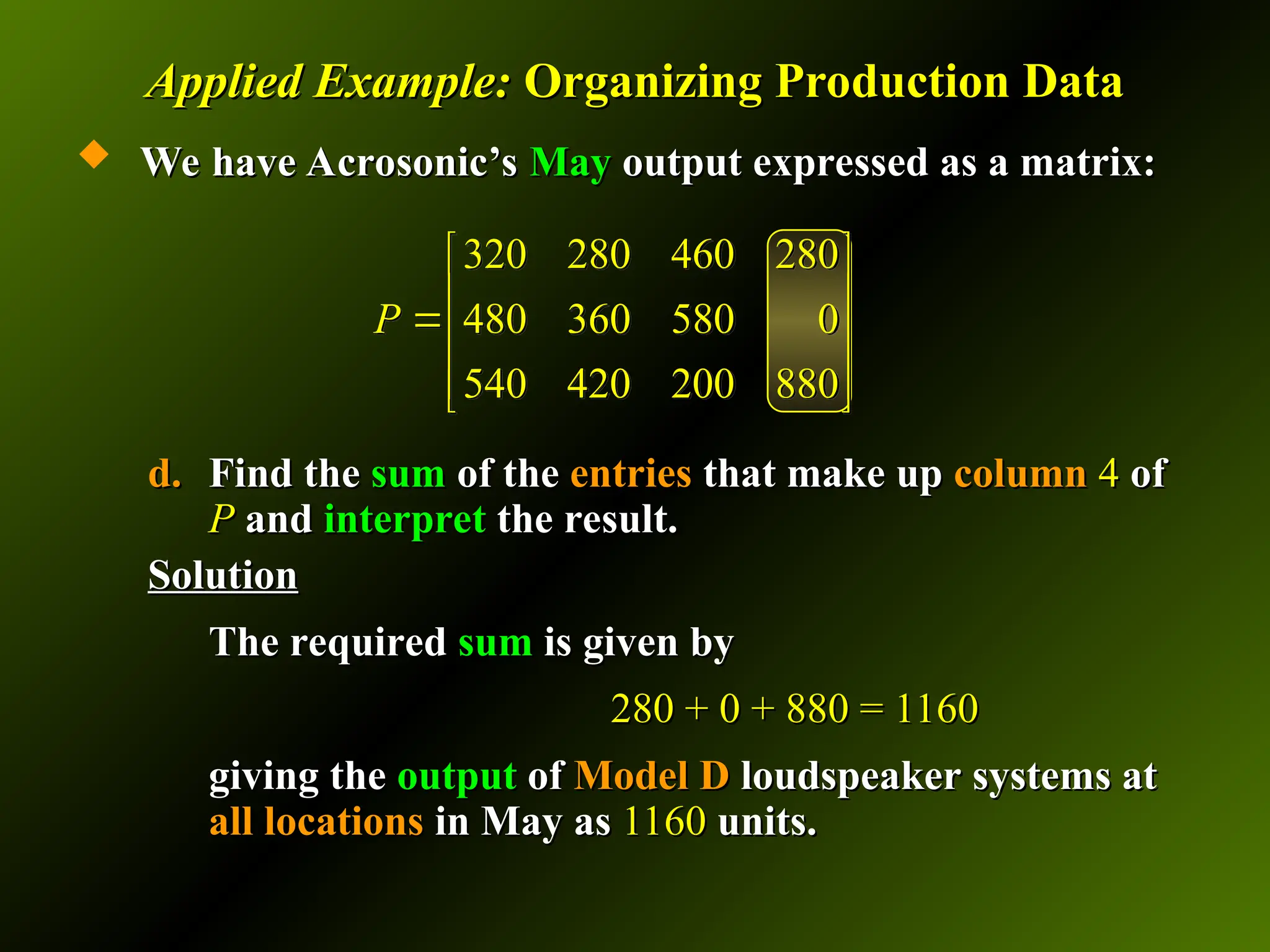
  • 45.
    Matrices and Gauss-Jordan Matricesand Gauss-Jordan  Every step Every step in the in the Gauss-Jordan elimination method Gauss-Jordan elimination method can be can be expressed with expressed with matrices matrices, rather than systems of equations, , rather than systems of equations, thus simplifying the whole process: thus simplifying the whole process:  Steps expressed as Steps expressed as systems of equations systems of equations: :  Steps expressed as Steps expressed as augmented matrices augmented matrices: : 1 0 0 3 0 1 2 3 0 0 1 2             3 2 3 2 x y z z     Toggle slides Toggle slides back and forth to back and forth to compare before compare before and changes and changes
  • 46.
    Matrices and Gauss-Jordan Matricesand Gauss-Jordan  Every step Every step in the in the Gauss-Jordan elimination method Gauss-Jordan elimination method can be can be expressed with expressed with matrices matrices, rather than systems of equations, , rather than systems of equations, thus simplifying the whole process: thus simplifying the whole process:  Steps expressed as Steps expressed as systems of equations systems of equations: :  Steps expressed as Steps expressed as augmented matrices augmented matrices: : 1 0 0 3 0 1 0 1 0 0 1 2           3 1 2 x y z    Row Reduced Form Row Reduced Form of the Matrix of the Matrix Toggle slides Toggle slides back and forth to back and forth to compare before compare before and changes and changes
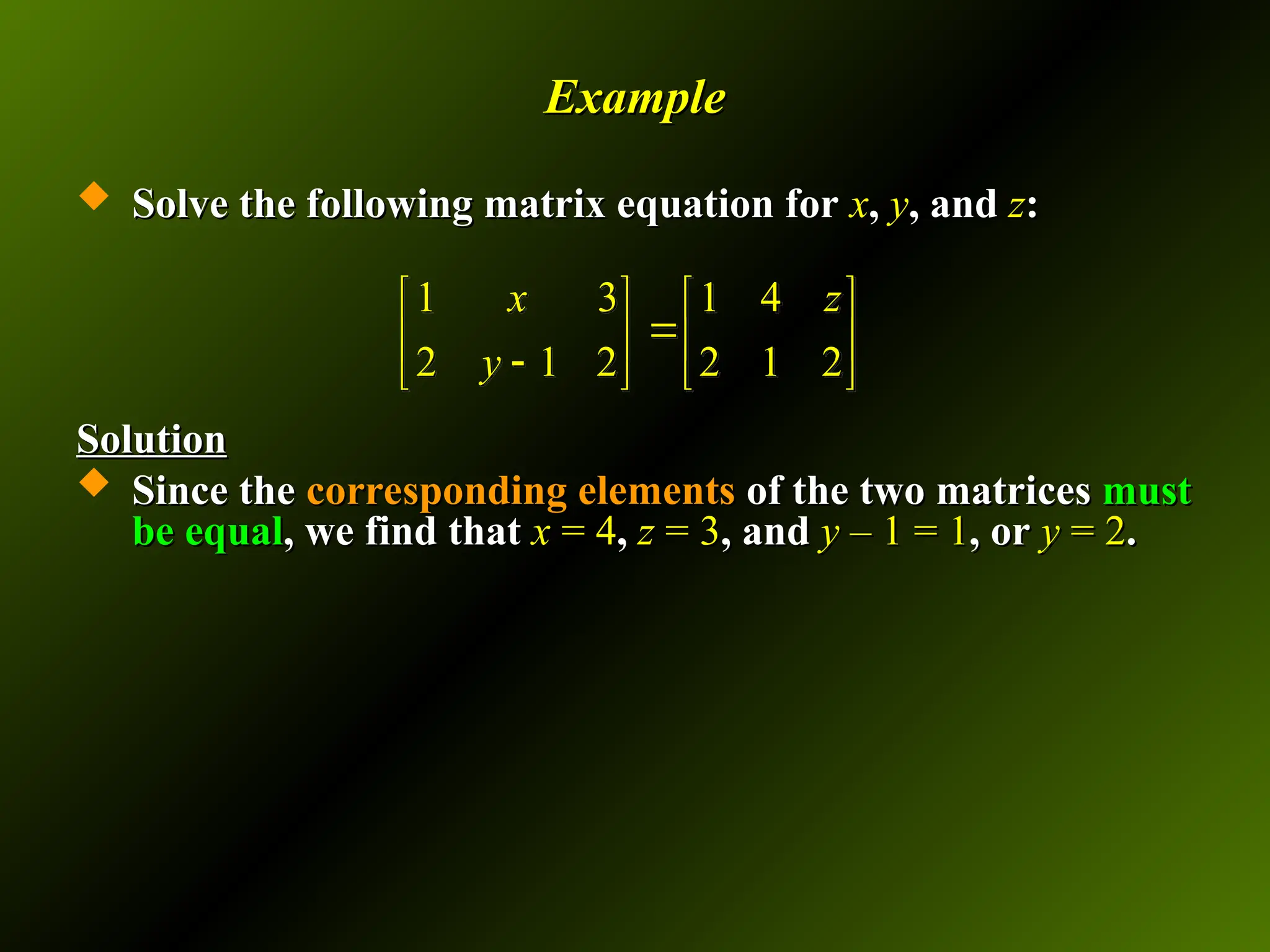
  • 47.
    Row-Reduced Form ofa Matrix Row-Reduced Form of a Matrix  Each row consisting entirely of Each row consisting entirely of zeros zeros lies lies below below all all rows having rows having nonzero entries nonzero entries. .  The The first first nonzero entry nonzero entry in each nonzero row is in each nonzero row is 1 1 (called a (called a leading leading 1 1). ).  In any two successive (nonzero) rows, the In any two successive (nonzero) rows, the leading leading 1 1 in the lower row lies in the lower row lies to the right to the right of the of the leading leading 1 1 in in the the upper row upper row. .  If a column contains a If a column contains a leading leading 1 1, then the other , then the other entries in that column are entries in that column are zeros zeros. .
  • 48.
    Row Operations Row Operations 1. 1.Interchange any two rows. Interchange any two rows. 2. 2. Replace any row by a nonzero constant Replace any row by a nonzero constant multiple of itself. multiple of itself. 3. 3. Replace any row by the sum of that row Replace any row by the sum of that row and a constant multiple of any other row. and a constant multiple of any other row.
  • 49.
    Terminology for the Terminologyfor the Gauss-Jordan Elimination Method Gauss-Jordan Elimination Method Unit Column Unit Column  A column in a coefficient matrix is in unit form A column in a coefficient matrix is in unit form if if one one of the entries in the column is a of the entries in the column is a 1 1 and the and the other other entries are entries are zeros zeros. . Pivoting Pivoting  The The sequence sequence of of row operations row operations that that transforms transforms a a given column given column in an augmented matrix into a in an augmented matrix into a unit column unit column. .
  • 50.
    Notation for RowOperations Notation for Row Operations  Letting Letting R Ri i denote the denote the i ith th row of a matrix, we write row of a matrix, we write Operation 1: Operation 1: R Ri i ↔ R ↔ Rj j to mean: to mean: Interchange Interchange row row i i with row with row j j. . Operation 2: Operation 2: cR cRi i to mean: to mean: replace replace row row i i with with c c times times row row i i. . Operation 3: Operation 3: R Ri i + aR + aRj j to mean: to mean: Replace Replace row row i i with the with the sum sum of row of row i i and and a a times times row row j j. .
  • 51.
    Example Example  Pivot thematrix about the circled element Pivot the matrix about the circled element Solution Solution 3 5 9 2 3 5       3 5 9 2 3 5       1 1 3 R 5 3 3 1 5 2 3       2 1 2 R R  5 3 1 3 1 3 0 1        
  • 52.
    The Gauss-Jordan EliminationMethod The Gauss-Jordan Elimination Method 1. 1. Write the Write the augmented matrix augmented matrix corresponding to corresponding to the linear system. the linear system. 2. 2. Interchange rows Interchange rows, if necessary, to obtain an , if necessary, to obtain an augmented matrix in which the augmented matrix in which the first entry first entry in in the the first row first row is is nonzero nonzero. Then . Then pivot pivot the matrix the matrix about this entry. about this entry. 3. 3. Interchange Interchange the the second row second row with any row below with any row below it, if necessary, to obtain an augmented matrix it, if necessary, to obtain an augmented matrix in which the in which the second entry second entry in the in the second row second row is is nonzero nonzero. . Pivot Pivot the matrix about this entry. the matrix about this entry. 4. 4. Continue Continue until the final matrix is in until the final matrix is in row- row- reduced form reduced form. .
  • 53.
    Example Example  Use theGauss-Jordan elimination method to solve the Use the Gauss-Jordan elimination method to solve the system of equations system of equations Solution Solution 3 2 8 9 2 2 3 2 3 8 x y z x y z x y z           3 2 8 9 2 2 1 3 1 2 3 8              1 2 R R  Toggle slides back and Toggle slides back and forth to compare before forth to compare before and after matrix changes and after matrix changes
  • 54.
    Example Example  Use theGauss-Jordan elimination method to solve the Use the Gauss-Jordan elimination method to solve the system of equations system of equations Solution Solution 3 2 8 9 2 2 3 2 3 8 x y z x y z x y z           1 0 9 12 2 2 1 3 1 2 3 8             2 1 2 R R  3 1 R R  1 2 R R  Toggle slides back and Toggle slides back and forth to compare before forth to compare before and after matrix changes and after matrix changes
  • 55.
    Example Example  Use theGauss-Jordan elimination method to solve the Use the Gauss-Jordan elimination method to solve the system of equations system of equations Solution Solution 3 2 8 9 2 2 3 2 3 8 x y z x y z x y z           1 0 9 12 0 2 19 27 0 2 12 4             2 1 2 R R  3 1 R R  2 3 R R  Toggle slides back and Toggle slides back and forth to compare before forth to compare before and after matrix changes and after matrix changes
  • 56.
    Example Example  Use theGauss-Jordan elimination method to solve the Use the Gauss-Jordan elimination method to solve the system of equations system of equations Solution Solution 3 2 8 9 2 2 3 2 3 8 x y z x y z x y z           2 3 R R  1 2 2 R 1 0 9 12 0 2 12 4 0 2 19 27             Toggle slides back and Toggle slides back and forth to compare before forth to compare before and after matrix changes and after matrix changes
  • 57.
    Example Example  Use theGauss-Jordan elimination method to solve the Use the Gauss-Jordan elimination method to solve the system of equations system of equations Solution Solution 3 2 8 9 2 2 3 2 3 8 x y z x y z x y z           1 2 2 R 1 0 9 12 0 1 6 2 0 2 19 27             3 2 R R  Toggle slides back and Toggle slides back and forth to compare before forth to compare before and after matrix changes and after matrix changes
  • 58.
    Example Example  Use theGauss-Jordan elimination method to solve the Use the Gauss-Jordan elimination method to solve the system of equations system of equations Solution Solution 3 2 8 9 2 2 3 2 3 8 x y z x y z x y z           1 0 9 12 0 1 6 2 0 0 31 31             3 2 R R  1 3 31 R Toggle slides back and Toggle slides back and forth to compare before forth to compare before and after matrix changes and after matrix changes
  • 59.
    Example Example  Use theGauss-Jordan elimination method to solve the Use the Gauss-Jordan elimination method to solve the system of equations system of equations Solution Solution 3 2 8 9 2 2 3 2 3 8 x y z x y z x y z           1 0 9 12 0 1 6 2 0 0 1 1             1 3 31 R 1 3 9 R R  2 3 6 R R  Toggle slides back and Toggle slides back and forth to compare before forth to compare before and after matrix changes and after matrix changes
  • 60.
    Example Example  Use theGauss-Jordan elimination method to solve the Use the Gauss-Jordan elimination method to solve the system of equations system of equations Solution Solution 3 2 8 9 2 2 3 2 3 8 x y z x y z x y z           1 0 0 3 0 1 0 4 0 0 1 1           2 3 6 R R  1 3 9 R R  Toggle slides back and Toggle slides back and forth to compare before forth to compare before and after matrix changes and after matrix changes
  • 61.
    Example Example  Use theGauss-Jordan elimination method to solve the Use the Gauss-Jordan elimination method to solve the system of equations system of equations Solution Solution  The The solution solution to the system is thus to the system is thus x x = 3 = 3, , y y = 4 = 4, and , and z z = 1 = 1. . 3 2 8 9 2 2 3 2 3 8 x y z x y z x y z           1 0 0 3 0 1 0 4 0 0 1 1          
  • 62.
    5.3 5.3 Systems of LinearEquations: Systems of Linear Equations: Underdetermined and Overdetermined systems Underdetermined and Overdetermined systems 2 3 2 3 2 1 2 3 5 3 x y z x y z x y z          1 2 3 2 3 1 2 1 2 3 5 3                 1 x z y z    0 1 x z y z    
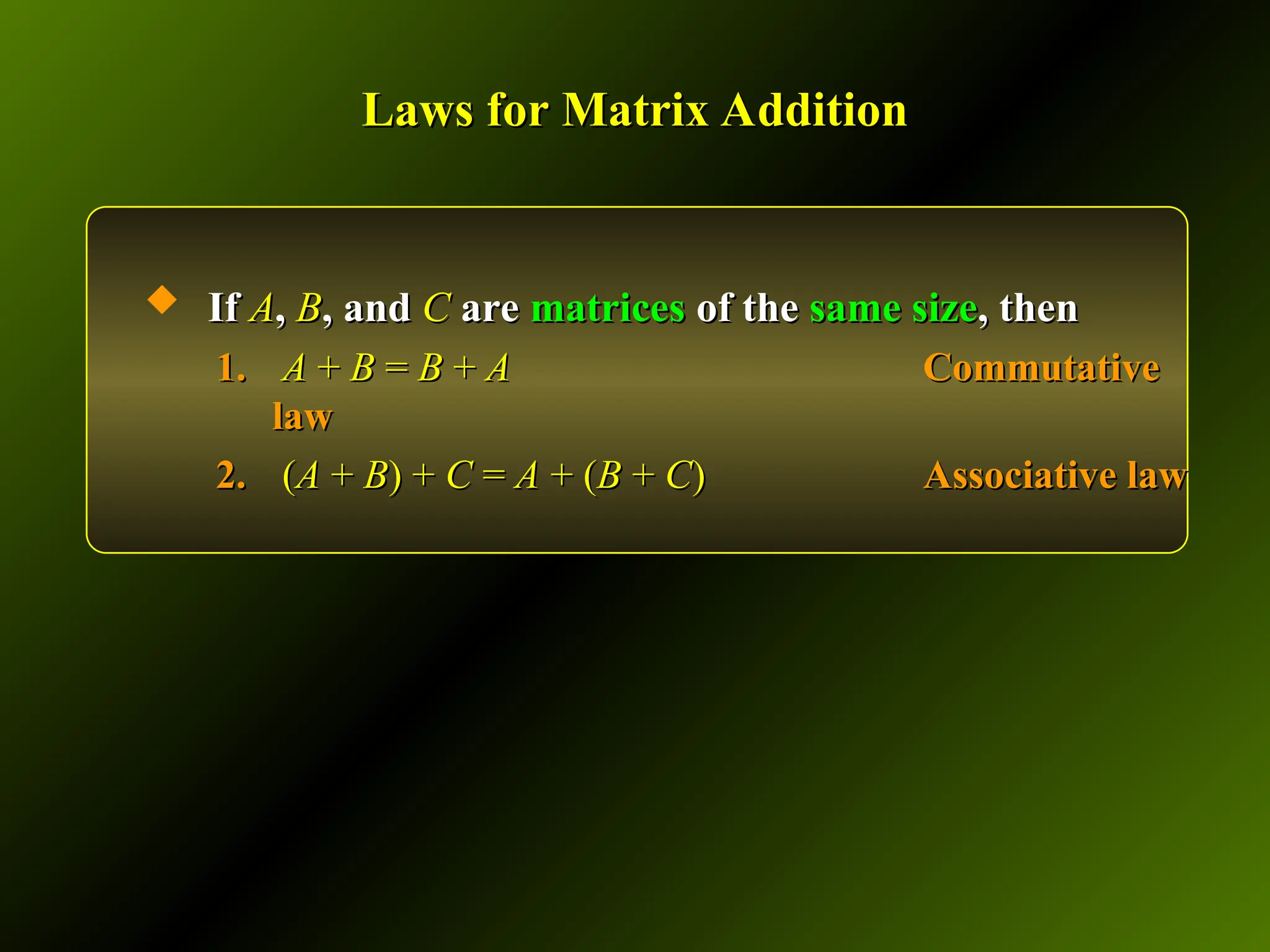
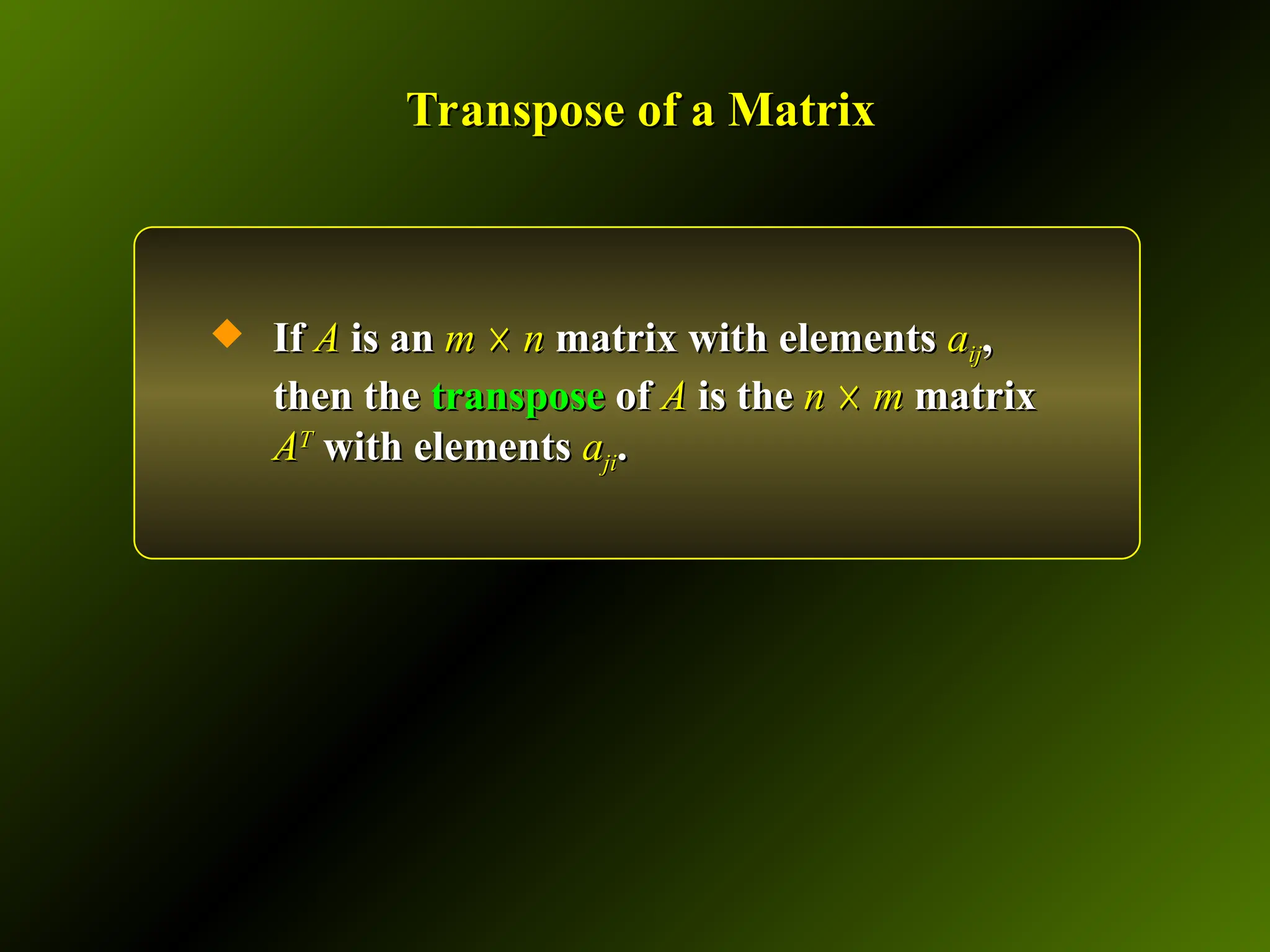
  • 63.
    A System ofEquations A System of Equations with an Infinite Number of Solutions with an Infinite Number of Solutions  Solve the system of equations given by Solve the system of equations given by Solution Solution 2 3 2 3 2 1 2 3 5 3 x y z x y z x y z          1 2 3 2 3 1 2 1 2 3 5 3                 2 1 3 R R  3 1 2 R R  Toggle slides back and Toggle slides back and forth to compare before forth to compare before and after matrix changes and after matrix changes
  • 64.
    A System ofEquations A System of Equations with an Infinite Number of Solutions with an Infinite Number of Solutions  Solve the system of equations given by Solve the system of equations given by Solution Solution 2 3 2 3 2 1 2 3 5 3 x y z x y z x y z          1 2 3 2 0 7 7 7 0 1 1 1               2 1 3 R R  3 1 2 R R  1 2 7 R  Toggle slides back and Toggle slides back and forth to compare before forth to compare before and after matrix changes and after matrix changes
  • 65.
    A System ofEquations A System of Equations with an Infinite Number of Solutions with an Infinite Number of Solutions  Solve the system of equations given by Solve the system of equations given by Solution Solution 2 3 2 3 2 1 2 3 5 3 x y z x y z x y z          1 2 3 2 0 1 1 1 0 1 1 1                1 2 7 R  1 2 2 R R  3 2 R R  Toggle slides back and Toggle slides back and forth to compare before forth to compare before and after matrix changes and after matrix changes
  • 66.
    A System ofEquations A System of Equations with an Infinite Number of Solutions with an Infinite Number of Solutions  Solve the system of equations given by Solve the system of equations given by Solution Solution 2 3 2 3 2 1 2 3 5 3 x y z x y z x y z          1 0 1 0 0 1 1 1 0 0 0 0              1 2 2 R R  3 2 R R  Toggle slides back and Toggle slides back and forth to compare before forth to compare before and after matrix changes and after matrix changes
  • 67.
    A System ofEquations A System of Equations with an Infinite Number of Solutions with an Infinite Number of Solutions  Solve the system of equations given by Solve the system of equations given by Solution Solution  Observe that Observe that row three row three reads reads 0 = 0 0 = 0, which is , which is true true but but of no use of no use to us. to us. 2 3 2 3 2 1 2 3 5 3 x y z x y z x y z          1 0 1 0 0 1 1 1 0 0 0 0             
  • 68.
    A System ofEquations A System of Equations with an Infinite Number of Solutions with an Infinite Number of Solutions  Solve the system of equations given by Solve the system of equations given by Solution Solution  This last augmented matrix is in This last augmented matrix is in row-reduced form row-reduced form. .  Interpreting it as a Interpreting it as a system of equations system of equations gives a system of gives a system of two equations two equations in in three variables three variables x x, , y y, and , and z z: : 2 3 2 3 2 1 2 3 5 3 x y z x y z x y z          1 0 1 0 0 1 1 1 0 0 0 0              0 1 x z y z    
  • 69.
    A System ofEquations A System of Equations with an Infinite Number of Solutions with an Infinite Number of Solutions  Solve the system of equations given by Solve the system of equations given by Solution Solution  Let’s Let’s single out single out a single variable – a single variable –say, say, z z– and – and solve solve for for x x and and y y in terms of it. in terms of it.  If we assign a If we assign a particular value particular value of of z z – –say, say, z z = 0 = 0– we obtain – we obtain x x = 0 = 0 and and y y = –1 = –1, giving the , giving the solution solution (0, –1, 0) (0, –1, 0). . 2 3 2 3 2 1 2 3 5 3 x y z x y z x y z          1 x z y z    0 1 x z y z     (0) 0 (0) 1 1     
  • 70.
    A System ofEquations A System of Equations with an Infinite Number of Solutions with an Infinite Number of Solutions  Solve the system of equations given by Solve the system of equations given by Solution Solution  Let’s Let’s single out single out a single variable – a single variable –say, say, z z– and – and solve solve for for x x and and y y in terms of it. in terms of it.  If we instead assign If we instead assign z z = 1 = 1, we obtain the , we obtain the solution solution (1, 0, 1) (1, 0, 1). . 2 3 2 3 2 1 2 3 5 3 x y z x y z x y z          1 x z y z    0 1 x z y z     (1) 1 (1) 1 0     
  • 71.
    A System ofEquations A System of Equations with an Infinite Number of Solutions with an Infinite Number of Solutions  Solve the system of equations given by Solve the system of equations given by Solution Solution  Let’s Let’s single out single out a single variable – a single variable –say, say, z z– and – and solve solve for for x x and and y y in terms of it. in terms of it.  In general In general, we set , we set z z = = t t, where , where t t represents represents any real number any real number (called the (called the parameter parameter) to obtain the ) to obtain the solution solution ( (t t, , t t – 1, – 1, t t) ). . 2 3 2 3 2 1 2 3 5 3 x y z x y z x y z          1 x z y z    0 1 x z y z     ( ) ( ) 1 1 t t t t      
  • 72.
    A System ofEquations That Has No Solution A System of Equations That Has No Solution  Solve the system of equations given by Solve the system of equations given by Solution Solution 1 3 4 5 5 1 x y z x y z x y z          1 1 1 1 3 1 1 4 1 5 5 1              2 1 3 R R  3 1 R R  Toggle slides back and Toggle slides back and forth to compare before forth to compare before and after matrix changes and after matrix changes
  • 73.
    A System ofEquations That Has No Solution A System of Equations That Has No Solution  Solve the system of equations given by Solve the system of equations given by Solution Solution 1 1 1 1 0 4 4 1 0 4 4 2              2 1 3 R R  3 1 R R  3 2 R R  1 3 4 5 5 1 x y z x y z x y z          Toggle slides back and Toggle slides back and forth to compare before forth to compare before and after matrix changes and after matrix changes
  • 74.
    A System ofEquations That Has No Solution A System of Equations That Has No Solution  Solve the system of equations given by Solve the system of equations given by Solution Solution 1 1 1 1 0 4 4 1 0 0 0 1              3 2 R R  1 3 4 5 5 1 x y z x y z x y z          Toggle slides back and Toggle slides back and forth to compare before forth to compare before and after matrix changes and after matrix changes
  • 75.
    A System ofEquations That Has No Solution A System of Equations That Has No Solution  Solve the system of equations given by Solve the system of equations given by Solution Solution  Observe that row three reads Observe that row three reads 0 0x x + 0 + 0y y + 0 + 0z z = –1 = –1 or or 0 = –1 0 = –1! !  We therefore conclude We therefore conclude the system is the system is inconsistent inconsistent and has and has no solution no solution. . 1 1 1 1 0 4 4 1 0 0 0 1              1 3 4 5 5 1 x y z x y z x y z         
  • 76.
    Systems with noSolution Systems with no Solution  If there is a If there is a row row in the augmented matrix in the augmented matrix containing containing all zeros all zeros to the to the left left of the of the vertical line vertical line and a and a nonzero nonzero entry to the entry to the right right of the of the line line, then , then the system of equations has the system of equations has no solution no solution. .
  • 77.
    Theorem 1 Theorem 1 a. a.If the If the number of equations number of equations is is greater greater than or than or equal to the equal to the number of variables number of variables in a linear in a linear system, then one of the following is true: system, then one of the following is true: i. i. The system has The system has no solution no solution. . ii. ii. The system has The system has exactly one solution exactly one solution. . iii. iii. The system has The system has infinitely many solutions infinitely many solutions. . b. b. If there are If there are fewer fewer equations than variables equations than variables in in a linear system, then the system either has no a linear system, then the system either has no solution solution or it has or it has infinitely many solutions infinitely many solutions. .
  • 78.
    5.4 5.4 Matrices Matrices 2 3 2 3 XB A X A B     2 3 2 3 X B A X A B     3 4 3 2 3 1 2 1 2                 3 4 3 2 3 1 2 1 2                 9 12 3 2 3 6 1 2                 9 12 3 2 3 6 1 2                 6 10 2 4        6 10 2 4        6 10 1 2 4 2 X         6 10 1 2 4 2 X         3 5 1 2        3 5 1 2       
  • 79.
    Matrix Matrix  A A matrix matrixis an is an ordered rectangular array of numbers ordered rectangular array of numbers. .  A matrix with A matrix with m m rows rows and and n n columns columns has size has size m m ☓ ☓ n n. .  The The entry entry in the in the i ith th row row and and j jth th column column is denoted by is denoted by a aij ij. .
  • 80.
    Applied Example: Applied Example:Organizing Production Data Organizing Production Data  The Acrosonic Company manufactures The Acrosonic Company manufactures four different four different loudspeaker systems loudspeaker systems at at three three separate separate locations locations. .  The company’s The company’s May May output is as follows: output is as follows:  If we agree to preserve the If we agree to preserve the relative location relative location of each of each entry entry in the table, we can summarize the set of data as follows: in the table, we can summarize the set of data as follows: Model A Model A Model B Model B Model C Model C Model D Model D Location I Location I 320 320 280 280 460 460 280 280 Location II Location II 480 480 360 360 580 580 0 0 Location III Location III 540 540 420 420 200 200 880 880 320 280 460 280 480 360 580 0 540 420 200 880          
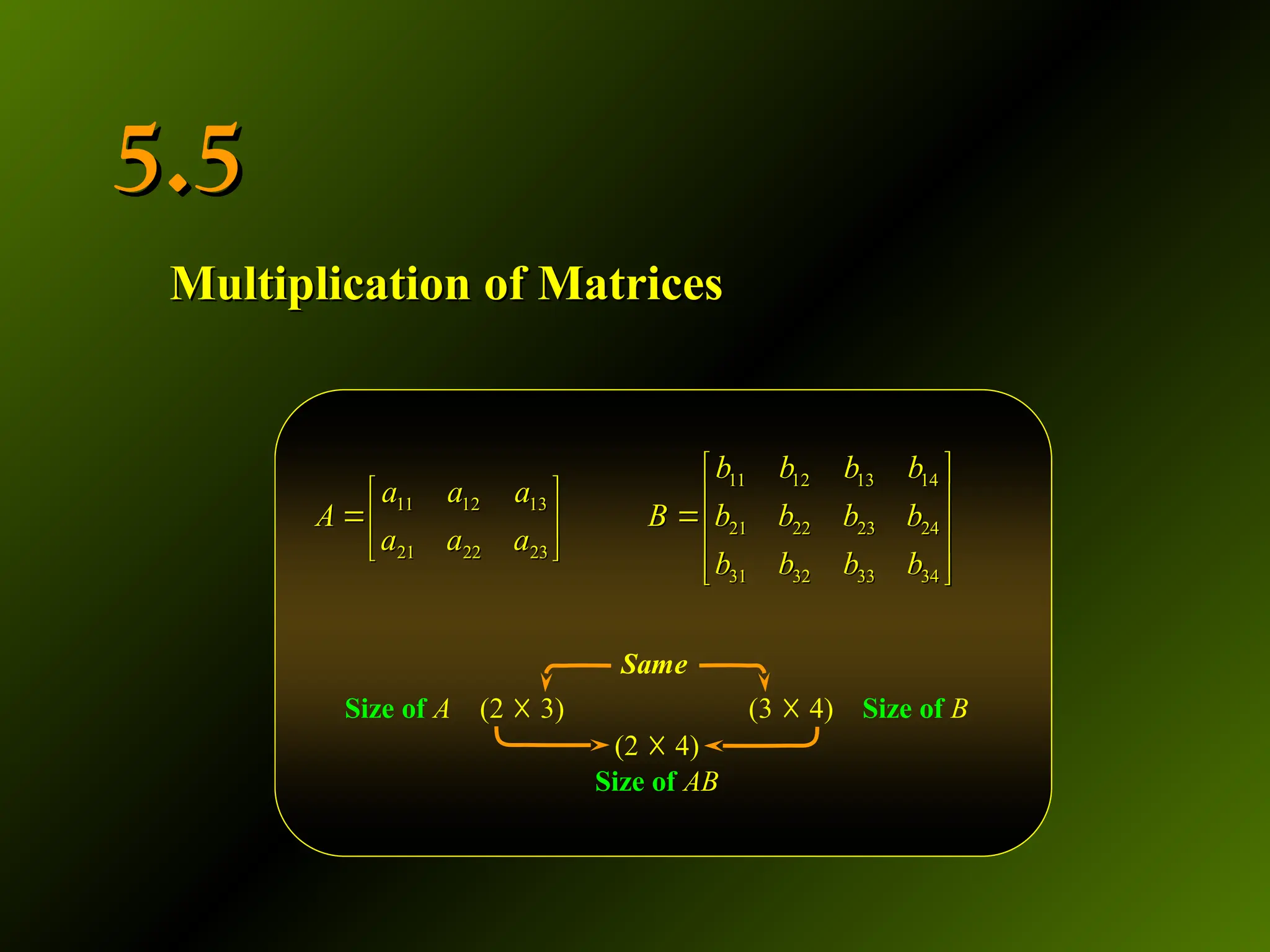
  • 81.
    Applied Example: Applied Example:Organizing Production Data Organizing Production Data  We have Acrosonic’s We have Acrosonic’s May May output expressed as a matrix: output expressed as a matrix: a. a. What is the What is the size size of the matrix of the matrix P P? ? Solution Solution Matrix Matrix P P has has three rows three rows and and four columns four columns and hence and hence has has size size 3 3 ☓ ☓ 4 4. . 320 280 460 280 480 360 580 0 540 420 200 880 P          
  • 82.
    Applied Example: Applied Example:Organizing Production Data Organizing Production Data  We have Acrosonic’s We have Acrosonic’s May May output expressed as a matrix: output expressed as a matrix: b. b. Find Find a a24 24 (the entry in (the entry in row 2 row 2 and and column 4 column 4 of the of the matrix matrix P P) and give an ) and give an interpretation interpretation of this number. of this number. Solution Solution The required entry lies in The required entry lies in row 2 row 2 and and column 4 column 4, and is , and is the the number 0 number 0. This means that . This means that no model D no model D loudspeaker system was manufactured at location II loudspeaker system was manufactured at location II in May. in May. 320 280 460 280 480 360 580 0 540 420 200 880 P          
  • 83.
    Applied Example: Applied Example:Organizing Production Data Organizing Production Data  We have Acrosonic’s We have Acrosonic’s May May output expressed as a matrix: output expressed as a matrix: c. c. Find the Find the sum sum of the of the entries entries that make up that make up row row 1 1 of of P P and and interpret interpret the result. the result. Solution Solution The required The required sum sum is given by is given by 320 + 280 + 460 + 280 = 1340 320 + 280 + 460 + 280 = 1340 which gives the which gives the total number total number of loudspeaker systems of loudspeaker systems manufactured at manufactured at location I location I in May as in May as 1340 1340 units. units. 320 280 460 280 480 360 580 0 540 420 200 880 P          
  • 84.
    Applied Example: Applied Example:Organizing Production Data Organizing Production Data  We have Acrosonic’s We have Acrosonic’s May May output expressed as a matrix: output expressed as a matrix: d. d. Find the Find the sum sum of the of the entries entries that make up that make up column column 4 4 of of P P and and interpret interpret the result. the result. Solution Solution The required The required sum sum is given by is given by 280 + 0 + 880 = 1160 280 + 0 + 880 = 1160 giving the giving the output output of of Model D Model D loudspeaker systems at loudspeaker systems at all all locations locations in May as in May as 1160 1160 units. units. 320 280 460 280 480 360 580 0 540 420 200 880 P          
  • 85.
    Equality of Matrices Equalityof Matrices  Two matrices are equal if they have the same size Two matrices are equal if they have the same size and their corresponding entries are equal. and their corresponding entries are equal.
  • 86.
    Example Example  Solve thefollowing matrix equation for Solve the following matrix equation for x x, , y y, and , and z z: : Solution Solution  Since the Since the corresponding elements corresponding elements of the two matrices of the two matrices must must be equal be equal, we find that , we find that x x = 4 = 4, , z z = 3 = 3, and , and y y – 1 = 1 – 1 = 1, or , or y y = 2 = 2. . 1 3 1 4 2 1 2 2 1 2 x z y              
  • 87.
    Addition and Subtractionof Matrices Addition and Subtraction of Matrices  If If A A and and B B are two matrices of the are two matrices of the same size same size, then: , then: 1. 1. The The sum sum A A + + B B is the matrix obtained by is the matrix obtained by adding adding the corresponding entries the corresponding entries in the two matrices. in the two matrices. 2. 2. The The difference difference A A – – B B is the matrix obtained by is the matrix obtained by subtracting the corresponding entries subtracting the corresponding entries in in B B from from those in those in A A. .
  • 88.
    Applied Example: Applied Example:Organizing Production Data Organizing Production Data  The The total output total output of Acrosonic for of Acrosonic for May May is is  The The total output total output of Acrosonic for of Acrosonic for June June is is  Find the Find the total output total output of the company for of the company for May May and and June June. . Model A Model A Model B Model B Model C Model C Model D Model D Location I Location I 210 210 180 180 330 330 180 180 Location II Location II 400 400 300 300 450 450 40 40 Location III Location III 420 420 280 280 180 180 740 740 Model A Model A Model B Model B Model C Model C Model D Model D Location I Location I 320 320 280 280 460 460 280 280 Location II Location II 480 480 360 360 580 580 0 0 Location III Location III 540 540 420 420 200 200 880 880
  • 89.
    Applied Example: Applied Example:Organizing Production Data Organizing Production Data Solution Solution  Expressing the Expressing the output output for for May May and and June June as matrices: as matrices: ✦ The The total output total output of Acrosonic for of Acrosonic for May May is is ✦ The The total output total output of Acrosonic for of Acrosonic for June June is is 320 280 460 280 480 360 580 0 540 420 200 880 A            210 180 330 180 400 300 450 40 420 280 180 740 B           
  • 90.
    Applied Example: Applied Example:Organizing Production Data Organizing Production Data Solution Solution  The The total output total output of the company for of the company for May May and and June June is is given by the matrix given by the matrix 320 280 460 280 210 180 330 180 480 360 580 0 400 300 450 40 540 420 200 880 420 280 180 740 530 460 790 460 880 660 1030 40 960 700 380 1620 A B                                  
  • 91.
    Laws for MatrixAddition Laws for Matrix Addition  If If A A, , B B, and , and C C are are matrices matrices of the of the same size same size, then , then 1. 1. A A + + B B = = B B + + A A Commutative Commutative law law 2. 2. ( (A A + + B B) + ) + C C = = A A + ( + (B B + + C C) ) Associative law Associative law
  • 92.
    Transpose of aMatrix Transpose of a Matrix  If If A A is an is an m m ☓ ☓ n n matrix with elements matrix with elements a aij ij, , then the then the transpose transpose of of A A is the is the n n ☓ ☓ m m matrix matrix A AT T with elements with elements a aji ji. .
  • 93.
    Example Example  Find the Findthe transpose transpose of the matrix of the matrix Solution Solution  The The transpose transpose of the matrix of the matrix A A is is 1 2 3 4 5 6 7 8 9 A            1 4 7 2 5 8 3 6 9 T A           
  • 94.
    Scalar Product Scalar Product If If A A is a matrix and is a matrix and c c is a is a real number real number, then , then the the scalar product scalar product cA cA is the matrix obtained is the matrix obtained by by multiplying multiplying each entry each entry of of A A by by c c. .
  • 95.
    Example Example  Given Given find thematrix find the matrix X X that satisfies that satisfies 2 2X X + + B B = 3 = 3A A Solution Solution 2 3 2 3 X B A X A B     3 4 3 2 3 1 2 1 2                 9 12 3 2 3 6 1 2                 6 10 2 4        6 10 1 2 4 2 X         3 5 1 2        3 4 3 2 1 2 1 2 A B                 and
  • 96.
    Applied Example: Applied Example:Production Planning Production Planning  The management of Acrosonic has decided to increase its The management of Acrosonic has decided to increase its July July production of production of loudspeaker systems loudspeaker systems by by 10% 10% (over (over June June output). output).  Find a Find a matrix matrix giving the targeted production for giving the targeted production for July July. . Solution Solution  We have seen that Acrosonic’s total output for We have seen that Acrosonic’s total output for June June may may be represented by the matrix be represented by the matrix 210 180 330 180 400 300 450 40 420 280 180 740 B           
  • 97.
    Applied Example: Applied Example:Production Planning Production Planning  The management of Acrosonic has decided to increase its The management of Acrosonic has decided to increase its July July production of production of loudspeaker systems loudspeaker systems by by 10% 10% (over (over June June output). output).  Find a Find a matrix matrix giving the targeted production for giving the targeted production for July July. . Solution Solution  The required matrix is given by The required matrix is given by 210 180 330 180 (1.1) 1.1 400 300 450 40 420 280 180 740 B            231 198 363 198 440 330 495 44 462 308 198 814           
  • 98.
    5.5 5.5 Multiplication of Matrices Multiplicationof Matrices 11 12 13 14 11 12 13 21 22 23 24 21 22 23 31 32 33 34 b b b b a a a A B b b b b a a a b b b b                   11 12 13 14 11 12 13 21 22 23 24 21 22 23 31 32 33 34 b b b b a a a A B b b b b a a a b b b b                   Size of A (2 ☓ 3) (3 ☓ 4) Size of B (2 ☓ 4) Size of AB Same
  • 99.
    Multiplying a RowMatrix by a Column Matrix Multiplying a Row Matrix by a Column Matrix  If we have a If we have a row matrix row matrix of size of size 1 1☓ ☓ n n, ,  And a And a column matrix column matrix of size of size n n ☓ ☓ 1 1, ,  Then we may define the Then we may define the matrix product matrix product of of A A and and B B, written , written AB AB, by , by 1 2 3 [ ] n A a a a a     1 2 3 n b b B b b                   1 2 1 2 3 3 1 1 2 2 3 3 [ ] n n n n b b AB a a a a b a b a b a b a b b                           
  • 100.
    Example Example  Let Let  Findthe matrix product Find the matrix product AB AB. . Solution Solution 2 3 [1 2 3 5] 0 1 a d n A B                 2 3 [1 2 3 5] (1)(2) ( 2)(3) (3)(0) (5)( 1) 9 0 1 AB                      
  • 101.
    Dimensions Requirement Dimensions Requirement forMatrices Being Multiplied for Matrices Being Multiplied  Note from the last example that for the multiplication to Note from the last example that for the multiplication to be be feasible feasible, the , the number of columns number of columns of the of the row matrix row matrix A A must be equal must be equal to the to the number of rows number of rows of the of the column column matrix matrix B B. .
  • 102.
    Dimensions of theProduct Matrix Dimensions of the Product Matrix  From last example, note that the From last example, note that the product matrix product matrix AB AB has has size size 1 1 ☓ ☓ 1 1. .  This has to do with the fact that we are multiplying a This has to do with the fact that we are multiplying a row row matrix matrix with a with a column matrix column matrix. .  We can establish the We can establish the dimensions dimensions of a of a product matrix product matrix schematically: schematically: Size of Size of A A (1 (1 ☓ ☓ n n) ) ( (n n ☓ ☓ 1 1) ) Size of Size of B B Size of Size of AB AB ( (1 1 ☓ ☓ 1 1) ) Same Same
  • 103.
    Dimensions of theProduct Matrix Dimensions of the Product Matrix  More generally, if More generally, if A A is a matrix of size is a matrix of size m m ☓ ☓ n n and and B B is a is a matrix of size matrix of size n n ☓ ☓ p p, then the , then the matrix product matrix product of of A A and and B B, , AB AB, is defined and is a matrix of , is defined and is a matrix of size m m ☓ ☓ p p. .  Schematically: Schematically:  The The number of columns number of columns of of A A must be the must be the same same as the as the number of rows number of rows of of B B for the multiplication to be for the multiplication to be feasible feasible. . Size of Size of A A ( (m m ☓ ☓ n n) ) ( (n n ☓ ☓ p p) ) Size of Size of B B Size of Size of AB AB ( (m m ☓ ☓ p p) ) Same Same
  • 104.
    Mechanics of MatrixMultiplication Mechanics of Matrix Multiplication  To see how to compute the To see how to compute the product product of a of a 2 2 ☓ ☓ 3 3 matrix matrix A A and and a a 3 3 ☓ ☓ 4 4 matrix matrix B B, suppose , suppose  From the schematic From the schematic we see that the matrix product we see that the matrix product C = AB C = AB is is feasible feasible (since the (since the number of number of columns columns of of A A equals equals the number of the number of rows rows of of B B) and ) and has size has size 2 2 ☓ ☓ 4 4. . 11 12 13 14 11 12 13 21 22 23 24 21 22 23 31 32 33 34 b b b b a a a A B b b b b a a a b b b b                   Size of Size of A A (2 3 ☓ (2 3 ☓ ) ) (3 4 ☓ (3 4 ☓ ) ) Size of Size of B B Size of Size of AB AB ( (2 2 ☓ ☓ 4 4) ) Same Same
  • 105.
    Mechanics of MatrixMultiplication Mechanics of Matrix Multiplication  To see how to compute the To see how to compute the product product of a of a 2 2 ☓ ☓ 3 3 matrix matrix A A and and a a 3 3 ☓ ☓ 4 4 matrix matrix B B, suppose , suppose  Thus, Thus,  To see how to To see how to calculate the entries calculate the entries of of C C consider consider entry entry c c11 11: : 11 12 13 14 21 22 23 24 c c c c C c c c c       11 11 11 12 13 21 11 11 12 21 13 31 31 [ ] b c a a a b a b a b a b b               11 12 13 14 11 12 13 21 22 23 24 21 22 23 31 32 33 34 b b b b a a a A B b b b b a a a b b b b                  
  • 106.
    Mechanics of MatrixMultiplication Mechanics of Matrix Multiplication  To see how to compute the To see how to compute the product product of a of a 2 2 ☓ ☓ 3 3 matrix matrix A A and and a a 3 3 ☓ ☓ 4 4 matrix matrix B B, suppose , suppose  Thus, Thus,  Now consider calculating the Now consider calculating the entry entry c c12 12: : 11 12 13 14 21 22 23 24 c c c c C c c c c       12 12 11 12 13 22 11 12 12 22 13 32 32 [ ] b c a a a b a b a b a b b               11 12 13 14 11 12 13 21 22 23 24 21 22 23 31 32 33 34 b b b b a a a A B b b b b a a a b b b b                  
  • 107.
    Mechanics of MatrixMultiplication Mechanics of Matrix Multiplication  To see how to compute the To see how to compute the product product of a of a 2 2 ☓ ☓ 3 3 matrix matrix A A and and a a 3 3 ☓ ☓ 4 4 matrix matrix B B, suppose , suppose  Thus, Thus,  Now consider calculating the Now consider calculating the entry entry c c21 21: : 11 12 13 14 21 22 23 24 c c c c C c c c c       11 21 21 22 23 21 21 11 22 21 23 31 31 [ ] b c a a a b a b a b a b b               11 12 13 14 11 12 13 21 22 23 24 21 22 23 31 32 33 34 b b b b a a a A B b b b b a a a b b b b                  
  • 108.
    Mechanics of MatrixMultiplication Mechanics of Matrix Multiplication  To see how to compute the To see how to compute the product product of a of a 2 2 ☓ ☓ 3 3 matrix matrix A A and and a a 3 3 ☓ ☓ 4 4 matrix matrix B B, suppose , suppose  Thus, Thus,  Other entries are computed in a Other entries are computed in a similar manner similar manner. . 11 12 13 14 21 22 23 24 c c c c C c c c c       11 12 13 14 11 12 13 21 22 23 24 21 22 23 31 32 33 34 b b b b a a a A B b b b b a a a b b b b                  
  • 109.
    Example Example  Let Let  Compute ComputeAB AB. . Solution Solution  Since the Since the number of columns number of columns of of A A is is equal equal to the to the number number of rows of rows of of B B, the matrix product , the matrix product C = AB C = AB is defined is defined. .  The The size size of of C C is is 2 2 ☓ ☓ 3 3. . 1 3 3 3 1 4 4 1 2 1 2 3 2 4 1 A B                     
  • 110.
    Example Example  Let Let  Compute ComputeAB AB. . Solution Solution  Thus, Thus,  Calculate all entries for Calculate all entries for C C: : 1 3 3 3 1 4 4 1 2 1 2 3 2 4 1 A B                      11 12 13 21 22 23 1 3 3 3 1 4 4 1 2 1 2 3 2 4 1 c c c C AB c c c                            11 1 [3 1 4] 4 (3)(1) (1)(4) (4)(2) 15 2 c               
  • 111.
    Example Example  Let Let  Compute ComputeAB AB. . Solution Solution  Thus, Thus,  Calculate all entries for Calculate all entries for C C: : 1 3 3 3 1 4 4 1 2 1 2 3 2 4 1 A B                      12 13 21 22 23 1 3 3 15 3 1 4 4 1 2 1 2 3 2 4 1 c c C AB c c c                            12 3 [3 1 4] 1 (3)(3) (1)( 1) (4)(4) 24 4 c                 
  • 112.
    Example Example  Let Let  Compute ComputeAB AB. . Solution Solution  Thus, Thus,  Calculate all entries for Calculate all entries for C C: : 1 3 3 3 1 4 4 1 2 1 2 3 2 4 1 A B                      13 21 22 23 1 3 3 15 24 3 1 4 4 1 2 1 2 3 2 4 1 c C AB c c c                            13 3 [3 1 4] 2 (3)( 3) (1)(2) (4)(1) 3 1 c                 
  • 113.
    Example Example  Let Let  Compute ComputeAB AB. . Solution Solution  Thus, Thus,  Calculate all entries for Calculate all entries for C C: : 1 3 3 3 1 4 4 1 2 1 2 3 2 4 1 A B                      21 22 23 1 3 3 15 24 3 3 1 4 4 1 2 1 2 3 2 4 1 C AB c c c                             21 1 [ 1 2 3] 4 ( 1)(1) (2)(4) (3)(2) 13 2 c                 
  • 114.
    Example Example  Let Let  Compute ComputeAB AB. . Solution Solution  Thus, Thus,  Calculate all entries for Calculate all entries for C C: : 1 3 3 3 1 4 4 1 2 1 2 3 2 4 1 A B                      22 23 1 3 3 15 24 3 3 1 4 4 1 2 13 1 2 3 2 4 1 C AB c c                             22 3 [ 1 2 3] 1 ( 1)(3) (2)( 1) (3)(4) 7 4 c                   
  • 115.
    Example Example  Let Let  Compute ComputeAB AB. . Solution Solution  Thus, Thus,  Calculate all entries for Calculate all entries for C C: : 1 3 3 3 1 4 4 1 2 1 2 3 2 4 1 A B                      23 1 3 3 15 24 3 3 1 4 4 1 2 13 7 1 2 3 2 4 1 C AB c                             23 3 [ 1 2 3] 2 ( 1)( 3) (2)(2) (3)(1) 10 1 c                   
  • 116.
    Example Example  Let Let  Compute ComputeAB AB. . Solution Solution  Thus, Thus, 1 3 3 3 1 4 4 1 2 1 2 3 2 4 1 A B                      1 3 3 3 1 4 15 24 3 4 1 2 1 2 3 13 7 10 2 4 1 C AB                             
  • 117.
    Laws for MatrixMultiplication Laws for Matrix Multiplication  If the If the products products and and sums sums are defined for the are defined for the matrices matrices A A, , B B, and , and C C, then , then 1. 1. ( (AB AB) )C C = = A A( (BC BC) ) Associative law Associative law 2. 2. A A( (B B + + C C) = ) = AB AB + + AC AC Distributive law Distributive law
  • 118.
    Identity Matrix Identity Matrix The The identity matrix identity matrix of of size size n n is given by is given by n n rows rows n n columns columns 1 0 0 0 1 0 0 0 1 n I                          
  • 119.
    Properties of theIdentity Matrix Properties of the Identity Matrix  The The identity matrix identity matrix has the has the properties properties that that ✦ I In n A A = = A A for any for any n n ☓ ☓ r r matrix matrix A A. . ✦ BI BIn n = = B B for any for any s s ☓ ☓ n n matrix matrix B B. . ✦ In particular, if In particular, if A A is a is a square matrix square matrix of of size size n n, then , then n n I A AI A  
  • 120.
    Example Example  Let Let  Then Then So, So, I I3 3A A = = AI AI3 3 = = A A. . 1 3 1 4 3 2 1 0 1 A             3 1 0 0 1 3 1 1 3 1 0 1 0 4 3 2 4 3 2 0 0 1 1 0 1 1 0 1 I A A                                    3 1 3 1 1 0 0 1 3 1 4 3 2 0 1 0 4 3 2 1 0 1 0 0 1 1 0 1 AI A                                   
  • 121.
    Matrix Representation Matrix Representation A system of linear equations A system of linear equations can be expressed in the form can be expressed in the form of of an equation of matrices an equation of matrices. Consider the system . Consider the system  The The coefficients coefficients on the left-hand side of the equation can on the left-hand side of the equation can be expressed as be expressed as matrix matrix A A below, the below, the variables variables as as matrix matrix X X, , and the and the constants constants on right-hand side of the equation as on right-hand side of the equation as matrix matrix B B: : 2 4 6 3 6 5 1 3 7 0 x y z x y z x y z           2 4 1 6 3 6 5 1 1 3 7 0 x A X y B z                                      
  • 122.
    Matrix Representation Matrix Representation A system of linear equations A system of linear equations can be expressed in the form can be expressed in the form of of an equation of matrices an equation of matrices. Consider the system . Consider the system  The The matrix representation matrix representation of the system of linear of the system of linear equations is given by equations is given by AX AX = = B B, or , or 2 4 6 3 6 5 1 3 7 0 x y z x y z x y z           2 4 1 6 3 6 5 1 1 3 7 0 x y z                                    
  • 123.
    Matrix Representation Matrix Representation A system of linear equations A system of linear equations can be expressed in the form can be expressed in the form of of an equation of matrices an equation of matrices. Consider the system . Consider the system  To confirm this, we can To confirm this, we can multiply the two matrices multiply the two matrices on the on the left-hand side left-hand side of the equation, obtaining of the equation, obtaining which, by matrix equality, is easily seen to be which, by matrix equality, is easily seen to be equivalent equivalent to to the given the given system of linear equations system of linear equations. . 2 4 6 3 6 5 1 3 7 0 x y z x y z x y z           2 4 6 3 6 5 1 3 7 0 x y z x y z x y z                             
  • 124.
    5.6 5.6 The Inverse ofa Square Matrix The Inverse of a Square Matrix (3)(1) ( 1)(2) ( 1)( 1) 2 ( 4)(1) (2)(2) (1)( 1) 1 ( 1)(1) (0)(2) (1)( 1) 2                                     (3)(1) ( 1)(2) ( 1)( 1) 2 ( 4)(1) (2)(2) (1)( 1) 1 ( 1)(1) (0)(2) (1)( 1) 2                                     x y z            x y z           
  • 125.
    Inverse of aMatrix Inverse of a Matrix  Let Let A A be a be a square matrix square matrix of size of size n n. .  A A square matrix square matrix A A–1 –1 of size of size n n such that such that is called the is called the inverse of inverse of A A. .  Not every matrix has an inverse. Not every matrix has an inverse. ✦ A square matrix that A square matrix that has has an inverse is an inverse is said to be said to be nonsingular nonsingular. . ✦ A square matrix that A square matrix that does not have does not have an an inverse is said to be inverse is said to be singular singular. . 1 1 n A A AA I    
  • 126.
    Example: Example: A NonsingularMatrix A Nonsingular Matrix  The matrix The matrix has has a matrix a matrix as its as its inverse inverse. .  This can be demonstrated by This can be demonstrated by multiplying them multiplying them: : 1 2 3 4 A       1 3 1 2 2 2 1 A         1 3 1 2 2 2 1 1 2 1 0 3 4 0 1 AA I                         1 3 1 2 2 2 1 1 2 1 0 3 4 0 1 A A I                        
  • 127.
    Example: Example: A SingularMatrix A Singular Matrix  The matrix The matrix does does not not have have an an inverse inverse. .  If If B B had an inverse given by had an inverse given by where where a a, , b b, , c c, and , and d d are some appropriate numbers, then are some appropriate numbers, then by by definition definition of an of an inverse inverse we would have we would have BB BB–1 –1 = = I I. .  That is That is implying implying that that 0 = 1, 0 = 1, which is which is impossible impossible! ! 0 1 0 0 B       0 1 1 0 0 0 0 1 1 0 0 0 0 1 a b c d c d                                 1 a b B c d       
  • 128.
    Finding the Inverseof a Square Matrix Finding the Inverse of a Square Matrix  Given the Given the n n ☓ ☓ n n matrix matrix A A: : 1. 1. Adjoin the Adjoin the n n ☓ ☓ n n identity matrix identity matrix I I to obtain to obtain the the augmented matrix augmented matrix [ [A A | | I I ] ]. . 2. 2. Use a sequence of Use a sequence of row operations row operations to to reduce reduce [ [A A | | I I ] ] to the form to the form [ [I I | | B B] ] if possible. if possible.  Then the matrix Then the matrix B B is the is the inverse inverse of of A A. .
  • 129.
    Example Example  Find theinverse of the matrix Find the inverse of the matrix Solution Solution  We form the We form the augmented matrix augmented matrix 2 1 1 3 2 1 2 1 2 A            2 1 1 1 0 0 3 2 1 0 1 0 2 1 2 0 0 1          
  • 130.
    Example Example  Find theinverse of the matrix Find the inverse of the matrix Solution Solution  And use the And use the Gauss-Jordan elimination method Gauss-Jordan elimination method to to reduce it reduce it to the form to the form [ [I I | | B B] ]: : 2 1 1 3 2 1 2 1 2 A            2 1 1 1 0 0 3 2 1 0 1 0 2 1 2 0 0 1           1 2 R R  Toggle slides Toggle slides back and forth to back and forth to compare before compare before and changes and changes
  • 131.
    Example Example  Find theinverse of the matrix Find the inverse of the matrix Solution Solution  And use the And use the Gauss-Jordan elimination method Gauss-Jordan elimination method to to reduce it reduce it to the form to the form [ [I I | | B B] ]: : 2 1 1 3 2 1 2 1 2 A            1 1 0 1 1 0 3 2 1 0 1 0 2 1 2 0 0 1              1 2 R R  1 2 3 3 1 3 2 R R R R R    Toggle slides Toggle slides back and forth to back and forth to compare before compare before and changes and changes
  • 132.
    Example Example  Find theinverse of the matrix Find the inverse of the matrix Solution Solution  And use the And use the Gauss-Jordan elimination method Gauss-Jordan elimination method to to reduce it reduce it to the form to the form [ [I I | | B B] ]: : 2 1 1 3 2 1 2 1 2 A            1 1 0 1 1 0 0 1 1 3 2 0 0 1 2 2 2 1                1 2 3 3 1 3 2 R R R R R    1 2 2 3 2 R R R R R    Toggle slides Toggle slides back and forth to back and forth to compare before compare before and changes and changes
  • 133.
    1 2 2 3 2 RR R R R    Example Example  Find the inverse of the matrix Find the inverse of the matrix Solution Solution  And use the And use the Gauss-Jordan elimination method Gauss-Jordan elimination method to to reduce it reduce it to the form to the form [ [I I | | B B] ]: : 2 1 1 3 2 1 2 1 2 A            1 0 1 2 1 0 0 1 1 3 2 0 0 0 1 1 0 1               1 3 2 3 R R R R   Toggle slides Toggle slides back and forth to back and forth to compare before compare before and changes and changes
  • 134.
    Example Example  Find theinverse of the matrix Find the inverse of the matrix Solution Solution  And use the And use the Gauss-Jordan elimination method Gauss-Jordan elimination method to to reduce it reduce it to the form to the form [ [I I | | B B] ]: : 2 1 1 3 2 1 2 1 2 A            1 0 0 3 1 1 0 1 0 4 2 1 0 0 1 1 0 1               1 3 2 3 R R R R   I In n B B Toggle slides Toggle slides back and forth to back and forth to compare before compare before and changes and changes
  • 135.
    Example Example  Find theinverse of the matrix Find the inverse of the matrix Solution Solution  Thus, the Thus, the inverse inverse of of A A is the matrix is the matrix 2 1 1 3 2 1 2 1 2 A            3 1 1 4 2 1 1 0 1               1 A 
  • 136.
    A Formula forthe Inverse of a A Formula for the Inverse of a 2 2 ☓ ☓ 2 2 Matrix Matrix  Let Let  Suppose Suppose D D = = ad – bc ad – bc is is not not equal to equal to zero zero. .  Then Then A A–1 –1 exists and is given by exists and is given by a b A c d       1 1 d b A c a D          
  • 137.
    Example Example  Find theinverse of Find the inverse of Solution Solution  We first We first identify identify a a, , b b, , c c, and , and d d as being as being 1 1, , 2 2, , 3 3, and , and 4 4 respectively. respectively.  We then We then compute compute D D = = ad – bc ad – bc = (1)(4) – (2)(3) = 4 – 6 = – = (1)(4) – (2)(3) = 4 – 6 = – 2 2 1 2 3 4 A      
  • 138.
    Example Example  Find theinverse of Find the inverse of Solution Solution  Next, we Next, we substitute substitute the the values values 1 1, , 2 2, , 3 3, and , and 4 4 instead of instead of a a, , b b, , c c, and , and d d, respectively, in the formula , respectively, in the formula matrix matrix to obtain to obtain the the matrix matrix 1 2 3 4 A       4 2 3 1         d b c a        
  • 139.
    Example Example  Find theinverse of Find the inverse of Solution Solution  Finally, Finally, multiplying multiplying this matrix by this matrix by 1/ 1/D D, we obtain , we obtain 1 2 3 4 A       1 3 1 2 2 2 1 4 2 1 1 3 1 2 d b A c a D                            
  • 140.
    Using Inverses toSolve Systems of Equations Using Inverses to Solve Systems of Equations  If If AX AX = = B B is a is a linear system linear system of of n n equations equations in in n n unknowns unknowns and if and if A A–1 –1 exists, then exists, then X X = = A A–1 –1 B B is the is the unique solution unique solution of the system. of the system.
  • 141.
    Example Example  Solve thesystem of linear equations Solve the system of linear equations Solution Solution  Write the system of equations in the form Write the system of equations in the form AX AX = = B B where where 2 1 3 2 2 2 2 1 x y z x y z x y z          1 2 1 x X y B z                        2 1 1 3 2 1 2 1 2 A           
  • 142.
    Example Example  Solve thesystem of linear equations Solve the system of linear equations Solution Solution  Find the inverse matrix of Find the inverse matrix of A A: : 2 1 3 2 2 2 2 1 x y z x y z x y z          1 2 1 x X y B z                        2 1 1 3 2 1 2 1 2 A            1 3 1 1 4 2 1 1 0 1 A               
  • 143.
    Example Example  Solve thesystem of linear equations Solve the system of linear equations Solution Solution  Finally, we write the matrix equation Finally, we write the matrix equation X X = = A A–1 –1 B B and multiply: and multiply: 2 1 3 2 2 2 2 1 x y z x y z x y z          x y z            3 1 1 1 4 2 1 2 1 0 1 1                         
  • 144.
    Example Example  Solve thesystem of linear equations Solve the system of linear equations Solution Solution  Finally, we write the matrix equation Finally, we write the matrix equation X X = = A A–1 –1 B B and multiply: and multiply:  Thus, the solution is Thus, the solution is x x = 2 = 2, , y y = –1 = –1, and , and z z = –2 = –2. . 2 1 3 2 2 2 2 1 x y z x y z x y z          (3)(1) ( 1)(2) ( 1)( 1) 2 ( 4)(1) (2)(2) (1)( 1) 1 ( 1)(1) (0)(2) (1)( 1) 2                                     x y z           
  • 145.