PHYSIOLOGY-A
PHARM 313
Lecture No. 2: Chemical composition of the body
BASIC CELL FUNCTIONS
Dr. Sadia Rehman
RIPS Sahiwal
RIPS Sahiwal Physiology 2
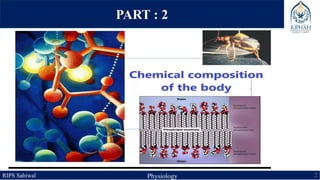
PART : 2
RIPS Sahiwal Physiology 3
LEARNING OBJECTIVES
 Molecules
 Polar molecules
 Free radicals
 Solutions and its types
 Water as universal solvent
RIPS Sahiwal Physiology 4
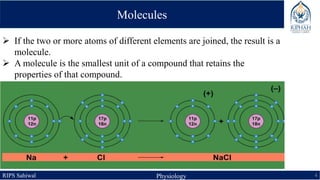
 If the two or more atoms of different elements are joined, the result is a
molecule.
 A molecule is the smallest unit of a compound that retains the
properties of that compound.
Molecules
RIPS Sahiwal Physiology 5
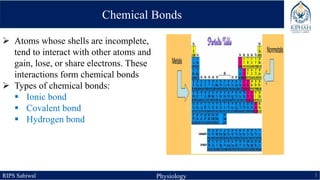
 Atoms whose shells are incomplete,
tend to interact with other atoms and
gain, lose, or share electrons. These
interactions form chemical bonds
 Types of chemical bonds:
 Ionic bond
 Covalent bond
 Hydrogen bond
Chemical Bonds
RIPS Sahiwal Physiology 6
 An attraction between ions of opposite charge
results in Ionic Bond.
 An ionic bond is formed when electrons are
transferred from one atom to another.
 Ionic bonds are most often formed between
atoms that have fewer than two electrons in
their outer electron shells.
 For example,
Sodium and chloride ions
 Bond to form sodium chloride, (table salt).
Ionic Bond
NaCl
RIPS Sahiwal Physiology 7
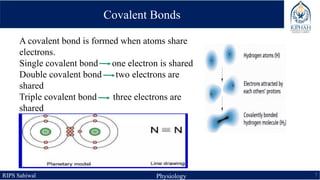
A covalent bond is formed when atoms share
electrons.
Single covalent bond one electron is shared
Double covalent bond two electrons are
shared
Triple covalent bond three electrons are
shared
Covalent Bonds
RIPS Sahiwal Physiology 8
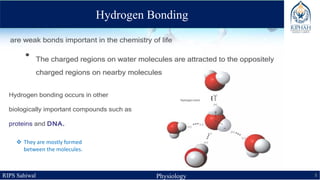
Hydrogen Bonding
 They are mostly formed
between the molecules.
RIPS Sahiwal Physiology 9
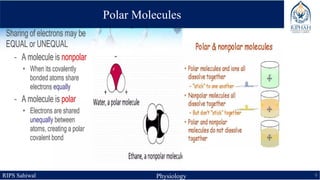
Polar Molecules
RIPS Sahiwal Physiology 10
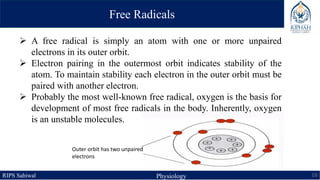
 A free radical is simply an atom with one or more unpaired
electrons in its outer orbit.
 Electron pairing in the outermost orbit indicates stability of the
atom. To maintain stability each electron in the outer orbit must be
paired with another electron.
 Probably the most well-known free radical, oxygen is the basis for
development of most free radicals in the body. Inherently, oxygen
is an unstable molecules.
Free Radicals
Outer orbit has two unpaired
electrons
RIPS Sahiwal Physiology 11
Characteristics of Free Radicals
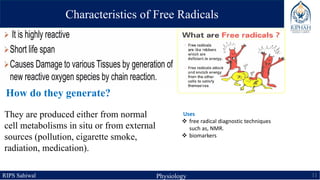
How do they generate?
Uses
 free radical diagnostic techniques
such as, NMR.
 biomarkers
They are produced either from normal
cell metabolisms in situ or from external
sources (pollution, cigarette smoke,
radiation, medication).
RIPS Sahiwal Physiology 12
Characteristics of Free Radicals
 Free radicals are unstable molecules in the body that can damage
DNA in cells. In turn, this can increase your risk for disease,
including cancer.
 The body naturally makes some free radicals as a by product of the
processes it normally does, but you can also get more free radicals by
exposure to certain toxic substances.
 Antioxidants, like those found naturally in fruits and vegetables, are a
key way to "fight" free radicals and the oxidative stress they cause in
your body.
RIPS Sahiwal Physiology 13
Solutions
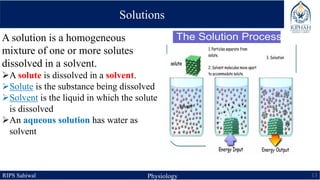
A solution is a homogeneous
mixture of one or more solutes
dissolved in a solvent.
A solute is dissolved in a solvent.
Solute is the substance being dissolved
Solvent is the liquid in which the solute
is dissolved
An aqueous solution has water as
solvent
RIPS Sahiwal Physiology 14
Solutions
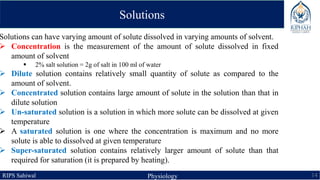
Solutions can have varying amount of solute dissolved in varying amounts of solvent.
 Concentration is the measurement of the amount of solute dissolved in fixed
amount of solvent
 2% salt solution = 2g of salt in 100 ml of water
 Dilute solution contains relatively small quantity of solute as compared to the
amount of solvent.
 Concentrated solution contains large amount of solute in the solution than that in
dilute solution
 Un-saturated solution is a solution in which more solute can be dissolved at given
temperature
 A saturated solution is one where the concentration is maximum and no more
solute is able to dissolved at given temperature
 Super-saturated solution contains relatively larger amount of solute than that
required for saturation (it is prepared by heating).
RIPS Sahiwal Physiology 15
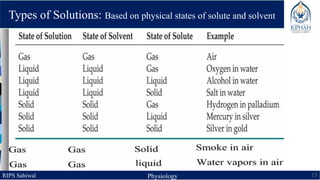
Types of Solutions: Based on physical states of solute and solvent
RIPS Sahiwal Physiology 17
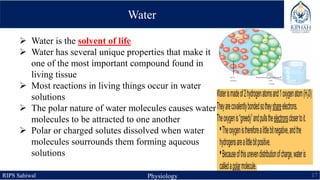
 Water is the solvent of life
 Water has several unique properties that make it
one of the most important compound found in
living tissue
 Most reactions in living things occur in water
solutions
 The polar nature of water molecules causes water
molecules to be attracted to one another
 Polar or charged solutes dissolved when water
molecules sourrounds them forming aqueous
solutions
Water
RIPS Sahiwal Physiology 18
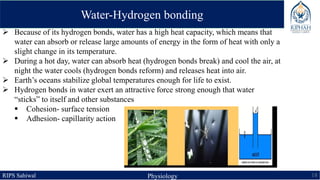
 Because of its hydrogen bonds, water has a high heat capacity, which means that
water can absorb or release large amounts of energy in the form of heat with only a
slight change in its temperature.
 During a hot day, water can absorb heat (hydrogen bonds break) and cool the air, at
night the water cools (hydrogen bonds reform) and releases heat into air.
 Earth’s oceans stabilize global temperatures enough for life to exist.
 Hydrogen bonds in water exert an attractive force strong enough that water
“sticks” to itself and other substances
 Cohesion- surface tension
 Adhesion- capillarity action
Water-Hydrogen bonding
RIPS Sahiwal Physiology 19
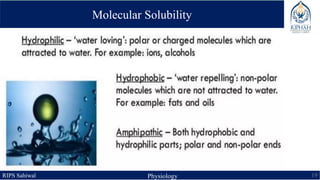
Molecular Solubility
REFERENCES
20
 Human Physiology An Integrated Approach. Dee Unglaub Silverthorn.
 Vander’s Human Physiology The mechanisms of the body function.
Physiology
Physiology in Quran
21
Physiology
lecture 2 (Physio).pdf very important for

lecture 2 (Physio).pdf very important for

  • 1.
    PHYSIOLOGY-A PHARM 313 Lecture No.2: Chemical composition of the body BASIC CELL FUNCTIONS Dr. Sadia Rehman RIPS Sahiwal
  • 2.
  • 3.
    RIPS Sahiwal Physiology3 LEARNING OBJECTIVES  Molecules  Polar molecules  Free radicals  Solutions and its types  Water as universal solvent
  • 4.
    RIPS Sahiwal Physiology4  If the two or more atoms of different elements are joined, the result is a molecule.  A molecule is the smallest unit of a compound that retains the properties of that compound. Molecules
  • 5.
    RIPS Sahiwal Physiology5  Atoms whose shells are incomplete, tend to interact with other atoms and gain, lose, or share electrons. These interactions form chemical bonds  Types of chemical bonds:  Ionic bond  Covalent bond  Hydrogen bond Chemical Bonds
  • 6.
    RIPS Sahiwal Physiology6  An attraction between ions of opposite charge results in Ionic Bond.  An ionic bond is formed when electrons are transferred from one atom to another.  Ionic bonds are most often formed between atoms that have fewer than two electrons in their outer electron shells.  For example, Sodium and chloride ions  Bond to form sodium chloride, (table salt). Ionic Bond NaCl
  • 7.
    RIPS Sahiwal Physiology7 A covalent bond is formed when atoms share electrons. Single covalent bond one electron is shared Double covalent bond two electrons are shared Triple covalent bond three electrons are shared Covalent Bonds
  • 8.
    RIPS Sahiwal Physiology8 Hydrogen Bonding  They are mostly formed between the molecules.
  • 9.
    RIPS Sahiwal Physiology9 Polar Molecules
  • 10.
    RIPS Sahiwal Physiology10  A free radical is simply an atom with one or more unpaired electrons in its outer orbit.  Electron pairing in the outermost orbit indicates stability of the atom. To maintain stability each electron in the outer orbit must be paired with another electron.  Probably the most well-known free radical, oxygen is the basis for development of most free radicals in the body. Inherently, oxygen is an unstable molecules. Free Radicals Outer orbit has two unpaired electrons
  • 11.
    RIPS Sahiwal Physiology11 Characteristics of Free Radicals How do they generate? Uses  free radical diagnostic techniques such as, NMR.  biomarkers They are produced either from normal cell metabolisms in situ or from external sources (pollution, cigarette smoke, radiation, medication).
  • 12.
    RIPS Sahiwal Physiology12 Characteristics of Free Radicals  Free radicals are unstable molecules in the body that can damage DNA in cells. In turn, this can increase your risk for disease, including cancer.  The body naturally makes some free radicals as a by product of the processes it normally does, but you can also get more free radicals by exposure to certain toxic substances.  Antioxidants, like those found naturally in fruits and vegetables, are a key way to "fight" free radicals and the oxidative stress they cause in your body.
  • 13.
    RIPS Sahiwal Physiology13 Solutions A solution is a homogeneous mixture of one or more solutes dissolved in a solvent. A solute is dissolved in a solvent. Solute is the substance being dissolved Solvent is the liquid in which the solute is dissolved An aqueous solution has water as solvent
  • 14.
    RIPS Sahiwal Physiology14 Solutions Solutions can have varying amount of solute dissolved in varying amounts of solvent.  Concentration is the measurement of the amount of solute dissolved in fixed amount of solvent  2% salt solution = 2g of salt in 100 ml of water  Dilute solution contains relatively small quantity of solute as compared to the amount of solvent.  Concentrated solution contains large amount of solute in the solution than that in dilute solution  Un-saturated solution is a solution in which more solute can be dissolved at given temperature  A saturated solution is one where the concentration is maximum and no more solute is able to dissolved at given temperature  Super-saturated solution contains relatively larger amount of solute than that required for saturation (it is prepared by heating).
  • 15.
    RIPS Sahiwal Physiology15 Types of Solutions: Based on physical states of solute and solvent
  • 17.
    RIPS Sahiwal Physiology17  Water is the solvent of life  Water has several unique properties that make it one of the most important compound found in living tissue  Most reactions in living things occur in water solutions  The polar nature of water molecules causes water molecules to be attracted to one another  Polar or charged solutes dissolved when water molecules sourrounds them forming aqueous solutions Water
  • 18.
    RIPS Sahiwal Physiology18  Because of its hydrogen bonds, water has a high heat capacity, which means that water can absorb or release large amounts of energy in the form of heat with only a slight change in its temperature.  During a hot day, water can absorb heat (hydrogen bonds break) and cool the air, at night the water cools (hydrogen bonds reform) and releases heat into air.  Earth’s oceans stabilize global temperatures enough for life to exist.  Hydrogen bonds in water exert an attractive force strong enough that water “sticks” to itself and other substances  Cohesion- surface tension  Adhesion- capillarity action Water-Hydrogen bonding
  • 19.
    RIPS Sahiwal Physiology19 Molecular Solubility
  • 20.
    REFERENCES 20  Human PhysiologyAn Integrated Approach. Dee Unglaub Silverthorn.  Vander’s Human Physiology The mechanisms of the body function. Physiology
  • 21.