System Integration
& Architecture
Nagwovuma Margaret
3/15/2024
System
Integration
&
Architecture
1
Introduction
• Many systems are built to easy, improve and
transform organizations.
• Some organizations have many departments which
run systems which are independent of each other.
• And systems built sometimes, may not have an
abstract view (architecture) which leads to failure
of system interoperability.
• There is need to have architectural view of the
system as a priority to help in the design to avoid
the likeliness of system failure.
3/15/2024
System
Integration
&
Architecture
2
Introduction
• Besides after the system has been designed and developed
in consideration of the size of the organization, i.e. most
especially when the organization is large, need is required to
integrate such systems to ensure flexibility, Speed, Cost ,
Standardization, Data integrity, reliability and robustness.
• This can help Information Technology (IT), energy, and
financial services industry among others to have an easy to
use integrated system.
3/15/2024
System
Integration
&
Architecture
3
What students need to know
• Systems Integration (SI) process, approaches,
drivers, tools and techniques required for
successful SI, critical success factors, and best
practices.
• The course focuses on how a proposed system will
be integrated with other existing or planned
systems.
• It addresses the System Integration problem using
architectures as the basis and then addresses the
evaluation of the architectures in terms of the
capabilities they provide.
3/15/2024
System
Integration
&
Architecture
4
What students need to learn
• The theory and practice of business process integration,
legacy integration, new systems integration, business-to-
business integration, integration of commercial-off-the-
shelf (COTS) products, interface control and management,
testing, integrated program management, integrated
Business Continuity Planning (BCP).
3/15/2024
System
Integration
&
Architecture
5
Aims
• To provide the students an understanding of
the technical and business process issues
involved in systems integration.
3/15/2024
System
Integration
&
Architecture
6
Learning outcomes
• On completion of this course, the students will be
able to:
• Identify integration issues upfront in the process
of System Integration and should be able to
identify the best practices that ensure successful
System Integration.
• Have an understanding of the technical and
business process issues involved in systems
integration.
3/15/2024
System
Integration
&
Architecture
7
Teaching and learning pattern
• Teaching this course will be in lecture form.
A number of case studies will also be used
to illustrate some concepts as mentioned in
the indicative content.
3/15/2024
System
Integration
&
Architecture
8
Indicative content
• The System of Systems Integration Problem
• Human, Organizational, Societal Cultural, Economic,
and Technological aspects;
• Processes, approaches, drivers, tools and techniques required for
successful SI, critical success factors, and best practices in
Systems Integration;
• The Role of Architectures in Systems Integration;
• Integration in a System of Systems and a Federation 60 of
Systems;
• Model Based Architecture, Design, and Integration;
• Systems of Systems Interoperability;
• Evaluation of architectures;
• Measures of Performance and Effectiveness;
3/15/2024
System
Integration
&
Architecture
9
Indicative content
• Assessment of System Capabilities;
• Analysis of Alternatives;
• Case studies and examples from the Information Technology
(IT), energy, and financial services industry to illustrate the
concepts discussed.
• The theory and practice of business process integration,
legacy integration, new systems integration, business-to-
business integration, integration of commercial-off-the-
shelf (COTS) products, interface control and management,
testing, integrated program management, integrated
Business Continuity Planning (BCP). Specific focus will be
given to issues of interface integration and interoperability
of systems.
3/15/2024
System
Integration
&
Architecture
10
Assessment method
• Assessment will be in form of tests and
practical assignments (40%) and final written
examination (60%)
3/15/2024
System
Integration
&
Architecture
11
Reference books
• Sage A.P. and Rouse, W.B. Handbook of Systems
Engineering and management, John Wiley & Sons,
1999.
3/15/2024
System
Integration
&
Architecture
12
Key terminologies in this course
• Various key terminologies shall be used
throughout this course as follows
• System
• Systems thinking
• System Integration
• System Architecture
• Project
3/15/2024
System
Integration
&
Architecture
13
System
• An array of components designed to accomplish
a particular objective according to plan. Many
sub-systems many be designed which later on
are combined together to form a system which
is intended to achieve a specific objective which
may be set by the Project manager.
3/15/2024
System
Integration
&
Architecture
14
Systems thinking
 Is a way of understanding an entity in terms of its purpose, as
three steps
 The three major steps followed in systems thinking
1. Identify a containing whole (system), of which the thing to be
explained is a part.
2. Explain the behavior or properties of the containing whole.
3. Explain the behavior or properties of the thing to be explained
in terms of its role(s)or function(s) within its containing whole
(Ackoff, 1981)
3/15/2024
System
Integration
&
Architecture
15
System Integration
• Is the combination of inter-related elements to achieve a
common objective (s).
3/15/2024
System
Integration
&
Architecture
16
System Architecture
• The architecture of a system defines its high-level structure,
exposing its gross organization as a collection of interacting
components.
• Elements needed to model a software architecture include:
• Components, Connectors, Systems, Properties and Styles.
3/15/2024
System
Integration
&
Architecture
17
What is a project?
• From the key terms described above, a system developer and
architects cannot do anything without first establishing various
projects. These projects may be new or existing.
• So it is inevitable to first understand what a project is, factors that
influence the project, who the owners are and many more as
discussed below.
3/15/2024
System
Integration
&
Architecture
18
19
What Is a Project?
• A project is a temporary endeavor undertaken to
accomplish a unique product or service
• Attributes of projects
• unique purpose
• temporary
• require resources, often from various areas
• should have a primary sponsor and/or customer
• involve uncertainty
3/15/2024
System
Integration
&
Architecture
Where do information Systems Projects
Originate (Sources of Projects)?
New or changed IS development projects come from problems,
opportunities, and directives and are always subject to one or more
constraints.
1. Problems – may either be current, suspected, or anticipated.
Problems are undesirable situations that prevent the business
from fully achieving its purpose, goals, and objectives (users
discovering real problems with existing IS).
2. An Opportunity – is a chance to improve the business even in
the absence of specific problems. This means that the business is
hoping to create a system that will help it with increasing its
revenue, profit, or services, or decreasing its costs.
3. A Directive – is a new requirement that is imposed by
management, government, or some external influence i.e. are
mandates that come from either an internal or external source of
the business.
3/15/2024
System
Integration
&
Architecture
20
21
Projects Cannot Be Run in Isolation
• Projects must operate in a broad organizational
environment
• Project managers need to take a holistic or systems view
of a project and understand how it is situated within the
larger organization
3/15/2024
System
Integration
&
Architecture
21
22
Stakeholders
• Stakeholders are the people involved in or affected by
project activities
• Stakeholders include
• the project sponsor and project team
• support staff
• customers
• users
• suppliers
• opponents to the project
3/15/2024
System
Integration
&
Architecture
Importance of Stakeholders
• Project managers must take time to identify,
understand, and manage relationships with all
project stakeholders
• Using the four frames of organizations can help
meet stakeholder needs and expectations
• Senior executives are very important stakeholders
3/15/2024
System
Integration
&
Architecture
23
24
Table 2-2. What Helps Projects
Succeed?
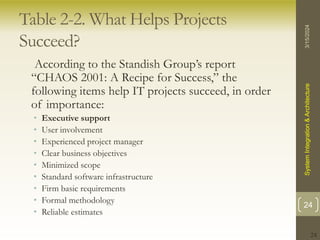
According to the Standish Group’s report
“CHAOS 2001: A Recipe for Success,” the
following items help IT projects succeed, in order
of importance:
• Executive support
• User involvement
• Experienced project manager
• Clear business objectives
• Minimized scope
• Standard software infrastructure
• Firm basic requirements
• Formal methodology
• Reliable estimates
3/15/2024
System
Integration
&
Architecture
24
25
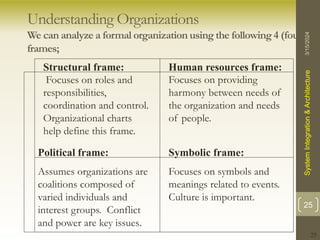
Understanding Organizations
We can analyze a formal organization using the following 4 (four)
frames;
Structural frame:
Focuses on roles and
responsibilities,
coordination and control.
Organizational charts
help define this frame.
Human resources frame:
Focuses on providing
harmony between needs of
the organization and needs
of people.
Political frame:
Assumes organizations are
coalitions composed of
varied individuals and
interest groups. Conflict
and power are key issues.
Symbolic frame:
Focuses on symbols and
meanings related to events.
Culture is important.
3/15/2024
System
Integration
&
Architecture
25
26
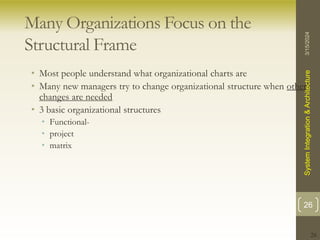
Many Organizations Focus on the
Structural Frame
• Most people understand what organizational charts are
• Many new managers try to change organizational structure when other
changes are needed
• 3 basic organizational structures
• Functional-
• project
• matrix
3/15/2024
System
Integration
&
Architecture
26
Basic Organizational Structures
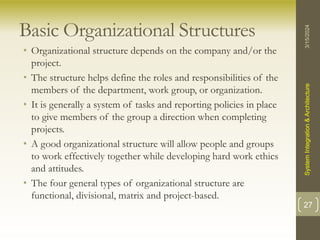
• Organizational structure depends on the company and/or the
project.
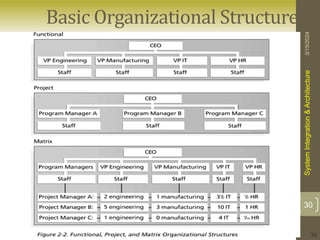
• The structure helps define the roles and responsibilities of the
members of the department, work group, or organization.
• It is generally a system of tasks and reporting policies in place
to give members of the group a direction when completing
projects.
• A good organizational structure will allow people and groups
to work effectively together while developing hard work ethics
and attitudes.
• The four general types of organizational structure are
functional, divisional, matrix and project-based.
3/15/2024
System
Integration
&
Architecture
27
Basic Organizational Structures
• Functional Structure - People who do similar tasks, have
similar skills and/or jobs in an organization are grouped
into a functional structure. The advantages of this kind of
structure include quick decision making because the group
members are able to communicate easily with each other.
People in functional structures can learn from each other
easier because they already possess similar skill sets and
interests.
• Divisional Structure - In a divisional structure, the company will
coordinate inter-group relationships to create a work team that can
readily meet the needs of a certain customer or group of customers.
The division of labor in this kind of structure will ensure greater
output of varieties of similar products. An example of a divisional
structure is geographical, where divisions are set up in regions to work
with each other to produce similar products that meet the needs of the
individual regions.
3/15/2024
System
Integration
&
Architecture
28
Basic Organizational Structures
• Matrix Structure - Matrix structures are more complex in
that they group people in two different ways: by the function
they perform and by the product team they are working with. In
a matrix structure the team members are given more autonomy
and expected to take more responsibility for their work. This
increases the productivity of the team, fosters greater innovation
and creativity, and allows managers to cooperatively solve
decision-making problems through group interaction.
• Project Organization Structure - In a project-organizational
structure, the teams are put together based on the number of
members needed to produce the product or complete the project.
The number of significantly different kinds of tasks are taken
into account when structuring a project in this manner, assuring
that the right members are chosen to participate in the project.
3/15/2024
System
Integration
&
Architecture
29
30
Basic Organizational Structures
3/15/2024
System
Integration
&
Architecture
30
31
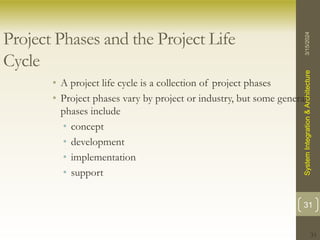
Project Phases and the Project Life
Cycle
• A project life cycle is a collection of project phases
• Project phases vary by project or industry, but some general
phases include
• concept
• development
• implementation
• support
3/15/2024
System
Integration
&
Architecture
31
32
Phases of the Project Life Cycle
3/15/2024
System
Integration
&
Architecture
32
33
Product Life Cycles
 Products also have life cycles
 The Systems Development Life Cycle (SDLC) is a
framework for describing the phases involved in
developing and maintaining information systems
 Systems development projects can follow
 Predictive models: The scope of the project can be clearly articulated and
the schedule and cost can be predicted.
 Adaptive models: Projects are mission driven and component based, using
time-based cycles to meet target dates.
3/15/2024
System
Integration
&
Architecture
33
Predictive Life Cycle Models
 The waterfall model has well-defined, linear stages of systems
development and support.
 The spiral model shows that software is developed using an
iterative or spiral approach rather than a linear approach.
 The incremental release model provides for progressive
development of operational software.
 The prototyping model is used for developing prototypes to
clarify user requirements.
 The RAD model is used to produce systems quickly without
sacrificing quality.
3/15/2024
System
Integration
&
Architecture
34
35
Adaptive Life Cycle Models
 Extreme Programming (XP): Developers program
in pairs and must write the tests for their own code.
XP teams include developers, managers, and users.
 Scrum: Repetitions of iterative development are
referred to as sprints, which normally last thirty days.
Teams often meet every day for a short meeting,
called a scrum, to decide what to accomplish that day.
Works best for object-oriented technology projects
and requires strong leadership to coordinate the work
3/15/2024
System
Integration
&
Architecture
35
36
Distinguishing Project Life Cycles and
Product Life Cycles
• The project life cycle applies to all projects, regardless of the products
being produced
• Product life cycle models vary considerably based on
the nature of the product
• Most large IT systems are developed as a series of projects
• Project management is done in all of the product life cycle phases
3/15/2024
System
Integration
&
Architecture
36
37
Why Have Project Phases and
Management Reviews?
• A project should successfully pass through each of the project phases
in order to continue on to the next
• Management reviews (also called phase exits or kill points) should
occur after each phase to evaluate the project’s progress, likely
success, and continued compatibility with organizational goals
3/15/2024
System
Integration
&
Architecture
37
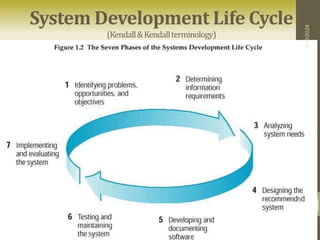
System Development Life Cycle
(Kendall&Kendallterminology)
System
Integration
&
Architecture
3/15/2024
38
Topic 1
Requirements
3/15/2024
System
Integration
&
Architecture
39
Requirements
• A system cannot be analyzed, designed, implemented and
evaluated unless the problem is understood and requirements
elicited.
• Requirements are fundamental basis of all the system
development processes.
• System architects will always base of the requirements elicited by
the system analyst to design an architectural view of the system.
Besides much as the system is designed and there is need for
integration say business process integration, legacy integration,
new systems integration, business-to-business integration,
integration of commercial-off-the-shelf (COTS) products,
interface control and management, testing, integrated program
management, integrated Business Continuity Planning (BCP),
requirement is the basis.
3/15/2024
System
Integration
&
Architecture
40
Sub Topics
Requirements elicitation,
documentation, and maintenance
Modeling tools and methodologies
Using Unified Modeling Language
Testing
3/15/2024
System
Integration
&
Architecture
41
Core learning outcomes:
• Compare and contrast the various requirements modeling techniques.
• Distinguish between non-functional and functional requirements.
• Identify and classify the roles played by external users of a system.
• Explain and give examples of use cases.
• Explain the structure of a detailed use case.
• Detail a use case based on relating functional requirements.
• Describe the types of event flows in a use case and under which
conditions they occur.
• Explain how requirements gathering fits into a system development
lifecycle.
• Explain how use cases drive testing throughout the system lifecycle.
3/15/2024
System
Integration
&
Architecture
42
What are requirements?
• Requirements are statements that identify the
essential needs of a system in order for it to have
value and utility.
3/15/2024
System
Integration
&
Architecture
43
Characteristics of Good Req’ts
• 1. Describes What, Not How.
• 2. Atomic. i.e., it should have a single purpose
• 3. Unique.
• 4. Documented and Accessible.
• 5. Identifies Its Owner.
• 6. Approved. After a requirement has been revised, reviewed,
and rewritten, it must be approved by its owner.
• 7. Traceable. A good requirement is traceable; it should be
possible to trace each requirement back to its source.
• 8. Necessary.
3/15/2024
System
Integration
&
Architecture
44
Characteristics of Good Req’ts cont….
• 9. Complete.
• 10. Unambiguous
• 11. Quantitative and testable
• 12. Identifies applicable states
• 14. States Assumptions. All assumptions should be stated.
• 15. Use of Shall, Should, and Will. A mandatory requirement should
be expressed using the word shall (e.g., "The system shall conform to
all state laws
• 16. Avoids Certain Words. The words optimize, maximize, and
minimize should not be used in stating requirements, because we
could never prove that we had achieved them.
3/15/2024
System
Integration
&
Architecture
45
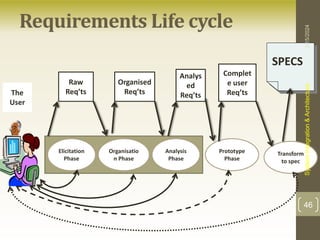
Requirements Life cycle
The
User
Elicitation
Phase
Organisatio
n Phase
Analysis
Phase
Prototype
Phase
Transform
to spec
Raw
Req’ts
Organised
Req’ts
Analys
ed
Req’ts
Complet
e user
Req’ts
SPECS
3/15/2024
System
Integration
&
Architecture
46
Requirement Life Cycle .. Cont..
 Elicitation Phase
The starting point of the requirements engineering process is an elicitation
process that involves a number of people to ensure consideration of a
broad scope of potential ideas and candidate problems
 Organisation Phase
In this step there is no transformation of the requirements, but simple
classification and categorization. For example, requirements may be
grouped into functional vs. nonfunctional requirements.
 Analysis Phase
This represents a transformation.
3/15/2024
System
Integration
&
Architecture
47
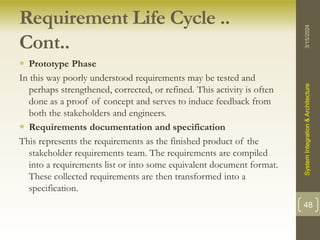
Requirement Life Cycle ..
Cont..
 Prototype Phase
In this way poorly understood requirements may be tested and
perhaps strengthened, corrected, or refined. This activity is often
done as a proof of concept and serves to induce feedback from
both the stakeholders and engineers.
 Requirements documentation and specification
This represents the requirements as the finished product of the
stakeholder requirements team. The requirements are compiled
into a requirements list or into some equivalent document format.
These collected requirements are then transformed into a
specification.
3/15/2024
System
Integration
&
Architecture
48
Requirements elicitation,
documentation, and
maintenance
3/15/2024
System
Integration
&
Architecture
49
Requirements elicitation
• Requirements determination addresses the
gathering and documenting of the true and
real requirements for the Information System
being developed.
• Requirements is the wants and /or needs of the
user within a problem domain. elicit
3/15/2024
System
Integration
&
Architecture
50
Requirements determination questions
• Requirements determination questions
• Who does it?
• What is done?
• Where is it done?
• When is it done
• How is it done
• Why is it done?
3/15/2024
System
Integration
&
Architecture
51
Systems Requirements
• Characteristics or features that must be included to
satisfy business requirements
• Outputs
• Inputs
• Processes
• Timing
• Controls
• Volumes. sizes, and frequencies
• Data/Information collected can be about; people,
organisation, work and work environment.
3/15/2024
System
Integration
&
Architecture
52
Fact – Finding Methods
• Sampling (of existing documentation, forms, and
databases).
• Research and site visits. (Participation)
• Observation of the work environment.
• Questionnaires.
• Interviews.
• Prototyping.
• JAD/Joint requirements planning (JRP).
3/15/2024
System
Integration
&
Architecture
53
Types of Requirements
User Requirements: these are statements in Natural language plus
diagrams of services the system provides, together with its operational
constraints. These can be categorised into 2; functional requirements and
non-functional requirements
Functional requirements
Describe what the system should do
Non-functional requirements
Consists of Constraints that must be adhered to during
development (design and implementation)
Remember ‘Constraints.’
System requirements
What we agree to provide
Describes system services
Contract between Client and contractor
3/15/2024
System
Integration
&
Architecture
54
Functional requirements
• What inputs the system should accept
• What outputs the system should produce
• What data the system should store that other systems might use
• What computations the system should perform
• The timing and synchronization of the above
3/15/2024
System
Integration
&
Architecture
55
Non-functional requirements
• Non-functional requirements are global constraints on a
computer system
• e.g. development costs, operational costs, performance, reliability,
• The challenge of Non-functional requirements:
• Hard to model
• Usually stated informally, and so are:
• often contradictory,
• difficult to enforce during development
• difficult to evaluate for the customer prior to delivery
3/15/2024
System
Integration
&
Architecture
56
Non-functional requirements
• Define system properties and constraints e.g.
reliability, response time and storage requirements.
Constraints are I/O device capability, system
representations.
• Process requirements may also be specified
mandating a particular programming language or
development method
• Non-functional requirements may be more critical
than functional requirements. If these are not met,
the system is useless.
3/15/2024
System
Integration
&
Architecture
57
Examples of NFR
• Interface requirements
• how will the new system interface with its environment?
• User interfaces and “user-friendliness”
• Interfaces with other systems
• Performance requirements
• Time - response time
• Throughput - transactions per second
3/15/2024
System
Integration
&
Architecture
58
Examples of NFR
• Security
• permissible information flows
• Or who can do what
• Survivability – e.g. system will need to survive fire
natural catastrophes, etc
• Operating requirements
• physical constraints (size, weight),
• personnel availability & skill level
• accessibility for maintenance
• environmental conditions
3/15/2024
System
Integration
&
Architecture
59
Examples of NFR
• Lifecycle requirements
• Maintainability, Enhanciability, Portability, expected market or
product lifespan
• limits on development
• E.g. development time limitations, resource availability and
methodological standards.
• Economic requirements
• e.g. restrictions on immediate and/or long-term costs.
3/15/2024
System
Integration
&
Architecture
60
Requirements Documentation
• There are basically two types of documents realised
from the requirements elicitation phase. These include;
• User Requirements Specification Document
• System requirements specification Document
3/15/2024
System
Integration
&
Architecture
61
User Requirements Specification –
URS/URD
 The URS document outlines precisely what the User (or customer) is
expecting from this system.
 User Requirement Specification may incorporate the functional
requirements of the system or may be in a separate document
labelled the Functional Requirements Specification - the FRS.
The URD has the following
information:
1. Functional Requirements
2. Non-Functional Requirements
3/15/2024
System
Integration
&
Architecture
62
System Requirements Specification
Document
A detailed description of the system services.
• What do we agree to provide?
• A structured document setting out detailed
descriptions of the system services.
• Written as a contract between client and
contractor.
3/15/2024
System
Integration
&
Architecture
63
TOOLS THAT AID IN DEVELOPING &
UNDERSTANDING SYSTEM REQ’TS
• Affinity diagrams
• Force-field analysis
• Ishikawa fishbone (cause-and-effect) diagrams
• Pareto diagrams
• Pugh charts
• Quality function deployment (QFD)
3/15/2024
System
Integration
&
Architecture
64
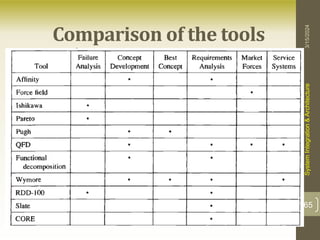
Comparison of the tools
3/15/2024
System
Integration
&
Architecture
65

Lecture 1_System Integration & Architecture

  • 1.
    System Integration & Architecture NagwovumaMargaret 3/15/2024 System Integration & Architecture 1
  • 2.
    Introduction • Many systemsare built to easy, improve and transform organizations. • Some organizations have many departments which run systems which are independent of each other. • And systems built sometimes, may not have an abstract view (architecture) which leads to failure of system interoperability. • There is need to have architectural view of the system as a priority to help in the design to avoid the likeliness of system failure. 3/15/2024 System Integration & Architecture 2
  • 3.
    Introduction • Besides afterthe system has been designed and developed in consideration of the size of the organization, i.e. most especially when the organization is large, need is required to integrate such systems to ensure flexibility, Speed, Cost , Standardization, Data integrity, reliability and robustness. • This can help Information Technology (IT), energy, and financial services industry among others to have an easy to use integrated system. 3/15/2024 System Integration & Architecture 3
  • 4.
    What students needto know • Systems Integration (SI) process, approaches, drivers, tools and techniques required for successful SI, critical success factors, and best practices. • The course focuses on how a proposed system will be integrated with other existing or planned systems. • It addresses the System Integration problem using architectures as the basis and then addresses the evaluation of the architectures in terms of the capabilities they provide. 3/15/2024 System Integration & Architecture 4
  • 5.
    What students needto learn • The theory and practice of business process integration, legacy integration, new systems integration, business-to- business integration, integration of commercial-off-the- shelf (COTS) products, interface control and management, testing, integrated program management, integrated Business Continuity Planning (BCP). 3/15/2024 System Integration & Architecture 5
  • 6.
    Aims • To providethe students an understanding of the technical and business process issues involved in systems integration. 3/15/2024 System Integration & Architecture 6
  • 7.
    Learning outcomes • Oncompletion of this course, the students will be able to: • Identify integration issues upfront in the process of System Integration and should be able to identify the best practices that ensure successful System Integration. • Have an understanding of the technical and business process issues involved in systems integration. 3/15/2024 System Integration & Architecture 7
  • 8.
    Teaching and learningpattern • Teaching this course will be in lecture form. A number of case studies will also be used to illustrate some concepts as mentioned in the indicative content. 3/15/2024 System Integration & Architecture 8
  • 9.
    Indicative content • TheSystem of Systems Integration Problem • Human, Organizational, Societal Cultural, Economic, and Technological aspects; • Processes, approaches, drivers, tools and techniques required for successful SI, critical success factors, and best practices in Systems Integration; • The Role of Architectures in Systems Integration; • Integration in a System of Systems and a Federation 60 of Systems; • Model Based Architecture, Design, and Integration; • Systems of Systems Interoperability; • Evaluation of architectures; • Measures of Performance and Effectiveness; 3/15/2024 System Integration & Architecture 9
  • 10.
    Indicative content • Assessmentof System Capabilities; • Analysis of Alternatives; • Case studies and examples from the Information Technology (IT), energy, and financial services industry to illustrate the concepts discussed. • The theory and practice of business process integration, legacy integration, new systems integration, business-to- business integration, integration of commercial-off-the- shelf (COTS) products, interface control and management, testing, integrated program management, integrated Business Continuity Planning (BCP). Specific focus will be given to issues of interface integration and interoperability of systems. 3/15/2024 System Integration & Architecture 10
  • 11.
    Assessment method • Assessmentwill be in form of tests and practical assignments (40%) and final written examination (60%) 3/15/2024 System Integration & Architecture 11
  • 12.
    Reference books • SageA.P. and Rouse, W.B. Handbook of Systems Engineering and management, John Wiley & Sons, 1999. 3/15/2024 System Integration & Architecture 12
  • 13.
    Key terminologies inthis course • Various key terminologies shall be used throughout this course as follows • System • Systems thinking • System Integration • System Architecture • Project 3/15/2024 System Integration & Architecture 13
  • 14.
    System • An arrayof components designed to accomplish a particular objective according to plan. Many sub-systems many be designed which later on are combined together to form a system which is intended to achieve a specific objective which may be set by the Project manager. 3/15/2024 System Integration & Architecture 14
  • 15.
    Systems thinking  Isa way of understanding an entity in terms of its purpose, as three steps  The three major steps followed in systems thinking 1. Identify a containing whole (system), of which the thing to be explained is a part. 2. Explain the behavior or properties of the containing whole. 3. Explain the behavior or properties of the thing to be explained in terms of its role(s)or function(s) within its containing whole (Ackoff, 1981) 3/15/2024 System Integration & Architecture 15
  • 16.
    System Integration • Isthe combination of inter-related elements to achieve a common objective (s). 3/15/2024 System Integration & Architecture 16
  • 17.
    System Architecture • Thearchitecture of a system defines its high-level structure, exposing its gross organization as a collection of interacting components. • Elements needed to model a software architecture include: • Components, Connectors, Systems, Properties and Styles. 3/15/2024 System Integration & Architecture 17
  • 18.
    What is aproject? • From the key terms described above, a system developer and architects cannot do anything without first establishing various projects. These projects may be new or existing. • So it is inevitable to first understand what a project is, factors that influence the project, who the owners are and many more as discussed below. 3/15/2024 System Integration & Architecture 18
  • 19.
    19 What Is aProject? • A project is a temporary endeavor undertaken to accomplish a unique product or service • Attributes of projects • unique purpose • temporary • require resources, often from various areas • should have a primary sponsor and/or customer • involve uncertainty 3/15/2024 System Integration & Architecture
  • 20.
    Where do informationSystems Projects Originate (Sources of Projects)? New or changed IS development projects come from problems, opportunities, and directives and are always subject to one or more constraints. 1. Problems – may either be current, suspected, or anticipated. Problems are undesirable situations that prevent the business from fully achieving its purpose, goals, and objectives (users discovering real problems with existing IS). 2. An Opportunity – is a chance to improve the business even in the absence of specific problems. This means that the business is hoping to create a system that will help it with increasing its revenue, profit, or services, or decreasing its costs. 3. A Directive – is a new requirement that is imposed by management, government, or some external influence i.e. are mandates that come from either an internal or external source of the business. 3/15/2024 System Integration & Architecture 20
  • 21.
    21 Projects Cannot BeRun in Isolation • Projects must operate in a broad organizational environment • Project managers need to take a holistic or systems view of a project and understand how it is situated within the larger organization 3/15/2024 System Integration & Architecture 21
  • 22.
    22 Stakeholders • Stakeholders arethe people involved in or affected by project activities • Stakeholders include • the project sponsor and project team • support staff • customers • users • suppliers • opponents to the project 3/15/2024 System Integration & Architecture
  • 23.
    Importance of Stakeholders •Project managers must take time to identify, understand, and manage relationships with all project stakeholders • Using the four frames of organizations can help meet stakeholder needs and expectations • Senior executives are very important stakeholders 3/15/2024 System Integration & Architecture 23
  • 24.
    24 Table 2-2. WhatHelps Projects Succeed? According to the Standish Group’s report “CHAOS 2001: A Recipe for Success,” the following items help IT projects succeed, in order of importance: • Executive support • User involvement • Experienced project manager • Clear business objectives • Minimized scope • Standard software infrastructure • Firm basic requirements • Formal methodology • Reliable estimates 3/15/2024 System Integration & Architecture 24
  • 25.
    25 Understanding Organizations We cananalyze a formal organization using the following 4 (four) frames; Structural frame: Focuses on roles and responsibilities, coordination and control. Organizational charts help define this frame. Human resources frame: Focuses on providing harmony between needs of the organization and needs of people. Political frame: Assumes organizations are coalitions composed of varied individuals and interest groups. Conflict and power are key issues. Symbolic frame: Focuses on symbols and meanings related to events. Culture is important. 3/15/2024 System Integration & Architecture 25
  • 26.
    26 Many Organizations Focuson the Structural Frame • Most people understand what organizational charts are • Many new managers try to change organizational structure when other changes are needed • 3 basic organizational structures • Functional- • project • matrix 3/15/2024 System Integration & Architecture 26
  • 27.
    Basic Organizational Structures •Organizational structure depends on the company and/or the project. • The structure helps define the roles and responsibilities of the members of the department, work group, or organization. • It is generally a system of tasks and reporting policies in place to give members of the group a direction when completing projects. • A good organizational structure will allow people and groups to work effectively together while developing hard work ethics and attitudes. • The four general types of organizational structure are functional, divisional, matrix and project-based. 3/15/2024 System Integration & Architecture 27
  • 28.
    Basic Organizational Structures •Functional Structure - People who do similar tasks, have similar skills and/or jobs in an organization are grouped into a functional structure. The advantages of this kind of structure include quick decision making because the group members are able to communicate easily with each other. People in functional structures can learn from each other easier because they already possess similar skill sets and interests. • Divisional Structure - In a divisional structure, the company will coordinate inter-group relationships to create a work team that can readily meet the needs of a certain customer or group of customers. The division of labor in this kind of structure will ensure greater output of varieties of similar products. An example of a divisional structure is geographical, where divisions are set up in regions to work with each other to produce similar products that meet the needs of the individual regions. 3/15/2024 System Integration & Architecture 28
  • 29.
    Basic Organizational Structures •Matrix Structure - Matrix structures are more complex in that they group people in two different ways: by the function they perform and by the product team they are working with. In a matrix structure the team members are given more autonomy and expected to take more responsibility for their work. This increases the productivity of the team, fosters greater innovation and creativity, and allows managers to cooperatively solve decision-making problems through group interaction. • Project Organization Structure - In a project-organizational structure, the teams are put together based on the number of members needed to produce the product or complete the project. The number of significantly different kinds of tasks are taken into account when structuring a project in this manner, assuring that the right members are chosen to participate in the project. 3/15/2024 System Integration & Architecture 29
  • 30.
  • 31.
    31 Project Phases andthe Project Life Cycle • A project life cycle is a collection of project phases • Project phases vary by project or industry, but some general phases include • concept • development • implementation • support 3/15/2024 System Integration & Architecture 31
  • 32.
    32 Phases of theProject Life Cycle 3/15/2024 System Integration & Architecture 32
  • 33.
    33 Product Life Cycles Products also have life cycles  The Systems Development Life Cycle (SDLC) is a framework for describing the phases involved in developing and maintaining information systems  Systems development projects can follow  Predictive models: The scope of the project can be clearly articulated and the schedule and cost can be predicted.  Adaptive models: Projects are mission driven and component based, using time-based cycles to meet target dates. 3/15/2024 System Integration & Architecture 33
  • 34.
    Predictive Life CycleModels  The waterfall model has well-defined, linear stages of systems development and support.  The spiral model shows that software is developed using an iterative or spiral approach rather than a linear approach.  The incremental release model provides for progressive development of operational software.  The prototyping model is used for developing prototypes to clarify user requirements.  The RAD model is used to produce systems quickly without sacrificing quality. 3/15/2024 System Integration & Architecture 34
  • 35.
    35 Adaptive Life CycleModels  Extreme Programming (XP): Developers program in pairs and must write the tests for their own code. XP teams include developers, managers, and users.  Scrum: Repetitions of iterative development are referred to as sprints, which normally last thirty days. Teams often meet every day for a short meeting, called a scrum, to decide what to accomplish that day. Works best for object-oriented technology projects and requires strong leadership to coordinate the work 3/15/2024 System Integration & Architecture 35
  • 36.
    36 Distinguishing Project LifeCycles and Product Life Cycles • The project life cycle applies to all projects, regardless of the products being produced • Product life cycle models vary considerably based on the nature of the product • Most large IT systems are developed as a series of projects • Project management is done in all of the product life cycle phases 3/15/2024 System Integration & Architecture 36
  • 37.
    37 Why Have ProjectPhases and Management Reviews? • A project should successfully pass through each of the project phases in order to continue on to the next • Management reviews (also called phase exits or kill points) should occur after each phase to evaluate the project’s progress, likely success, and continued compatibility with organizational goals 3/15/2024 System Integration & Architecture 37
  • 38.
    System Development LifeCycle (Kendall&Kendallterminology) System Integration & Architecture 3/15/2024 38
  • 39.
  • 40.
    Requirements • A systemcannot be analyzed, designed, implemented and evaluated unless the problem is understood and requirements elicited. • Requirements are fundamental basis of all the system development processes. • System architects will always base of the requirements elicited by the system analyst to design an architectural view of the system. Besides much as the system is designed and there is need for integration say business process integration, legacy integration, new systems integration, business-to-business integration, integration of commercial-off-the-shelf (COTS) products, interface control and management, testing, integrated program management, integrated Business Continuity Planning (BCP), requirement is the basis. 3/15/2024 System Integration & Architecture 40
  • 41.
    Sub Topics Requirements elicitation, documentation,and maintenance Modeling tools and methodologies Using Unified Modeling Language Testing 3/15/2024 System Integration & Architecture 41
  • 42.
    Core learning outcomes: •Compare and contrast the various requirements modeling techniques. • Distinguish between non-functional and functional requirements. • Identify and classify the roles played by external users of a system. • Explain and give examples of use cases. • Explain the structure of a detailed use case. • Detail a use case based on relating functional requirements. • Describe the types of event flows in a use case and under which conditions they occur. • Explain how requirements gathering fits into a system development lifecycle. • Explain how use cases drive testing throughout the system lifecycle. 3/15/2024 System Integration & Architecture 42
  • 43.
    What are requirements? •Requirements are statements that identify the essential needs of a system in order for it to have value and utility. 3/15/2024 System Integration & Architecture 43
  • 44.
    Characteristics of GoodReq’ts • 1. Describes What, Not How. • 2. Atomic. i.e., it should have a single purpose • 3. Unique. • 4. Documented and Accessible. • 5. Identifies Its Owner. • 6. Approved. After a requirement has been revised, reviewed, and rewritten, it must be approved by its owner. • 7. Traceable. A good requirement is traceable; it should be possible to trace each requirement back to its source. • 8. Necessary. 3/15/2024 System Integration & Architecture 44
  • 45.
    Characteristics of GoodReq’ts cont…. • 9. Complete. • 10. Unambiguous • 11. Quantitative and testable • 12. Identifies applicable states • 14. States Assumptions. All assumptions should be stated. • 15. Use of Shall, Should, and Will. A mandatory requirement should be expressed using the word shall (e.g., "The system shall conform to all state laws • 16. Avoids Certain Words. The words optimize, maximize, and minimize should not be used in stating requirements, because we could never prove that we had achieved them. 3/15/2024 System Integration & Architecture 45
  • 46.
    Requirements Life cycle The User Elicitation Phase Organisatio nPhase Analysis Phase Prototype Phase Transform to spec Raw Req’ts Organised Req’ts Analys ed Req’ts Complet e user Req’ts SPECS 3/15/2024 System Integration & Architecture 46
  • 47.
    Requirement Life Cycle.. Cont..  Elicitation Phase The starting point of the requirements engineering process is an elicitation process that involves a number of people to ensure consideration of a broad scope of potential ideas and candidate problems  Organisation Phase In this step there is no transformation of the requirements, but simple classification and categorization. For example, requirements may be grouped into functional vs. nonfunctional requirements.  Analysis Phase This represents a transformation. 3/15/2024 System Integration & Architecture 47
  • 48.
    Requirement Life Cycle.. Cont..  Prototype Phase In this way poorly understood requirements may be tested and perhaps strengthened, corrected, or refined. This activity is often done as a proof of concept and serves to induce feedback from both the stakeholders and engineers.  Requirements documentation and specification This represents the requirements as the finished product of the stakeholder requirements team. The requirements are compiled into a requirements list or into some equivalent document format. These collected requirements are then transformed into a specification. 3/15/2024 System Integration & Architecture 48
  • 49.
  • 50.
    Requirements elicitation • Requirementsdetermination addresses the gathering and documenting of the true and real requirements for the Information System being developed. • Requirements is the wants and /or needs of the user within a problem domain. elicit 3/15/2024 System Integration & Architecture 50
  • 51.
    Requirements determination questions •Requirements determination questions • Who does it? • What is done? • Where is it done? • When is it done • How is it done • Why is it done? 3/15/2024 System Integration & Architecture 51
  • 52.
    Systems Requirements • Characteristicsor features that must be included to satisfy business requirements • Outputs • Inputs • Processes • Timing • Controls • Volumes. sizes, and frequencies • Data/Information collected can be about; people, organisation, work and work environment. 3/15/2024 System Integration & Architecture 52
  • 53.
    Fact – FindingMethods • Sampling (of existing documentation, forms, and databases). • Research and site visits. (Participation) • Observation of the work environment. • Questionnaires. • Interviews. • Prototyping. • JAD/Joint requirements planning (JRP). 3/15/2024 System Integration & Architecture 53
  • 54.
    Types of Requirements UserRequirements: these are statements in Natural language plus diagrams of services the system provides, together with its operational constraints. These can be categorised into 2; functional requirements and non-functional requirements Functional requirements Describe what the system should do Non-functional requirements Consists of Constraints that must be adhered to during development (design and implementation) Remember ‘Constraints.’ System requirements What we agree to provide Describes system services Contract between Client and contractor 3/15/2024 System Integration & Architecture 54
  • 55.
    Functional requirements • Whatinputs the system should accept • What outputs the system should produce • What data the system should store that other systems might use • What computations the system should perform • The timing and synchronization of the above 3/15/2024 System Integration & Architecture 55
  • 56.
    Non-functional requirements • Non-functionalrequirements are global constraints on a computer system • e.g. development costs, operational costs, performance, reliability, • The challenge of Non-functional requirements: • Hard to model • Usually stated informally, and so are: • often contradictory, • difficult to enforce during development • difficult to evaluate for the customer prior to delivery 3/15/2024 System Integration & Architecture 56
  • 57.
    Non-functional requirements • Definesystem properties and constraints e.g. reliability, response time and storage requirements. Constraints are I/O device capability, system representations. • Process requirements may also be specified mandating a particular programming language or development method • Non-functional requirements may be more critical than functional requirements. If these are not met, the system is useless. 3/15/2024 System Integration & Architecture 57
  • 58.
    Examples of NFR •Interface requirements • how will the new system interface with its environment? • User interfaces and “user-friendliness” • Interfaces with other systems • Performance requirements • Time - response time • Throughput - transactions per second 3/15/2024 System Integration & Architecture 58
  • 59.
    Examples of NFR •Security • permissible information flows • Or who can do what • Survivability – e.g. system will need to survive fire natural catastrophes, etc • Operating requirements • physical constraints (size, weight), • personnel availability & skill level • accessibility for maintenance • environmental conditions 3/15/2024 System Integration & Architecture 59
  • 60.
    Examples of NFR •Lifecycle requirements • Maintainability, Enhanciability, Portability, expected market or product lifespan • limits on development • E.g. development time limitations, resource availability and methodological standards. • Economic requirements • e.g. restrictions on immediate and/or long-term costs. 3/15/2024 System Integration & Architecture 60
  • 61.
    Requirements Documentation • Thereare basically two types of documents realised from the requirements elicitation phase. These include; • User Requirements Specification Document • System requirements specification Document 3/15/2024 System Integration & Architecture 61
  • 62.
    User Requirements Specification– URS/URD  The URS document outlines precisely what the User (or customer) is expecting from this system.  User Requirement Specification may incorporate the functional requirements of the system or may be in a separate document labelled the Functional Requirements Specification - the FRS. The URD has the following information: 1. Functional Requirements 2. Non-Functional Requirements 3/15/2024 System Integration & Architecture 62
  • 63.
    System Requirements Specification Document Adetailed description of the system services. • What do we agree to provide? • A structured document setting out detailed descriptions of the system services. • Written as a contract between client and contractor. 3/15/2024 System Integration & Architecture 63
  • 64.
    TOOLS THAT AIDIN DEVELOPING & UNDERSTANDING SYSTEM REQ’TS • Affinity diagrams • Force-field analysis • Ishikawa fishbone (cause-and-effect) diagrams • Pareto diagrams • Pugh charts • Quality function deployment (QFD) 3/15/2024 System Integration & Architecture 64
  • 65.
    Comparison of thetools 3/15/2024 System Integration & Architecture 65