©The McGraw-Hill Companies, Inc., 2000 © Adapted for use at JMU by Mohamed Aboutabl, 2003
1
1
Chapter 14
Multicasting And Multicast
Routing Protocols
 INTRODUCTION
 MULTICAST ROUTING
 MULTICAST TREES
 MULTICAST ROUTING PROTOCOLS
 DVMRP
 MOSPF
 CBT
 PIM
 MBONE
©The McGraw-Hill Companies, Inc., 2000 © Adapted for use at JMU by Mohamed Aboutabl, 2003
2
2
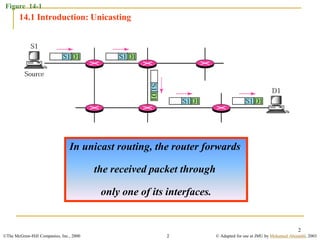
Figure 14-1
In unicast routing, the router forwards
the received packet through
only one of its interfaces.
14.1 Introduction: Unicasting
©The McGraw-Hill Companies, Inc., 2000 © Adapted for use at JMU by Mohamed Aboutabl, 2003
3
3
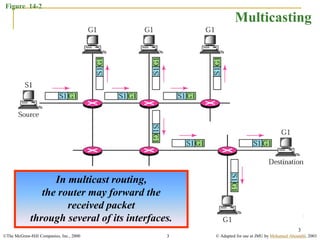
Figure 14-2
Multicasting
In multicast routing,
the router may forward the
received packet
through several of its interfaces.
©The McGraw-Hill Companies, Inc., 2000 © Adapted for use at JMU by Mohamed Aboutabl, 2003
4
4
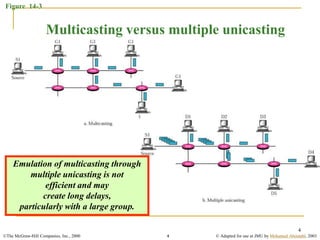
Figure 14-3
Multicasting versus multiple unicasting
Emulation of multicasting through
multiple unicasting is not
efficient and may
create long delays,
particularly with a large group.
©The McGraw-Hill Companies, Inc., 2000 © Adapted for use at JMU by Mohamed Aboutabl, 2003
5
5
Application of Multicasting
 Access to Distributed Databases
 Information Dissemination: e.g. multicast software updates to
customers
 News Delivery
 Teleconferencing, Web Seminars
 Distant Learning
©The McGraw-Hill Companies, Inc., 2000 © Adapted for use at JMU by Mohamed Aboutabl, 2003
6
6
14.3 Multicast Routing
Objectives
 Every member receives EXACTLY ONE copy of the packet
 Non-members receive nothing
 No loops in route
 Optimal path from source to each destination.
Terminology
 Spanning Tree: Source is the root, group members are the leaves.
 Shortest Path Spanning Tree: Each path from root to a leaf is the
shortest according to some metric
©The McGraw-Hill Companies, Inc., 2000 © Adapted for use at JMU by Mohamed Aboutabl, 2003
7
7
14.3 Multicast Trees
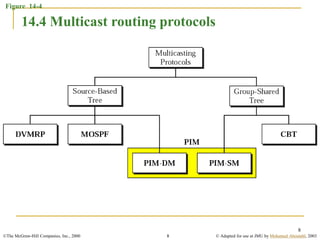
 Source-Based Tree:
 For each combination of (source , group), there is a shortest path
spanning tree.
 Approach 1: DVMRP; an extension of unicast distance vector
routing (e.g. RIP)
 Approach 2: MOSPF; an extension of unicast link state routing
(e.g. OSPF)
 Group-Share Tree
 One tree for the entire group
 Rendezvous-Point Tree: one router is the center of the group and
therefore the root of the tree.
 CBT and PIM-SP protocols.
©The McGraw-Hill Companies, Inc., 2000 © Adapted for use at JMU by Mohamed Aboutabl, 2003
8
8
Figure 14-4
14.4 Multicast routing protocols
©The McGraw-Hill Companies, Inc., 2000 © Adapted for use at JMU by Mohamed Aboutabl, 2003
9
9
14.5 Distance Vector Multicast Routing Protocol - DVMRP
 No pre-defined route from source to destination. Tree is gradually
created by successive routers along the path.
 Uses shortest path (fewest hops)
 Prevent loops: apply Reverse Path Forwarding (RFP)
 Prevent Duplication: apply Reverse Path Broadcasting (RPB)
 Multicast with dynamic membership: apply Reverse Path
Multicasting (RPM) with pruning, grafting, and lifetime.
©The McGraw-Hill Companies, Inc., 2000 © Adapted for use at JMU by Mohamed Aboutabl, 2003
10
10
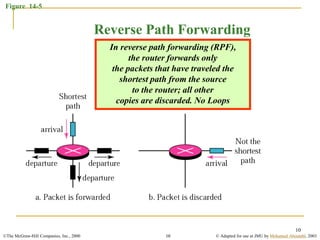
Figure 14-5
Reverse Path Forwarding
In reverse path forwarding (RPF),
the router forwards only
the packets that have traveled the
shortest path from the source
to the router; all other
copies are discarded. No Loops
©The McGraw-Hill Companies, Inc., 2000 © Adapted for use at JMU by Mohamed Aboutabl, 2003
11
11
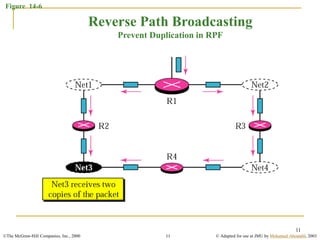
Figure 14-6
Reverse Path Broadcasting
Prevent Duplication in RPF
©The McGraw-Hill Companies, Inc., 2000 © Adapted for use at JMU by Mohamed Aboutabl, 2003
12
12
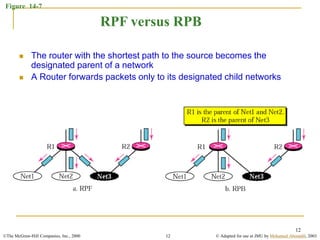
Figure 14-7
RPF versus RPB
 The router with the shortest path to the source becomes the
designated parent of a network
 A Router forwards packets only to its designated child networks
©The McGraw-Hill Companies, Inc., 2000 © Adapted for use at JMU by Mohamed Aboutabl, 2003
13
13
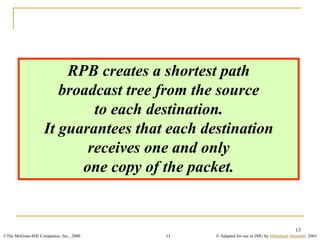
RPB creates a shortest path
broadcast tree from the source
to each destination.
It guarantees that each destination
receives one and only
one copy of the packet.
©The McGraw-Hill Companies, Inc., 2000 © Adapted for use at JMU by Mohamed Aboutabl, 2003
14
14
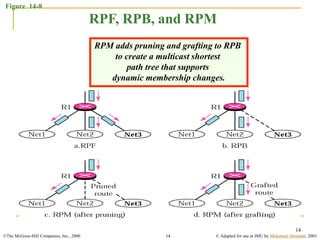
Figure 14-8
RPF, RPB, and RPM
RPM adds pruning and grafting to RPB
to create a multicast shortest
path tree that supports
dynamic membership changes.
©The McGraw-Hill Companies, Inc., 2000 © Adapted for use at JMU by Mohamed Aboutabl, 2003
15
15
MOSPF
14.6
©The McGraw-Hill Companies, Inc., 2000 © Adapted for use at JMU by Mohamed Aboutabl, 2003
16
16
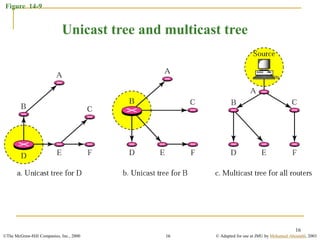
Figure 14-9
Unicast tree and multicast tree
©The McGraw-Hill Companies, Inc., 2000 © Adapted for use at JMU by Mohamed Aboutabl, 2003
17
17
Core-Based Tree
CBT
14.7
©The McGraw-Hill Companies, Inc., 2000 © Adapted for use at JMU by Mohamed Aboutabl, 2003
18
18
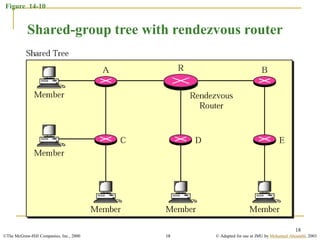
Figure 14-10
Shared-group tree with rendezvous router
©The McGraw-Hill Companies, Inc., 2000 © Adapted for use at JMU by Mohamed Aboutabl, 2003
19
19
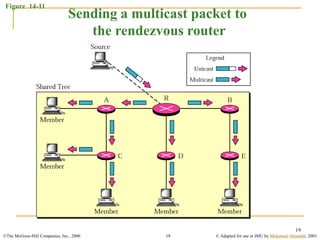
Figure 14-11
Sending a multicast packet to
the rendezvous router
©The McGraw-Hill Companies, Inc., 2000 © Adapted for use at JMU by Mohamed Aboutabl, 2003
20
20
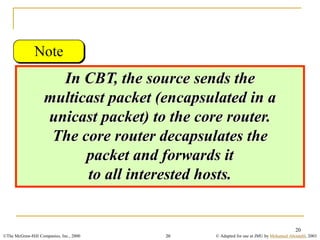
In CBT, the source sends the
multicast packet (encapsulated in a
unicast packet) to the core router.
The core router decapsulates the
packet and forwards it
to all interested hosts.

Lecture 19- Multicasting.ppt

  • 1.
    ©The McGraw-Hill Companies,Inc., 2000 © Adapted for use at JMU by Mohamed Aboutabl, 2003 1 1 Chapter 14 Multicasting And Multicast Routing Protocols  INTRODUCTION  MULTICAST ROUTING  MULTICAST TREES  MULTICAST ROUTING PROTOCOLS  DVMRP  MOSPF  CBT  PIM  MBONE
  • 2.
    ©The McGraw-Hill Companies,Inc., 2000 © Adapted for use at JMU by Mohamed Aboutabl, 2003 2 2 Figure 14-1 In unicast routing, the router forwards the received packet through only one of its interfaces. 14.1 Introduction: Unicasting
  • 3.
    ©The McGraw-Hill Companies,Inc., 2000 © Adapted for use at JMU by Mohamed Aboutabl, 2003 3 3 Figure 14-2 Multicasting In multicast routing, the router may forward the received packet through several of its interfaces.
  • 4.
    ©The McGraw-Hill Companies,Inc., 2000 © Adapted for use at JMU by Mohamed Aboutabl, 2003 4 4 Figure 14-3 Multicasting versus multiple unicasting Emulation of multicasting through multiple unicasting is not efficient and may create long delays, particularly with a large group.
  • 5.
    ©The McGraw-Hill Companies,Inc., 2000 © Adapted for use at JMU by Mohamed Aboutabl, 2003 5 5 Application of Multicasting  Access to Distributed Databases  Information Dissemination: e.g. multicast software updates to customers  News Delivery  Teleconferencing, Web Seminars  Distant Learning
  • 6.
    ©The McGraw-Hill Companies,Inc., 2000 © Adapted for use at JMU by Mohamed Aboutabl, 2003 6 6 14.3 Multicast Routing Objectives  Every member receives EXACTLY ONE copy of the packet  Non-members receive nothing  No loops in route  Optimal path from source to each destination. Terminology  Spanning Tree: Source is the root, group members are the leaves.  Shortest Path Spanning Tree: Each path from root to a leaf is the shortest according to some metric
  • 7.
    ©The McGraw-Hill Companies,Inc., 2000 © Adapted for use at JMU by Mohamed Aboutabl, 2003 7 7 14.3 Multicast Trees  Source-Based Tree:  For each combination of (source , group), there is a shortest path spanning tree.  Approach 1: DVMRP; an extension of unicast distance vector routing (e.g. RIP)  Approach 2: MOSPF; an extension of unicast link state routing (e.g. OSPF)  Group-Share Tree  One tree for the entire group  Rendezvous-Point Tree: one router is the center of the group and therefore the root of the tree.  CBT and PIM-SP protocols.
  • 8.
    ©The McGraw-Hill Companies,Inc., 2000 © Adapted for use at JMU by Mohamed Aboutabl, 2003 8 8 Figure 14-4 14.4 Multicast routing protocols
  • 9.
    ©The McGraw-Hill Companies,Inc., 2000 © Adapted for use at JMU by Mohamed Aboutabl, 2003 9 9 14.5 Distance Vector Multicast Routing Protocol - DVMRP  No pre-defined route from source to destination. Tree is gradually created by successive routers along the path.  Uses shortest path (fewest hops)  Prevent loops: apply Reverse Path Forwarding (RFP)  Prevent Duplication: apply Reverse Path Broadcasting (RPB)  Multicast with dynamic membership: apply Reverse Path Multicasting (RPM) with pruning, grafting, and lifetime.
  • 10.
    ©The McGraw-Hill Companies,Inc., 2000 © Adapted for use at JMU by Mohamed Aboutabl, 2003 10 10 Figure 14-5 Reverse Path Forwarding In reverse path forwarding (RPF), the router forwards only the packets that have traveled the shortest path from the source to the router; all other copies are discarded. No Loops
  • 11.
    ©The McGraw-Hill Companies,Inc., 2000 © Adapted for use at JMU by Mohamed Aboutabl, 2003 11 11 Figure 14-6 Reverse Path Broadcasting Prevent Duplication in RPF
  • 12.
    ©The McGraw-Hill Companies,Inc., 2000 © Adapted for use at JMU by Mohamed Aboutabl, 2003 12 12 Figure 14-7 RPF versus RPB  The router with the shortest path to the source becomes the designated parent of a network  A Router forwards packets only to its designated child networks
  • 13.
    ©The McGraw-Hill Companies,Inc., 2000 © Adapted for use at JMU by Mohamed Aboutabl, 2003 13 13 RPB creates a shortest path broadcast tree from the source to each destination. It guarantees that each destination receives one and only one copy of the packet.
  • 14.
    ©The McGraw-Hill Companies,Inc., 2000 © Adapted for use at JMU by Mohamed Aboutabl, 2003 14 14 Figure 14-8 RPF, RPB, and RPM RPM adds pruning and grafting to RPB to create a multicast shortest path tree that supports dynamic membership changes.
  • 15.
    ©The McGraw-Hill Companies,Inc., 2000 © Adapted for use at JMU by Mohamed Aboutabl, 2003 15 15 MOSPF 14.6
  • 16.
    ©The McGraw-Hill Companies,Inc., 2000 © Adapted for use at JMU by Mohamed Aboutabl, 2003 16 16 Figure 14-9 Unicast tree and multicast tree
  • 17.
    ©The McGraw-Hill Companies,Inc., 2000 © Adapted for use at JMU by Mohamed Aboutabl, 2003 17 17 Core-Based Tree CBT 14.7
  • 18.
    ©The McGraw-Hill Companies,Inc., 2000 © Adapted for use at JMU by Mohamed Aboutabl, 2003 18 18 Figure 14-10 Shared-group tree with rendezvous router
  • 19.
    ©The McGraw-Hill Companies,Inc., 2000 © Adapted for use at JMU by Mohamed Aboutabl, 2003 19 19 Figure 14-11 Sending a multicast packet to the rendezvous router
  • 20.
    ©The McGraw-Hill Companies,Inc., 2000 © Adapted for use at JMU by Mohamed Aboutabl, 2003 20 20 In CBT, the source sends the multicast packet (encapsulated in a unicast packet) to the core router. The core router decapsulates the packet and forwards it to all interested hosts.