LECTURE 16
INTRODUCTION TO
EQUITY
In last week’s lecture we looked at……..
Conditions, Warranties and Implied Terms
Provisions under the Sale of Goods Act (1979) & The
Supply of Goods & Services Act (1982)
This week we will be looking at Equity: Equitable
principles and remedies, and the doctrine of
promissory estoppel
RECAP- LECTURE 15
 Understand what Equity is and how it interacts with the Common Law;
 Describe and explain the nature of equitable remedies and the
circumstances under which they can be sought;
 Explain what the doctrine of Promissory Estoppel is and the principle that
estoppel is a “shield and not a sword”;
 Outline the facts and judgement of Central London Property Trust Ltd v High
Trees House Ltd (1947);
 Apply legal principles to given facts and demonstrate criticality & analysis
when answering fact based questions; and
 Analyse case law and be able to apply case law in a persuasive manner to
hypothetical case studies
LEARNING OUTCOMES:
 Granville Williams:
the English Law is a composition of 3 great elements: legislation, common
law and equity. Infused with European law, these elements make up the
English law we have today
 Recap:
 UK has a common law system….laws are not codified and come from three
different sources……
 Statutory law- Acts of Parliament (primary legislation)
 Common law- “judge made law”; doctrine of judicial precedent
 Equity- (equitable) principles which work with the common law…….G.Williams:
“working behind the scenes of the common law”.
THE ENGLISH COMMON LAW SYSTEM
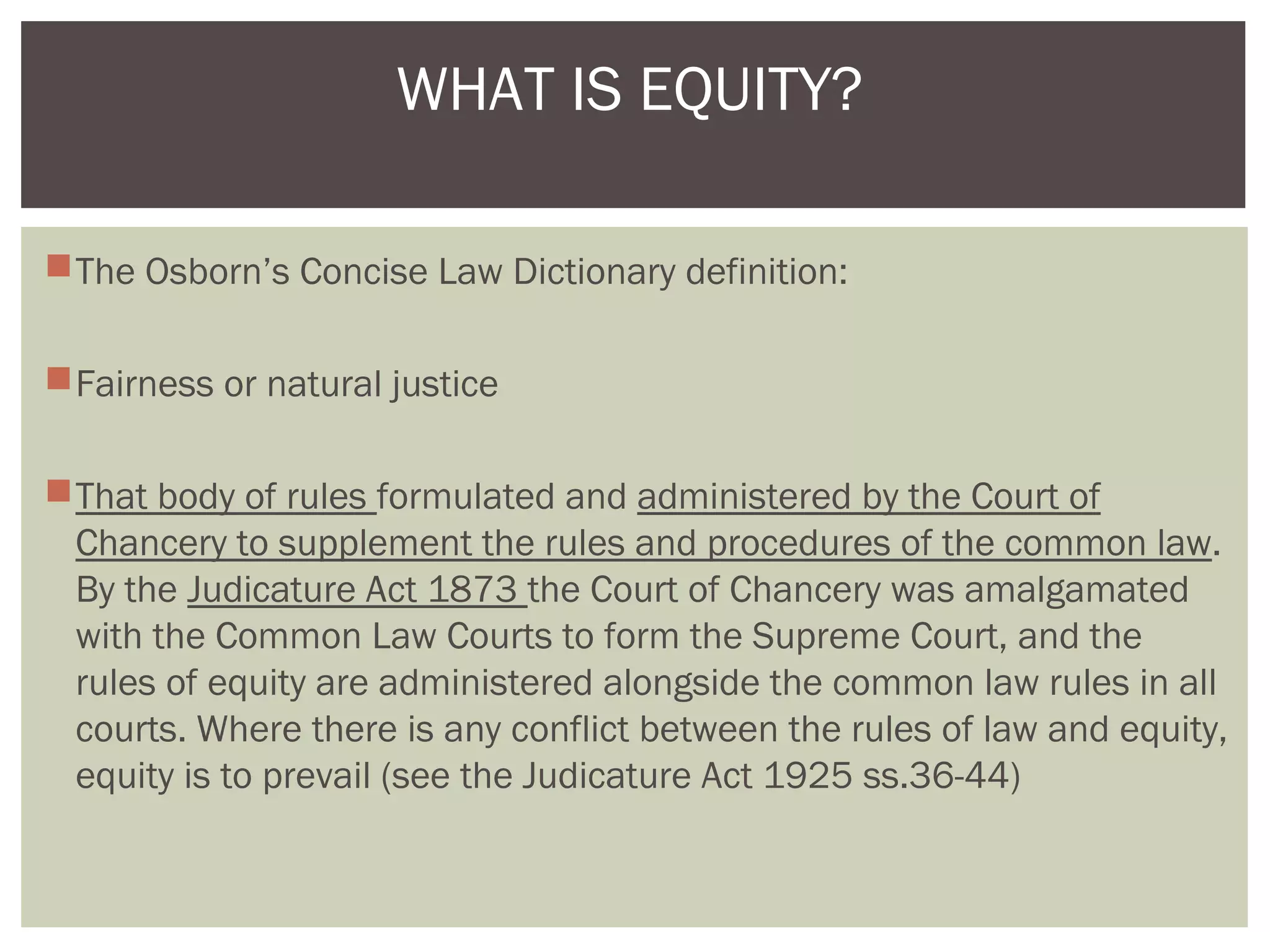
The Osborn’s Concise Law Dictionary definition:
Fairness or natural justice
That body of rules formulated and administered by the Court of
Chancery to supplement the rules and procedures of the common law.
By the Judicature Act 1873 the Court of Chancery was amalgamated
with the Common Law Courts to form the Supreme Court, and the
rules of equity are administered alongside the common law rules in all
courts. Where there is any conflict between the rules of law and equity,
equity is to prevail (see the Judicature Act 1925 ss.36-44)
WHAT IS EQUITY?
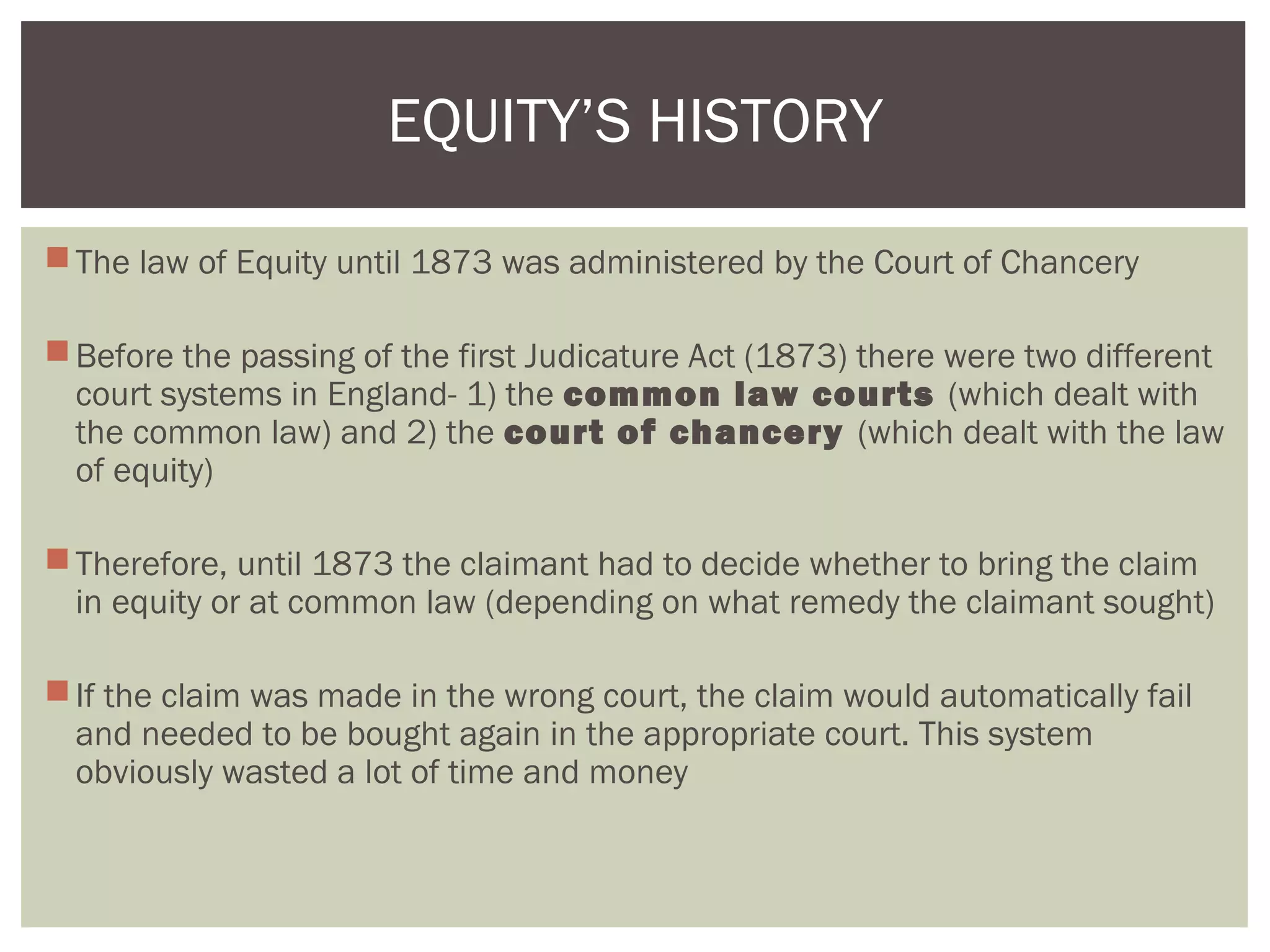
The law of Equity until 1873 was administered by the Court of Chancery
Before the passing of the first Judicature Act (1873) there were two different
court systems in England- 1) the common law courts (which dealt with
the common law) and 2) the court of chancery (which dealt with the law
of equity)
Therefore, until 1873 the claimant had to decide whether to bring the claim
in equity or at common law (depending on what remedy the claimant sought)
If the claim was made in the wrong court, the claim would automatically fail
and needed to be bought again in the appropriate court. This system
obviously wasted a lot of time and money
EQUITY’S HISTORY
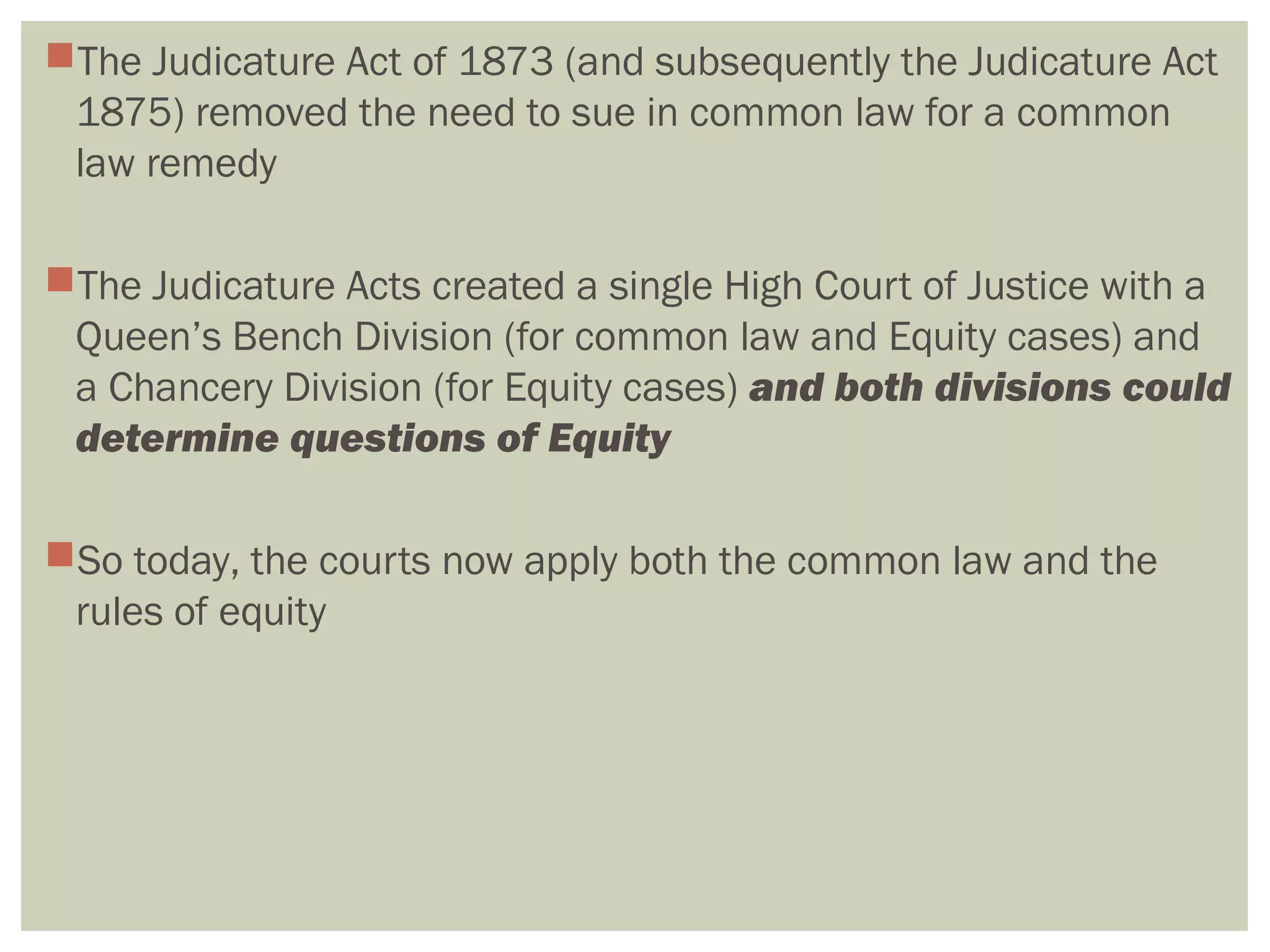
The Judicature Act of 1873 (and subsequently the Judicature Act
1875) removed the need to sue in common law for a common
law remedy
The Judicature Acts created a single High Court of Justice with a
Queen’s Bench Division (for common law and Equity cases) and
a Chancery Division (for Equity cases) and both divisions could
determine questions of Equity
So today, the courts now apply both the common law and the
rules of equity
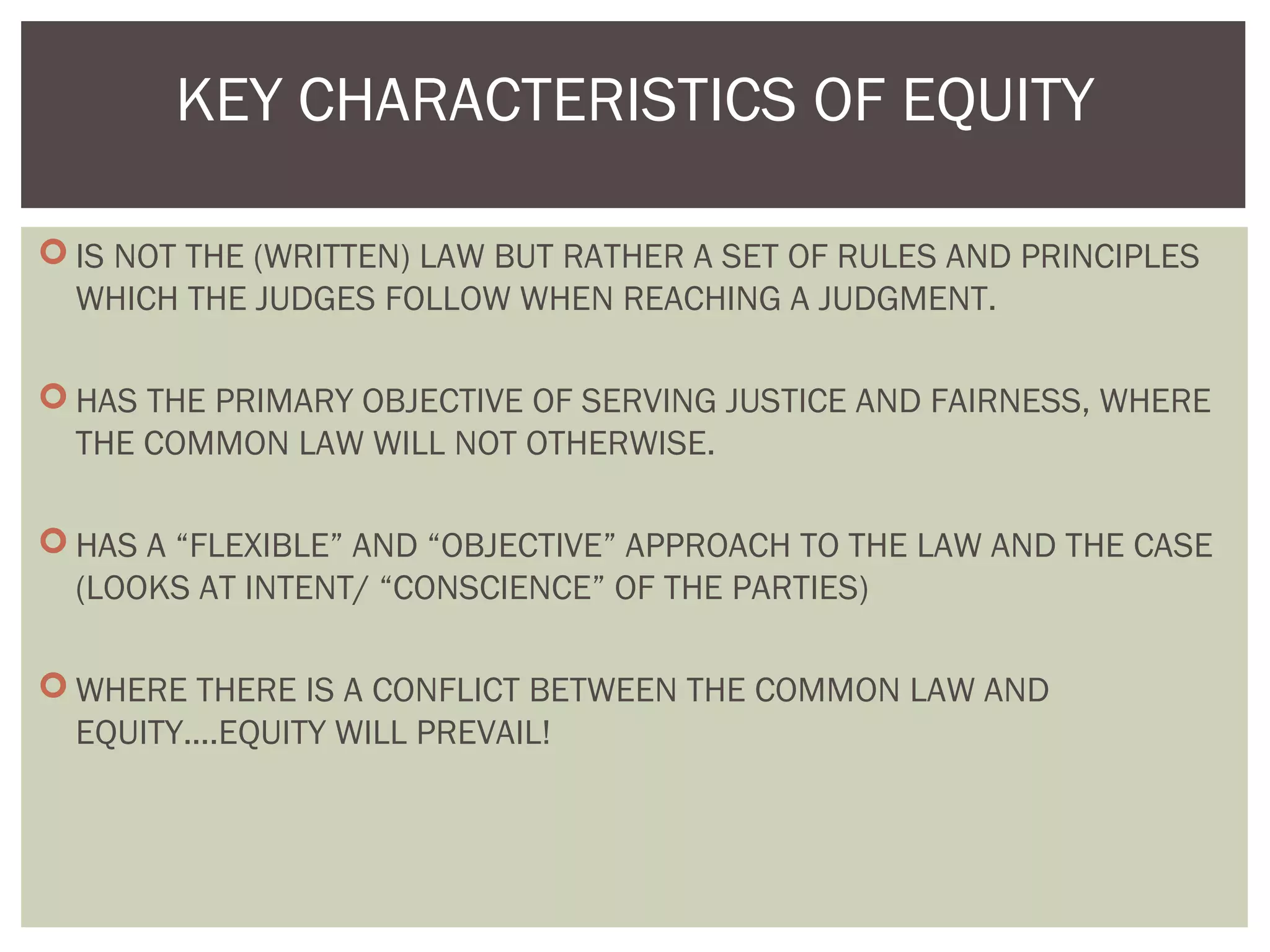
 IS NOT THE (WRITTEN) LAW BUT RATHER A SET OF RULES AND PRINCIPLES
WHICH THE JUDGES FOLLOW WHEN REACHING A JUDGMENT.
 HAS THE PRIMARY OBJECTIVE OF SERVING JUSTICE AND FAIRNESS, WHERE
THE COMMON LAW WILL NOT OTHERWISE.
 HAS A “FLEXIBLE” AND “OBJECTIVE” APPROACH TO THE LAW AND THE CASE
(LOOKS AT INTENT/ “CONSCIENCE” OF THE PARTIES)
 WHERE THERE IS A CONFLICT BETWEEN THE COMMON LAW AND
EQUITY....EQUITY WILL PREVAIL!
KEY CHARACTERISTICS OF EQUITY
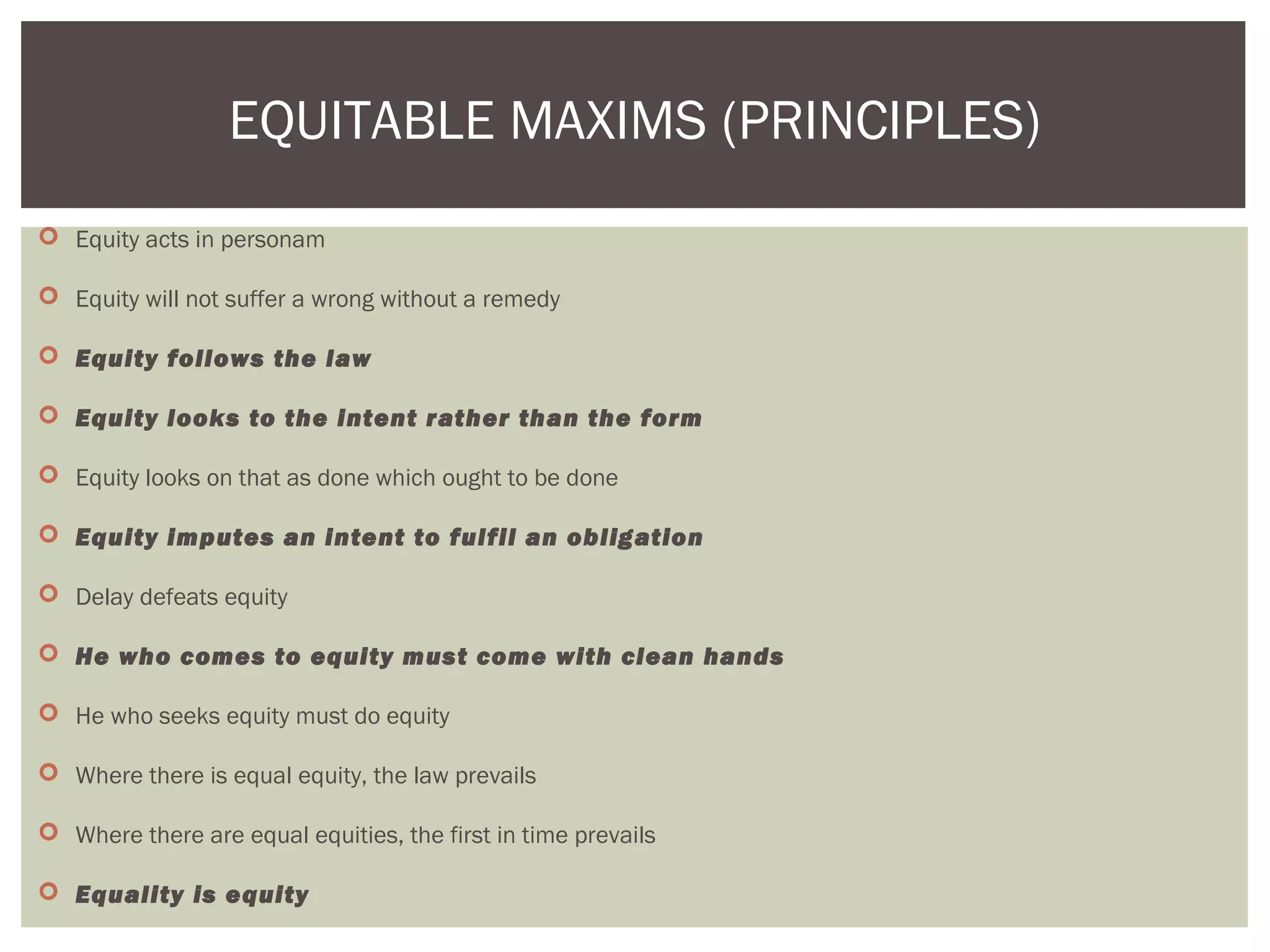
 Equity acts in personam
 Equity will not suffer a wrong without a remedy
 Equity follows the law
 Equity looks to the intent rather than the form
 Equity looks on that as done which ought to be done
 Equity imputes an intent to fulfil an obligation
 Delay defeats equity
 He who comes to equity must come with clean hands
 He who seeks equity must do equity
 Where there is equal equity, the law prevails
 Where there are equal equities, the first in time prevails
 Equality is equity
EQUITABLE MAXIMS (PRINCIPLES)
……..You are expected to be able to recite and
explain each of the maxims outlined!
I'm only joking!!!!
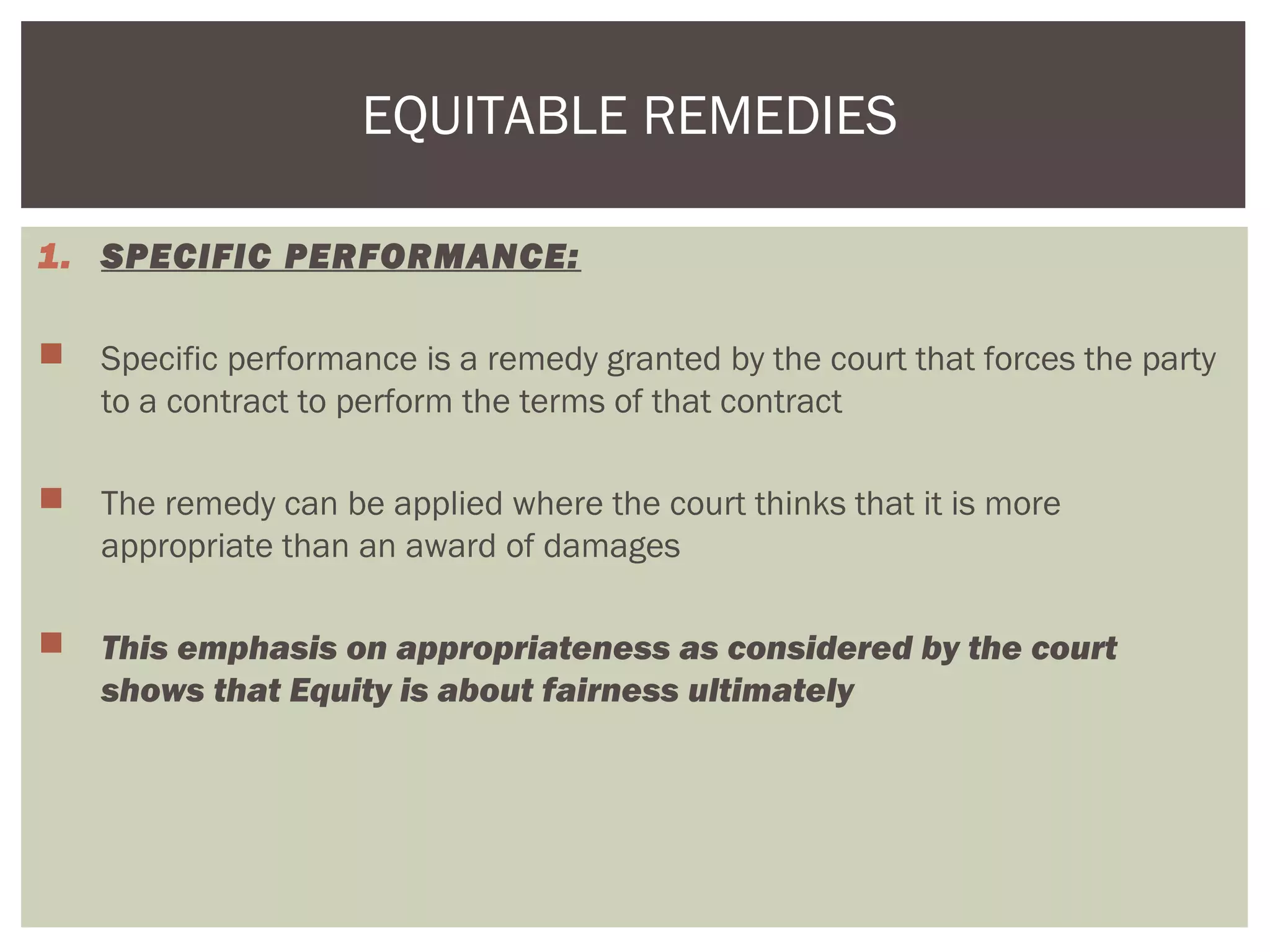
1. SPECIFIC PERFORMANCE:
 Specific performance is a remedy granted by the court that forces the party
to a contract to perform the terms of that contract
 The remedy can be applied where the court thinks that it is more
appropriate than an award of damages
 This emphasis on appropriateness as considered by the court
shows that Equity is about fairness ultimately
EQUITABLE REMEDIES
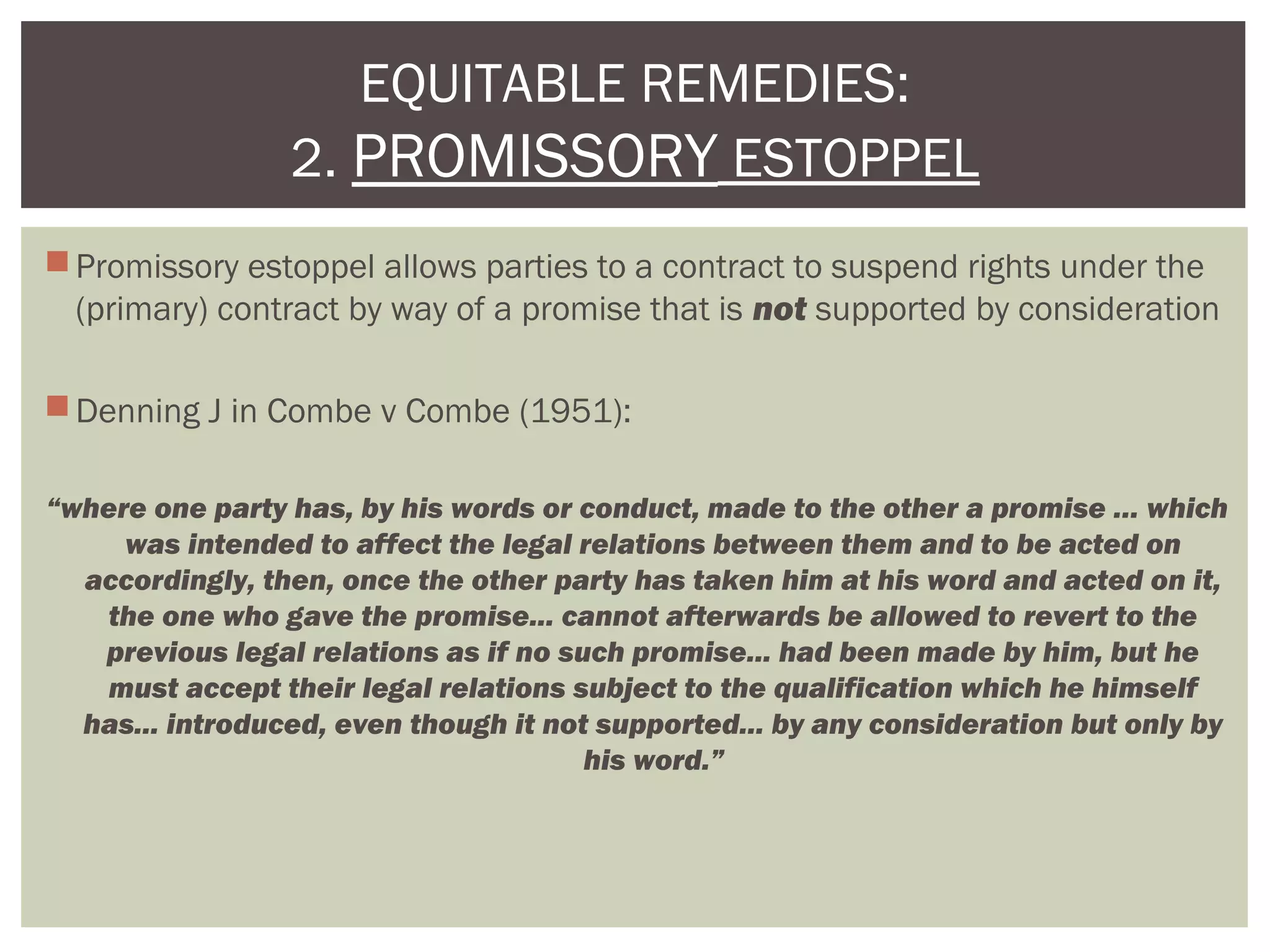
Promissory estoppel allows parties to a contract to suspend rights under the
(primary) contract by way of a promise that is not supported by consideration
Denning J in Combe v Combe (1951):
“where one party has, by his words or conduct, made to the other a promise … which
was intended to affect the legal relations between them and to be acted on
accordingly, then, once the other party has taken him at his word and acted on it,
the one who gave the promise... cannot afterwards be allowed to revert to the
previous legal relations as if no such promise... had been made by him, but he
must accept their legal relations subject to the qualification which he himself
has... introduced, even though it not supported... by any consideration but only by
his word.”
EQUITABLE REMEDIES:
2. PROMISSORY ESTOPPEL
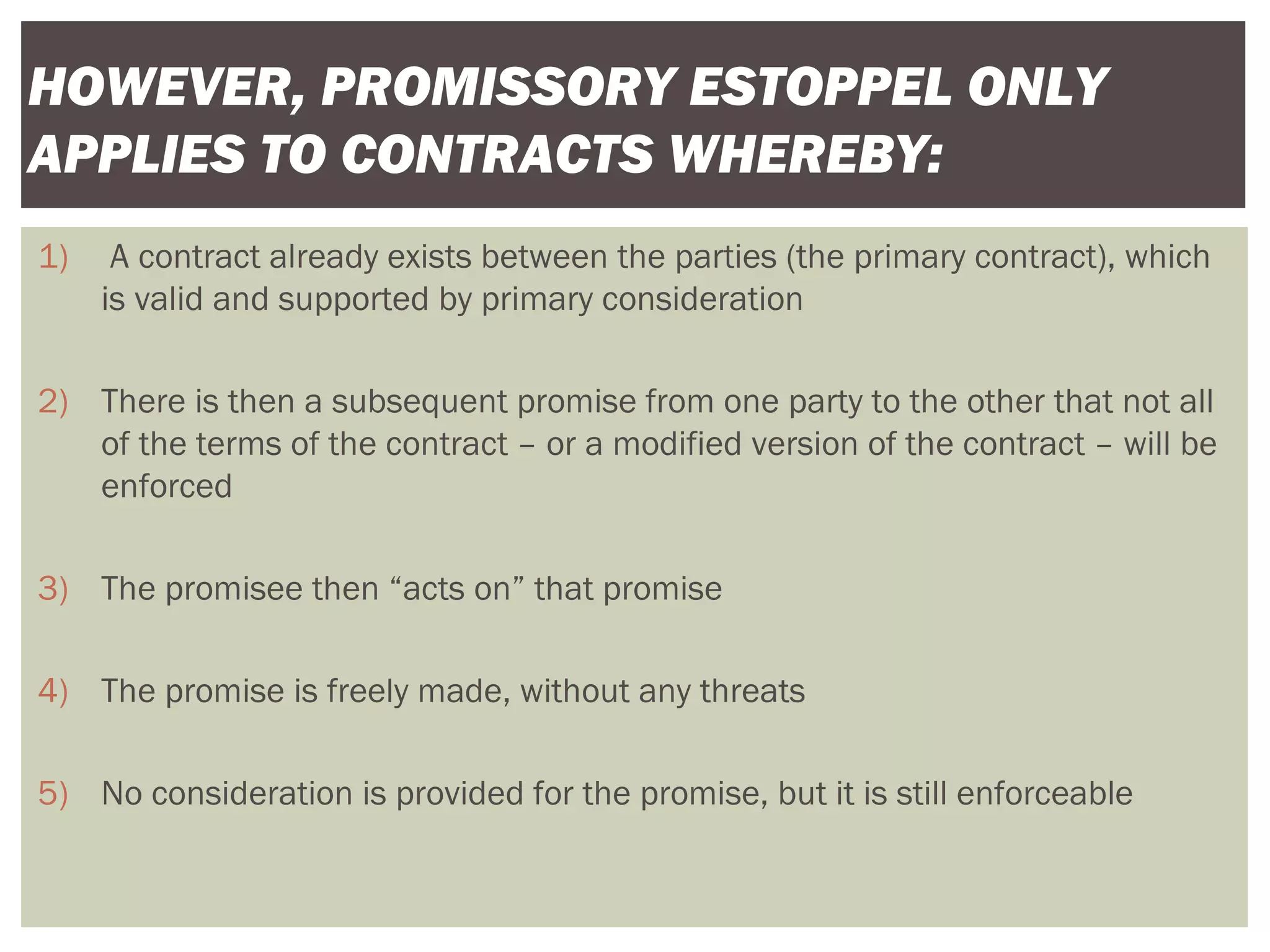
1) A contract already exists between the parties (the primary contract), which
is valid and supported by primary consideration
2) There is then a subsequent promise from one party to the other that not all
of the terms of the contract – or a modified version of the contract – will be
enforced
3) The promisee then “acts on” that promise
4) The promise is freely made, without any threats
5) No consideration is provided for the promise, but it is still enforceable
HOWEVER, PROMISSORY ESTOPPEL ONLY
APPLIES TO CONTRACTS WHEREBY:
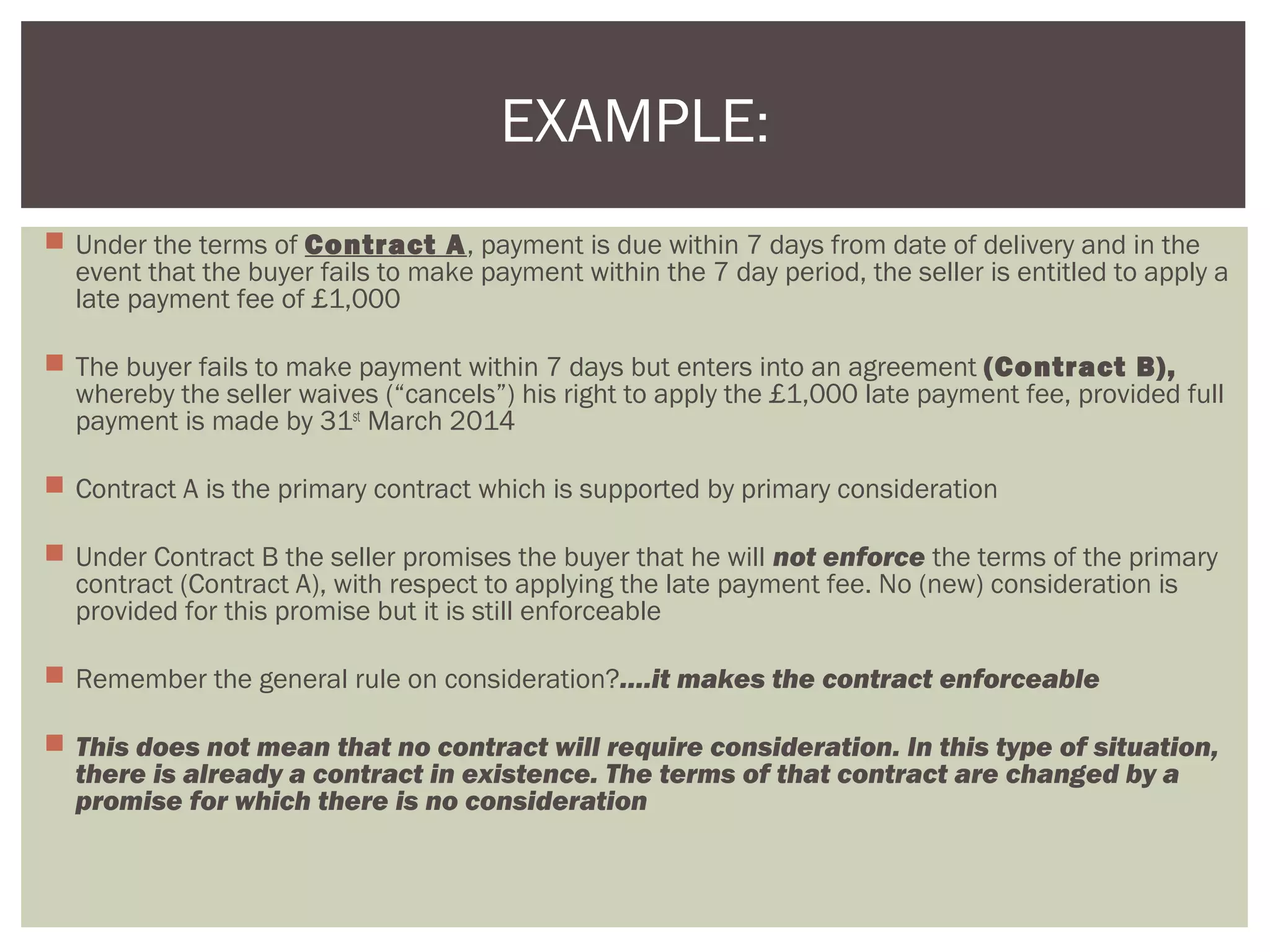
 Under the terms of Contract A, payment is due within 7 days from date of delivery and in the
event that the buyer fails to make payment within the 7 day period, the seller is entitled to apply a
late payment fee of £1,000
 The buyer fails to make payment within 7 days but enters into an agreement (Contract B),
whereby the seller waives (“cancels”) his right to apply the £1,000 late payment fee, provided full
payment is made by 31st
March 2014
 Contract A is the primary contract which is supported by primary consideration
 Under Contract B the seller promises the buyer that he will not enforce the terms of the primary
contract (Contract A), with respect to applying the late payment fee. No (new) consideration is
provided for this promise but it is still enforceable
 Remember the general rule on consideration?….it makes the contract enforceable
 This does not mean that no contract will require consideration. In this type of situation,
there is already a contract in existence. The terms of that contract are changed by a
promise for which there is no consideration
EXAMPLE:
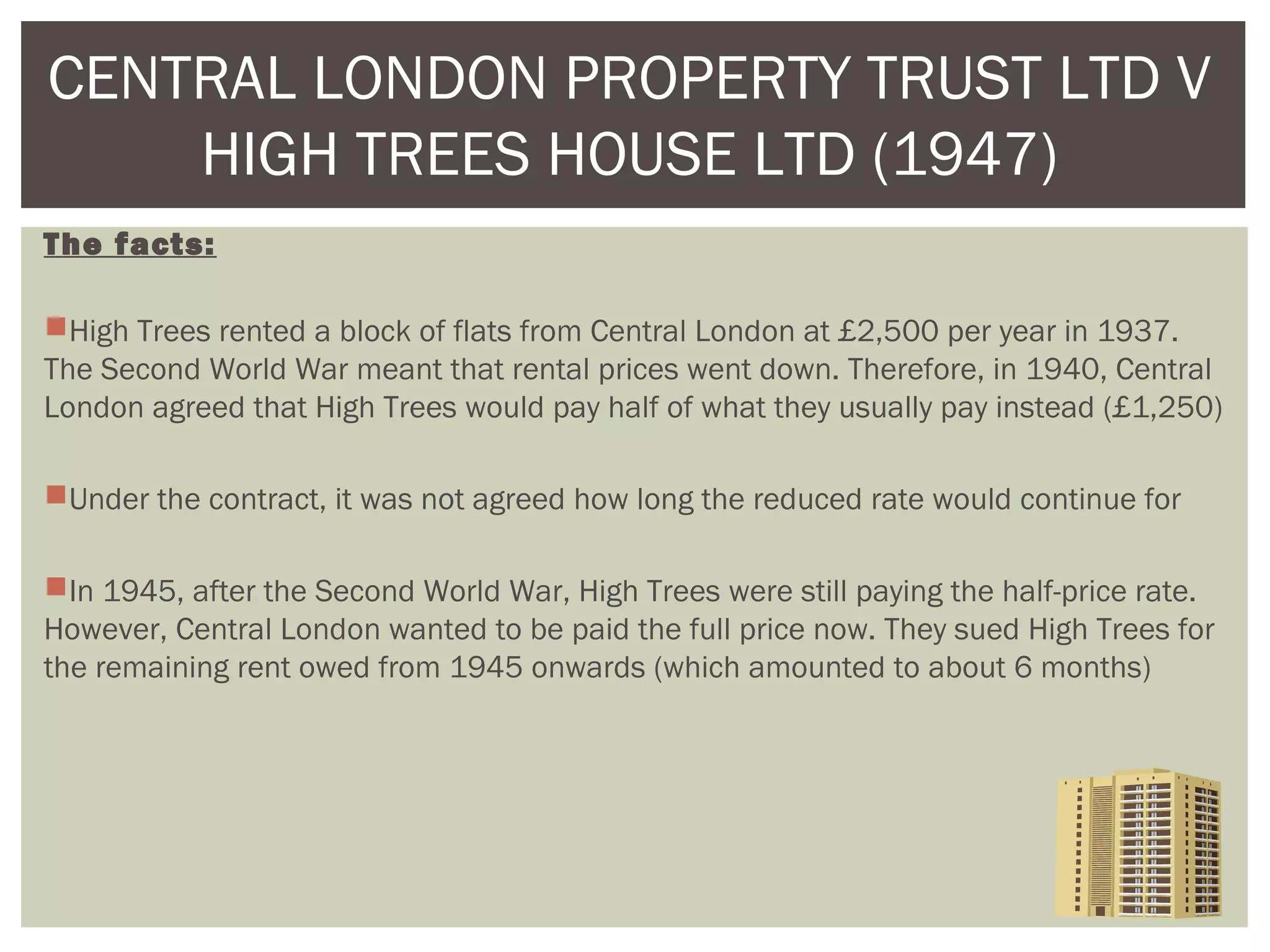
The facts:
High Trees rented a block of flats from Central London at £2,500 per year in 1937.
The Second World War meant that rental prices went down. Therefore, in 1940, Central
London agreed that High Trees would pay half of what they usually pay instead (£1,250)
Under the contract, it was not agreed how long the reduced rate would continue for
In 1945, after the Second World War, High Trees were still paying the half-price rate.
However, Central London wanted to be paid the full price now. They sued High Trees for
the remaining rent owed from 1945 onwards (which amounted to about 6 months)
CENTRAL LONDON PROPERTY TRUST LTD V
HIGH TREES HOUSE LTD (1947)
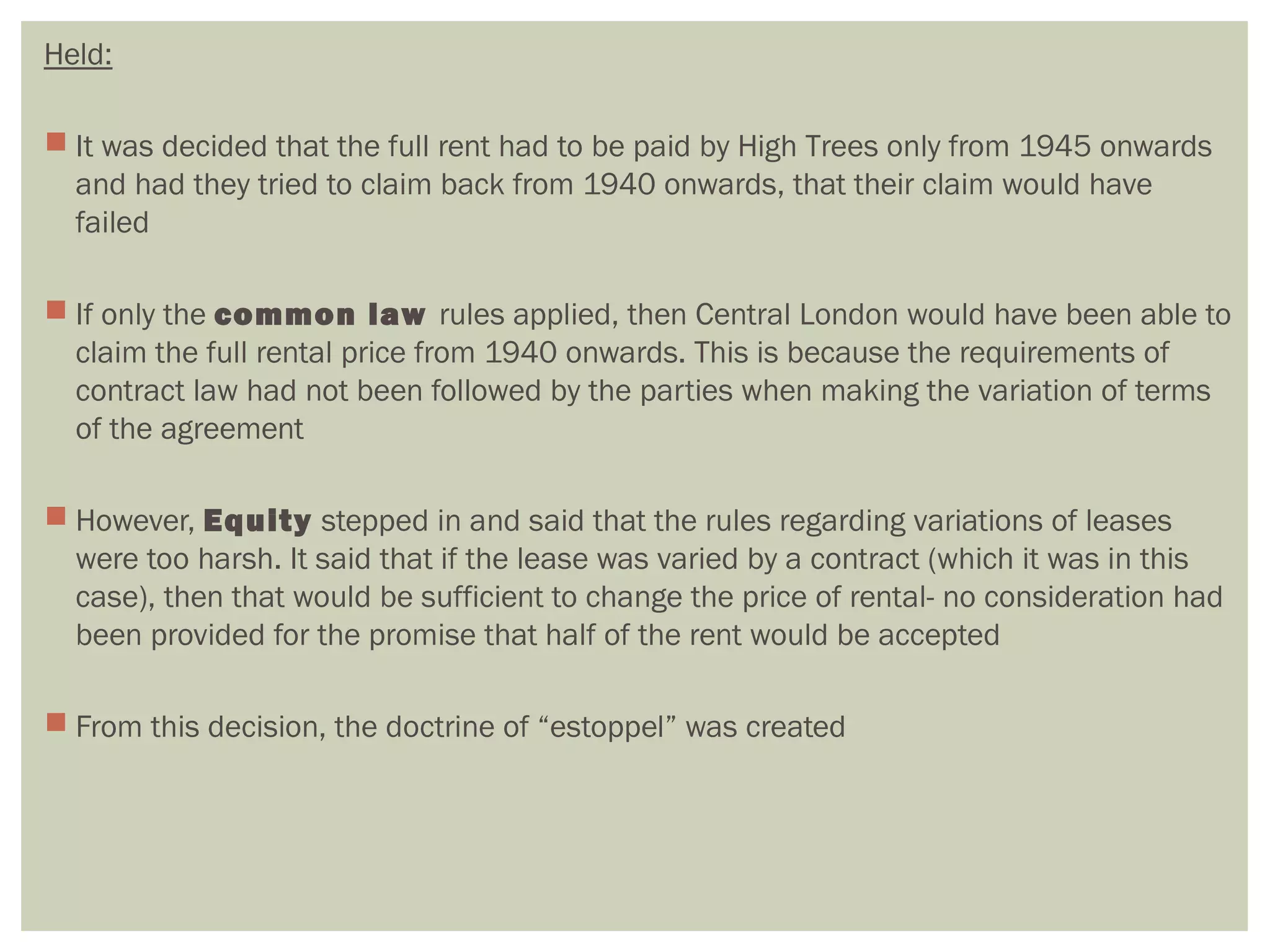
Held:
 It was decided that the full rent had to be paid by High Trees only from 1945 onwards
and had they tried to claim back from 1940 onwards, that their claim would have
failed
 If only the common law rules applied, then Central London would have been able to
claim the full rental price from 1940 onwards. This is because the requirements of
contract law had not been followed by the parties when making the variation of terms
of the agreement
 However, Equity stepped in and said that the rules regarding variations of leases
were too harsh. It said that if the lease was varied by a contract (which it was in this
case), then that would be sufficient to change the price of rental- no consideration had
been provided for the promise that half of the rent would be accepted
 From this decision, the doctrine of “estoppel” was created
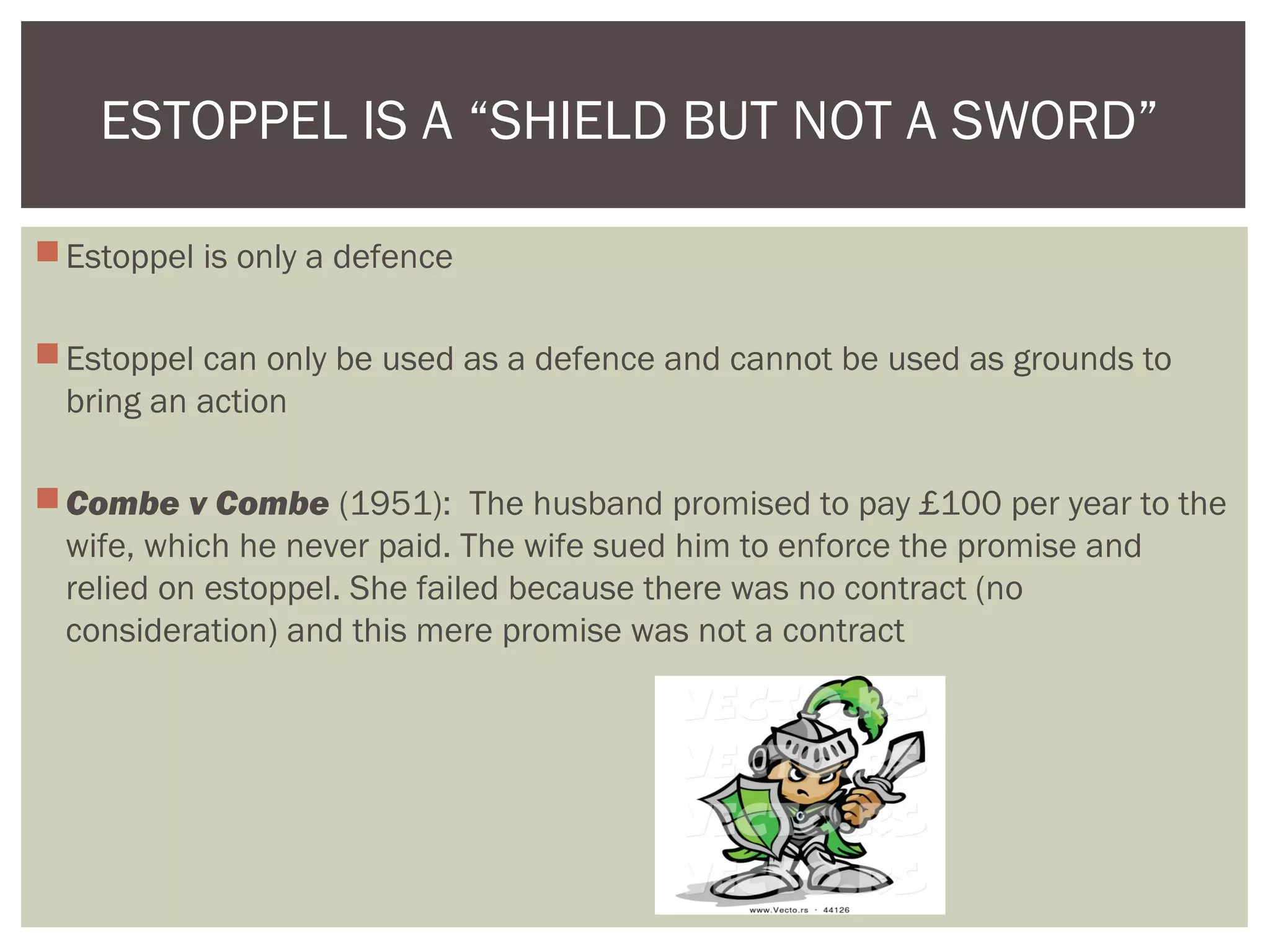
Estoppel is only a defence
Estoppel can only be used as a defence and cannot be used as grounds to
bring an action
Combe v Combe (1951): The husband promised to pay £100 per year to the
wife, which he never paid. The wife sued him to enforce the promise and
relied on estoppel. She failed because there was no contract (no
consideration) and this mere promise was not a contract
ESTOPPEL IS A “SHIELD BUT NOT A SWORD”
 Hand-out:
 Reading List
 Glanville Williams :Learning the Law, 15th
edition, pages 21-24 (“Common Law
& Equity”)
 Preparatory Questions
 No classes on Friday 21st
February 2014
 Next week’s peer Observation……….kindly be on your best behaviour! 
 Please take your rubbish with you at the end of the lecture…
PREPS. FOR SEMINAR 16

Lecture 16 introduction to equity

  • 1.
  • 2.
    In last week’slecture we looked at…….. Conditions, Warranties and Implied Terms Provisions under the Sale of Goods Act (1979) & The Supply of Goods & Services Act (1982) This week we will be looking at Equity: Equitable principles and remedies, and the doctrine of promissory estoppel RECAP- LECTURE 15
  • 3.
     Understand whatEquity is and how it interacts with the Common Law;  Describe and explain the nature of equitable remedies and the circumstances under which they can be sought;  Explain what the doctrine of Promissory Estoppel is and the principle that estoppel is a “shield and not a sword”;  Outline the facts and judgement of Central London Property Trust Ltd v High Trees House Ltd (1947);  Apply legal principles to given facts and demonstrate criticality & analysis when answering fact based questions; and  Analyse case law and be able to apply case law in a persuasive manner to hypothetical case studies LEARNING OUTCOMES:
  • 4.
     Granville Williams: theEnglish Law is a composition of 3 great elements: legislation, common law and equity. Infused with European law, these elements make up the English law we have today  Recap:  UK has a common law system….laws are not codified and come from three different sources……  Statutory law- Acts of Parliament (primary legislation)  Common law- “judge made law”; doctrine of judicial precedent  Equity- (equitable) principles which work with the common law…….G.Williams: “working behind the scenes of the common law”. THE ENGLISH COMMON LAW SYSTEM
  • 5.
    The Osborn’s ConciseLaw Dictionary definition: Fairness or natural justice That body of rules formulated and administered by the Court of Chancery to supplement the rules and procedures of the common law. By the Judicature Act 1873 the Court of Chancery was amalgamated with the Common Law Courts to form the Supreme Court, and the rules of equity are administered alongside the common law rules in all courts. Where there is any conflict between the rules of law and equity, equity is to prevail (see the Judicature Act 1925 ss.36-44) WHAT IS EQUITY?
  • 6.
    The law ofEquity until 1873 was administered by the Court of Chancery Before the passing of the first Judicature Act (1873) there were two different court systems in England- 1) the common law courts (which dealt with the common law) and 2) the court of chancery (which dealt with the law of equity) Therefore, until 1873 the claimant had to decide whether to bring the claim in equity or at common law (depending on what remedy the claimant sought) If the claim was made in the wrong court, the claim would automatically fail and needed to be bought again in the appropriate court. This system obviously wasted a lot of time and money EQUITY’S HISTORY
  • 7.
    The Judicature Actof 1873 (and subsequently the Judicature Act 1875) removed the need to sue in common law for a common law remedy The Judicature Acts created a single High Court of Justice with a Queen’s Bench Division (for common law and Equity cases) and a Chancery Division (for Equity cases) and both divisions could determine questions of Equity So today, the courts now apply both the common law and the rules of equity
  • 8.
     IS NOTTHE (WRITTEN) LAW BUT RATHER A SET OF RULES AND PRINCIPLES WHICH THE JUDGES FOLLOW WHEN REACHING A JUDGMENT.  HAS THE PRIMARY OBJECTIVE OF SERVING JUSTICE AND FAIRNESS, WHERE THE COMMON LAW WILL NOT OTHERWISE.  HAS A “FLEXIBLE” AND “OBJECTIVE” APPROACH TO THE LAW AND THE CASE (LOOKS AT INTENT/ “CONSCIENCE” OF THE PARTIES)  WHERE THERE IS A CONFLICT BETWEEN THE COMMON LAW AND EQUITY....EQUITY WILL PREVAIL! KEY CHARACTERISTICS OF EQUITY
  • 9.
     Equity actsin personam  Equity will not suffer a wrong without a remedy  Equity follows the law  Equity looks to the intent rather than the form  Equity looks on that as done which ought to be done  Equity imputes an intent to fulfil an obligation  Delay defeats equity  He who comes to equity must come with clean hands  He who seeks equity must do equity  Where there is equal equity, the law prevails  Where there are equal equities, the first in time prevails  Equality is equity EQUITABLE MAXIMS (PRINCIPLES)
  • 10.
    ……..You are expectedto be able to recite and explain each of the maxims outlined! I'm only joking!!!!
  • 11.
    1. SPECIFIC PERFORMANCE: Specific performance is a remedy granted by the court that forces the party to a contract to perform the terms of that contract  The remedy can be applied where the court thinks that it is more appropriate than an award of damages  This emphasis on appropriateness as considered by the court shows that Equity is about fairness ultimately EQUITABLE REMEDIES
  • 12.
    Promissory estoppel allowsparties to a contract to suspend rights under the (primary) contract by way of a promise that is not supported by consideration Denning J in Combe v Combe (1951): “where one party has, by his words or conduct, made to the other a promise … which was intended to affect the legal relations between them and to be acted on accordingly, then, once the other party has taken him at his word and acted on it, the one who gave the promise... cannot afterwards be allowed to revert to the previous legal relations as if no such promise... had been made by him, but he must accept their legal relations subject to the qualification which he himself has... introduced, even though it not supported... by any consideration but only by his word.” EQUITABLE REMEDIES: 2. PROMISSORY ESTOPPEL
  • 13.
    1) A contractalready exists between the parties (the primary contract), which is valid and supported by primary consideration 2) There is then a subsequent promise from one party to the other that not all of the terms of the contract – or a modified version of the contract – will be enforced 3) The promisee then “acts on” that promise 4) The promise is freely made, without any threats 5) No consideration is provided for the promise, but it is still enforceable HOWEVER, PROMISSORY ESTOPPEL ONLY APPLIES TO CONTRACTS WHEREBY:
  • 14.
     Under theterms of Contract A, payment is due within 7 days from date of delivery and in the event that the buyer fails to make payment within the 7 day period, the seller is entitled to apply a late payment fee of £1,000  The buyer fails to make payment within 7 days but enters into an agreement (Contract B), whereby the seller waives (“cancels”) his right to apply the £1,000 late payment fee, provided full payment is made by 31st March 2014  Contract A is the primary contract which is supported by primary consideration  Under Contract B the seller promises the buyer that he will not enforce the terms of the primary contract (Contract A), with respect to applying the late payment fee. No (new) consideration is provided for this promise but it is still enforceable  Remember the general rule on consideration?….it makes the contract enforceable  This does not mean that no contract will require consideration. In this type of situation, there is already a contract in existence. The terms of that contract are changed by a promise for which there is no consideration EXAMPLE:
  • 15.
    The facts: High Treesrented a block of flats from Central London at £2,500 per year in 1937. The Second World War meant that rental prices went down. Therefore, in 1940, Central London agreed that High Trees would pay half of what they usually pay instead (£1,250) Under the contract, it was not agreed how long the reduced rate would continue for In 1945, after the Second World War, High Trees were still paying the half-price rate. However, Central London wanted to be paid the full price now. They sued High Trees for the remaining rent owed from 1945 onwards (which amounted to about 6 months) CENTRAL LONDON PROPERTY TRUST LTD V HIGH TREES HOUSE LTD (1947)
  • 16.
    Held:  It wasdecided that the full rent had to be paid by High Trees only from 1945 onwards and had they tried to claim back from 1940 onwards, that their claim would have failed  If only the common law rules applied, then Central London would have been able to claim the full rental price from 1940 onwards. This is because the requirements of contract law had not been followed by the parties when making the variation of terms of the agreement  However, Equity stepped in and said that the rules regarding variations of leases were too harsh. It said that if the lease was varied by a contract (which it was in this case), then that would be sufficient to change the price of rental- no consideration had been provided for the promise that half of the rent would be accepted  From this decision, the doctrine of “estoppel” was created
  • 17.
    Estoppel is onlya defence Estoppel can only be used as a defence and cannot be used as grounds to bring an action Combe v Combe (1951): The husband promised to pay £100 per year to the wife, which he never paid. The wife sued him to enforce the promise and relied on estoppel. She failed because there was no contract (no consideration) and this mere promise was not a contract ESTOPPEL IS A “SHIELD BUT NOT A SWORD”
  • 18.
     Hand-out:  ReadingList  Glanville Williams :Learning the Law, 15th edition, pages 21-24 (“Common Law & Equity”)  Preparatory Questions  No classes on Friday 21st February 2014  Next week’s peer Observation……….kindly be on your best behaviour!   Please take your rubbish with you at the end of the lecture… PREPS. FOR SEMINAR 16