Transfer of property
Topic 3.
Actionable Claim
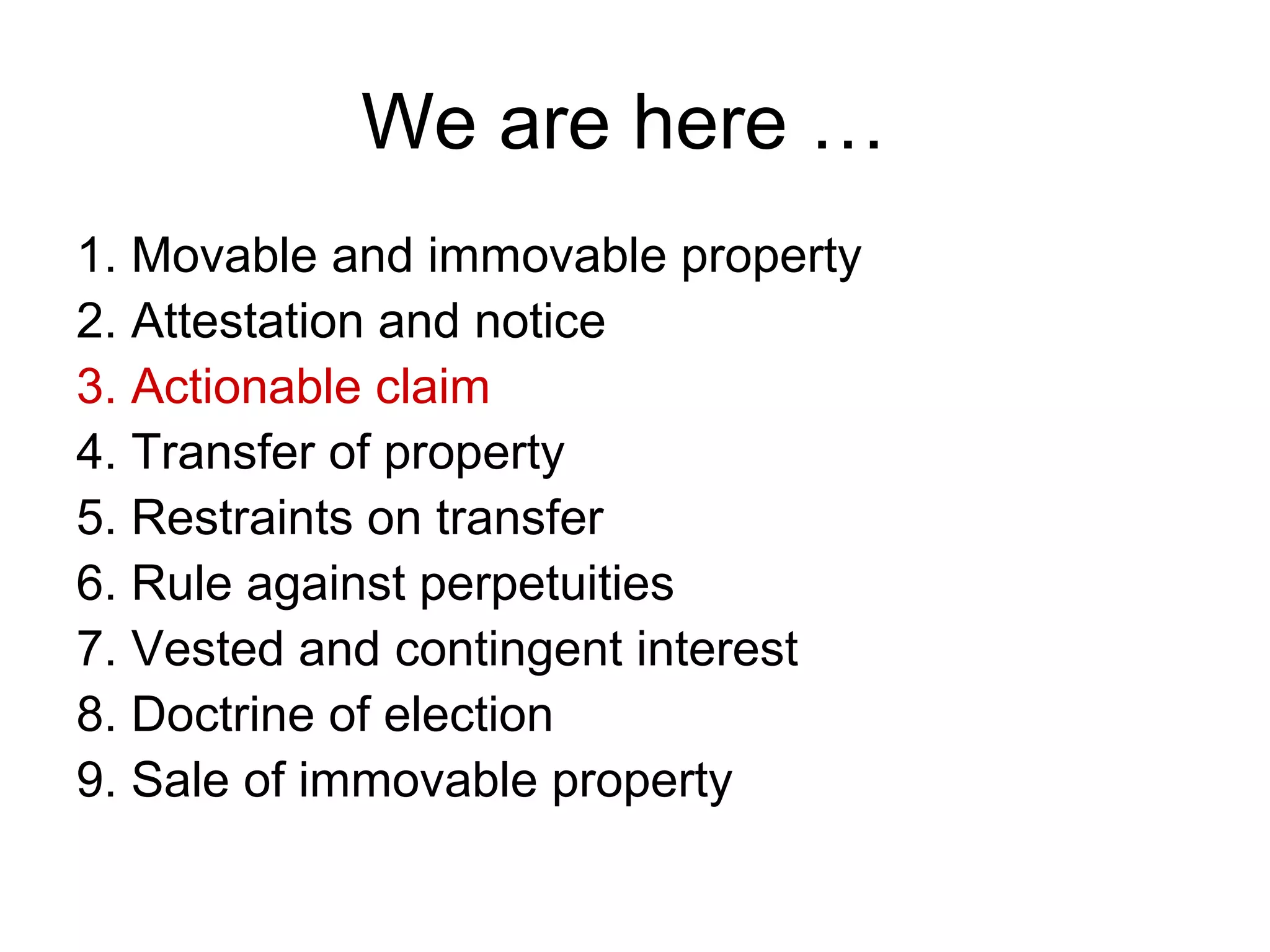
We are here …
1. Movable and immovable property
2. Attestation and notice
3. Actionable claim
4. Transfer of property
5. Restraints on transfer
6. Rule against perpetuities
7. Vested and contingent interest
8. Doctrine of election
9. Sale of immovable property
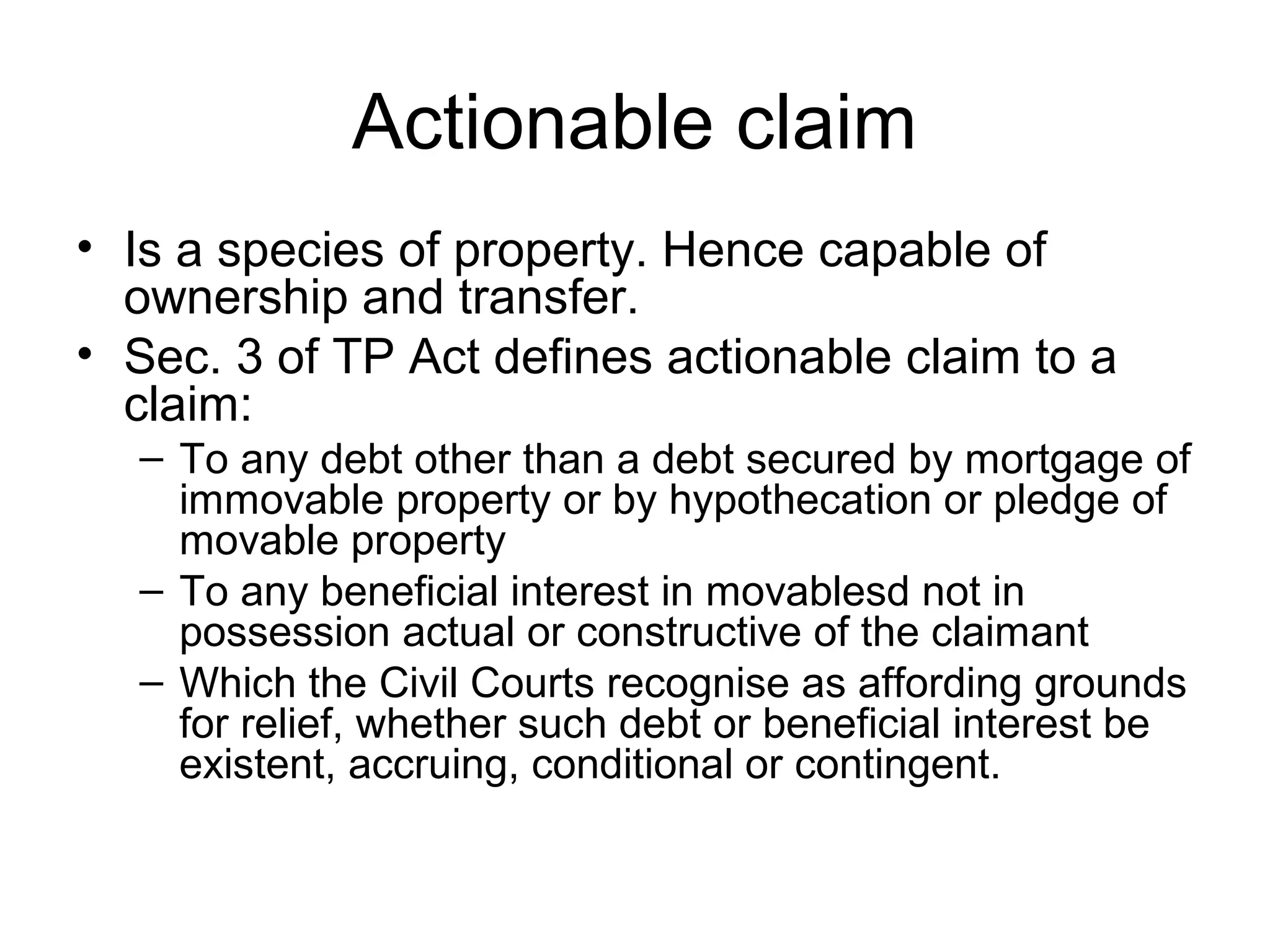
Actionable claim
• Is a species of property. Hence capable of
ownership and transfer.
• Sec. 3 of TP Act defines actionable claim to a
claim:
– To any debt other than a debt secured by mortgage of
immovable property or by hypothecation or pledge of
movable property
– To any beneficial interest in movablesd not in
possession actual or constructive of the claimant
– Which the Civil Courts recognise as affording grounds
for relief, whether such debt or beneficial interest be
existent, accruing, conditional or contingent.
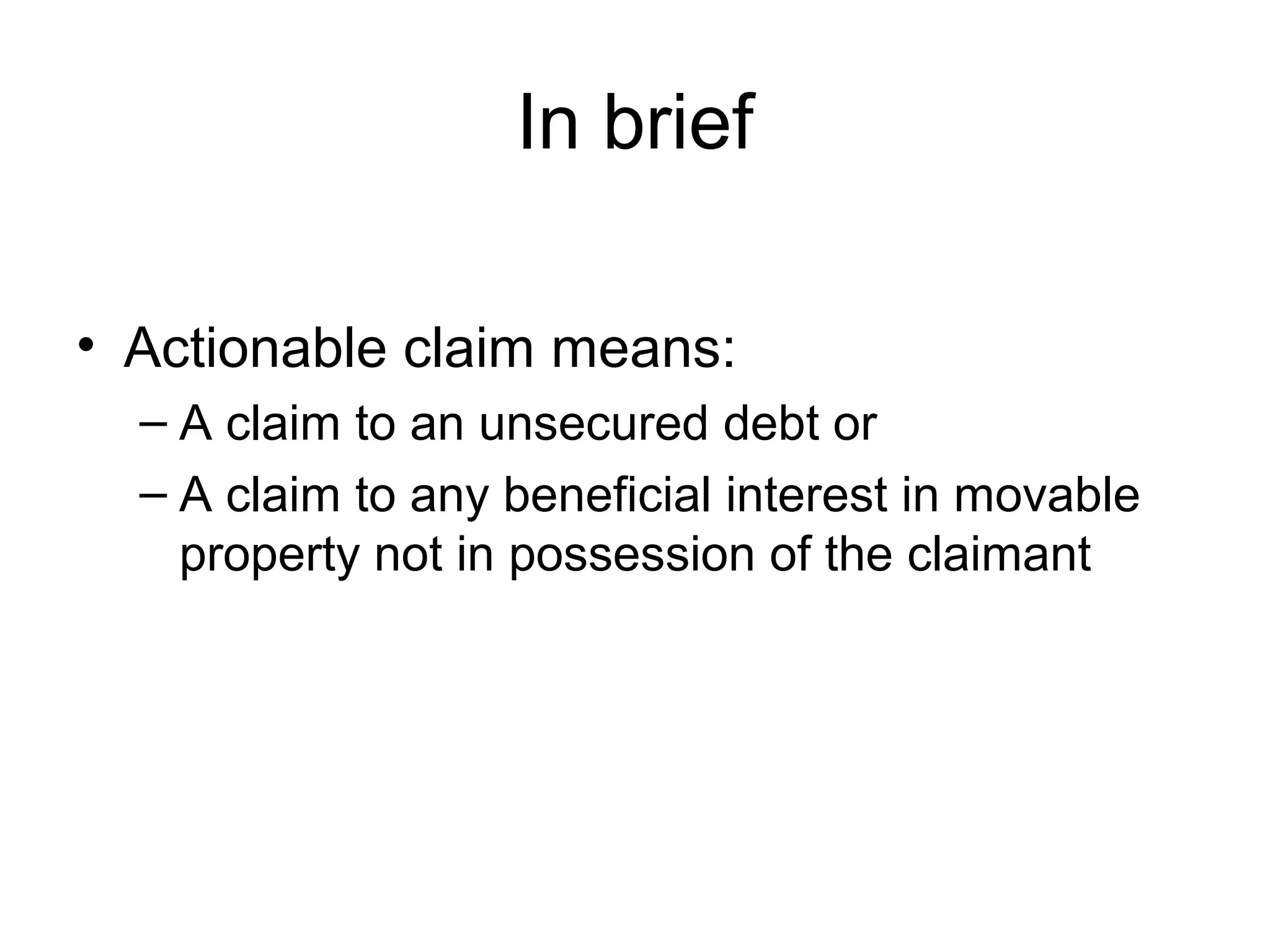
In brief
• Actionable claim means:
– A claim to an unsecured debt or
– A claim to any beneficial interest in movable
property not in possession of the claimant
Chose-in-action
• In England: personal property, not in the
possession of the claimant, which can only
be recovered by taking action in the court.
• If an amount is certain, then only it can be
considered debt
• If the amount is uncertain, it is not debt
• Debts may be payable in future or
conditional or contingent
illustrations
• “A” owes Rs. 1000 to “B”. “B”’s claim is an actionable
claim. Because, “B” can bring an action in a court and
claim back the amount
• “A” borrows Rs. 1000 from “B” and mortgages his house
to him. Mortgage is not an actionable claim.
• “A” contracts to buy goods from “B”. On the due date, A
fails to take delivery and B sells the goods in the open
market at a loss of Rs. 1000. B has a right to claim the
damages from A, but this claim is not an actionable
claim.
• A contracts to sell to B, 100 bales of cotton deliverable
on a future day. B has a beneficial interest in the goods
and it is an actionable claim
Cases
• Doraiswamy Mualiar v. D. Aiyangar
• Jafer Meher Ali v. Budge Jute Mills
• Official Assignee v. Hukum Chand
The contents of this file have been compiled from various
reliable sources. Due care has been taken to avoid
errors. The author of this work takes no responsibility for
the consequences arising out of error. The reader is
advised to cross check with the text books and the Act in
case of confusion. You are allowed to share this file with
your friends without making changes to the contents of
this file. However, you are not allowed to exploit this
work commercially.
- Gagan K.
University of Mysore
gagan555@gmail.com

Topic 3. Actionable claim

  • 1.
    Transfer of property Topic3. Actionable Claim
  • 2.
    We are here… 1. Movable and immovable property 2. Attestation and notice 3. Actionable claim 4. Transfer of property 5. Restraints on transfer 6. Rule against perpetuities 7. Vested and contingent interest 8. Doctrine of election 9. Sale of immovable property
  • 3.
    Actionable claim • Isa species of property. Hence capable of ownership and transfer. • Sec. 3 of TP Act defines actionable claim to a claim: – To any debt other than a debt secured by mortgage of immovable property or by hypothecation or pledge of movable property – To any beneficial interest in movablesd not in possession actual or constructive of the claimant – Which the Civil Courts recognise as affording grounds for relief, whether such debt or beneficial interest be existent, accruing, conditional or contingent.
  • 4.
    In brief • Actionableclaim means: – A claim to an unsecured debt or – A claim to any beneficial interest in movable property not in possession of the claimant
  • 5.
    Chose-in-action • In England:personal property, not in the possession of the claimant, which can only be recovered by taking action in the court. • If an amount is certain, then only it can be considered debt • If the amount is uncertain, it is not debt • Debts may be payable in future or conditional or contingent
  • 6.
    illustrations • “A” owesRs. 1000 to “B”. “B”’s claim is an actionable claim. Because, “B” can bring an action in a court and claim back the amount • “A” borrows Rs. 1000 from “B” and mortgages his house to him. Mortgage is not an actionable claim. • “A” contracts to buy goods from “B”. On the due date, A fails to take delivery and B sells the goods in the open market at a loss of Rs. 1000. B has a right to claim the damages from A, but this claim is not an actionable claim. • A contracts to sell to B, 100 bales of cotton deliverable on a future day. B has a beneficial interest in the goods and it is an actionable claim
  • 7.
    Cases • Doraiswamy Mualiarv. D. Aiyangar • Jafer Meher Ali v. Budge Jute Mills • Official Assignee v. Hukum Chand
  • 8.
    The contents ofthis file have been compiled from various reliable sources. Due care has been taken to avoid errors. The author of this work takes no responsibility for the consequences arising out of error. The reader is advised to cross check with the text books and the Act in case of confusion. You are allowed to share this file with your friends without making changes to the contents of this file. However, you are not allowed to exploit this work commercially. - Gagan K. University of Mysore gagan555@gmail.com