EQUITABLE DOCTRINES
DEFINITION

• A rule or principle of law, especially when
established by precedent.

• A set of general principles which are said to
govern the way in which equity operates, illustrating
the qualities of equity.

• The Court of Chancery applied the doctrines and
maxims interchangeably.
DOCTRINE OF CONVERSION


• The basis of this doctrine is the maxim ‘Equity looks
on that as done which ought to be done’.

• Introduced in the 18th Cent, to stop the unfairness of
allowing trustees prejudicially to affect the interests of
beneficiaries by postponing sales or purchase of land.

• Thus it promotes justice; assist the owner of the
subject matter of conversion in the accomplishment of
his objective to distribute his property in accordance
to his presumed intention.
DOCTRINE OF CONVERSION

• It is normally illustrated in a trust for sale of
  land; in that equity regards that land to
  devolve as if it were money or money as if it
  were land.

• Conversion is effective at the date of the
  instrument expressing the intention (in cases
  of deed) and the date of testator’s death (in
  cases of will).
DOCTRINE OF CONVERSION

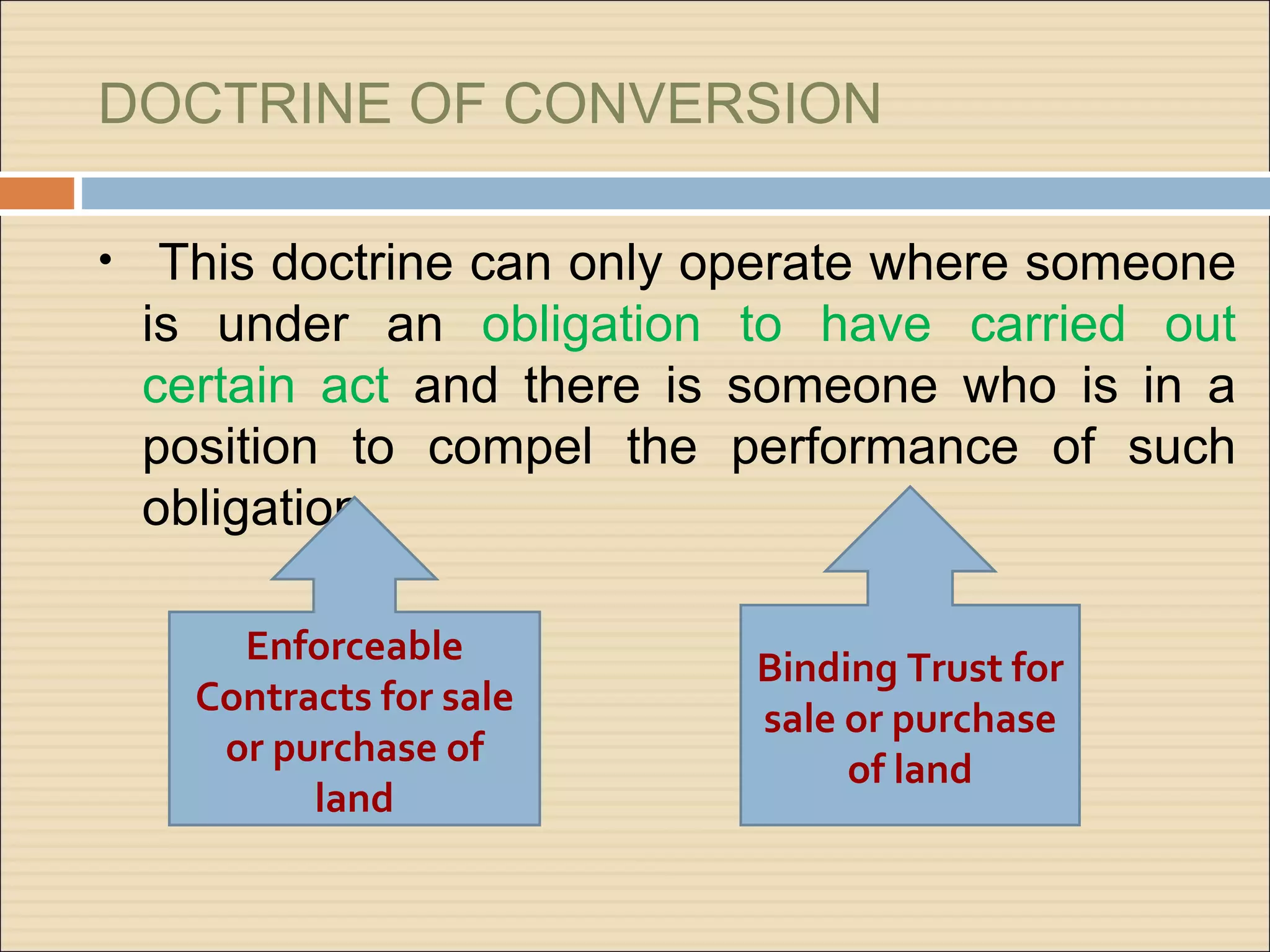
•    This doctrine can only operate where someone
    is under an obligation to have carried out
    certain act and there is someone who is in a
    position to compel the performance of such
    obligation.

        Enforceable
                             Binding Trust for
      Contracts for sale
                             sale or purchase
       or purchase of
                                  of land
            land
Fletcher v Ashburner (1779)

•   “Nothing was better established than this
    principle, that money directed to be
    employed in the purchase of land, and land
    directed to be sold and turned into money
    are to be considered as that species of
    property into which they are directed to be
    converted”.
Sweetapple v Bindon (1705)
Testator (mom) bequeathed £300 to be used for
the purchase of land (property) to the use of her
daughter and grandchildren-Daughter died and
no purchase of land had been made- Husband
of the daughter claimed to be tenant by courtesy
of the fund of £300 – Claim upheld; though
purchase of land had not been made, by the
doctrine of conversion, the money was regarded
as realty (real property).
DOCTRINE OF ELECTION

•   A person may not take a benefit and reject an
    associated burden or, choose between parts of
    a single transaction.

            Birmingham v Kirwan (1805)
• Lord Redesdale; “A person cannot accept and
  reject the same instrument”.

•   This doctrine operates when a testator has
    committed a mistake.
DOCTRINE OF ELECTION

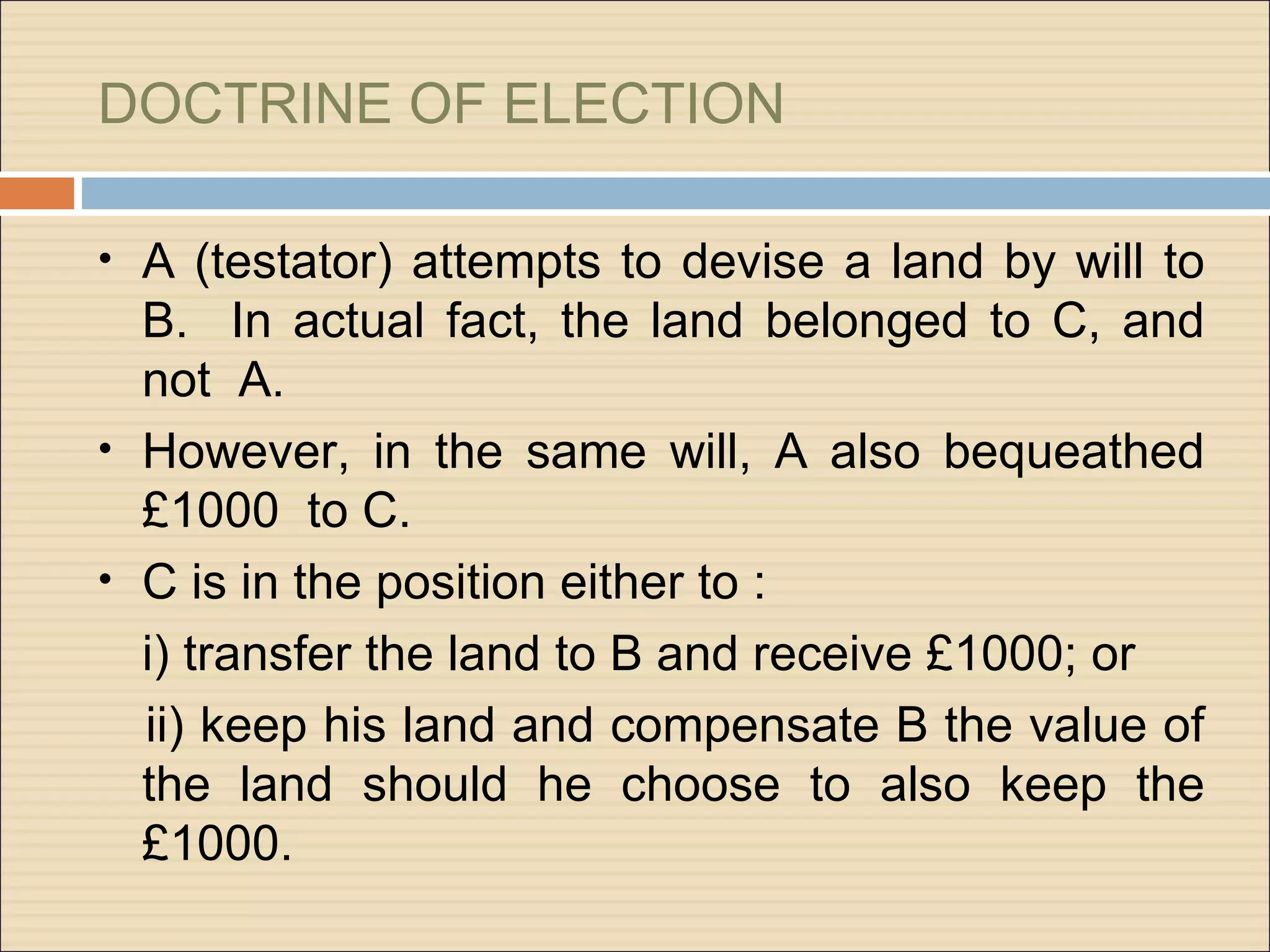
• A (testator) attempts to devise a land by will to
  B. In actual fact, the land belonged to C, and
  not A.
• However, in the same will, A also bequeathed
  £1000 to C.
• C is in the position either to :
  i) transfer the land to B and receive £1000; or
  ii) keep his land and compensate B the value of
  the land should he choose to also keep the
  £1000.
DOCTRINE OF ELECTION

                   Re Edwards [1958]
     Conditions for election:
iii) Intention on the part of A to dispose certain
     property to someone (B),
iv)The property is not A’s property i.e. someone
     else’s property (C), and
v) Benefit should be given to the true owner of the
     property (C).
DOCTRINE OF SATISFACTION

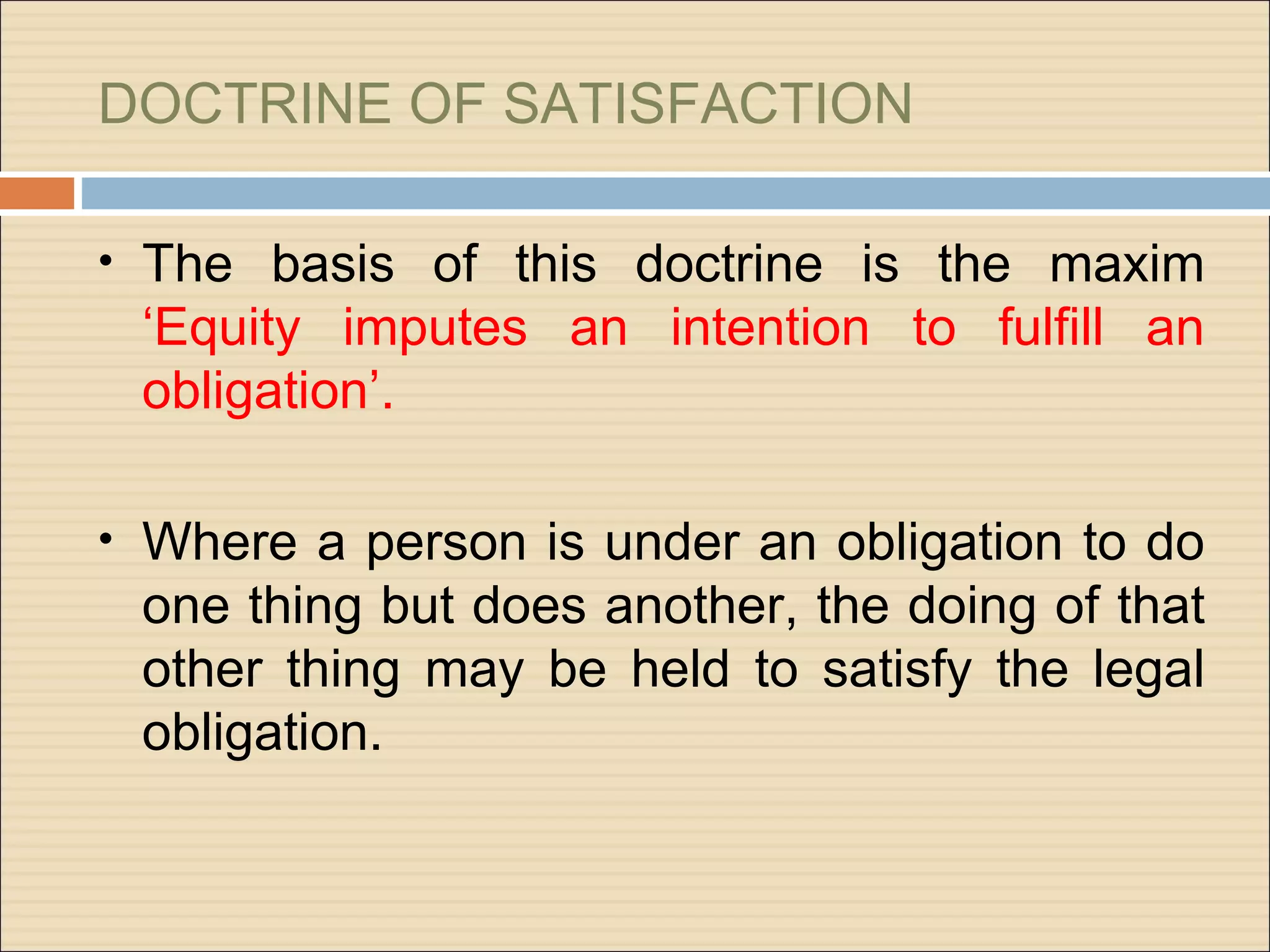
• The basis of this doctrine is the maxim
 ‘Equity imputes an intention to fulfill an
 obligation’.

• Where a person is under an obligation to do
 one thing but does another, the doing of that
 other thing may be held to satisfy the legal
 obligation.
DOCTRINE OF SATISFACTION

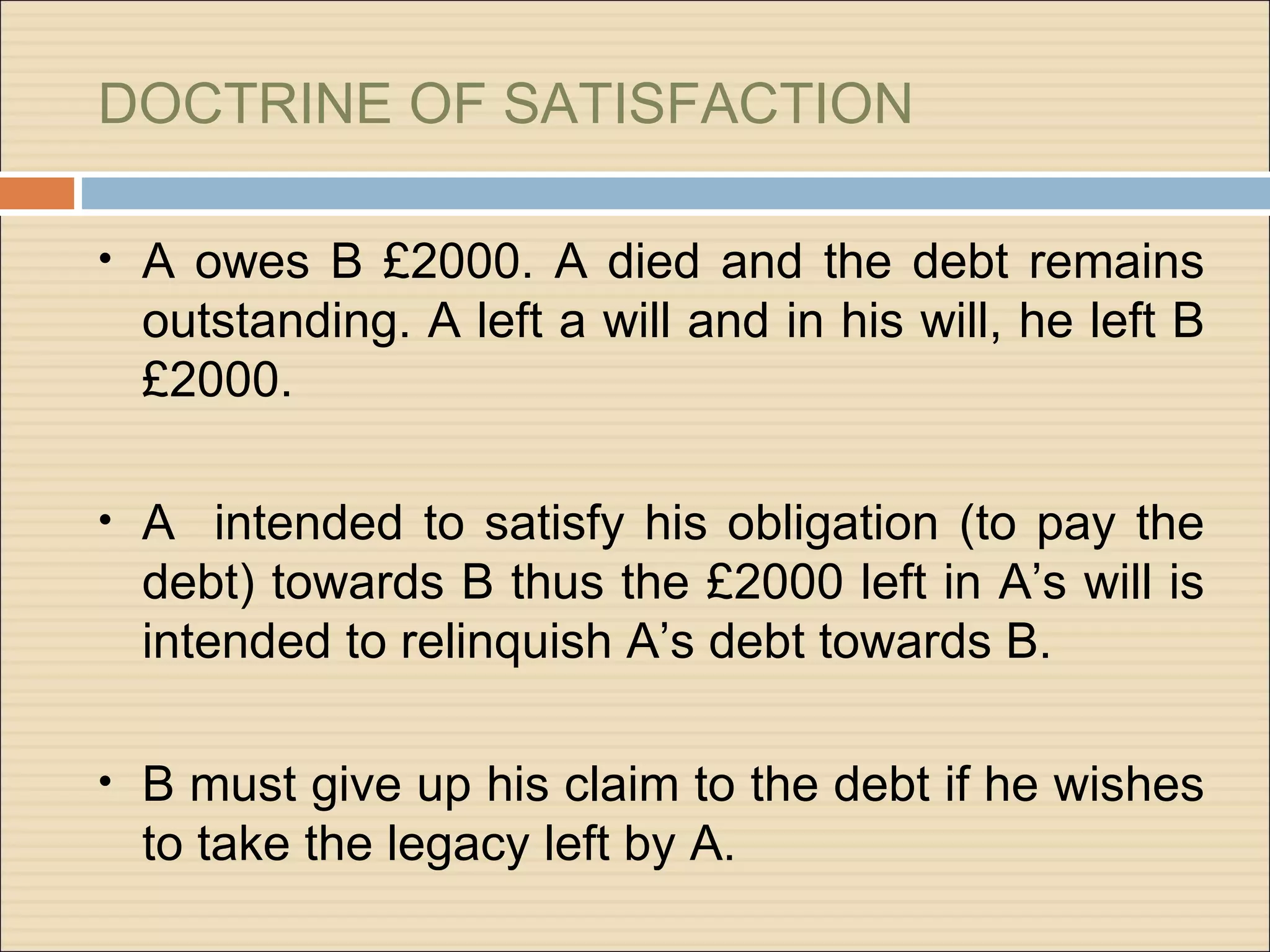
• A owes B £2000. A died and the debt remains
  outstanding. A left a will and in his will, he left B
  £2000.

• A intended to satisfy his obligation (to pay the
  debt) towards B thus the £2000 left in A’s will is
  intended to relinquish A’s debt towards B.

• B must give up his claim to the debt if he wishes
  to take the legacy left by A.
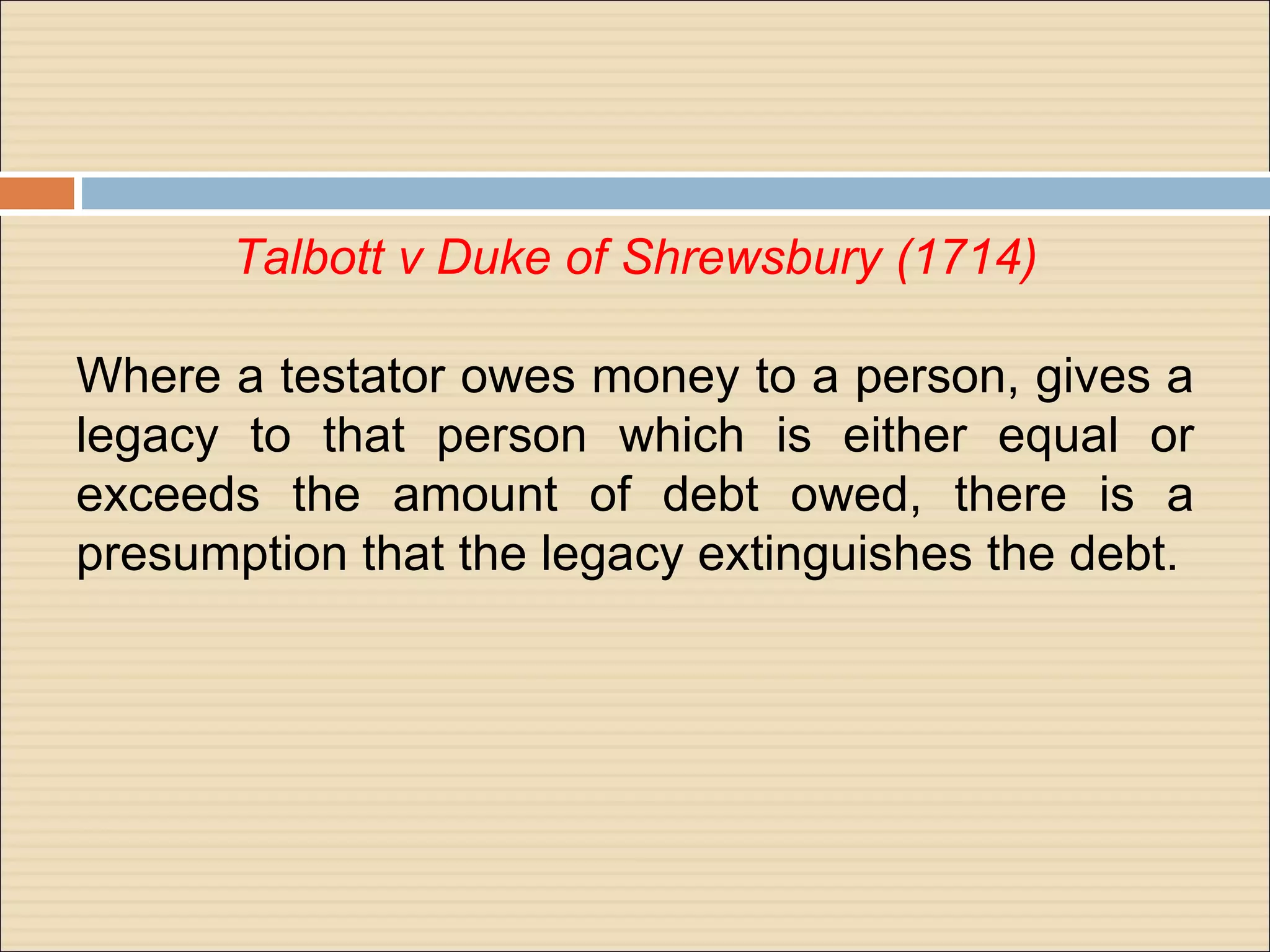
Talbott v Duke of Shrewsbury (1714)

Where a testator owes money to a person, gives a
legacy to that person which is either equal or
exceeds the amount of debt owed, there is a
presumption that the legacy extinguishes the debt.
DOCTRINE OF SATISFACTION


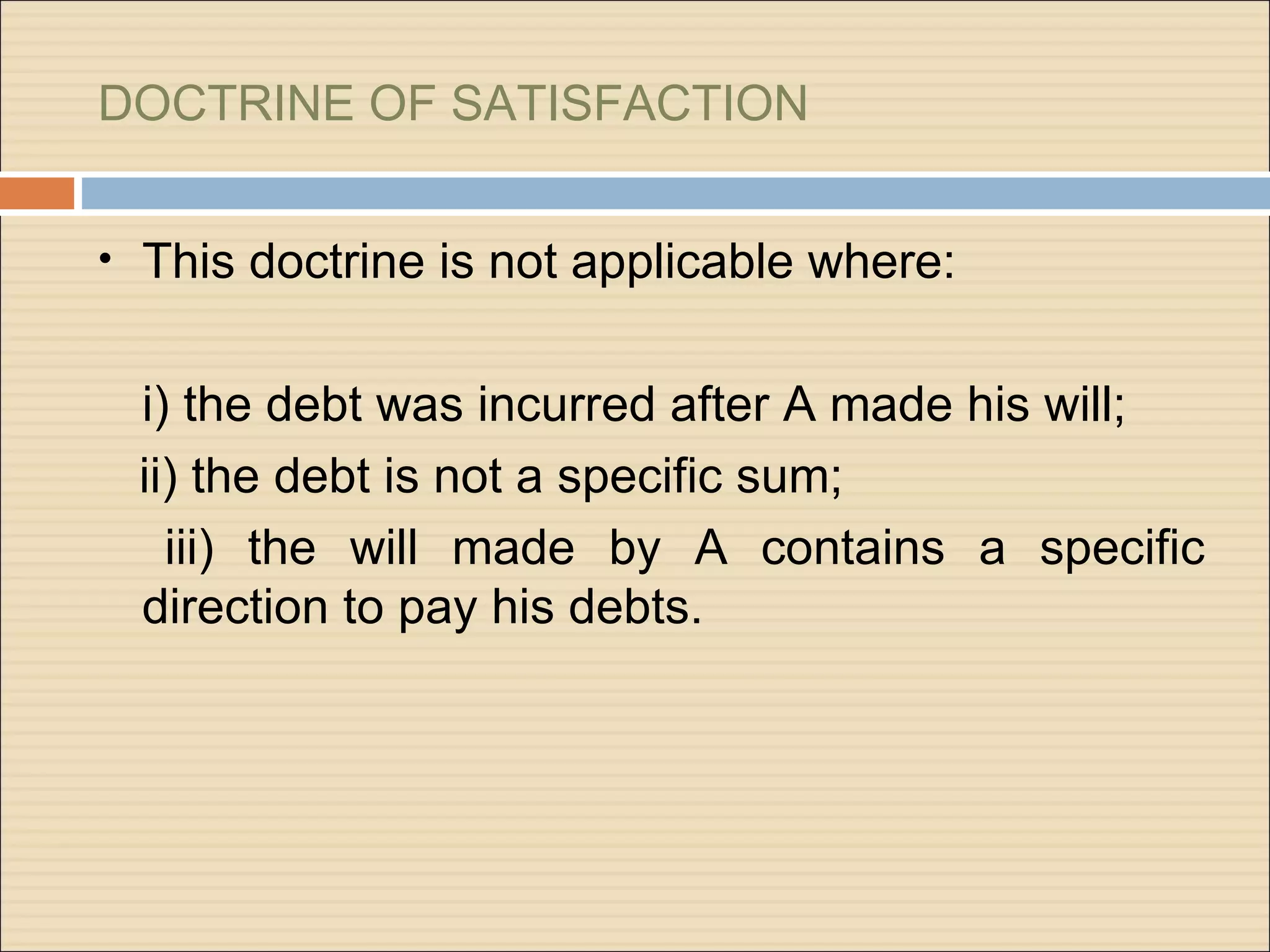
• This doctrine is not applicable where:


 i) the debt was incurred after A made his will;
 ii) the debt is not a specific sum;
   iii) the will made by A contains a specific
 direction to pay his debts.
DOCTRINE OF PERFORMANCE

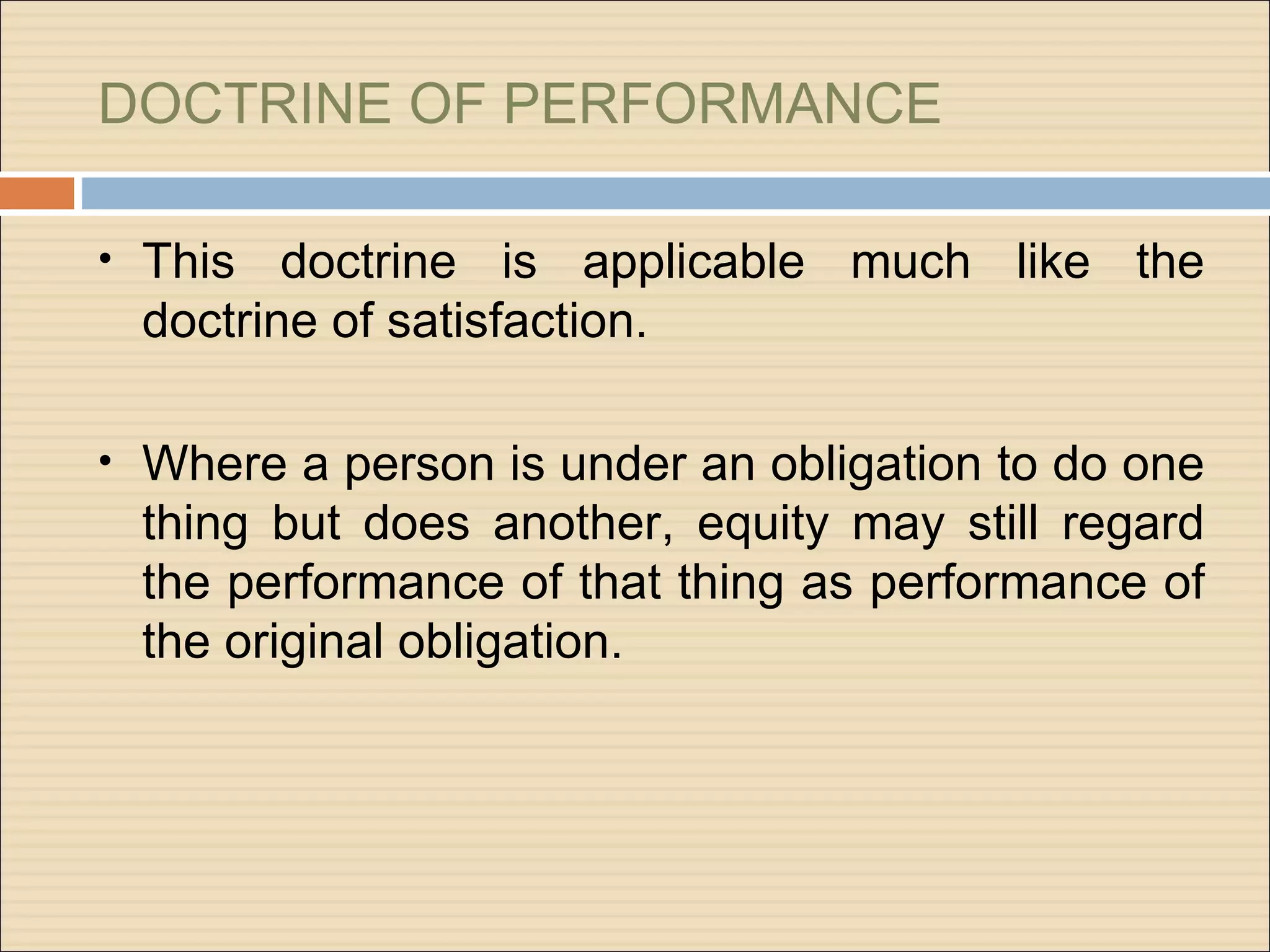
• This  doctrine is applicable much like the
 doctrine of satisfaction.

• Where a person is under an obligation to do one
 thing but does another, equity may still regard
 the performance of that thing as performance of
 the original obligation.
DOCTRINE OF PERFORMANCE

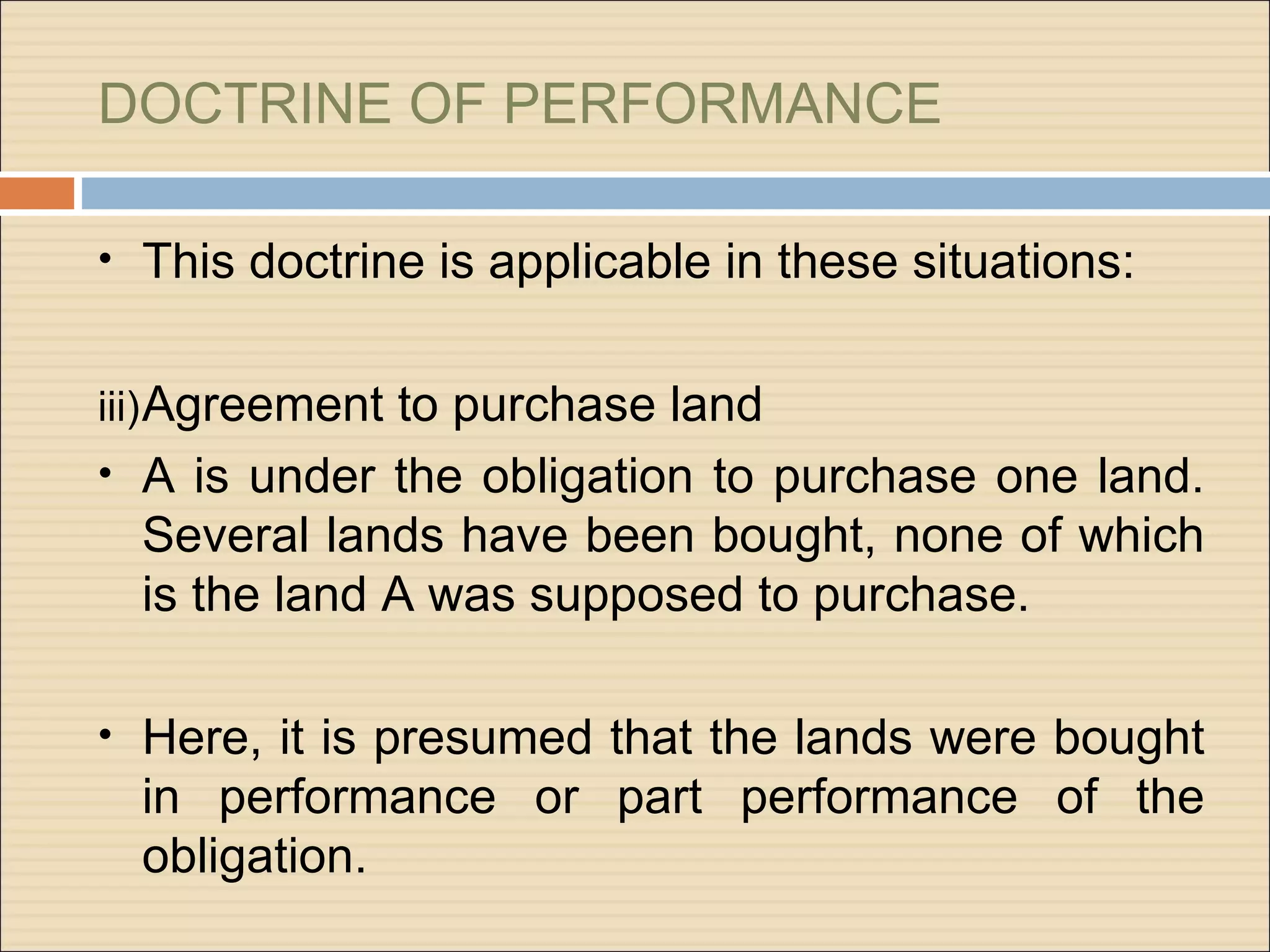
• This doctrine is applicable in these situations:


iii) Agreement to purchase land
• A is under the obligation to purchase one land.
  Several lands have been bought, none of which
  is the land A was supposed to purchase.

• Here, it is presumed that the lands were bought
  in performance or part performance of the
  obligation.
DOCTRINE OF PERFORMANCE

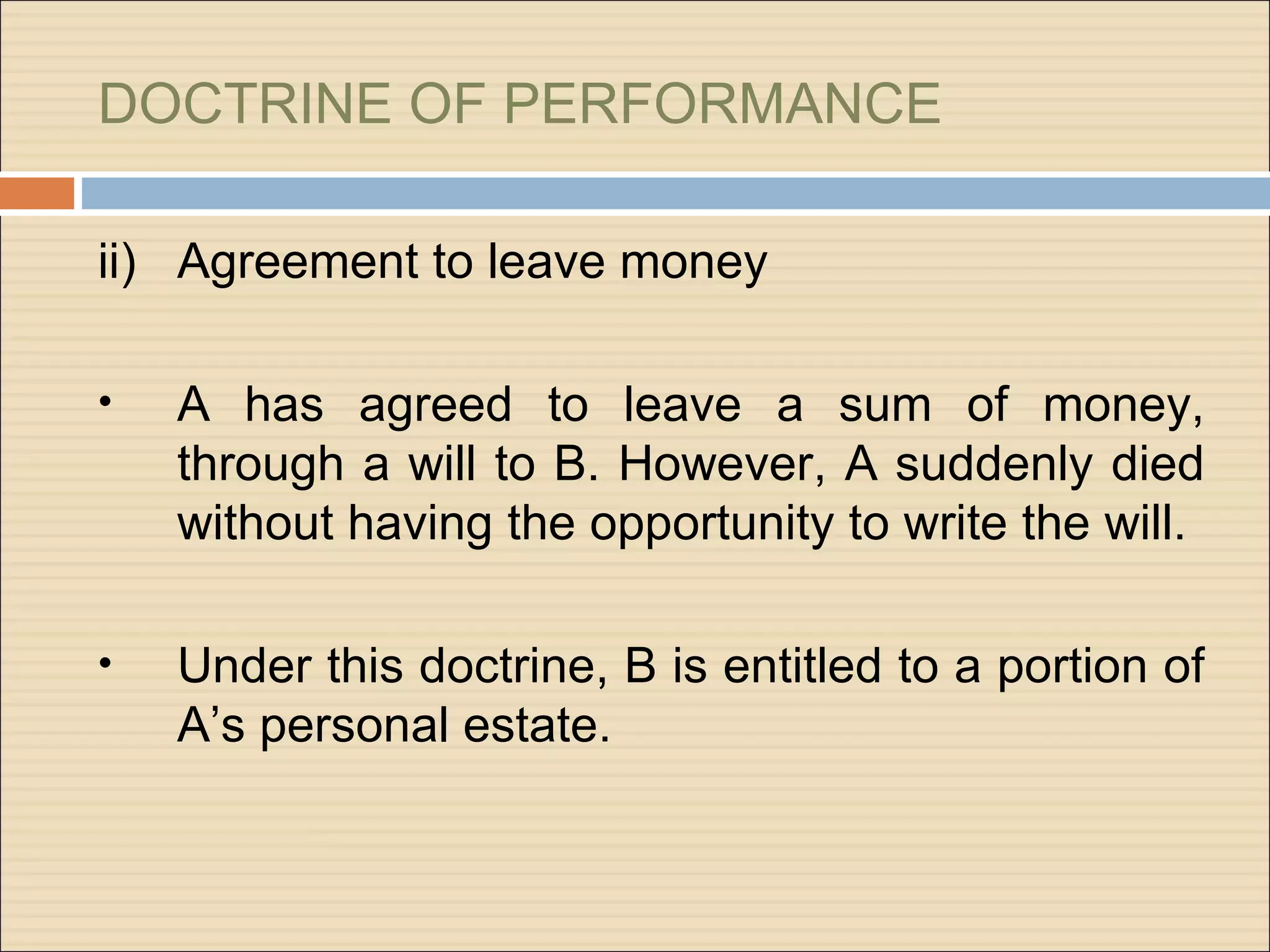
ii) Agreement to leave money

•   A has agreed to leave a sum of money,
    through a will to B. However, A suddenly died
    without having the opportunity to write the will.

•   Under this doctrine, B is entitled to a portion of
    A’s personal estate.

Equitable doctrines

  • 1.
  • 2.
    DEFINITION • A ruleor principle of law, especially when established by precedent. • A set of general principles which are said to govern the way in which equity operates, illustrating the qualities of equity. • The Court of Chancery applied the doctrines and maxims interchangeably.
  • 3.
    DOCTRINE OF CONVERSION •The basis of this doctrine is the maxim ‘Equity looks on that as done which ought to be done’. • Introduced in the 18th Cent, to stop the unfairness of allowing trustees prejudicially to affect the interests of beneficiaries by postponing sales or purchase of land. • Thus it promotes justice; assist the owner of the subject matter of conversion in the accomplishment of his objective to distribute his property in accordance to his presumed intention.
  • 4.
    DOCTRINE OF CONVERSION •It is normally illustrated in a trust for sale of land; in that equity regards that land to devolve as if it were money or money as if it were land. • Conversion is effective at the date of the instrument expressing the intention (in cases of deed) and the date of testator’s death (in cases of will).
  • 5.
    DOCTRINE OF CONVERSION • This doctrine can only operate where someone is under an obligation to have carried out certain act and there is someone who is in a position to compel the performance of such obligation. Enforceable Binding Trust for Contracts for sale sale or purchase or purchase of of land land
  • 6.
    Fletcher v Ashburner(1779) • “Nothing was better established than this principle, that money directed to be employed in the purchase of land, and land directed to be sold and turned into money are to be considered as that species of property into which they are directed to be converted”.
  • 7.
    Sweetapple v Bindon(1705) Testator (mom) bequeathed £300 to be used for the purchase of land (property) to the use of her daughter and grandchildren-Daughter died and no purchase of land had been made- Husband of the daughter claimed to be tenant by courtesy of the fund of £300 – Claim upheld; though purchase of land had not been made, by the doctrine of conversion, the money was regarded as realty (real property).
  • 8.
    DOCTRINE OF ELECTION • A person may not take a benefit and reject an associated burden or, choose between parts of a single transaction. Birmingham v Kirwan (1805) • Lord Redesdale; “A person cannot accept and reject the same instrument”. • This doctrine operates when a testator has committed a mistake.
  • 9.
    DOCTRINE OF ELECTION •A (testator) attempts to devise a land by will to B. In actual fact, the land belonged to C, and not A. • However, in the same will, A also bequeathed £1000 to C. • C is in the position either to : i) transfer the land to B and receive £1000; or ii) keep his land and compensate B the value of the land should he choose to also keep the £1000.
  • 10.
    DOCTRINE OF ELECTION Re Edwards [1958] Conditions for election: iii) Intention on the part of A to dispose certain property to someone (B), iv)The property is not A’s property i.e. someone else’s property (C), and v) Benefit should be given to the true owner of the property (C).
  • 11.
    DOCTRINE OF SATISFACTION •The basis of this doctrine is the maxim ‘Equity imputes an intention to fulfill an obligation’. • Where a person is under an obligation to do one thing but does another, the doing of that other thing may be held to satisfy the legal obligation.
  • 12.
    DOCTRINE OF SATISFACTION •A owes B £2000. A died and the debt remains outstanding. A left a will and in his will, he left B £2000. • A intended to satisfy his obligation (to pay the debt) towards B thus the £2000 left in A’s will is intended to relinquish A’s debt towards B. • B must give up his claim to the debt if he wishes to take the legacy left by A.
  • 13.
    Talbott v Dukeof Shrewsbury (1714) Where a testator owes money to a person, gives a legacy to that person which is either equal or exceeds the amount of debt owed, there is a presumption that the legacy extinguishes the debt.
  • 14.
    DOCTRINE OF SATISFACTION •This doctrine is not applicable where: i) the debt was incurred after A made his will; ii) the debt is not a specific sum; iii) the will made by A contains a specific direction to pay his debts.
  • 15.
    DOCTRINE OF PERFORMANCE •This doctrine is applicable much like the doctrine of satisfaction. • Where a person is under an obligation to do one thing but does another, equity may still regard the performance of that thing as performance of the original obligation.
  • 16.
    DOCTRINE OF PERFORMANCE •This doctrine is applicable in these situations: iii) Agreement to purchase land • A is under the obligation to purchase one land. Several lands have been bought, none of which is the land A was supposed to purchase. • Here, it is presumed that the lands were bought in performance or part performance of the obligation.
  • 17.
    DOCTRINE OF PERFORMANCE ii)Agreement to leave money • A has agreed to leave a sum of money, through a will to B. However, A suddenly died without having the opportunity to write the will. • Under this doctrine, B is entitled to a portion of A’s personal estate.