
EQUITY AND TRUSTS
SUMMARY
LAWSKOOL UK
UK EQUITY AND TRUSTS LAW
lawskool.co.uk
©
CONTENTS
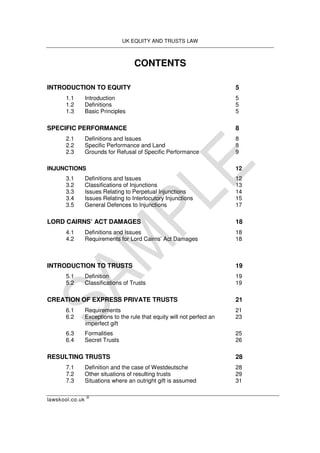
INTRODUCTION TO EQUITY 5
1.1 Introduction 5
1.2 Definitions 5
1.3 Basic Principles 5
SPECIFIC PERFORMANCE 8
2.1 Definitions and Issues 8
2.2 Specific Performance and Land 8
2.3 Grounds for Refusal of Specific Performance 9
INJUNCTIONS 12
3.1 Definitions and Issues 12
3.2 Classifications of Injunctions 13
3.3 Issues Relating to Perpetual Injunctions 14
3.4 Issues Relating to Interlocutory Injunctions 15
3.5 General Defences to Injunctions 17
LORD CAIRNS’ ACT DAMAGES 18
4.1 Definitions and Issues 18
4.2 Requirements for Lord Cairns’ Act Damages 18
INTRODUCTION TO TRUSTS 19
5.1 Definition 19
5.2 Classifications of Trusts 19
CREATION OF EXPRESS PRIVATE TRUSTS 21
6.1 Requirements 21
6.2 Exceptions to the rule that equity will not perfect an 23
imperfect gift
6.3 Formalities 25
6.4 Secret Trusts 26
RESULTING TRUSTS 28
7.1 Definition and the case of Westdeutsche 28
7.2 Other situations of resulting trusts 29
7.3 Situations where an outright gift is assumed 31
UK EQUITY AND TRUSTS LAW
lawskool.co.uk
©
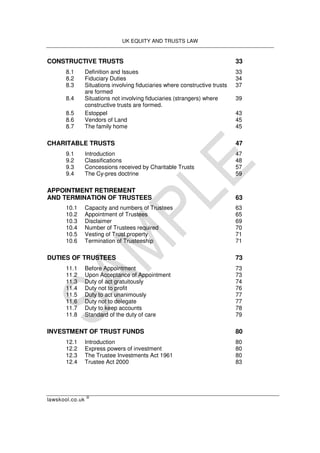
CONSTRUCTIVE TRUSTS 33
8.1 Definition and Issues 33
8.2 Fiduciary Duties 34
8.3 Situations involving fiduciaries where constructive trusts 37
are formed
8.4 Situations not involving fiduciaries (strangers) where 39
constructive trusts are formed.
8.5 Estoppel 43
8.6 Vendors of Land 45
8.7 The family home 45
CHARITABLE TRUSTS 47
9.1 Introduction 47
9.2 Classifications 48
9.3 Concessions received by Charitable Trusts 57
9.4 The Cy-pres doctrine 59
APPOINTMENT RETIREMENT
AND TERMINATION OF TRUSTEES 63
10.1 Capacity and numbers of Trustees 63
10.2 Appointment of Trustees 65
10.3 Disclaimer 69
10.4 Number of Trustees required 70
10.5 Vesting of Trust property 71
10.6 Termination of Trusteeship 71
DUTIES OF TRUSTEES 73
11.1 Before Appointment 73
11.2 Upon Acceptance of Appointment 73
11.3 Duty of act gratuitously 74
11.4 Duty not to profit 76
11.5 Duty to act unanimously 77
11.6 Duty not to delegate 77
11.7 Duty to keep accounts 78
11.8 Standard of the duty of care 79
INVESTMENT OF TRUST FUNDS 80
12.1 Introduction 80
12.2 Express powers of investment 80
12.3 The Trustee Investments Act 1961 80
12.4 Trustee Act 2000 83
UK EQUITY AND TRUSTS LAW
lawskool.co.uk
©
REMEDIES FOR BREACH OF TRUST 84
13.1 Injunctions 84
13.2 Personal action against the Trustee 85
13.3 Defences available to the Trustee 87
TRACING 90
14.1 Introduction 90
14.2 Tracing in Equity 91
14.3 Tracing in Common Law 95
UK EQUITY AND TRUSTS LAW
lawskool.co.uk
©
1 Introduction to Equity
1.1 Introduction
In general, equity is a collection of legal principles that is intended to complement
common law principles. Generally, it functions to mitigate the unfair impact that rigid
common law principles can have in certain situations. It accomplishes this by looking at
each individual case and facilitating the right course of action for the parties involved.
Simply put, equity’s primary mission is to ensure fairness, often at the expense of
certainty in the law. It is able to do this as it is guided by certain maxims, instead of being
bound by rigid and inflexible rules that limits its powers.
1.2 Definitions
Definitively, equity is the part of law, which immediately prior to the enactment of the
Supreme Courts of Judicature Acts 1873 and 1875, was exclusively enforced in the
Court of Chancery. Prior to the aforementioned Acts, equity had not been enforced in the
Courts of Common Law at all.
A common law remedy at the Court of Common Law was available if there had been an
infringement of a legal right, and the relief it afforded was usually that of damages.
Equitable remedies at the Court of Chancery were used when damages were deemed to
be either inappropriate or inadequate.
The effect of the Acts was to allow the Supreme Court to administer both equitable and
common law remedies. Today, section 49 of the Supreme Court Act 1981 allows all
courts dealing with civil cases to administer equitable remedies.
UK EQUITY AND TRUSTS LAW
lawskool.co.uk
©
1.3 Basic Principles
The following maxims of equity act as guidelines for the courts in determining whether
equitable jurisdiction should be exercised:
1.2.1 Equity will not suffer a wrong to be without a remedy.
This principle means that equity will intervene to protect a right that is not
enforceable at law due to a mere technicality in the law. E.g. the enforcement of a
trust by the beneficiary even though the beneficiary is not the legal owner.
1.2.2 Equity follows the law
Equity does not contravene statute law and will only act against common law rules
in exceptional circumstances
1.2.3 He who seeks equity must do equity
A claimant who wishes for equity to be applied must act fairly towards the defendant.
Case: Chappell v. Times Newspapers Ltd [1975] 1 W.L.R. 482, where the
claimants failed to obtain an injunction to prevent their dismissals as they had
refused to undertake not to become involved in strikes.
1.2.4 He who comes to equity must come with clean hands
A claimant will not be able to obtain equitable relief if his behaviour in connection
with the relief sought is blameworthy.
Case: Duchess of Argyll v Duke of Argyll [1967] Ch 302, where the claimant was
refused an injunction to prevent the publication of her ex-husband’s account of their
married life, due to the fact that it the claimant’s subsequent immorality led to the
termination of their marriage.
UK EQUITY AND TRUSTS LAW
lawskool.co.uk
©
1.2.5 Where the equities are equal, the law prevails
E.g. A bona fide purchaser who purchases land would have prevailing title of the
land, even if there had already been a prior equitable interest by another party.
1.2.6 Where the equities are equal, the first in time prevails
Equitable interests rank in order of creation. Therefore, a prior equitable interest
would prevail over an equitable interest that had been created after.
1.2.7 Equity imputes an intention to fulfil an obligation
A person cannot seek equitable relief if the purported offending party does some act
that could be regarded as performance of his original obligations.
1.2.8 Equity regards as done that which ought to be done
If there is an enforceable obligation between parties, equity treats the parties as
already in the position which they would be in after the performance of the obligation.
Case: Walsh v. Lonsdale (1882) 21 Ch.D. 9, where it was held that a specifically
enforceable contract for a lease creates an equitable lease.
1.2.9 Equity is equality
Where 2 or more parties have an interest in the same property, equity would seek to
divide the property equally between the parties, unless there is good reason for any
other basis of division. E.g. Unless otherwise stated, equity presumes a tenancy in
common, and not a joint tenancy with regard to equitable joint interests.
1.2.10 Equity looks to the intent rather than the form
E.g. Equity will regard a relationship as a trust, even if the term “trust” has not been
explicitly used.
UK EQUITY AND TRUSTS LAW
lawskool.co.uk
©
1.2.11 Delay defeats equities
A claimant will not be able to seek equitable relief if he has delayed unreasonably in
bringing his action.
♠♠♠♠
To order the complete version of the lawskool Equity and Trusts Law
Summary please visit www.lawskool.co.uk

UK Equity and Trust

  • 1.
  • 2.
    UK EQUITY ANDTRUSTS LAW lawskool.co.uk © CONTENTS INTRODUCTION TO EQUITY 5 1.1 Introduction 5 1.2 Definitions 5 1.3 Basic Principles 5 SPECIFIC PERFORMANCE 8 2.1 Definitions and Issues 8 2.2 Specific Performance and Land 8 2.3 Grounds for Refusal of Specific Performance 9 INJUNCTIONS 12 3.1 Definitions and Issues 12 3.2 Classifications of Injunctions 13 3.3 Issues Relating to Perpetual Injunctions 14 3.4 Issues Relating to Interlocutory Injunctions 15 3.5 General Defences to Injunctions 17 LORD CAIRNS’ ACT DAMAGES 18 4.1 Definitions and Issues 18 4.2 Requirements for Lord Cairns’ Act Damages 18 INTRODUCTION TO TRUSTS 19 5.1 Definition 19 5.2 Classifications of Trusts 19 CREATION OF EXPRESS PRIVATE TRUSTS 21 6.1 Requirements 21 6.2 Exceptions to the rule that equity will not perfect an 23 imperfect gift 6.3 Formalities 25 6.4 Secret Trusts 26 RESULTING TRUSTS 28 7.1 Definition and the case of Westdeutsche 28 7.2 Other situations of resulting trusts 29 7.3 Situations where an outright gift is assumed 31
  • 3.
    UK EQUITY ANDTRUSTS LAW lawskool.co.uk © CONSTRUCTIVE TRUSTS 33 8.1 Definition and Issues 33 8.2 Fiduciary Duties 34 8.3 Situations involving fiduciaries where constructive trusts 37 are formed 8.4 Situations not involving fiduciaries (strangers) where 39 constructive trusts are formed. 8.5 Estoppel 43 8.6 Vendors of Land 45 8.7 The family home 45 CHARITABLE TRUSTS 47 9.1 Introduction 47 9.2 Classifications 48 9.3 Concessions received by Charitable Trusts 57 9.4 The Cy-pres doctrine 59 APPOINTMENT RETIREMENT AND TERMINATION OF TRUSTEES 63 10.1 Capacity and numbers of Trustees 63 10.2 Appointment of Trustees 65 10.3 Disclaimer 69 10.4 Number of Trustees required 70 10.5 Vesting of Trust property 71 10.6 Termination of Trusteeship 71 DUTIES OF TRUSTEES 73 11.1 Before Appointment 73 11.2 Upon Acceptance of Appointment 73 11.3 Duty of act gratuitously 74 11.4 Duty not to profit 76 11.5 Duty to act unanimously 77 11.6 Duty not to delegate 77 11.7 Duty to keep accounts 78 11.8 Standard of the duty of care 79 INVESTMENT OF TRUST FUNDS 80 12.1 Introduction 80 12.2 Express powers of investment 80 12.3 The Trustee Investments Act 1961 80 12.4 Trustee Act 2000 83
  • 4.
    UK EQUITY ANDTRUSTS LAW lawskool.co.uk © REMEDIES FOR BREACH OF TRUST 84 13.1 Injunctions 84 13.2 Personal action against the Trustee 85 13.3 Defences available to the Trustee 87 TRACING 90 14.1 Introduction 90 14.2 Tracing in Equity 91 14.3 Tracing in Common Law 95
  • 5.
    UK EQUITY ANDTRUSTS LAW lawskool.co.uk © 1 Introduction to Equity 1.1 Introduction In general, equity is a collection of legal principles that is intended to complement common law principles. Generally, it functions to mitigate the unfair impact that rigid common law principles can have in certain situations. It accomplishes this by looking at each individual case and facilitating the right course of action for the parties involved. Simply put, equity’s primary mission is to ensure fairness, often at the expense of certainty in the law. It is able to do this as it is guided by certain maxims, instead of being bound by rigid and inflexible rules that limits its powers. 1.2 Definitions Definitively, equity is the part of law, which immediately prior to the enactment of the Supreme Courts of Judicature Acts 1873 and 1875, was exclusively enforced in the Court of Chancery. Prior to the aforementioned Acts, equity had not been enforced in the Courts of Common Law at all. A common law remedy at the Court of Common Law was available if there had been an infringement of a legal right, and the relief it afforded was usually that of damages. Equitable remedies at the Court of Chancery were used when damages were deemed to be either inappropriate or inadequate. The effect of the Acts was to allow the Supreme Court to administer both equitable and common law remedies. Today, section 49 of the Supreme Court Act 1981 allows all courts dealing with civil cases to administer equitable remedies.
  • 6.
    UK EQUITY ANDTRUSTS LAW lawskool.co.uk © 1.3 Basic Principles The following maxims of equity act as guidelines for the courts in determining whether equitable jurisdiction should be exercised: 1.2.1 Equity will not suffer a wrong to be without a remedy. This principle means that equity will intervene to protect a right that is not enforceable at law due to a mere technicality in the law. E.g. the enforcement of a trust by the beneficiary even though the beneficiary is not the legal owner. 1.2.2 Equity follows the law Equity does not contravene statute law and will only act against common law rules in exceptional circumstances 1.2.3 He who seeks equity must do equity A claimant who wishes for equity to be applied must act fairly towards the defendant. Case: Chappell v. Times Newspapers Ltd [1975] 1 W.L.R. 482, where the claimants failed to obtain an injunction to prevent their dismissals as they had refused to undertake not to become involved in strikes. 1.2.4 He who comes to equity must come with clean hands A claimant will not be able to obtain equitable relief if his behaviour in connection with the relief sought is blameworthy. Case: Duchess of Argyll v Duke of Argyll [1967] Ch 302, where the claimant was refused an injunction to prevent the publication of her ex-husband’s account of their married life, due to the fact that it the claimant’s subsequent immorality led to the termination of their marriage.
  • 7.
    UK EQUITY ANDTRUSTS LAW lawskool.co.uk © 1.2.5 Where the equities are equal, the law prevails E.g. A bona fide purchaser who purchases land would have prevailing title of the land, even if there had already been a prior equitable interest by another party. 1.2.6 Where the equities are equal, the first in time prevails Equitable interests rank in order of creation. Therefore, a prior equitable interest would prevail over an equitable interest that had been created after. 1.2.7 Equity imputes an intention to fulfil an obligation A person cannot seek equitable relief if the purported offending party does some act that could be regarded as performance of his original obligations. 1.2.8 Equity regards as done that which ought to be done If there is an enforceable obligation between parties, equity treats the parties as already in the position which they would be in after the performance of the obligation. Case: Walsh v. Lonsdale (1882) 21 Ch.D. 9, where it was held that a specifically enforceable contract for a lease creates an equitable lease. 1.2.9 Equity is equality Where 2 or more parties have an interest in the same property, equity would seek to divide the property equally between the parties, unless there is good reason for any other basis of division. E.g. Unless otherwise stated, equity presumes a tenancy in common, and not a joint tenancy with regard to equitable joint interests. 1.2.10 Equity looks to the intent rather than the form E.g. Equity will regard a relationship as a trust, even if the term “trust” has not been explicitly used.
  • 8.
    UK EQUITY ANDTRUSTS LAW lawskool.co.uk © 1.2.11 Delay defeats equities A claimant will not be able to seek equitable relief if he has delayed unreasonably in bringing his action. ♠♠♠♠ To order the complete version of the lawskool Equity and Trusts Law Summary please visit www.lawskool.co.uk