FARM AS A BUSINESS
Upstream
OUTLINE
❑ Introduction
❑ The Farm a Business: New Perspective
❑ What is Business?
❑ The Farm in the Business Flow Chart
❑ The Foundations of a Successful Farm Business
❑ Farm Planning
❑ Principles/ steps in Planning
❑ Farm Record Keeping
❑ Benefits of Accurate Farm Record/Book Keeping
❑ Farm Budgeting
Learning Objectives
At the end of this module, participants should be able to:
❑ Run their farms like any other business.
❑ Define what a business is and give examples of the
different types of businesses
❑ Describe the business process as a flow chart
❑ State and explain the pillars on which any successful
farm business should stand
❑ Draw a viable plan to guide in the farm operation for
the season.
INTRODUCTION
Farming is the process of working the ground, planting
seeds, and growing edible plants. You can also describe
raising animals for milk or meat as farming.
Farming is a great way to describe the lifestyle and work
of people whose jobs are in the agriculture industry. It is
the management, production, and marketing of
agricultural commodities.
FARM AS A BUSSINESS: NEW PERSPECTIVE
❑ Farmers should run their farms like any other
business
❑ Farmers who consider farming as a business venture,
do not run it on sound business lines.
❑ Farming like any other business provides sustenance,
hence, the need for farmers to be educated that
farming is a form of business.
WHAT IS A BUSINESS?
In a very simple term business “is an activity that
someone undertakes to make a product/ service which
he sells for a profit”.
A business includes the following:
❑ the owner, who organizes resources to set up the
business,
❑ he/ she makes a product/ service.
❑ the product/ service is sold in the market to a buyer
❑ a profit is made on the product/ service sold
❑ Farming, therefore fits into the definition of a business.
❑ The farmer is the owner; who organizes resources
(land, tools, seedlings, people, chemicals etc.)
❑ He sets up the farm(business) to produce crops.
❑ The produce is sold in the market and profit is made.
WHAT IS A BUSINESS? Cont’d
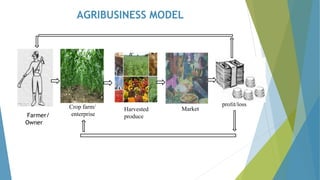
AGRIBUSINESS MODEL
Farmer/
Owner
Crop farm/
enterprise
Harvested
produce
Market
profit/loss
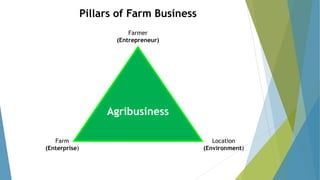
Pillars of Farm Business
Farmer
(Entrepreneur)
Farm
(Enterprise)
Location
(Environment)
Agribusiness
As an entrepreneur, the farmer must possess certain
qualities for business growth. These are:
Risk Taking Ability: Risk is the probability that an event
may or may not occur.
Opportunity Seeking and Initiative: He must be a kin
observer of his environment to identify new opportunities
and seize them.
ENTREPRENEURIAL COMPETENCIES
Goal Setting: This involve setting achievable goals for the
business.
Information Seeking: The farmer searches for information
necessary for his decision making.
Systematic Planning and Monitoring: This involves planning
and monitoring of activities within the business.
Commitment, Passion and Persistence: He should be
committed to the goals and plans and show persistency in
following a particular course of action to achieve them.
Self Confidence and Independence: He should trust in his
abilities, qualities and judgement of issues.
ENTREPRENEURIAL COMPETENCIES Cont.
Interpersonal Skills and Social Networking: This is the ability to deal
and relate with customers, workers, suppliers, competitors, banks,
extension officers etc. in the course of running the business.
Positive Attitude: this is the foundation upon which every business is
established and the prefix for it sustainability. Positive attitudes can
be expressed positively or negatively.
Stress Taker: This is the ability of the farmer to cope/deal with many
difficult situations at the same time and also be able to make right
decisions
AGRIBUSINESS PLANNING
❑ Planning
This requires preparing a sequence of action steps which will
assist in achieving a specific goal.
❑ Why Planning
❖ It helps in determine the resource needed for farming
activities
❖ It helps in identify future problems during plan
implementation
❖ It helps the farmer to make the best use of resources
❖ It helps the farmer to measuring
successes/achievements in handling a task
FARM PLANNING CONT’D.
❑ Steps in Planning
❖ Set an achievable goal, which must be SMART,
❖ List the objectives to be achieved.
❖ List the activities to be undertaken under each objective
❖ For each activity specify the person responsible and the
time frame needed
❖ Establish the resources needed to undertake each activity
in broad terms.
❖ State specific periods for plan implementation and review
❖ Goals set must be SMART( Specific, Measurable,
Achievable, Realistic and Time-bound)
BOOK KEEPING
❑ What is Bookkeeping?
❖ Bookkeeping involves the recording, on a daily basis, of a
company’s financial transactions. It is a part of the
process of accounting.
❖ Without bookkeeping, a business enterprise would not be
aware of their current financial position, as well as the
transactions that occur within the firm.
❖ Accurate bookkeeping is also crucial to external users,
such as investors, financial institutions, or the
government that need access to reliable information to
make better investment decision
BENEFITS OF FARM RECORD
❖ It helps to measure efficiency and progress
❖ Easier to prepare accounts at year end
❖ Avoid over/under tax payments
❖ Identify strengths and weaknesses in the farm business
❖ Make productivity projections
❖ Help maximize the expenses you claim and minimize tax burden
❖ Make it easier to pay employees and creditors and see what is owed
❖ Simplify process if you want to get a loan or sell the business
❖ Easier to distribute profits to shareholders (dividends)
❖ Quicker for partnerships to view profits and losses
❖ Make it easier should the business get audited by auditors
FARM BUDGETING
❑ Budget
A budget is a forecast of an entity’s costs and income for a
particular period of time normally based on a cycle. This is
an all important activity in running the business.
Definition of Terms
Preparing the Budget (Cost of Inputs and Labour):
The farmer will use the planning done to prepare the
budget (cost) estimates.
Planned total costs of activities:
This is the total costs of all activities under the plan. It is
the amount needed to implement the plan.
FARM BUDGETING Cont’d.
Planned gross revenue from sales:
This is an estimate of what will be sold under the plan
Planned Variable Cost:
This is expressed in terms of the total planned cost of
inputs, including total planned cost of hired labor.
Planned Gross Margin:
This is the planned total gross revenue minus the total
planned variable cost.
Profit/Loss of the Plan:
This is the difference between the total gross revenue and
the total planned variable cost
As actors in the AVC, clear understanding of the concept of
agribusiness and best agribusiness management practices is
indispensable to survive competition and improve
performance.
Conclusion
THANK YOU

02-Farming as a Business Upstream).pdf

  • 1.
    FARM AS ABUSINESS Upstream
  • 2.
    OUTLINE ❑ Introduction ❑ TheFarm a Business: New Perspective ❑ What is Business? ❑ The Farm in the Business Flow Chart ❑ The Foundations of a Successful Farm Business ❑ Farm Planning ❑ Principles/ steps in Planning ❑ Farm Record Keeping ❑ Benefits of Accurate Farm Record/Book Keeping ❑ Farm Budgeting
  • 3.
    Learning Objectives At theend of this module, participants should be able to: ❑ Run their farms like any other business. ❑ Define what a business is and give examples of the different types of businesses ❑ Describe the business process as a flow chart ❑ State and explain the pillars on which any successful farm business should stand ❑ Draw a viable plan to guide in the farm operation for the season.
  • 4.
    INTRODUCTION Farming is theprocess of working the ground, planting seeds, and growing edible plants. You can also describe raising animals for milk or meat as farming. Farming is a great way to describe the lifestyle and work of people whose jobs are in the agriculture industry. It is the management, production, and marketing of agricultural commodities.
  • 5.
    FARM AS ABUSSINESS: NEW PERSPECTIVE ❑ Farmers should run their farms like any other business ❑ Farmers who consider farming as a business venture, do not run it on sound business lines. ❑ Farming like any other business provides sustenance, hence, the need for farmers to be educated that farming is a form of business.
  • 6.
    WHAT IS ABUSINESS? In a very simple term business “is an activity that someone undertakes to make a product/ service which he sells for a profit”. A business includes the following: ❑ the owner, who organizes resources to set up the business, ❑ he/ she makes a product/ service. ❑ the product/ service is sold in the market to a buyer ❑ a profit is made on the product/ service sold
  • 7.
    ❑ Farming, thereforefits into the definition of a business. ❑ The farmer is the owner; who organizes resources (land, tools, seedlings, people, chemicals etc.) ❑ He sets up the farm(business) to produce crops. ❑ The produce is sold in the market and profit is made. WHAT IS A BUSINESS? Cont’d
  • 8.
  • 9.
    Pillars of FarmBusiness Farmer (Entrepreneur) Farm (Enterprise) Location (Environment) Agribusiness
  • 10.
    As an entrepreneur,the farmer must possess certain qualities for business growth. These are: Risk Taking Ability: Risk is the probability that an event may or may not occur. Opportunity Seeking and Initiative: He must be a kin observer of his environment to identify new opportunities and seize them. ENTREPRENEURIAL COMPETENCIES
  • 11.
    Goal Setting: Thisinvolve setting achievable goals for the business. Information Seeking: The farmer searches for information necessary for his decision making. Systematic Planning and Monitoring: This involves planning and monitoring of activities within the business. Commitment, Passion and Persistence: He should be committed to the goals and plans and show persistency in following a particular course of action to achieve them. Self Confidence and Independence: He should trust in his abilities, qualities and judgement of issues. ENTREPRENEURIAL COMPETENCIES Cont.
  • 12.
    ENTREPRENEURIAL COMPETENCIES Cont. InterpersonalSkills and Social Networking: This is the ability to deal and relate with customers, workers, suppliers, competitors, banks, extension officers etc. in the course of running the business. Positive Attitude: this is the foundation upon which every business is established and the prefix for it sustainability. Positive attitudes can be expressed positively or negatively. Stress Taker: This is the ability of the farmer to cope/deal with many difficult situations at the same time and also be able to make right decisions
  • 13.
    AGRIBUSINESS PLANNING ❑ Planning Thisrequires preparing a sequence of action steps which will assist in achieving a specific goal. ❑ Why Planning ❖ It helps in determine the resource needed for farming activities ❖ It helps in identify future problems during plan implementation ❖ It helps the farmer to make the best use of resources ❖ It helps the farmer to measuring successes/achievements in handling a task
  • 14.
    FARM PLANNING CONT’D. ❑Steps in Planning ❖ Set an achievable goal, which must be SMART, ❖ List the objectives to be achieved. ❖ List the activities to be undertaken under each objective ❖ For each activity specify the person responsible and the time frame needed ❖ Establish the resources needed to undertake each activity in broad terms. ❖ State specific periods for plan implementation and review ❖ Goals set must be SMART( Specific, Measurable, Achievable, Realistic and Time-bound)
  • 15.
    BOOK KEEPING ❑ Whatis Bookkeeping? ❖ Bookkeeping involves the recording, on a daily basis, of a company’s financial transactions. It is a part of the process of accounting. ❖ Without bookkeeping, a business enterprise would not be aware of their current financial position, as well as the transactions that occur within the firm. ❖ Accurate bookkeeping is also crucial to external users, such as investors, financial institutions, or the government that need access to reliable information to make better investment decision
  • 16.
    BENEFITS OF FARMRECORD ❖ It helps to measure efficiency and progress ❖ Easier to prepare accounts at year end ❖ Avoid over/under tax payments ❖ Identify strengths and weaknesses in the farm business ❖ Make productivity projections ❖ Help maximize the expenses you claim and minimize tax burden ❖ Make it easier to pay employees and creditors and see what is owed ❖ Simplify process if you want to get a loan or sell the business ❖ Easier to distribute profits to shareholders (dividends) ❖ Quicker for partnerships to view profits and losses ❖ Make it easier should the business get audited by auditors
  • 17.
    FARM BUDGETING ❑ Budget Abudget is a forecast of an entity’s costs and income for a particular period of time normally based on a cycle. This is an all important activity in running the business. Definition of Terms Preparing the Budget (Cost of Inputs and Labour): The farmer will use the planning done to prepare the budget (cost) estimates. Planned total costs of activities: This is the total costs of all activities under the plan. It is the amount needed to implement the plan.
  • 18.
    FARM BUDGETING Cont’d. Plannedgross revenue from sales: This is an estimate of what will be sold under the plan Planned Variable Cost: This is expressed in terms of the total planned cost of inputs, including total planned cost of hired labor. Planned Gross Margin: This is the planned total gross revenue minus the total planned variable cost. Profit/Loss of the Plan: This is the difference between the total gross revenue and the total planned variable cost
  • 19.
    As actors inthe AVC, clear understanding of the concept of agribusiness and best agribusiness management practices is indispensable to survive competition and improve performance. Conclusion
  • 20.