Lecture 10: Some Thoughts on Education

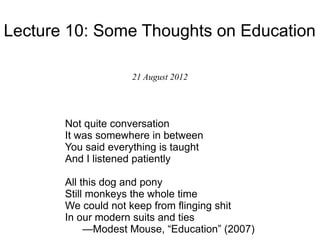
                     21 August 2012


       Not quite conversation
       It was somewhere in between
       You said everything is taught
       And I listened patiently

       All this dog and pony
       Still monkeys the whole time
       We could not keep from flinging shit
       In our modern suits and ties
            —Modest Mouse, “Education” (2007)
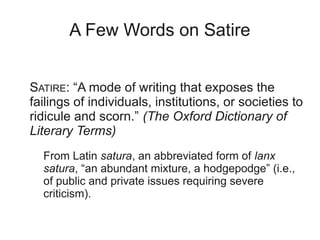
A Few Words on Satire


SATIRE: “A mode of writing that exposes the
failings of individuals, institutions, or societies to
ridicule and scorn.” (The Oxford Dictionary of
Literary Terms)
  From Latin satura, an abbreviated form of lanx
  satura, “an abundant mixture, a hodgepodge” (i.e.,
  of public and private issues requiring severe
  criticism).
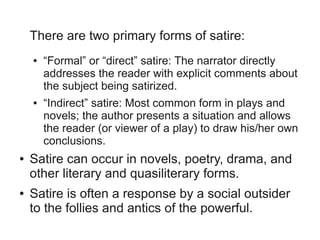
There are two primary forms of satire:
    ●   “Formal” or “direct” satire: The narrator directly
        addresses the reader with explicit comments about
        the subject being satirized.
    ●   “Indirect” satire: Most common form in plays and
        novels; the author presents a situation and allows
        the reader (or viewer of a play) to draw his/her own
        conclusions.
●   Satire can occur in novels, poetry, drama, and
    other literary and quasiliterary forms.
●   Satire is often a response by a social outsider
    to the follies and antics of the powerful.
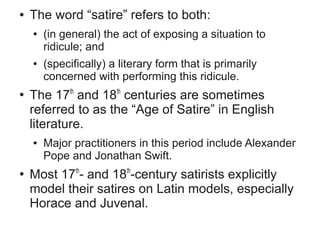
●   The word “satire” refers to both:
    ●   (in general) the act of exposing a situation to
        ridicule; and
    ●   (specifically) a literary form that is primarily
        concerned with performing this ridicule.
●
    The 17th and 18th centuries are sometimes
    referred to as the “Age of Satire” in English
    literature.
    ●   Major practitioners in this period include Alexander
        Pope and Jonathan Swift.
●
    Most 17th- and 18th-century satirists explicitly
    model their satires on Latin models, especially
    Horace and Juvenal.
●   Satire can range in tone from gentle chiding to
    bitter excoriation.
●   Historically, satire has generally tended toward
    didacticism.
●   In order to criticize the follies of individuals or
    social groups, satire requires that its readers
    share a particular moral viewpoint with the
    author.
    ●   This is especially true for indirect satire.
●   Hence, the satirist, in and by writing satire,
    elevates and promotes him- or herself as an
    authoritative judge of morality.
●   Satirists often take the position of being
    “humanistic in spirit,” loving their fellow human
    beings and wanting to reform those who
    commit evil and folly in order to benefit all.
●   British poet W.H. Auden takes a very traditional
    view of satire: “Satire is angry and optimistic; it
    believes that, once people's attention is drawn
    to some evil, they will mend their ways.”
    (Forward to Angus Stewart’s Sense and
    Inconsequence, 1972)
Menippean (or Varronian) Satire
●   So-called after the (lost) works of the Greek
    Cynic philosopher Menippus (3rd century BCE),
    or his Roman imitator, Varro (1st century BCE)
●   Characterized by:
    ●   miscellaneous contents
    ●   displays of erudition
    ●   comical discussions on philosophical topics
●   An example you may already know: Lewis
    Carroll’s Alice’s Adventures in Wonderland.
Magic(al) Realism
●   A literary form that maintains a “reliable” and
    “objective” narrative form while incorporating
    fabulous and fantastical events.
●   The term was initially applied to a trend in
    German fiction in the 1950s.
●   However, it is now more commonly associated
    with certain authors in Central and South
    America.
●   Often, the “magical” elements are figures for
    the incredibly complex and phantasmagorical
    political realities of the contemporary world.

Lecture 10 - Some Thoughts on Education

  • 1.
    Lecture 10: SomeThoughts on Education 21 August 2012 Not quite conversation It was somewhere in between You said everything is taught And I listened patiently All this dog and pony Still monkeys the whole time We could not keep from flinging shit In our modern suits and ties —Modest Mouse, “Education” (2007)
  • 2.
    A Few Wordson Satire SATIRE: “A mode of writing that exposes the failings of individuals, institutions, or societies to ridicule and scorn.” (The Oxford Dictionary of Literary Terms) From Latin satura, an abbreviated form of lanx satura, “an abundant mixture, a hodgepodge” (i.e., of public and private issues requiring severe criticism).
  • 3.
    There are twoprimary forms of satire: ● “Formal” or “direct” satire: The narrator directly addresses the reader with explicit comments about the subject being satirized. ● “Indirect” satire: Most common form in plays and novels; the author presents a situation and allows the reader (or viewer of a play) to draw his/her own conclusions. ● Satire can occur in novels, poetry, drama, and other literary and quasiliterary forms. ● Satire is often a response by a social outsider to the follies and antics of the powerful.
  • 4.
    The word “satire” refers to both: ● (in general) the act of exposing a situation to ridicule; and ● (specifically) a literary form that is primarily concerned with performing this ridicule. ● The 17th and 18th centuries are sometimes referred to as the “Age of Satire” in English literature. ● Major practitioners in this period include Alexander Pope and Jonathan Swift. ● Most 17th- and 18th-century satirists explicitly model their satires on Latin models, especially Horace and Juvenal.
  • 5.
    Satire can range in tone from gentle chiding to bitter excoriation. ● Historically, satire has generally tended toward didacticism. ● In order to criticize the follies of individuals or social groups, satire requires that its readers share a particular moral viewpoint with the author. ● This is especially true for indirect satire. ● Hence, the satirist, in and by writing satire, elevates and promotes him- or herself as an authoritative judge of morality.
  • 6.
    Satirists often take the position of being “humanistic in spirit,” loving their fellow human beings and wanting to reform those who commit evil and folly in order to benefit all. ● British poet W.H. Auden takes a very traditional view of satire: “Satire is angry and optimistic; it believes that, once people's attention is drawn to some evil, they will mend their ways.” (Forward to Angus Stewart’s Sense and Inconsequence, 1972)
  • 7.
    Menippean (or Varronian)Satire ● So-called after the (lost) works of the Greek Cynic philosopher Menippus (3rd century BCE), or his Roman imitator, Varro (1st century BCE) ● Characterized by: ● miscellaneous contents ● displays of erudition ● comical discussions on philosophical topics ● An example you may already know: Lewis Carroll’s Alice’s Adventures in Wonderland.
  • 8.
    Magic(al) Realism ● A literary form that maintains a “reliable” and “objective” narrative form while incorporating fabulous and fantastical events. ● The term was initially applied to a trend in German fiction in the 1950s. ● However, it is now more commonly associated with certain authors in Central and South America. ● Often, the “magical” elements are figures for the incredibly complex and phantasmagorical political realities of the contemporary world.