Lecture 10: Cui bono?
English 192
Summer 2013
20 August 2013
“I was cleaning a room and, meandering about, approached the
divan and couldn’t remember whether or not I had dusted it. Since
these movements are habitual and unconscious, I could not
remember – so that if I had dusted it and forgot – that is, had
acted unconsciously, then it was the same as if I had not. If some
conscious person had been watching, then the fact could be
established. If, however, no one was looking, or looking on
unconsciously, if the whole complex lives of many people go on
unconsciously, then such lives are as if they had never been.”
— Leo Tolstoy’s Diary, entry of 1 March 1897.
“Bradley’s elegant formulation warns us of the
self-defeating price to be paid for any truly
thoroughgoing exercise of systemic thinking in
history; and this, whether we have to do with a
relatively contemporary (structural) conception
of the synchronic (or of totality, or of the mode
of production, or the Foucauldian episteme), or
simply (as in Bradley) of some state a/state b
progression, or indeed with some more general
sense of the present as an immense and
interrelated web from which not even a dead
butterfly can fall at the peril of the whole.”
(Jameson 87)
“I think that the attack on ‘causality’ as such is
misplaced; Kant has taught us (along with many
others) that in a sense cause and causality are
mental categories, about which it makes no
sense to assert that they are either true or false.
It would be more plausible and useful to think of
causality as an essentially narrative category […]
In other words, as the number of things that
historical inquiry is willing to accept as
determinants increases – gender relations,
writing systems, weaponry – each becomes a
candidate for a new version of that ‘ultimately
determining instance’ or cause which in its turn
dictates a new historical narrative, a fresh way of
telling the story of the historical change in
question.” (87-88)
● Jameson’s concern here is to raise the possibility
of meaningful change (the realization of the
Utopian impulse) in the face of what seem to be
totalizing systems locking the existing world into
place.
● Part of this explanation involves treating the
historical (diachronic) understanding as rejected not
for being inaccurate, but for being threatening due to
its complexity and the consequent difficulty of
understanding this perspective.
The threat of the historical perspective
“A proliferation of narratives […] emerges which raises
the terrifying specter of postmodern relativism and which
is scarcely reduced by assigning each one its specific
sub-field and then attempting to reconstruct some new
and more ‘complex’ or ‘differentiated’ discipline as a whole
[…] From a limited series of conventional and
reassuringly simple narrative options (the so-called
master narratives), history becomes a bewildering torrent
of sheer Becoming, a stream into which, as Cratylus put it
long ago, one cannot even step once.
“It then proves reassuring to abandon these diachronic
dilemmas altogether, and to turn towards a perspective
and a way of looking at things in which they do not even
arise. Such is the realm of the synchronic, and we may
well ask ourselves what replaces narrative here and what
representational forms are available to articulate this new
systemic view of the multiple coexistence of factors or
facts.” (88-89)
“synchronic history of this kind has nothing to do
with a present, eternal or otherwise, and is not to
be grasped in terms of lived or existential time.”
(89)
“the more airtight the synchronic system laid in
place all around us, the more surely history itself
evaporates in the process, and along with It any
possibility of political agency or collective anti-
systemic praxis.” (89)
“the seemingly very different concepts of writing
and time are in reality profoundly complicitous
and interrelated: whether the very idea of
language is the result of an incapacity to think
time coherently or the other way round, we do
not have to decide.” (99)
Points to take away from Jameson
● Utopian literature is a subgenre of SF; Utopian
thought and the Utopian impulse are, for
Jameson, basic components of what it means to
be human, and operate on large and small
scales throughout human history.
● The question of what we desire is also central to
questions of how we understand who we are.
● SF is a genre in which we have unique
opportunities to examine the wishing component
of human identity, in part because it offers
expansive opportunities for wish-fulfillment.
● To understand a situation synchronically is to see it as
it exists at a certain point in time, seeing its parts in
relation to each other.
● To understand a situation diachronically is to
understand its history and development.
● These terms are adapted by Jameson from Swiss linguist
Ferdinand de Saussure.
● As with so many other things in life, it is necessary to make a
choice here: it is not possible to do an adequate job of both at
the same time. The two viewpoints are mutually exclusive.
● Jameson’s adaptation of the terms intends for us to
understand the history of a situation, because focusing on its
structure without a sense of its history leads to a belief that
structures are unchangeable, which is historically false.
● In fact, the default understanding of a situation as synchronic
is a motivated interpretive choice, for the reasons we have
talked about today.
“This is clearly a question that needs to be enlarged
to include Science Fiction as well, if one follows
Darko Suvin [in Metamorphoses of Science Fiction],
as I do, in believing Utopia to be a socio-economic
sub-genre of that broader literary form. Suvin’s
principle of ‘cognitive estrangement’ – an aesthetic
which, building on the Russian Formalist notion of
‘making strange’ as well as the Brechtian
Verfremdungseffekt, characterizes SF in terms of
an essentially epistemological function […] – thus
posits one specific subset of this generic category
specifically devoted to the imagination of alternative
social and economic forms.” (xiii-xiv)
Glancing back before we move on …
Defamiliarization (ostranenie)
● This is one of the key terms of Russian
Formalism (an early 20th century literary
movement) that attempts to distinguish what
makes “literary” language different from
“ordinary” language.
● Literary language is taken to operate so as to
disrupt ordinary language and habitual modes
of perception.
● The effect is understood to be produced by
“artistic devices” (plot, rhythm, syntax, etc.).
“Mr. Wordsworth, on the other hand, was to […] give the
charm of novelty to things of every day, and to excite a
feeling analogous to the supernatural, by awakening the
mind's attention to the lethargy of custom, and directing it to
the loveliness and the wonders of the world before us; an
inexhaustible treasure, but for which, in consequence of the
film of familiarity and selfish solicitude, we have eyes, yet
see not, ears that hear not, and hearts that neither feel nor
understand.” (S.T. Coleridge, Biographia Literaria, 1817)
“Poetry lifts the veil from the hidden beauty of the world, and
makes familiar objects be as if they were not familiar; it
reproduces all that it represents, and the impersonations
clothed in its Elysian light stand thenceforward in the minds
of those who have once contemplated them, as memorials
of that gentle and exalted content which extends itself over
all thoughts and actions with which it coexists.” (Percy
Shelley, “A Defence of Poetry,” 1821)
“Habituation devours works, clothes, furniture,
one’s wife, and the fear of war. ‘If the whole
complex lives of many people go on
unconsciously, then such lives are as if they
had never been.’ And art exists that one may
recover the sensation of life; it exists to make
one feel things, to make the stone stony. The
purpose of art is to impart the sensation of
things as they are perceived and not as they
are known. The technique of art is to make
objects ‘unfamiliar,’ to make forms difficult, to
increase the difficulty and length of perception
because the process of perception is an
aesthetic end in itself and must be prolonged.”
Victor Shklovsky, “Art as Technique” (1917)
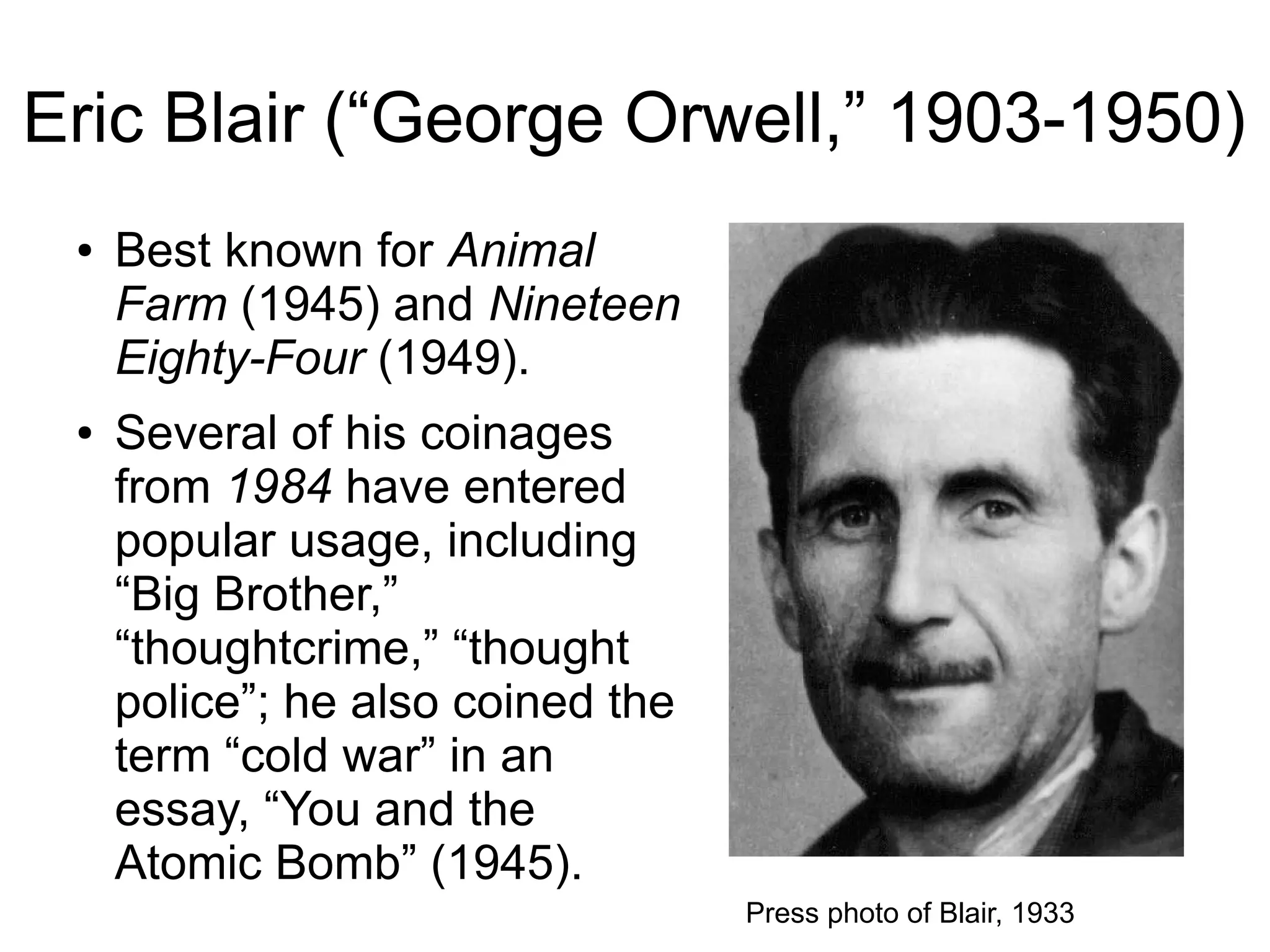
Eric Blair (“George Orwell,” 1903-1950)
● Best known for Animal
Farm (1945) and Nineteen
Eighty-Four (1949).
● Several of his coinages
from 1984 have entered
popular usage, including
“Big Brother,”
“thoughtcrime,” “thought
police”; he also coined the
term “cold war” in an
essay, “You and the
Atomic Bomb” (1945).
Press photo of Blair, 1933
“Politics and the English Language” (1946)
“Most people who bother with the matter at all
would admit that the English language is in a
bad way, but it is generally assumed that we
cannot by conscious action do anything about it.
[…] Underneath this lies the half-conscious belief
that language is a natural growth and not an
instrument which we shape for our own
purposes.” (127)
“Now, it is clear that the decline of a language
must ultimately have political and economic
causes: it is not due simply to the influence of
this or that individual writer.” (127)
“the English language […] becomes ugly and
inaccurate because our thoughts are foolish, but the
slovenliness of our language makes it easier for us
to have foolish thoughts.” (128)
“no modern writer of the kind I am discussing—no
one capable of using phrases like ‘objective
consideration of contemporary phenomena”—would
ever tabulate his thoughts in that precise and
detailed way.” (133)
“By using stale metaphors, similes and idioms, you
save much mental effort, at the cost of leaving your
meaning vague, not only for your reader but for
yourself.” (134)
Language and Thought
“The sole aim of a metaphor is to call up a visual
image. When these images clash—as in The Fascist
octopus has sung its swan song, the jackboot is
thrown into the melting-pot—it can be taken as certain
that the writer is not seeing a mental image of the
objects he is naming; in other words he is not really
thinking.” (134)
“When one watches some tired hack on the platform
mechanically repeating the familiar phrases […] one
often has a curious feeling that one is not watching a
live human being but some kind of dummy. […] And
this is not altogether fanciful. A speaker who uses that
kind of phraseology has gone some distance toward
turning himself into a machine. The appropriate noises
are coming out of his larynx, but his brain is not
involved as it would be if he were choosing his words
for himself.” (136)
“the work of prose construction”*
“modern writing at its worst does not consist in
picking out words for the sake of their meaning
and inventing images in order to make the
meaning clearer. It consists in gumming
together long strips of words which have
already been set in order by someone else, and
making the results presentable by sheer
humbug.” (134)
*
Orwell 130
Some primary faults of bad writing
(for Orwell)
● “staleness of imagery [and] lack of precision”
(129)
● “banal statements […] given an appearance of
profundity” (131)
● “slovenliness and vagueness” (132)
● “words […] used in a consciously dishonest
way” (133)
Motivated bad writing
“In our age there is no such thing as ‘keeping out
of politics’. All issues are political issues, and
politics itself is a mass of lies, evasions, folly,
hatred and schizophrenia.” (137)
“If thought corrupts language, language can also
corrupt thought. […] The debased language that I
have been discussing is in some ways very
convenient.” (137)
“one ought to recognise that the present political
chaos is connected with the decay of language,
and that one can probably bring about some
improvement by starting at the verbal end.” (139)
Writing advice
“A scrupulous writer, in every sentence that he
writes, will ask himself at least four questions, thus:
What am I trying to say? What words will express it?
What image or idiom will make it clearer? Is this
image fresh enough to have an effect? And he will
probably ask himself two more: Could I put it more
shortly? Have I said anything that is avoidably
ugly?” (135)
“What is above all needed is to let the meaning
choose the word, and not the other way around.”
(138)
“one can choose—not merely accept—the phrases
that will best cover the meaning.” (139)
“I think the following rules will cover
most cases:” (139)
i. Never use a metaphor, simile or other figure of
speech which you are used to seeing in print.
ii.Never use a long word where a short one will do.
iii.If it is possible to cut a word out, always cut it out.
iv.Never use the passive where you can use the
active.
v.Never use a foreign phrase, a scientific word or a
jargon if you can think of an everyday English
equivalent.
vi.Break any of thee rules sooner than say anything
outright barbarous.
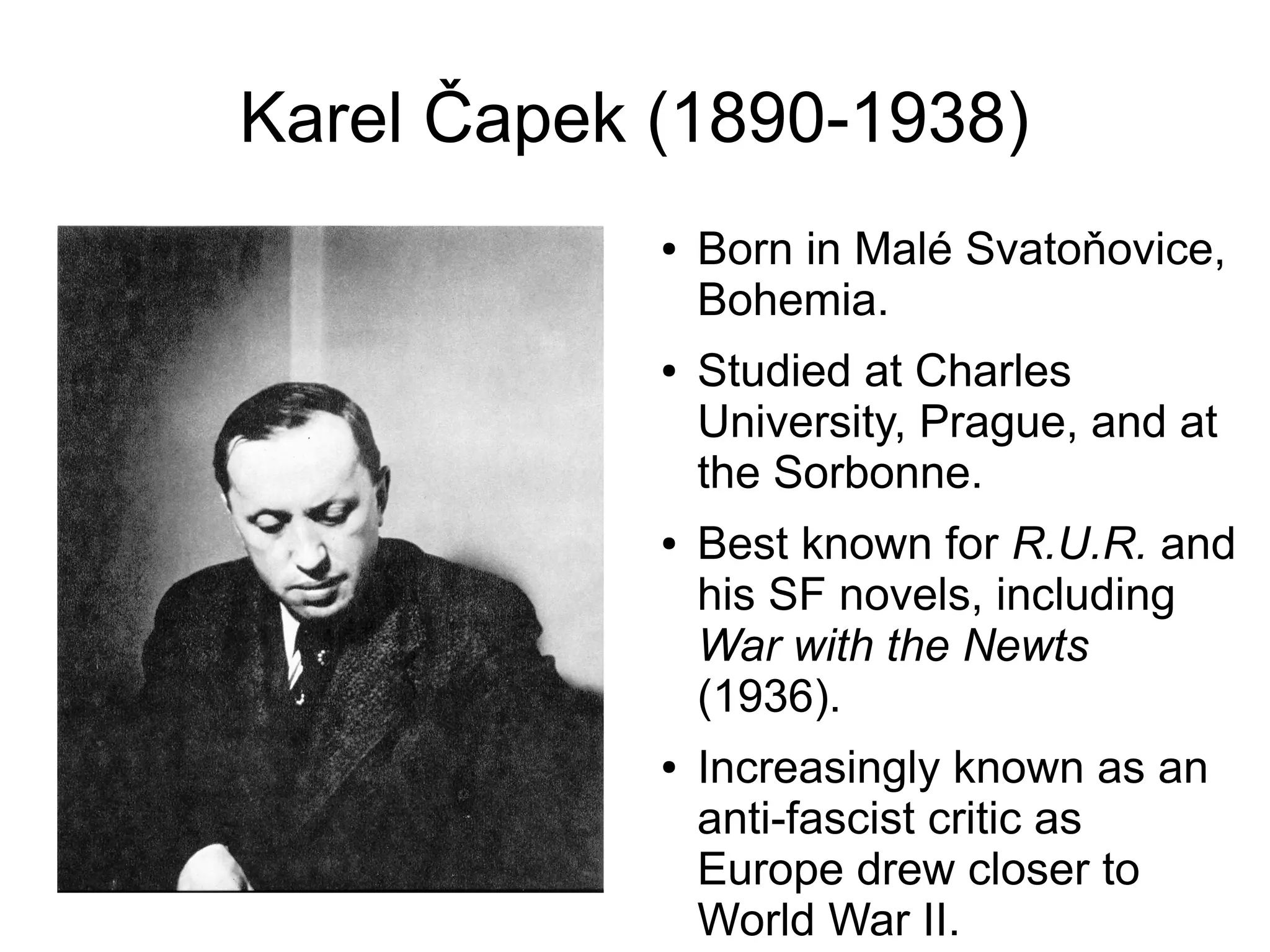
Karel Čapek (1890-1938)
● Born in Malé Svatoňovice,
Bohemia.
● Studied at Charles
University, Prague, and at
the Sorbonne.
● Best known for R.U.R. and
his SF novels, including
War with the Newts
(1936).
● Increasingly known as an
anti-fascist critic as
Europe drew closer to
World War II.
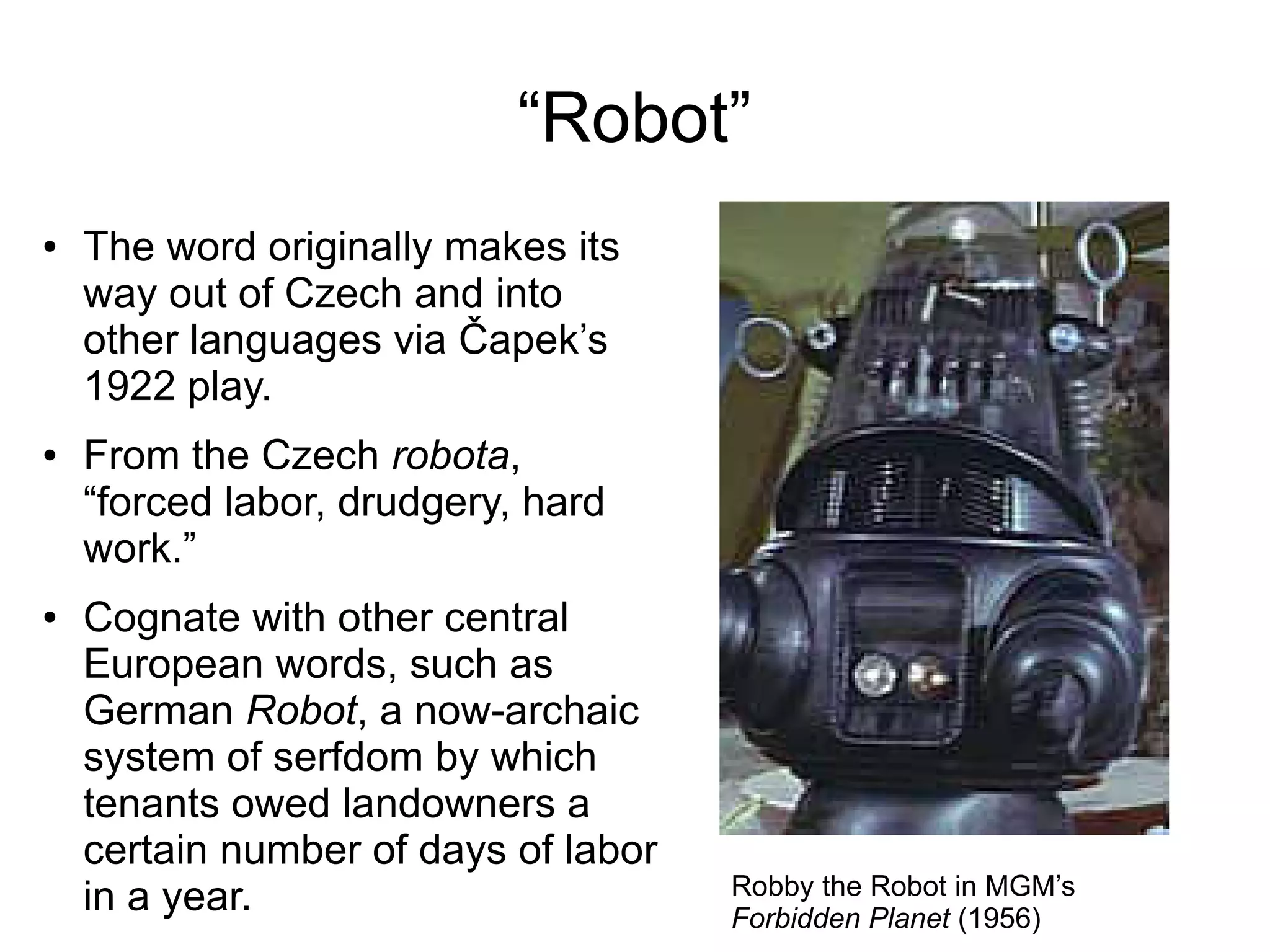
“Robot”
● The word originally makes its
way out of Czech and into
other languages via Čapek’s
1922 play.
● From the Czech robota,
“forced labor, drudgery, hard
work.”
● Cognate with other central
European words, such as
German Robot, a now-archaic
system of serfdom by which
tenants owed landowners a
certain number of days of labor
in a year. Robby the Robot in MGM’s
Forbidden Planet (1956)
Media Credits
● Orwell’s press-card photo is out of copyright because it
is an anonymous work first published in 1933. Source:
https://en.wikipedia.org/wiki/File:George_Orwell_press_p
hoto.jpg
● The photo of Karel Čapek is out of copyright because it
was published anonymously and taken no later than
1938. Source:
https://commons.wikimedia.org/wiki/File:Karel_
%C4%8Capek.jpg
● The screen capture from Forbidden Planet is copyright
MGM; I believe that a low-resolution capture of part of
one frame from for teaching constitutes fair use. Source:
https://en.wikipedia.org/wiki/File:Robbie_Forbidden_Plan
et.jpg

Lecture 10 - Cui bono?

  • 1.
    Lecture 10: Cuibono? English 192 Summer 2013 20 August 2013 “I was cleaning a room and, meandering about, approached the divan and couldn’t remember whether or not I had dusted it. Since these movements are habitual and unconscious, I could not remember – so that if I had dusted it and forgot – that is, had acted unconsciously, then it was the same as if I had not. If some conscious person had been watching, then the fact could be established. If, however, no one was looking, or looking on unconsciously, if the whole complex lives of many people go on unconsciously, then such lives are as if they had never been.” — Leo Tolstoy’s Diary, entry of 1 March 1897.
  • 2.
    “Bradley’s elegant formulationwarns us of the self-defeating price to be paid for any truly thoroughgoing exercise of systemic thinking in history; and this, whether we have to do with a relatively contemporary (structural) conception of the synchronic (or of totality, or of the mode of production, or the Foucauldian episteme), or simply (as in Bradley) of some state a/state b progression, or indeed with some more general sense of the present as an immense and interrelated web from which not even a dead butterfly can fall at the peril of the whole.” (Jameson 87)
  • 3.
    “I think thatthe attack on ‘causality’ as such is misplaced; Kant has taught us (along with many others) that in a sense cause and causality are mental categories, about which it makes no sense to assert that they are either true or false. It would be more plausible and useful to think of causality as an essentially narrative category […] In other words, as the number of things that historical inquiry is willing to accept as determinants increases – gender relations, writing systems, weaponry – each becomes a candidate for a new version of that ‘ultimately determining instance’ or cause which in its turn dictates a new historical narrative, a fresh way of telling the story of the historical change in question.” (87-88)
  • 4.
    ● Jameson’s concernhere is to raise the possibility of meaningful change (the realization of the Utopian impulse) in the face of what seem to be totalizing systems locking the existing world into place. ● Part of this explanation involves treating the historical (diachronic) understanding as rejected not for being inaccurate, but for being threatening due to its complexity and the consequent difficulty of understanding this perspective. The threat of the historical perspective
  • 5.
    “A proliferation ofnarratives […] emerges which raises the terrifying specter of postmodern relativism and which is scarcely reduced by assigning each one its specific sub-field and then attempting to reconstruct some new and more ‘complex’ or ‘differentiated’ discipline as a whole […] From a limited series of conventional and reassuringly simple narrative options (the so-called master narratives), history becomes a bewildering torrent of sheer Becoming, a stream into which, as Cratylus put it long ago, one cannot even step once. “It then proves reassuring to abandon these diachronic dilemmas altogether, and to turn towards a perspective and a way of looking at things in which they do not even arise. Such is the realm of the synchronic, and we may well ask ourselves what replaces narrative here and what representational forms are available to articulate this new systemic view of the multiple coexistence of factors or facts.” (88-89)
  • 6.
    “synchronic history ofthis kind has nothing to do with a present, eternal or otherwise, and is not to be grasped in terms of lived or existential time.” (89) “the more airtight the synchronic system laid in place all around us, the more surely history itself evaporates in the process, and along with It any possibility of political agency or collective anti- systemic praxis.” (89) “the seemingly very different concepts of writing and time are in reality profoundly complicitous and interrelated: whether the very idea of language is the result of an incapacity to think time coherently or the other way round, we do not have to decide.” (99)
  • 7.
    Points to takeaway from Jameson ● Utopian literature is a subgenre of SF; Utopian thought and the Utopian impulse are, for Jameson, basic components of what it means to be human, and operate on large and small scales throughout human history. ● The question of what we desire is also central to questions of how we understand who we are. ● SF is a genre in which we have unique opportunities to examine the wishing component of human identity, in part because it offers expansive opportunities for wish-fulfillment.
  • 8.
    ● To understanda situation synchronically is to see it as it exists at a certain point in time, seeing its parts in relation to each other. ● To understand a situation diachronically is to understand its history and development. ● These terms are adapted by Jameson from Swiss linguist Ferdinand de Saussure. ● As with so many other things in life, it is necessary to make a choice here: it is not possible to do an adequate job of both at the same time. The two viewpoints are mutually exclusive. ● Jameson’s adaptation of the terms intends for us to understand the history of a situation, because focusing on its structure without a sense of its history leads to a belief that structures are unchangeable, which is historically false. ● In fact, the default understanding of a situation as synchronic is a motivated interpretive choice, for the reasons we have talked about today.
  • 9.
    “This is clearlya question that needs to be enlarged to include Science Fiction as well, if one follows Darko Suvin [in Metamorphoses of Science Fiction], as I do, in believing Utopia to be a socio-economic sub-genre of that broader literary form. Suvin’s principle of ‘cognitive estrangement’ – an aesthetic which, building on the Russian Formalist notion of ‘making strange’ as well as the Brechtian Verfremdungseffekt, characterizes SF in terms of an essentially epistemological function […] – thus posits one specific subset of this generic category specifically devoted to the imagination of alternative social and economic forms.” (xiii-xiv) Glancing back before we move on …
  • 10.
    Defamiliarization (ostranenie) ● Thisis one of the key terms of Russian Formalism (an early 20th century literary movement) that attempts to distinguish what makes “literary” language different from “ordinary” language. ● Literary language is taken to operate so as to disrupt ordinary language and habitual modes of perception. ● The effect is understood to be produced by “artistic devices” (plot, rhythm, syntax, etc.).
  • 11.
    “Mr. Wordsworth, onthe other hand, was to […] give the charm of novelty to things of every day, and to excite a feeling analogous to the supernatural, by awakening the mind's attention to the lethargy of custom, and directing it to the loveliness and the wonders of the world before us; an inexhaustible treasure, but for which, in consequence of the film of familiarity and selfish solicitude, we have eyes, yet see not, ears that hear not, and hearts that neither feel nor understand.” (S.T. Coleridge, Biographia Literaria, 1817) “Poetry lifts the veil from the hidden beauty of the world, and makes familiar objects be as if they were not familiar; it reproduces all that it represents, and the impersonations clothed in its Elysian light stand thenceforward in the minds of those who have once contemplated them, as memorials of that gentle and exalted content which extends itself over all thoughts and actions with which it coexists.” (Percy Shelley, “A Defence of Poetry,” 1821)
  • 12.
    “Habituation devours works,clothes, furniture, one’s wife, and the fear of war. ‘If the whole complex lives of many people go on unconsciously, then such lives are as if they had never been.’ And art exists that one may recover the sensation of life; it exists to make one feel things, to make the stone stony. The purpose of art is to impart the sensation of things as they are perceived and not as they are known. The technique of art is to make objects ‘unfamiliar,’ to make forms difficult, to increase the difficulty and length of perception because the process of perception is an aesthetic end in itself and must be prolonged.” Victor Shklovsky, “Art as Technique” (1917)
  • 13.
    Eric Blair (“GeorgeOrwell,” 1903-1950) ● Best known for Animal Farm (1945) and Nineteen Eighty-Four (1949). ● Several of his coinages from 1984 have entered popular usage, including “Big Brother,” “thoughtcrime,” “thought police”; he also coined the term “cold war” in an essay, “You and the Atomic Bomb” (1945). Press photo of Blair, 1933
  • 14.
    “Politics and theEnglish Language” (1946) “Most people who bother with the matter at all would admit that the English language is in a bad way, but it is generally assumed that we cannot by conscious action do anything about it. […] Underneath this lies the half-conscious belief that language is a natural growth and not an instrument which we shape for our own purposes.” (127) “Now, it is clear that the decline of a language must ultimately have political and economic causes: it is not due simply to the influence of this or that individual writer.” (127)
  • 15.
    “the English language[…] becomes ugly and inaccurate because our thoughts are foolish, but the slovenliness of our language makes it easier for us to have foolish thoughts.” (128) “no modern writer of the kind I am discussing—no one capable of using phrases like ‘objective consideration of contemporary phenomena”—would ever tabulate his thoughts in that precise and detailed way.” (133) “By using stale metaphors, similes and idioms, you save much mental effort, at the cost of leaving your meaning vague, not only for your reader but for yourself.” (134) Language and Thought
  • 16.
    “The sole aimof a metaphor is to call up a visual image. When these images clash—as in The Fascist octopus has sung its swan song, the jackboot is thrown into the melting-pot—it can be taken as certain that the writer is not seeing a mental image of the objects he is naming; in other words he is not really thinking.” (134) “When one watches some tired hack on the platform mechanically repeating the familiar phrases […] one often has a curious feeling that one is not watching a live human being but some kind of dummy. […] And this is not altogether fanciful. A speaker who uses that kind of phraseology has gone some distance toward turning himself into a machine. The appropriate noises are coming out of his larynx, but his brain is not involved as it would be if he were choosing his words for himself.” (136)
  • 17.
    “the work ofprose construction”* “modern writing at its worst does not consist in picking out words for the sake of their meaning and inventing images in order to make the meaning clearer. It consists in gumming together long strips of words which have already been set in order by someone else, and making the results presentable by sheer humbug.” (134) * Orwell 130
  • 18.
    Some primary faultsof bad writing (for Orwell) ● “staleness of imagery [and] lack of precision” (129) ● “banal statements […] given an appearance of profundity” (131) ● “slovenliness and vagueness” (132) ● “words […] used in a consciously dishonest way” (133)
  • 19.
    Motivated bad writing “Inour age there is no such thing as ‘keeping out of politics’. All issues are political issues, and politics itself is a mass of lies, evasions, folly, hatred and schizophrenia.” (137) “If thought corrupts language, language can also corrupt thought. […] The debased language that I have been discussing is in some ways very convenient.” (137) “one ought to recognise that the present political chaos is connected with the decay of language, and that one can probably bring about some improvement by starting at the verbal end.” (139)
  • 20.
    Writing advice “A scrupulouswriter, in every sentence that he writes, will ask himself at least four questions, thus: What am I trying to say? What words will express it? What image or idiom will make it clearer? Is this image fresh enough to have an effect? And he will probably ask himself two more: Could I put it more shortly? Have I said anything that is avoidably ugly?” (135) “What is above all needed is to let the meaning choose the word, and not the other way around.” (138) “one can choose—not merely accept—the phrases that will best cover the meaning.” (139)
  • 21.
    “I think thefollowing rules will cover most cases:” (139) i. Never use a metaphor, simile or other figure of speech which you are used to seeing in print. ii.Never use a long word where a short one will do. iii.If it is possible to cut a word out, always cut it out. iv.Never use the passive where you can use the active. v.Never use a foreign phrase, a scientific word or a jargon if you can think of an everyday English equivalent. vi.Break any of thee rules sooner than say anything outright barbarous.
  • 22.
    Karel Čapek (1890-1938) ●Born in Malé Svatoňovice, Bohemia. ● Studied at Charles University, Prague, and at the Sorbonne. ● Best known for R.U.R. and his SF novels, including War with the Newts (1936). ● Increasingly known as an anti-fascist critic as Europe drew closer to World War II.
  • 23.
    “Robot” ● The wordoriginally makes its way out of Czech and into other languages via Čapek’s 1922 play. ● From the Czech robota, “forced labor, drudgery, hard work.” ● Cognate with other central European words, such as German Robot, a now-archaic system of serfdom by which tenants owed landowners a certain number of days of labor in a year. Robby the Robot in MGM’s Forbidden Planet (1956)
  • 24.
    Media Credits ● Orwell’spress-card photo is out of copyright because it is an anonymous work first published in 1933. Source: https://en.wikipedia.org/wiki/File:George_Orwell_press_p hoto.jpg ● The photo of Karel Čapek is out of copyright because it was published anonymously and taken no later than 1938. Source: https://commons.wikimedia.org/wiki/File:Karel_ %C4%8Capek.jpg ● The screen capture from Forbidden Planet is copyright MGM; I believe that a low-resolution capture of part of one frame from for teaching constitutes fair use. Source: https://en.wikipedia.org/wiki/File:Robbie_Forbidden_Plan et.jpg