এ েয়ড এি েকশন ডেভলপেম
লকচার 1 (A):

র আেগ

1. Introduction to Mobile Platforms
2. Comparison among Platforms
3. Advantages of Android Platform
4. Android Ecosystem
5. Mobile Apps Trends
6. Resources

Ahsanul Karim
karim.ahsanul@gmail.com
http://droidtraining.wordpress.com
Introduction to Mobile Platforms

A Brief History [1]

April 3, 2013: 40th anniversary of first cell phone call ever made

1973

1983

1989
Introduction to Mobile Platforms

A Brief History [2]

1998

2004
2013

2007
InfoGraphics Source: mashable.com
Introduction to Mobile Platforms

Smartphones [1]

A Smartphone is a mobile phone that
offers:
1. Advanced Computing Ability
2. Rich Feature Set
3. Connectivity
Handheld computers with Telephony
Most of them comes with own Operating
System with Application Development
Frameworks.

To learn more: wikipedia on Smartphone
Introduction to Mobile Platforms

Android

iPhone

Smartphones [2]

Windows Phone

Blackberry
and Others...
Introduction to Mobile Platforms

Smartphones [3]

What Type of Mobile Devices do we use in 2013

Data Source: Nielson's Report 2013
Introduction to Mobile Platforms

Phone Usage [1]

Analytics Data showing WHAT USERS DO [US Consumers only]

Data Source: Flurry.
com
Introduction to Mobile Platforms

Phone Usage [2]

Analytics Data showing WHAT USERS DO

Data Source: Nielson's Report 2013
Introduction to Mobile Platforms

Phone Usage [3]

Which Apps do we use

Data Source: Nielson's Report 2013
Introduction to Mobile Platforms

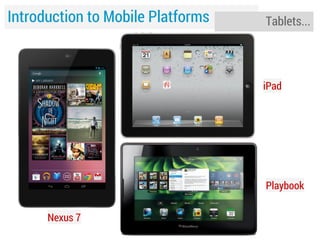
Tablets...

iPad

Playbook
Nexus 7
Introduction to Mobile Platforms

Platforms...

Platform

Language(s) Remarks

Android

Java, C, C++

Open Source [OS based on Linux]
http://developer.android.com

Bada

C, C++

Samsung's platform [OS running on Linux/RealTime OS]
http://developer.bada.com

BlackBerry C, C++, Java

A platform that provides a variety of development
languages and runtimes
http://developer.blackberry.com/

iOS

C, Objective-C Requires Apple Developer account
http://developer.apple.com/devcenter/ios/index.action

MeeGo

Qt, C++

Intel and Nokia giuded open source OS (Based on Linux)
http://meego.com/developers
Introduction to Mobile Platforms

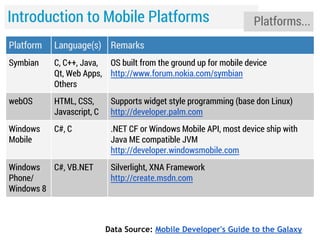
Platforms...

Platform

Language(s) Remarks

Symbian

C, C++, Java, OS built from the ground up for mobile device
Qt, Web Apps, http://www.forum.nokia.com/symbian
Others

webOS

HTML, CSS,
Javascript, C

Supports widget style programming (base don Linux)
http://developer.palm.com

Windows
Mobile

C#, C

.NET CF or Windows Mobile API, most device ship with
Java ME compatible JVM
http://developer.windowsmobile.com

Windows
C#, VB.NET
Phone/
Windows 8

Silverlight, XNA Framework
http://create.msdn.com

Data Source: Mobile Developer's Guide to the Galaxy
Introduction to Mobile Platforms

Platforms...
Why Android

Fastest Growth

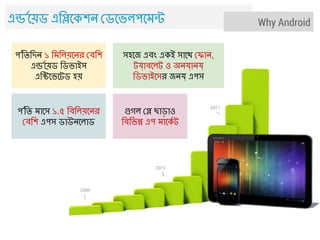
Every day more than 1 million new Android devices activated worldwide.
[1] Android powers hundreds of millions of
mobile devices in more than 190 countries
around the world.
[2] It's the largest installed base
[3] Fastest Growth

Data Source: Developer Site
এ েয়ড এি েকশন ডেভলপেম
প িতিদন ১ িমিলয়েনর বিশ
এ েয়ড িডভাইস
এি েভেটড হয়

সহেজ এবং একই সােথ ফান,
ট াবেলট ও অন ান
িডভাইেসর জন এপস

প িত মােস ১.৫ িবিলয়েনর
বিশ এপস ডাউনেলাড

গল ছাড়াও
িবিভ এপ মােকট

Why Android
Why Android

Largest Market Share

During 3 months (March
2013-May 2013), 53% of
smartphone owners in the
US had a handset that runs
on the Android operating
system

Data Source: Neisen Newswire
Why Android

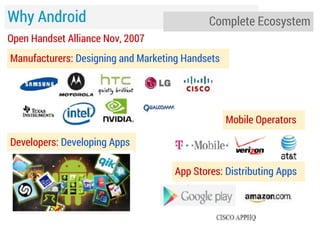
Complete Ecosystem

Open Handset Alliance Nov, 2007
Manufacturers: Designing and Marketing Handsets

Mobile Operators
Developers: Developing Apps
App Stores: Distributing Apps
Why Android

Wide Rage of Device Support

Easily optimize a single binary for phones, tablets, and other devices.

[1] Smartphones
[2] Tablets
[3] Television
Why Android

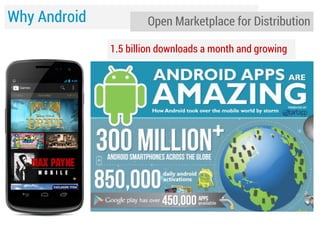
Open Marketplace for Distribution
1.5 billion downloads a month and growing
Why Android

Technical Advantages

1. Java Programming Language
2. Open Source Platform with less Proprietary Restrictions and
more Opportunities of Innovation
3. Development Environment Support in Windows, Mac OSX and
Linux
4. No need to pay to start development
5. Low barrier to Market (No app approval procedure and Low fee)
6. Rich and Easy to Integrate Feature Set
7. Easy and Cost-effective Prototyping for Research and Business
Why Android
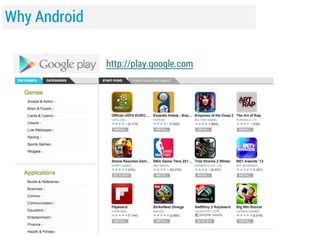
http://play.google.com
Why Android
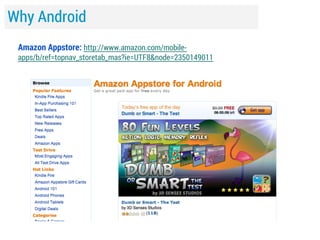
Amazon Appstore: http://www.amazon.com/mobile-

apps/b/ref=topnav_storetab_mas?ie=UTF8&node=2350149011
Why Android
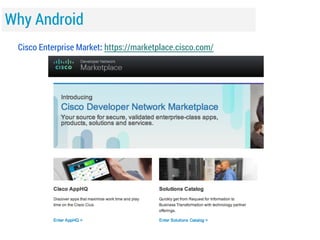
Cisco Enterprise Market: https://marketplace.cisco.com/
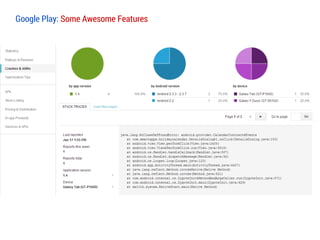
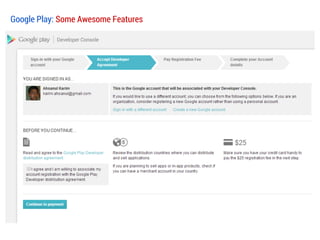
Google Play: Some Awesome Features
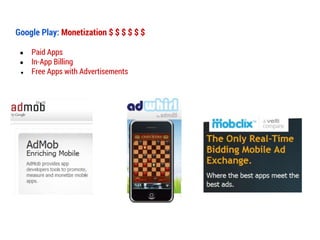
Google Play: Monetization $ $ $ $ $ $
●
●
●

Paid Apps
In-App Billing
Free Apps with Advertisements
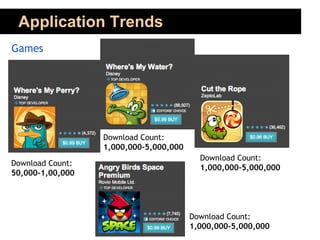
Application Trends
Games

Download Count:
1,000,000-5,000,000
Download Count:
50,000-1,00,000

Download Count:
1,000,000-5,000,000

Download Count:
1,000,000-5,000,000
Application Trends
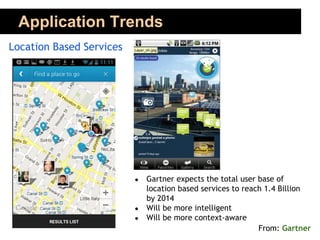
Location Based Services

●

●
●

Gartner expects the total user base of
location based services to reach 1.4 Billion
by 2014
Will be more intelligent
Will be more context-aware
From: Gartner
Application Trends
Mobile Social Networking
Fastest growing platform
Videos
Photos
Games
Commerce
Marketing

From: Gartner
Application Trends
●
●
●
●
●
●
●

Mobile Search
Mobile Payments
Context Aware Service
Object Recognition
Mobile Instant Messaging
Mobile Email
Mobile Video

From: Gartner
What is Android

The first truly open and comprehensive platform for mobile devices.
It includes an operating system, user-interface and applications — all
of the software to run a mobile phone but without the proprietary
obstacles that have hindered mobile innovation.
—Where’s My Gphone?

http://googleblog.blogspot.com/2007/11/ wheres-my-gphone.html
What is Android
Android is an ecosystem made up of a combination of three
components:
●

A free, open-source operating system for embedded devices

●

An open-source development platform for creating applications

●

Devices, particularly mobile phones, that run the Android
operating system and the applications created for it
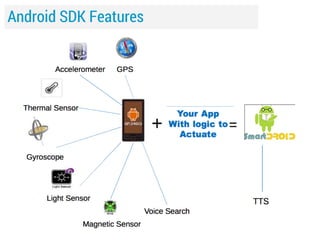
Android SDK Features
More specifically, Android is made up of several necessary and
dependent parts, including the following:
●

●
●
●
●
●
●
●

A Compatibility Definition Document (CDD) and Compatibility Test
Suite (CTS) that describe the capabilities required for a device to
support the software stack.
A Linux operating system kernel
Open source libraries including SQLite, WebKit, OpenGL and Media
Manager
A run time used to execute and host Android applications, including
the Dalvik Virtual Machine (VM)
An application framework
A user interface framework
A set of core pre-installed applications
A software development kit (SDK) used to create applications,
including the related tools, plugins, and documentation
Android SDK Features
●
●
●
●
●
●
●

●

●
●

Access to Hardware, including Camera, GPS and Sensors
Data Transfers using Wi-Fi, Bluetooth and NFC
Maps, Geocoding and Location Based Services
Background Services
SQLite Database
Shared Data and Inter-Application Communication
Full Multimedia Hardware control including Playback and
Recording
GSM, EDGE, 3G, 4G and LTE networks support for Telephony and
Data Transfer
Integrated HTML5 supported WebKit based Browser
2D and 3D Graphics using OpenGL ES 2.0
Android SDK Features
Resources
Resource

Link

Book

The Busy Coder's Guide to Android Development [Mark Murphy]
Professional Android 4 App Development [Reto Meier]

Blog

http://droidtraining.wordpress.com
http://androidstream.wordpress.net

Videos

http://vimeo.com/search?q=androidstream

Training

http://developer.android.com/training/index.html

Slides

http://www.slideshare.net/androidstream/presentations
Thank You
Questions

Sources:
● http://developer.android.com
● Profession Android 4 Application Development by Reto Meier
● Various Websites

লেকচার ১ (ক)- শুরুর আগে:

  • 1.
    এ েয়ড এিেকশন ডেভলপেম লকচার 1 (A): র আেগ 1. Introduction to Mobile Platforms 2. Comparison among Platforms 3. Advantages of Android Platform 4. Android Ecosystem 5. Mobile Apps Trends 6. Resources Ahsanul Karim karim.ahsanul@gmail.com http://droidtraining.wordpress.com
  • 2.
    Introduction to MobilePlatforms A Brief History [1] April 3, 2013: 40th anniversary of first cell phone call ever made 1973 1983 1989
  • 3.
    Introduction to MobilePlatforms A Brief History [2] 1998 2004 2013 2007 InfoGraphics Source: mashable.com
  • 4.
    Introduction to MobilePlatforms Smartphones [1] A Smartphone is a mobile phone that offers: 1. Advanced Computing Ability 2. Rich Feature Set 3. Connectivity Handheld computers with Telephony Most of them comes with own Operating System with Application Development Frameworks. To learn more: wikipedia on Smartphone
  • 5.
    Introduction to MobilePlatforms Android iPhone Smartphones [2] Windows Phone Blackberry and Others...
  • 6.
    Introduction to MobilePlatforms Smartphones [3] What Type of Mobile Devices do we use in 2013 Data Source: Nielson's Report 2013
  • 7.
    Introduction to MobilePlatforms Phone Usage [1] Analytics Data showing WHAT USERS DO [US Consumers only] Data Source: Flurry. com
  • 8.
    Introduction to MobilePlatforms Phone Usage [2] Analytics Data showing WHAT USERS DO Data Source: Nielson's Report 2013
  • 9.
    Introduction to MobilePlatforms Phone Usage [3] Which Apps do we use Data Source: Nielson's Report 2013
  • 10.
    Introduction to MobilePlatforms Tablets... iPad Playbook Nexus 7
  • 11.
    Introduction to MobilePlatforms Platforms... Platform Language(s) Remarks Android Java, C, C++ Open Source [OS based on Linux] http://developer.android.com Bada C, C++ Samsung's platform [OS running on Linux/RealTime OS] http://developer.bada.com BlackBerry C, C++, Java A platform that provides a variety of development languages and runtimes http://developer.blackberry.com/ iOS C, Objective-C Requires Apple Developer account http://developer.apple.com/devcenter/ios/index.action MeeGo Qt, C++ Intel and Nokia giuded open source OS (Based on Linux) http://meego.com/developers
  • 12.
    Introduction to MobilePlatforms Platforms... Platform Language(s) Remarks Symbian C, C++, Java, OS built from the ground up for mobile device Qt, Web Apps, http://www.forum.nokia.com/symbian Others webOS HTML, CSS, Javascript, C Supports widget style programming (base don Linux) http://developer.palm.com Windows Mobile C#, C .NET CF or Windows Mobile API, most device ship with Java ME compatible JVM http://developer.windowsmobile.com Windows C#, VB.NET Phone/ Windows 8 Silverlight, XNA Framework http://create.msdn.com Data Source: Mobile Developer's Guide to the Galaxy
  • 13.
    Introduction to MobilePlatforms Platforms...
  • 14.
    Why Android Fastest Growth Everyday more than 1 million new Android devices activated worldwide. [1] Android powers hundreds of millions of mobile devices in more than 190 countries around the world. [2] It's the largest installed base [3] Fastest Growth Data Source: Developer Site
  • 15.
    এ েয়ড এিেকশন ডেভলপেম প িতিদন ১ িমিলয়েনর বিশ এ েয়ড িডভাইস এি েভেটড হয় সহেজ এবং একই সােথ ফান, ট াবেলট ও অন ান িডভাইেসর জন এপস প িত মােস ১.৫ িবিলয়েনর বিশ এপস ডাউনেলাড গল ছাড়াও িবিভ এপ মােকট Why Android
  • 16.
    Why Android Largest MarketShare During 3 months (March 2013-May 2013), 53% of smartphone owners in the US had a handset that runs on the Android operating system Data Source: Neisen Newswire
  • 17.
    Why Android Complete Ecosystem OpenHandset Alliance Nov, 2007 Manufacturers: Designing and Marketing Handsets Mobile Operators Developers: Developing Apps App Stores: Distributing Apps
  • 18.
    Why Android Wide Rageof Device Support Easily optimize a single binary for phones, tablets, and other devices. [1] Smartphones [2] Tablets [3] Television
  • 19.
    Why Android Open Marketplacefor Distribution 1.5 billion downloads a month and growing
  • 20.
    Why Android Technical Advantages 1.Java Programming Language 2. Open Source Platform with less Proprietary Restrictions and more Opportunities of Innovation 3. Development Environment Support in Windows, Mac OSX and Linux 4. No need to pay to start development 5. Low barrier to Market (No app approval procedure and Low fee) 6. Rich and Easy to Integrate Feature Set 7. Easy and Cost-effective Prototyping for Research and Business
  • 21.
  • 22.
    Why Android Amazon Appstore:http://www.amazon.com/mobile- apps/b/ref=topnav_storetab_mas?ie=UTF8&node=2350149011
  • 23.
    Why Android Cisco EnterpriseMarket: https://marketplace.cisco.com/
  • 24.
    Google Play: SomeAwesome Features
  • 25.
    Google Play: SomeAwesome Features
  • 26.
    Google Play: SomeAwesome Features
  • 27.
    Google Play: Monetization$ $ $ $ $ $ ● ● ● Paid Apps In-App Billing Free Apps with Advertisements
  • 28.
    Application Trends Games Download Count: 1,000,000-5,000,000 DownloadCount: 50,000-1,00,000 Download Count: 1,000,000-5,000,000 Download Count: 1,000,000-5,000,000
  • 29.
    Application Trends Location BasedServices ● ● ● Gartner expects the total user base of location based services to reach 1.4 Billion by 2014 Will be more intelligent Will be more context-aware From: Gartner
  • 30.
    Application Trends Mobile SocialNetworking Fastest growing platform Videos Photos Games Commerce Marketing From: Gartner
  • 31.
    Application Trends ● ● ● ● ● ● ● Mobile Search MobilePayments Context Aware Service Object Recognition Mobile Instant Messaging Mobile Email Mobile Video From: Gartner
  • 32.
    What is Android Thefirst truly open and comprehensive platform for mobile devices. It includes an operating system, user-interface and applications — all of the software to run a mobile phone but without the proprietary obstacles that have hindered mobile innovation. —Where’s My Gphone? http://googleblog.blogspot.com/2007/11/ wheres-my-gphone.html
  • 33.
    What is Android Androidis an ecosystem made up of a combination of three components: ● A free, open-source operating system for embedded devices ● An open-source development platform for creating applications ● Devices, particularly mobile phones, that run the Android operating system and the applications created for it
  • 34.
    Android SDK Features Morespecifically, Android is made up of several necessary and dependent parts, including the following: ● ● ● ● ● ● ● ● A Compatibility Definition Document (CDD) and Compatibility Test Suite (CTS) that describe the capabilities required for a device to support the software stack. A Linux operating system kernel Open source libraries including SQLite, WebKit, OpenGL and Media Manager A run time used to execute and host Android applications, including the Dalvik Virtual Machine (VM) An application framework A user interface framework A set of core pre-installed applications A software development kit (SDK) used to create applications, including the related tools, plugins, and documentation
  • 35.
    Android SDK Features ● ● ● ● ● ● ● ● ● ● Accessto Hardware, including Camera, GPS and Sensors Data Transfers using Wi-Fi, Bluetooth and NFC Maps, Geocoding and Location Based Services Background Services SQLite Database Shared Data and Inter-Application Communication Full Multimedia Hardware control including Playback and Recording GSM, EDGE, 3G, 4G and LTE networks support for Telephony and Data Transfer Integrated HTML5 supported WebKit based Browser 2D and 3D Graphics using OpenGL ES 2.0
  • 36.
  • 37.
    Resources Resource Link Book The Busy Coder'sGuide to Android Development [Mark Murphy] Professional Android 4 App Development [Reto Meier] Blog http://droidtraining.wordpress.com http://androidstream.wordpress.net Videos http://vimeo.com/search?q=androidstream Training http://developer.android.com/training/index.html Slides http://www.slideshare.net/androidstream/presentations
  • 38.
    Thank You Questions Sources: ● http://developer.android.com ●Profession Android 4 Application Development by Reto Meier ● Various Websites