INVESTMENTS IN
EDUCATION
1
INVESTMENT IN EDUCATION
Introduction:
 Stakeholders in education are required to consider
complex issues involving the economics of
education and educational finance, including:
o Public investment in education
o Educational funding choices
o Productivity and incentives
o Accountability in public schools
2
INVESTMENT IN EDUCATION
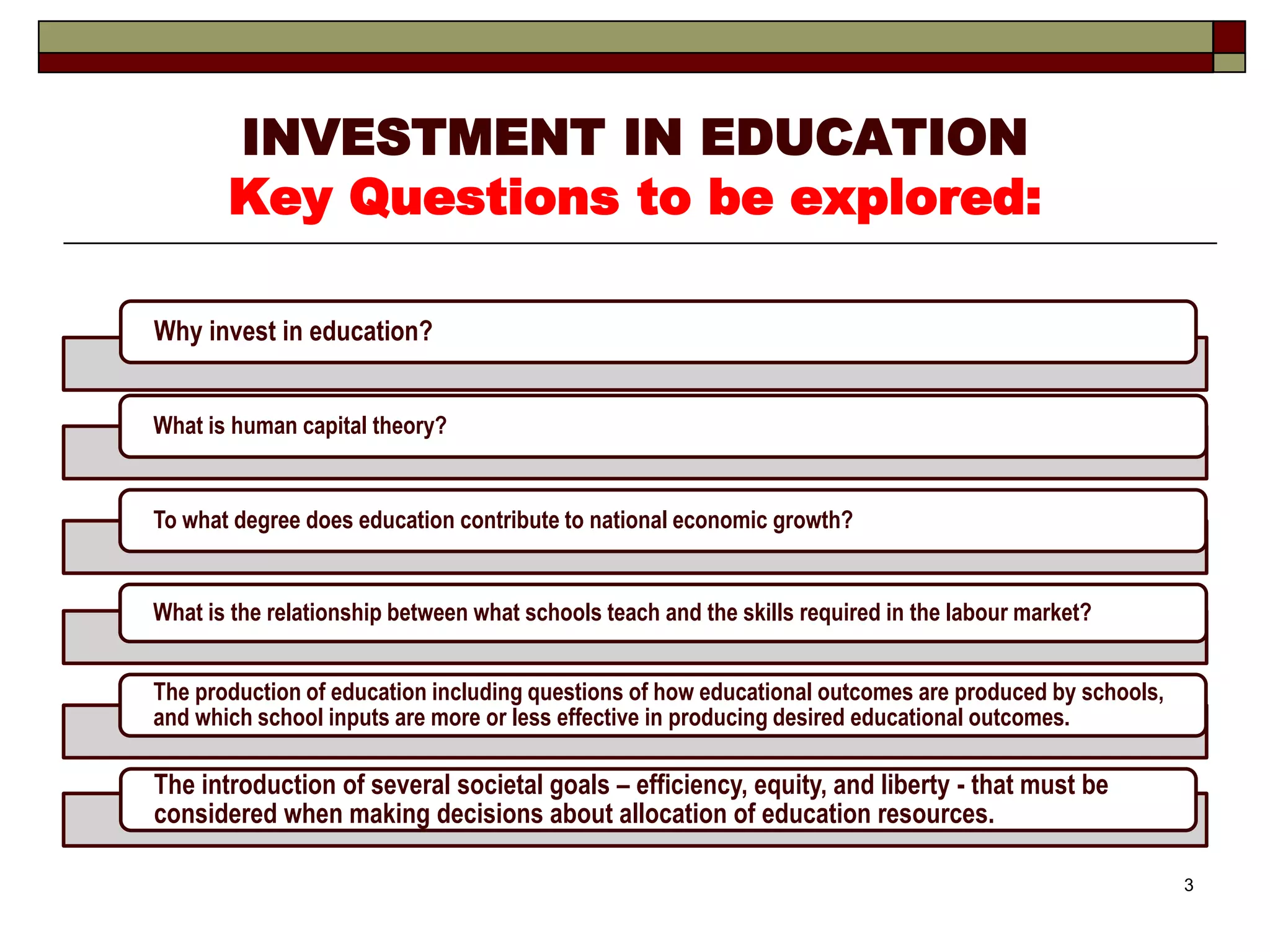
Key Questions to be explored:
Why invest in education?
What is human capital theory?
To what degree does education contribute to national economic growth?
What is the relationship between what schools teach and the skills required in the labour market?
The production of education including questions of how educational outcomes are produced by schools,
and which school inputs are more or less effective in producing desired educational outcomes.
The introduction of several societal goals – efficiency, equity, and liberty - that must be
considered when making decisions about allocation of education resources.
3
4
 What is an “educated
person” ?
 What should educated
people know and be
able to do when they
graduate from school?
Who is an educated person?
• Need grounding in the broad domains of knowledge
– sciences, social sciences, arts and humanities
• Should also possess:
• A number of core competencies
• The ability to search out, evaluate, and integrate
knowledge from many sources and contexts;
• Historical and contemporary knowledge;
• Ethical judgement, grounded values, and a well-
developed sense of responsibility; and
• A demonstrated capacity to turn knowledge into
good practice. 5
THE HUMAN CAPITAL
THEORY
6
Human Capital Theory
 Human Capital refers to:
“the stock of competencies, knowledge and personality attributes
embodied in the ability to perform labour so as to produce economic
value. It is the attributes gained by a worker through education and
experience”.
 Human Capital Theories developed by:
o Adam Smith (1976)
o Thomas W. Schultz (1971)
o Jacob Mincer & Gary Becker (1964)
o Sakamota & Powers (1995)
o Psacharopoulus & Woodhall (1997)
7
Human Capital Theory
Theory of HUMAN CAPITAL by T. W. Schultz
 He argues that both knowledge and skill are a form
of capital, and that this capital is a product of
“deliberate investment”.
 Schultz highlights western countries, and explains “that
their increase in national output is as a result of
investment in human capital. He also makes a direct
link between an increase in investment in human
capital, and the overall increase in workers
earnings”. 8
Human Capital Theory
It can also be stated as follows:
 “Individuals acquire skills and knowledge to increase their
value in the labour markets. The main mechanisms for
acquiring human capital are experience, training and
education.
 Education facilitates the acquisition of new skills and
knowledge that increase productivity. This increase in
productivity frees up resources to new technologies, new
businesses, and new wealth, eventually resulting in
increased economic growth”.
9
Human Capital Theory
Advantage:
 it enables us to think of not only the years of schooling,
but also of a variety of other characteristics as part of
human capital investments, including:
 school quality,
 training,
 attitudes towards work, etc.
 Using this type of reasoning enables us to have some
understanding towards the differences in earnings
across workers that are not accounted by schooling
differences alone.
10
Human Capital Theory
Disadvantage:
 Thinking of every difference in remuneration that
we observe in the labor market as due to human
capital.
 There are notable exceptions in relating all pay
differences including:
 Compensating differentials
 Labor market imperfections
 Taste-based discrimination
11
Sources of Human Capital
Differences
 Innate ability
 Schooling
 School quality and non-schooling
investments
 Training
 Pre-labor market influences
12
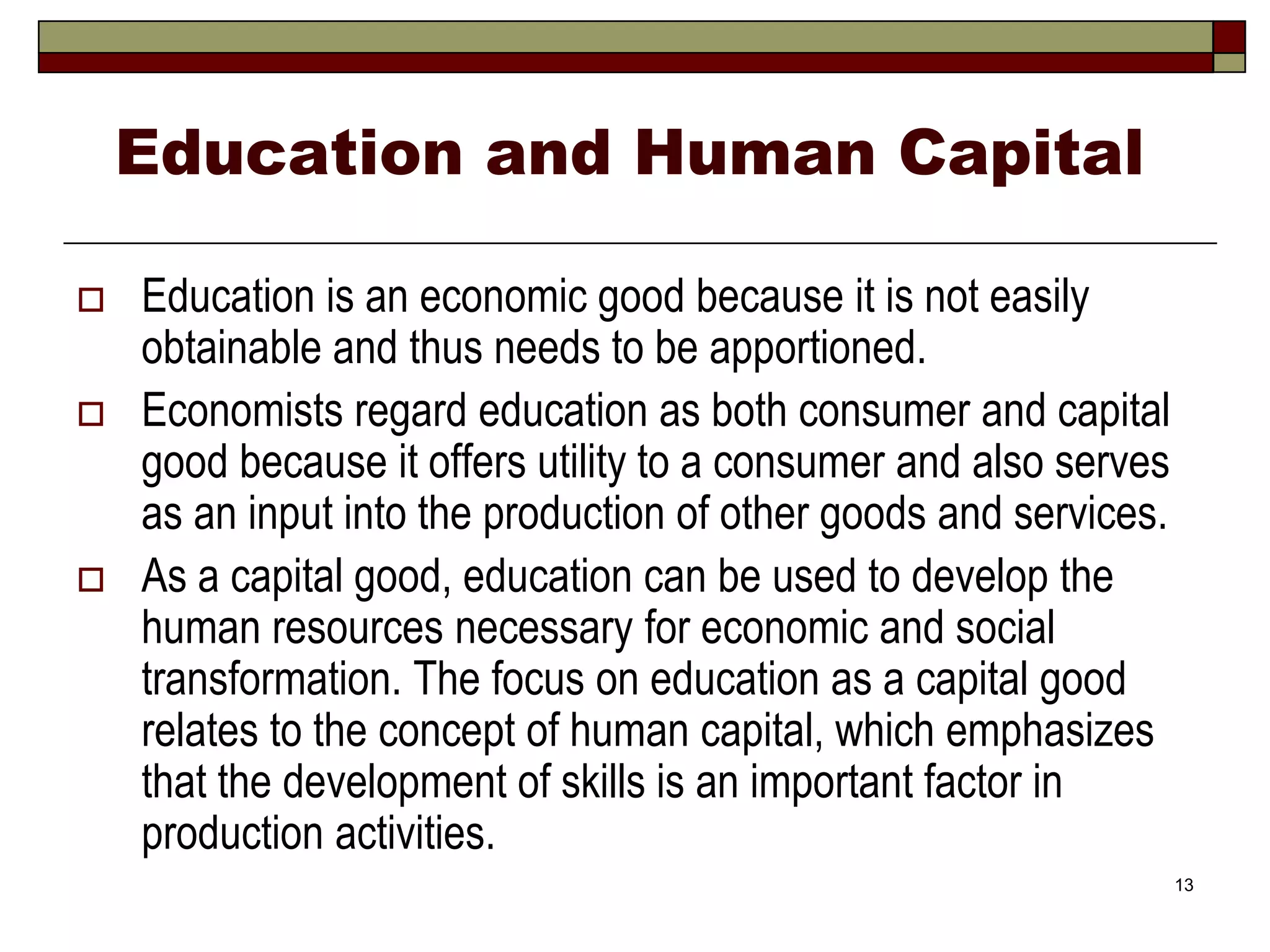
Education and Human Capital
 Education is an economic good because it is not easily
obtainable and thus needs to be apportioned.
 Economists regard education as both consumer and capital
good because it offers utility to a consumer and also serves
as an input into the production of other goods and services.
 As a capital good, education can be used to develop the
human resources necessary for economic and social
transformation. The focus on education as a capital good
relates to the concept of human capital, which emphasizes
that the development of skills is an important factor in
production activities.
13
Education and Human Capital
 It is widely accepted that education creates improved
citizens and helps to upgrade the general standard of
living in a society.
 This increasing faith in education as an agent of
change in many developing countries has led to a
heavy investment in it.
 The pressure for higher education in many developing
countries has undoubtedly been helped by public
perception of financial reward from pursuing such
education. Generally, this goes with the belief that
expanding education promotes economic growth.
14
Education and Human Capital
 However, the paradox accompanying this belief is
that, despite the huge investment on education,
there is little evidence of growth-promoting
externalities of education in these countries.
15
Education and Human Capital
 According to Babalola (2003), the rationality behind
investment in human capital is based on three arguments:
 that the new generation must be given the appropriate parts of
the knowledge which has already been accumulated by
previous generations;
 that new generation should be taught how existing knowledge
should be used to develop new products, to introduce new
processes and production methods and social services; and
 that people must be encouraged to develop entirely new ideas,
products, processes and methods through creative
approaches.
16
Education and Human Capital
 The importance of education and human capital
has been brought out in many studies of economic
growth and development.
 Robert (1991)
 Van-Den Berg (2001)
 Smith (1976)
 Garba (2002)
 Odekunle (2001)
 Ayara (2002)
17
Education and Human Capital
 The review of empirical tests of the theory have
shown positive correlation between educational
attainment and economic growth and development.
 Odekunle (2001) affirms that investment in human
capital has positive effects on the supply of
entrepreneurial activity and technological
innovation.
 Ayeni (2003) asserts that education as an
investment has future benefits of creation of status,
job security and other benefits in cash and in kind.
18
Education and Human Capital
 However, Ayara (2002) reports that education has not
had the expected positive growth impact on economic
growth in Nigeria. Hence, he proposes three
possibilities that could account for such results, which
are:
 Educational capital has gone into privately remunerative
but socially unproductive activities; or
 There has been slow growth in the demand for educated
labour; or
 The education system has failed, such that schooling
provides few (or no) skills.
19
Education and Human Capital
 The contribution of education to economic growth and
development occurs through its ability to increase the productivity
of an existing labour force in various ways. Babalola (2003)
 However, the economic evaluation of educational investment
projects should take into account certain criteria:
o Direct economic returns to investment, in terms of the balance between the
opportunity costs of resources and the expected future benefits;
o Indirect economic returns, in terms of external benefits affecting other
members of society;
o The private demand for education and other factors determining individual
demand for education;
o The geographical and social distribution of educational opportunities; and
o The distribution of financial benefits and burdens of education.
20
Sensitivity of
Human Capital Theory
 The main problem associated with the belief that
education is good for economic growth and
development concerns how to maintain an equilibrium
position: Babalola (2003). That is, where there will
be no evidence of either shortage or surplus
supply of educated people.
 A shortage of educated people might limit
growth, while excess supply of it might create
unemployment and thus limit economic growth
and development.
21
Implications of Human Capital
Theory to Educational Development
 The basic implication of the human capital model
is that allocation of resources on education
should be expanded to the point where the
present value of the streams of returns to
marginal investment is equal to or greater than
the marginal costs.
22
CONCLUSION AND RECOMMENDATIONS
 Developing countries are confronted by most of the problems that
could limit the capacity of expansion in education to stimulate
growth and development such as under-employment, low
absorptive capacity, shortage of professionals, regional
imbalances and brain-drain.
 The persistence of many of the problems in spite of the various
policy formulation and responses points to the need for a more
focused, responsive, functional and qualitative educational
system.
 To contribute significantly to economic growth and development,
education must be of high quality and also meet the skill-
demand needs of the economy.
23

Lecture 1 investment in education

  • 1.
  • 2.
    INVESTMENT IN EDUCATION Introduction: Stakeholders in education are required to consider complex issues involving the economics of education and educational finance, including: o Public investment in education o Educational funding choices o Productivity and incentives o Accountability in public schools 2
  • 3.
    INVESTMENT IN EDUCATION KeyQuestions to be explored: Why invest in education? What is human capital theory? To what degree does education contribute to national economic growth? What is the relationship between what schools teach and the skills required in the labour market? The production of education including questions of how educational outcomes are produced by schools, and which school inputs are more or less effective in producing desired educational outcomes. The introduction of several societal goals – efficiency, equity, and liberty - that must be considered when making decisions about allocation of education resources. 3
  • 4.
    4  What isan “educated person” ?  What should educated people know and be able to do when they graduate from school?
  • 5.
    Who is aneducated person? • Need grounding in the broad domains of knowledge – sciences, social sciences, arts and humanities • Should also possess: • A number of core competencies • The ability to search out, evaluate, and integrate knowledge from many sources and contexts; • Historical and contemporary knowledge; • Ethical judgement, grounded values, and a well- developed sense of responsibility; and • A demonstrated capacity to turn knowledge into good practice. 5
  • 6.
  • 7.
    Human Capital Theory Human Capital refers to: “the stock of competencies, knowledge and personality attributes embodied in the ability to perform labour so as to produce economic value. It is the attributes gained by a worker through education and experience”.  Human Capital Theories developed by: o Adam Smith (1976) o Thomas W. Schultz (1971) o Jacob Mincer & Gary Becker (1964) o Sakamota & Powers (1995) o Psacharopoulus & Woodhall (1997) 7
  • 8.
    Human Capital Theory Theoryof HUMAN CAPITAL by T. W. Schultz  He argues that both knowledge and skill are a form of capital, and that this capital is a product of “deliberate investment”.  Schultz highlights western countries, and explains “that their increase in national output is as a result of investment in human capital. He also makes a direct link between an increase in investment in human capital, and the overall increase in workers earnings”. 8
  • 9.
    Human Capital Theory Itcan also be stated as follows:  “Individuals acquire skills and knowledge to increase their value in the labour markets. The main mechanisms for acquiring human capital are experience, training and education.  Education facilitates the acquisition of new skills and knowledge that increase productivity. This increase in productivity frees up resources to new technologies, new businesses, and new wealth, eventually resulting in increased economic growth”. 9
  • 10.
    Human Capital Theory Advantage: it enables us to think of not only the years of schooling, but also of a variety of other characteristics as part of human capital investments, including:  school quality,  training,  attitudes towards work, etc.  Using this type of reasoning enables us to have some understanding towards the differences in earnings across workers that are not accounted by schooling differences alone. 10
  • 11.
    Human Capital Theory Disadvantage: Thinking of every difference in remuneration that we observe in the labor market as due to human capital.  There are notable exceptions in relating all pay differences including:  Compensating differentials  Labor market imperfections  Taste-based discrimination 11
  • 12.
    Sources of HumanCapital Differences  Innate ability  Schooling  School quality and non-schooling investments  Training  Pre-labor market influences 12
  • 13.
    Education and HumanCapital  Education is an economic good because it is not easily obtainable and thus needs to be apportioned.  Economists regard education as both consumer and capital good because it offers utility to a consumer and also serves as an input into the production of other goods and services.  As a capital good, education can be used to develop the human resources necessary for economic and social transformation. The focus on education as a capital good relates to the concept of human capital, which emphasizes that the development of skills is an important factor in production activities. 13
  • 14.
    Education and HumanCapital  It is widely accepted that education creates improved citizens and helps to upgrade the general standard of living in a society.  This increasing faith in education as an agent of change in many developing countries has led to a heavy investment in it.  The pressure for higher education in many developing countries has undoubtedly been helped by public perception of financial reward from pursuing such education. Generally, this goes with the belief that expanding education promotes economic growth. 14
  • 15.
    Education and HumanCapital  However, the paradox accompanying this belief is that, despite the huge investment on education, there is little evidence of growth-promoting externalities of education in these countries. 15
  • 16.
    Education and HumanCapital  According to Babalola (2003), the rationality behind investment in human capital is based on three arguments:  that the new generation must be given the appropriate parts of the knowledge which has already been accumulated by previous generations;  that new generation should be taught how existing knowledge should be used to develop new products, to introduce new processes and production methods and social services; and  that people must be encouraged to develop entirely new ideas, products, processes and methods through creative approaches. 16
  • 17.
    Education and HumanCapital  The importance of education and human capital has been brought out in many studies of economic growth and development.  Robert (1991)  Van-Den Berg (2001)  Smith (1976)  Garba (2002)  Odekunle (2001)  Ayara (2002) 17
  • 18.
    Education and HumanCapital  The review of empirical tests of the theory have shown positive correlation between educational attainment and economic growth and development.  Odekunle (2001) affirms that investment in human capital has positive effects on the supply of entrepreneurial activity and technological innovation.  Ayeni (2003) asserts that education as an investment has future benefits of creation of status, job security and other benefits in cash and in kind. 18
  • 19.
    Education and HumanCapital  However, Ayara (2002) reports that education has not had the expected positive growth impact on economic growth in Nigeria. Hence, he proposes three possibilities that could account for such results, which are:  Educational capital has gone into privately remunerative but socially unproductive activities; or  There has been slow growth in the demand for educated labour; or  The education system has failed, such that schooling provides few (or no) skills. 19
  • 20.
    Education and HumanCapital  The contribution of education to economic growth and development occurs through its ability to increase the productivity of an existing labour force in various ways. Babalola (2003)  However, the economic evaluation of educational investment projects should take into account certain criteria: o Direct economic returns to investment, in terms of the balance between the opportunity costs of resources and the expected future benefits; o Indirect economic returns, in terms of external benefits affecting other members of society; o The private demand for education and other factors determining individual demand for education; o The geographical and social distribution of educational opportunities; and o The distribution of financial benefits and burdens of education. 20
  • 21.
    Sensitivity of Human CapitalTheory  The main problem associated with the belief that education is good for economic growth and development concerns how to maintain an equilibrium position: Babalola (2003). That is, where there will be no evidence of either shortage or surplus supply of educated people.  A shortage of educated people might limit growth, while excess supply of it might create unemployment and thus limit economic growth and development. 21
  • 22.
    Implications of HumanCapital Theory to Educational Development  The basic implication of the human capital model is that allocation of resources on education should be expanded to the point where the present value of the streams of returns to marginal investment is equal to or greater than the marginal costs. 22
  • 23.
    CONCLUSION AND RECOMMENDATIONS Developing countries are confronted by most of the problems that could limit the capacity of expansion in education to stimulate growth and development such as under-employment, low absorptive capacity, shortage of professionals, regional imbalances and brain-drain.  The persistence of many of the problems in spite of the various policy formulation and responses points to the need for a more focused, responsive, functional and qualitative educational system.  To contribute significantly to economic growth and development, education must be of high quality and also meet the skill- demand needs of the economy. 23