Polymer Reaction Engineering By Muhammad Zafar Iqbal Lecture#1 Introduction to Polymer Reaction Engineering P.E. 304 06/10/09 Polymer & Process Engineering
Agenda Course Goals and Objective Week Plan Assignment Schedule + Groups Chapter 1 from  Chemical Reaction Engineering by Levenspiel 06/10/09 Polymer & Process Engineering
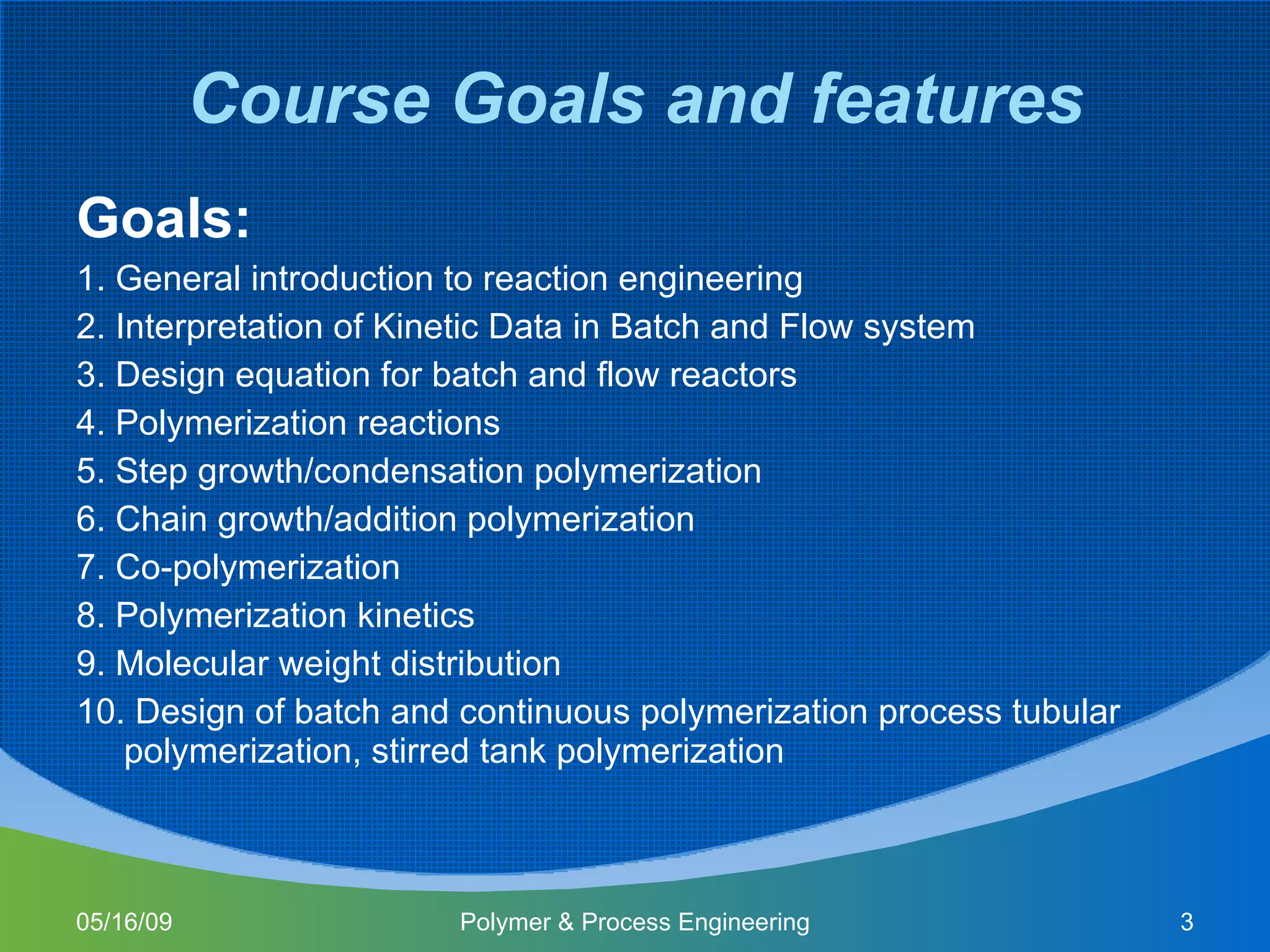
Course Goals and features Goals: 1. General introduction to reaction engineering 2. Interpretation of Kinetic Data in Batch and Flow system 3. Design equation for batch and flow reactors 4. Polymerization reactions 5. Step growth/condensation polymerization 6. Chain growth/addition polymerization 7. Co-polymerization 8. Polymerization kinetics 9. Molecular weight distribution 10. Design of batch and continuous polymerization process tubular polymerization, stirred tank polymerization 06/10/09 Polymer & Process Engineering
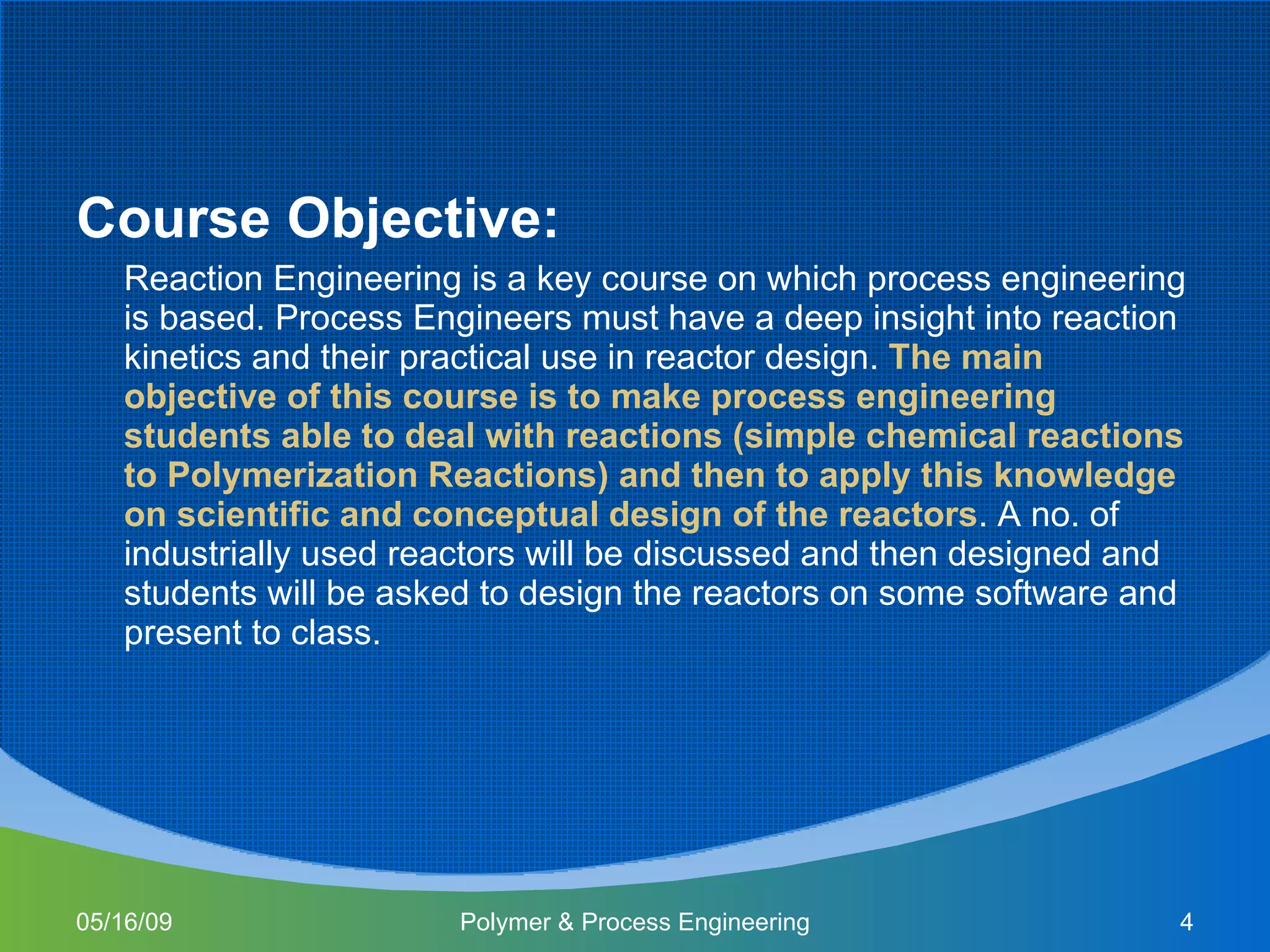
Course Objective: Reaction Engineering is a key course on which process engineering is based. Process Engineers must have a deep insight into reaction kinetics and their practical use in reactor design.  The main objective of this course is to make process engineering students able to deal with reactions (simple chemical reactions to Polymerization Reactions) and then to apply this knowledge on scientific and conceptual design of the reactors . A no. of industrially used reactors will be discussed and then designed and students will be asked to design the reactors on some software and present to class.  06/10/09 Polymer & Process Engineering
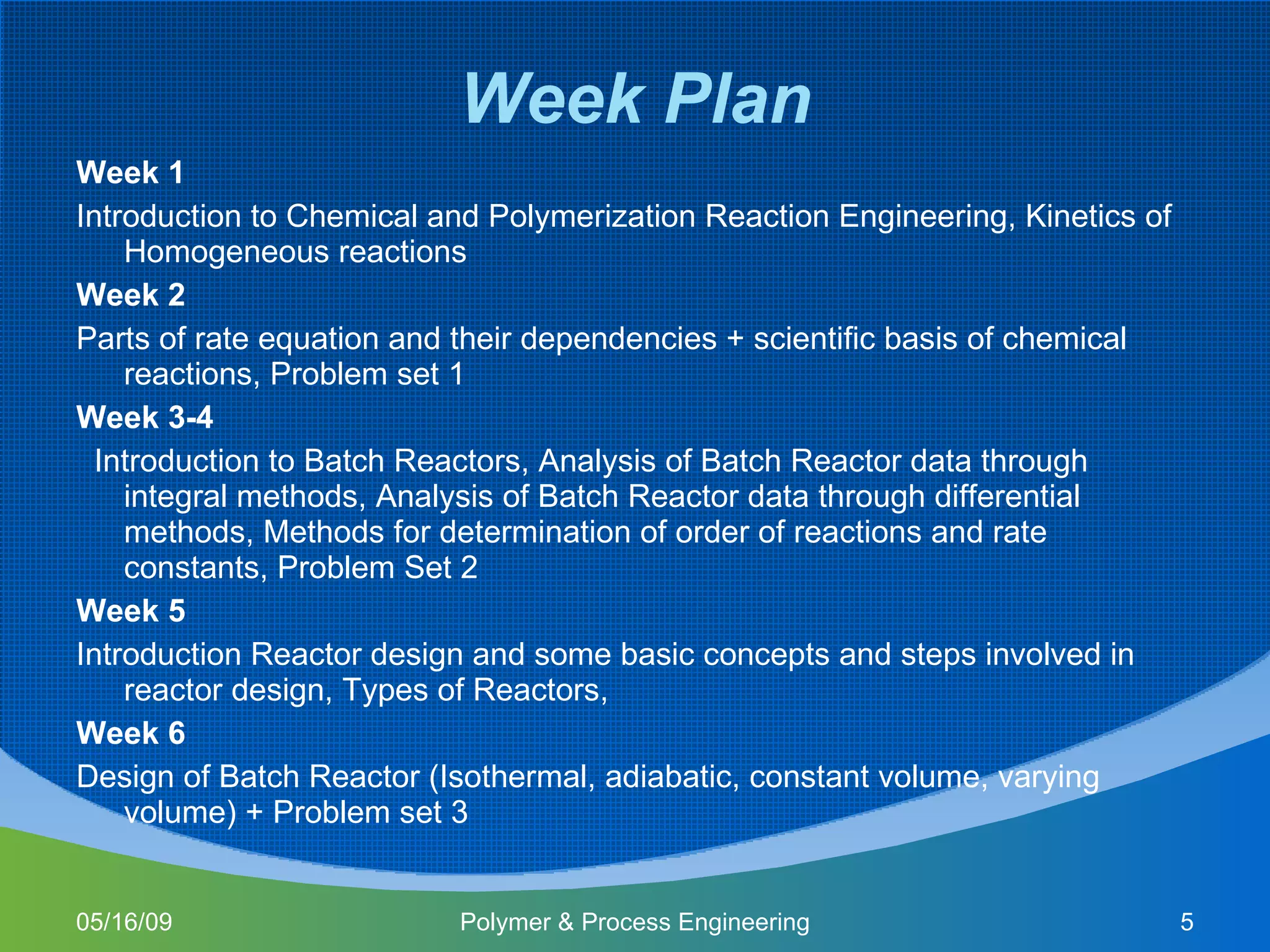
Week Plan Week 1 Introduction to Chemical and Polymerization Reaction Engineering, Kinetics of Homogeneous reactions Week 2 Parts of rate equation and their dependencies + scientific basis of chemical reactions, Problem set 1 Week 3-4 Introduction to Batch Reactors, Analysis of Batch Reactor data through integral methods, Analysis of Batch Reactor data through differential methods, Methods for determination of order of reactions and rate constants, Problem Set 2 Week 5 Introduction Reactor design and some basic concepts and steps involved in reactor design, Types of Reactors,  Week 6 Design of Batch Reactor (Isothermal, adiabatic, constant volume, varying volume) + Problem set 3 06/10/09 Polymer & Process Engineering
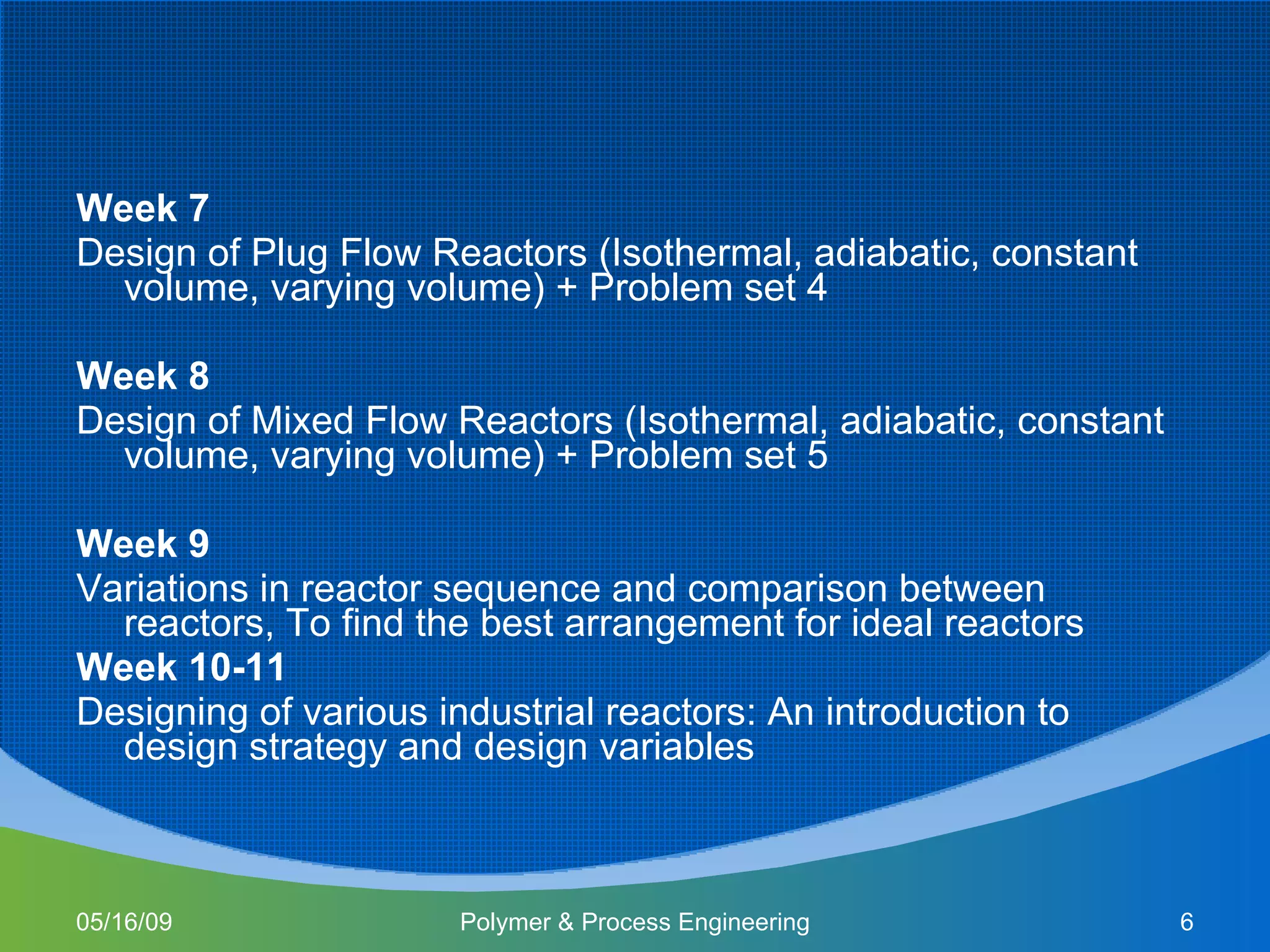
Week 7 Design of Plug Flow Reactors (Isothermal, adiabatic, constant volume, varying volume) + Problem set 4 Week 8 Design of Mixed Flow Reactors (Isothermal, adiabatic, constant volume, varying volume) + Problem set 5 Week 9 Variations in reactor sequence and comparison between reactors, To find the best arrangement for ideal reactors Week 10-11 Designing of various industrial reactors: An introduction to design strategy and design variables 06/10/09 Polymer & Process Engineering
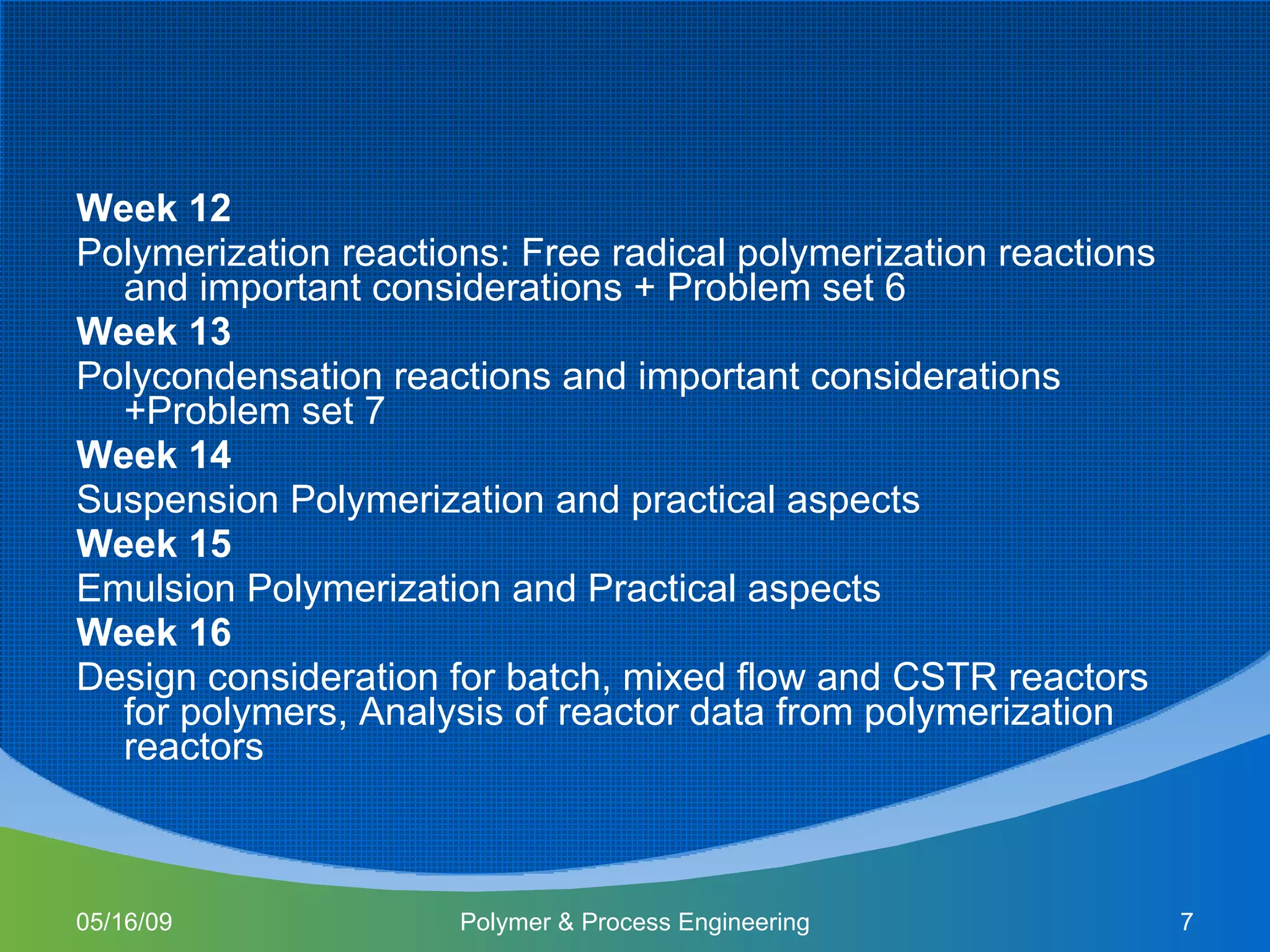
Week 12 Polymerization reactions: Free radical polymerization reactions and important considerations + Problem set 6 Week 13 Polycondensation reactions and important considerations +Problem set 7  Week 14 Suspension Polymerization and practical aspects Week 15 Emulsion Polymerization and Practical aspects Week 16 Design consideration for batch, mixed flow and CSTR reactors for polymers, Analysis of reactor data from polymerization reactors 06/10/09 Polymer & Process Engineering
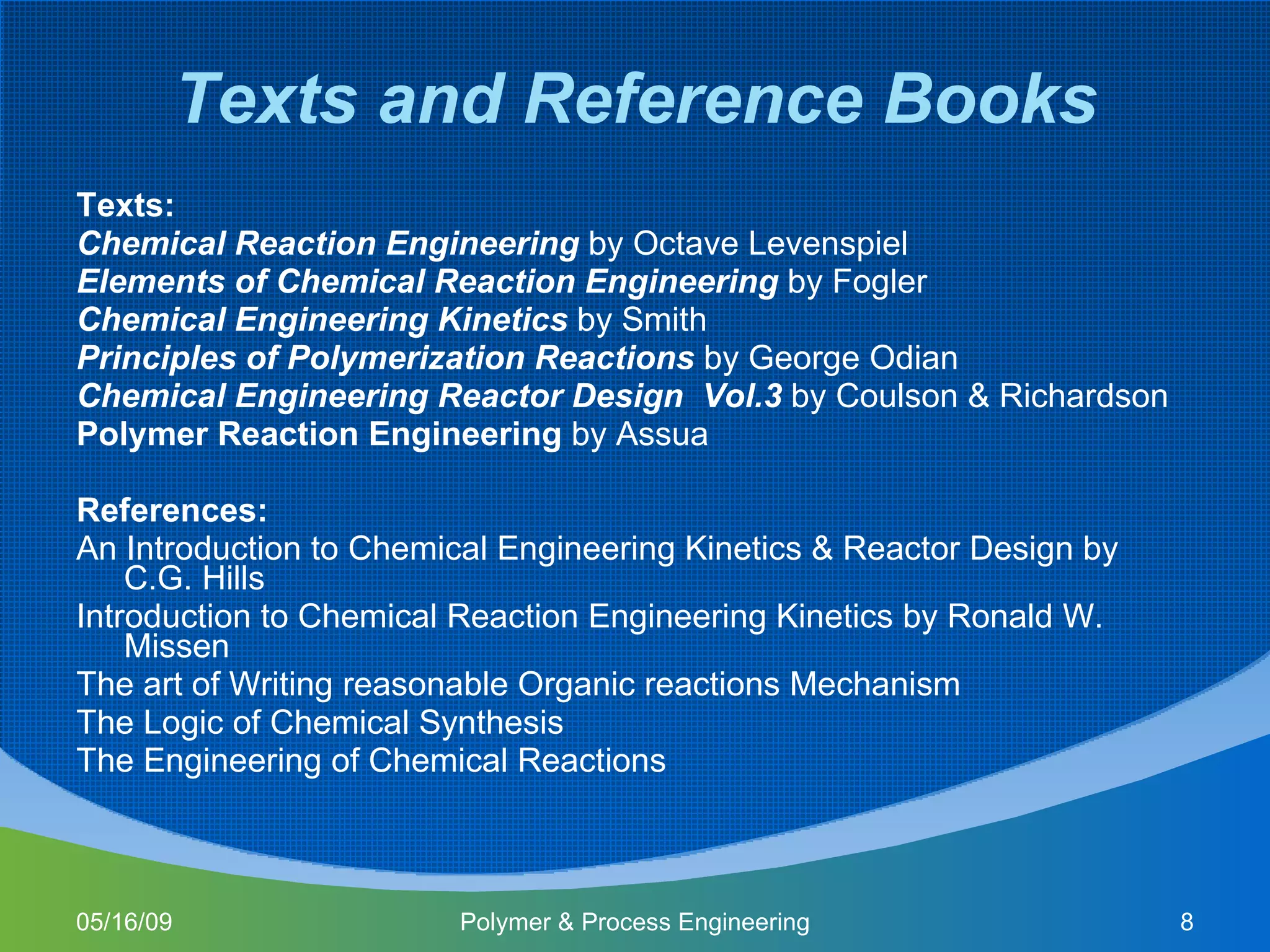
Texts and Reference Books Texts: Chemical Reaction Engineering   by Octave Levenspiel Elements of Chemical Reaction Engineering  by Fogler Chemical Engineering Kinetics  by Smith Principles of Polymerization Reactions  by George Odian Chemical Engineering Reactor Design  Vol.3  by Coulson & Richardson Polymer Reaction Engineering  by Assua References: An Introduction to Chemical Engineering Kinetics & Reactor Design by C.G. Hills Introduction to Chemical Reaction Engineering Kinetics by Ronald W. Missen The art of Writing reasonable Organic reactions Mechanism The Logic of Chemical Synthesis The Engineering of Chemical Reactions 06/10/09 Polymer & Process Engineering
Assignments Class must divide itself into groups containing not more than four students. Each group will be assigned a design problem and the time line for different steps for that. During lectures, some problem sets will also be given to students which must be solved within 1 week. Rewards for Assignments: Problem Set: 50% marks Design Assignment: 50% marks  06/10/09 Polymer & Process Engineering
Introduction to Reaction Engineering Chemical Reaction Engineering is that engineering activity concerned with the exploitation of chemical reactions on a commercial scale. Its goal is the successful design and operation of chemical reactors. It sets chemical/process engineering apart as a distinct branch of the engineering profession. Chemical treatment step is  the heart of the process , the thing that makes or breaks the process economics. Reactor itself may be a very small part of the whole plant but this is the thing that decides what further treatment would be necessary to get better products. 06/10/09 Polymer & Process Engineering
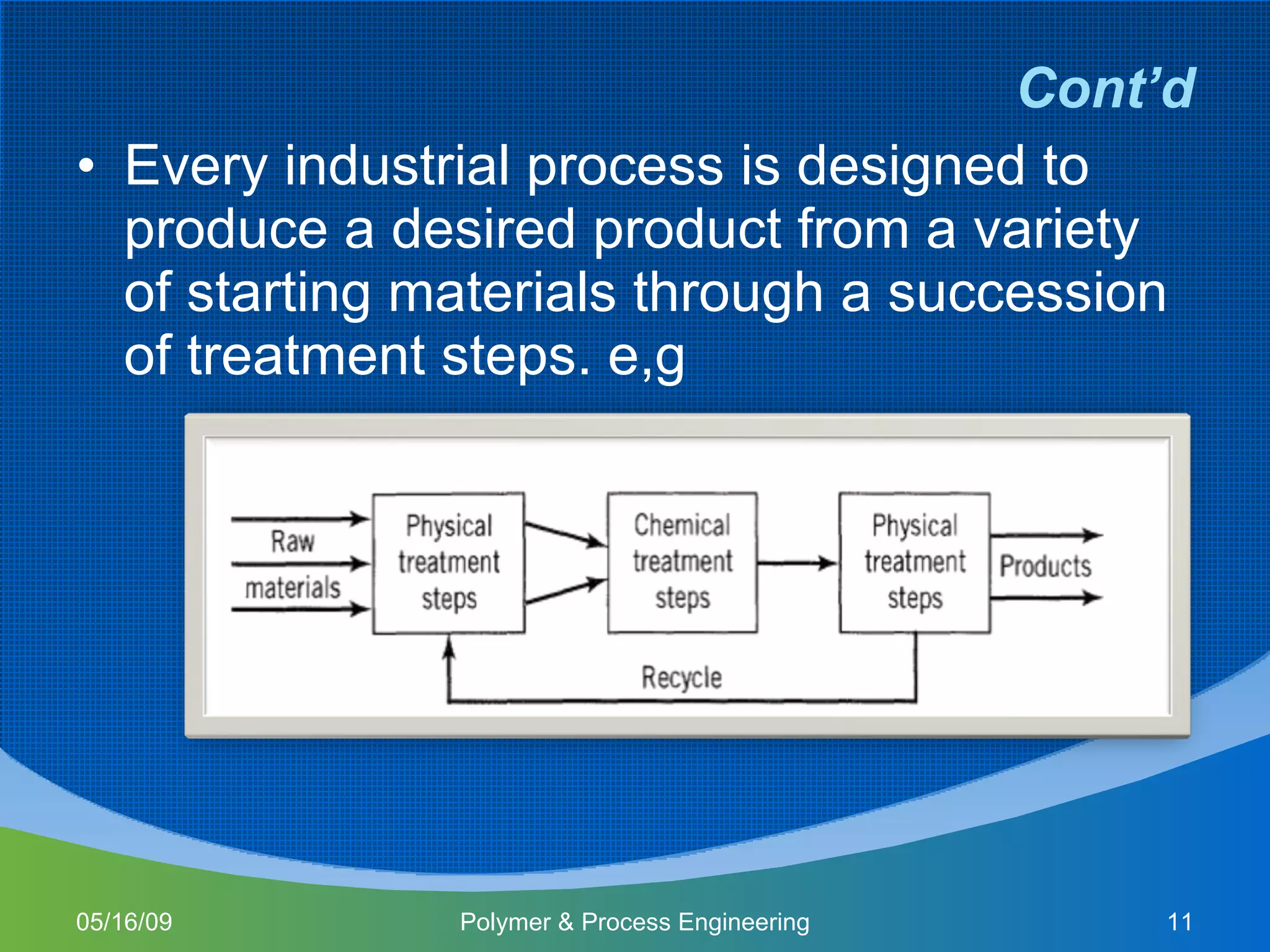
Cont’d Every industrial process is designed to produce a desired product from a variety of starting materials through a succession of treatment steps. e,g 06/10/09 Polymer & Process Engineering
Reactor design uses information, knowledge and experience from a variety of areas like: Thermodynamics Chemical Kinetics Fluid Mechanics Heat Transfer Mass Transfer Economics Chemical reaction engineering is the synthesis o f all these factors with the aim of properly designing a reactor. 06/10/09 Polymer & Process Engineering
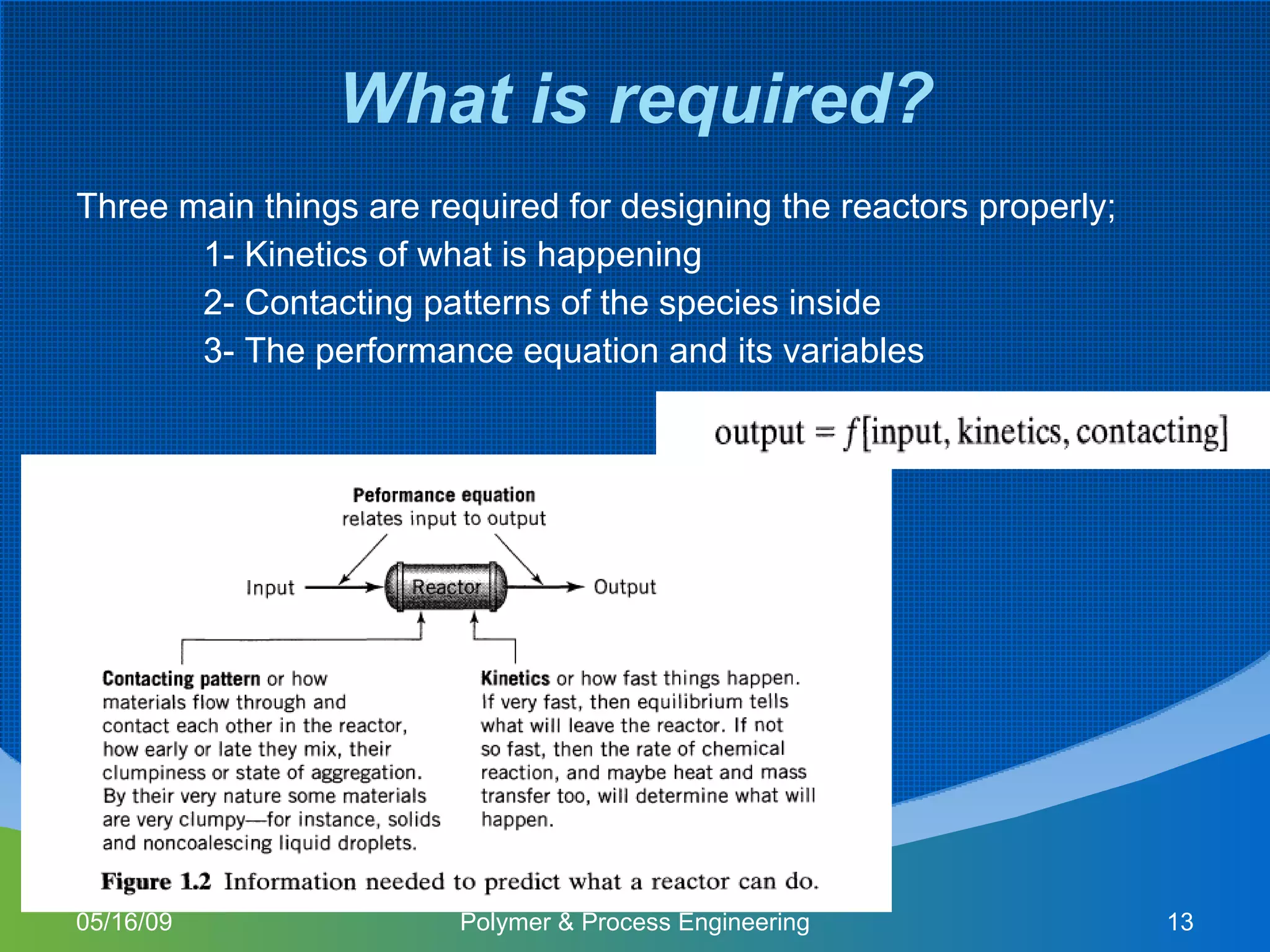
What is required? Three main things are required for designing the reactors properly; 1- Kinetics of what is happening 2- Contacting patterns of the species inside 3- The performance equation and its variables  06/10/09 Polymer & Process Engineering
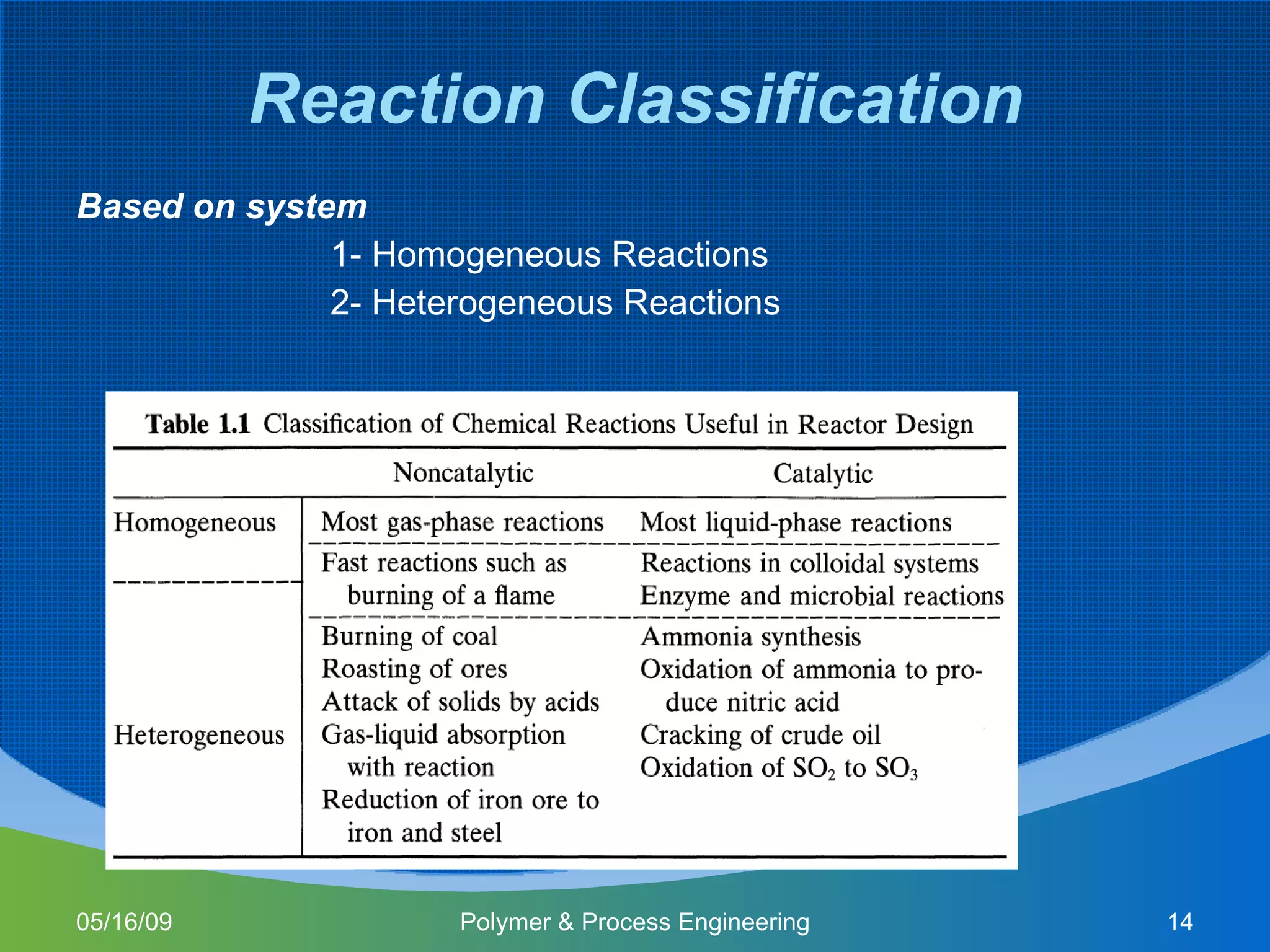
Reaction Classification Based on system 1- Homogeneous Reactions 2- Heterogeneous Reactions 06/10/09 Polymer & Process Engineering
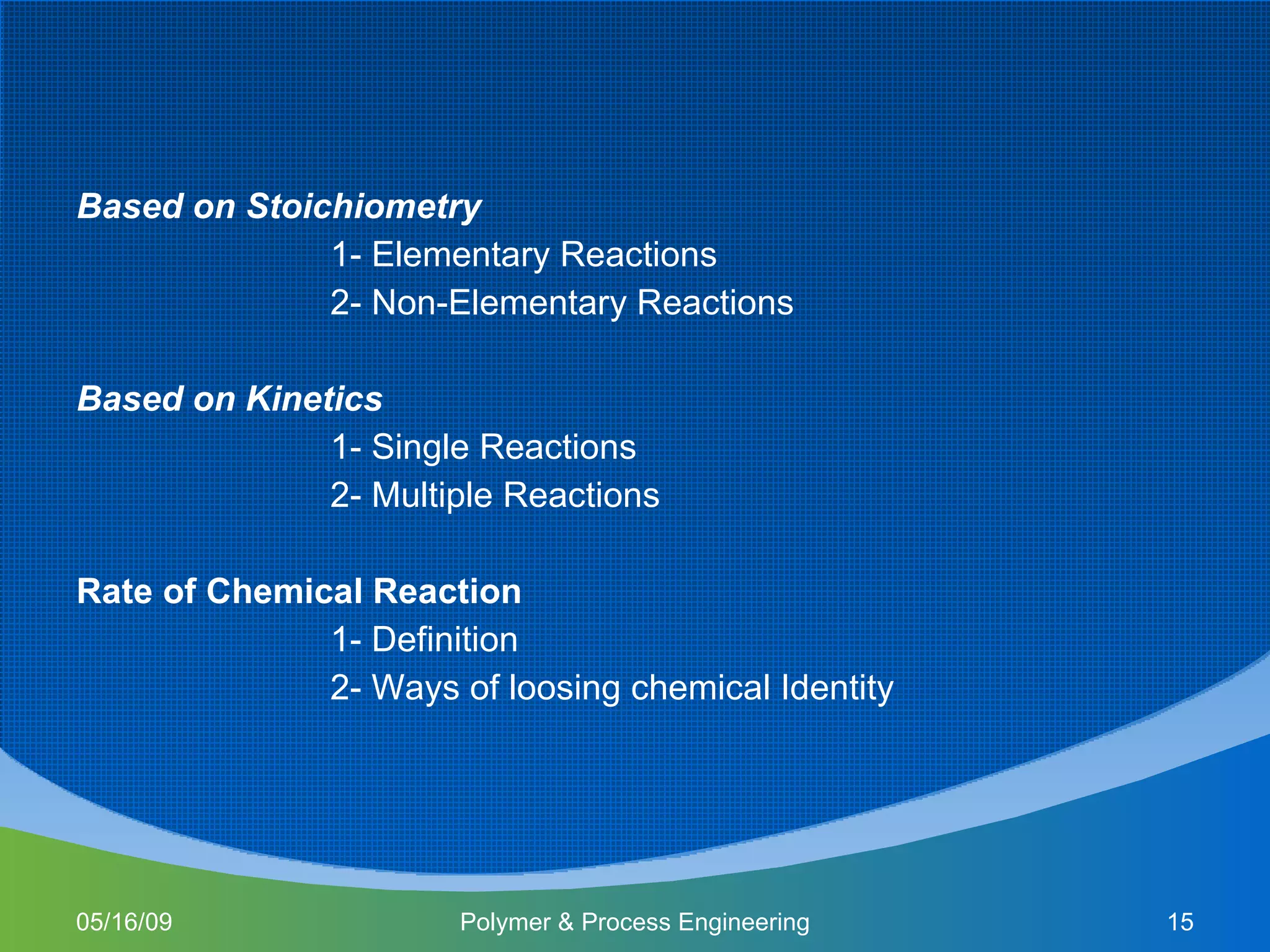
Based on Stoichiometry 1- Elementary Reactions 2- Non-Elementary Reactions Based on Kinetics 1- Single Reactions 2- Multiple Reactions Rate of Chemical Reaction 1- Definition 2- Ways of loosing chemical Identity 06/10/09 Polymer & Process Engineering
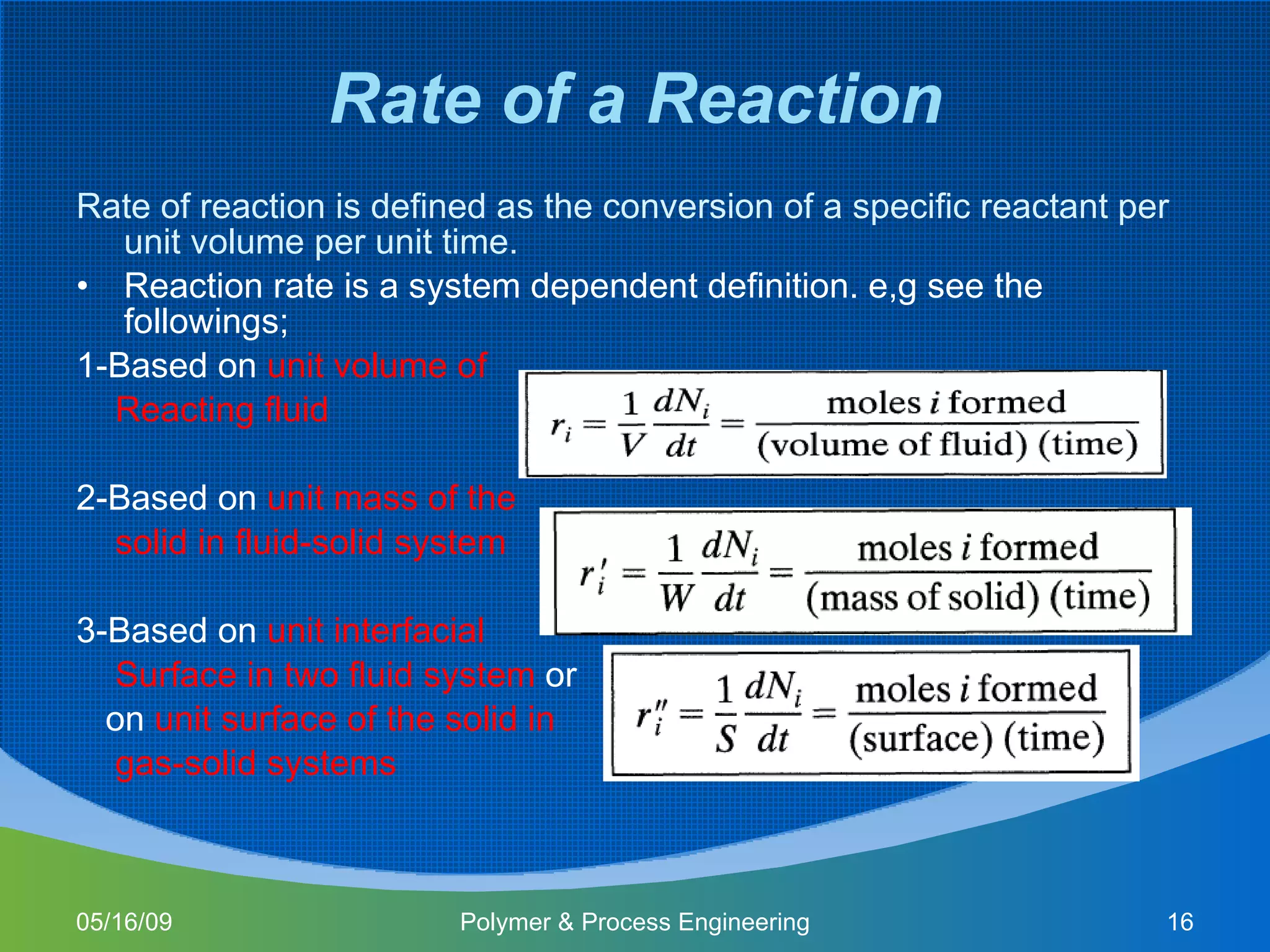
Rate of a Reaction Rate of reaction is defined as the conversion of a specific reactant per unit volume per unit time . Reaction rate is a system dependent definition. e,g see the followings; 1-Based on  unit volume of  Reacting fluid  2-Based on  unit mass of the solid in fluid-solid system  3-Based on  unit interfacial  Surface   in two fluid system  or  on  unit surface of the solid in gas-solid systems 06/10/09 Polymer & Process Engineering
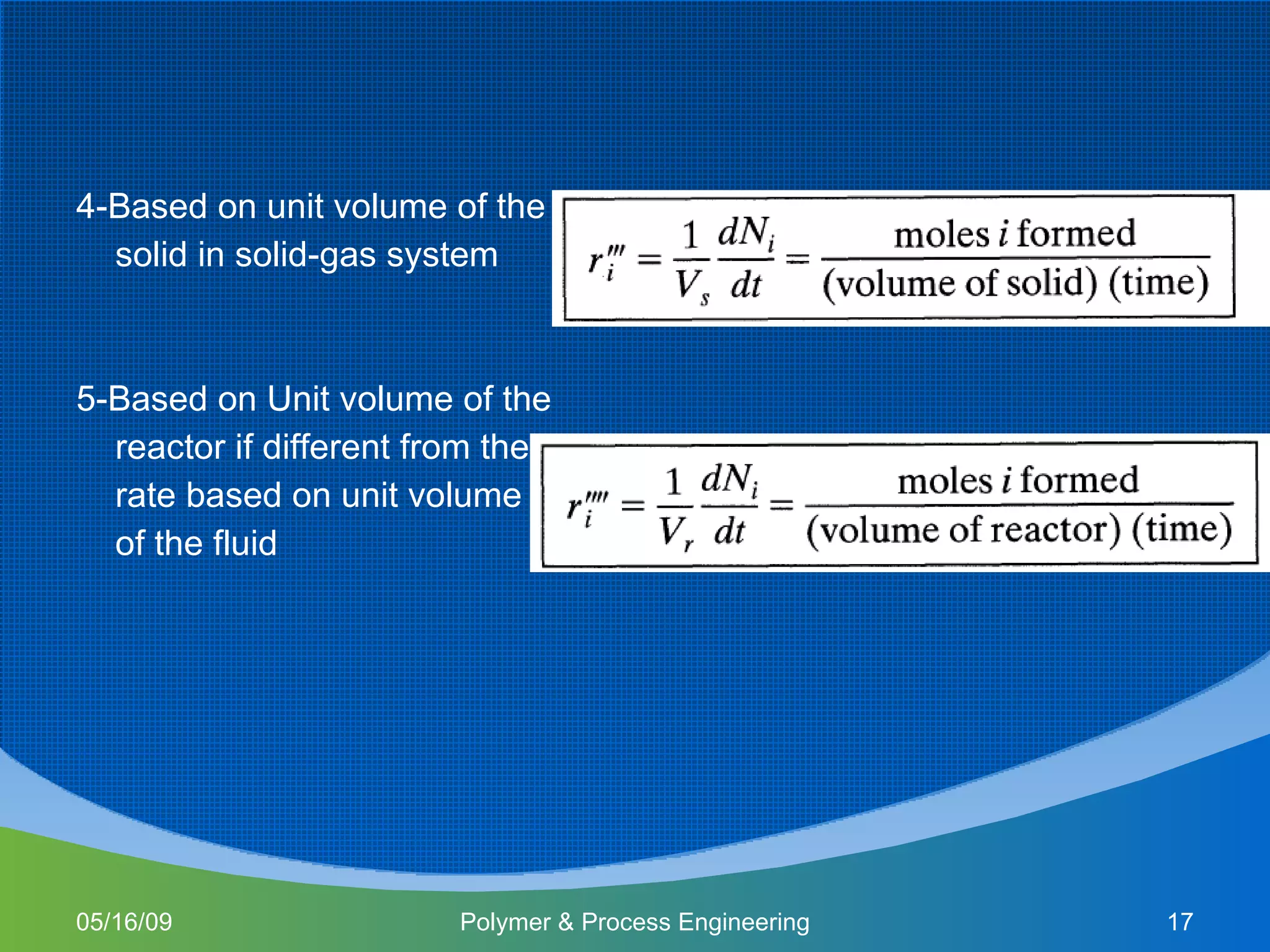
4-Based on unit volume of the  solid in solid-gas system 5-Based on Unit volume of the reactor if different from the  rate based on unit volume of the fluid 06/10/09 Polymer & Process Engineering
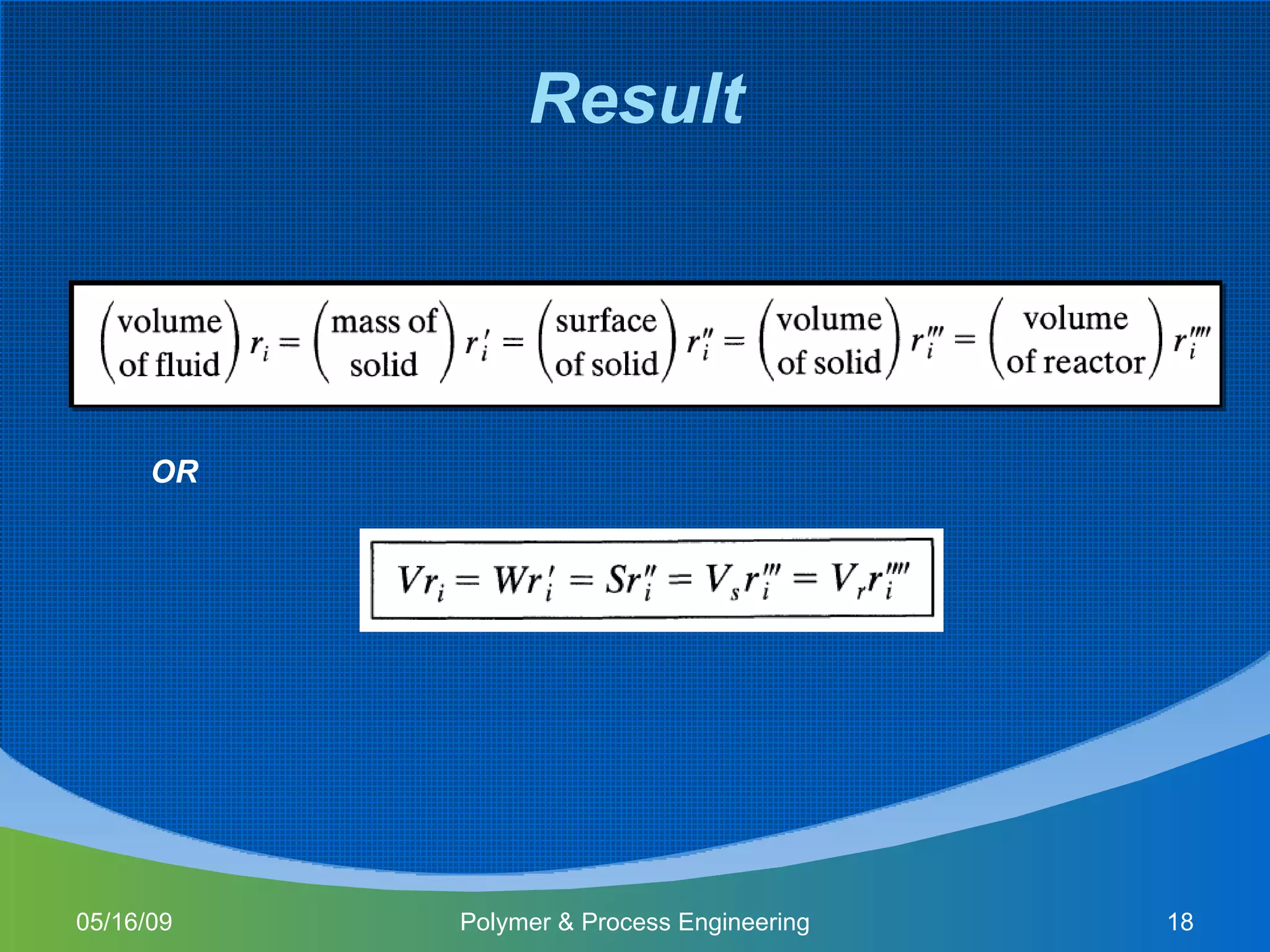
Result OR 06/10/09 Polymer & Process Engineering
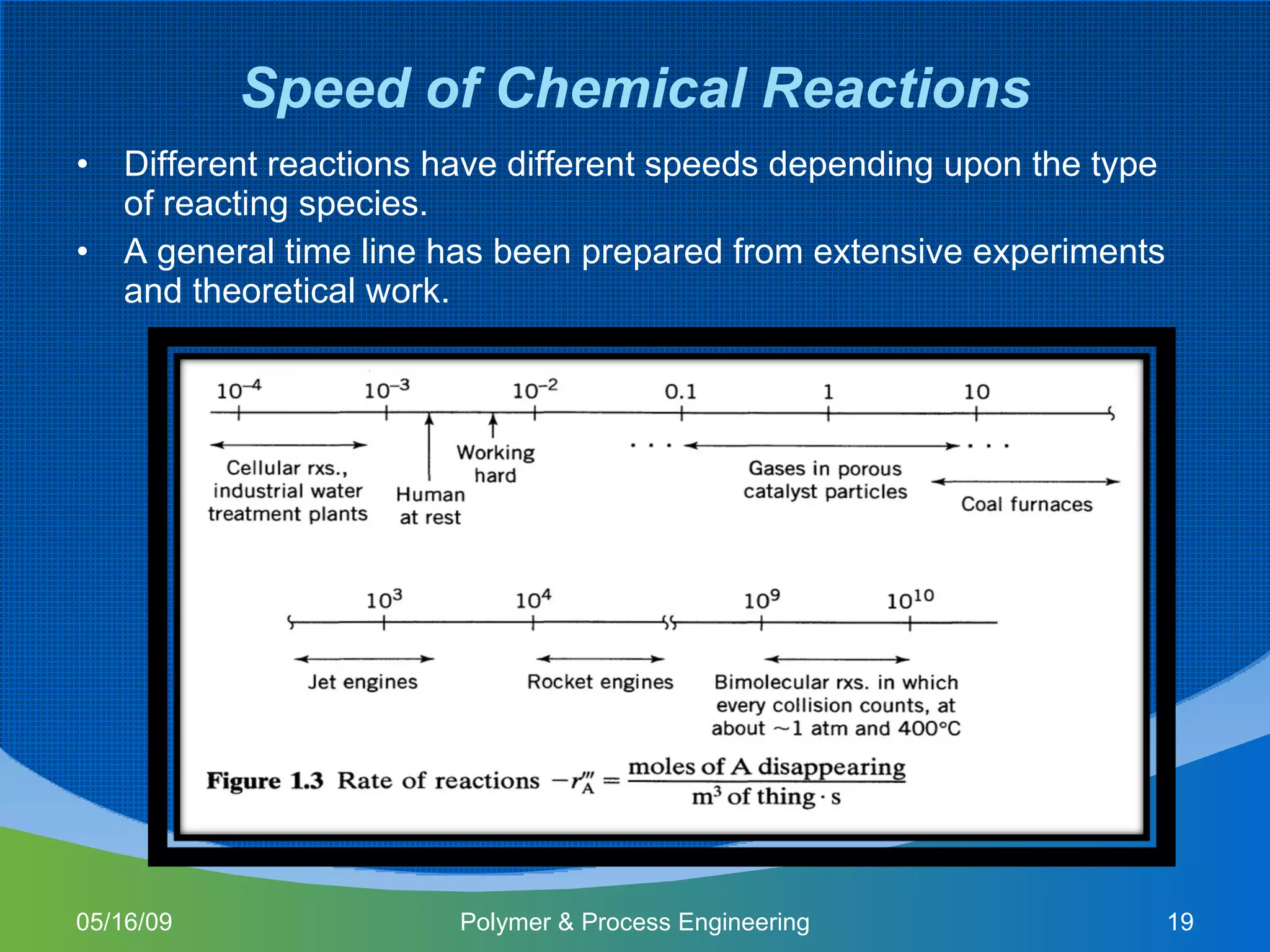
Speed of Chemical Reactions Different reactions have different speeds depending upon the type of reacting species.  A general time line has been prepared from extensive experiments and theoretical work. 06/10/09 Polymer & Process Engineering
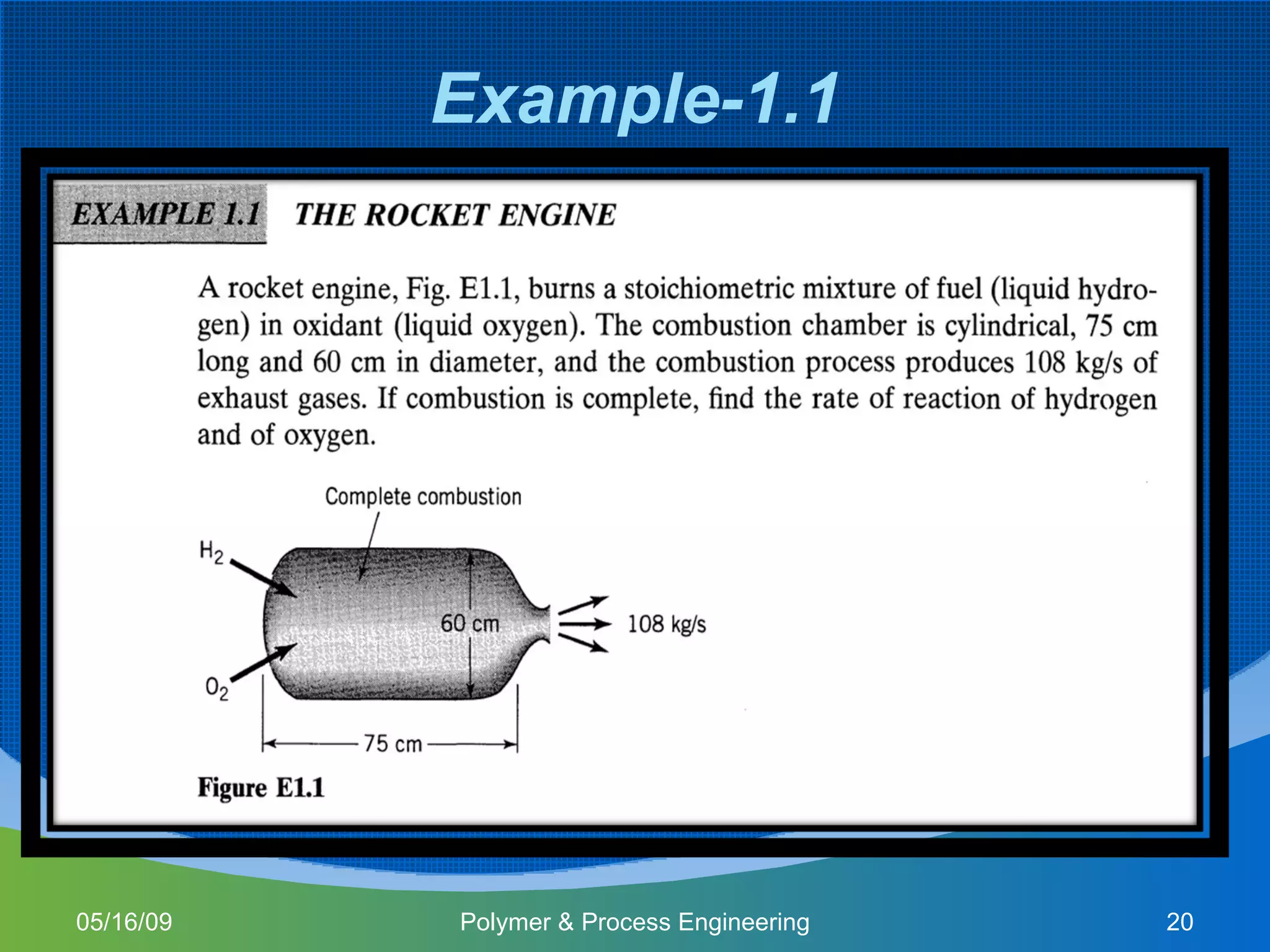
Example-1.1 06/10/09 Polymer & Process Engineering
Steps Identify the system (Liquid, gas or solid) Identify the species and reaction Find the volume of the system using conventional formulae Write a rate equation for the reaction Calculate the rate of reaction  Compare the results with General Rate Table  06/10/09 Polymer & Process Engineering

Lecture 1 Introduction And Chapter 1 From Levenspiel

  • 1.
    Polymer Reaction EngineeringBy Muhammad Zafar Iqbal Lecture#1 Introduction to Polymer Reaction Engineering P.E. 304 06/10/09 Polymer & Process Engineering
  • 2.
    Agenda Course Goalsand Objective Week Plan Assignment Schedule + Groups Chapter 1 from Chemical Reaction Engineering by Levenspiel 06/10/09 Polymer & Process Engineering
  • 3.
    Course Goals andfeatures Goals: 1. General introduction to reaction engineering 2. Interpretation of Kinetic Data in Batch and Flow system 3. Design equation for batch and flow reactors 4. Polymerization reactions 5. Step growth/condensation polymerization 6. Chain growth/addition polymerization 7. Co-polymerization 8. Polymerization kinetics 9. Molecular weight distribution 10. Design of batch and continuous polymerization process tubular polymerization, stirred tank polymerization 06/10/09 Polymer & Process Engineering
  • 4.
    Course Objective: ReactionEngineering is a key course on which process engineering is based. Process Engineers must have a deep insight into reaction kinetics and their practical use in reactor design. The main objective of this course is to make process engineering students able to deal with reactions (simple chemical reactions to Polymerization Reactions) and then to apply this knowledge on scientific and conceptual design of the reactors . A no. of industrially used reactors will be discussed and then designed and students will be asked to design the reactors on some software and present to class. 06/10/09 Polymer & Process Engineering
  • 5.
    Week Plan Week1 Introduction to Chemical and Polymerization Reaction Engineering, Kinetics of Homogeneous reactions Week 2 Parts of rate equation and their dependencies + scientific basis of chemical reactions, Problem set 1 Week 3-4 Introduction to Batch Reactors, Analysis of Batch Reactor data through integral methods, Analysis of Batch Reactor data through differential methods, Methods for determination of order of reactions and rate constants, Problem Set 2 Week 5 Introduction Reactor design and some basic concepts and steps involved in reactor design, Types of Reactors, Week 6 Design of Batch Reactor (Isothermal, adiabatic, constant volume, varying volume) + Problem set 3 06/10/09 Polymer & Process Engineering
  • 6.
    Week 7 Designof Plug Flow Reactors (Isothermal, adiabatic, constant volume, varying volume) + Problem set 4 Week 8 Design of Mixed Flow Reactors (Isothermal, adiabatic, constant volume, varying volume) + Problem set 5 Week 9 Variations in reactor sequence and comparison between reactors, To find the best arrangement for ideal reactors Week 10-11 Designing of various industrial reactors: An introduction to design strategy and design variables 06/10/09 Polymer & Process Engineering
  • 7.
    Week 12 Polymerizationreactions: Free radical polymerization reactions and important considerations + Problem set 6 Week 13 Polycondensation reactions and important considerations +Problem set 7 Week 14 Suspension Polymerization and practical aspects Week 15 Emulsion Polymerization and Practical aspects Week 16 Design consideration for batch, mixed flow and CSTR reactors for polymers, Analysis of reactor data from polymerization reactors 06/10/09 Polymer & Process Engineering
  • 8.
    Texts and ReferenceBooks Texts: Chemical Reaction Engineering by Octave Levenspiel Elements of Chemical Reaction Engineering by Fogler Chemical Engineering Kinetics by Smith Principles of Polymerization Reactions by George Odian Chemical Engineering Reactor Design Vol.3 by Coulson & Richardson Polymer Reaction Engineering by Assua References: An Introduction to Chemical Engineering Kinetics & Reactor Design by C.G. Hills Introduction to Chemical Reaction Engineering Kinetics by Ronald W. Missen The art of Writing reasonable Organic reactions Mechanism The Logic of Chemical Synthesis The Engineering of Chemical Reactions 06/10/09 Polymer & Process Engineering
  • 9.
    Assignments Class mustdivide itself into groups containing not more than four students. Each group will be assigned a design problem and the time line for different steps for that. During lectures, some problem sets will also be given to students which must be solved within 1 week. Rewards for Assignments: Problem Set: 50% marks Design Assignment: 50% marks 06/10/09 Polymer & Process Engineering
  • 10.
    Introduction to ReactionEngineering Chemical Reaction Engineering is that engineering activity concerned with the exploitation of chemical reactions on a commercial scale. Its goal is the successful design and operation of chemical reactors. It sets chemical/process engineering apart as a distinct branch of the engineering profession. Chemical treatment step is the heart of the process , the thing that makes or breaks the process economics. Reactor itself may be a very small part of the whole plant but this is the thing that decides what further treatment would be necessary to get better products. 06/10/09 Polymer & Process Engineering
  • 11.
    Cont’d Every industrialprocess is designed to produce a desired product from a variety of starting materials through a succession of treatment steps. e,g 06/10/09 Polymer & Process Engineering
  • 12.
    Reactor design usesinformation, knowledge and experience from a variety of areas like: Thermodynamics Chemical Kinetics Fluid Mechanics Heat Transfer Mass Transfer Economics Chemical reaction engineering is the synthesis o f all these factors with the aim of properly designing a reactor. 06/10/09 Polymer & Process Engineering
  • 13.
    What is required?Three main things are required for designing the reactors properly; 1- Kinetics of what is happening 2- Contacting patterns of the species inside 3- The performance equation and its variables 06/10/09 Polymer & Process Engineering
  • 14.
    Reaction Classification Basedon system 1- Homogeneous Reactions 2- Heterogeneous Reactions 06/10/09 Polymer & Process Engineering
  • 15.
    Based on Stoichiometry1- Elementary Reactions 2- Non-Elementary Reactions Based on Kinetics 1- Single Reactions 2- Multiple Reactions Rate of Chemical Reaction 1- Definition 2- Ways of loosing chemical Identity 06/10/09 Polymer & Process Engineering
  • 16.
    Rate of aReaction Rate of reaction is defined as the conversion of a specific reactant per unit volume per unit time . Reaction rate is a system dependent definition. e,g see the followings; 1-Based on unit volume of Reacting fluid 2-Based on unit mass of the solid in fluid-solid system 3-Based on unit interfacial Surface in two fluid system or on unit surface of the solid in gas-solid systems 06/10/09 Polymer & Process Engineering
  • 17.
    4-Based on unitvolume of the solid in solid-gas system 5-Based on Unit volume of the reactor if different from the rate based on unit volume of the fluid 06/10/09 Polymer & Process Engineering
  • 18.
    Result OR 06/10/09Polymer & Process Engineering
  • 19.
    Speed of ChemicalReactions Different reactions have different speeds depending upon the type of reacting species. A general time line has been prepared from extensive experiments and theoretical work. 06/10/09 Polymer & Process Engineering
  • 20.
    Example-1.1 06/10/09 Polymer& Process Engineering
  • 21.
    Steps Identify thesystem (Liquid, gas or solid) Identify the species and reaction Find the volume of the system using conventional formulae Write a rate equation for the reaction Calculate the rate of reaction Compare the results with General Rate Table 06/10/09 Polymer & Process Engineering

Editor's Notes

  • #2 Polymer Reaction Engineering Polymer Reaction Engineering