Lecture	4	Introduction	to	PIC	Assembly	
Language	(Continued)
Dr.	Asim	Ghaffar
Ph.D.	Mechanical	Engineering	(Robotics)
University	of	Leeds,	UK
Email:	asim.ghaffar@uet.edu.pk
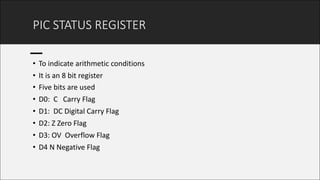
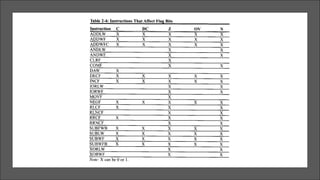
PIC	STATUS	REGISTER
• To	indicate	arithmetic	conditions
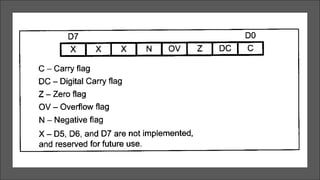
• It	is	an	8	bit	register
• Five	bits	are	used
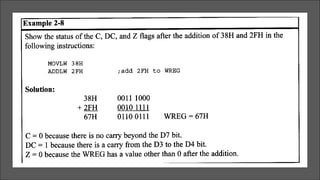
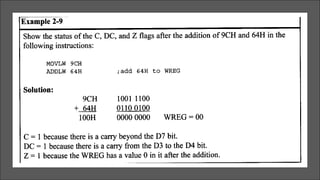
• D0:		C			Carry	Flag
• D1:		DC	Digital	Carry	Flag
• D2:	Z	Zero	Flag
• D3:	OV		Overflow	Flag
• D4	N	Negative	Flag
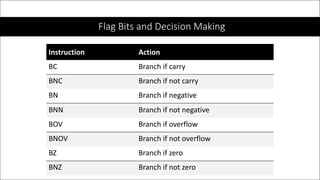
Flag	Bits	and	Decision	Making
Instruction Action
BC Branch	if	carry
BNC Branch	if	not	carry
BN Branch	if	negative
BNN Branch	if	not	negative
BOV Branch	if	overflow
BNOV Branch	if	not	overflow
BZ Branch	if	zero
BNZ Branch	if	not	zero
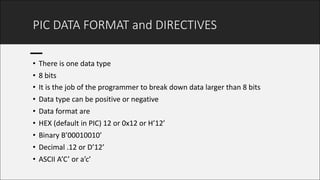
PIC	DATA	FORMAT	and	DIRECTIVES
• There	is	one	data	type
• 8	bits	
• It	is	the	job	of	the	programmer	to	break	down	data	larger	than	8	bits
• Data	type	can	be	positive	or	negative
• Data	format	are	
• HEX	(default	in	PIC)	12	or	0x12	or	H’12’
• Binary	B’00010010’
• Decimal	.12	or	D’12’
• ASCII	A’C’	or	a’c’
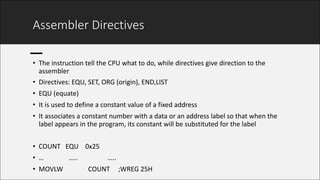
Assembler	Directives
• The	instruction	tell	the	CPU	what	to	do,	while	directives	give	direction	to	the	
assembler
• Directives:	EQU,	SET,	ORG	(origin),	END,LIST
• EQU	(equate)
• It	is	used	to	define	a	constant	value	of	a	fixed	address
• It	associates	a	constant	number	with	a	data	or	an	address	label	so	that	when	the	
label	appears	in	the	program,	its	constant	will	be	substituted	for	the	label
• COUNT			EQU				0x25
• …															…..																		…..
• MOVLW															COUNT					;WREG	25H
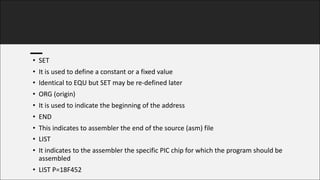
• SET
• It	is	used	to	define	a	constant	or	a	fixed	value
• Identical	to	EQU	but	SET	may	be	re-defined	later
• ORG	(origin)
• It	is	used	to	indicate	the	beginning	of	the	address
• END
• This	indicates	to	assembler	the	end	of	the	source	(asm)	file
• LIST
• It	indicates	to	the	assembler	the	specific	PIC	chip	for	which	the	program	should	be	
assembled
• LIST	P=18F452
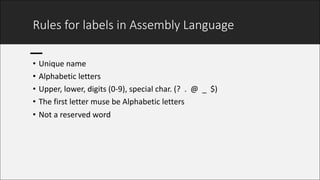
Rules	for	labels	in	Assembly	Language
• Unique	name
• Alphabetic	letters	
• Upper,	lower,	digits	(0-9),	special	char.	(?		.		@		_		$)
• The	first	letter	muse	be	Alphabetic	letters
• Not	a	reserved	word
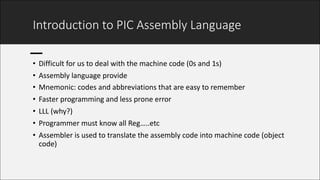
Introduction	to	PIC	Assembly	Language
• Difficult	for	us	to	deal	with	the	machine	code	(0s	and	1s)
• Assembly	language	provide
• Mnemonic:	codes	and	abbreviations	that	are	easy	to	remember
• Faster	programming	and	less	prone	error
• LLL	(why?)
• Programmer	must	know	all	Reg…..etc
• Assembler	is	used	to	translate	the	assembly	code	into	machine	code	(object	
code)
Structure	of	Assembly	Language
• Series	of	lines
• Instruction
• Directives
• Consists	of	four	fields
• [label]			mnemonic			[operands]			[;commands]
• Label:	refer	to	line	by	code	(certain	length)
• Mnemonic	and	operands	are	task	that	should	be	executed.
• Directive	don’t	generate	any	machine	code	and	used	by	assembler
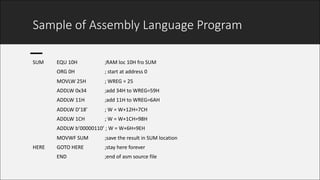
Sample	of	Assembly	Language	Program
SUM	 EQU	10H	 ;RAM	loc	10H	fro	SUM	
ORG	0H ;	start	at	address	0	
MOVLW	25H	 ;	WREG	=	25	
ADDLW	0x34	 ;add	34H	to	WREG=59H	
ADDLW	11H	 ;add	11H	to	WREG=6AH	
ADDLW	D’18’	 ;	W	=	W+12H=7CH	
ADDLW	1CH	 ;	W	=	W+1CH=98H	
ADDLW	b’00000110’	;	W	=	W+6H=9EH	
MOVWF	SUM	 ;save	the	result	in	SUM	location	
HERE	 GOTO	HERE	 ;stay	here	forever	
END	 ;end	of	asm source	file
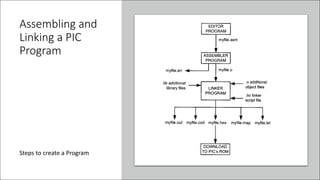
Assembling	and	
Linking	a	PIC	
Program
Steps	to	create	a	Program
Questions?

Lec_4 Introduction to PIC Assembly Language instructions (Continued).pdf