UNIT –I
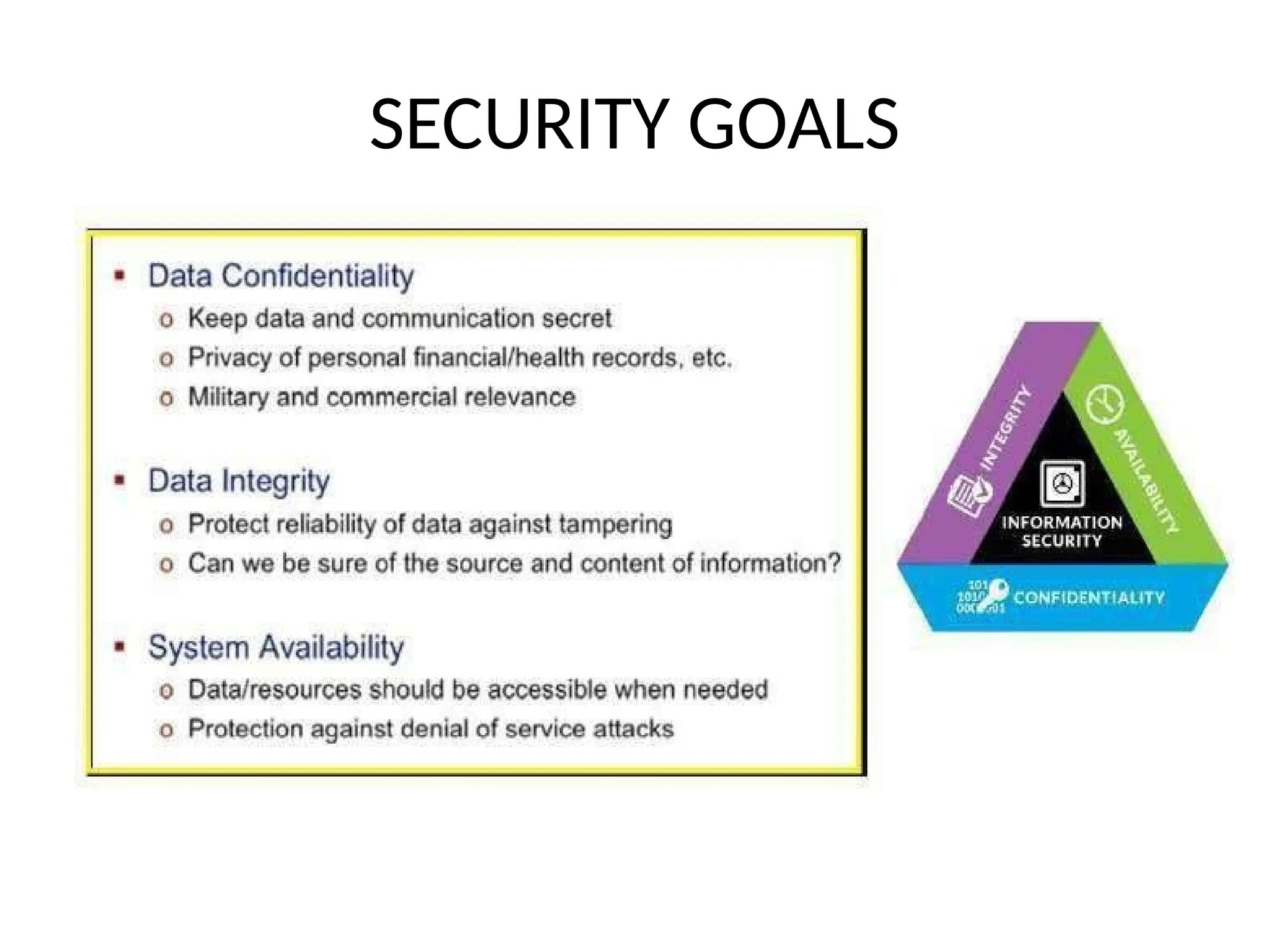
Security Goals
Cryptographic Attacks
Services and Mechanisms Mathematics of Cryptography
WHAT IS CRYPTOGRAPHY?
Cryptography is the study of secure communications
techniques that allow only the sender and intended
recipient of a message to view its contents.
The term is derived from the Greek word kryptos, which
means hidden
WHAT IS NETWORK SECURITY ?
Network Security consists of the provisions and policies
adapted by network Administrator to prevent and monitor
unauthorized access, misuse, modification, or denial of a
computer network and network-accessible resources.
.
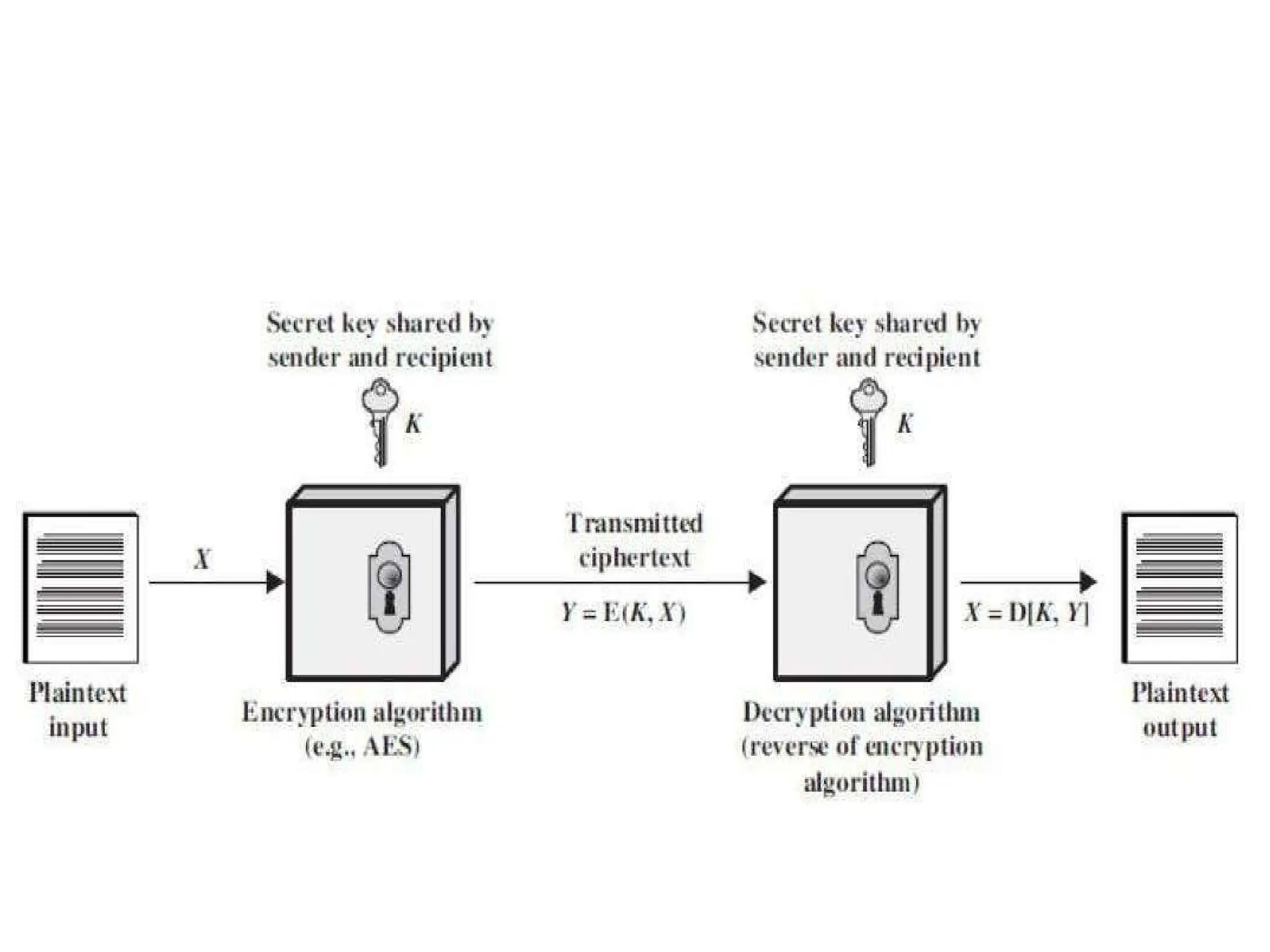
MODEL FOR NETWORK SECURITY - TERMINOLOGY
 Plaintext - the original message
 Cipher text - the coded message
 Cipher - algorithm for transforming plaintext to cipher text
 Key - info used in cipher known only to sender/receiver
 Encipher (Encrypt) - converting plaintext to cipher text
 Decipher (Decrypt) - recovering cipher text from plaintext
 Cryptography - study of encryption principles/methods
 Cryptanalysis (code breaking) - the study of principles/
methods of deciphering cipher text without knowing key
 Cryptology - the field of both cryptography and cryptanalysis
SECURITY GOALS
Cryptographic Attacks
 Accessing of data by unauthorized entity is called as attack
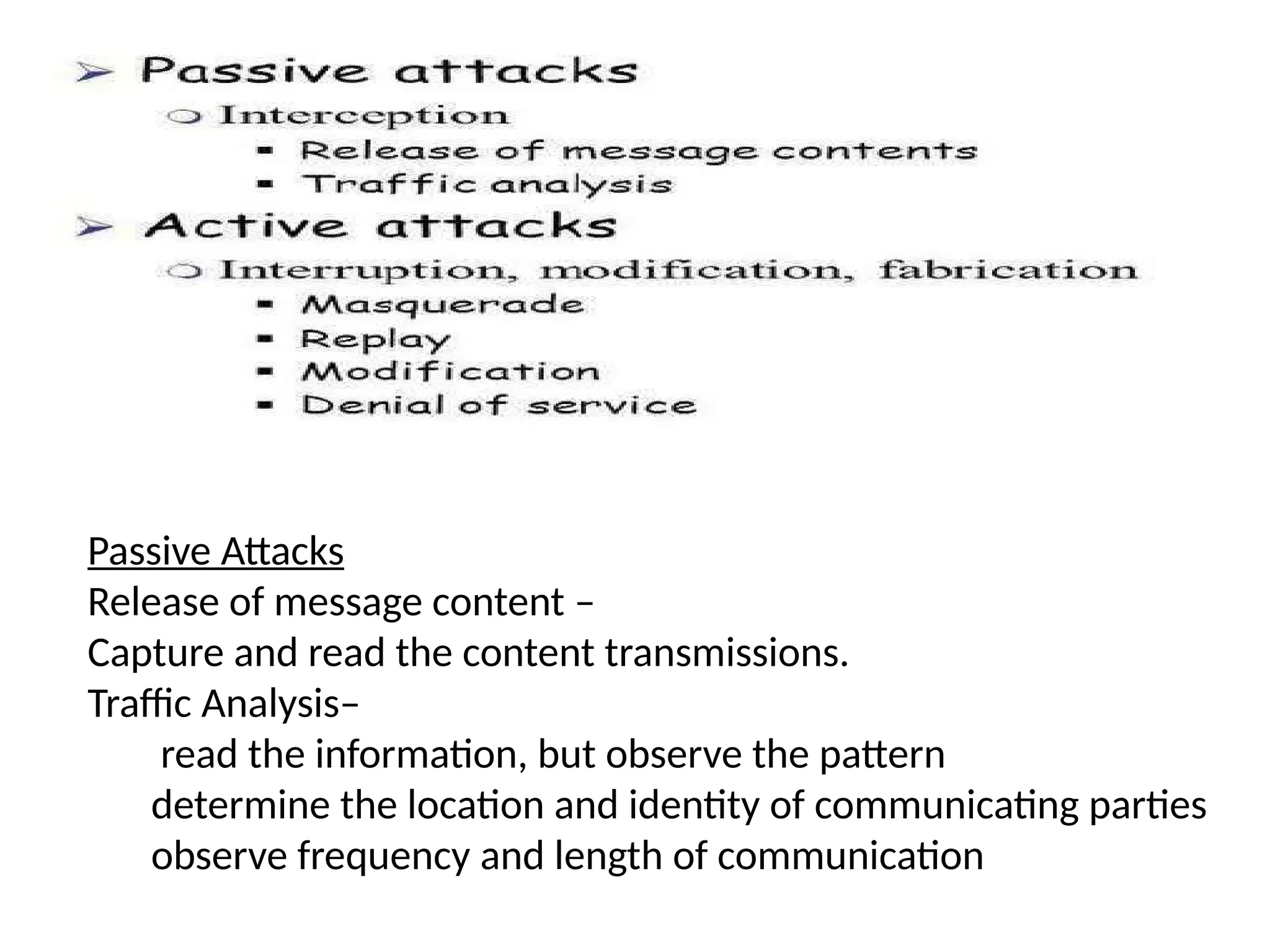
Passive Attacks
Active Attacks
 Passive Attacks:
In a passive attack, the attacker’s goal is just to obtain
information. This means that the attack does not
modify data or harm the system.
 Active Attacks:
An active attack may change the data or harm the system.
Attacks that threaten the integrity and availability are active attacks
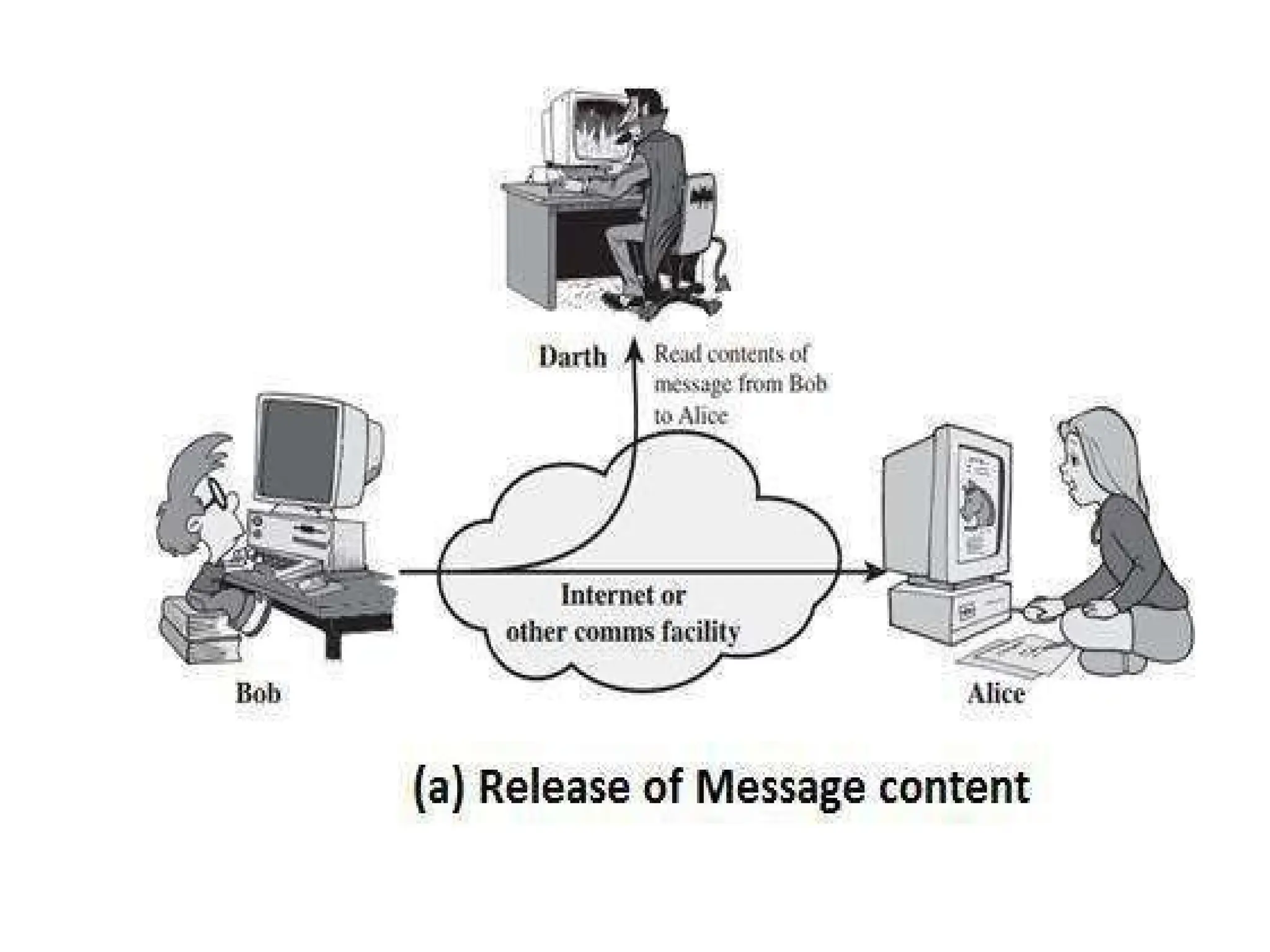
Passive Attacks
Release of message content –
Capture and read the content transmissions.
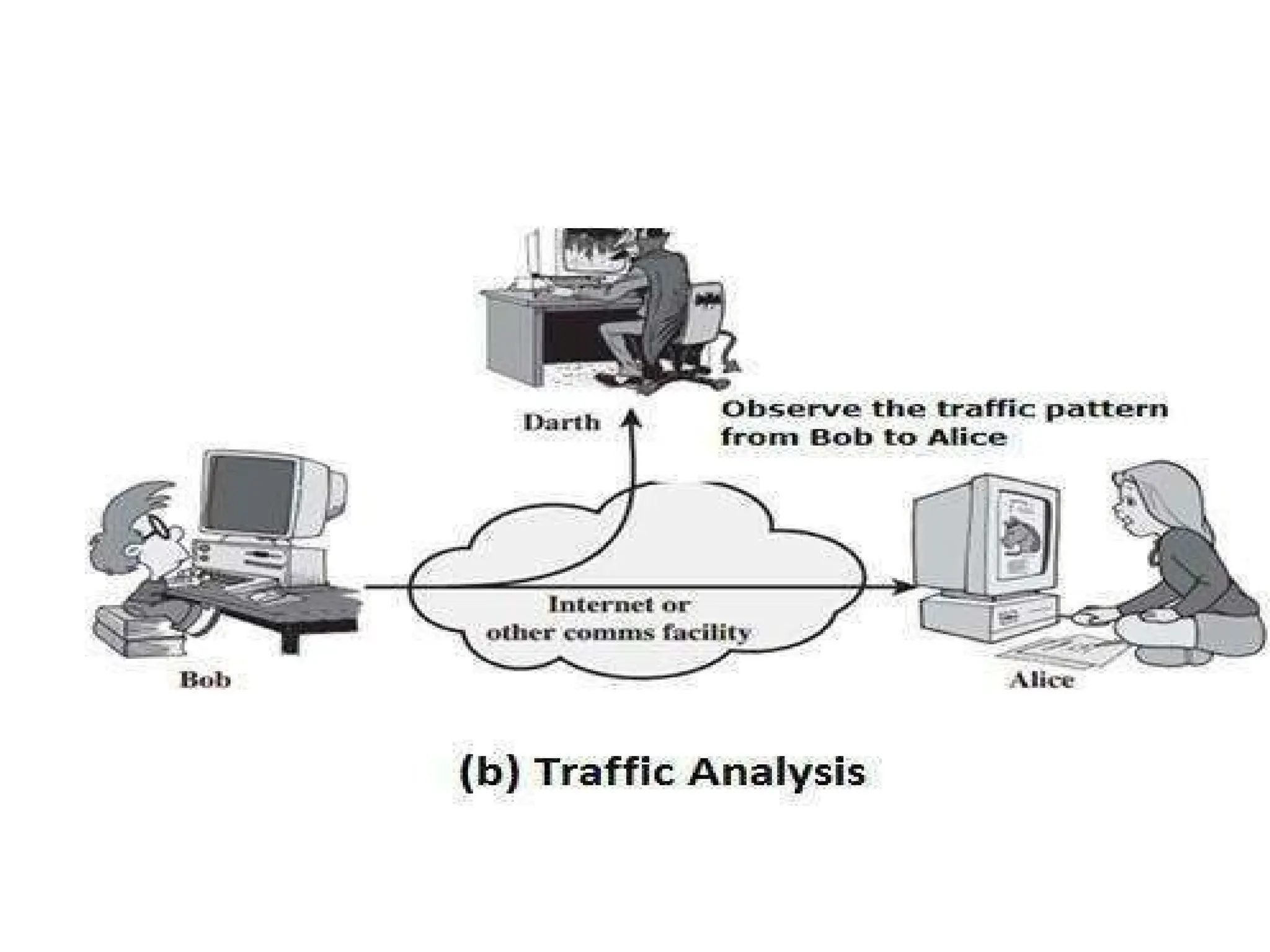
Traffic Analysis–
read the information, but observe the pattern
determine the location and identity of communicating parties
observe frequency and length of communication
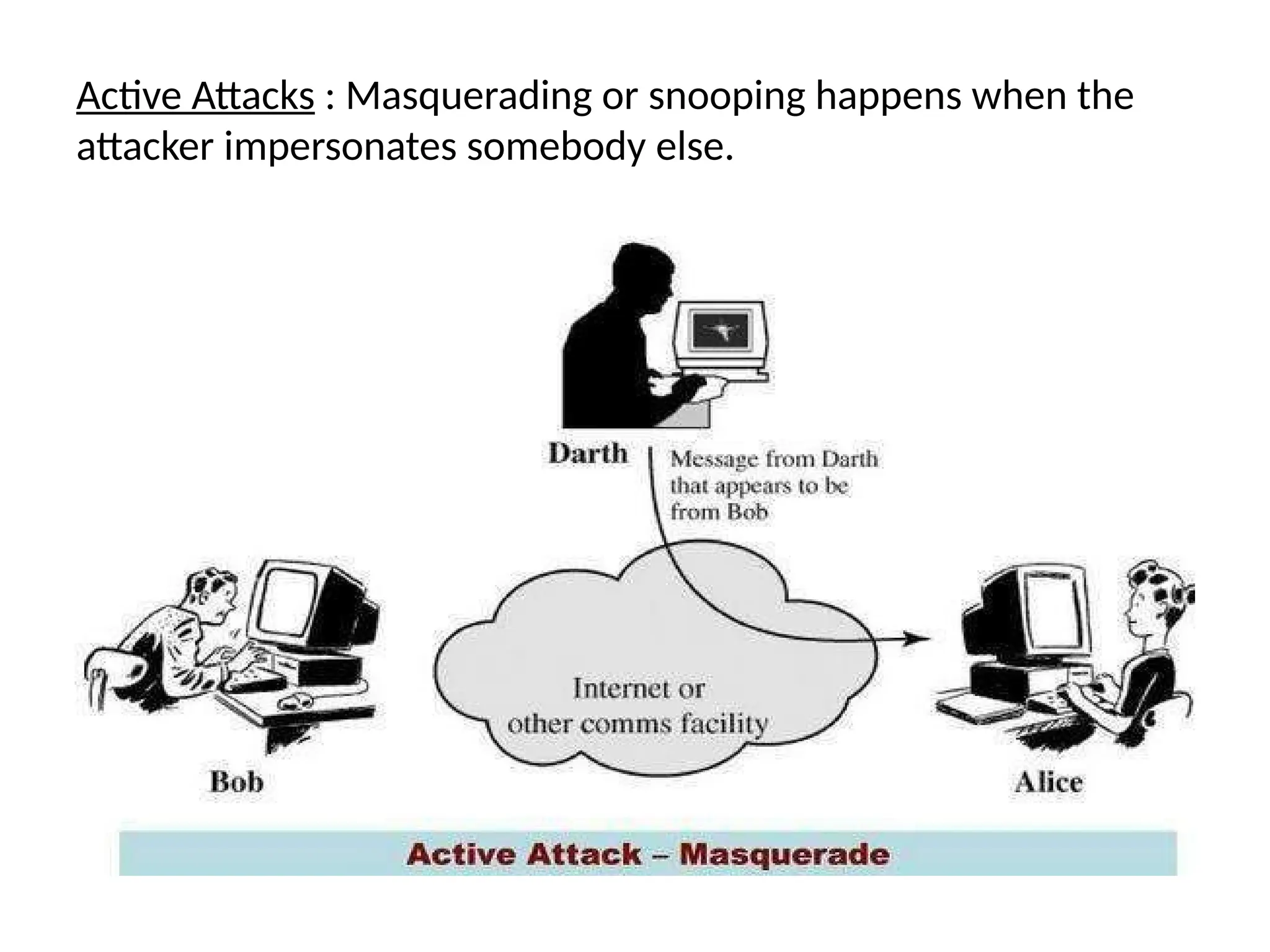
Active Attacks : Masquerading or snooping happens when the
attacker impersonates somebody else.
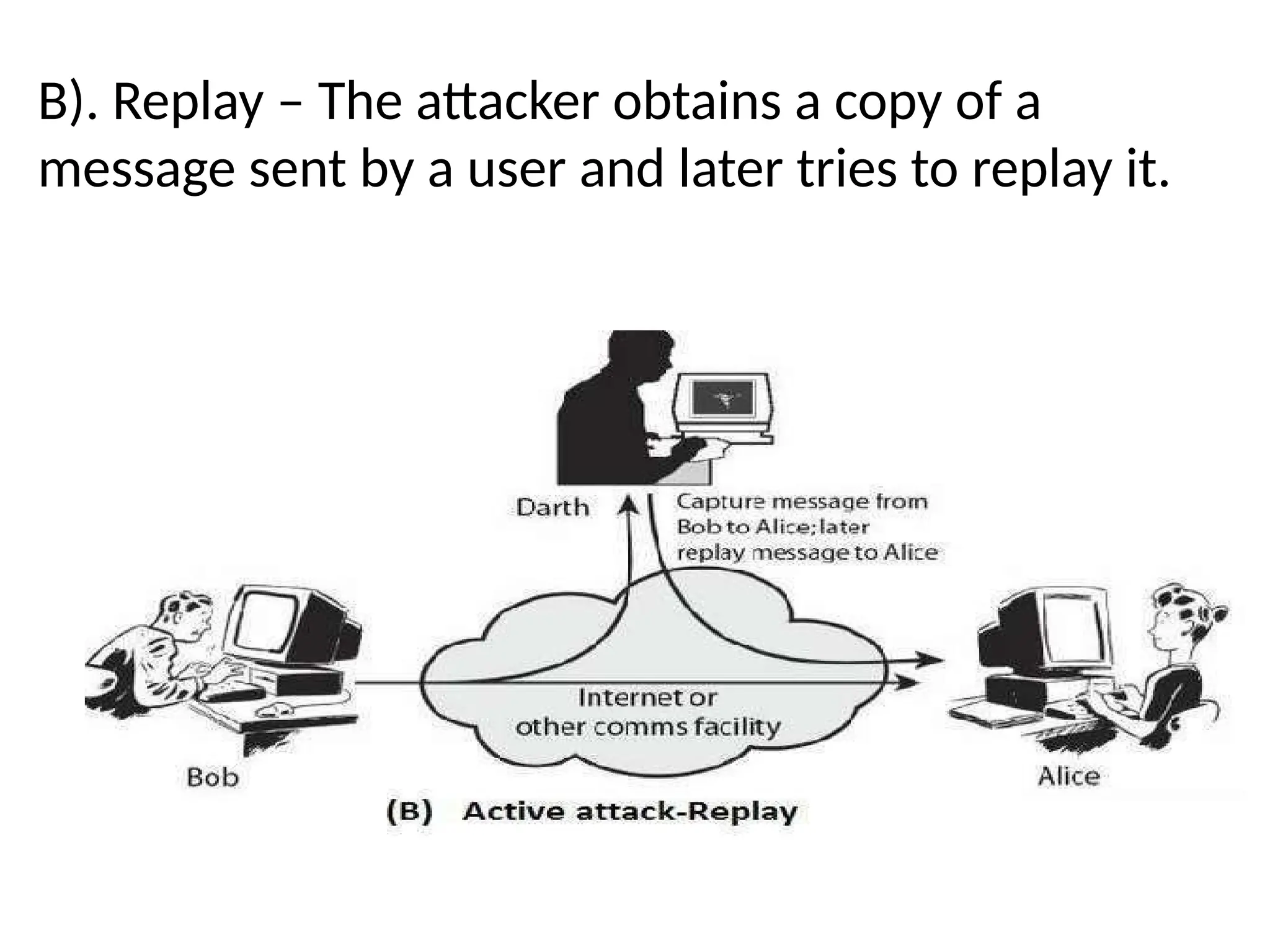
B). Replay – The attacker obtains a copy of a
message sent by a user and later tries to replay it.
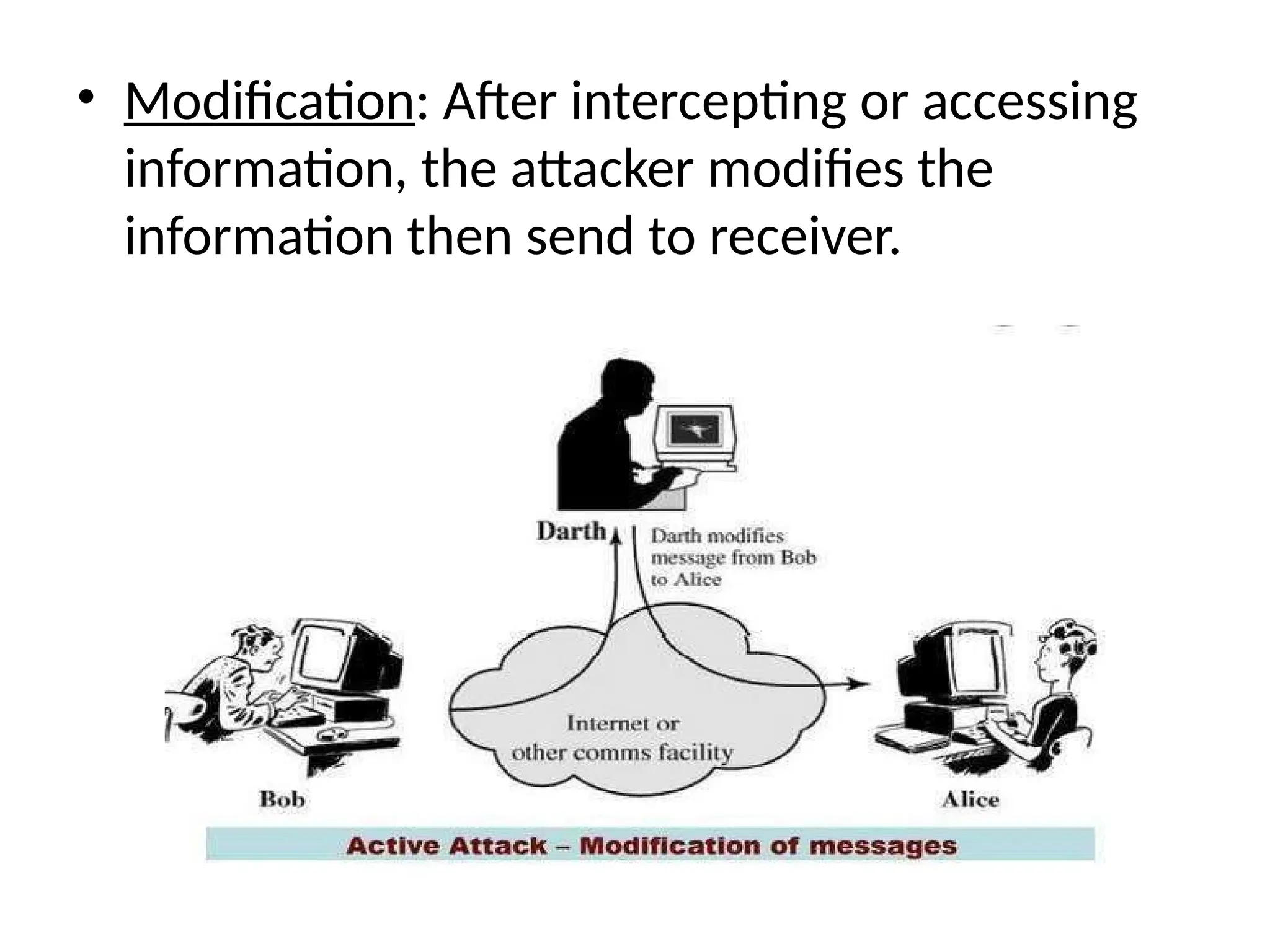
• Modification: After intercepting or accessing
information, the attacker modifies the
information then send to receiver.
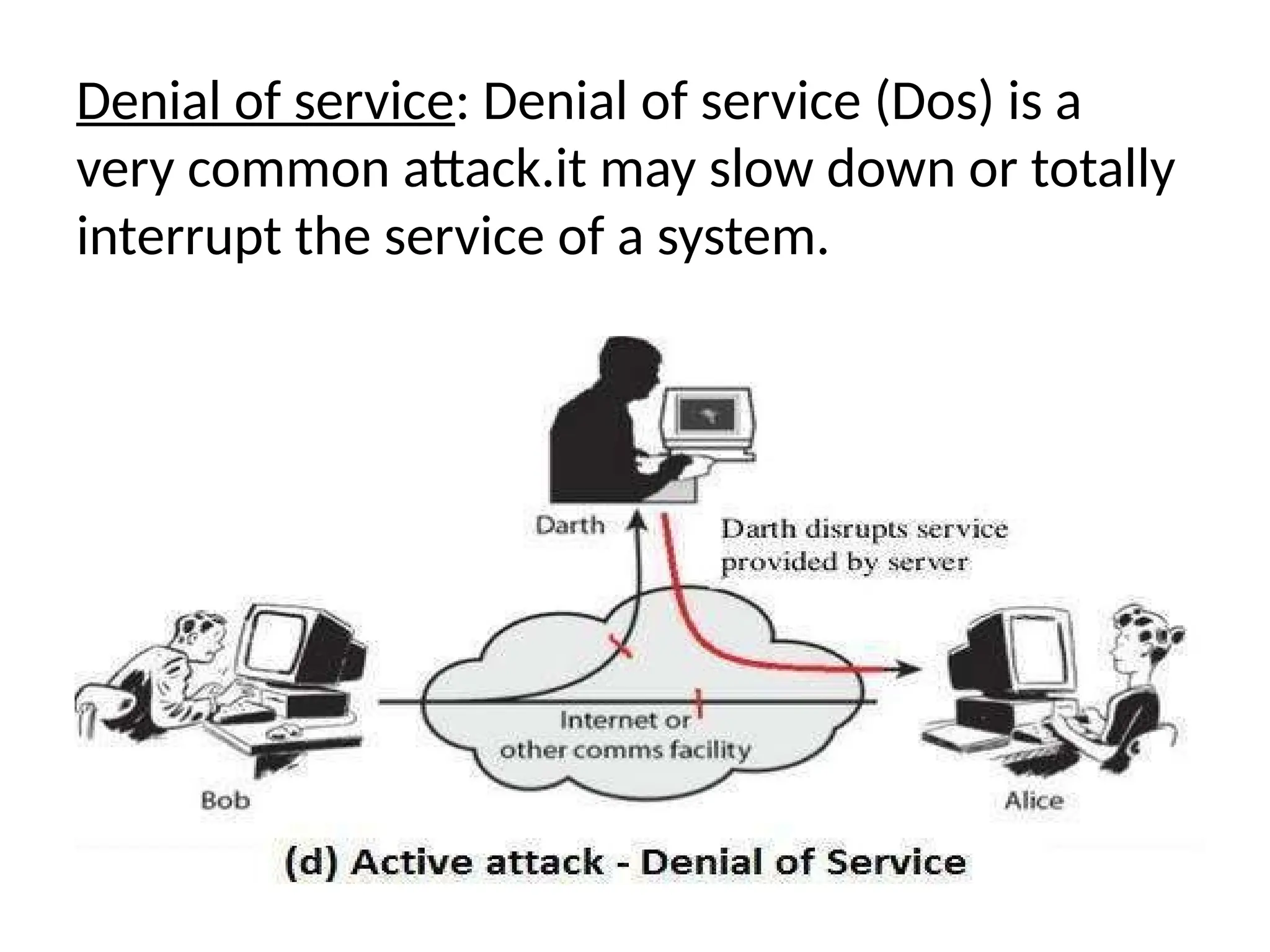
Denial of service: Denial of service (Dos) is a
very common attack.it may slow down or totally
interrupt the service of a system.
Cryptographic Attacks Categories
Cryptographic attacks can be broadly categorized into two distinct
types:
Cryptanalytic
Non-Cryptanalytic
Cryptanalytic Attacks:
These attacks are combinations of statistical and algebraic techniques
aimed to discover the secret key of a cipher.
The attacker thus guesses the key and looks for the distinguishing
property. if the property is detected, the guess is correct otherwise
the next guess is tried.
Non-Cryptanalytic Attacks:
The other types of attacks are non-cryptanalytic attacks, which do not
explain the mathematical weakness of the cryptographic algorithm.
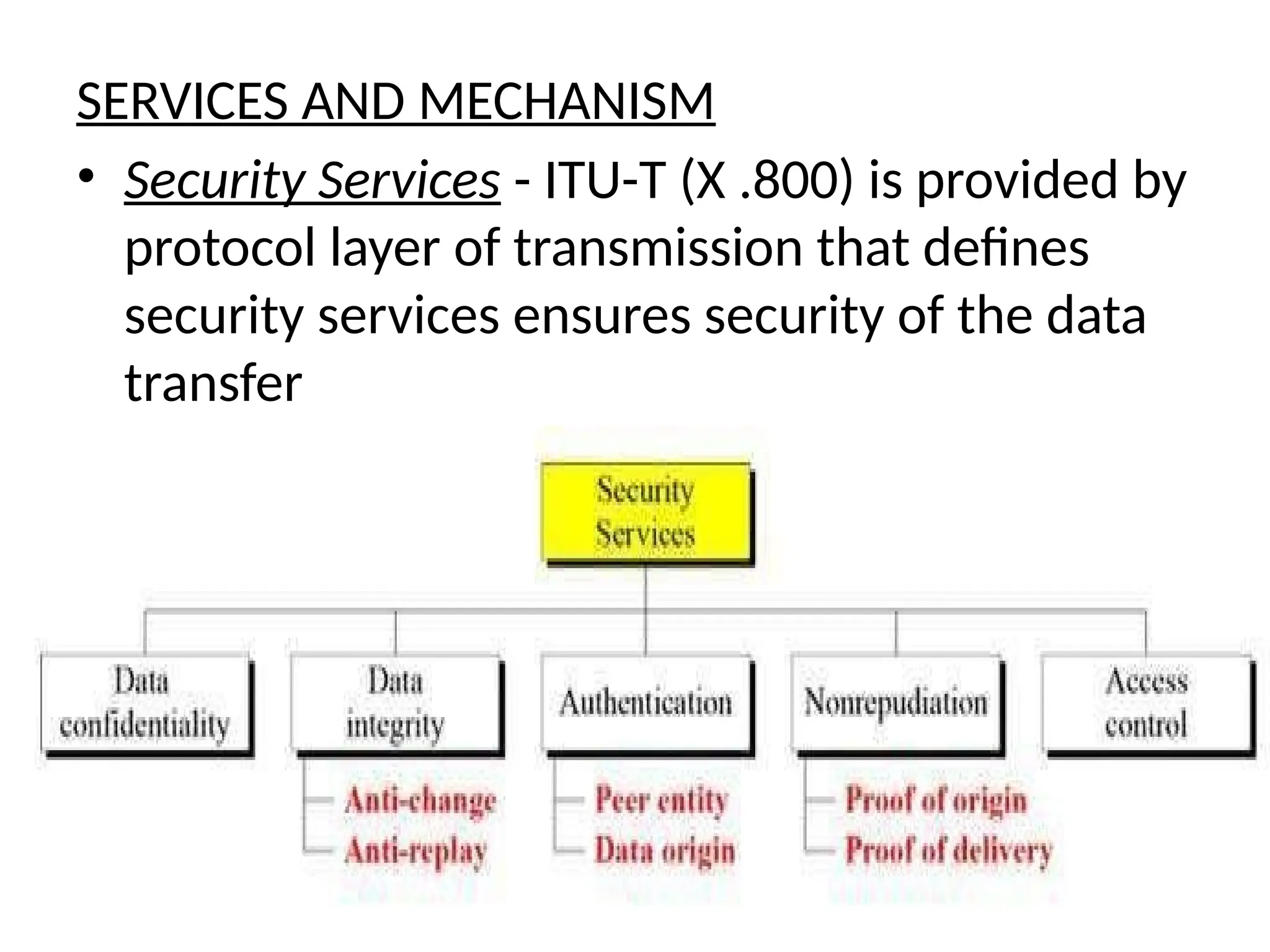
SERVICES AND MECHANISM
• Security Services - ITU-T (X .800) is provided by
protocol layer of transmission that defines
security services ensures security of the data
transfer
Security Services
Data Confidentiality: It is designed to protect data
from disclosure attack. It is designed to prevent
snooping and traffic analysis attack.
Data Integrity: It is designed to protect data from
modification, insertion, deletion and replaying by
an adversary
Authentication: It provides the authentication of
the party at the other end of the line.
Non-repudiation: It protects against repudiation
by either the sender or the receiver of the data.
Access Control: It provides protection against
unauthorized access to data
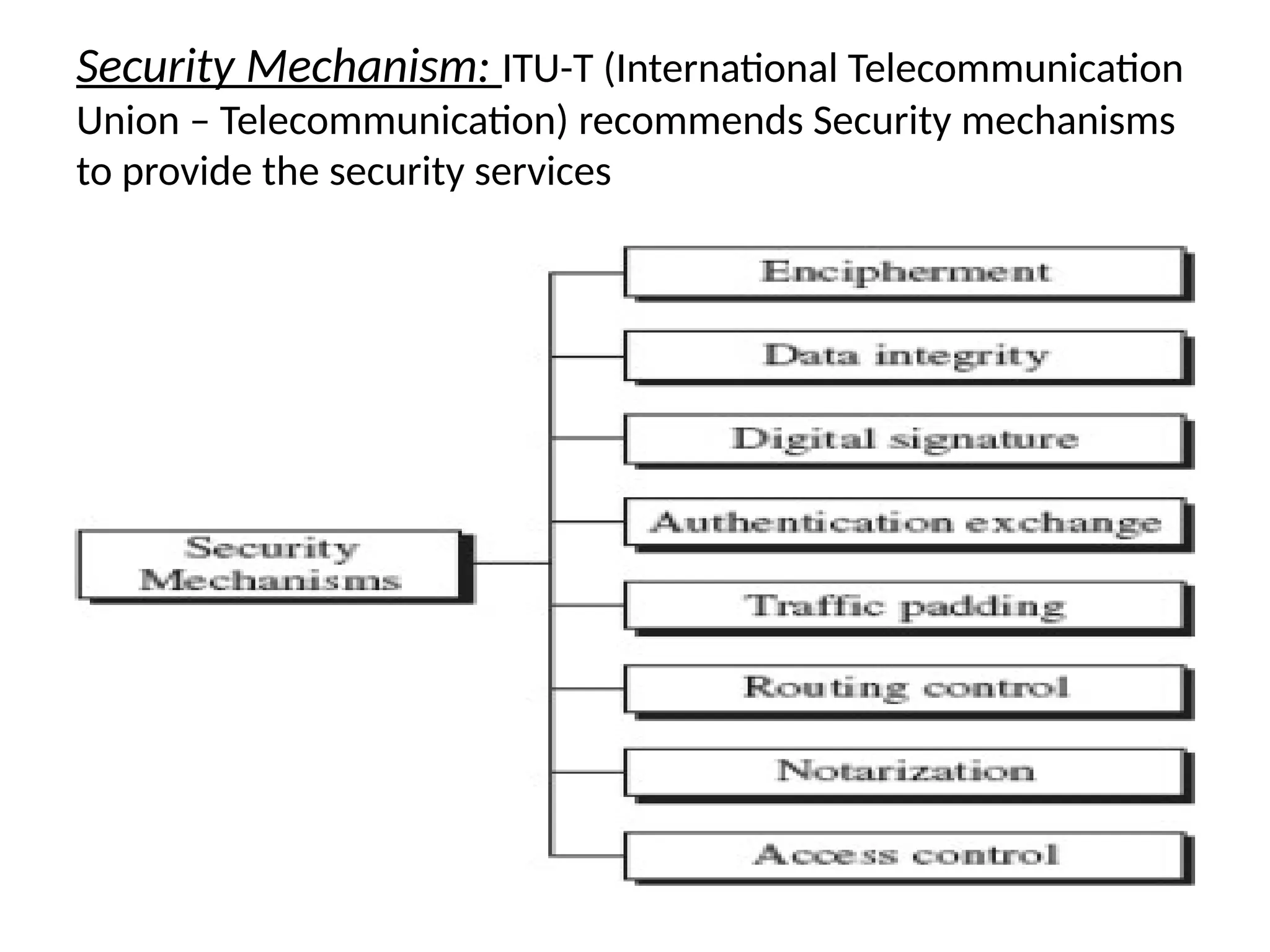
Security Mechanism: ITU-T (International Telecommunication
Union – Telecommunication) recommends Security mechanisms
to provide the security services
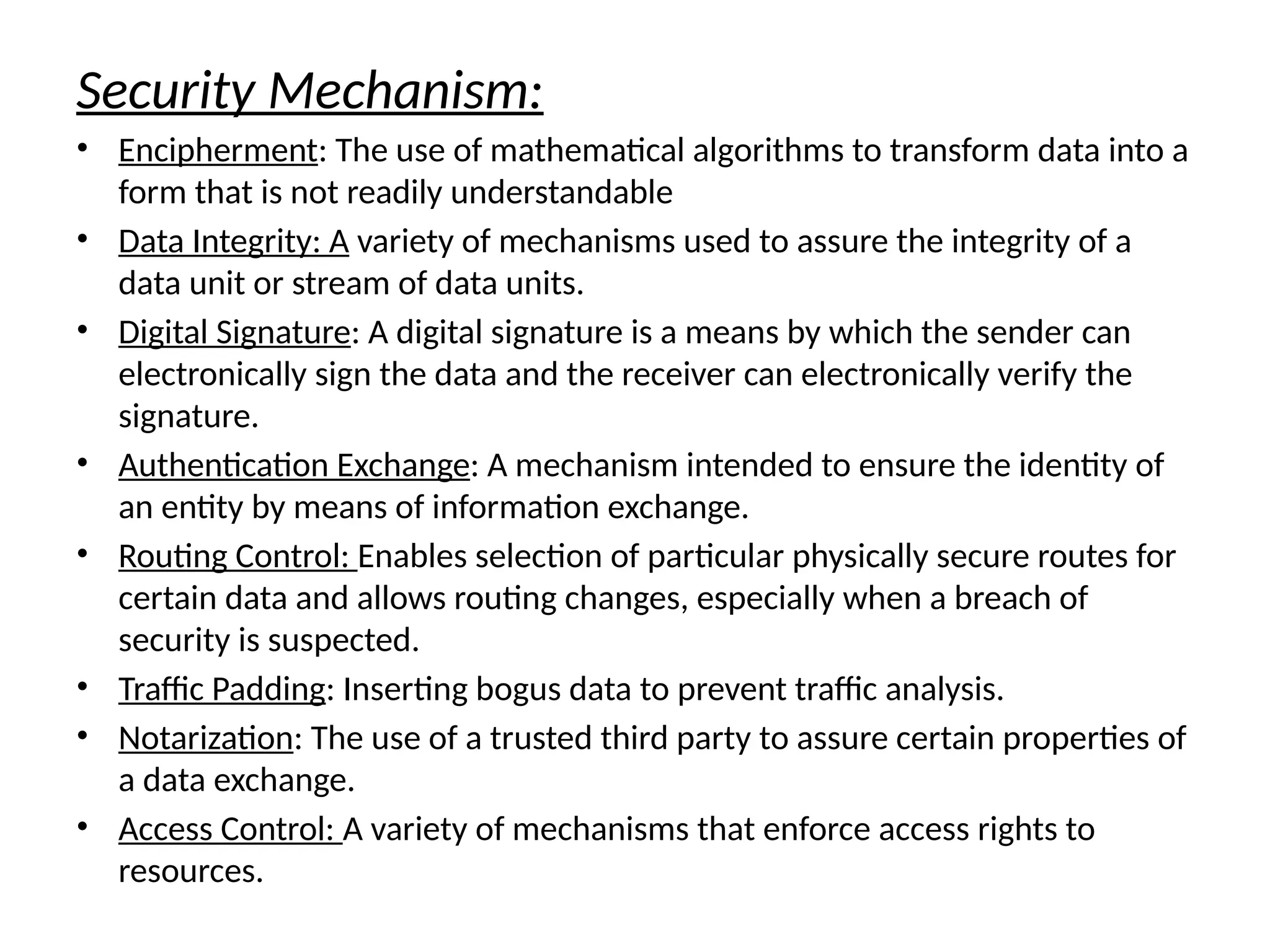
Security Mechanism:
• Encipherment: The use of mathematical algorithms to transform data into a
form that is not readily understandable
• Data Integrity: A variety of mechanisms used to assure the integrity of a
data unit or stream of data units.
• Digital Signature: A digital signature is a means by which the sender can
electronically sign the data and the receiver can electronically verify the
signature.
• Authentication Exchange: A mechanism intended to ensure the identity of
an entity by means of information exchange.
• Routing Control: Enables selection of particular physically secure routes for
certain data and allows routing changes, especially when a breach of
security is suspected.
• Traffic Padding: Inserting bogus data to prevent traffic analysis.
• Notarization: The use of a trusted third party to assure certain properties of
a data exchange.
• Access Control: A variety of mechanisms that enforce access rights to
resources.
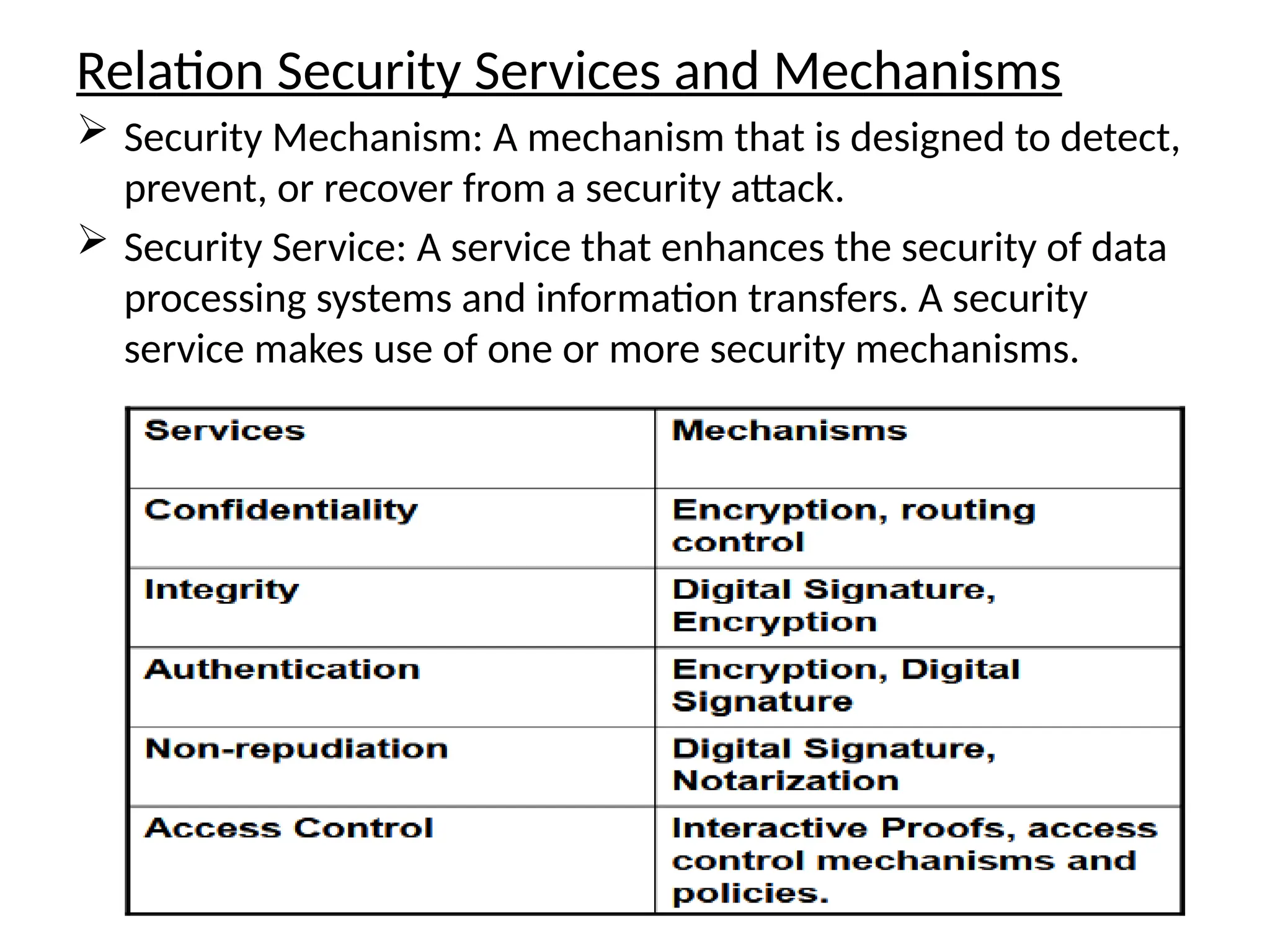
Relation Security Services and Mechanisms
 Security Mechanism: A mechanism that is designed to detect,
prevent, or recover from a security attack.
 Security Service: A service that enhances the security of data
processing systems and information transfers. A security
service makes use of one or more security mechanisms.
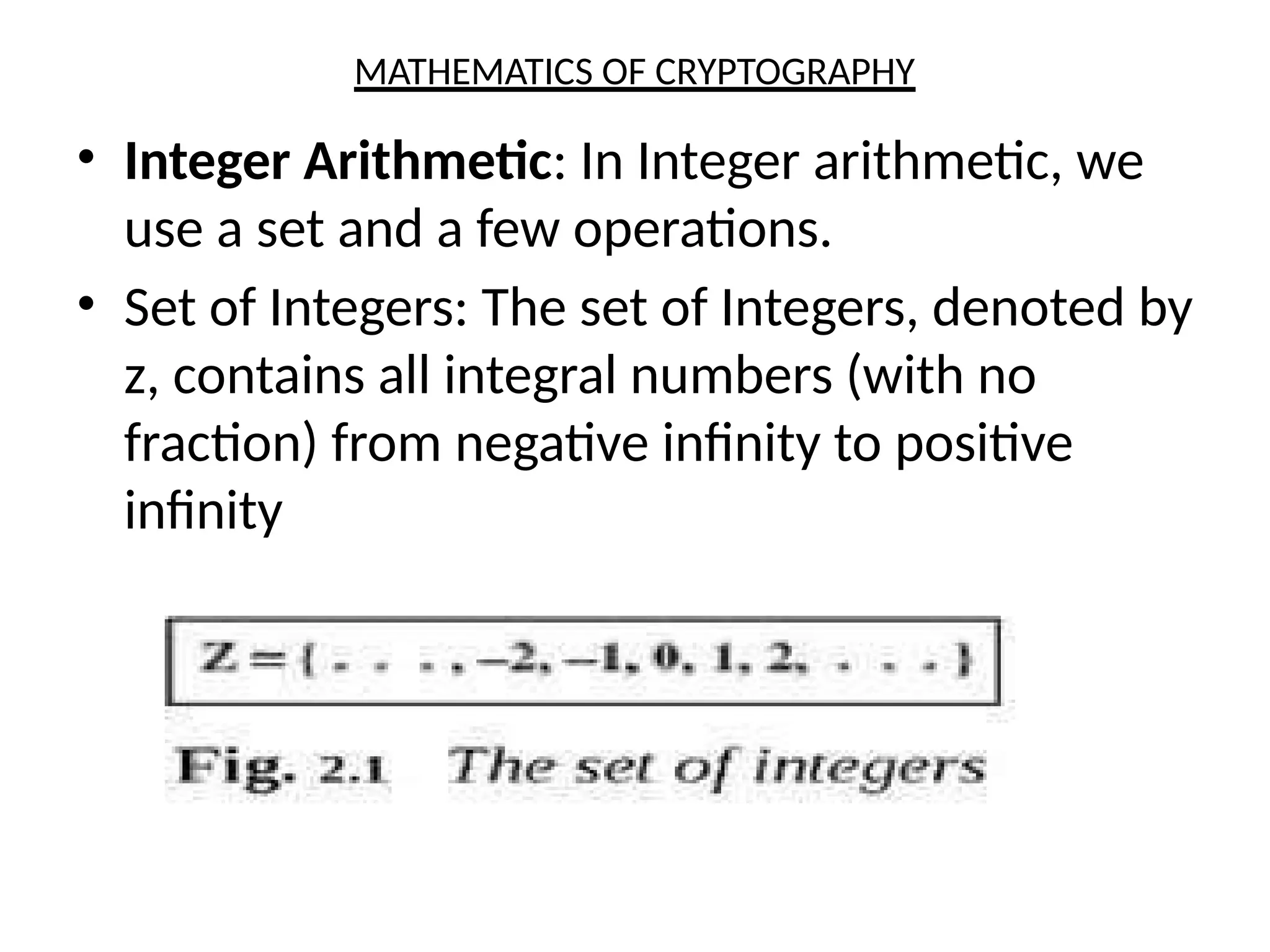
MATHEMATICS OF CRYPTOGRAPHY
• Integer Arithmetic: In Integer arithmetic, we
use a set and a few operations.
• Set of Integers: The set of Integers, denoted by
z, contains all integral numbers (with no
fraction) from negative infinity to positive
infinity
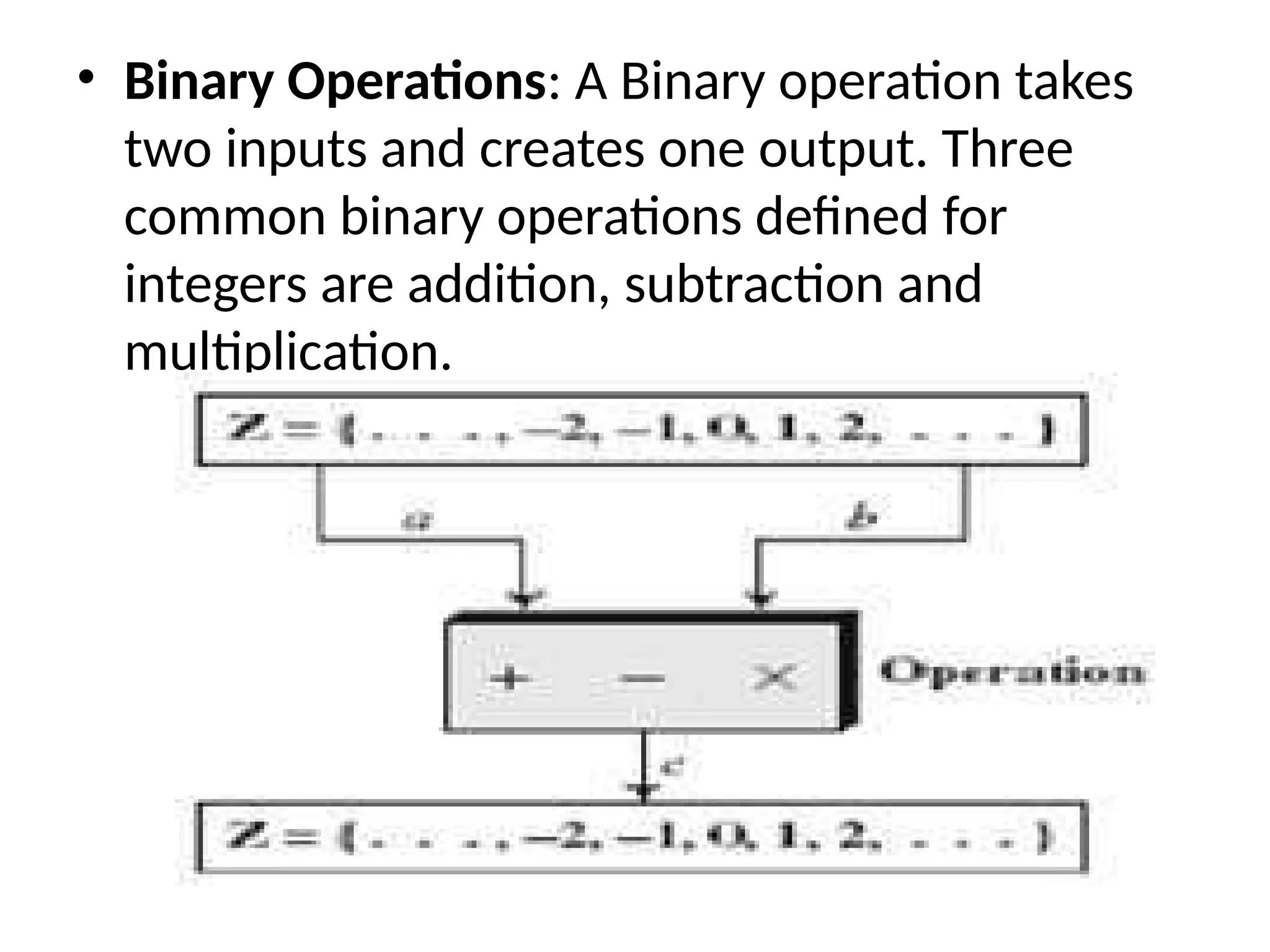
• Binary Operations: A Binary operation takes
two inputs and creates one output. Three
common binary operations defined for
integers are addition, subtraction and
multiplication.
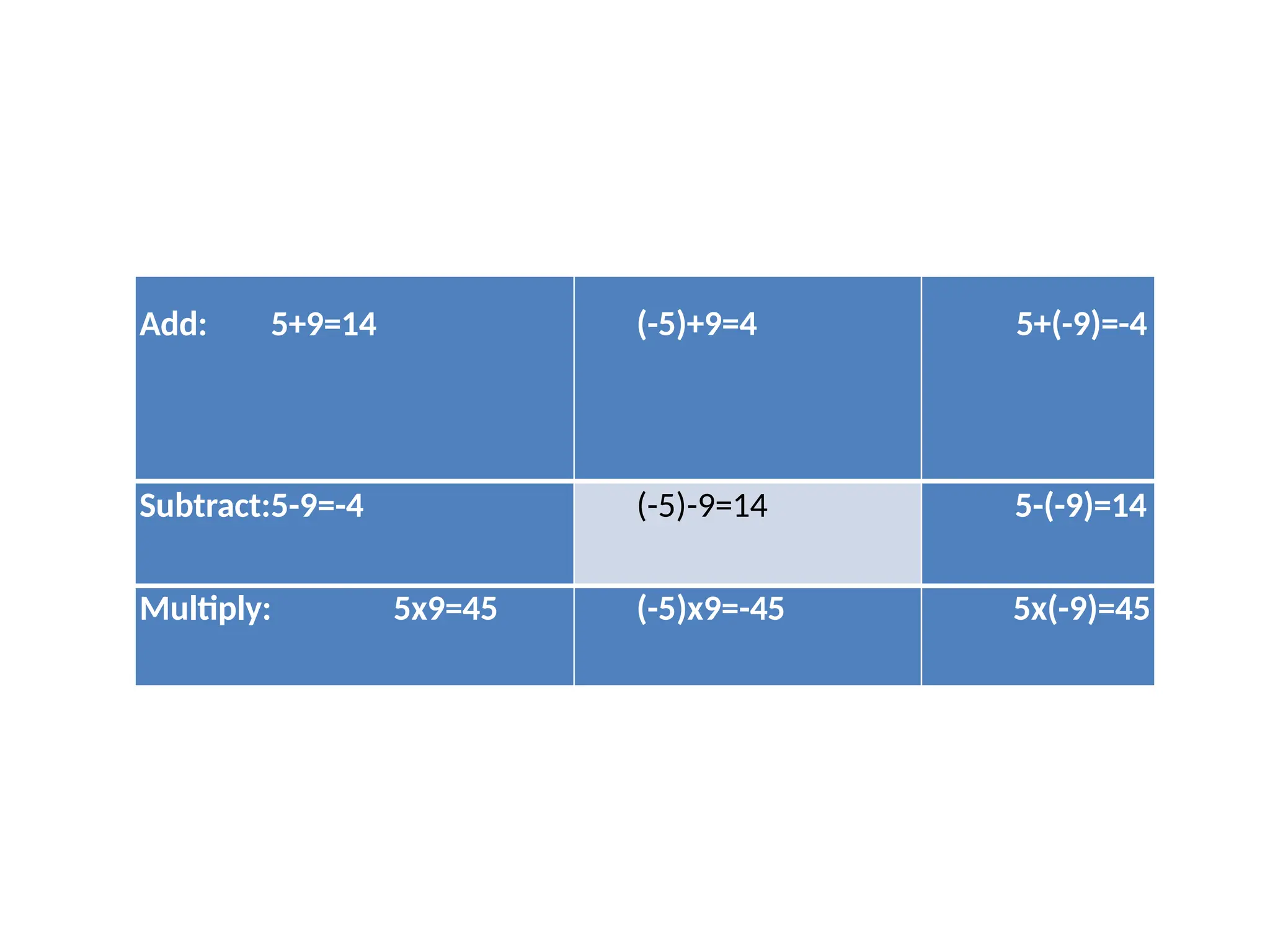
Add: 5+9=14 (-5)+9=4 5+(-9)=-4
Subtract:5-9=-4 (-5)-9=14 5-(-9)=14
Multiply: 5x9=45 (-5)x9=-45 5x(-9)=45
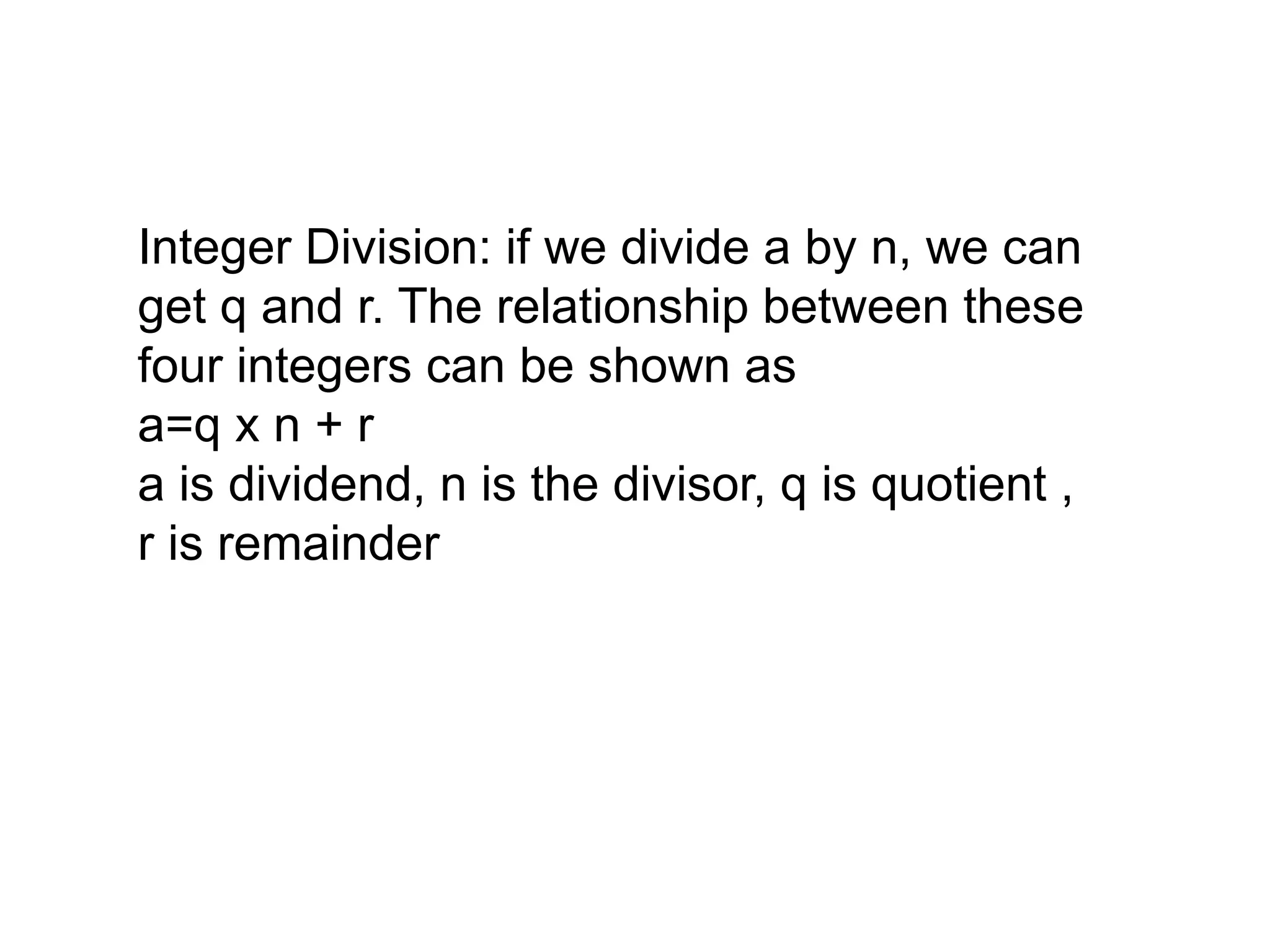
Integer Division: if we divide a by n, we can
get q and r. The relationship between these
four integers can be shown as
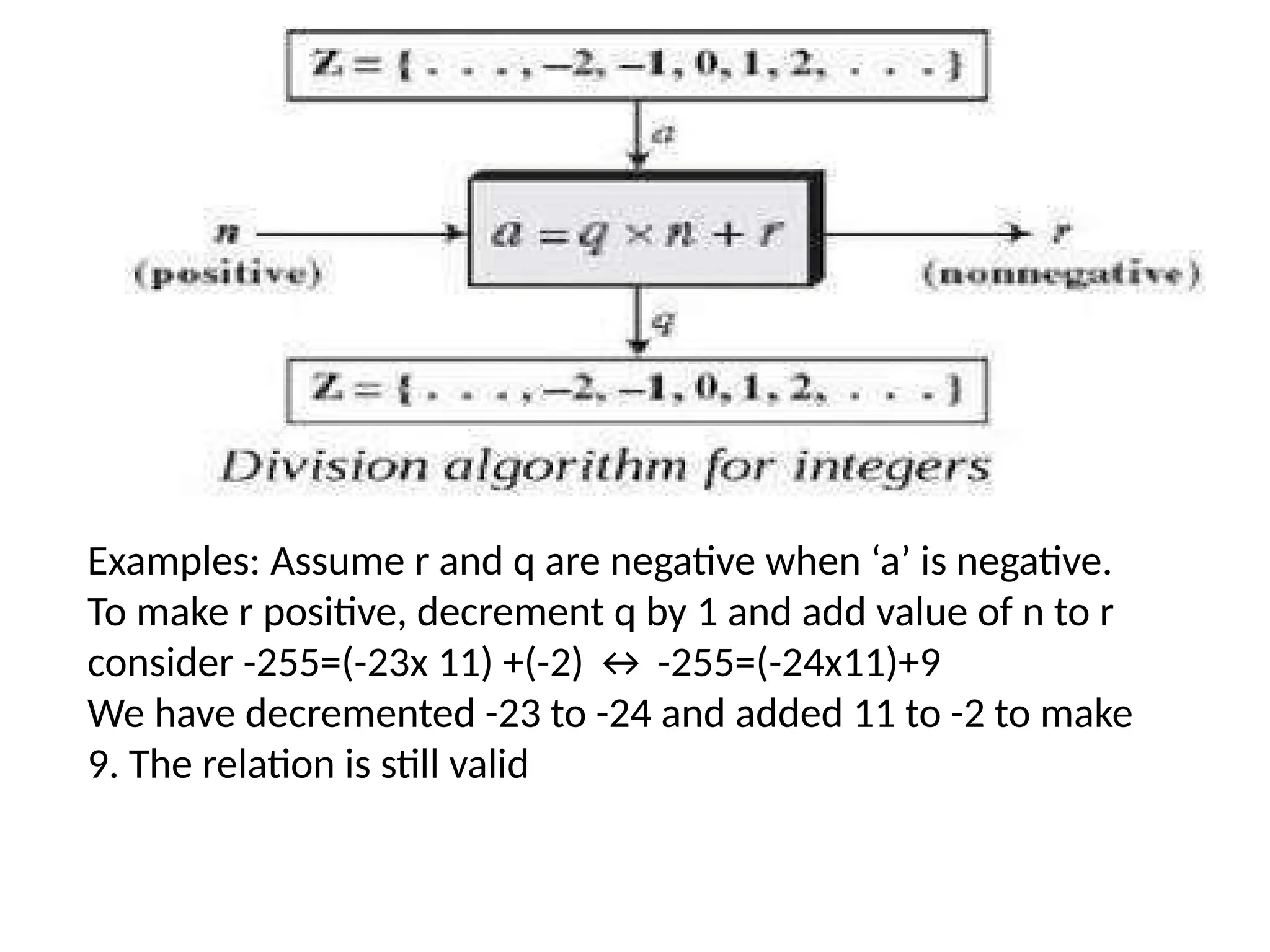
a=q x n + r
a is dividend, n is the divisor, q is quotient ,
r is remainder
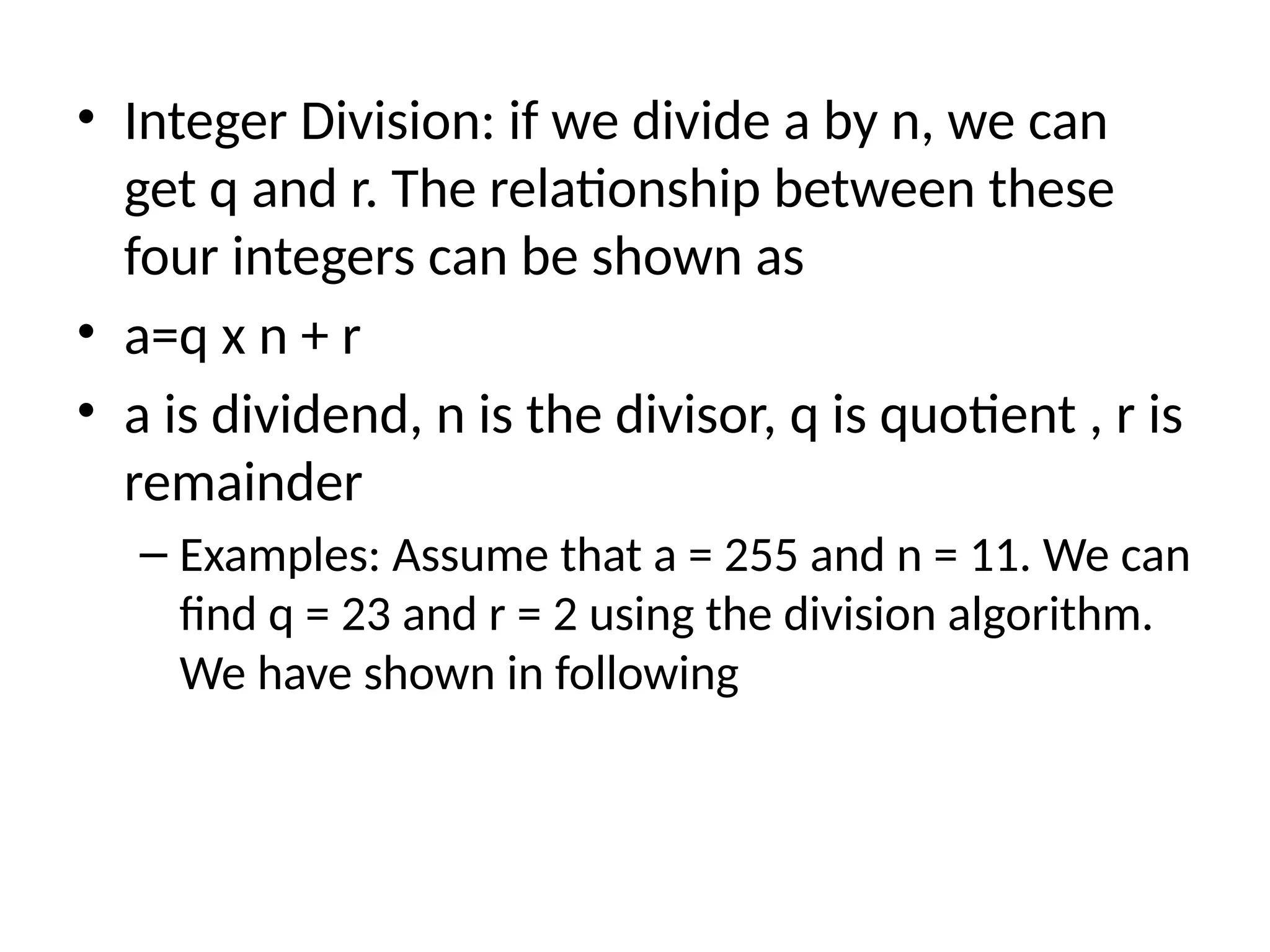
• Integer Division: if we divide a by n, we can
get q and r. The relationship between these
four integers can be shown as
• a=q x n + r
• a is dividend, n is the divisor, q is quotient , r is
remainder
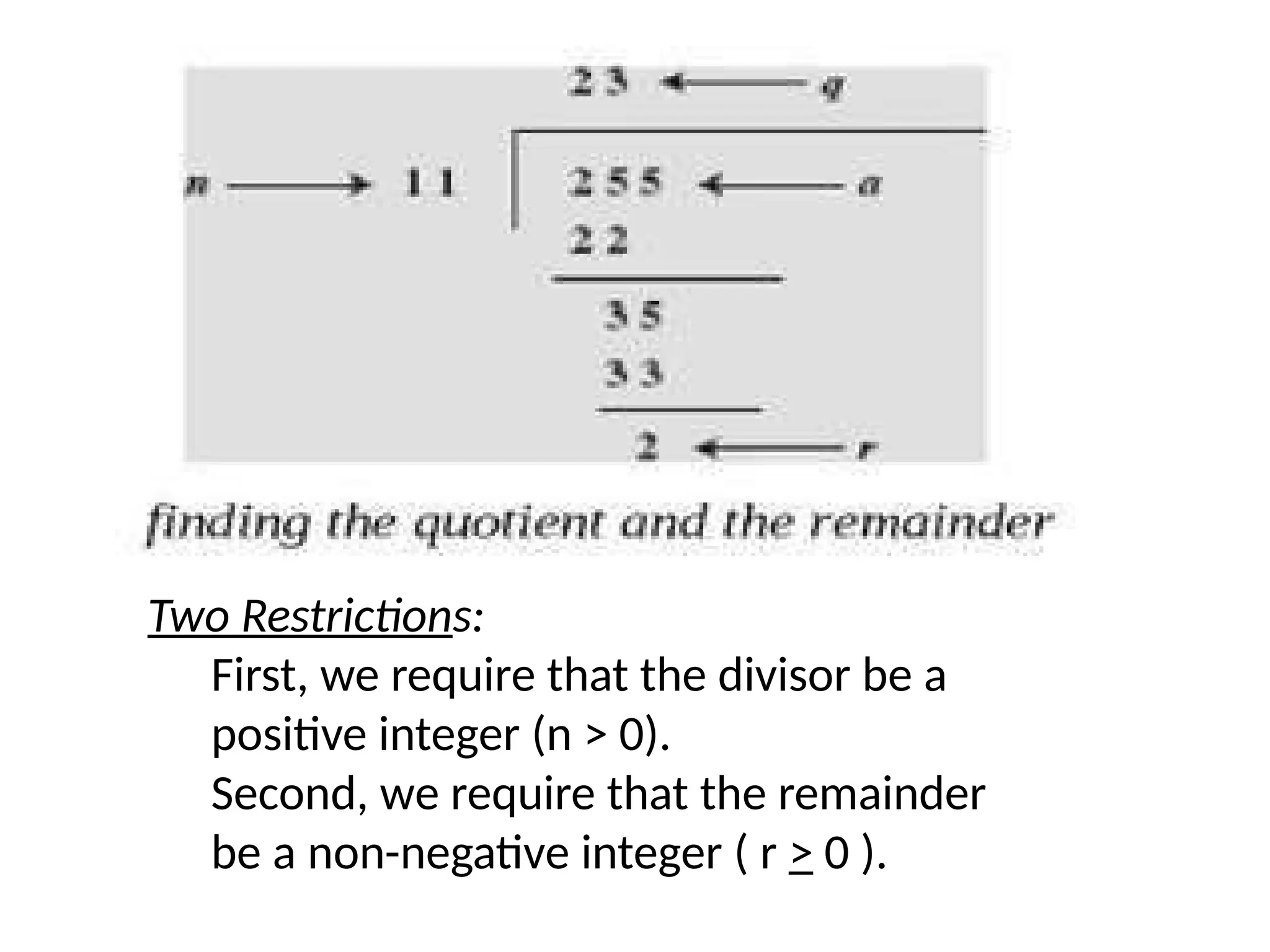
– Examples: Assume that a = 255 and n = 11. We can
find q = 23 and r = 2 using the division algorithm.
We have shown in following
Two Restrictions:
First, we require that the divisor be a
positive integer (n > 0).
Second, we require that the remainder
be a non-negative integer ( r > 0 ).
Examples: Assume r and q are negative when ‘a’ is negative.
To make r positive, decrement q by 1 and add value of n to r
consider -255=(-23x 11) +(-2) ↔ -255=(-24x11)+9
We have decremented -23 to -24 and added 11 to -2 to make
9. The relation is still valid
Divisibility:
• If a is not zero and we let r = 0 in the division relation,
we get a = q x n
• We then say that n divides a ( or n is a divisor of a ).
We can also say that a is divisible by n. The above is n
| a
• If the remainder is not zero, then n does not divide a
and we can write the relationship as a + n.
• Examples: The integer 4 divides the integer 32
because 32 = 8 x 4. We show this is as 4 |32
• The number 8 does not divide the number 42
because 42 = 5 x 8 + 2. There is a remainder, the
number 2, in the equation.
• We show this as 8 + 42.
Examples:
• Since 3 | 15 and 15 | 45, according to third
property, 3 | 45
• Since 3 | 15 and 3 | 9, according to the fourth
property, 3 |(15 x 2 + 9 x 4), which means 3 |
66.
Greatest Common Divisor(GCD)
• The greatest common divisor of two positive integers is the largest
integer that can divide both integers we can write the relationship
as a + n.
• Examples: GCD of 15 and 20 is 2 because divisors of 15 are 3,5 and
divisors of 20 are 2,4,5,10. The
• GCD is 5
– Euclidean Algorithm:
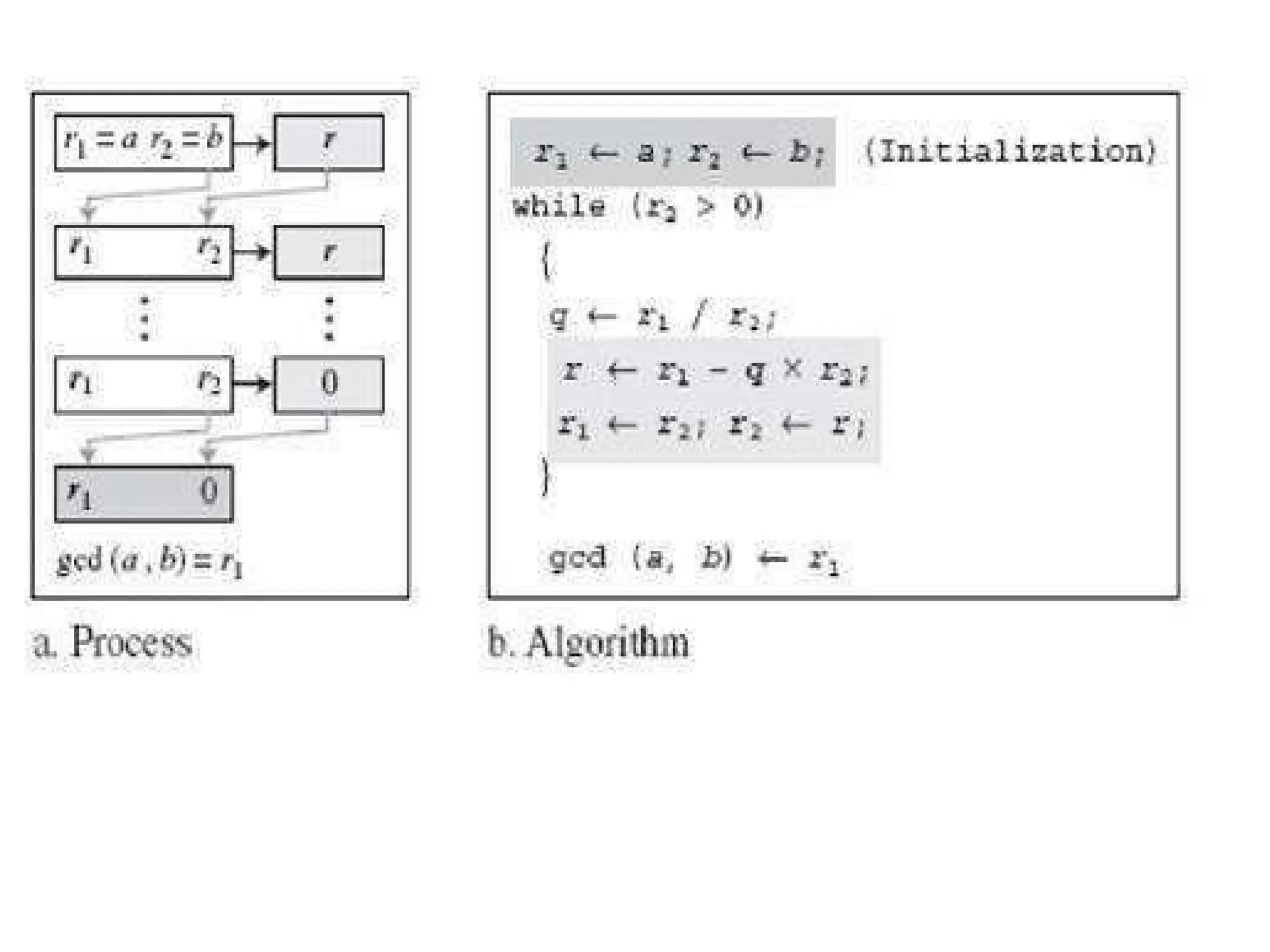
– Euclidean algorithm is used to finding the greatest common
divisor (gcd) of two positive integers. The Euclidean algorithm is
based on the following two facts
• Fact 1: gcd ( a, 0 ) = a
• Fact 2: gcd ( a, b ) = gcd ( b , r ), where r is the remainder of
dividing a by b
• When gcd ( a, b ) = 1, we say that a and b are relatively prime.
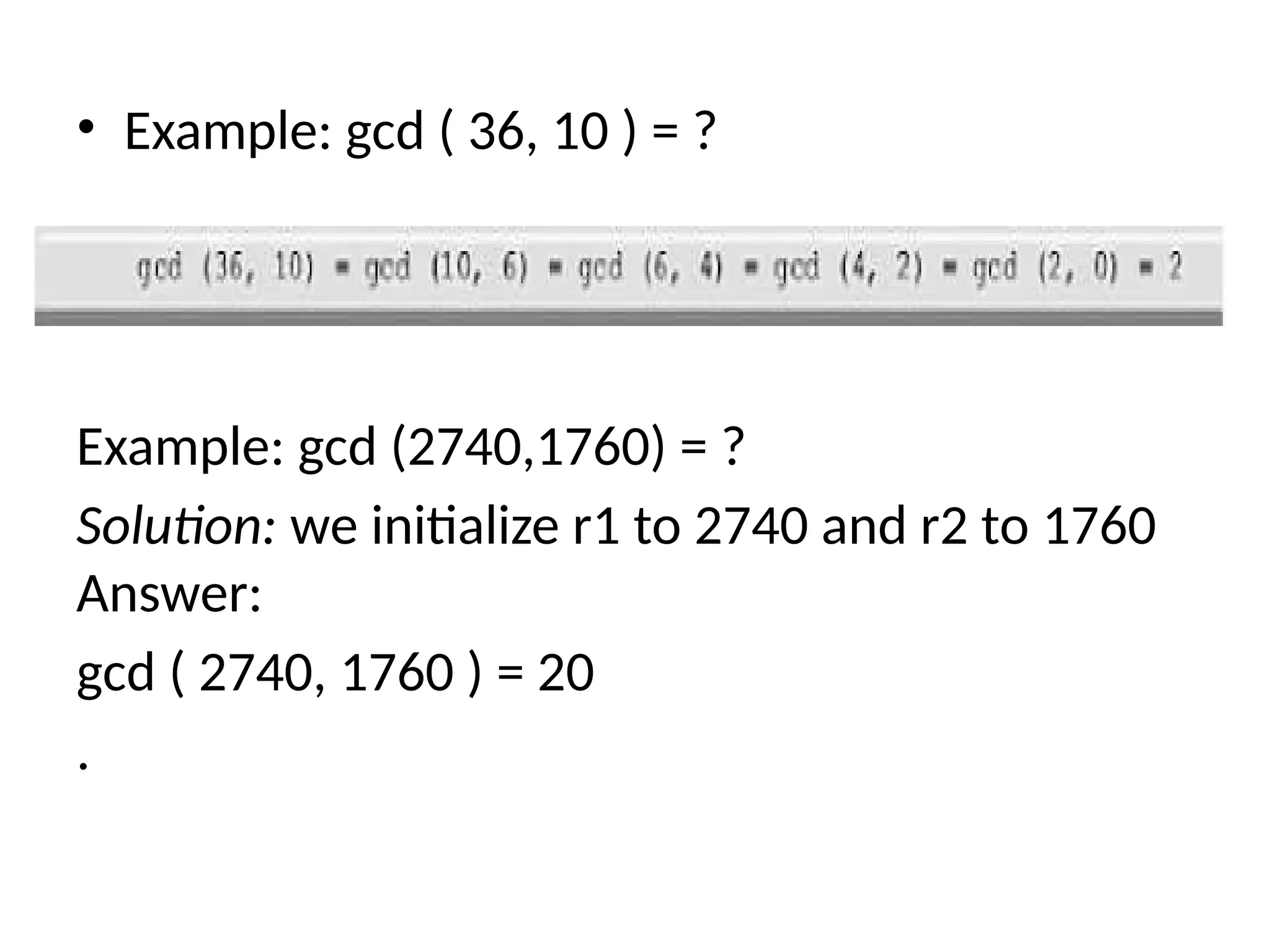
• Example: gcd ( 36, 10 ) = ?
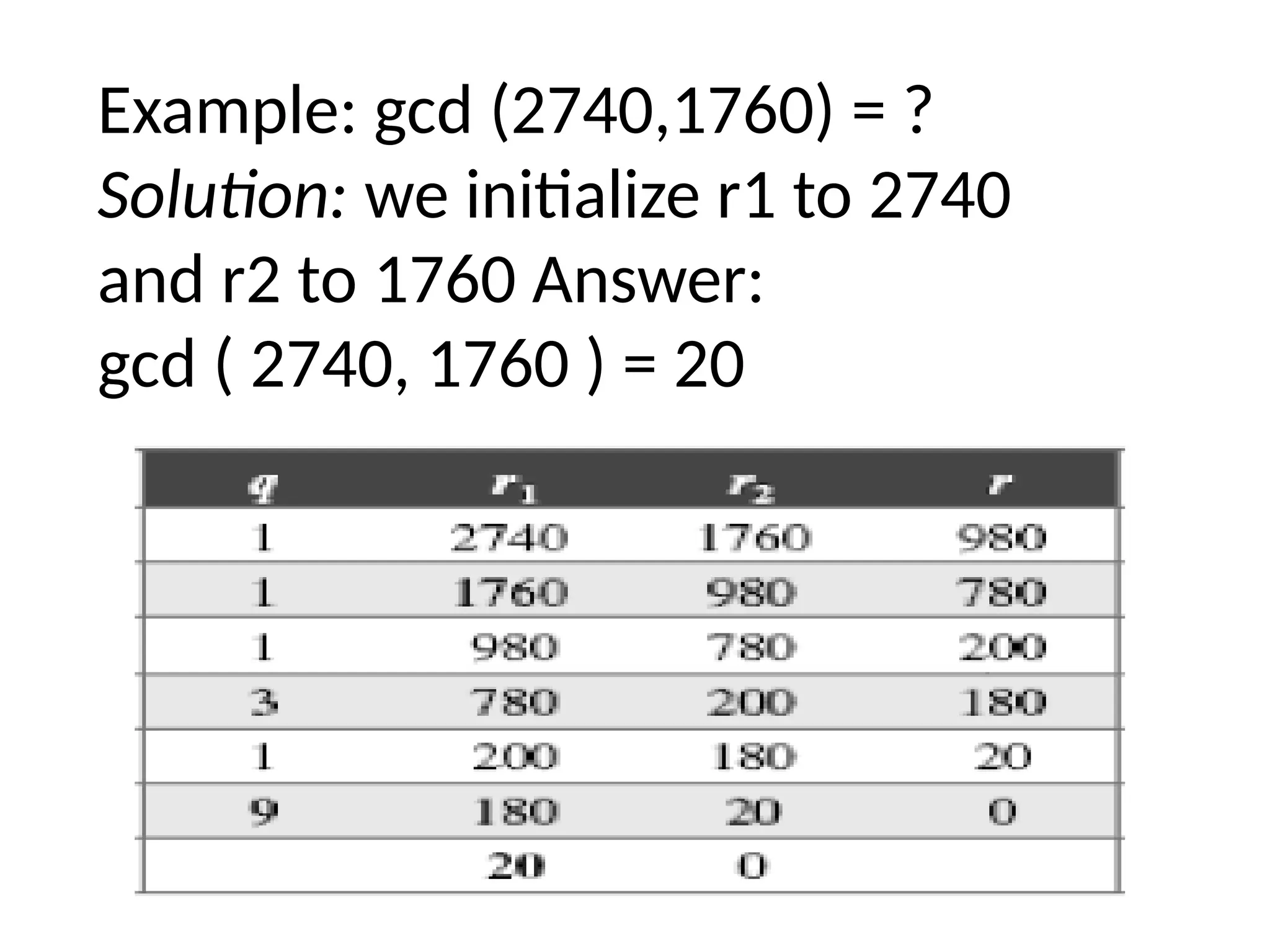
Example: gcd (2740,1760) = ?
Solution: we initialize r1 to 2740 and r2 to 1760
Answer:
gcd ( 2740, 1760 ) = 20
.
Example: gcd (2740,1760) = ?
Solution: we initialize r1 to 2740
and r2 to 1760 Answer:
gcd ( 2740, 1760 ) = 20
• Extended Euclidean Algorithm
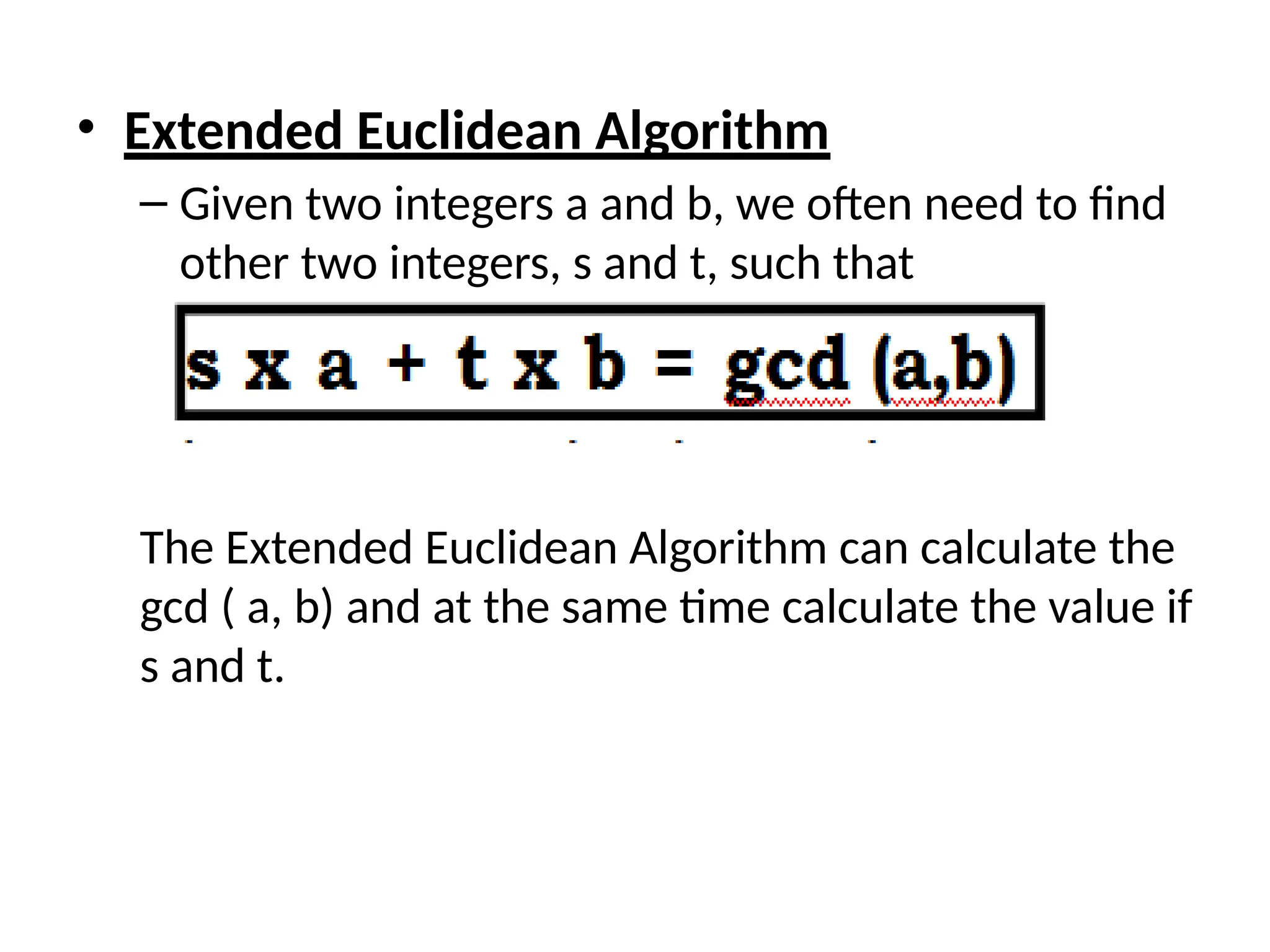
– Given two integers a and b, we often need to find
other two integers, s and t, such that
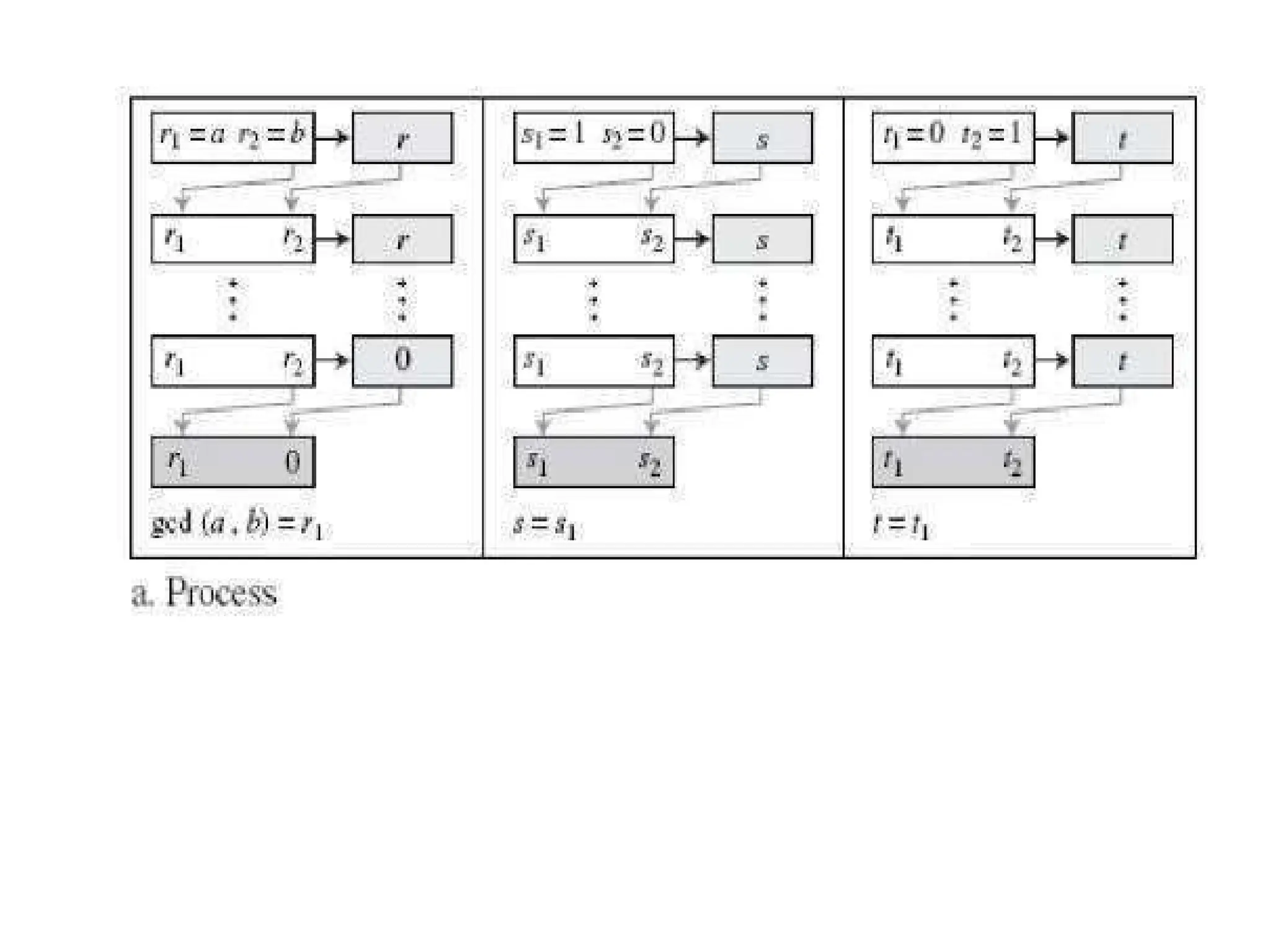
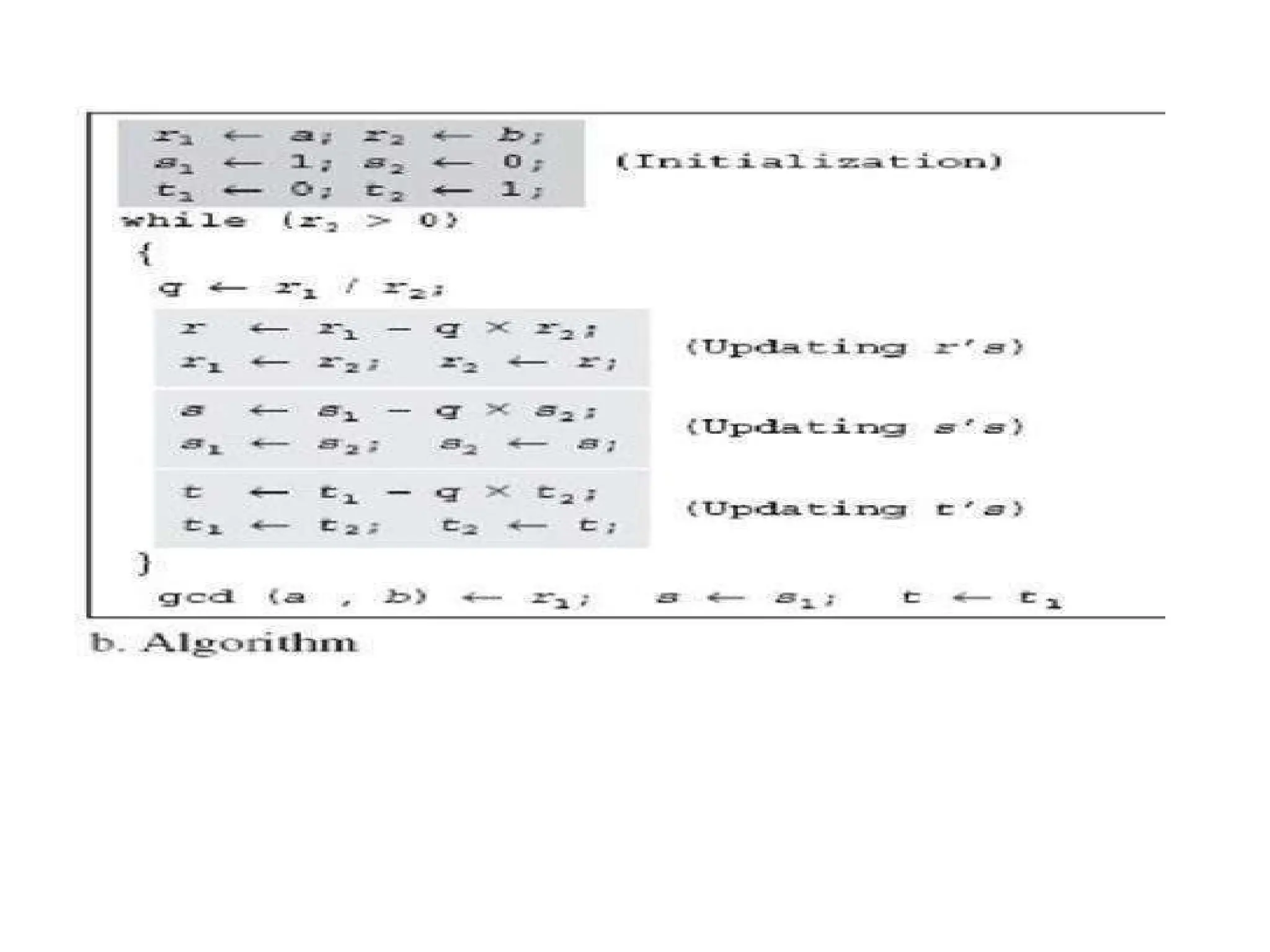
The Extended Euclidean Algorithm can calculate the
gcd ( a, b) and at the same time calculate the value if
s and t.
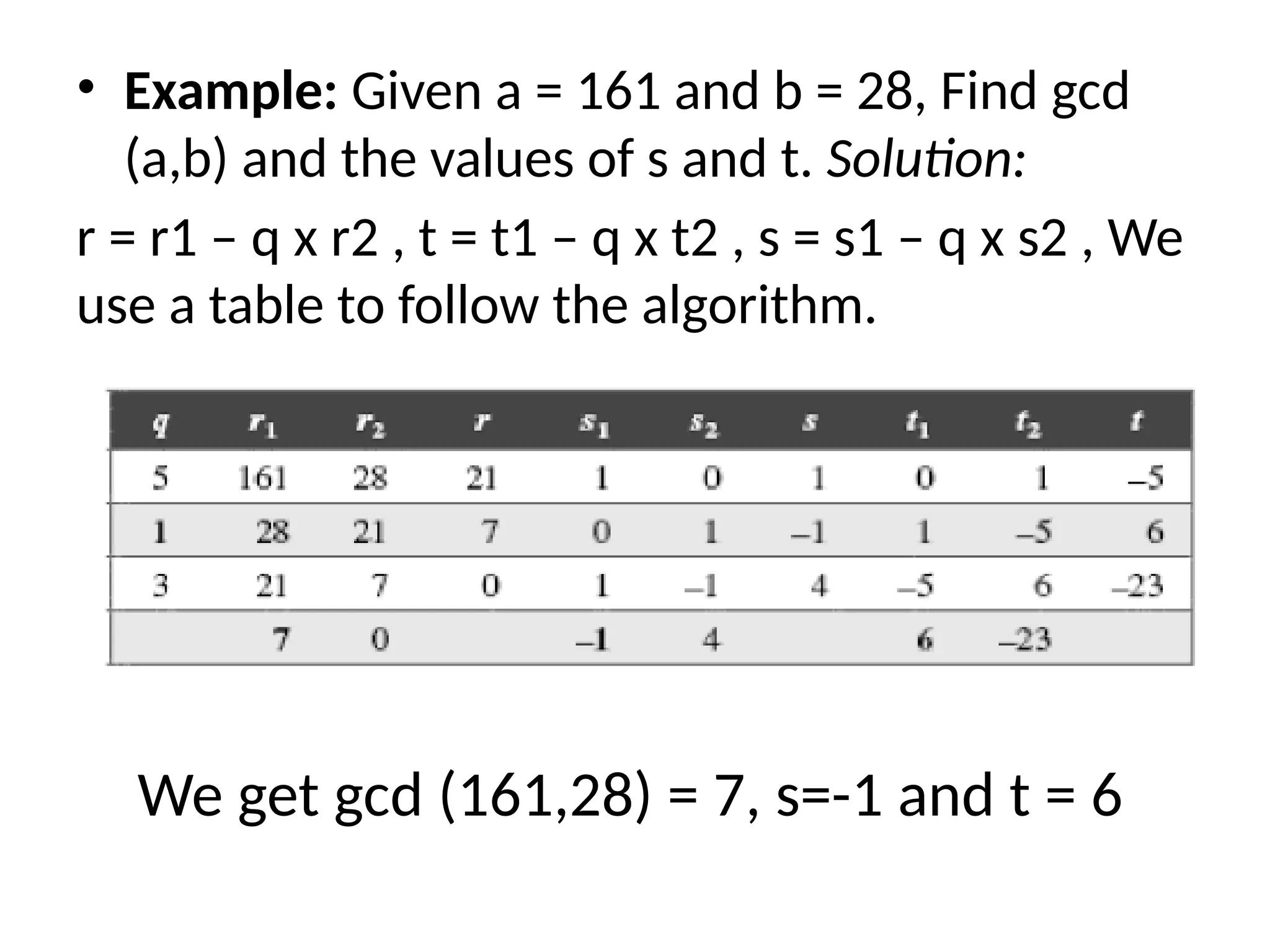
• Example: Given a = 161 and b = 28, Find gcd
(a,b) and the values of s and t. Solution:
r = r1 – q x r2 , t = t1 – q x t2 , s = s1 – q x s2 , We
use a table to follow the algorithm.
We get gcd (161,28) = 7, s=-1 and t = 6

RC CNS UNIT I.pptx introduction to cnstopics

  • 1.
    UNIT –I Security Goals CryptographicAttacks Services and Mechanisms Mathematics of Cryptography
  • 2.
    WHAT IS CRYPTOGRAPHY? Cryptographyis the study of secure communications techniques that allow only the sender and intended recipient of a message to view its contents. The term is derived from the Greek word kryptos, which means hidden WHAT IS NETWORK SECURITY ? Network Security consists of the provisions and policies adapted by network Administrator to prevent and monitor unauthorized access, misuse, modification, or denial of a computer network and network-accessible resources. .
  • 3.
    MODEL FOR NETWORKSECURITY - TERMINOLOGY  Plaintext - the original message  Cipher text - the coded message  Cipher - algorithm for transforming plaintext to cipher text  Key - info used in cipher known only to sender/receiver  Encipher (Encrypt) - converting plaintext to cipher text  Decipher (Decrypt) - recovering cipher text from plaintext  Cryptography - study of encryption principles/methods  Cryptanalysis (code breaking) - the study of principles/ methods of deciphering cipher text without knowing key  Cryptology - the field of both cryptography and cryptanalysis
  • 5.
  • 6.
    Cryptographic Attacks  Accessingof data by unauthorized entity is called as attack Passive Attacks Active Attacks  Passive Attacks: In a passive attack, the attacker’s goal is just to obtain information. This means that the attack does not modify data or harm the system.  Active Attacks: An active attack may change the data or harm the system. Attacks that threaten the integrity and availability are active attacks
  • 7.
    Passive Attacks Release ofmessage content – Capture and read the content transmissions. Traffic Analysis– read the information, but observe the pattern determine the location and identity of communicating parties observe frequency and length of communication
  • 10.
    Active Attacks :Masquerading or snooping happens when the attacker impersonates somebody else.
  • 11.
    B). Replay –The attacker obtains a copy of a message sent by a user and later tries to replay it.
  • 12.
    • Modification: Afterintercepting or accessing information, the attacker modifies the information then send to receiver.
  • 13.
    Denial of service:Denial of service (Dos) is a very common attack.it may slow down or totally interrupt the service of a system.
  • 14.
    Cryptographic Attacks Categories Cryptographicattacks can be broadly categorized into two distinct types: Cryptanalytic Non-Cryptanalytic Cryptanalytic Attacks: These attacks are combinations of statistical and algebraic techniques aimed to discover the secret key of a cipher. The attacker thus guesses the key and looks for the distinguishing property. if the property is detected, the guess is correct otherwise the next guess is tried. Non-Cryptanalytic Attacks: The other types of attacks are non-cryptanalytic attacks, which do not explain the mathematical weakness of the cryptographic algorithm.
  • 15.
    SERVICES AND MECHANISM •Security Services - ITU-T (X .800) is provided by protocol layer of transmission that defines security services ensures security of the data transfer
  • 16.
    Security Services Data Confidentiality:It is designed to protect data from disclosure attack. It is designed to prevent snooping and traffic analysis attack. Data Integrity: It is designed to protect data from modification, insertion, deletion and replaying by an adversary Authentication: It provides the authentication of the party at the other end of the line. Non-repudiation: It protects against repudiation by either the sender or the receiver of the data. Access Control: It provides protection against unauthorized access to data
  • 17.
    Security Mechanism: ITU-T(International Telecommunication Union – Telecommunication) recommends Security mechanisms to provide the security services
  • 18.
    Security Mechanism: • Encipherment:The use of mathematical algorithms to transform data into a form that is not readily understandable • Data Integrity: A variety of mechanisms used to assure the integrity of a data unit or stream of data units. • Digital Signature: A digital signature is a means by which the sender can electronically sign the data and the receiver can electronically verify the signature. • Authentication Exchange: A mechanism intended to ensure the identity of an entity by means of information exchange. • Routing Control: Enables selection of particular physically secure routes for certain data and allows routing changes, especially when a breach of security is suspected. • Traffic Padding: Inserting bogus data to prevent traffic analysis. • Notarization: The use of a trusted third party to assure certain properties of a data exchange. • Access Control: A variety of mechanisms that enforce access rights to resources.
  • 19.
    Relation Security Servicesand Mechanisms  Security Mechanism: A mechanism that is designed to detect, prevent, or recover from a security attack.  Security Service: A service that enhances the security of data processing systems and information transfers. A security service makes use of one or more security mechanisms.
  • 20.
    MATHEMATICS OF CRYPTOGRAPHY •Integer Arithmetic: In Integer arithmetic, we use a set and a few operations. • Set of Integers: The set of Integers, denoted by z, contains all integral numbers (with no fraction) from negative infinity to positive infinity
  • 21.
    • Binary Operations:A Binary operation takes two inputs and creates one output. Three common binary operations defined for integers are addition, subtraction and multiplication.
  • 22.
    Add: 5+9=14 (-5)+9=45+(-9)=-4 Subtract:5-9=-4 (-5)-9=14 5-(-9)=14 Multiply: 5x9=45 (-5)x9=-45 5x(-9)=45
  • 23.
    Integer Division: ifwe divide a by n, we can get q and r. The relationship between these four integers can be shown as a=q x n + r a is dividend, n is the divisor, q is quotient , r is remainder
  • 24.
    • Integer Division:if we divide a by n, we can get q and r. The relationship between these four integers can be shown as • a=q x n + r • a is dividend, n is the divisor, q is quotient , r is remainder – Examples: Assume that a = 255 and n = 11. We can find q = 23 and r = 2 using the division algorithm. We have shown in following
  • 25.
    Two Restrictions: First, werequire that the divisor be a positive integer (n > 0). Second, we require that the remainder be a non-negative integer ( r > 0 ).
  • 26.
    Examples: Assume rand q are negative when ‘a’ is negative. To make r positive, decrement q by 1 and add value of n to r consider -255=(-23x 11) +(-2) ↔ -255=(-24x11)+9 We have decremented -23 to -24 and added 11 to -2 to make 9. The relation is still valid
  • 27.
    Divisibility: • If ais not zero and we let r = 0 in the division relation, we get a = q x n • We then say that n divides a ( or n is a divisor of a ). We can also say that a is divisible by n. The above is n | a • If the remainder is not zero, then n does not divide a and we can write the relationship as a + n. • Examples: The integer 4 divides the integer 32 because 32 = 8 x 4. We show this is as 4 |32 • The number 8 does not divide the number 42 because 42 = 5 x 8 + 2. There is a remainder, the number 2, in the equation. • We show this as 8 + 42.
  • 28.
    Examples: • Since 3| 15 and 15 | 45, according to third property, 3 | 45 • Since 3 | 15 and 3 | 9, according to the fourth property, 3 |(15 x 2 + 9 x 4), which means 3 | 66.
  • 29.
    Greatest Common Divisor(GCD) •The greatest common divisor of two positive integers is the largest integer that can divide both integers we can write the relationship as a + n. • Examples: GCD of 15 and 20 is 2 because divisors of 15 are 3,5 and divisors of 20 are 2,4,5,10. The • GCD is 5 – Euclidean Algorithm: – Euclidean algorithm is used to finding the greatest common divisor (gcd) of two positive integers. The Euclidean algorithm is based on the following two facts • Fact 1: gcd ( a, 0 ) = a • Fact 2: gcd ( a, b ) = gcd ( b , r ), where r is the remainder of dividing a by b • When gcd ( a, b ) = 1, we say that a and b are relatively prime.
  • 31.
    • Example: gcd( 36, 10 ) = ? Example: gcd (2740,1760) = ? Solution: we initialize r1 to 2740 and r2 to 1760 Answer: gcd ( 2740, 1760 ) = 20 .
  • 32.
    Example: gcd (2740,1760)= ? Solution: we initialize r1 to 2740 and r2 to 1760 Answer: gcd ( 2740, 1760 ) = 20
  • 33.
    • Extended EuclideanAlgorithm – Given two integers a and b, we often need to find other two integers, s and t, such that The Extended Euclidean Algorithm can calculate the gcd ( a, b) and at the same time calculate the value if s and t.
  • 36.
    • Example: Givena = 161 and b = 28, Find gcd (a,b) and the values of s and t. Solution: r = r1 – q x r2 , t = t1 – q x t2 , s = s1 – q x s2 , We use a table to follow the algorithm. We get gcd (161,28) = 7, s=-1 and t = 6