September 9, 2024
MATHEMATICS OF CRYPTOGRAPHY
PART I
MODULAR ARITHMETIC AND CONGRUENCE
September 9, 2024
Objectives
• To review integer arithmetic, concentrating on
divisibility and finding the GCD using Euclidean
algorithm.
• To understand how the extended Euclidean
algorithm can be used to solve linear Diophantine
equations.
• To solve linear congruent equations.
• To find additive and multiplicative inverses.
• To emphasize the importance of modular arithmetic
and the modulo operators, because they are
extensively used in cryptography.
September 9, 2024
Book : Cryptography and Network
security by Behrouz A. Forouzan
September 9, 2024
Integer Arithmetic
• In integer arithmetic, we use a set and a few
operations.
• Reviewed here to create a background for
modular arithmetic.
September 9, 2024
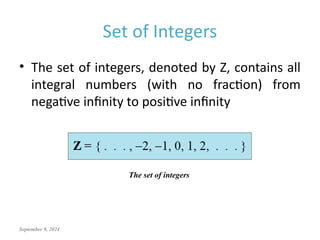
Set of Integers
• The set of integers, denoted by Z, contains all
integral numbers (with no fraction) from
negative infinity to positive infinity
The set of integers
September 9, 2024
Binary Operations
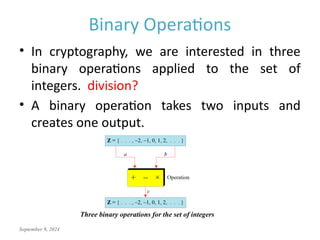
• In cryptography, we are interested in three
binary operations applied to the set of
integers. division?
• A binary operation takes two inputs and
creates one output.
The set of integers
Three binary operations for the set of integers
September 9, 2024
Integer Division
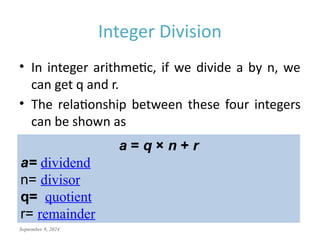
• In integer arithmetic, if we divide a by n, we
can get q and r.
• The relationship between these four integers
can be shown as
a = q × n + r
a= dividend
n= divisor
q= quotient
r= remainder
September 9, 2024
Integer Division(cont.)
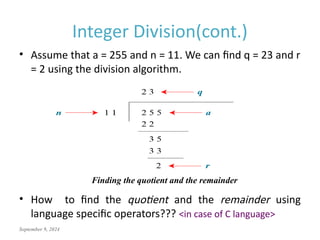
• Assume that a = 255 and n = 11. We can find q = 23 and r
= 2 using the division algorithm.
• How to find the quotient and the remainder using
language specific operators??? <in case of C language>
Finding the quotient and the remainder
September 9, 2024
Integer Division(cont.)
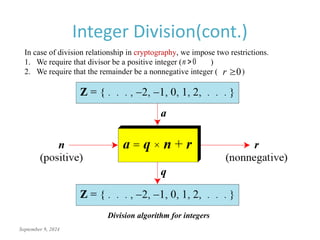
Division algorithm for integers
In case of division relationship in cryptography, we impose two restrictions.
1. We require that divisor be a positive integer ( )
2. We require that the remainder be a nonnegative integer ( )
0
n 
0
r 
September 9, 2024
Integer Division(cont.)
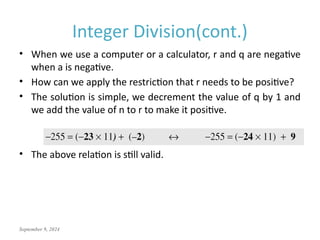
• When we use a computer or a calculator, r and q are negative
when a is negative.
• How can we apply the restriction that r needs to be positive?
• The solution is simple, we decrement the value of q by 1 and
we add the value of n to r to make it positive.
• The above relation is still valid.
September 9, 2024
Integer Division(cont.)
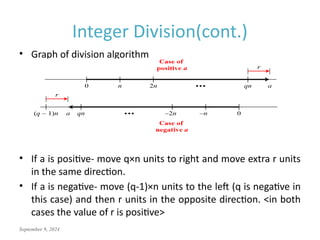
• Graph of division algorithm
• If a is positive- move q×n units to right and move extra r units
in the same direction.
• If a is negative- move (q-1)×n units to the left (q is negative in
this case) and then r units in the opposite direction. <in both
cases the value of r is positive>
September 9, 2024
Divisibility
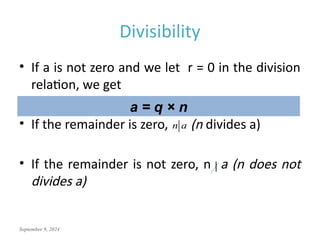
• If a is not zero and we let r = 0 in the division
relation, we get
• If the remainder is zero, (n divides a)
• If the remainder is not zero, n a (n does not
divides a)
a = q × n
n a
September 9, 2024
Divisibility(cont.)
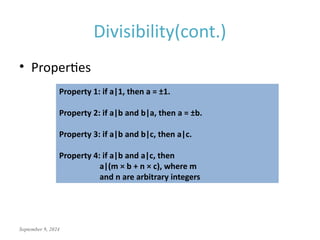
• Properties
Property 1: if a|1, then a = ±1.
Property 2: if a|b and b|a, then a = ±b.
Property 3: if a|b and b|c, then a|c.
Property 4: if a|b and a|c, then
a|(m × b + n × c), where m
and n are arbitrary integers
September 9, 2024
Divisibility(cont.)
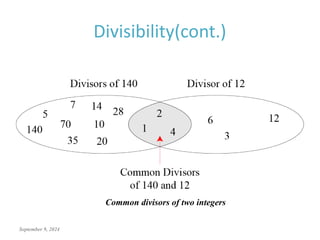
Common divisors of two integers
September 9, 2024
Divisibility(cont.)
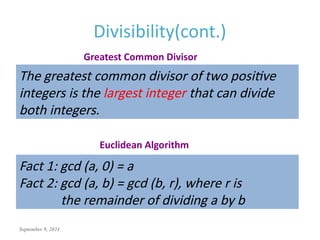
Euclidean Algorithm
Fact 1: gcd (a, 0) = a
Fact 2: gcd (a, b) = gcd (b, r), where r is
the remainder of dividing a by b
The greatest common divisor of two positive
integers is the largest integer that can divide
both integers.
Greatest Common Divisor
September 9, 2024
Divisibility(cont.)
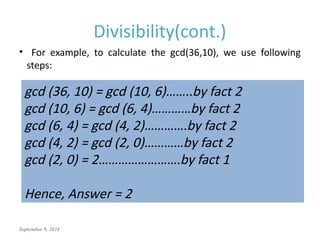
• For example, to calculate the gcd(36,10), we use following
steps:
gcd (36, 10) = gcd (10, 6)……..by fact 2
gcd (10, 6) = gcd (6, 4)…………by fact 2
gcd (6, 4) = gcd (4, 2)………….by fact 2
gcd (4, 2) = gcd (2, 0)…………by fact 2
gcd (2, 0) = 2…………………….by fact 1
Hence, Answer = 2
September 9, 2024
Divisibility(cont.)
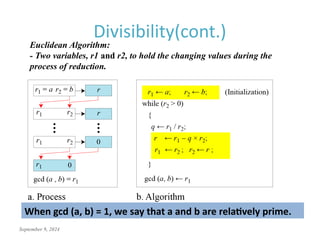
Euclidean Algorithm:
- Two variables, r1 and r2, to hold the changing values during the
process of reduction.
When gcd (a, b) = 1, we say that a and b are relatively prime.
September 9, 2024
Divisibility(cont.)
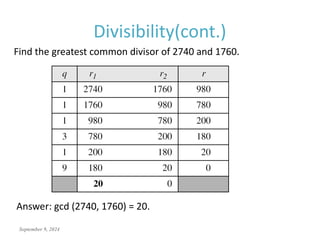
Find the greatest common divisor of 2740 and 1760.
Answer: gcd (2740, 1760) = 20.
September 9, 2024
Divisibility(cont.)
Find the greatest common divisor of 25 and 60.
September 9, 2024
Divisibility(cont.)
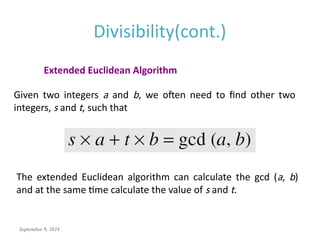
Extended Euclidean Algorithm
Given two integers a and b, we often need to find other two
integers, s and t, such that
The extended Euclidean algorithm can calculate the gcd (a, b)
and at the same time calculate the value of s and t.
September 9, 2024
Divisibility(cont.)
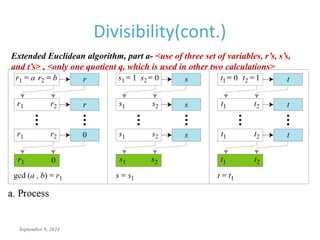
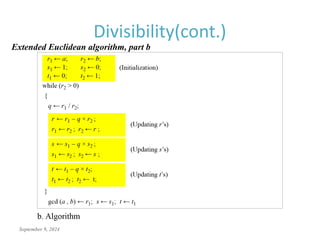
Extended Euclidean algorithm, part a- <use of three set of variables, r’s, s’s,
and t’s> , <only one quotient q, which is used in other two calculations>
September 9, 2024
Divisibility(cont.)
Extended Euclidean algorithm, part b
September 9, 2024
Divisibility(cont.)
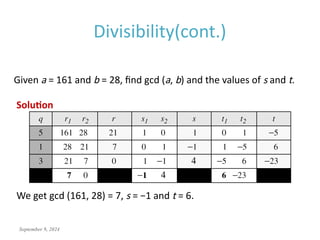
Given a = 161 and b = 28, find gcd (a, b) and the values of s and t.
We get gcd (161, 28) = 7, s = −1 and t = 6.
Solution
September 9, 2024
Divisibility(cont.)
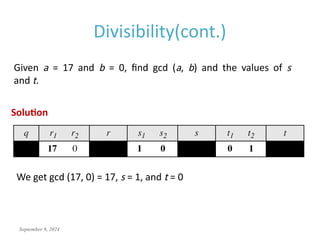
Given a = 17 and b = 0, find gcd (a, b) and the values of s
and t.
We get gcd (17, 0) = 17, s = 1, and t = 0
Solution
September 9, 2024
Divisibility(cont.)
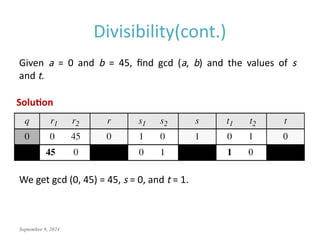
Given a = 0 and b = 45, find gcd (a, b) and the values of s
and t.
We get gcd (0, 45) = 45, s = 0, and t = 1.
Solution
September 9, 2024
Divisibility(cont.)
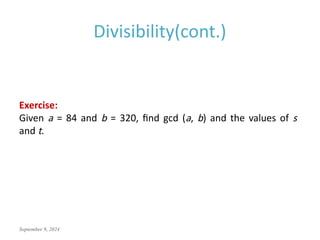
Exercise:
Given a = 84 and b = 320, find gcd (a, b) and the values of s
and t.
September 9, 2024
Divisibility(cont.)
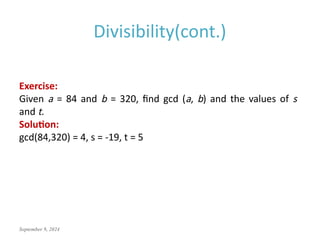
Exercise:
Given a = 84 and b = 320, find gcd (a, b) and the values of s
and t.
Solution:
gcd(84,320) = 4, s = -19, t = 5
September 9, 2024
Modular Arithmetic
September 9, 2024
Preliminary
• The division relationship (a = q × n + r)
discussed in the previous section has two
inputs (a and n) and two outputs (q and r).
• In modular arithmetic, we are interested in
only one of the outputs, the remainder r.
September 9, 2024
Preliminary(cont.)
• We use modular arithmetic in our daily life; for
example, we use a clock to measure time. Our
clock system uses modulo 12 arithmetic.
However, instead of a 0 we use the number
12.
September 9, 2024
Modulo Operator
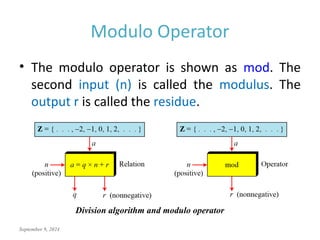
• The modulo operator is shown as mod. The
second input (n) is called the modulus. The
output r is called the residue.
Division algorithm and modulo operator
September 9, 2024
Modulo Operator(cont.)
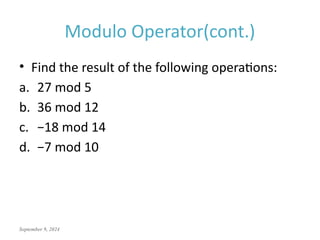
• Find the result of the following operations:
a. 27 mod 5
b. 36 mod 12
c. −18 mod 14
d. −7 mod 10
September 9, 2024
Modulo Operator(cont.)
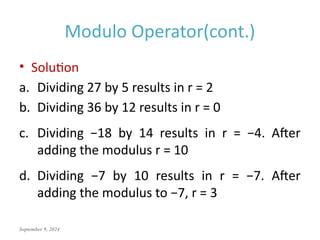
• Solution
a. Dividing 27 by 5 results in r = 2
b. Dividing 36 by 12 results in r = 0
c. Dividing −18 by 14 results in r = −4. After
adding the modulus r = 10
d. Dividing −7 by 10 results in r = −7. After
adding the modulus to −7, r = 3
September 9, 2024
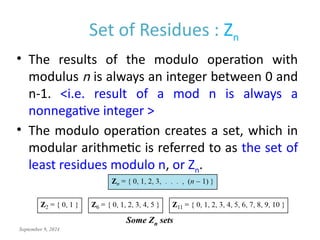
Set of Residues : Zn
• The results of the modulo operation with
modulus n is always an integer between 0 and
n-1. <i.e. result of a mod n is always a
nonnegative integer >
• The modulo operation creates a set, which in
modular arithmetic is referred to as the set of
least residues modulo n, or Zn.
Some Zn sets
September 9, 2024
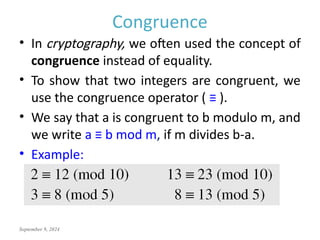
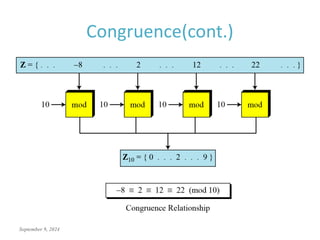
Congruence
• In cryptography, we often used the concept of
congruence instead of equality.
• To show that two integers are congruent, we
use the congruence operator ( ≡ ).
• We say that a is congruent to b modulo m, and
we write a ≡ b mod m, if m divides b-a.
• Example:
September 9, 2024
Congruence(cont.)
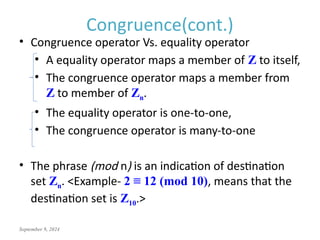
• Congruence operator Vs. equality operator
• A equality operator maps a member of Z to itself,
• The congruence operator maps a member from
Z to member of Zn.
• The equality operator is one-to-one,
• The congruence operator is many-to-one
• The phrase (mod n) is an indication of destination
set Zn. <Example- 2 ≡ 12 (mod 10), means that the
destination set is Z10.>
September 9, 2024
Congruence(cont.)
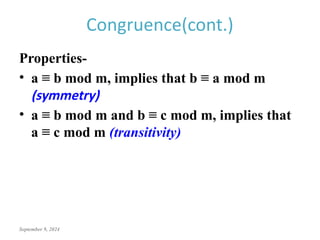
Properties-
• a ≡ b mod m, implies that b ≡ a mod m
(symmetry)
• a ≡ b mod m and b ≡ c mod m, implies that
a ≡ c mod m (transitivity)
September 9, 2024
Congruence(cont.)
September 9, 2024
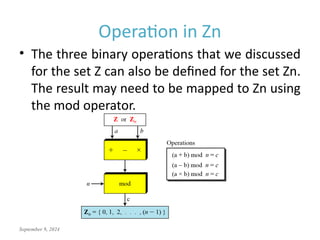
Operation in Zn
• The three binary operations that we discussed
for the set Z can also be defined for the set Zn.
The result may need to be mapped to Zn using
the mod operator.
September 9, 2024
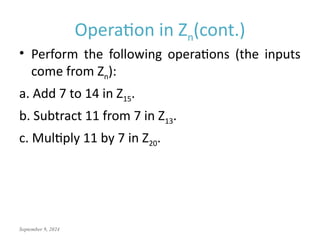
Operation in Zn(cont.)
• Perform the following operations (the inputs
come from Zn):
a. Add 7 to 14 in Z15.
b. Subtract 11 from 7 in Z13.
c. Multiply 11 by 7 in Z20.
September 9, 2024
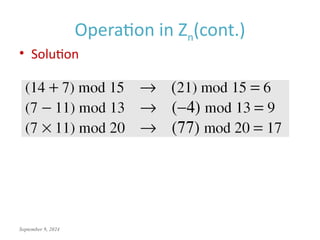
Operation in Zn(cont.)
• Solution
September 9, 2024
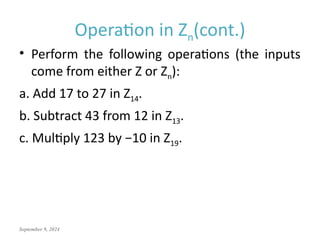
Operation in Zn(cont.)
• Perform the following operations (the inputs
come from either Z or Zn):
a. Add 17 to 27 in Z14.
b. Subtract 43 from 12 in Z13.
c. Multiply 123 by −10 in Z19.
September 9, 2024
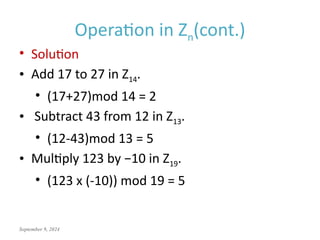
Operation in Zn(cont.)
• Solution
• Add 17 to 27 in Z14.
• (17+27)mod 14 = 2
• Subtract 43 from 12 in Z13.
• (12-43)mod 13 = 5
• Multiply 123 by −10 in Z19.
• (123 x (-10)) mod 19 = 5
September 9, 2024
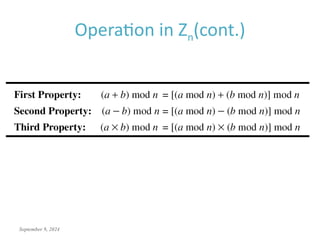
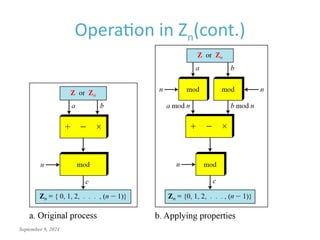
Operation in Zn(cont.)
September 9, 2024
Operation in Zn(cont.)
September 9, 2024
Operation in Zn(cont.)
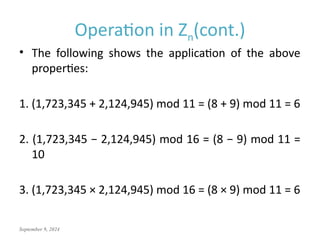
• The following shows the application of the above
properties:
1. (1,723,345 + 2,124,945) mod 11 = (8 + 9) mod 11 = 6
2. (1,723,345 − 2,124,945) mod 16 = (8 − 9) mod 11 =
10
3. (1,723,345 × 2,124,945) mod 16 = (8 × 9) mod 11 = 6
September 9, 2024
Inverses
• Working in modular arithmetic, we often need
to find the inverse of a number relative to an
operation.
• additive inverse (relative to an addition
operation) or
• a multiplicative inverse (relative to a
multiplication operation).
September 9, 2024
• In cryptography we often work with inverses.
• If the sender uses an integer (as the encryption key), the
receiver uses the inverse of that integer (as the decryption
key).
• If the operation (encryption/decryption algorithm) is addition,
Zn can be used as the set of possible keys because each
integer in this set has an additive inverse.
• On the other hand, if the operation (encryption/decryption
algorithm) is multiplication , Zn cannot be the set of possible
keys because only some numbers of this set have a
multiplicative inverse.
Inverses- relevancy with cryptography
September 9, 2024
Additive Inverses
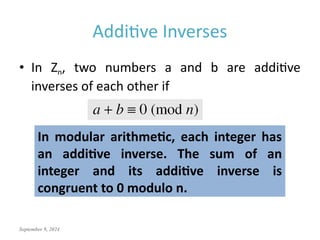
• In Zn, two numbers a and b are additive
inverses of each other if
In modular arithmetic, each integer has
an additive inverse. The sum of an
integer and its additive inverse is
congruent to 0 modulo n.
September 9, 2024
Additive Inverses
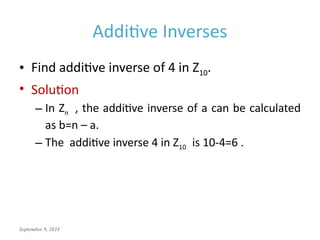
• Find additive inverse of 4 in Z10.
• Solution
– In Zn , the additive inverse of a can be calculated
as b=n – a.
– The additive inverse 4 in Z10 is 10-4=6 .
September 9, 2024
Additive Inverses
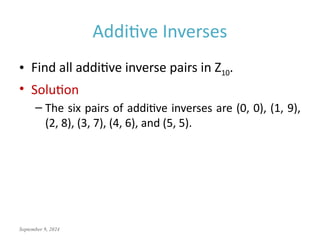
• Find all additive inverse pairs in Z10.
• Solution
– The six pairs of additive inverses are (0, 0), (1, 9),
(2, 8), (3, 7), (4, 6), and (5, 5).
September 9, 2024
Multiplicative Inverses
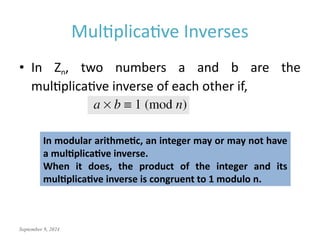
• In Zn, two numbers a and b are the
multiplicative inverse of each other if,
In modular arithmetic, an integer may or may not have
a multiplicative inverse.
When it does, the product of the integer and its
multiplicative inverse is congruent to 1 modulo n.
September 9, 2024
Multiplicative Inverses(cont.)
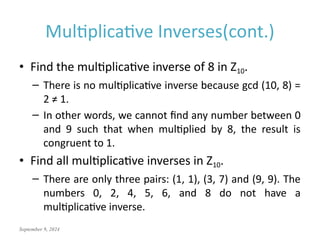
• Find the multiplicative inverse of 8 in Z10.
– There is no multiplicative inverse because gcd (10, 8) =
2 ≠ 1.
– In other words, we cannot find any number between 0
and 9 such that when multiplied by 8, the result is
congruent to 1.
• Find all multiplicative inverses in Z10.
– There are only three pairs: (1, 1), (3, 7) and (9, 9). The
numbers 0, 2, 4, 5, 6, and 8 do not have a
multiplicative inverse.
September 9, 2024
Multiplicative Inverses(cont.)
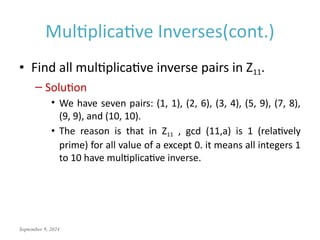
• Find all multiplicative inverse pairs in Z11.
September 9, 2024
Multiplicative Inverses(cont.)
• Find all multiplicative inverse pairs in Z11.
– Solution
• We have seven pairs: (1, 1), (2, 6), (3, 4), (5, 9), (7, 8),
(9, 9), and (10, 10).
• The reason is that in Z11 , gcd (11,a) is 1 (relatively
prime) for all value of a except 0. it means all integers 1
to 10 have multiplicative inverse.
September 9, 2024
Multiplicative Inverses(cont.)
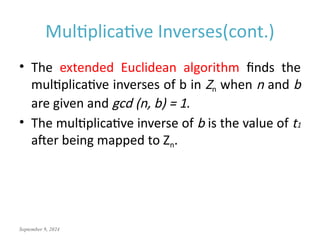
• The extended Euclidean algorithm finds the
multiplicative inverses of b in Zn when n and b
are given and gcd (n, b) = 1.
• The multiplicative inverse of b is the value of t1
after being mapped to Zn.
September 9, 2024
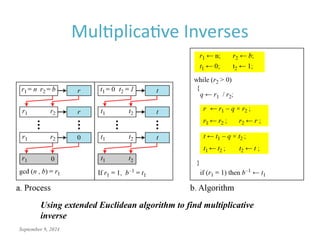
Multiplicative Inverses
Using extended Euclidean algorithm to find multiplicative
inverse
September 9, 2024
Multiplicative Inverses(cont.)
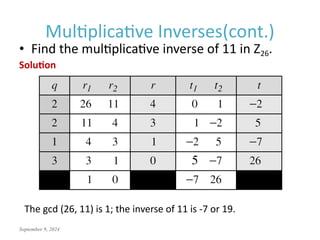
• Find the multiplicative inverse of 11 in Z26.
Solution
The gcd (26, 11) is 1; the inverse of 11 is -7 or 19.
September 9, 2024
Multiplicative Inverses(cont.)
• Find the multiplicative inverse of 23 in Z100.
September 9, 2024
Multiplicative Inverses(cont.)
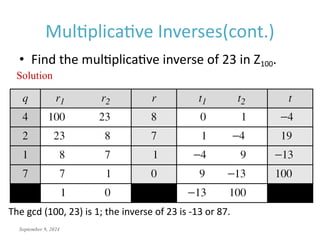
• Find the multiplicative inverse of 23 in Z100.
Solution
The gcd (100, 23) is 1; the inverse of 23 is -13 or 87.
September 9, 2024
Multiplicative Inverses(cont.)
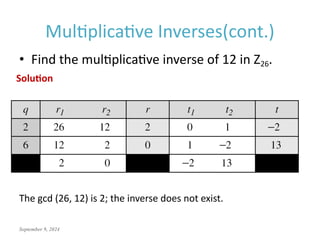
• Find the multiplicative inverse of 12 in Z26.
Solution
The gcd (26, 12) is 2; the inverse does not exist.
September 9, 2024
Addition and Multiplication Tables
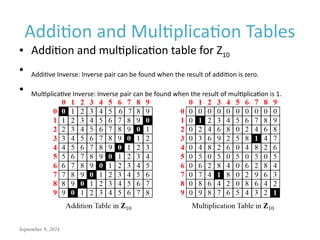
• Addition and multiplication table for Z10
• Additive Inverse: Inverse pair can be found when the result of addition is zero.
• Multiplicative Inverse: Inverse pair can be found when the result of multiplication is 1.
September 9, 2024
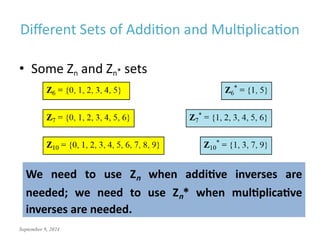
Different Sets of Addition and Multiplication
• Some Zn and Zn* sets
We need to use Zn when additive inverses are
needed; we need to use Zn* when multiplicative
inverses are needed.
September 9, 2024
Linear Congruence
Cryptography often involves solving an equation or a
set of equations of one or more variables with
coefficient in Zn. This section shows how to solve
equations when the power of each variable is 1 (linear
equation).
2.4.1 Single-Variable Linear Equations
2.4.2 Set of Linear Equations
Topics discussed in this section:
September 9, 2024
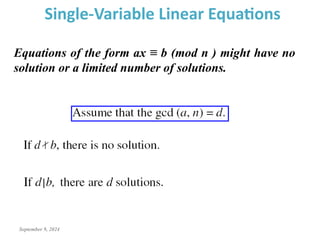
Single-Variable Linear Equations
Equations of the form ax ≡ b (mod n ) might have no
solution or a limited number of solutions.
September 9, 2024
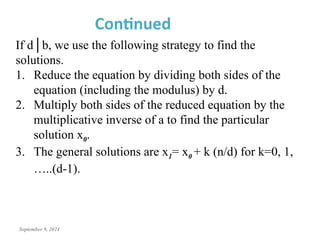
Continued
If d│b, we use the following strategy to find the
solutions.
1. Reduce the equation by dividing both sides of the
equation (including the modulus) by d.
2. Multiply both sides of the reduced equation by the
multiplicative inverse of a to find the particular
solution x0.
3. The general solutions are x1= x0 + k (n/d) for k=0, 1,
…..(d-1).
September 9, 2024
Example
Continued
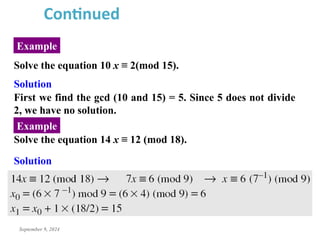
Solve the equation 10 x ≡ 2(mod 15).
Solution
First we find the gcd (10 and 15) = 5. Since 5 does not divide
2, we have no solution.
Solve the equation 14 x ≡ 12 (mod 18).
Solution
Example
September 9, 2024
Example
Continued
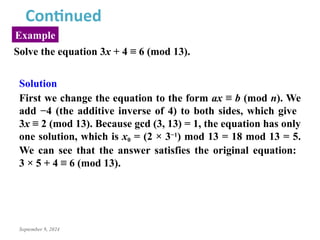
Solve the equation 3x + 4 ≡ 6 (mod 13).
Solution
First we change the equation to the form ax ≡ b (mod n). We
add −4 (the additive inverse of 4) to both sides, which give
3x ≡ 2 (mod 13). Because gcd (3, 13) = 1, the equation has only
one solution, which is x0 = (2 × 3−1) mod 13 = 18 mod 13 = 5.
We can see that the answer satisfies the original equation:
3 × 5 + 4 ≡ 6 (mod 13).
September 9, 2024
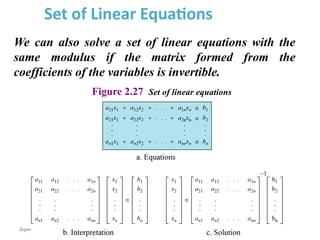
Set of Linear Equations
We can also solve a set of linear equations with the
same modulus if the matrix formed from the
coefficients of the variables is invertible.
Figure 2.27 Set of linear equations
September 9, 2024
Example
Continued
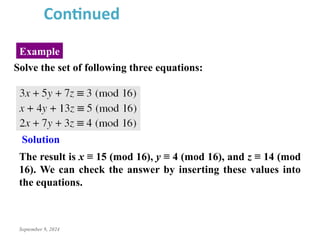
Solve the set of following three equations:
The result is x ≡ 15 (mod 16), y ≡ 4 (mod 16), and z ≡ 14 (mod
16). We can check the answer by inserting these values into
the equations.
Solution

Part 1 Mathematical Backgroud mathsbd-1.pptx

  • 1.
    September 9, 2024 MATHEMATICSOF CRYPTOGRAPHY PART I MODULAR ARITHMETIC AND CONGRUENCE
  • 2.
    September 9, 2024 Objectives •To review integer arithmetic, concentrating on divisibility and finding the GCD using Euclidean algorithm. • To understand how the extended Euclidean algorithm can be used to solve linear Diophantine equations. • To solve linear congruent equations. • To find additive and multiplicative inverses. • To emphasize the importance of modular arithmetic and the modulo operators, because they are extensively used in cryptography.
  • 3.
    September 9, 2024 Book: Cryptography and Network security by Behrouz A. Forouzan
  • 4.
    September 9, 2024 IntegerArithmetic • In integer arithmetic, we use a set and a few operations. • Reviewed here to create a background for modular arithmetic.
  • 5.
    September 9, 2024 Setof Integers • The set of integers, denoted by Z, contains all integral numbers (with no fraction) from negative infinity to positive infinity The set of integers
  • 6.
    September 9, 2024 BinaryOperations • In cryptography, we are interested in three binary operations applied to the set of integers. division? • A binary operation takes two inputs and creates one output. The set of integers Three binary operations for the set of integers
  • 7.
    September 9, 2024 IntegerDivision • In integer arithmetic, if we divide a by n, we can get q and r. • The relationship between these four integers can be shown as a = q × n + r a= dividend n= divisor q= quotient r= remainder
  • 8.
    September 9, 2024 IntegerDivision(cont.) • Assume that a = 255 and n = 11. We can find q = 23 and r = 2 using the division algorithm. • How to find the quotient and the remainder using language specific operators??? <in case of C language> Finding the quotient and the remainder
  • 9.
    September 9, 2024 IntegerDivision(cont.) Division algorithm for integers In case of division relationship in cryptography, we impose two restrictions. 1. We require that divisor be a positive integer ( ) 2. We require that the remainder be a nonnegative integer ( ) 0 n  0 r 
  • 10.
    September 9, 2024 IntegerDivision(cont.) • When we use a computer or a calculator, r and q are negative when a is negative. • How can we apply the restriction that r needs to be positive? • The solution is simple, we decrement the value of q by 1 and we add the value of n to r to make it positive. • The above relation is still valid.
  • 11.
    September 9, 2024 IntegerDivision(cont.) • Graph of division algorithm • If a is positive- move q×n units to right and move extra r units in the same direction. • If a is negative- move (q-1)×n units to the left (q is negative in this case) and then r units in the opposite direction. <in both cases the value of r is positive>
  • 12.
    September 9, 2024 Divisibility •If a is not zero and we let r = 0 in the division relation, we get • If the remainder is zero, (n divides a) • If the remainder is not zero, n a (n does not divides a) a = q × n n a
  • 13.
    September 9, 2024 Divisibility(cont.) •Properties Property 1: if a|1, then a = ±1. Property 2: if a|b and b|a, then a = ±b. Property 3: if a|b and b|c, then a|c. Property 4: if a|b and a|c, then a|(m × b + n × c), where m and n are arbitrary integers
  • 14.
  • 15.
    September 9, 2024 Divisibility(cont.) EuclideanAlgorithm Fact 1: gcd (a, 0) = a Fact 2: gcd (a, b) = gcd (b, r), where r is the remainder of dividing a by b The greatest common divisor of two positive integers is the largest integer that can divide both integers. Greatest Common Divisor
  • 16.
    September 9, 2024 Divisibility(cont.) •For example, to calculate the gcd(36,10), we use following steps: gcd (36, 10) = gcd (10, 6)……..by fact 2 gcd (10, 6) = gcd (6, 4)…………by fact 2 gcd (6, 4) = gcd (4, 2)………….by fact 2 gcd (4, 2) = gcd (2, 0)…………by fact 2 gcd (2, 0) = 2…………………….by fact 1 Hence, Answer = 2
  • 17.
    September 9, 2024 Divisibility(cont.) EuclideanAlgorithm: - Two variables, r1 and r2, to hold the changing values during the process of reduction. When gcd (a, b) = 1, we say that a and b are relatively prime.
  • 18.
    September 9, 2024 Divisibility(cont.) Findthe greatest common divisor of 2740 and 1760. Answer: gcd (2740, 1760) = 20.
  • 19.
    September 9, 2024 Divisibility(cont.) Findthe greatest common divisor of 25 and 60.
  • 20.
    September 9, 2024 Divisibility(cont.) ExtendedEuclidean Algorithm Given two integers a and b, we often need to find other two integers, s and t, such that The extended Euclidean algorithm can calculate the gcd (a, b) and at the same time calculate the value of s and t.
  • 21.
    September 9, 2024 Divisibility(cont.) ExtendedEuclidean algorithm, part a- <use of three set of variables, r’s, s’s, and t’s> , <only one quotient q, which is used in other two calculations>
  • 22.
  • 23.
    September 9, 2024 Divisibility(cont.) Givena = 161 and b = 28, find gcd (a, b) and the values of s and t. We get gcd (161, 28) = 7, s = −1 and t = 6. Solution
  • 24.
    September 9, 2024 Divisibility(cont.) Givena = 17 and b = 0, find gcd (a, b) and the values of s and t. We get gcd (17, 0) = 17, s = 1, and t = 0 Solution
  • 25.
    September 9, 2024 Divisibility(cont.) Givena = 0 and b = 45, find gcd (a, b) and the values of s and t. We get gcd (0, 45) = 45, s = 0, and t = 1. Solution
  • 26.
    September 9, 2024 Divisibility(cont.) Exercise: Givena = 84 and b = 320, find gcd (a, b) and the values of s and t.
  • 27.
    September 9, 2024 Divisibility(cont.) Exercise: Givena = 84 and b = 320, find gcd (a, b) and the values of s and t. Solution: gcd(84,320) = 4, s = -19, t = 5
  • 28.
  • 29.
    September 9, 2024 Preliminary •The division relationship (a = q × n + r) discussed in the previous section has two inputs (a and n) and two outputs (q and r). • In modular arithmetic, we are interested in only one of the outputs, the remainder r.
  • 30.
    September 9, 2024 Preliminary(cont.) •We use modular arithmetic in our daily life; for example, we use a clock to measure time. Our clock system uses modulo 12 arithmetic. However, instead of a 0 we use the number 12.
  • 31.
    September 9, 2024 ModuloOperator • The modulo operator is shown as mod. The second input (n) is called the modulus. The output r is called the residue. Division algorithm and modulo operator
  • 32.
    September 9, 2024 ModuloOperator(cont.) • Find the result of the following operations: a. 27 mod 5 b. 36 mod 12 c. −18 mod 14 d. −7 mod 10
  • 33.
    September 9, 2024 ModuloOperator(cont.) • Solution a. Dividing 27 by 5 results in r = 2 b. Dividing 36 by 12 results in r = 0 c. Dividing −18 by 14 results in r = −4. After adding the modulus r = 10 d. Dividing −7 by 10 results in r = −7. After adding the modulus to −7, r = 3
  • 34.
    September 9, 2024 Setof Residues : Zn • The results of the modulo operation with modulus n is always an integer between 0 and n-1. <i.e. result of a mod n is always a nonnegative integer > • The modulo operation creates a set, which in modular arithmetic is referred to as the set of least residues modulo n, or Zn. Some Zn sets
  • 35.
    September 9, 2024 Congruence •In cryptography, we often used the concept of congruence instead of equality. • To show that two integers are congruent, we use the congruence operator ( ≡ ). • We say that a is congruent to b modulo m, and we write a ≡ b mod m, if m divides b-a. • Example:
  • 36.
    September 9, 2024 Congruence(cont.) •Congruence operator Vs. equality operator • A equality operator maps a member of Z to itself, • The congruence operator maps a member from Z to member of Zn. • The equality operator is one-to-one, • The congruence operator is many-to-one • The phrase (mod n) is an indication of destination set Zn. <Example- 2 ≡ 12 (mod 10), means that the destination set is Z10.>
  • 37.
    September 9, 2024 Congruence(cont.) Properties- •a ≡ b mod m, implies that b ≡ a mod m (symmetry) • a ≡ b mod m and b ≡ c mod m, implies that a ≡ c mod m (transitivity)
  • 38.
  • 39.
    September 9, 2024 Operationin Zn • The three binary operations that we discussed for the set Z can also be defined for the set Zn. The result may need to be mapped to Zn using the mod operator.
  • 40.
    September 9, 2024 Operationin Zn(cont.) • Perform the following operations (the inputs come from Zn): a. Add 7 to 14 in Z15. b. Subtract 11 from 7 in Z13. c. Multiply 11 by 7 in Z20.
  • 41.
    September 9, 2024 Operationin Zn(cont.) • Solution
  • 42.
    September 9, 2024 Operationin Zn(cont.) • Perform the following operations (the inputs come from either Z or Zn): a. Add 17 to 27 in Z14. b. Subtract 43 from 12 in Z13. c. Multiply 123 by −10 in Z19.
  • 43.
    September 9, 2024 Operationin Zn(cont.) • Solution • Add 17 to 27 in Z14. • (17+27)mod 14 = 2 • Subtract 43 from 12 in Z13. • (12-43)mod 13 = 5 • Multiply 123 by −10 in Z19. • (123 x (-10)) mod 19 = 5
  • 44.
  • 45.
  • 46.
    September 9, 2024 Operationin Zn(cont.) • The following shows the application of the above properties: 1. (1,723,345 + 2,124,945) mod 11 = (8 + 9) mod 11 = 6 2. (1,723,345 − 2,124,945) mod 16 = (8 − 9) mod 11 = 10 3. (1,723,345 × 2,124,945) mod 16 = (8 × 9) mod 11 = 6
  • 47.
    September 9, 2024 Inverses •Working in modular arithmetic, we often need to find the inverse of a number relative to an operation. • additive inverse (relative to an addition operation) or • a multiplicative inverse (relative to a multiplication operation).
  • 48.
    September 9, 2024 •In cryptography we often work with inverses. • If the sender uses an integer (as the encryption key), the receiver uses the inverse of that integer (as the decryption key). • If the operation (encryption/decryption algorithm) is addition, Zn can be used as the set of possible keys because each integer in this set has an additive inverse. • On the other hand, if the operation (encryption/decryption algorithm) is multiplication , Zn cannot be the set of possible keys because only some numbers of this set have a multiplicative inverse. Inverses- relevancy with cryptography
  • 49.
    September 9, 2024 AdditiveInverses • In Zn, two numbers a and b are additive inverses of each other if In modular arithmetic, each integer has an additive inverse. The sum of an integer and its additive inverse is congruent to 0 modulo n.
  • 50.
    September 9, 2024 AdditiveInverses • Find additive inverse of 4 in Z10. • Solution – In Zn , the additive inverse of a can be calculated as b=n – a. – The additive inverse 4 in Z10 is 10-4=6 .
  • 51.
    September 9, 2024 AdditiveInverses • Find all additive inverse pairs in Z10. • Solution – The six pairs of additive inverses are (0, 0), (1, 9), (2, 8), (3, 7), (4, 6), and (5, 5).
  • 52.
    September 9, 2024 MultiplicativeInverses • In Zn, two numbers a and b are the multiplicative inverse of each other if, In modular arithmetic, an integer may or may not have a multiplicative inverse. When it does, the product of the integer and its multiplicative inverse is congruent to 1 modulo n.
  • 53.
    September 9, 2024 MultiplicativeInverses(cont.) • Find the multiplicative inverse of 8 in Z10. – There is no multiplicative inverse because gcd (10, 8) = 2 ≠ 1. – In other words, we cannot find any number between 0 and 9 such that when multiplied by 8, the result is congruent to 1. • Find all multiplicative inverses in Z10. – There are only three pairs: (1, 1), (3, 7) and (9, 9). The numbers 0, 2, 4, 5, 6, and 8 do not have a multiplicative inverse.
  • 54.
    September 9, 2024 MultiplicativeInverses(cont.) • Find all multiplicative inverse pairs in Z11.
  • 55.
    September 9, 2024 MultiplicativeInverses(cont.) • Find all multiplicative inverse pairs in Z11. – Solution • We have seven pairs: (1, 1), (2, 6), (3, 4), (5, 9), (7, 8), (9, 9), and (10, 10). • The reason is that in Z11 , gcd (11,a) is 1 (relatively prime) for all value of a except 0. it means all integers 1 to 10 have multiplicative inverse.
  • 56.
    September 9, 2024 MultiplicativeInverses(cont.) • The extended Euclidean algorithm finds the multiplicative inverses of b in Zn when n and b are given and gcd (n, b) = 1. • The multiplicative inverse of b is the value of t1 after being mapped to Zn.
  • 57.
    September 9, 2024 MultiplicativeInverses Using extended Euclidean algorithm to find multiplicative inverse
  • 58.
    September 9, 2024 MultiplicativeInverses(cont.) • Find the multiplicative inverse of 11 in Z26. Solution The gcd (26, 11) is 1; the inverse of 11 is -7 or 19.
  • 59.
    September 9, 2024 MultiplicativeInverses(cont.) • Find the multiplicative inverse of 23 in Z100.
  • 60.
    September 9, 2024 MultiplicativeInverses(cont.) • Find the multiplicative inverse of 23 in Z100. Solution The gcd (100, 23) is 1; the inverse of 23 is -13 or 87.
  • 61.
    September 9, 2024 MultiplicativeInverses(cont.) • Find the multiplicative inverse of 12 in Z26. Solution The gcd (26, 12) is 2; the inverse does not exist.
  • 62.
    September 9, 2024 Additionand Multiplication Tables • Addition and multiplication table for Z10 • Additive Inverse: Inverse pair can be found when the result of addition is zero. • Multiplicative Inverse: Inverse pair can be found when the result of multiplication is 1.
  • 63.
    September 9, 2024 DifferentSets of Addition and Multiplication • Some Zn and Zn* sets We need to use Zn when additive inverses are needed; we need to use Zn* when multiplicative inverses are needed.
  • 64.
    September 9, 2024 LinearCongruence Cryptography often involves solving an equation or a set of equations of one or more variables with coefficient in Zn. This section shows how to solve equations when the power of each variable is 1 (linear equation). 2.4.1 Single-Variable Linear Equations 2.4.2 Set of Linear Equations Topics discussed in this section:
  • 65.
    September 9, 2024 Single-VariableLinear Equations Equations of the form ax ≡ b (mod n ) might have no solution or a limited number of solutions.
  • 66.
    September 9, 2024 Continued Ifd│b, we use the following strategy to find the solutions. 1. Reduce the equation by dividing both sides of the equation (including the modulus) by d. 2. Multiply both sides of the reduced equation by the multiplicative inverse of a to find the particular solution x0. 3. The general solutions are x1= x0 + k (n/d) for k=0, 1, …..(d-1).
  • 67.
    September 9, 2024 Example Continued Solvethe equation 10 x ≡ 2(mod 15). Solution First we find the gcd (10 and 15) = 5. Since 5 does not divide 2, we have no solution. Solve the equation 14 x ≡ 12 (mod 18). Solution Example
  • 68.
    September 9, 2024 Example Continued Solvethe equation 3x + 4 ≡ 6 (mod 13). Solution First we change the equation to the form ax ≡ b (mod n). We add −4 (the additive inverse of 4) to both sides, which give 3x ≡ 2 (mod 13). Because gcd (3, 13) = 1, the equation has only one solution, which is x0 = (2 × 3−1) mod 13 = 18 mod 13 = 5. We can see that the answer satisfies the original equation: 3 × 5 + 4 ≡ 6 (mod 13).
  • 69.
    September 9, 2024 Setof Linear Equations We can also solve a set of linear equations with the same modulus if the matrix formed from the coefficients of the variables is invertible. Figure 2.27 Set of linear equations
  • 70.
    September 9, 2024 Example Continued Solvethe set of following three equations: The result is x ≡ 15 (mod 16), y ≡ 4 (mod 16), and z ≡ 14 (mod 16). We can check the answer by inserting these values into the equations. Solution